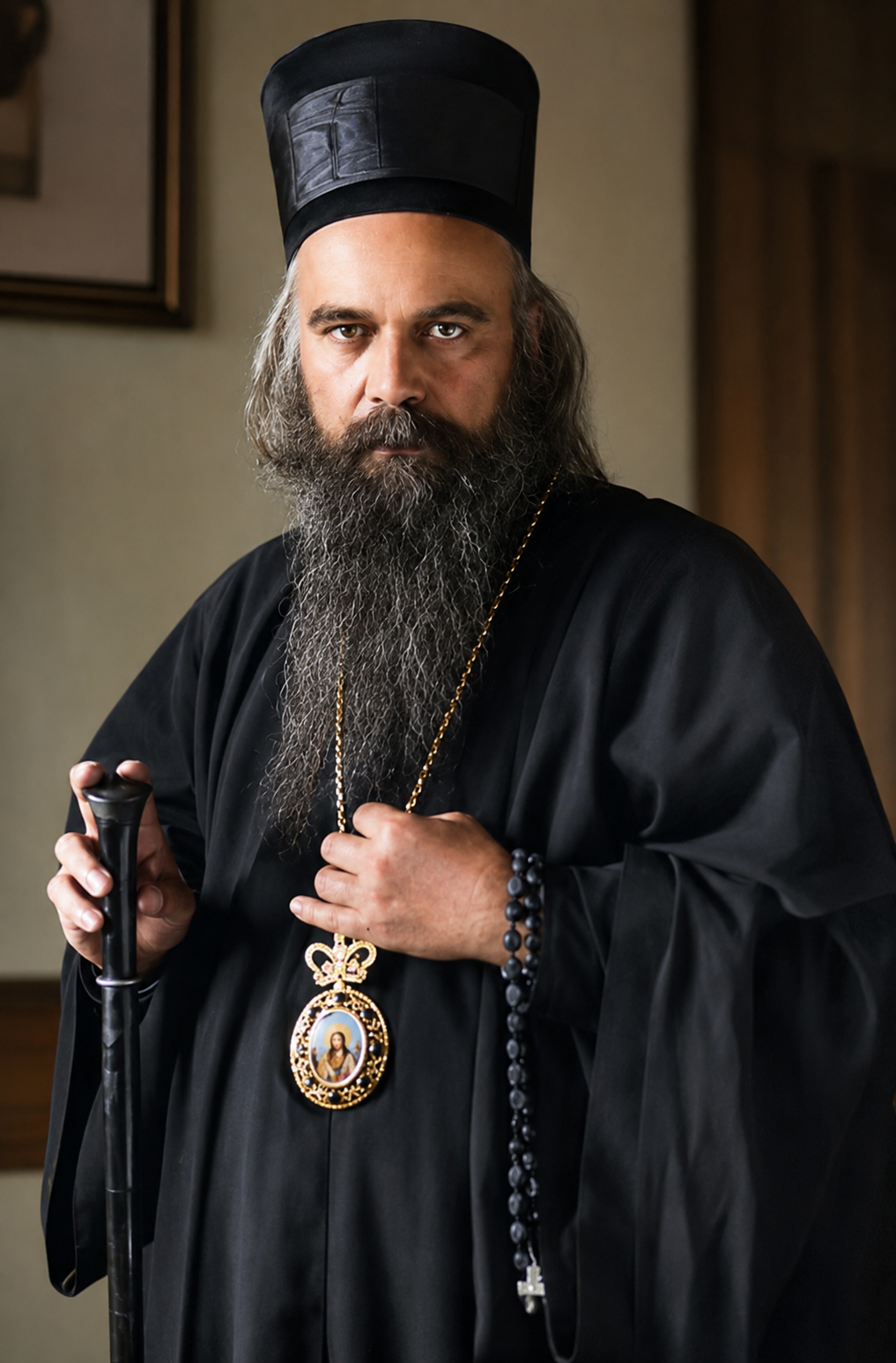
 Image 1 of 1
Saint Nikolaj Velimirović Prayer Card - For Preachers, Repentance, Courage & Faith Under Persecution
Saint Nikolaj Velimirović, also known as Saint Nikolai of Žiča, Saint Nikolai of Ohrid and Žiča, or the Serbian Chrysostom, was one of the most influential Serbian Orthodox bishops, preachers, theologians, missionaries, and spiritual writers of the twentieth century. Born in the Serbian village of Lelić in 1881, he became internationally known for his preaching, served as bishop in Žiča and Ohrid, helped lead a major Serbian spiritual revival, endured Nazi imprisonment during the Second World War, and spent the final years of his life teaching future Orthodox clergy in the United States. The Serbian Orthodox Church formally glorified him in 2003, while the Orthodox Church in America commemorates his repose on March 18 and the translation of his relics on April 20.
Saint Nikolaj is especially meaningful for preachers, priests, seminarians, missionaries, Christian teachers, writers, people seeking repentance, Christians suffering persecution or imprisonment, those trying to remain faithful under political pressure, and anyone who wants to communicate deep theology in language ordinary people can understand. These associations arise directly from his ministry because he spent decades preaching, teaching, writing, forming clergy, encouraging repentance, rebuilding religious life after war, and carrying Orthodox Christianity into public settings across Serbia, Britain, and the United States.
His connection with preaching is particularly strong. The OCA remembers that his sermons generally remained under twenty minutes and were organized around a few clear points, yet they communicated serious Orthodox theology in language ordinary people could understand and repeatedly called listeners toward repentance. This combination of theological depth, clarity, brevity, and pastoral force explains the affectionate title “Serbian Chrysostom,” comparing his preaching ministry with Saint John Chrysostom.
Saint Nikolaj is also an especially meaningful intercessor for anyone whose Christian witness has become costly. He lived through two world wars, German occupation, detention by the Nazi authorities, imprisonment at Dachau, exile from his homeland, and the rise of communist Yugoslavia, which made his return to ordinary episcopal life effectively impossible. His final decade became a ministry in exile, yet the loss of homeland did not end his vocation because he continued preaching, writing, teaching seminarians, and serving the Orthodox Church in America.
His story has particular importance for priests and seminarians in the United States. Saint Nikolaj taught at Saint Sava Seminary in Libertyville before settling at Saint Tikhon's Monastery and Seminary in Pennsylvania in 1951, where he served as professor, dean, and rector during the final years of his life. Saint Tikhon's still remembers him as a former rector, maintains an annual Saint Nicholai lecture, and in 2026 organized a pilgrimage through Serbia and North Macedonia tracing his life and ministry.
Saint Nikolaj is equally important for Christian writers. He regarded writing as a way of continuing to preach beyond the physical reach of his voice, and among his best-known works are The Prologue from Ohrid, The Life of Saint Sava, interpretations of the Lord's Prayer, sermons, devotional writings, and numerous shorter theological works. The OCA describes his writings as spiritual teaching directed even toward people who would never personally hear one of his sermons.
His life also offers a strong model for repentance without theatrical religiosity. The Church's own Troparion calls him a “teacher of repentance,” while his pastoral ministry consistently emphasized that Orthodox Christianity should transform actual life rather than remain merely cultural, intellectual, or ethnic. The Serbian spiritual revival with which he became associated encouraged ordinary people to pray, read Scripture, return to the sacraments, restore monasteries, and take personal Christian life seriously.
This prayer card is especially fitting for priests preparing sermons, seminarians, theological students, missionaries, Christian teachers, spiritual writers, Serbian Orthodox families, people suffering for their faith, Christians living far from their homeland, and anyone asking for courage to remain faithful when circumstances cannot easily be changed. It can also make a meaningful ordination, seminary graduation, missionary commissioning, name-day, clergy anniversary, or Christian writing gift.
Each card is handmade in Austin, TX and created to order. We do not keep stock, because every prayer card is treated as a unique devotional offering. They are printed on museum-quality photo paper, not cardstock, and every card is made slowly during prayer with intentional reverence for the saint and for the person who will receive it. Names are lifted before Christ, intentions are held carefully, and each piece is handled multiple times in prayerful silence, asking God for mercy and asking Saint Nikolaj to intercede for the soul it is being made for. This is devotional craftsmanship shaped with patience, care, and spiritual responsibility because every soul and every prayer matters.
THE LIFE & STORY
Saint Nikolaj was born in Lelić in western Serbia on January 4, 1881, corresponding to December 23, 1880 on the Old Calendar then in use. His parents, Dragomir and Katarina Velimirović, raised a large family on a farm, and the OCA emphasizes the unusually strong religious influence of his mother. As a child, Nikolaj would walk with her several miles to Ćelije Monastery for worship, creating an early connection with the monastic world that would remain important throughout his life.
He was physically frail from childhood, and weakness eventually prevented him from meeting the requirements for military academy. His intellectual ability opened another path, however, and he entered Saint Sava Seminary in Belgrade, where his gifts for languages, theology, philosophy, and preaching rapidly became apparent.
After graduating in 1905, Nikolaj continued advanced studies in Western Europe. The OCA's received Life records doctoral studies at the University of Bern and King's College in Oxford, while modern archival scholarship documents his substantial period of study and ecclesiastical activity in Britain before the First World War. These years exposed him directly to Western philosophy, theology, culture, and Christian communities rather than leaving his later commentary on Western Christianity based only on secondhand impressions.
After returning to Serbia, he became seriously ill with dysentery and made a vow to dedicate the remainder of his life wholly to God if he recovered. He did recover, and in December 1909 he received monastic tonsure at Rakovica Monastery and was ordained to the priesthood, beginning the monastic and clerical life for which he would eventually become known throughout Serbia.
Nikolaj then traveled to Russia for further theological formation before returning to Serbia to teach. He taught philosophy, logic, history, and languages at the seminary, and the OCA tradition credits him with knowledge of seven languages, a gift that later allowed him to address audiences across several countries and become one of the most internationally visible Serbian churchmen of his generation.
THE SERBIAN CHRYSOSTOM
Saint Nikolaj's reputation as a preacher grew remarkably quickly. The title Serbian Chrysostom compares him with Saint John Chrysostom, whose name itself means “golden-mouthed,” and the comparison reflects Nikolaj's unusual ability to make serious Christian theology memorable without reducing it to simplistic slogans. Saint Tikhon's Seminary today describes him as a gifted orator and one of the most influential Serbian Orthodox spiritual leaders and writers of the twentieth century.
The OCA remembers that he usually kept sermons relatively short and focused them around three principal points. His aim was not to demonstrate how much theology he knew but to teach theological truth in a form people could understand and then call them toward a changed life.
This makes Saint Nikolaj one of the strongest modern Orthodox saints for preachers and homilists. A priest preparing a sermon can ask his intercession not merely for eloquence but for the much harder gifts of clarity, restraint, discernment, fidelity to the Gospel, and the ability to know what the people listening actually need to hear.
His example is also useful for Christian teachers, catechists, and writers because communication is not improved simply by making everything longer or more complicated. Saint Nikolaj's preaching suggests that theological depth and accessibility do not have to oppose one another when a teacher knows the subject deeply enough to identify what is essential.
WORLD WAR I & HIS MISSION TO THE WEST
When the First World War devastated Serbia, Nikolaj's linguistic ability and international education became important to his suffering country. The Serbian government sent him abroad to explain Serbia's situation, seek humanitarian and political support, and strengthen connections with Christian communities in Britain and the United States.
His wartime work in Britain became extraordinarily extensive. Archival research published by the University of Belgrade documents his collaboration with the Serbian Relief Fund, British supporters of Serbia, Anglican clergy, academics, journalists, and political figures, while his preaching placed him before audiences that few Orthodox clergy of his generation could have reached.
The same scholarship documents an especially important milestone in 1917, when Nikolaj became the first Orthodox clergyman to preach at Saint Paul's Cathedral in London. He preached there again in 1919, and his wartime ministry built unusually close relationships between Serbian Orthodoxy and parts of the Church of England.
He also traveled in the United States during this period, appealing to Serbian and other Slavic communities and presenting the Serbian cause to American audiences. His ability to move between Orthodox ecclesiastical settings and the public institutions of Western Europe and America made him an unusually international Orthodox figure long before his eventual exile in the United States.
SAINT NIKOLAJ & CHRISTIAN UNITY
An interesting and sometimes overlooked part of Saint Nikolaj's early life is his strong interest in Christian rapprochement, particularly between the Orthodox Church and the Church of England. Modern archival scholarship shows that during his British years he was an active advocate for closer Anglican-Orthodox relations and maintained cordial contacts not only with Anglicans but also with Catholic and other Christian clergy in Britain.
His later writings often became considerably more critical of Western religious developments, so it is misleading to reduce his entire life either to an uncomplicated ecumenist or to someone who never engaged sympathetically with Christians outside Orthodoxy. His thought developed through decades marked by war, revolution, theological controversy, political extremism, exile, and changing assessments of European civilization.
That history can be useful for Christians studying his writings today. A saint's theological corpus may stretch across decades, and reading one sentence from one period without understanding the historical development surrounding it can create a distorted picture of the whole person.
BISHOP OF ŽIČA & OHRID
Saint Nikolaj returned to Serbia after the First World War and was consecrated Bishop of Žiča in 1919. He later served in Ohrid, a city profoundly connected with Saints Clement and Naum and with the ancient Christian history of the Balkans.
The devastation left by war made his episcopal ministry intensely practical. He helped establish orphanages, assisted the poor, and worked among communities carrying the losses of military occupation, death, poverty, and displacement. His episcopacy therefore combined preaching and theological work with direct care for people whose suffering could not be solved merely through sermons.
This makes Saint Nikolaj a meaningful intercessor not only for bishops and theologians but for Christians involved in relief work, orphan care, parish charity, and rebuilding communities after catastrophe. His life reminds clergy that theological leadership and concrete works of mercy belong together.
THE BOGOMOLJCI SPIRITUAL REVIVAL
Saint Nikolaj became closely associated with the Bogomoljački Pokret, or Serbian popular devotional movement, which encouraged ordinary believers toward prayer, Scripture reading, repentance, sacramental life, and renewed Christian practice. The OCA credits his leadership within this movement with helping restore monasteries and revitalize monastic life at a time when Serbian religious practice needed rebuilding after years of social disruption and war.
The movement's importance helps explain why Nikolaj became far more than an academic bishop. He wanted Orthodox Christianity to become a lived faith among farmers, workers, families, young people, monastics, and ordinary parishioners rather than remain a cultural identity activated primarily on feast days.
His Troparion therefore calls him a teacher of repentance, a title rooted in the central direction of his pastoral ministry. He sought not merely admiration for Serbian religious heritage but actual return to Christ.
REPENTANCE AS THE BEGINNING OF RENEWAL
Repentance occupies a central place in Saint Nikolaj's preaching because he did not believe lasting renewal could be created only through political reform, education, nationalism, or economic improvement. Christian renewal had to involve the conversion of the human heart, beginning with recognition of personal sin and return toward God.
This emphasis makes him especially meaningful for someone who knows a great deal about Christianity but realizes that information has not necessarily produced conversion. The spiritual question is not merely whether someone can explain the faith but whether prayer, confession, forgiveness, generosity, and obedience to Christ are actually changing the person's life.
Repentance also prevents religious concern about society from becoming purely accusatory. Before Christians explain everything wrong with the world around them, Saint Nikolaj's liturgical memory calls them first toward the repentance through which their own hearts are placed under judgment and mercy.
HIS SECOND MISSIONARY PERIOD IN AMERICA
In 1921, Bishop Nikolaj returned to the United States for an extended missionary visit. The OCA says he delivered more than one hundred addresses in less than six months and raised money for the orphanages he supported, combining missionary preaching with practical humanitarian work.
His American ministry gives him a particularly strong place within the history of Orthodoxy in the United States. He did not merely spend his final years here by accident, because America had already formed part of his missionary work decades before permanent exile brought him back after the Second World War.
The OCA's liturgical Troparion even remembers him specifically as a teacher in America, while its liturgical resources include him among saints connected with North American Orthodox life. This provides a real devotional basis for American Orthodox seminarians, clergy, missionaries, and converts to regard Saint Nikolaj as part of their own local spiritual inheritance rather than only as a distant Serbian bishop.
PRAYER, COMPUNCTION & THE GIFT OF TEARS
The OCA's Life remembers Saint Nikolaj as a man of compunctionate prayer who possessed the gift of tears, a familiar theme within the Orthodox ascetic tradition. Tears in this context are not sentimental emotion for its own sake but an expression of repentance, tenderness toward God, awareness of sin, and compassion for human suffering.
This aspect of his life is important because his public reputation can easily overshadow his interior prayer. The internationally educated bishop, celebrated preacher, political prisoner, author, and public intellectual remained fundamentally a monk whose theological activity grew out of worship and repentance.
Saint Nikolaj can therefore be especially meaningful for someone whose prayer feels too intellectual. His life demonstrates that a powerful mind does not need to become emotionally or spiritually distant from God, because serious theological thought can coexist with profound compunction and tenderness of heart.
HIS LOVE FOR CHILDREN
The OCA particularly remembers Saint Nikolaj's affection for children, noting that children themselves eagerly approached him for a blessing. This pastoral warmth provides an important counterbalance to the severe tone found in some of his polemical writings, because people who knew him personally also remembered a bishop capable of tenderness and accessibility.
His work establishing orphanages after the First World War gives that affection a practical dimension. Children affected by war were not merely symbols within his preaching, because he helped build institutions intended to care for them.
Saint Nikolaj may therefore be meaningfully invoked by people working in children's ministry, religious education, orphan care, or pastoral service to young people. It would be too strong to call him a universally established patron of children, but his biography provides a genuine devotional connection.
THE SECOND WORLD WAR & NAZI ARREST
Germany invaded Yugoslavia in April 1941, and Bishop Nikolaj's opposition to the occupation quickly placed him under Nazi suspicion. German authorities arrested or confined him, first restricting him at Serbian monasteries and later holding him together with Serbian Patriarch Gavrilo Dožić.
In September 1944, Nikolaj and Patriarch Gavrilo were transferred to Dachau concentration camp. This episode became one of the most frequently remembered parts of his later hagiography and appears directly in his Orthodox Kontakion, which recalls that he endured suffering at Dachau for Christ.
His imprisonment makes Saint Nikolaj particularly meaningful for prisoners, persecuted Christians, clergy under political repression, and people whose freedom has been restricted because of religious conviction. This is a devotional association arising from his actual biography rather than an invented formal patronage.
AN IMPORTANT HISTORICAL NOTE ABOUT DACHAU
Accounts of Saint Nikolaj's imprisonment at Dachau differ in significant details, so an accurate product page should avoid exaggeration. The OCA's hagiographic Life states that he witnessed atrocities there and was himself tortured, while historical researchers emphasize that Nikolaj and Patriarch Gavrilo were classified as special or honorary prisoners, were separated from the ordinary concentration-camp population, and received treatment different from that suffered by the majority of Dachau's prisoners.
Scholarly accounts also indicate that the two Serbian hierarchs were moved out of Dachau before the camp's liberation rather than remaining there until American troops arrived. The exact degree of physical mistreatment experienced by Nikolaj is therefore disputed, but his arrest by Nazi authorities, long detention under German control, transfer to Dachau, and involuntary separation from his episcopal ministry are not seriously in question.
This distinction matters because the suffering of millions of ordinary concentration-camp prisoners should not be blurred by imprecise devotional language. Saint Nikolaj can be honored as someone imprisoned by the Nazi regime without claiming that his conditions were identical to those endured by prisoners subjected to forced labor, starvation, systematic extermination, or the worst conditions of the camp.
SUFFERING WITHOUT ALLOWING SUFFERING TO BECOME IDENTITY
Saint Nikolaj's life crossed war repeatedly. He witnessed the devastation of Serbia during the First World War, ministered among people suffering its aftermath, lived through the destruction of the Second World War, experienced Nazi imprisonment, and then found his homeland ruled by a communist government under which his return to ordinary episcopal ministry was no longer realistic.
Yet he did not spend the final decade of his life simply rehearsing what had happened to him. His American years became years of teaching, writing, preaching, forming seminarians, and continuing the work of the Church, showing that suffering can remain historically important without becoming the only story a person has left to tell.
This makes him particularly meaningful for people trying to rebuild after trauma, persecution, forced migration, or exile. The past does not need to be denied, but neither must it become the boundary beyond which vocation can no longer continue.
EXILE & THE LOSS OF HOMELAND
After the war, Patriarch Gavrilo eventually returned to Yugoslavia, while Nikolaj remained outside his homeland. The rise of Josip Broz Tito's communist government, with its hostility toward influential religious figures, convinced Nikolaj that he could better serve his people abroad, and he eventually settled permanently in the United States in 1946.
Exile therefore became part of his spiritual biography. He loved Serbia deeply and continued writing for Serbian Christians, yet he had to accept that the final chapter of his earthly life would unfold thousands of miles from Lelić, Žiča, Ohrid, and the communities he had once shepherded directly.
Saint Nikolaj can be especially meaningful for immigrants, refugees, expatriates, and Christians who have had to build a life far from the place they regard as home. His American ministry demonstrates that exile can contain genuine loss while still becoming fertile ground for a new form of service.
SAINT NIKOLAJ IN THE UNITED STATES
After arriving in America, Saint Nikolaj taught for several years at Saint Sava Seminary in Libertyville, Illinois. In 1951 he moved to Saint Tikhon's Monastery and Seminary in South Canaan, Pennsylvania, where he lived and worked during the final five years of his life.
At Saint Tikhon's he served as professor, dean, and rector. He also lectured at Saint Vladimir's Seminary and Holy Trinity Monastery in Jordanville, giving his final years a remarkable connection with several major institutions that helped shape twentieth-century Orthodox theological life in North America.
His presence at Saint Tikhon's remains part of the seminary's institutional memory. The seminary preserves artifacts associated with him, holds an annual lecture bearing his name, and explicitly remembers him as a canonized former rector whose legacy continues in the formation of Orthodox clergy.
A SAINT FOR SEMINARIANS
Saint Nikolaj's final years make him one of the strongest modern Orthodox saints for seminarians and clergy formation in America. He did not approach seminary education merely as academic preparation but as formation of shepherds who would eventually carry responsibility for souls.
A seminarian can therefore ask Saint Nikolaj's intercession for preaching, theological clarity, pastoral compassion, courage, prayer, and the ability to remain human while carrying the weight of ministry. His own range of experience, from elite European universities to monasteries, orphanages, prison, exile, and a small Pennsylvania seminary, also teaches that priestly formation cannot be reduced to classroom competence alone.
His life can be particularly encouraging when seminary feels ordinary or hidden. One never knows which future parish, mission, monastery, school, or suffering community may eventually depend upon what is being learned quietly now.
THE PROLOGUE FROM OHRID
Saint Nikolaj's best-known work in English is probably The Prologue from Ohrid, sometimes titled The Prologue of Ohrid. The work combines lives of saints, hymns, reflections, and homiletic material arranged according to the Church calendar, making it a daily spiritual companion rather than simply a conventional historical encyclopedia.
Its structure reveals something central about Saint Nikolaj's theology. Scripture, saints, repentance, prayer, doctrinal reflection, and the liturgical year belong together because Christianity is not divided neatly into separate academic subjects.
The Prologue also makes Saint Nikolaj particularly meaningful for people who write or publish about saints. His work demonstrates the enormous evangelistic value of making hagiography readable enough that Christians encounter the saints as companions within daily prayer rather than as obscure figures known only to specialists.
PRAYERS BY THE LAKE
Another beloved work associated with Saint Nikolaj is Prayers by the Lake, a collection of poetic spiritual meditations. OCA reflections continue drawing upon the work, showing how his devotional writing has remained part of English-speaking Orthodox spiritual life decades after his repose.
The book reveals a somewhat different voice from the public bishop and famous preacher. Its language is contemplative and personal, filled with longing for God, reflection upon the soul, repentance, creation, love, and the mysteries of spiritual life.
This makes Saint Nikolaj particularly meaningful for Christians whose own prayer develops through writing. Journaling, poetry, private meditations, and theological reflection can become forms of prayer when they are truly directed toward God rather than merely toward self-analysis.
THE LIFE OF SAINT SAVA
Saint Nikolaj also wrote extensively about Saint Sava of Serbia, the foundational spiritual father and first archbishop of the autocephalous Serbian Church. His Life of Saint Sava introduced generations of English-speaking readers to the saint who stands at the center of Serbian Orthodox identity.
Nikolaj understood Serbian history through Saint Sava not simply as national pride but as a vocation shaped by Christ, monasticism, worship, education, reconciliation, and service. His own episcopal ministry at Žiča placed him physically within one of the great sacred landscapes associated with Saint Sava's work.
This makes a Saint Nikolaj prayer card especially appropriate for someone already devoted to Saint Sava. The two saints represent different centuries but belong to the same continuing Serbian Orthodox spiritual inheritance.
SAINT NIKOLAJ & SAINT JUSTIN POPOVIĆ
Saint Justin Popović belonged to the next generation of Serbian Orthodox theological renewal and is remembered in the OCA's tradition as both a friend and disciple of Saint Nikolaj. The two became among the most internationally influential Serbian theologians of the twentieth century, although their styles and particular theological concerns were distinct.
Saint Nikolaj's preaching, spiritual renewal, engagement with Western Christianity, Serbian pastoral concerns, and emphasis on repentance helped form the religious environment within which Saint Justin developed. Justin then carried forward an intensely Christ-centered, patristic, and hagiographic Orthodox theology under the very different pressures of communist Yugoslavia.
For Christians collecting prayer cards of modern Serbian saints, Saints Nikolaj and Justin naturally belong together. Their lives represent a teacher and a younger spiritual heir whose combined influence profoundly shaped twentieth-century Serbian Orthodox theology and spirituality.
MISSIONARY WRITING
Saint Nikolaj once thought of his writings as sermons that could continue speaking to people he would never meet. The idea helps explain the remarkable breadth of his literary work and why his books have remained influential after the circumstances of his public preaching disappeared.
A written page can cross national borders, survive political regimes, reach someone decades after the author's death, and speak privately to a person who would never walk into the original preacher's church. Saint Nikolaj's life therefore offers a particularly strong model for websites, publishers, teachers, and Christian writers using modern media to communicate the faith.
The responsibility is equally serious because written words remain after the writer is no longer present to clarify them. Saint Nikolaj's own legacy demonstrates both the enormous good that Christian writing can accomplish and the lasting consequences of passages that later generations find deeply troubling.
A NECESSARY NOTE ON CONTROVERSIAL WRITINGS
An exhaustive historical page about Saint Nikolaj should acknowledge that some passages in his writings and sermons concerning Jews have been identified by modern historians as antisemitic. Scholar Jovan Byford has documented anti-Jewish rhetoric predating the Second World War as well as especially severe passages in material published after Nikolaj's imprisonment, while other scholars have discussed the question of whether particular passages should be classified as traditional Christian anti-Judaism, modern political antisemitism, or some combination of the two.
The issue cannot responsibly be resolved by saying that every criticism is simply communist propaganda, because researchers have traced objectionable rhetoric to identifiable texts and sermons. At the same time, Nikolaj's biography does not fit a simple picture of a Nazi sympathizer: the Nazis arrested him, he spent years under German control, he was ultimately sent to Dachau, and testimony exists that he helped protect a Jewish family during the occupation.
The rescue testimony does not make objectionable anti-Jewish language disappear, just as the existence of troubling language does not erase his imprisonment by the Nazis or the Serbian Orthodox Church's later decision to canonize him. These are different historical facts that need to be held together rather than using one fact as a weapon for pretending the others never existed.
For a devotional product page, the safest approach is therefore to avoid using anti-Jewish polemical passages as inspirational quotations and to focus devotional material on his established liturgical themes of Christ, repentance, preaching, pastoral service, suffering, and prayer. Historical honesty does not require making the controversy the center of his saint page, but it does require not concealing it when presenting a detailed biography.
SAINT NIKOLAJ & THE JEWISH FAMILY HE HELPED
The historical discussion becomes more complicated because testimony preserved after the war states that Saint Nikolaj helped protect a Jewish woman and her family during Nazi occupation. Academic discussions of his legacy acknowledge this rescue tradition, including the claim that the family was hidden at Ljubostinja Monastery and later helped onward under false documentation.
That action deserves recognition because protecting Jews under Nazi rule involved genuine danger. It should nevertheless be treated as evidence about something he did rather than as a device for automatically cancelling every objection raised about things he wrote.
Holding both together produces a more historically serious portrait. Human lives can contain genuine courage, compassion, theological greatness, historical limitation, contradiction, and words that later Christians should not repeat.
WHY THIS CONTROVERSY DOES NOT NEED TO DEFINE THE ENTIRE CARD
Saint Nikolaj's liturgical cult does not center upon controversial political statements. His Troparion and Kontakion remember him as a preacher of the risen Christ, teacher of repentance, shepherd of the Serbian people, teacher in America, bishop of Ohrid and Žiča, and sufferer under imprisonment.
Those are therefore the most appropriate themes for a devotional prayer card. Someone venerating Saint Nikolaj does not need to reproduce every historical judgment he ever made, because the devotional center of the card is his intercession before Christ and the virtues for which the Church explicitly praises him.
For Christian education, however, completeness matters. A serious biography can simultaneously venerate a saint and refuse to turn hagiography into historical concealment.
SAINT NIKOLAJ AS A TEACHER OF REPENTANCE
The phrase “teacher of repentance” in his Troparion may be the strongest single devotional theme for Saint Nikolaj. His spiritual revival work, preaching, monastic renewal, devotional writing, and pastoral guidance were all directed toward bringing people from nominal Christianity into active life with Christ.
Repentance in this context is larger than feeling guilty. It means redirecting the mind and life toward God, returning to prayer, changing behavior, confessing sin, receiving the sacramental life of the Church, and recovering the orientation toward eternity that daily distraction continually weakens.
Saint Nikolaj can therefore be an especially meaningful saint for someone who has become spiritually complacent. His card can serve as a reminder that the Christian life is not sustained automatically simply because someone belongs to an Orthodox family or possesses religious objects.
A SAINT FOR PREACHERS
Few modern Orthodox saints have a stronger historical claim to association with preaching than Saint Nikolaj. His public ministry stretched from village churches and Serbian monasteries to Britain, American lecture halls, seminaries, cathedrals, and international audiences, while both church sources and modern historical scholarship emphasize his extraordinary ability as an orator.
A preacher can ask Saint Nikolaj's prayers for the discipline to know what to leave out as well as what to include. His reputation for concise sermons suggests that clarity sometimes requires enough theological understanding to resist saying everything one knows.
His intercession may also be especially useful when a priest fears public speaking. Nikolaj's example shows that preaching is ultimately not performance but the pastoral work of placing truth before actual human beings in a way that calls them toward Christ.
A SAINT FOR CHRISTIAN WRITERS & AUTHORS
Saint Nikolaj's enormous written legacy makes him a natural intercessor for authors, editors, translators, bloggers, theological researchers, and people creating Orthodox educational material. His writings ranged from saints' lives and biblical reflection to theology, poetry, pastoral correspondence, national suffering, and meditation.
His example also places responsibility upon writers because words can outlive the author by generations. A Christian writer can therefore ask Saint Nikolaj not only for productivity but for accuracy, humility, charity, clarity, and wisdom about what should or should not be published.
For someone building a long-term library of Christian content, Saint Nikolaj's concept of the written sermon is particularly valuable. A page written carefully today may serve someone years later whom the author will never personally know.
A SAINT FOR MISSIONARIES
Saint Nikolaj crossed cultures throughout his ministry and repeatedly carried Orthodox Christianity beyond the boundaries of Serbia. His missions in Britain and America during the First World War, later American episcopal work, international speaking, and final years forming clergy make him a strong devotional figure for missionaries and evangelists.
His ministry also demonstrates that missionary communication requires understanding the audience. Nikolaj could speak differently to Serbian villagers, British church leaders, American immigrants, seminarians, and international academics without abandoning the Christian identity that gave the message coherence.
That adaptability is not the same as changing the Gospel to please every audience. It means learning how to communicate faithfully across cultural and intellectual differences.
A SAINT FOR PEOPLE LIVING FAR FROM HOME
Saint Nikolaj's final eleven years were spent away from Serbia, and his death took place in rural Pennsylvania rather than the homeland that had shaped nearly every earlier stage of his ministry. Yet exile eventually connected him permanently with Orthodox Christianity in America.
Immigrants and refugees can recognize something familiar in that combination of gratitude and homesickness. A new country can become the place where God gives meaningful work while the heart still remains attached to a homeland that cannot simply be replaced.
Saint Nikolaj's relics would eventually return to Serbia, but his American ministry remains part of his permanent legacy. The movement of his life therefore binds Serbia and the United States together in a way few modern Orthodox saints do.
HIS FINAL LITURGY & REPOSE
On March 17, 1956, Saint Nikolaj served his final Divine Liturgy at Saint Tikhon's. The OCA's Life remembers that after the service he unusually bowed to the brothers and asked their forgiveness, a gesture later remembered as an apparent preparation for death.
The following morning, March 18, 1956, he was found dead in his room in an attitude of prayer. He was seventy-five years old and had spent the final years of his life doing what had characterized so much of his ministry: praying, teaching, writing, and forming future clergy.
His repose in prayer became a fitting conclusion to the life of someone whose public achievements could otherwise obscure the monastic foundation beneath them. The famous preacher ended not behind a podium but before God.
HIS BURIAL IN AMERICA
Saint Nikolaj was initially buried at Saint Sava Monastery in Libertyville, Illinois, where Serbian Orthodox Christians in America could venerate the bishop who had spent his final decade among them. His wish, however, had been to return eventually to his native Serbia.
For approximately thirty-five years his body remained in the United States. The burial became another important connection between the Serbian Church and American Orthodoxy, particularly for generations of Serbian immigrants who had known him personally or through his preaching and writings.
THE TRANSLATION OF HIS RELICS TO SERBIA
In 1991, Saint Nikolaj's relics were transferred from the United States to his native village of Lelić in Serbia. The OCA commemorates the translation of his relics on April 20, while Serbian old-calendar observance may correspond to a later Gregorian civil date.
His relics were returned to the spiritual landscape that had formed him as a child. The man who had died in exile could finally rest in the village from which his extraordinary journey through Serbia, Russia, Switzerland, Britain, America, Ohrid, Dachau, and Pennsylvania had begun.
For pilgrims seeking the principal shrine associated with Saint Nikolaj's relics today, Lelić in western Serbia is therefore the central destination.
HIS GLORIFICATION AS A SAINT
The Serbian Orthodox Church formally canonized Saint Nikolaj on May 19, 2003. The decision recognized a widespread devotion that had already developed among Serbian Orthodox Christians and established his public liturgical veneration throughout the Church.
His glorification occurred less than half a century after his repose and only twelve years after the return of his relics to Serbia. Devotion then continued spreading outside the Serbian Church, particularly in the Orthodox communities and seminaries of North America where his personal ministry was still remembered.
Saint Nikolaj is therefore specifically a modern Eastern Orthodox saint, canonized by the Serbian Orthodox Church rather than the Catholic Church. His card should be labeled accurately as Serbian Orthodox while also recognizing his unusually important place within American Orthodox history.
FEAST DAYS
The principal commemoration of Saint Nikolaj's repose is March 18, which is the date used by the Orthodox Church in America. The OCA also commemorates the Translation of his Relics on April 20, giving the saint two established liturgical dates in its calendar.
Serbian churches using the Julian calendar may display corresponding civil Gregorian dates differently, which explains why customers sometimes encounter multiple dates associated with his feast. The most useful product-page presentation is therefore to identify March 18 as the commemoration of his repose and April 20 as the liturgical commemoration of the translation of his relics.
PRAYERS
A simple traditional invocation may be prayed throughout the day: Holy Hierarch Nikolaj of Žiča, pray to God for us. This is especially fitting before preaching, teaching, theological writing, missionary work, confession, seminary study, or any situation in which a Christian needs courage to speak about Christ clearly and faithfully.
The Orthodox Troparion praises Saint Nikolaj as a preacher of the risen Christ, a spiritual guide, a teacher of repentance, and a teacher in America. It concludes by asking his intercession for peace and the joy of God's Kingdom, making the hymn particularly appropriate for a prayer card because it draws upon the Church's established worship rather than a newly invented devotional prayer.
A priest preparing a homily can seek Saint Nikolaj's prayers for the grace to say what is necessary without speaking merely to impress. A writer can ask for clarity and responsibility, while someone suffering under opposition can ask for courage that does not become hatred or pride.
A person living far from home can also ask his intercession because Nikolaj knew both deep attachment to homeland and the necessity of continuing one's vocation in exile. His final years show that God can open meaningful spiritual work in a place someone never expected to become home.
This prayer card is especially fitting beside a Bible, sermon notebook, seminary textbook, prayer book, copy of The Prologue from Ohrid, writer's desk, missionary bag, or home prayer corner. It can also make a meaningful gift for Serbian Orthodox families and for seminarians at Saint Tikhon's, where Saint Nikolaj's physical presence and teaching remain part of the institution's spiritual history.
FAQ
Who is Saint Nikolaj Velimirović? Saint Nikolaj Velimirović was a Serbian Orthodox bishop, theologian, preacher, writer, missionary, and spiritual father who lived from 1881 to 1956. He served the Church in Serbia, Ohrid, Britain, and the United States and was canonized by the Serbian Orthodox Church in 2003.
Is Saint Nikolaj Velimirović the same as Saint Nikolai of Žiča? Yes, both names refer to the same saint. He is also called Saint Nikolai of Ohrid and Žiča, Bishop Nikolai Velimirovich, or Saint Nikolaj of Lelić, depending upon the language and ecclesiastical context.
Why are there so many spellings of his name? Serbian Latin spelling is Nikolaj Velimirović, while English-language Orthodox sources commonly use Nikolai Velimirovich, Nicholai, or Nicholas. The spelling Žiča may likewise appear as Zhicha or Zicha in English transliteration.
When was Saint Nikolaj born? He was born in Lelić in western Serbia on January 4, 1881, corresponding to December 23, 1880 on the Old Calendar. His mother Katarina played an especially important role in his early religious formation.
Was Saint Nikolaj a monk? Yes, he received monastic tonsure at Rakovica Monastery in December 1909 after recovering from a serious illness. He was also ordained to the priesthood and later became a bishop.
Was Saint Nikolaj highly educated? Yes, he received extensive theological and philosophical education in Serbia and abroad. The OCA's Life records advanced degrees at Bern and Oxford, while archival scholarship documents significant study and ecclesiastical work in Western Europe before his episcopacy.
How many languages did Saint Nikolaj speak? The OCA says that he spoke seven languages, which helped make his international preaching and missionary work possible. His linguistic ability allowed him to communicate in several very different cultural settings throughout his life.
Why is Saint Nikolaj called the Serbian Chrysostom? He became famous as an exceptionally gifted preacher capable of presenting serious theology clearly and memorably. Saint Tikhon's describes him as a tireless preacher and gifted orator, while the OCA remembers his concise and carefully structured sermons.
What is Saint Nikolaj the patron saint of? The Serbian Orthodox Church does not reduce him to one rigid modern patronage category. His strongest grounded devotional associations include preachers, priests, seminarians, missionaries, Christian writers, repentance, persecuted Christians, prisoners of conscience, teachers, and people living in exile.
Is Saint Nikolaj a good saint for preachers? Yes, this is one of his strongest associations because preaching was central to his ministry throughout Serbia, Britain, and America. His reputation for brief, clear, repentance-centered sermons makes him especially appropriate for priests preparing homilies.
Can seminarians pray to Saint Nikolaj? Yes, especially because he spent his final years teaching seminarians and eventually served as rector of Saint Tikhon's Seminary. The seminary continues honoring his legacy through an annual lecture and other programs.
Can Christian writers pray to Saint Nikolaj? Yes, his literary ministry was enormous and included saints' lives, sermons, theological reflection, biblical meditation, poetry, and pastoral writing. His own understanding of books as a way to continue preaching makes him particularly fitting for writers and publishers.
What is The Prologue from Ohrid? It is Saint Nikolaj's best-known devotional work, arranged through the Church year and containing lives of saints, reflections, hymns, and spiritual instruction. It remains widely used among English-speaking Orthodox Christians.
Did Saint Nikolaj write Prayers by the Lake? Yes, the work is one of his well-known collections of poetic spiritual meditation and prayer. Orthodox writers and clergy continue citing it as part of his devotional legacy.
Did Saint Nikolaj write about Saint Sava? Yes, The Life of Saint Sava is among the works through which English-speaking readers have encountered Serbian Orthodox spirituality. Saint Sava's influence also deeply shaped Nikolaj's understanding of Serbian Christianity.
Was Saint Nikolaj a bishop of Ohrid? Yes, after becoming Bishop of Žiča he was later transferred to Ohrid. His association with Ohrid was so important that his famous Prologue bears the city's name.
Did Saint Nikolaj help orphans? Yes, following the devastation of the First World War he established orphanages and assisted people suffering poverty and loss. During his American missionary visits he also raised funds to support these works.
What was the Bogomoljci movement? It was a Serbian popular spiritual renewal movement emphasizing prayer, Scripture, repentance, and active Christian life. Under Saint Nikolaj's guidance it also contributed to monastic revival and the restoration of monasteries.
Is Saint Nikolaj especially associated with repentance? Yes, his official Orthodox Troparion actually calls him a teacher of repentance. This makes repentance one of the most secure devotional themes for a Saint Nikolaj prayer card.
Did Saint Nikolaj preach in England? Yes, he became a widely known Serbian Orthodox voice in Britain during the First World War. Archival research documents preaching in prominent Anglican churches and identifies him as the first Orthodox clergyman to preach at Saint Paul's Cathedral in 1917.
Did Saint Nikolaj support better Orthodox-Anglican relations? During his early and wartime British ministry he strongly favored closer relations and potential reunion between Orthodox and Anglican Christians. His later theological positions developed in a more critical direction, so the complete historical picture is more complex than describing him simply as either ecumenical or anti-ecumenical.
Did Saint Nikolaj preach in America before moving there permanently? Yes, he visited America during the First World War and again as a missionary bishop in the early 1920s. During the 1921 mission, the OCA says he gave more than one hundred talks in less than six months.
Was Saint Nikolaj imprisoned by the Nazis? Yes, German authorities arrested or confined him after their occupation of Yugoslavia and later transferred him and Patriarch Gavrilo to Dachau in 1944. His Orthodox Kontakion specifically remembers the suffering he endured there.
Was Saint Nikolaj tortured in Dachau? Church hagiographic accounts, including the OCA Life, say that he suffered torture, while modern historians emphasize that he and Patriarch Gavrilo were held as special prisoners under conditions different from ordinary Dachau inmates and dispute some claims about the severity of his treatment. The historically safest statement is that his Nazi imprisonment and transfer to Dachau are certain, while details about the extent of physical torture are contested.
Was Saint Nikolaj at Dachau until the Americans liberated the camp? Modern historical research indicates that he and Patriarch Gavrilo were moved out of Dachau before its final liberation. Popular hagiographic accounts sometimes compress the chronology, so careful biographies should distinguish imprisonment at Dachau from his later liberation from German control.
Can prisoners pray to Saint Nikolaj? Yes, his imprisonment by the Nazi regime gives him a genuine devotional connection with prisoners and people whose freedom has been taken because of religious or political persecution. It is more accurate to call him a meaningful intercessor for prisoners than to invent an exclusive formal patronage.
Can persecuted Christians pray to Saint Nikolaj? Yes, because he experienced political surveillance, detention, Nazi imprisonment, and eventual exile. His example is particularly appropriate for Christians asking for courage without hatred or despair.
Did Saint Nikolaj live in America? Yes, he settled permanently in the United States after the Second World War. He taught at Saint Sava Seminary and later spent his final five years at Saint Tikhon's Monastery and Seminary in Pennsylvania.
Was Saint Nikolaj rector of Saint Tikhon's Seminary? Yes, Saint Tikhon's own institutional history remembers him as professor and later rector during the 1950s. His connection with the school remains a visible part of its spiritual identity.
Is Saint Nikolaj considered an American Orthodox saint? He is a Serbian saint whose final years and substantial missionary work took place in the United States. OCA liturgical resources include him among saints connected with North American Orthodoxy, and his Troparion calls him a teacher in America, so his American connection is exceptionally strong.
Did Saint Nikolaj know Saint Justin Popović? Yes, Orthodox sources remember Saint Justin as a friend and disciple of Saint Nikolaj. Together they became two of the most influential Serbian Orthodox theological figures of the twentieth century.
Is Saint Nikolaj connected with children? Yes, the OCA remembers his particular affection for children and the way they eagerly approached him for blessings. His establishment of orphanages after war also gives that affection a practical expression.
Was Saint Nikolaj antisemitic? Some passages in his sermons and writings have been identified by historians as containing antisemitic rhetoric, and the issue is a genuine scholarly controversy rather than something responsible biographies should simply ignore. Defenders of Saint Nikolaj have disputed how those passages should be classified and contextualized, but their existence warrants caution when selecting devotional quotations from his large body of work.
Did Saint Nikolaj help save Jews during the Holocaust? Testimony exists that he helped hide and protect a Jewish family during the Nazi occupation, and modern academic discussions acknowledge this rescue tradition. That action is historically significant, although it does not by itself settle debates surrounding anti-Jewish passages in some of his writings.
Was Saint Nikolaj a Nazi collaborator? The simple label is inconsistent with the established fact that Nazi authorities arrested him, kept him under German control, and eventually imprisoned him at Dachau. His wartime political relationships and some later writings remain debated by historians, but describing him simply as either an uncomplicated Nazi collaborator or as someone whose entire wartime biography is beyond controversy would both oversimplify the evidence.
Should controversial passages from Saint Nikolaj be printed on a prayer card? For a devotional product, it is much safer to use his established liturgical texts or securely attributable teachings centered upon Christ, repentance, prayer, and spiritual life. His enormous body of work contains more than enough spiritually useful material without choosing passages entangled in historical or anti-Jewish controversy.
When did Saint Nikolaj die? He reposed on March 18, 1956 at Saint Tikhon's Monastery in Pennsylvania. He was found in his room in an attitude of prayer after having served his final Divine Liturgy the previous day.
Where was Saint Nikolaj first buried? He was initially buried at Saint Sava Monastery in Libertyville, Illinois. He had long desired to be returned to Serbia, however, and that eventually occurred in 1991.
Where are Saint Nikolaj's relics now? His relics were transferred to Lelić, Serbia, in 1991 and are venerated in the village of his birth. Lelić is therefore the principal pilgrimage destination for Christians seeking his relics today.
When is the translation of Saint Nikolaj's relics commemorated? The OCA commemorates the translation on April 20. Its liturgical calendar provides a separate commemoration in addition to the March 18 feast of his repose.
When was Saint Nikolaj canonized? The Serbian Orthodox Church formally glorified him on May 19, 2003. His cult had already become widespread among Serbian Orthodox Christians before the formal canonization.
When is Saint Nikolaj Velimirović's feast day? His repose is commemorated on March 18, while the translation of his relics is commemorated on April 20 in the OCA calendar. Churches using different civil and ecclesiastical calendars may display corresponding dates differently.
Is Saint Nikolaj an Eastern Orthodox saint? Yes, he was formally canonized by the Serbian Orthodox Church and is venerated throughout Eastern Orthodoxy. His liturgical service is also used within the Orthodox Church in America.
Is Saint Nikolaj Velimirović a Catholic saint? No, he is a modern saint formally canonized by the Serbian Orthodox Church rather than the Catholic Church. Catholics interested in modern Eastern Christianity may read his works, but a prayer-card product should identify him accurately as a Serbian Orthodox saint.
Can I give this card to a priest? Yes, Saint Nikolaj's extraordinary preaching and episcopal ministry make the card especially appropriate for priests. It can be given at ordination, an anniversary of ordination, a parish assignment, or simply as encouragement before a demanding preaching or pastoral season.
Can I give this card to a seminarian? Yes, particularly because Saint Nikolaj spent his final years forming seminarians in America and served as rector of Saint Tikhon's. His card can remind students that theological education ultimately exists for prayer, preaching, pastoral service, and the salvation of souls.
Can I give this card to a missionary? Yes, Saint Nikolaj spent significant periods carrying Orthodox Christianity across national and cultural boundaries. His preaching in Britain and America makes him especially meaningful for missionaries who need clarity, courage, adaptability, and fidelity.
Can I give this card to someone in prison? Yes, his own detention and imprisonment under the Nazi regime make that a natural devotional use. The card can accompany prayer for endurance, protection from despair, repentance, and preservation of faith under confinement.
Can I give this card to an immigrant or refugee? Yes, Saint Nikolaj spent the final years of his life permanently separated from his Serbian homeland. His successful continuation of ministry in America makes his story particularly meaningful for people rebuilding life and vocation far from home.
Can I give this card to a Christian writer? Yes, because his written work became an extension of his preaching and continued reaching people long after his death. His card can be a reminder to write with clarity, responsibility, prayer, and awareness that words can outlive the writer.
What does Saint Nikolaj teach about preaching? His life teaches that preaching should make theological truth understandable and should ultimately call the listener toward repentance rather than admiration of the speaker. His own concise homiletic style is remembered specifically by the OCA.
What does Saint Nikolaj teach about repentance? His liturgical title as a teacher of repentance reflects his conviction that genuine Christian renewal begins within the human heart. Churches, monasteries, families, and societies may need renewal, but the movement toward renewal begins with people actually turning again toward God.
What does Saint Nikolaj teach about suffering? His biography demonstrates that suffering can change the circumstances of vocation without necessarily destroying vocation itself. War, imprisonment, illness, exile, and the loss of homeland altered his ministry repeatedly, but he continued serving through each new form of life.
What does Saint Nikolaj teach about Christian writing? His large literary legacy demonstrates the missionary power of writing that can continue teaching people the author will never meet. His life also warns implicitly that published words endure, making accuracy, charity, and responsibility especially important for religious authors.
What does Saint Nikolaj teach about exile? His final American years show that love for one's homeland and faithful service in a new country do not have to contradict one another. He remained profoundly Serbian while becoming an important teacher within American Orthodox Christianity.
What is the main message of Saint Nikolaj Velimirović's life? Saint Nikolaj's life teaches that Christian witness can continue through radically changing circumstances when repentance, prayer, and fidelity to Christ remain at the center. A sickly Serbian village boy became an internationally educated monk, famous preacher, missionary to Britain and America, bishop of Žiča and Ohrid, builder of orphanages, leader of spiritual renewal, Nazi prisoner, exile, author, and finally rector of an Orthodox seminary in rural Pennsylvania. His biography also contains historical complexities that should not be erased, yet the Church's own liturgical memory places the emphasis upon the risen Christ he preached, the repentance he taught, the suffering he endured, and the souls he continued serving even when war and exile took away almost everything familiar.
Saint Nikolaj Velimirović, also known as Saint Nikolai of Žiča, Saint Nikolai of Ohrid and Žiča, or the Serbian Chrysostom, was one of the most influential Serbian Orthodox bishops, preachers, theologians, missionaries, and spiritual writers of the twentieth century. Born in the Serbian village of Lelić in 1881, he became internationally known for his preaching, served as bishop in Žiča and Ohrid, helped lead a major Serbian spiritual revival, endured Nazi imprisonment during the Second World War, and spent the final years of his life teaching future Orthodox clergy in the United States. The Serbian Orthodox Church formally glorified him in 2003, while the Orthodox Church in America commemorates his repose on March 18 and the translation of his relics on April 20.
Saint Nikolaj is especially meaningful for preachers, priests, seminarians, missionaries, Christian teachers, writers, people seeking repentance, Christians suffering persecution or imprisonment, those trying to remain faithful under political pressure, and anyone who wants to communicate deep theology in language ordinary people can understand. These associations arise directly from his ministry because he spent decades preaching, teaching, writing, forming clergy, encouraging repentance, rebuilding religious life after war, and carrying Orthodox Christianity into public settings across Serbia, Britain, and the United States.
His connection with preaching is particularly strong. The OCA remembers that his sermons generally remained under twenty minutes and were organized around a few clear points, yet they communicated serious Orthodox theology in language ordinary people could understand and repeatedly called listeners toward repentance. This combination of theological depth, clarity, brevity, and pastoral force explains the affectionate title “Serbian Chrysostom,” comparing his preaching ministry with Saint John Chrysostom.
Saint Nikolaj is also an especially meaningful intercessor for anyone whose Christian witness has become costly. He lived through two world wars, German occupation, detention by the Nazi authorities, imprisonment at Dachau, exile from his homeland, and the rise of communist Yugoslavia, which made his return to ordinary episcopal life effectively impossible. His final decade became a ministry in exile, yet the loss of homeland did not end his vocation because he continued preaching, writing, teaching seminarians, and serving the Orthodox Church in America.
His story has particular importance for priests and seminarians in the United States. Saint Nikolaj taught at Saint Sava Seminary in Libertyville before settling at Saint Tikhon's Monastery and Seminary in Pennsylvania in 1951, where he served as professor, dean, and rector during the final years of his life. Saint Tikhon's still remembers him as a former rector, maintains an annual Saint Nicholai lecture, and in 2026 organized a pilgrimage through Serbia and North Macedonia tracing his life and ministry.
Saint Nikolaj is equally important for Christian writers. He regarded writing as a way of continuing to preach beyond the physical reach of his voice, and among his best-known works are The Prologue from Ohrid, The Life of Saint Sava, interpretations of the Lord's Prayer, sermons, devotional writings, and numerous shorter theological works. The OCA describes his writings as spiritual teaching directed even toward people who would never personally hear one of his sermons.
His life also offers a strong model for repentance without theatrical religiosity. The Church's own Troparion calls him a “teacher of repentance,” while his pastoral ministry consistently emphasized that Orthodox Christianity should transform actual life rather than remain merely cultural, intellectual, or ethnic. The Serbian spiritual revival with which he became associated encouraged ordinary people to pray, read Scripture, return to the sacraments, restore monasteries, and take personal Christian life seriously.
This prayer card is especially fitting for priests preparing sermons, seminarians, theological students, missionaries, Christian teachers, spiritual writers, Serbian Orthodox families, people suffering for their faith, Christians living far from their homeland, and anyone asking for courage to remain faithful when circumstances cannot easily be changed. It can also make a meaningful ordination, seminary graduation, missionary commissioning, name-day, clergy anniversary, or Christian writing gift.
Each card is handmade in Austin, TX and created to order. We do not keep stock, because every prayer card is treated as a unique devotional offering. They are printed on museum-quality photo paper, not cardstock, and every card is made slowly during prayer with intentional reverence for the saint and for the person who will receive it. Names are lifted before Christ, intentions are held carefully, and each piece is handled multiple times in prayerful silence, asking God for mercy and asking Saint Nikolaj to intercede for the soul it is being made for. This is devotional craftsmanship shaped with patience, care, and spiritual responsibility because every soul and every prayer matters.
THE LIFE & STORY
Saint Nikolaj was born in Lelić in western Serbia on January 4, 1881, corresponding to December 23, 1880 on the Old Calendar then in use. His parents, Dragomir and Katarina Velimirović, raised a large family on a farm, and the OCA emphasizes the unusually strong religious influence of his mother. As a child, Nikolaj would walk with her several miles to Ćelije Monastery for worship, creating an early connection with the monastic world that would remain important throughout his life.
He was physically frail from childhood, and weakness eventually prevented him from meeting the requirements for military academy. His intellectual ability opened another path, however, and he entered Saint Sava Seminary in Belgrade, where his gifts for languages, theology, philosophy, and preaching rapidly became apparent.
After graduating in 1905, Nikolaj continued advanced studies in Western Europe. The OCA's received Life records doctoral studies at the University of Bern and King's College in Oxford, while modern archival scholarship documents his substantial period of study and ecclesiastical activity in Britain before the First World War. These years exposed him directly to Western philosophy, theology, culture, and Christian communities rather than leaving his later commentary on Western Christianity based only on secondhand impressions.
After returning to Serbia, he became seriously ill with dysentery and made a vow to dedicate the remainder of his life wholly to God if he recovered. He did recover, and in December 1909 he received monastic tonsure at Rakovica Monastery and was ordained to the priesthood, beginning the monastic and clerical life for which he would eventually become known throughout Serbia.
Nikolaj then traveled to Russia for further theological formation before returning to Serbia to teach. He taught philosophy, logic, history, and languages at the seminary, and the OCA tradition credits him with knowledge of seven languages, a gift that later allowed him to address audiences across several countries and become one of the most internationally visible Serbian churchmen of his generation.
THE SERBIAN CHRYSOSTOM
Saint Nikolaj's reputation as a preacher grew remarkably quickly. The title Serbian Chrysostom compares him with Saint John Chrysostom, whose name itself means “golden-mouthed,” and the comparison reflects Nikolaj's unusual ability to make serious Christian theology memorable without reducing it to simplistic slogans. Saint Tikhon's Seminary today describes him as a gifted orator and one of the most influential Serbian Orthodox spiritual leaders and writers of the twentieth century.
The OCA remembers that he usually kept sermons relatively short and focused them around three principal points. His aim was not to demonstrate how much theology he knew but to teach theological truth in a form people could understand and then call them toward a changed life.
This makes Saint Nikolaj one of the strongest modern Orthodox saints for preachers and homilists. A priest preparing a sermon can ask his intercession not merely for eloquence but for the much harder gifts of clarity, restraint, discernment, fidelity to the Gospel, and the ability to know what the people listening actually need to hear.
His example is also useful for Christian teachers, catechists, and writers because communication is not improved simply by making everything longer or more complicated. Saint Nikolaj's preaching suggests that theological depth and accessibility do not have to oppose one another when a teacher knows the subject deeply enough to identify what is essential.
WORLD WAR I & HIS MISSION TO THE WEST
When the First World War devastated Serbia, Nikolaj's linguistic ability and international education became important to his suffering country. The Serbian government sent him abroad to explain Serbia's situation, seek humanitarian and political support, and strengthen connections with Christian communities in Britain and the United States.
His wartime work in Britain became extraordinarily extensive. Archival research published by the University of Belgrade documents his collaboration with the Serbian Relief Fund, British supporters of Serbia, Anglican clergy, academics, journalists, and political figures, while his preaching placed him before audiences that few Orthodox clergy of his generation could have reached.
The same scholarship documents an especially important milestone in 1917, when Nikolaj became the first Orthodox clergyman to preach at Saint Paul's Cathedral in London. He preached there again in 1919, and his wartime ministry built unusually close relationships between Serbian Orthodoxy and parts of the Church of England.
He also traveled in the United States during this period, appealing to Serbian and other Slavic communities and presenting the Serbian cause to American audiences. His ability to move between Orthodox ecclesiastical settings and the public institutions of Western Europe and America made him an unusually international Orthodox figure long before his eventual exile in the United States.
SAINT NIKOLAJ & CHRISTIAN UNITY
An interesting and sometimes overlooked part of Saint Nikolaj's early life is his strong interest in Christian rapprochement, particularly between the Orthodox Church and the Church of England. Modern archival scholarship shows that during his British years he was an active advocate for closer Anglican-Orthodox relations and maintained cordial contacts not only with Anglicans but also with Catholic and other Christian clergy in Britain.
His later writings often became considerably more critical of Western religious developments, so it is misleading to reduce his entire life either to an uncomplicated ecumenist or to someone who never engaged sympathetically with Christians outside Orthodoxy. His thought developed through decades marked by war, revolution, theological controversy, political extremism, exile, and changing assessments of European civilization.
That history can be useful for Christians studying his writings today. A saint's theological corpus may stretch across decades, and reading one sentence from one period without understanding the historical development surrounding it can create a distorted picture of the whole person.
BISHOP OF ŽIČA & OHRID
Saint Nikolaj returned to Serbia after the First World War and was consecrated Bishop of Žiča in 1919. He later served in Ohrid, a city profoundly connected with Saints Clement and Naum and with the ancient Christian history of the Balkans.
The devastation left by war made his episcopal ministry intensely practical. He helped establish orphanages, assisted the poor, and worked among communities carrying the losses of military occupation, death, poverty, and displacement. His episcopacy therefore combined preaching and theological work with direct care for people whose suffering could not be solved merely through sermons.
This makes Saint Nikolaj a meaningful intercessor not only for bishops and theologians but for Christians involved in relief work, orphan care, parish charity, and rebuilding communities after catastrophe. His life reminds clergy that theological leadership and concrete works of mercy belong together.
THE BOGOMOLJCI SPIRITUAL REVIVAL
Saint Nikolaj became closely associated with the Bogomoljački Pokret, or Serbian popular devotional movement, which encouraged ordinary believers toward prayer, Scripture reading, repentance, sacramental life, and renewed Christian practice. The OCA credits his leadership within this movement with helping restore monasteries and revitalize monastic life at a time when Serbian religious practice needed rebuilding after years of social disruption and war.
The movement's importance helps explain why Nikolaj became far more than an academic bishop. He wanted Orthodox Christianity to become a lived faith among farmers, workers, families, young people, monastics, and ordinary parishioners rather than remain a cultural identity activated primarily on feast days.
His Troparion therefore calls him a teacher of repentance, a title rooted in the central direction of his pastoral ministry. He sought not merely admiration for Serbian religious heritage but actual return to Christ.
REPENTANCE AS THE BEGINNING OF RENEWAL
Repentance occupies a central place in Saint Nikolaj's preaching because he did not believe lasting renewal could be created only through political reform, education, nationalism, or economic improvement. Christian renewal had to involve the conversion of the human heart, beginning with recognition of personal sin and return toward God.
This emphasis makes him especially meaningful for someone who knows a great deal about Christianity but realizes that information has not necessarily produced conversion. The spiritual question is not merely whether someone can explain the faith but whether prayer, confession, forgiveness, generosity, and obedience to Christ are actually changing the person's life.
Repentance also prevents religious concern about society from becoming purely accusatory. Before Christians explain everything wrong with the world around them, Saint Nikolaj's liturgical memory calls them first toward the repentance through which their own hearts are placed under judgment and mercy.
HIS SECOND MISSIONARY PERIOD IN AMERICA
In 1921, Bishop Nikolaj returned to the United States for an extended missionary visit. The OCA says he delivered more than one hundred addresses in less than six months and raised money for the orphanages he supported, combining missionary preaching with practical humanitarian work.
His American ministry gives him a particularly strong place within the history of Orthodoxy in the United States. He did not merely spend his final years here by accident, because America had already formed part of his missionary work decades before permanent exile brought him back after the Second World War.
The OCA's liturgical Troparion even remembers him specifically as a teacher in America, while its liturgical resources include him among saints connected with North American Orthodox life. This provides a real devotional basis for American Orthodox seminarians, clergy, missionaries, and converts to regard Saint Nikolaj as part of their own local spiritual inheritance rather than only as a distant Serbian bishop.
PRAYER, COMPUNCTION & THE GIFT OF TEARS
The OCA's Life remembers Saint Nikolaj as a man of compunctionate prayer who possessed the gift of tears, a familiar theme within the Orthodox ascetic tradition. Tears in this context are not sentimental emotion for its own sake but an expression of repentance, tenderness toward God, awareness of sin, and compassion for human suffering.
This aspect of his life is important because his public reputation can easily overshadow his interior prayer. The internationally educated bishop, celebrated preacher, political prisoner, author, and public intellectual remained fundamentally a monk whose theological activity grew out of worship and repentance.
Saint Nikolaj can therefore be especially meaningful for someone whose prayer feels too intellectual. His life demonstrates that a powerful mind does not need to become emotionally or spiritually distant from God, because serious theological thought can coexist with profound compunction and tenderness of heart.
HIS LOVE FOR CHILDREN
The OCA particularly remembers Saint Nikolaj's affection for children, noting that children themselves eagerly approached him for a blessing. This pastoral warmth provides an important counterbalance to the severe tone found in some of his polemical writings, because people who knew him personally also remembered a bishop capable of tenderness and accessibility.
His work establishing orphanages after the First World War gives that affection a practical dimension. Children affected by war were not merely symbols within his preaching, because he helped build institutions intended to care for them.
Saint Nikolaj may therefore be meaningfully invoked by people working in children's ministry, religious education, orphan care, or pastoral service to young people. It would be too strong to call him a universally established patron of children, but his biography provides a genuine devotional connection.
THE SECOND WORLD WAR & NAZI ARREST
Germany invaded Yugoslavia in April 1941, and Bishop Nikolaj's opposition to the occupation quickly placed him under Nazi suspicion. German authorities arrested or confined him, first restricting him at Serbian monasteries and later holding him together with Serbian Patriarch Gavrilo Dožić.
In September 1944, Nikolaj and Patriarch Gavrilo were transferred to Dachau concentration camp. This episode became one of the most frequently remembered parts of his later hagiography and appears directly in his Orthodox Kontakion, which recalls that he endured suffering at Dachau for Christ.
His imprisonment makes Saint Nikolaj particularly meaningful for prisoners, persecuted Christians, clergy under political repression, and people whose freedom has been restricted because of religious conviction. This is a devotional association arising from his actual biography rather than an invented formal patronage.
AN IMPORTANT HISTORICAL NOTE ABOUT DACHAU
Accounts of Saint Nikolaj's imprisonment at Dachau differ in significant details, so an accurate product page should avoid exaggeration. The OCA's hagiographic Life states that he witnessed atrocities there and was himself tortured, while historical researchers emphasize that Nikolaj and Patriarch Gavrilo were classified as special or honorary prisoners, were separated from the ordinary concentration-camp population, and received treatment different from that suffered by the majority of Dachau's prisoners.
Scholarly accounts also indicate that the two Serbian hierarchs were moved out of Dachau before the camp's liberation rather than remaining there until American troops arrived. The exact degree of physical mistreatment experienced by Nikolaj is therefore disputed, but his arrest by Nazi authorities, long detention under German control, transfer to Dachau, and involuntary separation from his episcopal ministry are not seriously in question.
This distinction matters because the suffering of millions of ordinary concentration-camp prisoners should not be blurred by imprecise devotional language. Saint Nikolaj can be honored as someone imprisoned by the Nazi regime without claiming that his conditions were identical to those endured by prisoners subjected to forced labor, starvation, systematic extermination, or the worst conditions of the camp.
SUFFERING WITHOUT ALLOWING SUFFERING TO BECOME IDENTITY
Saint Nikolaj's life crossed war repeatedly. He witnessed the devastation of Serbia during the First World War, ministered among people suffering its aftermath, lived through the destruction of the Second World War, experienced Nazi imprisonment, and then found his homeland ruled by a communist government under which his return to ordinary episcopal ministry was no longer realistic.
Yet he did not spend the final decade of his life simply rehearsing what had happened to him. His American years became years of teaching, writing, preaching, forming seminarians, and continuing the work of the Church, showing that suffering can remain historically important without becoming the only story a person has left to tell.
This makes him particularly meaningful for people trying to rebuild after trauma, persecution, forced migration, or exile. The past does not need to be denied, but neither must it become the boundary beyond which vocation can no longer continue.
EXILE & THE LOSS OF HOMELAND
After the war, Patriarch Gavrilo eventually returned to Yugoslavia, while Nikolaj remained outside his homeland. The rise of Josip Broz Tito's communist government, with its hostility toward influential religious figures, convinced Nikolaj that he could better serve his people abroad, and he eventually settled permanently in the United States in 1946.
Exile therefore became part of his spiritual biography. He loved Serbia deeply and continued writing for Serbian Christians, yet he had to accept that the final chapter of his earthly life would unfold thousands of miles from Lelić, Žiča, Ohrid, and the communities he had once shepherded directly.
Saint Nikolaj can be especially meaningful for immigrants, refugees, expatriates, and Christians who have had to build a life far from the place they regard as home. His American ministry demonstrates that exile can contain genuine loss while still becoming fertile ground for a new form of service.
SAINT NIKOLAJ IN THE UNITED STATES
After arriving in America, Saint Nikolaj taught for several years at Saint Sava Seminary in Libertyville, Illinois. In 1951 he moved to Saint Tikhon's Monastery and Seminary in South Canaan, Pennsylvania, where he lived and worked during the final five years of his life.
At Saint Tikhon's he served as professor, dean, and rector. He also lectured at Saint Vladimir's Seminary and Holy Trinity Monastery in Jordanville, giving his final years a remarkable connection with several major institutions that helped shape twentieth-century Orthodox theological life in North America.
His presence at Saint Tikhon's remains part of the seminary's institutional memory. The seminary preserves artifacts associated with him, holds an annual lecture bearing his name, and explicitly remembers him as a canonized former rector whose legacy continues in the formation of Orthodox clergy.
A SAINT FOR SEMINARIANS
Saint Nikolaj's final years make him one of the strongest modern Orthodox saints for seminarians and clergy formation in America. He did not approach seminary education merely as academic preparation but as formation of shepherds who would eventually carry responsibility for souls.
A seminarian can therefore ask Saint Nikolaj's intercession for preaching, theological clarity, pastoral compassion, courage, prayer, and the ability to remain human while carrying the weight of ministry. His own range of experience, from elite European universities to monasteries, orphanages, prison, exile, and a small Pennsylvania seminary, also teaches that priestly formation cannot be reduced to classroom competence alone.
His life can be particularly encouraging when seminary feels ordinary or hidden. One never knows which future parish, mission, monastery, school, or suffering community may eventually depend upon what is being learned quietly now.
THE PROLOGUE FROM OHRID
Saint Nikolaj's best-known work in English is probably The Prologue from Ohrid, sometimes titled The Prologue of Ohrid. The work combines lives of saints, hymns, reflections, and homiletic material arranged according to the Church calendar, making it a daily spiritual companion rather than simply a conventional historical encyclopedia.
Its structure reveals something central about Saint Nikolaj's theology. Scripture, saints, repentance, prayer, doctrinal reflection, and the liturgical year belong together because Christianity is not divided neatly into separate academic subjects.
The Prologue also makes Saint Nikolaj particularly meaningful for people who write or publish about saints. His work demonstrates the enormous evangelistic value of making hagiography readable enough that Christians encounter the saints as companions within daily prayer rather than as obscure figures known only to specialists.
PRAYERS BY THE LAKE
Another beloved work associated with Saint Nikolaj is Prayers by the Lake, a collection of poetic spiritual meditations. OCA reflections continue drawing upon the work, showing how his devotional writing has remained part of English-speaking Orthodox spiritual life decades after his repose.
The book reveals a somewhat different voice from the public bishop and famous preacher. Its language is contemplative and personal, filled with longing for God, reflection upon the soul, repentance, creation, love, and the mysteries of spiritual life.
This makes Saint Nikolaj particularly meaningful for Christians whose own prayer develops through writing. Journaling, poetry, private meditations, and theological reflection can become forms of prayer when they are truly directed toward God rather than merely toward self-analysis.
THE LIFE OF SAINT SAVA
Saint Nikolaj also wrote extensively about Saint Sava of Serbia, the foundational spiritual father and first archbishop of the autocephalous Serbian Church. His Life of Saint Sava introduced generations of English-speaking readers to the saint who stands at the center of Serbian Orthodox identity.
Nikolaj understood Serbian history through Saint Sava not simply as national pride but as a vocation shaped by Christ, monasticism, worship, education, reconciliation, and service. His own episcopal ministry at Žiča placed him physically within one of the great sacred landscapes associated with Saint Sava's work.
This makes a Saint Nikolaj prayer card especially appropriate for someone already devoted to Saint Sava. The two saints represent different centuries but belong to the same continuing Serbian Orthodox spiritual inheritance.
SAINT NIKOLAJ & SAINT JUSTIN POPOVIĆ
Saint Justin Popović belonged to the next generation of Serbian Orthodox theological renewal and is remembered in the OCA's tradition as both a friend and disciple of Saint Nikolaj. The two became among the most internationally influential Serbian theologians of the twentieth century, although their styles and particular theological concerns were distinct.
Saint Nikolaj's preaching, spiritual renewal, engagement with Western Christianity, Serbian pastoral concerns, and emphasis on repentance helped form the religious environment within which Saint Justin developed. Justin then carried forward an intensely Christ-centered, patristic, and hagiographic Orthodox theology under the very different pressures of communist Yugoslavia.
For Christians collecting prayer cards of modern Serbian saints, Saints Nikolaj and Justin naturally belong together. Their lives represent a teacher and a younger spiritual heir whose combined influence profoundly shaped twentieth-century Serbian Orthodox theology and spirituality.
MISSIONARY WRITING
Saint Nikolaj once thought of his writings as sermons that could continue speaking to people he would never meet. The idea helps explain the remarkable breadth of his literary work and why his books have remained influential after the circumstances of his public preaching disappeared.
A written page can cross national borders, survive political regimes, reach someone decades after the author's death, and speak privately to a person who would never walk into the original preacher's church. Saint Nikolaj's life therefore offers a particularly strong model for websites, publishers, teachers, and Christian writers using modern media to communicate the faith.
The responsibility is equally serious because written words remain after the writer is no longer present to clarify them. Saint Nikolaj's own legacy demonstrates both the enormous good that Christian writing can accomplish and the lasting consequences of passages that later generations find deeply troubling.
A NECESSARY NOTE ON CONTROVERSIAL WRITINGS
An exhaustive historical page about Saint Nikolaj should acknowledge that some passages in his writings and sermons concerning Jews have been identified by modern historians as antisemitic. Scholar Jovan Byford has documented anti-Jewish rhetoric predating the Second World War as well as especially severe passages in material published after Nikolaj's imprisonment, while other scholars have discussed the question of whether particular passages should be classified as traditional Christian anti-Judaism, modern political antisemitism, or some combination of the two.
The issue cannot responsibly be resolved by saying that every criticism is simply communist propaganda, because researchers have traced objectionable rhetoric to identifiable texts and sermons. At the same time, Nikolaj's biography does not fit a simple picture of a Nazi sympathizer: the Nazis arrested him, he spent years under German control, he was ultimately sent to Dachau, and testimony exists that he helped protect a Jewish family during the occupation.
The rescue testimony does not make objectionable anti-Jewish language disappear, just as the existence of troubling language does not erase his imprisonment by the Nazis or the Serbian Orthodox Church's later decision to canonize him. These are different historical facts that need to be held together rather than using one fact as a weapon for pretending the others never existed.
For a devotional product page, the safest approach is therefore to avoid using anti-Jewish polemical passages as inspirational quotations and to focus devotional material on his established liturgical themes of Christ, repentance, preaching, pastoral service, suffering, and prayer. Historical honesty does not require making the controversy the center of his saint page, but it does require not concealing it when presenting a detailed biography.
SAINT NIKOLAJ & THE JEWISH FAMILY HE HELPED
The historical discussion becomes more complicated because testimony preserved after the war states that Saint Nikolaj helped protect a Jewish woman and her family during Nazi occupation. Academic discussions of his legacy acknowledge this rescue tradition, including the claim that the family was hidden at Ljubostinja Monastery and later helped onward under false documentation.
That action deserves recognition because protecting Jews under Nazi rule involved genuine danger. It should nevertheless be treated as evidence about something he did rather than as a device for automatically cancelling every objection raised about things he wrote.
Holding both together produces a more historically serious portrait. Human lives can contain genuine courage, compassion, theological greatness, historical limitation, contradiction, and words that later Christians should not repeat.
WHY THIS CONTROVERSY DOES NOT NEED TO DEFINE THE ENTIRE CARD
Saint Nikolaj's liturgical cult does not center upon controversial political statements. His Troparion and Kontakion remember him as a preacher of the risen Christ, teacher of repentance, shepherd of the Serbian people, teacher in America, bishop of Ohrid and Žiča, and sufferer under imprisonment.
Those are therefore the most appropriate themes for a devotional prayer card. Someone venerating Saint Nikolaj does not need to reproduce every historical judgment he ever made, because the devotional center of the card is his intercession before Christ and the virtues for which the Church explicitly praises him.
For Christian education, however, completeness matters. A serious biography can simultaneously venerate a saint and refuse to turn hagiography into historical concealment.
SAINT NIKOLAJ AS A TEACHER OF REPENTANCE
The phrase “teacher of repentance” in his Troparion may be the strongest single devotional theme for Saint Nikolaj. His spiritual revival work, preaching, monastic renewal, devotional writing, and pastoral guidance were all directed toward bringing people from nominal Christianity into active life with Christ.
Repentance in this context is larger than feeling guilty. It means redirecting the mind and life toward God, returning to prayer, changing behavior, confessing sin, receiving the sacramental life of the Church, and recovering the orientation toward eternity that daily distraction continually weakens.
Saint Nikolaj can therefore be an especially meaningful saint for someone who has become spiritually complacent. His card can serve as a reminder that the Christian life is not sustained automatically simply because someone belongs to an Orthodox family or possesses religious objects.
A SAINT FOR PREACHERS
Few modern Orthodox saints have a stronger historical claim to association with preaching than Saint Nikolaj. His public ministry stretched from village churches and Serbian monasteries to Britain, American lecture halls, seminaries, cathedrals, and international audiences, while both church sources and modern historical scholarship emphasize his extraordinary ability as an orator.
A preacher can ask Saint Nikolaj's prayers for the discipline to know what to leave out as well as what to include. His reputation for concise sermons suggests that clarity sometimes requires enough theological understanding to resist saying everything one knows.
His intercession may also be especially useful when a priest fears public speaking. Nikolaj's example shows that preaching is ultimately not performance but the pastoral work of placing truth before actual human beings in a way that calls them toward Christ.
A SAINT FOR CHRISTIAN WRITERS & AUTHORS
Saint Nikolaj's enormous written legacy makes him a natural intercessor for authors, editors, translators, bloggers, theological researchers, and people creating Orthodox educational material. His writings ranged from saints' lives and biblical reflection to theology, poetry, pastoral correspondence, national suffering, and meditation.
His example also places responsibility upon writers because words can outlive the author by generations. A Christian writer can therefore ask Saint Nikolaj not only for productivity but for accuracy, humility, charity, clarity, and wisdom about what should or should not be published.
For someone building a long-term library of Christian content, Saint Nikolaj's concept of the written sermon is particularly valuable. A page written carefully today may serve someone years later whom the author will never personally know.
A SAINT FOR MISSIONARIES
Saint Nikolaj crossed cultures throughout his ministry and repeatedly carried Orthodox Christianity beyond the boundaries of Serbia. His missions in Britain and America during the First World War, later American episcopal work, international speaking, and final years forming clergy make him a strong devotional figure for missionaries and evangelists.
His ministry also demonstrates that missionary communication requires understanding the audience. Nikolaj could speak differently to Serbian villagers, British church leaders, American immigrants, seminarians, and international academics without abandoning the Christian identity that gave the message coherence.
That adaptability is not the same as changing the Gospel to please every audience. It means learning how to communicate faithfully across cultural and intellectual differences.
A SAINT FOR PEOPLE LIVING FAR FROM HOME
Saint Nikolaj's final eleven years were spent away from Serbia, and his death took place in rural Pennsylvania rather than the homeland that had shaped nearly every earlier stage of his ministry. Yet exile eventually connected him permanently with Orthodox Christianity in America.
Immigrants and refugees can recognize something familiar in that combination of gratitude and homesickness. A new country can become the place where God gives meaningful work while the heart still remains attached to a homeland that cannot simply be replaced.
Saint Nikolaj's relics would eventually return to Serbia, but his American ministry remains part of his permanent legacy. The movement of his life therefore binds Serbia and the United States together in a way few modern Orthodox saints do.
HIS FINAL LITURGY & REPOSE
On March 17, 1956, Saint Nikolaj served his final Divine Liturgy at Saint Tikhon's. The OCA's Life remembers that after the service he unusually bowed to the brothers and asked their forgiveness, a gesture later remembered as an apparent preparation for death.
The following morning, March 18, 1956, he was found dead in his room in an attitude of prayer. He was seventy-five years old and had spent the final years of his life doing what had characterized so much of his ministry: praying, teaching, writing, and forming future clergy.
His repose in prayer became a fitting conclusion to the life of someone whose public achievements could otherwise obscure the monastic foundation beneath them. The famous preacher ended not behind a podium but before God.
HIS BURIAL IN AMERICA
Saint Nikolaj was initially buried at Saint Sava Monastery in Libertyville, Illinois, where Serbian Orthodox Christians in America could venerate the bishop who had spent his final decade among them. His wish, however, had been to return eventually to his native Serbia.
For approximately thirty-five years his body remained in the United States. The burial became another important connection between the Serbian Church and American Orthodoxy, particularly for generations of Serbian immigrants who had known him personally or through his preaching and writings.
THE TRANSLATION OF HIS RELICS TO SERBIA
In 1991, Saint Nikolaj's relics were transferred from the United States to his native village of Lelić in Serbia. The OCA commemorates the translation of his relics on April 20, while Serbian old-calendar observance may correspond to a later Gregorian civil date.
His relics were returned to the spiritual landscape that had formed him as a child. The man who had died in exile could finally rest in the village from which his extraordinary journey through Serbia, Russia, Switzerland, Britain, America, Ohrid, Dachau, and Pennsylvania had begun.
For pilgrims seeking the principal shrine associated with Saint Nikolaj's relics today, Lelić in western Serbia is therefore the central destination.
HIS GLORIFICATION AS A SAINT
The Serbian Orthodox Church formally canonized Saint Nikolaj on May 19, 2003. The decision recognized a widespread devotion that had already developed among Serbian Orthodox Christians and established his public liturgical veneration throughout the Church.
His glorification occurred less than half a century after his repose and only twelve years after the return of his relics to Serbia. Devotion then continued spreading outside the Serbian Church, particularly in the Orthodox communities and seminaries of North America where his personal ministry was still remembered.
Saint Nikolaj is therefore specifically a modern Eastern Orthodox saint, canonized by the Serbian Orthodox Church rather than the Catholic Church. His card should be labeled accurately as Serbian Orthodox while also recognizing his unusually important place within American Orthodox history.
FEAST DAYS
The principal commemoration of Saint Nikolaj's repose is March 18, which is the date used by the Orthodox Church in America. The OCA also commemorates the Translation of his Relics on April 20, giving the saint two established liturgical dates in its calendar.
Serbian churches using the Julian calendar may display corresponding civil Gregorian dates differently, which explains why customers sometimes encounter multiple dates associated with his feast. The most useful product-page presentation is therefore to identify March 18 as the commemoration of his repose and April 20 as the liturgical commemoration of the translation of his relics.
PRAYERS
A simple traditional invocation may be prayed throughout the day: Holy Hierarch Nikolaj of Žiča, pray to God for us. This is especially fitting before preaching, teaching, theological writing, missionary work, confession, seminary study, or any situation in which a Christian needs courage to speak about Christ clearly and faithfully.
The Orthodox Troparion praises Saint Nikolaj as a preacher of the risen Christ, a spiritual guide, a teacher of repentance, and a teacher in America. It concludes by asking his intercession for peace and the joy of God's Kingdom, making the hymn particularly appropriate for a prayer card because it draws upon the Church's established worship rather than a newly invented devotional prayer.
A priest preparing a homily can seek Saint Nikolaj's prayers for the grace to say what is necessary without speaking merely to impress. A writer can ask for clarity and responsibility, while someone suffering under opposition can ask for courage that does not become hatred or pride.
A person living far from home can also ask his intercession because Nikolaj knew both deep attachment to homeland and the necessity of continuing one's vocation in exile. His final years show that God can open meaningful spiritual work in a place someone never expected to become home.
This prayer card is especially fitting beside a Bible, sermon notebook, seminary textbook, prayer book, copy of The Prologue from Ohrid, writer's desk, missionary bag, or home prayer corner. It can also make a meaningful gift for Serbian Orthodox families and for seminarians at Saint Tikhon's, where Saint Nikolaj's physical presence and teaching remain part of the institution's spiritual history.
FAQ
Who is Saint Nikolaj Velimirović? Saint Nikolaj Velimirović was a Serbian Orthodox bishop, theologian, preacher, writer, missionary, and spiritual father who lived from 1881 to 1956. He served the Church in Serbia, Ohrid, Britain, and the United States and was canonized by the Serbian Orthodox Church in 2003.
Is Saint Nikolaj Velimirović the same as Saint Nikolai of Žiča? Yes, both names refer to the same saint. He is also called Saint Nikolai of Ohrid and Žiča, Bishop Nikolai Velimirovich, or Saint Nikolaj of Lelić, depending upon the language and ecclesiastical context.
Why are there so many spellings of his name? Serbian Latin spelling is Nikolaj Velimirović, while English-language Orthodox sources commonly use Nikolai Velimirovich, Nicholai, or Nicholas. The spelling Žiča may likewise appear as Zhicha or Zicha in English transliteration.
When was Saint Nikolaj born? He was born in Lelić in western Serbia on January 4, 1881, corresponding to December 23, 1880 on the Old Calendar. His mother Katarina played an especially important role in his early religious formation.
Was Saint Nikolaj a monk? Yes, he received monastic tonsure at Rakovica Monastery in December 1909 after recovering from a serious illness. He was also ordained to the priesthood and later became a bishop.
Was Saint Nikolaj highly educated? Yes, he received extensive theological and philosophical education in Serbia and abroad. The OCA's Life records advanced degrees at Bern and Oxford, while archival scholarship documents significant study and ecclesiastical work in Western Europe before his episcopacy.
How many languages did Saint Nikolaj speak? The OCA says that he spoke seven languages, which helped make his international preaching and missionary work possible. His linguistic ability allowed him to communicate in several very different cultural settings throughout his life.
Why is Saint Nikolaj called the Serbian Chrysostom? He became famous as an exceptionally gifted preacher capable of presenting serious theology clearly and memorably. Saint Tikhon's describes him as a tireless preacher and gifted orator, while the OCA remembers his concise and carefully structured sermons.
What is Saint Nikolaj the patron saint of? The Serbian Orthodox Church does not reduce him to one rigid modern patronage category. His strongest grounded devotional associations include preachers, priests, seminarians, missionaries, Christian writers, repentance, persecuted Christians, prisoners of conscience, teachers, and people living in exile.
Is Saint Nikolaj a good saint for preachers? Yes, this is one of his strongest associations because preaching was central to his ministry throughout Serbia, Britain, and America. His reputation for brief, clear, repentance-centered sermons makes him especially appropriate for priests preparing homilies.
Can seminarians pray to Saint Nikolaj? Yes, especially because he spent his final years teaching seminarians and eventually served as rector of Saint Tikhon's Seminary. The seminary continues honoring his legacy through an annual lecture and other programs.
Can Christian writers pray to Saint Nikolaj? Yes, his literary ministry was enormous and included saints' lives, sermons, theological reflection, biblical meditation, poetry, and pastoral writing. His own understanding of books as a way to continue preaching makes him particularly fitting for writers and publishers.
What is The Prologue from Ohrid? It is Saint Nikolaj's best-known devotional work, arranged through the Church year and containing lives of saints, reflections, hymns, and spiritual instruction. It remains widely used among English-speaking Orthodox Christians.
Did Saint Nikolaj write Prayers by the Lake? Yes, the work is one of his well-known collections of poetic spiritual meditation and prayer. Orthodox writers and clergy continue citing it as part of his devotional legacy.
Did Saint Nikolaj write about Saint Sava? Yes, The Life of Saint Sava is among the works through which English-speaking readers have encountered Serbian Orthodox spirituality. Saint Sava's influence also deeply shaped Nikolaj's understanding of Serbian Christianity.
Was Saint Nikolaj a bishop of Ohrid? Yes, after becoming Bishop of Žiča he was later transferred to Ohrid. His association with Ohrid was so important that his famous Prologue bears the city's name.
Did Saint Nikolaj help orphans? Yes, following the devastation of the First World War he established orphanages and assisted people suffering poverty and loss. During his American missionary visits he also raised funds to support these works.
What was the Bogomoljci movement? It was a Serbian popular spiritual renewal movement emphasizing prayer, Scripture, repentance, and active Christian life. Under Saint Nikolaj's guidance it also contributed to monastic revival and the restoration of monasteries.
Is Saint Nikolaj especially associated with repentance? Yes, his official Orthodox Troparion actually calls him a teacher of repentance. This makes repentance one of the most secure devotional themes for a Saint Nikolaj prayer card.
Did Saint Nikolaj preach in England? Yes, he became a widely known Serbian Orthodox voice in Britain during the First World War. Archival research documents preaching in prominent Anglican churches and identifies him as the first Orthodox clergyman to preach at Saint Paul's Cathedral in 1917.
Did Saint Nikolaj support better Orthodox-Anglican relations? During his early and wartime British ministry he strongly favored closer relations and potential reunion between Orthodox and Anglican Christians. His later theological positions developed in a more critical direction, so the complete historical picture is more complex than describing him simply as either ecumenical or anti-ecumenical.
Did Saint Nikolaj preach in America before moving there permanently? Yes, he visited America during the First World War and again as a missionary bishop in the early 1920s. During the 1921 mission, the OCA says he gave more than one hundred talks in less than six months.
Was Saint Nikolaj imprisoned by the Nazis? Yes, German authorities arrested or confined him after their occupation of Yugoslavia and later transferred him and Patriarch Gavrilo to Dachau in 1944. His Orthodox Kontakion specifically remembers the suffering he endured there.
Was Saint Nikolaj tortured in Dachau? Church hagiographic accounts, including the OCA Life, say that he suffered torture, while modern historians emphasize that he and Patriarch Gavrilo were held as special prisoners under conditions different from ordinary Dachau inmates and dispute some claims about the severity of his treatment. The historically safest statement is that his Nazi imprisonment and transfer to Dachau are certain, while details about the extent of physical torture are contested.
Was Saint Nikolaj at Dachau until the Americans liberated the camp? Modern historical research indicates that he and Patriarch Gavrilo were moved out of Dachau before its final liberation. Popular hagiographic accounts sometimes compress the chronology, so careful biographies should distinguish imprisonment at Dachau from his later liberation from German control.
Can prisoners pray to Saint Nikolaj? Yes, his imprisonment by the Nazi regime gives him a genuine devotional connection with prisoners and people whose freedom has been taken because of religious or political persecution. It is more accurate to call him a meaningful intercessor for prisoners than to invent an exclusive formal patronage.
Can persecuted Christians pray to Saint Nikolaj? Yes, because he experienced political surveillance, detention, Nazi imprisonment, and eventual exile. His example is particularly appropriate for Christians asking for courage without hatred or despair.
Did Saint Nikolaj live in America? Yes, he settled permanently in the United States after the Second World War. He taught at Saint Sava Seminary and later spent his final five years at Saint Tikhon's Monastery and Seminary in Pennsylvania.
Was Saint Nikolaj rector of Saint Tikhon's Seminary? Yes, Saint Tikhon's own institutional history remembers him as professor and later rector during the 1950s. His connection with the school remains a visible part of its spiritual identity.
Is Saint Nikolaj considered an American Orthodox saint? He is a Serbian saint whose final years and substantial missionary work took place in the United States. OCA liturgical resources include him among saints connected with North American Orthodoxy, and his Troparion calls him a teacher in America, so his American connection is exceptionally strong.
Did Saint Nikolaj know Saint Justin Popović? Yes, Orthodox sources remember Saint Justin as a friend and disciple of Saint Nikolaj. Together they became two of the most influential Serbian Orthodox theological figures of the twentieth century.
Is Saint Nikolaj connected with children? Yes, the OCA remembers his particular affection for children and the way they eagerly approached him for blessings. His establishment of orphanages after war also gives that affection a practical expression.
Was Saint Nikolaj antisemitic? Some passages in his sermons and writings have been identified by historians as containing antisemitic rhetoric, and the issue is a genuine scholarly controversy rather than something responsible biographies should simply ignore. Defenders of Saint Nikolaj have disputed how those passages should be classified and contextualized, but their existence warrants caution when selecting devotional quotations from his large body of work.
Did Saint Nikolaj help save Jews during the Holocaust? Testimony exists that he helped hide and protect a Jewish family during the Nazi occupation, and modern academic discussions acknowledge this rescue tradition. That action is historically significant, although it does not by itself settle debates surrounding anti-Jewish passages in some of his writings.
Was Saint Nikolaj a Nazi collaborator? The simple label is inconsistent with the established fact that Nazi authorities arrested him, kept him under German control, and eventually imprisoned him at Dachau. His wartime political relationships and some later writings remain debated by historians, but describing him simply as either an uncomplicated Nazi collaborator or as someone whose entire wartime biography is beyond controversy would both oversimplify the evidence.
Should controversial passages from Saint Nikolaj be printed on a prayer card? For a devotional product, it is much safer to use his established liturgical texts or securely attributable teachings centered upon Christ, repentance, prayer, and spiritual life. His enormous body of work contains more than enough spiritually useful material without choosing passages entangled in historical or anti-Jewish controversy.
When did Saint Nikolaj die? He reposed on March 18, 1956 at Saint Tikhon's Monastery in Pennsylvania. He was found in his room in an attitude of prayer after having served his final Divine Liturgy the previous day.
Where was Saint Nikolaj first buried? He was initially buried at Saint Sava Monastery in Libertyville, Illinois. He had long desired to be returned to Serbia, however, and that eventually occurred in 1991.
Where are Saint Nikolaj's relics now? His relics were transferred to Lelić, Serbia, in 1991 and are venerated in the village of his birth. Lelić is therefore the principal pilgrimage destination for Christians seeking his relics today.
When is the translation of Saint Nikolaj's relics commemorated? The OCA commemorates the translation on April 20. Its liturgical calendar provides a separate commemoration in addition to the March 18 feast of his repose.
When was Saint Nikolaj canonized? The Serbian Orthodox Church formally glorified him on May 19, 2003. His cult had already become widespread among Serbian Orthodox Christians before the formal canonization.
When is Saint Nikolaj Velimirović's feast day? His repose is commemorated on March 18, while the translation of his relics is commemorated on April 20 in the OCA calendar. Churches using different civil and ecclesiastical calendars may display corresponding dates differently.
Is Saint Nikolaj an Eastern Orthodox saint? Yes, he was formally canonized by the Serbian Orthodox Church and is venerated throughout Eastern Orthodoxy. His liturgical service is also used within the Orthodox Church in America.
Is Saint Nikolaj Velimirović a Catholic saint? No, he is a modern saint formally canonized by the Serbian Orthodox Church rather than the Catholic Church. Catholics interested in modern Eastern Christianity may read his works, but a prayer-card product should identify him accurately as a Serbian Orthodox saint.
Can I give this card to a priest? Yes, Saint Nikolaj's extraordinary preaching and episcopal ministry make the card especially appropriate for priests. It can be given at ordination, an anniversary of ordination, a parish assignment, or simply as encouragement before a demanding preaching or pastoral season.
Can I give this card to a seminarian? Yes, particularly because Saint Nikolaj spent his final years forming seminarians in America and served as rector of Saint Tikhon's. His card can remind students that theological education ultimately exists for prayer, preaching, pastoral service, and the salvation of souls.
Can I give this card to a missionary? Yes, Saint Nikolaj spent significant periods carrying Orthodox Christianity across national and cultural boundaries. His preaching in Britain and America makes him especially meaningful for missionaries who need clarity, courage, adaptability, and fidelity.
Can I give this card to someone in prison? Yes, his own detention and imprisonment under the Nazi regime make that a natural devotional use. The card can accompany prayer for endurance, protection from despair, repentance, and preservation of faith under confinement.
Can I give this card to an immigrant or refugee? Yes, Saint Nikolaj spent the final years of his life permanently separated from his Serbian homeland. His successful continuation of ministry in America makes his story particularly meaningful for people rebuilding life and vocation far from home.
Can I give this card to a Christian writer? Yes, because his written work became an extension of his preaching and continued reaching people long after his death. His card can be a reminder to write with clarity, responsibility, prayer, and awareness that words can outlive the writer.
What does Saint Nikolaj teach about preaching? His life teaches that preaching should make theological truth understandable and should ultimately call the listener toward repentance rather than admiration of the speaker. His own concise homiletic style is remembered specifically by the OCA.
What does Saint Nikolaj teach about repentance? His liturgical title as a teacher of repentance reflects his conviction that genuine Christian renewal begins within the human heart. Churches, monasteries, families, and societies may need renewal, but the movement toward renewal begins with people actually turning again toward God.
What does Saint Nikolaj teach about suffering? His biography demonstrates that suffering can change the circumstances of vocation without necessarily destroying vocation itself. War, imprisonment, illness, exile, and the loss of homeland altered his ministry repeatedly, but he continued serving through each new form of life.
What does Saint Nikolaj teach about Christian writing? His large literary legacy demonstrates the missionary power of writing that can continue teaching people the author will never meet. His life also warns implicitly that published words endure, making accuracy, charity, and responsibility especially important for religious authors.
What does Saint Nikolaj teach about exile? His final American years show that love for one's homeland and faithful service in a new country do not have to contradict one another. He remained profoundly Serbian while becoming an important teacher within American Orthodox Christianity.
What is the main message of Saint Nikolaj Velimirović's life? Saint Nikolaj's life teaches that Christian witness can continue through radically changing circumstances when repentance, prayer, and fidelity to Christ remain at the center. A sickly Serbian village boy became an internationally educated monk, famous preacher, missionary to Britain and America, bishop of Žiča and Ohrid, builder of orphanages, leader of spiritual renewal, Nazi prisoner, exile, author, and finally rector of an Orthodox seminary in rural Pennsylvania. His biography also contains historical complexities that should not be erased, yet the Church's own liturgical memory places the emphasis upon the risen Christ he preached, the repentance he taught, the suffering he endured, and the souls he continued serving even when war and exile took away almost everything familiar.