 Image 1 of 1
Saint Nino / Nina of Georgia Prayer Card - For Conversion, Missionaries, Evangelization & Family Faith
Saint Nino of Georgia, also written Saint Nina, is honored as Equal to the Apostles and Enlightener of Georgia, one of the highest missionary titles given to a saint in the Eastern Christian tradition. A young woman from Cappadocia, she journeyed into the ancient kingdom of Iberia in the early fourth century carrying a simple cross made from grapevines, preached Jesus Christ among a predominantly pagan people, became associated with remarkable healings and conversions, and played the central missionary role in the conversion of King Mirian III, Queen Nana, and eventually the Georgian nation. The Orthodox Church of Georgia traces its establishment in the early fourth century especially to her apostolic work.
Saint Nino is especially meaningful for missionaries, evangelists, converts, catechists, women discerning ministry or missionary service, Christians praying for the conversion of family members, and anyone who feels too ordinary or inadequately equipped for the task God appears to be placing before them. Her traditional Life specifically remembers her questioning how a young and seemingly fragile woman could possibly accomplish such an enormous mission, yet the Theotokos directed her toward Georgia and gave her the grapevine cross that became the enduring symbol of her apostolate.
Her story is particularly powerful for Christians praying for someone they love to discover or return to the faith. Saint Nino did not begin her mission with political authority, an army, wealth, or a large missionary organization, yet her witness eventually reached the royal household and helped transform the religious life of an entire kingdom. The Church therefore honors her not merely as a successful missionary but as Equal to the Apostles, placing her evangelical work in the same spiritual category as those who carried the Gospel into nations during the apostolic age.
Saint Nino also has a strong connection with healing and prayer for families. Her traditional Life remembers the terminally ill Queen Nana being healed through her ministry, while the childless royal gardener and his wife became among Nino's first disciples after God granted them a child through her prayers. These stories provide a historical devotional basis for seeking Saint Nino's intercession during illness or when praying for a child, although it would go beyond the sources to declare her a universally established patron saint of infertility or a particular disease.
Her life is equally significant for women because Georgia's great evangelizer was not a bishop, ruler, soldier, or politically powerful nobleman. She was a Christian woman whose principal missionary weapons were prayer, teaching, personal holiness, perseverance, healing, and the Cross, and even papal reflections on Georgia have emphasized the remarkable fact that the Christian identity of the nation grew through the witness of Saint Nino.
For Georgian Orthodox Christians, Saint Nino occupies a place that is difficult to overstate. Her grapevine cross remains treasured at Sioni Cathedral in Tbilisi, her relics are venerated at Bodbe Monastery, and the Georgian Church continues to celebrate her as the woman through whom the Gospel became deeply rooted in the nation. During the January 2026 celebration of her feast in Tbilisi, her historic cross was again brought out publicly for veneration at Sioni Cathedral.
This prayer card is especially fitting for missionaries, catechists, converts, Georgian Orthodox families, godparents, parents praying for adult children who have left the Church, Christians sharing the Gospel with family members, women discerning vocation, people entering an unfamiliar place because they believe God has called them there, and anyone who needs courage to speak openly about Christ. It can also be meaningful during illness, prayer for children, or discernment when the path ahead seems much larger than the person being asked to walk it.
Each card is handmade in Austin, TX and created to order. We do not keep stock, because every prayer card is treated as a unique devotional offering. They are printed on museum-quality photo paper, not cardstock, and every card is made slowly during prayer with intentional reverence for the saint and for the person who will receive it. Names are lifted before Christ, intentions are held carefully, and each piece is handled multiple times in prayerful silence, asking God for mercy and asking Saint Nino to intercede for the soul it is being made for. This is devotional craftsmanship shaped with patience, care, and spiritual responsibility because every soul and every prayer matters.
THE LIFE & STORY
Saint Nino lived during the early fourth century and came from Cappadocia, the ancient Christian region of Asia Minor that would later become famous for saints such as Basil the Great, Gregory of Nazianzus, and Gregory of Nyssa. Her traditional Georgian and Orthodox Life describes her as a relative of the Great Martyr Saint George and names her parents as Zabulon, a Roman military commander, and Sosana. These family details belong to the received hagiographic tradition surrounding Nino and should be understood in that context rather than treated as though every genealogical element can be independently verified from contemporary civil records.
According to that tradition, Nino's family moved to Jerusalem when she was about twelve years old. Her father eventually entered monastic life in the wilderness of the Jordan, while her mother was dedicated to service within the Church, and Nino was placed under the care of an elderly Christian woman named Sara Niaphor who instructed her in the life, Passion, and Resurrection of Jesus Christ.
During this period, Nino learned the Georgian Christian tradition concerning the Robe of Christ, which was believed to have been carried to Georgia and preserved there. The thought that a sacred object connected so closely with Christ rested in a largely pagan country affected her deeply, and she began praying fervently to the Mother of God for permission and guidance to travel there.
The traditional Life then records the event that would define Saint Nino's iconography for the rest of Christian history. The Theotokos appeared to her and directed her to go into Georgia and preach the Gospel of Jesus Christ, promising divine assistance and protection for the mission.
Nino was overwhelmed by what she was being asked to do. She questioned how a young woman with no worldly power could possibly undertake such an enormous mission, and the traditional account remembers the Mother of God answering by giving her a cross made from grapevines as a sign of protection against visible and invisible enemies.
When Nino awoke, she found the cross with her and bound its two branches together with strands of hair. The precise hagiographic tradition differs over whether the hair was Nino's or the Theotokos's, and the OCA explicitly preserves both forms of the account. What matters to the devotional tradition is the cross itself, which became inseparable from Saint Nino and remains one of the most recognizable sacred symbols of Georgian Christianity.
Nino then presented her calling to the ecclesiastical authority described in her Life as Patriarch Juvenal of Jerusalem. The traditional account says that he blessed her missionary vocation and prayed that Christ would guide her, protect her, and grant her wisdom to proclaim the Resurrection.
Her road toward Georgia was dangerous. The traditional Life places Nino with Saints Rhipsimia and Gaiana and their companions, Christian women fleeing persecution connected with Emperor Diocletian. The women entered Armenia, where Rhipsimia, Gaiana, and their companions were martyred, while Nino escaped and continued toward the mission for which she believed God had preserved her.
This part of her story gives Saint Nino's missionary vocation a very different character from an organized journey undertaken with security and resources. She entered Georgia after witnessing persecution and the loss of Christian companions, and according to the Georgian liturgical tradition she came through the Javakheti Mountains near Lake Paravani, effectively continuing alone.
The Georgian Church commemorates this event separately as the Entrance of Saint Nino into Georgia. The OCA calendar celebrates that entrance on May 19 and describes it as an important feast of the Apostolic Church of Georgia, while Saint Nino's principal commemoration remains January 14 according to the liturgical calendar used by the OCA.
After entering the country, Nino encountered local shepherds and gradually made her way toward the populated regions of the ancient Georgian kingdom then known as Iberia or Kartli. In this context, Iberia refers to the ancient Caucasian kingdom centered in what is now eastern Georgia and has nothing to do with the Iberian Peninsula of Spain and Portugal.
Nino eventually reached Urbnisi and then traveled with local people toward Mtskheta, the ancient Georgian capital. There she encountered a society still shaped substantially by pagan worship and witnessed crowds gathering to venerate the idol Armazi.
The sight deeply distressed her. According to her traditional Life, Nino prayed that God would have mercy upon the Georgian people and reveal Himself as the one true God, after which a violent storm with wind and hail shattered the pagan images and scattered the worshippers.
Nino did not follow this event by establishing herself in a palace or powerful institution. She lived simply in the garden of the king, beneath a bramble or similar shelter, and the family of the royal gardener became closely connected with her.
The gardener and his wife had no children. According to the Orthodox Life, Saint Nino prayed for them and they received a child, after which the couple confessed Christ and became among her disciples.
This story gives Saint Nino a natural devotional connection with couples longing for children, but accuracy matters when describing that devotion. The Church's Life clearly preserves a miracle involving a childless couple, so seeking her intercession for conception or family prayer is historically grounded, while calling her the formal universal “patron saint of infertility” would be stronger than the sources justify.
Nino continued preaching, teaching, praying, and drawing people toward Christianity. Her missionary approach appears within the tradition as personal and relational, growing through encounters, healings, instruction, and the visible seriousness of her own Christian life rather than through political coercion.
The mission eventually reached the royal household through Queen Nana. The queen became gravely ill, and the traditional Life records that Saint Nino healed her after Nana confessed Christ as the true God, after which the queen became a Christian.
King Mirian initially reacted very differently. He remained pagan and became disturbed by the growing influence of Saint Nino's preaching, and the hagiographic account says that he even contemplated persecuting Christians, including his own wife if she refused to abandon the faith.
Then an event occurred that became decisive in Georgian Christian memory. While the king was hunting, an extraordinary darkness came over him, leaving him frightened and unable to find his way. He first called upon the pagan gods but received no help, and in desperation he turned toward the God preached by Nino and promised that if Christ delivered him, he would confess His name and support the Christian faith.
The darkness lifted.
The king returned to the city convinced that the God proclaimed by Nino was true and informed her of his decision. His conversion, together with Queen Nana's, opened the way for Christianity to become established throughout the Georgian kingdom, and both Orthodox and Catholic sources continue to identify Saint Nino's fourth-century preaching and the conversion of King Mirian as foundational to Christian Georgia.
Nino's missionary achievement was therefore extraordinary. She entered a country as a foreign Christian woman without civil authority, yet her preaching eventually helped transform the religion of the royal household and the spiritual direction of an entire people.
This is why the Church did not remember her merely as a pious ascetic or local missionary.
It gave her the title Equal to the Apostles.
THE GRAPEVINE CROSS OF SAINT NINO
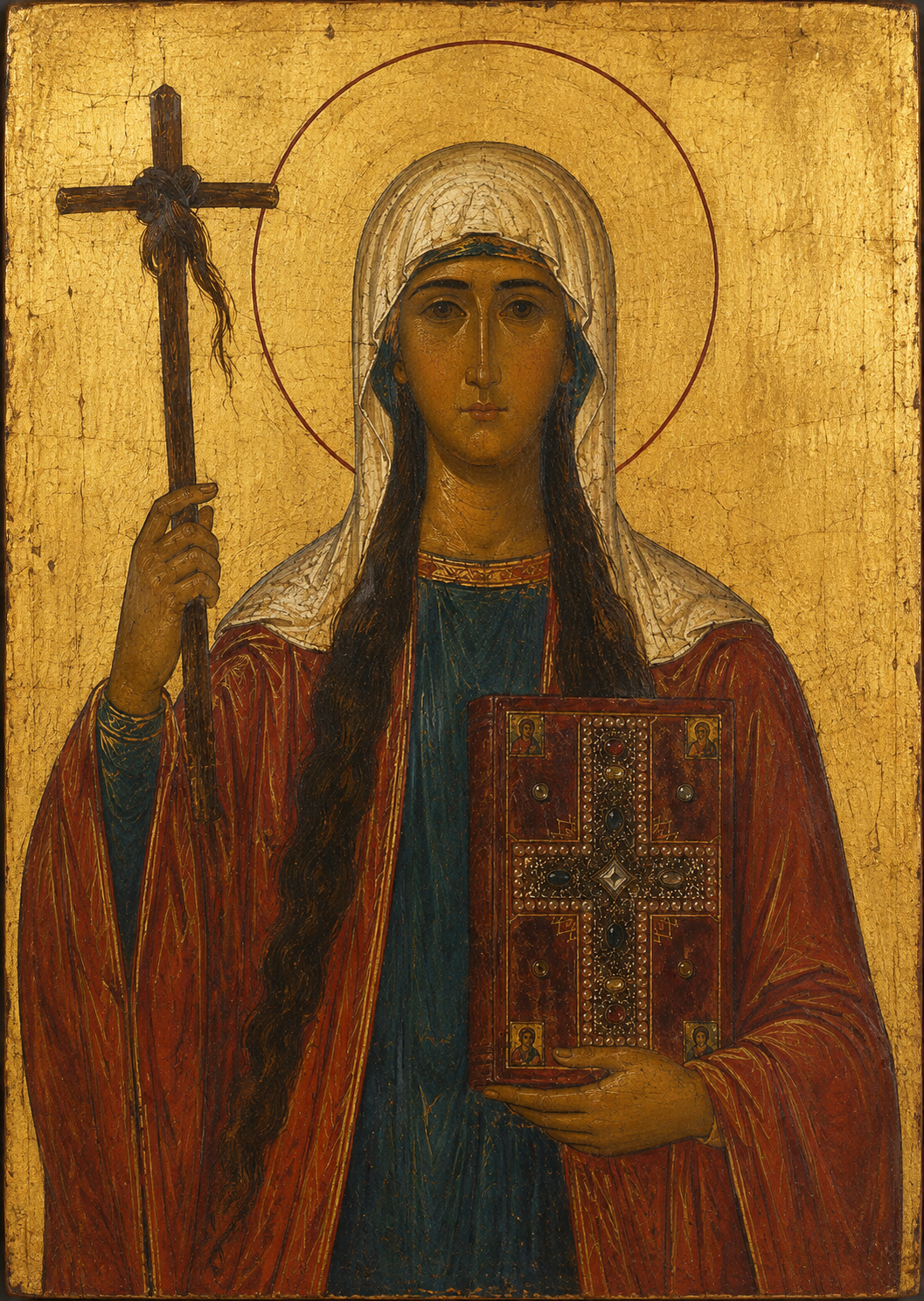
The most distinctive symbol of Saint Nino is her grapevine cross, commonly called Saint Nino's Cross. Unlike a rigid symmetrical cross, its horizontal branch often bends downward, producing the unmistakable form seen throughout Georgian Christian art, churches, jewelry, icons, and national religious imagery. The traditional Life links this unusual cross directly with Nino's mission, remembering it as the cross given to her when the Mother of God sent her into Georgia.
The vine itself possesses obvious Christian symbolism. During his 2016 visit to Georgia, Pope Francis specifically reflected on Saint Nino's vine-branch cross and connected its form with Christ's words in John 15, where Jesus identifies Himself as the true vine and His disciples as branches who must remain united to Him in order to bear fruit.
The symbolism is particularly appropriate for Nino because she entered Georgia with almost nothing except faith and the Cross, yet the Gospel planted through her mission produced a Christian tradition that survived centuries of invasion, political upheaval, persecution, foreign domination, Soviet atheism, and cultural change. What began as the mission of one Christian woman became inseparable from the spiritual identity of an entire nation.
Saint Nino's historic cross is still preserved in Sioni Cathedral in Tbilisi. OCA reports from both earlier visits and the January 2026 feast identify Sioni as the place where the cross is treasured, and in January 2026 it was brought out for public veneration during the celebration of Saint Nino.
This makes the cross one of the most important surviving physical objects associated with Saint Nino. A pilgrim visiting Georgia can therefore venerate her relics at Bodbe and also encounter the cross associated with her apostolic mission in Tbilisi.
For Christians who keep a Saint Nino card in the home, the grapevine cross can become a powerful reminder that missionary fruitfulness does not depend primarily upon impressive resources. Her mission began with obedience, prayer, and a cross.
CONVERSION & PRAYING FOR SOMEONE TO FIND CHRIST
Few saints possess a stronger historical connection with conversion and evangelization than Saint Nino. Her traditional ministry includes the conversion of ordinary households, Queen Nana, King Mirian, and eventually large portions of the Georgian people, while Orthodox hymnography explicitly calls her the preacher who brought Kartli to the way of life and truth.
This makes Saint Nino an especially fitting intercessor for a Christian praying for a husband, wife, child, parent, sibling, or friend who does not believe in Christ or has abandoned the faith. That does not mean the saint possesses a mechanical ability to force someone into conversion, because authentic faith involves the mystery of human freedom and grace.
Her life instead teaches the Christian how to remain faithful while another person's conversion unfolds on a timetable that cannot be controlled.
Nino preached.
Nino prayed.
Nino lived visibly as a Christian.
She answered questions.
She served people.
She did not control when every person would believe.
Queen Nana's conversion came before King Mirian's, and the king initially resisted strongly enough that Christian growth actually threatened him. The sequence itself can encourage someone whose own family contains one believer and another person who remains resistant, because the fact that one loved one does not yet respond does not mean prayer and faithful witness have become pointless.
Saint Nino therefore offers a particularly useful model for evangelization within relationships. The Christian can speak truth without manipulation, pray without despair, live the faith seriously, answer questions honestly, and entrust the final interior work of conversion to God.
Her life also reminds parents that faith is something transmitted rather than merely assumed. A child may grow up surrounded by Christianity without personally embracing Christ, and the answer is not always more pressure. Persistent prayer, authentic example, charity, sacramental life, and a home in which Christianity is actually lived may accomplish something arguments alone cannot.
MISSIONARIES & EVANGELISTS
Saint Nino is one of the greatest female missionary saints in Christian history. Her liturgical title Equal to the Apostles is itself a declaration that her proclamation of the Gospel among the Georgian people was understood as apostolic in character.
Her story is particularly useful for missionaries because she entered a culture different from her own without possessing political control over it. She had to learn how to communicate with people, endure uncertainty, travel through dangerous regions, and trust that God could work through encounters whose results she could not predict.
Missionary work is sometimes imagined as a dramatic life available only to unusual people, yet Saint Nino's traditional hesitation reveals something much more human. She herself questioned whether she was capable of the responsibility placed before her.
That doubt did not cancel the vocation.
For someone entering missionary work, becoming a catechist, teaching religious education, starting a parish ministry, or simply trying to speak openly about Christ within ordinary life, Saint Nino provides an important distinction between feeling capable and being called. Christians may never feel adequate to every task God gives them, but adequacy is not the same thing as obedience.
Her life also helps correct the assumption that evangelization must always be loud. Much of her influence developed through prayer, healing, conversation, personal relationships, and the credibility of a life visibly centered upon God.
The conversion of Georgia ultimately became enormous, but the mission was built one encounter at a time.
SAINT NINO & WOMEN CALLED TO GREAT WORK
Saint Nino possesses particular importance for Christian women because the Church openly calls her Equal to the Apostles. The title is not symbolic praise detached from what she accomplished, because Orthodox liturgical texts compare her preaching directly with that of Saint Andrew and the other Apostles.
Her life demonstrates that the absence of ordination to the priesthood does not mean a Christian woman's potential contribution to the evangelizing mission of the Church is small. Nino evangelized a nation, instructed converts, counseled rulers, participated in the formation of Christian communities, and became one of the foundational figures of an ancient apostolic Church.
Pope John Paul II later summarized the Christian history of Georgia by observing that it began in the fourth century when the testimony of a woman, Saint Nino, converted the king and the nation to Christ. Pope Francis likewise emphasized Nino's Equal-to-the-Apostles mission when addressing the Georgian Orthodox Church.
This gives Saint Nino a particularly strong place for women involved in catechesis, Christian education, evangelization, apologetics, missionary service, charitable ministry, writing, motherhood, godparenting, or the countless less visible ways through which faith is passed from one person to another.
Her example does not require every Christian woman to undertake a geographically dramatic mission. A mother who teaches children to pray, a grandmother who preserves the faith when others have abandoned it, a catechist who patiently forms converts, or a friend who helps someone discover Christ may participate in the same evangelical movement on a different scale.
During his visit to Georgia, Pope Francis even connected the legacy of Saint Nino with Georgian mothers and grandmothers who continue handing on the Christian faith. The Gospel planted by one woman continues to be carried through generations of other women who may never receive public recognition.
QUEEN NANA, HEALING & PRAYER FOR THE SICK
Healing played an important role in the spread of Saint Nino's mission. Her traditional Life records the healing of Queen Nana, whose serious illness had resisted other help and whose recovery became closely connected with her confession of Christ.
This gives a clear historical basis for seeking Saint Nino's intercession during illness, although she is not ordinarily presented as a narrowly defined patron of one particular disease. Her life instead joins physical healing with conversion, emphasizing the salvation of the whole person rather than treating miraculous healing as an isolated display of supernatural power.
A Christian praying to Saint Nino for someone who is sick can therefore ask for bodily healing while also praying for spiritual strength, peace, repentance, wisdom for physicians, endurance during treatment, and deeper confidence in Christ.
Her life does not promise that every prayer for physical healing will end in the same way as Queen Nana's. Christian prayer asks boldly while leaving the final outcome to God, trusting that His mercy is larger than the one particular answer we hope to receive.
Saint Nino can therefore be a meaningful saint for hospital rooms, serious diagnoses, surgery, chronic illness, and families walking through frightening uncertainty. The person asking her intercession is joining a devotional tradition whose earliest stories already connected her prayer with healing.
THE CHILDLESS GARDENER & PRAYERS FOR CHILDREN
The story of the royal gardener and his wife provides another important aspect of Saint Nino's traditional Life. The couple was childless, and after Saint Nino prayed for them God granted them a child, after which they received the Christian faith and became her disciples.
This makes Saint Nino a meaningful intercessor for couples experiencing infertility or praying for children. The devotion should be presented carefully, however, because the historical tradition provides a specific childlessness miracle without necessarily establishing a formal universal patronage title over infertility.
For a couple already seeking appropriate medical care, prayer to Saint Nino can accompany rather than replace that care. Christian prayer can include the longing for conception, wisdom concerning treatment, strength within the marriage, freedom from shame, protection from despair, and trust in God during a situation that can become physically and emotionally exhausting.
Saint Nino can also be invoked more broadly for children already born. Her own missionary life was devoted to bringing an entire people into the Christian faith, so parents and godparents may naturally seek her prayers that children grow not merely around Christianity but into a personal and enduring love of Christ.
KING MIRIAN & THE DARKNESS
The conversion of King Mirian III is one of the defining events of Saint Nino's mission. The traditional account remembers him first as an opponent of the growing Christian movement who considered suppressing the faith, then as a man brought to desperation when supernatural darkness overtook him during a hunt.
When appeals to the pagan gods brought no help, Mirian called upon the God whom Saint Nino preached. He promised that if Christ delivered him from the darkness he would confess His name, honor the Cross, and support the Christian faith, and the traditional Life says that the light immediately returned.
The event carries an obvious spiritual symbolism even before questions about its miraculous character are considered. A king who believed he could resist the Gospel discovered that his own power could not give him light, and the person through whom he had to learn about the true God was a foreign Christian woman with none of his political authority.
Christian history repeatedly contains this reversal.
The person who appears powerful may be spiritually blind.
The person who appears insignificant may be carrying the light.
Mirian's conversion also gives Saint Nino a particular connection with leaders and those whose decisions affect other people. When a ruler turns toward God, the consequences of that decision extend far beyond his private life.
This does not mean the Christian faith should be imposed by political force. The spiritual lesson is that leaders need conversion just as urgently as everyone else because power does not protect the soul from darkness.
THE CONVERSION OF GEORGIA
By the beginning of the fourth century, Christianity was not entirely unknown in Georgia. Orthodox tradition remembers earlier apostolic preaching connected particularly with Saints Andrew the First-Called and Simon the Canaanite, yet the OCA notes that much of the country remained pagan when Saint Nino arrived.
Nino's mission became the decisive turning point. OCA historical material describes the Georgian Church as tracing its official establishment to approximately 330, when her preaching led to the conversion of the royal house and wider population.
Her influence cannot be separated from the later history of Georgian culture. Both John Paul II and Francis have recognized the early fourth-century preaching of Saint Nino as foundational to Georgia's Christian identity and to the extraordinary cultural tradition that Christianity subsequently produced there.
Churches, monasteries, icons, Georgian sacred music, manuscripts, monastic scholarship, architecture, and eventually generations of Georgian saints grew within the Christian culture to which Saint Nino's mission had given decisive momentum.
This makes her story one of the clearest examples of how evangelizing one generation can affect generations that the missionary will never see.
Saint Nino could not have personally taught millions of future Georgians.
She taught the people standing in front of her.
They taught others.
Those Christians built churches and communities.
Their descendants taught another generation.
Eventually a missionary's obedience became a national Christian inheritance.
SAINT NINO & SAINT GEORGE
Saint Nino's traditional Life identifies her as a relative of Saint George the Great Martyr, one of the most universally beloved military martyrs of Eastern Christianity. The OCA preserves this relationship as part of Georgian ecclesiastical tradition and also records a tradition that Nino encouraged the Christians she evangelized to honor Saint George as a special protector.
This connection helps explain the extraordinary devotion to Saint George within Georgian Christianity. Georgia possesses an especially deep historical relationship with the Great Martyr, and Saint Nino's own devotion to him became part of the country's Christian memory.
The relationship also provides a beautiful spiritual pairing. Saint George represents fearless public martyrdom, while Saint Nino represents persistent missionary evangelization, yet both forms of witness arise from the same confession that Christ is worth more than safety, status, or earthly security.
For families devoted to both saints, Saint George and Saint Nino can therefore represent two complementary forms of courage. One shows fidelity when the demand is to die rather than deny Christ, while the other shows fidelity when the demand is to spend years patiently making Him known.
THE ROBE OF CHRIST & MTSKHETA
The traditional Life of Saint Nino connects her early desire to evangelize Georgia with the belief that the Robe of Christ had been brought there. She learned this tradition while growing up in Jerusalem, and it became part of her longing to travel into a land where the relic was believed to rest but where the majority of the population did not yet confess Christ.
The Georgian tradition of Christ's robe became especially connected with Svetitskhoveli Cathedral in Mtskheta, one of the great sacred sites of Georgian Christianity. During an official OCA visit to the Georgian Church, the delegation identified the cathedral as containing the robe of Christ according to Georgian tradition and noted that the site was associated with Georgia's earliest fourth-century church.
This provides an important connection between Nino's missionary desire and the landscape of Georgian pilgrimage today. Mtskheta is not simply an archaeological setting from her story because it remains one of the great spiritual centers of the Georgian Orthodox Church.
For Christians interested in Saint Nino, a pilgrimage to Georgia can therefore follow several parts of her life: Mtskheta and Svetitskhoveli, Sioni Cathedral in Tbilisi with her cross, and Bodbe with her relics. Each location preserves a different dimension of the saint's mission and the Christian civilization that developed from it.
THE RELICS OF SAINT NINO AT BODBE
Saint Nino spent the final period of her earthly life in eastern Georgia and reposed at Bodbe. Her traditional Life states that she specifically wished to be buried where she died, and King Mirian later erected a church honoring Saint George over the place of her grave.
Her relics remain venerated at Bodbe Monastery, which continues to be one of the most important pilgrimage sites associated with Saint Nino. During an official visit to the Orthodox Church of Georgia, the OCA delegation specifically traveled to Bodbe to venerate her relics.
The location is spiritually fitting because the woman who traveled so far ultimately became permanently rooted within the country she had entered as a missionary stranger. Georgia became not merely the place of her work but the place of her burial.
Pilgrims therefore encounter an extraordinary reversal at Bodbe. Saint Nino originally came to Georgia carrying the Gospel to people who did not know her, while generations of those people's descendants now travel to her grave asking her prayers.
The missionary became the spiritual mother of the nation she evangelized.
SAINT NINO'S CROSS AT SIONI CATHEDRAL
While Saint Nino's relics are associated with Bodbe, her famous grapevine cross is treasured at Sioni Cathedral in Tbilisi. The OCA has repeatedly documented the cross there, including during the January 2026 celebration of her feast when it was brought out for veneration.
The preservation of the cross gives Saint Nino's story an unusual physical immediacy. Christians do not encounter only a later artistic representation of the grapevine cross because Georgian tradition preserves the cross associated directly with the saint's mission.
The cross also demonstrates the remarkable durability of Christian memory. An object associated with a fourth-century missionary remains at the center of Georgian worship more than sixteen centuries later.
For a Georgian Christian household, displaying Saint Nino with her grapevine cross therefore carries more than ethnic or cultural meaning. It points back toward the instrument through which Georgia remembers receiving the Gospel from the woman it calls Equal to the Apostles.
BEGINNING WHEN YOU FEEL UNQUALIFIED
One of the most spiritually useful details of Saint Nino's traditional Life is her initial hesitation. When confronted with the magnitude of the mission, she asked how someone like her could possibly accomplish it.
The question sounds familiar because Christians frequently assume that God's call will arrive only after they feel qualified.
A person may believe they need more theological knowledge before speaking about Christ.
A parent may believe they are too imperfect to begin leading family prayer.
A convert may believe they need decades of experience before helping someone else.
A woman may believe that the contribution available to her within the Church must necessarily remain small.
Saint Nino's life answers these fears without pretending preparation is unnecessary. She received formation, sought the blessing of the Church, prayed, and undertook the mission seriously, but she did not wait until the task felt proportional to her personal strength.
Her cross became the answer to the question of adequacy.
The mission was not ultimately about how powerful Nino was.
It was about whose Gospel she carried.
PRAYERS
A simple traditional invocation may be prayed regularly: Holy Equal-to-the-Apostles Nino, pray to God for us. This is especially fitting when praying for someone's conversion, preparing to share the Gospel, beginning missionary work, asking for guidance in vocation, or seeking courage to follow a path that feels larger than one's abilities.
The traditional Orthodox Troparion honors Saint Nino as a servant of the Word of God who followed the apostolic pattern of Saint Andrew, enlightened Iberia, and became an instrument of the Holy Spirit. It concludes by asking her to “pray to Christ God for the salvation of our souls.”
Her Kontakion gives an equally strong foundation for missionary devotion. It remembers her as Equal to the Apostles, preacher of God's Word, bearer of the good news, disciple of the Mother of God, and intercessor for the people she brought toward Christ.
Someone praying for a family member who has left Christianity can keep Saint Nino's card near a prayer corner and use the traditional invocation while naming that person before Christ. Her life encourages persistent intercession without attempting to manipulate or control the person whose conversion is being sought.
Missionaries and catechists may invoke her before teaching because Saint Nino's vocation was fundamentally evangelical. Her life is especially useful when fear whispers that a person is too inexperienced, too quiet, too ordinary, or too socially insignificant to accomplish meaningful work for Christ.
Couples praying for children may also seek her intercession because of the traditional miracle involving the childless gardener and his wife, while those facing illness may remember Queen Nana's healing. These are natural devotional applications of events preserved in her Life rather than claims that Saint Nino possesses exclusive patronage over infertility or disease.
This prayer card is especially fitting for a Georgian Orthodox prayer corner, Bible, missionary bag, catechism classroom, parish office, seminary room, family prayer space, or bedside table. It can also make a meaningful baptism, chrismation, conversion, name-day, missionary commissioning, or godparent gift.
FAQ
Who is Saint Nino of Georgia? Saint Nino was an early fourth-century Christian missionary from Cappadocia who became the principal evangelizer of ancient Georgia. The Orthodox Church honors her as Equal to the Apostles and Enlightener of Georgia because her preaching played the decisive role in the conversion of King Mirian, Queen Nana, and the Georgian kingdom.
Is Saint Nino the same person as Saint Nina of Georgia? Yes, Nino and Nina are different forms used in English and other languages for the same saint. Georgian usage normally preserves the form Nino, while many Slavic and English Orthodox sources also use Nina.
What does “Equal to the Apostles” mean? Equal to the Apostles is an important Eastern Christian title given to certain saints whose missionary or evangelical work had an extraordinary apostolic impact. Saint Nino receives the title because her preaching brought the Gospel into the life of an entire people and helped establish Christianity throughout Georgia.
Why is Saint Nino called the Enlightener of Georgia? She is called the Enlightener because her early fourth-century mission became the decisive force in bringing the Georgian kingdom into Christianity. Both Orthodox and Catholic sources continue to identify her preaching as foundational to Georgia's Christian history and culture.
Was Saint Nino Georgian? Saint Nino's traditional Life identifies her as coming from Cappadocia, not as someone originally born in Georgia. She became inseparably associated with Georgia because that was the nation she evangelized and the place where she eventually died and was buried.
Was Saint Nino related to Saint George? Her traditional Orthodox Life identifies her as a relative of Saint George the Great Martyr. Georgian tradition also remembers her as strongly devoted to him and as encouraging the Christians she evangelized to honor Saint George.
Who were Saint Nino's parents? Her hagiographic tradition names her father as Zabulon, a Roman military commander, and her mother as Sosana. The Life further places her family in Jerusalem during Nino's youth and connects her formation with the Christian community there.
Did Saint Nino know the Virgin Mary? No, not historically in the ordinary earthly sense because they lived centuries apart. Her traditional Life instead records an appearance of the Theotokos in which Mary commissioned Nino to preach in Georgia and gave her the grapevine cross associated with her mission.
What is Saint Nino's grapevine cross? It is the distinctive cross traditionally given to Saint Nino when the Mother of God directed her to evangelize Georgia. Its horizontal branch bends downward, and Nino's traditional Life says the vine branches were bound together with strands of hair.
Where is Saint Nino's cross today? The cross is treasured at Sioni Cathedral in Tbilisi, Georgia. It remains an active object of devotion and was brought out for public veneration during Saint Nino's January 2026 feast.
Why is Saint Nino's cross made from grapevines? The grapevine form comes from her traditional Life, while Christian reflection has also connected it beautifully with Christ's statement that He is the true vine in John 15. Pope Francis highlighted this connection during his visit to Georgia in 2016.
What is Saint Nino the patron saint of? It is more accurate to speak of her strongest devotional associations than to manufacture a universal patronage list. Saint Nino is especially fitting for missionaries, evangelization, conversion, catechists, women sharing the faith, Christians praying for unbelieving family members, and people discerning a difficult vocation because these themes arise directly from her life.
Is Saint Nino a patron saint of missionaries? She is one of the most natural saints for missionaries to invoke because the Church formally honors her as Equal to the Apostles and Enlightener of Georgia. Her entire adult spiritual identity is bound to the missionary proclamation of Christ.
Can I pray to Saint Nino for someone's conversion? Yes, this is one of the strongest devotional applications of her life. Her preaching led ordinary people, Queen Nana, King Mirian, and eventually much of Georgia toward Christianity, making her an especially meaningful intercessor when praying that someone discover or return to Christ.
Can I pray to Saint Nino for my children to return to church? Yes, her missionary life makes this particularly appropriate. Parents can seek her intercession while also trying to live Christianity authentically, maintain loving relationships, and entrust the timing of another person's conversion to God.
Can godparents pray to Saint Nino for their godchildren? Yes, especially when the intention concerns perseverance in the Christian faith or return to active church life. Saint Nino's entire ministry centered upon helping people receive and remain within the Gospel.
Is Saint Nino a saint for evangelists and catechists? Yes, her liturgical texts specifically praise her as a preacher and bearer of the good news who brought Kartli toward Christian truth. Catechists and evangelists can therefore seek her intercession for wisdom, courage, clarity, and humility.
Is Saint Nino a good saint for converts? Yes, because her own ministry repeatedly involved people encountering Christianity for the first time and then building an entirely new life around Christ. A convert may find particular encouragement in the communities she helped form among people who had previously practiced another religion.
Is Saint Nino especially important for women? Yes, because she is one of Christianity's greatest examples of a woman receiving an explicitly missionary vocation whose effect reached an entire nation. The Church's title Equal to the Apostles publicly recognizes the magnitude of her evangelical work.
Can women missionaries pray to Saint Nino? Yes, she is one of the most fitting saints for women involved in evangelization or missionary work. Her life demonstrates that Christian missionary authority can arise through holiness, truth, courage, prayer, and faithful witness rather than worldly rank.
Is Saint Nino associated with healing? Yes, her traditional Life prominently records the healing of the gravely ill Queen Nana. Healing is therefore a genuine part of Saint Nino's hagiographic tradition, although she is not ordinarily reduced to a patron saint of one particular medical condition.
Can I pray to Saint Nino for someone who is sick? Yes, especially in light of Queen Nana's healing. A Christian can ask Saint Nino to intercede for physical recovery, good medical care, strength, peace, and whatever God knows is necessary for the sick person's salvation and well-being.
Is Saint Nino associated with infertility? Her traditional Life records that a childless gardener and his wife received a child through her prayers. This gives a legitimate devotional basis for couples experiencing infertility to seek her intercession, although describing her as the formal universal patron saint of infertility would overstate the historical evidence.
Can couples pray to Saint Nino for a baby? Yes, the childless couple in her Life makes this a natural reason to seek her prayers. Such devotion can accompany appropriate fertility care and prayer for strength, peace, and unity within the marriage.
Did Saint Nino convert Queen Nana? Yes, according to the Orthodox tradition, Queen Nana became a Christian after being healed through Saint Nino's ministry. Her conversion became an important step toward the eventual conversion of the royal household.
Did Saint Nino convert King Mirian? Saint Nino's preaching prepared the way for King Mirian's conversion, while his decisive turn toward Christ occurred during the famous hunting episode in which darkness overtook him. After appealing to the God of Nino and seeing the light return, he committed himself to the Christian faith.
What happened to King Mirian during the hunt? According to the traditional Life, an extraordinary darkness came over him and his appeals to the pagan gods failed. When he called upon the God preached by Saint Nino and promised to confess Christ, the light returned, becoming the decisive event in his conversion.
Did Saint Nino convert the whole country of Georgia by herself? It would be too simplistic to say that no Christianity existed before her or that one person personally instructed every Georgian. Orthodox tradition remembers earlier apostolic preaching, particularly that of Saint Andrew, but Saint Nino's fourth-century mission became the decisive movement leading to conversion of the royal house and broad establishment of Christianity.
Was Georgia Christian before Saint Nino? Christian preaching had reached the region earlier according to Georgian and Orthodox tradition, but much of the kingdom remained pagan at the beginning of the fourth century. Saint Nino's mission transformed Christianity from a limited presence into the dominant faith of the kingdom.
What did ancient Georgia call itself? The eastern Georgian kingdom in Saint Nino's time is commonly called Iberia in Greek and Roman sources and Kartli in Georgian tradition. This ancient Caucasian Iberia should not be confused with Spain or Portugal.
Why do Saint Nino's hymns call her the Enlightener of Iberia? In that liturgical phrase, Iberia means the ancient Georgian kingdom of Kartli. Her Troparion honors her as its enlightener because her preaching brought the Christian faith decisively into the kingdom.
What is Saint Nino's connection with Mtskheta? Mtskheta was the ancient royal capital and one of the principal settings of her missionary work. It was there that her preaching reached the royal court and where the foundations of the Christian Georgian kingdom took shape.
What is Saint Nino's connection with Svetitskhoveli Cathedral? Svetitskhoveli stands in Mtskheta at a site deeply connected with Georgia's earliest Christian tradition and the traditional location associated with Christ's robe. OCA reporting on the Georgian Church identifies the cathedral with the first fourth-century church and with the continuing tradition of the Robe of Christ.
Where did Saint Nino die? Saint Nino reposed at Bodbe in eastern Georgia. Her Life says that she wished to be buried where she died rather than have her body carried elsewhere.
Where are Saint Nino's relics today? Her relics are venerated at Bodbe Monastery in Georgia. Official OCA delegations visiting the Georgian Orthodox Church have specifically traveled there to venerate them.
Can pilgrims visit Saint Nino's relics? Yes, Bodbe is an important Georgian Orthodox pilgrimage destination connected with her burial. A pilgrimage focused on Saint Nino may also include Sioni Cathedral in Tbilisi, where her grapevine cross is treasured.
When is Saint Nino's feast day? The OCA commemorates Saint Nino's repose on January 14, while the Georgian Orthodox Church, following the Julian calendar for this fixed feast, celebrates that liturgical January 14 on January 27 of the current Gregorian civil calendar. The Georgian celebration on January 27 was observed again publicly in Tbilisi in 2026.
Why do I see both January 14 and January 27 for Saint Nino? They represent the same traditional feast expressed through different calendars. January 14 Julian currently corresponds to January 27 Gregorian, which explains why Georgian Orthodox Christians commonly celebrate Saint Nino on January 27 civil time.
Does Saint Nino have another feast day? Yes, the Entrance of Saint Nino into Georgia is also commemorated. The OCA lists that feast on May 19, remembering the beginning of her apostolic mission among the Georgian people.
Is Saint Nino an Eastern Orthodox saint? Yes, Saint Nino is one of the foundational saints of Georgian Orthodoxy and is venerated throughout the wider Eastern Orthodox Church. Her titles Equal to the Apostles and Enlightener of Georgia are firmly established within Orthodox liturgical tradition.
Is Saint Nino recognized by Catholics? Saint Nino lived in the early fourth century, many centuries before the later separation between Catholic and Orthodox Christianity. Modern popes have repeatedly honored her as the great early Christian evangelizer of Georgia, and Saint John Paul II explicitly invoked her intercession during his engagement with the Georgian people.
Can a Catholic have a devotion to Saint Nino? Yes, her early date and her place within ancient Christianity make such devotion entirely natural, particularly for Eastern Catholics or Catholics interested in the Christian East. Catholic papal sources speak of her positively as the fourth-century saint through whose preaching Christian Georgia took shape.
Can I give this prayer card to a Georgian Orthodox Christian? Yes, Saint Nino is one of the most important possible saints for a Georgian Orthodox Christian. She is the Enlightener of Georgia, her relics remain at Bodbe, and her grapevine cross remains treasured in Tbilisi.
Can I give this prayer card to a missionary? Yes, this is one of the strongest uses for a Saint Nino card. Her Equal-to-the-Apostles title is based precisely upon the extraordinary missionary work through which the Gospel became established in Georgia.
Can I give this card to someone becoming a catechist? Yes, because Saint Nino spent her life teaching people who did not yet understand Christianity. Her intercession is especially fitting for anyone who needs to explain the faith patiently, accurately, and in a way that leads people toward Christ.
Can I give this card to a woman discerning her vocation? Yes, especially if she feels that the work God may be calling her toward is larger than her present confidence. Saint Nino's own traditional hesitation and subsequent obedience make her particularly meaningful in that situation.
Can I pray to Saint Nino when I feel unqualified? Yes, because her traditional Life specifically remembers her questioning how someone like her could possibly fulfill the mission given to her. Her story teaches that humility about one's limitations does not have to become refusal of God's call.
What does Saint Nino teach about evangelization? Her life teaches that evangelization combines proclamation with prayer, personal holiness, relationships, patience, and reliance upon God. She entered Georgia without worldly power and nevertheless became the central missionary figure in the conversion of the kingdom.
What does Saint Nino teach about praying for unbelieving family members? Her story encourages persistence without coercion because people responded to the Gospel at different times and in different ways. Queen Nana believed before King Mirian, while Mirian initially resisted strongly before his eventual conversion.
What does Saint Nino teach about women in the Church? Her life demonstrates that a woman can exercise extraordinary evangelical influence without reducing her vocation to secular categories of power. The Church calls her Equal to the Apostles because the fruit of her missionary work transformed an entire Christian people.
What does Saint Nino teach about courage? She teaches that courage may mean continuing a mission even after fear, loss, danger, and uncertainty have stripped away the security a person expected to have. Her traditional journey into Georgia began after persecution and the martyrdom of Christian companions, yet she continued alone toward the people she believed God had called her to serve.
What does Saint Nino teach about vocation? Her life teaches that vocation begins with obedience rather than certainty about our own abilities. She did not believe herself naturally sufficient for the conversion of a nation, yet the mission became fruitful because the center of the work was Christ rather than Saint Nino's personal power.
What is the main message of Saint Nino of Georgia's life? Saint Nino's life teaches that one faithful Christian can become the beginning of something far larger than that person's own life. A young woman carrying a grapevine cross entered a largely pagan kingdom, prayed for the sick and childless, taught ordinary families, witnessed to a queen, helped lead a resistant king toward Christ, and became the missionary mother of Christian Georgia. Her life calls Christians to pray for conversion without despair, speak about Christ without shame, obey vocation without waiting to feel powerful, and trust that God can produce generations of fruit from one person's faithful yes.
Saint Nino of Georgia, also written Saint Nina, is honored as Equal to the Apostles and Enlightener of Georgia, one of the highest missionary titles given to a saint in the Eastern Christian tradition. A young woman from Cappadocia, she journeyed into the ancient kingdom of Iberia in the early fourth century carrying a simple cross made from grapevines, preached Jesus Christ among a predominantly pagan people, became associated with remarkable healings and conversions, and played the central missionary role in the conversion of King Mirian III, Queen Nana, and eventually the Georgian nation. The Orthodox Church of Georgia traces its establishment in the early fourth century especially to her apostolic work.
Saint Nino is especially meaningful for missionaries, evangelists, converts, catechists, women discerning ministry or missionary service, Christians praying for the conversion of family members, and anyone who feels too ordinary or inadequately equipped for the task God appears to be placing before them. Her traditional Life specifically remembers her questioning how a young and seemingly fragile woman could possibly accomplish such an enormous mission, yet the Theotokos directed her toward Georgia and gave her the grapevine cross that became the enduring symbol of her apostolate.
Her story is particularly powerful for Christians praying for someone they love to discover or return to the faith. Saint Nino did not begin her mission with political authority, an army, wealth, or a large missionary organization, yet her witness eventually reached the royal household and helped transform the religious life of an entire kingdom. The Church therefore honors her not merely as a successful missionary but as Equal to the Apostles, placing her evangelical work in the same spiritual category as those who carried the Gospel into nations during the apostolic age.
Saint Nino also has a strong connection with healing and prayer for families. Her traditional Life remembers the terminally ill Queen Nana being healed through her ministry, while the childless royal gardener and his wife became among Nino's first disciples after God granted them a child through her prayers. These stories provide a historical devotional basis for seeking Saint Nino's intercession during illness or when praying for a child, although it would go beyond the sources to declare her a universally established patron saint of infertility or a particular disease.
Her life is equally significant for women because Georgia's great evangelizer was not a bishop, ruler, soldier, or politically powerful nobleman. She was a Christian woman whose principal missionary weapons were prayer, teaching, personal holiness, perseverance, healing, and the Cross, and even papal reflections on Georgia have emphasized the remarkable fact that the Christian identity of the nation grew through the witness of Saint Nino.
For Georgian Orthodox Christians, Saint Nino occupies a place that is difficult to overstate. Her grapevine cross remains treasured at Sioni Cathedral in Tbilisi, her relics are venerated at Bodbe Monastery, and the Georgian Church continues to celebrate her as the woman through whom the Gospel became deeply rooted in the nation. During the January 2026 celebration of her feast in Tbilisi, her historic cross was again brought out publicly for veneration at Sioni Cathedral.
This prayer card is especially fitting for missionaries, catechists, converts, Georgian Orthodox families, godparents, parents praying for adult children who have left the Church, Christians sharing the Gospel with family members, women discerning vocation, people entering an unfamiliar place because they believe God has called them there, and anyone who needs courage to speak openly about Christ. It can also be meaningful during illness, prayer for children, or discernment when the path ahead seems much larger than the person being asked to walk it.
Each card is handmade in Austin, TX and created to order. We do not keep stock, because every prayer card is treated as a unique devotional offering. They are printed on museum-quality photo paper, not cardstock, and every card is made slowly during prayer with intentional reverence for the saint and for the person who will receive it. Names are lifted before Christ, intentions are held carefully, and each piece is handled multiple times in prayerful silence, asking God for mercy and asking Saint Nino to intercede for the soul it is being made for. This is devotional craftsmanship shaped with patience, care, and spiritual responsibility because every soul and every prayer matters.
THE LIFE & STORY
Saint Nino lived during the early fourth century and came from Cappadocia, the ancient Christian region of Asia Minor that would later become famous for saints such as Basil the Great, Gregory of Nazianzus, and Gregory of Nyssa. Her traditional Georgian and Orthodox Life describes her as a relative of the Great Martyr Saint George and names her parents as Zabulon, a Roman military commander, and Sosana. These family details belong to the received hagiographic tradition surrounding Nino and should be understood in that context rather than treated as though every genealogical element can be independently verified from contemporary civil records.
According to that tradition, Nino's family moved to Jerusalem when she was about twelve years old. Her father eventually entered monastic life in the wilderness of the Jordan, while her mother was dedicated to service within the Church, and Nino was placed under the care of an elderly Christian woman named Sara Niaphor who instructed her in the life, Passion, and Resurrection of Jesus Christ.
During this period, Nino learned the Georgian Christian tradition concerning the Robe of Christ, which was believed to have been carried to Georgia and preserved there. The thought that a sacred object connected so closely with Christ rested in a largely pagan country affected her deeply, and she began praying fervently to the Mother of God for permission and guidance to travel there.
The traditional Life then records the event that would define Saint Nino's iconography for the rest of Christian history. The Theotokos appeared to her and directed her to go into Georgia and preach the Gospel of Jesus Christ, promising divine assistance and protection for the mission.
Nino was overwhelmed by what she was being asked to do. She questioned how a young woman with no worldly power could possibly undertake such an enormous mission, and the traditional account remembers the Mother of God answering by giving her a cross made from grapevines as a sign of protection against visible and invisible enemies.
When Nino awoke, she found the cross with her and bound its two branches together with strands of hair. The precise hagiographic tradition differs over whether the hair was Nino's or the Theotokos's, and the OCA explicitly preserves both forms of the account. What matters to the devotional tradition is the cross itself, which became inseparable from Saint Nino and remains one of the most recognizable sacred symbols of Georgian Christianity.
Nino then presented her calling to the ecclesiastical authority described in her Life as Patriarch Juvenal of Jerusalem. The traditional account says that he blessed her missionary vocation and prayed that Christ would guide her, protect her, and grant her wisdom to proclaim the Resurrection.
Her road toward Georgia was dangerous. The traditional Life places Nino with Saints Rhipsimia and Gaiana and their companions, Christian women fleeing persecution connected with Emperor Diocletian. The women entered Armenia, where Rhipsimia, Gaiana, and their companions were martyred, while Nino escaped and continued toward the mission for which she believed God had preserved her.
This part of her story gives Saint Nino's missionary vocation a very different character from an organized journey undertaken with security and resources. She entered Georgia after witnessing persecution and the loss of Christian companions, and according to the Georgian liturgical tradition she came through the Javakheti Mountains near Lake Paravani, effectively continuing alone.
The Georgian Church commemorates this event separately as the Entrance of Saint Nino into Georgia. The OCA calendar celebrates that entrance on May 19 and describes it as an important feast of the Apostolic Church of Georgia, while Saint Nino's principal commemoration remains January 14 according to the liturgical calendar used by the OCA.
After entering the country, Nino encountered local shepherds and gradually made her way toward the populated regions of the ancient Georgian kingdom then known as Iberia or Kartli. In this context, Iberia refers to the ancient Caucasian kingdom centered in what is now eastern Georgia and has nothing to do with the Iberian Peninsula of Spain and Portugal.
Nino eventually reached Urbnisi and then traveled with local people toward Mtskheta, the ancient Georgian capital. There she encountered a society still shaped substantially by pagan worship and witnessed crowds gathering to venerate the idol Armazi.
The sight deeply distressed her. According to her traditional Life, Nino prayed that God would have mercy upon the Georgian people and reveal Himself as the one true God, after which a violent storm with wind and hail shattered the pagan images and scattered the worshippers.
Nino did not follow this event by establishing herself in a palace or powerful institution. She lived simply in the garden of the king, beneath a bramble or similar shelter, and the family of the royal gardener became closely connected with her.
The gardener and his wife had no children. According to the Orthodox Life, Saint Nino prayed for them and they received a child, after which the couple confessed Christ and became among her disciples.
This story gives Saint Nino a natural devotional connection with couples longing for children, but accuracy matters when describing that devotion. The Church's Life clearly preserves a miracle involving a childless couple, so seeking her intercession for conception or family prayer is historically grounded, while calling her the formal universal “patron saint of infertility” would be stronger than the sources justify.
Nino continued preaching, teaching, praying, and drawing people toward Christianity. Her missionary approach appears within the tradition as personal and relational, growing through encounters, healings, instruction, and the visible seriousness of her own Christian life rather than through political coercion.
The mission eventually reached the royal household through Queen Nana. The queen became gravely ill, and the traditional Life records that Saint Nino healed her after Nana confessed Christ as the true God, after which the queen became a Christian.
King Mirian initially reacted very differently. He remained pagan and became disturbed by the growing influence of Saint Nino's preaching, and the hagiographic account says that he even contemplated persecuting Christians, including his own wife if she refused to abandon the faith.
Then an event occurred that became decisive in Georgian Christian memory. While the king was hunting, an extraordinary darkness came over him, leaving him frightened and unable to find his way. He first called upon the pagan gods but received no help, and in desperation he turned toward the God preached by Nino and promised that if Christ delivered him, he would confess His name and support the Christian faith.
The darkness lifted.
The king returned to the city convinced that the God proclaimed by Nino was true and informed her of his decision. His conversion, together with Queen Nana's, opened the way for Christianity to become established throughout the Georgian kingdom, and both Orthodox and Catholic sources continue to identify Saint Nino's fourth-century preaching and the conversion of King Mirian as foundational to Christian Georgia.
Nino's missionary achievement was therefore extraordinary. She entered a country as a foreign Christian woman without civil authority, yet her preaching eventually helped transform the religion of the royal household and the spiritual direction of an entire people.
This is why the Church did not remember her merely as a pious ascetic or local missionary.
It gave her the title Equal to the Apostles.
THE GRAPEVINE CROSS OF SAINT NINO
The most distinctive symbol of Saint Nino is her grapevine cross, commonly called Saint Nino's Cross. Unlike a rigid symmetrical cross, its horizontal branch often bends downward, producing the unmistakable form seen throughout Georgian Christian art, churches, jewelry, icons, and national religious imagery. The traditional Life links this unusual cross directly with Nino's mission, remembering it as the cross given to her when the Mother of God sent her into Georgia.
The vine itself possesses obvious Christian symbolism. During his 2016 visit to Georgia, Pope Francis specifically reflected on Saint Nino's vine-branch cross and connected its form with Christ's words in John 15, where Jesus identifies Himself as the true vine and His disciples as branches who must remain united to Him in order to bear fruit.
The symbolism is particularly appropriate for Nino because she entered Georgia with almost nothing except faith and the Cross, yet the Gospel planted through her mission produced a Christian tradition that survived centuries of invasion, political upheaval, persecution, foreign domination, Soviet atheism, and cultural change. What began as the mission of one Christian woman became inseparable from the spiritual identity of an entire nation.
Saint Nino's historic cross is still preserved in Sioni Cathedral in Tbilisi. OCA reports from both earlier visits and the January 2026 feast identify Sioni as the place where the cross is treasured, and in January 2026 it was brought out for public veneration during the celebration of Saint Nino.
This makes the cross one of the most important surviving physical objects associated with Saint Nino. A pilgrim visiting Georgia can therefore venerate her relics at Bodbe and also encounter the cross associated with her apostolic mission in Tbilisi.
For Christians who keep a Saint Nino card in the home, the grapevine cross can become a powerful reminder that missionary fruitfulness does not depend primarily upon impressive resources. Her mission began with obedience, prayer, and a cross.
CONVERSION & PRAYING FOR SOMEONE TO FIND CHRIST
Few saints possess a stronger historical connection with conversion and evangelization than Saint Nino. Her traditional ministry includes the conversion of ordinary households, Queen Nana, King Mirian, and eventually large portions of the Georgian people, while Orthodox hymnography explicitly calls her the preacher who brought Kartli to the way of life and truth.
This makes Saint Nino an especially fitting intercessor for a Christian praying for a husband, wife, child, parent, sibling, or friend who does not believe in Christ or has abandoned the faith. That does not mean the saint possesses a mechanical ability to force someone into conversion, because authentic faith involves the mystery of human freedom and grace.
Her life instead teaches the Christian how to remain faithful while another person's conversion unfolds on a timetable that cannot be controlled.
Nino preached.
Nino prayed.
Nino lived visibly as a Christian.
She answered questions.
She served people.
She did not control when every person would believe.
Queen Nana's conversion came before King Mirian's, and the king initially resisted strongly enough that Christian growth actually threatened him. The sequence itself can encourage someone whose own family contains one believer and another person who remains resistant, because the fact that one loved one does not yet respond does not mean prayer and faithful witness have become pointless.
Saint Nino therefore offers a particularly useful model for evangelization within relationships. The Christian can speak truth without manipulation, pray without despair, live the faith seriously, answer questions honestly, and entrust the final interior work of conversion to God.
Her life also reminds parents that faith is something transmitted rather than merely assumed. A child may grow up surrounded by Christianity without personally embracing Christ, and the answer is not always more pressure. Persistent prayer, authentic example, charity, sacramental life, and a home in which Christianity is actually lived may accomplish something arguments alone cannot.
MISSIONARIES & EVANGELISTS
Saint Nino is one of the greatest female missionary saints in Christian history. Her liturgical title Equal to the Apostles is itself a declaration that her proclamation of the Gospel among the Georgian people was understood as apostolic in character.
Her story is particularly useful for missionaries because she entered a culture different from her own without possessing political control over it. She had to learn how to communicate with people, endure uncertainty, travel through dangerous regions, and trust that God could work through encounters whose results she could not predict.
Missionary work is sometimes imagined as a dramatic life available only to unusual people, yet Saint Nino's traditional hesitation reveals something much more human. She herself questioned whether she was capable of the responsibility placed before her.
That doubt did not cancel the vocation.
For someone entering missionary work, becoming a catechist, teaching religious education, starting a parish ministry, or simply trying to speak openly about Christ within ordinary life, Saint Nino provides an important distinction between feeling capable and being called. Christians may never feel adequate to every task God gives them, but adequacy is not the same thing as obedience.
Her life also helps correct the assumption that evangelization must always be loud. Much of her influence developed through prayer, healing, conversation, personal relationships, and the credibility of a life visibly centered upon God.
The conversion of Georgia ultimately became enormous, but the mission was built one encounter at a time.
SAINT NINO & WOMEN CALLED TO GREAT WORK
Saint Nino possesses particular importance for Christian women because the Church openly calls her Equal to the Apostles. The title is not symbolic praise detached from what she accomplished, because Orthodox liturgical texts compare her preaching directly with that of Saint Andrew and the other Apostles.
Her life demonstrates that the absence of ordination to the priesthood does not mean a Christian woman's potential contribution to the evangelizing mission of the Church is small. Nino evangelized a nation, instructed converts, counseled rulers, participated in the formation of Christian communities, and became one of the foundational figures of an ancient apostolic Church.
Pope John Paul II later summarized the Christian history of Georgia by observing that it began in the fourth century when the testimony of a woman, Saint Nino, converted the king and the nation to Christ. Pope Francis likewise emphasized Nino's Equal-to-the-Apostles mission when addressing the Georgian Orthodox Church.
This gives Saint Nino a particularly strong place for women involved in catechesis, Christian education, evangelization, apologetics, missionary service, charitable ministry, writing, motherhood, godparenting, or the countless less visible ways through which faith is passed from one person to another.
Her example does not require every Christian woman to undertake a geographically dramatic mission. A mother who teaches children to pray, a grandmother who preserves the faith when others have abandoned it, a catechist who patiently forms converts, or a friend who helps someone discover Christ may participate in the same evangelical movement on a different scale.
During his visit to Georgia, Pope Francis even connected the legacy of Saint Nino with Georgian mothers and grandmothers who continue handing on the Christian faith. The Gospel planted by one woman continues to be carried through generations of other women who may never receive public recognition.
QUEEN NANA, HEALING & PRAYER FOR THE SICK
Healing played an important role in the spread of Saint Nino's mission. Her traditional Life records the healing of Queen Nana, whose serious illness had resisted other help and whose recovery became closely connected with her confession of Christ.
This gives a clear historical basis for seeking Saint Nino's intercession during illness, although she is not ordinarily presented as a narrowly defined patron of one particular disease. Her life instead joins physical healing with conversion, emphasizing the salvation of the whole person rather than treating miraculous healing as an isolated display of supernatural power.
A Christian praying to Saint Nino for someone who is sick can therefore ask for bodily healing while also praying for spiritual strength, peace, repentance, wisdom for physicians, endurance during treatment, and deeper confidence in Christ.
Her life does not promise that every prayer for physical healing will end in the same way as Queen Nana's. Christian prayer asks boldly while leaving the final outcome to God, trusting that His mercy is larger than the one particular answer we hope to receive.
Saint Nino can therefore be a meaningful saint for hospital rooms, serious diagnoses, surgery, chronic illness, and families walking through frightening uncertainty. The person asking her intercession is joining a devotional tradition whose earliest stories already connected her prayer with healing.
THE CHILDLESS GARDENER & PRAYERS FOR CHILDREN
The story of the royal gardener and his wife provides another important aspect of Saint Nino's traditional Life. The couple was childless, and after Saint Nino prayed for them God granted them a child, after which they received the Christian faith and became her disciples.
This makes Saint Nino a meaningful intercessor for couples experiencing infertility or praying for children. The devotion should be presented carefully, however, because the historical tradition provides a specific childlessness miracle without necessarily establishing a formal universal patronage title over infertility.
For a couple already seeking appropriate medical care, prayer to Saint Nino can accompany rather than replace that care. Christian prayer can include the longing for conception, wisdom concerning treatment, strength within the marriage, freedom from shame, protection from despair, and trust in God during a situation that can become physically and emotionally exhausting.
Saint Nino can also be invoked more broadly for children already born. Her own missionary life was devoted to bringing an entire people into the Christian faith, so parents and godparents may naturally seek her prayers that children grow not merely around Christianity but into a personal and enduring love of Christ.
KING MIRIAN & THE DARKNESS
The conversion of King Mirian III is one of the defining events of Saint Nino's mission. The traditional account remembers him first as an opponent of the growing Christian movement who considered suppressing the faith, then as a man brought to desperation when supernatural darkness overtook him during a hunt.
When appeals to the pagan gods brought no help, Mirian called upon the God whom Saint Nino preached. He promised that if Christ delivered him from the darkness he would confess His name, honor the Cross, and support the Christian faith, and the traditional Life says that the light immediately returned.
The event carries an obvious spiritual symbolism even before questions about its miraculous character are considered. A king who believed he could resist the Gospel discovered that his own power could not give him light, and the person through whom he had to learn about the true God was a foreign Christian woman with none of his political authority.
Christian history repeatedly contains this reversal.
The person who appears powerful may be spiritually blind.
The person who appears insignificant may be carrying the light.
Mirian's conversion also gives Saint Nino a particular connection with leaders and those whose decisions affect other people. When a ruler turns toward God, the consequences of that decision extend far beyond his private life.
This does not mean the Christian faith should be imposed by political force. The spiritual lesson is that leaders need conversion just as urgently as everyone else because power does not protect the soul from darkness.
THE CONVERSION OF GEORGIA
By the beginning of the fourth century, Christianity was not entirely unknown in Georgia. Orthodox tradition remembers earlier apostolic preaching connected particularly with Saints Andrew the First-Called and Simon the Canaanite, yet the OCA notes that much of the country remained pagan when Saint Nino arrived.
Nino's mission became the decisive turning point. OCA historical material describes the Georgian Church as tracing its official establishment to approximately 330, when her preaching led to the conversion of the royal house and wider population.
Her influence cannot be separated from the later history of Georgian culture. Both John Paul II and Francis have recognized the early fourth-century preaching of Saint Nino as foundational to Georgia's Christian identity and to the extraordinary cultural tradition that Christianity subsequently produced there.
Churches, monasteries, icons, Georgian sacred music, manuscripts, monastic scholarship, architecture, and eventually generations of Georgian saints grew within the Christian culture to which Saint Nino's mission had given decisive momentum.
This makes her story one of the clearest examples of how evangelizing one generation can affect generations that the missionary will never see.
Saint Nino could not have personally taught millions of future Georgians.
She taught the people standing in front of her.
They taught others.
Those Christians built churches and communities.
Their descendants taught another generation.
Eventually a missionary's obedience became a national Christian inheritance.
SAINT NINO & SAINT GEORGE
Saint Nino's traditional Life identifies her as a relative of Saint George the Great Martyr, one of the most universally beloved military martyrs of Eastern Christianity. The OCA preserves this relationship as part of Georgian ecclesiastical tradition and also records a tradition that Nino encouraged the Christians she evangelized to honor Saint George as a special protector.
This connection helps explain the extraordinary devotion to Saint George within Georgian Christianity. Georgia possesses an especially deep historical relationship with the Great Martyr, and Saint Nino's own devotion to him became part of the country's Christian memory.
The relationship also provides a beautiful spiritual pairing. Saint George represents fearless public martyrdom, while Saint Nino represents persistent missionary evangelization, yet both forms of witness arise from the same confession that Christ is worth more than safety, status, or earthly security.
For families devoted to both saints, Saint George and Saint Nino can therefore represent two complementary forms of courage. One shows fidelity when the demand is to die rather than deny Christ, while the other shows fidelity when the demand is to spend years patiently making Him known.
THE ROBE OF CHRIST & MTSKHETA
The traditional Life of Saint Nino connects her early desire to evangelize Georgia with the belief that the Robe of Christ had been brought there. She learned this tradition while growing up in Jerusalem, and it became part of her longing to travel into a land where the relic was believed to rest but where the majority of the population did not yet confess Christ.
The Georgian tradition of Christ's robe became especially connected with Svetitskhoveli Cathedral in Mtskheta, one of the great sacred sites of Georgian Christianity. During an official OCA visit to the Georgian Church, the delegation identified the cathedral as containing the robe of Christ according to Georgian tradition and noted that the site was associated with Georgia's earliest fourth-century church.
This provides an important connection between Nino's missionary desire and the landscape of Georgian pilgrimage today. Mtskheta is not simply an archaeological setting from her story because it remains one of the great spiritual centers of the Georgian Orthodox Church.
For Christians interested in Saint Nino, a pilgrimage to Georgia can therefore follow several parts of her life: Mtskheta and Svetitskhoveli, Sioni Cathedral in Tbilisi with her cross, and Bodbe with her relics. Each location preserves a different dimension of the saint's mission and the Christian civilization that developed from it.
THE RELICS OF SAINT NINO AT BODBE
Saint Nino spent the final period of her earthly life in eastern Georgia and reposed at Bodbe. Her traditional Life states that she specifically wished to be buried where she died, and King Mirian later erected a church honoring Saint George over the place of her grave.
Her relics remain venerated at Bodbe Monastery, which continues to be one of the most important pilgrimage sites associated with Saint Nino. During an official visit to the Orthodox Church of Georgia, the OCA delegation specifically traveled to Bodbe to venerate her relics.
The location is spiritually fitting because the woman who traveled so far ultimately became permanently rooted within the country she had entered as a missionary stranger. Georgia became not merely the place of her work but the place of her burial.
Pilgrims therefore encounter an extraordinary reversal at Bodbe. Saint Nino originally came to Georgia carrying the Gospel to people who did not know her, while generations of those people's descendants now travel to her grave asking her prayers.
The missionary became the spiritual mother of the nation she evangelized.
SAINT NINO'S CROSS AT SIONI CATHEDRAL
While Saint Nino's relics are associated with Bodbe, her famous grapevine cross is treasured at Sioni Cathedral in Tbilisi. The OCA has repeatedly documented the cross there, including during the January 2026 celebration of her feast when it was brought out for veneration.
The preservation of the cross gives Saint Nino's story an unusual physical immediacy. Christians do not encounter only a later artistic representation of the grapevine cross because Georgian tradition preserves the cross associated directly with the saint's mission.
The cross also demonstrates the remarkable durability of Christian memory. An object associated with a fourth-century missionary remains at the center of Georgian worship more than sixteen centuries later.
For a Georgian Christian household, displaying Saint Nino with her grapevine cross therefore carries more than ethnic or cultural meaning. It points back toward the instrument through which Georgia remembers receiving the Gospel from the woman it calls Equal to the Apostles.
BEGINNING WHEN YOU FEEL UNQUALIFIED
One of the most spiritually useful details of Saint Nino's traditional Life is her initial hesitation. When confronted with the magnitude of the mission, she asked how someone like her could possibly accomplish it.
The question sounds familiar because Christians frequently assume that God's call will arrive only after they feel qualified.
A person may believe they need more theological knowledge before speaking about Christ.
A parent may believe they are too imperfect to begin leading family prayer.
A convert may believe they need decades of experience before helping someone else.
A woman may believe that the contribution available to her within the Church must necessarily remain small.
Saint Nino's life answers these fears without pretending preparation is unnecessary. She received formation, sought the blessing of the Church, prayed, and undertook the mission seriously, but she did not wait until the task felt proportional to her personal strength.
Her cross became the answer to the question of adequacy.
The mission was not ultimately about how powerful Nino was.
It was about whose Gospel she carried.
PRAYERS
A simple traditional invocation may be prayed regularly: Holy Equal-to-the-Apostles Nino, pray to God for us. This is especially fitting when praying for someone's conversion, preparing to share the Gospel, beginning missionary work, asking for guidance in vocation, or seeking courage to follow a path that feels larger than one's abilities.
The traditional Orthodox Troparion honors Saint Nino as a servant of the Word of God who followed the apostolic pattern of Saint Andrew, enlightened Iberia, and became an instrument of the Holy Spirit. It concludes by asking her to “pray to Christ God for the salvation of our souls.”
Her Kontakion gives an equally strong foundation for missionary devotion. It remembers her as Equal to the Apostles, preacher of God's Word, bearer of the good news, disciple of the Mother of God, and intercessor for the people she brought toward Christ.
Someone praying for a family member who has left Christianity can keep Saint Nino's card near a prayer corner and use the traditional invocation while naming that person before Christ. Her life encourages persistent intercession without attempting to manipulate or control the person whose conversion is being sought.
Missionaries and catechists may invoke her before teaching because Saint Nino's vocation was fundamentally evangelical. Her life is especially useful when fear whispers that a person is too inexperienced, too quiet, too ordinary, or too socially insignificant to accomplish meaningful work for Christ.
Couples praying for children may also seek her intercession because of the traditional miracle involving the childless gardener and his wife, while those facing illness may remember Queen Nana's healing. These are natural devotional applications of events preserved in her Life rather than claims that Saint Nino possesses exclusive patronage over infertility or disease.
This prayer card is especially fitting for a Georgian Orthodox prayer corner, Bible, missionary bag, catechism classroom, parish office, seminary room, family prayer space, or bedside table. It can also make a meaningful baptism, chrismation, conversion, name-day, missionary commissioning, or godparent gift.
FAQ
Who is Saint Nino of Georgia? Saint Nino was an early fourth-century Christian missionary from Cappadocia who became the principal evangelizer of ancient Georgia. The Orthodox Church honors her as Equal to the Apostles and Enlightener of Georgia because her preaching played the decisive role in the conversion of King Mirian, Queen Nana, and the Georgian kingdom.
Is Saint Nino the same person as Saint Nina of Georgia? Yes, Nino and Nina are different forms used in English and other languages for the same saint. Georgian usage normally preserves the form Nino, while many Slavic and English Orthodox sources also use Nina.
What does “Equal to the Apostles” mean? Equal to the Apostles is an important Eastern Christian title given to certain saints whose missionary or evangelical work had an extraordinary apostolic impact. Saint Nino receives the title because her preaching brought the Gospel into the life of an entire people and helped establish Christianity throughout Georgia.
Why is Saint Nino called the Enlightener of Georgia? She is called the Enlightener because her early fourth-century mission became the decisive force in bringing the Georgian kingdom into Christianity. Both Orthodox and Catholic sources continue to identify her preaching as foundational to Georgia's Christian history and culture.
Was Saint Nino Georgian? Saint Nino's traditional Life identifies her as coming from Cappadocia, not as someone originally born in Georgia. She became inseparably associated with Georgia because that was the nation she evangelized and the place where she eventually died and was buried.
Was Saint Nino related to Saint George? Her traditional Orthodox Life identifies her as a relative of Saint George the Great Martyr. Georgian tradition also remembers her as strongly devoted to him and as encouraging the Christians she evangelized to honor Saint George.
Who were Saint Nino's parents? Her hagiographic tradition names her father as Zabulon, a Roman military commander, and her mother as Sosana. The Life further places her family in Jerusalem during Nino's youth and connects her formation with the Christian community there.
Did Saint Nino know the Virgin Mary? No, not historically in the ordinary earthly sense because they lived centuries apart. Her traditional Life instead records an appearance of the Theotokos in which Mary commissioned Nino to preach in Georgia and gave her the grapevine cross associated with her mission.
What is Saint Nino's grapevine cross? It is the distinctive cross traditionally given to Saint Nino when the Mother of God directed her to evangelize Georgia. Its horizontal branch bends downward, and Nino's traditional Life says the vine branches were bound together with strands of hair.
Where is Saint Nino's cross today? The cross is treasured at Sioni Cathedral in Tbilisi, Georgia. It remains an active object of devotion and was brought out for public veneration during Saint Nino's January 2026 feast.
Why is Saint Nino's cross made from grapevines? The grapevine form comes from her traditional Life, while Christian reflection has also connected it beautifully with Christ's statement that He is the true vine in John 15. Pope Francis highlighted this connection during his visit to Georgia in 2016.
What is Saint Nino the patron saint of? It is more accurate to speak of her strongest devotional associations than to manufacture a universal patronage list. Saint Nino is especially fitting for missionaries, evangelization, conversion, catechists, women sharing the faith, Christians praying for unbelieving family members, and people discerning a difficult vocation because these themes arise directly from her life.
Is Saint Nino a patron saint of missionaries? She is one of the most natural saints for missionaries to invoke because the Church formally honors her as Equal to the Apostles and Enlightener of Georgia. Her entire adult spiritual identity is bound to the missionary proclamation of Christ.
Can I pray to Saint Nino for someone's conversion? Yes, this is one of the strongest devotional applications of her life. Her preaching led ordinary people, Queen Nana, King Mirian, and eventually much of Georgia toward Christianity, making her an especially meaningful intercessor when praying that someone discover or return to Christ.
Can I pray to Saint Nino for my children to return to church? Yes, her missionary life makes this particularly appropriate. Parents can seek her intercession while also trying to live Christianity authentically, maintain loving relationships, and entrust the timing of another person's conversion to God.
Can godparents pray to Saint Nino for their godchildren? Yes, especially when the intention concerns perseverance in the Christian faith or return to active church life. Saint Nino's entire ministry centered upon helping people receive and remain within the Gospel.
Is Saint Nino a saint for evangelists and catechists? Yes, her liturgical texts specifically praise her as a preacher and bearer of the good news who brought Kartli toward Christian truth. Catechists and evangelists can therefore seek her intercession for wisdom, courage, clarity, and humility.
Is Saint Nino a good saint for converts? Yes, because her own ministry repeatedly involved people encountering Christianity for the first time and then building an entirely new life around Christ. A convert may find particular encouragement in the communities she helped form among people who had previously practiced another religion.
Is Saint Nino especially important for women? Yes, because she is one of Christianity's greatest examples of a woman receiving an explicitly missionary vocation whose effect reached an entire nation. The Church's title Equal to the Apostles publicly recognizes the magnitude of her evangelical work.
Can women missionaries pray to Saint Nino? Yes, she is one of the most fitting saints for women involved in evangelization or missionary work. Her life demonstrates that Christian missionary authority can arise through holiness, truth, courage, prayer, and faithful witness rather than worldly rank.
Is Saint Nino associated with healing? Yes, her traditional Life prominently records the healing of the gravely ill Queen Nana. Healing is therefore a genuine part of Saint Nino's hagiographic tradition, although she is not ordinarily reduced to a patron saint of one particular medical condition.
Can I pray to Saint Nino for someone who is sick? Yes, especially in light of Queen Nana's healing. A Christian can ask Saint Nino to intercede for physical recovery, good medical care, strength, peace, and whatever God knows is necessary for the sick person's salvation and well-being.
Is Saint Nino associated with infertility? Her traditional Life records that a childless gardener and his wife received a child through her prayers. This gives a legitimate devotional basis for couples experiencing infertility to seek her intercession, although describing her as the formal universal patron saint of infertility would overstate the historical evidence.
Can couples pray to Saint Nino for a baby? Yes, the childless couple in her Life makes this a natural reason to seek her prayers. Such devotion can accompany appropriate fertility care and prayer for strength, peace, and unity within the marriage.
Did Saint Nino convert Queen Nana? Yes, according to the Orthodox tradition, Queen Nana became a Christian after being healed through Saint Nino's ministry. Her conversion became an important step toward the eventual conversion of the royal household.
Did Saint Nino convert King Mirian? Saint Nino's preaching prepared the way for King Mirian's conversion, while his decisive turn toward Christ occurred during the famous hunting episode in which darkness overtook him. After appealing to the God of Nino and seeing the light return, he committed himself to the Christian faith.
What happened to King Mirian during the hunt? According to the traditional Life, an extraordinary darkness came over him and his appeals to the pagan gods failed. When he called upon the God preached by Saint Nino and promised to confess Christ, the light returned, becoming the decisive event in his conversion.
Did Saint Nino convert the whole country of Georgia by herself? It would be too simplistic to say that no Christianity existed before her or that one person personally instructed every Georgian. Orthodox tradition remembers earlier apostolic preaching, particularly that of Saint Andrew, but Saint Nino's fourth-century mission became the decisive movement leading to conversion of the royal house and broad establishment of Christianity.
Was Georgia Christian before Saint Nino? Christian preaching had reached the region earlier according to Georgian and Orthodox tradition, but much of the kingdom remained pagan at the beginning of the fourth century. Saint Nino's mission transformed Christianity from a limited presence into the dominant faith of the kingdom.
What did ancient Georgia call itself? The eastern Georgian kingdom in Saint Nino's time is commonly called Iberia in Greek and Roman sources and Kartli in Georgian tradition. This ancient Caucasian Iberia should not be confused with Spain or Portugal.
Why do Saint Nino's hymns call her the Enlightener of Iberia? In that liturgical phrase, Iberia means the ancient Georgian kingdom of Kartli. Her Troparion honors her as its enlightener because her preaching brought the Christian faith decisively into the kingdom.
What is Saint Nino's connection with Mtskheta? Mtskheta was the ancient royal capital and one of the principal settings of her missionary work. It was there that her preaching reached the royal court and where the foundations of the Christian Georgian kingdom took shape.
What is Saint Nino's connection with Svetitskhoveli Cathedral? Svetitskhoveli stands in Mtskheta at a site deeply connected with Georgia's earliest Christian tradition and the traditional location associated with Christ's robe. OCA reporting on the Georgian Church identifies the cathedral with the first fourth-century church and with the continuing tradition of the Robe of Christ.
Where did Saint Nino die? Saint Nino reposed at Bodbe in eastern Georgia. Her Life says that she wished to be buried where she died rather than have her body carried elsewhere.
Where are Saint Nino's relics today? Her relics are venerated at Bodbe Monastery in Georgia. Official OCA delegations visiting the Georgian Orthodox Church have specifically traveled there to venerate them.
Can pilgrims visit Saint Nino's relics? Yes, Bodbe is an important Georgian Orthodox pilgrimage destination connected with her burial. A pilgrimage focused on Saint Nino may also include Sioni Cathedral in Tbilisi, where her grapevine cross is treasured.
When is Saint Nino's feast day? The OCA commemorates Saint Nino's repose on January 14, while the Georgian Orthodox Church, following the Julian calendar for this fixed feast, celebrates that liturgical January 14 on January 27 of the current Gregorian civil calendar. The Georgian celebration on January 27 was observed again publicly in Tbilisi in 2026.
Why do I see both January 14 and January 27 for Saint Nino? They represent the same traditional feast expressed through different calendars. January 14 Julian currently corresponds to January 27 Gregorian, which explains why Georgian Orthodox Christians commonly celebrate Saint Nino on January 27 civil time.
Does Saint Nino have another feast day? Yes, the Entrance of Saint Nino into Georgia is also commemorated. The OCA lists that feast on May 19, remembering the beginning of her apostolic mission among the Georgian people.
Is Saint Nino an Eastern Orthodox saint? Yes, Saint Nino is one of the foundational saints of Georgian Orthodoxy and is venerated throughout the wider Eastern Orthodox Church. Her titles Equal to the Apostles and Enlightener of Georgia are firmly established within Orthodox liturgical tradition.
Is Saint Nino recognized by Catholics? Saint Nino lived in the early fourth century, many centuries before the later separation between Catholic and Orthodox Christianity. Modern popes have repeatedly honored her as the great early Christian evangelizer of Georgia, and Saint John Paul II explicitly invoked her intercession during his engagement with the Georgian people.
Can a Catholic have a devotion to Saint Nino? Yes, her early date and her place within ancient Christianity make such devotion entirely natural, particularly for Eastern Catholics or Catholics interested in the Christian East. Catholic papal sources speak of her positively as the fourth-century saint through whose preaching Christian Georgia took shape.
Can I give this prayer card to a Georgian Orthodox Christian? Yes, Saint Nino is one of the most important possible saints for a Georgian Orthodox Christian. She is the Enlightener of Georgia, her relics remain at Bodbe, and her grapevine cross remains treasured in Tbilisi.
Can I give this prayer card to a missionary? Yes, this is one of the strongest uses for a Saint Nino card. Her Equal-to-the-Apostles title is based precisely upon the extraordinary missionary work through which the Gospel became established in Georgia.
Can I give this card to someone becoming a catechist? Yes, because Saint Nino spent her life teaching people who did not yet understand Christianity. Her intercession is especially fitting for anyone who needs to explain the faith patiently, accurately, and in a way that leads people toward Christ.
Can I give this card to a woman discerning her vocation? Yes, especially if she feels that the work God may be calling her toward is larger than her present confidence. Saint Nino's own traditional hesitation and subsequent obedience make her particularly meaningful in that situation.
Can I pray to Saint Nino when I feel unqualified? Yes, because her traditional Life specifically remembers her questioning how someone like her could possibly fulfill the mission given to her. Her story teaches that humility about one's limitations does not have to become refusal of God's call.
What does Saint Nino teach about evangelization? Her life teaches that evangelization combines proclamation with prayer, personal holiness, relationships, patience, and reliance upon God. She entered Georgia without worldly power and nevertheless became the central missionary figure in the conversion of the kingdom.
What does Saint Nino teach about praying for unbelieving family members? Her story encourages persistence without coercion because people responded to the Gospel at different times and in different ways. Queen Nana believed before King Mirian, while Mirian initially resisted strongly before his eventual conversion.
What does Saint Nino teach about women in the Church? Her life demonstrates that a woman can exercise extraordinary evangelical influence without reducing her vocation to secular categories of power. The Church calls her Equal to the Apostles because the fruit of her missionary work transformed an entire Christian people.
What does Saint Nino teach about courage? She teaches that courage may mean continuing a mission even after fear, loss, danger, and uncertainty have stripped away the security a person expected to have. Her traditional journey into Georgia began after persecution and the martyrdom of Christian companions, yet she continued alone toward the people she believed God had called her to serve.
What does Saint Nino teach about vocation? Her life teaches that vocation begins with obedience rather than certainty about our own abilities. She did not believe herself naturally sufficient for the conversion of a nation, yet the mission became fruitful because the center of the work was Christ rather than Saint Nino's personal power.
What is the main message of Saint Nino of Georgia's life? Saint Nino's life teaches that one faithful Christian can become the beginning of something far larger than that person's own life. A young woman carrying a grapevine cross entered a largely pagan kingdom, prayed for the sick and childless, taught ordinary families, witnessed to a queen, helped lead a resistant king toward Christ, and became the missionary mother of Christian Georgia. Her life calls Christians to pray for conversion without despair, speak about Christ without shame, obey vocation without waiting to feel powerful, and trust that God can produce generations of fruit from one person's faithful yes.