 Image 1 of 1
-
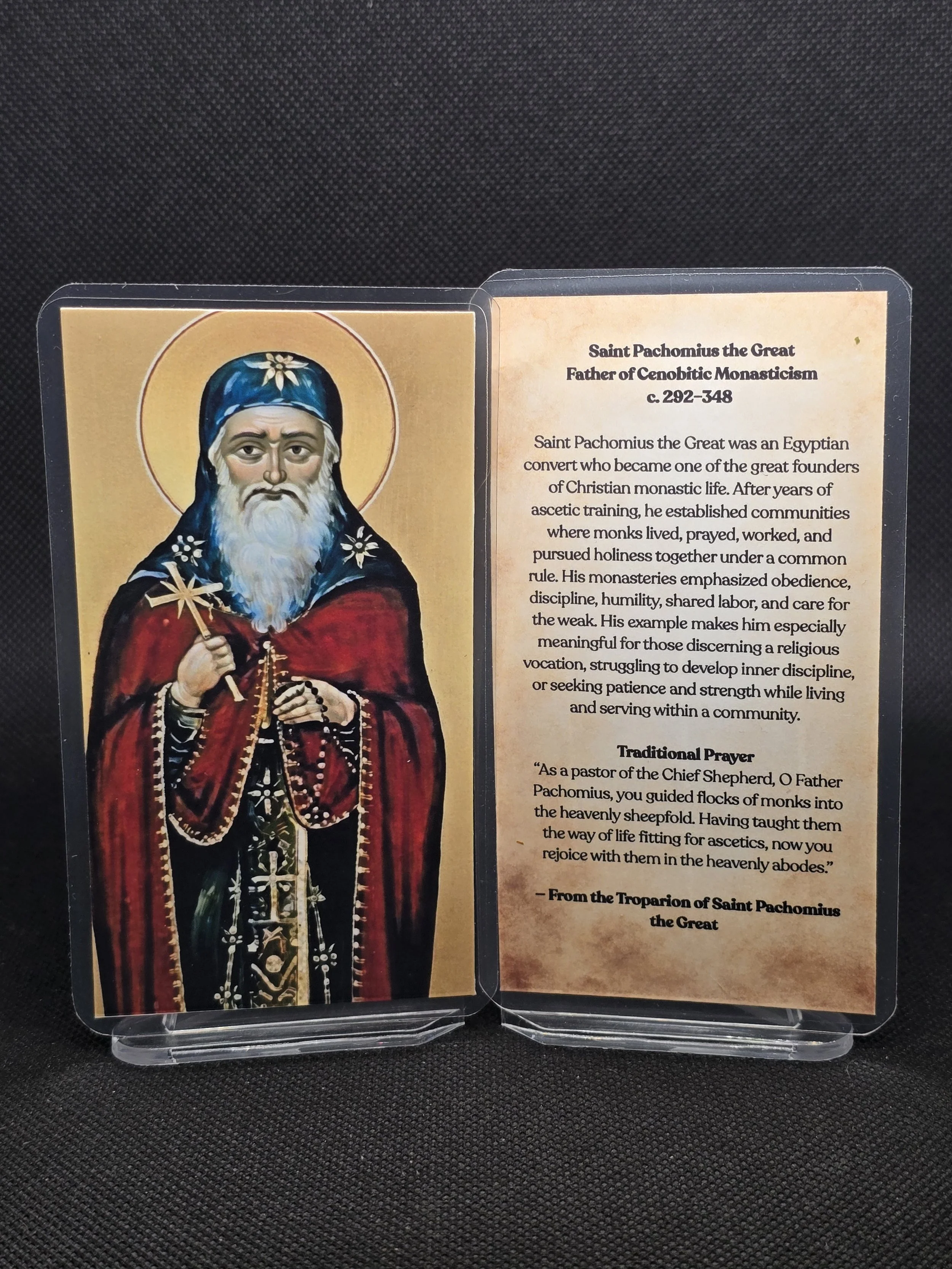
THE LIFE & STORY
Pachomius was born into a pagan family in Upper Egypt around AD 292. His early life gave no indication that he would become one of the most influential spiritual architects in Christian history. As a young man, he was forcibly conscripted into the Roman army during the reign of Emperor Constantine.
While held with other recruits, he experienced a moment that changed his life.
Local Christians, unknown to him and expecting nothing in return, brought food, water, and consolation to the imprisoned soldiers. Pachomius asked why strangers would show such kindness. He was told that they did it for the love of Christ.
That act of mercy became the seed of his conversion.
After completing his military obligation, Pachomius sought baptism and committed himself to learning the Christian faith. He withdrew into the desert under the guidance of an older hermit named Palamon, embracing rigorous fasting, prayer, and silence.
Yet something stirred within him.
While living as a solitary ascetic, Pachomius sensed that not all souls were called to complete isolation. He perceived that many desired the desert but lacked guidance and stability. Through prayer, he received a conviction that God was calling him to build a new form of monastic life, one that combined ascetic discipline with communal structure.
He established his first monastery at Tabennesi along the Nile River.
This was revolutionary.
Instead of scattered hermits, Pachomius created organized communities where monks lived under a common rule, shared work, prayed together at fixed hours, and practiced obedience to a superior. He wrote one of the earliest monastic rules, outlining daily rhythms of prayer, labor, silence, and charity.
Life under Pachomius was disciplined.
Monks wove baskets, copied texts, cared for the sick, and supported one another spiritually. Obedience was central. Humility was cultivated intentionally. Individualism was slowly reshaped into shared life.
His communities grew rapidly. Within a few decades, thousands of monks and nuns lived under his guidance across multiple monasteries. His structure influenced later monastic rules, including those that would shape both Eastern and Western Christian monasticism.
Despite rapid growth, Pachomius remained deeply humble. He did not seek prominence. He emphasized repentance, vigilance of thought, and brotherly love. He warned against spiritual pride and insisted that discipline must always serve charity.
Near the end of his life, a plague swept through the region. Pachomius personally cared for the sick within his communities. Eventually he contracted illness himself and died around AD 348.
He left behind not merely buildings, but a living tradition.
His vision reshaped Christian spirituality. Through him, the desert became not only a place of solitude, but a school of communion.
-
MIRACLES & PATRONAGE
Patron Saint Of:
Vocations and discernment of calling
Inner discipline and spiritual stability
Strength in community life
Protection against spiritual pride
Perseverance in structured spiritual practice
Saint Pachomius’ miracle tradition centers on spiritual transformation rather than dramatic signs.
During his lifetime, many who entered his monasteries reported profound interior change, freedom from chaotic thoughts, and renewed purpose. His leadership created environments where wounded souls found stability and direction.
After his death, devotion to him spread through Egyptian monasticism and beyond. Monks and laypeople alike testified to receiving clarity in vocation and strength during seasons of spiritual confusion through his intercession.
He is especially invoked by those discerning religious life, struggling with discipline, or feeling strained within community settings. His intercession is sought by those who desire structure without rigidity and obedience without fear.
Saint Pachomius continues to guide those who seek God not only in silence, but in shared life.
-
PRAYERS
Short Traditional Invocation
Saint Pachomius the Great, father of community life, pray for us.
Personal Devotional Prayer
Saint Pachomius, humble builder of spiritual households,
you who transformed solitude into sacred community,
I come to you seeking direction and strength.You understand the tension between freedom and obedience.
You understand the difficulty of living closely with others.
You understand the slow work of shaping the soul through discipline.Stand beside me now.
Intercede for me as I discern my calling.
Intercede for me when routine feels burdensome.
Intercede for me when community feels challenging or overwhelming.Ask Christ to grant me humility.
Ask Him to steady my heart in times of frustration.
Ask Him to give me perseverance in small daily acts of faithfulness.Teach me how to live with structure without losing joy.
Teach me how to obey without resentment.
Teach me how to love those placed beside me.Saint Pachomius, you believed that holiness grows in shared prayer and shared sacrifice.
Help me embrace the life God is shaping for me.
Help me trust that discipline is not restriction, but protection.Carry my intentions before the throne of mercy.
Hold my name in your prayer.
Guard my vocation and strengthen my resolve.May your witness remind me that growth is gradual,
that obedience refines the heart,
and that community can become a place of healing.Amen.
-
FAQ
What is Saint Pachomius the Great known for?
He is known as the founder of cenobitic monasticism, organizing monks into structured communities governed by a common rule of prayer, labor, and obedience.When is his feast day?
May 9 in the Eastern Orthodox calendar and May 14 in the Roman Catholic calendar, with commemorations in the Coptic tradition.Which Christian traditions venerate Saint Pachomius?
He is venerated by Oriental Orthodox Christians, Eastern Orthodox Christians, and the Universal Catholic Church.Why do people pray to Saint Pachomius for vocations and discipline?
Because he created a spiritual framework that helped countless believers grow in stability, humility, and perseverance. His intercession is sought by those discerning their calling or striving to live faithfully within structured spiritual commitments.