 Image 1 of 1
Saint Padre Pio Prayer Card – For Healing, Confession, Spiritual Warfare, Suffering & Trust in God
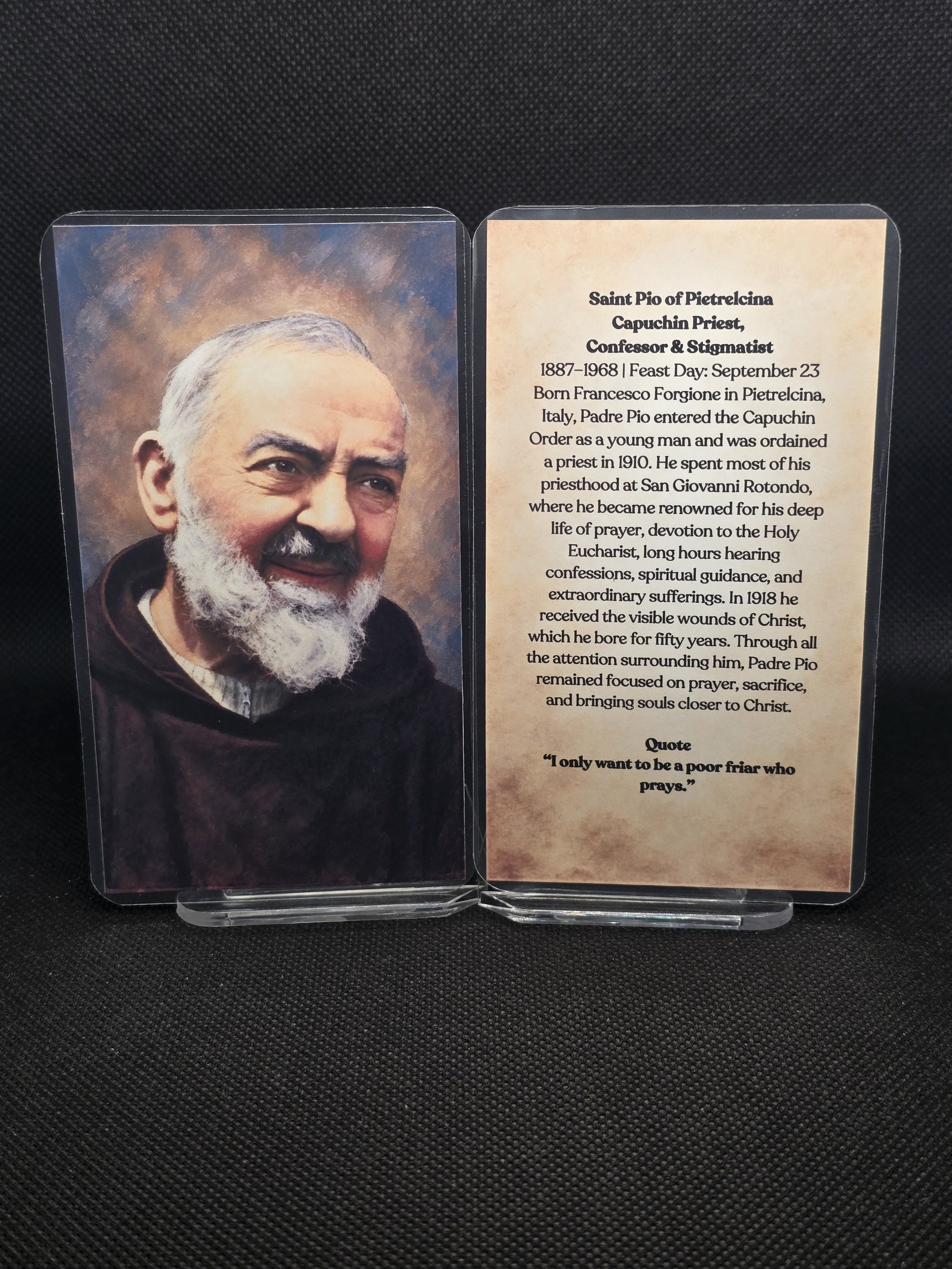
Saint Pio of Pietrelcina, known throughout the world simply as Padre Pio, was a Capuchin Franciscan priest whose extraordinary life became centered upon the Eucharist, Confession, prayer, suffering, spiritual direction, and complete surrender to Jesus Christ. For approximately fifty years he bore the visible wounds associated with the Passion of Christ, while thousands traveled to the remote Italian town of San Giovanni Rotondo seeking his prayers, counsel, and ministry in the confessional.
Padre Pio’s story speaks especially powerfully to people carrying chronic illness, physical pain, anxiety, spiritual struggles, difficult temptations, grief, family concerns, the need for conversion, and situations requiring deep trust in God. He is also beloved by people seeking a stronger prayer life, deeper devotion to the Eucharist, courage to return to Confession, and perseverance when suffering seems to have no clear purpose.
His life should not be reduced to extraordinary phenomena. Padre Pio repeatedly directed attention away from himself and toward Christ, particularly through the Mass, the Sacrament of Reconciliation, prayer for others, and practical care for the sick. The hospital he helped establish and the prayer groups that developed around his ministry reveal that his spirituality joined intense contemplation with concrete love for suffering people.
Each prayer card measures 2.5" x 4.25", is handmade in Austin, Texas, printed on museum-quality photo paper rather than ordinary cardstock, and double laminated for durability. Every card is made to order and prepared prayerfully, with the recipient and their intentions brought before Christ while asking Saint Pio of Pietrelcina to intercede for their needs.
THE LIFE & STORY
Padre Pio was born Francesco Forgione on May 25, 1887, in the small town of Pietrelcina in southern Italy. His parents, Grazio Forgione and Maria Giuseppa De Nunzio, raised their family in a deeply religious environment, and Francesco showed an attraction to prayer and religious life from an early age.
At twelve years old he received Confirmation and his First Holy Communion. His desire to become a friar continued to grow, and his family made significant sacrifices so that he could receive the education necessary to pursue a religious vocation.
BECOMING BROTHER PIO
On January 6, 1903, sixteen-year-old Francesco entered the novitiate of the Capuchin Friars at Morcone. Later that month he received the Franciscan habit and the religious name Fra Pio, or Brother Pio, taking the name associated with Pope Saint Pius V.
The Capuchin life emphasized poverty, obedience, penance, fraternity, prayer, and the spirituality of Saint Francis of Assisi. Padre Pio would remain unmistakably Franciscan throughout his life, even as unusual spiritual experiences and worldwide attention eventually surrounded him.
He made his solemn religious profession on January 27, 1907, permanently committing himself to the Capuchin way of life. Physical illness complicated his formation, however, and poor health would remain a recurring element of his story from youth until old age.
ORDAINED A PRIEST
Padre Pio was ordained to the priesthood on August 10, 1910, in Benevento. Because of his continuing health problems, he spent considerable time afterward near his family in Pietrelcina rather than living continuously within a friary.
Priesthood quickly became the center of his identity. In later years, people would focus intensely upon the stigmata and stories of extraordinary gifts, but Padre Pio’s daily ministry remained fundamentally priestly: celebrating Mass, hearing Confessions, guiding souls, praying for those who asked for help, and directing people toward Christ.
SAN GIOVANNI ROTONDO
In 1916, Padre Pio was sent to the Capuchin friary at San Giovanni Rotondo, a small town on the Gargano peninsula in southern Italy. What was expected to be another assignment became the place where he would remain for more than fifty years and where virtually every major event of his mature ministry would unfold.
San Giovanni Rotondo gradually changed because of his presence. Pilgrims began arriving from throughout Italy and eventually from around the world, turning a previously remote friary into an international center of prayer, Confession, pilgrimage, and devotion.
THE STIGMATA
On September 20, 1918, while Padre Pio was praying in the choir of the friary church, wounds appeared on his hands, feet, and side corresponding to the traditional wounds of the crucified Christ. These visible wounds became known as the stigmata and remained associated with him for approximately fifty years.
The wounds brought enormous attention, something Padre Pio himself did not seek. Physicians examined him, Church authorities investigated him, pilgrims came to see him, newspapers reported about him, and both devotion and controversy followed him for decades.
For Padre Pio, the wounds were not a spectacle. His spirituality remained centered upon union with the suffering Christ, and the stigmata belonged within a much larger life of sacrifice, prayer, obedience, priesthood, and concern for souls.
FIFTY YEARS BEARING THE WOUNDS OF CHRIST
The visible stigmata remained with Padre Pio from 1918 until shortly before his death in 1968. Bandages frequently covered his hands, and photographs of him celebrating Mass often show those coverings clearly.
Living for decades with painful wounds made suffering more than a theological subject for Padre Pio. His body carried chronic illness and pain throughout much of his life, allowing those who suffer physically to encounter a saint who knew prolonged weakness rather than only temporary hardship.
His life does not promise that prayer will always remove suffering immediately. Instead, Padre Pio repeatedly demonstrates the Christian conviction that suffering can be brought into union with Christ rather than endured as though God were absent from it.
THE MASS AT THE CENTER OF HIS LIFE
The celebration of the Eucharist stood at the heart of Padre Pio’s spirituality. The Vatican’s official biography of him describes the celebration of Holy Mass as the highest point of his apostolic activity, and people traveled tremendous distances simply to attend his Mass.
His celebrations were known for intense recollection and could be lengthy because of the depth of his prayer. Those who attended frequently described the impression that Padre Pio was not merely performing a ritual but entering deeply into the mystery of Christ’s sacrifice.
For Christians struggling with distraction, routine, or loss of reverence toward the Eucharist, Padre Pio remains a powerful spiritual guide. His entire priestly life points toward the altar as the place where the sacrifice of Christ becomes present sacramentally and where the Christian learns to offer his or her own life with Him.
THE CONFESSIONAL
Padre Pio spent countless hours hearing Confessions and became one of the twentieth century’s most famous ministers of the Sacrament of Reconciliation. People sometimes waited days for an opportunity to confess to him because of the enormous number seeking spiritual guidance.
He was known as a demanding confessor rather than one who treated sin casually. Accounts from penitents describe a priest who could be direct and uncompromising while also showing profound concern for genuine repentance and lasting conversion.
His popularity in the confessional reflects something essential about his spirituality. Padre Pio did not merely fascinate people with extraordinary phenomena; he continually directed them toward repentance, sacramental grace, amendment of life, and reconciliation with God.
FOR THOSE RETURNING TO CONFESSION
Many Christians experience fear or embarrassment after being away from Confession for years. Shame can convince someone that returning will be humiliating, while repeated sin can create the false impression that there is little point in confessing again.
Padre Pio’s life strongly challenges that despair. He devoted an enormous portion of his priesthood to reconciliation because he understood both the seriousness of sin and the greater power of God’s mercy when a person genuinely turns back toward Him.
A Padre Pio prayer card can therefore be especially meaningful for someone preparing to return to Confession after a long absence. His intercession may be sought for honesty, contrition, courage, perseverance, and the grace to begin again.
SPIRITUAL DIRECTION
Padre Pio guided a vast number of spiritual sons and daughters, both personally and through correspondence. His letters reveal an intense concern with prayer, temptation, discouragement, humility, obedience, suffering, discernment, and confidence in Divine Providence.
His spiritual direction was practical as well as mystical. Again and again, he encouraged people not to become consumed by fear, scruples, or constant examination of themselves, but instead to place greater confidence in God and continue faithfully performing the duties placed before them.
That balance helps explain why devotion to Padre Pio remains strong among people struggling with anxiety and spiritual discouragement. His spirituality recognized the seriousness of spiritual battle without allowing fear to become greater than trust in God.
PRAYER AS THE KEY TO GOD’S HEART
Padre Pio lived an extraordinarily intense life of prayer. The Vatican biography preserves one of his most beautiful teachings:
“In books we seek God, in prayer we find him. Prayer is the key which opens God’s heart.”
These words summarize much of his life. Study could teach someone about God, but Padre Pio insisted that personal prayer brought the soul into living relationship with Him.
For someone trying to establish a daily prayer rule, return to prayer after a period of dryness, or learn to remain with God during suffering, Padre Pio offers a model of persistent prayer that does not depend upon emotional consolation.
“PRAY, HOPE, AND DON’T WORRY”
One of the sayings most closely associated with Padre Pio is his encouragement to pray, hope, and not surrender to worry. The phrase has endured because it captures his repeated insistence that anxiety about the future should be answered with prayerful confidence in God.
That teaching does not mean pretending that suffering, illness, financial problems, family crises, or frightening circumstances are insignificant. Padre Pio experienced more than enough hardship to know otherwise, but he continually redirected fear away from endless speculation and toward trust in Divine Providence.
His spirituality therefore remains especially meaningful for people whose minds continually return to what might go wrong. Prayer does not eliminate every uncertainty, but it prevents uncertainty from becoming the final authority over the heart.
SPIRITUAL WARFARE
Padre Pio’s writings and early biographies contain numerous accounts of severe spiritual trials, temptations, and experiences interpreted within traditional Christian language as attacks from demonic forces. He took the reality of spiritual warfare seriously and repeatedly emphasized prayer, the sacraments, humility, obedience, and trust in God as essential weapons in the Christian life.
Devotion to Padre Pio is therefore common among people seeking courage during intense temptation or spiritual struggle. His example keeps spiritual warfare centered upon Christ rather than fascination with evil, because Padre Pio’s response was consistently deeper prayer, greater humility, Confession, the Eucharist, and confidence in God.
For Christians experiencing fear around spiritual warfare, his life also offers an important balance. Evil is not presented as equal to God, and the Christian response is not panic but fidelity to Christ.
HIS GUARDIAN ANGEL
Padre Pio had an especially strong devotion to the guardian angels, frequently encouraging his spiritual children to call upon their angels for assistance. Accounts surrounding his ministry also contain numerous stories in which people believed their guardian angels played a role in bringing intentions or requests to him.
Whatever extraordinary stories may surround this devotion, the underlying teaching is firmly rooted in traditional Christianity: God assigns angels to assist and guard human beings, and Christians may confidently ask for their heavenly protection.
Padre Pio’s devotion to the guardian angels makes his prayer card especially meaningful for families praying for children, travelers, soldiers, people in dangerous occupations, and anyone seeking greater awareness of God’s providential care.
HIS DEVOTION TO THE BLESSED VIRGIN MARY
Padre Pio possessed a profound devotion to the Mother of God, particularly through the Rosary. Witnesses remembered him carrying and praying the Rosary repeatedly throughout the day, making Marian prayer part of the ordinary rhythm of his life.
His Marian devotion was never separated from Christ. Mary led him more deeply toward Jesus, particularly toward His Passion, Eucharistic presence, and sacrificial love.
For people trying to build a more consistent Rosary habit, Padre Pio offers an especially compelling example. The Rosary was not simply an occasional devotion for him but a continual companion through prayer, suffering, ministry, and old age.
SUFFERING & CHRONIC ILLNESS
Physical weakness followed Padre Pio from youth. Respiratory problems, fevers, digestive illness, chronic pain, the wounds associated with the stigmata, and eventually the difficulties of old age meant that suffering accompanied almost every period of his life.
His holiness therefore did not depend upon perfect health. Padre Pio continued praying, hearing Confessions, celebrating Mass, guiding people, and developing charitable works while carrying physical limitations that repeatedly complicated his life.
For someone living with chronic pain or illness, this is an important aspect of his story. Padre Pio may be approached not only as a saint associated with reported healings, but as a man who personally knew what it meant to continue serving God while the body remained weak.
FOR HEALING
Countless people sought Padre Pio’s prayers for physical healing during his lifetime, and reports of extraordinary favors became closely associated with his ministry. His canonization itself followed the Church’s formal investigation and recognition of a healing presented in connection with his intercession.
Christian devotion to Padre Pio for healing should still place God rather than the saint at the center. Saints intercede; God heals according to His wisdom and providence, and prayer can seek physical healing while also asking for strength, peace, perseverance, and grace when a cure does not come in the way hoped for.
His prayer card is therefore especially fitting for hospital patients, people awaiting surgery, families facing serious diagnoses, those with chronic illness, and anyone carrying a medical intention before God.
FALSE ACCUSATIONS, CONTROVERSY & OBEDIENCE
Padre Pio’s life was not one of constant public approval. The extraordinary attention surrounding the stigmata produced accusations, investigations, conflicting reports, ecclesiastical restrictions, and periods during which his public ministry was sharply limited.
In 1931, restrictions prevented him from hearing Confessions and from celebrating Mass publicly. Padre Pio accepted the decision in obedience, continuing to celebrate privately and refusing to turn his personal suffering into rebellion against Church authority.
The restrictions were eventually lifted, but the episode became an important part of his spiritual witness. Padre Pio’s obedience is especially striking because the restrictions affected precisely the priestly ministries he loved most.
“MAY GOD’S WILL BE DONE”
When severe restrictions were communicated to Padre Pio in 1931, accounts from the friary preserve his response as an acceptance of God’s will. He was deeply hurt by the decision but submitted rather than building a movement around himself or encouraging supporters to defy legitimate authority.
This period distinguishes authentic devotion to Padre Pio from fascination with miracles alone. His holiness was tested not only through physical suffering but through humiliation, misunderstanding, and obedience when obedience personally cost him something.
Christians experiencing false accusations, damaged reputations, unfair treatment, or circumstances they cannot immediately correct may therefore find particular meaning in this chapter of his life. Padre Pio did not pretend injustice was painless, but he refused to let resentment become his spiritual master.
CASA SOLLIEVO DELLA SOFFERENZA
Padre Pio’s concern for suffering eventually took concrete form in Casa Sollievo della Sofferenza, the House for the Relief of Suffering. The hospital opened in San Giovanni Rotondo on May 5, 1956, becoming one of the major charitable works associated with his life.
The hospital demonstrates that Padre Pio’s response to suffering was not merely to tell sick people to endure it. He wanted excellent medical care available to those who needed it, joining prayer for healing with serious human efforts to relieve pain and treat disease.
This union of medicine and faith remains one of the most important aspects of his legacy. Padre Pio could believe deeply in miracles while simultaneously supporting physicians, hospitals, scientific medicine, and professional care for the sick.
PADRE PIO PRAYER GROUPS
Padre Pio encouraged the formation of prayer groups, particularly in response to appeals for renewed prayer during the upheavals of the twentieth century. These groups developed internationally and became another major part of his spiritual legacy.
The prayer groups emphasize a truth visible throughout Padre Pio’s life: Christian prayer is not meant to be isolated from charity, the Eucharist, and ordinary responsibilities. Prayer strengthens people to live differently, serve others, endure suffering, and remain faithful when circumstances become difficult.
For families or parish groups seeking deeper communal prayer, Padre Pio’s example provides a model that combines personal devotion with the life of the wider Christian community.
MIRACLES & EXTRAORDINARY GIFTS
Many extraordinary phenomena have been attributed to Padre Pio, including reported healings, knowledge of hidden matters, mystical experiences, fragrances associated with his presence, and accounts of bilocation. These stories form a large part of popular devotion to him and were reported by numerous people during and after his lifetime.
His sanctity, however, does not depend upon accepting every popular story circulated about him. The Church ultimately canonized Padre Pio because of his life of heroic Christian virtue and the canonically recognized miracle connected with his cause, not because every anecdote associated with him was formally authenticated.
This distinction allows devotion to remain both reverent and historically responsible. The extraordinary should never obscure the ordinary holiness visible in decades of prayer, Confession, Eucharistic devotion, obedience, charity, and perseverance.
FOR ANXIETY & WORRY
Padre Pio’s encouragement toward hope has made him especially meaningful for people whose lives are dominated by worry. His counsel continually turned people toward prayer, trust in God, attention to the present duty, and confidence that Divine Providence remains active even when the future cannot be controlled.
Anxiety can tempt a person to live constantly in imagined futures rather than the present moment. Padre Pio’s spirituality answers that temptation by returning the soul again and again to prayer and the conviction that God already knows what lies ahead.
Those struggling with worry may therefore ask his intercession for peace, perseverance, wise action, and the ability to entrust what cannot presently be solved to God.
FOR FAMILY INTENTIONS
Thousands of people brought family problems to Padre Pio during his lifetime. Parents sought prayers for children, spouses brought troubled marriages, families asked for healing, and people requested help for relatives who had abandoned their faith.
His prayer card remains especially appropriate for a family prayer corner or for someone carrying a loved one in persistent prayer. Padre Pio’s ministry reminds Christians that intercession for another person may require patience and perseverance rather than immediate visible results.
Family members can ask his prayers for conversion, reconciliation, healing, protection, stronger marriages, return to the sacraments, and the grace to love someone faithfully even when their situation cannot be changed quickly.
FOR CONVERSION
Padre Pio regarded the salvation of souls as far more important than his own comfort. His long hours in the confessional and demanding spiritual direction were ordered toward genuine conversion rather than simply making people feel reassured.
People who approached him sometimes encountered a priest unwilling to minimize serious sin. Yet his firmness came from the conviction that reconciliation with God was possible and worth the difficult work of repentance.
For someone praying for their own conversion or the return of a loved one to Christ, Padre Pio provides a powerful intercessor. His entire priesthood was spent helping people turn again toward God.
HIS FINAL YEARS
As Padre Pio aged, his physical strength declined considerably. By the later 1960s he required increasing assistance, sometimes celebrated Mass seated, and eventually used a wheelchair.
Yet pilgrims continued coming to San Giovanni Rotondo, and Padre Pio remained spiritually connected with the enormous family that had developed around his ministry. His increasing weakness gradually stripped away many of the activities that had defined his public life, leaving prayer and suffering increasingly at the center.
His final years therefore complete the pattern visible throughout his life. Padre Pio’s value did not depend upon how much activity his body could still perform, and physical decline did not make his vocation meaningless.
HIS LAST MASS
On September 22, 1968, Padre Pio celebrated what would become his final Mass. He was extremely weak and nearly collapsed during the celebration, requiring assistance afterward.
Later that day he gave a final blessing to the people gathered at San Giovanni Rotondo. The priest who had spent decades blessing, confessing, counseling, and praying for others was nearing the end of a life almost entirely spent within the same friary.
HIS DEATH
Padre Pio died during the early hours of September 23, 1968, at the age of eighty-one. The date would later become his liturgical feast and the day on which Christians around the world commemorate Saint Pio of Pietrelcina.
His death brought enormous public mourning because devotion to him had already spread far beyond San Giovanni Rotondo. The friar who had entered the Capuchins as an obscure teenager from Pietrelcina had become one of the most widely recognized religious figures of the twentieth century.
BEATIFICATION & CANONIZATION
Pope Saint John Paul II beatified Padre Pio on May 2, 1999, after the Church completed the required examination of his life, virtues, and a healing presented for the cause. His liturgical commemoration was assigned to September 23.
Following recognition of another miracle, Pope John Paul II canonized him on June 16, 2002, in Saint Peter’s Square. Padre Pio was henceforth formally venerated throughout the Church as Saint Pio of Pietrelcina.
His canonization did not declare every extraordinary story ever told about him historically certain. It formally recognized the holiness of the Capuchin priest whose life had been marked by prayer, the Cross, sacramental ministry, obedience, charity, and extraordinary devotion to Christ.
HIS FEAST DAY
The feast of Saint Pio of Pietrelcina is celebrated on September 23, the anniversary of his death in 1968. Pope John Paul II placed his liturgical memorial on the Roman Calendar following his canonization.
September 23 has consequently become an important day at Padre Pio shrines, prayer groups, parishes, and homes throughout the world. Many devotees attend Mass, pray the Rosary, seek Confession, or bring particular intentions to God through Saint Pio’s intercession.
HIS RELICS IN SAN GIOVANNI ROTONDO
Padre Pio was originally buried at San Giovanni Rotondo, where his grave quickly became a destination for pilgrims. His remains were canonically exhumed in 2008 so that their condition could be examined and appropriate conservation measures could be undertaken.
His relics are now venerated at San Giovanni Rotondo, the place most intimately connected with his life and ministry. Pilgrims continue traveling there from around the world to pray, attend Mass, visit the places where he lived, and entrust intentions to his intercession.
The preservation of his remains should be understood within the ancient Christian practice of honoring the relics of saints. The physical remains are not worshipped; they are treated reverently because they belonged to a person whose body was consecrated to God and whose life has been formally recognized for holiness.
THE QUOTE
One of Padre Pio’s teachings preserved in the official account of his life beautifully summarizes the foundation beneath everything extraordinary associated with him:
“In books we seek God, in prayer we find him. Prayer is the key which opens God’s heart.”
The line brings the focus back to something available to every Christian. Most people will never experience the extraordinary events associated with Padre Pio, but every person can pray, seek God, repent, receive the sacraments, grow in charity, and learn to trust Him more deeply.
FAQ
Who was Padre Pio? Saint Pio of Pietrelcina was an Italian Capuchin Franciscan priest who lived from 1887 to 1968. He became famous for his stigmata, intense celebration of Mass, extraordinary ministry in the confessional, spiritual direction, prayer, care for the sick, and the remarkable number of people who sought his help.
What was Padre Pio’s birth name? He was born Francesco Forgione in Pietrelcina, Italy, on May 25, 1887. He received the name Pio after entering the Capuchin Franciscan novitiate as a young man.
When was Padre Pio ordained? Padre Pio was ordained a priest on August 10, 1910, in Benevento. His priesthood would eventually center upon the Eucharist, Confession, spiritual direction, prayer, and ministry to enormous numbers of pilgrims.
Where did Padre Pio live? Padre Pio spent the major portion of his mature life at the Capuchin friary in San Giovanni Rotondo, Italy. He arrived there in 1916 and remained associated with the friary until his death in 1968.
Did Padre Pio really have the stigmata? Visible wounds associated with the wounds of Christ appeared on Padre Pio in September 1918 and remained associated with him for approximately fifty years. The wounds were examined during his lifetime and became one of the principal reasons enormous public attention surrounded him.
How long did Padre Pio bear the stigmata? The visible wounds remained for roughly fifty years, from 1918 until shortly before his death in September 1968. Padre Pio himself did not present the wounds as entertainment, but understood his suffering within his devotion to the Passion of Christ.
Why is Padre Pio associated with Confession? He spent many years hearing Confessions for long hours and became famous as a demanding but deeply sought-after confessor. Pilgrims traveled great distances to receive the Sacrament of Reconciliation from him and seek spiritual guidance.
Is Padre Pio associated with healing? Yes, many people sought his prayers for healing during his lifetime, and numerous favors have been reported through his intercession. The Church formally recognized miracles during the canonical processes leading to his beatification and canonization.
Can I ask Padre Pio to pray for a medical condition? Yes, Christians may ask Saint Pio to intercede for healing, strength, peace, and perseverance during illness. His own prolonged physical suffering also makes him particularly meaningful for people whose illnesses do not resolve quickly.
Is Padre Pio good for someone with anxiety? His teachings strongly emphasize prayer, hope, confidence in God, and refusal to surrender to excessive worry. People struggling with anxiety often find his spirituality helpful because it repeatedly directs fear back toward prayer and trust in Divine Providence.
Is Padre Pio associated with spiritual warfare? Accounts of his life contain numerous descriptions of severe temptations and spiritual battles, and he took the reality of demonic temptation seriously. His response remained centered upon Christ through prayer, Confession, the Eucharist, humility, obedience, and trust rather than fear or fascination with evil.
Was Padre Pio devoted to the Rosary? Yes, the Rosary occupied an important place in his daily spiritual life. He was frequently seen praying it and strongly encouraged Marian devotion among those seeking his spiritual guidance.
Did Padre Pio believe in guardian angels? Yes, Padre Pio had a particularly strong devotion to guardian angels and encouraged his spiritual children to seek their assistance. Numerous popular stories developed around this aspect of his spirituality, while the underlying devotion itself belongs to longstanding Christian teaching about the ministry of angels.
Why was Padre Pio restricted by Church authorities? The unusual phenomena surrounding him, enormous publicity, conflicting claims, and concerns reaching Church authorities resulted in investigations and restrictions during portions of his ministry. Padre Pio submitted to the restrictions, and his public priestly ministry was later restored.
Did Padre Pio obey the restrictions placed upon him? Yes, accounts from his Capuchin community emphasize that he followed the restrictions imposed upon him even though they caused significant personal suffering. His obedience during this period became an important part of the Church’s later evaluation of his life.
What was Casa Sollievo della Sofferenza? The House for the Relief of Suffering was the hospital Padre Pio helped establish at San Giovanni Rotondo, opening in 1956. The institution expressed his belief that love for suffering people should include serious medical care as well as prayer.
What are Padre Pio Prayer Groups? These are communities inspired by Padre Pio’s encouragement of organized prayer, Eucharistic devotion, and Christian life. Prayer Groups developed internationally and remain an important part of his spiritual legacy.
When did Padre Pio die? Padre Pio died on September 23, 1968, at San Giovanni Rotondo. He was eighty-one years old and had spent more than half a century connected with the Capuchin community there.
When was Padre Pio beatified? Pope Saint John Paul II beatified Padre Pio on May 2, 1999. The beatification followed the Church’s investigation of his virtues and the required recognition of a miracle.
When was Padre Pio canonized? Pope Saint John Paul II canonized Saint Pio of Pietrelcina on June 16, 2002, in Saint Peter’s Square. His feast is celebrated each year on September 23.
Where are Padre Pio’s relics? His relics are venerated at San Giovanni Rotondo in Italy, the town where he spent the great majority of his priestly ministry. The site remains one of the major Christian pilgrimage destinations associated with a modern saint.
Who would this Padre Pio prayer card make a meaningful gift for? It is especially fitting for someone facing illness, surgery, chronic pain, anxiety, spiritual warfare, difficult temptations, grief, family problems, or a return to Confession. It is also meaningful for people devoted to the Eucharist, the Rosary, guardian angels, spiritual direction, or anyone simply trying to deepen their prayer and trust in God.
THE MAIN MESSAGE OF SAINT PADRE PIO’S LIFE
Padre Pio’s life contains enough extraordinary events to draw attention almost endlessly, but the deepest message of his life is far simpler. He wanted people to pray, receive the sacraments, repent of sin, love Jesus Christ, remain close to the Eucharist, entrust themselves to God, and persevere when carrying a cross.
The stigmata made him famous, but the confessional reveals what he wanted to accomplish with that fame. People came because they had heard about miracles and extraordinary phenomena, yet many left having gone to Confession, returned to prayer, reconciled with God, or begun taking their Christian life seriously again.
His hospital reveals the same pattern in another form. Padre Pio did not respond to suffering with words alone but helped create an institution dedicated to relieving it, joining confidence in supernatural grace with compassion, medicine, and practical care.
For anyone carrying an illness, a persistent sin, anxiety, spiritual darkness, family pain, or another burden that cannot simply be removed, Saint Pio offers a spirituality built upon hope rather than denial. His own life contained suffering, misunderstanding, physical weakness, restrictions, temptation, and enormous responsibility, yet he continued returning to the same foundation: Christ, the Eucharist, Confession, prayer, and trust in God.
Saint Pio of Pietrelcina, known throughout the world simply as Padre Pio, was a Capuchin Franciscan priest whose extraordinary life became centered upon the Eucharist, Confession, prayer, suffering, spiritual direction, and complete surrender to Jesus Christ. For approximately fifty years he bore the visible wounds associated with the Passion of Christ, while thousands traveled to the remote Italian town of San Giovanni Rotondo seeking his prayers, counsel, and ministry in the confessional.
Padre Pio’s story speaks especially powerfully to people carrying chronic illness, physical pain, anxiety, spiritual struggles, difficult temptations, grief, family concerns, the need for conversion, and situations requiring deep trust in God. He is also beloved by people seeking a stronger prayer life, deeper devotion to the Eucharist, courage to return to Confession, and perseverance when suffering seems to have no clear purpose.
His life should not be reduced to extraordinary phenomena. Padre Pio repeatedly directed attention away from himself and toward Christ, particularly through the Mass, the Sacrament of Reconciliation, prayer for others, and practical care for the sick. The hospital he helped establish and the prayer groups that developed around his ministry reveal that his spirituality joined intense contemplation with concrete love for suffering people.
Each prayer card measures 2.5" x 4.25", is handmade in Austin, Texas, printed on museum-quality photo paper rather than ordinary cardstock, and double laminated for durability. Every card is made to order and prepared prayerfully, with the recipient and their intentions brought before Christ while asking Saint Pio of Pietrelcina to intercede for their needs.
THE LIFE & STORY
Padre Pio was born Francesco Forgione on May 25, 1887, in the small town of Pietrelcina in southern Italy. His parents, Grazio Forgione and Maria Giuseppa De Nunzio, raised their family in a deeply religious environment, and Francesco showed an attraction to prayer and religious life from an early age.
At twelve years old he received Confirmation and his First Holy Communion. His desire to become a friar continued to grow, and his family made significant sacrifices so that he could receive the education necessary to pursue a religious vocation.
BECOMING BROTHER PIO
On January 6, 1903, sixteen-year-old Francesco entered the novitiate of the Capuchin Friars at Morcone. Later that month he received the Franciscan habit and the religious name Fra Pio, or Brother Pio, taking the name associated with Pope Saint Pius V.
The Capuchin life emphasized poverty, obedience, penance, fraternity, prayer, and the spirituality of Saint Francis of Assisi. Padre Pio would remain unmistakably Franciscan throughout his life, even as unusual spiritual experiences and worldwide attention eventually surrounded him.
He made his solemn religious profession on January 27, 1907, permanently committing himself to the Capuchin way of life. Physical illness complicated his formation, however, and poor health would remain a recurring element of his story from youth until old age.
ORDAINED A PRIEST
Padre Pio was ordained to the priesthood on August 10, 1910, in Benevento. Because of his continuing health problems, he spent considerable time afterward near his family in Pietrelcina rather than living continuously within a friary.
Priesthood quickly became the center of his identity. In later years, people would focus intensely upon the stigmata and stories of extraordinary gifts, but Padre Pio’s daily ministry remained fundamentally priestly: celebrating Mass, hearing Confessions, guiding souls, praying for those who asked for help, and directing people toward Christ.
SAN GIOVANNI ROTONDO
In 1916, Padre Pio was sent to the Capuchin friary at San Giovanni Rotondo, a small town on the Gargano peninsula in southern Italy. What was expected to be another assignment became the place where he would remain for more than fifty years and where virtually every major event of his mature ministry would unfold.
San Giovanni Rotondo gradually changed because of his presence. Pilgrims began arriving from throughout Italy and eventually from around the world, turning a previously remote friary into an international center of prayer, Confession, pilgrimage, and devotion.
THE STIGMATA
On September 20, 1918, while Padre Pio was praying in the choir of the friary church, wounds appeared on his hands, feet, and side corresponding to the traditional wounds of the crucified Christ. These visible wounds became known as the stigmata and remained associated with him for approximately fifty years.
The wounds brought enormous attention, something Padre Pio himself did not seek. Physicians examined him, Church authorities investigated him, pilgrims came to see him, newspapers reported about him, and both devotion and controversy followed him for decades.
For Padre Pio, the wounds were not a spectacle. His spirituality remained centered upon union with the suffering Christ, and the stigmata belonged within a much larger life of sacrifice, prayer, obedience, priesthood, and concern for souls.
FIFTY YEARS BEARING THE WOUNDS OF CHRIST
The visible stigmata remained with Padre Pio from 1918 until shortly before his death in 1968. Bandages frequently covered his hands, and photographs of him celebrating Mass often show those coverings clearly.
Living for decades with painful wounds made suffering more than a theological subject for Padre Pio. His body carried chronic illness and pain throughout much of his life, allowing those who suffer physically to encounter a saint who knew prolonged weakness rather than only temporary hardship.
His life does not promise that prayer will always remove suffering immediately. Instead, Padre Pio repeatedly demonstrates the Christian conviction that suffering can be brought into union with Christ rather than endured as though God were absent from it.
THE MASS AT THE CENTER OF HIS LIFE
The celebration of the Eucharist stood at the heart of Padre Pio’s spirituality. The Vatican’s official biography of him describes the celebration of Holy Mass as the highest point of his apostolic activity, and people traveled tremendous distances simply to attend his Mass.
His celebrations were known for intense recollection and could be lengthy because of the depth of his prayer. Those who attended frequently described the impression that Padre Pio was not merely performing a ritual but entering deeply into the mystery of Christ’s sacrifice.
For Christians struggling with distraction, routine, or loss of reverence toward the Eucharist, Padre Pio remains a powerful spiritual guide. His entire priestly life points toward the altar as the place where the sacrifice of Christ becomes present sacramentally and where the Christian learns to offer his or her own life with Him.
THE CONFESSIONAL
Padre Pio spent countless hours hearing Confessions and became one of the twentieth century’s most famous ministers of the Sacrament of Reconciliation. People sometimes waited days for an opportunity to confess to him because of the enormous number seeking spiritual guidance.
He was known as a demanding confessor rather than one who treated sin casually. Accounts from penitents describe a priest who could be direct and uncompromising while also showing profound concern for genuine repentance and lasting conversion.
His popularity in the confessional reflects something essential about his spirituality. Padre Pio did not merely fascinate people with extraordinary phenomena; he continually directed them toward repentance, sacramental grace, amendment of life, and reconciliation with God.
FOR THOSE RETURNING TO CONFESSION
Many Christians experience fear or embarrassment after being away from Confession for years. Shame can convince someone that returning will be humiliating, while repeated sin can create the false impression that there is little point in confessing again.
Padre Pio’s life strongly challenges that despair. He devoted an enormous portion of his priesthood to reconciliation because he understood both the seriousness of sin and the greater power of God’s mercy when a person genuinely turns back toward Him.
A Padre Pio prayer card can therefore be especially meaningful for someone preparing to return to Confession after a long absence. His intercession may be sought for honesty, contrition, courage, perseverance, and the grace to begin again.
SPIRITUAL DIRECTION
Padre Pio guided a vast number of spiritual sons and daughters, both personally and through correspondence. His letters reveal an intense concern with prayer, temptation, discouragement, humility, obedience, suffering, discernment, and confidence in Divine Providence.
His spiritual direction was practical as well as mystical. Again and again, he encouraged people not to become consumed by fear, scruples, or constant examination of themselves, but instead to place greater confidence in God and continue faithfully performing the duties placed before them.
That balance helps explain why devotion to Padre Pio remains strong among people struggling with anxiety and spiritual discouragement. His spirituality recognized the seriousness of spiritual battle without allowing fear to become greater than trust in God.
PRAYER AS THE KEY TO GOD’S HEART
Padre Pio lived an extraordinarily intense life of prayer. The Vatican biography preserves one of his most beautiful teachings:
“In books we seek God, in prayer we find him. Prayer is the key which opens God’s heart.”
These words summarize much of his life. Study could teach someone about God, but Padre Pio insisted that personal prayer brought the soul into living relationship with Him.
For someone trying to establish a daily prayer rule, return to prayer after a period of dryness, or learn to remain with God during suffering, Padre Pio offers a model of persistent prayer that does not depend upon emotional consolation.
“PRAY, HOPE, AND DON’T WORRY”
One of the sayings most closely associated with Padre Pio is his encouragement to pray, hope, and not surrender to worry. The phrase has endured because it captures his repeated insistence that anxiety about the future should be answered with prayerful confidence in God.
That teaching does not mean pretending that suffering, illness, financial problems, family crises, or frightening circumstances are insignificant. Padre Pio experienced more than enough hardship to know otherwise, but he continually redirected fear away from endless speculation and toward trust in Divine Providence.
His spirituality therefore remains especially meaningful for people whose minds continually return to what might go wrong. Prayer does not eliminate every uncertainty, but it prevents uncertainty from becoming the final authority over the heart.
SPIRITUAL WARFARE
Padre Pio’s writings and early biographies contain numerous accounts of severe spiritual trials, temptations, and experiences interpreted within traditional Christian language as attacks from demonic forces. He took the reality of spiritual warfare seriously and repeatedly emphasized prayer, the sacraments, humility, obedience, and trust in God as essential weapons in the Christian life.
Devotion to Padre Pio is therefore common among people seeking courage during intense temptation or spiritual struggle. His example keeps spiritual warfare centered upon Christ rather than fascination with evil, because Padre Pio’s response was consistently deeper prayer, greater humility, Confession, the Eucharist, and confidence in God.
For Christians experiencing fear around spiritual warfare, his life also offers an important balance. Evil is not presented as equal to God, and the Christian response is not panic but fidelity to Christ.
HIS GUARDIAN ANGEL
Padre Pio had an especially strong devotion to the guardian angels, frequently encouraging his spiritual children to call upon their angels for assistance. Accounts surrounding his ministry also contain numerous stories in which people believed their guardian angels played a role in bringing intentions or requests to him.
Whatever extraordinary stories may surround this devotion, the underlying teaching is firmly rooted in traditional Christianity: God assigns angels to assist and guard human beings, and Christians may confidently ask for their heavenly protection.
Padre Pio’s devotion to the guardian angels makes his prayer card especially meaningful for families praying for children, travelers, soldiers, people in dangerous occupations, and anyone seeking greater awareness of God’s providential care.
HIS DEVOTION TO THE BLESSED VIRGIN MARY
Padre Pio possessed a profound devotion to the Mother of God, particularly through the Rosary. Witnesses remembered him carrying and praying the Rosary repeatedly throughout the day, making Marian prayer part of the ordinary rhythm of his life.
His Marian devotion was never separated from Christ. Mary led him more deeply toward Jesus, particularly toward His Passion, Eucharistic presence, and sacrificial love.
For people trying to build a more consistent Rosary habit, Padre Pio offers an especially compelling example. The Rosary was not simply an occasional devotion for him but a continual companion through prayer, suffering, ministry, and old age.
SUFFERING & CHRONIC ILLNESS
Physical weakness followed Padre Pio from youth. Respiratory problems, fevers, digestive illness, chronic pain, the wounds associated with the stigmata, and eventually the difficulties of old age meant that suffering accompanied almost every period of his life.
His holiness therefore did not depend upon perfect health. Padre Pio continued praying, hearing Confessions, celebrating Mass, guiding people, and developing charitable works while carrying physical limitations that repeatedly complicated his life.
For someone living with chronic pain or illness, this is an important aspect of his story. Padre Pio may be approached not only as a saint associated with reported healings, but as a man who personally knew what it meant to continue serving God while the body remained weak.
FOR HEALING
Countless people sought Padre Pio’s prayers for physical healing during his lifetime, and reports of extraordinary favors became closely associated with his ministry. His canonization itself followed the Church’s formal investigation and recognition of a healing presented in connection with his intercession.
Christian devotion to Padre Pio for healing should still place God rather than the saint at the center. Saints intercede; God heals according to His wisdom and providence, and prayer can seek physical healing while also asking for strength, peace, perseverance, and grace when a cure does not come in the way hoped for.
His prayer card is therefore especially fitting for hospital patients, people awaiting surgery, families facing serious diagnoses, those with chronic illness, and anyone carrying a medical intention before God.
FALSE ACCUSATIONS, CONTROVERSY & OBEDIENCE
Padre Pio’s life was not one of constant public approval. The extraordinary attention surrounding the stigmata produced accusations, investigations, conflicting reports, ecclesiastical restrictions, and periods during which his public ministry was sharply limited.
In 1931, restrictions prevented him from hearing Confessions and from celebrating Mass publicly. Padre Pio accepted the decision in obedience, continuing to celebrate privately and refusing to turn his personal suffering into rebellion against Church authority.
The restrictions were eventually lifted, but the episode became an important part of his spiritual witness. Padre Pio’s obedience is especially striking because the restrictions affected precisely the priestly ministries he loved most.
“MAY GOD’S WILL BE DONE”
When severe restrictions were communicated to Padre Pio in 1931, accounts from the friary preserve his response as an acceptance of God’s will. He was deeply hurt by the decision but submitted rather than building a movement around himself or encouraging supporters to defy legitimate authority.
This period distinguishes authentic devotion to Padre Pio from fascination with miracles alone. His holiness was tested not only through physical suffering but through humiliation, misunderstanding, and obedience when obedience personally cost him something.
Christians experiencing false accusations, damaged reputations, unfair treatment, or circumstances they cannot immediately correct may therefore find particular meaning in this chapter of his life. Padre Pio did not pretend injustice was painless, but he refused to let resentment become his spiritual master.
CASA SOLLIEVO DELLA SOFFERENZA
Padre Pio’s concern for suffering eventually took concrete form in Casa Sollievo della Sofferenza, the House for the Relief of Suffering. The hospital opened in San Giovanni Rotondo on May 5, 1956, becoming one of the major charitable works associated with his life.
The hospital demonstrates that Padre Pio’s response to suffering was not merely to tell sick people to endure it. He wanted excellent medical care available to those who needed it, joining prayer for healing with serious human efforts to relieve pain and treat disease.
This union of medicine and faith remains one of the most important aspects of his legacy. Padre Pio could believe deeply in miracles while simultaneously supporting physicians, hospitals, scientific medicine, and professional care for the sick.
PADRE PIO PRAYER GROUPS
Padre Pio encouraged the formation of prayer groups, particularly in response to appeals for renewed prayer during the upheavals of the twentieth century. These groups developed internationally and became another major part of his spiritual legacy.
The prayer groups emphasize a truth visible throughout Padre Pio’s life: Christian prayer is not meant to be isolated from charity, the Eucharist, and ordinary responsibilities. Prayer strengthens people to live differently, serve others, endure suffering, and remain faithful when circumstances become difficult.
For families or parish groups seeking deeper communal prayer, Padre Pio’s example provides a model that combines personal devotion with the life of the wider Christian community.
MIRACLES & EXTRAORDINARY GIFTS
Many extraordinary phenomena have been attributed to Padre Pio, including reported healings, knowledge of hidden matters, mystical experiences, fragrances associated with his presence, and accounts of bilocation. These stories form a large part of popular devotion to him and were reported by numerous people during and after his lifetime.
His sanctity, however, does not depend upon accepting every popular story circulated about him. The Church ultimately canonized Padre Pio because of his life of heroic Christian virtue and the canonically recognized miracle connected with his cause, not because every anecdote associated with him was formally authenticated.
This distinction allows devotion to remain both reverent and historically responsible. The extraordinary should never obscure the ordinary holiness visible in decades of prayer, Confession, Eucharistic devotion, obedience, charity, and perseverance.
FOR ANXIETY & WORRY
Padre Pio’s encouragement toward hope has made him especially meaningful for people whose lives are dominated by worry. His counsel continually turned people toward prayer, trust in God, attention to the present duty, and confidence that Divine Providence remains active even when the future cannot be controlled.
Anxiety can tempt a person to live constantly in imagined futures rather than the present moment. Padre Pio’s spirituality answers that temptation by returning the soul again and again to prayer and the conviction that God already knows what lies ahead.
Those struggling with worry may therefore ask his intercession for peace, perseverance, wise action, and the ability to entrust what cannot presently be solved to God.
FOR FAMILY INTENTIONS
Thousands of people brought family problems to Padre Pio during his lifetime. Parents sought prayers for children, spouses brought troubled marriages, families asked for healing, and people requested help for relatives who had abandoned their faith.
His prayer card remains especially appropriate for a family prayer corner or for someone carrying a loved one in persistent prayer. Padre Pio’s ministry reminds Christians that intercession for another person may require patience and perseverance rather than immediate visible results.
Family members can ask his prayers for conversion, reconciliation, healing, protection, stronger marriages, return to the sacraments, and the grace to love someone faithfully even when their situation cannot be changed quickly.
FOR CONVERSION
Padre Pio regarded the salvation of souls as far more important than his own comfort. His long hours in the confessional and demanding spiritual direction were ordered toward genuine conversion rather than simply making people feel reassured.
People who approached him sometimes encountered a priest unwilling to minimize serious sin. Yet his firmness came from the conviction that reconciliation with God was possible and worth the difficult work of repentance.
For someone praying for their own conversion or the return of a loved one to Christ, Padre Pio provides a powerful intercessor. His entire priesthood was spent helping people turn again toward God.
HIS FINAL YEARS
As Padre Pio aged, his physical strength declined considerably. By the later 1960s he required increasing assistance, sometimes celebrated Mass seated, and eventually used a wheelchair.
Yet pilgrims continued coming to San Giovanni Rotondo, and Padre Pio remained spiritually connected with the enormous family that had developed around his ministry. His increasing weakness gradually stripped away many of the activities that had defined his public life, leaving prayer and suffering increasingly at the center.
His final years therefore complete the pattern visible throughout his life. Padre Pio’s value did not depend upon how much activity his body could still perform, and physical decline did not make his vocation meaningless.
HIS LAST MASS
On September 22, 1968, Padre Pio celebrated what would become his final Mass. He was extremely weak and nearly collapsed during the celebration, requiring assistance afterward.
Later that day he gave a final blessing to the people gathered at San Giovanni Rotondo. The priest who had spent decades blessing, confessing, counseling, and praying for others was nearing the end of a life almost entirely spent within the same friary.
HIS DEATH
Padre Pio died during the early hours of September 23, 1968, at the age of eighty-one. The date would later become his liturgical feast and the day on which Christians around the world commemorate Saint Pio of Pietrelcina.
His death brought enormous public mourning because devotion to him had already spread far beyond San Giovanni Rotondo. The friar who had entered the Capuchins as an obscure teenager from Pietrelcina had become one of the most widely recognized religious figures of the twentieth century.
BEATIFICATION & CANONIZATION
Pope Saint John Paul II beatified Padre Pio on May 2, 1999, after the Church completed the required examination of his life, virtues, and a healing presented for the cause. His liturgical commemoration was assigned to September 23.
Following recognition of another miracle, Pope John Paul II canonized him on June 16, 2002, in Saint Peter’s Square. Padre Pio was henceforth formally venerated throughout the Church as Saint Pio of Pietrelcina.
His canonization did not declare every extraordinary story ever told about him historically certain. It formally recognized the holiness of the Capuchin priest whose life had been marked by prayer, the Cross, sacramental ministry, obedience, charity, and extraordinary devotion to Christ.
HIS FEAST DAY
The feast of Saint Pio of Pietrelcina is celebrated on September 23, the anniversary of his death in 1968. Pope John Paul II placed his liturgical memorial on the Roman Calendar following his canonization.
September 23 has consequently become an important day at Padre Pio shrines, prayer groups, parishes, and homes throughout the world. Many devotees attend Mass, pray the Rosary, seek Confession, or bring particular intentions to God through Saint Pio’s intercession.
HIS RELICS IN SAN GIOVANNI ROTONDO
Padre Pio was originally buried at San Giovanni Rotondo, where his grave quickly became a destination for pilgrims. His remains were canonically exhumed in 2008 so that their condition could be examined and appropriate conservation measures could be undertaken.
His relics are now venerated at San Giovanni Rotondo, the place most intimately connected with his life and ministry. Pilgrims continue traveling there from around the world to pray, attend Mass, visit the places where he lived, and entrust intentions to his intercession.
The preservation of his remains should be understood within the ancient Christian practice of honoring the relics of saints. The physical remains are not worshipped; they are treated reverently because they belonged to a person whose body was consecrated to God and whose life has been formally recognized for holiness.
THE QUOTE
One of Padre Pio’s teachings preserved in the official account of his life beautifully summarizes the foundation beneath everything extraordinary associated with him:
“In books we seek God, in prayer we find him. Prayer is the key which opens God’s heart.”
The line brings the focus back to something available to every Christian. Most people will never experience the extraordinary events associated with Padre Pio, but every person can pray, seek God, repent, receive the sacraments, grow in charity, and learn to trust Him more deeply.
FAQ
Who was Padre Pio? Saint Pio of Pietrelcina was an Italian Capuchin Franciscan priest who lived from 1887 to 1968. He became famous for his stigmata, intense celebration of Mass, extraordinary ministry in the confessional, spiritual direction, prayer, care for the sick, and the remarkable number of people who sought his help.
What was Padre Pio’s birth name? He was born Francesco Forgione in Pietrelcina, Italy, on May 25, 1887. He received the name Pio after entering the Capuchin Franciscan novitiate as a young man.
When was Padre Pio ordained? Padre Pio was ordained a priest on August 10, 1910, in Benevento. His priesthood would eventually center upon the Eucharist, Confession, spiritual direction, prayer, and ministry to enormous numbers of pilgrims.
Where did Padre Pio live? Padre Pio spent the major portion of his mature life at the Capuchin friary in San Giovanni Rotondo, Italy. He arrived there in 1916 and remained associated with the friary until his death in 1968.
Did Padre Pio really have the stigmata? Visible wounds associated with the wounds of Christ appeared on Padre Pio in September 1918 and remained associated with him for approximately fifty years. The wounds were examined during his lifetime and became one of the principal reasons enormous public attention surrounded him.
How long did Padre Pio bear the stigmata? The visible wounds remained for roughly fifty years, from 1918 until shortly before his death in September 1968. Padre Pio himself did not present the wounds as entertainment, but understood his suffering within his devotion to the Passion of Christ.
Why is Padre Pio associated with Confession? He spent many years hearing Confessions for long hours and became famous as a demanding but deeply sought-after confessor. Pilgrims traveled great distances to receive the Sacrament of Reconciliation from him and seek spiritual guidance.
Is Padre Pio associated with healing? Yes, many people sought his prayers for healing during his lifetime, and numerous favors have been reported through his intercession. The Church formally recognized miracles during the canonical processes leading to his beatification and canonization.
Can I ask Padre Pio to pray for a medical condition? Yes, Christians may ask Saint Pio to intercede for healing, strength, peace, and perseverance during illness. His own prolonged physical suffering also makes him particularly meaningful for people whose illnesses do not resolve quickly.
Is Padre Pio good for someone with anxiety? His teachings strongly emphasize prayer, hope, confidence in God, and refusal to surrender to excessive worry. People struggling with anxiety often find his spirituality helpful because it repeatedly directs fear back toward prayer and trust in Divine Providence.
Is Padre Pio associated with spiritual warfare? Accounts of his life contain numerous descriptions of severe temptations and spiritual battles, and he took the reality of demonic temptation seriously. His response remained centered upon Christ through prayer, Confession, the Eucharist, humility, obedience, and trust rather than fear or fascination with evil.
Was Padre Pio devoted to the Rosary? Yes, the Rosary occupied an important place in his daily spiritual life. He was frequently seen praying it and strongly encouraged Marian devotion among those seeking his spiritual guidance.
Did Padre Pio believe in guardian angels? Yes, Padre Pio had a particularly strong devotion to guardian angels and encouraged his spiritual children to seek their assistance. Numerous popular stories developed around this aspect of his spirituality, while the underlying devotion itself belongs to longstanding Christian teaching about the ministry of angels.
Why was Padre Pio restricted by Church authorities? The unusual phenomena surrounding him, enormous publicity, conflicting claims, and concerns reaching Church authorities resulted in investigations and restrictions during portions of his ministry. Padre Pio submitted to the restrictions, and his public priestly ministry was later restored.
Did Padre Pio obey the restrictions placed upon him? Yes, accounts from his Capuchin community emphasize that he followed the restrictions imposed upon him even though they caused significant personal suffering. His obedience during this period became an important part of the Church’s later evaluation of his life.
What was Casa Sollievo della Sofferenza? The House for the Relief of Suffering was the hospital Padre Pio helped establish at San Giovanni Rotondo, opening in 1956. The institution expressed his belief that love for suffering people should include serious medical care as well as prayer.
What are Padre Pio Prayer Groups? These are communities inspired by Padre Pio’s encouragement of organized prayer, Eucharistic devotion, and Christian life. Prayer Groups developed internationally and remain an important part of his spiritual legacy.
When did Padre Pio die? Padre Pio died on September 23, 1968, at San Giovanni Rotondo. He was eighty-one years old and had spent more than half a century connected with the Capuchin community there.
When was Padre Pio beatified? Pope Saint John Paul II beatified Padre Pio on May 2, 1999. The beatification followed the Church’s investigation of his virtues and the required recognition of a miracle.
When was Padre Pio canonized? Pope Saint John Paul II canonized Saint Pio of Pietrelcina on June 16, 2002, in Saint Peter’s Square. His feast is celebrated each year on September 23.
Where are Padre Pio’s relics? His relics are venerated at San Giovanni Rotondo in Italy, the town where he spent the great majority of his priestly ministry. The site remains one of the major Christian pilgrimage destinations associated with a modern saint.
Who would this Padre Pio prayer card make a meaningful gift for? It is especially fitting for someone facing illness, surgery, chronic pain, anxiety, spiritual warfare, difficult temptations, grief, family problems, or a return to Confession. It is also meaningful for people devoted to the Eucharist, the Rosary, guardian angels, spiritual direction, or anyone simply trying to deepen their prayer and trust in God.
THE MAIN MESSAGE OF SAINT PADRE PIO’S LIFE
Padre Pio’s life contains enough extraordinary events to draw attention almost endlessly, but the deepest message of his life is far simpler. He wanted people to pray, receive the sacraments, repent of sin, love Jesus Christ, remain close to the Eucharist, entrust themselves to God, and persevere when carrying a cross.
The stigmata made him famous, but the confessional reveals what he wanted to accomplish with that fame. People came because they had heard about miracles and extraordinary phenomena, yet many left having gone to Confession, returned to prayer, reconciled with God, or begun taking their Christian life seriously again.
His hospital reveals the same pattern in another form. Padre Pio did not respond to suffering with words alone but helped create an institution dedicated to relieving it, joining confidence in supernatural grace with compassion, medicine, and practical care.
For anyone carrying an illness, a persistent sin, anxiety, spiritual darkness, family pain, or another burden that cannot simply be removed, Saint Pio offers a spirituality built upon hope rather than denial. His own life contained suffering, misunderstanding, physical weakness, restrictions, temptation, and enormous responsibility, yet he continued returning to the same foundation: Christ, the Eucharist, Confession, prayer, and trust in God.