 Image 1 of 1
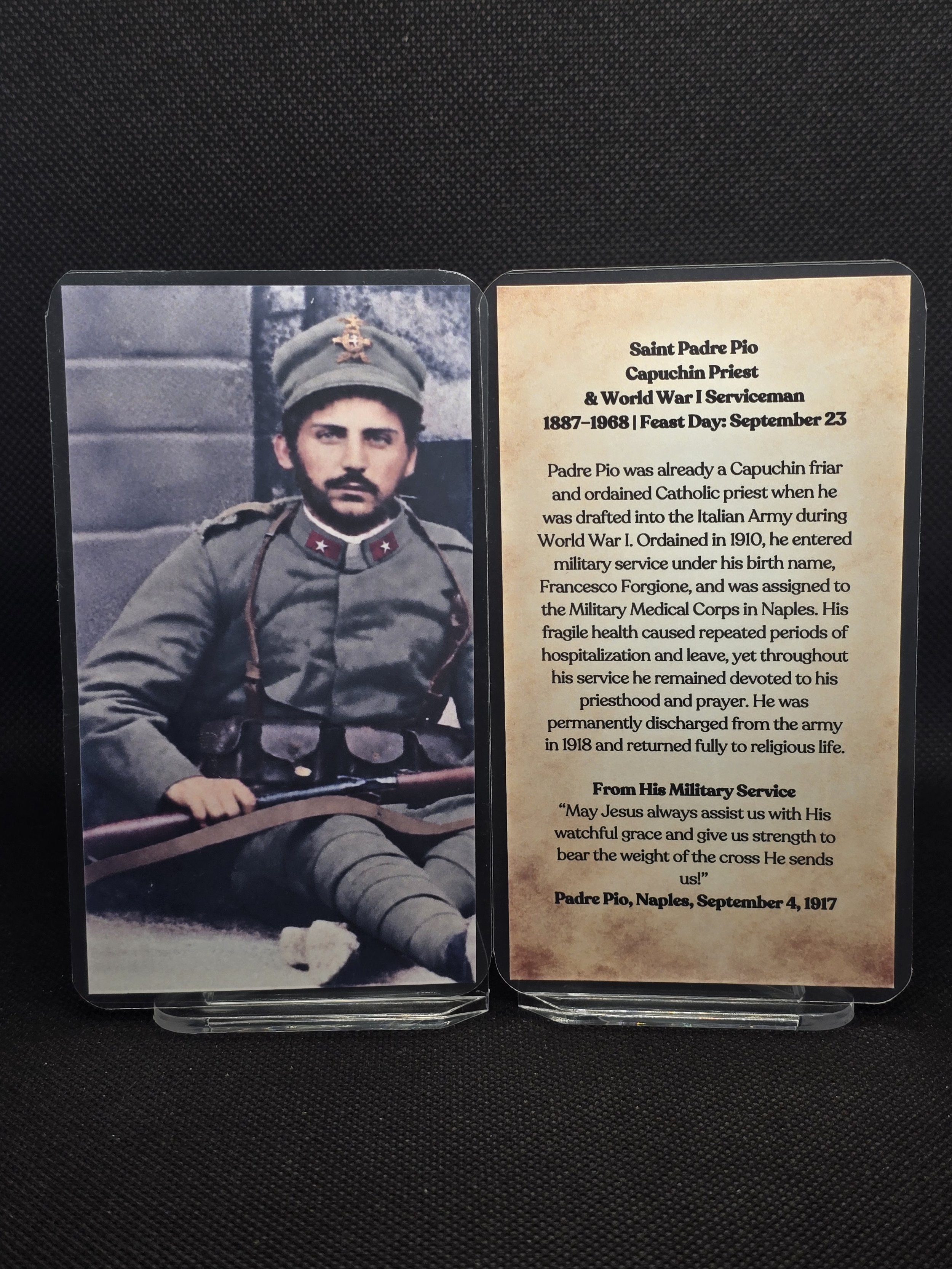
Saint Padre Pio WWI Italian Army Prayer Card | For Soldiers, Veterans, Military Families & Faith Under Trial
Saint Pio of Pietrelcina, better known throughout the world as Padre Pio, is remembered for the stigmata, extraordinary prayer, long hours in the confessional, devotion to the Eucharist, and a priestly ministry that touched millions of lives. Before that worldwide ministry developed, however, the young Capuchin priest experienced a very different chapter of life when World War I brought him into the Royal Italian Army as an ordinary enlisted soldier.
Drafted under his baptismal name, Francesco Forgione, Padre Pio served as a Private in the Italian Army Medical Corps. He was assigned to the 10th Company of Medical Corps in Naples, and during his later period of active duty he served with its 4th Platoon. He was already an ordained priest, but he did not serve as a military chaplain and was never sent to the combat front.
His military experience was shaped instead by obedience, repeated recalls to duty, serious illness, military hospitals, medical examinations, periods of convalescence, and uncertainty about when he would be allowed to return permanently to his Capuchin vocation. This lesser-known part of Padre Pio’s life gives soldiers, veterans, medically separated service members, and military families an unusual connection with a saint who personally knew what it meant to put on a uniform and live under military authority.
Each prayer card measures 2.5" x 4.25", is handmade in Austin, Texas, printed on museum-quality photo paper rather than ordinary cardstock, and double laminated for durability. Every card is made to order and prepared prayerfully, with the recipient and their intentions brought before Christ while asking Saint Pio of Pietrelcina to intercede for those serving in uniform, those who have served, and the families who carry the sacrifices of military life with them.
THE YOUNG PADRE PIO
Francesco Forgione was born on May 25, 1887, in Pietrelcina, Italy, and entered the Capuchin Franciscans while still young. He took the religious name Pio and was ordained to the priesthood on August 10, 1910, five years before Italy’s entry into the First World War.
Serious health problems had already followed him throughout religious formation. He suffered recurrent fevers, respiratory problems, stomach illness, weakness, and other symptoms that frequently forced him to leave normal community life and recover in his hometown of Pietrelcina.
ITALY ENTERS WORLD WAR I
Italy entered World War I in May 1915, and mobilization reached into religious communities as young friars and priests of military age were called into service. Padre Pio understood that religious vows did not automatically remove the obligations imposed upon men of his generation.
On May 31, 1915, months before beginning his own military service, he wrote words that would soon become personally significant: “If our country calls us, we must obey its voice; if this call imposes painful trials upon us, let us accept them with resignation and courage.” He would soon be required to live the obedience and courage he had encouraged in others.
PRIVATE FRANCESCO FORGIONE
Padre Pio reported to the military district at Benevento on November 6, 1915. After examinations and further processing, he was ordered to Naples and arrived there in December, where the Army assigned him to the 10th Company of the Medical Corps.
To the Army he was not officially the future Saint Pio or even primarily Padre Pio. He was Private Francesco Forgione, an enlisted soldier required to follow military regulations, report when summoned, undergo medical examinations, and remain subject to Army authority until formally discharged.
A PRIEST SERVING AS AN ORDINARY SOLDIER
Padre Pio’s military status was unusual because he had already been a priest for five years. Nevertheless, he did not enter the Army as an officer or military chaplain, and his priesthood did not place him outside the ordinary military system into which he had been drafted.
The familiar photograph of Padre Pio in his World War I uniform preserves this unusual moment of his life. Beneath the military uniform was already a professed Capuchin friar and ordained priest, yet during this period he shared many of the restrictions, uncertainties, and frustrations experienced by other conscripted men.
THE 10TH COMPANY OF THE MEDICAL CORPS
Padre Pio was assigned to the 10th Company of the Italian Medical Corps in Naples, with later records placing him in the 4th Platoon. This designation sometimes causes confusion because it can sound as though he worked as a battlefield physician or combat medic, but his actual military experience was dominated by his own severe health problems.
He was never sent to the trenches or a combat front. Instead, his service unfolded around barracks, military hospitals, medical evaluations, periods of duty in Naples, and repeated convalescent leave when his physical condition made normal service impossible.
HIS FIRST PERIOD OF SERVICE
Padre Pio’s first period in Naples was extremely short because his health quickly deteriorated. Military physicians recognized serious pulmonary problems and granted him approximately one year of medical leave, allowing him to return to Pietrelcina.
That medical leave did not permanently release him from the Army. As long as his military obligation remained in force, he could be recalled and examined again whenever the authorities believed that his health might permit renewed service.
CALLED BACK TO DUTY
Over the following years Padre Pio experienced repeated cycles of recall, military examination, active duty, sickness, and convalescence. He returned again when ordered rather than treating his health difficulties or religious vocation as permission simply to ignore the summons.
In August 1917, he was called back to active duty and assigned to the 4th Platoon of the 10th Company in Naples. His health soon deteriorated again, with extremely high fevers and respiratory problems eventually resulting in another hospital stay and further medical leave.
182 DAYS IN UNIFORM
Although Padre Pio’s military obligation stretched from 1915 until 1918, he did not spend three uninterrupted years on active duty. His actual military service totaled approximately 182 days, divided among several separate periods because illness repeatedly forced him into medical leave.
This distinction is important to his story because Padre Pio should not be portrayed as a long-term combat soldier. His genuine military experience was instead the experience of a physically fragile conscript repeatedly attempting to fulfill his obligation while his health continually prevented sustained service.
HE WAS NEVER SENT TO THE FRONT
Padre Pio never served at the World War I battlefront. His medical condition kept him in Naples and other military medical settings, and the Army repeatedly determined that his health required convalescence rather than frontline deployment.
His military prayer card therefore honors a different kind of military experience from that of a decorated combat veteran. Padre Pio knew the uncertainty of being drafted, wearing the uniform, submitting to military authority, being separated from the life he wanted to live, undergoing repeated medical evaluations, and wondering what his failing health meant for his future.
“WE MUST DO OUR DUTY”
Padre Pio’s surviving wartime correspondence reveals that duty was already an important part of his thinking before he entered the Army. In the same period in which Italy mobilized for war, he wrote about doing one’s duty according to the strength available and accepting painful obligations with courage.
Those words acquire greater weight because his own strength was so limited. He was not writing as a naturally robust young man eager for military adventure, but as someone whose chronic illnesses would soon make even ordinary military service extraordinarily difficult.
FAITH WHEN DUTY IS NOT CHOSEN
Military service was not the vocation Padre Pio had chosen for himself. He had entered the Capuchins and received priestly ordination years earlier, yet war temporarily placed him into an entirely different structure of life.
His response offers a meaningful Christian perspective for people serving in circumstances they did not choose. Faithfulness is sometimes expressed not through dramatic achievement but through obedience, patience, endurance, and continuing to seek God while circumstances remain outside personal control.
SERIOUS ILLNESS DURING SERVICE
Padre Pio’s poor health was genuine and persistent rather than a convenient means of avoiding military duty. Military doctors repeatedly documented respiratory and pulmonary problems severe enough to interrupt his service and send him home for extended periods of recovery.
His condition became particularly serious during his later period of duty. High fevers and respiratory disease eventually convinced military physicians that repeated convalescence was no longer sufficient and that continued service was physically unrealistic.
PERMANENTLY DISCHARGED IN 1918
Padre Pio returned for another military examination in March 1918, but his health again failed. Doctors diagnosed serious bilateral pulmonary disease, historically described as double bronchoalveolitis, and determined that he was permanently unfit for military service.
On March 16, 1918, Private Francesco Forgione received his final military discharge. After years of summonses, examinations, temporary leave, and uncertainty, the military chapter of his life was finally closed.
FOR THOSE MEDICALLY DISCHARGED
Padre Pio’s experience can carry particular meaning for veterans whose own service ended because of illness, injury, disability, or a medical evaluation they never expected. Military separation can create a painful feeling that a planned identity or future has suddenly been taken away.
Padre Pio’s life after March 1918 offers a striking counterpoint to that fear. His military career ended because his body could not continue, yet the work for which history would remember him had barely begun.
WHAT HAPPENED AFTER HIS DISCHARGE
Following his permanent discharge, Padre Pio returned to San Giovanni Rotondo and resumed the Capuchin life that military service had repeatedly interrupted. He would remain there for approximately fifty years, becoming one of the most widely known spiritual figures of the twentieth century.
Only months after leaving military service, the extraordinary mystical events associated with the mature Padre Pio intensified. In September 1918, he received the visible stigmata, beginning the period that would eventually draw pilgrims from throughout Italy and later from around the world.
THE SOLDIER BEFORE THE STIGMATA
The military photograph on this prayer card is particularly striking because it captures Padre Pio immediately before the period most people associate with him. Instead of the older Capuchin priest familiar from countless photographs, it shows the young Francesco Forgione dressed as an Italian soldier during one of the most uncertain periods of his life.
Within months, the uniform would be gone permanently and the brown Capuchin habit would again define his outward appearance. His military photograph therefore preserves a brief transition between the little-known young priest struggling with illness and the stigmatized friar who would become internationally famous.
FOR ACTIVE-DUTY SERVICE MEMBERS
Active-duty service often involves far more than the dramatic moments remembered in military history. Orders, waiting, separation from family, medical examinations, frustrating bureaucracy, uncertainty about assignments, and performing duties one did not personally choose can become the ordinary burdens of military life.
Padre Pio personally encountered that less glamorous side of service. His military years provide a Christian companion for those trying to remain faithful, patient, and prayerful while fulfilling responsibilities under conditions they cannot fully control.
FOR VETERANS
Veterans may recognize something significant in seeing a saint represented in an ordinary enlisted uniform. Padre Pio was not photographed wearing ceremonial military clothing for a special religious occasion; the image belongs to a real chapter when he was himself a soldier subject to the demands of wartime service.
His story also reminds veterans that military service is one chapter of a life rather than the final measure of a person’s identity. The years after Padre Pio left the Army ultimately became far more important than the relatively brief time he spent wearing the uniform.
FOR MILITARY FAMILIES
Military service affects spouses, parents, children, and extended families as well as the person wearing the uniform. Orders can disrupt plans, illness can create uncertainty, and repeated separations can make an already difficult vocation more demanding.
Padre Pio’s spirituality of trust, prayer, surrender, and courage speaks naturally to families carrying these burdens. His intercession may be sought for protection, strength during separation, healing after service, peace amid uncertainty, and perseverance when a family’s future feels outside its control.
FOR MILITARY MEDICAL PERSONNEL
Padre Pio’s assignment to the Medical Corps creates a historical connection with military healthcare, even though he should not be inaccurately described as a battlefield medic or physician. His own experience was primarily that of a soldier who repeatedly became a patient within the military medical system.
Doctors, nurses, corpsmen, medics, medical technicians, and others caring for service members can therefore encounter his military story from another perspective. Padre Pio knew personally what it was like for health, military obligation, and uncertainty about the future to become inseparably connected.
FOR THOSE WHOSE PLANS HAVE BEEN INTERRUPTED
Padre Pio believed his vocation was religious life, yet illness repeatedly removed him from normal Capuchin community life and war temporarily placed him into military service. Much of his young adulthood could easily have looked like a sequence of interruptions rather than preparation for anything important.
His later life reveals how incomplete that judgment would have been. Circumstances that appeared to delay his vocation did not prevent the fulfillment of that vocation, and even years marked by sickness and uncertainty became part of the formation of the priest he ultimately became.
PADRE PIO AND SERVICEMEN AFTER WORLD WAR I
Padre Pio’s connection with military personnel did not end when his own service concluded. During World War II, Allied servicemen stationed in southern Italy traveled to San Giovanni Rotondo, attended his Mass, spoke with him, sought Confession, and asked for his prayers.
Many of those servicemen later returned home carrying stories about the extraordinary Capuchin priest they had encountered in Italy. Their experiences contributed to the spread of Padre Pio’s reputation beyond Italy, particularly among English-speaking Christians in the decades before modern media made him internationally familiar.
A SAINT WHO UNDERSTOOD THE UNIFORM
Padre Pio’s military service represents only a small portion of his eighty-one years of life, yet it gives soldiers and veterans a personal point of connection that is often overlooked. He knew the difference between freely choosing a vocation and receiving an order, and he knew what it meant when illness made continued service impossible.
The military uniform therefore adds something important to his devotional image. The saint known for supernatural phenomena, long hours of prayer, and extraordinary spiritual gifts was also once Private Francesco Forgione, standing in an Italian Army uniform and facing an uncertain future.
HIS MILITARY QUOTE
Shortly after Italy entered World War I, Padre Pio wrote words about military obligation that later became part of his own lived experience: “If our country calls us, we must obey its voice; if this call imposes painful trials upon us, let us accept them with resignation and courage.”
He wrote those words on May 31, 1915, before beginning his own military service. Within months he would receive the summons himself, making the quotation an unusually personal expression of the obedience and courage demanded during this brief chapter of his life.
HIS FEAST DAY
Saint Pio of Pietrelcina died on September 23, 1968, after spending approximately half a century at San Giovanni Rotondo. Pope Saint John Paul II canonized him on June 16, 2002, and his liturgical memorial is celebrated each year on September 23.
The soldier photographed during World War I therefore lived long enough to become one of the most recognizable saints of the modern age. His military service remained a relatively small chapter, but it reveals another dimension of a life repeatedly shaped by suffering, obedience, duty, and confidence in God.
FAQ
Was Padre Pio really in the Italian Army? Yes, Padre Pio was drafted during World War I and served under his baptismal name, Francesco Forgione. He was assigned to the 10th Company of the Italian Medical Corps in Naples and served during several separate periods between 1915 and 1918.
What rank was Padre Pio? Padre Pio served as an enlisted Private, not as an officer. Military and biographical records identify him during this period as Private Francesco Forgione.
Was Padre Pio a military chaplain? No, Padre Pio was already an ordained priest, but his wartime status was that of an ordinary enlisted soldier. His service should therefore not be confused with priests who entered the armed forces specifically as commissioned military chaplains.
What military unit did Padre Pio serve with? He served with the 10th Company of the Italian Medical Corps in Naples. During his 1917 period of active duty, he was assigned specifically to the 4th Platoon of that company.
Was Padre Pio a combat medic? No, his assignment to the Medical Corps should not be interpreted as evidence that he served as a battlefield medic. His military history was instead dominated by his own recurring illnesses, military medical examinations, hospital stays, and convalescence.
Did Padre Pio fight in the trenches? No, Padre Pio was never sent to the combat front during World War I. His health prevented frontline deployment, and his periods of active service took place primarily in Naples.
How long was Padre Pio in the military? His military obligation stretched from 1915 until his permanent discharge in 1918, but his actual active service totaled approximately 182 days. Those days were divided among several separate periods because illness repeatedly resulted in medical leave.
Why was Padre Pio discharged? Severe and recurring illness made sustained military service impossible. Following another medical examination in March 1918, he was declared permanently unfit for duty because of serious bilateral pulmonary disease.
When was Padre Pio discharged from the Army? He received his permanent military discharge on March 16, 1918. He then returned to the Capuchin life at San Giovanni Rotondo, where he would remain for the rest of his life.
Was Padre Pio already a priest while serving in the Army? Yes, Padre Pio had been ordained in 1910, approximately five years before his first military call. This makes his service particularly unusual because an ordained Capuchin priest temporarily served as an ordinary enlisted private.
Is the photograph of Padre Pio in military uniform authentic? Yes, historical photographs survive showing the young Padre Pio wearing his World War I Italian military uniform. The image provides a rare glimpse of him during the relatively brief period when he served as Private Francesco Forgione.
Did Padre Pio consider military duty important? His correspondence before his own service shows that he believed people should fulfill legitimate duties according to their strength. He wrote that if the country called, the summons should be obeyed and painful trials accepted with courage.
Did Padre Pio serve during World War II? No, his own military service occurred during World War I. During World War II, however, Allied soldiers stationed in Italy frequently visited him at San Giovanni Rotondo and helped spread knowledge of him after returning home.
Is Padre Pio officially the patron saint of soldiers or veterans? Padre Pio is not generally presented as the formally designated universal patron saint of soldiers or veterans. His genuine military service nevertheless gives servicemen, veterans, medically discharged troops, and military families a natural devotional connection with him.
Who would this military Padre Pio prayer card make a meaningful gift for? The card is especially fitting for active-duty service members, veterans, recruits, military families, medically separated veterans, military medical personnel, and Christians facing difficult obligations or major disruptions in their plans. It can also be given for enlistments, military graduations, deployments, retirements, Veterans Day, Memorial Day, Confirmation, or as encouragement during a difficult period of service.
THE MAIN MESSAGE OF PADRE PIO’S MILITARY SERVICE
Padre Pio’s military service is powerful precisely because it should not be exaggerated into a story of battlefield heroism. He was an ordinary private whose body struggled with the demands placed upon it, whose military service repeatedly interrupted the life he wanted to live, and whose future remained uncertain until the Army finally discharged him for medical reasons.
The end of his military career could easily have looked like failure if judged only by rank, length of service, physical strength, or combat experience. Instead, March 1918 marked the beginning of the period in which Padre Pio would enter the extraordinary ministry that ultimately made his name known throughout the Christian world.
For veterans whose service ended sooner than expected, for soldiers struggling with illness, and for anyone whose plans have been disrupted by circumstances beyond their control, Padre Pio’s story carries a deeply hopeful message. A chapter can end without a vocation ending, weakness can coexist with courage, and a person’s greatest service to God and others may still lie ahead.
Saint Pio of Pietrelcina, better known throughout the world as Padre Pio, is remembered for the stigmata, extraordinary prayer, long hours in the confessional, devotion to the Eucharist, and a priestly ministry that touched millions of lives. Before that worldwide ministry developed, however, the young Capuchin priest experienced a very different chapter of life when World War I brought him into the Royal Italian Army as an ordinary enlisted soldier.
Drafted under his baptismal name, Francesco Forgione, Padre Pio served as a Private in the Italian Army Medical Corps. He was assigned to the 10th Company of Medical Corps in Naples, and during his later period of active duty he served with its 4th Platoon. He was already an ordained priest, but he did not serve as a military chaplain and was never sent to the combat front.
His military experience was shaped instead by obedience, repeated recalls to duty, serious illness, military hospitals, medical examinations, periods of convalescence, and uncertainty about when he would be allowed to return permanently to his Capuchin vocation. This lesser-known part of Padre Pio’s life gives soldiers, veterans, medically separated service members, and military families an unusual connection with a saint who personally knew what it meant to put on a uniform and live under military authority.
Each prayer card measures 2.5" x 4.25", is handmade in Austin, Texas, printed on museum-quality photo paper rather than ordinary cardstock, and double laminated for durability. Every card is made to order and prepared prayerfully, with the recipient and their intentions brought before Christ while asking Saint Pio of Pietrelcina to intercede for those serving in uniform, those who have served, and the families who carry the sacrifices of military life with them.
THE YOUNG PADRE PIO
Francesco Forgione was born on May 25, 1887, in Pietrelcina, Italy, and entered the Capuchin Franciscans while still young. He took the religious name Pio and was ordained to the priesthood on August 10, 1910, five years before Italy’s entry into the First World War.
Serious health problems had already followed him throughout religious formation. He suffered recurrent fevers, respiratory problems, stomach illness, weakness, and other symptoms that frequently forced him to leave normal community life and recover in his hometown of Pietrelcina.
ITALY ENTERS WORLD WAR I
Italy entered World War I in May 1915, and mobilization reached into religious communities as young friars and priests of military age were called into service. Padre Pio understood that religious vows did not automatically remove the obligations imposed upon men of his generation.
On May 31, 1915, months before beginning his own military service, he wrote words that would soon become personally significant: “If our country calls us, we must obey its voice; if this call imposes painful trials upon us, let us accept them with resignation and courage.” He would soon be required to live the obedience and courage he had encouraged in others.
PRIVATE FRANCESCO FORGIONE
Padre Pio reported to the military district at Benevento on November 6, 1915. After examinations and further processing, he was ordered to Naples and arrived there in December, where the Army assigned him to the 10th Company of the Medical Corps.
To the Army he was not officially the future Saint Pio or even primarily Padre Pio. He was Private Francesco Forgione, an enlisted soldier required to follow military regulations, report when summoned, undergo medical examinations, and remain subject to Army authority until formally discharged.
A PRIEST SERVING AS AN ORDINARY SOLDIER
Padre Pio’s military status was unusual because he had already been a priest for five years. Nevertheless, he did not enter the Army as an officer or military chaplain, and his priesthood did not place him outside the ordinary military system into which he had been drafted.
The familiar photograph of Padre Pio in his World War I uniform preserves this unusual moment of his life. Beneath the military uniform was already a professed Capuchin friar and ordained priest, yet during this period he shared many of the restrictions, uncertainties, and frustrations experienced by other conscripted men.
THE 10TH COMPANY OF THE MEDICAL CORPS
Padre Pio was assigned to the 10th Company of the Italian Medical Corps in Naples, with later records placing him in the 4th Platoon. This designation sometimes causes confusion because it can sound as though he worked as a battlefield physician or combat medic, but his actual military experience was dominated by his own severe health problems.
He was never sent to the trenches or a combat front. Instead, his service unfolded around barracks, military hospitals, medical evaluations, periods of duty in Naples, and repeated convalescent leave when his physical condition made normal service impossible.
HIS FIRST PERIOD OF SERVICE
Padre Pio’s first period in Naples was extremely short because his health quickly deteriorated. Military physicians recognized serious pulmonary problems and granted him approximately one year of medical leave, allowing him to return to Pietrelcina.
That medical leave did not permanently release him from the Army. As long as his military obligation remained in force, he could be recalled and examined again whenever the authorities believed that his health might permit renewed service.
CALLED BACK TO DUTY
Over the following years Padre Pio experienced repeated cycles of recall, military examination, active duty, sickness, and convalescence. He returned again when ordered rather than treating his health difficulties or religious vocation as permission simply to ignore the summons.
In August 1917, he was called back to active duty and assigned to the 4th Platoon of the 10th Company in Naples. His health soon deteriorated again, with extremely high fevers and respiratory problems eventually resulting in another hospital stay and further medical leave.
182 DAYS IN UNIFORM
Although Padre Pio’s military obligation stretched from 1915 until 1918, he did not spend three uninterrupted years on active duty. His actual military service totaled approximately 182 days, divided among several separate periods because illness repeatedly forced him into medical leave.
This distinction is important to his story because Padre Pio should not be portrayed as a long-term combat soldier. His genuine military experience was instead the experience of a physically fragile conscript repeatedly attempting to fulfill his obligation while his health continually prevented sustained service.
HE WAS NEVER SENT TO THE FRONT
Padre Pio never served at the World War I battlefront. His medical condition kept him in Naples and other military medical settings, and the Army repeatedly determined that his health required convalescence rather than frontline deployment.
His military prayer card therefore honors a different kind of military experience from that of a decorated combat veteran. Padre Pio knew the uncertainty of being drafted, wearing the uniform, submitting to military authority, being separated from the life he wanted to live, undergoing repeated medical evaluations, and wondering what his failing health meant for his future.
“WE MUST DO OUR DUTY”
Padre Pio’s surviving wartime correspondence reveals that duty was already an important part of his thinking before he entered the Army. In the same period in which Italy mobilized for war, he wrote about doing one’s duty according to the strength available and accepting painful obligations with courage.
Those words acquire greater weight because his own strength was so limited. He was not writing as a naturally robust young man eager for military adventure, but as someone whose chronic illnesses would soon make even ordinary military service extraordinarily difficult.
FAITH WHEN DUTY IS NOT CHOSEN
Military service was not the vocation Padre Pio had chosen for himself. He had entered the Capuchins and received priestly ordination years earlier, yet war temporarily placed him into an entirely different structure of life.
His response offers a meaningful Christian perspective for people serving in circumstances they did not choose. Faithfulness is sometimes expressed not through dramatic achievement but through obedience, patience, endurance, and continuing to seek God while circumstances remain outside personal control.
SERIOUS ILLNESS DURING SERVICE
Padre Pio’s poor health was genuine and persistent rather than a convenient means of avoiding military duty. Military doctors repeatedly documented respiratory and pulmonary problems severe enough to interrupt his service and send him home for extended periods of recovery.
His condition became particularly serious during his later period of duty. High fevers and respiratory disease eventually convinced military physicians that repeated convalescence was no longer sufficient and that continued service was physically unrealistic.
PERMANENTLY DISCHARGED IN 1918
Padre Pio returned for another military examination in March 1918, but his health again failed. Doctors diagnosed serious bilateral pulmonary disease, historically described as double bronchoalveolitis, and determined that he was permanently unfit for military service.
On March 16, 1918, Private Francesco Forgione received his final military discharge. After years of summonses, examinations, temporary leave, and uncertainty, the military chapter of his life was finally closed.
FOR THOSE MEDICALLY DISCHARGED
Padre Pio’s experience can carry particular meaning for veterans whose own service ended because of illness, injury, disability, or a medical evaluation they never expected. Military separation can create a painful feeling that a planned identity or future has suddenly been taken away.
Padre Pio’s life after March 1918 offers a striking counterpoint to that fear. His military career ended because his body could not continue, yet the work for which history would remember him had barely begun.
WHAT HAPPENED AFTER HIS DISCHARGE
Following his permanent discharge, Padre Pio returned to San Giovanni Rotondo and resumed the Capuchin life that military service had repeatedly interrupted. He would remain there for approximately fifty years, becoming one of the most widely known spiritual figures of the twentieth century.
Only months after leaving military service, the extraordinary mystical events associated with the mature Padre Pio intensified. In September 1918, he received the visible stigmata, beginning the period that would eventually draw pilgrims from throughout Italy and later from around the world.
THE SOLDIER BEFORE THE STIGMATA
The military photograph on this prayer card is particularly striking because it captures Padre Pio immediately before the period most people associate with him. Instead of the older Capuchin priest familiar from countless photographs, it shows the young Francesco Forgione dressed as an Italian soldier during one of the most uncertain periods of his life.
Within months, the uniform would be gone permanently and the brown Capuchin habit would again define his outward appearance. His military photograph therefore preserves a brief transition between the little-known young priest struggling with illness and the stigmatized friar who would become internationally famous.
FOR ACTIVE-DUTY SERVICE MEMBERS
Active-duty service often involves far more than the dramatic moments remembered in military history. Orders, waiting, separation from family, medical examinations, frustrating bureaucracy, uncertainty about assignments, and performing duties one did not personally choose can become the ordinary burdens of military life.
Padre Pio personally encountered that less glamorous side of service. His military years provide a Christian companion for those trying to remain faithful, patient, and prayerful while fulfilling responsibilities under conditions they cannot fully control.
FOR VETERANS
Veterans may recognize something significant in seeing a saint represented in an ordinary enlisted uniform. Padre Pio was not photographed wearing ceremonial military clothing for a special religious occasion; the image belongs to a real chapter when he was himself a soldier subject to the demands of wartime service.
His story also reminds veterans that military service is one chapter of a life rather than the final measure of a person’s identity. The years after Padre Pio left the Army ultimately became far more important than the relatively brief time he spent wearing the uniform.
FOR MILITARY FAMILIES
Military service affects spouses, parents, children, and extended families as well as the person wearing the uniform. Orders can disrupt plans, illness can create uncertainty, and repeated separations can make an already difficult vocation more demanding.
Padre Pio’s spirituality of trust, prayer, surrender, and courage speaks naturally to families carrying these burdens. His intercession may be sought for protection, strength during separation, healing after service, peace amid uncertainty, and perseverance when a family’s future feels outside its control.
FOR MILITARY MEDICAL PERSONNEL
Padre Pio’s assignment to the Medical Corps creates a historical connection with military healthcare, even though he should not be inaccurately described as a battlefield medic or physician. His own experience was primarily that of a soldier who repeatedly became a patient within the military medical system.
Doctors, nurses, corpsmen, medics, medical technicians, and others caring for service members can therefore encounter his military story from another perspective. Padre Pio knew personally what it was like for health, military obligation, and uncertainty about the future to become inseparably connected.
FOR THOSE WHOSE PLANS HAVE BEEN INTERRUPTED
Padre Pio believed his vocation was religious life, yet illness repeatedly removed him from normal Capuchin community life and war temporarily placed him into military service. Much of his young adulthood could easily have looked like a sequence of interruptions rather than preparation for anything important.
His later life reveals how incomplete that judgment would have been. Circumstances that appeared to delay his vocation did not prevent the fulfillment of that vocation, and even years marked by sickness and uncertainty became part of the formation of the priest he ultimately became.
PADRE PIO AND SERVICEMEN AFTER WORLD WAR I
Padre Pio’s connection with military personnel did not end when his own service concluded. During World War II, Allied servicemen stationed in southern Italy traveled to San Giovanni Rotondo, attended his Mass, spoke with him, sought Confession, and asked for his prayers.
Many of those servicemen later returned home carrying stories about the extraordinary Capuchin priest they had encountered in Italy. Their experiences contributed to the spread of Padre Pio’s reputation beyond Italy, particularly among English-speaking Christians in the decades before modern media made him internationally familiar.
A SAINT WHO UNDERSTOOD THE UNIFORM
Padre Pio’s military service represents only a small portion of his eighty-one years of life, yet it gives soldiers and veterans a personal point of connection that is often overlooked. He knew the difference between freely choosing a vocation and receiving an order, and he knew what it meant when illness made continued service impossible.
The military uniform therefore adds something important to his devotional image. The saint known for supernatural phenomena, long hours of prayer, and extraordinary spiritual gifts was also once Private Francesco Forgione, standing in an Italian Army uniform and facing an uncertain future.
HIS MILITARY QUOTE
Shortly after Italy entered World War I, Padre Pio wrote words about military obligation that later became part of his own lived experience: “If our country calls us, we must obey its voice; if this call imposes painful trials upon us, let us accept them with resignation and courage.”
He wrote those words on May 31, 1915, before beginning his own military service. Within months he would receive the summons himself, making the quotation an unusually personal expression of the obedience and courage demanded during this brief chapter of his life.
HIS FEAST DAY
Saint Pio of Pietrelcina died on September 23, 1968, after spending approximately half a century at San Giovanni Rotondo. Pope Saint John Paul II canonized him on June 16, 2002, and his liturgical memorial is celebrated each year on September 23.
The soldier photographed during World War I therefore lived long enough to become one of the most recognizable saints of the modern age. His military service remained a relatively small chapter, but it reveals another dimension of a life repeatedly shaped by suffering, obedience, duty, and confidence in God.
FAQ
Was Padre Pio really in the Italian Army? Yes, Padre Pio was drafted during World War I and served under his baptismal name, Francesco Forgione. He was assigned to the 10th Company of the Italian Medical Corps in Naples and served during several separate periods between 1915 and 1918.
What rank was Padre Pio? Padre Pio served as an enlisted Private, not as an officer. Military and biographical records identify him during this period as Private Francesco Forgione.
Was Padre Pio a military chaplain? No, Padre Pio was already an ordained priest, but his wartime status was that of an ordinary enlisted soldier. His service should therefore not be confused with priests who entered the armed forces specifically as commissioned military chaplains.
What military unit did Padre Pio serve with? He served with the 10th Company of the Italian Medical Corps in Naples. During his 1917 period of active duty, he was assigned specifically to the 4th Platoon of that company.
Was Padre Pio a combat medic? No, his assignment to the Medical Corps should not be interpreted as evidence that he served as a battlefield medic. His military history was instead dominated by his own recurring illnesses, military medical examinations, hospital stays, and convalescence.
Did Padre Pio fight in the trenches? No, Padre Pio was never sent to the combat front during World War I. His health prevented frontline deployment, and his periods of active service took place primarily in Naples.
How long was Padre Pio in the military? His military obligation stretched from 1915 until his permanent discharge in 1918, but his actual active service totaled approximately 182 days. Those days were divided among several separate periods because illness repeatedly resulted in medical leave.
Why was Padre Pio discharged? Severe and recurring illness made sustained military service impossible. Following another medical examination in March 1918, he was declared permanently unfit for duty because of serious bilateral pulmonary disease.
When was Padre Pio discharged from the Army? He received his permanent military discharge on March 16, 1918. He then returned to the Capuchin life at San Giovanni Rotondo, where he would remain for the rest of his life.
Was Padre Pio already a priest while serving in the Army? Yes, Padre Pio had been ordained in 1910, approximately five years before his first military call. This makes his service particularly unusual because an ordained Capuchin priest temporarily served as an ordinary enlisted private.
Is the photograph of Padre Pio in military uniform authentic? Yes, historical photographs survive showing the young Padre Pio wearing his World War I Italian military uniform. The image provides a rare glimpse of him during the relatively brief period when he served as Private Francesco Forgione.
Did Padre Pio consider military duty important? His correspondence before his own service shows that he believed people should fulfill legitimate duties according to their strength. He wrote that if the country called, the summons should be obeyed and painful trials accepted with courage.
Did Padre Pio serve during World War II? No, his own military service occurred during World War I. During World War II, however, Allied soldiers stationed in Italy frequently visited him at San Giovanni Rotondo and helped spread knowledge of him after returning home.
Is Padre Pio officially the patron saint of soldiers or veterans? Padre Pio is not generally presented as the formally designated universal patron saint of soldiers or veterans. His genuine military service nevertheless gives servicemen, veterans, medically discharged troops, and military families a natural devotional connection with him.
Who would this military Padre Pio prayer card make a meaningful gift for? The card is especially fitting for active-duty service members, veterans, recruits, military families, medically separated veterans, military medical personnel, and Christians facing difficult obligations or major disruptions in their plans. It can also be given for enlistments, military graduations, deployments, retirements, Veterans Day, Memorial Day, Confirmation, or as encouragement during a difficult period of service.
THE MAIN MESSAGE OF PADRE PIO’S MILITARY SERVICE
Padre Pio’s military service is powerful precisely because it should not be exaggerated into a story of battlefield heroism. He was an ordinary private whose body struggled with the demands placed upon it, whose military service repeatedly interrupted the life he wanted to live, and whose future remained uncertain until the Army finally discharged him for medical reasons.
The end of his military career could easily have looked like failure if judged only by rank, length of service, physical strength, or combat experience. Instead, March 1918 marked the beginning of the period in which Padre Pio would enter the extraordinary ministry that ultimately made his name known throughout the Christian world.
For veterans whose service ended sooner than expected, for soldiers struggling with illness, and for anyone whose plans have been disrupted by circumstances beyond their control, Padre Pio’s story carries a deeply hopeful message. A chapter can end without a vocation ending, weakness can coexist with courage, and a person’s greatest service to God and others may still lie ahead.