 Image 1 of 1
Saint Paraskeva / Saint Petka Prayer Card - For Healing, Affliction, Mercy & Difficult Times
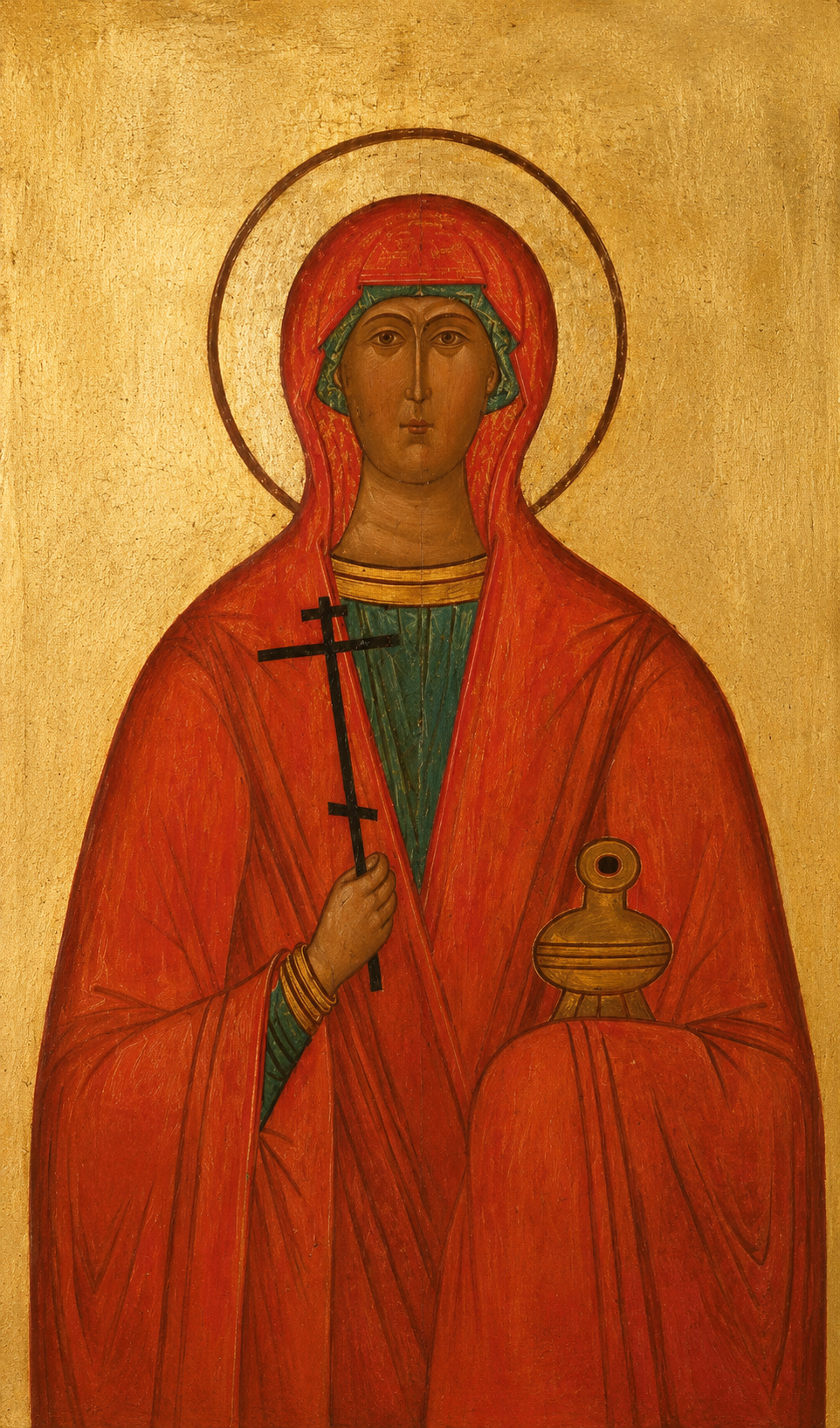
Saint Paraskeva the New, known throughout the Balkans as Saint Petka, Saint Paraskeva of Serbia, Paraskeva of the Balkans, and Paraskeva of Epivates, is one of the most beloved female ascetic saints of Eastern Orthodoxy. She lived during the eleventh century, gave away what she possessed to the poor, embraced monastic and hesychastic life while still young, spent years in ascetic prayer near the Holy Land, and died at only about twenty-seven years of age. Her incorrupt relics later traveled through Bulgaria, Serbia, Constantinople, and finally Iași, Romania, where they remain a major center of Orthodox pilgrimage and devotion.
Saint Petka is especially meaningful for people suffering through illness, prolonged affliction, poverty, grief, family hardship, spiritual struggle, or circumstances that require patient endurance. This association is strongly grounded in the Church's own worship because her traditional Kontakion calls her a holy intercessor for the afflicted and remembers the grace of miracles associated with her. The shrine containing her relics in Iași likewise describes generations of believers approaching her for spiritual help and physical healing.
Her life is also deeply connected with mercy toward the poor. According to her traditional Life, Paraskeva was moved profoundly by Christ's command to deny oneself and follow Him, after which she began giving her clothing away to people in need despite the objections of her family. Romanian Orthodox tradition likewise emphasizes generosity as one of her defining virtues and preserves the tradition that she even gave away the gold cross she had worn from Baptism when she encountered someone in poverty.
This makes Saint Paraskeva an especially meaningful intercessor for Christians trying to loosen their attachment to possessions, grow in generosity, or remember the suffering of other people while facing difficulties of their own. Her holiness was not expressed through worldly accomplishments, political influence, or a long public ministry. It grew from prayer, fasting, charity, humility, solitude, and an intense desire to belong entirely to Christ.
Saint Petka is also particularly significant for Serbian Orthodox Christians. The Serbian Orthodox Church commonly calls her Holy Mother Petka or Venerable Paraskeva of Serbia, and Serbian ecclesiastical tradition describes her as being of Serbian descent, although she was born at Epivates in Thrace rather than within the modern borders of Serbia. Her relics were also kept in Belgrade for more than a century, strengthening the profound devotion to her that remains part of Serbian Orthodox life.
Her importance reaches far beyond one nation, however. Romanian Patriarch Daniel has described Saint Paraskeva as a saint who gathers Orthodox peoples together, specifically noting devotion to her among Romanians, Greeks, Bulgarians, and Serbs. Her relics now rest in Iași, where she is particularly beloved in Romanian Orthodoxy and where enormous numbers of pilgrims continue to approach her shrine.
This prayer card is created for those facing illness, chronic suffering, emotional or spiritual affliction, financial hardship, family difficulty, grief, loneliness, temptation, and other seasons in which patient faithfulness becomes difficult. It is also especially fitting for Serbian and Romanian Orthodox families, women seeking an ascetic female saint, people trying to grow in mercy toward the poor, and Christians drawn toward the quiet spirituality of prayer, fasting, and inner stillness.
Each card is handmade in Austin, TX and created to order. We do not keep stock, because every prayer card is treated as a unique devotional offering. They are printed on museum-quality photo paper, not cardstock, and every card is made slowly during prayer with intentional reverence for the saint and for the person who will receive it. Names are lifted before Christ, intentions are held carefully, and each piece is handled multiple times in prayerful silence, asking God for mercy and asking Saint Paraskeva to intercede for the soul it is being made for. This is devotional craftsmanship shaped with patience, care, and spiritual responsibility because every soul and every prayer matters.
THE LIFE & STORY
Saint Paraskeva the New was born during the eleventh century in Epivates, a settlement in Thrace near the Sea of Marmara between the region of Constantinople and the western approaches toward the Black Sea. Orthodox sources describe her family as devout Christians, and her older brother Euthymius likewise embraced religious life, eventually becoming a monk and later a bishop.
Her life changed profoundly while she was still young. According to the traditional account preserved by the Orthodox Church, Paraskeva heard Christ's words from Matthew 16 calling anyone who wished to follow Him to deny himself, take up the cross, and follow. Rather than receiving those words only as a general spiritual principle, the young Paraskeva understood them as a personal summons.
She began giving her clothing to people who were poor, an action that created tension within her household because her family did not understand why she continually gave away what had been provided for her. This early generosity would become one of the central themes preserved in devotion to Saint Petka, and modern Romanian Orthodox teaching continues to emphasize her mercy as one of the defining characteristics of her holiness.
The importance of this part of her story goes beyond generosity with possessions. Paraskeva had begun to understand Christian discipleship as a real relinquishment of ownership over the self. Her clothing, wealth, comfort, future, and eventually the direction of her entire life were no longer things she wanted to reserve entirely for herself.
After the death of her parents, Orthodox tradition says Paraskeva received monastic tonsure while still very young. The OCA account places her tonsure around the age of fifteen, after which she left the familiar world of her childhood and pursued an increasingly austere life of prayer and asceticism.
Ecclesiastical accounts preserve somewhat different details about the exact stages of her monastic journey. The tradition of Iași remembers time spent in a monastery near Constantinople and approximately five years at a monastery in Pontic Heraclea before she journeyed toward the Holy Land, while the OCA emphasizes her prolonged ascetic life in the Jordanian desert. Both traditions agree on the essential spiritual pattern: Saint Paraskeva left home, entered religious life, traveled toward the lands sanctified by Christ, and spent her youth seeking God through prayer, fasting, and solitude.
The Jordanian desert connected Paraskeva with one of Christianity's great ascetic traditions. Centuries before her birth, the deserts of Egypt, Palestine, Syria, and the Jordan had drawn men and women who wanted to confront the passions through silence, fasting, prayer, vigils, Scripture, and continual remembrance of God.
Saint Paraskeva entered that world while still remarkably young. Her spiritual life therefore challenges the assumption that serious holiness belongs primarily to old age, after worldly ambitions and opportunities have already passed. Romanian Patriarch Daniel has emphasized precisely this aspect of her witness, pointing to the intensity rather than the length of her earthly life.
According to the traditional Life, Paraskeva remained in the ascetic life until about the age of twenty-five. She then received a divine command directing her to return to her homeland, a command that must have seemed strange after years spent intentionally leaving that world behind.
Her obedience is spiritually important because Christian vocation does not always mean remaining permanently where prayer has previously brought us. Sometimes God calls a person away from home, while at another moment obedience may mean returning to the place that had once been left behind.
Paraskeva returned to Epivates and lived there quietly for approximately two years. She was no longer surrounded by the dramatic landscape of the Holy Land or the recognized ascetic environment of the desert, yet the interior life formed through years of prayer traveled with her.
Saint Paraskeva reposed at approximately twenty-seven years of age and was buried near the sea. Her life had been short enough that almost any modern measure of achievement would have called it unfinished, yet the Church came to recognize within those few years a degree of holiness that would shape Christian devotion across entire nations for the next millennium.
Her influence expanded especially after her death. According to the Orthodox tradition, miracles began occurring at her grave, leading eventually to the discovery of her relics. The body was found incorrupt and was placed for veneration in the Church of the Holy Apostles at Epivates.
The centuries that followed would carry her relics across the Balkans and Eastern Europe in a journey almost as remarkable as her earthly life. Bulgaria, Serbia, Constantinople, Moldavia, and Romania would each become deeply connected with the young ascetic who had once tried to disappear from worldly attention.
SAINT PETKA & THE AFFLICTED
One of the most firmly established devotional associations with Saint Paraskeva is her intercession for people who are afflicted. Her Orthodox Kontakion explicitly remembers her as an intercessor for those who suffer and connects her with the grace of miracles, giving this devotion a strong liturgical foundation rather than relying only on later popular patronage.
Affliction is a broad word because human suffering rarely fits neatly into one category. Someone may suffer from cancer, chronic pain, depression, poverty, grief, loneliness, infertility, family conflict, fear, spiritual temptation, or years of uncertainty in which no single crisis ends but life continually feels difficult.
Saint Petka is meaningful within precisely that breadth because the Church's hymn does not restrict her intercession to one disease or one narrowly defined problem. It calls her an intercessor for the afflicted, making the devotion especially appropriate when suffering has become complicated enough that a person no longer knows how to categorize the need.
The long history of healing associated with her relics reinforces this devotion. The OCA records that many healings occurred after the transfer of her relics to Iași, while the Metropolitan complex in Iași continues to describe her relics as a source of spiritual and physical help for those who seek her intercession.
This does not mean that devotion to Saint Paraskeva should replace medical treatment, professional counseling, financial assistance, or other forms of practical help. Orthodox Christianity does not require choosing between prayer and appropriate human assistance because medicine, charity, counsel, and skilled care can themselves become means through which God's mercy reaches suffering people.
A Christian may therefore ask Saint Petka's intercession while undergoing chemotherapy, recovering from surgery, seeking help for mental illness, caring for an aging parent, trying to escape poverty, or simply waiting for circumstances that have not yet changed. The prayer can include both a bold request for healing and the equally important request for endurance when healing does not come according to the timetable we desire.
MERCY, POVERTY & GENEROSITY
Mercy appears at the beginning of Saint Paraskeva's spiritual story. Hearing Christ's call to self-denial, she began giving her clothing to people in need despite the difficulty this created within her family.
Romanian Orthodox tradition remembers her generosity even more vividly. Patriarch Daniel has emphasized that Saint Paraskeva's virtues were especially marked by mercy and preserves the tradition that she once gave the gold cross she had worn from Baptism to a poor man.
Whether the Christian possesses much or little, her example raises a difficult question about attachment. Generosity is relatively easy when we give away what we no longer want, but Christian mercy becomes more demanding when another person's need reaches something we consider genuinely ours.
Saint Paraskeva's life therefore makes her a meaningful intercessor for people trying to grow in generosity, overcome excessive attachment to possessions, or cultivate greater concern for the poor. Her example does not require every Christian to abandon all property and become a desert ascetic, but it does challenge the instinct to treat everything received from God as though it existed only for personal comfort.
Her life is equally meaningful for people who are themselves poor because Paraskeva's devotion does not romanticize poverty from a safe distance. The saint who gave to those in need later deliberately embraced an austere life with very little of her own, making voluntary simplicity and mercy toward involuntary poverty part of the same Christian witness.
HESYCHASM, SILENCE & PRAYER
The traditional Troparion of Saint Paraskeva explicitly remembers her love for the solitary and hesychastic life. It describes her spiritual struggle through fasting, prayer, tears, the Cross, and resistance to the passions, placing her firmly within the Eastern ascetic tradition of interior stillness.
Hesychasm comes from the Greek word hesychia, meaning stillness or quiet, but Christian stillness is more than the absence of external noise. A room can be completely silent while the heart remains filled with resentment, anxiety, memories, fantasies, and arguments, while a person surrounded by ordinary responsibilities may gradually learn to preserve interior remembrance of God.
Saint Paraskeva's withdrawal into solitude was therefore not simply an attempt to escape other people. The desert became a place where distractions were stripped away so that the deeper movements of the heart could be confronted through prayer, repentance, fasting, and dependence upon God.
This makes her especially meaningful for Christians who feel spiritually scattered. A person may not be able to travel to the Jordanian desert, but small forms of hesychia can still be cultivated through a prayer corner, periods without a phone, the Jesus Prayer, Scripture, fasting, silent time before God, and deliberate restraint from the constant stream of stimulation that fills modern life.
Her spiritual tradition also reminds Christians that silence is not an end in itself. The young woman who sought solitude was also the woman remembered for extraordinary mercy toward the poor, demonstrating that authentic prayer should make the heart more compassionate rather than less interested in human suffering.
SAINT PETKA IN SERBIAN ORTHODOX TRADITION
Saint Paraskeva holds an extraordinary place within Serbian Orthodox Christianity, where she is affectionately known as Sveta Petka, or Saint Petka. The Serbian Orthodox Church's English resources identify her as Venerable Paraskeva or Petka of Serbia and preserve the Serbian tradition that she was of Serbian descent, born at Epivates in Thrace.
The title “of Serbia” can create confusion for English-language readers because it may sound as though she was born inside the modern Serbian state. She was not. Epivates was in Thrace near Constantinople, and other Orthodox traditions commonly identify her as Paraskeva of Epivates, Paraskeva the New, Paraskeva of the Balkans, or Pious Paraskeva.
For a product page, using both names is therefore particularly helpful. Saint Paraskeva / Saint Petka of Serbia corresponds to familiar Serbian and OCA terminology, while including “Paraskeva the New” and “of Epivates” helps distinguish her historically and prevents confusion with the several other Orthodox saints who bear the name Paraskeva.
Her connection with Serbia became even stronger through the history of her relics. After centuries at Epivates and later in Tarnovo, the relics eventually came into Serbian possession and were brought to Belgrade, where they remained until the Ottoman conquest led to their transfer to Constantinople. Ecclesiastical sources differ slightly concerning individual years in this complicated journey, but they agree on the major sequence linking her relics with Bulgaria, Serbia, Constantinople, and ultimately Iași.
Devotion to Saint Petka remains widespread among Serbian Orthodox Christians, including churches and parish communities dedicated to her throughout Serbia and the diaspora. She is therefore not simply a saint who temporarily passed through Serbian history but one of the female saints most deeply loved within Serbian Orthodox popular devotion.
A SAINT SHARED ACROSS THE BALKANS
One of the most beautiful aspects of Saint Paraskeva's story is that several Orthodox peoples regard her with extraordinary affection. Romanian Patriarch Daniel has specifically described her as bringing Orthodox peoples together and has highlighted devotion among Romanians, Greeks, Bulgarians, and Serbs.
Her life began in Thrace, her ascetic journey reached toward the Holy Land, her relics were honored in Bulgaria, later rested in Serbia, returned to Constantinople, and eventually found their permanent home in Romanian Moldavia. Her spiritual geography therefore crosses many of the boundaries that later generations would treat as national divisions.
This makes Saint Paraskeva an especially meaningful saint for Orthodox families with Balkan heritage or mixed ethnic backgrounds. Her story demonstrates that sainthood does not belong exclusively to one nation's possession because holiness becomes a gift to the entire Church.
The different names themselves tell part of this story. A Serbian family may call her Sveta Petka, a Romanian Christian may know her as Cuvioasa Parascheva, another Orthodox Christian may call her Paraskevi the New, and an English calendar may list Paraskeva of Serbia or Paraskeva of the Balkans. These names point toward the same eleventh-century ascetic whose feast is October 14 and whose relics are venerated in Iași.
THE JOURNEY OF HER HOLY RELICS
The relics of Saint Paraskeva possess one of the most remarkable histories among Orthodox saints. After miracles became associated with her grave at Epivates, her incorrupt body was uncovered and transferred to the Church of the Holy Apostles, where it remained for generations.
Her relics were later transferred to Tarnovo in Bulgaria during the thirteenth century. Patriarch Euthymius of Tarnovo wrote her Life and helped establish her liturgical commemoration, strengthening devotion to Saint Paraskeva throughout the medieval Balkan Christian world.
Political upheaval repeatedly changed the location of the shrine. Following Ottoman expansion, her relics were eventually taken into Serbian lands and brought to Belgrade, where Saint Petka became deeply connected with Serbian Orthodox devotion.
After the Ottoman conquest of Belgrade, the relics were transferred to Constantinople. They remained there until the seventeenth century, when Moldavian Prince Vasile Lupu received them and brought them to Iași in 1641, where they were placed in the Church of the Three Holy Hierarchs.
A major fire in the nineteenth century threatened the shrine, yet the relics survived. They were subsequently transferred to the Metropolitan Cathedral in Iași, where they remain today and continue to receive enormous numbers of pilgrims.
The movement of her relics can initially appear to be merely a complicated historical sequence, but it explains why Saint Paraskeva became so deeply loved by several different Orthodox nations. Each place that received her relics also received a living tradition of pilgrimage, hymns, churches, stories of healing, and family devotion.
HER RELICS IN IAȘI
The principal relics of Saint Paraskeva are now enshrined in the Metropolitan Cathedral of Iași, Romania. The Archdiocese of Iași describes the shrine as a place where believers seek both spiritual and physical help through her intercession.
Her annual October pilgrimage is among the largest Orthodox pilgrimages in the region. In 2024, Romanian Orthodox reporting recorded more than 200,000 pilgrims venerating the relics during the feast period, demonstrating that devotion to Saint Paraskeva remains intensely alive rather than merely historical.
The extraordinary popularity of the shrine also reveals something about the saint herself. Paraskeva lived only a short life, held no ecclesiastical office, founded no empire, and wrote no famous theological treatise, yet nearly a thousand years later enormous crowds wait for hours simply to approach her relics in prayer.
The contrast is striking because the young woman who deliberately sought hiddenness became one of the most publicly venerated saints of the Orthodox Balkans. Christianity repeatedly contains this paradox: people who cease trying to make themselves important can become spiritually important to generations they never imagined.
SAINT PARASKEVA & HEALING
Healing is one of the strongest continuing associations with Saint Petka. The OCA explicitly records healings connected with her relics at Iași, while the shrine's own historical presentation describes believers approaching her relics for both spiritual assistance and physical healing.
This makes Saint Paraskeva an appropriate intercessor for someone facing cancer, chronic illness, surgery, infertility, neurological disease, emotional suffering, or another medical condition, even though it would be inaccurate to turn each individual illness into a separate ancient patronage title.
The Christian seeks Saint Paraskeva's intercession while understanding that God is the source of healing. The saint does not possess an independent supernatural power competing with Christ but stands alive in Him and prays with the Church before God.
Prayer for healing also includes more than the desired physical outcome. A person may ask for wisdom for doctors, strength during treatment, peace before surgery, patience during rehabilitation, consolation for family members, protection from despair, and the ability to remain faithful even when the path ahead remains uncertain.
For that reason, a Saint Petka prayer card can be especially meaningful in a hospital room, beside medication, inside a caregiver's bag, or within the home prayer corner of a family walking through serious illness.
SAINT PARASKEVA & WOMEN SEEKING A LIFE OF PRAYER
Saint Paraskeva offers women a particularly strong example of holiness centered upon prayer, mercy, courage, and spiritual independence from social expectations. She did not become holy through marriage to an important man, membership in a ruling family, or association with a famous male spiritual figure. Her own response to Christ formed the center of her story.
Her brother became a bishop, but Paraskeva's vocation followed another path. She sought obscurity, monasticism, poverty, the desert, and a life in which virtually every worldly measure of status disappeared.
This gives her particular meaning for Orthodox women discerning monasticism, single women seeking a serious spiritual life, widows entering a quieter season of life, and women who simply want a female saint whose holiness developed through prayer and ascetic discipline.
Her life should not be interpreted as teaching that a woman must leave ordinary family life in order to become holy. The Church contains married saints, mothers, queens, martyrs, monastics, fools for Christ, missionaries, and ascetics, but Saint Paraskeva demonstrates especially clearly the dignity and spiritual fruitfulness of a woman's direct vocation to ascetic and contemplative life.
PRAYERS
A simple traditional invocation may be prayed throughout the day: Venerable Mother Paraskeva, pray to God for us. Serbian Christians may naturally use the name Petka instead, praying, Holy Mother Petka, pray to God for us, while bringing the particular need directly before Christ.
The traditional Orthodox Troparion remembers Saint Paraskeva's love for the solitary and hesychastic life, her pursuit of Christ, and her spiritual struggle through the Cross, fasting, prayer, and tears. Rather than presenting holiness as effortless, the hymn remembers a woman who actively struggled against the passions and dedicated her youth to God.
Her traditional Kontakion gives an especially appropriate prayerful foundation for people suffering through illness or hardship because it calls her a holy intercessor for the afflicted and remembers the grace of miracles associated with her.
Someone facing illness may use the traditional invocation while naming the sick person before Christ and asking Saint Paraskeva to intercede. Someone facing poverty or financial hardship may likewise ask for mercy, provision, wisdom, and the grace to remain generous rather than allowing fear to harden the heart toward others.
Those seeking a deeper prayer life can invoke Saint Paraskeva while remembering the hesychastic dimension of her asceticism. The prayer card can be placed beside a prayer rope, Bible, Psalter, or icon as a reminder that interior stillness develops through repeated attention to God rather than through a single dramatic spiritual experience.
This prayer card is especially fitting for a prayer corner, hospital room, bedside table, Bible, wallet, caregiver's bag, Serbian Orthodox family icon corner, or anywhere someone needs a reminder that affliction does not place a person beyond the intercession of the saints and the mercy of Christ.
FAQ
Who is Saint Paraskeva of Serbia? Saint Paraskeva of Serbia is the eleventh-century Orthodox ascetic also known as Saint Petka, Paraskeva the New, Paraskeva of Epivates, and Paraskeva of the Balkans. She was born in Epivates in Thrace, lived an ascetic and monastic life, and reposed at approximately twenty-seven years old.
Is Saint Paraskeva the same saint as Saint Petka? Yes, in this context Saint Petka is the same saint as Saint Paraskeva the New. “Petka” is the familiar Slavic form associated with her name and is especially common within Serbian Orthodox devotion.
Is Saint Paraskeva of Serbia really from Serbia? She was not born within the borders of modern Serbia. She was born at Epivates in Thrace near Constantinople, while Serbian Orthodox tradition describes her as being of Serbian descent and commonly calls her Venerable Paraskeva or Petka of Serbia. Her relics also spent an important period in Belgrade, deepening her connection with Serbian Orthodox history.
Why is Saint Paraskeva called Paraskeva of the Balkans? The title reflects the extraordinary devotion to her across several Balkan Orthodox peoples. Her life and relics became connected with Thrace, Bulgaria, Serbia, Constantinople, and Romania, and Romanian Patriarch Daniel has specifically noted devotion to her among Greeks, Bulgarians, Serbs, and Romanians.
Is Saint Paraskeva the New the same person as Paraskeva of Serbia? Yes, these titles refer to the same eleventh-century saint commemorated on October 14. “The New” helps distinguish her from earlier martyrs also named Paraskeva.
Is Saint Paraskeva the same as Saint Paraskevi of Rome? No. Saint Paraskevi of Rome is a different saint and martyr traditionally commemorated on July 26, while Saint Paraskeva the New or Saint Petka is the eleventh-century ascetic commemorated on October 14.
Is Saint Paraskeva the same as the Great Martyr Paraskeva of Iconium? No. The Great Martyr Paraskeva of Iconium belongs to a different early Christian martyr tradition and is commemorated on October 28. Saint Petka of Serbia is the later eleventh-century ascetic whose feast is October 14.
Why are there several saints named Paraskeva? The Greek name Paraskevi means Friday and became a Christian personal name connected particularly with Friday as the day of Christ's Passion. Several different female saints therefore bear the name, which makes the additional titles “the New,” “of Epivates,” “of Serbia,” or “of the Balkans” important for identifying Saint Petka correctly.
What is Saint Paraskeva the patron saint of? Orthodox devotion does not require a rigid universal patronage list, so the strongest description comes from the Church's own hymnography. Saint Paraskeva is explicitly called a holy intercessor for the afflicted and a saint associated with miracles, while longstanding devotion also connects her strongly with healing and help during suffering.
Is Saint Petka a healing saint? Yes, healing is one of the strongest established devotional associations with her. Orthodox sources record healings connected with her relics, and the shrine at Iași describes believers seeking spiritual and physical help through her intercession.
Can I pray to Saint Petka for serious illness? Yes. Her traditional association with the afflicted and with healing makes her an especially appropriate saint to invoke during serious illness, hospitalization, chronic disease, or difficult treatment. Christians should continue appropriate medical care while also bringing the situation before God in prayer.
Can I pray to Saint Paraskeva for cancer? Yes. Cancer is not an exclusive ancient patronage assigned specifically to Saint Paraskeva, but her strong traditional connection with healing and those who suffer makes her a fitting intercessor for someone with cancer.
Can I pray to Saint Petka before surgery? Yes. Her intercession may be sought for the patient, doctors, nurses, family members, and a successful recovery. A traditional invocation such as “Holy Mother Petka, pray to God for us” can be prayed before and during the hospital stay.
Can I pray to Saint Paraskeva for emotional or spiritual suffering? Yes. Her traditional Kontakion describes her broadly as an intercessor for the afflicted rather than limiting her intercession to physical disease. This makes her especially meaningful during grief, fear, discouragement, spiritual temptation, or other forms of suffering.
Is Saint Petka good to pray to during difficult times? Yes. Her established association with affliction, miracles, healing, fasting, and perseverance makes her a natural saint to invoke when a person is enduring a prolonged difficult season rather than facing only one specific problem.
Is Saint Paraskeva associated with the poor? Yes. Her traditional Life specifically remembers her giving her clothing to needy people while she was still young, and modern Romanian Orthodox teaching emphasizes mercy and generosity as defining virtues of Saint Paraskeva.
Did Saint Paraskeva give away her clothes? Yes, according to her traditional Life. After hearing Christ's call to self-denial, she repeatedly gave clothing to people in need even though her family objected.
Did Saint Paraskeva become a nun? Yes. Orthodox tradition records that she received monastic tonsure while still young and spent much of her short life pursuing prayer and asceticism.
Was Saint Petka a hesychast? Her Orthodox Troparion specifically praises her love for the solitary and hesychastic life. Her spirituality centered on prayer, fasting, tears, ascetic struggle, and withdrawal into solitude for the sake of deeper communion with Christ.
Did Saint Paraskeva live in the Holy Land? Yes. Her traditional Life connects her ascetic years with the region of the Jordan and the Holy Land before she received a divine command to return to her homeland.
How old was Saint Paraskeva when she died? The OCA and the official shrine history in Iași preserve the tradition that she reposed at approximately twenty-seven years old. Her short life is often emphasized as evidence that holiness depends upon the depth of a person's life in God rather than the number of years lived.
Were Saint Paraskeva's relics found incorrupt? According to the Orthodox tradition, yes. Miracles at her grave led to the uncovering of her body, which was found incorrupt and transferred to a church for veneration.
Where are Saint Paraskeva's relics today? Her principal relics are enshrined at the Metropolitan Cathedral in Iași, Romania, where they continue to receive pilgrims from Romania and abroad.
Were Saint Paraskeva's relics ever in Serbia? Yes. Her relics were brought to Belgrade during the medieval period and remained deeply connected with Serbian devotion until Ottoman conquest led to their transfer to Constantinople.
Were Saint Petka's relics ever in Bulgaria? Yes. Her relics were transferred to Tarnovo during the thirteenth century and became an important part of medieval Bulgarian Orthodox devotion. Patriarch Euthymius of Tarnovo also wrote her Life.
How did Saint Paraskeva's relics get to Romania? After periods in Epivates, Tarnovo, Serbian lands, and Constantinople, her relics were given to Moldavian Prince Vasile Lupu and transferred to Iași in 1641. They were initially placed in the Church of the Three Holy Hierarchs and later moved to the Metropolitan Cathedral.
Did Saint Paraskeva's relics survive a fire? Yes. Orthodox sources record that the relics survived a major fire in the nineteenth century, after which they were moved to the Metropolitan Cathedral in Iași.
Why is Iași important to Saint Paraskeva? Iași has housed her relics since 1641 and has become the principal modern center of devotion to the saint. The annual feast draws enormous numbers of pilgrims who come to venerate her relics and seek her intercession.
When is Saint Paraskeva's feast day? Her traditional feast is October 14. Churches following the Julian calendar celebrate liturgical October 14 on October 27 according to the current Gregorian civil calendar, which is why Serbian Christians commonly associate Saint Petka's feast with October 27.
Why do I see both October 14 and October 27 for Saint Petka? They are the same traditional feast expressed through different calendars. October 14 on the Julian calendar currently falls on October 27 on the Gregorian civil calendar, while jurisdictions using the revised calendar celebrate the feast civilly on October 14.
Is Saint Petka especially important to Serbian Orthodox Christians? Yes. She is one of the most beloved female saints in Serbian Orthodox devotion, where she is commonly called Sveta Petka or Holy Mother Petka. Her relics' historical presence in Belgrade further strengthened this relationship.
Is Saint Paraskeva important in Romanian Orthodoxy? Yes. Her relics have been in Iași since the seventeenth century, and Romanian Orthodox sources describe her as one of the country's most beloved saints and the Protectress of Moldavia. Hundreds of churches in Romania are dedicated to her.
Can I give this prayer card to someone who is Serbian? Yes. A Saint Petka prayer card is particularly meaningful for a Serbian Orthodox Christian because Sveta Petka has an exceptionally strong place in Serbian devotional life and is widely honored by Serbian parishes and families.
Can I give this card to someone who is Romanian? Yes. Saint Paraskeva is among the most deeply beloved saints in Romanian Orthodoxy, especially in Moldavia, and her principal shrine is located in Iași.
Can I give this prayer card to someone who is sick? Yes. This is one of the strongest uses for a Saint Paraskeva prayer card because her liturgical texts explicitly associate her with the afflicted and miracles, while centuries of devotion at her relics are connected with healing.
Can I give this card to someone going through financial hardship? Yes. Although financial problems are not a specific formal patronage, Saint Paraskeva's extraordinary mercy toward the poor and her broader association with affliction make the card meaningful for someone experiencing poverty, unemployment, or material insecurity.
Can women especially pray to Saint Paraskeva? Yes. Any Christian may seek her intercession, but her life provides women with a particularly strong example of monastic vocation, prayer, generosity, asceticism, spiritual independence, and complete dedication to Christ.
What does Saint Paraskeva teach about generosity? Her life teaches that Christian mercy must eventually become concrete. She responded to Christ's call by giving what she possessed to people in need, showing that compassion becomes spiritually serious when it costs something.
What does Saint Paraskeva teach about prayer? Her ascetic life and traditional hymnography emphasize solitude, hesychasm, fasting, tears, and perseverance in prayer. Her example teaches that interior stillness is cultivated through repeated turning toward God rather than simply through finding a physically quiet location.
What does Saint Paraskeva teach about suffering? Her devotion reminds Christians that affliction can be brought directly before God without shame or pretending that suffering is easy. The Church remembers her as an intercessor for those who suffer, while her own ascetic life demonstrates perseverance, self-denial, and trust in Christ.
What is the main message of Saint Paraskeva's life? Saint Paraskeva's life teaches that a short and hidden life can become extraordinarily fruitful when it is given completely to Christ. A young woman heard the Gospel, gave to the poor, embraced monasticism, sought God in solitude, returned home in obedience, and died before reaching thirty, yet nearly a thousand years later Christians across Serbia, Romania, Bulgaria, Greece, and beyond continue to seek her prayers. Her life calls Christians toward mercy, simplicity, prayer, self-denial, compassion for the afflicted, and the quiet holiness that grows when Christ becomes more important than comfort or recognition.
Saint Paraskeva the New, known throughout the Balkans as Saint Petka, Saint Paraskeva of Serbia, Paraskeva of the Balkans, and Paraskeva of Epivates, is one of the most beloved female ascetic saints of Eastern Orthodoxy. She lived during the eleventh century, gave away what she possessed to the poor, embraced monastic and hesychastic life while still young, spent years in ascetic prayer near the Holy Land, and died at only about twenty-seven years of age. Her incorrupt relics later traveled through Bulgaria, Serbia, Constantinople, and finally Iași, Romania, where they remain a major center of Orthodox pilgrimage and devotion.
Saint Petka is especially meaningful for people suffering through illness, prolonged affliction, poverty, grief, family hardship, spiritual struggle, or circumstances that require patient endurance. This association is strongly grounded in the Church's own worship because her traditional Kontakion calls her a holy intercessor for the afflicted and remembers the grace of miracles associated with her. The shrine containing her relics in Iași likewise describes generations of believers approaching her for spiritual help and physical healing.
Her life is also deeply connected with mercy toward the poor. According to her traditional Life, Paraskeva was moved profoundly by Christ's command to deny oneself and follow Him, after which she began giving her clothing away to people in need despite the objections of her family. Romanian Orthodox tradition likewise emphasizes generosity as one of her defining virtues and preserves the tradition that she even gave away the gold cross she had worn from Baptism when she encountered someone in poverty.
This makes Saint Paraskeva an especially meaningful intercessor for Christians trying to loosen their attachment to possessions, grow in generosity, or remember the suffering of other people while facing difficulties of their own. Her holiness was not expressed through worldly accomplishments, political influence, or a long public ministry. It grew from prayer, fasting, charity, humility, solitude, and an intense desire to belong entirely to Christ.
Saint Petka is also particularly significant for Serbian Orthodox Christians. The Serbian Orthodox Church commonly calls her Holy Mother Petka or Venerable Paraskeva of Serbia, and Serbian ecclesiastical tradition describes her as being of Serbian descent, although she was born at Epivates in Thrace rather than within the modern borders of Serbia. Her relics were also kept in Belgrade for more than a century, strengthening the profound devotion to her that remains part of Serbian Orthodox life.
Her importance reaches far beyond one nation, however. Romanian Patriarch Daniel has described Saint Paraskeva as a saint who gathers Orthodox peoples together, specifically noting devotion to her among Romanians, Greeks, Bulgarians, and Serbs. Her relics now rest in Iași, where she is particularly beloved in Romanian Orthodoxy and where enormous numbers of pilgrims continue to approach her shrine.
This prayer card is created for those facing illness, chronic suffering, emotional or spiritual affliction, financial hardship, family difficulty, grief, loneliness, temptation, and other seasons in which patient faithfulness becomes difficult. It is also especially fitting for Serbian and Romanian Orthodox families, women seeking an ascetic female saint, people trying to grow in mercy toward the poor, and Christians drawn toward the quiet spirituality of prayer, fasting, and inner stillness.
Each card is handmade in Austin, TX and created to order. We do not keep stock, because every prayer card is treated as a unique devotional offering. They are printed on museum-quality photo paper, not cardstock, and every card is made slowly during prayer with intentional reverence for the saint and for the person who will receive it. Names are lifted before Christ, intentions are held carefully, and each piece is handled multiple times in prayerful silence, asking God for mercy and asking Saint Paraskeva to intercede for the soul it is being made for. This is devotional craftsmanship shaped with patience, care, and spiritual responsibility because every soul and every prayer matters.
THE LIFE & STORY
Saint Paraskeva the New was born during the eleventh century in Epivates, a settlement in Thrace near the Sea of Marmara between the region of Constantinople and the western approaches toward the Black Sea. Orthodox sources describe her family as devout Christians, and her older brother Euthymius likewise embraced religious life, eventually becoming a monk and later a bishop.
Her life changed profoundly while she was still young. According to the traditional account preserved by the Orthodox Church, Paraskeva heard Christ's words from Matthew 16 calling anyone who wished to follow Him to deny himself, take up the cross, and follow. Rather than receiving those words only as a general spiritual principle, the young Paraskeva understood them as a personal summons.
She began giving her clothing to people who were poor, an action that created tension within her household because her family did not understand why she continually gave away what had been provided for her. This early generosity would become one of the central themes preserved in devotion to Saint Petka, and modern Romanian Orthodox teaching continues to emphasize her mercy as one of the defining characteristics of her holiness.
The importance of this part of her story goes beyond generosity with possessions. Paraskeva had begun to understand Christian discipleship as a real relinquishment of ownership over the self. Her clothing, wealth, comfort, future, and eventually the direction of her entire life were no longer things she wanted to reserve entirely for herself.
After the death of her parents, Orthodox tradition says Paraskeva received monastic tonsure while still very young. The OCA account places her tonsure around the age of fifteen, after which she left the familiar world of her childhood and pursued an increasingly austere life of prayer and asceticism.
Ecclesiastical accounts preserve somewhat different details about the exact stages of her monastic journey. The tradition of Iași remembers time spent in a monastery near Constantinople and approximately five years at a monastery in Pontic Heraclea before she journeyed toward the Holy Land, while the OCA emphasizes her prolonged ascetic life in the Jordanian desert. Both traditions agree on the essential spiritual pattern: Saint Paraskeva left home, entered religious life, traveled toward the lands sanctified by Christ, and spent her youth seeking God through prayer, fasting, and solitude.
The Jordanian desert connected Paraskeva with one of Christianity's great ascetic traditions. Centuries before her birth, the deserts of Egypt, Palestine, Syria, and the Jordan had drawn men and women who wanted to confront the passions through silence, fasting, prayer, vigils, Scripture, and continual remembrance of God.
Saint Paraskeva entered that world while still remarkably young. Her spiritual life therefore challenges the assumption that serious holiness belongs primarily to old age, after worldly ambitions and opportunities have already passed. Romanian Patriarch Daniel has emphasized precisely this aspect of her witness, pointing to the intensity rather than the length of her earthly life.
According to the traditional Life, Paraskeva remained in the ascetic life until about the age of twenty-five. She then received a divine command directing her to return to her homeland, a command that must have seemed strange after years spent intentionally leaving that world behind.
Her obedience is spiritually important because Christian vocation does not always mean remaining permanently where prayer has previously brought us. Sometimes God calls a person away from home, while at another moment obedience may mean returning to the place that had once been left behind.
Paraskeva returned to Epivates and lived there quietly for approximately two years. She was no longer surrounded by the dramatic landscape of the Holy Land or the recognized ascetic environment of the desert, yet the interior life formed through years of prayer traveled with her.
Saint Paraskeva reposed at approximately twenty-seven years of age and was buried near the sea. Her life had been short enough that almost any modern measure of achievement would have called it unfinished, yet the Church came to recognize within those few years a degree of holiness that would shape Christian devotion across entire nations for the next millennium.
Her influence expanded especially after her death. According to the Orthodox tradition, miracles began occurring at her grave, leading eventually to the discovery of her relics. The body was found incorrupt and was placed for veneration in the Church of the Holy Apostles at Epivates.
The centuries that followed would carry her relics across the Balkans and Eastern Europe in a journey almost as remarkable as her earthly life. Bulgaria, Serbia, Constantinople, Moldavia, and Romania would each become deeply connected with the young ascetic who had once tried to disappear from worldly attention.
SAINT PETKA & THE AFFLICTED
One of the most firmly established devotional associations with Saint Paraskeva is her intercession for people who are afflicted. Her Orthodox Kontakion explicitly remembers her as an intercessor for those who suffer and connects her with the grace of miracles, giving this devotion a strong liturgical foundation rather than relying only on later popular patronage.
Affliction is a broad word because human suffering rarely fits neatly into one category. Someone may suffer from cancer, chronic pain, depression, poverty, grief, loneliness, infertility, family conflict, fear, spiritual temptation, or years of uncertainty in which no single crisis ends but life continually feels difficult.
Saint Petka is meaningful within precisely that breadth because the Church's hymn does not restrict her intercession to one disease or one narrowly defined problem. It calls her an intercessor for the afflicted, making the devotion especially appropriate when suffering has become complicated enough that a person no longer knows how to categorize the need.
The long history of healing associated with her relics reinforces this devotion. The OCA records that many healings occurred after the transfer of her relics to Iași, while the Metropolitan complex in Iași continues to describe her relics as a source of spiritual and physical help for those who seek her intercession.
This does not mean that devotion to Saint Paraskeva should replace medical treatment, professional counseling, financial assistance, or other forms of practical help. Orthodox Christianity does not require choosing between prayer and appropriate human assistance because medicine, charity, counsel, and skilled care can themselves become means through which God's mercy reaches suffering people.
A Christian may therefore ask Saint Petka's intercession while undergoing chemotherapy, recovering from surgery, seeking help for mental illness, caring for an aging parent, trying to escape poverty, or simply waiting for circumstances that have not yet changed. The prayer can include both a bold request for healing and the equally important request for endurance when healing does not come according to the timetable we desire.
MERCY, POVERTY & GENEROSITY
Mercy appears at the beginning of Saint Paraskeva's spiritual story. Hearing Christ's call to self-denial, she began giving her clothing to people in need despite the difficulty this created within her family.
Romanian Orthodox tradition remembers her generosity even more vividly. Patriarch Daniel has emphasized that Saint Paraskeva's virtues were especially marked by mercy and preserves the tradition that she once gave the gold cross she had worn from Baptism to a poor man.
Whether the Christian possesses much or little, her example raises a difficult question about attachment. Generosity is relatively easy when we give away what we no longer want, but Christian mercy becomes more demanding when another person's need reaches something we consider genuinely ours.
Saint Paraskeva's life therefore makes her a meaningful intercessor for people trying to grow in generosity, overcome excessive attachment to possessions, or cultivate greater concern for the poor. Her example does not require every Christian to abandon all property and become a desert ascetic, but it does challenge the instinct to treat everything received from God as though it existed only for personal comfort.
Her life is equally meaningful for people who are themselves poor because Paraskeva's devotion does not romanticize poverty from a safe distance. The saint who gave to those in need later deliberately embraced an austere life with very little of her own, making voluntary simplicity and mercy toward involuntary poverty part of the same Christian witness.
HESYCHASM, SILENCE & PRAYER
The traditional Troparion of Saint Paraskeva explicitly remembers her love for the solitary and hesychastic life. It describes her spiritual struggle through fasting, prayer, tears, the Cross, and resistance to the passions, placing her firmly within the Eastern ascetic tradition of interior stillness.
Hesychasm comes from the Greek word hesychia, meaning stillness or quiet, but Christian stillness is more than the absence of external noise. A room can be completely silent while the heart remains filled with resentment, anxiety, memories, fantasies, and arguments, while a person surrounded by ordinary responsibilities may gradually learn to preserve interior remembrance of God.
Saint Paraskeva's withdrawal into solitude was therefore not simply an attempt to escape other people. The desert became a place where distractions were stripped away so that the deeper movements of the heart could be confronted through prayer, repentance, fasting, and dependence upon God.
This makes her especially meaningful for Christians who feel spiritually scattered. A person may not be able to travel to the Jordanian desert, but small forms of hesychia can still be cultivated through a prayer corner, periods without a phone, the Jesus Prayer, Scripture, fasting, silent time before God, and deliberate restraint from the constant stream of stimulation that fills modern life.
Her spiritual tradition also reminds Christians that silence is not an end in itself. The young woman who sought solitude was also the woman remembered for extraordinary mercy toward the poor, demonstrating that authentic prayer should make the heart more compassionate rather than less interested in human suffering.
SAINT PETKA IN SERBIAN ORTHODOX TRADITION
Saint Paraskeva holds an extraordinary place within Serbian Orthodox Christianity, where she is affectionately known as Sveta Petka, or Saint Petka. The Serbian Orthodox Church's English resources identify her as Venerable Paraskeva or Petka of Serbia and preserve the Serbian tradition that she was of Serbian descent, born at Epivates in Thrace.
The title “of Serbia” can create confusion for English-language readers because it may sound as though she was born inside the modern Serbian state. She was not. Epivates was in Thrace near Constantinople, and other Orthodox traditions commonly identify her as Paraskeva of Epivates, Paraskeva the New, Paraskeva of the Balkans, or Pious Paraskeva.
For a product page, using both names is therefore particularly helpful. Saint Paraskeva / Saint Petka of Serbia corresponds to familiar Serbian and OCA terminology, while including “Paraskeva the New” and “of Epivates” helps distinguish her historically and prevents confusion with the several other Orthodox saints who bear the name Paraskeva.
Her connection with Serbia became even stronger through the history of her relics. After centuries at Epivates and later in Tarnovo, the relics eventually came into Serbian possession and were brought to Belgrade, where they remained until the Ottoman conquest led to their transfer to Constantinople. Ecclesiastical sources differ slightly concerning individual years in this complicated journey, but they agree on the major sequence linking her relics with Bulgaria, Serbia, Constantinople, and ultimately Iași.
Devotion to Saint Petka remains widespread among Serbian Orthodox Christians, including churches and parish communities dedicated to her throughout Serbia and the diaspora. She is therefore not simply a saint who temporarily passed through Serbian history but one of the female saints most deeply loved within Serbian Orthodox popular devotion.
A SAINT SHARED ACROSS THE BALKANS
One of the most beautiful aspects of Saint Paraskeva's story is that several Orthodox peoples regard her with extraordinary affection. Romanian Patriarch Daniel has specifically described her as bringing Orthodox peoples together and has highlighted devotion among Romanians, Greeks, Bulgarians, and Serbs.
Her life began in Thrace, her ascetic journey reached toward the Holy Land, her relics were honored in Bulgaria, later rested in Serbia, returned to Constantinople, and eventually found their permanent home in Romanian Moldavia. Her spiritual geography therefore crosses many of the boundaries that later generations would treat as national divisions.
This makes Saint Paraskeva an especially meaningful saint for Orthodox families with Balkan heritage or mixed ethnic backgrounds. Her story demonstrates that sainthood does not belong exclusively to one nation's possession because holiness becomes a gift to the entire Church.
The different names themselves tell part of this story. A Serbian family may call her Sveta Petka, a Romanian Christian may know her as Cuvioasa Parascheva, another Orthodox Christian may call her Paraskevi the New, and an English calendar may list Paraskeva of Serbia or Paraskeva of the Balkans. These names point toward the same eleventh-century ascetic whose feast is October 14 and whose relics are venerated in Iași.
THE JOURNEY OF HER HOLY RELICS
The relics of Saint Paraskeva possess one of the most remarkable histories among Orthodox saints. After miracles became associated with her grave at Epivates, her incorrupt body was uncovered and transferred to the Church of the Holy Apostles, where it remained for generations.
Her relics were later transferred to Tarnovo in Bulgaria during the thirteenth century. Patriarch Euthymius of Tarnovo wrote her Life and helped establish her liturgical commemoration, strengthening devotion to Saint Paraskeva throughout the medieval Balkan Christian world.
Political upheaval repeatedly changed the location of the shrine. Following Ottoman expansion, her relics were eventually taken into Serbian lands and brought to Belgrade, where Saint Petka became deeply connected with Serbian Orthodox devotion.
After the Ottoman conquest of Belgrade, the relics were transferred to Constantinople. They remained there until the seventeenth century, when Moldavian Prince Vasile Lupu received them and brought them to Iași in 1641, where they were placed in the Church of the Three Holy Hierarchs.
A major fire in the nineteenth century threatened the shrine, yet the relics survived. They were subsequently transferred to the Metropolitan Cathedral in Iași, where they remain today and continue to receive enormous numbers of pilgrims.
The movement of her relics can initially appear to be merely a complicated historical sequence, but it explains why Saint Paraskeva became so deeply loved by several different Orthodox nations. Each place that received her relics also received a living tradition of pilgrimage, hymns, churches, stories of healing, and family devotion.
HER RELICS IN IAȘI
The principal relics of Saint Paraskeva are now enshrined in the Metropolitan Cathedral of Iași, Romania. The Archdiocese of Iași describes the shrine as a place where believers seek both spiritual and physical help through her intercession.
Her annual October pilgrimage is among the largest Orthodox pilgrimages in the region. In 2024, Romanian Orthodox reporting recorded more than 200,000 pilgrims venerating the relics during the feast period, demonstrating that devotion to Saint Paraskeva remains intensely alive rather than merely historical.
The extraordinary popularity of the shrine also reveals something about the saint herself. Paraskeva lived only a short life, held no ecclesiastical office, founded no empire, and wrote no famous theological treatise, yet nearly a thousand years later enormous crowds wait for hours simply to approach her relics in prayer.
The contrast is striking because the young woman who deliberately sought hiddenness became one of the most publicly venerated saints of the Orthodox Balkans. Christianity repeatedly contains this paradox: people who cease trying to make themselves important can become spiritually important to generations they never imagined.
SAINT PARASKEVA & HEALING
Healing is one of the strongest continuing associations with Saint Petka. The OCA explicitly records healings connected with her relics at Iași, while the shrine's own historical presentation describes believers approaching her relics for both spiritual assistance and physical healing.
This makes Saint Paraskeva an appropriate intercessor for someone facing cancer, chronic illness, surgery, infertility, neurological disease, emotional suffering, or another medical condition, even though it would be inaccurate to turn each individual illness into a separate ancient patronage title.
The Christian seeks Saint Paraskeva's intercession while understanding that God is the source of healing. The saint does not possess an independent supernatural power competing with Christ but stands alive in Him and prays with the Church before God.
Prayer for healing also includes more than the desired physical outcome. A person may ask for wisdom for doctors, strength during treatment, peace before surgery, patience during rehabilitation, consolation for family members, protection from despair, and the ability to remain faithful even when the path ahead remains uncertain.
For that reason, a Saint Petka prayer card can be especially meaningful in a hospital room, beside medication, inside a caregiver's bag, or within the home prayer corner of a family walking through serious illness.
SAINT PARASKEVA & WOMEN SEEKING A LIFE OF PRAYER
Saint Paraskeva offers women a particularly strong example of holiness centered upon prayer, mercy, courage, and spiritual independence from social expectations. She did not become holy through marriage to an important man, membership in a ruling family, or association with a famous male spiritual figure. Her own response to Christ formed the center of her story.
Her brother became a bishop, but Paraskeva's vocation followed another path. She sought obscurity, monasticism, poverty, the desert, and a life in which virtually every worldly measure of status disappeared.
This gives her particular meaning for Orthodox women discerning monasticism, single women seeking a serious spiritual life, widows entering a quieter season of life, and women who simply want a female saint whose holiness developed through prayer and ascetic discipline.
Her life should not be interpreted as teaching that a woman must leave ordinary family life in order to become holy. The Church contains married saints, mothers, queens, martyrs, monastics, fools for Christ, missionaries, and ascetics, but Saint Paraskeva demonstrates especially clearly the dignity and spiritual fruitfulness of a woman's direct vocation to ascetic and contemplative life.
PRAYERS
A simple traditional invocation may be prayed throughout the day: Venerable Mother Paraskeva, pray to God for us. Serbian Christians may naturally use the name Petka instead, praying, Holy Mother Petka, pray to God for us, while bringing the particular need directly before Christ.
The traditional Orthodox Troparion remembers Saint Paraskeva's love for the solitary and hesychastic life, her pursuit of Christ, and her spiritual struggle through the Cross, fasting, prayer, and tears. Rather than presenting holiness as effortless, the hymn remembers a woman who actively struggled against the passions and dedicated her youth to God.
Her traditional Kontakion gives an especially appropriate prayerful foundation for people suffering through illness or hardship because it calls her a holy intercessor for the afflicted and remembers the grace of miracles associated with her.
Someone facing illness may use the traditional invocation while naming the sick person before Christ and asking Saint Paraskeva to intercede. Someone facing poverty or financial hardship may likewise ask for mercy, provision, wisdom, and the grace to remain generous rather than allowing fear to harden the heart toward others.
Those seeking a deeper prayer life can invoke Saint Paraskeva while remembering the hesychastic dimension of her asceticism. The prayer card can be placed beside a prayer rope, Bible, Psalter, or icon as a reminder that interior stillness develops through repeated attention to God rather than through a single dramatic spiritual experience.
This prayer card is especially fitting for a prayer corner, hospital room, bedside table, Bible, wallet, caregiver's bag, Serbian Orthodox family icon corner, or anywhere someone needs a reminder that affliction does not place a person beyond the intercession of the saints and the mercy of Christ.
FAQ
Who is Saint Paraskeva of Serbia? Saint Paraskeva of Serbia is the eleventh-century Orthodox ascetic also known as Saint Petka, Paraskeva the New, Paraskeva of Epivates, and Paraskeva of the Balkans. She was born in Epivates in Thrace, lived an ascetic and monastic life, and reposed at approximately twenty-seven years old.
Is Saint Paraskeva the same saint as Saint Petka? Yes, in this context Saint Petka is the same saint as Saint Paraskeva the New. “Petka” is the familiar Slavic form associated with her name and is especially common within Serbian Orthodox devotion.
Is Saint Paraskeva of Serbia really from Serbia? She was not born within the borders of modern Serbia. She was born at Epivates in Thrace near Constantinople, while Serbian Orthodox tradition describes her as being of Serbian descent and commonly calls her Venerable Paraskeva or Petka of Serbia. Her relics also spent an important period in Belgrade, deepening her connection with Serbian Orthodox history.
Why is Saint Paraskeva called Paraskeva of the Balkans? The title reflects the extraordinary devotion to her across several Balkan Orthodox peoples. Her life and relics became connected with Thrace, Bulgaria, Serbia, Constantinople, and Romania, and Romanian Patriarch Daniel has specifically noted devotion to her among Greeks, Bulgarians, Serbs, and Romanians.
Is Saint Paraskeva the New the same person as Paraskeva of Serbia? Yes, these titles refer to the same eleventh-century saint commemorated on October 14. “The New” helps distinguish her from earlier martyrs also named Paraskeva.
Is Saint Paraskeva the same as Saint Paraskevi of Rome? No. Saint Paraskevi of Rome is a different saint and martyr traditionally commemorated on July 26, while Saint Paraskeva the New or Saint Petka is the eleventh-century ascetic commemorated on October 14.
Is Saint Paraskeva the same as the Great Martyr Paraskeva of Iconium? No. The Great Martyr Paraskeva of Iconium belongs to a different early Christian martyr tradition and is commemorated on October 28. Saint Petka of Serbia is the later eleventh-century ascetic whose feast is October 14.
Why are there several saints named Paraskeva? The Greek name Paraskevi means Friday and became a Christian personal name connected particularly with Friday as the day of Christ's Passion. Several different female saints therefore bear the name, which makes the additional titles “the New,” “of Epivates,” “of Serbia,” or “of the Balkans” important for identifying Saint Petka correctly.
What is Saint Paraskeva the patron saint of? Orthodox devotion does not require a rigid universal patronage list, so the strongest description comes from the Church's own hymnography. Saint Paraskeva is explicitly called a holy intercessor for the afflicted and a saint associated with miracles, while longstanding devotion also connects her strongly with healing and help during suffering.
Is Saint Petka a healing saint? Yes, healing is one of the strongest established devotional associations with her. Orthodox sources record healings connected with her relics, and the shrine at Iași describes believers seeking spiritual and physical help through her intercession.
Can I pray to Saint Petka for serious illness? Yes. Her traditional association with the afflicted and with healing makes her an especially appropriate saint to invoke during serious illness, hospitalization, chronic disease, or difficult treatment. Christians should continue appropriate medical care while also bringing the situation before God in prayer.
Can I pray to Saint Paraskeva for cancer? Yes. Cancer is not an exclusive ancient patronage assigned specifically to Saint Paraskeva, but her strong traditional connection with healing and those who suffer makes her a fitting intercessor for someone with cancer.
Can I pray to Saint Petka before surgery? Yes. Her intercession may be sought for the patient, doctors, nurses, family members, and a successful recovery. A traditional invocation such as “Holy Mother Petka, pray to God for us” can be prayed before and during the hospital stay.
Can I pray to Saint Paraskeva for emotional or spiritual suffering? Yes. Her traditional Kontakion describes her broadly as an intercessor for the afflicted rather than limiting her intercession to physical disease. This makes her especially meaningful during grief, fear, discouragement, spiritual temptation, or other forms of suffering.
Is Saint Petka good to pray to during difficult times? Yes. Her established association with affliction, miracles, healing, fasting, and perseverance makes her a natural saint to invoke when a person is enduring a prolonged difficult season rather than facing only one specific problem.
Is Saint Paraskeva associated with the poor? Yes. Her traditional Life specifically remembers her giving her clothing to needy people while she was still young, and modern Romanian Orthodox teaching emphasizes mercy and generosity as defining virtues of Saint Paraskeva.
Did Saint Paraskeva give away her clothes? Yes, according to her traditional Life. After hearing Christ's call to self-denial, she repeatedly gave clothing to people in need even though her family objected.
Did Saint Paraskeva become a nun? Yes. Orthodox tradition records that she received monastic tonsure while still young and spent much of her short life pursuing prayer and asceticism.
Was Saint Petka a hesychast? Her Orthodox Troparion specifically praises her love for the solitary and hesychastic life. Her spirituality centered on prayer, fasting, tears, ascetic struggle, and withdrawal into solitude for the sake of deeper communion with Christ.
Did Saint Paraskeva live in the Holy Land? Yes. Her traditional Life connects her ascetic years with the region of the Jordan and the Holy Land before she received a divine command to return to her homeland.
How old was Saint Paraskeva when she died? The OCA and the official shrine history in Iași preserve the tradition that she reposed at approximately twenty-seven years old. Her short life is often emphasized as evidence that holiness depends upon the depth of a person's life in God rather than the number of years lived.
Were Saint Paraskeva's relics found incorrupt? According to the Orthodox tradition, yes. Miracles at her grave led to the uncovering of her body, which was found incorrupt and transferred to a church for veneration.
Where are Saint Paraskeva's relics today? Her principal relics are enshrined at the Metropolitan Cathedral in Iași, Romania, where they continue to receive pilgrims from Romania and abroad.
Were Saint Paraskeva's relics ever in Serbia? Yes. Her relics were brought to Belgrade during the medieval period and remained deeply connected with Serbian devotion until Ottoman conquest led to their transfer to Constantinople.
Were Saint Petka's relics ever in Bulgaria? Yes. Her relics were transferred to Tarnovo during the thirteenth century and became an important part of medieval Bulgarian Orthodox devotion. Patriarch Euthymius of Tarnovo also wrote her Life.
How did Saint Paraskeva's relics get to Romania? After periods in Epivates, Tarnovo, Serbian lands, and Constantinople, her relics were given to Moldavian Prince Vasile Lupu and transferred to Iași in 1641. They were initially placed in the Church of the Three Holy Hierarchs and later moved to the Metropolitan Cathedral.
Did Saint Paraskeva's relics survive a fire? Yes. Orthodox sources record that the relics survived a major fire in the nineteenth century, after which they were moved to the Metropolitan Cathedral in Iași.
Why is Iași important to Saint Paraskeva? Iași has housed her relics since 1641 and has become the principal modern center of devotion to the saint. The annual feast draws enormous numbers of pilgrims who come to venerate her relics and seek her intercession.
When is Saint Paraskeva's feast day? Her traditional feast is October 14. Churches following the Julian calendar celebrate liturgical October 14 on October 27 according to the current Gregorian civil calendar, which is why Serbian Christians commonly associate Saint Petka's feast with October 27.
Why do I see both October 14 and October 27 for Saint Petka? They are the same traditional feast expressed through different calendars. October 14 on the Julian calendar currently falls on October 27 on the Gregorian civil calendar, while jurisdictions using the revised calendar celebrate the feast civilly on October 14.
Is Saint Petka especially important to Serbian Orthodox Christians? Yes. She is one of the most beloved female saints in Serbian Orthodox devotion, where she is commonly called Sveta Petka or Holy Mother Petka. Her relics' historical presence in Belgrade further strengthened this relationship.
Is Saint Paraskeva important in Romanian Orthodoxy? Yes. Her relics have been in Iași since the seventeenth century, and Romanian Orthodox sources describe her as one of the country's most beloved saints and the Protectress of Moldavia. Hundreds of churches in Romania are dedicated to her.
Can I give this prayer card to someone who is Serbian? Yes. A Saint Petka prayer card is particularly meaningful for a Serbian Orthodox Christian because Sveta Petka has an exceptionally strong place in Serbian devotional life and is widely honored by Serbian parishes and families.
Can I give this card to someone who is Romanian? Yes. Saint Paraskeva is among the most deeply beloved saints in Romanian Orthodoxy, especially in Moldavia, and her principal shrine is located in Iași.
Can I give this prayer card to someone who is sick? Yes. This is one of the strongest uses for a Saint Paraskeva prayer card because her liturgical texts explicitly associate her with the afflicted and miracles, while centuries of devotion at her relics are connected with healing.
Can I give this card to someone going through financial hardship? Yes. Although financial problems are not a specific formal patronage, Saint Paraskeva's extraordinary mercy toward the poor and her broader association with affliction make the card meaningful for someone experiencing poverty, unemployment, or material insecurity.
Can women especially pray to Saint Paraskeva? Yes. Any Christian may seek her intercession, but her life provides women with a particularly strong example of monastic vocation, prayer, generosity, asceticism, spiritual independence, and complete dedication to Christ.
What does Saint Paraskeva teach about generosity? Her life teaches that Christian mercy must eventually become concrete. She responded to Christ's call by giving what she possessed to people in need, showing that compassion becomes spiritually serious when it costs something.
What does Saint Paraskeva teach about prayer? Her ascetic life and traditional hymnography emphasize solitude, hesychasm, fasting, tears, and perseverance in prayer. Her example teaches that interior stillness is cultivated through repeated turning toward God rather than simply through finding a physically quiet location.
What does Saint Paraskeva teach about suffering? Her devotion reminds Christians that affliction can be brought directly before God without shame or pretending that suffering is easy. The Church remembers her as an intercessor for those who suffer, while her own ascetic life demonstrates perseverance, self-denial, and trust in Christ.
What is the main message of Saint Paraskeva's life? Saint Paraskeva's life teaches that a short and hidden life can become extraordinarily fruitful when it is given completely to Christ. A young woman heard the Gospel, gave to the poor, embraced monasticism, sought God in solitude, returned home in obedience, and died before reaching thirty, yet nearly a thousand years later Christians across Serbia, Romania, Bulgaria, Greece, and beyond continue to seek her prayers. Her life calls Christians toward mercy, simplicity, prayer, self-denial, compassion for the afflicted, and the quiet holiness that grows when Christ becomes more important than comfort or recognition.