 Image 1 of 1
Saint Photini, the Samaritan Woman Prayer Card - For Conversion, Evangelization, Freedom from Shame & Courage to Share Christ
Saint Photini, the Samaritan Woman at the Well, is one of the most remarkable women encountered personally by Jesus Christ in the Gospels and is honored in the Eastern Christian tradition as Equal to the Apostles and Great Martyr. Saint John's Gospel does not give the Samaritan Woman a personal name, but the Orthodox tradition knows her as Photini, meaning the enlightened or luminous one, because her encounter with Christ transformed her from someone coming quietly to draw ordinary water into a woman who immediately ran back to her community proclaiming what she had discovered. The Church's liturgical tradition sees in that transformation the beginning of an extraordinary evangelical witness.
Saint Photini is especially meaningful for conversion, returning to Christ after a complicated past, evangelization, courage to speak openly about Jesus, freedom from shame, family conversion, repentance, and the desire to encounter God personally rather than merely know religious information about Him. These associations arise first from John 4 itself, where a conversation about water gradually becomes a revelation about her life, worship, the Messiah, and eternal life, and then from the Church's later tradition, which remembers Photini as a missionary and martyr who continued proclaiming Christ long after the encounter at Jacob's Well.
Her story is particularly powerful for people who believe their past has disqualified them from being useful to God. Jesus knew her history before she told Him, including the five husbands she had already had and the fact that the man then in her life was not her husband, yet He did not avoid her, humiliate her publicly, or treat her as someone unworthy of theological conversation. Instead, He spoke with her at extraordinary depth about living water, true worship, and His own identity as the Messiah, and she subsequently became the very person through whom many people in her city first heard about Him.
Saint Photini is therefore one of the strongest saints for people carrying shame about relationships, divorce, sexual sin, family history, or a life that has not followed the path they once expected. Her Gospel story does not teach that the truth about sin is irrelevant, because Christ directly brings the reality of her situation into the light, but neither does He reduce her to that situation. The encounter moves from truth toward revelation, faith, and mission, showing that repentance is not merely being reminded of who we were but being drawn into who Christ is calling us to become.
She is also especially fitting for evangelists, catechists, converts, people trying to bring family members back to Christianity, and Christians who are afraid to speak about what Christ has done in their lives. After recognizing that Jesus possessed knowledge no ordinary stranger could have possessed, the Samaritan Woman left her water jar and returned to the city, drawing others toward Christ through personal testimony. The people later encountered Jesus themselves, so her witness did not make her the center of their faith but brought them to the One who was.
That pattern remains one of the healthiest models of Christian evangelization. Photini did not begin by possessing a theology degree, ecclesiastical office, missionary organization, or years of formation, but she knew that something extraordinary had happened in her encounter with Jesus and invited other people to investigate Him for themselves. Her testimony opened a door, while their own encounter with Christ deepened the faith that began through hearing her.
Saint Photini also has an important place for women seeking a strong female model of evangelization and theological seriousness. Jesus engages her in a sustained theological conversation touching Samaritan and Jewish worship, the coming messianic age, the nature of God, the meaning of true worship, living water, and His identity as the Christ. The Eastern Church's title Equal to the Apostles reflects not simply that she met Jesus but that she received the Gospel and then became a bearer of it to others.
Her story also speaks directly to those who feel like outsiders in religious spaces. She stood on several social boundaries at once as a Samaritan speaking with a Jewish man and as a woman whose domestic history placed her outside conventional expectations, yet Christ crossed those boundaries deliberately without compromising truth. The Greek Orthodox tradition repeatedly uses her story to show that the Gospel is offered to those whom religious and social communities may consider beyond their natural circle.
This prayer card is especially fitting for converts, catechumens, evangelists, people returning to the Church, women rebuilding their lives after painful relationships, parents praying for children who have left the faith, people carrying shame about their past, Christians discerning how to speak about Jesus without fear, and anyone longing to move from merely knowing about God toward personally encountering Him. It can also make a meaningful baptism, chrismation, conversion, catechist, missionary, or name-day gift, especially for someone named Photini, Fotini, Photina, or Svetlana.
Each card is handmade in Austin, TX and created to order. We do not keep stock, because every prayer card is treated as a unique devotional offering. They are printed on museum-quality photo paper, not cardstock, and every card is made slowly during prayer with intentional reverence for the saint and for the person who will receive it. Names are lifted before Christ, intentions are held carefully, and each piece is handled multiple times in prayerful silence, asking God for mercy and asking Saint Photini to intercede for the soul it is being made for. This is devotional craftsmanship shaped with patience, care, and spiritual responsibility because every soul and every prayer matters.
THE WOMAN AT JACOB'S WELL
The part of Saint Photini's life that can be known directly from Scripture is found in John 4:5-42. Jesus entered Samaria and came near the city of Sychar, where Jacob's Well stood, and because He was tired from the journey He sat beside the well while His disciples went into the city to obtain food. A Samaritan woman came to draw water, and Jesus began the encounter with the extraordinarily simple request that she give Him a drink.
The woman immediately recognized that something unusual was happening because Jesus was a Jew and she was a Samaritan. The relationship between Jews and Samaritans carried generations of religious and historical conflict, and John's Gospel itself notes the social barrier between them. Yet Christ did not begin with an argument about ethnic hostility or with condemnation of the woman, but with a request that created the possibility of conversation.
The conversation quickly moved beyond ordinary water. Jesus spoke of a living water that He could give, water that would become within the recipient a spring leading toward eternal life, and the woman initially understood Him in practical terms because she was standing beside a literal well and had come there precisely because she needed water. Christ gradually led her from the material image toward the spiritual reality it signified.
This movement makes the Samaritan Woman's story particularly important within the Paschal season. Orthodox liturgical teaching connects the Sunday of the Samaritan Woman with Baptism, the grace of the Holy Spirit, and the new life offered in Christ, while the Jerusalem Patriarchate interprets the living water as the life of the Holy Spirit given to believers. The encounter therefore becomes more than the story of one woman's conversion because it reveals something about what Christ offers every person who thirsts for life in God.
JESUS KNEW HER ENTIRE PAST
At a critical point in the conversation, Jesus told the woman to call her husband. She answered truthfully that she had no husband, and Christ revealed that He already knew she had previously had five husbands and that the man she was presently with was not her husband.
It is important not to add details Scripture itself does not give. John does not explain how each of the five marriages ended, so it would be careless to state that all five necessarily represented adultery, abandonment, or moral failure on her part, although the current irregular relationship clearly becomes an important part of the conversation. Eastern Christian commentary traditionally sees Christ's revelation as bringing her life into truth and repentance without turning the encounter into public humiliation.
The woman's reaction is revealing because she did not flee when Christ demonstrated knowledge of her private life. She recognized Him as a prophet and continued the theological conversation, suggesting that His truthfulness did not make her feel merely condemned but opened the possibility that the person standing before her was someone capable of revealing God.
This gives Saint Photini a powerful devotional connection with confession, repentance, and freedom from shame. There is a profound difference between hiding because we believe Christ will discover something about us and approaching Him knowing that He already sees the entire truth. Photini's story begins to change when the hidden parts of life no longer have to remain hidden from the One who already knows them.
WORSHIP IN SPIRIT AND TRUTH
The conversation then turned toward one of the oldest divisions between Samaritans and Jews: where God should rightly be worshipped. The Samaritan tradition centered worship on Mount Gerizim, while Jewish worship centered on Jerusalem, and Photini asked Jesus to address the dispute.
Christ's response went beyond merely choosing one sacred mountain over another. He announced the coming hour in which true worshippers would worship the Father in spirit and truth, shifting the discussion toward the new reality inaugurated through Him. The Jerusalem Patriarchate continues to emphasize this passage in its annual celebration of the Samaritan Woman at Jacob's Well, interpreting it in connection with the Holy Spirit and the life of the Church.
This means Photini's conversation with Jesus is not a shallow moral lesson about a troubled woman's private life. She is given one of the Gospel's major teachings about worship, revelation, and the relationship between God and those who seek Him. Her story therefore makes her especially meaningful for Christians who feel that questions, theological searching, or a complicated religious background somehow place them outside serious spiritual conversation.
Jesus did not tell her to stop asking theological questions until she had fixed herself completely. He led her more deeply into truth precisely within the encounter that was already exposing and transforming her life, showing that conversion involves both the heart and the mind.
“I AM HE”: CHRIST REVEALS HIMSELF
Photini then spoke of the coming Messiah, expecting that when He came He would explain these matters fully. Jesus responded by identifying Himself as the One she was awaiting, making the encounter one of the Gospel of John's clearest moments of direct messianic self-revelation.
The theological movement of the conversation is extraordinary. She initially sees a Jewish stranger asking for water, then addresses Him as someone greater, recognizes Him as a prophet, discusses the Messiah, and finally stands before the Messiah Himself. The progression illustrates how faith can deepen through genuine encounter rather than appearing fully formed at the first moment.
For someone in conversion, this pattern can be profoundly encouraging. A person may begin with curiosity, questions, partial understanding, skepticism, or even misconceptions and still be moving toward Christ. Photini's story shows Jesus patiently leading someone deeper rather than demanding that complete theological comprehension exist before the conversation can begin.
SHE LEFT HER WATER JAR
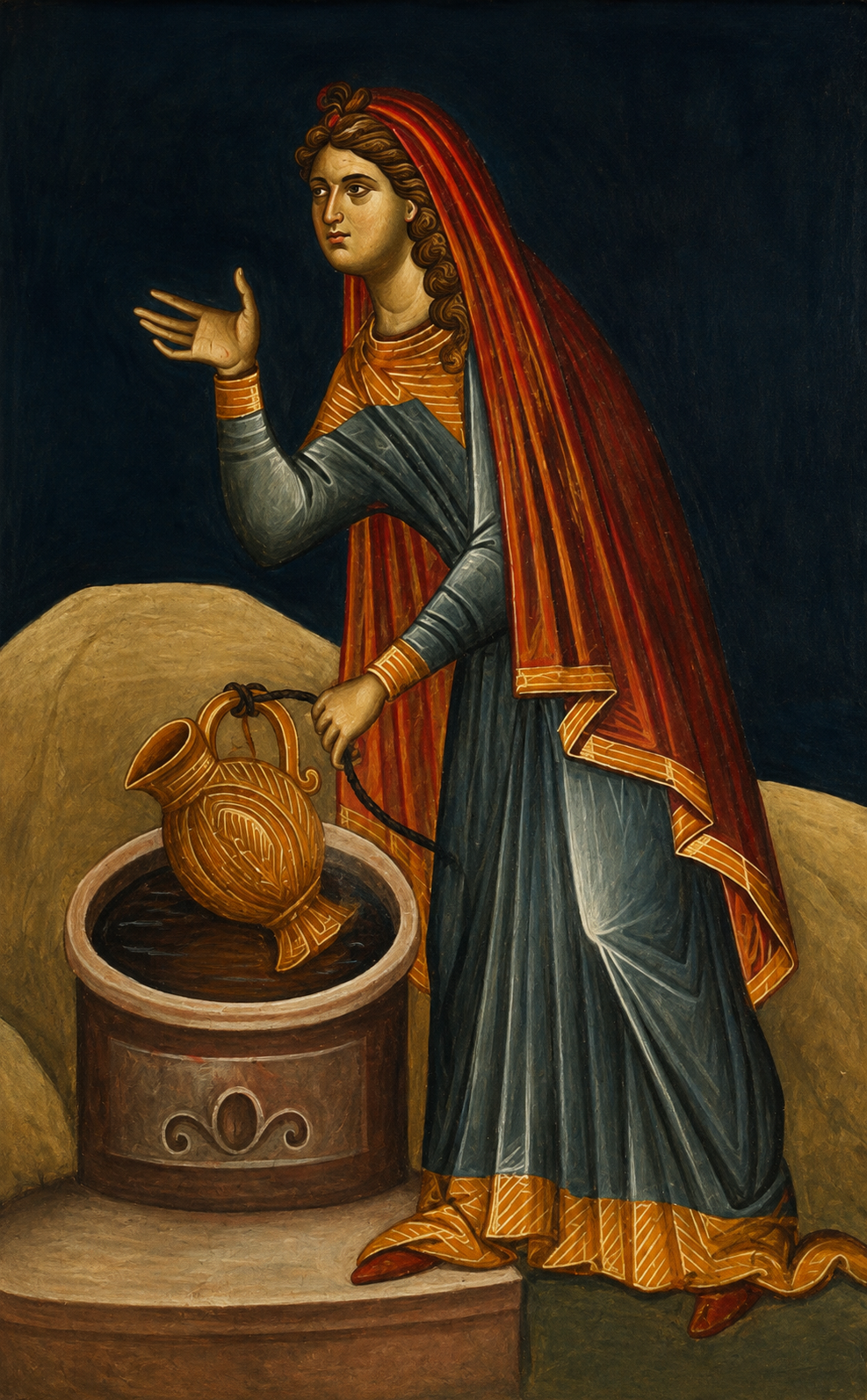
When the disciples returned, the woman left her water jar and went back toward the city. Christian preaching has often noticed the symbolic beauty of this detail because the woman who arrived seeking ordinary water departed carrying news about the One who had offered living water.
The abandoned jar should not be exaggerated into a magical symbol, but its place in the Gospel is striking. Photini had come to the well for a practical task, yet the encounter with Christ became so urgent that telling other people about Him displaced the ordinary purpose that had brought her there.
Her first message was rooted in personal experience. She told the people of the city about a man who knew the truth of her life and invited them to consider whether He might be the Christ, and the testimony was powerful enough that people left the city and came toward Jesus.
This makes Saint Photini one of the clearest biblical examples of personal testimony becoming evangelization. She did not pretend to know everything, but she told the truth about what had happened and directed people toward Christ rather than toward herself.
THE WOMAN WHO BROUGHT A CITY TO CHRIST
John's Gospel says that many Samaritans from the city initially believed because of the woman's testimony. After they came to Jesus and heard Him themselves, their faith deepened beyond reliance upon her report, and they recognized Christ directly.
This sequence is essential to understanding healthy evangelization. Photini's testimony mattered enormously, but the final goal was not for people to remain dependent upon Photini's spiritual experience. She brought them toward Jesus so that they could encounter Him themselves.
Parents praying for children who have left the faith can find both encouragement and humility in this pattern. We can speak, pray, answer questions, live faithfully, and invite, but ultimately another person's relationship with Christ cannot remain borrowed from ours.
The same principle applies to catechists, missionaries, apologists, and Christian writers. Good evangelization does not create dependence upon the evangelist but helps people move toward direct life in Christ and His Church.
FROM SHAME TO WITNESS
One of the most powerful transformations in the entire story is the movement from a woman whose personal circumstances could have produced shame to a woman willing to speak publicly to her community. Whatever people in Sychar already knew or thought about her, Photini no longer allowed fear of their judgment to silence what she had encountered in Christ.
This does not mean Christians should reveal every private sin publicly. The lesson is that once something has been brought into the light before Christ, shame no longer needs to exercise total control over the person's identity.
Saint Photini can therefore become especially meaningful for people recovering from sexual sin, divorce, broken relationships, addiction, public embarrassment, family scandal, or other histories that produce the thought, “No one would listen to me if they knew who I had been.” Her Gospel story gives a radically different answer because the people who knew her history were the very people she went to tell about Christ.
The credibility of Christian witness does not always come from being able to say, “I never failed.” Sometimes it comes from being able to say that Christ met us within the truth and changed the direction of our life.
SAINT PHOTINI & CONVERSION
Conversion in Photini's story is not merely intellectual agreement with a proposition. It involves recognition of Christ, confrontation with truth, a new understanding of worship, personal faith, and movement outward toward other people.
For someone becoming Christian, Saint Photini can therefore become a particularly fitting intercessor. Converts frequently have to rethink old assumptions, explain changes to family members, encounter misunderstanding, learn new forms of worship, and gradually allow the Gospel to reach parts of life they initially hoped to leave untouched.
Her story also shows that Christ is not frightened by questions. Photini asks about water, identity, religious divisions, worship, and the Messiah, and the conversation grows deeper rather than collapsing under the weight of her questions.
A catechumen or newly baptized Christian may therefore keep a Saint Photini card as a reminder that genuine conversion includes both receiving answers and continuing to follow the One to whom those answers point.
SAINT PHOTINI & EVANGELIZATION
Saint Photini's strongest devotional association after conversion is evangelization. The Orthodox Church's Troparion calls her Equal to the Apostles and describes her as someone who received the water of salvation and then gave it abundantly to others who thirsted, making missionary witness part of the Church's official liturgical memory of her.
Her model of evangelization is especially useful because it begins with authentic encounter rather than technique. Photini had something to say because Christ had actually reached her life, and the credibility of the message was connected with the visible urgency of that transformation.
This is particularly relevant for Christians who are uncomfortable with evangelization because they imagine it requires argumentative confrontation with strangers. Photini's example begins much more simply with telling people what she had encountered and inviting them to come see for themselves.
The Melkite Catholic Church has even used Saint Photini as a model for new evangelization, particularly because contemporary people often respond to authenticity, relationship, and visible experience before abstract argument. That is a modern pastoral application rather than an ancient formal patronage title, but it fits the Gospel pattern remarkably well.
PRAYING FOR FAMILY MEMBERS TO FIND CHRIST
The later Orthodox tradition remembers Photini's missionary work as beginning especially within her own family. The OCA's received Life names her sons Victor, later called Photinos, and Joses, together with five sisters named Anatole, Photo, Photida, Paraskeve, and Kyriake, and remembers them as participating in the proclamation of Christ and eventually suffering martyrdom.
These family details come from the Church's hagiographic tradition rather than from John's Gospel itself, so they should be distinguished from the biblical account. Scripture tells us that the Samaritan Woman brought people from her city toward Christ, while the later Orthodox Life expands her missionary story into a family apostolate extending beyond Samaria.
This makes Saint Photini especially meaningful for parents, grandparents, spouses, or siblings praying that someone they love will encounter Christ. Her traditional story is not one of private spirituality isolated from family relationships but of faith spreading outward through the people closest to her.
That does not make Photini a mechanism for forcing another person's conversion. Her intercession can instead accompany patient prayer, truthful witness, loving relationships, and the willingness to let Christ work within another person's freedom.
THE LATER ORTHODOX TRADITION OF HER MISSIONARY LIFE
John's Gospel concludes Photini's biblical story with the Samaritan community encountering Jesus, but the Orthodox hagiographic tradition continues her biography far beyond John 4. The OCA preserves a detailed traditional Life in which Photini later preached Christianity in Carthage during the reign of Emperor Nero, while her sons and sisters also became active Christian witnesses.
According to this tradition, Photini lived in Carthage with her younger son Joses and preached there openly. Her older son Victor served in the Roman military and was appointed commander at Attalia in Asia Minor, but rather than suppress Christians he confessed that he too desired to preach Christ.
The tradition then describes an official named Sebastian being converted after a miraculous healing of blindness. Nero eventually heard of the growing Christian witness and ordered Photini, her family, and their companions to Rome, where they were subjected to repeated attempts to make them renounce Christ.
These episodes should be described clearly as the received Orthodox hagiographic tradition. They are part of the Church's liturgical memory of Saint Photini but are not details supplied by the New Testament or by surviving contemporary Roman court records.
SAINT PHOTINI BEFORE NERO
The traditional Life presents Saint Photini as astonishingly fearless before Emperor Nero, the Roman ruler whose reign became associated with severe persecution of Christians. She and her companions refused to renounce Christ despite threats and torture, and the narrative repeatedly depicts Photini continuing to evangelize even while imprisoned or under imperial supervision.
According to the same tradition, Photini and her sisters were placed within the imperial court under the supervision of Nero's daughter Domnina. Rather than being converted away from Christianity, Photini reportedly converted Domnina and her servants to Christ, continuing the same missionary pattern that began at Jacob's Well.
The theological continuity is striking even though the later story is hagiographic. At the well, Photini goes from receiving Christ's word to telling a city about Him, while in the martyr tradition she continues proclaiming Christ in the very environment intended to silence her.
This is why the Church's title Equal to the Apostles fits more than the moment beside the well. Eastern tradition remembers the rest of her life as the continuation of the evangelical movement that began in John 4.
HER MARTYRDOM
The OCA's received Life preserves an exceptionally severe account of the tortures inflicted upon Photini and the Christians with her. The narrative includes imprisonment, physical torture, crucifixion attempts, miraculous healings, the martyrdom of her family and companions, and Photini herself being thrown into a well before her death around the year 66.
The details are graphic enough that a devotional product page does not need to dwell unnecessarily upon every form of violence. What matters spiritually is the continuity between the woman who first recognized Christ beside a well and the martyr who, according to tradition, eventually surrendered her earthly life rather than deny Him.
The well therefore appears almost like a frame around her Christian story. At Jacob's Well she encountered the One who offered living water, while the later hagiographic tradition remembers her earthly life ending after she was cast into another well because she would not renounce Him.
The Church does not honor Photini because suffering itself is holy. She is honored because fear, imperial power, humiliation, and violence could not reverse the confession that began when she recognized Jesus as the Christ.
FROM A WATER JAR TO THE MARTYR'S CROSS
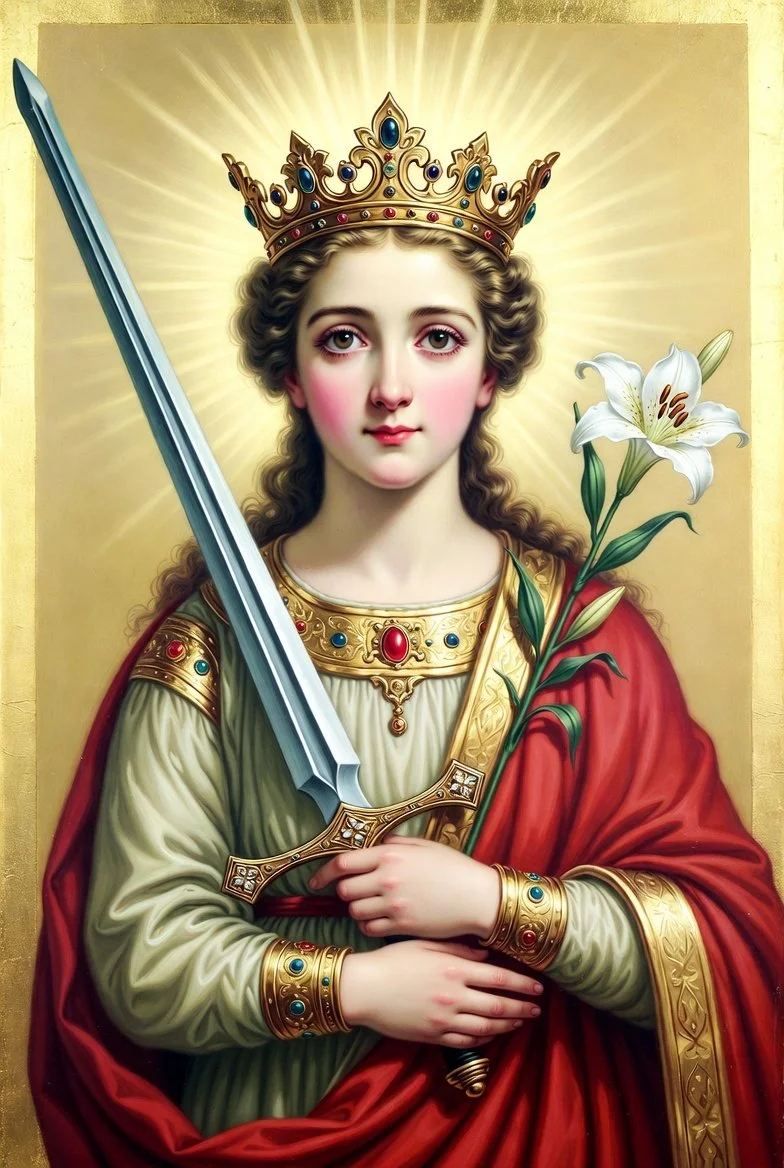
Orthodox icons of Saint Photini may emphasize different moments of her life. Some show Christ and Photini together at Jacob's Well, emphasizing the Gospel encounter, while individual icons may depict her holding a water vessel as a sign of that meeting and a cross as the traditional symbol of martyrdom.
The two symbols summarize her transformation beautifully. The jar recalls the woman who came looking for ordinary water, while the martyr's cross recalls the woman whose encounter with Christ eventually became a confession she was willing to carry through suffering.
Neither symbol should obscure the most important reality. Photini is not important because of the jar itself or because martyrdom made her dramatic, but because both point to the same relationship with Christ.
Her story begins with thirst and ends in witness.
WHY HER NAME IS PHOTINI
The Gospel of John calls her simply the Samaritan Woman and never records a personal name. The name Photini, Photinē, or Fotini comes from Eastern Christian tradition and is connected with the Greek idea of illumination or light, which is why English Orthodox sources sometimes explain her as “the enlightened one.”
Slavic traditions may also connect her with the name Svetlana, which similarly carries an association with light. The OCA therefore lists her as Photini and includes Svetlana among the forms associated with the saint.
The name is theologically appropriate because the woman who begins John 4 without recognizing who is speaking to her gradually receives greater spiritual understanding. She becomes “illumined” not because she discovers hidden knowledge independently but because Christ reveals Himself to her.
For product SEO, including both Saint Photini and the Samaritan Woman is especially important because many Christians know the Gospel story without ever having encountered the Eastern name.
PHOTINI, PHOTINA, FOTINI OR SVETLANA?
English sources use several spellings for the saint's name, including Photini, Photina, Photine, and Fotini. Orthodox sources also associate her with the Slavic name Svetlana, and all of these can refer to the Samaritan Woman honored in the Eastern tradition.
For an English-language prayer card, Saint Photini, the Samaritan Woman is probably the clearest primary title. Including Photina, Fotini, and Svetlana within the description and FAQ can help people searching different linguistic forms find the same saint without cluttering the main product title.
SAINT PHOTINI & WOMEN WHO FEEL JUDGED
Saint Photini's story is particularly valuable for women who feel they have been reduced to their relationship history. John tells us enough about her situation to know that it was complicated, while later Christian preaching has often focused so heavily upon that history that the depth of her theological conversation and missionary importance can disappear behind it.
Jesus does not ignore the truth about her life, but neither does He make that truth the last thing He says about her. He continues speaking with her about worship, salvation, the Messiah, and eternal life, which reveals a radically different measure of her dignity than one based solely upon how other people assessed her relationships.
The Church then remembers the same woman as Equal to the Apostles. That transformation is especially meaningful for someone who has internalized the belief that a failed marriage, sexual history, divorce, single motherhood, or another complicated circumstance has permanently defined their spiritual worth.
Saint Photini's story does not erase responsibility where repentance is needed. It reveals that repentance can open into vocation rather than merely into lifelong shame.
SAINT PHOTINI & PEOPLE WHO FEEL LIKE OUTSIDERS
The Samaritan Woman belonged to a community with a complicated religious relationship to Judaism, and the Gospel emphasizes the unusual nature of a Jewish man asking a Samaritan woman for water. Christ's willingness to engage her became a sign that salvation could not be confined within the social boundaries people had learned to treat as permanent.
This makes Saint Photini especially meaningful for converts from another religious background, people who feel culturally out of place in a parish, and Christians who fear they do not naturally “fit” within religious communities. Her story does not say differences are meaningless, because Jesus and Photini openly discuss them, but it shows that difference does not prevent genuine encounter with Christ.
The same lesson challenges established Christians. If Christ was willing to begin such a profound conversation with someone His society regarded as religiously and socially outside the expected circle, Christians should be cautious about assuming they already know who is or is not spiritually reachable.
Photini herself became the evidence.
THE LIVING WATER
The image of living water stands at the center of Saint Photini's story. Jesus takes the ordinary reality for which she came to the well and uses it to reveal a deeper gift leading toward eternal life, while Orthodox liturgical interpretation connects this water with the grace and life of the Holy Spirit.
This makes her especially appropriate for baptisms and chrismations. The Sunday of the Samaritan Woman falls within the Pentecostarion and belongs to a sequence of post-Paschal Sundays in which water, illumination, resurrection, and new life are recurring themes.
The water also gives Photini's story a continuing devotional meaning for people who feel spiritually empty. Many things promise to satisfy human thirst, including relationships, status, possessions, entertainment, achievement, and approval, yet the Gospel deliberately moves from ordinary thirst toward the deeper hunger of the human person for communion with God.
Saint Photini is therefore not merely a saint for people whose lives look like hers. She is a saint for anyone discovering that what they have repeatedly gone back to obtain has never fully satisfied the deeper thirst of the heart.
TRUE WORSHIP
Christ's teaching to Photini about worship in spirit and truth makes her story especially important for people whose religious life has become primarily external. Sacred places matter profoundly in Christianity, yet Jesus tells Photini that genuine worship cannot be reduced to possession of the correct mountain or geographical location.
This does not abolish churches, liturgy, sacraments, sacred art, pilgrimage, or embodied worship. The Orthodox tradition itself celebrates Photini at the physical site of Jacob's Well and builds churches around sacred locations, while simultaneously hearing Christ's warning that external religious forms must lead toward genuine communion with God.
For Christians who attend services faithfully but feel spiritually distant, Photini can therefore become a meaningful intercessor for the renewal of worship from the heart. Her encounter reminds us that correct religious practice and interior conversion should ultimately meet rather than remain separate.
THE SUNDAY OF THE SAMARITAN WOMAN
The Orthodox Church gives the Samaritan Woman an extraordinary place within the liturgical year through the Sunday of the Samaritan Woman, celebrated during the Paschal season. GOARCH identifies it as the fifth Sunday of Holy Pascha, when the Gospel reading of John 4:5-42 is proclaimed and the Church meditates upon living water, true worship, revelation, and conversion.
The feast is especially beautiful because Photini's story is placed after the Resurrection rather than treated only as a chronological episode from before the Passion. The Church hears her encounter through Paschal eyes and sees the living water offered by Christ as part of the new life opened through His death and Resurrection.
At Jacob's Well itself, the Greek Orthodox Patriarchate of Jerusalem continues celebrating the Sunday of the Samaritan Woman in the Church of Saint Photini. The annual celebration physically returns the Gospel reading to the location where the encounter is traditionally remembered.
HER FIXED FEAST DAYS
Saint Photini also has fixed calendar commemorations in addition to the movable Sunday of the Samaritan Woman. The Orthodox Church in America commemorates her with her family and companions on March 20, while the OCA explicitly notes that Greek usage commemorates Saint Photini on February 26.
This difference explains why prayer cards, icon shops, church calendars, and online references may give either February 26 or March 20. Neither necessarily indicates a different Samaritan Woman, because different Orthodox local traditions preserve different fixed commemorations while all also share the major Paschal celebration of her Gospel encounter.
For a product page serving multiple Eastern traditions, the clearest approach is to list both fixed dates and explain the difference rather than choose one and imply that the other is wrong.
CATHOLIC & EASTERN CATHOLIC DEVOTION
Saint Photini belongs to an apostolic-era Gospel story that predates later divisions between Eastern and Western Christianity, but the name Photini and the detailed martyr tradition are especially prominent in Eastern Christianity. Melkite Catholic sources explicitly refer to the Samaritan Woman as Saint Photini and use her as a model of evangelization and conversion.
Older Western Catholic devotional calendars also preserve a historical commemoration of Saint Photina, the Samaritan Woman, on March 20, although she is not nearly as prominent in contemporary Latin Catholic devotion as she is in Byzantine Christianity.
For an exact faith label, the safest wording is that Saint Photini is especially venerated in the Eastern Orthodox and Byzantine Christian traditions, including Melkite Catholic usage, while the Samaritan Woman herself is of course a biblical figure belonging to the shared Gospel inheritance of all Christians. This avoids implying that every later Eastern hagiographic detail has identical liturgical prominence in every Catholic tradition.
JACOB'S WELL TODAY
The site traditionally identified as Jacob's Well is in modern Nablus, historically Neapolis, in Samaria, and it remains an active pilgrimage site of the Greek Orthodox Patriarchate of Jerusalem. A large Orthodox church dedicated to Saint Photini the Samaritan Woman stands at the site, and the Patriarchate continues celebrating her Paschal feast there.
For a Christian devoted to Saint Photini, this is one of the most direct Gospel pilgrimage sites imaginable. Pilgrims can stand at the place where the Jerusalem Patriarchate preserves the tradition of Jesus' conversation with the Samaritan Woman and hear the same Gospel proclaimed within a church bearing her name.
The Patriarchate also reports preserving a small relic associated with Saint Photini within the Church of Jacob's Well. Its account additionally identifies a vessel traditionally connected with the Samaritan Woman, although such object traditions should be presented as ecclesiastical pilgrimage traditions rather than treated as archaeologically proven artifacts from John 4.
THE RELICS OF SAINT PHOTINI
The OCA states that the head of Saint Photini is preserved at Grigoriou Monastery on Mount Athos. It also records an older Constantinopolitan tradition in which churches dedicated to her became associated particularly with miraculous healings of diseases of the eyes.
The connection with eye healing creates an interesting relationship with her name and symbolism of illumination, but it should not be exaggerated into an exclusive universal patronage of every eye disease. The safest statement is that the OCA specifically preserves a historical miracle tradition involving healing of eye conditions at churches dedicated to her.
For pilgrims interested in her relics, Grigoriou Monastery on Mount Athos is therefore one of the most important locations associated with Saint Photini beyond Jacob's Well itself. Women, who cannot enter Mount Athos, can still encounter her devotion through churches and relic portions elsewhere, particularly at Jacob's Well and in Orthodox communities that commemorate her.
SAINT PHOTINI & HEALING OF THE EYES
Because the OCA records miracles involving eye diseases at churches dedicated to Saint Photini in Constantinople, Christians experiencing problems with sight may naturally seek her intercession. That association is historically grounded, although healing is not the central theme of her Gospel identity in the same way that conversion and evangelization are.
The spiritual symbolism is also difficult to miss because Photini's name is associated with illumination and her entire Gospel encounter is a movement from partial understanding toward recognizing Christ. Physical and spiritual sight should not be confused, but the traditional association gives people facing eye disease a genuine historical reason to seek her prayers without manufacturing a modern patronage.
THE WOMAN WHO ASKED QUESTIONS
Saint Photini is a particularly valuable saint for people who worry that asking hard questions is somehow opposed to faith. Her conversation with Jesus is filled with questions about ethnic boundaries, water, Jacob, worship, sacred geography, prophecy, and the Messiah, and Christ responds by leading her deeper rather than dismissing her curiosity.
This does not mean every question is equally sincere or that Christianity possesses no doctrinal boundaries. It means honest questions can become part of conversion when they are asked within a willingness to follow truth wherever it leads.
A catechist or teacher can learn something important from Christ's response to Photini. He does not unload every theological answer at once, but meets her where she is, answers one question, exposes a deeper reality, and allows understanding to grow through the conversation.
COURAGE TO TALK ABOUT JESUS
Many Christians sincerely believe in Christ but become nervous when conversation creates an opportunity to speak openly about Him. Saint Photini's immediate response after the well makes her particularly meaningful for this fear because she moved toward the people who knew her rather than waiting until she had become an expert.
Her example does not require Christians to become aggressive or argumentative. She invites others toward an encounter, and that invitation becomes powerful because it comes from someone whose own life has just been affected by what she is describing.
Christians can therefore ask Saint Photini for courage to speak naturally about the faith within ordinary relationships. Evangelization may begin not with a debate but with an honest sentence about why prayer matters, why someone returned to church, how Christ changed a decision, or why the Gospel has become real within suffering.
The destination remains the same as it was in Sychar. The witness is meant to lead toward Jesus.
A SAINT FOR CATECHUMENS & CONVERTS
Saint Photini is especially fitting for catechumens and converts because her Gospel story is itself a process of increasing recognition. She does not begin the conversation already confessing Jesus as the Messiah, but understanding grows through encounter until she is ready to tell others about Him.
Conversion can feel disorienting because familiar assumptions begin changing while new beliefs, worship practices, language, and community relationships are still being learned. Photini's story shows that movement toward Christ can happen through stages without those stages being meaningless.
Her card can therefore make an especially appropriate baptism or chrismation gift. The imagery of living water, illumination, confession of Christ, and immediate witness makes her story unusually rich for someone beginning sacramental life within the Church.
A SAINT FOR BROKEN RELATIONSHIP HISTORY
Saint Photini's relationship history makes her especially meaningful for people who come to Christ after divorce, remarriage, cohabitation, sexual sin, or complicated family circumstances. Scripture does not give enough detail to assign blame for every previous marriage, but it clearly presents a current relationship that does not correspond to marriage and allows Christ to bring that truth openly into the conversation.
What follows is crucial because Christ does not end the encounter after identifying the problem. He reveals Himself more fully, and the woman becomes an evangelistic witness.
The Christian message is therefore not that the past does not matter. It is that the past does not have sovereign authority over the future once a person meets Christ in truth.
For someone afraid to return to church because their life feels too complicated, Saint Photini is a particularly beautiful companion. Her story says that Christ already knows the situation before the person approaches the well.
PRAYERS
A simple traditional invocation may be prayed throughout the day: Holy Great Martyr and Equal-to-the-Apostles Photini, pray to God for us. This wording follows the titles used in her Orthodox liturgical tradition and is particularly fitting when praying for conversion, courage to evangelize, repentance, freedom from shame, or a family member who has not yet encountered Christ personally.
Her traditional Troparion beautifully connects the Gospel encounter with her later mission by remembering that she received the saving water of Christ and then shared it with others. The hymn concludes by asking Saint Photini to intercede before Christ for the salvation of the faithful, making it an established Church prayer rather than a newly invented devotional text.
Someone praying for the conversion of a family member can ask Saint Photini's intercession while naming that person before Christ. Her story encourages persistent witness without coercion because she invited her city toward Jesus but the people ultimately had to encounter and believe in Him themselves.
A person burdened by shame can likewise ask her prayers while remembering that Christ already knows the full truth. The goal is not to hide successfully but to become free enough to stand in the light, repent where repentance is needed, receive mercy, and allow the past to become part of a testimony rather than a permanent prison.
This prayer card is especially fitting for a Bible near John 4, a baptism or chrismation gift, a catechumen's prayer corner, a missionary bag, a catechist's desk, a women's ministry, or a family prayer space where someone is being remembered for conversion. It can also be especially meaningful for someone rebuilding life after painful relationships and learning that Christ's knowledge of the past does not prevent Him from calling that person into holiness.
FAQ
Who is Saint Photini? Saint Photini is the name Eastern Christian tradition gives to the Samaritan Woman who spoke with Jesus at Jacob's Well in John 4:5-42. The Orthodox Church honors her as a Great Martyr and Equal to the Apostles because of her Gospel witness and the later tradition of her missionary life and martyrdom.
Is Saint Photini actually named in the Bible? No, the Gospel of John never gives the Samaritan Woman a personal name. Photini is the name preserved by Eastern Christian tradition, and Greek Orthodox sources explain it in connection with illumination or being enlightened.
Is Photini the Samaritan Woman at the well? Yes, Orthodox tradition explicitly identifies Saint Photini with the Samaritan Woman of John 4. The OCA, GOARCH, and Greek Orthodox Patriarchate of Jerusalem all make that identification.
What does the name Photini mean? The name is associated with light and illumination, which is why she is sometimes described in English as the Enlightened One. The name is especially fitting because her Gospel encounter moves from incomplete understanding toward recognition of Jesus as the Messiah.
Is Fotini the same saint as Photini? Yes, Fotini and Photini are different transliterations of the same Greek name. Photina and Photine are also encountered in English and other European-language sources.
Is Svetlana connected with Saint Photini? Yes, Slavic Orthodox usage associates the saint with the name Svetlana, another name connected with light. The OCA itself lists Svetlana among the names associated with Saint Photini.
What is Saint Photini known for? She is especially known for her encounter with Christ at Jacob's Well, receiving His teaching about living water and true worship, bringing people from her city to Jesus, and later being remembered by Orthodox tradition as a missionary and martyr. The Church therefore honors her particularly as Equal to the Apostles.
What is Saint Photini the patron saint of? The strongest devotional associations grounded in her Gospel story and Church tradition are conversion, evangelization, repentance, people returning to Christ, courage to share the faith, and freedom from shame about a complicated past. It is safer to describe these as authentic devotional associations than to manufacture a rigid universal patronage list.
Is Saint Photini a saint for conversion? Yes, conversion is one of the strongest themes in her Gospel story because her understanding of Jesus develops dramatically during their conversation and immediately changes her behavior. She then becomes instrumental in bringing other Samaritans to Christ.
Can I pray to Saint Photini for someone's conversion? Yes, this is an especially natural reason to seek her intercession. Her own witness brought others toward Christ, while the later Orthodox tradition also remembers her family becoming part of her missionary life.
Can I pray to Saint Photini for my children to return to church? Yes, her life makes her particularly meaningful for parents and grandparents praying that someone they love will encounter Christ personally. Her story also reminds the person praying that witness and invitation can open doors, but another person's final response to Christ remains free.
Is Saint Photini a saint for evangelists? Yes, very strongly. Her Orthodox Troparion describes her receiving the water of salvation and then giving it to others, while the Church formally calls her Equal to the Apostles.
Can missionaries pray to Saint Photini? Yes, her Gospel testimony and later missionary tradition make her an especially appropriate intercessor for missionaries. Her example emphasizes bringing people to Christ rather than making the missionary the center of attention.
Is Saint Photini a good saint for catechists? Yes, particularly because her encounter with Christ becomes a movement from questions and partial understanding into faith and proclamation. Catechists can ask her prayers for clarity, patience, and the ability to lead others toward their own deeper encounter with Jesus.
Is Saint Photini a saint for people with a sinful past? Her story is especially meaningful for people carrying shame about their past because Christ knows her relationship history completely and still leads her toward truth, faith, and mission. The Gospel does not present repentance as pretending the past never happened, but it also refuses to let the past become her permanent identity.
Can I pray to Saint Photini after divorce? Yes, especially if someone is carrying shame, grief, confusion, or spiritual discouragement connected with a complicated relationship history. John does not tell us how Photini's five marriages ended, so her story should not be simplistically reduced to divorce, but it certainly demonstrates Christ meeting someone whose relational life was complicated.
Can someone who is cohabiting or in an irregular relationship pray to Saint Photini? Yes, and her story may be particularly meaningful because Christ directly addressed the fact that the man then in her life was not her husband. The proper spiritual lesson is neither condemnation without mercy nor pretending the situation does not matter, but allowing Christ to bring life into truth and repentance.
Did Saint Photini have five husbands? John 4 states that the Samaritan Woman had previously had five husbands. Jesus also states that the man she was presently with was not her husband, but Scripture does not explain what happened in each previous marriage.
Was Saint Photini a prostitute? The Gospel never calls the Samaritan Woman a prostitute. Describing her that way goes beyond the biblical text and should be avoided.
Was Saint Photini an adulteress? John clearly describes an irregular current relationship but does not give enough information to reconstruct the moral circumstances of all five former marriages. It is more accurate to say that Christ confronted the truth about her complicated relationship history and led her toward faith and transformation.
Why did Jesus speak with a Samaritan woman? The encounter crossed significant ethnic, religious, and social boundaries because Jews and Samaritans had a deeply strained relationship. The Gospel uses the encounter to reveal that Christ's saving mission reaches beyond the boundaries people frequently use to separate themselves from one another.
What is the living water Jesus offered Saint Photini? Orthodox interpretation understands the living water as the divine life and grace given through Christ, closely connected with the Holy Spirit and eternal life. The Church's Paschal celebration of the Samaritan Woman repeatedly develops this baptismal and Spirit-filled meaning.
Why did Saint Photini leave her water jar? John's Gospel records that she left the jar when she went back to the city to tell people about Jesus. Christian tradition sees the detail as a beautiful sign that the encounter with Christ had become more urgent than the ordinary task that originally brought her to the well.
Did Saint Photini convert her whole town? John states that many Samaritans initially believed because of the woman's testimony and that more came to faith after personally hearing Jesus. It is therefore accurate to say her witness played a major role in bringing the community toward Christ, while their own encounter with Him became decisive.
Was Saint Photini the first evangelist? It is safer not to create an absolute chronological title that Scripture and the Church do not universally use. She is nevertheless one of the clearest early examples in the Gospels of someone personally encountering Christ and immediately bringing a community toward Him, and the Orthodox Church honors her as Equal to the Apostles.
Why is Saint Photini called Equal to the Apostles? The title recognizes the extraordinary missionary character of her witness. Her Orthodox Troparion remembers her as someone who received salvation from Christ and then gave that saving message to others, while the later tradition expands that witness into a life of missionary preaching and martyrdom.
Did Saint Photini become a martyr? According to the Orthodox hagiographic tradition, yes. The OCA preserves a detailed Life in which she and members of her family suffered under Emperor Nero and Photini eventually died after refusing to renounce Christ.
Is Saint Photini's martyrdom described in the Bible? No, the biblical account ends with the events in Samaria. The missionary activities in Carthage and Rome, her family details, confrontation with Nero, and martyrdom belong to later Orthodox hagiographic tradition.
Did Saint Photini meet Emperor Nero? The Orthodox Life says that she was brought before Nero in Rome and refused to renounce Christ despite persecution. This should be presented as the Church's traditional Life rather than as an event independently documented by surviving Roman governmental records.
Did Saint Photini preach in Carthage? According to Orthodox tradition, yes. The OCA's Life states that she lived in Carthage with her younger son Joses and preached Christianity there during Nero's reign.
Did Saint Photini have children? The later Orthodox tradition names two sons, Victor and Joses. These names are not supplied by John 4 and therefore belong to the saint's hagiographic tradition rather than the biblical account.
Did Saint Photini have sisters? Orthodox tradition names five sisters: Anatole, Photo, Photida, Paraskeve, and Kyriake. The OCA remembers them together with Photini among the Christians who suffered during the persecution associated with Nero.
How did Saint Photini die? The received Orthodox Life says she underwent repeated torture and was ultimately cast into a well, where she surrendered her soul to God around the year 66. These details come from ecclesiastical hagiography rather than John's Gospel.
Is there a connection between the well where she met Jesus and her martyrdom? The Gospel encounter unquestionably occurs at Jacob's Well, while the later Orthodox tradition also places her final death in a well. Christians have naturally seen spiritual symbolism in that parallel, although the second event belongs to later hagiography rather than Scripture.
Where is Jacob's Well today? The Greek Orthodox Patriarchate of Jerusalem preserves the site in Nablus, historically Neapolis, in Samaria. A large Orthodox Church of Saint Photini stands there, and the Patriarchate continues celebrating the Sunday of the Samaritan Woman at the well.
Can pilgrims visit Jacob's Well? Yes, it remains an active Greek Orthodox pilgrimage site. The church is dedicated to Saint Photini and preserves the traditional location of the Gospel encounter.
Where are Saint Photini's relics? The OCA states that her head is preserved at Grigoriou Monastery on Mount Athos. The Jerusalem Patriarchate also reports preserving a small relic associated with Saint Photini at the Church of Jacob's Well.
Is Saint Photini associated with healing eye diseases? Yes, historically. The OCA records that two churches dedicated to Saint Photini in Constantinople became associated with miracles, particularly healings of eye diseases.
Can I pray to Saint Photini for an eye condition? Yes, the historical miracle tradition gives a legitimate basis for seeking her intercession for eye disease. It is nevertheless better to describe this as a traditional healing association rather than claim that she is the exclusive universal patron of ophthalmic conditions.
When is Saint Photini's feast day? The OCA commemorates Saint Photini and her companions on March 20, while the same OCA Life notes that Greek usage commemorates her on February 26. She is also celebrated during the Paschal season on the Sunday of the Samaritan Woman.
Why do I see February 26 and March 20 for Saint Photini? Different Orthodox calendar traditions preserve different fixed commemorations of the same saint. Greek usage commonly gives February 26, while the OCA calendar commemorates Photini and her companions on March 20.
What is the Sunday of the Samaritan Woman? It is the Paschal Sunday on which the Orthodox Church proclaims John 4 and commemorates Christ's encounter with Photini at Jacob's Well. GOARCH identifies it as the fifth Sunday of Holy Pascha and emphasizes the themes of living water, revelation, and faith.
Is Saint Photini an Orthodox saint? Yes, she has a major place in Eastern Orthodox liturgy and hagiography and is honored as Great Martyr and Equal to the Apostles. Her commemoration appears in OCA, GOARCH, and Jerusalem Patriarchate sources.
Is Saint Photini venerated by Eastern Catholics? Yes, Photini appears within Byzantine Catholic tradition, including Melkite Catholic teaching and devotional material. Melkite sources explicitly identify the Samaritan Woman as Photini and even use her as a model for evangelization.
Is Saint Photini a Catholic saint? The Samaritan Woman is a biblical figure belonging to the common Christian inheritance, and older Western Catholic devotional calendars also preserve a historical March 20 feast of Saint Photina. Her named cult and elaborate martyr biography, however, are much more prominent in Eastern Orthodox and Byzantine Christian tradition, so that distinction is worth preserving.
Can I give this card to a catechumen? Yes, Saint Photini is an especially appropriate saint for someone preparing for Baptism or Chrismation. Her encounter combines living water, illumination, theological discovery, conversion, and the beginning of evangelical witness.
Can I give this card to someone becoming Christian? Yes, her story beautifully reflects the gradual movement from questioning and incomplete understanding toward recognition of Christ and a changed life. It can therefore make a meaningful conversion or reception-into-the-Church gift.
Can I give this card to someone returning to church after many years? Yes, especially if shame about the past has made returning difficult. Photini's story shows Christ addressing truth directly while simultaneously opening a future that is much larger than the person's previous history.
Can I give this card to someone after a divorce? Yes, particularly when the person needs a reminder that relationship history does not exhaust Christian identity. Scripture should not be stretched into claiming Photini's five marriages were identical to modern divorce situations, but her encounter clearly speaks to lives complicated by relationships and the possibility of beginning again in Christ.
Can I give this card to someone afraid to talk about Jesus? Yes, because Photini moved quickly from encounter to witness and invited others toward Christ despite having no established missionary credentials. Her example is particularly useful for Christians learning that evangelization can begin with honest testimony rather than aggressive argument.
Can women involved in ministry pray to Saint Photini? Yes, particularly women serving as catechists, missionaries, educators, writers, or evangelists. The Church's title Equal to the Apostles recognizes the extraordinary missionary importance of her witness without requiring her to hold an ordained office.
What does Saint Photini teach about shame? Her story teaches that Christ's knowledge of our past is deeper than our attempts to conceal it, yet His knowledge does not prevent Him from calling us forward. The woman whose complicated life was exposed in conversation became the person who openly brought her community toward Jesus.
What does Saint Photini teach about repentance? She demonstrates that repentance involves coming into truth before Christ and allowing that truth to redirect life rather than remaining trapped in humiliation. Her story moves almost immediately from disclosure into revelation, faith, and witness.
What does Saint Photini teach about evangelization? She teaches that evangelization can begin with telling the truth about what Christ has done and inviting other people to encounter Him personally. Her community eventually believed not only because of her testimony but because they themselves heard Christ.
What does Saint Photini teach about difficult questions? Her conversation demonstrates that honest theological questions can become part of the road toward faith. Jesus takes her questions seriously and uses them to lead her toward a deeper understanding of worship and His own identity.
What does Saint Photini teach about outsiders? Her story shows Christ deliberately crossing social and religious boundaries without abandoning truth. The woman who might have seemed unlikely to become a major Christian witness becomes the person through whom others are drawn toward Him.
What does Saint Photini teach about family conversion? The biblical account shows her witness spreading through her community, while Orthodox tradition remembers her own sons and sisters joining in the Christian mission. Together these traditions make her especially meaningful for people praying that faith will spread through their family.
What does Saint Photini teach about true worship? Christ told her that true worship is in spirit and truth, moving beyond the old dispute about whether worship belonged exclusively to one sacred mountain or another. Her story therefore joins external religious practice with the deeper transformation of the person who comes before God.
What does Saint Photini teach about the living water? Her story teaches that the deepest human thirst cannot finally be satisfied by ordinary created things alone. Christ offers the life of God, understood by Orthodox tradition in close connection with the grace of the Holy Spirit and eternal life.
What is the main message of Saint Photini's life? Saint Photini's life teaches that Christ can take the very parts of a person's story that seem most capable of producing shame and transform that person into a witness of His mercy and truth. The Samaritan Woman came to Jacob's Well carrying an ordinary water jar and a complicated history, entered a conversation with Jesus in which nothing important remained hidden, discovered the Messiah, left the well to bring others toward Him, and became remembered by the Church as Equal to the Apostles and a martyr. Her story tells converts, evangelists, people with broken pasts, and anyone afraid to return to God that Christ does not need us to arrive pretending to be someone else, because He already knows who is standing at the well and still offers living water.
Saint Photini, the Samaritan Woman at the Well, is one of the most remarkable women encountered personally by Jesus Christ in the Gospels and is honored in the Eastern Christian tradition as Equal to the Apostles and Great Martyr. Saint John's Gospel does not give the Samaritan Woman a personal name, but the Orthodox tradition knows her as Photini, meaning the enlightened or luminous one, because her encounter with Christ transformed her from someone coming quietly to draw ordinary water into a woman who immediately ran back to her community proclaiming what she had discovered. The Church's liturgical tradition sees in that transformation the beginning of an extraordinary evangelical witness.
Saint Photini is especially meaningful for conversion, returning to Christ after a complicated past, evangelization, courage to speak openly about Jesus, freedom from shame, family conversion, repentance, and the desire to encounter God personally rather than merely know religious information about Him. These associations arise first from John 4 itself, where a conversation about water gradually becomes a revelation about her life, worship, the Messiah, and eternal life, and then from the Church's later tradition, which remembers Photini as a missionary and martyr who continued proclaiming Christ long after the encounter at Jacob's Well.
Her story is particularly powerful for people who believe their past has disqualified them from being useful to God. Jesus knew her history before she told Him, including the five husbands she had already had and the fact that the man then in her life was not her husband, yet He did not avoid her, humiliate her publicly, or treat her as someone unworthy of theological conversation. Instead, He spoke with her at extraordinary depth about living water, true worship, and His own identity as the Messiah, and she subsequently became the very person through whom many people in her city first heard about Him.
Saint Photini is therefore one of the strongest saints for people carrying shame about relationships, divorce, sexual sin, family history, or a life that has not followed the path they once expected. Her Gospel story does not teach that the truth about sin is irrelevant, because Christ directly brings the reality of her situation into the light, but neither does He reduce her to that situation. The encounter moves from truth toward revelation, faith, and mission, showing that repentance is not merely being reminded of who we were but being drawn into who Christ is calling us to become.
She is also especially fitting for evangelists, catechists, converts, people trying to bring family members back to Christianity, and Christians who are afraid to speak about what Christ has done in their lives. After recognizing that Jesus possessed knowledge no ordinary stranger could have possessed, the Samaritan Woman left her water jar and returned to the city, drawing others toward Christ through personal testimony. The people later encountered Jesus themselves, so her witness did not make her the center of their faith but brought them to the One who was.
That pattern remains one of the healthiest models of Christian evangelization. Photini did not begin by possessing a theology degree, ecclesiastical office, missionary organization, or years of formation, but she knew that something extraordinary had happened in her encounter with Jesus and invited other people to investigate Him for themselves. Her testimony opened a door, while their own encounter with Christ deepened the faith that began through hearing her.
Saint Photini also has an important place for women seeking a strong female model of evangelization and theological seriousness. Jesus engages her in a sustained theological conversation touching Samaritan and Jewish worship, the coming messianic age, the nature of God, the meaning of true worship, living water, and His identity as the Christ. The Eastern Church's title Equal to the Apostles reflects not simply that she met Jesus but that she received the Gospel and then became a bearer of it to others.
Her story also speaks directly to those who feel like outsiders in religious spaces. She stood on several social boundaries at once as a Samaritan speaking with a Jewish man and as a woman whose domestic history placed her outside conventional expectations, yet Christ crossed those boundaries deliberately without compromising truth. The Greek Orthodox tradition repeatedly uses her story to show that the Gospel is offered to those whom religious and social communities may consider beyond their natural circle.
This prayer card is especially fitting for converts, catechumens, evangelists, people returning to the Church, women rebuilding their lives after painful relationships, parents praying for children who have left the faith, people carrying shame about their past, Christians discerning how to speak about Jesus without fear, and anyone longing to move from merely knowing about God toward personally encountering Him. It can also make a meaningful baptism, chrismation, conversion, catechist, missionary, or name-day gift, especially for someone named Photini, Fotini, Photina, or Svetlana.
Each card is handmade in Austin, TX and created to order. We do not keep stock, because every prayer card is treated as a unique devotional offering. They are printed on museum-quality photo paper, not cardstock, and every card is made slowly during prayer with intentional reverence for the saint and for the person who will receive it. Names are lifted before Christ, intentions are held carefully, and each piece is handled multiple times in prayerful silence, asking God for mercy and asking Saint Photini to intercede for the soul it is being made for. This is devotional craftsmanship shaped with patience, care, and spiritual responsibility because every soul and every prayer matters.
THE WOMAN AT JACOB'S WELL
The part of Saint Photini's life that can be known directly from Scripture is found in John 4:5-42. Jesus entered Samaria and came near the city of Sychar, where Jacob's Well stood, and because He was tired from the journey He sat beside the well while His disciples went into the city to obtain food. A Samaritan woman came to draw water, and Jesus began the encounter with the extraordinarily simple request that she give Him a drink.
The woman immediately recognized that something unusual was happening because Jesus was a Jew and she was a Samaritan. The relationship between Jews and Samaritans carried generations of religious and historical conflict, and John's Gospel itself notes the social barrier between them. Yet Christ did not begin with an argument about ethnic hostility or with condemnation of the woman, but with a request that created the possibility of conversation.
The conversation quickly moved beyond ordinary water. Jesus spoke of a living water that He could give, water that would become within the recipient a spring leading toward eternal life, and the woman initially understood Him in practical terms because she was standing beside a literal well and had come there precisely because she needed water. Christ gradually led her from the material image toward the spiritual reality it signified.
This movement makes the Samaritan Woman's story particularly important within the Paschal season. Orthodox liturgical teaching connects the Sunday of the Samaritan Woman with Baptism, the grace of the Holy Spirit, and the new life offered in Christ, while the Jerusalem Patriarchate interprets the living water as the life of the Holy Spirit given to believers. The encounter therefore becomes more than the story of one woman's conversion because it reveals something about what Christ offers every person who thirsts for life in God.
JESUS KNEW HER ENTIRE PAST
At a critical point in the conversation, Jesus told the woman to call her husband. She answered truthfully that she had no husband, and Christ revealed that He already knew she had previously had five husbands and that the man she was presently with was not her husband.
It is important not to add details Scripture itself does not give. John does not explain how each of the five marriages ended, so it would be careless to state that all five necessarily represented adultery, abandonment, or moral failure on her part, although the current irregular relationship clearly becomes an important part of the conversation. Eastern Christian commentary traditionally sees Christ's revelation as bringing her life into truth and repentance without turning the encounter into public humiliation.
The woman's reaction is revealing because she did not flee when Christ demonstrated knowledge of her private life. She recognized Him as a prophet and continued the theological conversation, suggesting that His truthfulness did not make her feel merely condemned but opened the possibility that the person standing before her was someone capable of revealing God.
This gives Saint Photini a powerful devotional connection with confession, repentance, and freedom from shame. There is a profound difference between hiding because we believe Christ will discover something about us and approaching Him knowing that He already sees the entire truth. Photini's story begins to change when the hidden parts of life no longer have to remain hidden from the One who already knows them.
WORSHIP IN SPIRIT AND TRUTH
The conversation then turned toward one of the oldest divisions between Samaritans and Jews: where God should rightly be worshipped. The Samaritan tradition centered worship on Mount Gerizim, while Jewish worship centered on Jerusalem, and Photini asked Jesus to address the dispute.
Christ's response went beyond merely choosing one sacred mountain over another. He announced the coming hour in which true worshippers would worship the Father in spirit and truth, shifting the discussion toward the new reality inaugurated through Him. The Jerusalem Patriarchate continues to emphasize this passage in its annual celebration of the Samaritan Woman at Jacob's Well, interpreting it in connection with the Holy Spirit and the life of the Church.
This means Photini's conversation with Jesus is not a shallow moral lesson about a troubled woman's private life. She is given one of the Gospel's major teachings about worship, revelation, and the relationship between God and those who seek Him. Her story therefore makes her especially meaningful for Christians who feel that questions, theological searching, or a complicated religious background somehow place them outside serious spiritual conversation.
Jesus did not tell her to stop asking theological questions until she had fixed herself completely. He led her more deeply into truth precisely within the encounter that was already exposing and transforming her life, showing that conversion involves both the heart and the mind.
“I AM HE”: CHRIST REVEALS HIMSELF
Photini then spoke of the coming Messiah, expecting that when He came He would explain these matters fully. Jesus responded by identifying Himself as the One she was awaiting, making the encounter one of the Gospel of John's clearest moments of direct messianic self-revelation.
The theological movement of the conversation is extraordinary. She initially sees a Jewish stranger asking for water, then addresses Him as someone greater, recognizes Him as a prophet, discusses the Messiah, and finally stands before the Messiah Himself. The progression illustrates how faith can deepen through genuine encounter rather than appearing fully formed at the first moment.
For someone in conversion, this pattern can be profoundly encouraging. A person may begin with curiosity, questions, partial understanding, skepticism, or even misconceptions and still be moving toward Christ. Photini's story shows Jesus patiently leading someone deeper rather than demanding that complete theological comprehension exist before the conversation can begin.
SHE LEFT HER WATER JAR
When the disciples returned, the woman left her water jar and went back toward the city. Christian preaching has often noticed the symbolic beauty of this detail because the woman who arrived seeking ordinary water departed carrying news about the One who had offered living water.
The abandoned jar should not be exaggerated into a magical symbol, but its place in the Gospel is striking. Photini had come to the well for a practical task, yet the encounter with Christ became so urgent that telling other people about Him displaced the ordinary purpose that had brought her there.
Her first message was rooted in personal experience. She told the people of the city about a man who knew the truth of her life and invited them to consider whether He might be the Christ, and the testimony was powerful enough that people left the city and came toward Jesus.
This makes Saint Photini one of the clearest biblical examples of personal testimony becoming evangelization. She did not pretend to know everything, but she told the truth about what had happened and directed people toward Christ rather than toward herself.
THE WOMAN WHO BROUGHT A CITY TO CHRIST
John's Gospel says that many Samaritans from the city initially believed because of the woman's testimony. After they came to Jesus and heard Him themselves, their faith deepened beyond reliance upon her report, and they recognized Christ directly.
This sequence is essential to understanding healthy evangelization. Photini's testimony mattered enormously, but the final goal was not for people to remain dependent upon Photini's spiritual experience. She brought them toward Jesus so that they could encounter Him themselves.
Parents praying for children who have left the faith can find both encouragement and humility in this pattern. We can speak, pray, answer questions, live faithfully, and invite, but ultimately another person's relationship with Christ cannot remain borrowed from ours.
The same principle applies to catechists, missionaries, apologists, and Christian writers. Good evangelization does not create dependence upon the evangelist but helps people move toward direct life in Christ and His Church.
FROM SHAME TO WITNESS
One of the most powerful transformations in the entire story is the movement from a woman whose personal circumstances could have produced shame to a woman willing to speak publicly to her community. Whatever people in Sychar already knew or thought about her, Photini no longer allowed fear of their judgment to silence what she had encountered in Christ.
This does not mean Christians should reveal every private sin publicly. The lesson is that once something has been brought into the light before Christ, shame no longer needs to exercise total control over the person's identity.
Saint Photini can therefore become especially meaningful for people recovering from sexual sin, divorce, broken relationships, addiction, public embarrassment, family scandal, or other histories that produce the thought, “No one would listen to me if they knew who I had been.” Her Gospel story gives a radically different answer because the people who knew her history were the very people she went to tell about Christ.
The credibility of Christian witness does not always come from being able to say, “I never failed.” Sometimes it comes from being able to say that Christ met us within the truth and changed the direction of our life.
SAINT PHOTINI & CONVERSION
Conversion in Photini's story is not merely intellectual agreement with a proposition. It involves recognition of Christ, confrontation with truth, a new understanding of worship, personal faith, and movement outward toward other people.
For someone becoming Christian, Saint Photini can therefore become a particularly fitting intercessor. Converts frequently have to rethink old assumptions, explain changes to family members, encounter misunderstanding, learn new forms of worship, and gradually allow the Gospel to reach parts of life they initially hoped to leave untouched.
Her story also shows that Christ is not frightened by questions. Photini asks about water, identity, religious divisions, worship, and the Messiah, and the conversation grows deeper rather than collapsing under the weight of her questions.
A catechumen or newly baptized Christian may therefore keep a Saint Photini card as a reminder that genuine conversion includes both receiving answers and continuing to follow the One to whom those answers point.
SAINT PHOTINI & EVANGELIZATION
Saint Photini's strongest devotional association after conversion is evangelization. The Orthodox Church's Troparion calls her Equal to the Apostles and describes her as someone who received the water of salvation and then gave it abundantly to others who thirsted, making missionary witness part of the Church's official liturgical memory of her.
Her model of evangelization is especially useful because it begins with authentic encounter rather than technique. Photini had something to say because Christ had actually reached her life, and the credibility of the message was connected with the visible urgency of that transformation.
This is particularly relevant for Christians who are uncomfortable with evangelization because they imagine it requires argumentative confrontation with strangers. Photini's example begins much more simply with telling people what she had encountered and inviting them to come see for themselves.
The Melkite Catholic Church has even used Saint Photini as a model for new evangelization, particularly because contemporary people often respond to authenticity, relationship, and visible experience before abstract argument. That is a modern pastoral application rather than an ancient formal patronage title, but it fits the Gospel pattern remarkably well.
PRAYING FOR FAMILY MEMBERS TO FIND CHRIST
The later Orthodox tradition remembers Photini's missionary work as beginning especially within her own family. The OCA's received Life names her sons Victor, later called Photinos, and Joses, together with five sisters named Anatole, Photo, Photida, Paraskeve, and Kyriake, and remembers them as participating in the proclamation of Christ and eventually suffering martyrdom.
These family details come from the Church's hagiographic tradition rather than from John's Gospel itself, so they should be distinguished from the biblical account. Scripture tells us that the Samaritan Woman brought people from her city toward Christ, while the later Orthodox Life expands her missionary story into a family apostolate extending beyond Samaria.
This makes Saint Photini especially meaningful for parents, grandparents, spouses, or siblings praying that someone they love will encounter Christ. Her traditional story is not one of private spirituality isolated from family relationships but of faith spreading outward through the people closest to her.
That does not make Photini a mechanism for forcing another person's conversion. Her intercession can instead accompany patient prayer, truthful witness, loving relationships, and the willingness to let Christ work within another person's freedom.
THE LATER ORTHODOX TRADITION OF HER MISSIONARY LIFE
John's Gospel concludes Photini's biblical story with the Samaritan community encountering Jesus, but the Orthodox hagiographic tradition continues her biography far beyond John 4. The OCA preserves a detailed traditional Life in which Photini later preached Christianity in Carthage during the reign of Emperor Nero, while her sons and sisters also became active Christian witnesses.
According to this tradition, Photini lived in Carthage with her younger son Joses and preached there openly. Her older son Victor served in the Roman military and was appointed commander at Attalia in Asia Minor, but rather than suppress Christians he confessed that he too desired to preach Christ.
The tradition then describes an official named Sebastian being converted after a miraculous healing of blindness. Nero eventually heard of the growing Christian witness and ordered Photini, her family, and their companions to Rome, where they were subjected to repeated attempts to make them renounce Christ.
These episodes should be described clearly as the received Orthodox hagiographic tradition. They are part of the Church's liturgical memory of Saint Photini but are not details supplied by the New Testament or by surviving contemporary Roman court records.
SAINT PHOTINI BEFORE NERO
The traditional Life presents Saint Photini as astonishingly fearless before Emperor Nero, the Roman ruler whose reign became associated with severe persecution of Christians. She and her companions refused to renounce Christ despite threats and torture, and the narrative repeatedly depicts Photini continuing to evangelize even while imprisoned or under imperial supervision.
According to the same tradition, Photini and her sisters were placed within the imperial court under the supervision of Nero's daughter Domnina. Rather than being converted away from Christianity, Photini reportedly converted Domnina and her servants to Christ, continuing the same missionary pattern that began at Jacob's Well.
The theological continuity is striking even though the later story is hagiographic. At the well, Photini goes from receiving Christ's word to telling a city about Him, while in the martyr tradition she continues proclaiming Christ in the very environment intended to silence her.
This is why the Church's title Equal to the Apostles fits more than the moment beside the well. Eastern tradition remembers the rest of her life as the continuation of the evangelical movement that began in John 4.
HER MARTYRDOM
The OCA's received Life preserves an exceptionally severe account of the tortures inflicted upon Photini and the Christians with her. The narrative includes imprisonment, physical torture, crucifixion attempts, miraculous healings, the martyrdom of her family and companions, and Photini herself being thrown into a well before her death around the year 66.
The details are graphic enough that a devotional product page does not need to dwell unnecessarily upon every form of violence. What matters spiritually is the continuity between the woman who first recognized Christ beside a well and the martyr who, according to tradition, eventually surrendered her earthly life rather than deny Him.
The well therefore appears almost like a frame around her Christian story. At Jacob's Well she encountered the One who offered living water, while the later hagiographic tradition remembers her earthly life ending after she was cast into another well because she would not renounce Him.
The Church does not honor Photini because suffering itself is holy. She is honored because fear, imperial power, humiliation, and violence could not reverse the confession that began when she recognized Jesus as the Christ.
FROM A WATER JAR TO THE MARTYR'S CROSS
Orthodox icons of Saint Photini may emphasize different moments of her life. Some show Christ and Photini together at Jacob's Well, emphasizing the Gospel encounter, while individual icons may depict her holding a water vessel as a sign of that meeting and a cross as the traditional symbol of martyrdom.
The two symbols summarize her transformation beautifully. The jar recalls the woman who came looking for ordinary water, while the martyr's cross recalls the woman whose encounter with Christ eventually became a confession she was willing to carry through suffering.
Neither symbol should obscure the most important reality. Photini is not important because of the jar itself or because martyrdom made her dramatic, but because both point to the same relationship with Christ.
Her story begins with thirst and ends in witness.
WHY HER NAME IS PHOTINI
The Gospel of John calls her simply the Samaritan Woman and never records a personal name. The name Photini, Photinē, or Fotini comes from Eastern Christian tradition and is connected with the Greek idea of illumination or light, which is why English Orthodox sources sometimes explain her as “the enlightened one.”
Slavic traditions may also connect her with the name Svetlana, which similarly carries an association with light. The OCA therefore lists her as Photini and includes Svetlana among the forms associated with the saint.
The name is theologically appropriate because the woman who begins John 4 without recognizing who is speaking to her gradually receives greater spiritual understanding. She becomes “illumined” not because she discovers hidden knowledge independently but because Christ reveals Himself to her.
For product SEO, including both Saint Photini and the Samaritan Woman is especially important because many Christians know the Gospel story without ever having encountered the Eastern name.
PHOTINI, PHOTINA, FOTINI OR SVETLANA?
English sources use several spellings for the saint's name, including Photini, Photina, Photine, and Fotini. Orthodox sources also associate her with the Slavic name Svetlana, and all of these can refer to the Samaritan Woman honored in the Eastern tradition.
For an English-language prayer card, Saint Photini, the Samaritan Woman is probably the clearest primary title. Including Photina, Fotini, and Svetlana within the description and FAQ can help people searching different linguistic forms find the same saint without cluttering the main product title.
SAINT PHOTINI & WOMEN WHO FEEL JUDGED
Saint Photini's story is particularly valuable for women who feel they have been reduced to their relationship history. John tells us enough about her situation to know that it was complicated, while later Christian preaching has often focused so heavily upon that history that the depth of her theological conversation and missionary importance can disappear behind it.
Jesus does not ignore the truth about her life, but neither does He make that truth the last thing He says about her. He continues speaking with her about worship, salvation, the Messiah, and eternal life, which reveals a radically different measure of her dignity than one based solely upon how other people assessed her relationships.
The Church then remembers the same woman as Equal to the Apostles. That transformation is especially meaningful for someone who has internalized the belief that a failed marriage, sexual history, divorce, single motherhood, or another complicated circumstance has permanently defined their spiritual worth.
Saint Photini's story does not erase responsibility where repentance is needed. It reveals that repentance can open into vocation rather than merely into lifelong shame.
SAINT PHOTINI & PEOPLE WHO FEEL LIKE OUTSIDERS
The Samaritan Woman belonged to a community with a complicated religious relationship to Judaism, and the Gospel emphasizes the unusual nature of a Jewish man asking a Samaritan woman for water. Christ's willingness to engage her became a sign that salvation could not be confined within the social boundaries people had learned to treat as permanent.
This makes Saint Photini especially meaningful for converts from another religious background, people who feel culturally out of place in a parish, and Christians who fear they do not naturally “fit” within religious communities. Her story does not say differences are meaningless, because Jesus and Photini openly discuss them, but it shows that difference does not prevent genuine encounter with Christ.
The same lesson challenges established Christians. If Christ was willing to begin such a profound conversation with someone His society regarded as religiously and socially outside the expected circle, Christians should be cautious about assuming they already know who is or is not spiritually reachable.
Photini herself became the evidence.
THE LIVING WATER
The image of living water stands at the center of Saint Photini's story. Jesus takes the ordinary reality for which she came to the well and uses it to reveal a deeper gift leading toward eternal life, while Orthodox liturgical interpretation connects this water with the grace and life of the Holy Spirit.
This makes her especially appropriate for baptisms and chrismations. The Sunday of the Samaritan Woman falls within the Pentecostarion and belongs to a sequence of post-Paschal Sundays in which water, illumination, resurrection, and new life are recurring themes.
The water also gives Photini's story a continuing devotional meaning for people who feel spiritually empty. Many things promise to satisfy human thirst, including relationships, status, possessions, entertainment, achievement, and approval, yet the Gospel deliberately moves from ordinary thirst toward the deeper hunger of the human person for communion with God.
Saint Photini is therefore not merely a saint for people whose lives look like hers. She is a saint for anyone discovering that what they have repeatedly gone back to obtain has never fully satisfied the deeper thirst of the heart.
TRUE WORSHIP
Christ's teaching to Photini about worship in spirit and truth makes her story especially important for people whose religious life has become primarily external. Sacred places matter profoundly in Christianity, yet Jesus tells Photini that genuine worship cannot be reduced to possession of the correct mountain or geographical location.
This does not abolish churches, liturgy, sacraments, sacred art, pilgrimage, or embodied worship. The Orthodox tradition itself celebrates Photini at the physical site of Jacob's Well and builds churches around sacred locations, while simultaneously hearing Christ's warning that external religious forms must lead toward genuine communion with God.
For Christians who attend services faithfully but feel spiritually distant, Photini can therefore become a meaningful intercessor for the renewal of worship from the heart. Her encounter reminds us that correct religious practice and interior conversion should ultimately meet rather than remain separate.
THE SUNDAY OF THE SAMARITAN WOMAN
The Orthodox Church gives the Samaritan Woman an extraordinary place within the liturgical year through the Sunday of the Samaritan Woman, celebrated during the Paschal season. GOARCH identifies it as the fifth Sunday of Holy Pascha, when the Gospel reading of John 4:5-42 is proclaimed and the Church meditates upon living water, true worship, revelation, and conversion.
The feast is especially beautiful because Photini's story is placed after the Resurrection rather than treated only as a chronological episode from before the Passion. The Church hears her encounter through Paschal eyes and sees the living water offered by Christ as part of the new life opened through His death and Resurrection.
At Jacob's Well itself, the Greek Orthodox Patriarchate of Jerusalem continues celebrating the Sunday of the Samaritan Woman in the Church of Saint Photini. The annual celebration physically returns the Gospel reading to the location where the encounter is traditionally remembered.
HER FIXED FEAST DAYS
Saint Photini also has fixed calendar commemorations in addition to the movable Sunday of the Samaritan Woman. The Orthodox Church in America commemorates her with her family and companions on March 20, while the OCA explicitly notes that Greek usage commemorates Saint Photini on February 26.
This difference explains why prayer cards, icon shops, church calendars, and online references may give either February 26 or March 20. Neither necessarily indicates a different Samaritan Woman, because different Orthodox local traditions preserve different fixed commemorations while all also share the major Paschal celebration of her Gospel encounter.
For a product page serving multiple Eastern traditions, the clearest approach is to list both fixed dates and explain the difference rather than choose one and imply that the other is wrong.
CATHOLIC & EASTERN CATHOLIC DEVOTION
Saint Photini belongs to an apostolic-era Gospel story that predates later divisions between Eastern and Western Christianity, but the name Photini and the detailed martyr tradition are especially prominent in Eastern Christianity. Melkite Catholic sources explicitly refer to the Samaritan Woman as Saint Photini and use her as a model of evangelization and conversion.
Older Western Catholic devotional calendars also preserve a historical commemoration of Saint Photina, the Samaritan Woman, on March 20, although she is not nearly as prominent in contemporary Latin Catholic devotion as she is in Byzantine Christianity.
For an exact faith label, the safest wording is that Saint Photini is especially venerated in the Eastern Orthodox and Byzantine Christian traditions, including Melkite Catholic usage, while the Samaritan Woman herself is of course a biblical figure belonging to the shared Gospel inheritance of all Christians. This avoids implying that every later Eastern hagiographic detail has identical liturgical prominence in every Catholic tradition.
JACOB'S WELL TODAY
The site traditionally identified as Jacob's Well is in modern Nablus, historically Neapolis, in Samaria, and it remains an active pilgrimage site of the Greek Orthodox Patriarchate of Jerusalem. A large Orthodox church dedicated to Saint Photini the Samaritan Woman stands at the site, and the Patriarchate continues celebrating her Paschal feast there.
For a Christian devoted to Saint Photini, this is one of the most direct Gospel pilgrimage sites imaginable. Pilgrims can stand at the place where the Jerusalem Patriarchate preserves the tradition of Jesus' conversation with the Samaritan Woman and hear the same Gospel proclaimed within a church bearing her name.
The Patriarchate also reports preserving a small relic associated with Saint Photini within the Church of Jacob's Well. Its account additionally identifies a vessel traditionally connected with the Samaritan Woman, although such object traditions should be presented as ecclesiastical pilgrimage traditions rather than treated as archaeologically proven artifacts from John 4.
THE RELICS OF SAINT PHOTINI
The OCA states that the head of Saint Photini is preserved at Grigoriou Monastery on Mount Athos. It also records an older Constantinopolitan tradition in which churches dedicated to her became associated particularly with miraculous healings of diseases of the eyes.
The connection with eye healing creates an interesting relationship with her name and symbolism of illumination, but it should not be exaggerated into an exclusive universal patronage of every eye disease. The safest statement is that the OCA specifically preserves a historical miracle tradition involving healing of eye conditions at churches dedicated to her.
For pilgrims interested in her relics, Grigoriou Monastery on Mount Athos is therefore one of the most important locations associated with Saint Photini beyond Jacob's Well itself. Women, who cannot enter Mount Athos, can still encounter her devotion through churches and relic portions elsewhere, particularly at Jacob's Well and in Orthodox communities that commemorate her.
SAINT PHOTINI & HEALING OF THE EYES
Because the OCA records miracles involving eye diseases at churches dedicated to Saint Photini in Constantinople, Christians experiencing problems with sight may naturally seek her intercession. That association is historically grounded, although healing is not the central theme of her Gospel identity in the same way that conversion and evangelization are.
The spiritual symbolism is also difficult to miss because Photini's name is associated with illumination and her entire Gospel encounter is a movement from partial understanding toward recognizing Christ. Physical and spiritual sight should not be confused, but the traditional association gives people facing eye disease a genuine historical reason to seek her prayers without manufacturing a modern patronage.
THE WOMAN WHO ASKED QUESTIONS
Saint Photini is a particularly valuable saint for people who worry that asking hard questions is somehow opposed to faith. Her conversation with Jesus is filled with questions about ethnic boundaries, water, Jacob, worship, sacred geography, prophecy, and the Messiah, and Christ responds by leading her deeper rather than dismissing her curiosity.
This does not mean every question is equally sincere or that Christianity possesses no doctrinal boundaries. It means honest questions can become part of conversion when they are asked within a willingness to follow truth wherever it leads.
A catechist or teacher can learn something important from Christ's response to Photini. He does not unload every theological answer at once, but meets her where she is, answers one question, exposes a deeper reality, and allows understanding to grow through the conversation.
COURAGE TO TALK ABOUT JESUS
Many Christians sincerely believe in Christ but become nervous when conversation creates an opportunity to speak openly about Him. Saint Photini's immediate response after the well makes her particularly meaningful for this fear because she moved toward the people who knew her rather than waiting until she had become an expert.
Her example does not require Christians to become aggressive or argumentative. She invites others toward an encounter, and that invitation becomes powerful because it comes from someone whose own life has just been affected by what she is describing.
Christians can therefore ask Saint Photini for courage to speak naturally about the faith within ordinary relationships. Evangelization may begin not with a debate but with an honest sentence about why prayer matters, why someone returned to church, how Christ changed a decision, or why the Gospel has become real within suffering.
The destination remains the same as it was in Sychar. The witness is meant to lead toward Jesus.
A SAINT FOR CATECHUMENS & CONVERTS
Saint Photini is especially fitting for catechumens and converts because her Gospel story is itself a process of increasing recognition. She does not begin the conversation already confessing Jesus as the Messiah, but understanding grows through encounter until she is ready to tell others about Him.
Conversion can feel disorienting because familiar assumptions begin changing while new beliefs, worship practices, language, and community relationships are still being learned. Photini's story shows that movement toward Christ can happen through stages without those stages being meaningless.
Her card can therefore make an especially appropriate baptism or chrismation gift. The imagery of living water, illumination, confession of Christ, and immediate witness makes her story unusually rich for someone beginning sacramental life within the Church.
A SAINT FOR BROKEN RELATIONSHIP HISTORY
Saint Photini's relationship history makes her especially meaningful for people who come to Christ after divorce, remarriage, cohabitation, sexual sin, or complicated family circumstances. Scripture does not give enough detail to assign blame for every previous marriage, but it clearly presents a current relationship that does not correspond to marriage and allows Christ to bring that truth openly into the conversation.
What follows is crucial because Christ does not end the encounter after identifying the problem. He reveals Himself more fully, and the woman becomes an evangelistic witness.
The Christian message is therefore not that the past does not matter. It is that the past does not have sovereign authority over the future once a person meets Christ in truth.
For someone afraid to return to church because their life feels too complicated, Saint Photini is a particularly beautiful companion. Her story says that Christ already knows the situation before the person approaches the well.
PRAYERS
A simple traditional invocation may be prayed throughout the day: Holy Great Martyr and Equal-to-the-Apostles Photini, pray to God for us. This wording follows the titles used in her Orthodox liturgical tradition and is particularly fitting when praying for conversion, courage to evangelize, repentance, freedom from shame, or a family member who has not yet encountered Christ personally.
Her traditional Troparion beautifully connects the Gospel encounter with her later mission by remembering that she received the saving water of Christ and then shared it with others. The hymn concludes by asking Saint Photini to intercede before Christ for the salvation of the faithful, making it an established Church prayer rather than a newly invented devotional text.
Someone praying for the conversion of a family member can ask Saint Photini's intercession while naming that person before Christ. Her story encourages persistent witness without coercion because she invited her city toward Jesus but the people ultimately had to encounter and believe in Him themselves.
A person burdened by shame can likewise ask her prayers while remembering that Christ already knows the full truth. The goal is not to hide successfully but to become free enough to stand in the light, repent where repentance is needed, receive mercy, and allow the past to become part of a testimony rather than a permanent prison.
This prayer card is especially fitting for a Bible near John 4, a baptism or chrismation gift, a catechumen's prayer corner, a missionary bag, a catechist's desk, a women's ministry, or a family prayer space where someone is being remembered for conversion. It can also be especially meaningful for someone rebuilding life after painful relationships and learning that Christ's knowledge of the past does not prevent Him from calling that person into holiness.
FAQ
Who is Saint Photini? Saint Photini is the name Eastern Christian tradition gives to the Samaritan Woman who spoke with Jesus at Jacob's Well in John 4:5-42. The Orthodox Church honors her as a Great Martyr and Equal to the Apostles because of her Gospel witness and the later tradition of her missionary life and martyrdom.
Is Saint Photini actually named in the Bible? No, the Gospel of John never gives the Samaritan Woman a personal name. Photini is the name preserved by Eastern Christian tradition, and Greek Orthodox sources explain it in connection with illumination or being enlightened.
Is Photini the Samaritan Woman at the well? Yes, Orthodox tradition explicitly identifies Saint Photini with the Samaritan Woman of John 4. The OCA, GOARCH, and Greek Orthodox Patriarchate of Jerusalem all make that identification.
What does the name Photini mean? The name is associated with light and illumination, which is why she is sometimes described in English as the Enlightened One. The name is especially fitting because her Gospel encounter moves from incomplete understanding toward recognition of Jesus as the Messiah.
Is Fotini the same saint as Photini? Yes, Fotini and Photini are different transliterations of the same Greek name. Photina and Photine are also encountered in English and other European-language sources.
Is Svetlana connected with Saint Photini? Yes, Slavic Orthodox usage associates the saint with the name Svetlana, another name connected with light. The OCA itself lists Svetlana among the names associated with Saint Photini.
What is Saint Photini known for? She is especially known for her encounter with Christ at Jacob's Well, receiving His teaching about living water and true worship, bringing people from her city to Jesus, and later being remembered by Orthodox tradition as a missionary and martyr. The Church therefore honors her particularly as Equal to the Apostles.
What is Saint Photini the patron saint of? The strongest devotional associations grounded in her Gospel story and Church tradition are conversion, evangelization, repentance, people returning to Christ, courage to share the faith, and freedom from shame about a complicated past. It is safer to describe these as authentic devotional associations than to manufacture a rigid universal patronage list.
Is Saint Photini a saint for conversion? Yes, conversion is one of the strongest themes in her Gospel story because her understanding of Jesus develops dramatically during their conversation and immediately changes her behavior. She then becomes instrumental in bringing other Samaritans to Christ.
Can I pray to Saint Photini for someone's conversion? Yes, this is an especially natural reason to seek her intercession. Her own witness brought others toward Christ, while the later Orthodox tradition also remembers her family becoming part of her missionary life.
Can I pray to Saint Photini for my children to return to church? Yes, her life makes her particularly meaningful for parents and grandparents praying that someone they love will encounter Christ personally. Her story also reminds the person praying that witness and invitation can open doors, but another person's final response to Christ remains free.
Is Saint Photini a saint for evangelists? Yes, very strongly. Her Orthodox Troparion describes her receiving the water of salvation and then giving it to others, while the Church formally calls her Equal to the Apostles.
Can missionaries pray to Saint Photini? Yes, her Gospel testimony and later missionary tradition make her an especially appropriate intercessor for missionaries. Her example emphasizes bringing people to Christ rather than making the missionary the center of attention.
Is Saint Photini a good saint for catechists? Yes, particularly because her encounter with Christ becomes a movement from questions and partial understanding into faith and proclamation. Catechists can ask her prayers for clarity, patience, and the ability to lead others toward their own deeper encounter with Jesus.
Is Saint Photini a saint for people with a sinful past? Her story is especially meaningful for people carrying shame about their past because Christ knows her relationship history completely and still leads her toward truth, faith, and mission. The Gospel does not present repentance as pretending the past never happened, but it also refuses to let the past become her permanent identity.
Can I pray to Saint Photini after divorce? Yes, especially if someone is carrying shame, grief, confusion, or spiritual discouragement connected with a complicated relationship history. John does not tell us how Photini's five marriages ended, so her story should not be simplistically reduced to divorce, but it certainly demonstrates Christ meeting someone whose relational life was complicated.
Can someone who is cohabiting or in an irregular relationship pray to Saint Photini? Yes, and her story may be particularly meaningful because Christ directly addressed the fact that the man then in her life was not her husband. The proper spiritual lesson is neither condemnation without mercy nor pretending the situation does not matter, but allowing Christ to bring life into truth and repentance.
Did Saint Photini have five husbands? John 4 states that the Samaritan Woman had previously had five husbands. Jesus also states that the man she was presently with was not her husband, but Scripture does not explain what happened in each previous marriage.
Was Saint Photini a prostitute? The Gospel never calls the Samaritan Woman a prostitute. Describing her that way goes beyond the biblical text and should be avoided.
Was Saint Photini an adulteress? John clearly describes an irregular current relationship but does not give enough information to reconstruct the moral circumstances of all five former marriages. It is more accurate to say that Christ confronted the truth about her complicated relationship history and led her toward faith and transformation.
Why did Jesus speak with a Samaritan woman? The encounter crossed significant ethnic, religious, and social boundaries because Jews and Samaritans had a deeply strained relationship. The Gospel uses the encounter to reveal that Christ's saving mission reaches beyond the boundaries people frequently use to separate themselves from one another.
What is the living water Jesus offered Saint Photini? Orthodox interpretation understands the living water as the divine life and grace given through Christ, closely connected with the Holy Spirit and eternal life. The Church's Paschal celebration of the Samaritan Woman repeatedly develops this baptismal and Spirit-filled meaning.
Why did Saint Photini leave her water jar? John's Gospel records that she left the jar when she went back to the city to tell people about Jesus. Christian tradition sees the detail as a beautiful sign that the encounter with Christ had become more urgent than the ordinary task that originally brought her to the well.
Did Saint Photini convert her whole town? John states that many Samaritans initially believed because of the woman's testimony and that more came to faith after personally hearing Jesus. It is therefore accurate to say her witness played a major role in bringing the community toward Christ, while their own encounter with Him became decisive.
Was Saint Photini the first evangelist? It is safer not to create an absolute chronological title that Scripture and the Church do not universally use. She is nevertheless one of the clearest early examples in the Gospels of someone personally encountering Christ and immediately bringing a community toward Him, and the Orthodox Church honors her as Equal to the Apostles.
Why is Saint Photini called Equal to the Apostles? The title recognizes the extraordinary missionary character of her witness. Her Orthodox Troparion remembers her as someone who received salvation from Christ and then gave that saving message to others, while the later tradition expands that witness into a life of missionary preaching and martyrdom.
Did Saint Photini become a martyr? According to the Orthodox hagiographic tradition, yes. The OCA preserves a detailed Life in which she and members of her family suffered under Emperor Nero and Photini eventually died after refusing to renounce Christ.
Is Saint Photini's martyrdom described in the Bible? No, the biblical account ends with the events in Samaria. The missionary activities in Carthage and Rome, her family details, confrontation with Nero, and martyrdom belong to later Orthodox hagiographic tradition.
Did Saint Photini meet Emperor Nero? The Orthodox Life says that she was brought before Nero in Rome and refused to renounce Christ despite persecution. This should be presented as the Church's traditional Life rather than as an event independently documented by surviving Roman governmental records.
Did Saint Photini preach in Carthage? According to Orthodox tradition, yes. The OCA's Life states that she lived in Carthage with her younger son Joses and preached Christianity there during Nero's reign.
Did Saint Photini have children? The later Orthodox tradition names two sons, Victor and Joses. These names are not supplied by John 4 and therefore belong to the saint's hagiographic tradition rather than the biblical account.
Did Saint Photini have sisters? Orthodox tradition names five sisters: Anatole, Photo, Photida, Paraskeve, and Kyriake. The OCA remembers them together with Photini among the Christians who suffered during the persecution associated with Nero.
How did Saint Photini die? The received Orthodox Life says she underwent repeated torture and was ultimately cast into a well, where she surrendered her soul to God around the year 66. These details come from ecclesiastical hagiography rather than John's Gospel.
Is there a connection between the well where she met Jesus and her martyrdom? The Gospel encounter unquestionably occurs at Jacob's Well, while the later Orthodox tradition also places her final death in a well. Christians have naturally seen spiritual symbolism in that parallel, although the second event belongs to later hagiography rather than Scripture.
Where is Jacob's Well today? The Greek Orthodox Patriarchate of Jerusalem preserves the site in Nablus, historically Neapolis, in Samaria. A large Orthodox Church of Saint Photini stands there, and the Patriarchate continues celebrating the Sunday of the Samaritan Woman at the well.
Can pilgrims visit Jacob's Well? Yes, it remains an active Greek Orthodox pilgrimage site. The church is dedicated to Saint Photini and preserves the traditional location of the Gospel encounter.
Where are Saint Photini's relics? The OCA states that her head is preserved at Grigoriou Monastery on Mount Athos. The Jerusalem Patriarchate also reports preserving a small relic associated with Saint Photini at the Church of Jacob's Well.
Is Saint Photini associated with healing eye diseases? Yes, historically. The OCA records that two churches dedicated to Saint Photini in Constantinople became associated with miracles, particularly healings of eye diseases.
Can I pray to Saint Photini for an eye condition? Yes, the historical miracle tradition gives a legitimate basis for seeking her intercession for eye disease. It is nevertheless better to describe this as a traditional healing association rather than claim that she is the exclusive universal patron of ophthalmic conditions.
When is Saint Photini's feast day? The OCA commemorates Saint Photini and her companions on March 20, while the same OCA Life notes that Greek usage commemorates her on February 26. She is also celebrated during the Paschal season on the Sunday of the Samaritan Woman.
Why do I see February 26 and March 20 for Saint Photini? Different Orthodox calendar traditions preserve different fixed commemorations of the same saint. Greek usage commonly gives February 26, while the OCA calendar commemorates Photini and her companions on March 20.
What is the Sunday of the Samaritan Woman? It is the Paschal Sunday on which the Orthodox Church proclaims John 4 and commemorates Christ's encounter with Photini at Jacob's Well. GOARCH identifies it as the fifth Sunday of Holy Pascha and emphasizes the themes of living water, revelation, and faith.
Is Saint Photini an Orthodox saint? Yes, she has a major place in Eastern Orthodox liturgy and hagiography and is honored as Great Martyr and Equal to the Apostles. Her commemoration appears in OCA, GOARCH, and Jerusalem Patriarchate sources.
Is Saint Photini venerated by Eastern Catholics? Yes, Photini appears within Byzantine Catholic tradition, including Melkite Catholic teaching and devotional material. Melkite sources explicitly identify the Samaritan Woman as Photini and even use her as a model for evangelization.
Is Saint Photini a Catholic saint? The Samaritan Woman is a biblical figure belonging to the common Christian inheritance, and older Western Catholic devotional calendars also preserve a historical March 20 feast of Saint Photina. Her named cult and elaborate martyr biography, however, are much more prominent in Eastern Orthodox and Byzantine Christian tradition, so that distinction is worth preserving.
Can I give this card to a catechumen? Yes, Saint Photini is an especially appropriate saint for someone preparing for Baptism or Chrismation. Her encounter combines living water, illumination, theological discovery, conversion, and the beginning of evangelical witness.
Can I give this card to someone becoming Christian? Yes, her story beautifully reflects the gradual movement from questioning and incomplete understanding toward recognition of Christ and a changed life. It can therefore make a meaningful conversion or reception-into-the-Church gift.
Can I give this card to someone returning to church after many years? Yes, especially if shame about the past has made returning difficult. Photini's story shows Christ addressing truth directly while simultaneously opening a future that is much larger than the person's previous history.
Can I give this card to someone after a divorce? Yes, particularly when the person needs a reminder that relationship history does not exhaust Christian identity. Scripture should not be stretched into claiming Photini's five marriages were identical to modern divorce situations, but her encounter clearly speaks to lives complicated by relationships and the possibility of beginning again in Christ.
Can I give this card to someone afraid to talk about Jesus? Yes, because Photini moved quickly from encounter to witness and invited others toward Christ despite having no established missionary credentials. Her example is particularly useful for Christians learning that evangelization can begin with honest testimony rather than aggressive argument.
Can women involved in ministry pray to Saint Photini? Yes, particularly women serving as catechists, missionaries, educators, writers, or evangelists. The Church's title Equal to the Apostles recognizes the extraordinary missionary importance of her witness without requiring her to hold an ordained office.
What does Saint Photini teach about shame? Her story teaches that Christ's knowledge of our past is deeper than our attempts to conceal it, yet His knowledge does not prevent Him from calling us forward. The woman whose complicated life was exposed in conversation became the person who openly brought her community toward Jesus.
What does Saint Photini teach about repentance? She demonstrates that repentance involves coming into truth before Christ and allowing that truth to redirect life rather than remaining trapped in humiliation. Her story moves almost immediately from disclosure into revelation, faith, and witness.
What does Saint Photini teach about evangelization? She teaches that evangelization can begin with telling the truth about what Christ has done and inviting other people to encounter Him personally. Her community eventually believed not only because of her testimony but because they themselves heard Christ.
What does Saint Photini teach about difficult questions? Her conversation demonstrates that honest theological questions can become part of the road toward faith. Jesus takes her questions seriously and uses them to lead her toward a deeper understanding of worship and His own identity.
What does Saint Photini teach about outsiders? Her story shows Christ deliberately crossing social and religious boundaries without abandoning truth. The woman who might have seemed unlikely to become a major Christian witness becomes the person through whom others are drawn toward Him.
What does Saint Photini teach about family conversion? The biblical account shows her witness spreading through her community, while Orthodox tradition remembers her own sons and sisters joining in the Christian mission. Together these traditions make her especially meaningful for people praying that faith will spread through their family.
What does Saint Photini teach about true worship? Christ told her that true worship is in spirit and truth, moving beyond the old dispute about whether worship belonged exclusively to one sacred mountain or another. Her story therefore joins external religious practice with the deeper transformation of the person who comes before God.
What does Saint Photini teach about the living water? Her story teaches that the deepest human thirst cannot finally be satisfied by ordinary created things alone. Christ offers the life of God, understood by Orthodox tradition in close connection with the grace of the Holy Spirit and eternal life.
What is the main message of Saint Photini's life? Saint Photini's life teaches that Christ can take the very parts of a person's story that seem most capable of producing shame and transform that person into a witness of His mercy and truth. The Samaritan Woman came to Jacob's Well carrying an ordinary water jar and a complicated history, entered a conversation with Jesus in which nothing important remained hidden, discovered the Messiah, left the well to bring others toward Him, and became remembered by the Church as Equal to the Apostles and a martyr. Her story tells converts, evangelists, people with broken pasts, and anyone afraid to return to God that Christ does not need us to arrive pretending to be someone else, because He already knows who is standing at the well and still offers living water.