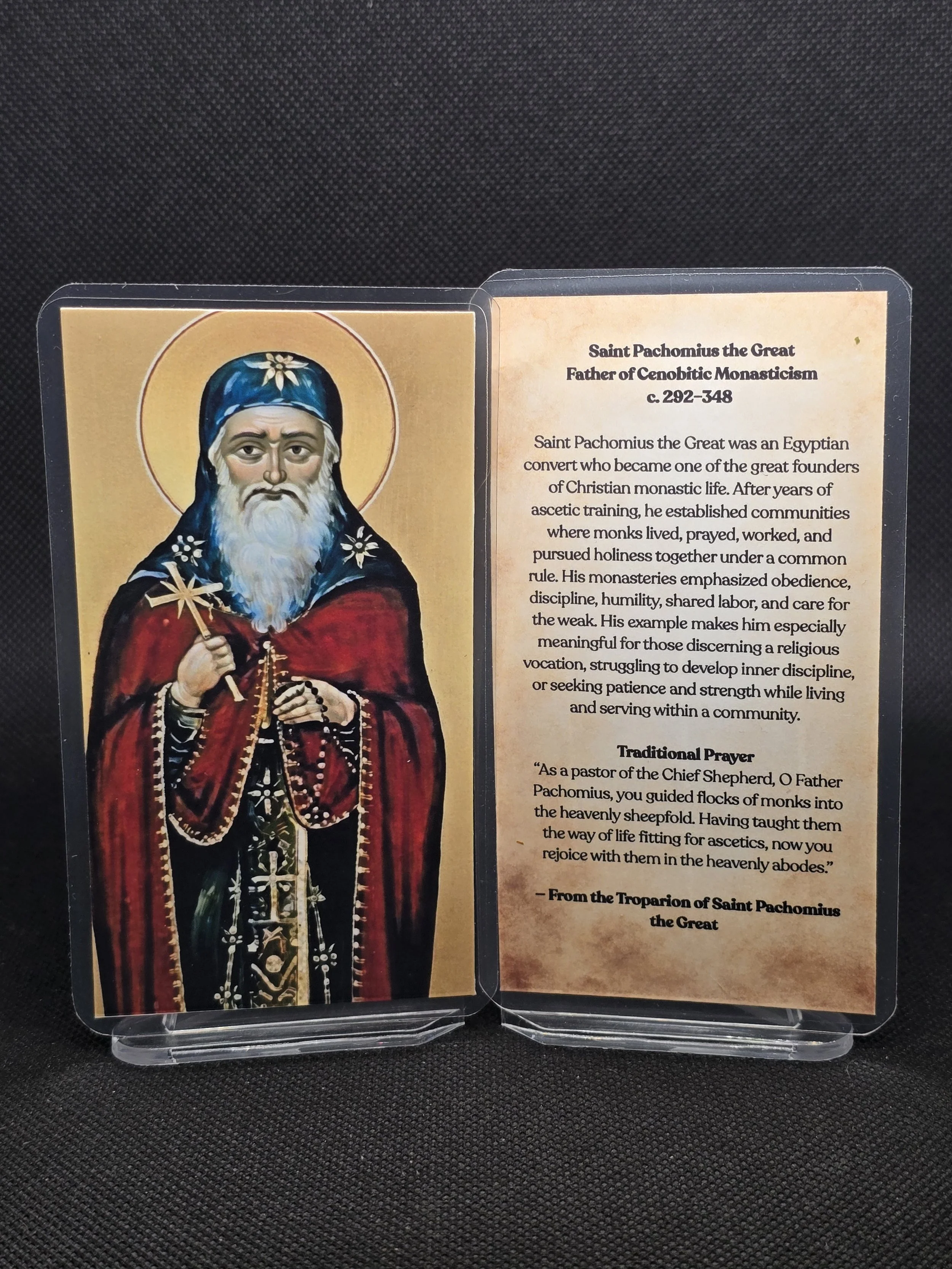
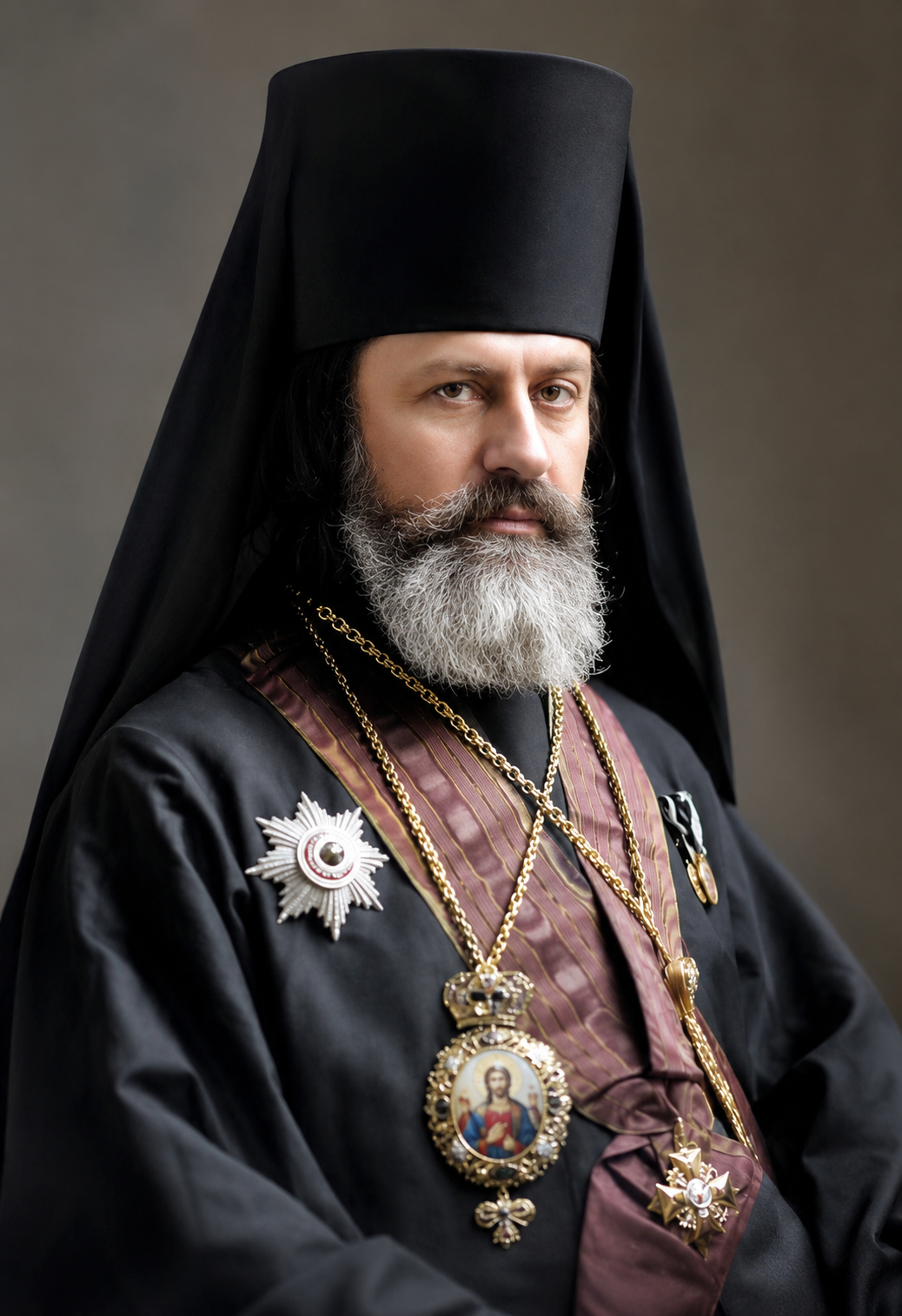
 Image 1 of 1
Saint Raphael of Brooklyn Prayer Card - For Immigrants, Missionaries, Orthodox Unity & Pastoral Care
Saint Raphael of Brooklyn, Holy Hierarch Raphael Hawaweeny, was one of the great missionary bishops of Orthodoxy in North America and the first Orthodox bishop ever consecrated on American soil. Born in Beirut in 1860 to a Syrian Orthodox family displaced from Damascus by anti-Christian violence, he eventually crossed the Atlantic to care for scattered Arabic-speaking Orthodox immigrants, traveled throughout the United States, Canada, and Mexico in search of isolated faithful, established parishes, trained and recruited priests, published books and The Word magazine, encouraged the use of English in church life, and helped lay foundations for a genuinely multiethnic Orthodox presence in America.
Saint Raphael is especially meaningful for immigrants, refugees, families living far from their homeland, missionaries, priests, parish founders, Christians searching for a church community, people who feel spiritually lost or isolated, and anyone working for unity within the Church. His own liturgical tradition describes him as a seeker of the lost, consolation of the oppressed, father to orphans, friend of the poor, peacemaker, and good shepherd, making these devotional themes firmly grounded in how the Antiochian Orthodox Church itself remembers him.
His life is particularly powerful for Christians who have moved far from the churches, customs, and communities in which their faith was first formed. Saint Raphael arrived in America and discovered Orthodox Christians scattered through cities, towns, and isolated farms, many without a priest or nearby parish. Some had begun attending other churches simply because no Orthodox community was available, so Raphael went looking for them rather than waiting for them to find him.
This makes him one of the strongest modern Orthodox saints for people searching for the lost sheep of the Church. Parish evangelization, outreach to lapsed Orthodox Christians, ministry to immigrants, and the formation of new mission communities all fit naturally within his spiritual legacy because these were not secondary interests in his life. They were the work to which he gave twenty years in North America.
Saint Raphael is also an important saint for Orthodox unity across ethnic and linguistic divisions. Although his own flock was primarily Arabic-speaking, he ministered to Greeks and Russians as well, spoke several languages, assisted Saint Tikhon within a multiethnic North American diocese, and encouraged the use of English because he understood that immigrant children were becoming Americans and needed to hear the faith in a language they actually understood. The OCA's proclamation of his glorification explicitly expressed the hope that his veneration would strengthen Orthodox unity in North America.
His example is equally important for parish priests and bishops because Saint Raphael understood pastoral care as something intensely personal. He traveled thousands of miles, celebrated the Divine Liturgy in homes where no church existed, baptized children, heard confessions, blessed marriages, reconciled divided communities, recruited priests, and repeatedly chose his scattered American flock over opportunities to return to the Middle East for prestigious episcopal positions.
Saint Raphael is therefore not simply an important historical figure in American Orthodoxy. His traditional hymns portray him as a continuing intercessor who calls scattered sheep into the unity of the Church, guards Orthodox teaching, consoles the suffering, and intercedes before Christ for those who seek his prayers.
This prayer card is especially fitting for immigrants, refugees, converts, parish priests, bishops, seminarians, missionaries, church planters, families searching for an Orthodox parish, people who have drifted away from church life, Christians working across ethnic divisions, and anyone trying to build a faithful Christian community in a place where very little infrastructure yet exists. It is also particularly meaningful for Antiochian Orthodox Christians, Arab-American Orthodox families, and anyone devoted to the saints who helped establish Orthodoxy in North America.
Each card is handmade in Austin, TX and created to order. We do not keep stock, because every prayer card is treated as a unique devotional offering. They are printed on museum-quality photo paper, not cardstock, and every card is made slowly during prayer with intentional reverence for the saint and for the person who will receive it. Names are lifted before Christ, intentions are held carefully, and each piece is handled multiple times in prayerful silence, asking God for mercy and asking Saint Raphael to intercede for the soul it is being made for. This is devotional craftsmanship shaped with patience, care, and spiritual responsibility because every soul and every prayer matters.
THE LIFE & STORY
Saint Raphael was born in 1860 in Beirut, although his family belonged to Damascus. His parents, Michael Hawaweeny and Mariam, were devout Orthodox Christians, and Mariam was herself the daughter of a priest. The family had fled Damascus because of the violent anti-Christian persecution of 1860, during which Saint Joseph of Damascus and many other Christians were martyred, so displacement and the suffering of Middle Eastern Christians formed part of Raphael's story from the moment of his birth.
His exact date of birth is uncertain. Raphael himself believed it was near November 8, the feast of the Archangels Michael and Gabriel and the Bodiless Powers, but he was baptized on the Feast of Theophany in 1861 with the name Rafla. After the immediate danger passed, the family returned to Damascus, where the young boy began his education.
Raphael proved to be an unusually capable student, but his family's financial circumstances eventually threatened to end his education. A deacon who recognized the boy's ability recommended him to the Patriarch of Antioch, and Raphael was accepted as a student of the Patriarchate in preparation for service to the Church. By his late teens, he was already teaching Arabic and Turkish.
In 1879 he received monastic tonsure and entered more directly into ecclesiastical service. Because the theological school at Balamand was not then operating, Raphael was chosen for advanced study at the famous Theological School of Halki near Constantinople, where he was ordained to the diaconate in 1885 and completed his theological studies the following year.
His intellectual gifts were considerable, but his education never remained confined to one Christian culture. Raphael's life connected Antioch, Constantinople, Russia, and eventually North America, allowing him to learn languages and experience Orthodox Christianity across several national traditions. The OCA later identified this multilingual and multicultural formation as one of the providential preparations for his missionary work among the diverse Orthodox peoples of America.
Raphael wanted still deeper theological formation and received permission to study at the Kiev Theological Academy. In 1889 he was ordered to become head of the Antiochian representation church in Moscow, where he was ordained to the priesthood and shortly afterward elevated to the rank of archimandrite.
His administrative abilities quickly became evident. During his work in Moscow he reduced a large debt attached to the Antiochian representation and arranged for twenty-four Syrian students to receive education in Russia, hoping they would eventually return to Syria and help educate others. His concern was already larger than his own career because he understood education as a way to strengthen the Church for future generations.
Raphael also became deeply involved in the struggle for greater native Arab participation in leadership within the Patriarchate of Antioch. He wrote articles and letters advocating for the rights and proper representation of the Arab Orthodox faithful, and his outspoken position eventually led to ecclesiastical conflict and suspension from priestly functions for a period. The suspension was later lifted, and he continued his service within the Russian Church.
This period reveals something important about Saint Raphael's personality because he was not simply gentle in the sense of avoiding conflict. He could defend what he believed was right with great force, yet later accounts of his American ministry equally emphasize mercy, personal warmth, and pastoral tenderness. The saint remembered as a peacemaker was therefore capable of firm theological and ecclesiastical conviction.
Raphael eventually taught Arabic at the theological academy in Kazan. His life might easily have remained in Russia, but in 1895 the Syrian Orthodox Benevolent Society of New York asked for a priest who could serve Arabic-speaking Orthodox immigrants in America. Raphael accepted the call.
He arrived in New York on November 2, 1895. Within only weeks he had secured a place in lower Manhattan where a chapel could be established for the Arabic-speaking Orthodox community, and the new church was dedicated to Saint Nicholas of Myra.
The situation he encountered immediately revealed the enormous scale of the mission. Arabic-speaking Orthodox immigrants were scattered across a continent, often living hundreds of miles from an Orthodox priest or parish, and some were beginning to lose contact with the Church altogether.
Saint Raphael refused to treat geography as an excuse.
In 1896 he began the first of his great pastoral journeys, visiting approximately thirty cities between New York and San Francisco. Where no church existed, he celebrated the Divine Liturgy in people's homes, heard confessions, baptized children, blessed marriages, preached, taught, and searched for Orthodox Christians who otherwise might never have encountered a priest.
His journeys continued for years. During one seven-month trip beginning in 1899, he visited forty-three cities and towns throughout the northeastern, southern, and midwestern United States, traveling by both land and sea.
The missionary map eventually extended beyond the United States because Saint Raphael traveled through Canada and Mexico as well. The OCA's Life describes him explicitly as searching through North America for scattered Orthodox Christians so that they would not be left without pastoral care.
This is why one of the most appropriate titles applied to him is Good Shepherd of the lost sheep in America. He did not regard the people who disappeared from church life as someone else's problem because their absence became a reason to travel farther.
IMMIGRANTS, REFUGEES & FAMILIES FAR FROM HOME
Saint Raphael's own story began with displacement. His parents were Syrians from Damascus who fled to Beirut during anti-Christian violence, and he later spent significant portions of his life in Constantinople, Russia, and the United States.
He therefore knew something personally about living far from one's homeland.
When he arrived in America, the people entrusted to him were experiencing the same reality on an enormous scale. Arabic-speaking Orthodox Christians had crossed the ocean seeking a future but often found themselves separated from the churches, clergy, languages, feasts, and communities that had structured Christian life in the Middle East.
Immigration can create a spiritual problem that is easy to underestimate. A family may preserve food, language, music, and cultural customs after moving to another country while slowly losing the religious practices that gave those customs their deepest meaning.
Saint Raphael understood that a church community had to be rebuilt wherever the people were actually living.
He therefore established parishes, found clergy, created cemeteries, provided service books, taught the faith, and formed structures capable of surviving beyond the immigrant generation. At the time of his death, the Syro-Arab Mission contained thirty parishes and approximately 25,000 faithful.
This makes Saint Raphael especially meaningful for immigrant parents worried about whether their children will keep the faith. He confronted essentially the same question more than a century ago, particularly as children of Arabic-speaking immigrants began speaking English and entering an American culture very different from their parents' homeland.
His answer was not to pretend the children could remain culturally unchanged. He instead worked to preserve Orthodox Christianity while recognizing that the language through which the next generation encountered the faith would increasingly be English.
That is a remarkably important distinction.
The goal was not merely to preserve an immigrant subculture.
The goal was to preserve Orthodoxy.
FINDING THE LOST SHEEP
Saint Raphael's Troparion praises his proclamation for calling the scattered sheep into the unity of the Church, while his life repeatedly describes journeys undertaken specifically to locate Orthodox Christians without nearby pastoral care.
This makes him an especially meaningful saint for Christians praying for people who have drifted away from church life.
The phrase “lost sheep” can easily become judgmental if it is used only to describe someone else's failures. Saint Raphael's life places the responsibility differently because a shepherd who notices a sheep is missing is supposed to go looking.
Parishes devoted to outreach can therefore seek his intercession when trying to reconnect with people who were baptized Orthodox but have not attended church for years. Priests can ask his prayers for parishioners who quietly disappear, while parents can seek his intercession for adult children who no longer participate in the sacramental life of the Church.
His example also challenges church communities to ask why people are disappearing. Saint Raphael recognized practical barriers such as language, geography, and lack of clergy and then worked to remove those barriers rather than simply blaming people for failing to overcome them by themselves.
A church can therefore learn from him by remaining serious about doctrine while also becoming easier for spiritually hungry people to enter, understand, and belong to.
BUILDING PARISHES WHERE NONE EXIST
Saint Raphael is one of the most natural Orthodox saints for church planters, mission parishes, parish councils, and communities trying to build a permanent church. His ministry repeatedly involved creating ecclesiastical structure where virtually none existed before.
He began in New York with a small chapel in a converted loft. As the community grew, he worked to secure a cemetery and a permanent church, eventually purchasing a building on Pacific Street in Brooklyn that became Saint Nicholas Cathedral.
Saint Nicholas Cathedral remains active in Brooklyn today and identifies itself as the first community established by Saint Raphael in 1895. It later became the mother cathedral and seat of the Antiochian Orthodox Christian Archdiocese of North America.
The movement from rented room to cathedral is spiritually significant because new ministries rarely begin with everything they need. Someone must pray in the small room first.
Saint Raphael understood that a permanent church building matters, but he did not wait for the building before beginning the Church's work. He preached, celebrated, baptized, taught, and gathered the faithful wherever circumstances permitted.
This is an especially useful example for small missions worshipping in rented halls, converted storefronts, school gyms, houses, or other temporary spaces. The temporary room can still contain the full sacramental life of the Church while the community patiently builds toward something more permanent.
SAINT RAPHAEL & SAINT TIKHON
Saint Raphael's American ministry became closely connected with Saint Tikhon, the future Patriarch and Confessor of Moscow. When Tikhon became the Russian hierarch responsible for North America, he envisioned a multiethnic Orthodox Church capable of caring for Russians, Arabs, Greeks, Slavs, and other Orthodox peoples without treating nationality as the ultimate definition of ecclesial life.
Saint Raphael became one of the key bishops within that vision.
In 1903 the Russian Holy Synod unanimously elected Raphael to become Bishop of Brooklyn while continuing his leadership of the Syro-Arab Mission. On the Third Sunday of Great Lent in 1904, Saints Tikhon and Bishop Innocent consecrated him at Saint Nicholas Cathedral in Brooklyn, making Raphael the first Orthodox bishop consecrated on American soil.
That wording matters because Saint Raphael was not the first Orthodox bishop ever to minister in North America. His distinction is that his episcopal consecration itself took place here, an event the OCA later specifically highlighted when proclaiming his glorification.
The two saints also became connected with another major American Orthodox institution. In July 1905, Bishop Raphael consecrated the grounds for Saint Tikhon's Monastery in South Canaan, Pennsylvania, blessed the orphanage, and celebrated at the site where the monastery would develop.
Saint Raphael's American story therefore cannot be separated from Saint Tikhon's broader missionary vision. Together they represent an early period when Orthodox bishops were already asking how an ancient faith carried by immigrants could take root permanently in North America.
ORTHODOX UNITY ACROSS ETHNIC LINES
Saint Raphael loved his Arab Orthodox people intensely, but he did not believe Orthodoxy belonged to one ethnicity. The OCA records him ministering to Greeks and Russians as well as Arabs, and the proclamation of his glorification stresses his service within a multiethnic American Orthodox structure.
This gives Saint Raphael particular importance in modern American Orthodoxy, where jurisdictional and ethnic divisions remain a complicated reality.
He could respect language, culture, and the traditions of particular peoples without allowing those things to become larger than the Church itself.
His life therefore offers a healthy alternative to two opposite mistakes. One mistake treats ethnicity as though it were irrelevant and asks immigrants to erase their heritage, while the other turns ethnicity into such a central feature of parish identity that people outside that culture begin to feel the Church does not belong to them.
Saint Raphael navigated between those extremes.
He built Arabic-speaking communities because his people genuinely needed them.
He also ministered beyond the Arabic community and supported English because he understood that the Gospel could not remain locked permanently inside one immigrant language.
The OCA's glorification proclamation made this dimension explicit by praying that Saint Raphael's recognition would further Orthodox unity in North America.
For Christians working toward cooperation between Antiochian, Greek, OCA, Russian, Serbian, Romanian, Georgian, Bulgarian, and other Orthodox communities, Saint Raphael is therefore an especially meaningful intercessor.
ENGLISH, CHILDREN & PRESERVING THE FAITH
Saint Raphael became deeply concerned about the children of immigrant families. He recognized that many no longer spoke Arabic fluently and were beginning to attend non-Orthodox churches simply because religious education there was offered in English.
His response was remarkably practical.
He encouraged the use of English in Orthodox worship and education.
The OCA describes him as among the first Orthodox hierarchs in America to recognize this need and specifically notes his recommendation that parishes use Isabel Hapgood's English-language service book.
This did not mean Saint Raphael despised Arabic or wanted immigrant families to abandon their heritage. He understood that the faith must become fully accessible to the children being raised in the country where they actually lived.
This lesson remains relevant to immigrant churches today.
A first generation may instinctively experience the ancestral language as inseparable from worship because it carries memories of home, grandparents, feast days, and childhood prayer. A younger generation may hear that same language primarily as something they do not fully understand.
Saint Raphael's pastoral instinct was to protect the faith rather than sacrifice the younger generation to nostalgia.
His example invites every parish to ask whether children understand what they are praying.
THE WORD & THE MINISTRY OF WRITING
Saint Raphael realized that physical travel alone could never reach every member of his scattered flock. At the end of 1904, he therefore announced the creation of Al-Kalimat, The Word, an Arabic-language church publication intended to link the widely dispersed Syro-Arab Orthodox communities of North America. The first issue appeared in January 1905.
He regarded the publication as one of the major achievements of his ministry.
The magazine taught doctrine, Christian morality, Church history, current ecclesiastical matters, and news from the sacramental lives of the communities. Saint Raphael himself wrote many, and perhaps most, of the articles published during his lifetime.
This makes him an especially meaningful intercessor for Christian writers, editors, publishers, parish communicators, and people using media for evangelization.
Raphael understood something that remains even more important today: communication technology can extend pastoral care beyond physical distance.
For him, the technology was print.
For a modern Christian ministry, it may be websites, podcasts, books, videos, email, or social media.
The medium changes, but the spiritual question remains the same. Does the communication actually help people know Christ, understand the faith, and remain connected with the Church?
Saint Raphael's example places Christian media under pastoral responsibility rather than vanity. He wrote because there were souls he could not reach in person.
PEACEMAKING & DIVIDED COMMUNITIES
The Antiochian hymn to Saint Raphael explicitly calls him a peacemaker, and his Life contains a remarkable example of this ministry in Johnstown, Pennsylvania. A severe feud had divided members of the Arabic community there, and even the civil courts had failed to restore peace, but Saint Raphael succeeded in reconciling the parties.
This makes him a particularly appropriate saint for parish conflict, family division, ethnic tension, and communities damaged by personal rivalry.
Church conflict can be especially painful because people may believe they are defending something sacred while behaving in ways that destroy communion. Saint Raphael's pastoral life demonstrates that maintaining doctrine and seeking reconciliation are not opposites.
A peacemaker is not someone who pretends differences do not matter.
A Christian peacemaker seeks truth without allowing resentment, pride, or personal hatred to become more important than communion.
His intercession may therefore be especially meaningful for parish councils facing division, priests entering conflicted communities, families fighting over inheritance or cultural expectations, or groups whose disagreements have become so personal that nobody remembers what originally caused the conflict.
DEFENDING ORTHODOX TEACHING
Saint Raphael's gentleness did not mean doctrinal indifference. His Kontakion specifically calls him a guardian and defender of the Church's teaching who protected his flock from false doctrine and confirmed them in the true faith.
This dimension of his life is particularly important because American religious pluralism created pastoral situations his Middle Eastern immigrant flock had never encountered before.
Raphael maintained cordial relationships with non-Orthodox Christians, but when he believed confusion could endanger his flock, he drew clear theological boundaries. The OCA's Life stresses his conviction that genuine Church unity had to be grounded in the Orthodox faith rather than achieved simply by ignoring doctrinal differences.
This makes Saint Raphael meaningful for Christians trying to balance charity and conviction.
There is a false way to defend doctrine that treats every non-Orthodox person as an enemy.
There is also a false way to seek peace that treats doctrine as though it does not matter.
Saint Raphael attempted to avoid both.
His life is therefore especially useful for clergy, catechists, converts, theologians, and Christians involved in ecumenical conversations. He reminds them that love does not require confusion and conviction does not require cruelty.
CHOOSING THE FLOCK OVER PRESTIGE
More than once, Saint Raphael had opportunities to return to the Middle East and accept important episcopal positions. He was considered for Latakia, invited to become an auxiliary bishop in Beirut, and elected Bishop of Zahleh, yet he repeatedly declined or remained in America because he believed his pastoral work among the immigrant flock was unfinished.
This is one of the strongest examples of his identity as a shepherd.
Returning to the Middle East could have brought status, familiarity, and a prestigious role within an ancient Christian homeland. Remaining in America meant continuing the exhausting work of traveling through immigrant communities that lacked buildings, priests, schools, money, and ecclesiastical infrastructure.
Saint Raphael chose the unfinished mission.
This makes him especially meaningful for anyone discerning between a more prestigious opportunity and a less glamorous responsibility that may actually be the place God is asking them to remain.
Christian vocation is not measured automatically by promotion.
Sometimes fidelity means staying where the work is hardest because the people there still need a shepherd.
HIS ILLNESS & REPOSE
Saint Raphael's years of relentless work eventually took a physical toll. Toward the end of 1912, he became ill while working in his office and was diagnosed with a heart condition, yet after a short period of recovery he returned to celebrating the Divine Liturgy and continued pastoral travels during 1913 and 1914.
In 1915 his health declined again, and he spent approximately two months confined at home. The OCA's Life remembers him bearing the illness patiently until he peacefully reposed at 12:40 a.m. on February 14 according to the old calendar, corresponding to February 27 on the civil Gregorian calendar, in 1915.
He was only in his mid-fifties.
Yet the scale of his work was extraordinary. By the time of his repose, his Syro-Arab Mission had thirty parishes and approximately 25,000 faithful, and he had spent twenty years building Orthodox church life across North America.
His relatively short American ministry therefore demonstrates how much spiritual fruit can grow from persistent pastoral attention.
Saint Raphael did not live long enough to see the mature Antiochian Archdiocese, generations of English-speaking Orthodox Christians, or the many American parishes that would later invoke him as a saint.
He planted.
Others continued building.
GLORIFICATION AS A SAINT
The Holy Synod of the Orthodox Church in America formally decided in March 2000 to number Bishop Raphael among the saints after reviewing the recommendation of a joint canonization commission connected with the OCA and the Antiochian Orthodox Archdiocese. His glorification was celebrated at Saint Tikhon's Monastery on May 28 and 29, 2000.
The proclamation identified several reasons his life was especially important to the Church. It emphasized his prayer, holiness, missionary work, establishment of thirty parishes, literary activity, Arabic prayer book, use of English, multiethnic ministry, and assistance to Saint Tikhon's vision for Orthodoxy in North America.
The proclamation also made his holy remains relics of the Church and established liturgical commemoration. It specifically expressed the hope that Saint Raphael's glorification would strengthen love, cooperation, and Orthodox unity throughout North America.
A further important development occurred in 2023, when the Holy Synod of the Patriarchate of Antioch added Saint Raphael to its calendar of saints and designated February 27, the day of his repose, as his feast. Saint Nicholas Cathedral in Brooklyn therefore now identifies February 27 and the first Saturday of November as his two primary commemorations.
This recognition is especially significant because Saint Raphael was a son of the Church of Antioch whose greatest pastoral work took place in North America. His life now stands openly within both Antiochian and wider American Orthodox liturgical memory.
THE HOLY RELICS OF SAINT RAPHAEL
Saint Raphael's relics have traveled through several locations connected with his American ministry. He was originally buried in New York, and his remains were later transferred to Antiochian Village in Pennsylvania, where a major shrine to him developed.
An especially important translation occurred in July 2024, when his relics were exhumed from the grave at Antiochian Village and transferred into a special reliquary for permanent veneration in the Church of Saint Ignatius of Antioch at Antiochian Village. The cathedral in Brooklyn now commemorates July 19 as a secondary feast associated with this translation.
Saint Nicholas Antiochian Orthodox Cathedral in Brooklyn also preserves a reliquary containing a portion of Saint Raphael's relics, presented there in November 2000. The cathedral he founded therefore remains one of the important places where the faithful can venerate him.
For American Orthodox Christians, this creates several unusually accessible connections with a modern saint. His relics are not on another continent or hidden within a remote medieval monastery because significant relics can be venerated in Pennsylvania and Brooklyn, places directly connected with the work he performed during his earthly life.
Saint Raphael's principal relic shrine at Antiochian Village is especially appropriate because the location serves generations of Orthodox young people, clergy, families, and pilgrims. The shepherd who worried intensely about the faith of immigrant children now rests in a place where new generations continue learning Orthodox Christianity.
HEALING & CONSOLATION
Saint Raphael is primarily remembered as a missionary bishop and good shepherd, but healing also belongs to his liturgical tradition. His Troparion ends by glorifying Christ who grants healing through the saint, while the Antiochian hymn used at his shrine calls him the consolation of the oppressed and asks his continuing intercession.
This provides a legitimate devotional basis for seeking Saint Raphael's prayers during illness and suffering without turning him artificially into the patron saint of a particular disease.
His own final years also involved heart illness. The OCA records that he developed a serious cardiac condition in 1912, continued serving as his strength allowed, and ultimately died after another period of illness in 1915.
For someone living with heart disease, chronic illness, or physical weakness that interferes with work or ministry, Saint Raphael can therefore become especially meaningful. His example does not romanticize illness, but it shows a bishop adapting his ministry to physical limitations without believing that sickness had made his life spiritually useless.
His intercession is equally appropriate for people carrying emotional or social suffering. The Church calls him a consolation of the oppressed because much of his life was spent among immigrants, poor families, orphans, isolated believers, and people separated from the familiar world they once knew.
PRAYERS
A simple traditional invocation may be prayed regularly: Holy Hierarch Raphael of Brooklyn, pray to God for us. This is especially fitting when praying for immigrants, missing parishioners, new church missions, divided communities, clergy, Orthodox unity, or someone struggling to remain faithful far from a familiar Christian community.
The Church's Troparion describes Saint Raphael's proclamation going throughout North America and calling scattered Christians back into the unity of the Church. It ends by glorifying Christ for granting strength, the crown of holiness, and healing through His servant.
His Kontakion remembers him as a guardian of Orthodox teaching, a son of Syria, and a glory of North America. It asks him to continue interceding before the Lord for the salvation of the faithful, making it especially appropriate for Christians seeking his prayers for the preservation of faith within families and parishes.
The Antiochian hymn associated with his shrine gives additional devotional language by remembering him as “Seeker of the lost” and “Peacemaker and Good Shepherd.” Those titles provide a particularly strong basis for asking his intercession for lapsed Christians, fractured parishes, displaced families, or people who no longer know where they belong within the Church.
A priest may invoke Saint Raphael before beginning a pastoral visit or attempting reconciliation within a divided parish. A missionary or church planter may keep the card nearby while praying for the people who have not yet found the community, while immigrant parents may ask his intercession that their children inherit the Orthodox faith rather than only the cultural memories surrounding it.
This prayer card is especially fitting for a parish office, priest's prayer book, missionary bag, seminary room, immigrant family prayer corner, new mission church, catechism classroom, hospital bedside, or anywhere someone needs a reminder that the shepherd's task is to seek people rather than merely wait for them to appear.
FAQ
Who is Saint Raphael of Brooklyn? Saint Raphael Hawaweeny was a Syrian Orthodox monk, priest, missionary, theologian, writer, and bishop who served North America from 1895 until his death in 1915. He became the first Orthodox bishop consecrated on American soil and is one of the major saints associated with the establishment of Orthodoxy in the United States.
Was Saint Raphael really from Brooklyn? Brooklyn refers to his episcopal title and the location of his cathedral rather than his birthplace. He was born in Beirut to a Syrian family from Damascus and became Bishop of Brooklyn after years of missionary work among Orthodox immigrants in America.
What was Saint Raphael's last name? His family name was Hawaweeny, and he is commonly called Saint Raphael Hawaweeny or Saint Raphael of Brooklyn. His baptismal name was Rafla, and he later became known ecclesiastically as Raphael.
Where was Saint Raphael born? He was born in Beirut in 1860, although his parents were from Damascus. They had fled there because of the violent persecution of Christians occurring in Damascus at the time.
Was Saint Raphael connected with Saint Joseph of Damascus? Yes, the Hawaweeny family fled Damascus during the same persecution in which Saint Joseph of Damascus and many other Christians were martyred. The OCA's Life specifically places Raphael's birth within this historical setting.
Was Saint Raphael Syrian or Lebanese? His family was Syrian and belonged to Damascus, but he was physically born in Beirut because his parents had fled there for safety. Modern national boundaries and identities can make this history sound simpler than it actually was, so “Syrian Orthodox family, born in Beirut” is the most careful description.
Was Saint Raphael Antiochian Orthodox? Yes, Saint Raphael was a son of the Patriarchate of Antioch and spent much of his early ecclesiastical life serving Antiochian interests. His American episcopal ministry functioned within the Russian Orthodox Mission, and the Patriarchate of Antioch formally added him to its calendar of saints in 2023.
Did Saint Raphael study in Russia? Yes, he studied at the Kiev Theological Academy and later served in Moscow and taught Arabic in Kazan. His Russian formation became part of the multicultural background that later helped him serve a diverse American Orthodox population.
Did Saint Raphael study at Halki? Yes, he studied at the Theological School of Halki and was ordained to the diaconate there in 1885. He completed his theological studies in 1886 before returning to the Middle East.
When did Saint Raphael come to America? He arrived in New York on November 2, 1895 after being invited to serve the Arabic-speaking Orthodox community. Within weeks he had helped establish a chapel for the community in lower Manhattan.
Why did Saint Raphael come to America? Arabic-speaking Orthodox immigrants were living throughout North America without sufficient priests or parishes, and the Syrian Orthodox Benevolent Society of New York asked for a priest to care for them. Raphael accepted the missionary responsibility and crossed the Atlantic to serve the scattered flock.
Was Saint Raphael the first Orthodox bishop in America? The most accurate statement is that Saint Raphael was the first Orthodox bishop consecrated on American soil. Orthodox bishops had ministered in North America before him, but his episcopal consecration in Brooklyn in 1904 was the first such consecration held here.
Who consecrated Saint Raphael as bishop? Saint Tikhon and Bishop Innocent consecrated him at Saint Nicholas Cathedral in Brooklyn on the Third Sunday of Great Lent in 1904. Raphael then continued as Bishop of Brooklyn and head of the Syro-Arab Orthodox Mission.
Was Saint Raphael a friend of Saint Tikhon? Their ministries were closely connected, and Saint Raphael served as one of Saint Tikhon's vicar bishops within the large multiethnic American diocese. Both saints shared a vision in which Orthodox Christians of several national backgrounds could be cared for within one ecclesial structure.
What is Saint Raphael of Brooklyn known for? He is especially known for missionary travel, organizing Orthodox parishes, caring for Arabic-speaking immigrants, working across ethnic boundaries, publishing The Word, promoting English in church life, defending Orthodox doctrine, and becoming the first Orthodox bishop consecrated in America.
What is Saint Raphael the patron saint of? Orthodox sources do not reduce him to one universal patronage category, so his liturgical titles are the safest guide. He is especially fitting as an intercessor for immigrants, scattered or lapsed Orthodox Christians, missionaries, parish communities, orphans, the poor, peacemaking, clergy, and Orthodox unity, because these themes are explicitly present in his hymns and ministry.
Is Saint Raphael a patron saint of immigrants? It is better to call him a powerful intercessor for immigrants than claim an exclusive formal patronage. His own family was displaced by persecution, and his entire North American ministry centered on immigrant Orthodox Christians trying to preserve their faith in a new country.
Can refugees pray to Saint Raphael? Yes, his family's displacement during the Damascus persecution gives his story a genuine connection with refugee experience. He also spent much of his life serving people separated from their homeland and familiar church communities.
Can I pray to Saint Raphael for someone who has stopped going to church? Yes, this is one of the strongest devotional applications of his life because his Troparion remembers him calling scattered sheep back into the unity of the Church. His earthly ministry likewise consisted of physically searching for Orthodox Christians who had become isolated from parish life.
Is Saint Raphael a good saint for parish outreach? Yes, his entire American mission offers a model for parish outreach. He traveled to people who lacked pastoral care, established communities where they lived, and worked to remove barriers that were causing Orthodox Christians to drift away.
Can a new Orthodox mission pray to Saint Raphael? Yes, Saint Raphael is one of the most natural North American saints for new mission communities. He repeatedly established parish life in places where no functioning Orthodox church existed and understood how small communities gradually become permanent churches.
How many parishes did Saint Raphael establish? The OCA's proclamation states that he established thirty parishes, and his Life records that the Syro-Arab Mission contained thirty parishes and about 25,000 faithful at the time of his death.
Did Saint Raphael travel across America? Yes, extensively. His pastoral journeys took him through dozens of cities and towns across the United States, and his ministry eventually extended through Canada and Mexico as well.
Did Saint Raphael celebrate Liturgy in people's homes? Yes, when he found Orthodox Christians in locations without churches, he celebrated the Divine Liturgy in their homes and provided baptisms, confessions, marriages, preaching, and pastoral care.
Did Saint Raphael help establish Saint Tikhon's Monastery? Yes, in July 1905 he consecrated the monastery grounds and blessed the orphanage at South Canaan, Pennsylvania. Saint Tikhon's Monastery continues to remember his role in its founding history.
Did Saint Raphael support English in Orthodox worship? Yes, very clearly. He believed English was necessary for the future of Orthodoxy among immigrant children in America and recommended English-language services and religious education.
Why did Saint Raphael want English used in church? He saw children from Arabic-speaking families becoming English-speaking Americans and worried that some were attending non-Orthodox churches because they could actually understand the religious education there. His concern was preserving their Orthodox faith across generations.
Did Saint Raphael publish a magazine? Yes, he founded Al-Kalimat, The Word, whose first issue appeared in January 1905. It was designed to teach the faith and connect widely scattered Arabic-speaking Orthodox communities throughout North America.
Is The Word magazine connected with Saint Raphael? Yes, Saint Raphael founded the publication and wrote many of its early articles. The OCA specifically remembers this as one of the important aspects of his missionary work.
Is Saint Raphael a saint for writers and publishers? His major use of print ministry makes him a natural intercessor for Christian writers, editors, and publishers, particularly those using media to teach the faith. This is best described as a devotional application of his actual work rather than an exclusive formal patronage.
Was Saint Raphael a peacemaker? Yes, the Antiochian hymn to him explicitly calls him a peacemaker. His Life also records that he reconciled a deeply divided Arabic community in Johnstown after civil legal efforts had failed.
Can I pray to Saint Raphael for a divided parish? Yes, his pastoral work and liturgical title as a peacemaker make this an especially appropriate reason to seek his intercession. He understood that parish unity required both fidelity to the faith and reconciliation among people.
Is Saint Raphael associated with Orthodox unity? Yes, very strongly. His ministry crossed Arab, Greek, Russian, and American cultural boundaries, and the OCA's official proclamation specifically prayed that his glorification would advance Orthodox unity in North America.
Can Orthodox Christians from traditions other than Antioch pray to Saint Raphael? Yes, he is an Orthodox saint whose ministry itself crossed ethnic and jurisdictional lines. He served Greeks and Russians as well as Arabs and belonged to the wider story of Orthodoxy in North America.
Did Saint Raphael defend Orthodox doctrine? Yes, his Kontakion specifically calls him a guardian and defender of the Church's teaching. His Life also records his concern that his flock not become confused about differences between Orthodoxy and other Christian traditions.
Did Saint Raphael reject all relationships with non-Orthodox Christians? No, the OCA's Life says he was not opposed to dialogue or friendly relations. He nevertheless insisted that genuine Christian unity could not be achieved by ignoring doctrinal truth.
Was Saint Raphael ever offered a bishopric in the Middle East? Yes, several times. He was considered or selected for episcopal positions including Zahleh and other Middle Eastern sees, but he repeatedly remained committed to the unfinished pastoral work among his American flock.
Why did Saint Raphael stay in America? He believed the scattered Orthodox immigrants entrusted to him still needed churches, clergy, cemeteries, education, and pastoral care. His decisions show that he regarded the American mission as a real vocation rather than a temporary assignment.
Did Saint Raphael suffer from heart disease? Yes, physicians diagnosed him with a heart ailment toward the end of 1912. He continued serving when his strength permitted, but the condition eventually contributed to his death.
Can someone with heart disease pray to Saint Raphael? Yes, especially because he personally endured serious heart illness during his final years. This is a devotional connection rather than a formal exclusive patronage, and prayer can accompany appropriate medical care.
Is Saint Raphael associated with healing? Yes, his Orthodox Troparion explicitly praises Christ for granting healing through him. His primary historical identity is as missionary and bishop, but healing belongs to the Church's liturgical devotion to him.
When did Saint Raphael die? Saint Raphael reposed in 1915. His death occurred on February 14 according to the old Julian reckoning, corresponding to February 27 on the Gregorian civil calendar.
When is Saint Raphael of Brooklyn's feast day? The OCA commemorates his repose on February 27, while his traditional North American celebration also includes the first Saturday of November. After Antioch formally added him to its calendar in 2023, February 27 was designated there as his feast as well.
Does Saint Raphael have a feast for the translation of his relics? Yes, Saint Nicholas Cathedral records July 19 as a secondary feast connected with the 2024 translation of his relics at Antiochian Village.
When was Saint Raphael glorified? The OCA Holy Synod decided to number him among the saints in March 2000, and the public glorification services were celebrated at Saint Tikhon's Monastery on May 28 and 29, 2000.
When did the Patriarchate of Antioch recognize Saint Raphael? The Holy Synod of Antioch added him to its calendar of saints on October 19, 2023, according to Saint Nicholas Antiochian Orthodox Cathedral. February 27 was designated as his Antiochian feast day.
Where are Saint Raphael's relics today? His principal relics are venerated in the Church of Saint Ignatius of Antioch at Antiochian Village in Pennsylvania, following their 2024 translation into a special reliquary. A significant reliquary containing a portion of his relics is also preserved at Saint Nicholas Cathedral in Brooklyn.
Can I visit Saint Raphael's relics? Yes, Antiochian Village explicitly welcomes the faithful to venerate his relics at Saint Ignatius Church. Saint Nicholas Cathedral in Brooklyn also preserves relics of the saint in the community he founded.
Is Saint Nicholas Cathedral in Brooklyn connected with Saint Raphael? Yes, very closely. Saint Raphael founded the original community in 1895, developed the parish that became his cathedral, and his relics remain there for veneration today.
Can I give this prayer card to an immigrant family? Yes, it is especially appropriate because Saint Raphael dedicated his American ministry to immigrant Christians trying to preserve their Orthodox faith in a new country. His own family history also began with displacement caused by persecution.
Can I give this prayer card to a priest? Yes, Saint Raphael is one of the strongest modern Orthodox models of pastoral priesthood and episcopal ministry in North America. His willingness to travel, teach, reconcile, celebrate in homes, and search for isolated parishioners gives clergy an especially practical example of shepherding.
Can I give this card to a seminarian? Yes, his life brings together theological education, missionary work, multilingual ministry, writing, parish building, and pastoral care. It is especially meaningful for someone preparing for ministry in a culturally diverse environment.
Can I give this card to someone starting a church or mission parish? Yes, Saint Raphael repeatedly built church communities from very small beginnings and established dozens of parishes across North America. His example is particularly appropriate when a mission lacks money, a permanent building, or enough clergy.
Can I pray to Saint Raphael for my children to remain Orthodox? Yes, this concern was central to his own pastoral ministry. He worried that immigrant children who could not understand Arabic would leave Orthodoxy, so he promoted English-language worship and education to help the faith become genuinely theirs.
What does Saint Raphael teach about immigration? His life teaches that moving to a new country does not require leaving one's Christian faith behind, but preserving the faith may require building new institutions and adapting pastoral methods to the realities of the next generation. His ministry combined respect for immigrant heritage with a determination that Orthodoxy become rooted in America itself.
What does Saint Raphael teach about parish ministry? He teaches that pastoral care requires searching for people rather than simply serving whoever appears on Sunday morning. His journeys through dozens of communities show a shepherd willing to spend himself so isolated Christians could receive the sacraments and remain connected with the Church.
What does Saint Raphael teach about church unity? His life shows that Christian unity cannot be reduced either to ethnic sameness or to doctrinal compromise. He served several Orthodox peoples within one ecclesial vision while remaining firm about the teachings of the Orthodox faith.
What does Saint Raphael teach about leadership? His life teaches that ecclesiastical leadership exists for the flock rather than for advancement. He repeatedly chose difficult missionary responsibility over opportunities for prestigious office elsewhere, which makes his authority inseparable from sacrifice.
What is the main message of Saint Raphael of Brooklyn's life? Saint Raphael's life teaches that a good shepherd goes looking for people who have become scattered. A child born to displaced Syrian Christians became a monk and theologian, crossed cultures and languages, traveled through a continent in search of isolated Orthodox families, founded parishes, wrote and published for people he could not visit, encouraged the next generation to worship in a language it understood, worked across ethnic divisions, and became the first Orthodox bishop consecrated on American soil. His life calls Christians to preserve the faith without turning it into an ethnic possession, seek people who have drifted away, build churches where none exist, and understand pastoral leadership as the willingness to go wherever the lost sheep are found.
Saint Raphael of Brooklyn, Holy Hierarch Raphael Hawaweeny, was one of the great missionary bishops of Orthodoxy in North America and the first Orthodox bishop ever consecrated on American soil. Born in Beirut in 1860 to a Syrian Orthodox family displaced from Damascus by anti-Christian violence, he eventually crossed the Atlantic to care for scattered Arabic-speaking Orthodox immigrants, traveled throughout the United States, Canada, and Mexico in search of isolated faithful, established parishes, trained and recruited priests, published books and The Word magazine, encouraged the use of English in church life, and helped lay foundations for a genuinely multiethnic Orthodox presence in America.
Saint Raphael is especially meaningful for immigrants, refugees, families living far from their homeland, missionaries, priests, parish founders, Christians searching for a church community, people who feel spiritually lost or isolated, and anyone working for unity within the Church. His own liturgical tradition describes him as a seeker of the lost, consolation of the oppressed, father to orphans, friend of the poor, peacemaker, and good shepherd, making these devotional themes firmly grounded in how the Antiochian Orthodox Church itself remembers him.
His life is particularly powerful for Christians who have moved far from the churches, customs, and communities in which their faith was first formed. Saint Raphael arrived in America and discovered Orthodox Christians scattered through cities, towns, and isolated farms, many without a priest or nearby parish. Some had begun attending other churches simply because no Orthodox community was available, so Raphael went looking for them rather than waiting for them to find him.
This makes him one of the strongest modern Orthodox saints for people searching for the lost sheep of the Church. Parish evangelization, outreach to lapsed Orthodox Christians, ministry to immigrants, and the formation of new mission communities all fit naturally within his spiritual legacy because these were not secondary interests in his life. They were the work to which he gave twenty years in North America.
Saint Raphael is also an important saint for Orthodox unity across ethnic and linguistic divisions. Although his own flock was primarily Arabic-speaking, he ministered to Greeks and Russians as well, spoke several languages, assisted Saint Tikhon within a multiethnic North American diocese, and encouraged the use of English because he understood that immigrant children were becoming Americans and needed to hear the faith in a language they actually understood. The OCA's proclamation of his glorification explicitly expressed the hope that his veneration would strengthen Orthodox unity in North America.
His example is equally important for parish priests and bishops because Saint Raphael understood pastoral care as something intensely personal. He traveled thousands of miles, celebrated the Divine Liturgy in homes where no church existed, baptized children, heard confessions, blessed marriages, reconciled divided communities, recruited priests, and repeatedly chose his scattered American flock over opportunities to return to the Middle East for prestigious episcopal positions.
Saint Raphael is therefore not simply an important historical figure in American Orthodoxy. His traditional hymns portray him as a continuing intercessor who calls scattered sheep into the unity of the Church, guards Orthodox teaching, consoles the suffering, and intercedes before Christ for those who seek his prayers.
This prayer card is especially fitting for immigrants, refugees, converts, parish priests, bishops, seminarians, missionaries, church planters, families searching for an Orthodox parish, people who have drifted away from church life, Christians working across ethnic divisions, and anyone trying to build a faithful Christian community in a place where very little infrastructure yet exists. It is also particularly meaningful for Antiochian Orthodox Christians, Arab-American Orthodox families, and anyone devoted to the saints who helped establish Orthodoxy in North America.
Each card is handmade in Austin, TX and created to order. We do not keep stock, because every prayer card is treated as a unique devotional offering. They are printed on museum-quality photo paper, not cardstock, and every card is made slowly during prayer with intentional reverence for the saint and for the person who will receive it. Names are lifted before Christ, intentions are held carefully, and each piece is handled multiple times in prayerful silence, asking God for mercy and asking Saint Raphael to intercede for the soul it is being made for. This is devotional craftsmanship shaped with patience, care, and spiritual responsibility because every soul and every prayer matters.
THE LIFE & STORY
Saint Raphael was born in 1860 in Beirut, although his family belonged to Damascus. His parents, Michael Hawaweeny and Mariam, were devout Orthodox Christians, and Mariam was herself the daughter of a priest. The family had fled Damascus because of the violent anti-Christian persecution of 1860, during which Saint Joseph of Damascus and many other Christians were martyred, so displacement and the suffering of Middle Eastern Christians formed part of Raphael's story from the moment of his birth.
His exact date of birth is uncertain. Raphael himself believed it was near November 8, the feast of the Archangels Michael and Gabriel and the Bodiless Powers, but he was baptized on the Feast of Theophany in 1861 with the name Rafla. After the immediate danger passed, the family returned to Damascus, where the young boy began his education.
Raphael proved to be an unusually capable student, but his family's financial circumstances eventually threatened to end his education. A deacon who recognized the boy's ability recommended him to the Patriarch of Antioch, and Raphael was accepted as a student of the Patriarchate in preparation for service to the Church. By his late teens, he was already teaching Arabic and Turkish.
In 1879 he received monastic tonsure and entered more directly into ecclesiastical service. Because the theological school at Balamand was not then operating, Raphael was chosen for advanced study at the famous Theological School of Halki near Constantinople, where he was ordained to the diaconate in 1885 and completed his theological studies the following year.
His intellectual gifts were considerable, but his education never remained confined to one Christian culture. Raphael's life connected Antioch, Constantinople, Russia, and eventually North America, allowing him to learn languages and experience Orthodox Christianity across several national traditions. The OCA later identified this multilingual and multicultural formation as one of the providential preparations for his missionary work among the diverse Orthodox peoples of America.
Raphael wanted still deeper theological formation and received permission to study at the Kiev Theological Academy. In 1889 he was ordered to become head of the Antiochian representation church in Moscow, where he was ordained to the priesthood and shortly afterward elevated to the rank of archimandrite.
His administrative abilities quickly became evident. During his work in Moscow he reduced a large debt attached to the Antiochian representation and arranged for twenty-four Syrian students to receive education in Russia, hoping they would eventually return to Syria and help educate others. His concern was already larger than his own career because he understood education as a way to strengthen the Church for future generations.
Raphael also became deeply involved in the struggle for greater native Arab participation in leadership within the Patriarchate of Antioch. He wrote articles and letters advocating for the rights and proper representation of the Arab Orthodox faithful, and his outspoken position eventually led to ecclesiastical conflict and suspension from priestly functions for a period. The suspension was later lifted, and he continued his service within the Russian Church.
This period reveals something important about Saint Raphael's personality because he was not simply gentle in the sense of avoiding conflict. He could defend what he believed was right with great force, yet later accounts of his American ministry equally emphasize mercy, personal warmth, and pastoral tenderness. The saint remembered as a peacemaker was therefore capable of firm theological and ecclesiastical conviction.
Raphael eventually taught Arabic at the theological academy in Kazan. His life might easily have remained in Russia, but in 1895 the Syrian Orthodox Benevolent Society of New York asked for a priest who could serve Arabic-speaking Orthodox immigrants in America. Raphael accepted the call.
He arrived in New York on November 2, 1895. Within only weeks he had secured a place in lower Manhattan where a chapel could be established for the Arabic-speaking Orthodox community, and the new church was dedicated to Saint Nicholas of Myra.
The situation he encountered immediately revealed the enormous scale of the mission. Arabic-speaking Orthodox immigrants were scattered across a continent, often living hundreds of miles from an Orthodox priest or parish, and some were beginning to lose contact with the Church altogether.
Saint Raphael refused to treat geography as an excuse.
In 1896 he began the first of his great pastoral journeys, visiting approximately thirty cities between New York and San Francisco. Where no church existed, he celebrated the Divine Liturgy in people's homes, heard confessions, baptized children, blessed marriages, preached, taught, and searched for Orthodox Christians who otherwise might never have encountered a priest.
His journeys continued for years. During one seven-month trip beginning in 1899, he visited forty-three cities and towns throughout the northeastern, southern, and midwestern United States, traveling by both land and sea.
The missionary map eventually extended beyond the United States because Saint Raphael traveled through Canada and Mexico as well. The OCA's Life describes him explicitly as searching through North America for scattered Orthodox Christians so that they would not be left without pastoral care.
This is why one of the most appropriate titles applied to him is Good Shepherd of the lost sheep in America. He did not regard the people who disappeared from church life as someone else's problem because their absence became a reason to travel farther.
IMMIGRANTS, REFUGEES & FAMILIES FAR FROM HOME
Saint Raphael's own story began with displacement. His parents were Syrians from Damascus who fled to Beirut during anti-Christian violence, and he later spent significant portions of his life in Constantinople, Russia, and the United States.
He therefore knew something personally about living far from one's homeland.
When he arrived in America, the people entrusted to him were experiencing the same reality on an enormous scale. Arabic-speaking Orthodox Christians had crossed the ocean seeking a future but often found themselves separated from the churches, clergy, languages, feasts, and communities that had structured Christian life in the Middle East.
Immigration can create a spiritual problem that is easy to underestimate. A family may preserve food, language, music, and cultural customs after moving to another country while slowly losing the religious practices that gave those customs their deepest meaning.
Saint Raphael understood that a church community had to be rebuilt wherever the people were actually living.
He therefore established parishes, found clergy, created cemeteries, provided service books, taught the faith, and formed structures capable of surviving beyond the immigrant generation. At the time of his death, the Syro-Arab Mission contained thirty parishes and approximately 25,000 faithful.
This makes Saint Raphael especially meaningful for immigrant parents worried about whether their children will keep the faith. He confronted essentially the same question more than a century ago, particularly as children of Arabic-speaking immigrants began speaking English and entering an American culture very different from their parents' homeland.
His answer was not to pretend the children could remain culturally unchanged. He instead worked to preserve Orthodox Christianity while recognizing that the language through which the next generation encountered the faith would increasingly be English.
That is a remarkably important distinction.
The goal was not merely to preserve an immigrant subculture.
The goal was to preserve Orthodoxy.
FINDING THE LOST SHEEP
Saint Raphael's Troparion praises his proclamation for calling the scattered sheep into the unity of the Church, while his life repeatedly describes journeys undertaken specifically to locate Orthodox Christians without nearby pastoral care.
This makes him an especially meaningful saint for Christians praying for people who have drifted away from church life.
The phrase “lost sheep” can easily become judgmental if it is used only to describe someone else's failures. Saint Raphael's life places the responsibility differently because a shepherd who notices a sheep is missing is supposed to go looking.
Parishes devoted to outreach can therefore seek his intercession when trying to reconnect with people who were baptized Orthodox but have not attended church for years. Priests can ask his prayers for parishioners who quietly disappear, while parents can seek his intercession for adult children who no longer participate in the sacramental life of the Church.
His example also challenges church communities to ask why people are disappearing. Saint Raphael recognized practical barriers such as language, geography, and lack of clergy and then worked to remove those barriers rather than simply blaming people for failing to overcome them by themselves.
A church can therefore learn from him by remaining serious about doctrine while also becoming easier for spiritually hungry people to enter, understand, and belong to.
BUILDING PARISHES WHERE NONE EXIST
Saint Raphael is one of the most natural Orthodox saints for church planters, mission parishes, parish councils, and communities trying to build a permanent church. His ministry repeatedly involved creating ecclesiastical structure where virtually none existed before.
He began in New York with a small chapel in a converted loft. As the community grew, he worked to secure a cemetery and a permanent church, eventually purchasing a building on Pacific Street in Brooklyn that became Saint Nicholas Cathedral.
Saint Nicholas Cathedral remains active in Brooklyn today and identifies itself as the first community established by Saint Raphael in 1895. It later became the mother cathedral and seat of the Antiochian Orthodox Christian Archdiocese of North America.
The movement from rented room to cathedral is spiritually significant because new ministries rarely begin with everything they need. Someone must pray in the small room first.
Saint Raphael understood that a permanent church building matters, but he did not wait for the building before beginning the Church's work. He preached, celebrated, baptized, taught, and gathered the faithful wherever circumstances permitted.
This is an especially useful example for small missions worshipping in rented halls, converted storefronts, school gyms, houses, or other temporary spaces. The temporary room can still contain the full sacramental life of the Church while the community patiently builds toward something more permanent.
SAINT RAPHAEL & SAINT TIKHON
Saint Raphael's American ministry became closely connected with Saint Tikhon, the future Patriarch and Confessor of Moscow. When Tikhon became the Russian hierarch responsible for North America, he envisioned a multiethnic Orthodox Church capable of caring for Russians, Arabs, Greeks, Slavs, and other Orthodox peoples without treating nationality as the ultimate definition of ecclesial life.
Saint Raphael became one of the key bishops within that vision.
In 1903 the Russian Holy Synod unanimously elected Raphael to become Bishop of Brooklyn while continuing his leadership of the Syro-Arab Mission. On the Third Sunday of Great Lent in 1904, Saints Tikhon and Bishop Innocent consecrated him at Saint Nicholas Cathedral in Brooklyn, making Raphael the first Orthodox bishop consecrated on American soil.
That wording matters because Saint Raphael was not the first Orthodox bishop ever to minister in North America. His distinction is that his episcopal consecration itself took place here, an event the OCA later specifically highlighted when proclaiming his glorification.
The two saints also became connected with another major American Orthodox institution. In July 1905, Bishop Raphael consecrated the grounds for Saint Tikhon's Monastery in South Canaan, Pennsylvania, blessed the orphanage, and celebrated at the site where the monastery would develop.
Saint Raphael's American story therefore cannot be separated from Saint Tikhon's broader missionary vision. Together they represent an early period when Orthodox bishops were already asking how an ancient faith carried by immigrants could take root permanently in North America.
ORTHODOX UNITY ACROSS ETHNIC LINES
Saint Raphael loved his Arab Orthodox people intensely, but he did not believe Orthodoxy belonged to one ethnicity. The OCA records him ministering to Greeks and Russians as well as Arabs, and the proclamation of his glorification stresses his service within a multiethnic American Orthodox structure.
This gives Saint Raphael particular importance in modern American Orthodoxy, where jurisdictional and ethnic divisions remain a complicated reality.
He could respect language, culture, and the traditions of particular peoples without allowing those things to become larger than the Church itself.
His life therefore offers a healthy alternative to two opposite mistakes. One mistake treats ethnicity as though it were irrelevant and asks immigrants to erase their heritage, while the other turns ethnicity into such a central feature of parish identity that people outside that culture begin to feel the Church does not belong to them.
Saint Raphael navigated between those extremes.
He built Arabic-speaking communities because his people genuinely needed them.
He also ministered beyond the Arabic community and supported English because he understood that the Gospel could not remain locked permanently inside one immigrant language.
The OCA's glorification proclamation made this dimension explicit by praying that Saint Raphael's recognition would further Orthodox unity in North America.
For Christians working toward cooperation between Antiochian, Greek, OCA, Russian, Serbian, Romanian, Georgian, Bulgarian, and other Orthodox communities, Saint Raphael is therefore an especially meaningful intercessor.
ENGLISH, CHILDREN & PRESERVING THE FAITH
Saint Raphael became deeply concerned about the children of immigrant families. He recognized that many no longer spoke Arabic fluently and were beginning to attend non-Orthodox churches simply because religious education there was offered in English.
His response was remarkably practical.
He encouraged the use of English in Orthodox worship and education.
The OCA describes him as among the first Orthodox hierarchs in America to recognize this need and specifically notes his recommendation that parishes use Isabel Hapgood's English-language service book.
This did not mean Saint Raphael despised Arabic or wanted immigrant families to abandon their heritage. He understood that the faith must become fully accessible to the children being raised in the country where they actually lived.
This lesson remains relevant to immigrant churches today.
A first generation may instinctively experience the ancestral language as inseparable from worship because it carries memories of home, grandparents, feast days, and childhood prayer. A younger generation may hear that same language primarily as something they do not fully understand.
Saint Raphael's pastoral instinct was to protect the faith rather than sacrifice the younger generation to nostalgia.
His example invites every parish to ask whether children understand what they are praying.
THE WORD & THE MINISTRY OF WRITING
Saint Raphael realized that physical travel alone could never reach every member of his scattered flock. At the end of 1904, he therefore announced the creation of Al-Kalimat, The Word, an Arabic-language church publication intended to link the widely dispersed Syro-Arab Orthodox communities of North America. The first issue appeared in January 1905.
He regarded the publication as one of the major achievements of his ministry.
The magazine taught doctrine, Christian morality, Church history, current ecclesiastical matters, and news from the sacramental lives of the communities. Saint Raphael himself wrote many, and perhaps most, of the articles published during his lifetime.
This makes him an especially meaningful intercessor for Christian writers, editors, publishers, parish communicators, and people using media for evangelization.
Raphael understood something that remains even more important today: communication technology can extend pastoral care beyond physical distance.
For him, the technology was print.
For a modern Christian ministry, it may be websites, podcasts, books, videos, email, or social media.
The medium changes, but the spiritual question remains the same. Does the communication actually help people know Christ, understand the faith, and remain connected with the Church?
Saint Raphael's example places Christian media under pastoral responsibility rather than vanity. He wrote because there were souls he could not reach in person.
PEACEMAKING & DIVIDED COMMUNITIES
The Antiochian hymn to Saint Raphael explicitly calls him a peacemaker, and his Life contains a remarkable example of this ministry in Johnstown, Pennsylvania. A severe feud had divided members of the Arabic community there, and even the civil courts had failed to restore peace, but Saint Raphael succeeded in reconciling the parties.
This makes him a particularly appropriate saint for parish conflict, family division, ethnic tension, and communities damaged by personal rivalry.
Church conflict can be especially painful because people may believe they are defending something sacred while behaving in ways that destroy communion. Saint Raphael's pastoral life demonstrates that maintaining doctrine and seeking reconciliation are not opposites.
A peacemaker is not someone who pretends differences do not matter.
A Christian peacemaker seeks truth without allowing resentment, pride, or personal hatred to become more important than communion.
His intercession may therefore be especially meaningful for parish councils facing division, priests entering conflicted communities, families fighting over inheritance or cultural expectations, or groups whose disagreements have become so personal that nobody remembers what originally caused the conflict.
DEFENDING ORTHODOX TEACHING
Saint Raphael's gentleness did not mean doctrinal indifference. His Kontakion specifically calls him a guardian and defender of the Church's teaching who protected his flock from false doctrine and confirmed them in the true faith.
This dimension of his life is particularly important because American religious pluralism created pastoral situations his Middle Eastern immigrant flock had never encountered before.
Raphael maintained cordial relationships with non-Orthodox Christians, but when he believed confusion could endanger his flock, he drew clear theological boundaries. The OCA's Life stresses his conviction that genuine Church unity had to be grounded in the Orthodox faith rather than achieved simply by ignoring doctrinal differences.
This makes Saint Raphael meaningful for Christians trying to balance charity and conviction.
There is a false way to defend doctrine that treats every non-Orthodox person as an enemy.
There is also a false way to seek peace that treats doctrine as though it does not matter.
Saint Raphael attempted to avoid both.
His life is therefore especially useful for clergy, catechists, converts, theologians, and Christians involved in ecumenical conversations. He reminds them that love does not require confusion and conviction does not require cruelty.
CHOOSING THE FLOCK OVER PRESTIGE
More than once, Saint Raphael had opportunities to return to the Middle East and accept important episcopal positions. He was considered for Latakia, invited to become an auxiliary bishop in Beirut, and elected Bishop of Zahleh, yet he repeatedly declined or remained in America because he believed his pastoral work among the immigrant flock was unfinished.
This is one of the strongest examples of his identity as a shepherd.
Returning to the Middle East could have brought status, familiarity, and a prestigious role within an ancient Christian homeland. Remaining in America meant continuing the exhausting work of traveling through immigrant communities that lacked buildings, priests, schools, money, and ecclesiastical infrastructure.
Saint Raphael chose the unfinished mission.
This makes him especially meaningful for anyone discerning between a more prestigious opportunity and a less glamorous responsibility that may actually be the place God is asking them to remain.
Christian vocation is not measured automatically by promotion.
Sometimes fidelity means staying where the work is hardest because the people there still need a shepherd.
HIS ILLNESS & REPOSE
Saint Raphael's years of relentless work eventually took a physical toll. Toward the end of 1912, he became ill while working in his office and was diagnosed with a heart condition, yet after a short period of recovery he returned to celebrating the Divine Liturgy and continued pastoral travels during 1913 and 1914.
In 1915 his health declined again, and he spent approximately two months confined at home. The OCA's Life remembers him bearing the illness patiently until he peacefully reposed at 12:40 a.m. on February 14 according to the old calendar, corresponding to February 27 on the civil Gregorian calendar, in 1915.
He was only in his mid-fifties.
Yet the scale of his work was extraordinary. By the time of his repose, his Syro-Arab Mission had thirty parishes and approximately 25,000 faithful, and he had spent twenty years building Orthodox church life across North America.
His relatively short American ministry therefore demonstrates how much spiritual fruit can grow from persistent pastoral attention.
Saint Raphael did not live long enough to see the mature Antiochian Archdiocese, generations of English-speaking Orthodox Christians, or the many American parishes that would later invoke him as a saint.
He planted.
Others continued building.
GLORIFICATION AS A SAINT
The Holy Synod of the Orthodox Church in America formally decided in March 2000 to number Bishop Raphael among the saints after reviewing the recommendation of a joint canonization commission connected with the OCA and the Antiochian Orthodox Archdiocese. His glorification was celebrated at Saint Tikhon's Monastery on May 28 and 29, 2000.
The proclamation identified several reasons his life was especially important to the Church. It emphasized his prayer, holiness, missionary work, establishment of thirty parishes, literary activity, Arabic prayer book, use of English, multiethnic ministry, and assistance to Saint Tikhon's vision for Orthodoxy in North America.
The proclamation also made his holy remains relics of the Church and established liturgical commemoration. It specifically expressed the hope that Saint Raphael's glorification would strengthen love, cooperation, and Orthodox unity throughout North America.
A further important development occurred in 2023, when the Holy Synod of the Patriarchate of Antioch added Saint Raphael to its calendar of saints and designated February 27, the day of his repose, as his feast. Saint Nicholas Cathedral in Brooklyn therefore now identifies February 27 and the first Saturday of November as his two primary commemorations.
This recognition is especially significant because Saint Raphael was a son of the Church of Antioch whose greatest pastoral work took place in North America. His life now stands openly within both Antiochian and wider American Orthodox liturgical memory.
THE HOLY RELICS OF SAINT RAPHAEL
Saint Raphael's relics have traveled through several locations connected with his American ministry. He was originally buried in New York, and his remains were later transferred to Antiochian Village in Pennsylvania, where a major shrine to him developed.
An especially important translation occurred in July 2024, when his relics were exhumed from the grave at Antiochian Village and transferred into a special reliquary for permanent veneration in the Church of Saint Ignatius of Antioch at Antiochian Village. The cathedral in Brooklyn now commemorates July 19 as a secondary feast associated with this translation.
Saint Nicholas Antiochian Orthodox Cathedral in Brooklyn also preserves a reliquary containing a portion of Saint Raphael's relics, presented there in November 2000. The cathedral he founded therefore remains one of the important places where the faithful can venerate him.
For American Orthodox Christians, this creates several unusually accessible connections with a modern saint. His relics are not on another continent or hidden within a remote medieval monastery because significant relics can be venerated in Pennsylvania and Brooklyn, places directly connected with the work he performed during his earthly life.
Saint Raphael's principal relic shrine at Antiochian Village is especially appropriate because the location serves generations of Orthodox young people, clergy, families, and pilgrims. The shepherd who worried intensely about the faith of immigrant children now rests in a place where new generations continue learning Orthodox Christianity.
HEALING & CONSOLATION
Saint Raphael is primarily remembered as a missionary bishop and good shepherd, but healing also belongs to his liturgical tradition. His Troparion ends by glorifying Christ who grants healing through the saint, while the Antiochian hymn used at his shrine calls him the consolation of the oppressed and asks his continuing intercession.
This provides a legitimate devotional basis for seeking Saint Raphael's prayers during illness and suffering without turning him artificially into the patron saint of a particular disease.
His own final years also involved heart illness. The OCA records that he developed a serious cardiac condition in 1912, continued serving as his strength allowed, and ultimately died after another period of illness in 1915.
For someone living with heart disease, chronic illness, or physical weakness that interferes with work or ministry, Saint Raphael can therefore become especially meaningful. His example does not romanticize illness, but it shows a bishop adapting his ministry to physical limitations without believing that sickness had made his life spiritually useless.
His intercession is equally appropriate for people carrying emotional or social suffering. The Church calls him a consolation of the oppressed because much of his life was spent among immigrants, poor families, orphans, isolated believers, and people separated from the familiar world they once knew.
PRAYERS
A simple traditional invocation may be prayed regularly: Holy Hierarch Raphael of Brooklyn, pray to God for us. This is especially fitting when praying for immigrants, missing parishioners, new church missions, divided communities, clergy, Orthodox unity, or someone struggling to remain faithful far from a familiar Christian community.
The Church's Troparion describes Saint Raphael's proclamation going throughout North America and calling scattered Christians back into the unity of the Church. It ends by glorifying Christ for granting strength, the crown of holiness, and healing through His servant.
His Kontakion remembers him as a guardian of Orthodox teaching, a son of Syria, and a glory of North America. It asks him to continue interceding before the Lord for the salvation of the faithful, making it especially appropriate for Christians seeking his prayers for the preservation of faith within families and parishes.
The Antiochian hymn associated with his shrine gives additional devotional language by remembering him as “Seeker of the lost” and “Peacemaker and Good Shepherd.” Those titles provide a particularly strong basis for asking his intercession for lapsed Christians, fractured parishes, displaced families, or people who no longer know where they belong within the Church.
A priest may invoke Saint Raphael before beginning a pastoral visit or attempting reconciliation within a divided parish. A missionary or church planter may keep the card nearby while praying for the people who have not yet found the community, while immigrant parents may ask his intercession that their children inherit the Orthodox faith rather than only the cultural memories surrounding it.
This prayer card is especially fitting for a parish office, priest's prayer book, missionary bag, seminary room, immigrant family prayer corner, new mission church, catechism classroom, hospital bedside, or anywhere someone needs a reminder that the shepherd's task is to seek people rather than merely wait for them to appear.
FAQ
Who is Saint Raphael of Brooklyn? Saint Raphael Hawaweeny was a Syrian Orthodox monk, priest, missionary, theologian, writer, and bishop who served North America from 1895 until his death in 1915. He became the first Orthodox bishop consecrated on American soil and is one of the major saints associated with the establishment of Orthodoxy in the United States.
Was Saint Raphael really from Brooklyn? Brooklyn refers to his episcopal title and the location of his cathedral rather than his birthplace. He was born in Beirut to a Syrian family from Damascus and became Bishop of Brooklyn after years of missionary work among Orthodox immigrants in America.
What was Saint Raphael's last name? His family name was Hawaweeny, and he is commonly called Saint Raphael Hawaweeny or Saint Raphael of Brooklyn. His baptismal name was Rafla, and he later became known ecclesiastically as Raphael.
Where was Saint Raphael born? He was born in Beirut in 1860, although his parents were from Damascus. They had fled there because of the violent persecution of Christians occurring in Damascus at the time.
Was Saint Raphael connected with Saint Joseph of Damascus? Yes, the Hawaweeny family fled Damascus during the same persecution in which Saint Joseph of Damascus and many other Christians were martyred. The OCA's Life specifically places Raphael's birth within this historical setting.
Was Saint Raphael Syrian or Lebanese? His family was Syrian and belonged to Damascus, but he was physically born in Beirut because his parents had fled there for safety. Modern national boundaries and identities can make this history sound simpler than it actually was, so “Syrian Orthodox family, born in Beirut” is the most careful description.
Was Saint Raphael Antiochian Orthodox? Yes, Saint Raphael was a son of the Patriarchate of Antioch and spent much of his early ecclesiastical life serving Antiochian interests. His American episcopal ministry functioned within the Russian Orthodox Mission, and the Patriarchate of Antioch formally added him to its calendar of saints in 2023.
Did Saint Raphael study in Russia? Yes, he studied at the Kiev Theological Academy and later served in Moscow and taught Arabic in Kazan. His Russian formation became part of the multicultural background that later helped him serve a diverse American Orthodox population.
Did Saint Raphael study at Halki? Yes, he studied at the Theological School of Halki and was ordained to the diaconate there in 1885. He completed his theological studies in 1886 before returning to the Middle East.
When did Saint Raphael come to America? He arrived in New York on November 2, 1895 after being invited to serve the Arabic-speaking Orthodox community. Within weeks he had helped establish a chapel for the community in lower Manhattan.
Why did Saint Raphael come to America? Arabic-speaking Orthodox immigrants were living throughout North America without sufficient priests or parishes, and the Syrian Orthodox Benevolent Society of New York asked for a priest to care for them. Raphael accepted the missionary responsibility and crossed the Atlantic to serve the scattered flock.
Was Saint Raphael the first Orthodox bishop in America? The most accurate statement is that Saint Raphael was the first Orthodox bishop consecrated on American soil. Orthodox bishops had ministered in North America before him, but his episcopal consecration in Brooklyn in 1904 was the first such consecration held here.
Who consecrated Saint Raphael as bishop? Saint Tikhon and Bishop Innocent consecrated him at Saint Nicholas Cathedral in Brooklyn on the Third Sunday of Great Lent in 1904. Raphael then continued as Bishop of Brooklyn and head of the Syro-Arab Orthodox Mission.
Was Saint Raphael a friend of Saint Tikhon? Their ministries were closely connected, and Saint Raphael served as one of Saint Tikhon's vicar bishops within the large multiethnic American diocese. Both saints shared a vision in which Orthodox Christians of several national backgrounds could be cared for within one ecclesial structure.
What is Saint Raphael of Brooklyn known for? He is especially known for missionary travel, organizing Orthodox parishes, caring for Arabic-speaking immigrants, working across ethnic boundaries, publishing The Word, promoting English in church life, defending Orthodox doctrine, and becoming the first Orthodox bishop consecrated in America.
What is Saint Raphael the patron saint of? Orthodox sources do not reduce him to one universal patronage category, so his liturgical titles are the safest guide. He is especially fitting as an intercessor for immigrants, scattered or lapsed Orthodox Christians, missionaries, parish communities, orphans, the poor, peacemaking, clergy, and Orthodox unity, because these themes are explicitly present in his hymns and ministry.
Is Saint Raphael a patron saint of immigrants? It is better to call him a powerful intercessor for immigrants than claim an exclusive formal patronage. His own family was displaced by persecution, and his entire North American ministry centered on immigrant Orthodox Christians trying to preserve their faith in a new country.
Can refugees pray to Saint Raphael? Yes, his family's displacement during the Damascus persecution gives his story a genuine connection with refugee experience. He also spent much of his life serving people separated from their homeland and familiar church communities.
Can I pray to Saint Raphael for someone who has stopped going to church? Yes, this is one of the strongest devotional applications of his life because his Troparion remembers him calling scattered sheep back into the unity of the Church. His earthly ministry likewise consisted of physically searching for Orthodox Christians who had become isolated from parish life.
Is Saint Raphael a good saint for parish outreach? Yes, his entire American mission offers a model for parish outreach. He traveled to people who lacked pastoral care, established communities where they lived, and worked to remove barriers that were causing Orthodox Christians to drift away.
Can a new Orthodox mission pray to Saint Raphael? Yes, Saint Raphael is one of the most natural North American saints for new mission communities. He repeatedly established parish life in places where no functioning Orthodox church existed and understood how small communities gradually become permanent churches.
How many parishes did Saint Raphael establish? The OCA's proclamation states that he established thirty parishes, and his Life records that the Syro-Arab Mission contained thirty parishes and about 25,000 faithful at the time of his death.
Did Saint Raphael travel across America? Yes, extensively. His pastoral journeys took him through dozens of cities and towns across the United States, and his ministry eventually extended through Canada and Mexico as well.
Did Saint Raphael celebrate Liturgy in people's homes? Yes, when he found Orthodox Christians in locations without churches, he celebrated the Divine Liturgy in their homes and provided baptisms, confessions, marriages, preaching, and pastoral care.
Did Saint Raphael help establish Saint Tikhon's Monastery? Yes, in July 1905 he consecrated the monastery grounds and blessed the orphanage at South Canaan, Pennsylvania. Saint Tikhon's Monastery continues to remember his role in its founding history.
Did Saint Raphael support English in Orthodox worship? Yes, very clearly. He believed English was necessary for the future of Orthodoxy among immigrant children in America and recommended English-language services and religious education.
Why did Saint Raphael want English used in church? He saw children from Arabic-speaking families becoming English-speaking Americans and worried that some were attending non-Orthodox churches because they could actually understand the religious education there. His concern was preserving their Orthodox faith across generations.
Did Saint Raphael publish a magazine? Yes, he founded Al-Kalimat, The Word, whose first issue appeared in January 1905. It was designed to teach the faith and connect widely scattered Arabic-speaking Orthodox communities throughout North America.
Is The Word magazine connected with Saint Raphael? Yes, Saint Raphael founded the publication and wrote many of its early articles. The OCA specifically remembers this as one of the important aspects of his missionary work.
Is Saint Raphael a saint for writers and publishers? His major use of print ministry makes him a natural intercessor for Christian writers, editors, and publishers, particularly those using media to teach the faith. This is best described as a devotional application of his actual work rather than an exclusive formal patronage.
Was Saint Raphael a peacemaker? Yes, the Antiochian hymn to him explicitly calls him a peacemaker. His Life also records that he reconciled a deeply divided Arabic community in Johnstown after civil legal efforts had failed.
Can I pray to Saint Raphael for a divided parish? Yes, his pastoral work and liturgical title as a peacemaker make this an especially appropriate reason to seek his intercession. He understood that parish unity required both fidelity to the faith and reconciliation among people.
Is Saint Raphael associated with Orthodox unity? Yes, very strongly. His ministry crossed Arab, Greek, Russian, and American cultural boundaries, and the OCA's official proclamation specifically prayed that his glorification would advance Orthodox unity in North America.
Can Orthodox Christians from traditions other than Antioch pray to Saint Raphael? Yes, he is an Orthodox saint whose ministry itself crossed ethnic and jurisdictional lines. He served Greeks and Russians as well as Arabs and belonged to the wider story of Orthodoxy in North America.
Did Saint Raphael defend Orthodox doctrine? Yes, his Kontakion specifically calls him a guardian and defender of the Church's teaching. His Life also records his concern that his flock not become confused about differences between Orthodoxy and other Christian traditions.
Did Saint Raphael reject all relationships with non-Orthodox Christians? No, the OCA's Life says he was not opposed to dialogue or friendly relations. He nevertheless insisted that genuine Christian unity could not be achieved by ignoring doctrinal truth.
Was Saint Raphael ever offered a bishopric in the Middle East? Yes, several times. He was considered or selected for episcopal positions including Zahleh and other Middle Eastern sees, but he repeatedly remained committed to the unfinished pastoral work among his American flock.
Why did Saint Raphael stay in America? He believed the scattered Orthodox immigrants entrusted to him still needed churches, clergy, cemeteries, education, and pastoral care. His decisions show that he regarded the American mission as a real vocation rather than a temporary assignment.
Did Saint Raphael suffer from heart disease? Yes, physicians diagnosed him with a heart ailment toward the end of 1912. He continued serving when his strength permitted, but the condition eventually contributed to his death.
Can someone with heart disease pray to Saint Raphael? Yes, especially because he personally endured serious heart illness during his final years. This is a devotional connection rather than a formal exclusive patronage, and prayer can accompany appropriate medical care.
Is Saint Raphael associated with healing? Yes, his Orthodox Troparion explicitly praises Christ for granting healing through him. His primary historical identity is as missionary and bishop, but healing belongs to the Church's liturgical devotion to him.
When did Saint Raphael die? Saint Raphael reposed in 1915. His death occurred on February 14 according to the old Julian reckoning, corresponding to February 27 on the Gregorian civil calendar.
When is Saint Raphael of Brooklyn's feast day? The OCA commemorates his repose on February 27, while his traditional North American celebration also includes the first Saturday of November. After Antioch formally added him to its calendar in 2023, February 27 was designated there as his feast as well.
Does Saint Raphael have a feast for the translation of his relics? Yes, Saint Nicholas Cathedral records July 19 as a secondary feast connected with the 2024 translation of his relics at Antiochian Village.
When was Saint Raphael glorified? The OCA Holy Synod decided to number him among the saints in March 2000, and the public glorification services were celebrated at Saint Tikhon's Monastery on May 28 and 29, 2000.
When did the Patriarchate of Antioch recognize Saint Raphael? The Holy Synod of Antioch added him to its calendar of saints on October 19, 2023, according to Saint Nicholas Antiochian Orthodox Cathedral. February 27 was designated as his Antiochian feast day.
Where are Saint Raphael's relics today? His principal relics are venerated in the Church of Saint Ignatius of Antioch at Antiochian Village in Pennsylvania, following their 2024 translation into a special reliquary. A significant reliquary containing a portion of his relics is also preserved at Saint Nicholas Cathedral in Brooklyn.
Can I visit Saint Raphael's relics? Yes, Antiochian Village explicitly welcomes the faithful to venerate his relics at Saint Ignatius Church. Saint Nicholas Cathedral in Brooklyn also preserves relics of the saint in the community he founded.
Is Saint Nicholas Cathedral in Brooklyn connected with Saint Raphael? Yes, very closely. Saint Raphael founded the original community in 1895, developed the parish that became his cathedral, and his relics remain there for veneration today.
Can I give this prayer card to an immigrant family? Yes, it is especially appropriate because Saint Raphael dedicated his American ministry to immigrant Christians trying to preserve their Orthodox faith in a new country. His own family history also began with displacement caused by persecution.
Can I give this prayer card to a priest? Yes, Saint Raphael is one of the strongest modern Orthodox models of pastoral priesthood and episcopal ministry in North America. His willingness to travel, teach, reconcile, celebrate in homes, and search for isolated parishioners gives clergy an especially practical example of shepherding.
Can I give this card to a seminarian? Yes, his life brings together theological education, missionary work, multilingual ministry, writing, parish building, and pastoral care. It is especially meaningful for someone preparing for ministry in a culturally diverse environment.
Can I give this card to someone starting a church or mission parish? Yes, Saint Raphael repeatedly built church communities from very small beginnings and established dozens of parishes across North America. His example is particularly appropriate when a mission lacks money, a permanent building, or enough clergy.
Can I pray to Saint Raphael for my children to remain Orthodox? Yes, this concern was central to his own pastoral ministry. He worried that immigrant children who could not understand Arabic would leave Orthodoxy, so he promoted English-language worship and education to help the faith become genuinely theirs.
What does Saint Raphael teach about immigration? His life teaches that moving to a new country does not require leaving one's Christian faith behind, but preserving the faith may require building new institutions and adapting pastoral methods to the realities of the next generation. His ministry combined respect for immigrant heritage with a determination that Orthodoxy become rooted in America itself.
What does Saint Raphael teach about parish ministry? He teaches that pastoral care requires searching for people rather than simply serving whoever appears on Sunday morning. His journeys through dozens of communities show a shepherd willing to spend himself so isolated Christians could receive the sacraments and remain connected with the Church.
What does Saint Raphael teach about church unity? His life shows that Christian unity cannot be reduced either to ethnic sameness or to doctrinal compromise. He served several Orthodox peoples within one ecclesial vision while remaining firm about the teachings of the Orthodox faith.
What does Saint Raphael teach about leadership? His life teaches that ecclesiastical leadership exists for the flock rather than for advancement. He repeatedly chose difficult missionary responsibility over opportunities for prestigious office elsewhere, which makes his authority inseparable from sacrifice.
What is the main message of Saint Raphael of Brooklyn's life? Saint Raphael's life teaches that a good shepherd goes looking for people who have become scattered. A child born to displaced Syrian Christians became a monk and theologian, crossed cultures and languages, traveled through a continent in search of isolated Orthodox families, founded parishes, wrote and published for people he could not visit, encouraged the next generation to worship in a language it understood, worked across ethnic divisions, and became the first Orthodox bishop consecrated on American soil. His life calls Christians to preserve the faith without turning it into an ethnic possession, seek people who have drifted away, build churches where none exist, and understand pastoral leadership as the willingness to go wherever the lost sheep are found.