 Image 1 of 1
Saint Romanos the Melodist Prayer Card - Patron of Church Musicians, Singers, Chanters & Hymnographers
Saint Romanos the Melodist, also called Saint Romanus the Melodist, Romanos the Hymnographer, and Romanos the Sweet-Singer, was a sixth-century Syrian-born deacon, poet, composer, and one of the greatest hymnographers in Christian history. Born in Emesa, the modern city of Homs in Syria, Romanos eventually served the Church in Beirut and Constantinople, where his extraordinary sacred poetry helped shape Byzantine worship for centuries. The Orthodox Church in America remembers him as the composer of nearly a thousand hymns, while the Greek Orthodox Archdiocese describes him as a patron of those who sing for the Church.
Saint Romanos is especially meaningful for church musicians, Byzantine chanters, cantors, choir members, choir directors, singers, composers, hymnographers, poets, Christian writers, readers, deacons, music teachers, people nervous about singing in church, people who have been embarrassed because of their abilities, and anyone asking God to transform an ordinary or undeveloped talent into something that can serve Him. These associations come directly from his life because Romanos devoted his vocation to liturgical music and sacred poetry, and both the Greek Orthodox Archdiocese and Orthodox Church in America continue formally connecting his memory with church musicians.
His connection with church music is particularly strong and is much more than a modern devotional invention. The Greek Orthodox Archdiocese's National Forum of Greek Orthodox Church Musicians identifies Romanos with those who sing for the Church, while the Orthodox Church in America has established an Order of Saint Romanos honoring distinguished composers, arrangers, conductors, teachers, and church musicians. The OCA also observes the Sunday on or after his October 1 feast as Church Musician Sunday, specifically recognizing choir directors, singers, chanters, readers, composers, arrangers, and bell-ringers.
Romanos is also an unusually meaningful saint for someone who feels that his or her voice is not good enough. The ancient devotional tradition preserved by the Churches remembers Romanos as a poor or unimpressive singer who was humiliated by other clergy before receiving, through the intercession of the Mother of God, the extraordinary gift for which he eventually became famous. His story therefore does not simply honor naturally talented musicians because it speaks powerfully to people who love worship but fear that their own abilities are inadequate.
This prayer card is especially fitting for cantors beginning Byzantine chant, children joining a church choir, music directors, seminarians learning liturgical music, deacons, composers writing sacred music, Christian poets, singers preparing for services, and people who have experienced criticism or embarrassment while trying to use their gifts. It can also make a meaningful ordination, choir anniversary, cantor installation, music-school graduation, name-day, baptism, chrismation, parish music ministry, or Christmas gift because Romanos' most famous surviving hymn celebrates the Nativity of Christ.
Each card is handmade in Austin, TX and created to order. We do not keep stock, because every prayer card is treated as a unique devotional offering. They are printed on museum-quality photo paper, not cardstock, and every card is made slowly during prayer with intentional reverence for the saint and for the person who will receive it. Names are lifted before Christ, intentions are held carefully, and each piece is handled multiple times in prayerful silence, asking God for mercy and asking Saint Romanos the Melodist to intercede for the soul it is being made for. This is devotional craftsmanship shaped with patience, care, and spiritual responsibility because every soul and every prayer matters.
THE LIFE & STORY
Saint Romanos was born during the latter part of the fifth century in Emesa, the ancient Syrian city now known as Homs. Orthodox and Melkite sources remember him as having been born into a Jewish family, although the exact circumstances and timing of his conversion or baptism are not securely known. The Melkite Church's Menaion specifically cautions that we do not know when he was baptized or whether the rest of his family converted with him.
His Syrian birthplace is important because Romanos' later contribution to Greek-language Byzantine hymnography did not arise in cultural isolation. The Melkite tradition explains that the form he perfected appears to have important connections with the Syriac tradition of poetic sermons, allowing Romanos to stand at a remarkable meeting point between the Syriac Christian world of the Levant and the Greek-speaking liturgical world of Constantinople.
Romanos therefore belongs naturally within the history of the ancient Church of Antioch as well as within Byzantine Christianity. The Melkite Greek Catholic Church specifically includes him in its Synaxis of the Saints of Antioch, remembering him on October 1 among the saints whose lives emerged from the Syriac and Antiochian Christian world.
FROM HOMS TO BEIRUT
As a young man, Romanos left Syria for Beirut, one of the important Christian centers of the eastern Mediterranean. Greek Orthodox sources remember him serving as a deacon there, while the Melkite Menaion notes that the surviving accounts differ about whether his ordination to the diaconate occurred in Beirut or somewhat later. What is secure is that Romanos entered Church service before eventually making his way to Constantinople.
That uncertainty is worth preserving because Romanos' later fame encouraged different traditions to fill in details of his early biography. The central historical picture remains clear even when every chronological detail cannot be reconstructed: a Syrian Christian formed in the Antiochian world eventually carried his vocation through Beirut into the imperial capital, where his work transformed Christian hymnography.
This movement between Homs, Beirut, and Constantinople also makes Romanos particularly meaningful for Eastern Christians living outside the places where they were born. His life demonstrates how a spiritual inheritance received in one culture can become fruitful within another without requiring someone to erase where he came from.
CONSTANTINOPLE
During the reign of Emperor Anastasius I, Romanos moved to Constantinople, the capital of the Eastern Roman Empire. The Melkite Menaion places him among the clergy accepted by the patriarch and associates him with the Monastery of the Theotokos in the district of Kyros, while the OCA remembers his service at the great church of Hagia Sophia.
Hagia Sophia stood at the heart of imperial Byzantine Christianity. For a man who would become one of the greatest hymnographers in Christian history, serving within the liturgical world of Constantinople placed Romanos at the center of an extraordinarily rich environment of Scripture, preaching, chant, ceremonial worship, theological controversy, and devotion to the Mother of God.
Yet Romanos did not initially arrive as a celebrated musical genius. His hagiographic tradition remembers something almost exactly opposite, which makes the next chapter of his life so important.
THE SINGER WHO COULD NOT SING
The Church's traditional Life remembers Romanos as not initially possessing a beautiful singing voice or impressive ability as a reader. On the eve of the Nativity, he attempted to read during the service so poorly that another reader had to replace him, and members of the clergy mocked him afterward.
The Melkite tradition similarly describes Romanos as lacking a pleasing voice or special ability as a chanter and remembers other clerics deliberately giving him a difficult part in a service, exposing his limitations publicly. Whatever historical details surround the story's later literary development, the tradition consistently remembers a man whose later greatness followed an experience of profound inadequacy and humiliation.
This makes Saint Romanos one of the most meaningful saints for people afraid of singing publicly or serving at the kliros, choir loft, cantor stand, lectern, or ambo. Someone does not have to pretend embarrassment does not hurt in order to continue serving God, because Romanos' tradition begins precisely with a moment in which his desire to worship exceeded his visible ability.
HUMILIATION WITHOUT QUITTING
Romanos could easily have responded by simply refusing ever to sing publicly again. Instead, the tradition remembers him bringing his grief into prayer before the Mother of God, turning humiliation toward God rather than allowing humiliation to determine whether his vocation was finished.
That distinction gives his life a much broader meaning than church music alone. People are often tempted to abandon something good because they were mocked during the earliest and least polished stage of learning it, whether the skill involves chanting, writing, public speaking, teaching, serving at the altar, or making art.
Romanos' story does not promise that every weakness will miraculously disappear. It does teach that another person's ridicule is not a reliable measure of what God may eventually accomplish through someone who remains faithful.
HIS DEVOTION TO THE THEOTOKOS
Romanos possessed a deep devotion to the Mother of God, and the OCA remembers him praying at the Church of the Theotokos at Blachernae. He spent nights in prayer and particularly sought the intercession of the Virgin whose role in the Incarnation would later become one of the great themes of his hymnography.
This Marian dimension is essential to Romanos' story because his famous transformation is not remembered simply as the discovery of a hidden natural talent. Christian tradition specifically interprets his gift as a grace received through the intercession of the Theotokos.
Romanos can therefore be particularly meaningful for Christians asking the Mother of God to help them offer their talents more completely to Christ. His devotion also explains why Marian themes occupy such an important place within the hymnographic tradition associated with his name.
THE VISION OF THE SCROLL
According to the ancient devotional tradition, the grieving Romanos prayed before an icon of the Mother of God and fell asleep. The Theotokos appeared to him and gave him a scroll, commanding him to eat it. Romanos obeyed, and when he awoke he discovered that he had received extraordinary gifts of understanding, composition, poetry, and sacred song.
The image of eating a scroll has deep biblical resonance. The prophets encounter similar imagery when God's word is received so completely that it is not merely observed externally but symbolically consumed, becoming part of the messenger who must proclaim it.
Romanos' tradition therefore connects sacred creativity with something much deeper than artistic inspiration. The hymnographer must first receive the divine word inwardly before offering it outwardly through poetry and song.
“TODAY THE VIRGIN GIVES BIRTH”
At the next service, Romanos mounted the ambo and began chanting the hymn that would become permanently associated with his name. Its famous opening announces that the Virgin gives birth to the Transcendent One, introducing a long poetic meditation upon the mystery of Christ's Nativity.
The short hymn Byzantine Christians commonly call the Kontakion of the Nativity today is only the introductory portion of Romanos' much longer original work. The complete composition contained twenty-four stanzas and functioned almost like a sung theological sermon in poetry.
This is one reason a Saint Romanos prayer card makes a particularly meaningful Christmas gift. Every year millions of Eastern Christians encounter his theological poetry again during the celebration of Christ's birth even when they may not immediately recognize the name of its author.
WHAT IS A KONTAKION?
The modern Byzantine service usually preserves only a relatively short hymn under the name kontakion, but the original form developed by Romanos was considerably larger. The Melkite Menaion explains that Romanos' kontakia consisted of a sequence of poetic stanzas sung by a soloist while the people or choir responded with a recurring refrain.
The OCA similarly describes the classical kontakion as a chanted verse sermon composed of short stanzas ending with a common refrain. Rather than separating preaching, poetry, theology, music, Scripture, and congregational participation into unrelated activities, the form united them within one act of worship.
Romanos became the supreme master of this form. His contribution helps explain why his importance cannot be measured merely by counting how many individual melodies survive today.
THE SYRIAC ROOTS OF HIS POETRY
Romanos' Syrian background may have contributed significantly to the form of poetry he perfected in Greek. The Melkite Menaion notes that musicologists have connected the kontakion with the Syriac memrâ, a poetic or verse homily capable of retelling and interpreting biblical passages through sung poetry.
Romanos appears to have brought that Syrian inheritance into creative interaction with Greek dramatic and poetic conventions. The result became something unmistakably Byzantine while still carrying traces of the Christian culture from which he came.
This makes him an especially important saint for anyone studying the relationship between Syriac Christianity, Antioch, Byzantine worship, and Greek hymnography. Eastern Christian traditions did not develop in sealed compartments because ideas, melodies, poetry, theology, languages, and people continually crossed regional boundaries.
A SAINT OF THE ANTIOCHIAN WORLD
Because Romanos was born in Homs and served the Church in Beirut before his Constantinopolitan ministry, the Melkite Greek Catholic Church includes him among the Saints of Antioch. This gives him an unusually beautiful position within Eastern Christianity because both Antiochian and Byzantine worlds can recognize part of their spiritual inheritance within him.
For Melkite Catholics in particular, Romanos is not simply an important Byzantine hymnographer from somewhere far away. He emerged from the same Syriac and Levantine Christian world that forms an essential part of Antiochian identity before carrying those gifts into the worship of Constantinople.
A Romanos prayer card can therefore be particularly meaningful for Melkite Catholics, Antiochian Orthodox Christians, Syrian Christians, Lebanese Christians, Byzantine Catholics, Greek Orthodox Christians, and anyone studying the interaction between Syriac and Byzantine traditions.
THEOLOGY THAT COULD BE SUNG
Romanos wrote sacred poetry about the Incarnation, Nativity, Crucifixion, Resurrection, saints, biblical events, repentance, and Christian life. His work transformed theology into language capable of being sung and remembered, allowing doctrinal teaching to enter the worshipper's imagination as well as the intellect.
This is one of the reasons sacred hymnody occupies such an important place within Eastern Christianity. Christians repeatedly sing theological truths until the language of doctrine becomes part of the memory and eventually part of the language through which they pray.
Romanos therefore makes an especially fitting saint for Christian songwriters and composers. The purpose of sacred music is not merely creating something emotionally beautiful because beauty becomes genuinely ecclesial when it serves truth, worship, Scripture, and the glorification of God.
SCRIPTURE BECOMING POETRY
Romanos possessed an extraordinary ability to retell biblical events dramatically. Characters speak, questions are asked, biblical images interact with one another, and Old Testament events become prophetic patterns revealing Christ and the mysteries of salvation.
The OCA particularly highlights Romanos' use of biblical typology, in which people, places, and events of the Old Testament are understood as patterns fulfilled in Christ. One example is the Burning Bush, interpreted as an image of the Theotokos bearing the divine Word without being consumed.
His hymnography therefore provides a powerful example for Christians trying to understand how the Fathers read Scripture. Biblical interpretation was not limited to extracting isolated propositions because Scripture formed an interconnected story whose patterns culminated in Christ.
A PREACHER THROUGH MUSIC
Although Romanos is usually called a hymnographer rather than a preacher, the ancient kontakion was essentially capable of functioning as a sermon in verse. A congregation could listen to an extended theological treatment of a feast while participating repeatedly through the refrain.
Romanos therefore occupies an interesting position between preacher, poet, theologian, composer, and liturgical musician. His work challenges modern distinctions that sometimes place theology in the classroom, preaching at the pulpit, music in the choir loft, and poetry somewhere outside serious Christian teaching.
His life makes him meaningful for anyone trying to communicate Christianity creatively without weakening its theological substance. Art can become catechesis when beauty and truth remain joined.
SIMPLE LANGUAGE & DEEP THEOLOGY
The Greek Orthodox Archdiocese emphasizes that Romanos wrote hymns capable of speaking to the hearts of ordinary people through accessible language and attractive poetic meter. His greatness therefore did not depend upon making every theological idea sound complicated.
This provides an especially useful model for Christian writers, teachers, composers, and catechists. Making theology understandable is not the same thing as making it shallow because some of the greatest teachers in Christian history possessed the ability to express profound truths in memorable language.
Romanos can therefore be asked to intercede for people working to find the right words, especially when the goal is to make the faith accessible without changing what the Church actually teaches.
THE SWEET-SINGER
Romanos became known by titles including Melodist, Sweet-Singer, and Righteous Chanter. These titles reflect the extraordinary transformation remembered by the Church, in which the man originally mocked for his voice eventually became permanently associated with the beauty of Christian hymnody.
The Greek title Melodos refers to more than someone who simply wrote words. The Greek Orthodox School of Byzantine Music explains that Romanos' designation as a melodist indicates a figure associated with composing both sacred poetry and its musical expression.
His card therefore belongs naturally beside the music stand of a cantor, composer, choir director, or church musician. The title by which history remembers him is itself a reminder of how completely grace can redirect the story others once told about someone's limitations.
PATRON OF CHURCH MUSICIANS
Romanos' connection with church musicians is unusually well established. The Greek Orthodox Archdiocese explicitly describes him as having been called the patron saint of all who sing for the Church, and its National Forum honors distinguished church musicians with the Saint Romanos the Melodist Medallion.
The Orthodox Church in America likewise places its Order of Saint Romanos under his patronage and bestows the honor upon influential composers, arrangers, teachers, conductors, and other people who have significantly served Orthodox liturgical music.
Calling Romanos a patron of church musicians is therefore not an invented product-page designation. It reflects actual institutional devotion within contemporary Orthodox Christianity.
CHURCH MUSICIAN SUNDAY
The Holy Synod of Bishops of the Orthodox Church in America designated the Sunday on or following Romanos' October 1 commemoration as Church Musician Sunday. The observance honors those whose work makes liturgical music possible in Orthodox parishes.
The OCA specifically names choir directors, singers, chanters, readers, composers, arrangers, and bell-ringers among those whose service should be recognized. This gives almost every form of Orthodox parish music ministry a concrete connection with Romanos' feast.
A Saint Romanos card is therefore particularly appropriate as a thank-you gift from a parish to a choir director, cantor, longtime choir member, or volunteer musician whose service often remains largely invisible to the congregation.
A SAINT FOR BYZANTINE CHANTERS
Romanos is naturally associated with psaltai and Byzantine chanters, and modern Greek Orthodox institutions continue using his name for organizations devoted specifically to preserving Byzantine chant. His legacy represents an ancient model of singing as ministry rather than performance.
A chanter stands in an unusual place because the voice must be audible without allowing the personality of the singer to become the center of worship. Romanos' story is therefore especially suitable for prayer for humility, preparation, memory, musical discipline, and the ability to direct attention toward the sacred text rather than toward oneself.
His intercession can be sought both by highly trained chanters and by someone struggling through the first tones and unfamiliar notation of Byzantine music. His own hagiography begins not with mastery but with weakness.
A SAINT FOR CHOIR MEMBERS
Romanos is equally fitting for choir members, including people who may never sing solos or receive public recognition. Church music depends upon disciplined cooperation, because each singer must listen to others and allow an individual voice to become part of something larger.
The modern observances dedicated to Romanos intentionally include ordinary singers as well as composers and directors. The Church's recognition therefore reflects the importance of the person who faithfully stands in the choir week after week even without producing famous compositions.
A Romanos card can make a meaningful choir anniversary or end-of-year gift because it honors music as a genuine form of service to the worshipping Church.
A SAINT FOR COMPOSERS
Romanos' extraordinary creative output makes him one of Christianity's strongest saints for composers and hymnographers. The OCA tradition attributes nearly a thousand hymns to him, with approximately eighty surviving, while modern Greek Orthodox scholarship identifies roughly eighty-five surviving kontakia attributed to him.
Numbers vary somewhat because attribution within ancient manuscript traditions is complicated. What does not depend upon an exact count is Romanos' status as one of the most prolific and influential sacred poets of Byzantine Christianity.
Christian composers can therefore seek his intercession not merely for creativity but for discernment about whether the music they create truly serves prayer.
A SAINT FOR POETS & WRITERS
Romanos also belongs naturally beside poets, writers, dramatists, and storytellers. His surviving works show that imagination, dialogue, symbolism, emotion, biblical interpretation, and doctrinal precision can coexist within Christian writing.
His example is particularly valuable for writers who fear that serious theology must always sound dry. Romanos helped generations of Christians encounter doctrine through beautiful language precisely because he did not treat beauty and truth as enemies.
A writer can therefore ask Saint Romanos for clarity, humility, disciplined imagination, and the grace to produce work that serves Christ instead of simply displaying talent.
A SAINT FOR PEOPLE WHO HAVE BEEN MOCKED
Perhaps one of Romanos' most immediately human devotional associations is with people who have been laughed at while trying to do something good. His hagiography deliberately remembers the ridicule he suffered before describing the gift that later astonished those same people.
The point is not that every critic will eventually be proven wrong in a dramatic miracle. It is that humiliation does not possess authority to decide what someone is capable of becoming.
A person beginning choir, seminary, public speaking, writing, music, or another ministry can keep Romanos' card nearby as a reminder that early weakness and final vocation are not always the same thing.
A SAINT FOR CREATIVE BLOCKS
Romanos can also be a meaningful intercessor when a writer, poet, singer, or composer feels unable to create. His traditional vision of receiving the scroll presents creativity as something offered back to God after first being received as gift.
This does not eliminate the need for practice, study, editing, musical training, or disciplined work. Christian prayer for creativity asks God to bless human effort rather than replace it.
Romanos' example therefore provides a healthier spiritual model than waiting passively for inspiration. Prayer, preparation, humility, perseverance, and work can all belong to the same creative vocation.
A SAINT FOR DEACONS
Romanos' tradition strongly associates him with the diaconate. Greek Orthodox sources remember him serving as a deacon in Beirut, while Orthodox tradition also remembers his later service in Constantinople, although sources vary regarding the precise chronology of his ordination.
This makes his prayer card particularly appropriate for men discerning or entering the diaconate. His life demonstrates that diaconal service can include much more than liturgical function because a deacon's voice, teaching, writing, creativity, and prayer can become lasting service to the Church.
A Saint Romanos card can therefore make a meaningful ordination-to-the-diaconate gift, particularly for a deacon with responsibility for chanting, preaching, teaching, or liturgical preparation.
HAGIA SOPHIA
Romanos eventually became associated with Hagia Sophia, the Great Church of Constantinople and one of the most important churches in Christian history. The OCA remembers him serving there as sacristan, while the Melkite Menaion likewise places his final service within the Great Church.
A sacristan carried responsibility for sacred vessels, liturgical objects, and practical preparation for worship. This means that the famous poet's vocation also contained ordinary work that had to be done faithfully behind the scenes.
Romanos therefore offers church musicians an important reminder that visible creative work and hidden practical service belong together. The composer whose hymns crossed centuries was also responsible for things that simply needed to be prepared correctly for church.
THE NATIVITY OF CHRIST
The Incarnation and Nativity stand at the center of Romanos' most famous surviving composition. His Nativity Kontakion celebrates the paradoxes of Christian faith: the eternal God becomes a child, the inaccessible One enters a cave, and divine majesty appears within human poverty.
The hymn's endurance demonstrates the power of good theology expressed memorably. Christians may forget an entire theological lecture but continue carrying a line of hymnography in their minds for decades.
Romanos' prayer card is therefore especially fitting for a Christmas prayer corner, church choir Christmas exchange, Nativity concert, or gift to someone who sings during the Christmas services.
ROMANOS & THE MOTHER OF GOD
The Theotokos is not important in Romanos' story only because of the scroll vision. Marian imagery appears repeatedly within the theological world of his poetry because the Mother of God reveals the mystery of the Incarnation: the eternal Word truly assumed human nature and was genuinely born from a human mother.
Romanos' poetic theology therefore illustrates why Eastern Christian devotion to Mary is fundamentally Christological. Her significance continually points toward the identity of her Son.
His life can be especially meaningful for Marian singers, composers of hymns to the Theotokos, and people whose devotion to Mary leads them more deeply into the mystery of Christ.
DID ROMANOS WRITE THE AKATHIST HYMN?
Saint Romanos has traditionally been associated with the famous Akathist Hymn to the Theotokos, but its authorship should not be presented as historically certain. Some Orthodox sources consider Romanos a likely author, while the Melkite Menaion notes that he was frequently credited with the Akathist but concludes that the attribution probably should not be treated as secure.
The Antiochian Archdiocese likewise preserves a tradition identifying Romanos with the Akathist, demonstrating that the attribution is genuinely old and important even though modern scholarship has not universally accepted it.
The most accurate product-page language is therefore that the Akathist has traditionally been attributed to Saint Romanos, but its authorship remains disputed. His established hymnographic achievement is extraordinary even without depending upon the Akathist attribution.
WHY MOST OF HIS KONTAKIA ARE NO LONGER SUNG IN FULL
Romanos' long kontakia once occupied a much larger role within Byzantine worship than they do today. Over subsequent centuries, the canon became increasingly dominant within the morning office, and the older extended kontakion gradually contracted until usually only its introductory portion and an associated oikos remained.
This explains why Romanos can simultaneously be one of history's greatest Byzantine hymnographers while modern churchgoers hear only relatively small pieces of his original compositions during ordinary services.
His influence is therefore larger than the amount of Romanos' writing a parishioner hears on any particular Sunday. He helped shape a stage in the development of Byzantine worship whose influence remains embedded within the tradition.
THE CONTINUING LIFE OF HIS HYMNS
Although the complete classical kontakion largely disappeared from regular liturgical use, portions of Romanos' poetry remain alive in Eastern worship. His Nativity Kontakion is among the most familiar examples, and Orthodox writers continue drawing upon his surviving works for theological reflection.
This gives Romanos an extraordinary kind of immortality within Christian culture. Words written approximately fifteen centuries ago continue entering churches through the voices of people who may speak completely different modern languages from the Syrian poet who first composed them.
For Christian artists, this is a powerful reminder that work created in prayer may serve people whom its creator will never meet.
THE DIFFERENT DATES GIVEN FOR HIS DEATH
Ancient chronology surrounding Romanos is not completely uniform. The OCA and Melkite sources commonly place his repose around 556, while one Greek Orthodox Church Music biography gives the earlier date of 510.
Because the majority of the detailed ecclesiastical sources consulted here place him in the sixth century and around 556, the safest product-page dating is c. 490 to c. 556, while acknowledging that older devotional sources sometimes provide different dates.
This is a case where precision should not be manufactured simply because customers expect a birth-and-death date. Romanos' feast and historical period are secure even though the exact chronology of his life remains partially uncertain.
HIS REPOSE
Saint Romanos continued composing sacred poetry and serving the Church until his repose, traditionally placed around the middle of the sixth century. The OCA and Melkite Synaxis both place his death around 556 and remember a surviving corpus of roughly eighty compositions from a far larger original output.
Romanos did not need to die as a martyr for his life to become a permanent offering to the Church. His martyrdom was instead the quieter surrender involved in a lifetime of prayer, service, creativity, liturgy, discipline, and using a gift for the glory of Christ.
His voice eventually fell silent, but the Church continued singing.
HIS RELICS
Unlike several major Eastern saints whose complete relic shrines are well documented in current ecclesiastical sources, the principal Orthodox and Melkite sources describing Romanos do not identify a securely documented modern location containing his principal relics. The most responsible approach is therefore not to repeat unsourced internet claims about where his body or major relics are located.
Individual churches or monasteries may possess small relic fragments attributed to Saint Romanos, but a specific present-day location should be verified directly with the church possessing the relic before being presented to customers as an established pilgrimage destination.
For this product page, it is therefore better to state that the principal location of Romanos' relics is not securely documented in the official sources consulted rather than manufacture certainty.
FEAST DAY
Saint Romanos the Melodist is commemorated on October 1 in the Byzantine tradition. The Orthodox Church in America, Greek Orthodox Archdiocese, and Melkite Greek Catholic tradition all identify October 1 as his feast.
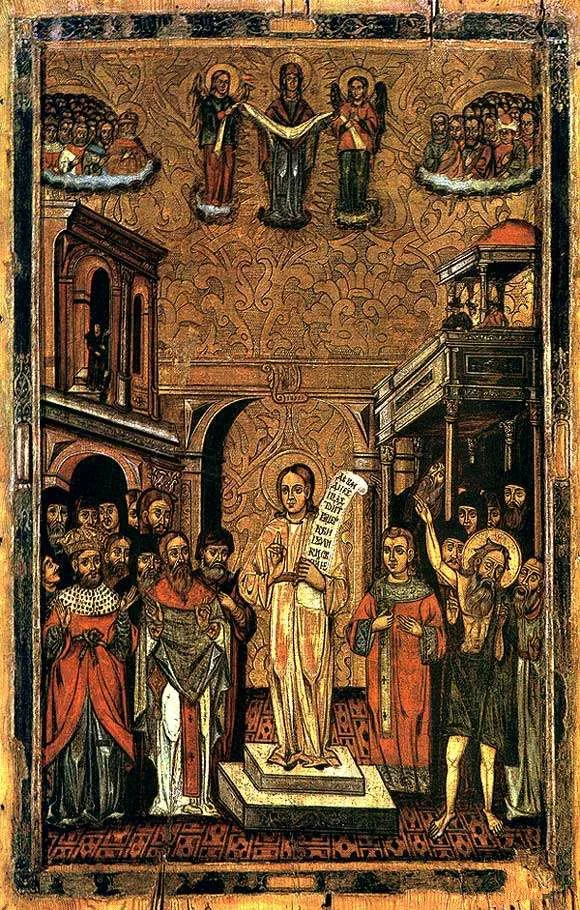
October 1 is also associated in Byzantine tradition with the Protection of the Theotokos, and some icons of that feast include Romanos chanting from the ambo. The shared date is especially fitting given the central place the Mother of God occupies within the traditional story of Romanos receiving his hymnographic gift.
His feast is therefore particularly appropriate for parish choirs and church musicians to seek his intercession and give thanks for the gift of sacred music.
PRAYERS
A simple traditional invocation may be prayed throughout the day: Venerable Father Romanos the Melodist, pray to God for us. It is especially fitting before choir rehearsal, chanting, composing sacred music, writing, reading in church, beginning a music lesson, or stepping forward to sing when fear or self-consciousness makes someone want to remain silent.
The Orthodox Church's established Troparion for Saint Romanos praises him for bringing joy to Christ's Church through his melodies, compares him to an inspired heavenly trumpet, remembers his illumination through the Mother of God, and honors him as God's poet. This existing liturgical hymn provides the safest and most traditional devotional prayer for a Romanos prayer card because it comes directly from the Church's worship rather than from a newly invented modern prayer.
Someone who has been mocked for singing can ask Romanos for perseverance without resentment, while a talented musician can ask his intercession for humility. A composer may seek help joining beauty with theological truth, and a cantor may ask for the grace to remember that the purpose of the voice is to lead prayer rather than attract attention.
A person struggling with creative work can also seek his prayers for discipline and inspiration. Romanos' story does not present creativity as personal possession because the gift represented by the scroll is something received from God and returned to Him in worship.
This prayer card is especially fitting beside a music stand, Byzantine chant book, choir folder, Psalter, Bible, prayer rope, composer's desk, piano, organ, recording workspace, deacon's prayer book, or home prayer corner. It can also make a meaningful gift for a cantor, choir director, singer, composer, church musician, seminarian, deacon, poet, music teacher, or young person joining a church choir for the first time.
FAQ
Who was Saint Romanos the Melodist? Saint Romanos the Melodist was a Syrian-born Christian deacon, poet, composer, and hymnographer who flourished during the late fifth and sixth centuries. He became famous in Constantinople for the long theological hymns called kontakia and is remembered as one of the greatest hymnographers of Byzantine Christianity.
Is Romanos the Melodist the same as Romanus the Melodist? Yes, Romanos and Romanus are different English forms of the same saint's name. Orthodox sources may also call him Roman the Melodist, Romanos the Hymnographer, or Romanos the Sweet-Singer.
Why is Saint Romanos called the Melodist? The title reflects his extraordinary contribution to sacred poetry and music. The Greek Orthodox School of Byzantine Music explains that a melodist was associated not simply with writing hymn texts but also with their musical composition.
Why is Saint Romanos called the Sweet-Singer? “Sweet-Singer” is one of the devotional titles traditionally attached to Romanos because of the beauty of the sacred hymnody for which he became famous. The title is particularly striking because his hagiography remembers him initially as an unimpressive singer.
Where was Saint Romanos born? He was born in Emesa, an ancient Syrian city corresponding to modern Homs, Syria. Melkite and Orthodox sources firmly connect him with the Syrian Christian world.
Was Saint Romanos Syrian? Yes, he was born in Syria and later served in Beirut before establishing himself in Constantinople. His Syrian background is particularly important for understanding the possible Syriac influences upon the hymnographic form he perfected.
Was Saint Romanos Jewish before becoming Christian? Church sources remember Romanos as having been born into a Jewish family. The exact circumstances of his baptism or conversion are uncertain, and the Melkite tradition specifically notes that we do not know when he was baptized or whether his entire family converted.
Is Saint Romanos connected with Antioch? Yes, Romanos was born in Homs and served in Beirut, both within the wider historical world of the Patriarchate of Antioch. The Melkite Greek Catholic Church specifically includes him in its Synaxis of the Saints of Antioch.
Is Saint Romanos important to Melkite Catholics? Yes, the Melkite Church commemorates him on October 1 and explicitly places him among the Saints of Antioch. His Syrian background and enormous influence upon Byzantine hymnography make him particularly meaningful within the Melkite tradition.
Is Saint Romanos important to Antiochian Orthodox Christians? Yes, his Syrian origin and connection with the ancient Antiochian Christian world give him a genuine place within Antiochian spiritual history. His subsequent ministry in Constantinople also makes him an important bridge between Antiochian and Byzantine Christian cultures.
Did Saint Romanos live in Beirut? Yes, sources connect Romanos with Church service in Beirut before his move to Constantinople. Greek Orthodox tradition identifies him as a deacon there, although the Melkite Menaion notes uncertainty about the precise timing of his ordination.
Was Saint Romanos a deacon? Yes, he is firmly remembered within Christian tradition as a deacon. Sources differ slightly about whether he was already ordained in Beirut or received ordination later in Constantinople.
Did Saint Romanos serve at Hagia Sophia? Yes, the Orthodox Church in America and Melkite sources associate his later ministry with the Great Church of Constantinople, Hagia Sophia. He is remembered in particular for service connected with the church and its liturgical life.
Was Saint Romanos originally a bad singer? His traditional Life says that Romanos was initially an unimpressive reader and singer and was mocked by other clergy after performing poorly during a service. This episode forms the setting for the famous vision in which the Mother of God gave him the scroll.
Why did other singers make fun of Saint Romanos? The devotional tradition remembers them ridiculing him because his voice and reading did not match the skill of the more experienced church singers. The humiliation affected him deeply and drove him toward prayer.
What happened when the Theotokos appeared to Saint Romanos? According to Church tradition, the Mother of God appeared to him while he was grieving and praying and gave him a scroll to eat. Afterward Romanos received an extraordinary gift of sacred poetry, understanding, and song.
Why did Saint Romanos eat a scroll? The scroll belongs to the visionary language of his hagiography and reflects biblical imagery in which God's word is symbolically consumed by those commissioned to proclaim it. The tradition presents Romanos' hymnographic gift as something spiritually received rather than merely self-created.
What was Saint Romanos' first famous hymn? His tradition identifies his great Nativity Kontakion, beginning with the Virgin giving birth to the Transcendent One, as the hymn he first proclaimed after receiving his miraculous gift.
Did Saint Romanos write “Today the Virgin”? Yes, the Nativity Kontakion associated with Romanos begins with the famous proclamation concerning the Virgin giving birth to the Transcendent One. The short hymn sung today is only the beginning of a much longer original composition.
How long was Saint Romanos' Nativity Kontakion? The original Nativity Kontakion contained an introductory section followed by twenty-four stanzas. Modern Byzantine worship ordinarily preserves only a small portion of the complete ancient work.
What is a kontakion? In Romanos' period, a kontakion was a lengthy sung poetic sermon composed of multiple stanzas with a repeated refrain. The much shorter kontakion familiar in modern Byzantine worship developed after this older form declined.
Did Saint Romanos invent the kontakion? It is more accurate to say that Romanos became the supreme master and most important hymnographer of the form rather than simply claiming that he invented it from nothing. Earlier poetic and Syriac traditions contributed to the development of the genre.
Is the kontakion connected with Syriac Christianity? Scholars have identified possible connections between the Byzantine kontakion and the Syriac memrâ, a form of poetic or sung homily. The Melkite Menaion specifically highlights this relationship when discussing Romanos' Syrian background.
How many hymns did Saint Romanos write? Church tradition attributes nearly a thousand compositions to Romanos, although only a fraction survive and ancient attribution is sometimes difficult to establish with certainty. Orthodox sources commonly place the surviving number around eighty to eighty-five.
Did Saint Romanos write the Akathist Hymn? Possibly, but the attribution is disputed. Some Orthodox traditions consider Romanos a likely author, while the Melkite Menaion cautions that the traditional attribution does not appear historically certain.
Is Saint Romanos the patron saint of church musicians? Yes, this is an exceptionally well-grounded devotional association. Greek Orthodox institutions call him the patron of those who sing for the Church, while the OCA places Church Musician Sunday and its Order of Saint Romanos in direct connection with him.
Is Saint Romanos the patron saint of singers? He is particularly associated with singers who serve the Church. His patronage is therefore strongest when singing is connected with Christian worship, choir ministry, chanting, or sacred music.
Is Saint Romanos the patron saint of Byzantine chanters? He is one of the strongest saints for Byzantine chanters because his entire legacy centers upon sacred hymnody and liturgical song. Modern Orthodox organizations devoted to Byzantine chant continue using his name and seeking his patronage.
Can choir members pray to Saint Romanos? Yes, choir members are specifically among the church musicians honored in contemporary Orthodox observances connected with Romanos. His feast is an especially appropriate time for parish choirs to seek his prayers.
Can choir directors pray to Saint Romanos? Yes, choir directors are specifically included within the Church Musician Sunday observance connected with Romanos. The OCA also honors distinguished conductors and teachers through the Order bearing his name.
Can composers pray to Saint Romanos? Yes, composition was at the center of Romanos' vocation, and modern Orthodox institutions invoke his patronage in honoring composers and arrangers. His life makes him especially meaningful for people creating music intended for worship.
Can writers and poets pray to Saint Romanos? Yes, Romanos was one of the great religious poets of Christian antiquity. His extraordinary ability to combine theology, Scripture, dramatic storytelling, and poetry gives him a natural devotional association with Christian writers and poets.
Can someone who is afraid to sing pray to Saint Romanos? Yes, his traditional Life makes this an especially meaningful use of his card because Romanos himself was remembered as an unimpressive singer who suffered public embarrassment. His story can encourage someone who wants to serve but feels inadequate.
Can someone pray to Saint Romanos for a better singing voice? Christians may certainly ask his intercession for help developing a voice in service to God. His story should not be treated as a promise of miraculous vocal transformation, but it provides a genuine traditional connection between Romanos, prayer, musical ability, and the offering of one's voice to God.
Can someone pray to Saint Romanos for creativity? Yes, particularly when that creativity is being used for Christian music, poetry, writing, teaching, or worship. His traditional reception of the scroll makes him a powerful reminder that creative gifts can be received with gratitude and returned to God through disciplined service.
Is Saint Romanos a good saint for people with stage fright? His biography gives him a meaningful devotional connection with people afraid of public performance because he knew humiliation connected with his voice. The more historically accurate language is to call him a meaningful intercessor rather than inventing a formal title such as patron saint of stage fright.
Is Saint Romanos a good saint for deacons? Yes, because Romanos himself served as a deacon and used his liturgical and creative gifts in service to the Church. His card can make an especially meaningful gift for a newly ordained deacon who also chants, teaches, writes, or serves liturgically.
What is Church Musician Sunday? The Orthodox Church in America observes the Sunday on or after Saint Romanos' feast as Church Musician Sunday. It recognizes the work of choir directors, singers, chanters, readers, composers, arrangers, bell-ringers, and others who support liturgical music.
What is the Order of Saint Romanos? The Orthodox Church in America established the Order of Saint Romanos under his patronage to recognize exceptional contributions to Orthodox liturgical music. Recipients have included influential composers, arrangers, conductors, teachers, and other musicians.
What is the Saint Romanos Medallion? The National Forum of Greek Orthodox Church Musicians awards the Saint Romanos the Melodist Medallion for exemplary national contributions to church music within the Greek Orthodox Archdiocese of America.
When is Saint Romanos the Melodist's feast day? Saint Romanos is commemorated on October 1. Orthodox and Melkite sources agree on this feast date even where some chronological details concerning his life differ.
Is Saint Romanos connected with the Protection of the Theotokos? His feast falls on October 1, the same date associated with the Protection of the Theotokos in much of the Byzantine tradition. Some icons of the feast even depict Romanos chanting from the ambo.
When was Saint Romanos born? His precise birth year is not known. He was born in the latter part of the fifth century, and modern presentations commonly place his birth around 490.
When did Saint Romanos die? The chronology is not completely uniform, but the OCA and Melkite tradition place his death around 556. Some other Church materials give an earlier date, so approximately 556 is preferable to claiming a precise date beyond the evidence.
Where are Saint Romanos' relics? The principal ecclesiastical sources used for this page do not identify one securely documented modern shrine containing his principal relics. Because online claims vary, a particular relic location should be independently verified before being presented as certain.
Is Saint Romanos an Orthodox saint? Yes, he is widely venerated throughout Eastern Orthodoxy and occupies an especially important place within Byzantine liturgical tradition. His feast appears in Orthodox calendars on October 1.
Do Eastern Catholics venerate Saint Romanos? Yes, Byzantine Catholics venerate him as part of their shared Byzantine liturgical heritage. The Melkite Greek Catholic Church specifically commemorates him and includes him among the Saints of Antioch.
Is Saint Romanos a Catholic saint? Romanos lived centuries before the later division between Catholic and Eastern Orthodox Christianity and belongs to the shared ancient Christian heritage of East and West. He is particularly prominent within Orthodox and Byzantine Catholic liturgical tradition.
Why is Saint Romanos important to Byzantine Christianity? He perfected one of the great forms of early Byzantine hymnography and produced theological poetry that profoundly shaped Christian worship. His work united Scripture, doctrine, preaching, poetry, music, and congregational participation.
Why are most of Romanos' complete kontakia no longer sung? The longer kontakion gradually lost its earlier place as the canon became dominant within Byzantine worship. Modern services generally preserve only shorter remnants of what had once been extensive poetic sermons.
Can I give this card to a cantor? Yes, Saint Romanos is one of the most fitting saints possible for a cantor or Byzantine chanter. His card can be given when someone begins chanting, completes music training, accepts a parish position, or simply needs encouragement in a demanding ministry.
Can I give this card to a church choir member? Yes, contemporary Orthodox observances honoring Romanos explicitly recognize choir singers as part of the Church's music ministry. The card can make a particularly appropriate choir appreciation or Christmas gift.
Can I give this card to a music teacher? Yes, especially to someone teaching sacred music, choir, Byzantine chant, or children preparing to sing in church. The Order of Saint Romanos itself recognizes teaching as an important contribution to Orthodox liturgical music.
Can I give this card to a songwriter? Yes, especially when the recipient is trying to write Christian or liturgical music. Romanos' example reminds songwriters that artistic beauty can become a genuine vehicle for Scripture and theology when it remains ordered toward God.
Can I give this card to someone who was embarrassed while singing? Yes, this may be one of the most personal uses of a Romanos prayer card because his traditional story begins with exactly that kind of humiliation. His life can remind someone that a painful early failure does not necessarily reveal the final limits of a gift.
What does Saint Romanos teach about talent? His life teaches that ability should ultimately be understood as gift and responsibility rather than personal glory. The voice, intelligence, imagination, and creative skill given to a person reach their highest purpose when they are offered back to God in service.
What does Saint Romanos teach about failure? His story demonstrates that an embarrassing failure does not necessarily mean someone should abandon a vocation. Romanos' remembered weakness became the setting in which his dependence upon God became most visible.
What does Saint Romanos teach about church music? His life and legacy demonstrate that church music can teach theology, interpret Scripture, unite a congregation in prayer, and proclaim Christian truth through beauty. Music in worship is therefore ministry rather than entertainment.
What does Saint Romanos teach about Christian creativity? Romanos shows that Christian creativity does not need to choose between artistic excellence and doctrinal depth. His greatest poetry became beautiful precisely because Scripture, theology, imagination, and worship were allowed to work together.
What is the main message of Saint Romanos the Melodist's life? Saint Romanos' life teaches that God can transform weakness offered in humility into a gift that serves generations. A Syrian Christian from Homs passed through Beirut to Constantinople, experienced humiliation because of his voice, sought the Mother of God's help in prayer, became one of Christianity's greatest hymnographers, and composed sacred poetry that Christians still sing roughly fifteen centuries later. His story speaks especially to anyone who has ever believed that a weak voice, imperfect beginning, criticism, or lack of confidence means there is nothing worth offering to God, because Romanos became the Sweet-Singer only after first knowing what it was like to feel that he could not sing.
Saint Romanos the Melodist, also called Saint Romanus the Melodist, Romanos the Hymnographer, and Romanos the Sweet-Singer, was a sixth-century Syrian-born deacon, poet, composer, and one of the greatest hymnographers in Christian history. Born in Emesa, the modern city of Homs in Syria, Romanos eventually served the Church in Beirut and Constantinople, where his extraordinary sacred poetry helped shape Byzantine worship for centuries. The Orthodox Church in America remembers him as the composer of nearly a thousand hymns, while the Greek Orthodox Archdiocese describes him as a patron of those who sing for the Church.
Saint Romanos is especially meaningful for church musicians, Byzantine chanters, cantors, choir members, choir directors, singers, composers, hymnographers, poets, Christian writers, readers, deacons, music teachers, people nervous about singing in church, people who have been embarrassed because of their abilities, and anyone asking God to transform an ordinary or undeveloped talent into something that can serve Him. These associations come directly from his life because Romanos devoted his vocation to liturgical music and sacred poetry, and both the Greek Orthodox Archdiocese and Orthodox Church in America continue formally connecting his memory with church musicians.
His connection with church music is particularly strong and is much more than a modern devotional invention. The Greek Orthodox Archdiocese's National Forum of Greek Orthodox Church Musicians identifies Romanos with those who sing for the Church, while the Orthodox Church in America has established an Order of Saint Romanos honoring distinguished composers, arrangers, conductors, teachers, and church musicians. The OCA also observes the Sunday on or after his October 1 feast as Church Musician Sunday, specifically recognizing choir directors, singers, chanters, readers, composers, arrangers, and bell-ringers.
Romanos is also an unusually meaningful saint for someone who feels that his or her voice is not good enough. The ancient devotional tradition preserved by the Churches remembers Romanos as a poor or unimpressive singer who was humiliated by other clergy before receiving, through the intercession of the Mother of God, the extraordinary gift for which he eventually became famous. His story therefore does not simply honor naturally talented musicians because it speaks powerfully to people who love worship but fear that their own abilities are inadequate.
This prayer card is especially fitting for cantors beginning Byzantine chant, children joining a church choir, music directors, seminarians learning liturgical music, deacons, composers writing sacred music, Christian poets, singers preparing for services, and people who have experienced criticism or embarrassment while trying to use their gifts. It can also make a meaningful ordination, choir anniversary, cantor installation, music-school graduation, name-day, baptism, chrismation, parish music ministry, or Christmas gift because Romanos' most famous surviving hymn celebrates the Nativity of Christ.
Each card is handmade in Austin, TX and created to order. We do not keep stock, because every prayer card is treated as a unique devotional offering. They are printed on museum-quality photo paper, not cardstock, and every card is made slowly during prayer with intentional reverence for the saint and for the person who will receive it. Names are lifted before Christ, intentions are held carefully, and each piece is handled multiple times in prayerful silence, asking God for mercy and asking Saint Romanos the Melodist to intercede for the soul it is being made for. This is devotional craftsmanship shaped with patience, care, and spiritual responsibility because every soul and every prayer matters.
THE LIFE & STORY
Saint Romanos was born during the latter part of the fifth century in Emesa, the ancient Syrian city now known as Homs. Orthodox and Melkite sources remember him as having been born into a Jewish family, although the exact circumstances and timing of his conversion or baptism are not securely known. The Melkite Church's Menaion specifically cautions that we do not know when he was baptized or whether the rest of his family converted with him.
His Syrian birthplace is important because Romanos' later contribution to Greek-language Byzantine hymnography did not arise in cultural isolation. The Melkite tradition explains that the form he perfected appears to have important connections with the Syriac tradition of poetic sermons, allowing Romanos to stand at a remarkable meeting point between the Syriac Christian world of the Levant and the Greek-speaking liturgical world of Constantinople.
Romanos therefore belongs naturally within the history of the ancient Church of Antioch as well as within Byzantine Christianity. The Melkite Greek Catholic Church specifically includes him in its Synaxis of the Saints of Antioch, remembering him on October 1 among the saints whose lives emerged from the Syriac and Antiochian Christian world.
FROM HOMS TO BEIRUT
As a young man, Romanos left Syria for Beirut, one of the important Christian centers of the eastern Mediterranean. Greek Orthodox sources remember him serving as a deacon there, while the Melkite Menaion notes that the surviving accounts differ about whether his ordination to the diaconate occurred in Beirut or somewhat later. What is secure is that Romanos entered Church service before eventually making his way to Constantinople.
That uncertainty is worth preserving because Romanos' later fame encouraged different traditions to fill in details of his early biography. The central historical picture remains clear even when every chronological detail cannot be reconstructed: a Syrian Christian formed in the Antiochian world eventually carried his vocation through Beirut into the imperial capital, where his work transformed Christian hymnography.
This movement between Homs, Beirut, and Constantinople also makes Romanos particularly meaningful for Eastern Christians living outside the places where they were born. His life demonstrates how a spiritual inheritance received in one culture can become fruitful within another without requiring someone to erase where he came from.
CONSTANTINOPLE
During the reign of Emperor Anastasius I, Romanos moved to Constantinople, the capital of the Eastern Roman Empire. The Melkite Menaion places him among the clergy accepted by the patriarch and associates him with the Monastery of the Theotokos in the district of Kyros, while the OCA remembers his service at the great church of Hagia Sophia.
Hagia Sophia stood at the heart of imperial Byzantine Christianity. For a man who would become one of the greatest hymnographers in Christian history, serving within the liturgical world of Constantinople placed Romanos at the center of an extraordinarily rich environment of Scripture, preaching, chant, ceremonial worship, theological controversy, and devotion to the Mother of God.
Yet Romanos did not initially arrive as a celebrated musical genius. His hagiographic tradition remembers something almost exactly opposite, which makes the next chapter of his life so important.
THE SINGER WHO COULD NOT SING
The Church's traditional Life remembers Romanos as not initially possessing a beautiful singing voice or impressive ability as a reader. On the eve of the Nativity, he attempted to read during the service so poorly that another reader had to replace him, and members of the clergy mocked him afterward.
The Melkite tradition similarly describes Romanos as lacking a pleasing voice or special ability as a chanter and remembers other clerics deliberately giving him a difficult part in a service, exposing his limitations publicly. Whatever historical details surround the story's later literary development, the tradition consistently remembers a man whose later greatness followed an experience of profound inadequacy and humiliation.
This makes Saint Romanos one of the most meaningful saints for people afraid of singing publicly or serving at the kliros, choir loft, cantor stand, lectern, or ambo. Someone does not have to pretend embarrassment does not hurt in order to continue serving God, because Romanos' tradition begins precisely with a moment in which his desire to worship exceeded his visible ability.
HUMILIATION WITHOUT QUITTING
Romanos could easily have responded by simply refusing ever to sing publicly again. Instead, the tradition remembers him bringing his grief into prayer before the Mother of God, turning humiliation toward God rather than allowing humiliation to determine whether his vocation was finished.
That distinction gives his life a much broader meaning than church music alone. People are often tempted to abandon something good because they were mocked during the earliest and least polished stage of learning it, whether the skill involves chanting, writing, public speaking, teaching, serving at the altar, or making art.
Romanos' story does not promise that every weakness will miraculously disappear. It does teach that another person's ridicule is not a reliable measure of what God may eventually accomplish through someone who remains faithful.
HIS DEVOTION TO THE THEOTOKOS
Romanos possessed a deep devotion to the Mother of God, and the OCA remembers him praying at the Church of the Theotokos at Blachernae. He spent nights in prayer and particularly sought the intercession of the Virgin whose role in the Incarnation would later become one of the great themes of his hymnography.
This Marian dimension is essential to Romanos' story because his famous transformation is not remembered simply as the discovery of a hidden natural talent. Christian tradition specifically interprets his gift as a grace received through the intercession of the Theotokos.
Romanos can therefore be particularly meaningful for Christians asking the Mother of God to help them offer their talents more completely to Christ. His devotion also explains why Marian themes occupy such an important place within the hymnographic tradition associated with his name.
THE VISION OF THE SCROLL
According to the ancient devotional tradition, the grieving Romanos prayed before an icon of the Mother of God and fell asleep. The Theotokos appeared to him and gave him a scroll, commanding him to eat it. Romanos obeyed, and when he awoke he discovered that he had received extraordinary gifts of understanding, composition, poetry, and sacred song.
The image of eating a scroll has deep biblical resonance. The prophets encounter similar imagery when God's word is received so completely that it is not merely observed externally but symbolically consumed, becoming part of the messenger who must proclaim it.
Romanos' tradition therefore connects sacred creativity with something much deeper than artistic inspiration. The hymnographer must first receive the divine word inwardly before offering it outwardly through poetry and song.
“TODAY THE VIRGIN GIVES BIRTH”
At the next service, Romanos mounted the ambo and began chanting the hymn that would become permanently associated with his name. Its famous opening announces that the Virgin gives birth to the Transcendent One, introducing a long poetic meditation upon the mystery of Christ's Nativity.
The short hymn Byzantine Christians commonly call the Kontakion of the Nativity today is only the introductory portion of Romanos' much longer original work. The complete composition contained twenty-four stanzas and functioned almost like a sung theological sermon in poetry.
This is one reason a Saint Romanos prayer card makes a particularly meaningful Christmas gift. Every year millions of Eastern Christians encounter his theological poetry again during the celebration of Christ's birth even when they may not immediately recognize the name of its author.
WHAT IS A KONTAKION?
The modern Byzantine service usually preserves only a relatively short hymn under the name kontakion, but the original form developed by Romanos was considerably larger. The Melkite Menaion explains that Romanos' kontakia consisted of a sequence of poetic stanzas sung by a soloist while the people or choir responded with a recurring refrain.
The OCA similarly describes the classical kontakion as a chanted verse sermon composed of short stanzas ending with a common refrain. Rather than separating preaching, poetry, theology, music, Scripture, and congregational participation into unrelated activities, the form united them within one act of worship.
Romanos became the supreme master of this form. His contribution helps explain why his importance cannot be measured merely by counting how many individual melodies survive today.
THE SYRIAC ROOTS OF HIS POETRY
Romanos' Syrian background may have contributed significantly to the form of poetry he perfected in Greek. The Melkite Menaion notes that musicologists have connected the kontakion with the Syriac memrâ, a poetic or verse homily capable of retelling and interpreting biblical passages through sung poetry.
Romanos appears to have brought that Syrian inheritance into creative interaction with Greek dramatic and poetic conventions. The result became something unmistakably Byzantine while still carrying traces of the Christian culture from which he came.
This makes him an especially important saint for anyone studying the relationship between Syriac Christianity, Antioch, Byzantine worship, and Greek hymnography. Eastern Christian traditions did not develop in sealed compartments because ideas, melodies, poetry, theology, languages, and people continually crossed regional boundaries.
A SAINT OF THE ANTIOCHIAN WORLD
Because Romanos was born in Homs and served the Church in Beirut before his Constantinopolitan ministry, the Melkite Greek Catholic Church includes him among the Saints of Antioch. This gives him an unusually beautiful position within Eastern Christianity because both Antiochian and Byzantine worlds can recognize part of their spiritual inheritance within him.
For Melkite Catholics in particular, Romanos is not simply an important Byzantine hymnographer from somewhere far away. He emerged from the same Syriac and Levantine Christian world that forms an essential part of Antiochian identity before carrying those gifts into the worship of Constantinople.
A Romanos prayer card can therefore be particularly meaningful for Melkite Catholics, Antiochian Orthodox Christians, Syrian Christians, Lebanese Christians, Byzantine Catholics, Greek Orthodox Christians, and anyone studying the interaction between Syriac and Byzantine traditions.
THEOLOGY THAT COULD BE SUNG
Romanos wrote sacred poetry about the Incarnation, Nativity, Crucifixion, Resurrection, saints, biblical events, repentance, and Christian life. His work transformed theology into language capable of being sung and remembered, allowing doctrinal teaching to enter the worshipper's imagination as well as the intellect.
This is one of the reasons sacred hymnody occupies such an important place within Eastern Christianity. Christians repeatedly sing theological truths until the language of doctrine becomes part of the memory and eventually part of the language through which they pray.
Romanos therefore makes an especially fitting saint for Christian songwriters and composers. The purpose of sacred music is not merely creating something emotionally beautiful because beauty becomes genuinely ecclesial when it serves truth, worship, Scripture, and the glorification of God.
SCRIPTURE BECOMING POETRY
Romanos possessed an extraordinary ability to retell biblical events dramatically. Characters speak, questions are asked, biblical images interact with one another, and Old Testament events become prophetic patterns revealing Christ and the mysteries of salvation.
The OCA particularly highlights Romanos' use of biblical typology, in which people, places, and events of the Old Testament are understood as patterns fulfilled in Christ. One example is the Burning Bush, interpreted as an image of the Theotokos bearing the divine Word without being consumed.
His hymnography therefore provides a powerful example for Christians trying to understand how the Fathers read Scripture. Biblical interpretation was not limited to extracting isolated propositions because Scripture formed an interconnected story whose patterns culminated in Christ.
A PREACHER THROUGH MUSIC
Although Romanos is usually called a hymnographer rather than a preacher, the ancient kontakion was essentially capable of functioning as a sermon in verse. A congregation could listen to an extended theological treatment of a feast while participating repeatedly through the refrain.
Romanos therefore occupies an interesting position between preacher, poet, theologian, composer, and liturgical musician. His work challenges modern distinctions that sometimes place theology in the classroom, preaching at the pulpit, music in the choir loft, and poetry somewhere outside serious Christian teaching.
His life makes him meaningful for anyone trying to communicate Christianity creatively without weakening its theological substance. Art can become catechesis when beauty and truth remain joined.
SIMPLE LANGUAGE & DEEP THEOLOGY
The Greek Orthodox Archdiocese emphasizes that Romanos wrote hymns capable of speaking to the hearts of ordinary people through accessible language and attractive poetic meter. His greatness therefore did not depend upon making every theological idea sound complicated.
This provides an especially useful model for Christian writers, teachers, composers, and catechists. Making theology understandable is not the same thing as making it shallow because some of the greatest teachers in Christian history possessed the ability to express profound truths in memorable language.
Romanos can therefore be asked to intercede for people working to find the right words, especially when the goal is to make the faith accessible without changing what the Church actually teaches.
THE SWEET-SINGER
Romanos became known by titles including Melodist, Sweet-Singer, and Righteous Chanter. These titles reflect the extraordinary transformation remembered by the Church, in which the man originally mocked for his voice eventually became permanently associated with the beauty of Christian hymnody.
The Greek title Melodos refers to more than someone who simply wrote words. The Greek Orthodox School of Byzantine Music explains that Romanos' designation as a melodist indicates a figure associated with composing both sacred poetry and its musical expression.
His card therefore belongs naturally beside the music stand of a cantor, composer, choir director, or church musician. The title by which history remembers him is itself a reminder of how completely grace can redirect the story others once told about someone's limitations.
PATRON OF CHURCH MUSICIANS
Romanos' connection with church musicians is unusually well established. The Greek Orthodox Archdiocese explicitly describes him as having been called the patron saint of all who sing for the Church, and its National Forum honors distinguished church musicians with the Saint Romanos the Melodist Medallion.
The Orthodox Church in America likewise places its Order of Saint Romanos under his patronage and bestows the honor upon influential composers, arrangers, teachers, conductors, and other people who have significantly served Orthodox liturgical music.
Calling Romanos a patron of church musicians is therefore not an invented product-page designation. It reflects actual institutional devotion within contemporary Orthodox Christianity.
CHURCH MUSICIAN SUNDAY
The Holy Synod of Bishops of the Orthodox Church in America designated the Sunday on or following Romanos' October 1 commemoration as Church Musician Sunday. The observance honors those whose work makes liturgical music possible in Orthodox parishes.
The OCA specifically names choir directors, singers, chanters, readers, composers, arrangers, and bell-ringers among those whose service should be recognized. This gives almost every form of Orthodox parish music ministry a concrete connection with Romanos' feast.
A Saint Romanos card is therefore particularly appropriate as a thank-you gift from a parish to a choir director, cantor, longtime choir member, or volunteer musician whose service often remains largely invisible to the congregation.
A SAINT FOR BYZANTINE CHANTERS
Romanos is naturally associated with psaltai and Byzantine chanters, and modern Greek Orthodox institutions continue using his name for organizations devoted specifically to preserving Byzantine chant. His legacy represents an ancient model of singing as ministry rather than performance.
A chanter stands in an unusual place because the voice must be audible without allowing the personality of the singer to become the center of worship. Romanos' story is therefore especially suitable for prayer for humility, preparation, memory, musical discipline, and the ability to direct attention toward the sacred text rather than toward oneself.
His intercession can be sought both by highly trained chanters and by someone struggling through the first tones and unfamiliar notation of Byzantine music. His own hagiography begins not with mastery but with weakness.
A SAINT FOR CHOIR MEMBERS
Romanos is equally fitting for choir members, including people who may never sing solos or receive public recognition. Church music depends upon disciplined cooperation, because each singer must listen to others and allow an individual voice to become part of something larger.
The modern observances dedicated to Romanos intentionally include ordinary singers as well as composers and directors. The Church's recognition therefore reflects the importance of the person who faithfully stands in the choir week after week even without producing famous compositions.
A Romanos card can make a meaningful choir anniversary or end-of-year gift because it honors music as a genuine form of service to the worshipping Church.
A SAINT FOR COMPOSERS
Romanos' extraordinary creative output makes him one of Christianity's strongest saints for composers and hymnographers. The OCA tradition attributes nearly a thousand hymns to him, with approximately eighty surviving, while modern Greek Orthodox scholarship identifies roughly eighty-five surviving kontakia attributed to him.
Numbers vary somewhat because attribution within ancient manuscript traditions is complicated. What does not depend upon an exact count is Romanos' status as one of the most prolific and influential sacred poets of Byzantine Christianity.
Christian composers can therefore seek his intercession not merely for creativity but for discernment about whether the music they create truly serves prayer.
A SAINT FOR POETS & WRITERS
Romanos also belongs naturally beside poets, writers, dramatists, and storytellers. His surviving works show that imagination, dialogue, symbolism, emotion, biblical interpretation, and doctrinal precision can coexist within Christian writing.
His example is particularly valuable for writers who fear that serious theology must always sound dry. Romanos helped generations of Christians encounter doctrine through beautiful language precisely because he did not treat beauty and truth as enemies.
A writer can therefore ask Saint Romanos for clarity, humility, disciplined imagination, and the grace to produce work that serves Christ instead of simply displaying talent.
A SAINT FOR PEOPLE WHO HAVE BEEN MOCKED
Perhaps one of Romanos' most immediately human devotional associations is with people who have been laughed at while trying to do something good. His hagiography deliberately remembers the ridicule he suffered before describing the gift that later astonished those same people.
The point is not that every critic will eventually be proven wrong in a dramatic miracle. It is that humiliation does not possess authority to decide what someone is capable of becoming.
A person beginning choir, seminary, public speaking, writing, music, or another ministry can keep Romanos' card nearby as a reminder that early weakness and final vocation are not always the same thing.
A SAINT FOR CREATIVE BLOCKS
Romanos can also be a meaningful intercessor when a writer, poet, singer, or composer feels unable to create. His traditional vision of receiving the scroll presents creativity as something offered back to God after first being received as gift.
This does not eliminate the need for practice, study, editing, musical training, or disciplined work. Christian prayer for creativity asks God to bless human effort rather than replace it.
Romanos' example therefore provides a healthier spiritual model than waiting passively for inspiration. Prayer, preparation, humility, perseverance, and work can all belong to the same creative vocation.
A SAINT FOR DEACONS
Romanos' tradition strongly associates him with the diaconate. Greek Orthodox sources remember him serving as a deacon in Beirut, while Orthodox tradition also remembers his later service in Constantinople, although sources vary regarding the precise chronology of his ordination.
This makes his prayer card particularly appropriate for men discerning or entering the diaconate. His life demonstrates that diaconal service can include much more than liturgical function because a deacon's voice, teaching, writing, creativity, and prayer can become lasting service to the Church.
A Saint Romanos card can therefore make a meaningful ordination-to-the-diaconate gift, particularly for a deacon with responsibility for chanting, preaching, teaching, or liturgical preparation.
HAGIA SOPHIA
Romanos eventually became associated with Hagia Sophia, the Great Church of Constantinople and one of the most important churches in Christian history. The OCA remembers him serving there as sacristan, while the Melkite Menaion likewise places his final service within the Great Church.
A sacristan carried responsibility for sacred vessels, liturgical objects, and practical preparation for worship. This means that the famous poet's vocation also contained ordinary work that had to be done faithfully behind the scenes.
Romanos therefore offers church musicians an important reminder that visible creative work and hidden practical service belong together. The composer whose hymns crossed centuries was also responsible for things that simply needed to be prepared correctly for church.
THE NATIVITY OF CHRIST
The Incarnation and Nativity stand at the center of Romanos' most famous surviving composition. His Nativity Kontakion celebrates the paradoxes of Christian faith: the eternal God becomes a child, the inaccessible One enters a cave, and divine majesty appears within human poverty.
The hymn's endurance demonstrates the power of good theology expressed memorably. Christians may forget an entire theological lecture but continue carrying a line of hymnography in their minds for decades.
Romanos' prayer card is therefore especially fitting for a Christmas prayer corner, church choir Christmas exchange, Nativity concert, or gift to someone who sings during the Christmas services.
ROMANOS & THE MOTHER OF GOD
The Theotokos is not important in Romanos' story only because of the scroll vision. Marian imagery appears repeatedly within the theological world of his poetry because the Mother of God reveals the mystery of the Incarnation: the eternal Word truly assumed human nature and was genuinely born from a human mother.
Romanos' poetic theology therefore illustrates why Eastern Christian devotion to Mary is fundamentally Christological. Her significance continually points toward the identity of her Son.
His life can be especially meaningful for Marian singers, composers of hymns to the Theotokos, and people whose devotion to Mary leads them more deeply into the mystery of Christ.
DID ROMANOS WRITE THE AKATHIST HYMN?
Saint Romanos has traditionally been associated with the famous Akathist Hymn to the Theotokos, but its authorship should not be presented as historically certain. Some Orthodox sources consider Romanos a likely author, while the Melkite Menaion notes that he was frequently credited with the Akathist but concludes that the attribution probably should not be treated as secure.
The Antiochian Archdiocese likewise preserves a tradition identifying Romanos with the Akathist, demonstrating that the attribution is genuinely old and important even though modern scholarship has not universally accepted it.
The most accurate product-page language is therefore that the Akathist has traditionally been attributed to Saint Romanos, but its authorship remains disputed. His established hymnographic achievement is extraordinary even without depending upon the Akathist attribution.
WHY MOST OF HIS KONTAKIA ARE NO LONGER SUNG IN FULL
Romanos' long kontakia once occupied a much larger role within Byzantine worship than they do today. Over subsequent centuries, the canon became increasingly dominant within the morning office, and the older extended kontakion gradually contracted until usually only its introductory portion and an associated oikos remained.
This explains why Romanos can simultaneously be one of history's greatest Byzantine hymnographers while modern churchgoers hear only relatively small pieces of his original compositions during ordinary services.
His influence is therefore larger than the amount of Romanos' writing a parishioner hears on any particular Sunday. He helped shape a stage in the development of Byzantine worship whose influence remains embedded within the tradition.
THE CONTINUING LIFE OF HIS HYMNS
Although the complete classical kontakion largely disappeared from regular liturgical use, portions of Romanos' poetry remain alive in Eastern worship. His Nativity Kontakion is among the most familiar examples, and Orthodox writers continue drawing upon his surviving works for theological reflection.
This gives Romanos an extraordinary kind of immortality within Christian culture. Words written approximately fifteen centuries ago continue entering churches through the voices of people who may speak completely different modern languages from the Syrian poet who first composed them.
For Christian artists, this is a powerful reminder that work created in prayer may serve people whom its creator will never meet.
THE DIFFERENT DATES GIVEN FOR HIS DEATH
Ancient chronology surrounding Romanos is not completely uniform. The OCA and Melkite sources commonly place his repose around 556, while one Greek Orthodox Church Music biography gives the earlier date of 510.
Because the majority of the detailed ecclesiastical sources consulted here place him in the sixth century and around 556, the safest product-page dating is c. 490 to c. 556, while acknowledging that older devotional sources sometimes provide different dates.
This is a case where precision should not be manufactured simply because customers expect a birth-and-death date. Romanos' feast and historical period are secure even though the exact chronology of his life remains partially uncertain.
HIS REPOSE
Saint Romanos continued composing sacred poetry and serving the Church until his repose, traditionally placed around the middle of the sixth century. The OCA and Melkite Synaxis both place his death around 556 and remember a surviving corpus of roughly eighty compositions from a far larger original output.
Romanos did not need to die as a martyr for his life to become a permanent offering to the Church. His martyrdom was instead the quieter surrender involved in a lifetime of prayer, service, creativity, liturgy, discipline, and using a gift for the glory of Christ.
His voice eventually fell silent, but the Church continued singing.
HIS RELICS
Unlike several major Eastern saints whose complete relic shrines are well documented in current ecclesiastical sources, the principal Orthodox and Melkite sources describing Romanos do not identify a securely documented modern location containing his principal relics. The most responsible approach is therefore not to repeat unsourced internet claims about where his body or major relics are located.
Individual churches or monasteries may possess small relic fragments attributed to Saint Romanos, but a specific present-day location should be verified directly with the church possessing the relic before being presented to customers as an established pilgrimage destination.
For this product page, it is therefore better to state that the principal location of Romanos' relics is not securely documented in the official sources consulted rather than manufacture certainty.
FEAST DAY
Saint Romanos the Melodist is commemorated on October 1 in the Byzantine tradition. The Orthodox Church in America, Greek Orthodox Archdiocese, and Melkite Greek Catholic tradition all identify October 1 as his feast.
October 1 is also associated in Byzantine tradition with the Protection of the Theotokos, and some icons of that feast include Romanos chanting from the ambo. The shared date is especially fitting given the central place the Mother of God occupies within the traditional story of Romanos receiving his hymnographic gift.
His feast is therefore particularly appropriate for parish choirs and church musicians to seek his intercession and give thanks for the gift of sacred music.
PRAYERS
A simple traditional invocation may be prayed throughout the day: Venerable Father Romanos the Melodist, pray to God for us. It is especially fitting before choir rehearsal, chanting, composing sacred music, writing, reading in church, beginning a music lesson, or stepping forward to sing when fear or self-consciousness makes someone want to remain silent.
The Orthodox Church's established Troparion for Saint Romanos praises him for bringing joy to Christ's Church through his melodies, compares him to an inspired heavenly trumpet, remembers his illumination through the Mother of God, and honors him as God's poet. This existing liturgical hymn provides the safest and most traditional devotional prayer for a Romanos prayer card because it comes directly from the Church's worship rather than from a newly invented modern prayer.
Someone who has been mocked for singing can ask Romanos for perseverance without resentment, while a talented musician can ask his intercession for humility. A composer may seek help joining beauty with theological truth, and a cantor may ask for the grace to remember that the purpose of the voice is to lead prayer rather than attract attention.
A person struggling with creative work can also seek his prayers for discipline and inspiration. Romanos' story does not present creativity as personal possession because the gift represented by the scroll is something received from God and returned to Him in worship.
This prayer card is especially fitting beside a music stand, Byzantine chant book, choir folder, Psalter, Bible, prayer rope, composer's desk, piano, organ, recording workspace, deacon's prayer book, or home prayer corner. It can also make a meaningful gift for a cantor, choir director, singer, composer, church musician, seminarian, deacon, poet, music teacher, or young person joining a church choir for the first time.
FAQ
Who was Saint Romanos the Melodist? Saint Romanos the Melodist was a Syrian-born Christian deacon, poet, composer, and hymnographer who flourished during the late fifth and sixth centuries. He became famous in Constantinople for the long theological hymns called kontakia and is remembered as one of the greatest hymnographers of Byzantine Christianity.
Is Romanos the Melodist the same as Romanus the Melodist? Yes, Romanos and Romanus are different English forms of the same saint's name. Orthodox sources may also call him Roman the Melodist, Romanos the Hymnographer, or Romanos the Sweet-Singer.
Why is Saint Romanos called the Melodist? The title reflects his extraordinary contribution to sacred poetry and music. The Greek Orthodox School of Byzantine Music explains that a melodist was associated not simply with writing hymn texts but also with their musical composition.
Why is Saint Romanos called the Sweet-Singer? “Sweet-Singer” is one of the devotional titles traditionally attached to Romanos because of the beauty of the sacred hymnody for which he became famous. The title is particularly striking because his hagiography remembers him initially as an unimpressive singer.
Where was Saint Romanos born? He was born in Emesa, an ancient Syrian city corresponding to modern Homs, Syria. Melkite and Orthodox sources firmly connect him with the Syrian Christian world.
Was Saint Romanos Syrian? Yes, he was born in Syria and later served in Beirut before establishing himself in Constantinople. His Syrian background is particularly important for understanding the possible Syriac influences upon the hymnographic form he perfected.
Was Saint Romanos Jewish before becoming Christian? Church sources remember Romanos as having been born into a Jewish family. The exact circumstances of his baptism or conversion are uncertain, and the Melkite tradition specifically notes that we do not know when he was baptized or whether his entire family converted.
Is Saint Romanos connected with Antioch? Yes, Romanos was born in Homs and served in Beirut, both within the wider historical world of the Patriarchate of Antioch. The Melkite Greek Catholic Church specifically includes him in its Synaxis of the Saints of Antioch.
Is Saint Romanos important to Melkite Catholics? Yes, the Melkite Church commemorates him on October 1 and explicitly places him among the Saints of Antioch. His Syrian background and enormous influence upon Byzantine hymnography make him particularly meaningful within the Melkite tradition.
Is Saint Romanos important to Antiochian Orthodox Christians? Yes, his Syrian origin and connection with the ancient Antiochian Christian world give him a genuine place within Antiochian spiritual history. His subsequent ministry in Constantinople also makes him an important bridge between Antiochian and Byzantine Christian cultures.
Did Saint Romanos live in Beirut? Yes, sources connect Romanos with Church service in Beirut before his move to Constantinople. Greek Orthodox tradition identifies him as a deacon there, although the Melkite Menaion notes uncertainty about the precise timing of his ordination.
Was Saint Romanos a deacon? Yes, he is firmly remembered within Christian tradition as a deacon. Sources differ slightly about whether he was already ordained in Beirut or received ordination later in Constantinople.
Did Saint Romanos serve at Hagia Sophia? Yes, the Orthodox Church in America and Melkite sources associate his later ministry with the Great Church of Constantinople, Hagia Sophia. He is remembered in particular for service connected with the church and its liturgical life.
Was Saint Romanos originally a bad singer? His traditional Life says that Romanos was initially an unimpressive reader and singer and was mocked by other clergy after performing poorly during a service. This episode forms the setting for the famous vision in which the Mother of God gave him the scroll.
Why did other singers make fun of Saint Romanos? The devotional tradition remembers them ridiculing him because his voice and reading did not match the skill of the more experienced church singers. The humiliation affected him deeply and drove him toward prayer.
What happened when the Theotokos appeared to Saint Romanos? According to Church tradition, the Mother of God appeared to him while he was grieving and praying and gave him a scroll to eat. Afterward Romanos received an extraordinary gift of sacred poetry, understanding, and song.
Why did Saint Romanos eat a scroll? The scroll belongs to the visionary language of his hagiography and reflects biblical imagery in which God's word is symbolically consumed by those commissioned to proclaim it. The tradition presents Romanos' hymnographic gift as something spiritually received rather than merely self-created.
What was Saint Romanos' first famous hymn? His tradition identifies his great Nativity Kontakion, beginning with the Virgin giving birth to the Transcendent One, as the hymn he first proclaimed after receiving his miraculous gift.
Did Saint Romanos write “Today the Virgin”? Yes, the Nativity Kontakion associated with Romanos begins with the famous proclamation concerning the Virgin giving birth to the Transcendent One. The short hymn sung today is only the beginning of a much longer original composition.
How long was Saint Romanos' Nativity Kontakion? The original Nativity Kontakion contained an introductory section followed by twenty-four stanzas. Modern Byzantine worship ordinarily preserves only a small portion of the complete ancient work.
What is a kontakion? In Romanos' period, a kontakion was a lengthy sung poetic sermon composed of multiple stanzas with a repeated refrain. The much shorter kontakion familiar in modern Byzantine worship developed after this older form declined.
Did Saint Romanos invent the kontakion? It is more accurate to say that Romanos became the supreme master and most important hymnographer of the form rather than simply claiming that he invented it from nothing. Earlier poetic and Syriac traditions contributed to the development of the genre.
Is the kontakion connected with Syriac Christianity? Scholars have identified possible connections between the Byzantine kontakion and the Syriac memrâ, a form of poetic or sung homily. The Melkite Menaion specifically highlights this relationship when discussing Romanos' Syrian background.
How many hymns did Saint Romanos write? Church tradition attributes nearly a thousand compositions to Romanos, although only a fraction survive and ancient attribution is sometimes difficult to establish with certainty. Orthodox sources commonly place the surviving number around eighty to eighty-five.
Did Saint Romanos write the Akathist Hymn? Possibly, but the attribution is disputed. Some Orthodox traditions consider Romanos a likely author, while the Melkite Menaion cautions that the traditional attribution does not appear historically certain.
Is Saint Romanos the patron saint of church musicians? Yes, this is an exceptionally well-grounded devotional association. Greek Orthodox institutions call him the patron of those who sing for the Church, while the OCA places Church Musician Sunday and its Order of Saint Romanos in direct connection with him.
Is Saint Romanos the patron saint of singers? He is particularly associated with singers who serve the Church. His patronage is therefore strongest when singing is connected with Christian worship, choir ministry, chanting, or sacred music.
Is Saint Romanos the patron saint of Byzantine chanters? He is one of the strongest saints for Byzantine chanters because his entire legacy centers upon sacred hymnody and liturgical song. Modern Orthodox organizations devoted to Byzantine chant continue using his name and seeking his patronage.
Can choir members pray to Saint Romanos? Yes, choir members are specifically among the church musicians honored in contemporary Orthodox observances connected with Romanos. His feast is an especially appropriate time for parish choirs to seek his prayers.
Can choir directors pray to Saint Romanos? Yes, choir directors are specifically included within the Church Musician Sunday observance connected with Romanos. The OCA also honors distinguished conductors and teachers through the Order bearing his name.
Can composers pray to Saint Romanos? Yes, composition was at the center of Romanos' vocation, and modern Orthodox institutions invoke his patronage in honoring composers and arrangers. His life makes him especially meaningful for people creating music intended for worship.
Can writers and poets pray to Saint Romanos? Yes, Romanos was one of the great religious poets of Christian antiquity. His extraordinary ability to combine theology, Scripture, dramatic storytelling, and poetry gives him a natural devotional association with Christian writers and poets.
Can someone who is afraid to sing pray to Saint Romanos? Yes, his traditional Life makes this an especially meaningful use of his card because Romanos himself was remembered as an unimpressive singer who suffered public embarrassment. His story can encourage someone who wants to serve but feels inadequate.
Can someone pray to Saint Romanos for a better singing voice? Christians may certainly ask his intercession for help developing a voice in service to God. His story should not be treated as a promise of miraculous vocal transformation, but it provides a genuine traditional connection between Romanos, prayer, musical ability, and the offering of one's voice to God.
Can someone pray to Saint Romanos for creativity? Yes, particularly when that creativity is being used for Christian music, poetry, writing, teaching, or worship. His traditional reception of the scroll makes him a powerful reminder that creative gifts can be received with gratitude and returned to God through disciplined service.
Is Saint Romanos a good saint for people with stage fright? His biography gives him a meaningful devotional connection with people afraid of public performance because he knew humiliation connected with his voice. The more historically accurate language is to call him a meaningful intercessor rather than inventing a formal title such as patron saint of stage fright.
Is Saint Romanos a good saint for deacons? Yes, because Romanos himself served as a deacon and used his liturgical and creative gifts in service to the Church. His card can make an especially meaningful gift for a newly ordained deacon who also chants, teaches, writes, or serves liturgically.
What is Church Musician Sunday? The Orthodox Church in America observes the Sunday on or after Saint Romanos' feast as Church Musician Sunday. It recognizes the work of choir directors, singers, chanters, readers, composers, arrangers, bell-ringers, and others who support liturgical music.
What is the Order of Saint Romanos? The Orthodox Church in America established the Order of Saint Romanos under his patronage to recognize exceptional contributions to Orthodox liturgical music. Recipients have included influential composers, arrangers, conductors, teachers, and other musicians.
What is the Saint Romanos Medallion? The National Forum of Greek Orthodox Church Musicians awards the Saint Romanos the Melodist Medallion for exemplary national contributions to church music within the Greek Orthodox Archdiocese of America.
When is Saint Romanos the Melodist's feast day? Saint Romanos is commemorated on October 1. Orthodox and Melkite sources agree on this feast date even where some chronological details concerning his life differ.
Is Saint Romanos connected with the Protection of the Theotokos? His feast falls on October 1, the same date associated with the Protection of the Theotokos in much of the Byzantine tradition. Some icons of the feast even depict Romanos chanting from the ambo.
When was Saint Romanos born? His precise birth year is not known. He was born in the latter part of the fifth century, and modern presentations commonly place his birth around 490.
When did Saint Romanos die? The chronology is not completely uniform, but the OCA and Melkite tradition place his death around 556. Some other Church materials give an earlier date, so approximately 556 is preferable to claiming a precise date beyond the evidence.
Where are Saint Romanos' relics? The principal ecclesiastical sources used for this page do not identify one securely documented modern shrine containing his principal relics. Because online claims vary, a particular relic location should be independently verified before being presented as certain.
Is Saint Romanos an Orthodox saint? Yes, he is widely venerated throughout Eastern Orthodoxy and occupies an especially important place within Byzantine liturgical tradition. His feast appears in Orthodox calendars on October 1.
Do Eastern Catholics venerate Saint Romanos? Yes, Byzantine Catholics venerate him as part of their shared Byzantine liturgical heritage. The Melkite Greek Catholic Church specifically commemorates him and includes him among the Saints of Antioch.
Is Saint Romanos a Catholic saint? Romanos lived centuries before the later division between Catholic and Eastern Orthodox Christianity and belongs to the shared ancient Christian heritage of East and West. He is particularly prominent within Orthodox and Byzantine Catholic liturgical tradition.
Why is Saint Romanos important to Byzantine Christianity? He perfected one of the great forms of early Byzantine hymnography and produced theological poetry that profoundly shaped Christian worship. His work united Scripture, doctrine, preaching, poetry, music, and congregational participation.
Why are most of Romanos' complete kontakia no longer sung? The longer kontakion gradually lost its earlier place as the canon became dominant within Byzantine worship. Modern services generally preserve only shorter remnants of what had once been extensive poetic sermons.
Can I give this card to a cantor? Yes, Saint Romanos is one of the most fitting saints possible for a cantor or Byzantine chanter. His card can be given when someone begins chanting, completes music training, accepts a parish position, or simply needs encouragement in a demanding ministry.
Can I give this card to a church choir member? Yes, contemporary Orthodox observances honoring Romanos explicitly recognize choir singers as part of the Church's music ministry. The card can make a particularly appropriate choir appreciation or Christmas gift.
Can I give this card to a music teacher? Yes, especially to someone teaching sacred music, choir, Byzantine chant, or children preparing to sing in church. The Order of Saint Romanos itself recognizes teaching as an important contribution to Orthodox liturgical music.
Can I give this card to a songwriter? Yes, especially when the recipient is trying to write Christian or liturgical music. Romanos' example reminds songwriters that artistic beauty can become a genuine vehicle for Scripture and theology when it remains ordered toward God.
Can I give this card to someone who was embarrassed while singing? Yes, this may be one of the most personal uses of a Romanos prayer card because his traditional story begins with exactly that kind of humiliation. His life can remind someone that a painful early failure does not necessarily reveal the final limits of a gift.
What does Saint Romanos teach about talent? His life teaches that ability should ultimately be understood as gift and responsibility rather than personal glory. The voice, intelligence, imagination, and creative skill given to a person reach their highest purpose when they are offered back to God in service.
What does Saint Romanos teach about failure? His story demonstrates that an embarrassing failure does not necessarily mean someone should abandon a vocation. Romanos' remembered weakness became the setting in which his dependence upon God became most visible.
What does Saint Romanos teach about church music? His life and legacy demonstrate that church music can teach theology, interpret Scripture, unite a congregation in prayer, and proclaim Christian truth through beauty. Music in worship is therefore ministry rather than entertainment.
What does Saint Romanos teach about Christian creativity? Romanos shows that Christian creativity does not need to choose between artistic excellence and doctrinal depth. His greatest poetry became beautiful precisely because Scripture, theology, imagination, and worship were allowed to work together.
What is the main message of Saint Romanos the Melodist's life? Saint Romanos' life teaches that God can transform weakness offered in humility into a gift that serves generations. A Syrian Christian from Homs passed through Beirut to Constantinople, experienced humiliation because of his voice, sought the Mother of God's help in prayer, became one of Christianity's greatest hymnographers, and composed sacred poetry that Christians still sing roughly fifteen centuries later. His story speaks especially to anyone who has ever believed that a weak voice, imperfect beginning, criticism, or lack of confidence means there is nothing worth offering to God, because Romanos became the Sweet-Singer only after first knowing what it was like to feel that he could not sing.