 Image 1 of 1
Saint Sabas the Sanctified Prayer Card - For Monks, Monastic Vocations, Prayer, Discipline & Perseverance
Saint Sabas the Sanctified, also known as Saint Sabbas the Sanctified, Saint Savva the Sanctified, or Saint Sava the Sanctified, was one of the greatest monastic fathers of the Christian East. Born in Cappadocia in 439, he entered monastic life while still a child, became a disciple of Saint Euthymius the Great, spent decades in the Judean wilderness, founded the monastery now known throughout the world as Mar Saba or the Great Lavra of Saint Sabas, organized communities of monks throughout Palestine, defended the Orthodox confession of Christ during severe theological conflict, and helped establish a liturgical and monastic tradition that eventually influenced worship across the Orthodox world. He reposed in 532, after more than seventy years of monastic life.
Saint Sabas is especially meaningful for monks, novices, men discerning monastic life, monastery founders, abbots, spiritual fathers, people trying to establish a disciplined prayer rule, Christians struggling with distractions, those seeking greater simplicity, people learning obedience, hermits and contemplatives, Christians facing temptation, and anyone who feels called to withdraw from unnecessary noise in order to seek God more seriously. These associations arise directly from his life because Sabas spent nearly his entire earthly existence pursuing prayer, fasting, silence, obedience, spiritual fatherhood, liturgical worship, community leadership, and the difficult balance between solitude and responsibility for others.
His connection with ordered prayer and liturgical discipline is especially strong. The Orthodox Church in America credits Saint Sabas with establishing the early Jerusalem monastic rule of church services, while the Patriarchate of Jerusalem explains that the liturgical tradition of his Lavra became a model for monasteries far beyond Palestine and eventually contributed to the form of the Typikon used throughout much of the Orthodox world.
Saint Sabas is also a powerful saint for someone who wants solitude but discovers that God keeps placing other people in need of help around them. Sabas repeatedly withdrew into the desert seeking quiet prayer, yet disciples gathered around him, bishops depended upon him, monasteries needed organization, theological controversies required his intervention, and even emperors eventually received petitions from the elderly monk. His life therefore shows that Christian solitude is not escape from love, because genuine prayer can eventually make a person more capable of carrying responsibility for others.
This prayer card is especially fitting for monks, novices, men discerning a monastery vocation, seminarians, priests, retreatants, Christians beginning a serious prayer rule, people struggling to remain faithful to fasting or spiritual disciplines, people seeking freedom from excessive possessions, and anyone drawn to the spirituality of the Judean Desert. It can also make a meaningful monastery entrance, tonsure, profession, ordination, retreat, spiritual-direction, baptism, chrismation, name-day, or feast-day gift.
Each card is handmade in Austin, TX and created to order. We do not keep stock, because every prayer card is treated as a unique devotional offering. They are printed on museum-quality photo paper, not cardstock, and every card is made slowly during prayer with intentional reverence for the saint and for the person who will receive it. Names are lifted before Christ, intentions are held carefully, and each piece is handled multiple times in prayerful silence, asking God for mercy and asking Saint Sabas the Sanctified to intercede for the soul it is being made for. This is devotional craftsmanship shaped with patience, care, and spiritual responsibility because every soul and every prayer matters.
THE LIFE & STORY
Saint Sabas was born in 439 in Moutalaski in Cappadocia, within the territory of modern Turkey. His parents, John and Sophia, were devout Christians, and his father served in the military. When military responsibilities required his parents to travel to Alexandria, the young Sabas was left in the care of relatives while still only about five years old.
Disputes soon developed among relatives over the management of the family's property. Rather than allowing inheritance, family conflict, or wealth to determine his future, Sabas eventually left the situation behind and entered the nearby Monastery of Saint Flavian when he was approximately eight years old. The boy who had been surrounded by arguments over possessions chose a life that would become increasingly defined by having almost nothing.
That contrast became one of the central movements of his life. Sabas began surrounded by property significant enough for relatives to quarrel over, yet he became one of Christianity's great teachers of detachment, simplicity, fasting, and the conviction that knowledge of God is more valuable than corruptible possessions.
ENTERING THE MONASTERY AS A CHILD
At the Monastery of Saint Flavian, the young Sabas learned the Psalter, Scripture, the services of the Church, obedience, manual work, and the disciplines of monastic life. The Patriarchate of Jerusalem remembers him becoming distinguished among the monks through sobriety, humility, bodily discipline, and obedience, while the OCA says that he quickly learned to read and became deeply knowledgeable in Holy Scripture.
His relatives later attempted to persuade him to return to ordinary life and marry, but Sabas remained committed to the monastery. By approximately seventeen years of age, he had formally received monastic tonsure and had already spent much of his childhood learning to organize daily life around prayer rather than around the expectations that had originally surrounded him.
Sabas' childhood vocation should not be turned into a general rule suggesting that children ought to make irreversible religious decisions without discernment. His story instead belongs to the particular world of late antique monasticism and demonstrates the unusual consistency of a vocation that appeared extremely early and remained unchanged for more than seven decades.
A SAINT FOR PEOPLE SURROUNDED BY FAMILY CONFLICT
The beginning of Sabas' story included something remarkably ordinary: relatives arguing about property and responsibility. The future desert father did not grow up in a perfectly peaceful household where every adult relationship automatically reflected Christian harmony.
This gives his biography relevance for people who find that family conflict, money, inheritance, or disagreements among relatives are beginning to dominate their attention. Sabas' solution cannot simply be copied literally by abandoning one's responsibilities, but his life presents a powerful contrast between possessing things and allowing things to possess the heart.
His card can therefore serve as a reminder to Christians asking for the grace not to allow money, inheritance, status, or family conflict to become spiritually larger than God. Sabas spent the remainder of his life demonstrating that freedom can sometimes begin when a person recognizes how little of what people fight over can actually be carried into eternity.
HIS FIRST MIRACLES
The Jerusalem Patriarchate preserves a story from Sabas' youth in which clothing was accidentally left inside a dangerously hot oven. Sabas made the sign of the Cross, entered the furnace, recovered the clothing, and emerged unharmed, an event remembered within his hagiographic tradition as an early indication of the extraordinary faith associated with his later life.
As with many ancient saints' Lives, individual miraculous episodes should be presented as part of the Church's received hagiographic tradition rather than rewritten as though modern historical documentation exists for every detail. What is unmistakable is that devotion to Sabas very early became connected with the conviction that his radical trust in God bore extraordinary spiritual fruit.
Later accounts associate his prayers with water appearing in the desert, rain during drought, healings of the sick, and deliverance from demonic affliction. These traditions make healing and God's provision genuine parts of devotion to Saint Sabas without requiring the invention of a narrow modern patronage title.
LEAVING CAPPADOCIA FOR JERUSALEM
After roughly ten years at his first monastery, Sabas received permission to travel to the Holy Land. He arrived in Jerusalem during the winter of 456 to 457, when he was still only about eighteen years old, but he was already searching for a more demanding form of monastic and eremitical life.
Jerusalem placed Sabas within the sacred geography of Christ's earthly ministry, Passion, Resurrection, and Ascension, yet he was not drawn only toward the crowded holy places of pilgrimage. His attention moved toward the wilderness surrounding Jerusalem, Jericho, the Jordan Valley, and the Dead Sea, where some of the greatest Palestinian ascetics of the fifth century had established communities devoted to prayer.
This movement became permanent. The Cappadocian child who had left his relatives' dispute would spend the great majority of his remaining life among the caves, ravines, cliffs, monasteries, and deserts of Palestine.
SAINT EUTHYMIUS THE GREAT
Sabas wanted to become a disciple of Saint Euthymius the Great, already one of the most respected monastic fathers of Palestine. Euthymius, however, considered Sabas too young for the severe life of his Lavra and sent him instead to the nearby cenobitic monastery under Abba Theoktistos, where monks lived a more structured common life.
This became an important lesson in obedience. Sabas had arrived knowing what kind of spiritual life he wanted, but his desired elder told him that he was not yet ready for it. Instead of deciding that his own spiritual preference was more enlightened than the judgment of an experienced elder, he accepted the direction he was given.
His life therefore provides an important example for people who are attracted to advanced ascetic practices before learning ordinary faithfulness. Sabas reached extraordinary solitude only after years of common prayer, service, obedience, manual work, fasting, and learning how to live peacefully with other people.
OBEDIENCE BEFORE SOLITUDE
Saint Sabas remained under the discipline of the monastery associated with Saint Theoktistos until approximately the age of thirty. The OCA emphasizes that he lived there in obedience, while the Jerusalem Patriarchate describes his life as combining fasting and vigil with practical ministry and service to his fellow monks.
This sequence matters because Christian solitude can be romanticized. The desert appears peaceful when viewed from a distance, but a person who cannot practice patience, humility, work, forgiveness, or obedience around other people may simply carry the same interior disorder into a quieter location.
Sabas' formation therefore moved through community before deeper solitude. His later authority as a guide to hermits rested upon years in which he had first learned how to submit his own will within a common life.
THE CAVE & THE BEGINNING OF HESYCHIA
After receiving permission for greater solitude, Sabas began living in a cave near the monastery. For five years he devoted himself increasingly to prayer and manual work, returning to the community on weekends for the Church's common worship and fellowship with the brethren.
The Jerusalem account describes him fasting through much of the week while producing handicrafts that he brought back to the monastery. His solitude therefore did not mean inactivity because prayer, work, fasting, and sacramental communion remained integrated within a disciplined rhythm of life.
This period makes Saint Sabas particularly meaningful for Christians seeking hesychia, the spiritual stillness cultivated within Eastern Christian ascetic tradition. Silence in this sense does not merely mean absence of sound, because its deeper purpose is the gathering of the scattered human person before God.
GREAT LENT IN THE WILDERNESS
Saint Euthymius eventually recognized Sabas' growing maturity and took him into the Rouba wilderness during periods of especially severe ascetic practice. The OCA records that they would enter the wilderness in January and remain there until Palm Sunday, while the Jerusalem Patriarchate describes fasting, vigils, scarcity of water, and continuous prayer during these desert periods.
Euthymius affectionately referred to Sabas as a “Child-Elder,” recognizing spiritual maturity in a man who was still young compared with the famous ascetics around him. The title does not mean Sabas had nothing left to learn, because Euthymius continued guiding him and encouraging growth in monastic virtue.
For modern Christians, these extreme ascetical practices should not be imitated without spiritual guidance. Their significance lies in the seriousness with which the desert fathers treated conversion, believing that attention, appetite, sleep, comfort, and self-will could all require training if the heart was to become increasingly free for God.
AFTER THE DEATH OF SAINT EUTHYMIUS
Saint Euthymius died in 473, removing one of the most important spiritual fathers from Sabas' life. Instead of immediately attempting to replace him by assuming authority over others, Sabas withdrew farther into the wilderness and entered a more solitary period of ascetic life.
He lived in regions associated with other great desert saints, including the wider spiritual world of Saint Gerasimos of the Jordan, and developed connections with monks who would help shape Palestinian monasticism. The Jerusalem Patriarchate also describes a spiritual bond between Sabas and Saint Theodosius the Cenobiarch, another foundational monastic leader of the region.
Sabas and Theodosius eventually represented complementary forms of monastic life. Sabas became particularly associated with anchorites and lavra life, while Theodosius became celebrated for the cenobitic tradition in which monks lived a closely organized common life.
HIS HERMITAGE IN THE KIDRON VALLEY
The Patriarchate of Jerusalem remembers Sabas eventually settling in a cave overlooking the Kidron valley, opposite the location where his famous Lavra would develop. The landscape is severe and dramatic, consisting of barren cliffs and ravines descending through the Judean wilderness toward the Dead Sea.
Sabas sought solitude there, but the reputation of his holiness began attracting other ascetics. By 483, approximately seventy hermits had gathered around him, creating the nucleus from which the Great Lavra would grow.
This is one of the great paradoxes of his life. The man who repeatedly went into the wilderness to be alone with God eventually became responsible for one of the most important monastic communities in Christian history.
THE FOUNDING OF MAR SABA
As disciples increased, the community required a place for common worship. Both the OCA and the Patriarchate of Jerusalem preserve a tradition that Sabas saw a pillar of fire indicating a cave naturally shaped in a way suitable for use as a church, and that cave became an early liturgical center of the developing Lavra.
The community that developed there became known as the Great Lavra of Saint Sabas, commonly called Mar Saba. The Patriarchate of Jerusalem dates the nucleus of the Lavra to 483 and describes it as one of the most important monasteries of the Judean Desert, with a history extending across more than fifteen centuries.
The monastery still stands in the wilderness east of Bethlehem. Its buildings cling dramatically to the walls of the Kidron valley, preserving the physical landscape in which Sabas and generations of monks sought God through prayer, fasting, liturgy, Scripture, silence, and ascetic discipline.
WHAT IS A LAVRA?
A lavra is a form of monastic community historically associated with hermits or semi-eremitical monks who live in individual cells or caves while gathering regularly for common worship and certain aspects of shared life. This allowed a greater degree of solitude than a fully cenobitic monastery while preserving obedience, liturgical communion, and connection with a spiritual father.
Saint Sabas became one of the greatest organizers of this form of Palestinian monasticism. His own formation explains why, because he had experienced both rigorous cenobitic life under Theoktistos and deep solitude under the guidance of Euthymius.
His Lavra therefore attempted to preserve something difficult: genuine solitude without spiritual independence. The hermit could withdraw from ordinary social life while remaining inside the sacramental and obedient life of the Church.
WHEN HIS OWN MONKS TURNED AGAINST HIM
Not every monk accepted Sabas' leadership peacefully. The Patriarchate of Jerusalem records that some monks despised and slandered him, eventually approaching Patriarch Sallustius and asking that Sabas be removed as their leader.
The patriarch responded very differently from what Sabas' opponents expected. Rather than removing him, Sallustius recognized his holiness, ordained him to the priesthood, and supported the development of the community's church.
This episode makes Saint Sabas especially meaningful for spiritual leaders, abbots, pastors, ministry leaders, and people who have been criticized by those they are trying to serve. Leadership within the Church does not guarantee gratitude, and sometimes a person can be attacked precisely by people for whom enormous sacrifices have already been made.
A SAINT FOR PEOPLE WHO HAVE BEEN SLANDERED
Sabas' experience demonstrates that a holy reputation does not prevent false accusation or internal opposition. He could survive the wilderness, hunger, and severe ascetic discipline, yet some of his most painful trials came from human beings living within his own community.
This gives his card a natural devotional use for people dealing with slander, unjust criticism, leadership conflict, or rejection by a community they have tried to serve. The goal of prayer in such circumstances is not merely vindication, because Christian leadership also requires examination of one's own heart, patience, forgiveness, and refusal to let resentment become the new master.
Sabas continued serving despite these conflicts. His long-term legacy demonstrates that temporary rejection by some people does not necessarily determine the value of a vocation.
ORDAINED TO THE PRIESTHOOD
Patriarch Sallustius ordained Sabas to the priesthood around 491, after decades of monastic formation. Sabas therefore became a hieromonk, a monk who is also a priest, and his pastoral responsibility increasingly extended beyond his own personal ascetic life.
His priesthood did not replace his identity as a monk. Instead, the sacramental ministry of the priest became integrated with the desert vocation he had already been living for decades.
A Saint Sabas prayer card can therefore be particularly meaningful for monastic priests and men preparing for priestly ordination within a monastery. His life shows the priesthood functioning not as an escape from ascetic discipline but as a deeper responsibility emerging from it.
LEADER OF THE DESERT MONKS
The Patriarchate of Jerusalem records that by 493, Sabas had been recognized as a leader and legislator among the anchorites surrounding Jerusalem. His authority increasingly extended across numerous communities rather than remaining limited to the original Great Lavra.
This is remarkable because Sabas never set out as a young man seeking ecclesiastical influence. His authority developed through decades of visible ascetic life, practical wisdom, endurance, prayer, and the trust other people gradually placed in him.
Christian authority therefore appears in his life as the consequence of service and tested character rather than personal ambition. He became capable of guiding many because he had spent years first learning to govern himself.
FOUNDER OF MULTIPLE MONASTERIES
Saint Sabas did not found only one monastery. The Patriarchate of Jerusalem credits him by the end of his life with three Lavras and six cenobitic monasteries, while its detailed biography describes additional communities founded as the Palestinian monastic movement expanded around him.
His gift therefore included more than solitary prayer. Sabas possessed the practical capacity to organize communities, establish rules, identify spiritual leaders, manage conflict, and create structures capable of continuing after his death.
This makes him particularly fitting for monastery founders, abbots, priors, superiors, and Christians responsible for building spiritual communities from the beginning. Founding a religious community requires vision, but Sabas' life demonstrates that vision must eventually become rule, worship, buildings, leadership, discipline, and a sustainable common life.
THE JERUSALEM TYPIKON
One of Saint Sabas' greatest legacies is his association with the Jerusalem or Savvaite Typikon, the rule governing the organization of monastic services and aspects of liturgical life. The OCA describes Sabas as composing the first monastic rule of Church services used throughout the Palestinian monasteries, while the Jerusalem Patriarchate emphasizes how the Lavra's liturgical order later spread far beyond Palestine.
The exact historical development of the Typikon occurred over centuries, so it would be too simple to imagine the entire modern Orthodox service book being written personally by Sabas in its present form. His monastery nevertheless became one of the decisive centers through which the Jerusalem liturgical tradition developed, matured, and spread.
Eventually Savvaite and Studite traditions interacted, and the resulting liturgical order spread through Constantinople, Mount Athos, Serbia, Bulgaria, Russia, and other parts of the Orthodox world. The Patriarchate of Jerusalem states that the Savvaite-Athonite form eventually became the dominant liturgical Typikon throughout Orthodoxy.
WHY SAINT SABAS MATTERS EVERY TIME THE CHURCH PRAYS
Most Orthodox Christians will never become monks at Mar Saba, yet the monastery's influence reaches into parish worship far beyond the Judean Desert. The sequence, structure, hymnography, fasting environment, and liturgical rhythms inherited through the Jerusalem tradition were profoundly affected by the monastic world formed around Saint Sabas.
His legacy therefore appears whenever Eastern Christians experience worship as something larger than individual preference. The liturgical day has an inherited architecture, and generations of monks prayed, preserved, copied, revised, and transmitted the services long before modern Christians opened a printed service book or liturgical app.
A Saint Sabas card can therefore be meaningful not only for monks but for cantors, readers, clergy, liturgical students, and people who love the structure of Byzantine worship. The saint's desert community helped preserve the ordered prayer through which countless Christians would later learn to pray.
SAINT SABAS & SAINT THEODOSIUS THE CENOBIARCH
Saint Sabas developed a close spiritual relationship with Saint Theodosius the Cenobiarch, another major founder of Palestinian monasticism. The two represented complementary forms of the monastic vocation, with Sabas especially associated with anchoritic and lavra life and Theodosius with the fully communal cenobitic tradition.
Their relationship matters because different forms of Christian asceticism do not need to compete. The hermit and the community monk pursue the same Christ through different structures of obedience, prayer, work, and fellowship.
For Christians collecting cards connected with the Desert Fathers and Palestinian monasticism, Saint Sabas and Saint Theodosius naturally belong together. Their lives help explain how the Judean Desert became one of the great centers of Christian monastic civilization.
DEFENDING THE FAITH
Saint Sabas was not isolated from the great Christological controversies of his age. During the reign of Emperor Anastasius I, conflict surrounding the Council of Chalcedon and Monophysite or anti-Chalcedonian movements placed severe pressure upon Eastern bishops and patriarchates.
The Patriarchate of Jerusalem remembers Sabas becoming an important defender of the Chalcedonian Orthodox position. At the request of Patriarch Elijah of Jerusalem, he traveled to Constantinople in 512, despite already being an elderly monk, and intervened with the emperor in defense of the Jerusalem patriarch and the faith professed by the Palestinian monastic community.
His story therefore challenges the stereotype that contemplation means refusing every public responsibility. Sabas spent decades seeking silence, yet when the Church required public courage, the old hermit left the desert and went to the imperial court.
THE DESERT MONKS ENTER JERUSALEM
When pressure upon the Orthodox leadership in Jerusalem intensified, Sabas helped gather the desert monks in defense of the Church's confession. The Jerusalem Patriarchate presents both Sabas and Saint Theodosius as important leaders in preserving the Chalcedonian position within the Patriarchate of Jerusalem during a period of severe ecclesiastical conflict.
This moment shows why the desert fathers cannot be reduced to private mystics uninterested in doctrine. Their asceticism was deeply theological because the identity of Christ determined what salvation, worship, sacramental life, and the transformation of humanity actually meant.
Saint Sabas can therefore be especially meaningful for Christians trying to hold together prayer and doctrinal fidelity. In his life, contemplation did not make theology less important because deeper prayer increased the seriousness with which truth about Christ was treated.
HIS FIRST JOURNEY TO CONSTANTINOPLE
The contrast between Mar Saba and Constantinople could hardly have been greater. Sabas moved from a remote desert landscape into the political and ecclesiastical center of the Eastern Roman Empire, where bishops, officials, imperial advisers, and the emperor himself were involved in struggles affecting the Church.
The old monk did not possess military force or political office. His influence came largely from the reputation of holiness built through a lifetime that made powerful people willing to hear him.
His journey demonstrates a distinctly Christian understanding of influence. Sabas became persuasive in the imperial capital precisely because everyone knew that he had spent his life seeking something other than imperial favor.
AN ELDER WHO COULD SPEAK TO EMPERORS
Saint Sabas returned to Constantinople a second time in 530, when he was approximately ninety years old. According to the Patriarchate of Jerusalem, he appealed to Emperor Justinian concerning harsh measures being considered against Palestine after serious unrest involving Samaritan revolts.
The elderly monk also requested support for the Church and the Holy Land. His final years therefore included diplomatic and pastoral responsibilities that would have been impossible to predict when he first disappeared into the desert seeking solitude.
This makes Sabas a compelling saint for older Christians who wonder whether their useful service to God is finished. At an age when many people would have expected complete withdrawal, Sabas was still traveling enormous distances and carrying the needs of communities before the most powerful ruler in his world.
A SAINT FOR OLD AGE & CONTINUING VOCATION
Sabas lived into his early nineties, an extraordinary lifespan for the sixth century, especially considering the severity of the ascetic practices attributed to him. His last decades were not simply a prolonged retirement because he continued overseeing monasteries, guiding disciples, defending doctrine, responding to crises, and undertaking demanding journeys.
His example can therefore be particularly meaningful for older Christians who fear that age has made them spiritually unnecessary. Physical capacity changes, but prayer, wisdom, counsel, intercession, memory, and tested faith can become increasingly important precisely when younger people need someone who has already survived decades of struggle.
The elderly Sabas could offer something the young Sabas could not: a lifetime of tested fidelity. Christian vocation can change form without disappearing.
THE MIRACULOUS SPRING
The OCA and Jerusalem traditions preserve an account of water appearing for the developing monastic community through Sabas' prayers. In a desert environment where water determines whether human settlement is even possible, such a tradition carries obvious spiritual and practical significance.
The story makes Saint Sabas a meaningful intercessor when communities face material need, drought, lack of resources, or seemingly impossible practical obstacles. It would be inaccurate to manufacture a formal modern title such as patron saint of water shortages, but provision in the wilderness is genuinely part of his received hagiography.
The deeper symbolism is equally fitting. Sabas sought God in an environment that looked empty and barren, yet the monastery that grew there became spiritually fertile enough to influence Christians for more than fifteen centuries.
PRAYER FOR RAIN
The OCA also remembers abundant rain during a drought among miracles attributed to Saint Sabas' prayers. The Jerusalem tradition similarly connects him with the ending of an extended drought in Palestine.
Christians facing drought or agricultural hardship can therefore reasonably seek his intercession. Such prayer does not turn a saint into a mechanism for controlling weather, because Christian intercession remains a request made humbly before God's providence rather than a spiritual guarantee.
For farmers, communities experiencing drought, and people whose livelihoods depend upon rain, Sabas' biography offers an ancient connection between desert prayer and dependence upon God for the necessities of life.
HEALINGS & DELIVERANCE
The OCA records traditions of healing the sick and deliverance of people afflicted by demons through Saint Sabas' prayers. These accounts fit the wider hagiographic portrait of a man whose decades of prayer were believed to have produced extraordinary spiritual authority.
This means Christians may certainly ask Saint Sabas to intercede for illness, spiritual oppression, temptation, and healing. It remains more historically accurate to describe these as genuine devotional associations than to create a modern claim that he is the exclusive patron of a specific disease.
His strongest spiritual identity remains monastic and ascetical, but healing is nevertheless part of the Church's memory of his life.
SAINT SABAS & TEMPTATION
Desert spirituality repeatedly confronts the reality of temptation. When external distractions are reduced, the monk often discovers that thoughts, desires, memories, pride, anger, appetite, fear, and self-will remain very active inside the heart.
Sabas' decades of fasting, prayer, solitude, obedience, and vigilance make him a natural intercessor for Christians struggling against persistent temptations. His life suggests that victory rarely comes through one dramatic moment because spiritual freedom is cultivated through repeated choices made faithfully over long periods.
This makes his card particularly fitting beside a prayer rule, fasting calendar, Bible, or prayer rope. The goal is not to become fascinated with temptation but to remember that habits can be retrained when the heart repeatedly turns toward God.
THE APPLE TRADITION
Western devotional tradition preserves a memorable story in which Sabas desired to eat an apple outside the appropriate time, recognized the power of the temptation, and chose to abstain rather than allow appetite to command him. Catholic sources have continued repeating the story as an illustration of his ascetic self-discipline.
The point is not that apples are spiritually dangerous. The story concerns the freedom to say no even to something harmless when desire itself begins behaving like a master.
This makes Sabas especially meaningful for Christians practicing fasting or trying to regain discipline around food, comfort, entertainment, technology, or another ordinary good that has become difficult to refuse. Asceticism does not require declaring created things evil because it trains the human will to enjoy good things without becoming enslaved to them.
A SAINT FOR FASTING
Fasting appears throughout Sabas' biography, beginning in his youth and continuing through the severe disciplines of the Judean wilderness. His Great Lent retreats with Saint Euthymius and his later solitary practices demonstrate how seriously Palestinian monasticism treated fasting as part of spiritual warfare and prayer.
Modern Christians should not imitate extreme historical fasts without appropriate pastoral and medical discernment. The useful lesson is instead that fasting becomes spiritually meaningful when joined to prayer, humility, obedience, repentance, charity, and the refusal to make personal achievement the center of attention.
Saint Sabas can therefore be especially meaningful at the beginning of Great Lent, the Nativity Fast, or another period of disciplined abstinence. His life reminds the Christian that fasting is meant to create freedom for God rather than pride about one's own endurance.
A SAINT FOR PEOPLE WHO NEED A PRAYER RULE
One of Sabas' greatest historical legacies concerns the ordering of worship. His monastery became a center from which disciplined patterns of prayer, fasting, psalmody, vigils, and feast observance spread into the larger Church.
This makes him a particularly fitting saint for someone trying to move from occasional spontaneous prayer toward a consistent daily rule. Structure can feel restrictive at first, but a rule exists partly because the human heart does not wake every morning equally motivated.
A prayer rule creates a place where faithfulness can continue even when emotion changes. Sabas' legacy demonstrates how ordered prayer can carry not only one person but entire communities across generations.
A SAINT FOR MONKS
Few saints possess a stronger historical connection with monasticism than Saint Sabas. He entered monastery life as a child, received formation under some of the greatest Palestinian elders, became an anchorite, founded multiple monasteries, guided large numbers of monks, shaped monastic rules, and established a Lavra that remains active more than fifteen centuries after its foundation.
His card is therefore particularly appropriate for a monk's cell or monastery chapel. A novice can ask for his intercession for obedience and perseverance, while an elder monk can seek his prayers for wisdom in guiding younger brothers.
For someone discerning monastic life, Sabas offers both attraction and warning. The beauty of the desert is real, but his story makes clear that monasticism involves work, conflict, obedience, discipline, responsibility, and perseverance rather than permanent spiritual tranquility.
A SAINT FOR MONASTIC DISCERNMENT
Men considering monastery life sometimes feel drawn first toward silence, icons, long services, robes, chanting, or the beauty of ancient monasteries. Sabas' biography moves quickly beneath the visual surface into the demanding realities of obedience, service, fasting, common life, correction, solitude, conflict, and lifelong stability.
His life therefore makes him especially fitting for someone asking whether monasticism is genuinely a vocation rather than simply an attraction to monastic aesthetics. A calling capable of surviving ordinary chores, difficult personalities, unglamorous obedience, and long periods without spiritual excitement is much stronger than an emotional fascination with the desert.
Saint Sabas can be asked to intercede for the grace to discern without fantasy. If the vocation is real, his example encourages courage; if it is not, his emphasis upon obedience encourages accepting the path God actually gives.
A SAINT FOR ABBOTS & SPIRITUAL FATHERS
Sabas eventually became responsible for large numbers of monks and multiple monasteries, making him a particularly important model for abbots, hegoumens, spiritual fathers, and religious superiors. His authority required not merely personal holiness but organization, discernment, conflict management, correction, and the ability to recognize that different monks needed different forms of spiritual guidance.
His own experience of opposition from monks also prevents an overly romantic image of spiritual fatherhood. A superior can genuinely love a community and still be misunderstood, criticized, or rejected.
A Saint Sabas card can therefore make a meaningful gift for the abbot or superior of a monastery. It asks not simply that the leader possess authority, but that authority remain rooted in prayer and willingness to serve.
SAINT JOHN OF DAMASCUS & MAR SABA
More than two centuries after Saint Sabas, the Great Lavra became closely associated with Saint John of Damascus, one of the greatest theologians of the eighth-century Church. The Patriarchate of Jerusalem identifies John's hermitage within the monastery and states that much of his theological work was written there.
The monastery also became associated with Saint Cosmas the Melodist and numerous other theologians, hymnographers, monks, confessors, and martyrs. In this way, the community founded by Sabas continued producing spiritual fruit long after its founder's death.
For Christians devoted to Saint John of Damascus, a Saint Sabas card provides valuable historical context. John's extraordinary theology emerged within a monastic tradition whose foundations had been laid generations earlier by the Cappadocian hermit who established Mar Saba.
THE THREE-HANDED ICON
The OCA preserves a tradition connecting the Three-Handed Icon of the Mother of God with the Lavra of Saint Sabas. Saint John of Damascus, whose miraculous healing is associated with that icon, later gave it to the Great Lavra, and the icon eventually became connected with Saint Sava of Serbia and Hilandar Monastery on Mount Athos.
This creates an extraordinary chain of spiritual relationships linking Saint Sabas the Sanctified, Saint John of Damascus, Saint Sava of Serbia, and Mount Athos. The history of one monastery therefore reaches into multiple centuries and several distinct Orthodox cultures.
A collection of cards devoted to these saints can reveal how interconnected Eastern Christian history actually is. Saints separated by centuries can nevertheless belong to one continuing spiritual inheritance through monasteries, icons, liturgical texts, discipleship, and pilgrimage.
SAINT SAVA OF SERBIA & SAINT SABAS THE SANCTIFIED
Saint Sava of Serbia later visited the Great Lavra, and Orthodox tradition preserves a remarkable story concerning Saint Sabas' staff and sacred icons. The monks understood events surrounding the Serbian archbishop's visit as fulfilling instructions associated with their founder, and Saint Sava carried important treasures from the Lavra into the Serbian and Athonite spiritual world.
The similarity of their names sometimes causes confusion, but Saint Sabas the Sanctified and Saint Sava of Serbia are entirely different saints. Sabas the Sanctified lived from 439 to 532 and founded Mar Saba in Palestine, while Sava of Serbia lived many centuries later and became the first archbishop of the autocephalous Serbian Church.
Their relationship, however, is genuine and important. The Serbian saint greatly respected the Palestinian monastic tradition associated with his namesake, and the Jerusalem Typikon later exercised strong influence upon Serbian monastic worship.
THE LAVRA AS A SCHOOL OF SAINTS
The Great Lavra eventually became home to a remarkable succession of holy men. The Patriarchate of Jerusalem names figures including Saint John of Damascus, Saint Cosmas the Melodist, Saint Stephen the Melodist, confessors, theologians, hymnographers, and martyrs among the generations formed within the monastery.
The monastery also became an important center for copying, translating, and preserving Christian texts. The Jerusalem Patriarchate describes activity involving Greek, Georgian, Arabic, and Syriac Christian literature, including translation work that helped transmit theological and ascetical writings across linguistic boundaries.
Sabas therefore founded far more than a place for individual monks to live. He established an institution that became capable of transmitting worship, theology, books, saints, and spiritual culture across centuries.
THE MARTYRS OF MAR SABA
The history of the Lavra after Saint Sabas was not peaceful. The monastery endured invasions, attacks, massacres, political upheaval, and repeated periods of great hardship because of its exposed position in the Judean Desert.
The Patriarchate of Jerusalem records, among other tragedies, the killing of monks during the Persian invasion of the Holy Land in 614, followed in later centuries by additional attacks on the monastery. Yet monastic life repeatedly returned and continued.
This history gives Sabas' foundation a powerful connection with perseverance across generations. A community founded in the fifth century survived circumstances that should, by ordinary calculations, have ended it many times.
MAR SABA TODAY
The Great Lavra of Saint Sabas remains an active monastery of the Greek Orthodox Patriarchate of Jerusalem. The Patriarchate identifies it as one of the most important monasteries of the Judean Desert and continues celebrating both Saint Sabas' feast and the return of his relics within the monastery.
Pilgrims encounter not a reconstructed historical attraction but a living monastic community. The original landscape of caves, ravines, churches, cells, and hermitages continues to communicate something of the severe environment in which Palestinian monasticism developed.
This continuity is extraordinary. Very few founders can look across fifteen centuries of history and still have monks praying in the place they established.
THE RELICS OF SAINT SABAS
Saint Sabas' relics provide one of the best-documented relic histories among the desert saints. The Patriarchate of Jerusalem states that his body was discovered incorrupt after his death and that the relics were eventually taken from the Holy Land, passing through Constantinople and later reaching Venice during the period of the Crusades.
For centuries the relics remained in the West. In 1965, the Roman Catholic Church returned Saint Sabas' body to the Greek Orthodox Patriarchate of Jerusalem, an event the Jerusalem Church continues commemorating liturgically each October.
The relics were solemnly received at Jerusalem's Jaffa Gate, venerated for approximately a week at the Church of the Holy Sepulchre, and then carried back to the Great Lavra that Sabas himself had founded.
WHERE ARE SAINT SABAS' RELICS TODAY?
The principal relics of Saint Sabas are now preserved in the main church of the Great Lavra of Saint Sabas in the Judean Desert, where pilgrims may venerate the saint in the monastery he established. The Patriarchate of Jerusalem describes his relic as incorrupt and intact and has repeatedly documented its presence at Mar Saba.
This makes Mar Saba one of the clearest pilgrimage destinations associated with any major Eastern monastic saint. The founder, his cave, his tomb, the monastery that bears his name, and his returned relics are all concentrated within the same sacred landscape.
For someone making a pilgrimage to the Holy Land specifically around the Desert Fathers, Mar Saba is therefore one of the most historically significant destinations available.
THE RETURN OF HIS RELICS FROM VENICE
The return of Saint Sabas' relics in 1965 possesses special significance because it occurred during a period of renewed contact between the Catholic and Orthodox Churches. The Jerusalem Patriarchate records that the Roman Church agreed to return the relic, after which an Orthodox delegation accompanied it back to the Holy Land.
Whatever the larger theological differences between the Churches, the return allowed the saint's body to be restored to the monastery where he had lived and where his spiritual sons continued praying.
The Church of Jerusalem now commemorates this event on October 13/26, according to the ecclesiastical and civil calendars referenced in its observance.
SAINT SABAS IN THE CATHOLIC CHURCH
Saint Sabas lived more than five centuries before the definitive separation between Catholic and Eastern Orthodox Christianity. He therefore belongs to the ancient Christian inheritance shared by both traditions and is not exclusively an Orthodox saint in the way a saint canonized after the schism might be.
Vatican News lists Saint Sabas, Abbot, among the Catholic saints commemorated on December 5, demonstrating his continued recognition within the Catholic Church.
His relics' return from Catholic custody in Venice to the Orthodox Patriarchate of Jerusalem also represents an unusual modern chapter in the history of a saint belonging to the shared pre-schism heritage of East and West.
SAINT SABAS FOR EASTERN CATHOLICS
Saint Sabas has particular importance for Byzantine Catholics, because the liturgical tradition associated with his Palestinian Lavra profoundly influenced the Byzantine office and monastic Typikon. His life belongs directly within the same Eastern Christian inheritance preserved by Melkite, Ruthenian, Ukrainian, Romanian, and other Byzantine Catholic communities.
A Byzantine Catholic venerating Saint Sabas is therefore not borrowing an unrelated Orthodox devotion. Sabas lived centuries before the schism, and both Catholic and Orthodox sources continue commemorating him as a saint.
For The Eastern Church, the most accurate labeling is therefore Saint Sabas the Sanctified, Venerable Monastic Father and Founder of the Great Lavra, with his place in both Orthodox and Catholic tradition clearly recognized.
WHY HE IS CALLED “THE SANCTIFIED”
The title “the Sanctified” distinguishes Sabas within the Christian tradition and reflects the extraordinary reputation for holiness attached to his life. He was also a priest-monk, having been ordained during the development of his Lavra, so his monastic and priestly identities became permanently joined.
The Patriarchate of Jerusalem explicitly connects his title with sanctification and presents his ascetic life as one of complete dedication to God. The emphasis is not upon a magical status but upon a person progressively consecrated through prayer, repentance, obedience, virtue, and the work of the Holy Spirit.
His title therefore summarizes the goal toward which his entire monastic system was directed. Rules, fasting, solitude, vigils, and obedience mattered only insofar as they helped human beings become holy in Christ.
HIS FINAL YEARS
Saint Sabas remained remarkably active into extreme old age. Even after founding monasteries and spending decades guiding monks, he continued carrying ecclesiastical responsibilities and traveled to Constantinople at approximately ninety years old.
He returned from this final mission to the Holy Land and continued the life that had defined him for more than seven decades. The desert that had once received him as a young monk had become filled with communities, churches, disciples, liturgical traditions, and institutions connected with his spiritual fatherhood.
He had not merely survived the desert. Through grace, prayer, discipline, and extraordinary persistence, he had helped turn the desert into a school of Christian holiness.
HIS REPOSE
Saint Sabas reposed on December 5, 532, at approximately ninety-three years of age. Both Orthodox and Catholic traditions preserve December 5 as his principal feast, giving unusual continuity to his commemoration across Christian traditions.
His death did not end the community he had established. The Great Lavra survived invasions, theological controversies, political changes, massacres, Crusaders, Islamic empires, earthquakes, and centuries of instability while continuing to preserve monastic worship in the Judean wilderness.
The physical monastery remains perhaps the most visible testimony to his earthly work. More important still is the liturgical and monastic tradition that traveled far beyond its walls.
FEAST DAY
The principal feast of Saint Sabas the Sanctified is December 5. The Orthodox Church in America commemorates him on that date, and Vatican News likewise lists Saint Sabas the Abbot among the Catholic saints remembered on December 5.
The Jerusalem Patriarchate also celebrates the return of his relics each October, commemorating their restoration from Venice to the Holy Land in 1965. This second observance has particular importance within the Great Lavra where his body is now venerated.
For most prayer-card purposes, December 5 should be given as his feast day, with the October commemoration mentioned separately as the feast of the return or translation of his relics.
ICONOGRAPHY
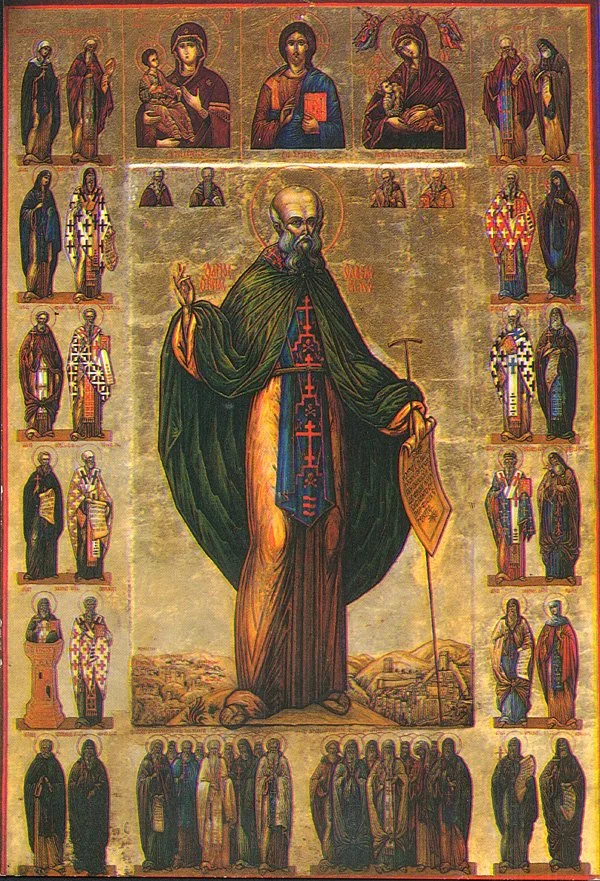
Saint Sabas is normally depicted as an elderly monastic father with a long beard and monastic garments, reflecting his life as one of the great desert elders of Palestine. The OCA notes a traditional iconographic scroll associated with him containing the teaching: “He who loves God disdains corruptible things, and prefers the knowledge of Him.”
That short teaching captures the central movement of his biography. The child surrounded by arguments concerning property became the elder who spent his life showing that knowledge of God surpasses possessions that eventually decay.
For a prayer card, imagery should therefore emphasize traditional monastic iconography rather than presenting Sabas as a Western abbot or bishop. His identity is inseparable from the Palestinian desert, Eastern monastic habit, spiritual fatherhood, and the ancient Lavra tradition.
PRAYERS
A simple traditional invocation may be prayed throughout the day: Venerable Father Sabas the Sanctified, pray to God for us. It is especially fitting before beginning a prayer rule, entering retreat, undertaking a fast, discerning monastic life, attempting to overcome a persistent temptation, or seeking the grace to remain faithful when spiritual enthusiasm has disappeared.
The Orthodox Church possesses established Troparion and Kontakion texts for Saint Sabas, and the OCA publishes his liturgical hymns for the December 5 commemoration. These hymns praise the desert life, ascetic labor, spiritual fruitfulness, and sanctity through which his wilderness became spiritually fertile.
Someone discerning monastic life can ask Saint Sabas for clarity and freedom from romantic expectations. Someone struggling with discipline can seek his prayers for perseverance, while a monk or priest can ask for humility sufficient to serve people without making leadership a source of pride.
A Christian experiencing constant distraction can also seek his intercession for greater interior stillness. Sabas' life demonstrates that silence becomes fruitful not when a person simply escapes noise, but when the heart learns to turn repeatedly toward God.
This prayer card is especially fitting beside a prayer rope, Psalter, Bible, Horologion, monastic rule, fasting calendar, icon corner, retreat journal, seminary books, or monastery cell. It can also make a meaningful gift for a monk, novice, abbot, priest, seminarian, retreatant, or Christian beginning a more serious life of prayer.
FAQ
Who was Saint Sabas the Sanctified? Saint Sabas the Sanctified was a fifth- and sixth-century Cappadocian monk, priest, hermit, spiritual father, and monastery founder who became one of the greatest figures of Palestinian monasticism. He lived from 439 to 532 and founded the Great Lavra now commonly called Mar Saba.
Is Saint Sabas also called Saint Sabbas? Yes, Sabas, Sabbas, Sava, and Savva are different English transliterations of forms of the same name. Searches for Saint Sabbas the Sanctified or Saint Savva the Sanctified therefore refer to the same fifth-century desert father.
When was Saint Sabas born? He was born in 439 in Moutalaski in Cappadocia, within what is now Turkey. His parents were Christians named John and Sophia, and his father served in the military.
When did Saint Sabas die? Saint Sabas reposed on December 5, 532, after more than seven decades of monastic life. He was approximately ninety-three years old.
When is Saint Sabas' feast day? His principal feast is December 5 in both Orthodox and Catholic calendars. The Orthodox Church in America and Vatican News both commemorate him on that date.
Where was Saint Sabas from? He was born in Cappadocia but spent the overwhelming majority of his monastic life in Palestine. His name became permanently associated with the Judean Desert and the Great Lavra he founded there.
How old was Saint Sabas when he entered a monastery? The OCA and Jerusalem Patriarchate place his entrance into the Monastery of Saint Flavian at approximately eight years old. He later received monastic tonsure while still a teenager.
Why did Saint Sabas become a monk so young? His early biography includes conflict among relatives over management of family property after his parents left for Alexandria. The young Sabas entered a monastery and ultimately remained committed to monastic life even when relatives later encouraged him to return and marry.
Was Saint Sabas a priest? Yes, Patriarch Sallustius of Jerusalem ordained him to the priesthood during the development of the Great Lavra. He therefore lived as both monk and priest, what Eastern Christianity calls a hieromonk.
Was Saint Sabas a bishop? No, Saint Sabas was not a bishop. His enormous ecclesiastical influence arose from his role as priest-monk, ascetic elder, monastery founder, and leader among Palestinian monastics.
Was Saint Sabas a hermit? Yes, periods of deep eremitical life were central to his spirituality. He spent years in caves and wilderness solitude, although disciples eventually gathered around him and transformed his solitary vocation into spiritual fatherhood.
Who was Saint Sabas' spiritual father? Saint Sabas was profoundly formed by Saint Euthymius the Great, who guided his development as an ascetic. Euthymius first sent the young Sabas to the cenobitic monastery of Saint Theoktistos so that he would learn obedience and common life before entering more severe solitude.
Did Saint Sabas know Saint Gerasimos of the Jordan? Sabas lived within the same wider Palestinian desert tradition and later settled in wilderness regions close to the monastic world associated with Saint Gerasimos. Their lives belong to the same remarkable period of fifth-century Palestinian monasticism.
Did Saint Sabas know Saint Theodosius the Cenobiarch? Yes, the Jerusalem tradition records an important spiritual relationship between them. Sabas became especially associated with anchoritic and Lavra monasticism, while Theodosius became one of the greatest organizers of cenobitic common life.
What is Mar Saba? Mar Saba is the common name for the Great Lavra of Saint Sabas the Sanctified, the famous monastery he founded in the Judean Desert. It remains an active monastery under the Greek Orthodox Patriarchate of Jerusalem.
When was Mar Saba founded? The Jerusalem Patriarchate places the beginning of the Lavra around 483, when approximately seventy anchorites had gathered around Saint Sabas. The community subsequently expanded and developed major churches and monastic structures.
Where is Mar Saba located? The monastery stands in the Judean Desert east of Bethlehem along the Kidron valley. Its dramatic complex is built into and above the desert ravine associated with Saint Sabas' hermitage.
Is Mar Saba still an active monastery? Yes, the Patriarchate of Jerusalem continues to identify it as a living monastic community and regularly celebrates liturgical observances there. Its uninterrupted or repeatedly restored monastic history stretches across more than fifteen centuries.
What is a lavra? A lavra historically refers to a monastic arrangement in which hermits or semi-eremitical monks live with significant solitude while gathering for common worship and remaining under spiritual authority. Saint Sabas became one of the great organizers of this model in Palestine.
How many monasteries did Saint Sabas found? The Jerusalem Patriarchate states that by the end of his life his monastic work included three Lavras and six cenobitic monasteries. His influence therefore extended far beyond the monastery that carries his name today.
What is Saint Sabas the patron saint of? There is no need to invent one narrow modern patronage category because his biography provides exceptionally strong devotional associations. He is especially meaningful for monks, monastic vocations, hermits, monastery founders, abbots, spiritual fathers, prayer, fasting, obedience, discipline, and perseverance.
Is Saint Sabas a patron saint of monks? He is one of the strongest historical saints for monastic life because virtually his entire life was devoted to monastic formation, solitude, founding monasteries, guiding monks, and organizing worship. Calling him a major monastic patron or intercessor is therefore firmly grounded in his biography.
Can someone discerning monastic life pray to Saint Sabas? Yes, he is one of the most appropriate saints for a man discerning a monastery vocation. His life can be invoked especially for discernment, obedience, perseverance, and freedom from romantic ideas about what monastic life actually requires.
Can monks pray to Saint Sabas? Yes, devotion to Saint Sabas has remained especially strong within Eastern monasticism. His own Lavra continues venerating him as its founder and spiritual father.
Can abbots pray to Saint Sabas? Yes, Sabas spent decades guiding monks and establishing communities, and he knew both the blessings and conflicts of spiritual leadership. His intercession is especially fitting for superiors seeking wisdom, patience, discernment, and humility.
Is Saint Sabas good for someone struggling with obedience? Yes, obedience was central to his own formation under Theoktistos and Euthymius. His willingness to accept a slower and more communal path than the one he originally wanted provides a strong model for learning to surrender self-will.
Is Saint Sabas good for someone struggling to pray consistently? Yes, ordered prayer became one of the defining features of his monastic legacy. His Lavra's liturgical tradition eventually influenced the prayer structure of monasteries and churches throughout the Orthodox world.
Can I pray to Saint Sabas for help with fasting? Yes, fasting occupied a major place throughout his ascetic life. His example is especially appropriate when asking for discipline, humility, perseverance, and the wisdom to fast in a way that actually leads toward God.
Is there an apple story about Saint Sabas? Yes, Western devotional tradition remembers him resisting the desire to eat an apple outside the proper time and using the experience as an exercise in self-mastery. The point of the story is discipline over appetite rather than anything negative about apples themselves.
Can someone struggling with temptation pray to Saint Sabas? Yes, his long ascetical life and desert spirituality give him a strong devotional association with spiritual warfare and perseverance against temptation. His example emphasizes repeated discipline rather than dependence upon momentary enthusiasm.
Did Saint Sabas perform miracles? Church tradition attributes numerous miracles to his prayers, including healings, deliverance from demonic affliction, provision of water, and rain during drought. These accounts form part of his established Orthodox hagiographic tradition.
Can I pray to Saint Sabas for healing? Yes, healing is specifically included among miracles associated with his intercession in Orthodox tradition. He should not be artificially presented as the exclusive patron saint of a particular disease, but prayer for healing is well grounded in his Life.
Can I pray to Saint Sabas during drought? Yes, both water in the desert and rain during drought are associated with his prayers. These traditions provide a genuine devotional reason to seek his intercession during water shortages or agricultural hardship.
Was Saint Sabas involved in theological controversy? Yes, despite his identity as a desert monk, he became actively involved in defending the Chalcedonian faith during major Christological controversies. He even traveled to Constantinople and appealed directly to emperors concerning the Church and Palestine.
Did Saint Sabas meet Emperor Anastasius? The Jerusalem Patriarchate records his journey to Constantinople in 512, where he appealed to Emperor Anastasius during the controversy surrounding the Orthodox Patriarchate of Jerusalem.
Did Saint Sabas meet Emperor Justinian? Yes, the Jerusalem Patriarchate records a second journey to Constantinople in 530, when Sabas was approximately ninety years old, during which he appealed to Justinian concerning Palestine.
What did Saint Sabas teach about possessions? The OCA associates him iconographically with the teaching that love of God leads a person to prefer knowledge of Him over corruptible things. His entire life, beginning with family conflict over property and ending in radical monastic poverty, strongly reinforces that theme.
What is the Jerusalem Typikon? The Jerusalem Typikon is the liturgical and monastic order associated with the Palestinian monasteries and especially the tradition of Saint Sabas' Lavra. Over centuries it developed and spread widely, ultimately exercising profound influence upon Orthodox worship.
Did Saint Sabas personally write the exact Orthodox Typikon used today? No, that would oversimplify a long historical development. Sabas is foundational to the Jerusalem monastic rule, but the liturgical Typikon continued developing, interacting with other traditions, and being revised over subsequent centuries.
Did Saint Sabas influence Orthodox worship today? Yes, enormously. The Patriarchate of Jerusalem traces the later spread of the Savvaite liturgical order through Byzantium, Mount Athos, Serbia, Bulgaria, Russia, and eventually the wider Orthodox world.
Is Saint Sabas connected with Saint John of Damascus? Yes, although they lived centuries apart. Saint John of Damascus later became a monk at Mar Saba, and the Jerusalem Patriarchate preserves his hermitage there and identifies the Lavra as an important setting for his theological work.
Is Saint Sabas connected with the Three-Handed Theotokos icon? Yes, Orthodox tradition says Saint John of Damascus gave the Three-Handed icon to the Lavra of Saint Sabas. It later became connected with Saint Sava of Serbia and Hilandar Monastery on Mount Athos.
Is Saint Sabas the same person as Saint Sava of Serbia? No, they are completely different saints separated by many centuries. Saint Sabas the Sanctified lived from 439 to 532 in Palestine, while Saint Sava of Serbia was a medieval Serbian archbishop who later had a strong devotional connection with Sabas' Lavra.
Did Saint Sava of Serbia visit Mar Saba? Yes, Orthodox tradition records his pilgrimage to the Lavra and links him with relics, icons, and the monastic heritage preserved there. The Jerusalem Typikon later became deeply influential within Serbian Church life.
Where are Saint Sabas' relics? His principal relics are preserved today in the Great Lavra of Saint Sabas in the Judean Desert. The Patriarchate of Jerusalem identifies the relic as being kept in the monastery's main church.
Are Saint Sabas' relics incorrupt? The Patriarchate of Jerusalem describes his relic as incorrupt and intact and continues publicly venerating it within the Lavra. This description belongs to the official devotional tradition of the Church of Jerusalem.
Were Saint Sabas' relics once in Venice? Yes, the relics were taken westward during the Crusading period and remained in Venice for centuries. In 1965 the Roman Catholic Church returned them to the Patriarchate of Jerusalem.
When were Saint Sabas' relics returned to Jerusalem? They were returned in October 1965. After being received in Jerusalem, they were exposed for veneration at the Church of the Holy Sepulchre before returning permanently to Mar Saba.
Is there a feast for the return of Saint Sabas' relics? Yes, the Patriarchate of Jerusalem commemorates the return on October 13/26, reflecting the Julian and Gregorian calendar dates used in the observance.
Is Saint Sabas Orthodox? Yes, he is one of the great monastic saints of Eastern Orthodoxy and is particularly important within the Patriarchate of Jerusalem. His monastery and relics remain under Orthodox guardianship today.
Is Saint Sabas a Catholic saint? Yes, because Sabas lived centuries before the East-West schism and remains recognized within Catholic tradition. Vatican News lists Saint Sabas the Abbot among the saints commemorated on December 5.
Can Eastern Catholics venerate Saint Sabas? Yes, absolutely. Saint Sabas belongs to the common pre-schism Christian inheritance, and his Lavra's liturgical tradition profoundly influenced the Byzantine worship inherited by Eastern Orthodox and Byzantine Catholic Christians.
Is Saint Sabas especially important to Byzantine Catholics? Yes, particularly because of the Savvaite contribution to the Byzantine liturgical tradition. Melkite, Ruthenian, Ukrainian, and other Byzantine Catholics pray within a tradition historically shaped in part by the Palestinian monastic world associated with Saint Sabas.
Can I give this card to a monk? Yes, Saint Sabas is one of the most appropriate saints possible for a monk. It can make a meaningful gift for monastery entrance, tonsure, profession, an anniversary of monastic vows, or simple encouragement during a difficult season.
Can I give this card to someone considering becoming a monk? Yes, because Sabas' life provides both inspiration and realism about monastic vocation. His path included beauty and deep prayer, but also obedience, manual work, conflict, fasting, responsibility, and decades of perseverance.
Can I give this card to an abbot? Yes, especially because Saint Sabas guided monks and founded multiple communities. His intercession can be sought for wisdom, patience, spiritual discernment, courage, and humility in leadership.
Can I give this card to a priest? Yes, Saint Sabas was himself ordained to the priesthood while remaining a monk. His example is especially appropriate for priests drawn toward ascetical prayer, spiritual direction, or monastic spirituality.
Can I give this card to someone going on retreat? Yes, Sabas' life is strongly connected with withdrawing from distraction in order to seek God more intensely. His card can serve as a reminder that retreat should lead back into ordinary life with greater prayer, clarity, and charity.
Can I give this card to someone trying to simplify their life? Yes, detachment from possessions is one of the strongest themes running through his biography. His early experience of relatives fighting over property and his later radical monastic poverty create a powerful contrast between material possession and spiritual freedom.
Can Saint Sabas help someone who is easily distracted in prayer? His entire monastic tradition was built around attention, silence, fasting, psalmody, and ordered prayer. Seeking his intercession can accompany the practical work of reducing distractions and patiently returning the mind toward God.
What does Saint Sabas teach about obedience? His life teaches that spiritual maturity often begins by accepting guidance that is not what we originally wanted. When Saint Euthymius refused to let the young Sabas immediately enter the severe anchoritic life, Sabas obeyed and spent years receiving the formation he actually needed.
What does Saint Sabas teach about solitude? He demonstrates that true solitude is not isolation from the Church or indifference toward other people. His own search for silence eventually produced communities, spiritual children, public responsibility, and service to the wider Church.
What does Saint Sabas teach about discipline? His life shows discipline as repeated freedom rather than punishment. Fasting, prayer, vigils, simplicity, work, and restraint trained the will so that temporary desires would not continually determine what he did.
What does Saint Sabas teach about leadership? His biography shows that Christian leaders may be misunderstood even by people they serve. Authority becomes trustworthy when it grows from prayer, sacrifice, tested character, and willingness to continue loving people even through conflict.
What does Saint Sabas teach about old age? Sabas remained spiritually and practically active into his nineties, even traveling to Constantinople on behalf of Palestine. His life shows that old age can become a period of deep spiritual fruitfulness rather than merely decline.
What does Saint Sabas teach about prayer? His life demonstrates that prayer becomes strongest when it is no longer dependent upon convenience or emotion. The ordered spiritual world that developed around his Lavra shows how consistent prayer can eventually shape individuals, communities, and even centuries of Christian worship.
What is the main message of Saint Sabas the Sanctified's life? Saint Sabas' life teaches that a person who gives himself steadily to God can become spiritually fruitful far beyond anything he originally intended. A child who fled family conflict entered a monastery, learned obedience before solitude, became a disciple of Saint Euthymius, withdrew into the Judean wilderness, attracted disciples despite seeking silence, founded monasteries, survived opposition from his own monks, defended the faith before emperors, helped shape the prayer life of Eastern Christianity, and left behind a Lavra that still prays more than fifteen centuries later. His life is a powerful reminder that holiness is rarely produced by one dramatic decision because it grows through thousands of acts of prayer, obedience, self-denial, repentance, courage, and perseverance repeated faithfully across an entire lifetime.
Saint Sabas the Sanctified, also known as Saint Sabbas the Sanctified, Saint Savva the Sanctified, or Saint Sava the Sanctified, was one of the greatest monastic fathers of the Christian East. Born in Cappadocia in 439, he entered monastic life while still a child, became a disciple of Saint Euthymius the Great, spent decades in the Judean wilderness, founded the monastery now known throughout the world as Mar Saba or the Great Lavra of Saint Sabas, organized communities of monks throughout Palestine, defended the Orthodox confession of Christ during severe theological conflict, and helped establish a liturgical and monastic tradition that eventually influenced worship across the Orthodox world. He reposed in 532, after more than seventy years of monastic life.
Saint Sabas is especially meaningful for monks, novices, men discerning monastic life, monastery founders, abbots, spiritual fathers, people trying to establish a disciplined prayer rule, Christians struggling with distractions, those seeking greater simplicity, people learning obedience, hermits and contemplatives, Christians facing temptation, and anyone who feels called to withdraw from unnecessary noise in order to seek God more seriously. These associations arise directly from his life because Sabas spent nearly his entire earthly existence pursuing prayer, fasting, silence, obedience, spiritual fatherhood, liturgical worship, community leadership, and the difficult balance between solitude and responsibility for others.
His connection with ordered prayer and liturgical discipline is especially strong. The Orthodox Church in America credits Saint Sabas with establishing the early Jerusalem monastic rule of church services, while the Patriarchate of Jerusalem explains that the liturgical tradition of his Lavra became a model for monasteries far beyond Palestine and eventually contributed to the form of the Typikon used throughout much of the Orthodox world.
Saint Sabas is also a powerful saint for someone who wants solitude but discovers that God keeps placing other people in need of help around them. Sabas repeatedly withdrew into the desert seeking quiet prayer, yet disciples gathered around him, bishops depended upon him, monasteries needed organization, theological controversies required his intervention, and even emperors eventually received petitions from the elderly monk. His life therefore shows that Christian solitude is not escape from love, because genuine prayer can eventually make a person more capable of carrying responsibility for others.
This prayer card is especially fitting for monks, novices, men discerning a monastery vocation, seminarians, priests, retreatants, Christians beginning a serious prayer rule, people struggling to remain faithful to fasting or spiritual disciplines, people seeking freedom from excessive possessions, and anyone drawn to the spirituality of the Judean Desert. It can also make a meaningful monastery entrance, tonsure, profession, ordination, retreat, spiritual-direction, baptism, chrismation, name-day, or feast-day gift.
Each card is handmade in Austin, TX and created to order. We do not keep stock, because every prayer card is treated as a unique devotional offering. They are printed on museum-quality photo paper, not cardstock, and every card is made slowly during prayer with intentional reverence for the saint and for the person who will receive it. Names are lifted before Christ, intentions are held carefully, and each piece is handled multiple times in prayerful silence, asking God for mercy and asking Saint Sabas the Sanctified to intercede for the soul it is being made for. This is devotional craftsmanship shaped with patience, care, and spiritual responsibility because every soul and every prayer matters.
THE LIFE & STORY
Saint Sabas was born in 439 in Moutalaski in Cappadocia, within the territory of modern Turkey. His parents, John and Sophia, were devout Christians, and his father served in the military. When military responsibilities required his parents to travel to Alexandria, the young Sabas was left in the care of relatives while still only about five years old.
Disputes soon developed among relatives over the management of the family's property. Rather than allowing inheritance, family conflict, or wealth to determine his future, Sabas eventually left the situation behind and entered the nearby Monastery of Saint Flavian when he was approximately eight years old. The boy who had been surrounded by arguments over possessions chose a life that would become increasingly defined by having almost nothing.
That contrast became one of the central movements of his life. Sabas began surrounded by property significant enough for relatives to quarrel over, yet he became one of Christianity's great teachers of detachment, simplicity, fasting, and the conviction that knowledge of God is more valuable than corruptible possessions.
ENTERING THE MONASTERY AS A CHILD
At the Monastery of Saint Flavian, the young Sabas learned the Psalter, Scripture, the services of the Church, obedience, manual work, and the disciplines of monastic life. The Patriarchate of Jerusalem remembers him becoming distinguished among the monks through sobriety, humility, bodily discipline, and obedience, while the OCA says that he quickly learned to read and became deeply knowledgeable in Holy Scripture.
His relatives later attempted to persuade him to return to ordinary life and marry, but Sabas remained committed to the monastery. By approximately seventeen years of age, he had formally received monastic tonsure and had already spent much of his childhood learning to organize daily life around prayer rather than around the expectations that had originally surrounded him.
Sabas' childhood vocation should not be turned into a general rule suggesting that children ought to make irreversible religious decisions without discernment. His story instead belongs to the particular world of late antique monasticism and demonstrates the unusual consistency of a vocation that appeared extremely early and remained unchanged for more than seven decades.
A SAINT FOR PEOPLE SURROUNDED BY FAMILY CONFLICT
The beginning of Sabas' story included something remarkably ordinary: relatives arguing about property and responsibility. The future desert father did not grow up in a perfectly peaceful household where every adult relationship automatically reflected Christian harmony.
This gives his biography relevance for people who find that family conflict, money, inheritance, or disagreements among relatives are beginning to dominate their attention. Sabas' solution cannot simply be copied literally by abandoning one's responsibilities, but his life presents a powerful contrast between possessing things and allowing things to possess the heart.
His card can therefore serve as a reminder to Christians asking for the grace not to allow money, inheritance, status, or family conflict to become spiritually larger than God. Sabas spent the remainder of his life demonstrating that freedom can sometimes begin when a person recognizes how little of what people fight over can actually be carried into eternity.
HIS FIRST MIRACLES
The Jerusalem Patriarchate preserves a story from Sabas' youth in which clothing was accidentally left inside a dangerously hot oven. Sabas made the sign of the Cross, entered the furnace, recovered the clothing, and emerged unharmed, an event remembered within his hagiographic tradition as an early indication of the extraordinary faith associated with his later life.
As with many ancient saints' Lives, individual miraculous episodes should be presented as part of the Church's received hagiographic tradition rather than rewritten as though modern historical documentation exists for every detail. What is unmistakable is that devotion to Sabas very early became connected with the conviction that his radical trust in God bore extraordinary spiritual fruit.
Later accounts associate his prayers with water appearing in the desert, rain during drought, healings of the sick, and deliverance from demonic affliction. These traditions make healing and God's provision genuine parts of devotion to Saint Sabas without requiring the invention of a narrow modern patronage title.
LEAVING CAPPADOCIA FOR JERUSALEM
After roughly ten years at his first monastery, Sabas received permission to travel to the Holy Land. He arrived in Jerusalem during the winter of 456 to 457, when he was still only about eighteen years old, but he was already searching for a more demanding form of monastic and eremitical life.
Jerusalem placed Sabas within the sacred geography of Christ's earthly ministry, Passion, Resurrection, and Ascension, yet he was not drawn only toward the crowded holy places of pilgrimage. His attention moved toward the wilderness surrounding Jerusalem, Jericho, the Jordan Valley, and the Dead Sea, where some of the greatest Palestinian ascetics of the fifth century had established communities devoted to prayer.
This movement became permanent. The Cappadocian child who had left his relatives' dispute would spend the great majority of his remaining life among the caves, ravines, cliffs, monasteries, and deserts of Palestine.
SAINT EUTHYMIUS THE GREAT
Sabas wanted to become a disciple of Saint Euthymius the Great, already one of the most respected monastic fathers of Palestine. Euthymius, however, considered Sabas too young for the severe life of his Lavra and sent him instead to the nearby cenobitic monastery under Abba Theoktistos, where monks lived a more structured common life.
This became an important lesson in obedience. Sabas had arrived knowing what kind of spiritual life he wanted, but his desired elder told him that he was not yet ready for it. Instead of deciding that his own spiritual preference was more enlightened than the judgment of an experienced elder, he accepted the direction he was given.
His life therefore provides an important example for people who are attracted to advanced ascetic practices before learning ordinary faithfulness. Sabas reached extraordinary solitude only after years of common prayer, service, obedience, manual work, fasting, and learning how to live peacefully with other people.
OBEDIENCE BEFORE SOLITUDE
Saint Sabas remained under the discipline of the monastery associated with Saint Theoktistos until approximately the age of thirty. The OCA emphasizes that he lived there in obedience, while the Jerusalem Patriarchate describes his life as combining fasting and vigil with practical ministry and service to his fellow monks.
This sequence matters because Christian solitude can be romanticized. The desert appears peaceful when viewed from a distance, but a person who cannot practice patience, humility, work, forgiveness, or obedience around other people may simply carry the same interior disorder into a quieter location.
Sabas' formation therefore moved through community before deeper solitude. His later authority as a guide to hermits rested upon years in which he had first learned how to submit his own will within a common life.
THE CAVE & THE BEGINNING OF HESYCHIA
After receiving permission for greater solitude, Sabas began living in a cave near the monastery. For five years he devoted himself increasingly to prayer and manual work, returning to the community on weekends for the Church's common worship and fellowship with the brethren.
The Jerusalem account describes him fasting through much of the week while producing handicrafts that he brought back to the monastery. His solitude therefore did not mean inactivity because prayer, work, fasting, and sacramental communion remained integrated within a disciplined rhythm of life.
This period makes Saint Sabas particularly meaningful for Christians seeking hesychia, the spiritual stillness cultivated within Eastern Christian ascetic tradition. Silence in this sense does not merely mean absence of sound, because its deeper purpose is the gathering of the scattered human person before God.
GREAT LENT IN THE WILDERNESS
Saint Euthymius eventually recognized Sabas' growing maturity and took him into the Rouba wilderness during periods of especially severe ascetic practice. The OCA records that they would enter the wilderness in January and remain there until Palm Sunday, while the Jerusalem Patriarchate describes fasting, vigils, scarcity of water, and continuous prayer during these desert periods.
Euthymius affectionately referred to Sabas as a “Child-Elder,” recognizing spiritual maturity in a man who was still young compared with the famous ascetics around him. The title does not mean Sabas had nothing left to learn, because Euthymius continued guiding him and encouraging growth in monastic virtue.
For modern Christians, these extreme ascetical practices should not be imitated without spiritual guidance. Their significance lies in the seriousness with which the desert fathers treated conversion, believing that attention, appetite, sleep, comfort, and self-will could all require training if the heart was to become increasingly free for God.
AFTER THE DEATH OF SAINT EUTHYMIUS
Saint Euthymius died in 473, removing one of the most important spiritual fathers from Sabas' life. Instead of immediately attempting to replace him by assuming authority over others, Sabas withdrew farther into the wilderness and entered a more solitary period of ascetic life.
He lived in regions associated with other great desert saints, including the wider spiritual world of Saint Gerasimos of the Jordan, and developed connections with monks who would help shape Palestinian monasticism. The Jerusalem Patriarchate also describes a spiritual bond between Sabas and Saint Theodosius the Cenobiarch, another foundational monastic leader of the region.
Sabas and Theodosius eventually represented complementary forms of monastic life. Sabas became particularly associated with anchorites and lavra life, while Theodosius became celebrated for the cenobitic tradition in which monks lived a closely organized common life.
HIS HERMITAGE IN THE KIDRON VALLEY
The Patriarchate of Jerusalem remembers Sabas eventually settling in a cave overlooking the Kidron valley, opposite the location where his famous Lavra would develop. The landscape is severe and dramatic, consisting of barren cliffs and ravines descending through the Judean wilderness toward the Dead Sea.
Sabas sought solitude there, but the reputation of his holiness began attracting other ascetics. By 483, approximately seventy hermits had gathered around him, creating the nucleus from which the Great Lavra would grow.
This is one of the great paradoxes of his life. The man who repeatedly went into the wilderness to be alone with God eventually became responsible for one of the most important monastic communities in Christian history.
THE FOUNDING OF MAR SABA
As disciples increased, the community required a place for common worship. Both the OCA and the Patriarchate of Jerusalem preserve a tradition that Sabas saw a pillar of fire indicating a cave naturally shaped in a way suitable for use as a church, and that cave became an early liturgical center of the developing Lavra.
The community that developed there became known as the Great Lavra of Saint Sabas, commonly called Mar Saba. The Patriarchate of Jerusalem dates the nucleus of the Lavra to 483 and describes it as one of the most important monasteries of the Judean Desert, with a history extending across more than fifteen centuries.
The monastery still stands in the wilderness east of Bethlehem. Its buildings cling dramatically to the walls of the Kidron valley, preserving the physical landscape in which Sabas and generations of monks sought God through prayer, fasting, liturgy, Scripture, silence, and ascetic discipline.
WHAT IS A LAVRA?
A lavra is a form of monastic community historically associated with hermits or semi-eremitical monks who live in individual cells or caves while gathering regularly for common worship and certain aspects of shared life. This allowed a greater degree of solitude than a fully cenobitic monastery while preserving obedience, liturgical communion, and connection with a spiritual father.
Saint Sabas became one of the greatest organizers of this form of Palestinian monasticism. His own formation explains why, because he had experienced both rigorous cenobitic life under Theoktistos and deep solitude under the guidance of Euthymius.
His Lavra therefore attempted to preserve something difficult: genuine solitude without spiritual independence. The hermit could withdraw from ordinary social life while remaining inside the sacramental and obedient life of the Church.
WHEN HIS OWN MONKS TURNED AGAINST HIM
Not every monk accepted Sabas' leadership peacefully. The Patriarchate of Jerusalem records that some monks despised and slandered him, eventually approaching Patriarch Sallustius and asking that Sabas be removed as their leader.
The patriarch responded very differently from what Sabas' opponents expected. Rather than removing him, Sallustius recognized his holiness, ordained him to the priesthood, and supported the development of the community's church.
This episode makes Saint Sabas especially meaningful for spiritual leaders, abbots, pastors, ministry leaders, and people who have been criticized by those they are trying to serve. Leadership within the Church does not guarantee gratitude, and sometimes a person can be attacked precisely by people for whom enormous sacrifices have already been made.
A SAINT FOR PEOPLE WHO HAVE BEEN SLANDERED
Sabas' experience demonstrates that a holy reputation does not prevent false accusation or internal opposition. He could survive the wilderness, hunger, and severe ascetic discipline, yet some of his most painful trials came from human beings living within his own community.
This gives his card a natural devotional use for people dealing with slander, unjust criticism, leadership conflict, or rejection by a community they have tried to serve. The goal of prayer in such circumstances is not merely vindication, because Christian leadership also requires examination of one's own heart, patience, forgiveness, and refusal to let resentment become the new master.
Sabas continued serving despite these conflicts. His long-term legacy demonstrates that temporary rejection by some people does not necessarily determine the value of a vocation.
ORDAINED TO THE PRIESTHOOD
Patriarch Sallustius ordained Sabas to the priesthood around 491, after decades of monastic formation. Sabas therefore became a hieromonk, a monk who is also a priest, and his pastoral responsibility increasingly extended beyond his own personal ascetic life.
His priesthood did not replace his identity as a monk. Instead, the sacramental ministry of the priest became integrated with the desert vocation he had already been living for decades.
A Saint Sabas prayer card can therefore be particularly meaningful for monastic priests and men preparing for priestly ordination within a monastery. His life shows the priesthood functioning not as an escape from ascetic discipline but as a deeper responsibility emerging from it.
LEADER OF THE DESERT MONKS
The Patriarchate of Jerusalem records that by 493, Sabas had been recognized as a leader and legislator among the anchorites surrounding Jerusalem. His authority increasingly extended across numerous communities rather than remaining limited to the original Great Lavra.
This is remarkable because Sabas never set out as a young man seeking ecclesiastical influence. His authority developed through decades of visible ascetic life, practical wisdom, endurance, prayer, and the trust other people gradually placed in him.
Christian authority therefore appears in his life as the consequence of service and tested character rather than personal ambition. He became capable of guiding many because he had spent years first learning to govern himself.
FOUNDER OF MULTIPLE MONASTERIES
Saint Sabas did not found only one monastery. The Patriarchate of Jerusalem credits him by the end of his life with three Lavras and six cenobitic monasteries, while its detailed biography describes additional communities founded as the Palestinian monastic movement expanded around him.
His gift therefore included more than solitary prayer. Sabas possessed the practical capacity to organize communities, establish rules, identify spiritual leaders, manage conflict, and create structures capable of continuing after his death.
This makes him particularly fitting for monastery founders, abbots, priors, superiors, and Christians responsible for building spiritual communities from the beginning. Founding a religious community requires vision, but Sabas' life demonstrates that vision must eventually become rule, worship, buildings, leadership, discipline, and a sustainable common life.
THE JERUSALEM TYPIKON
One of Saint Sabas' greatest legacies is his association with the Jerusalem or Savvaite Typikon, the rule governing the organization of monastic services and aspects of liturgical life. The OCA describes Sabas as composing the first monastic rule of Church services used throughout the Palestinian monasteries, while the Jerusalem Patriarchate emphasizes how the Lavra's liturgical order later spread far beyond Palestine.
The exact historical development of the Typikon occurred over centuries, so it would be too simple to imagine the entire modern Orthodox service book being written personally by Sabas in its present form. His monastery nevertheless became one of the decisive centers through which the Jerusalem liturgical tradition developed, matured, and spread.
Eventually Savvaite and Studite traditions interacted, and the resulting liturgical order spread through Constantinople, Mount Athos, Serbia, Bulgaria, Russia, and other parts of the Orthodox world. The Patriarchate of Jerusalem states that the Savvaite-Athonite form eventually became the dominant liturgical Typikon throughout Orthodoxy.
WHY SAINT SABAS MATTERS EVERY TIME THE CHURCH PRAYS
Most Orthodox Christians will never become monks at Mar Saba, yet the monastery's influence reaches into parish worship far beyond the Judean Desert. The sequence, structure, hymnography, fasting environment, and liturgical rhythms inherited through the Jerusalem tradition were profoundly affected by the monastic world formed around Saint Sabas.
His legacy therefore appears whenever Eastern Christians experience worship as something larger than individual preference. The liturgical day has an inherited architecture, and generations of monks prayed, preserved, copied, revised, and transmitted the services long before modern Christians opened a printed service book or liturgical app.
A Saint Sabas card can therefore be meaningful not only for monks but for cantors, readers, clergy, liturgical students, and people who love the structure of Byzantine worship. The saint's desert community helped preserve the ordered prayer through which countless Christians would later learn to pray.
SAINT SABAS & SAINT THEODOSIUS THE CENOBIARCH
Saint Sabas developed a close spiritual relationship with Saint Theodosius the Cenobiarch, another major founder of Palestinian monasticism. The two represented complementary forms of the monastic vocation, with Sabas especially associated with anchoritic and lavra life and Theodosius with the fully communal cenobitic tradition.
Their relationship matters because different forms of Christian asceticism do not need to compete. The hermit and the community monk pursue the same Christ through different structures of obedience, prayer, work, and fellowship.
For Christians collecting cards connected with the Desert Fathers and Palestinian monasticism, Saint Sabas and Saint Theodosius naturally belong together. Their lives help explain how the Judean Desert became one of the great centers of Christian monastic civilization.
DEFENDING THE FAITH
Saint Sabas was not isolated from the great Christological controversies of his age. During the reign of Emperor Anastasius I, conflict surrounding the Council of Chalcedon and Monophysite or anti-Chalcedonian movements placed severe pressure upon Eastern bishops and patriarchates.
The Patriarchate of Jerusalem remembers Sabas becoming an important defender of the Chalcedonian Orthodox position. At the request of Patriarch Elijah of Jerusalem, he traveled to Constantinople in 512, despite already being an elderly monk, and intervened with the emperor in defense of the Jerusalem patriarch and the faith professed by the Palestinian monastic community.
His story therefore challenges the stereotype that contemplation means refusing every public responsibility. Sabas spent decades seeking silence, yet when the Church required public courage, the old hermit left the desert and went to the imperial court.
THE DESERT MONKS ENTER JERUSALEM
When pressure upon the Orthodox leadership in Jerusalem intensified, Sabas helped gather the desert monks in defense of the Church's confession. The Jerusalem Patriarchate presents both Sabas and Saint Theodosius as important leaders in preserving the Chalcedonian position within the Patriarchate of Jerusalem during a period of severe ecclesiastical conflict.
This moment shows why the desert fathers cannot be reduced to private mystics uninterested in doctrine. Their asceticism was deeply theological because the identity of Christ determined what salvation, worship, sacramental life, and the transformation of humanity actually meant.
Saint Sabas can therefore be especially meaningful for Christians trying to hold together prayer and doctrinal fidelity. In his life, contemplation did not make theology less important because deeper prayer increased the seriousness with which truth about Christ was treated.
HIS FIRST JOURNEY TO CONSTANTINOPLE
The contrast between Mar Saba and Constantinople could hardly have been greater. Sabas moved from a remote desert landscape into the political and ecclesiastical center of the Eastern Roman Empire, where bishops, officials, imperial advisers, and the emperor himself were involved in struggles affecting the Church.
The old monk did not possess military force or political office. His influence came largely from the reputation of holiness built through a lifetime that made powerful people willing to hear him.
His journey demonstrates a distinctly Christian understanding of influence. Sabas became persuasive in the imperial capital precisely because everyone knew that he had spent his life seeking something other than imperial favor.
AN ELDER WHO COULD SPEAK TO EMPERORS
Saint Sabas returned to Constantinople a second time in 530, when he was approximately ninety years old. According to the Patriarchate of Jerusalem, he appealed to Emperor Justinian concerning harsh measures being considered against Palestine after serious unrest involving Samaritan revolts.
The elderly monk also requested support for the Church and the Holy Land. His final years therefore included diplomatic and pastoral responsibilities that would have been impossible to predict when he first disappeared into the desert seeking solitude.
This makes Sabas a compelling saint for older Christians who wonder whether their useful service to God is finished. At an age when many people would have expected complete withdrawal, Sabas was still traveling enormous distances and carrying the needs of communities before the most powerful ruler in his world.
A SAINT FOR OLD AGE & CONTINUING VOCATION
Sabas lived into his early nineties, an extraordinary lifespan for the sixth century, especially considering the severity of the ascetic practices attributed to him. His last decades were not simply a prolonged retirement because he continued overseeing monasteries, guiding disciples, defending doctrine, responding to crises, and undertaking demanding journeys.
His example can therefore be particularly meaningful for older Christians who fear that age has made them spiritually unnecessary. Physical capacity changes, but prayer, wisdom, counsel, intercession, memory, and tested faith can become increasingly important precisely when younger people need someone who has already survived decades of struggle.
The elderly Sabas could offer something the young Sabas could not: a lifetime of tested fidelity. Christian vocation can change form without disappearing.
THE MIRACULOUS SPRING
The OCA and Jerusalem traditions preserve an account of water appearing for the developing monastic community through Sabas' prayers. In a desert environment where water determines whether human settlement is even possible, such a tradition carries obvious spiritual and practical significance.
The story makes Saint Sabas a meaningful intercessor when communities face material need, drought, lack of resources, or seemingly impossible practical obstacles. It would be inaccurate to manufacture a formal modern title such as patron saint of water shortages, but provision in the wilderness is genuinely part of his received hagiography.
The deeper symbolism is equally fitting. Sabas sought God in an environment that looked empty and barren, yet the monastery that grew there became spiritually fertile enough to influence Christians for more than fifteen centuries.
PRAYER FOR RAIN
The OCA also remembers abundant rain during a drought among miracles attributed to Saint Sabas' prayers. The Jerusalem tradition similarly connects him with the ending of an extended drought in Palestine.
Christians facing drought or agricultural hardship can therefore reasonably seek his intercession. Such prayer does not turn a saint into a mechanism for controlling weather, because Christian intercession remains a request made humbly before God's providence rather than a spiritual guarantee.
For farmers, communities experiencing drought, and people whose livelihoods depend upon rain, Sabas' biography offers an ancient connection between desert prayer and dependence upon God for the necessities of life.
HEALINGS & DELIVERANCE
The OCA records traditions of healing the sick and deliverance of people afflicted by demons through Saint Sabas' prayers. These accounts fit the wider hagiographic portrait of a man whose decades of prayer were believed to have produced extraordinary spiritual authority.
This means Christians may certainly ask Saint Sabas to intercede for illness, spiritual oppression, temptation, and healing. It remains more historically accurate to describe these as genuine devotional associations than to create a modern claim that he is the exclusive patron of a specific disease.
His strongest spiritual identity remains monastic and ascetical, but healing is nevertheless part of the Church's memory of his life.
SAINT SABAS & TEMPTATION
Desert spirituality repeatedly confronts the reality of temptation. When external distractions are reduced, the monk often discovers that thoughts, desires, memories, pride, anger, appetite, fear, and self-will remain very active inside the heart.
Sabas' decades of fasting, prayer, solitude, obedience, and vigilance make him a natural intercessor for Christians struggling against persistent temptations. His life suggests that victory rarely comes through one dramatic moment because spiritual freedom is cultivated through repeated choices made faithfully over long periods.
This makes his card particularly fitting beside a prayer rule, fasting calendar, Bible, or prayer rope. The goal is not to become fascinated with temptation but to remember that habits can be retrained when the heart repeatedly turns toward God.
THE APPLE TRADITION
Western devotional tradition preserves a memorable story in which Sabas desired to eat an apple outside the appropriate time, recognized the power of the temptation, and chose to abstain rather than allow appetite to command him. Catholic sources have continued repeating the story as an illustration of his ascetic self-discipline.
The point is not that apples are spiritually dangerous. The story concerns the freedom to say no even to something harmless when desire itself begins behaving like a master.
This makes Sabas especially meaningful for Christians practicing fasting or trying to regain discipline around food, comfort, entertainment, technology, or another ordinary good that has become difficult to refuse. Asceticism does not require declaring created things evil because it trains the human will to enjoy good things without becoming enslaved to them.
A SAINT FOR FASTING
Fasting appears throughout Sabas' biography, beginning in his youth and continuing through the severe disciplines of the Judean wilderness. His Great Lent retreats with Saint Euthymius and his later solitary practices demonstrate how seriously Palestinian monasticism treated fasting as part of spiritual warfare and prayer.
Modern Christians should not imitate extreme historical fasts without appropriate pastoral and medical discernment. The useful lesson is instead that fasting becomes spiritually meaningful when joined to prayer, humility, obedience, repentance, charity, and the refusal to make personal achievement the center of attention.
Saint Sabas can therefore be especially meaningful at the beginning of Great Lent, the Nativity Fast, or another period of disciplined abstinence. His life reminds the Christian that fasting is meant to create freedom for God rather than pride about one's own endurance.
A SAINT FOR PEOPLE WHO NEED A PRAYER RULE
One of Sabas' greatest historical legacies concerns the ordering of worship. His monastery became a center from which disciplined patterns of prayer, fasting, psalmody, vigils, and feast observance spread into the larger Church.
This makes him a particularly fitting saint for someone trying to move from occasional spontaneous prayer toward a consistent daily rule. Structure can feel restrictive at first, but a rule exists partly because the human heart does not wake every morning equally motivated.
A prayer rule creates a place where faithfulness can continue even when emotion changes. Sabas' legacy demonstrates how ordered prayer can carry not only one person but entire communities across generations.
A SAINT FOR MONKS
Few saints possess a stronger historical connection with monasticism than Saint Sabas. He entered monastery life as a child, received formation under some of the greatest Palestinian elders, became an anchorite, founded multiple monasteries, guided large numbers of monks, shaped monastic rules, and established a Lavra that remains active more than fifteen centuries after its foundation.
His card is therefore particularly appropriate for a monk's cell or monastery chapel. A novice can ask for his intercession for obedience and perseverance, while an elder monk can seek his prayers for wisdom in guiding younger brothers.
For someone discerning monastic life, Sabas offers both attraction and warning. The beauty of the desert is real, but his story makes clear that monasticism involves work, conflict, obedience, discipline, responsibility, and perseverance rather than permanent spiritual tranquility.
A SAINT FOR MONASTIC DISCERNMENT
Men considering monastery life sometimes feel drawn first toward silence, icons, long services, robes, chanting, or the beauty of ancient monasteries. Sabas' biography moves quickly beneath the visual surface into the demanding realities of obedience, service, fasting, common life, correction, solitude, conflict, and lifelong stability.
His life therefore makes him especially fitting for someone asking whether monasticism is genuinely a vocation rather than simply an attraction to monastic aesthetics. A calling capable of surviving ordinary chores, difficult personalities, unglamorous obedience, and long periods without spiritual excitement is much stronger than an emotional fascination with the desert.
Saint Sabas can be asked to intercede for the grace to discern without fantasy. If the vocation is real, his example encourages courage; if it is not, his emphasis upon obedience encourages accepting the path God actually gives.
A SAINT FOR ABBOTS & SPIRITUAL FATHERS
Sabas eventually became responsible for large numbers of monks and multiple monasteries, making him a particularly important model for abbots, hegoumens, spiritual fathers, and religious superiors. His authority required not merely personal holiness but organization, discernment, conflict management, correction, and the ability to recognize that different monks needed different forms of spiritual guidance.
His own experience of opposition from monks also prevents an overly romantic image of spiritual fatherhood. A superior can genuinely love a community and still be misunderstood, criticized, or rejected.
A Saint Sabas card can therefore make a meaningful gift for the abbot or superior of a monastery. It asks not simply that the leader possess authority, but that authority remain rooted in prayer and willingness to serve.
SAINT JOHN OF DAMASCUS & MAR SABA
More than two centuries after Saint Sabas, the Great Lavra became closely associated with Saint John of Damascus, one of the greatest theologians of the eighth-century Church. The Patriarchate of Jerusalem identifies John's hermitage within the monastery and states that much of his theological work was written there.
The monastery also became associated with Saint Cosmas the Melodist and numerous other theologians, hymnographers, monks, confessors, and martyrs. In this way, the community founded by Sabas continued producing spiritual fruit long after its founder's death.
For Christians devoted to Saint John of Damascus, a Saint Sabas card provides valuable historical context. John's extraordinary theology emerged within a monastic tradition whose foundations had been laid generations earlier by the Cappadocian hermit who established Mar Saba.
THE THREE-HANDED ICON
The OCA preserves a tradition connecting the Three-Handed Icon of the Mother of God with the Lavra of Saint Sabas. Saint John of Damascus, whose miraculous healing is associated with that icon, later gave it to the Great Lavra, and the icon eventually became connected with Saint Sava of Serbia and Hilandar Monastery on Mount Athos.
This creates an extraordinary chain of spiritual relationships linking Saint Sabas the Sanctified, Saint John of Damascus, Saint Sava of Serbia, and Mount Athos. The history of one monastery therefore reaches into multiple centuries and several distinct Orthodox cultures.
A collection of cards devoted to these saints can reveal how interconnected Eastern Christian history actually is. Saints separated by centuries can nevertheless belong to one continuing spiritual inheritance through monasteries, icons, liturgical texts, discipleship, and pilgrimage.
SAINT SAVA OF SERBIA & SAINT SABAS THE SANCTIFIED
Saint Sava of Serbia later visited the Great Lavra, and Orthodox tradition preserves a remarkable story concerning Saint Sabas' staff and sacred icons. The monks understood events surrounding the Serbian archbishop's visit as fulfilling instructions associated with their founder, and Saint Sava carried important treasures from the Lavra into the Serbian and Athonite spiritual world.
The similarity of their names sometimes causes confusion, but Saint Sabas the Sanctified and Saint Sava of Serbia are entirely different saints. Sabas the Sanctified lived from 439 to 532 and founded Mar Saba in Palestine, while Sava of Serbia lived many centuries later and became the first archbishop of the autocephalous Serbian Church.
Their relationship, however, is genuine and important. The Serbian saint greatly respected the Palestinian monastic tradition associated with his namesake, and the Jerusalem Typikon later exercised strong influence upon Serbian monastic worship.
THE LAVRA AS A SCHOOL OF SAINTS
The Great Lavra eventually became home to a remarkable succession of holy men. The Patriarchate of Jerusalem names figures including Saint John of Damascus, Saint Cosmas the Melodist, Saint Stephen the Melodist, confessors, theologians, hymnographers, and martyrs among the generations formed within the monastery.
The monastery also became an important center for copying, translating, and preserving Christian texts. The Jerusalem Patriarchate describes activity involving Greek, Georgian, Arabic, and Syriac Christian literature, including translation work that helped transmit theological and ascetical writings across linguistic boundaries.
Sabas therefore founded far more than a place for individual monks to live. He established an institution that became capable of transmitting worship, theology, books, saints, and spiritual culture across centuries.
THE MARTYRS OF MAR SABA
The history of the Lavra after Saint Sabas was not peaceful. The monastery endured invasions, attacks, massacres, political upheaval, and repeated periods of great hardship because of its exposed position in the Judean Desert.
The Patriarchate of Jerusalem records, among other tragedies, the killing of monks during the Persian invasion of the Holy Land in 614, followed in later centuries by additional attacks on the monastery. Yet monastic life repeatedly returned and continued.
This history gives Sabas' foundation a powerful connection with perseverance across generations. A community founded in the fifth century survived circumstances that should, by ordinary calculations, have ended it many times.
MAR SABA TODAY
The Great Lavra of Saint Sabas remains an active monastery of the Greek Orthodox Patriarchate of Jerusalem. The Patriarchate identifies it as one of the most important monasteries of the Judean Desert and continues celebrating both Saint Sabas' feast and the return of his relics within the monastery.
Pilgrims encounter not a reconstructed historical attraction but a living monastic community. The original landscape of caves, ravines, churches, cells, and hermitages continues to communicate something of the severe environment in which Palestinian monasticism developed.
This continuity is extraordinary. Very few founders can look across fifteen centuries of history and still have monks praying in the place they established.
THE RELICS OF SAINT SABAS
Saint Sabas' relics provide one of the best-documented relic histories among the desert saints. The Patriarchate of Jerusalem states that his body was discovered incorrupt after his death and that the relics were eventually taken from the Holy Land, passing through Constantinople and later reaching Venice during the period of the Crusades.
For centuries the relics remained in the West. In 1965, the Roman Catholic Church returned Saint Sabas' body to the Greek Orthodox Patriarchate of Jerusalem, an event the Jerusalem Church continues commemorating liturgically each October.
The relics were solemnly received at Jerusalem's Jaffa Gate, venerated for approximately a week at the Church of the Holy Sepulchre, and then carried back to the Great Lavra that Sabas himself had founded.
WHERE ARE SAINT SABAS' RELICS TODAY?
The principal relics of Saint Sabas are now preserved in the main church of the Great Lavra of Saint Sabas in the Judean Desert, where pilgrims may venerate the saint in the monastery he established. The Patriarchate of Jerusalem describes his relic as incorrupt and intact and has repeatedly documented its presence at Mar Saba.
This makes Mar Saba one of the clearest pilgrimage destinations associated with any major Eastern monastic saint. The founder, his cave, his tomb, the monastery that bears his name, and his returned relics are all concentrated within the same sacred landscape.
For someone making a pilgrimage to the Holy Land specifically around the Desert Fathers, Mar Saba is therefore one of the most historically significant destinations available.
THE RETURN OF HIS RELICS FROM VENICE
The return of Saint Sabas' relics in 1965 possesses special significance because it occurred during a period of renewed contact between the Catholic and Orthodox Churches. The Jerusalem Patriarchate records that the Roman Church agreed to return the relic, after which an Orthodox delegation accompanied it back to the Holy Land.
Whatever the larger theological differences between the Churches, the return allowed the saint's body to be restored to the monastery where he had lived and where his spiritual sons continued praying.
The Church of Jerusalem now commemorates this event on October 13/26, according to the ecclesiastical and civil calendars referenced in its observance.
SAINT SABAS IN THE CATHOLIC CHURCH
Saint Sabas lived more than five centuries before the definitive separation between Catholic and Eastern Orthodox Christianity. He therefore belongs to the ancient Christian inheritance shared by both traditions and is not exclusively an Orthodox saint in the way a saint canonized after the schism might be.
Vatican News lists Saint Sabas, Abbot, among the Catholic saints commemorated on December 5, demonstrating his continued recognition within the Catholic Church.
His relics' return from Catholic custody in Venice to the Orthodox Patriarchate of Jerusalem also represents an unusual modern chapter in the history of a saint belonging to the shared pre-schism heritage of East and West.
SAINT SABAS FOR EASTERN CATHOLICS
Saint Sabas has particular importance for Byzantine Catholics, because the liturgical tradition associated with his Palestinian Lavra profoundly influenced the Byzantine office and monastic Typikon. His life belongs directly within the same Eastern Christian inheritance preserved by Melkite, Ruthenian, Ukrainian, Romanian, and other Byzantine Catholic communities.
A Byzantine Catholic venerating Saint Sabas is therefore not borrowing an unrelated Orthodox devotion. Sabas lived centuries before the schism, and both Catholic and Orthodox sources continue commemorating him as a saint.
For The Eastern Church, the most accurate labeling is therefore Saint Sabas the Sanctified, Venerable Monastic Father and Founder of the Great Lavra, with his place in both Orthodox and Catholic tradition clearly recognized.
WHY HE IS CALLED “THE SANCTIFIED”
The title “the Sanctified” distinguishes Sabas within the Christian tradition and reflects the extraordinary reputation for holiness attached to his life. He was also a priest-monk, having been ordained during the development of his Lavra, so his monastic and priestly identities became permanently joined.
The Patriarchate of Jerusalem explicitly connects his title with sanctification and presents his ascetic life as one of complete dedication to God. The emphasis is not upon a magical status but upon a person progressively consecrated through prayer, repentance, obedience, virtue, and the work of the Holy Spirit.
His title therefore summarizes the goal toward which his entire monastic system was directed. Rules, fasting, solitude, vigils, and obedience mattered only insofar as they helped human beings become holy in Christ.
HIS FINAL YEARS
Saint Sabas remained remarkably active into extreme old age. Even after founding monasteries and spending decades guiding monks, he continued carrying ecclesiastical responsibilities and traveled to Constantinople at approximately ninety years old.
He returned from this final mission to the Holy Land and continued the life that had defined him for more than seven decades. The desert that had once received him as a young monk had become filled with communities, churches, disciples, liturgical traditions, and institutions connected with his spiritual fatherhood.
He had not merely survived the desert. Through grace, prayer, discipline, and extraordinary persistence, he had helped turn the desert into a school of Christian holiness.
HIS REPOSE
Saint Sabas reposed on December 5, 532, at approximately ninety-three years of age. Both Orthodox and Catholic traditions preserve December 5 as his principal feast, giving unusual continuity to his commemoration across Christian traditions.
His death did not end the community he had established. The Great Lavra survived invasions, theological controversies, political changes, massacres, Crusaders, Islamic empires, earthquakes, and centuries of instability while continuing to preserve monastic worship in the Judean wilderness.
The physical monastery remains perhaps the most visible testimony to his earthly work. More important still is the liturgical and monastic tradition that traveled far beyond its walls.
FEAST DAY
The principal feast of Saint Sabas the Sanctified is December 5. The Orthodox Church in America commemorates him on that date, and Vatican News likewise lists Saint Sabas the Abbot among the Catholic saints remembered on December 5.
The Jerusalem Patriarchate also celebrates the return of his relics each October, commemorating their restoration from Venice to the Holy Land in 1965. This second observance has particular importance within the Great Lavra where his body is now venerated.
For most prayer-card purposes, December 5 should be given as his feast day, with the October commemoration mentioned separately as the feast of the return or translation of his relics.
ICONOGRAPHY
Saint Sabas is normally depicted as an elderly monastic father with a long beard and monastic garments, reflecting his life as one of the great desert elders of Palestine. The OCA notes a traditional iconographic scroll associated with him containing the teaching: “He who loves God disdains corruptible things, and prefers the knowledge of Him.”
That short teaching captures the central movement of his biography. The child surrounded by arguments concerning property became the elder who spent his life showing that knowledge of God surpasses possessions that eventually decay.
For a prayer card, imagery should therefore emphasize traditional monastic iconography rather than presenting Sabas as a Western abbot or bishop. His identity is inseparable from the Palestinian desert, Eastern monastic habit, spiritual fatherhood, and the ancient Lavra tradition.
PRAYERS
A simple traditional invocation may be prayed throughout the day: Venerable Father Sabas the Sanctified, pray to God for us. It is especially fitting before beginning a prayer rule, entering retreat, undertaking a fast, discerning monastic life, attempting to overcome a persistent temptation, or seeking the grace to remain faithful when spiritual enthusiasm has disappeared.
The Orthodox Church possesses established Troparion and Kontakion texts for Saint Sabas, and the OCA publishes his liturgical hymns for the December 5 commemoration. These hymns praise the desert life, ascetic labor, spiritual fruitfulness, and sanctity through which his wilderness became spiritually fertile.
Someone discerning monastic life can ask Saint Sabas for clarity and freedom from romantic expectations. Someone struggling with discipline can seek his prayers for perseverance, while a monk or priest can ask for humility sufficient to serve people without making leadership a source of pride.
A Christian experiencing constant distraction can also seek his intercession for greater interior stillness. Sabas' life demonstrates that silence becomes fruitful not when a person simply escapes noise, but when the heart learns to turn repeatedly toward God.
This prayer card is especially fitting beside a prayer rope, Psalter, Bible, Horologion, monastic rule, fasting calendar, icon corner, retreat journal, seminary books, or monastery cell. It can also make a meaningful gift for a monk, novice, abbot, priest, seminarian, retreatant, or Christian beginning a more serious life of prayer.
FAQ
Who was Saint Sabas the Sanctified? Saint Sabas the Sanctified was a fifth- and sixth-century Cappadocian monk, priest, hermit, spiritual father, and monastery founder who became one of the greatest figures of Palestinian monasticism. He lived from 439 to 532 and founded the Great Lavra now commonly called Mar Saba.
Is Saint Sabas also called Saint Sabbas? Yes, Sabas, Sabbas, Sava, and Savva are different English transliterations of forms of the same name. Searches for Saint Sabbas the Sanctified or Saint Savva the Sanctified therefore refer to the same fifth-century desert father.
When was Saint Sabas born? He was born in 439 in Moutalaski in Cappadocia, within what is now Turkey. His parents were Christians named John and Sophia, and his father served in the military.
When did Saint Sabas die? Saint Sabas reposed on December 5, 532, after more than seven decades of monastic life. He was approximately ninety-three years old.
When is Saint Sabas' feast day? His principal feast is December 5 in both Orthodox and Catholic calendars. The Orthodox Church in America and Vatican News both commemorate him on that date.
Where was Saint Sabas from? He was born in Cappadocia but spent the overwhelming majority of his monastic life in Palestine. His name became permanently associated with the Judean Desert and the Great Lavra he founded there.
How old was Saint Sabas when he entered a monastery? The OCA and Jerusalem Patriarchate place his entrance into the Monastery of Saint Flavian at approximately eight years old. He later received monastic tonsure while still a teenager.
Why did Saint Sabas become a monk so young? His early biography includes conflict among relatives over management of family property after his parents left for Alexandria. The young Sabas entered a monastery and ultimately remained committed to monastic life even when relatives later encouraged him to return and marry.
Was Saint Sabas a priest? Yes, Patriarch Sallustius of Jerusalem ordained him to the priesthood during the development of the Great Lavra. He therefore lived as both monk and priest, what Eastern Christianity calls a hieromonk.
Was Saint Sabas a bishop? No, Saint Sabas was not a bishop. His enormous ecclesiastical influence arose from his role as priest-monk, ascetic elder, monastery founder, and leader among Palestinian monastics.
Was Saint Sabas a hermit? Yes, periods of deep eremitical life were central to his spirituality. He spent years in caves and wilderness solitude, although disciples eventually gathered around him and transformed his solitary vocation into spiritual fatherhood.
Who was Saint Sabas' spiritual father? Saint Sabas was profoundly formed by Saint Euthymius the Great, who guided his development as an ascetic. Euthymius first sent the young Sabas to the cenobitic monastery of Saint Theoktistos so that he would learn obedience and common life before entering more severe solitude.
Did Saint Sabas know Saint Gerasimos of the Jordan? Sabas lived within the same wider Palestinian desert tradition and later settled in wilderness regions close to the monastic world associated with Saint Gerasimos. Their lives belong to the same remarkable period of fifth-century Palestinian monasticism.
Did Saint Sabas know Saint Theodosius the Cenobiarch? Yes, the Jerusalem tradition records an important spiritual relationship between them. Sabas became especially associated with anchoritic and Lavra monasticism, while Theodosius became one of the greatest organizers of cenobitic common life.
What is Mar Saba? Mar Saba is the common name for the Great Lavra of Saint Sabas the Sanctified, the famous monastery he founded in the Judean Desert. It remains an active monastery under the Greek Orthodox Patriarchate of Jerusalem.
When was Mar Saba founded? The Jerusalem Patriarchate places the beginning of the Lavra around 483, when approximately seventy anchorites had gathered around Saint Sabas. The community subsequently expanded and developed major churches and monastic structures.
Where is Mar Saba located? The monastery stands in the Judean Desert east of Bethlehem along the Kidron valley. Its dramatic complex is built into and above the desert ravine associated with Saint Sabas' hermitage.
Is Mar Saba still an active monastery? Yes, the Patriarchate of Jerusalem continues to identify it as a living monastic community and regularly celebrates liturgical observances there. Its uninterrupted or repeatedly restored monastic history stretches across more than fifteen centuries.
What is a lavra? A lavra historically refers to a monastic arrangement in which hermits or semi-eremitical monks live with significant solitude while gathering for common worship and remaining under spiritual authority. Saint Sabas became one of the great organizers of this model in Palestine.
How many monasteries did Saint Sabas found? The Jerusalem Patriarchate states that by the end of his life his monastic work included three Lavras and six cenobitic monasteries. His influence therefore extended far beyond the monastery that carries his name today.
What is Saint Sabas the patron saint of? There is no need to invent one narrow modern patronage category because his biography provides exceptionally strong devotional associations. He is especially meaningful for monks, monastic vocations, hermits, monastery founders, abbots, spiritual fathers, prayer, fasting, obedience, discipline, and perseverance.
Is Saint Sabas a patron saint of monks? He is one of the strongest historical saints for monastic life because virtually his entire life was devoted to monastic formation, solitude, founding monasteries, guiding monks, and organizing worship. Calling him a major monastic patron or intercessor is therefore firmly grounded in his biography.
Can someone discerning monastic life pray to Saint Sabas? Yes, he is one of the most appropriate saints for a man discerning a monastery vocation. His life can be invoked especially for discernment, obedience, perseverance, and freedom from romantic ideas about what monastic life actually requires.
Can monks pray to Saint Sabas? Yes, devotion to Saint Sabas has remained especially strong within Eastern monasticism. His own Lavra continues venerating him as its founder and spiritual father.
Can abbots pray to Saint Sabas? Yes, Sabas spent decades guiding monks and establishing communities, and he knew both the blessings and conflicts of spiritual leadership. His intercession is especially fitting for superiors seeking wisdom, patience, discernment, and humility.
Is Saint Sabas good for someone struggling with obedience? Yes, obedience was central to his own formation under Theoktistos and Euthymius. His willingness to accept a slower and more communal path than the one he originally wanted provides a strong model for learning to surrender self-will.
Is Saint Sabas good for someone struggling to pray consistently? Yes, ordered prayer became one of the defining features of his monastic legacy. His Lavra's liturgical tradition eventually influenced the prayer structure of monasteries and churches throughout the Orthodox world.
Can I pray to Saint Sabas for help with fasting? Yes, fasting occupied a major place throughout his ascetic life. His example is especially appropriate when asking for discipline, humility, perseverance, and the wisdom to fast in a way that actually leads toward God.
Is there an apple story about Saint Sabas? Yes, Western devotional tradition remembers him resisting the desire to eat an apple outside the proper time and using the experience as an exercise in self-mastery. The point of the story is discipline over appetite rather than anything negative about apples themselves.
Can someone struggling with temptation pray to Saint Sabas? Yes, his long ascetical life and desert spirituality give him a strong devotional association with spiritual warfare and perseverance against temptation. His example emphasizes repeated discipline rather than dependence upon momentary enthusiasm.
Did Saint Sabas perform miracles? Church tradition attributes numerous miracles to his prayers, including healings, deliverance from demonic affliction, provision of water, and rain during drought. These accounts form part of his established Orthodox hagiographic tradition.
Can I pray to Saint Sabas for healing? Yes, healing is specifically included among miracles associated with his intercession in Orthodox tradition. He should not be artificially presented as the exclusive patron saint of a particular disease, but prayer for healing is well grounded in his Life.
Can I pray to Saint Sabas during drought? Yes, both water in the desert and rain during drought are associated with his prayers. These traditions provide a genuine devotional reason to seek his intercession during water shortages or agricultural hardship.
Was Saint Sabas involved in theological controversy? Yes, despite his identity as a desert monk, he became actively involved in defending the Chalcedonian faith during major Christological controversies. He even traveled to Constantinople and appealed directly to emperors concerning the Church and Palestine.
Did Saint Sabas meet Emperor Anastasius? The Jerusalem Patriarchate records his journey to Constantinople in 512, where he appealed to Emperor Anastasius during the controversy surrounding the Orthodox Patriarchate of Jerusalem.
Did Saint Sabas meet Emperor Justinian? Yes, the Jerusalem Patriarchate records a second journey to Constantinople in 530, when Sabas was approximately ninety years old, during which he appealed to Justinian concerning Palestine.
What did Saint Sabas teach about possessions? The OCA associates him iconographically with the teaching that love of God leads a person to prefer knowledge of Him over corruptible things. His entire life, beginning with family conflict over property and ending in radical monastic poverty, strongly reinforces that theme.
What is the Jerusalem Typikon? The Jerusalem Typikon is the liturgical and monastic order associated with the Palestinian monasteries and especially the tradition of Saint Sabas' Lavra. Over centuries it developed and spread widely, ultimately exercising profound influence upon Orthodox worship.
Did Saint Sabas personally write the exact Orthodox Typikon used today? No, that would oversimplify a long historical development. Sabas is foundational to the Jerusalem monastic rule, but the liturgical Typikon continued developing, interacting with other traditions, and being revised over subsequent centuries.
Did Saint Sabas influence Orthodox worship today? Yes, enormously. The Patriarchate of Jerusalem traces the later spread of the Savvaite liturgical order through Byzantium, Mount Athos, Serbia, Bulgaria, Russia, and eventually the wider Orthodox world.
Is Saint Sabas connected with Saint John of Damascus? Yes, although they lived centuries apart. Saint John of Damascus later became a monk at Mar Saba, and the Jerusalem Patriarchate preserves his hermitage there and identifies the Lavra as an important setting for his theological work.
Is Saint Sabas connected with the Three-Handed Theotokos icon? Yes, Orthodox tradition says Saint John of Damascus gave the Three-Handed icon to the Lavra of Saint Sabas. It later became connected with Saint Sava of Serbia and Hilandar Monastery on Mount Athos.
Is Saint Sabas the same person as Saint Sava of Serbia? No, they are completely different saints separated by many centuries. Saint Sabas the Sanctified lived from 439 to 532 in Palestine, while Saint Sava of Serbia was a medieval Serbian archbishop who later had a strong devotional connection with Sabas' Lavra.
Did Saint Sava of Serbia visit Mar Saba? Yes, Orthodox tradition records his pilgrimage to the Lavra and links him with relics, icons, and the monastic heritage preserved there. The Jerusalem Typikon later became deeply influential within Serbian Church life.
Where are Saint Sabas' relics? His principal relics are preserved today in the Great Lavra of Saint Sabas in the Judean Desert. The Patriarchate of Jerusalem identifies the relic as being kept in the monastery's main church.
Are Saint Sabas' relics incorrupt? The Patriarchate of Jerusalem describes his relic as incorrupt and intact and continues publicly venerating it within the Lavra. This description belongs to the official devotional tradition of the Church of Jerusalem.
Were Saint Sabas' relics once in Venice? Yes, the relics were taken westward during the Crusading period and remained in Venice for centuries. In 1965 the Roman Catholic Church returned them to the Patriarchate of Jerusalem.
When were Saint Sabas' relics returned to Jerusalem? They were returned in October 1965. After being received in Jerusalem, they were exposed for veneration at the Church of the Holy Sepulchre before returning permanently to Mar Saba.
Is there a feast for the return of Saint Sabas' relics? Yes, the Patriarchate of Jerusalem commemorates the return on October 13/26, reflecting the Julian and Gregorian calendar dates used in the observance.
Is Saint Sabas Orthodox? Yes, he is one of the great monastic saints of Eastern Orthodoxy and is particularly important within the Patriarchate of Jerusalem. His monastery and relics remain under Orthodox guardianship today.
Is Saint Sabas a Catholic saint? Yes, because Sabas lived centuries before the East-West schism and remains recognized within Catholic tradition. Vatican News lists Saint Sabas the Abbot among the saints commemorated on December 5.
Can Eastern Catholics venerate Saint Sabas? Yes, absolutely. Saint Sabas belongs to the common pre-schism Christian inheritance, and his Lavra's liturgical tradition profoundly influenced the Byzantine worship inherited by Eastern Orthodox and Byzantine Catholic Christians.
Is Saint Sabas especially important to Byzantine Catholics? Yes, particularly because of the Savvaite contribution to the Byzantine liturgical tradition. Melkite, Ruthenian, Ukrainian, and other Byzantine Catholics pray within a tradition historically shaped in part by the Palestinian monastic world associated with Saint Sabas.
Can I give this card to a monk? Yes, Saint Sabas is one of the most appropriate saints possible for a monk. It can make a meaningful gift for monastery entrance, tonsure, profession, an anniversary of monastic vows, or simple encouragement during a difficult season.
Can I give this card to someone considering becoming a monk? Yes, because Sabas' life provides both inspiration and realism about monastic vocation. His path included beauty and deep prayer, but also obedience, manual work, conflict, fasting, responsibility, and decades of perseverance.
Can I give this card to an abbot? Yes, especially because Saint Sabas guided monks and founded multiple communities. His intercession can be sought for wisdom, patience, spiritual discernment, courage, and humility in leadership.
Can I give this card to a priest? Yes, Saint Sabas was himself ordained to the priesthood while remaining a monk. His example is especially appropriate for priests drawn toward ascetical prayer, spiritual direction, or monastic spirituality.
Can I give this card to someone going on retreat? Yes, Sabas' life is strongly connected with withdrawing from distraction in order to seek God more intensely. His card can serve as a reminder that retreat should lead back into ordinary life with greater prayer, clarity, and charity.
Can I give this card to someone trying to simplify their life? Yes, detachment from possessions is one of the strongest themes running through his biography. His early experience of relatives fighting over property and his later radical monastic poverty create a powerful contrast between material possession and spiritual freedom.
Can Saint Sabas help someone who is easily distracted in prayer? His entire monastic tradition was built around attention, silence, fasting, psalmody, and ordered prayer. Seeking his intercession can accompany the practical work of reducing distractions and patiently returning the mind toward God.
What does Saint Sabas teach about obedience? His life teaches that spiritual maturity often begins by accepting guidance that is not what we originally wanted. When Saint Euthymius refused to let the young Sabas immediately enter the severe anchoritic life, Sabas obeyed and spent years receiving the formation he actually needed.
What does Saint Sabas teach about solitude? He demonstrates that true solitude is not isolation from the Church or indifference toward other people. His own search for silence eventually produced communities, spiritual children, public responsibility, and service to the wider Church.
What does Saint Sabas teach about discipline? His life shows discipline as repeated freedom rather than punishment. Fasting, prayer, vigils, simplicity, work, and restraint trained the will so that temporary desires would not continually determine what he did.
What does Saint Sabas teach about leadership? His biography shows that Christian leaders may be misunderstood even by people they serve. Authority becomes trustworthy when it grows from prayer, sacrifice, tested character, and willingness to continue loving people even through conflict.
What does Saint Sabas teach about old age? Sabas remained spiritually and practically active into his nineties, even traveling to Constantinople on behalf of Palestine. His life shows that old age can become a period of deep spiritual fruitfulness rather than merely decline.
What does Saint Sabas teach about prayer? His life demonstrates that prayer becomes strongest when it is no longer dependent upon convenience or emotion. The ordered spiritual world that developed around his Lavra shows how consistent prayer can eventually shape individuals, communities, and even centuries of Christian worship.
What is the main message of Saint Sabas the Sanctified's life? Saint Sabas' life teaches that a person who gives himself steadily to God can become spiritually fruitful far beyond anything he originally intended. A child who fled family conflict entered a monastery, learned obedience before solitude, became a disciple of Saint Euthymius, withdrew into the Judean wilderness, attracted disciples despite seeking silence, founded monasteries, survived opposition from his own monks, defended the faith before emperors, helped shape the prayer life of Eastern Christianity, and left behind a Lavra that still prays more than fifteen centuries later. His life is a powerful reminder that holiness is rarely produced by one dramatic decision because it grows through thousands of acts of prayer, obedience, self-denial, repentance, courage, and perseverance repeated faithfully across an entire lifetime.