 Image 1 of 1
Saint Sebastian is one of Christianity’s most enduring martyrs, venerated across both Eastern and Western Christian traditions as a powerful witness of courage, endurance, and unwavering faith under persecution. His feast is celebrated on January 20 in the Roman Catholic Church and December 18 in many Eastern Orthodox calendars.
Sebastian was not merely a martyr.
He was a soldier of Christ hidden within the Roman army.
Born in the third century, Sebastian served as an officer in the Imperial Roman military under Emperor Diocletian. Outwardly, he appeared to be a loyal servant of Rome.
Inwardly, he belonged fully to Christ.
Sebastian used his position to secretly support imprisoned Christians, strengthen martyrs awaiting execution, and encourage believers facing torture. He brought courage where fear reigned.
He strengthened the persecuted.
He chose Christ over empire.
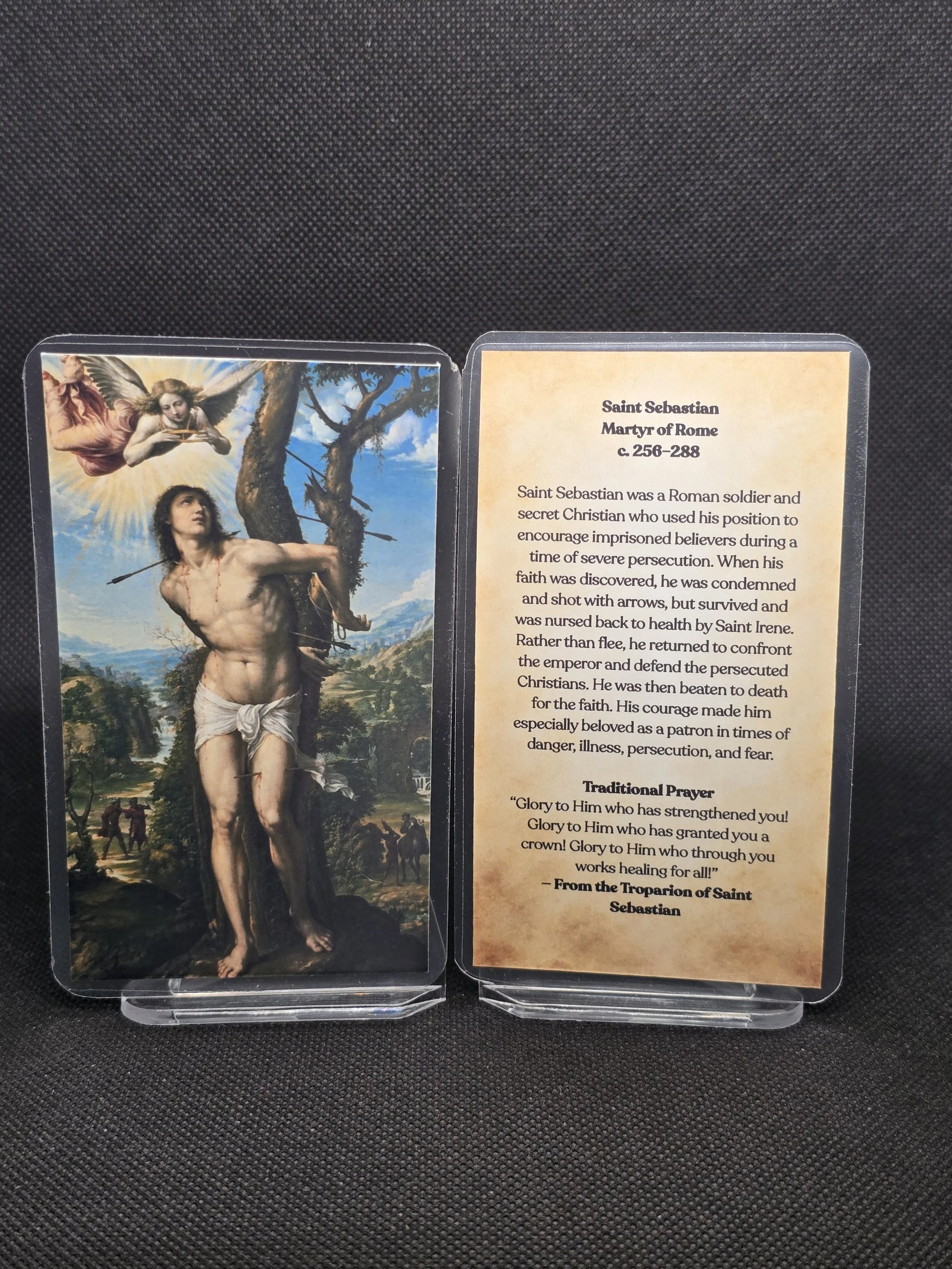
When his faith was discovered, Sebastian was sentenced to death by arrows. Bound to a tree and pierced repeatedly, he was left for dead. Yet he survived this first execution through divine providence and the care of Saint Irene.
He could have fled.
Instead, he returned.
Sebastian boldly confronted Emperor Diocletian for his cruelty toward Christians, proclaiming the truth of Christ openly. For this, he was ultimately beaten to death and martyred.
His life became a testimony not only of suffering, but of fearless spiritual defiance.
Today, Saint Sebastian is invoked by those seeking:
Strength during persecution
Courage under suffering
Protection from disease
Athletic endurance
Military protection
Perseverance in faith
Healing during plague or epidemic
This prayer card honors a saint whose body was pierced, but whose faith remained unconquered.
Each card is handmade in Austin and created to order. We do not keep stock, because every prayer card is treated as a unique devotional offering. They are printed on museum-quality photo paper, not cardstock, and each one is made during prayer. The saints are venerated throughout the entire process, and prayers are intentionally offered for the person who will receive the card. These are not mass-produced items. They are created slowly, reverently, and with spiritual intention, because every soul and every prayer matters.
Saint Sebastian was born around the mid-third century, likely in Gaul or Italy, during one of Christianity’s most dangerous eras.
The Roman Empire demanded loyalty.
Sebastian gave his loyalty to Christ.
Rising through military ranks, he became a captain of the Praetorian Guard under Emperor Diocletian. His status gave him unusual access to imprisoned Christians and condemned martyrs.
Rather than abandon them, he strengthened them.
Sebastian visited prisoners, encouraged confessions of faith, and reportedly converted several individuals, including Roman officials, through his witness.
Eventually, his Christian identity was exposed.
As punishment, he was bound to a tree and shot with arrows until presumed dead.
Yet God was not finished with him.
Rescued and healed by Saint Irene, Sebastian recovered. Rather than retreat into hiding, he directly confronted the emperor over his persecution of Christians.
This boldness sealed his fate.
Sebastian was clubbed to death and his body discarded. Christians later recovered and buried him in the catacombs along the Appian Way, where devotion to him spread rapidly.
Throughout the Middle Ages, Sebastian became especially associated with protection from plague, as arrows symbolized both his martyrdom and the sudden strikes of disease.
He remains one of Christianity’s most iconic saints of resilience, physical suffering, and fearless confession.
Saint Sebastian is remembered as both a martyr and protector.
His intercession has long been sought in times of physical danger and widespread illness.
Athletes
Soldiers
Archers
Plague victims
Protection from epidemics
Persecuted Christians
Strength under suffering
Courage in adversity
For centuries, Saint Sebastian has been invoked during outbreaks of plague and pestilence. Entire cities entrusted themselves to his prayers during medieval epidemics.
Countless churches were dedicated to him as a protector against sudden death and disease.
His witness continues to inspire:
Those facing persecution
Those suffering physically
Those enduring hardship
Those called to stand firm in hostile environments
Sebastian reminds believers that survival is not enough.
Faithfulness matters most.
Glorious Saint Sebastian, faithful soldier and courageous martyr, pray for us. Obtain for us strength in suffering, courage in persecution, and steadfast devotion to Christ in all trials. Amen.
Holy Saint Sebastian, brave defender of Christ, pray for me.
When fear weakens me, strengthen me.
When suffering pierces me, sustain me.
When the world pressures me to compromise, preserve my faith.
Teach me courage.
You endured arrows, pain, and death without abandoning Christ.
Help me endure my trials with similar steadfastness.
Protect me from illness.
Guard my body and soul.
Intercede for my family in times of suffering.
May your witness remind me that true victory is not comfort, but faithfulness.
Through your prayers, may I stand firm until the end.
Amen.
Q: What is Saint Sebastian known for?
He is known as an early Christian martyr, Roman soldier, and powerful intercessor for courage, plague protection, and perseverance.
Q: When is Saint Sebastian’s feast day?
January 20 in the Roman Catholic Church; December 18 in many Eastern traditions.
Q: Why is Saint Sebastian associated with plague protection?
Because his martyrdom by arrows became symbolically linked with protection against sudden pestilence and disease outbreaks.
Q: Which Christian traditions venerate Saint Sebastian?
He is honored by Roman Catholics, Eastern Orthodox Christians, Oriental Orthodox traditions, and many Eastern Catholic Churches.
Saint Sebastian is one of Christianity’s most enduring martyrs, venerated across both Eastern and Western Christian traditions as a powerful witness of courage, endurance, and unwavering faith under persecution. His feast is celebrated on January 20 in the Roman Catholic Church and December 18 in many Eastern Orthodox calendars.
Sebastian was not merely a martyr.
He was a soldier of Christ hidden within the Roman army.
Born in the third century, Sebastian served as an officer in the Imperial Roman military under Emperor Diocletian. Outwardly, he appeared to be a loyal servant of Rome.
Inwardly, he belonged fully to Christ.
Sebastian used his position to secretly support imprisoned Christians, strengthen martyrs awaiting execution, and encourage believers facing torture. He brought courage where fear reigned.
He strengthened the persecuted.
He chose Christ over empire.
When his faith was discovered, Sebastian was sentenced to death by arrows. Bound to a tree and pierced repeatedly, he was left for dead. Yet he survived this first execution through divine providence and the care of Saint Irene.
He could have fled.
Instead, he returned.
Sebastian boldly confronted Emperor Diocletian for his cruelty toward Christians, proclaiming the truth of Christ openly. For this, he was ultimately beaten to death and martyred.
His life became a testimony not only of suffering, but of fearless spiritual defiance.
Today, Saint Sebastian is invoked by those seeking:
Strength during persecution
Courage under suffering
Protection from disease
Athletic endurance
Military protection
Perseverance in faith
Healing during plague or epidemic
This prayer card honors a saint whose body was pierced, but whose faith remained unconquered.
Each card is handmade in Austin and created to order. We do not keep stock, because every prayer card is treated as a unique devotional offering. They are printed on museum-quality photo paper, not cardstock, and each one is made during prayer. The saints are venerated throughout the entire process, and prayers are intentionally offered for the person who will receive the card. These are not mass-produced items. They are created slowly, reverently, and with spiritual intention, because every soul and every prayer matters.
Saint Sebastian was born around the mid-third century, likely in Gaul or Italy, during one of Christianity’s most dangerous eras.
The Roman Empire demanded loyalty.
Sebastian gave his loyalty to Christ.
Rising through military ranks, he became a captain of the Praetorian Guard under Emperor Diocletian. His status gave him unusual access to imprisoned Christians and condemned martyrs.
Rather than abandon them, he strengthened them.
Sebastian visited prisoners, encouraged confessions of faith, and reportedly converted several individuals, including Roman officials, through his witness.
Eventually, his Christian identity was exposed.
As punishment, he was bound to a tree and shot with arrows until presumed dead.
Yet God was not finished with him.
Rescued and healed by Saint Irene, Sebastian recovered. Rather than retreat into hiding, he directly confronted the emperor over his persecution of Christians.
This boldness sealed his fate.
Sebastian was clubbed to death and his body discarded. Christians later recovered and buried him in the catacombs along the Appian Way, where devotion to him spread rapidly.
Throughout the Middle Ages, Sebastian became especially associated with protection from plague, as arrows symbolized both his martyrdom and the sudden strikes of disease.
He remains one of Christianity’s most iconic saints of resilience, physical suffering, and fearless confession.
Saint Sebastian is remembered as both a martyr and protector.
His intercession has long been sought in times of physical danger and widespread illness.
Athletes
Soldiers
Archers
Plague victims
Protection from epidemics
Persecuted Christians
Strength under suffering
Courage in adversity
For centuries, Saint Sebastian has been invoked during outbreaks of plague and pestilence. Entire cities entrusted themselves to his prayers during medieval epidemics.
Countless churches were dedicated to him as a protector against sudden death and disease.
His witness continues to inspire:
Those facing persecution
Those suffering physically
Those enduring hardship
Those called to stand firm in hostile environments
Sebastian reminds believers that survival is not enough.
Faithfulness matters most.
Glorious Saint Sebastian, faithful soldier and courageous martyr, pray for us. Obtain for us strength in suffering, courage in persecution, and steadfast devotion to Christ in all trials. Amen.
Holy Saint Sebastian, brave defender of Christ, pray for me.
When fear weakens me, strengthen me.
When suffering pierces me, sustain me.
When the world pressures me to compromise, preserve my faith.
Teach me courage.
You endured arrows, pain, and death without abandoning Christ.
Help me endure my trials with similar steadfastness.
Protect me from illness.
Guard my body and soul.
Intercede for my family in times of suffering.
May your witness remind me that true victory is not comfort, but faithfulness.
Through your prayers, may I stand firm until the end.
Amen.
Q: What is Saint Sebastian known for?
He is known as an early Christian martyr, Roman soldier, and powerful intercessor for courage, plague protection, and perseverance.
Q: When is Saint Sebastian’s feast day?
January 20 in the Roman Catholic Church; December 18 in many Eastern traditions.
Q: Why is Saint Sebastian associated with plague protection?
Because his martyrdom by arrows became symbolically linked with protection against sudden pestilence and disease outbreaks.
Q: Which Christian traditions venerate Saint Sebastian?
He is honored by Roman Catholics, Eastern Orthodox Christians, Oriental Orthodox traditions, and many Eastern Catholic Churches.