 Image 1 of 1
Saint Simon the Tanner Prayer Card | For Impossible Situations, Faith, Purity & Humility
Saint Simon the Tanner, also known as Saint Samaan the Tanner, Simon the Shoemaker, or Simon the Cobbler, was a tenth-century Egyptian Coptic Orthodox saint whose life became inseparably connected with one of the most famous miracles in Coptic Christianity: the moving of Mokattam Mountain in Cairo. During the patriarchate of Pope Abraam the Syrian, the Coptic Church remembers Simon as the hidden, one-eyed craftsman through whose prayers God answered a seemingly impossible challenge to the Christian community. The official history of the Coptic Orthodox Church places the event during Pope Abraam's patriarchate from 975 to 978 AD.
Saint Simon is especially meaningful for impossible situations, overwhelming problems, deep faith, humility, repentance, purity, freedom from lust, service to the poor, hidden acts of charity, workers and craftsmen, and anyone asking God to move a seemingly immovable obstacle. His story brings together Christ's teaching about faith capable of moving mountains with a man whose holiness was so hidden that the Patriarch of Alexandria had to be directed to him by the Virgin Mary.
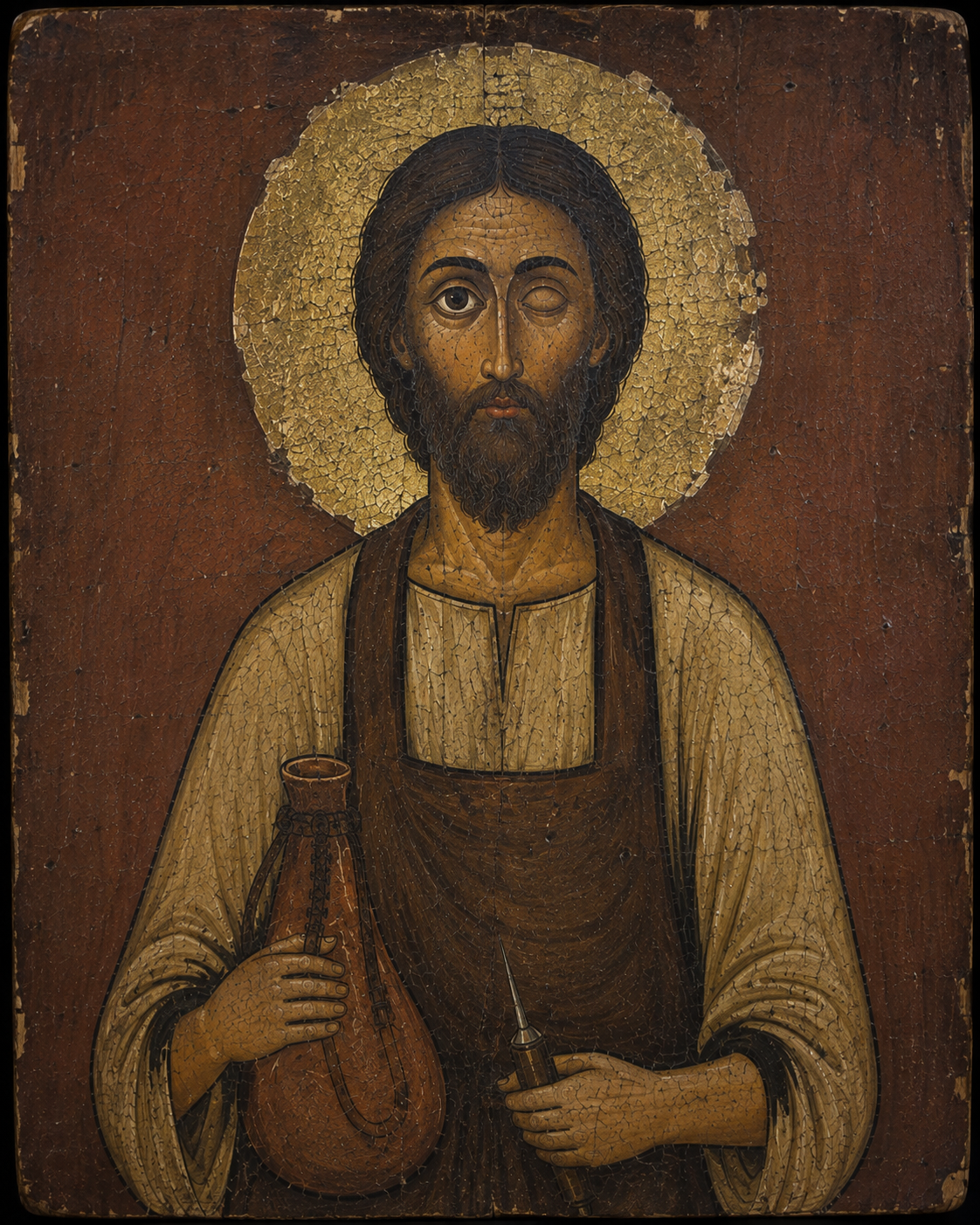
He is also one of the most visually distinctive Coptic saints because traditional icons frequently depict one of his eyes closed, missing, or damaged. That is not an artistic mistake and it is not simply meant to show old age. According to the Coptic tradition of his life, while Simon was repairing a woman's shoe he looked upon her lustfully, immediately repented, and took Christ's warning in Matthew 5:29 with extreme literalness by putting out one of his own eyes. His one-eyed appearance became such an identifying part of his tradition that the account of Pope Abraam describes the Virgin Mary directing the Pope specifically to find a one-eyed man carrying water for the needy.
The closed eye in his icon therefore represents radical repentance and the struggle for purity. It should not be read as a general instruction that Christians should physically harm themselves, because the Church's ordinary interpretation of Christ's words concerns ruthlessly removing occasions of sin rather than mutilating the body. Simon's hagiographic tradition presents his action as an extraordinary and severe literal response by one particular ascetic Christian, while the spiritual lesson is the seriousness with which he regarded sin and repentance.
Saint Simon is equally remarkable because his hidden life was filled with charity. Before going to work in the tannery, he regularly carried water to the sick, elderly, and others unable to fetch it for themselves. When Pope Abraam finally found the mysterious one-eyed man revealed by the Virgin Mary, Simon was not standing in a monastery, preaching publicly, or surrounded by disciples. He was quietly carrying water for people who needed help before beginning an ordinary day's labor.
For someone facing a problem that seems absolutely immovable, Saint Simon's story is one of the strongest in the Coptic tradition. The mountain miracle does not teach that faith is a technique for forcing God to perform whatever a person demands, but it does proclaim that circumstances appearing impossible to human strength remain completely subject to God. Simon's own role also keeps the story from becoming one of spiritual pride because after the miracle he disappeared rather than remaining to receive public praise.
This prayer card is especially fitting for someone facing an impossible situation, a major family crisis, an apparently hopeless problem, a difficult spiritual battle, sexual temptation, pornography, impurity, discouragement, or a need for deeper faith. It can also make a meaningful gift for craftsmen, leatherworkers, shoemakers, people serving the poor, Coptic Orthodox Christians, people beginning the Nativity Fast, and anyone who needs to remember that hidden holiness may accomplish more than visible worldly power.
Each 2.5" x 4.25" prayer card is handmade in Austin, Texas and prepared prayerfully with each order. It is printed on museum-quality photo paper rather than cardstock, double laminated for durability, and made while the recipient and their intentions are lifted before Christ in prayer, with Saint Simon the Tanner asked to intercede for them.
THE LIFE & STORY
Saint Simon lived in Egypt near the end of the tenth century, during the Fatimid period and the patriarchate of Pope Abraam the Syrian, the 62nd Pope of Alexandria. The official Coptic Orthodox Church history places Pope Abraam's patriarchate from 975 to 978 and specifically identifies this period with the incident of the moving of Mokattam Mountain and the saintly tanner named Simon.
Very little is securely preserved about Simon's childhood, parents, or early formation. The Coptic tradition essentially allows him to appear suddenly within history as an already mature Christian craftsman whose holiness had remained almost entirely unknown outside the people he quietly served. St. Takla's Coptic account explicitly notes that history does not preserve where he was born, how he was raised, or who his father was.
A WORKING MAN RATHER THAN A PUBLIC CHURCH LEADER
Simon earned his living through tanning and leatherwork, which explains the different names by which he is remembered. Tanner, cobbler, shoemaker, Samaan al-Kharraz, and Simon the Tanner all refer to the same saint within the Coptic tradition.
This is one of the most attractive features of his life. Simon was not a bishop, monk, famous theologian, wealthy patron, or political leader, yet the Church remembers him as the hidden man God chose when an entire Christian community found itself facing an impossible demand.
WHY IS ONE OF SAINT SIMON'S EYES CLOSED IN HIS ICON?
The closed or missing eye is one of Saint Simon's principal iconographic attributes, and it comes directly from his traditional Life. While working as a shoemaker, a woman came to him for a repair, and when part of her leg became visible Simon looked at her lustfully. The Coptic tradition says he was horrified by his own sinful glance and interpreted Christ's words in Matthew 5:29 with complete literalness, using his work tool to destroy the offending eye.
That is why many icons deliberately portray Simon with one eye shut, damaged, or absent. The image is meant to identify him and to recall his severe repentance, purity, and determination not to allow lust to rule him. The tradition is reinforced by the story of the mountain miracle itself, in which the Virgin Mary tells Pope Abraam to look specifically for a one-eyed man carrying water.
DID SAINT SIMON REALLY TAKE MATTHEW 5:29 LITERALLY?
According to his Coptic hagiographic tradition, yes. Matthew 5:29 records Christ's severe warning that if the right eye causes a person to sin, it should be cast away rather than allowing the whole person to be lost, and Simon's traditional Life says he responded to his lustful glance by applying those words literally.
That extraordinary act should be understood within the saint's hagiography rather than turned into a command for Christians to injure themselves. The spiritual meaning of Christ's teaching is that sin and its occasions must be dealt with decisively, and Simon's one eye became a dramatic Coptic symbol of how seriously he took repentance.
A SAINT FOR PURITY
Because of this event, Saint Simon has an unusually direct connection with sexual purity, lust, chastity, pornography, wandering eyes, and the discipline of one's thoughts. This is not a modern patronage arbitrarily attached to him because the most recognizable physical feature in his icon exists precisely because of the traditional story of his struggle against lust.
The more useful spiritual lesson is not physical punishment but refusing to negotiate endlessly with temptation. Simon's story asks Christians what habits, images, situations, relationships, or technologies repeatedly draw them toward sin and whether they are actually willing to remove those occasions from their lives.
THE EYE AS A SYMBOL OF REPENTANCE
Christian iconography often communicates a saint's history through one easily recognizable detail. Saint Peter may carry keys, martyrs may hold crosses or palms, and military saints may appear in armor, while Simon's damaged eye identifies the moment of radical repentance associated with his Life.
For that reason, correcting the closed eye in an icon to make both eyes appear normal would actually remove an important part of his traditional identity. When intentionally painted according to the Coptic tradition, the closed eye is supposed to be there.
HIS WATER SKIN OR JUG IN ICONS
Saint Simon is also frequently depicted carrying a water skin, jar, or vessel. This second identifying feature comes from the charitable routine through which Pope Abraam eventually found him.
Each morning, before reporting to the tannery, Simon carried water to sick and elderly people who could not obtain it for themselves. His icon therefore places radical ascetic repentance beside ordinary mercy, showing that holiness is not merely avoiding sin but actively loving one's neighbor.
A SAINT FOR PEOPLE WHO WORK WITH THEIR HANDS
Simon belonged to the world of ordinary craftsmen. His livelihood involved animal hides, leather, shoes, tools, physical labor, and the routines of a working neighborhood rather than the formal life of a monastery.
That makes him especially meaningful for craftsmen and tradespeople who sometimes imagine holiness belongs primarily to clergy or monastics. Simon's story insists that a workshop can contain a saint, and that ordinary labor can coexist with intense prayer, repentance, charity, and hidden communion with God.
A SAINT FOR HIDDEN CHARITY
Before becoming known for moving a mountain, Simon was already performing a quieter miracle of Christian love by helping people who could not repay him. The sick and elderly needed water, so he carried it to them before beginning his own workday.
This detail may reveal more about his holiness than the spectacular miracle itself. Simon had already learned to place another person's needs ahead of his convenience before anyone knew his name.
POPE ABRAAM THE SYRIAN
The other central figure in Simon's story is Pope Abraam the Syrian, the 62nd Patriarch of Alexandria. Coptic tradition remembers Abraam as a wealthy man who gave generously to the poor and the building of churches before becoming caught in the crisis that would lead to the miracle of Mokattam.
His patriarchate occurred during the Fatimid rule of Egypt. The Coptic Orthodox Church's official historical overview specifically places the moving of Mokattam Mountain during Abraam's years as Pope and identifies Simon as the tanner through whom the miracle was accomplished.
THE CHALLENGE TO MOVE A MOUNTAIN
Coptic tradition tells that the Fatimid Caliph Al-Muizz held religious discussions involving representatives of different faiths. During one dispute, Christ's teaching that faith as small as a mustard seed could move a mountain was raised against the Christians as a challenge.
The Caliph demanded that Pope Abraam demonstrate the truth of Christ's words by causing Mokattam Mountain, east of Cairo, to move. The Coptic account says the consequences of failure threatened the Christian community itself, leaving the Pope facing a demand completely beyond any human ability.
THREE DAYS OF FASTING & PRAYER
Pope Abraam asked for three days and gathered bishops, priests, and the Christian faithful for intense fasting and prayer. The crisis was therefore met first not through political maneuvering or physical resistance but through repentance and supplication before God.
The Coptic tradition continues remembering these three days in connection with the Nativity Fast. CopticChurch.net explains that three additional days of fasting were added to the forty-day preparation for the Nativity in remembrance of the three-day period preceding the mountain miracle.
THE VIRGIN MARY REVEALS SIMON
Before dawn on the third day, the exhausted Pope received a vision of the Virgin Mary. She directed him to leave through the gate toward the market and look for a particular person, describing him as a one-eyed man carrying water.
That description led directly to Simon. The man chosen for the impossible task was identifiable not through religious clothing, social rank, or public fame, but through the eye associated with his repentance and the water associated with his charity.
THE PATRIARCH FINDS THE TANNER
When Pope Abraam found Simon, he asked why the man was carrying water so early in the morning. Simon explained that bringing water to the sick and elderly who could not obtain it themselves was his regular practice before going to work in the tannery.
This scene reverses ordinary expectations about spiritual importance. The Patriarch of Alexandria was searching for the man through whom God would answer the crisis of an entire Church, and he discovered him performing a hidden work of mercy.
SIMON DID NOT WANT ATTENTION
When Pope Abraam explained the vision and what was being asked, Simon was reluctant. The Coptic account presents him as a deeply humble man who did not seek the extraordinary role being placed upon him, but who finally agreed after learning how the Virgin Mary had directed the Pope to him.
Humility therefore frames the miracle from beginning to end. Simon does not volunteer as the wonderworker, advertise himself afterward, or attempt to convert what happened into religious prestige.
SIMON'S INSTRUCTIONS
Simon instructed Pope Abraam to gather the Christian people with the Caliph and those accompanying him at Mokattam. The faithful were to pray, repeatedly cry Kyrie eleison, “Lord, have mercy,” kneel, rise, and make the sign of the Cross.
The miracle therefore did not resemble Simon publicly displaying supernatural power over the mountain. The Church prayed together, the Patriarch led the people, and Simon remained hidden among them.
THE MOVING OF MOKATTAM MOUNTAIN
The received Coptic account says that as the Christians prayed, knelt, and rose, the mountain shook and lifted, with daylight becoming visible beneath it. This happened repeatedly in the presence of the Caliph and the assembled crowd.
The official Coptic Orthodox Church continues including the incident in its historical chronology, stating that the moving of Mukattam occurred during Pope Abraam's patriarchate and that the Virgin Mary had revealed the saintly tanner Simon as the person through whom God would accomplish it.
THE FAITH THAT MOVES MOUNTAINS
Saint Simon consequently became one of Christianity's most literal examples of the biblical phrase “faith that moves mountains.” His story is particularly meaningful because Simon himself did not behave as though faith made him personally powerful.
The miracle points away from Simon and toward God. The tanner's greatness lies partly in being so humble that the spectacular miracle did not tempt him to become the center of the story.
A SAINT FOR IMPOSSIBLE SITUATIONS
This makes Saint Simon an especially natural intercessor for circumstances in which every ordinary solution appears exhausted. A frightening diagnosis, family crisis, financial catastrophe, impossible decision, prolonged legal problem, addiction, broken relationship, or spiritual battle can all feel like mountains that cannot be moved.
Asking for Saint Simon's intercession does not mean demanding a particular miracle on command. His story encourages the Christian to keep praying when human strength has reached its limit and to remember that nothing confronting us has become greater than God.
THE MOUNTAIN MOVED, BUT SIMON DISAPPEARED
After the extraordinary event, Pope Abraam looked for Simon and could not find him. Coptic tradition preserves different explanations, including that Simon deliberately withdrew because he feared human praise and vainglory.
This final action completes the spiritual meaning of his story. The man whose prayers were associated with moving a mountain apparently wanted no monument to himself at that moment and no public reward.
A SAINT FOR HUMILITY
Saint Simon therefore has one of the strongest possible associations with hidden humility. An entire city could witness something extraordinary while the saint most closely connected with the miracle slipped away before anyone could celebrate him.
For Christians struggling with recognition, social media, reputation, praise, ministry status, or the desire to be noticed for doing good, Simon's life asks an uncomfortable question: would we still do the work if nobody knew it was ours?
THE MIRACLE & THE NATIVITY FAST
The Coptic tradition remembers the three days of intense prayer preceding the miracle through the additional three days connected with the Nativity Fast. CopticChurch.net explains that Pope Abraam established the annual observance so the period of fasting associated with the crisis would continue to be remembered.
This means Simon's story is woven not only into popular devotion but into the fasting consciousness of Coptic Christianity. The mountain miracle became a continuing reminder of prayer, repentance, fasting, and God's deliverance.
SAINT SIMON & COPTIC IDENTITY
Saint Simon belongs particularly to the Coptic Orthodox Church, and his story is inseparable from medieval Coptic Christianity in Egypt. The official Coptic Orthodox historical chronology includes him by name, and contemporary Coptic diocesan structures continue identifying churches dedicated to Saint Simon the Tanner at Mokattam.
He should therefore be identified specifically as a Coptic Orthodox saint, rather than generically labeled Eastern Orthodox. The Coptic Orthodox Church belongs to the Oriental Orthodox communion, and preserving that identity accurately respects the tradition that has carried his story.
THE CAVE CHURCH AT MOKATTAM
Today, Saint Simon the Tanner Church at Mokattam in Cairo remains one of the most visually remarkable Christian sites associated with his memory. The official Coptic Orthodox Church directory identifies the Church of Saint Simon the Tanner among the churches of Mokattam.
Its setting among the cliffs of the same Mokattam landscape makes the site particularly powerful for pilgrims. The mountain that dominates Simon's traditional story has itself become the setting for a major Christian place of worship bearing his name.
AN ANCIENT ICON WITH POPE ABRAAM & SAINT SIMON
Coptic tradition also preserves an old icon depicting Pope Abraam and Saint Simon together, with Simon carrying water vessels and the Virgin Mary represented above. St. Takla identifies an icon at the Hanging Church in Old Cairo depicting these elements and associating Simon visually with the mountain miracle.
The water vessels are particularly important because they preserve the saint's charitable identity. Even when represented alongside a Patriarch and a great miracle, Simon is still shown as the man who carried water.
HIS RELICS
Modern Coptic tradition includes relics identified with Saint Simon the Tanner. St. Takla's church relic directory lists Saint Simon among the relics preserved there, while broader Coptic tradition also associates the rediscovery of remains attributed to him with Old Cairo during twentieth-century restoration work.
Because relic traditions can involve transfers and distributions among churches, the safest devotional wording is that relics attributed to Saint Simon are preserved and venerated within the Coptic Church rather than claiming his entire body now rests in one universally uncontested location.
THE TANNER, THE EYE & THE MOUNTAIN
Three visual elements summarize almost the whole of Saint Simon's spiritual identity: the leatherworker's tools, the damaged eye, and the mountain. The trade represents ordinary labor, the eye represents radical repentance, and the mountain represents extraordinary faith.
Yet the water vessel deserves to stand beside all three because charity existed before the miracle. Simon was already becoming a saint when nobody knew his name and he was simply carrying water to someone who could not carry it themselves.
A SAINT FOR PEOPLE STRUGGLING WITH LUST
Saint Simon is particularly compelling for Christians struggling with pornography or habitual lust because the tradition surrounding his eye makes the battle against impurity impossible to separate from his identity. His story treats sexual sin seriously, but its useful modern application is removing occasions of temptation rather than copying his physical action.
For someone struggling online, “gouging out the eye” may spiritually mean deleting an app, installing accountability software, changing routines, avoiding particular situations, ending access to certain material, going to confession, or asking for real help instead of repeatedly assuming willpower alone will solve the problem.
A SAINT FOR REPENTANCE AFTER A FALL
Simon is also important because the episode of his eye begins with failure, not with flawless purity. He experienced a lustful glance and responded with immediate repentance rather than deciding that one sinful moment had permanently defined him.
That makes him particularly meaningful for someone ashamed after falling into a recurring sin. Repentance means the fall does not receive the final word.
A SAINT FOR PEOPLE WHO SERVE THE ELDERLY
His practice of carrying water makes Saint Simon especially meaningful for people caring for elderly, sick, disabled, or dependent people. Coptic tradition specifically identifies this hidden service as something he performed regularly before beginning his paid work.
Caregiving can feel small compared with spectacular religious accomplishments, but Simon's story reverses that comparison. The man eventually connected with moving a mountain was first identified by the fact that he carried water.
A SAINT FOR ORDINARY WORKERS
Simon also gives working Christians a saint whose spirituality developed within ordinary labor. He handled hides and shoes, performed manual work, helped neighbors, and apparently possessed no public religious office.
His life can therefore encourage tradespeople who want work itself to become part of their Christian vocation. Holiness does not begin after clocking out because patience, honesty, service, self-control, charity, and prayer can all be practiced inside ordinary working life.
A SAINT FOR PROBLEMS THAT WILL NOT MOVE
Some problems resist every attempt to solve them. They remain month after month or year after year until the person begins treating hopelessness as realism.
Saint Simon's story does not promise that every desired outcome will occur, but it challenges the assumption that difficulty and impossibility mean exactly the same thing. The Christian can continue acting responsibly while still leaving room for God to accomplish something no human plan could produce.
A SAINT FOR FAITH WITHOUT SELF-IMPORTANCE
The mountain miracle could easily become a story about spectacular spiritual power. Simon's disappearance prevents that interpretation because the saint seems almost determined to remove himself from the center once his role is finished.
That makes his devotion particularly valuable whenever Christians become fascinated with miracles while forgetting humility. Genuine grace should make the person more conscious of God, not more impressed with himself.
ICONOGRAPHY
Traditional Coptic icons of Saint Simon commonly identify him through one damaged or closed eye, simple working clothing, and water vessels or leatherworking associations. These details visually communicate his repentance, his trade, and his hidden service to the needy.
If an icon shows Simon with one eye noticeably closed, it should generally be preserved rather than “corrected” during restoration or image editing. That feature is intentional and communicates one of the best-known episodes of his Coptic hagiography.
PRAYERS
Saint Simon's story is preserved within an established Coptic devotional tradition, so a simple saint-specific invocation is appropriate: “Saint Simon the Tanner, pray to God for us.” His intercession may be sought especially when circumstances seem impossible, when faith is weak, when someone is struggling for purity, or when hidden service has become exhausting.
The prayer surrounding his most famous miracle also gives a fitting foundation for personal devotion: Kyrie eleison, Lord, have mercy. The Coptic account remembers the Christian people repeatedly crying for God's mercy while kneeling and making the sign of the Cross before Mokattam.
Someone struggling with impurity can ask Saint Simon for the courage to remove occasions of sin rather than merely regret repeated falls. Someone facing an impossible situation can ask for persistent faith, while a caregiver or worker can ask for the humility to continue doing quiet acts of charity even when no one notices.
This prayer card is especially fitting beside a Bible, Agpeya, prayer rope, icon corner, workbench, bedside prayer space, recovery journal, or prayer list for an apparently impossible intention. The closed eye can become a daily reminder that repentance must be serious, while the water vessel and mountain remind the Christian that charity and faith belong together.
FAQ
Who was Saint Simon the Tanner? Saint Simon the Tanner was a tenth-century Egyptian Coptic Orthodox saint and leatherworker associated with the miraculous moving of Mokattam Mountain during the patriarchate of Pope Abraam the Syrian. Coptic tradition remembers him as an exceptionally humble, one-eyed working man who served the sick and elderly before beginning his daily work.
Why is Saint Simon also called Samaan the Tanner? Samaan is an Arabic form of the name Simon, while Tanner, Shoemaker, and Cobbler reflect the different leatherworking trades associated with him. The names refer to the same Coptic saint.
When did Saint Simon the Tanner live? He lived near the end of the tenth century in Egypt. His famous appearance in Coptic history occurred during Pope Abraam's patriarchate from approximately 975 to 978 AD.
Why does Saint Simon have one eye closed in icons? According to his Coptic Life, Simon looked lustfully at a woman while repairing her shoe and responded by taking Christ's warning in Matthew 5:29 with extreme literalness, putting out one of his eyes. Iconographers therefore depict him with a damaged, missing, or closed eye as an identifying symbol of repentance and purity.
Was Saint Simon born with only one good eye? That is not what his traditional Life says. The damaged eye is connected specifically with his act of repentance after a lustful glance.
Which eye did Saint Simon lose? Christ's wording in Matthew 5:29 specifically refers to the right eye, while Coptic retellings sometimes simply say Simon put out one of his eyes. For that reason, the important iconographic point is his one-eyed appearance rather than insisting that every painted icon must show the same anatomical side.
Should Christians imitate Saint Simon by physically harming themselves? No. The lasting spiritual lesson is to remove occasions of sin decisively, while Simon's physical action belongs to his extraordinary hagiographic tradition and should not be treated as normal Christian ascetic practice.
Is Saint Simon a good saint for purity? Yes, this is one of the strongest associations arising directly from his traditional Life. His damaged eye became an enduring iconographic reminder of his radical rejection of lust.
Is Saint Simon a good saint for someone struggling with pornography? Yes, especially as an intercessor for decisive repentance and removing occasions of temptation. His story encourages action rather than repeatedly allowing the same source of temptation to remain easily accessible.
What did Saint Simon do for a living? He worked as a tanner and leather craftsman, with traditions also calling him a shoemaker or cobbler. His ordinary trade is one reason he has such a strong connection with working people and craftsmen.
Why does Saint Simon carry water in icons? He regularly carried water to sick and elderly people who could not fetch it themselves before beginning his day's work. Pope Abraam recognized him partly through this charitable habit after the Virgin Mary described the person he should seek.
Is Saint Simon associated with the poor? Yes, his daily service to people unable to fetch their own water is one of the clearest details preserved about his ordinary life. His charity remained hidden until the events surrounding the mountain miracle brought him briefly into public attention.
What mountain did Saint Simon move? Coptic tradition identifies it as Mokattam Mountain, or the Mokattam Hills, east of historic Cairo. The official Coptic Orthodox Church continues including the incident within its history of Pope Abraam's patriarchate.
Did Saint Simon personally command the mountain to move? The Coptic tradition emphasizes communal prayer, the sign of the Cross, the repeated cry of “Lord, have mercy,” and Simon's guidance rather than presenting him as independently exercising magical power. The miracle is understood as God's action in response to faith and prayer.
Why did the Christians have to move Mokattam Mountain? According to the Coptic account, Christ's saying about faith capable of moving mountains was used to challenge Pope Abraam to prove the Christian faith. The Pope then requested three days for the Coptic community to fast and pray.
Who was Pope Abraam the Syrian? Pope Abraam was the 62nd Coptic Orthodox Patriarch of Alexandria and served during the Fatimid period. His patriarchate is specifically associated in official Coptic history with the incident of Mokattam Mountain and Saint Simon the Tanner.
How did Pope Abraam find Saint Simon? Coptic tradition says the Virgin Mary appeared to Pope Abraam and directed him to find a one-eyed man carrying water near the market. That description led the Pope to Simon.
Why was Simon chosen instead of a famous monk or bishop? The tradition does not present Simon as publicly important at all, which is part of its spiritual message. He was a hidden working man marked by repentance, charity, prayer, and humility.
What did the Christians pray when the mountain moved? The Coptic account remembers the people crying Kyrie eleison, meaning “Lord, have mercy,” while kneeling and rising as Pope Abraam made the sign of the Cross.
Why did Saint Simon disappear afterward? One Coptic tradition says Simon withdrew because he feared praise and vainglory after the miracle. Another preserved explanation speaks of his disappearance in more miraculous terms, but both traditions emphasize his profound humility.
Is Saint Simon good for impossible situations? Yes, this is probably his strongest modern devotional association. The defining event of his life concerns God answering a situation that was literally impossible by ordinary human power.
Is Saint Simon officially the patron saint of impossible causes? It is better not to impose a formal Western-style patronage title that Coptic sources do not use. His connection with impossible situations is nevertheless exceptionally strong because the central miracle of his life is the moving of Mokattam Mountain.
Is Saint Simon good for craftsmen and tradespeople? Yes, because he was himself a working leather craftsman rather than clergy or a wealthy public figure. His life demonstrates that intense holiness can develop within ordinary manual work.
Is Saint Simon a monk? The core Coptic sources emphasize his life as a tanner, charitable layman, and hidden ascetic rather than identifying him primarily as a monastery monk. His holiness therefore gives lay Christians an especially powerful example.
Is Saint Simon Coptic Orthodox? Yes. His history, miracle tradition, churches, and contemporary veneration belong particularly to the Coptic Orthodox Church, which is part of the Oriental Orthodox communion.
Is Saint Simon the Tanner the same Simon the Tanner mentioned in Acts? No. The Simon the Tanner in Acts 9 and 10 lived in Joppa during the apostolic age and hosted Saint Peter, while Saint Simon the Tanner of Cairo lived many centuries later in tenth-century Egypt. The similar occupation and name sometimes cause confusion, but they are different people.
Where is Saint Simon's church in Cairo? A major Coptic Orthodox church dedicated to Saint Simon stands at Mokattam in Cairo, and the official Coptic Orthodox Church lists the Church of Saint Simon the Tanner among the churches of the Mokattam diocese.
Are there relics of Saint Simon the Tanner? Relics identified with Saint Simon are venerated within the Coptic Church, including relics listed by St. Takla's church in Alexandria. Modern Coptic tradition also preserves accounts concerning the rediscovery of remains attributed to him in Old Cairo.
Why is Saint Simon associated with the Coptic Nativity Fast? The three days of prayer and fasting preceding the Mokattam miracle became part of Coptic remembrance of the event. CopticChurch.net records the tradition that three days were added to the forty-day Nativity Fast in commemoration of the crisis and deliverance.
What does Saint Simon teach about faith? His story teaches that Christian faith ultimately depends upon God's power rather than human ability. It also teaches that extraordinary faith can exist inside an apparently ordinary and hidden life.
What does Saint Simon teach about humility? Simon did not seek a public role in the miracle and disappeared afterward instead of remaining to receive praise. His Life therefore presents humility not simply as thinking little of oneself, but as becoming willing for God to receive the attention.
What does Saint Simon teach about repentance? His one-eyed iconography represents his conviction that sin had to be confronted seriously rather than excused. The useful Christian lesson is decisive repentance and removal of occasions of sin, not physical self-injury.
What does Saint Simon teach about charity? Before anyone knew him as the man associated with moving a mountain, he quietly carried water to sick and elderly people. His Life therefore places ordinary mercy before spectacular miracles.
What is the main message of Saint Simon the Tanner's life? Saint Simon's life teaches that God can accomplish extraordinary things through a person who is almost completely hidden from the world. A one-eyed leatherworker who spent his mornings carrying water to sick and elderly neighbors became the man the Virgin Mary revealed to the Patriarch of Alexandria when the Coptic Christian community faced an impossible demand. Through fasting, prayer, the sign of the Cross, and the repeated cry for God's mercy, Coptic tradition remembers Mokattam Mountain moving, yet Simon's response was not to become famous but to disappear from public praise. His closed eye, water vessel, ordinary work, and mountain together make him an extraordinary saint for repentance, purity, charity, humility, and every Christian standing before a problem that seems impossible to move.
Saint Simon the Tanner, also known as Saint Samaan the Tanner, Simon the Shoemaker, or Simon the Cobbler, was a tenth-century Egyptian Coptic Orthodox saint whose life became inseparably connected with one of the most famous miracles in Coptic Christianity: the moving of Mokattam Mountain in Cairo. During the patriarchate of Pope Abraam the Syrian, the Coptic Church remembers Simon as the hidden, one-eyed craftsman through whose prayers God answered a seemingly impossible challenge to the Christian community. The official history of the Coptic Orthodox Church places the event during Pope Abraam's patriarchate from 975 to 978 AD.
Saint Simon is especially meaningful for impossible situations, overwhelming problems, deep faith, humility, repentance, purity, freedom from lust, service to the poor, hidden acts of charity, workers and craftsmen, and anyone asking God to move a seemingly immovable obstacle. His story brings together Christ's teaching about faith capable of moving mountains with a man whose holiness was so hidden that the Patriarch of Alexandria had to be directed to him by the Virgin Mary.
He is also one of the most visually distinctive Coptic saints because traditional icons frequently depict one of his eyes closed, missing, or damaged. That is not an artistic mistake and it is not simply meant to show old age. According to the Coptic tradition of his life, while Simon was repairing a woman's shoe he looked upon her lustfully, immediately repented, and took Christ's warning in Matthew 5:29 with extreme literalness by putting out one of his own eyes. His one-eyed appearance became such an identifying part of his tradition that the account of Pope Abraam describes the Virgin Mary directing the Pope specifically to find a one-eyed man carrying water for the needy.
The closed eye in his icon therefore represents radical repentance and the struggle for purity. It should not be read as a general instruction that Christians should physically harm themselves, because the Church's ordinary interpretation of Christ's words concerns ruthlessly removing occasions of sin rather than mutilating the body. Simon's hagiographic tradition presents his action as an extraordinary and severe literal response by one particular ascetic Christian, while the spiritual lesson is the seriousness with which he regarded sin and repentance.
Saint Simon is equally remarkable because his hidden life was filled with charity. Before going to work in the tannery, he regularly carried water to the sick, elderly, and others unable to fetch it for themselves. When Pope Abraam finally found the mysterious one-eyed man revealed by the Virgin Mary, Simon was not standing in a monastery, preaching publicly, or surrounded by disciples. He was quietly carrying water for people who needed help before beginning an ordinary day's labor.
For someone facing a problem that seems absolutely immovable, Saint Simon's story is one of the strongest in the Coptic tradition. The mountain miracle does not teach that faith is a technique for forcing God to perform whatever a person demands, but it does proclaim that circumstances appearing impossible to human strength remain completely subject to God. Simon's own role also keeps the story from becoming one of spiritual pride because after the miracle he disappeared rather than remaining to receive public praise.
This prayer card is especially fitting for someone facing an impossible situation, a major family crisis, an apparently hopeless problem, a difficult spiritual battle, sexual temptation, pornography, impurity, discouragement, or a need for deeper faith. It can also make a meaningful gift for craftsmen, leatherworkers, shoemakers, people serving the poor, Coptic Orthodox Christians, people beginning the Nativity Fast, and anyone who needs to remember that hidden holiness may accomplish more than visible worldly power.
Each 2.5" x 4.25" prayer card is handmade in Austin, Texas and prepared prayerfully with each order. It is printed on museum-quality photo paper rather than cardstock, double laminated for durability, and made while the recipient and their intentions are lifted before Christ in prayer, with Saint Simon the Tanner asked to intercede for them.
THE LIFE & STORY
Saint Simon lived in Egypt near the end of the tenth century, during the Fatimid period and the patriarchate of Pope Abraam the Syrian, the 62nd Pope of Alexandria. The official Coptic Orthodox Church history places Pope Abraam's patriarchate from 975 to 978 and specifically identifies this period with the incident of the moving of Mokattam Mountain and the saintly tanner named Simon.
Very little is securely preserved about Simon's childhood, parents, or early formation. The Coptic tradition essentially allows him to appear suddenly within history as an already mature Christian craftsman whose holiness had remained almost entirely unknown outside the people he quietly served. St. Takla's Coptic account explicitly notes that history does not preserve where he was born, how he was raised, or who his father was.
A WORKING MAN RATHER THAN A PUBLIC CHURCH LEADER
Simon earned his living through tanning and leatherwork, which explains the different names by which he is remembered. Tanner, cobbler, shoemaker, Samaan al-Kharraz, and Simon the Tanner all refer to the same saint within the Coptic tradition.
This is one of the most attractive features of his life. Simon was not a bishop, monk, famous theologian, wealthy patron, or political leader, yet the Church remembers him as the hidden man God chose when an entire Christian community found itself facing an impossible demand.
WHY IS ONE OF SAINT SIMON'S EYES CLOSED IN HIS ICON?
The closed or missing eye is one of Saint Simon's principal iconographic attributes, and it comes directly from his traditional Life. While working as a shoemaker, a woman came to him for a repair, and when part of her leg became visible Simon looked at her lustfully. The Coptic tradition says he was horrified by his own sinful glance and interpreted Christ's words in Matthew 5:29 with complete literalness, using his work tool to destroy the offending eye.
That is why many icons deliberately portray Simon with one eye shut, damaged, or absent. The image is meant to identify him and to recall his severe repentance, purity, and determination not to allow lust to rule him. The tradition is reinforced by the story of the mountain miracle itself, in which the Virgin Mary tells Pope Abraam to look specifically for a one-eyed man carrying water.
DID SAINT SIMON REALLY TAKE MATTHEW 5:29 LITERALLY?
According to his Coptic hagiographic tradition, yes. Matthew 5:29 records Christ's severe warning that if the right eye causes a person to sin, it should be cast away rather than allowing the whole person to be lost, and Simon's traditional Life says he responded to his lustful glance by applying those words literally.
That extraordinary act should be understood within the saint's hagiography rather than turned into a command for Christians to injure themselves. The spiritual meaning of Christ's teaching is that sin and its occasions must be dealt with decisively, and Simon's one eye became a dramatic Coptic symbol of how seriously he took repentance.
A SAINT FOR PURITY
Because of this event, Saint Simon has an unusually direct connection with sexual purity, lust, chastity, pornography, wandering eyes, and the discipline of one's thoughts. This is not a modern patronage arbitrarily attached to him because the most recognizable physical feature in his icon exists precisely because of the traditional story of his struggle against lust.
The more useful spiritual lesson is not physical punishment but refusing to negotiate endlessly with temptation. Simon's story asks Christians what habits, images, situations, relationships, or technologies repeatedly draw them toward sin and whether they are actually willing to remove those occasions from their lives.
THE EYE AS A SYMBOL OF REPENTANCE
Christian iconography often communicates a saint's history through one easily recognizable detail. Saint Peter may carry keys, martyrs may hold crosses or palms, and military saints may appear in armor, while Simon's damaged eye identifies the moment of radical repentance associated with his Life.
For that reason, correcting the closed eye in an icon to make both eyes appear normal would actually remove an important part of his traditional identity. When intentionally painted according to the Coptic tradition, the closed eye is supposed to be there.
HIS WATER SKIN OR JUG IN ICONS
Saint Simon is also frequently depicted carrying a water skin, jar, or vessel. This second identifying feature comes from the charitable routine through which Pope Abraam eventually found him.
Each morning, before reporting to the tannery, Simon carried water to sick and elderly people who could not obtain it for themselves. His icon therefore places radical ascetic repentance beside ordinary mercy, showing that holiness is not merely avoiding sin but actively loving one's neighbor.
A SAINT FOR PEOPLE WHO WORK WITH THEIR HANDS
Simon belonged to the world of ordinary craftsmen. His livelihood involved animal hides, leather, shoes, tools, physical labor, and the routines of a working neighborhood rather than the formal life of a monastery.
That makes him especially meaningful for craftsmen and tradespeople who sometimes imagine holiness belongs primarily to clergy or monastics. Simon's story insists that a workshop can contain a saint, and that ordinary labor can coexist with intense prayer, repentance, charity, and hidden communion with God.
A SAINT FOR HIDDEN CHARITY
Before becoming known for moving a mountain, Simon was already performing a quieter miracle of Christian love by helping people who could not repay him. The sick and elderly needed water, so he carried it to them before beginning his own workday.
This detail may reveal more about his holiness than the spectacular miracle itself. Simon had already learned to place another person's needs ahead of his convenience before anyone knew his name.
POPE ABRAAM THE SYRIAN
The other central figure in Simon's story is Pope Abraam the Syrian, the 62nd Patriarch of Alexandria. Coptic tradition remembers Abraam as a wealthy man who gave generously to the poor and the building of churches before becoming caught in the crisis that would lead to the miracle of Mokattam.
His patriarchate occurred during the Fatimid rule of Egypt. The Coptic Orthodox Church's official historical overview specifically places the moving of Mokattam Mountain during Abraam's years as Pope and identifies Simon as the tanner through whom the miracle was accomplished.
THE CHALLENGE TO MOVE A MOUNTAIN
Coptic tradition tells that the Fatimid Caliph Al-Muizz held religious discussions involving representatives of different faiths. During one dispute, Christ's teaching that faith as small as a mustard seed could move a mountain was raised against the Christians as a challenge.
The Caliph demanded that Pope Abraam demonstrate the truth of Christ's words by causing Mokattam Mountain, east of Cairo, to move. The Coptic account says the consequences of failure threatened the Christian community itself, leaving the Pope facing a demand completely beyond any human ability.
THREE DAYS OF FASTING & PRAYER
Pope Abraam asked for three days and gathered bishops, priests, and the Christian faithful for intense fasting and prayer. The crisis was therefore met first not through political maneuvering or physical resistance but through repentance and supplication before God.
The Coptic tradition continues remembering these three days in connection with the Nativity Fast. CopticChurch.net explains that three additional days of fasting were added to the forty-day preparation for the Nativity in remembrance of the three-day period preceding the mountain miracle.
THE VIRGIN MARY REVEALS SIMON
Before dawn on the third day, the exhausted Pope received a vision of the Virgin Mary. She directed him to leave through the gate toward the market and look for a particular person, describing him as a one-eyed man carrying water.
That description led directly to Simon. The man chosen for the impossible task was identifiable not through religious clothing, social rank, or public fame, but through the eye associated with his repentance and the water associated with his charity.
THE PATRIARCH FINDS THE TANNER
When Pope Abraam found Simon, he asked why the man was carrying water so early in the morning. Simon explained that bringing water to the sick and elderly who could not obtain it themselves was his regular practice before going to work in the tannery.
This scene reverses ordinary expectations about spiritual importance. The Patriarch of Alexandria was searching for the man through whom God would answer the crisis of an entire Church, and he discovered him performing a hidden work of mercy.
SIMON DID NOT WANT ATTENTION
When Pope Abraam explained the vision and what was being asked, Simon was reluctant. The Coptic account presents him as a deeply humble man who did not seek the extraordinary role being placed upon him, but who finally agreed after learning how the Virgin Mary had directed the Pope to him.
Humility therefore frames the miracle from beginning to end. Simon does not volunteer as the wonderworker, advertise himself afterward, or attempt to convert what happened into religious prestige.
SIMON'S INSTRUCTIONS
Simon instructed Pope Abraam to gather the Christian people with the Caliph and those accompanying him at Mokattam. The faithful were to pray, repeatedly cry Kyrie eleison, “Lord, have mercy,” kneel, rise, and make the sign of the Cross.
The miracle therefore did not resemble Simon publicly displaying supernatural power over the mountain. The Church prayed together, the Patriarch led the people, and Simon remained hidden among them.
THE MOVING OF MOKATTAM MOUNTAIN
The received Coptic account says that as the Christians prayed, knelt, and rose, the mountain shook and lifted, with daylight becoming visible beneath it. This happened repeatedly in the presence of the Caliph and the assembled crowd.
The official Coptic Orthodox Church continues including the incident in its historical chronology, stating that the moving of Mukattam occurred during Pope Abraam's patriarchate and that the Virgin Mary had revealed the saintly tanner Simon as the person through whom God would accomplish it.
THE FAITH THAT MOVES MOUNTAINS
Saint Simon consequently became one of Christianity's most literal examples of the biblical phrase “faith that moves mountains.” His story is particularly meaningful because Simon himself did not behave as though faith made him personally powerful.
The miracle points away from Simon and toward God. The tanner's greatness lies partly in being so humble that the spectacular miracle did not tempt him to become the center of the story.
A SAINT FOR IMPOSSIBLE SITUATIONS
This makes Saint Simon an especially natural intercessor for circumstances in which every ordinary solution appears exhausted. A frightening diagnosis, family crisis, financial catastrophe, impossible decision, prolonged legal problem, addiction, broken relationship, or spiritual battle can all feel like mountains that cannot be moved.
Asking for Saint Simon's intercession does not mean demanding a particular miracle on command. His story encourages the Christian to keep praying when human strength has reached its limit and to remember that nothing confronting us has become greater than God.
THE MOUNTAIN MOVED, BUT SIMON DISAPPEARED
After the extraordinary event, Pope Abraam looked for Simon and could not find him. Coptic tradition preserves different explanations, including that Simon deliberately withdrew because he feared human praise and vainglory.
This final action completes the spiritual meaning of his story. The man whose prayers were associated with moving a mountain apparently wanted no monument to himself at that moment and no public reward.
A SAINT FOR HUMILITY
Saint Simon therefore has one of the strongest possible associations with hidden humility. An entire city could witness something extraordinary while the saint most closely connected with the miracle slipped away before anyone could celebrate him.
For Christians struggling with recognition, social media, reputation, praise, ministry status, or the desire to be noticed for doing good, Simon's life asks an uncomfortable question: would we still do the work if nobody knew it was ours?
THE MIRACLE & THE NATIVITY FAST
The Coptic tradition remembers the three days of intense prayer preceding the miracle through the additional three days connected with the Nativity Fast. CopticChurch.net explains that Pope Abraam established the annual observance so the period of fasting associated with the crisis would continue to be remembered.
This means Simon's story is woven not only into popular devotion but into the fasting consciousness of Coptic Christianity. The mountain miracle became a continuing reminder of prayer, repentance, fasting, and God's deliverance.
SAINT SIMON & COPTIC IDENTITY
Saint Simon belongs particularly to the Coptic Orthodox Church, and his story is inseparable from medieval Coptic Christianity in Egypt. The official Coptic Orthodox historical chronology includes him by name, and contemporary Coptic diocesan structures continue identifying churches dedicated to Saint Simon the Tanner at Mokattam.
He should therefore be identified specifically as a Coptic Orthodox saint, rather than generically labeled Eastern Orthodox. The Coptic Orthodox Church belongs to the Oriental Orthodox communion, and preserving that identity accurately respects the tradition that has carried his story.
THE CAVE CHURCH AT MOKATTAM
Today, Saint Simon the Tanner Church at Mokattam in Cairo remains one of the most visually remarkable Christian sites associated with his memory. The official Coptic Orthodox Church directory identifies the Church of Saint Simon the Tanner among the churches of Mokattam.
Its setting among the cliffs of the same Mokattam landscape makes the site particularly powerful for pilgrims. The mountain that dominates Simon's traditional story has itself become the setting for a major Christian place of worship bearing his name.
AN ANCIENT ICON WITH POPE ABRAAM & SAINT SIMON
Coptic tradition also preserves an old icon depicting Pope Abraam and Saint Simon together, with Simon carrying water vessels and the Virgin Mary represented above. St. Takla identifies an icon at the Hanging Church in Old Cairo depicting these elements and associating Simon visually with the mountain miracle.
The water vessels are particularly important because they preserve the saint's charitable identity. Even when represented alongside a Patriarch and a great miracle, Simon is still shown as the man who carried water.
HIS RELICS
Modern Coptic tradition includes relics identified with Saint Simon the Tanner. St. Takla's church relic directory lists Saint Simon among the relics preserved there, while broader Coptic tradition also associates the rediscovery of remains attributed to him with Old Cairo during twentieth-century restoration work.
Because relic traditions can involve transfers and distributions among churches, the safest devotional wording is that relics attributed to Saint Simon are preserved and venerated within the Coptic Church rather than claiming his entire body now rests in one universally uncontested location.
THE TANNER, THE EYE & THE MOUNTAIN
Three visual elements summarize almost the whole of Saint Simon's spiritual identity: the leatherworker's tools, the damaged eye, and the mountain. The trade represents ordinary labor, the eye represents radical repentance, and the mountain represents extraordinary faith.
Yet the water vessel deserves to stand beside all three because charity existed before the miracle. Simon was already becoming a saint when nobody knew his name and he was simply carrying water to someone who could not carry it themselves.
A SAINT FOR PEOPLE STRUGGLING WITH LUST
Saint Simon is particularly compelling for Christians struggling with pornography or habitual lust because the tradition surrounding his eye makes the battle against impurity impossible to separate from his identity. His story treats sexual sin seriously, but its useful modern application is removing occasions of temptation rather than copying his physical action.
For someone struggling online, “gouging out the eye” may spiritually mean deleting an app, installing accountability software, changing routines, avoiding particular situations, ending access to certain material, going to confession, or asking for real help instead of repeatedly assuming willpower alone will solve the problem.
A SAINT FOR REPENTANCE AFTER A FALL
Simon is also important because the episode of his eye begins with failure, not with flawless purity. He experienced a lustful glance and responded with immediate repentance rather than deciding that one sinful moment had permanently defined him.
That makes him particularly meaningful for someone ashamed after falling into a recurring sin. Repentance means the fall does not receive the final word.
A SAINT FOR PEOPLE WHO SERVE THE ELDERLY
His practice of carrying water makes Saint Simon especially meaningful for people caring for elderly, sick, disabled, or dependent people. Coptic tradition specifically identifies this hidden service as something he performed regularly before beginning his paid work.
Caregiving can feel small compared with spectacular religious accomplishments, but Simon's story reverses that comparison. The man eventually connected with moving a mountain was first identified by the fact that he carried water.
A SAINT FOR ORDINARY WORKERS
Simon also gives working Christians a saint whose spirituality developed within ordinary labor. He handled hides and shoes, performed manual work, helped neighbors, and apparently possessed no public religious office.
His life can therefore encourage tradespeople who want work itself to become part of their Christian vocation. Holiness does not begin after clocking out because patience, honesty, service, self-control, charity, and prayer can all be practiced inside ordinary working life.
A SAINT FOR PROBLEMS THAT WILL NOT MOVE
Some problems resist every attempt to solve them. They remain month after month or year after year until the person begins treating hopelessness as realism.
Saint Simon's story does not promise that every desired outcome will occur, but it challenges the assumption that difficulty and impossibility mean exactly the same thing. The Christian can continue acting responsibly while still leaving room for God to accomplish something no human plan could produce.
A SAINT FOR FAITH WITHOUT SELF-IMPORTANCE
The mountain miracle could easily become a story about spectacular spiritual power. Simon's disappearance prevents that interpretation because the saint seems almost determined to remove himself from the center once his role is finished.
That makes his devotion particularly valuable whenever Christians become fascinated with miracles while forgetting humility. Genuine grace should make the person more conscious of God, not more impressed with himself.
ICONOGRAPHY
Traditional Coptic icons of Saint Simon commonly identify him through one damaged or closed eye, simple working clothing, and water vessels or leatherworking associations. These details visually communicate his repentance, his trade, and his hidden service to the needy.
If an icon shows Simon with one eye noticeably closed, it should generally be preserved rather than “corrected” during restoration or image editing. That feature is intentional and communicates one of the best-known episodes of his Coptic hagiography.
PRAYERS
Saint Simon's story is preserved within an established Coptic devotional tradition, so a simple saint-specific invocation is appropriate: “Saint Simon the Tanner, pray to God for us.” His intercession may be sought especially when circumstances seem impossible, when faith is weak, when someone is struggling for purity, or when hidden service has become exhausting.
The prayer surrounding his most famous miracle also gives a fitting foundation for personal devotion: Kyrie eleison, Lord, have mercy. The Coptic account remembers the Christian people repeatedly crying for God's mercy while kneeling and making the sign of the Cross before Mokattam.
Someone struggling with impurity can ask Saint Simon for the courage to remove occasions of sin rather than merely regret repeated falls. Someone facing an impossible situation can ask for persistent faith, while a caregiver or worker can ask for the humility to continue doing quiet acts of charity even when no one notices.
This prayer card is especially fitting beside a Bible, Agpeya, prayer rope, icon corner, workbench, bedside prayer space, recovery journal, or prayer list for an apparently impossible intention. The closed eye can become a daily reminder that repentance must be serious, while the water vessel and mountain remind the Christian that charity and faith belong together.
FAQ
Who was Saint Simon the Tanner? Saint Simon the Tanner was a tenth-century Egyptian Coptic Orthodox saint and leatherworker associated with the miraculous moving of Mokattam Mountain during the patriarchate of Pope Abraam the Syrian. Coptic tradition remembers him as an exceptionally humble, one-eyed working man who served the sick and elderly before beginning his daily work.
Why is Saint Simon also called Samaan the Tanner? Samaan is an Arabic form of the name Simon, while Tanner, Shoemaker, and Cobbler reflect the different leatherworking trades associated with him. The names refer to the same Coptic saint.
When did Saint Simon the Tanner live? He lived near the end of the tenth century in Egypt. His famous appearance in Coptic history occurred during Pope Abraam's patriarchate from approximately 975 to 978 AD.
Why does Saint Simon have one eye closed in icons? According to his Coptic Life, Simon looked lustfully at a woman while repairing her shoe and responded by taking Christ's warning in Matthew 5:29 with extreme literalness, putting out one of his eyes. Iconographers therefore depict him with a damaged, missing, or closed eye as an identifying symbol of repentance and purity.
Was Saint Simon born with only one good eye? That is not what his traditional Life says. The damaged eye is connected specifically with his act of repentance after a lustful glance.
Which eye did Saint Simon lose? Christ's wording in Matthew 5:29 specifically refers to the right eye, while Coptic retellings sometimes simply say Simon put out one of his eyes. For that reason, the important iconographic point is his one-eyed appearance rather than insisting that every painted icon must show the same anatomical side.
Should Christians imitate Saint Simon by physically harming themselves? No. The lasting spiritual lesson is to remove occasions of sin decisively, while Simon's physical action belongs to his extraordinary hagiographic tradition and should not be treated as normal Christian ascetic practice.
Is Saint Simon a good saint for purity? Yes, this is one of the strongest associations arising directly from his traditional Life. His damaged eye became an enduring iconographic reminder of his radical rejection of lust.
Is Saint Simon a good saint for someone struggling with pornography? Yes, especially as an intercessor for decisive repentance and removing occasions of temptation. His story encourages action rather than repeatedly allowing the same source of temptation to remain easily accessible.
What did Saint Simon do for a living? He worked as a tanner and leather craftsman, with traditions also calling him a shoemaker or cobbler. His ordinary trade is one reason he has such a strong connection with working people and craftsmen.
Why does Saint Simon carry water in icons? He regularly carried water to sick and elderly people who could not fetch it themselves before beginning his day's work. Pope Abraam recognized him partly through this charitable habit after the Virgin Mary described the person he should seek.
Is Saint Simon associated with the poor? Yes, his daily service to people unable to fetch their own water is one of the clearest details preserved about his ordinary life. His charity remained hidden until the events surrounding the mountain miracle brought him briefly into public attention.
What mountain did Saint Simon move? Coptic tradition identifies it as Mokattam Mountain, or the Mokattam Hills, east of historic Cairo. The official Coptic Orthodox Church continues including the incident within its history of Pope Abraam's patriarchate.
Did Saint Simon personally command the mountain to move? The Coptic tradition emphasizes communal prayer, the sign of the Cross, the repeated cry of “Lord, have mercy,” and Simon's guidance rather than presenting him as independently exercising magical power. The miracle is understood as God's action in response to faith and prayer.
Why did the Christians have to move Mokattam Mountain? According to the Coptic account, Christ's saying about faith capable of moving mountains was used to challenge Pope Abraam to prove the Christian faith. The Pope then requested three days for the Coptic community to fast and pray.
Who was Pope Abraam the Syrian? Pope Abraam was the 62nd Coptic Orthodox Patriarch of Alexandria and served during the Fatimid period. His patriarchate is specifically associated in official Coptic history with the incident of Mokattam Mountain and Saint Simon the Tanner.
How did Pope Abraam find Saint Simon? Coptic tradition says the Virgin Mary appeared to Pope Abraam and directed him to find a one-eyed man carrying water near the market. That description led the Pope to Simon.
Why was Simon chosen instead of a famous monk or bishop? The tradition does not present Simon as publicly important at all, which is part of its spiritual message. He was a hidden working man marked by repentance, charity, prayer, and humility.
What did the Christians pray when the mountain moved? The Coptic account remembers the people crying Kyrie eleison, meaning “Lord, have mercy,” while kneeling and rising as Pope Abraam made the sign of the Cross.
Why did Saint Simon disappear afterward? One Coptic tradition says Simon withdrew because he feared praise and vainglory after the miracle. Another preserved explanation speaks of his disappearance in more miraculous terms, but both traditions emphasize his profound humility.
Is Saint Simon good for impossible situations? Yes, this is probably his strongest modern devotional association. The defining event of his life concerns God answering a situation that was literally impossible by ordinary human power.
Is Saint Simon officially the patron saint of impossible causes? It is better not to impose a formal Western-style patronage title that Coptic sources do not use. His connection with impossible situations is nevertheless exceptionally strong because the central miracle of his life is the moving of Mokattam Mountain.
Is Saint Simon good for craftsmen and tradespeople? Yes, because he was himself a working leather craftsman rather than clergy or a wealthy public figure. His life demonstrates that intense holiness can develop within ordinary manual work.
Is Saint Simon a monk? The core Coptic sources emphasize his life as a tanner, charitable layman, and hidden ascetic rather than identifying him primarily as a monastery monk. His holiness therefore gives lay Christians an especially powerful example.
Is Saint Simon Coptic Orthodox? Yes. His history, miracle tradition, churches, and contemporary veneration belong particularly to the Coptic Orthodox Church, which is part of the Oriental Orthodox communion.
Is Saint Simon the Tanner the same Simon the Tanner mentioned in Acts? No. The Simon the Tanner in Acts 9 and 10 lived in Joppa during the apostolic age and hosted Saint Peter, while Saint Simon the Tanner of Cairo lived many centuries later in tenth-century Egypt. The similar occupation and name sometimes cause confusion, but they are different people.
Where is Saint Simon's church in Cairo? A major Coptic Orthodox church dedicated to Saint Simon stands at Mokattam in Cairo, and the official Coptic Orthodox Church lists the Church of Saint Simon the Tanner among the churches of the Mokattam diocese.
Are there relics of Saint Simon the Tanner? Relics identified with Saint Simon are venerated within the Coptic Church, including relics listed by St. Takla's church in Alexandria. Modern Coptic tradition also preserves accounts concerning the rediscovery of remains attributed to him in Old Cairo.
Why is Saint Simon associated with the Coptic Nativity Fast? The three days of prayer and fasting preceding the Mokattam miracle became part of Coptic remembrance of the event. CopticChurch.net records the tradition that three days were added to the forty-day Nativity Fast in commemoration of the crisis and deliverance.
What does Saint Simon teach about faith? His story teaches that Christian faith ultimately depends upon God's power rather than human ability. It also teaches that extraordinary faith can exist inside an apparently ordinary and hidden life.
What does Saint Simon teach about humility? Simon did not seek a public role in the miracle and disappeared afterward instead of remaining to receive praise. His Life therefore presents humility not simply as thinking little of oneself, but as becoming willing for God to receive the attention.
What does Saint Simon teach about repentance? His one-eyed iconography represents his conviction that sin had to be confronted seriously rather than excused. The useful Christian lesson is decisive repentance and removal of occasions of sin, not physical self-injury.
What does Saint Simon teach about charity? Before anyone knew him as the man associated with moving a mountain, he quietly carried water to sick and elderly people. His Life therefore places ordinary mercy before spectacular miracles.
What is the main message of Saint Simon the Tanner's life? Saint Simon's life teaches that God can accomplish extraordinary things through a person who is almost completely hidden from the world. A one-eyed leatherworker who spent his mornings carrying water to sick and elderly neighbors became the man the Virgin Mary revealed to the Patriarch of Alexandria when the Coptic Christian community faced an impossible demand. Through fasting, prayer, the sign of the Cross, and the repeated cry for God's mercy, Coptic tradition remembers Mokattam Mountain moving, yet Simon's response was not to become famous but to disappear from public praise. His closed eye, water vessel, ordinary work, and mountain together make him an extraordinary saint for repentance, purity, charity, humility, and every Christian standing before a problem that seems impossible to move.