 Image 1 of 1
Saint Spyridon the Wonderworker Prayer Card – Intercessor for Financial Hardship, Debt, Housing & Urgent Needs
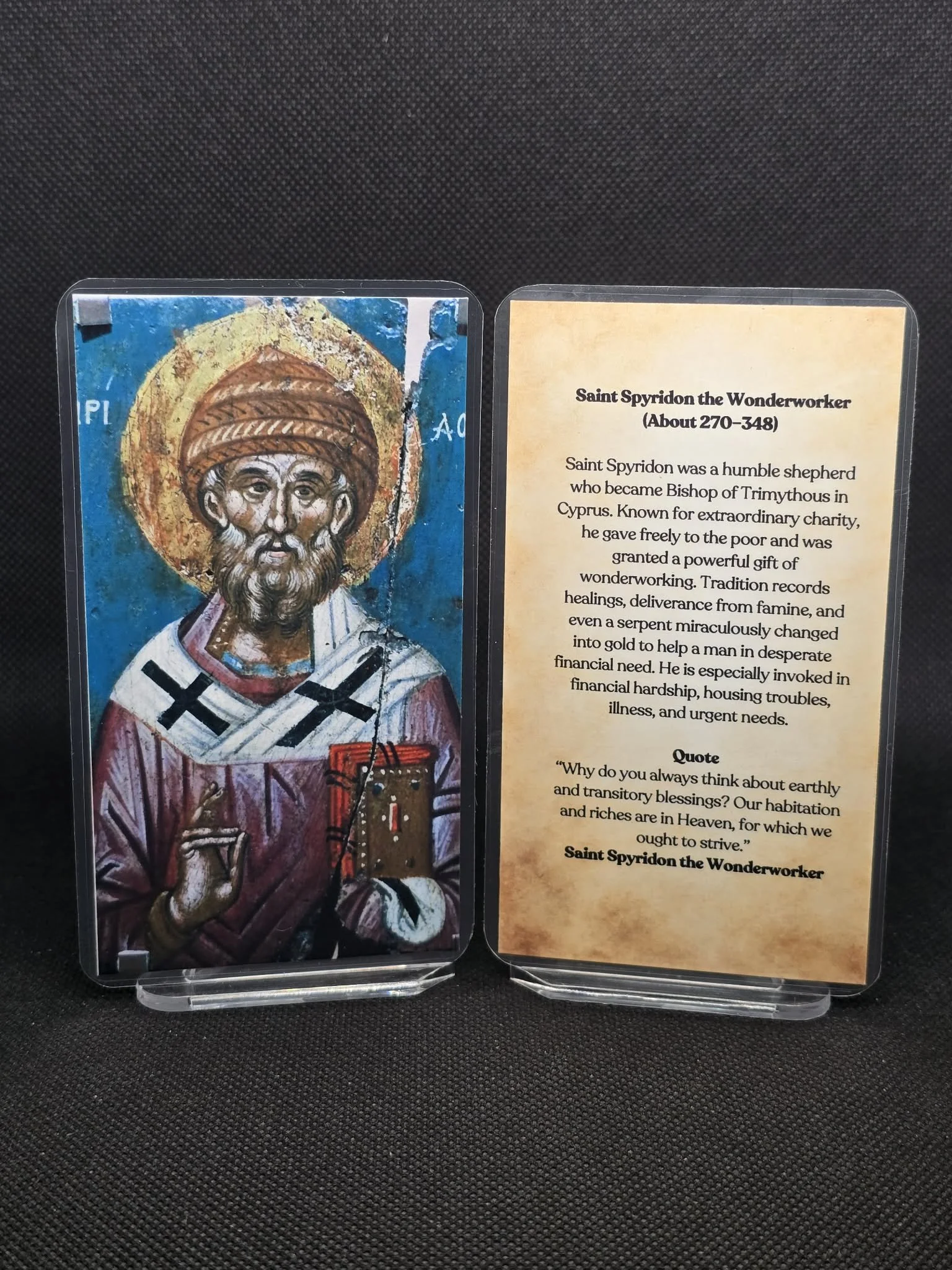
Saint Spyridon the Wonderworker is one of the most beloved saints of the Eastern Orthodox Church, remembered for an extraordinary life of simplicity, generosity, healing, and miraculous help. A shepherd who became a bishop, a defender of the Christian faith at the First Ecumenical Council of Nicaea, and a wonderworker whose relics are venerated on the Greek island of Corfu, Saint Spyridon has been loved by generations of Christians who turn to him in illness, poverty, debt, family difficulty, and urgent material need.
Saint Spyridon is especially meaningful for anyone facing financial hardship, overwhelming bills, debt, unemployment, difficulty finding a home, or a situation in which there simply does not seem to be enough. His ancient Life repeatedly presents him as a man who gave freely to the poor, opened his own storehouse to people in need, assisted those burdened by debt, and trusted God rather than wealth. For Christians frightened about money or unsure how their practical needs will be met, Saint Spyridon offers the example of a shepherd who possessed little, gave generously, and believed deeply in the providence of God.
He is also one of Christianity's great wonderworking bishops. Traditions concerning his life describe healings of incurable illness, deliverance from demons, miraculous rain during drought, the raising of the dead, the protection of the falsely accused, and extraordinary acts of divine provision. Orthodox Christians know him simply as Saint Spyridon the Wonderworker, and on Corfu he is honored not as a distant historical figure but as a living intercessor who continues to come to the aid of those who call upon God through his prayers.
One of the most beloved traditions surrounding Saint Spyridon is the reason he is sometimes called the Walking Saint. His incorrupt relics are enshrined on Corfu, and the slippers placed upon his feet are periodically replaced. According to the devotional tradition of the island, the slippers become worn because Saint Spyridon continues to "walk" throughout the world helping those who ask for his intercession. Pieces of these slippers have become treasured blessings in Orthodox churches throughout the world.
This prayer card is created for people facing financial difficulty, debt, unemployment, housing problems, business troubles, medical expenses, family emergencies, serious illness, legal injustice, or situations that appear humanly impossible. It is also appropriate for anyone seeking deeper trust in God's providence, generosity toward others, simplicity of life, courage in defending the faith, and freedom from the fear that comes when material circumstances become uncertain.
Saint Spyridon's traditional patronage and devotional associations include shepherds, farmers, the poor, those in material need, the sick, Corfu, and those seeking miraculous help. His connection with debt, financial hardship, housing, employment, and urgent material needs is best understood devotionally through the many traditions of his generosity and miraculous assistance rather than as a narrowly defined official patronage.
Each card is handmade in Austin, TX and created to order. We do not keep stock, because every prayer card is treated as a unique devotional offering. They are printed on museum-quality photo paper, not cardstock. Every card is made slowly, during prayer, with intentional reverence for the saint or holy image and for the person who will receive it. Names are lifted before Christ. Intentions are held carefully. Each piece is handled multiple times in prayerful silence, asking God for mercy and asking the saint to intercede for the soul it is being made for. This is not production work. It is devotional craftsmanship shaped with patience, care, and spiritual responsibility, because every soul and every prayer matters.
THE LIFE & STORY
Saint Spyridon was born on the island of Cyprus toward the end of the third century. Before becoming one of the great bishops and wonderworkers of the ancient Church, he lived the ordinary life of a shepherd. He married and had children, including a daughter named Irene. The simplicity of his beginnings remained important throughout his life. Even after he became a bishop, Christian tradition remembers him as humble, approachable, generous, and remarkably unconcerned with wealth or social status.
Spyridon used what he possessed to help his neighbors, strangers, the homeless, and the poor. His Life preserves a particularly striking description of how he helped people who were in debt. Part of his harvest was given outright to the needy, while another portion was made available to those who needed to borrow. He did not maintain elaborate records or demand complicated arrangements. Those who needed assistance could take what was necessary from his storehouse and later return it when they were able.
This generosity is one of the strongest reasons Saint Spyridon has become such a meaningful intercessor for Christians suffering under financial pressure. His concern for material need was not separated from his spiritual life. Feeding a hungry person, helping a debtor, welcoming a traveler, healing the sick, and preaching the truth of Christ all belonged to the same Christian life. He understood possessions as something entrusted by God for the service of others.
After the death of his wife, Spyridon was chosen as Bishop of Trimythous, or Tremithus, in Cyprus. Becoming a bishop did not transform him into an aristocrat or distance him from ordinary people. He continued to live simply and remained close to the poor. The shepherd of sheep became a shepherd of souls without abandoning the humility that had formed him.
Saint Spyridon is traditionally numbered among the bishops who participated in the First Ecumenical Council of Nicaea in AD 325. The Council confronted the teaching of Arius and proclaimed the Church's confession that the Son is truly God, of one essence with the Father. Among brilliant theologians and highly educated bishops, Spyridon stood out not because of sophisticated rhetoric but because of the simplicity and force of his faith.
One famous tradition tells of Saint Spyridon debating a philosopher who defended the Arian position. The philosopher was skilled in argument, but Spyridon's plain confession of the Christian faith affected him more deeply than clever reasoning. The story became a powerful image in Orthodox tradition: a humble shepherd confronting intellectual pride not through ignorance, but through a wisdom shaped by prayer and experience of God.
Another famous tradition from Nicaea tells how Saint Spyridon demonstrated the mystery of the Holy Trinity using a brick or piece of pottery. Holding the single object before those assembled, he squeezed it, and according to the story fire rose upward, water flowed downward, and clay remained in his hand. One object contained three elements, and Spyridon used the image to point toward the Christian confession of three divine Persons and one God. The scene appears frequently in Orthodox iconography of the saint.
Yet Saint Spyridon's holiness was never limited to theological controversy. His Life is filled with compassion. He welcomed strangers, distributed food, helped debtors, interceded for the sick, confronted injustice, and responded to human suffering with practical mercy. His miracles are remembered precisely because they occurred within this life of charity.
Saint Spyridon eventually reposed peacefully in the Lord during the fourth century. His relics were later transferred from Cyprus and ultimately came to the Greek island of Corfu, where they remain a center of intense devotion. To this day, Saint Spyridon is inseparably connected with Corfu, whose people honor him as their protector and powerful heavenly intercessor.
His feast is celebrated on December 12 in the Eastern Orthodox Church. Churches throughout Greece, Cyprus, the Balkans, the Middle East, Russia, Eastern Europe, and the Orthodox diaspora honor him as Saint Spyridon the Wonderworker, Bishop of Trimythous.
For modern Christians, Saint Spyridon's life speaks directly to a fear that has existed in every generation: the fear of not having enough. He knew poverty. He knew people burdened with debt. He knew farmers whose lives depended upon weather and harvest. He knew families with immediate physical needs. Yet his answer was not anxiety, hoarding, or indifference. His answer was faith in God expressed through generosity.
MIRACLES & PATRONAGE
Saint Spyridon's title Wonderworker comes from the remarkable number of miracles associated with his life and intercession. Ancient accounts describe him healing people suffering from serious illness, casting out demons, bringing rain during drought, stopping destructive weather, protecting innocent people from injustice, and even raising the dead through prayer.
One particularly moving account tells of a mother who brought her dead child to Saint Spyridon. The saint prayed, and the child was restored to life. Overcome by what she had witnessed, the mother herself collapsed and died. Saint Spyridon prayed again, and according to the tradition, the mother was also restored to life.
Another story concerns a friend of Saint Spyridon who had been falsely accused and condemned to death. Spyridon hurried to intervene, but a flooded stream blocked his path. He prayed and commanded the waters to allow him to cross. The waters obeyed, enabling him to continue his journey, and when the judge heard what had occurred, the condemned man was released. This story is one reason Saint Spyridon is also meaningful to those facing false accusations, legal injustice, or situations in which powerful circumstances seem impossible to overcome.
His Life also contains a miracle directly associated with financial need. One tradition tells of Saint Spyridon transforming a serpent into gold so that a poor man could meet an urgent financial obligation. When the crisis had passed and the gold was returned, the saint restored it to its original form. The story became another image of his concern for people whose material circumstances had become desperate.
Other stories describe robbers attempting to steal his sheep and being restrained by an invisible power. When Saint Spyridon discovered them the next morning, he did not punish them. He prayed for their release, urged them to abandon theft and earn an honest living, and then astonishingly gave them one of his sheep. Even his miracle of protection ended in mercy.
Orthodox tradition also remembers occasions when Saint Spyridon served the Divine services accompanied by unseen angels. One account describes invisible voices responding during the liturgy so beautifully that people outside the church came running toward the sound. When they entered, they found only Saint Spyridon and the few people serving with him.
After his earthly life, devotion to Saint Spyridon became especially strong on Corfu. His relics are enshrined there, and generations of Orthodox Christians have attributed protection, healing, and deliverance to his intercession. He is therefore honored as the protector of Corfu as well as one of the great wonderworkers of the Orthodox Church.
The beloved tradition of his worn slippers gives Saint Spyridon a particularly personal place in Orthodox devotion. The faithful speak of him as a saint who does not merely receive petitions from heaven but who goes out to meet those who need him. This is devotional language, but it captures something important about the way Orthodox Christians experience his intercession: Saint Spyridon is remembered as a helper who comes quickly.
For people facing financial hardship, his importance does not come from a promise that devotion will produce wealth. Saint Spyridon was himself a man of simplicity rather than luxury. His witness points instead toward providence, sufficient provision, freedom from desperation, generosity, justice, and trust that material difficulty is not beyond the mercy of God.
People therefore commonly seek Saint Spyridon's prayers during debt, unemployment, financial emergencies, difficulty finding suitable housing, unexpected expenses, business trouble, family crises, illness, and other urgent practical needs. These modern devotional associations fit naturally with the older stories of a bishop who continually opened his hands to people in material distress.
Saint Spyridon is equally meaningful for those trying to become more generous. It is easy to ask God for provision while remaining afraid to give anything away. Spyridon's life reverses that logic. He trusted God's providence enough to place what he possessed at the service of others. His life reminds Christians that the purpose of provision is not merely security, but love.
PRAYERS
The simplest traditional invocation may be prayed throughout the day: Holy Father Spyridon, pray to God for us.
The Orthodox Church also honors Saint Spyridon with a traditional Troparion and Kontakion on his feast. The Troparion remembers his defense of the truth at the First Ecumenical Council, his miracles, the raising of the dead, the transformation of the serpent into gold, the presence of angels during his prayers, and the healing God grants through his intercession.
A short portion of the traditional Troparion beautifully summarizes Orthodox devotion to him: “Glory to Him Who, through you, grants healing to all.”
Those praying about financial hardship do not need a complicated formula. The traditional invocation “Holy Father Spyridon, pray to God for us” may be offered while bringing the actual situation before Christ: the amount owed, the job that is needed, the home that must be found, the bill that cannot presently be paid, the business that is struggling, or the family member who needs help.
The same invocation can be used during serious illness, unjust accusation, family crisis, or another seemingly impossible situation. Christian prayer does not treat the saint as the source of the miracle. Saint Spyridon intercedes before God, while every grace, healing, provision, and deliverance ultimately comes from the Lord.
This prayer card is especially fitting for a wallet, purse, desk, home prayer corner, workplace, business, vehicle, hospital room, or anywhere a person wants a small physical reminder to turn fear into prayer and place material concerns before God.
FAQ
Who is Saint Spyridon the Wonderworker?
Saint Spyridon the Wonderworker was a fourth-century Christian bishop from Cyprus. He began life as a shepherd, married and had a family, later became Bishop of Trimythous, participated according to Church tradition in the First Ecumenical Council of Nicaea, and became famous for his humility, generosity, healing miracles, and extraordinary intercession.
Is Saint Spyridon an Orthodox saint?
Yes. Saint Spyridon is one of the most beloved saints of the Eastern Orthodox Church. Because he lived centuries before the separation between Eastern and Western Christianity, he also belongs to the shared ancient Christian heritage and is honored in Catholic tradition.
What is Saint Spyridon the patron saint of?
Saint Spyridon is traditionally associated with shepherds, farmers, the poor, the sick, and the island of Corfu, where his relics are enshrined and where he is honored as protector of the island. He is also widely invoked as a wonderworker for urgent needs and seemingly impossible circumstances.
Is Saint Spyridon the patron saint of money or financial problems?
It is more accurate to call Saint Spyridon a powerful intercessor for financial hardship and material need rather than an official patron saint of money. His ancient Life repeatedly emphasizes generosity to the poor, assistance to people in debt, and miraculous help during material crises. This historical tradition is the foundation for modern devotion to him during financial difficulty.
Why do people pray to Saint Spyridon for debt?
Saint Spyridon's Life specifically describes him helping people who were in debt. He allowed those in need to take provisions from his storehouse and return them later when they were able. Another miracle tradition describes him providing gold to a poor man facing an urgent financial obligation. These stories have made him especially meaningful to Christians struggling with debt.
Is Saint Spyridon associated with housing or finding a home?
Many Orthodox Christians today seek Saint Spyridon's intercession when searching for housing, facing housing insecurity, trying to purchase or rent a home, or dealing with another urgent material need. Housing is best understood as a modern devotional association connected with his broader tradition of helping people in practical necessity rather than as one of his ancient formal patronages.
Can I pray to Saint Spyridon for a job?
Yes. Christians may ask Saint Spyridon to intercede when unemployed, searching for work, facing job insecurity, or trying to provide for a family. His life strongly emphasizes honest labor, care for those in material need, generosity, and trust in God's providence.
Can I pray to Saint Spyridon for my business?
Yes. A business owner may seek Saint Spyridon's intercession during financial pressure, lost income, debt, difficult decisions, or uncertainty about the future. His example is especially useful because he points toward honest work, generosity, simplicity, mercy toward those who owe us, and trust in God rather than money.
Can I pray to Saint Spyridon for an emergency?
Yes. Saint Spyridon is traditionally honored as a wonderworker, and many of the stories associated with him involve immediate situations in which human help seemed insufficient. Christians invoke his intercession during illness, financial emergencies, injustice, danger, and other urgent needs.
Why is Saint Spyridon called the Wonderworker?
Saint Spyridon is called the Wonderworker because Christian tradition attributes numerous miracles to his prayers. These include healings, deliverance from demons, miraculous changes in weather, the raising of the dead, protection of innocent people, miraculous provision, and many miracles associated with his intercession after death.
Why is Saint Spyridon called the Walking Saint?
Saint Spyridon is affectionately called the Walking Saint because of a longstanding devotional tradition associated with his relics on Corfu. The slippers placed upon his feet are replaced periodically, and the faithful traditionally interpret their wear as a sign that Saint Spyridon continues to travel spiritually to help those who seek his intercession.
Where are Saint Spyridon's relics?
Saint Spyridon's relics are enshrined in the Church of Saint Spyridon on the Greek island of Corfu, also called Kerkyra. The shrine is one of the most important centers of devotion on the island, and Saint Spyridon is deeply woven into the religious identity and history of Corfu.
Was Saint Spyridon at the Council of Nicaea?
According to the ancient Church tradition preserved in his Life, Saint Spyridon participated in the First Ecumenical Council of Nicaea in AD 325. He is remembered for defending the divinity of Christ and the Orthodox confession of the Holy Trinity against Arian teaching.
What is the story of Saint Spyridon and the brick?
According to tradition, Saint Spyridon held a brick or piece of pottery while explaining the mystery of the Holy Trinity. Fire rose from it, water flowed downward, and clay remained in his hand. The single object containing three elements became an illustration of three divine Persons and one God.
What is the story of Saint Spyridon turning a snake into gold?
One of the best-known miracle traditions associated with Saint Spyridon tells of a poor man who desperately needed financial help. Saint Spyridon transformed a serpent into gold so the man could meet his obligation. After the debt had been resolved and the gold returned, Spyridon restored it to its original form. The miracle is even remembered in the Orthodox hymnography for his feast.
Did Saint Spyridon help poor people?
Yes. Care for the poor is one of the clearest themes of Saint Spyridon's life. He distributed his harvest to those in need, allowed people burdened by debt to take what they required from his storehouse, welcomed strangers, and lived with remarkable simplicity even after becoming a bishop.
What does Saint Spyridon teach about money?
Saint Spyridon teaches that possessions are gifts to be used with mercy rather than objects to be guarded fearfully. His life emphasizes generosity, simplicity, assistance to debtors, honest labor, and trust in God's providence. He is therefore a particularly meaningful saint for Christians trying to remain faithful while living through financial uncertainty.
When is Saint Spyridon's feast day?
Saint Spyridon the Wonderworker is commemorated on December 12 in the Eastern Orthodox Church.
Can I give this prayer card to someone struggling financially?
Yes. This card is especially fitting for someone facing debt, unemployment, reduced income, medical bills, housing difficulty, business problems, or another financial crisis. It provides a physical reminder that practical material needs can be brought before God in prayer.
Can I give this prayer card to someone looking for a home?
Yes. Saint Spyridon has become a beloved intercessor for people seeking housing or dealing with instability surrounding their home. It can be a meaningful devotional gift for someone searching for an apartment, purchasing a house, facing eviction or foreclosure, moving unexpectedly, or simply praying that God will provide an appropriate place to live.
Can I give this prayer card to someone who is sick?
Yes. Saint Spyridon has been honored as a healing wonderworker since ancient times. His Life contains numerous accounts of healing those suffering from serious illness, and the Orthodox Church continues to invoke him among the great wonderworking saints.
What is the main message of Saint Spyridon's life?
Saint Spyridon's life teaches that extraordinary holiness can exist together with profound simplicity. He was a shepherd, husband, father, bishop, defender of the faith, servant of the poor, and wonderworker. He possessed little, gave freely, trusted God deeply, and used everything placed in his hands for the good of others. For anyone frightened about money, health, housing, work, or an uncertain future, his life offers the same invitation: bring the need to God, refuse despair, remain generous, and trust that no human difficulty is beyond divine providence.
Saint Spyridon the Wonderworker is one of the most beloved saints of the Eastern Orthodox Church, remembered for an extraordinary life of simplicity, generosity, healing, and miraculous help. A shepherd who became a bishop, a defender of the Christian faith at the First Ecumenical Council of Nicaea, and a wonderworker whose relics are venerated on the Greek island of Corfu, Saint Spyridon has been loved by generations of Christians who turn to him in illness, poverty, debt, family difficulty, and urgent material need.
Saint Spyridon is especially meaningful for anyone facing financial hardship, overwhelming bills, debt, unemployment, difficulty finding a home, or a situation in which there simply does not seem to be enough. His ancient Life repeatedly presents him as a man who gave freely to the poor, opened his own storehouse to people in need, assisted those burdened by debt, and trusted God rather than wealth. For Christians frightened about money or unsure how their practical needs will be met, Saint Spyridon offers the example of a shepherd who possessed little, gave generously, and believed deeply in the providence of God.
He is also one of Christianity's great wonderworking bishops. Traditions concerning his life describe healings of incurable illness, deliverance from demons, miraculous rain during drought, the raising of the dead, the protection of the falsely accused, and extraordinary acts of divine provision. Orthodox Christians know him simply as Saint Spyridon the Wonderworker, and on Corfu he is honored not as a distant historical figure but as a living intercessor who continues to come to the aid of those who call upon God through his prayers.
One of the most beloved traditions surrounding Saint Spyridon is the reason he is sometimes called the Walking Saint. His incorrupt relics are enshrined on Corfu, and the slippers placed upon his feet are periodically replaced. According to the devotional tradition of the island, the slippers become worn because Saint Spyridon continues to "walk" throughout the world helping those who ask for his intercession. Pieces of these slippers have become treasured blessings in Orthodox churches throughout the world.
This prayer card is created for people facing financial difficulty, debt, unemployment, housing problems, business troubles, medical expenses, family emergencies, serious illness, legal injustice, or situations that appear humanly impossible. It is also appropriate for anyone seeking deeper trust in God's providence, generosity toward others, simplicity of life, courage in defending the faith, and freedom from the fear that comes when material circumstances become uncertain.
Saint Spyridon's traditional patronage and devotional associations include shepherds, farmers, the poor, those in material need, the sick, Corfu, and those seeking miraculous help. His connection with debt, financial hardship, housing, employment, and urgent material needs is best understood devotionally through the many traditions of his generosity and miraculous assistance rather than as a narrowly defined official patronage.
Each card is handmade in Austin, TX and created to order. We do not keep stock, because every prayer card is treated as a unique devotional offering. They are printed on museum-quality photo paper, not cardstock. Every card is made slowly, during prayer, with intentional reverence for the saint or holy image and for the person who will receive it. Names are lifted before Christ. Intentions are held carefully. Each piece is handled multiple times in prayerful silence, asking God for mercy and asking the saint to intercede for the soul it is being made for. This is not production work. It is devotional craftsmanship shaped with patience, care, and spiritual responsibility, because every soul and every prayer matters.
THE LIFE & STORY
Saint Spyridon was born on the island of Cyprus toward the end of the third century. Before becoming one of the great bishops and wonderworkers of the ancient Church, he lived the ordinary life of a shepherd. He married and had children, including a daughter named Irene. The simplicity of his beginnings remained important throughout his life. Even after he became a bishop, Christian tradition remembers him as humble, approachable, generous, and remarkably unconcerned with wealth or social status.
Spyridon used what he possessed to help his neighbors, strangers, the homeless, and the poor. His Life preserves a particularly striking description of how he helped people who were in debt. Part of his harvest was given outright to the needy, while another portion was made available to those who needed to borrow. He did not maintain elaborate records or demand complicated arrangements. Those who needed assistance could take what was necessary from his storehouse and later return it when they were able.
This generosity is one of the strongest reasons Saint Spyridon has become such a meaningful intercessor for Christians suffering under financial pressure. His concern for material need was not separated from his spiritual life. Feeding a hungry person, helping a debtor, welcoming a traveler, healing the sick, and preaching the truth of Christ all belonged to the same Christian life. He understood possessions as something entrusted by God for the service of others.
After the death of his wife, Spyridon was chosen as Bishop of Trimythous, or Tremithus, in Cyprus. Becoming a bishop did not transform him into an aristocrat or distance him from ordinary people. He continued to live simply and remained close to the poor. The shepherd of sheep became a shepherd of souls without abandoning the humility that had formed him.
Saint Spyridon is traditionally numbered among the bishops who participated in the First Ecumenical Council of Nicaea in AD 325. The Council confronted the teaching of Arius and proclaimed the Church's confession that the Son is truly God, of one essence with the Father. Among brilliant theologians and highly educated bishops, Spyridon stood out not because of sophisticated rhetoric but because of the simplicity and force of his faith.
One famous tradition tells of Saint Spyridon debating a philosopher who defended the Arian position. The philosopher was skilled in argument, but Spyridon's plain confession of the Christian faith affected him more deeply than clever reasoning. The story became a powerful image in Orthodox tradition: a humble shepherd confronting intellectual pride not through ignorance, but through a wisdom shaped by prayer and experience of God.
Another famous tradition from Nicaea tells how Saint Spyridon demonstrated the mystery of the Holy Trinity using a brick or piece of pottery. Holding the single object before those assembled, he squeezed it, and according to the story fire rose upward, water flowed downward, and clay remained in his hand. One object contained three elements, and Spyridon used the image to point toward the Christian confession of three divine Persons and one God. The scene appears frequently in Orthodox iconography of the saint.
Yet Saint Spyridon's holiness was never limited to theological controversy. His Life is filled with compassion. He welcomed strangers, distributed food, helped debtors, interceded for the sick, confronted injustice, and responded to human suffering with practical mercy. His miracles are remembered precisely because they occurred within this life of charity.
Saint Spyridon eventually reposed peacefully in the Lord during the fourth century. His relics were later transferred from Cyprus and ultimately came to the Greek island of Corfu, where they remain a center of intense devotion. To this day, Saint Spyridon is inseparably connected with Corfu, whose people honor him as their protector and powerful heavenly intercessor.
His feast is celebrated on December 12 in the Eastern Orthodox Church. Churches throughout Greece, Cyprus, the Balkans, the Middle East, Russia, Eastern Europe, and the Orthodox diaspora honor him as Saint Spyridon the Wonderworker, Bishop of Trimythous.
For modern Christians, Saint Spyridon's life speaks directly to a fear that has existed in every generation: the fear of not having enough. He knew poverty. He knew people burdened with debt. He knew farmers whose lives depended upon weather and harvest. He knew families with immediate physical needs. Yet his answer was not anxiety, hoarding, or indifference. His answer was faith in God expressed through generosity.
MIRACLES & PATRONAGE
Saint Spyridon's title Wonderworker comes from the remarkable number of miracles associated with his life and intercession. Ancient accounts describe him healing people suffering from serious illness, casting out demons, bringing rain during drought, stopping destructive weather, protecting innocent people from injustice, and even raising the dead through prayer.
One particularly moving account tells of a mother who brought her dead child to Saint Spyridon. The saint prayed, and the child was restored to life. Overcome by what she had witnessed, the mother herself collapsed and died. Saint Spyridon prayed again, and according to the tradition, the mother was also restored to life.
Another story concerns a friend of Saint Spyridon who had been falsely accused and condemned to death. Spyridon hurried to intervene, but a flooded stream blocked his path. He prayed and commanded the waters to allow him to cross. The waters obeyed, enabling him to continue his journey, and when the judge heard what had occurred, the condemned man was released. This story is one reason Saint Spyridon is also meaningful to those facing false accusations, legal injustice, or situations in which powerful circumstances seem impossible to overcome.
His Life also contains a miracle directly associated with financial need. One tradition tells of Saint Spyridon transforming a serpent into gold so that a poor man could meet an urgent financial obligation. When the crisis had passed and the gold was returned, the saint restored it to its original form. The story became another image of his concern for people whose material circumstances had become desperate.
Other stories describe robbers attempting to steal his sheep and being restrained by an invisible power. When Saint Spyridon discovered them the next morning, he did not punish them. He prayed for their release, urged them to abandon theft and earn an honest living, and then astonishingly gave them one of his sheep. Even his miracle of protection ended in mercy.
Orthodox tradition also remembers occasions when Saint Spyridon served the Divine services accompanied by unseen angels. One account describes invisible voices responding during the liturgy so beautifully that people outside the church came running toward the sound. When they entered, they found only Saint Spyridon and the few people serving with him.
After his earthly life, devotion to Saint Spyridon became especially strong on Corfu. His relics are enshrined there, and generations of Orthodox Christians have attributed protection, healing, and deliverance to his intercession. He is therefore honored as the protector of Corfu as well as one of the great wonderworkers of the Orthodox Church.
The beloved tradition of his worn slippers gives Saint Spyridon a particularly personal place in Orthodox devotion. The faithful speak of him as a saint who does not merely receive petitions from heaven but who goes out to meet those who need him. This is devotional language, but it captures something important about the way Orthodox Christians experience his intercession: Saint Spyridon is remembered as a helper who comes quickly.
For people facing financial hardship, his importance does not come from a promise that devotion will produce wealth. Saint Spyridon was himself a man of simplicity rather than luxury. His witness points instead toward providence, sufficient provision, freedom from desperation, generosity, justice, and trust that material difficulty is not beyond the mercy of God.
People therefore commonly seek Saint Spyridon's prayers during debt, unemployment, financial emergencies, difficulty finding suitable housing, unexpected expenses, business trouble, family crises, illness, and other urgent practical needs. These modern devotional associations fit naturally with the older stories of a bishop who continually opened his hands to people in material distress.
Saint Spyridon is equally meaningful for those trying to become more generous. It is easy to ask God for provision while remaining afraid to give anything away. Spyridon's life reverses that logic. He trusted God's providence enough to place what he possessed at the service of others. His life reminds Christians that the purpose of provision is not merely security, but love.
PRAYERS
The simplest traditional invocation may be prayed throughout the day: Holy Father Spyridon, pray to God for us.
The Orthodox Church also honors Saint Spyridon with a traditional Troparion and Kontakion on his feast. The Troparion remembers his defense of the truth at the First Ecumenical Council, his miracles, the raising of the dead, the transformation of the serpent into gold, the presence of angels during his prayers, and the healing God grants through his intercession.
A short portion of the traditional Troparion beautifully summarizes Orthodox devotion to him: “Glory to Him Who, through you, grants healing to all.”
Those praying about financial hardship do not need a complicated formula. The traditional invocation “Holy Father Spyridon, pray to God for us” may be offered while bringing the actual situation before Christ: the amount owed, the job that is needed, the home that must be found, the bill that cannot presently be paid, the business that is struggling, or the family member who needs help.
The same invocation can be used during serious illness, unjust accusation, family crisis, or another seemingly impossible situation. Christian prayer does not treat the saint as the source of the miracle. Saint Spyridon intercedes before God, while every grace, healing, provision, and deliverance ultimately comes from the Lord.
This prayer card is especially fitting for a wallet, purse, desk, home prayer corner, workplace, business, vehicle, hospital room, or anywhere a person wants a small physical reminder to turn fear into prayer and place material concerns before God.
FAQ
Who is Saint Spyridon the Wonderworker?
Saint Spyridon the Wonderworker was a fourth-century Christian bishop from Cyprus. He began life as a shepherd, married and had a family, later became Bishop of Trimythous, participated according to Church tradition in the First Ecumenical Council of Nicaea, and became famous for his humility, generosity, healing miracles, and extraordinary intercession.
Is Saint Spyridon an Orthodox saint?
Yes. Saint Spyridon is one of the most beloved saints of the Eastern Orthodox Church. Because he lived centuries before the separation between Eastern and Western Christianity, he also belongs to the shared ancient Christian heritage and is honored in Catholic tradition.
What is Saint Spyridon the patron saint of?
Saint Spyridon is traditionally associated with shepherds, farmers, the poor, the sick, and the island of Corfu, where his relics are enshrined and where he is honored as protector of the island. He is also widely invoked as a wonderworker for urgent needs and seemingly impossible circumstances.
Is Saint Spyridon the patron saint of money or financial problems?
It is more accurate to call Saint Spyridon a powerful intercessor for financial hardship and material need rather than an official patron saint of money. His ancient Life repeatedly emphasizes generosity to the poor, assistance to people in debt, and miraculous help during material crises. This historical tradition is the foundation for modern devotion to him during financial difficulty.
Why do people pray to Saint Spyridon for debt?
Saint Spyridon's Life specifically describes him helping people who were in debt. He allowed those in need to take provisions from his storehouse and return them later when they were able. Another miracle tradition describes him providing gold to a poor man facing an urgent financial obligation. These stories have made him especially meaningful to Christians struggling with debt.
Is Saint Spyridon associated with housing or finding a home?
Many Orthodox Christians today seek Saint Spyridon's intercession when searching for housing, facing housing insecurity, trying to purchase or rent a home, or dealing with another urgent material need. Housing is best understood as a modern devotional association connected with his broader tradition of helping people in practical necessity rather than as one of his ancient formal patronages.
Can I pray to Saint Spyridon for a job?
Yes. Christians may ask Saint Spyridon to intercede when unemployed, searching for work, facing job insecurity, or trying to provide for a family. His life strongly emphasizes honest labor, care for those in material need, generosity, and trust in God's providence.
Can I pray to Saint Spyridon for my business?
Yes. A business owner may seek Saint Spyridon's intercession during financial pressure, lost income, debt, difficult decisions, or uncertainty about the future. His example is especially useful because he points toward honest work, generosity, simplicity, mercy toward those who owe us, and trust in God rather than money.
Can I pray to Saint Spyridon for an emergency?
Yes. Saint Spyridon is traditionally honored as a wonderworker, and many of the stories associated with him involve immediate situations in which human help seemed insufficient. Christians invoke his intercession during illness, financial emergencies, injustice, danger, and other urgent needs.
Why is Saint Spyridon called the Wonderworker?
Saint Spyridon is called the Wonderworker because Christian tradition attributes numerous miracles to his prayers. These include healings, deliverance from demons, miraculous changes in weather, the raising of the dead, protection of innocent people, miraculous provision, and many miracles associated with his intercession after death.
Why is Saint Spyridon called the Walking Saint?
Saint Spyridon is affectionately called the Walking Saint because of a longstanding devotional tradition associated with his relics on Corfu. The slippers placed upon his feet are replaced periodically, and the faithful traditionally interpret their wear as a sign that Saint Spyridon continues to travel spiritually to help those who seek his intercession.
Where are Saint Spyridon's relics?
Saint Spyridon's relics are enshrined in the Church of Saint Spyridon on the Greek island of Corfu, also called Kerkyra. The shrine is one of the most important centers of devotion on the island, and Saint Spyridon is deeply woven into the religious identity and history of Corfu.
Was Saint Spyridon at the Council of Nicaea?
According to the ancient Church tradition preserved in his Life, Saint Spyridon participated in the First Ecumenical Council of Nicaea in AD 325. He is remembered for defending the divinity of Christ and the Orthodox confession of the Holy Trinity against Arian teaching.
What is the story of Saint Spyridon and the brick?
According to tradition, Saint Spyridon held a brick or piece of pottery while explaining the mystery of the Holy Trinity. Fire rose from it, water flowed downward, and clay remained in his hand. The single object containing three elements became an illustration of three divine Persons and one God.
What is the story of Saint Spyridon turning a snake into gold?
One of the best-known miracle traditions associated with Saint Spyridon tells of a poor man who desperately needed financial help. Saint Spyridon transformed a serpent into gold so the man could meet his obligation. After the debt had been resolved and the gold returned, Spyridon restored it to its original form. The miracle is even remembered in the Orthodox hymnography for his feast.
Did Saint Spyridon help poor people?
Yes. Care for the poor is one of the clearest themes of Saint Spyridon's life. He distributed his harvest to those in need, allowed people burdened by debt to take what they required from his storehouse, welcomed strangers, and lived with remarkable simplicity even after becoming a bishop.
What does Saint Spyridon teach about money?
Saint Spyridon teaches that possessions are gifts to be used with mercy rather than objects to be guarded fearfully. His life emphasizes generosity, simplicity, assistance to debtors, honest labor, and trust in God's providence. He is therefore a particularly meaningful saint for Christians trying to remain faithful while living through financial uncertainty.
When is Saint Spyridon's feast day?
Saint Spyridon the Wonderworker is commemorated on December 12 in the Eastern Orthodox Church.
Can I give this prayer card to someone struggling financially?
Yes. This card is especially fitting for someone facing debt, unemployment, reduced income, medical bills, housing difficulty, business problems, or another financial crisis. It provides a physical reminder that practical material needs can be brought before God in prayer.
Can I give this prayer card to someone looking for a home?
Yes. Saint Spyridon has become a beloved intercessor for people seeking housing or dealing with instability surrounding their home. It can be a meaningful devotional gift for someone searching for an apartment, purchasing a house, facing eviction or foreclosure, moving unexpectedly, or simply praying that God will provide an appropriate place to live.
Can I give this prayer card to someone who is sick?
Yes. Saint Spyridon has been honored as a healing wonderworker since ancient times. His Life contains numerous accounts of healing those suffering from serious illness, and the Orthodox Church continues to invoke him among the great wonderworking saints.
What is the main message of Saint Spyridon's life?
Saint Spyridon's life teaches that extraordinary holiness can exist together with profound simplicity. He was a shepherd, husband, father, bishop, defender of the faith, servant of the poor, and wonderworker. He possessed little, gave freely, trusted God deeply, and used everything placed in his hands for the good of others. For anyone frightened about money, health, housing, work, or an uncertain future, his life offers the same invitation: bring the need to God, refuse despair, remain generous, and trust that no human difficulty is beyond divine providence.