 Image 1 of 1
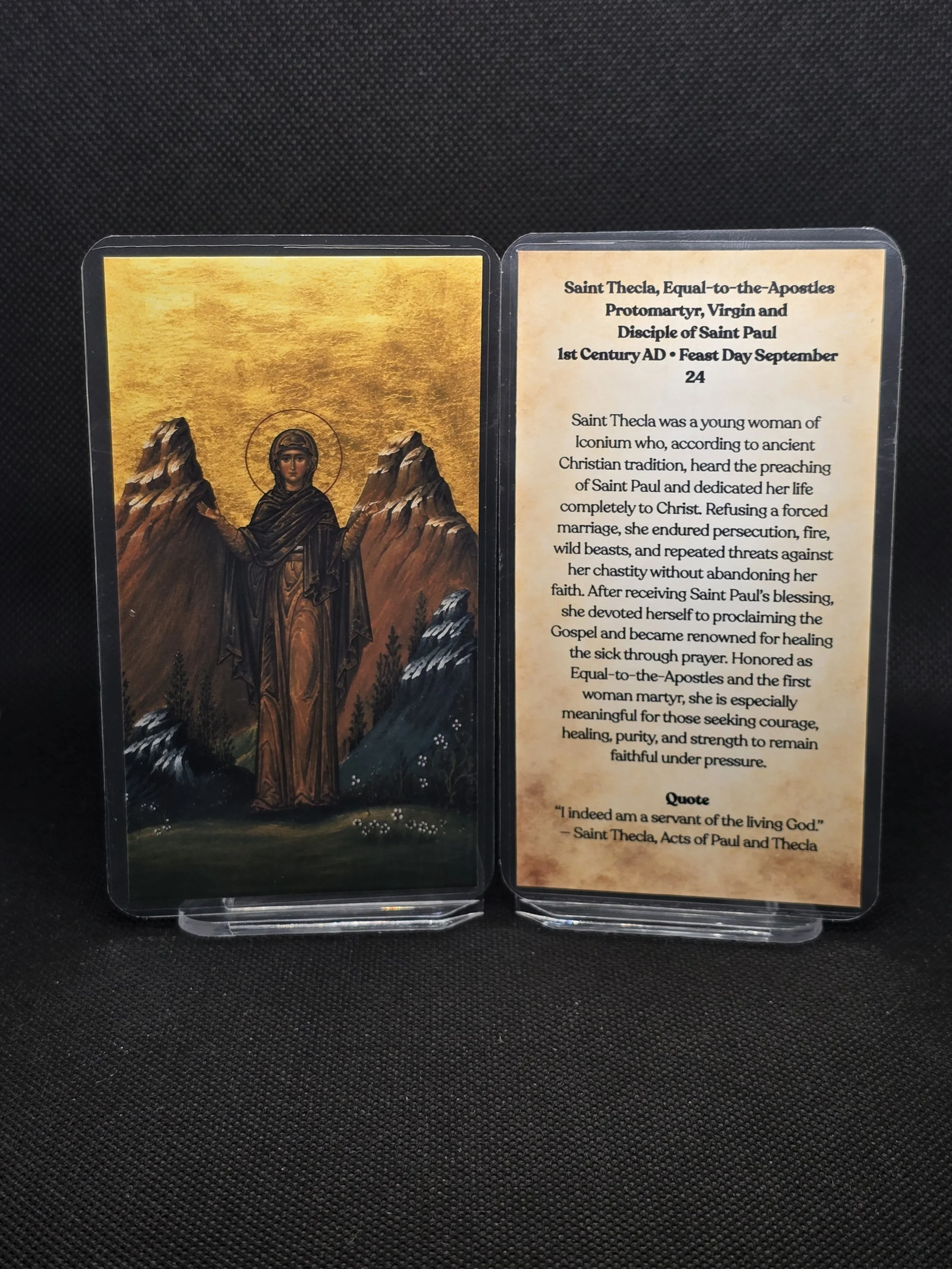
Saint Thecla, Equal-to-the-Apostles Prayer Card - For Courage, Healing, Chastity & Faith Under Pressure
Saint Thecla, also written Saint Thekla, is honored throughout the Eastern Christian tradition as the Holy Protomartyr and Equal-to-the-Apostles, one of the earliest and most celebrated female disciples associated with the apostolic age. According to the ancient Christian tradition received by the Orthodox Church, she was a young woman of Iconium who heard Saint Paul preach, gave her life completely to Jesus Christ, refused an arranged marriage despite tremendous family and civil pressure, survived repeated attempts to execute her, preached the Gospel, cared for the sick, and spent the remainder of her long life in prayer and evangelization. The Orthodox Church commemorates her on September 24 and gives her the exceptional titles Protomartyr among women and Equal-to-the-Apostles.
Saint Thecla is especially meaningful for women discerning vocation, Christians facing pressure from family or society, people trying to remain faithful when obedience to Christ costs them security, those resisting coercive relationships, women seeking chastity and spiritual strength, missionaries, evangelists, ascetics, monastics, and people asking God for healing. Several of these associations come directly from the Church's received Life, which remembers her refusing a marriage she no longer believed she could enter faithfully, surviving persecution, preaching Christ, healing the sick without payment, and converting many people. The OCA also specifically notes that Saint Thecla is invoked during the monastic tonsure of women, giving her a particularly strong and established connection with women's monastic vocation.
Her life is particularly powerful for someone who feels pressured to make a life decision simply because other people have already decided what that life should look like. Thecla's family expected marriage, her fiancé expected marriage, and the civil authorities eventually became involved when she refused, yet the received Christian tradition remembers her conclusion as a matter of conscience before Christ rather than adolescent rebellion for its own sake. Her story therefore provides a meaningful spiritual companion for people discerning marriage, celibacy, monasticism, missionary service, or another vocation when family expectations and personal conviction are pulling in different directions.
Saint Thecla is also a powerful saint for women facing unwanted sexual attention, coercion, harassment, or attempts by another person to control their body or future. The received Orthodox Life remembers a powerful man named Alexander pursuing her in Antioch after she had already chosen a life dedicated to Christ, while later tradition remembers further threats against her chastity in old age. The spiritual application should not turn every difficult relationship into martyrdom, but Thecla's story clearly presents a woman whose refusal had to be respected even when powerful men and civil authorities wanted something different from her.
Her connection with healing is equally ancient. The Orthodox Life remembers Thecla spending many years near Seleucia preaching Christ and healing the sick through prayer, and the Antiochian tradition at Maaloula preserves an equally strong reputation for her as a healing saint whose shrine has attracted generations of pilgrims seeking help for illness and infertility. The healing tradition is therefore substantial enough to use confidently on a prayer card, although it is more accurate to describe Saint Thecla broadly as a wonderworking healer than to manufacture an exclusive patronage over one modern diagnosis.
Saint Thecla also has tremendous importance for Christian women called to teach, evangelize, or bear public witness to Christ. The title Equal-to-the-Apostles is not simply decorative praise because the Church's received Life says she preached the Gospel for years, converted many pagans, and became one of the earliest female models of apostolic Christian witness. Greek Orthodox educational material continues to name Saint Thecla specifically among women honored as Equal to the Apostles.
There is an important historical distinction worth making carefully. Saint Thecla is not named in the canonical New Testament, and the earliest surviving extended written narrative of her life is the second-century Acts of Paul and Thecla, an apocryphal Christian work that became extraordinarily influential in early Christianity. The Orthodox Church nevertheless received Thecla herself into its liturgical and hagiographic tradition, so a careful product page can distinguish between the antiquity of her Christian veneration and the fact that many narrative details come from post-New Testament tradition rather than pretending every scene is recorded in canonical Acts.
That distinction actually makes her ancient cult more interesting rather than less important. Thecla's veneration was deeply established in the early Christian world, major sanctuaries arose in places associated with her, women and ascetics looked to her as a model, and the surviving liturgy calls her the first woman martyr and a bearer of the apostolic faith. Her feast remains firmly established in Orthodox calendars today.
This prayer card is especially fitting for women discerning monastic life, young adults under intense family pressure, missionaries, catechists, Christian women in leadership or teaching roles, people suffering persecution for the faith, those facing coercive relationships, people praying for physical healing, and Christians trying to remain faithful when the easiest option would be compromise. It can also make a meaningful baptism, chrismation, vocation, monastic profession, graduation, missionary commissioning, or name-day gift for someone named Thecla, Thekla, Tekla, or Tecla.
Each card is handmade in Austin, TX and created to order. We do not keep stock, because every prayer card is treated as a unique devotional offering. They are printed on museum-quality photo paper, not cardstock, and every card is made slowly during prayer with intentional reverence for the saint and for the person who will receive it. Names are lifted before Christ, intentions are held carefully, and each piece is handled multiple times in prayerful silence, asking God for mercy and asking Saint Thecla to intercede for the soul it is being made for. This is devotional craftsmanship shaped with patience, care, and spiritual responsibility because every soul and every prayer matters.
THE LIFE & STORY
The Orthodox Church's received Life places Saint Thecla in Iconium, the ancient city corresponding to modern Konya in Turkey, during the apostolic age. She is remembered as the daughter of a wealthy and distinguished family and as an exceptionally beautiful young woman who, at approximately eighteen years old, had already been promised in marriage to an important young man.
Her life changed when she heard the preaching of Saint Paul the Apostle. The traditional narrative says that Paul's proclamation of Jesus Christ affected Thecla so deeply that she resolved to devote her life completely to Christ rather than proceed with the marriage planned for her. The Church's later hymnography preserves this connection prominently, beginning its Troparion by remembering that she was enlightened through Paul's words.
The decision immediately created conflict within her household. Thecla's mother opposed her refusal to marry, while her fiancé brought a complaint against Paul before the local prefect and accused the Apostle of turning his bride away from him. Paul was consequently imprisoned, and the received Life says Thecla secretly left her home at night, gave her jewelry to the guards, and entered the prison so that she could continue listening to Paul's instruction.
For three days, according to the tradition, she remained with Paul listening to his teaching until her disappearance was discovered. Servants eventually found her and brought her home by force, while Paul was brought before the authorities and banished from the city. Thecla was again pressured to accept the marriage, but neither her mother's pleading and anger nor the prefect's threats changed her decision.
This is one of the defining moments of her Christian identity. She was not merely choosing between two possible husbands or rejecting marriage as though marriage itself were spiritually inferior, because the Church venerates countless married saints and regards Christian marriage as holy. The point of Thecla's story is that she believed her particular vocation had become a complete dedication to Christ, and continuing toward a marriage she no longer freely intended would have violated that conviction.
The conflict then became terrifyingly severe. The traditional Life says her own mother called for her execution, and the authorities condemned Thecla to be burned alive because she would not abandon her new Christian commitment. She entered the place of execution making the Sign of the Cross, while the Church's tradition remembers divine protection intervening through a storm that extinguished the flames.
The episode became the foundation for her title Protomartyr among women. Thecla did not die in that first attempted execution, so the word does not mean that she was killed before every other female Christian, but Eastern Christian usage remembers her as the first great female sufferer for Christ and the prototype of generations of women martyrs who followed. Her Troparion explicitly calls her the first sufferer and martyr among women.
After escaping the fire, Thecla searched for Saint Paul and the Christians accompanying him. The received Orthodox tradition remembers Paul and his companions praying for her during the persecution, and Thecla eventually joined them before continuing toward Antioch, where another major trial began.
CHOOSING CHRIST WHEN FAMILY EXPECTATIONS ARE DIFFERENT
Saint Thecla's first great struggle was not against an emperor or foreign army. It took place within her own family and involved expectations about marriage, status, security, and the future that had apparently already been settled on her behalf.
That makes her story unusually relevant to vocational discernment. Family members often want what they sincerely believe is best for someone, yet even loving expectations can become painful when a person senses a genuine vocation that does not resemble the future everyone else imagined.
Saint Thecla should not be invoked as an excuse for rejecting advice simply because advice is uncomfortable. Her story instead raises a more demanding question about whether a Christian has become sufficiently rooted in Christ to distinguish between selfish resistance and a genuine call that may require disappointing people they love.
Her connection with women entering monastic life makes this application especially strong. The OCA specifically says Saint Thecla is invoked during the tonsure of women into monasticism, showing that the Church itself sees her refusal of marriage and total dedication to Christ as a lasting model for women called to consecrated ascetic life.
A young woman discerning monasticism can therefore seek Saint Thecla's prayers not merely for courage to leave ordinary life but for clarity about whether that call genuinely comes from God. A family struggling to understand such a vocation can likewise seek her intercession for peace, patience, and the ability to distinguish love from control.
THE FIRE & THE TITLE PROTOMARTYR
The traditional attempt to burn Thecla became one of the most recognizable scenes in her hagiography and liturgical memory. Her Troparion remembers her entering the flames with courage after accepting the Cross of Christ, while the Life says a violent downpour extinguished the fire and allowed her to leave unharmed.
The story gives Thecla a strong devotional connection with courage under persecution because she had every worldly reason to give in. Her family had turned against her, Paul had been expelled, civil authority had been brought against her, and death appeared to be the consequence of refusing to reverse the decision she had made for Christ.
Christian courage does not mean never feeling fear. It means that fear is no longer allowed to decide what is true or whom the Christian will worship, and Thecla's hagiographic memory presents precisely that kind of steadfastness.
Her story is therefore especially meaningful for Christians living in hostile environments where fidelity carries real social or legal consequences. It is equally applicable, on a smaller scale, when someone faces ridicule, professional pressure, family hostility, or social rejection because of a serious Christian commitment.
SAINT THECLA IN ANTIOCH & RESISTING SEXUAL COERCION
The received Life says Thecla later traveled with the apostolic company toward Antioch, where a prominent man named Alexander became attracted to her and pursued her. She rejected him and refused to surrender the celibate life she had chosen, and the conflict ultimately led to another condemnation.
This part of her story deserves careful pastoral attention because it is not simply about abstract chastity. Thecla is repeatedly placed in situations where men with social power believe they should be able to determine what happens to her, while she repeatedly insists through her actions that her body and vocation have already been consecrated to Christ.
Saint Thecla can therefore be especially meaningful for women escaping coercive relationships, unwanted sexual attention, stalking, or pressure to enter or remain in relationships against conscience. That is a modern devotional application rather than an ancient official patronage title, but it follows directly from the pattern preserved in her traditional Life.
Her example does not require someone experiencing danger to remain physically exposed in order to prove spiritual courage. Seeking help, leaving an unsafe situation, contacting appropriate authorities, and accepting protection can all be consistent with Christian prudence, while prayer to Saint Thecla can accompany those concrete actions.
THE WILD BEASTS & DIVINE PROTECTION
According to the Orthodox Life, Thecla was condemned again and wild animals were released against her, yet they refused to harm her. The account says the beasts instead became gentle before her, while further attempts to kill her also failed until the local prefect finally released her after recognizing that extraordinary divine protection surrounded her.
These scenes became central to her iconography and ancient popularity. Christian art frequently associates Thecla with lions or other beasts because the animals that were intended as instruments of execution became witnesses to her preservation.
Thecla can therefore be invoked naturally for protection in frightening circumstances, although it would overstate the evidence to market her as the exclusive formal patron saint of personal safety. Her tradition is fundamentally about protection for the sake of continued faithfulness rather than about a promise that Christians who invoke her will never encounter physical harm.
That distinction matters because Thecla's own life was filled with danger. Divine protection did not mean she was never threatened, only that according to the received tradition those threats never separated her from Christ or prevented the mission she was called to fulfill.
EQUAL-TO-THE-APOSTLES & EVANGELIZATION
After her ordeals, Saint Thecla did not simply disappear into private religious life. The Orthodox tradition remembers her continuing to preach the Gospel, living for years in a secluded region near Seleucia while still teaching people about Christ and bringing pagans into the Christian faith.
The OCA explicitly says that her many conversions are the reason the Church appropriately calls her Equal-to-the-Apostles. The title places her among an exceptional group of saints whose missionary fruit was understood as resembling the apostolic proclamation through which entire communities first encountered Christianity.
This makes Saint Thecla especially fitting for missionaries, catechists, Christian teachers, women involved in evangelization, and people who believe they have been called to speak publicly about Christ. Her life shows that a woman's apostolic influence within Christianity can be immense even without reducing her vocation to an ordained office.
GOARCH educational material likewise identifies Saint Thecla specifically among the Church's women honored as Equal to the Apostles. Her place within Orthodox memory therefore provides a significant historical answer to the idea that holiness and missionary importance must be measured primarily by ecclesiastical rank.
A WOMAN WHO PREACHED CHRIST
Thecla's traditional role as a preacher is one reason her ancient cult became especially important among Christian women. The earliest surviving extended narrative about her, the second-century Acts of Paul and Thecla, presents a Christian woman whose conversion does not remain private but becomes a life of public fidelity, asceticism, and missionary witness.
Historical care is important here because the Acts of Paul and Thecla is not part of the New Testament canon. It is an early Christian apocryphal text, and scholars therefore do not treat all its narrative details in the same way they would treat canonical Acts or Paul's authentic letters.
Yet the text's early date demonstrates something historically important about Christian memory. By the second century, Thecla was already being presented as a powerful example of female asceticism, discipleship, courage, and proclamation, and her veneration subsequently became deeply established throughout late antique Christianity.
A product page can therefore be both devotional and accurate. It can honor the Church's received Saint Thecla while being honest that the detailed stories belong to ancient hagiographic tradition rather than falsely implying that Luke recorded Thecla alongside Paul in canonical Acts.
HEALING THE SICK WITHOUT PAYMENT
The Orthodox Life remembers Saint Thecla spending many years near Seleucia healing sick people through prayer. Her ministry became so well known that, according to the tradition, pagan healers and sorcerers grew resentful because people were coming to her freely rather than paying them.
This gives Saint Thecla one of her strongest devotional connections with physical healing. Unlike patronage associations that emerge only through very recent popular lists, healing is actually woven into the Church's traditional account of what she did during her earthly life.
The same healing reputation remains alive in the Antiochian Christian tradition of Maaloula in Syria. The Greek Orthodox Patriarchate of Antioch describes Saint Thecla's convent there as a major pilgrimage shrine and records a longstanding local tradition in which people seek healing through her intercession, especially for paralysis, rheumatic illness, and infertility.
It would nevertheless be unwise to guarantee a particular medical outcome through devotion. Christians can seek Saint Thecla's prayers boldly while still receiving appropriate medical care, asking Christ both for bodily healing and for strength, wisdom, patience, and peace when healing does not occur according to the timetable they hoped for.
SAINT THECLA & INFERTILITY
The Maaloula tradition gives Saint Thecla a particularly notable connection with couples praying for children. The Antiochian Patriarchate's own description of the convent says generations of pilgrims have regarded the sacred spring there as connected with healing, including prayer for infertility, and it records traditions of childless couples coming to the saint's shrine with this intention.
This means infertility is not an invented modern search-engine patronage for Saint Thecla. There is a genuine regional Orthodox devotional tradition behind it, although it is most accurate to describe that association as especially strong at her Maaloula shrine rather than claim that every Christian tradition universally designates her the patron saint of infertility.
A couple struggling to conceive may therefore seek Saint Thecla's intercession while continuing appropriate medical evaluation and treatment. Prayer can include the hope for a child, protection of the marriage from despair or blame, wisdom concerning treatment decisions, and trust in God during a deeply painful uncertainty.
SAINT THECLA & WOMEN DISCERNING MONASTIC LIFE
Few devotional associations with Saint Thecla are more firmly grounded than her connection with women's monastic vocation. The OCA specifically states that the Protomartyr is invoked during the tonsure of women into monasticism, recognizing her as an intercessor for ascetics and a foundational example of female consecration to Christ.
Her life makes the connection understandable because the decisive turning point in her story is the conviction that she should no longer enter the marriage arranged for her. She gives herself instead to Christ, adopts an ascetic life, remains unmarried, and spends decades in prayer, evangelization, and healing according to the Church's tradition.
A woman discerning monasticism can therefore pray to Saint Thecla for something more important than enthusiasm about monastery life. She can ask for genuine discernment, freedom from romanticized expectations, courage if the calling is real, humility if it is not, and peace with family members who may struggle to understand.
Saint Thecla can also be meaningful for parents whose daughter is discerning a monastery. Her own family conflict provides a sobering reminder that a genuine vocation ultimately belongs to God and the person called, while Christian families are asked to love without attempting to own another person's future.
CHASTITY AS FREEDOM FOR CHRIST
Saint Thecla is closely associated with virginity and chastity, and her Kontakion praises her specifically for the beauty of virginity joined to the crown of martyrdom. Her story therefore became especially influential among Christian ascetics and consecrated virgins.
Chastity in her life should not be presented as hatred of marriage or of the human body. Christian chastity means the proper ordering of sexuality according to one's vocation, and Thecla's particular form of chastity was celibate dedication to Christ because that was the life she believed she had been called to embrace.
Her story is therefore relevant not only to monastics. A married Christian can admire Thecla's purity without copying her celibacy, because chastity within marriage and chastity within monastic life are different expressions of the same conviction that the body and sexuality belong within faithfulness to God rather than being controlled by appetite or pressure.
For someone struggling with sexual pressure, Saint Thecla can become a reminder that another person's desire does not define the Christian's obligation. Her repeated refusals in the received Life make bodily integrity and fidelity to conscience central features of her witness.
COURAGE WHEN SAYING NO HAS CONSEQUENCES
Saint Thecla's biography repeatedly places enormous consequences behind a simple refusal. She says no to a marriage, no to pressure, no to persecution, and no to demands that she abandon Christ, while each refusal creates another crisis in the traditional narrative.
This makes her especially meaningful for people learning that boundaries sometimes become costly only after they are enforced. It is easy for others to praise courage in theory, while actual courage may involve disappointing family, losing a relationship, being misunderstood, or enduring retaliation from someone accustomed to getting their way.
Christian courage does not require unnecessary conflict, and Saint Thecla should not become a symbol for reflexively opposing everyone around us. Her example is valuable because her refusal has a clear center: fidelity to Christ and the vocation she believed she had received from Him.
Someone seeking her intercession can therefore ask not only for courage to say no but for wisdom to know when no is actually necessary.
THECLA AS A GUIDE FOR THE SUFFERING
The Orthodox Life summarizes the Church's ancient devotion to Saint Thecla by describing her as a guide for those who suffer and as someone who passed through repeated trials without being separated from Christ. It also remembers numerous churches dedicated to her from early Christian centuries onward.
This provides a broader devotional application beyond the specific circumstances of her biography. A person experiencing persecution, family rejection, medical suffering, unwanted attention, fear, or a prolonged struggle can ask Saint Thecla to pray that suffering does not become the thing that decides their relationship with God.
Her story also provides a corrective to the assumption that divine favor should always make Christian life easier. Thecla's traditional life becomes more difficult after she responds to the Gospel, yet Christian memory interprets those difficulties not as evidence that she chose wrongly but as places where her fidelity became visible.
SELEUCIA: THE MAIN BYZANTINE TRADITION
The most widespread Byzantine version of Saint Thecla's later life places her near Seleucia in Isauria, in what is now southern Turkey. The OCA says that with Saint Paul's blessing she settled in a deserted region around Seleucia, where she spent many years preaching and healing before finally disappearing into a rock that opened to protect her when attackers approached.
The ancient Christian pilgrimage site associated with this tradition still survives archaeologically near modern Silifke. Turkey's official cultural heritage portal identifies the Aya Thekla archaeological site, also known as Meryemlik, as one of Anatolia's oldest and most important Christian centers, while the Turkish museum authority preserves the traditional connection between its cave church and Saint Thecla.
The existence of the ancient sanctuary is historically important even when individual miraculous details remain matters of Christian tradition. Saint Thecla's cult at Seleucia became substantial enough to shape architecture, pilgrimage, monasticism, and Christian memory for centuries.
For pilgrims interested in the earliest geographical center of her Byzantine veneration, the Aya Thekla or Meryemlik site near Silifke is therefore extremely important. The ruins preserve the physical memory of one of late antiquity's major Christian shrines even though the complex is no longer a functioning monastery of the scale it once was.
MAALOULA: THE ANTIOCHIAN TRADITION
A distinct and deeply rooted Antiochian tradition connects Saint Thecla with Maaloula in Syria, approximately sixty-five kilometers northeast of Damascus. The Greek Orthodox Patriarchate of Antioch maintains the Patriarchal Convent of Saint Thecla there and describes it as a major place of pilgrimage centered upon the grotto traditionally associated with the saint.
The Maaloula version differs from the better-known Seleucia tradition in important details. Antioch's monastery history says local tradition remembers Thecla fleeing into the Qalamoun mountains and being miraculously saved when the rock opened before her, after which she lived in the cave, preached, healed, and died there at an advanced age.
These traditions should not be artificially combined as though there were no difference between them. The Byzantine tradition centers her final years near Seleucia in Asia Minor, while the Antiochian local tradition centers them at Maaloula in Syria, and both have generated centuries of Christian devotion and pilgrimage.
For an educational product page, acknowledging both traditions is better than simply choosing one and presenting it as universally uncontested. It allows Orthodox Christians from different regions to recognize their own received devotion while giving customers a much more accurate understanding of why Saint Thecla is associated with important shrines in both Turkey and Syria.
THE CONVENT OF SAINT THECLA AT MAALOULA
The Patriarchal Convent of Saint Thecla at Maaloula belongs directly to the Greek Orthodox Patriarchate of Antioch. The monastery is built around the grotto associated with Thecla, and the Antiochian Patriarchate describes the shrine as containing a sacred spring and a long pilgrimage tradition connected with healing and answered prayer.
The monastery's history is especially significant because Maaloula preserves an ancient Christian culture within the mountains of Syria and remains famous for its Aramaic heritage. The Patriarchate notes that the village's geography helped preserve both Christianity and the local Aramaic language through centuries of political and religious change.
The shrine has also attracted devotion beyond strictly Orthodox Christian boundaries. The Antiochian Patriarchate records that local Muslim families have historically visited Saint Thecla's grotto as well, with some particularly seeking help when praying for children.
This does not change the explicitly Christian identity of Saint Thecla or the monastery. It demonstrates how deeply the saint's reputation became rooted in the religious memory of the surrounding region.
THE RELICS & TOMB TRADITIONS OF SAINT THECLA
The history of Saint Thecla's relics is complicated because multiple ancient and medieval locations possess strong traditions associated with her. The Antiochian convent at Maaloula venerates the grotto as her tomb and shrine, while Orthodox visitors in modern times have reported venerating relics there.
A separate major relic tradition exists in Tarragona, Spain, where relics identified with Saint Thecla have been venerated for centuries. In 2023, the Roman Catholic Archbishop of Tarragona presented a portion of these relics to a Romanian Orthodox community in Spain, demonstrating that the relic tradition continues to be honored across both Catholic and Orthodox communities.
Because several traditions developed over many centuries, it is safer to say that relics attributed to Saint Thecla are venerated in multiple locations rather than claim that one modern shrine unquestionably possesses her complete bodily remains. The ancient Christian world frequently translated relics from one place to another, and Thecla's exceptionally widespread cult produced numerous local traditions.
For a prayer card product page, the two most important geographical associations are therefore the ancient Seleucia/Meryemlik sanctuary in modern Turkey and the Saint Thecla Patriarchal Convent at Maaloula in Syria, with Tarragona also important for the Western relic tradition.
AN ANCIENT SAINT SHARED BY EAST & WEST
Saint Thecla belongs to the earliest centuries of Christianity and was venerated long before the later divisions between Catholic and Orthodox Christianity. Her cult was ancient in both East and West, and older Roman Catholic calendars remembered Saint Thecla on September 23, while the Orthodox Church celebrates her principally on September 24.
Pope John Paul II also included Saint Thecla among the notable holy women of the early Church when discussing Christianity's ancient heritage. This supports identifying her as part of the shared early Christian inheritance rather than treating her as a saint belonging exclusively to one modern communion.
Her prominence is much greater liturgically in Eastern Christianity today, where the titles Protomartyr and Equal-to-the-Apostles remain central. Catholics can nevertheless recognize her as an ancient saint of the undivided Christian centuries, while Eastern Catholics inheriting Byzantine and Antiochian traditions may encounter devotion to her especially naturally.
FEAST DAY
The principal Eastern Orthodox feast of Saint Thecla is September 24. Both the OCA calendar and its proper liturgical texts commemorate her on this date as Holy Protomartyr and Equal-to-the-Apostles.
Older Western Catholic usage commemorates her on September 23, which explains why customers may encounter both dates while researching the saint. The difference reflects distinct liturgical calendars rather than two different women named Thecla.
For Orthodox Christians using the unrevised Julian calendar, liturgical September 24 currently falls on October 7 of the civil Gregorian calendar. The underlying church feast remains September 24, while the civil date differs because of the calendar currently being followed.
PRAYERS
A simple traditional invocation may be prayed throughout the day: Holy Protomartyr and Equal-to-the-Apostles Thecla, pray to God for us. This is especially fitting when praying for vocational discernment, courage under pressure, healing, protection, chastity, missionary strength, or a woman preparing to enter monastic life.
The Orthodox Troparion remembers Saint Thecla's conversion through Saint Paul's preaching, her courageous entrance into the flames, and her acceptance of the Cross of Christ. It concludes with the established petition, “intercede before Christ God that our souls may be saved.”
Her Kontakion similarly remembers her virginity, martyrdom, apostolic faith, and miraculous preservation. These liturgical texts are especially appropriate for a prayer card because they give customers an authentic Church prayer connected directly with Saint Thecla instead of a newly invented devotional composition.
A woman discerning marriage or monasticism may seek Saint Thecla's prayers for clarity rather than simply asking for confirmation of whatever answer she already wants. Someone facing coercion may ask for courage, protection, and wise help, while a sick person may seek healing through the intercession of the woman whose ancient shrines became famous for care of the suffering.
Couples struggling with infertility may also seek her prayers, especially in light of the longstanding Maaloula tradition. The devotional practice can accompany appropriate medical care while entrusting the couple's desire for children, grief, marriage, and future to Christ.
This prayer card is especially fitting for a woman's prayer corner, monastery cell, missionary bag, hospital room, fertility prayer space, Bible, catechism classroom, or beside a prayer book during vocational discernment. It can also make an especially meaningful gift for someone preparing for monastic tonsure because Saint Thecla is explicitly remembered within the Church's tradition as an intercessor for women ascetics.
FAQ
Who is Saint Thecla? Saint Thecla is an early Christian saint traditionally remembered as a disciple of Saint Paul, missionary, ascetic, healer, and courageous sufferer for Christ. The Eastern Orthodox Church honors her as the Holy Protomartyr and Equal-to-the-Apostles and celebrates her principal feast on September 24.
Is Saint Thecla the same as Saint Thekla? Yes, Thecla and Thekla are different English transliterations of the same Greek name, while Tecla and Tekla are common forms in other languages. Using both Thecla and Thekla in a product description can therefore help people searching different spellings find the same saint.
Was Saint Thecla actually a disciple of Saint Paul? Ancient Christian tradition remembers her as a disciple of Paul who converted after hearing his preaching in Iconium. The detailed narrative is preserved outside the canonical New Testament, especially in the ancient Acts of Paul and Thecla, so it is accurate to describe the relationship as received early Christian tradition rather than a fact recorded in canonical Acts.
Is Saint Thecla mentioned in the Bible? No, Saint Thecla is not named in the canonical books of the New Testament. Her earliest surviving extended written story comes from the second-century Acts of Paul and Thecla, while her later veneration became firmly established within Christian liturgy and hagiography.
Is the Acts of Paul and Thecla part of the Bible? No, it is an early Christian apocryphal work rather than part of the New Testament canon. It is historically important for understanding the development of Saint Thecla's ancient cult, but its narrative should not be presented as though it has the same canonical status as the Acts of the Apostles.
What does Protomartyr mean for Saint Thecla? The Church honors Thecla as the first great female sufferer or martyr for Christ, making her a prototype for the women martyrs who followed. Her Orthodox Troparion explicitly remembers her as the first sufferer and martyr among women.
Why is Saint Thecla called Equal-to-the-Apostles? The Orthodox Life says that she spent years preaching the Gospel, converted many pagans, and brought people into Christian faith. The Church therefore honors the apostolic character of her missionary work with the title Equal-to-the-Apostles.
What is Saint Thecla the patron saint of? The strongest grounded devotional associations include women's monastic vocation, chastity, courage under persecution, missionary work, healing, ascetics, and people suffering under pressure or coercion. Rather than creating a rigid modern patronage list, these associations follow directly from her Orthodox Life, hymnography, and longstanding shrine traditions.
Is Saint Thecla a saint for women discerning monastic life? Yes, this is one of her most firmly established devotional connections. The OCA specifically says Saint Thecla is invoked during the tonsure of women into monasticism and calls her an intercessor for ascetics.
Can I pray to Saint Thecla when discerning marriage or celibacy? Yes, because vocation is central to her story and her refusal of an arranged marriage arose from what the Church remembers as a call to dedicate her life completely to Christ. Her intercession can be sought for genuine discernment rather than simply for confirmation of a predetermined answer.
Did Saint Thecla refuse an arranged marriage? According to the traditional Orthodox Life, she had been betrothed to a prominent young man before hearing Saint Paul preach. After embracing Christianity she resolved not to marry and instead devote herself to Christ, creating severe conflict with her fiancé and family.
Is Saint Thecla against marriage? No, her life should not be interpreted as a condemnation of Christian marriage. Her personal vocation was celibacy and ascetic dedication to Christ, while Christianity simultaneously venerates marriage as holy and honors many married saints.
Can Saint Thecla be prayed to by someone in an unwanted relationship? Yes, her traditional Life repeatedly remembers her resisting attempts by others to control whom she would marry or to override her chosen chastity. This makes her a natural intercessor for courage, safety, boundaries, and wise action when someone experiences coercive relationship pressure.
Can someone experiencing sexual harassment pray to Saint Thecla? Yes, especially because the Antioch episode in her traditional Life involves unwanted pursuit by a powerful man and her refusal to submit. This is best described as a meaningful modern devotional application of her story rather than an exclusive formal patronage title.
Was Saint Thecla burned alive? The received Christian Life says she was condemned to be burned after refusing to abandon her commitment to Christ. The tradition remembers a storm extinguishing the flames so that she survived the attempted execution.
Was Saint Thecla thrown to wild animals? According to the Orthodox hagiographic tradition, yes, but the animals refused to attack her and instead became gentle. The story became one of the most recognizable scenes associated with her in Christian art and hymnography.
Why are lions or wild animals shown with Saint Thecla? They refer to the ancient tradition that wild beasts were released to kill her but would not harm her. These animals therefore became symbols of the divine protection associated with her attempted martyrdom.
Can I pray to Saint Thecla for protection? Yes, her received Life contains repeated episodes in which she is preserved through serious danger. Protection is therefore a natural devotional association, although it is better not to promise that devotion guarantees freedom from every physical danger.
Is Saint Thecla associated with healing? Yes, very strongly. The Orthodox Life remembers her healing the sick through prayer during her years near Seleucia, while the Antiochian shrine at Maaloula has maintained a longstanding reputation for healing pilgrimage.
Can I pray to Saint Thecla for illness? Yes, because care of the sick belongs directly to her hagiographic tradition and to the continuing devotion at her shrines. A Christian can ask for physical healing while also praying for strength, wise medical care, and perseverance.
Is Saint Thecla associated with infertility? Yes, particularly in the longstanding Maaloula tradition. The Greek Orthodox Patriarchate of Antioch specifically records generations of pilgrims seeking Saint Thecla's help at her grotto for infertility and other illnesses.
Can couples trying to conceive pray to Saint Thecla? Yes, especially because infertility prayer has a genuine historical connection with her Maaloula shrine. The devotion can accompany medical care while the couple asks for a child, strength in marriage, and peace during uncertainty.
Is Saint Thecla a healer of paralysis? The Antiochian tradition at Maaloula specifically records the sacred spring as associated with prayers for conditions including paralysis and rheumatic illness. It is better to call this a regional healing tradition than to claim Saint Thecla is exclusively the patron of paralysis.
Was Saint Thecla a missionary? Yes, according to the received Orthodox tradition she preached for many years and brought numerous people to Christianity. This missionary witness is a primary reason the Church gives her the title Equal-to-the-Apostles.
Can missionaries pray to Saint Thecla? Yes, her title Equal-to-the-Apostles and the traditional account of her preaching make her especially fitting for missionaries and evangelists. Her example is particularly meaningful for women carrying the Gospel into difficult or hostile environments.
Can women catechists or Christian teachers pray to Saint Thecla? Yes, because the Church remembers her as a woman whose faith became active proclamation. Her life offers a strong model for women teaching, evangelizing, catechizing, and bearing public witness without pretending those ministries are identical to ordained priesthood.
Was Saint Thecla a nun? She lived before later Christian monastic institutions developed into their familiar forms, so calling her a nun in the modern technical sense can be misleading. Her celibate ascetic life nevertheless made her one of the foundational female models for later Christian monasticism, and she is explicitly invoked at women's monastic tonsure.
Did Saint Thecla live in a cave? Both major regional traditions associate her later life with secluded rocky places. The Byzantine tradition places her near Seleucia in Asia Minor, while the Antiochian tradition connects her especially with the grotto at Maaloula in Syria.
Where did Saint Thecla live after following Saint Paul? The principal Byzantine tradition says she eventually settled near Seleucia in Isauria, where she preached and healed for many years. A distinct Antiochian tradition places her later ascetic life at Maaloula in Syria, so both traditions should be acknowledged rather than silently combined.
Where is Seleucia today? The ancient Seleucia associated with Saint Thecla corresponds to the region around modern Silifke in Mersin Province, Turkey. The Aya Thekla or Meryemlik archaeological site remains there today and is officially recognized as an important ancient Christian center.
Can you visit Saint Thecla's ancient shrine in Turkey? Yes, the Aya Thekla archaeological site near Silifke preserves the cave church and ruins associated with her ancient pilgrimage cult. It is an archaeological site rather than a functioning major monastery like the community at Maaloula.
What is Saint Thecla's connection with Maaloula? The Greek Orthodox Patriarchate of Antioch maintains a convent there centered around a grotto traditionally regarded as Saint Thecla's place of refuge, prayer, healing, and burial. The site remains one of Syria's important Christian pilgrimage destinations.
Is the Saint Thecla monastery at Maaloula Orthodox? Yes, the Convent of Saint Thecla at Maaloula is a patriarchal monastery directly connected with the Greek Orthodox Patriarchate of Antioch and All the East. The Patriarchate identifies it as an active convent and pilgrimage shrine.
Does Maaloula claim to have Saint Thecla's tomb? Yes, the local Antiochian tradition venerates her grotto as the place connected with her final life and tomb. This differs geographically from the more widespread Byzantine Seleucia tradition, so the two should be presented as distinct historical devotional traditions.
Where are Saint Thecla's relics today? Relics attributed to Saint Thecla are venerated in multiple places, including the Maaloula tradition in Syria and the longstanding relic tradition at Tarragona in Spain. Because of the complexity of medieval translations and competing shrine traditions, it is safer not to claim that one location possesses her entire body.
Are there Saint Thecla relics in Spain? Yes, relics attributed to Saint Thecla have been venerated at Tarragona Cathedral for centuries. In 2023, a fragment from this relic tradition was given by the Catholic Archbishop of Tarragona to a Romanian Orthodox parish in Spain.
How old was Saint Thecla when she became Christian? The traditional Orthodox Life says she was approximately eighteen years old when she heard Saint Paul preach and turned completely toward Christ. That detail comes from hagiographic tradition rather than the canonical New Testament.
How old was Saint Thecla when she died? The received traditions generally remember her living to approximately ninety years old. Both the OCA's tradition and the Maaloula account associate her with a remarkably long life of prayer, preaching, and healing.
How did Saint Thecla die? The OCA's Byzantine tradition says that when attackers approached her in old age, she prayed and a rock opened to receive her, after which she surrendered her soul to God. The Maaloula tradition similarly associates her final life and death with a miraculous mountain refuge, though it locates the events in Syria rather than Seleucia.
Was Saint Thecla technically killed as a martyr? Her traditional story is unusual because repeated attempts to kill her fail, yet the Church still calls her Protomartyr because of the extreme sufferings and death sentences she endured for Christ. The title therefore emphasizes her confession and suffering rather than requiring that one execution attempt finally succeeded.
When is Saint Thecla's feast day? Eastern Orthodox Christians commemorate Saint Thecla principally on September 24. Older Western Catholic usage remembers her on September 23, which is why both dates can appear in Christian calendars.
Is Saint Thecla an Orthodox saint? Yes, she is deeply established in Orthodox liturgy and is honored as Protomartyr and Equal-to-the-Apostles. The OCA provides her Life, Troparion, and Kontakion for September 24.
Is Saint Thecla also a Catholic saint? Yes, Saint Thecla belongs to the ancient Christian inheritance shared by East and West, and older Roman Catholic calendars preserve her September 23 commemoration. Pope John Paul II also referred positively to Saint Thecla among the important holy women of the ancient Church.
Can Eastern Catholics venerate Saint Thecla? Yes, her apostolic-era tradition and ancient cult predate the later divisions between Catholic and Orthodox Christianity. She is particularly natural within Eastern Christian spirituality because her titles, feast, ascetic witness, and liturgical devotion remain especially prominent in Byzantine and Antiochian traditions.
What prayer can I say to Saint Thecla? A simple traditional invocation is “Holy Protomartyr and Equal-to-the-Apostles Thecla, pray to God for us.” Her Orthodox Troparion also concludes by asking her to intercede before Christ for the salvation of the faithful.
Can I give this prayer card to a woman entering a monastery? Yes, this is one of the strongest possible uses for a Saint Thecla prayer card because the Orthodox Church explicitly invokes her at women's monastic tonsure. Her entire Life also centers upon complete dedication to Christ, asceticism, perseverance, and spiritual motherhood through evangelization and healing.
Can I give this card to someone discerning her vocation? Yes, especially if she is trying to distinguish among marriage, monasticism, consecrated life, or another serious Christian calling. Saint Thecla's story shows both the importance of genuine freedom and the cost that can arise when a vocation differs from family expectations.
Can I give this card to someone experiencing family pressure? Yes, because family opposition occupies a major place in Saint Thecla's received Life. Her card can remind the recipient to seek courage without bitterness and discernment without simply treating disagreement as proof that everyone else is wrong.
Can I give this card to someone escaping an abusive or controlling relationship? Yes, because the traditional Life repeatedly shows Thecla refusing men and authorities who attempted to override her free commitment. The card can accompany practical safety measures and professional help while providing a spiritual reminder of dignity, courage, and faithfulness.
Can I give this card to someone struggling with infertility? Yes, especially because Saint Thecla's Maaloula shrine has a longstanding regional tradition of prayer for childless couples. This is a historically grounded devotional association rather than an invented modern patronage.
Can I give this card to someone who is sick? Yes, Saint Thecla's Orthodox Life directly remembers her healing the sick through prayer, while the Maaloula shrine has remained connected with healing pilgrimage for generations. Her intercession is therefore especially fitting for illness and recovery.
Can I give this card to a missionary or catechist? Yes, because her title Equal-to-the-Apostles is rooted specifically in the Church's memory of her preaching and converting others to Christ. Her prayer card is especially meaningful for a woman beginning missionary, catechetical, or evangelistic work.
What does Saint Thecla teach about vocation? Her Life teaches that vocation ultimately belongs to Christ and cannot be reduced to social expectation. Her example also teaches that freedom must be joined with discernment, because refusing a path is spiritually meaningful only when the refusal serves a deeper fidelity to God.
What does Saint Thecla teach about chastity? Her life presents chastity as a complete offering of her body and future to Christ according to her celibate vocation. The lesson is not that marriage is impure, but that no Christian should allow sexuality, social expectation, or another person's pressure to replace fidelity to the vocation God has given.
What does Saint Thecla teach about women in the Church? Her title Equal-to-the-Apostles demonstrates that the Church can recognize extraordinary evangelical and spiritual authority in a woman without measuring that authority only by ordination or institutional office. Her ancient memory presents a woman as ascetic, missionary, teacher, healer, and model for future generations of consecrated women.
What does Saint Thecla teach about courage? She teaches that courage is not simply dramatic fearlessness but continuing to choose Christ when that choice brings real consequences. Her traditional story repeatedly places her under pressure from family, powerful men, civic authorities, executioners, and social expectations without allowing any of them to become more important than fidelity.
What does Saint Thecla teach about healing? Her tradition presents healing as service freely offered in the name of Christ rather than personal power or spiritual performance. Both the Seleucia tradition and the living Maaloula devotion remember her especially as a woman whose prayer became a source of healing for others.
What is the main message of Saint Thecla's life? Saint Thecla's life teaches that a Christian woman's vocation belongs first to Christ and that faithfulness can remain free even when family expectations, social pressure, powerful people, persecution, and fear all demand a different answer. The ancient tradition remembers an eighteen-year-old woman hearing Saint Paul, surrendering her expected future to Christ, surviving repeated persecution, refusing coercion, preaching the Gospel, healing the sick, and becoming so important to Christian memory that the Church calls her both Protomartyr and Equal-to-the-Apostles. Her story offers courage to women discerning vocation, healing to those who suffer, hope to people whose boundaries are being challenged, and a lasting reminder that a hidden act of fidelity can become the beginning of an influence far larger than the person making the choice.
Saint Thecla, also written Saint Thekla, is honored throughout the Eastern Christian tradition as the Holy Protomartyr and Equal-to-the-Apostles, one of the earliest and most celebrated female disciples associated with the apostolic age. According to the ancient Christian tradition received by the Orthodox Church, she was a young woman of Iconium who heard Saint Paul preach, gave her life completely to Jesus Christ, refused an arranged marriage despite tremendous family and civil pressure, survived repeated attempts to execute her, preached the Gospel, cared for the sick, and spent the remainder of her long life in prayer and evangelization. The Orthodox Church commemorates her on September 24 and gives her the exceptional titles Protomartyr among women and Equal-to-the-Apostles.
Saint Thecla is especially meaningful for women discerning vocation, Christians facing pressure from family or society, people trying to remain faithful when obedience to Christ costs them security, those resisting coercive relationships, women seeking chastity and spiritual strength, missionaries, evangelists, ascetics, monastics, and people asking God for healing. Several of these associations come directly from the Church's received Life, which remembers her refusing a marriage she no longer believed she could enter faithfully, surviving persecution, preaching Christ, healing the sick without payment, and converting many people. The OCA also specifically notes that Saint Thecla is invoked during the monastic tonsure of women, giving her a particularly strong and established connection with women's monastic vocation.
Her life is particularly powerful for someone who feels pressured to make a life decision simply because other people have already decided what that life should look like. Thecla's family expected marriage, her fiancé expected marriage, and the civil authorities eventually became involved when she refused, yet the received Christian tradition remembers her conclusion as a matter of conscience before Christ rather than adolescent rebellion for its own sake. Her story therefore provides a meaningful spiritual companion for people discerning marriage, celibacy, monasticism, missionary service, or another vocation when family expectations and personal conviction are pulling in different directions.
Saint Thecla is also a powerful saint for women facing unwanted sexual attention, coercion, harassment, or attempts by another person to control their body or future. The received Orthodox Life remembers a powerful man named Alexander pursuing her in Antioch after she had already chosen a life dedicated to Christ, while later tradition remembers further threats against her chastity in old age. The spiritual application should not turn every difficult relationship into martyrdom, but Thecla's story clearly presents a woman whose refusal had to be respected even when powerful men and civil authorities wanted something different from her.
Her connection with healing is equally ancient. The Orthodox Life remembers Thecla spending many years near Seleucia preaching Christ and healing the sick through prayer, and the Antiochian tradition at Maaloula preserves an equally strong reputation for her as a healing saint whose shrine has attracted generations of pilgrims seeking help for illness and infertility. The healing tradition is therefore substantial enough to use confidently on a prayer card, although it is more accurate to describe Saint Thecla broadly as a wonderworking healer than to manufacture an exclusive patronage over one modern diagnosis.
Saint Thecla also has tremendous importance for Christian women called to teach, evangelize, or bear public witness to Christ. The title Equal-to-the-Apostles is not simply decorative praise because the Church's received Life says she preached the Gospel for years, converted many pagans, and became one of the earliest female models of apostolic Christian witness. Greek Orthodox educational material continues to name Saint Thecla specifically among women honored as Equal to the Apostles.
There is an important historical distinction worth making carefully. Saint Thecla is not named in the canonical New Testament, and the earliest surviving extended written narrative of her life is the second-century Acts of Paul and Thecla, an apocryphal Christian work that became extraordinarily influential in early Christianity. The Orthodox Church nevertheless received Thecla herself into its liturgical and hagiographic tradition, so a careful product page can distinguish between the antiquity of her Christian veneration and the fact that many narrative details come from post-New Testament tradition rather than pretending every scene is recorded in canonical Acts.
That distinction actually makes her ancient cult more interesting rather than less important. Thecla's veneration was deeply established in the early Christian world, major sanctuaries arose in places associated with her, women and ascetics looked to her as a model, and the surviving liturgy calls her the first woman martyr and a bearer of the apostolic faith. Her feast remains firmly established in Orthodox calendars today.
This prayer card is especially fitting for women discerning monastic life, young adults under intense family pressure, missionaries, catechists, Christian women in leadership or teaching roles, people suffering persecution for the faith, those facing coercive relationships, people praying for physical healing, and Christians trying to remain faithful when the easiest option would be compromise. It can also make a meaningful baptism, chrismation, vocation, monastic profession, graduation, missionary commissioning, or name-day gift for someone named Thecla, Thekla, Tekla, or Tecla.
Each card is handmade in Austin, TX and created to order. We do not keep stock, because every prayer card is treated as a unique devotional offering. They are printed on museum-quality photo paper, not cardstock, and every card is made slowly during prayer with intentional reverence for the saint and for the person who will receive it. Names are lifted before Christ, intentions are held carefully, and each piece is handled multiple times in prayerful silence, asking God for mercy and asking Saint Thecla to intercede for the soul it is being made for. This is devotional craftsmanship shaped with patience, care, and spiritual responsibility because every soul and every prayer matters.
THE LIFE & STORY
The Orthodox Church's received Life places Saint Thecla in Iconium, the ancient city corresponding to modern Konya in Turkey, during the apostolic age. She is remembered as the daughter of a wealthy and distinguished family and as an exceptionally beautiful young woman who, at approximately eighteen years old, had already been promised in marriage to an important young man.
Her life changed when she heard the preaching of Saint Paul the Apostle. The traditional narrative says that Paul's proclamation of Jesus Christ affected Thecla so deeply that she resolved to devote her life completely to Christ rather than proceed with the marriage planned for her. The Church's later hymnography preserves this connection prominently, beginning its Troparion by remembering that she was enlightened through Paul's words.
The decision immediately created conflict within her household. Thecla's mother opposed her refusal to marry, while her fiancé brought a complaint against Paul before the local prefect and accused the Apostle of turning his bride away from him. Paul was consequently imprisoned, and the received Life says Thecla secretly left her home at night, gave her jewelry to the guards, and entered the prison so that she could continue listening to Paul's instruction.
For three days, according to the tradition, she remained with Paul listening to his teaching until her disappearance was discovered. Servants eventually found her and brought her home by force, while Paul was brought before the authorities and banished from the city. Thecla was again pressured to accept the marriage, but neither her mother's pleading and anger nor the prefect's threats changed her decision.
This is one of the defining moments of her Christian identity. She was not merely choosing between two possible husbands or rejecting marriage as though marriage itself were spiritually inferior, because the Church venerates countless married saints and regards Christian marriage as holy. The point of Thecla's story is that she believed her particular vocation had become a complete dedication to Christ, and continuing toward a marriage she no longer freely intended would have violated that conviction.
The conflict then became terrifyingly severe. The traditional Life says her own mother called for her execution, and the authorities condemned Thecla to be burned alive because she would not abandon her new Christian commitment. She entered the place of execution making the Sign of the Cross, while the Church's tradition remembers divine protection intervening through a storm that extinguished the flames.
The episode became the foundation for her title Protomartyr among women. Thecla did not die in that first attempted execution, so the word does not mean that she was killed before every other female Christian, but Eastern Christian usage remembers her as the first great female sufferer for Christ and the prototype of generations of women martyrs who followed. Her Troparion explicitly calls her the first sufferer and martyr among women.
After escaping the fire, Thecla searched for Saint Paul and the Christians accompanying him. The received Orthodox tradition remembers Paul and his companions praying for her during the persecution, and Thecla eventually joined them before continuing toward Antioch, where another major trial began.
CHOOSING CHRIST WHEN FAMILY EXPECTATIONS ARE DIFFERENT
Saint Thecla's first great struggle was not against an emperor or foreign army. It took place within her own family and involved expectations about marriage, status, security, and the future that had apparently already been settled on her behalf.
That makes her story unusually relevant to vocational discernment. Family members often want what they sincerely believe is best for someone, yet even loving expectations can become painful when a person senses a genuine vocation that does not resemble the future everyone else imagined.
Saint Thecla should not be invoked as an excuse for rejecting advice simply because advice is uncomfortable. Her story instead raises a more demanding question about whether a Christian has become sufficiently rooted in Christ to distinguish between selfish resistance and a genuine call that may require disappointing people they love.
Her connection with women entering monastic life makes this application especially strong. The OCA specifically says Saint Thecla is invoked during the tonsure of women into monasticism, showing that the Church itself sees her refusal of marriage and total dedication to Christ as a lasting model for women called to consecrated ascetic life.
A young woman discerning monasticism can therefore seek Saint Thecla's prayers not merely for courage to leave ordinary life but for clarity about whether that call genuinely comes from God. A family struggling to understand such a vocation can likewise seek her intercession for peace, patience, and the ability to distinguish love from control.
THE FIRE & THE TITLE PROTOMARTYR
The traditional attempt to burn Thecla became one of the most recognizable scenes in her hagiography and liturgical memory. Her Troparion remembers her entering the flames with courage after accepting the Cross of Christ, while the Life says a violent downpour extinguished the fire and allowed her to leave unharmed.
The story gives Thecla a strong devotional connection with courage under persecution because she had every worldly reason to give in. Her family had turned against her, Paul had been expelled, civil authority had been brought against her, and death appeared to be the consequence of refusing to reverse the decision she had made for Christ.
Christian courage does not mean never feeling fear. It means that fear is no longer allowed to decide what is true or whom the Christian will worship, and Thecla's hagiographic memory presents precisely that kind of steadfastness.
Her story is therefore especially meaningful for Christians living in hostile environments where fidelity carries real social or legal consequences. It is equally applicable, on a smaller scale, when someone faces ridicule, professional pressure, family hostility, or social rejection because of a serious Christian commitment.
SAINT THECLA IN ANTIOCH & RESISTING SEXUAL COERCION
The received Life says Thecla later traveled with the apostolic company toward Antioch, where a prominent man named Alexander became attracted to her and pursued her. She rejected him and refused to surrender the celibate life she had chosen, and the conflict ultimately led to another condemnation.
This part of her story deserves careful pastoral attention because it is not simply about abstract chastity. Thecla is repeatedly placed in situations where men with social power believe they should be able to determine what happens to her, while she repeatedly insists through her actions that her body and vocation have already been consecrated to Christ.
Saint Thecla can therefore be especially meaningful for women escaping coercive relationships, unwanted sexual attention, stalking, or pressure to enter or remain in relationships against conscience. That is a modern devotional application rather than an ancient official patronage title, but it follows directly from the pattern preserved in her traditional Life.
Her example does not require someone experiencing danger to remain physically exposed in order to prove spiritual courage. Seeking help, leaving an unsafe situation, contacting appropriate authorities, and accepting protection can all be consistent with Christian prudence, while prayer to Saint Thecla can accompany those concrete actions.
THE WILD BEASTS & DIVINE PROTECTION
According to the Orthodox Life, Thecla was condemned again and wild animals were released against her, yet they refused to harm her. The account says the beasts instead became gentle before her, while further attempts to kill her also failed until the local prefect finally released her after recognizing that extraordinary divine protection surrounded her.
These scenes became central to her iconography and ancient popularity. Christian art frequently associates Thecla with lions or other beasts because the animals that were intended as instruments of execution became witnesses to her preservation.
Thecla can therefore be invoked naturally for protection in frightening circumstances, although it would overstate the evidence to market her as the exclusive formal patron saint of personal safety. Her tradition is fundamentally about protection for the sake of continued faithfulness rather than about a promise that Christians who invoke her will never encounter physical harm.
That distinction matters because Thecla's own life was filled with danger. Divine protection did not mean she was never threatened, only that according to the received tradition those threats never separated her from Christ or prevented the mission she was called to fulfill.
EQUAL-TO-THE-APOSTLES & EVANGELIZATION
After her ordeals, Saint Thecla did not simply disappear into private religious life. The Orthodox tradition remembers her continuing to preach the Gospel, living for years in a secluded region near Seleucia while still teaching people about Christ and bringing pagans into the Christian faith.
The OCA explicitly says that her many conversions are the reason the Church appropriately calls her Equal-to-the-Apostles. The title places her among an exceptional group of saints whose missionary fruit was understood as resembling the apostolic proclamation through which entire communities first encountered Christianity.
This makes Saint Thecla especially fitting for missionaries, catechists, Christian teachers, women involved in evangelization, and people who believe they have been called to speak publicly about Christ. Her life shows that a woman's apostolic influence within Christianity can be immense even without reducing her vocation to an ordained office.
GOARCH educational material likewise identifies Saint Thecla specifically among the Church's women honored as Equal to the Apostles. Her place within Orthodox memory therefore provides a significant historical answer to the idea that holiness and missionary importance must be measured primarily by ecclesiastical rank.
A WOMAN WHO PREACHED CHRIST
Thecla's traditional role as a preacher is one reason her ancient cult became especially important among Christian women. The earliest surviving extended narrative about her, the second-century Acts of Paul and Thecla, presents a Christian woman whose conversion does not remain private but becomes a life of public fidelity, asceticism, and missionary witness.
Historical care is important here because the Acts of Paul and Thecla is not part of the New Testament canon. It is an early Christian apocryphal text, and scholars therefore do not treat all its narrative details in the same way they would treat canonical Acts or Paul's authentic letters.
Yet the text's early date demonstrates something historically important about Christian memory. By the second century, Thecla was already being presented as a powerful example of female asceticism, discipleship, courage, and proclamation, and her veneration subsequently became deeply established throughout late antique Christianity.
A product page can therefore be both devotional and accurate. It can honor the Church's received Saint Thecla while being honest that the detailed stories belong to ancient hagiographic tradition rather than falsely implying that Luke recorded Thecla alongside Paul in canonical Acts.
HEALING THE SICK WITHOUT PAYMENT
The Orthodox Life remembers Saint Thecla spending many years near Seleucia healing sick people through prayer. Her ministry became so well known that, according to the tradition, pagan healers and sorcerers grew resentful because people were coming to her freely rather than paying them.
This gives Saint Thecla one of her strongest devotional connections with physical healing. Unlike patronage associations that emerge only through very recent popular lists, healing is actually woven into the Church's traditional account of what she did during her earthly life.
The same healing reputation remains alive in the Antiochian Christian tradition of Maaloula in Syria. The Greek Orthodox Patriarchate of Antioch describes Saint Thecla's convent there as a major pilgrimage shrine and records a longstanding local tradition in which people seek healing through her intercession, especially for paralysis, rheumatic illness, and infertility.
It would nevertheless be unwise to guarantee a particular medical outcome through devotion. Christians can seek Saint Thecla's prayers boldly while still receiving appropriate medical care, asking Christ both for bodily healing and for strength, wisdom, patience, and peace when healing does not occur according to the timetable they hoped for.
SAINT THECLA & INFERTILITY
The Maaloula tradition gives Saint Thecla a particularly notable connection with couples praying for children. The Antiochian Patriarchate's own description of the convent says generations of pilgrims have regarded the sacred spring there as connected with healing, including prayer for infertility, and it records traditions of childless couples coming to the saint's shrine with this intention.
This means infertility is not an invented modern search-engine patronage for Saint Thecla. There is a genuine regional Orthodox devotional tradition behind it, although it is most accurate to describe that association as especially strong at her Maaloula shrine rather than claim that every Christian tradition universally designates her the patron saint of infertility.
A couple struggling to conceive may therefore seek Saint Thecla's intercession while continuing appropriate medical evaluation and treatment. Prayer can include the hope for a child, protection of the marriage from despair or blame, wisdom concerning treatment decisions, and trust in God during a deeply painful uncertainty.
SAINT THECLA & WOMEN DISCERNING MONASTIC LIFE
Few devotional associations with Saint Thecla are more firmly grounded than her connection with women's monastic vocation. The OCA specifically states that the Protomartyr is invoked during the tonsure of women into monasticism, recognizing her as an intercessor for ascetics and a foundational example of female consecration to Christ.
Her life makes the connection understandable because the decisive turning point in her story is the conviction that she should no longer enter the marriage arranged for her. She gives herself instead to Christ, adopts an ascetic life, remains unmarried, and spends decades in prayer, evangelization, and healing according to the Church's tradition.
A woman discerning monasticism can therefore pray to Saint Thecla for something more important than enthusiasm about monastery life. She can ask for genuine discernment, freedom from romanticized expectations, courage if the calling is real, humility if it is not, and peace with family members who may struggle to understand.
Saint Thecla can also be meaningful for parents whose daughter is discerning a monastery. Her own family conflict provides a sobering reminder that a genuine vocation ultimately belongs to God and the person called, while Christian families are asked to love without attempting to own another person's future.
CHASTITY AS FREEDOM FOR CHRIST
Saint Thecla is closely associated with virginity and chastity, and her Kontakion praises her specifically for the beauty of virginity joined to the crown of martyrdom. Her story therefore became especially influential among Christian ascetics and consecrated virgins.
Chastity in her life should not be presented as hatred of marriage or of the human body. Christian chastity means the proper ordering of sexuality according to one's vocation, and Thecla's particular form of chastity was celibate dedication to Christ because that was the life she believed she had been called to embrace.
Her story is therefore relevant not only to monastics. A married Christian can admire Thecla's purity without copying her celibacy, because chastity within marriage and chastity within monastic life are different expressions of the same conviction that the body and sexuality belong within faithfulness to God rather than being controlled by appetite or pressure.
For someone struggling with sexual pressure, Saint Thecla can become a reminder that another person's desire does not define the Christian's obligation. Her repeated refusals in the received Life make bodily integrity and fidelity to conscience central features of her witness.
COURAGE WHEN SAYING NO HAS CONSEQUENCES
Saint Thecla's biography repeatedly places enormous consequences behind a simple refusal. She says no to a marriage, no to pressure, no to persecution, and no to demands that she abandon Christ, while each refusal creates another crisis in the traditional narrative.
This makes her especially meaningful for people learning that boundaries sometimes become costly only after they are enforced. It is easy for others to praise courage in theory, while actual courage may involve disappointing family, losing a relationship, being misunderstood, or enduring retaliation from someone accustomed to getting their way.
Christian courage does not require unnecessary conflict, and Saint Thecla should not become a symbol for reflexively opposing everyone around us. Her example is valuable because her refusal has a clear center: fidelity to Christ and the vocation she believed she had received from Him.
Someone seeking her intercession can therefore ask not only for courage to say no but for wisdom to know when no is actually necessary.
THECLA AS A GUIDE FOR THE SUFFERING
The Orthodox Life summarizes the Church's ancient devotion to Saint Thecla by describing her as a guide for those who suffer and as someone who passed through repeated trials without being separated from Christ. It also remembers numerous churches dedicated to her from early Christian centuries onward.
This provides a broader devotional application beyond the specific circumstances of her biography. A person experiencing persecution, family rejection, medical suffering, unwanted attention, fear, or a prolonged struggle can ask Saint Thecla to pray that suffering does not become the thing that decides their relationship with God.
Her story also provides a corrective to the assumption that divine favor should always make Christian life easier. Thecla's traditional life becomes more difficult after she responds to the Gospel, yet Christian memory interprets those difficulties not as evidence that she chose wrongly but as places where her fidelity became visible.
SELEUCIA: THE MAIN BYZANTINE TRADITION
The most widespread Byzantine version of Saint Thecla's later life places her near Seleucia in Isauria, in what is now southern Turkey. The OCA says that with Saint Paul's blessing she settled in a deserted region around Seleucia, where she spent many years preaching and healing before finally disappearing into a rock that opened to protect her when attackers approached.
The ancient Christian pilgrimage site associated with this tradition still survives archaeologically near modern Silifke. Turkey's official cultural heritage portal identifies the Aya Thekla archaeological site, also known as Meryemlik, as one of Anatolia's oldest and most important Christian centers, while the Turkish museum authority preserves the traditional connection between its cave church and Saint Thecla.
The existence of the ancient sanctuary is historically important even when individual miraculous details remain matters of Christian tradition. Saint Thecla's cult at Seleucia became substantial enough to shape architecture, pilgrimage, monasticism, and Christian memory for centuries.
For pilgrims interested in the earliest geographical center of her Byzantine veneration, the Aya Thekla or Meryemlik site near Silifke is therefore extremely important. The ruins preserve the physical memory of one of late antiquity's major Christian shrines even though the complex is no longer a functioning monastery of the scale it once was.
MAALOULA: THE ANTIOCHIAN TRADITION
A distinct and deeply rooted Antiochian tradition connects Saint Thecla with Maaloula in Syria, approximately sixty-five kilometers northeast of Damascus. The Greek Orthodox Patriarchate of Antioch maintains the Patriarchal Convent of Saint Thecla there and describes it as a major place of pilgrimage centered upon the grotto traditionally associated with the saint.
The Maaloula version differs from the better-known Seleucia tradition in important details. Antioch's monastery history says local tradition remembers Thecla fleeing into the Qalamoun mountains and being miraculously saved when the rock opened before her, after which she lived in the cave, preached, healed, and died there at an advanced age.
These traditions should not be artificially combined as though there were no difference between them. The Byzantine tradition centers her final years near Seleucia in Asia Minor, while the Antiochian local tradition centers them at Maaloula in Syria, and both have generated centuries of Christian devotion and pilgrimage.
For an educational product page, acknowledging both traditions is better than simply choosing one and presenting it as universally uncontested. It allows Orthodox Christians from different regions to recognize their own received devotion while giving customers a much more accurate understanding of why Saint Thecla is associated with important shrines in both Turkey and Syria.
THE CONVENT OF SAINT THECLA AT MAALOULA
The Patriarchal Convent of Saint Thecla at Maaloula belongs directly to the Greek Orthodox Patriarchate of Antioch. The monastery is built around the grotto associated with Thecla, and the Antiochian Patriarchate describes the shrine as containing a sacred spring and a long pilgrimage tradition connected with healing and answered prayer.
The monastery's history is especially significant because Maaloula preserves an ancient Christian culture within the mountains of Syria and remains famous for its Aramaic heritage. The Patriarchate notes that the village's geography helped preserve both Christianity and the local Aramaic language through centuries of political and religious change.
The shrine has also attracted devotion beyond strictly Orthodox Christian boundaries. The Antiochian Patriarchate records that local Muslim families have historically visited Saint Thecla's grotto as well, with some particularly seeking help when praying for children.
This does not change the explicitly Christian identity of Saint Thecla or the monastery. It demonstrates how deeply the saint's reputation became rooted in the religious memory of the surrounding region.
THE RELICS & TOMB TRADITIONS OF SAINT THECLA
The history of Saint Thecla's relics is complicated because multiple ancient and medieval locations possess strong traditions associated with her. The Antiochian convent at Maaloula venerates the grotto as her tomb and shrine, while Orthodox visitors in modern times have reported venerating relics there.
A separate major relic tradition exists in Tarragona, Spain, where relics identified with Saint Thecla have been venerated for centuries. In 2023, the Roman Catholic Archbishop of Tarragona presented a portion of these relics to a Romanian Orthodox community in Spain, demonstrating that the relic tradition continues to be honored across both Catholic and Orthodox communities.
Because several traditions developed over many centuries, it is safer to say that relics attributed to Saint Thecla are venerated in multiple locations rather than claim that one modern shrine unquestionably possesses her complete bodily remains. The ancient Christian world frequently translated relics from one place to another, and Thecla's exceptionally widespread cult produced numerous local traditions.
For a prayer card product page, the two most important geographical associations are therefore the ancient Seleucia/Meryemlik sanctuary in modern Turkey and the Saint Thecla Patriarchal Convent at Maaloula in Syria, with Tarragona also important for the Western relic tradition.
AN ANCIENT SAINT SHARED BY EAST & WEST
Saint Thecla belongs to the earliest centuries of Christianity and was venerated long before the later divisions between Catholic and Orthodox Christianity. Her cult was ancient in both East and West, and older Roman Catholic calendars remembered Saint Thecla on September 23, while the Orthodox Church celebrates her principally on September 24.
Pope John Paul II also included Saint Thecla among the notable holy women of the early Church when discussing Christianity's ancient heritage. This supports identifying her as part of the shared early Christian inheritance rather than treating her as a saint belonging exclusively to one modern communion.
Her prominence is much greater liturgically in Eastern Christianity today, where the titles Protomartyr and Equal-to-the-Apostles remain central. Catholics can nevertheless recognize her as an ancient saint of the undivided Christian centuries, while Eastern Catholics inheriting Byzantine and Antiochian traditions may encounter devotion to her especially naturally.
FEAST DAY
The principal Eastern Orthodox feast of Saint Thecla is September 24. Both the OCA calendar and its proper liturgical texts commemorate her on this date as Holy Protomartyr and Equal-to-the-Apostles.
Older Western Catholic usage commemorates her on September 23, which explains why customers may encounter both dates while researching the saint. The difference reflects distinct liturgical calendars rather than two different women named Thecla.
For Orthodox Christians using the unrevised Julian calendar, liturgical September 24 currently falls on October 7 of the civil Gregorian calendar. The underlying church feast remains September 24, while the civil date differs because of the calendar currently being followed.
PRAYERS
A simple traditional invocation may be prayed throughout the day: Holy Protomartyr and Equal-to-the-Apostles Thecla, pray to God for us. This is especially fitting when praying for vocational discernment, courage under pressure, healing, protection, chastity, missionary strength, or a woman preparing to enter monastic life.
The Orthodox Troparion remembers Saint Thecla's conversion through Saint Paul's preaching, her courageous entrance into the flames, and her acceptance of the Cross of Christ. It concludes with the established petition, “intercede before Christ God that our souls may be saved.”
Her Kontakion similarly remembers her virginity, martyrdom, apostolic faith, and miraculous preservation. These liturgical texts are especially appropriate for a prayer card because they give customers an authentic Church prayer connected directly with Saint Thecla instead of a newly invented devotional composition.
A woman discerning marriage or monasticism may seek Saint Thecla's prayers for clarity rather than simply asking for confirmation of whatever answer she already wants. Someone facing coercion may ask for courage, protection, and wise help, while a sick person may seek healing through the intercession of the woman whose ancient shrines became famous for care of the suffering.
Couples struggling with infertility may also seek her prayers, especially in light of the longstanding Maaloula tradition. The devotional practice can accompany appropriate medical care while entrusting the couple's desire for children, grief, marriage, and future to Christ.
This prayer card is especially fitting for a woman's prayer corner, monastery cell, missionary bag, hospital room, fertility prayer space, Bible, catechism classroom, or beside a prayer book during vocational discernment. It can also make an especially meaningful gift for someone preparing for monastic tonsure because Saint Thecla is explicitly remembered within the Church's tradition as an intercessor for women ascetics.
FAQ
Who is Saint Thecla? Saint Thecla is an early Christian saint traditionally remembered as a disciple of Saint Paul, missionary, ascetic, healer, and courageous sufferer for Christ. The Eastern Orthodox Church honors her as the Holy Protomartyr and Equal-to-the-Apostles and celebrates her principal feast on September 24.
Is Saint Thecla the same as Saint Thekla? Yes, Thecla and Thekla are different English transliterations of the same Greek name, while Tecla and Tekla are common forms in other languages. Using both Thecla and Thekla in a product description can therefore help people searching different spellings find the same saint.
Was Saint Thecla actually a disciple of Saint Paul? Ancient Christian tradition remembers her as a disciple of Paul who converted after hearing his preaching in Iconium. The detailed narrative is preserved outside the canonical New Testament, especially in the ancient Acts of Paul and Thecla, so it is accurate to describe the relationship as received early Christian tradition rather than a fact recorded in canonical Acts.
Is Saint Thecla mentioned in the Bible? No, Saint Thecla is not named in the canonical books of the New Testament. Her earliest surviving extended written story comes from the second-century Acts of Paul and Thecla, while her later veneration became firmly established within Christian liturgy and hagiography.
Is the Acts of Paul and Thecla part of the Bible? No, it is an early Christian apocryphal work rather than part of the New Testament canon. It is historically important for understanding the development of Saint Thecla's ancient cult, but its narrative should not be presented as though it has the same canonical status as the Acts of the Apostles.
What does Protomartyr mean for Saint Thecla? The Church honors Thecla as the first great female sufferer or martyr for Christ, making her a prototype for the women martyrs who followed. Her Orthodox Troparion explicitly remembers her as the first sufferer and martyr among women.
Why is Saint Thecla called Equal-to-the-Apostles? The Orthodox Life says that she spent years preaching the Gospel, converted many pagans, and brought people into Christian faith. The Church therefore honors the apostolic character of her missionary work with the title Equal-to-the-Apostles.
What is Saint Thecla the patron saint of? The strongest grounded devotional associations include women's monastic vocation, chastity, courage under persecution, missionary work, healing, ascetics, and people suffering under pressure or coercion. Rather than creating a rigid modern patronage list, these associations follow directly from her Orthodox Life, hymnography, and longstanding shrine traditions.
Is Saint Thecla a saint for women discerning monastic life? Yes, this is one of her most firmly established devotional connections. The OCA specifically says Saint Thecla is invoked during the tonsure of women into monasticism and calls her an intercessor for ascetics.
Can I pray to Saint Thecla when discerning marriage or celibacy? Yes, because vocation is central to her story and her refusal of an arranged marriage arose from what the Church remembers as a call to dedicate her life completely to Christ. Her intercession can be sought for genuine discernment rather than simply for confirmation of a predetermined answer.
Did Saint Thecla refuse an arranged marriage? According to the traditional Orthodox Life, she had been betrothed to a prominent young man before hearing Saint Paul preach. After embracing Christianity she resolved not to marry and instead devote herself to Christ, creating severe conflict with her fiancé and family.
Is Saint Thecla against marriage? No, her life should not be interpreted as a condemnation of Christian marriage. Her personal vocation was celibacy and ascetic dedication to Christ, while Christianity simultaneously venerates marriage as holy and honors many married saints.
Can Saint Thecla be prayed to by someone in an unwanted relationship? Yes, her traditional Life repeatedly remembers her resisting attempts by others to control whom she would marry or to override her chosen chastity. This makes her a natural intercessor for courage, safety, boundaries, and wise action when someone experiences coercive relationship pressure.
Can someone experiencing sexual harassment pray to Saint Thecla? Yes, especially because the Antioch episode in her traditional Life involves unwanted pursuit by a powerful man and her refusal to submit. This is best described as a meaningful modern devotional application of her story rather than an exclusive formal patronage title.
Was Saint Thecla burned alive? The received Christian Life says she was condemned to be burned after refusing to abandon her commitment to Christ. The tradition remembers a storm extinguishing the flames so that she survived the attempted execution.
Was Saint Thecla thrown to wild animals? According to the Orthodox hagiographic tradition, yes, but the animals refused to attack her and instead became gentle. The story became one of the most recognizable scenes associated with her in Christian art and hymnography.
Why are lions or wild animals shown with Saint Thecla? They refer to the ancient tradition that wild beasts were released to kill her but would not harm her. These animals therefore became symbols of the divine protection associated with her attempted martyrdom.
Can I pray to Saint Thecla for protection? Yes, her received Life contains repeated episodes in which she is preserved through serious danger. Protection is therefore a natural devotional association, although it is better not to promise that devotion guarantees freedom from every physical danger.
Is Saint Thecla associated with healing? Yes, very strongly. The Orthodox Life remembers her healing the sick through prayer during her years near Seleucia, while the Antiochian shrine at Maaloula has maintained a longstanding reputation for healing pilgrimage.
Can I pray to Saint Thecla for illness? Yes, because care of the sick belongs directly to her hagiographic tradition and to the continuing devotion at her shrines. A Christian can ask for physical healing while also praying for strength, wise medical care, and perseverance.
Is Saint Thecla associated with infertility? Yes, particularly in the longstanding Maaloula tradition. The Greek Orthodox Patriarchate of Antioch specifically records generations of pilgrims seeking Saint Thecla's help at her grotto for infertility and other illnesses.
Can couples trying to conceive pray to Saint Thecla? Yes, especially because infertility prayer has a genuine historical connection with her Maaloula shrine. The devotion can accompany medical care while the couple asks for a child, strength in marriage, and peace during uncertainty.
Is Saint Thecla a healer of paralysis? The Antiochian tradition at Maaloula specifically records the sacred spring as associated with prayers for conditions including paralysis and rheumatic illness. It is better to call this a regional healing tradition than to claim Saint Thecla is exclusively the patron of paralysis.
Was Saint Thecla a missionary? Yes, according to the received Orthodox tradition she preached for many years and brought numerous people to Christianity. This missionary witness is a primary reason the Church gives her the title Equal-to-the-Apostles.
Can missionaries pray to Saint Thecla? Yes, her title Equal-to-the-Apostles and the traditional account of her preaching make her especially fitting for missionaries and evangelists. Her example is particularly meaningful for women carrying the Gospel into difficult or hostile environments.
Can women catechists or Christian teachers pray to Saint Thecla? Yes, because the Church remembers her as a woman whose faith became active proclamation. Her life offers a strong model for women teaching, evangelizing, catechizing, and bearing public witness without pretending those ministries are identical to ordained priesthood.
Was Saint Thecla a nun? She lived before later Christian monastic institutions developed into their familiar forms, so calling her a nun in the modern technical sense can be misleading. Her celibate ascetic life nevertheless made her one of the foundational female models for later Christian monasticism, and she is explicitly invoked at women's monastic tonsure.
Did Saint Thecla live in a cave? Both major regional traditions associate her later life with secluded rocky places. The Byzantine tradition places her near Seleucia in Asia Minor, while the Antiochian tradition connects her especially with the grotto at Maaloula in Syria.
Where did Saint Thecla live after following Saint Paul? The principal Byzantine tradition says she eventually settled near Seleucia in Isauria, where she preached and healed for many years. A distinct Antiochian tradition places her later ascetic life at Maaloula in Syria, so both traditions should be acknowledged rather than silently combined.
Where is Seleucia today? The ancient Seleucia associated with Saint Thecla corresponds to the region around modern Silifke in Mersin Province, Turkey. The Aya Thekla or Meryemlik archaeological site remains there today and is officially recognized as an important ancient Christian center.
Can you visit Saint Thecla's ancient shrine in Turkey? Yes, the Aya Thekla archaeological site near Silifke preserves the cave church and ruins associated with her ancient pilgrimage cult. It is an archaeological site rather than a functioning major monastery like the community at Maaloula.
What is Saint Thecla's connection with Maaloula? The Greek Orthodox Patriarchate of Antioch maintains a convent there centered around a grotto traditionally regarded as Saint Thecla's place of refuge, prayer, healing, and burial. The site remains one of Syria's important Christian pilgrimage destinations.
Is the Saint Thecla monastery at Maaloula Orthodox? Yes, the Convent of Saint Thecla at Maaloula is a patriarchal monastery directly connected with the Greek Orthodox Patriarchate of Antioch and All the East. The Patriarchate identifies it as an active convent and pilgrimage shrine.
Does Maaloula claim to have Saint Thecla's tomb? Yes, the local Antiochian tradition venerates her grotto as the place connected with her final life and tomb. This differs geographically from the more widespread Byzantine Seleucia tradition, so the two should be presented as distinct historical devotional traditions.
Where are Saint Thecla's relics today? Relics attributed to Saint Thecla are venerated in multiple places, including the Maaloula tradition in Syria and the longstanding relic tradition at Tarragona in Spain. Because of the complexity of medieval translations and competing shrine traditions, it is safer not to claim that one location possesses her entire body.
Are there Saint Thecla relics in Spain? Yes, relics attributed to Saint Thecla have been venerated at Tarragona Cathedral for centuries. In 2023, a fragment from this relic tradition was given by the Catholic Archbishop of Tarragona to a Romanian Orthodox parish in Spain.
How old was Saint Thecla when she became Christian? The traditional Orthodox Life says she was approximately eighteen years old when she heard Saint Paul preach and turned completely toward Christ. That detail comes from hagiographic tradition rather than the canonical New Testament.
How old was Saint Thecla when she died? The received traditions generally remember her living to approximately ninety years old. Both the OCA's tradition and the Maaloula account associate her with a remarkably long life of prayer, preaching, and healing.
How did Saint Thecla die? The OCA's Byzantine tradition says that when attackers approached her in old age, she prayed and a rock opened to receive her, after which she surrendered her soul to God. The Maaloula tradition similarly associates her final life and death with a miraculous mountain refuge, though it locates the events in Syria rather than Seleucia.
Was Saint Thecla technically killed as a martyr? Her traditional story is unusual because repeated attempts to kill her fail, yet the Church still calls her Protomartyr because of the extreme sufferings and death sentences she endured for Christ. The title therefore emphasizes her confession and suffering rather than requiring that one execution attempt finally succeeded.
When is Saint Thecla's feast day? Eastern Orthodox Christians commemorate Saint Thecla principally on September 24. Older Western Catholic usage remembers her on September 23, which is why both dates can appear in Christian calendars.
Is Saint Thecla an Orthodox saint? Yes, she is deeply established in Orthodox liturgy and is honored as Protomartyr and Equal-to-the-Apostles. The OCA provides her Life, Troparion, and Kontakion for September 24.
Is Saint Thecla also a Catholic saint? Yes, Saint Thecla belongs to the ancient Christian inheritance shared by East and West, and older Roman Catholic calendars preserve her September 23 commemoration. Pope John Paul II also referred positively to Saint Thecla among the important holy women of the ancient Church.
Can Eastern Catholics venerate Saint Thecla? Yes, her apostolic-era tradition and ancient cult predate the later divisions between Catholic and Orthodox Christianity. She is particularly natural within Eastern Christian spirituality because her titles, feast, ascetic witness, and liturgical devotion remain especially prominent in Byzantine and Antiochian traditions.
What prayer can I say to Saint Thecla? A simple traditional invocation is “Holy Protomartyr and Equal-to-the-Apostles Thecla, pray to God for us.” Her Orthodox Troparion also concludes by asking her to intercede before Christ for the salvation of the faithful.
Can I give this prayer card to a woman entering a monastery? Yes, this is one of the strongest possible uses for a Saint Thecla prayer card because the Orthodox Church explicitly invokes her at women's monastic tonsure. Her entire Life also centers upon complete dedication to Christ, asceticism, perseverance, and spiritual motherhood through evangelization and healing.
Can I give this card to someone discerning her vocation? Yes, especially if she is trying to distinguish among marriage, monasticism, consecrated life, or another serious Christian calling. Saint Thecla's story shows both the importance of genuine freedom and the cost that can arise when a vocation differs from family expectations.
Can I give this card to someone experiencing family pressure? Yes, because family opposition occupies a major place in Saint Thecla's received Life. Her card can remind the recipient to seek courage without bitterness and discernment without simply treating disagreement as proof that everyone else is wrong.
Can I give this card to someone escaping an abusive or controlling relationship? Yes, because the traditional Life repeatedly shows Thecla refusing men and authorities who attempted to override her free commitment. The card can accompany practical safety measures and professional help while providing a spiritual reminder of dignity, courage, and faithfulness.
Can I give this card to someone struggling with infertility? Yes, especially because Saint Thecla's Maaloula shrine has a longstanding regional tradition of prayer for childless couples. This is a historically grounded devotional association rather than an invented modern patronage.
Can I give this card to someone who is sick? Yes, Saint Thecla's Orthodox Life directly remembers her healing the sick through prayer, while the Maaloula shrine has remained connected with healing pilgrimage for generations. Her intercession is therefore especially fitting for illness and recovery.
Can I give this card to a missionary or catechist? Yes, because her title Equal-to-the-Apostles is rooted specifically in the Church's memory of her preaching and converting others to Christ. Her prayer card is especially meaningful for a woman beginning missionary, catechetical, or evangelistic work.
What does Saint Thecla teach about vocation? Her Life teaches that vocation ultimately belongs to Christ and cannot be reduced to social expectation. Her example also teaches that freedom must be joined with discernment, because refusing a path is spiritually meaningful only when the refusal serves a deeper fidelity to God.
What does Saint Thecla teach about chastity? Her life presents chastity as a complete offering of her body and future to Christ according to her celibate vocation. The lesson is not that marriage is impure, but that no Christian should allow sexuality, social expectation, or another person's pressure to replace fidelity to the vocation God has given.
What does Saint Thecla teach about women in the Church? Her title Equal-to-the-Apostles demonstrates that the Church can recognize extraordinary evangelical and spiritual authority in a woman without measuring that authority only by ordination or institutional office. Her ancient memory presents a woman as ascetic, missionary, teacher, healer, and model for future generations of consecrated women.
What does Saint Thecla teach about courage? She teaches that courage is not simply dramatic fearlessness but continuing to choose Christ when that choice brings real consequences. Her traditional story repeatedly places her under pressure from family, powerful men, civic authorities, executioners, and social expectations without allowing any of them to become more important than fidelity.
What does Saint Thecla teach about healing? Her tradition presents healing as service freely offered in the name of Christ rather than personal power or spiritual performance. Both the Seleucia tradition and the living Maaloula devotion remember her especially as a woman whose prayer became a source of healing for others.
What is the main message of Saint Thecla's life? Saint Thecla's life teaches that a Christian woman's vocation belongs first to Christ and that faithfulness can remain free even when family expectations, social pressure, powerful people, persecution, and fear all demand a different answer. The ancient tradition remembers an eighteen-year-old woman hearing Saint Paul, surrendering her expected future to Christ, surviving repeated persecution, refusing coercion, preaching the Gospel, healing the sick, and becoming so important to Christian memory that the Church calls her both Protomartyr and Equal-to-the-Apostles. Her story offers courage to women discerning vocation, healing to those who suffer, hope to people whose boundaries are being challenged, and a lasting reminder that a hidden act of fidelity can become the beginning of an influence far larger than the person making the choice.