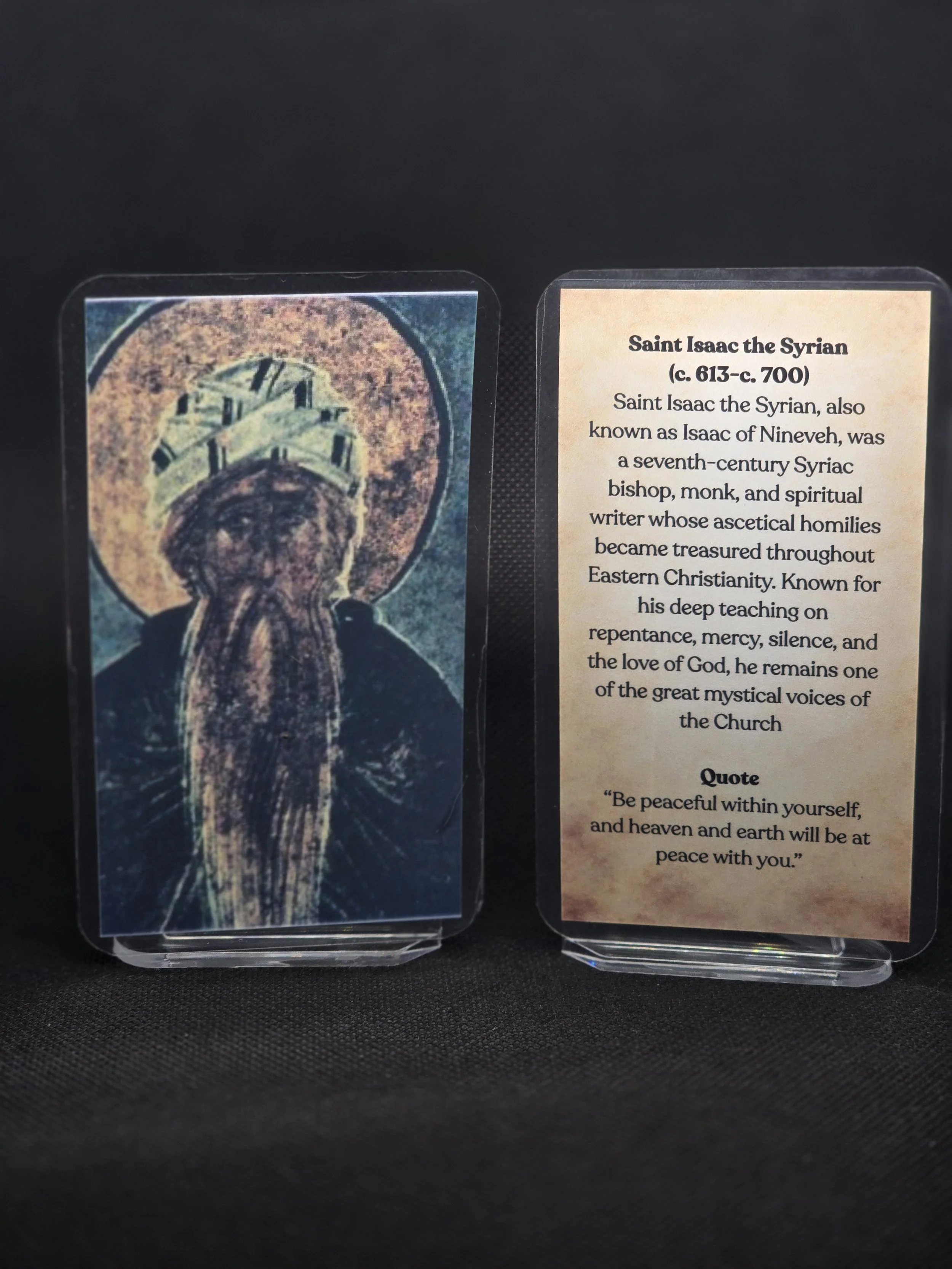
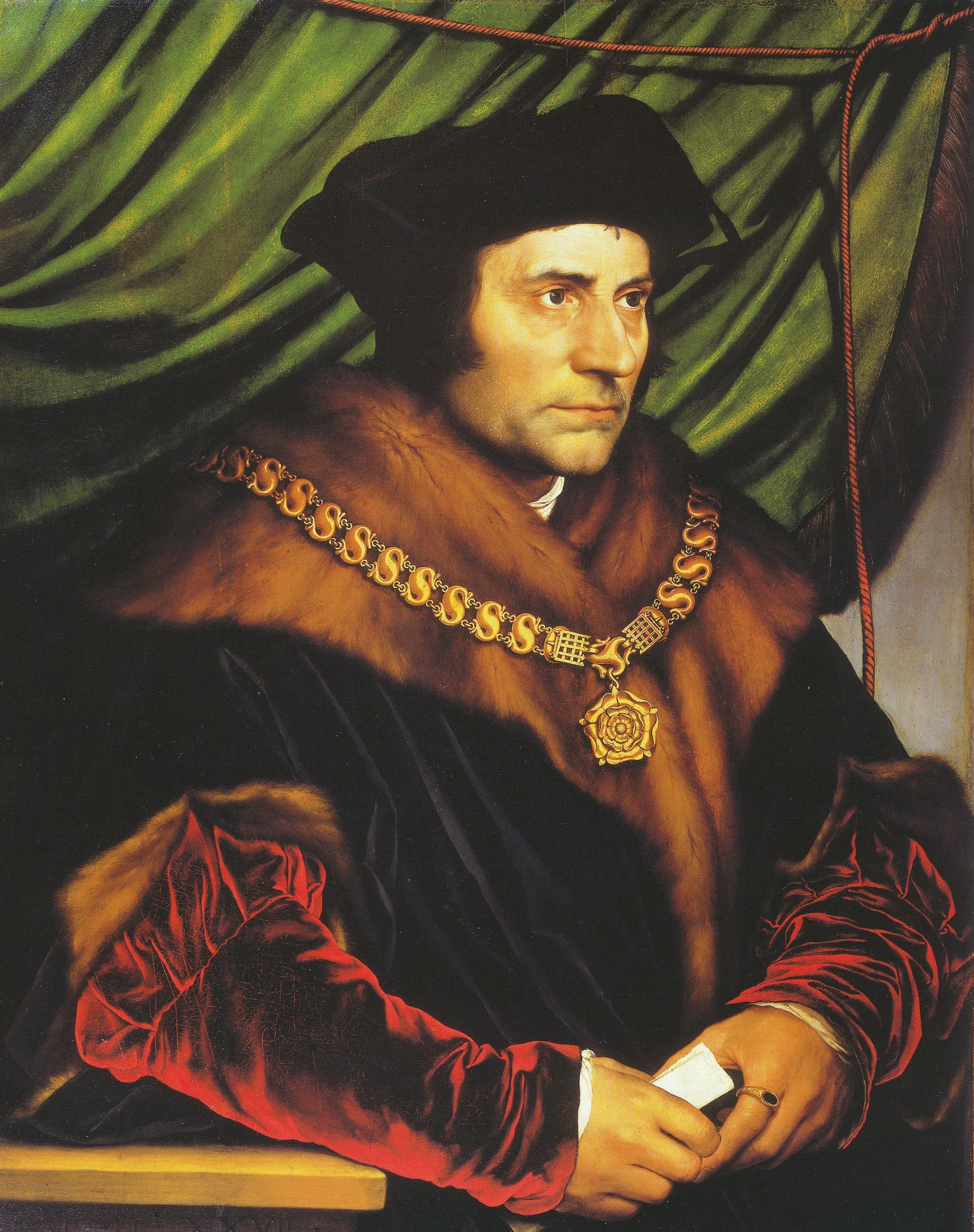
 Image 1 of 1
Saint Thomas More Prayer Card – For Conscience, Lawyers, Public Service, Integrity & Courage Under Pressure
Saint Thomas More was an English lawyer, husband, father, scholar, statesman, Lord Chancellor of England, and martyr whose final stand became one of history's most famous examples of conscience refusing to surrender to political power. He served King Henry VIII at the highest levels of government, yet when obedience to the king required him to accept claims he believed violated his Catholic faith and conscience, More chose imprisonment and death rather than speak words he believed were false.
His story is especially powerful because Thomas More was not a monk removed from public life. He was a married layman with children, a demanding professional career, political responsibilities, friendships, financial concerns, and a household filled with study, prayer, humor, and family life. His holiness developed while practicing law, serving in Parliament, negotiating diplomatic matters, raising children, writing books, attending Mass, and making difficult decisions inside the complicated world of government.
Saint Thomas More is especially meaningful for lawyers, judges, politicians, public officials, civil servants, business leaders, fathers, husbands, writers, scholars, and anyone facing pressure to violate a sincerely formed conscience for the sake of career, reputation, financial security, or acceptance. Pope Saint John Paul II formally proclaimed him Patron of Statesmen and Politicians, praising him as an enduring witness to the primacy of truth over power and the dignity of conscience.
Each prayer card measures 2.5" x 4.25", is handmade in Austin, Texas, printed on museum-quality photo paper rather than ordinary cardstock, and double laminated for durability. Every card is made to order and prepared prayerfully, with the recipient and their intentions brought before Christ while asking Saint Thomas More to intercede for their needs.
THE LIFE & STORY OF SAINT THOMAS MORE
Thomas More was born in London in 1478, the son of Sir John More, a respected lawyer and judge. His upbringing placed him close to the world of law and public service from childhood, but Thomas also developed an intense interest in literature, philosophy, theology, classical languages, and the Christian spiritual life.
As a young man, he studied at Oxford before continuing legal training in London. His intellect quickly became apparent, and he became associated with some of the leading humanist scholars of Renaissance Europe.
Among his closest intellectual friendships was his relationship with Desiderius Erasmus, one of the era's most famous scholars. More belonged to a generation of Christian humanists convinced that serious learning, moral reform, classical education, and Christian faith could strengthen both Church and society.
A POSSIBLE RELIGIOUS VOCATION
Before deciding upon marriage, More spent significant time discerning whether God might be calling him to religious life. He maintained close relationships with Franciscans and lived for a period near the London Charterhouse, observing elements of Carthusian spirituality and discipline.
He practiced prayer, fasting, and other forms of asceticism while studying whether he possessed a monastic vocation.
Eventually More concluded that his calling was not to the monastery but to marriage, family life, law, and public responsibility.
That discernment is important because Thomas More did not view the lay state as a lesser alternative after failing to become a monk. He came to understand marriage and public life as the circumstances within which he was called to serve God.
HUSBAND AND FATHER
In 1505, Thomas married Jane Colt. They had four children together before Jane died in 1511.
More then married Alice Middleton, a widow who had a daughter of her own. Their blended household became one of the most remarkable intellectual Christian homes of the period.
Thomas took the education of his daughters as seriously as the education of his son, something unusual enough in sixteenth-century England to attract attention. His daughter Margaret Roper became particularly accomplished in languages and scholarship and remained deeply close to her father throughout his final imprisonment.
Family life was not an accessory to More's public career. Pope Saint John Paul II specifically praised him as an affectionate husband and father who remained closely involved in the religious, moral, and intellectual formation of his children.
A HOUSEHOLD OF PRAYER AND LEARNING
More's home combined study, hospitality, family affection, intellectual discussion, and Christian prayer. He welcomed relatives, scholars, friends, young people seeking direction, and visitors from across European intellectual life.
The family prayed together and read Scripture. More attended Mass regularly and maintained private spiritual disciplines that were far stricter than his public personality suggested.
At the same time, he was famous for humor.
The saint remembered for dying rather than betray his conscience was not a gloomy man. Even during imprisonment he retained much of the wit and cheerful conversation for which he had long been known.
LAWYER
Thomas More became one of London's leading lawyers and developed a reputation for intelligence, careful reasoning, and integrity.
His legal career eventually carried him into public service. He entered Parliament, performed diplomatic assignments, served in judicial and administrative roles, became a member of the King's Council, and rose steadily through the political institutions of England.
The lawyer who would eventually become a martyr therefore understood government from inside its highest levels.
He was not resisting authority because he had never borne responsibility himself. He spent years exercising authority and believed legitimate government deserved respect.
The eventual conflict arose because he also believed authority possessed limits.
UTOPIA
More's best-known literary work, Utopia, was published in 1516. The book describes an imaginary society through a deliberately complicated dialogue that continues generating debate among historians, philosophers, political theorists, and literary scholars.
The title itself helped introduce the word “utopia” into common language.
The work examines questions about wealth, government, punishment, property, war, education, religious belief, social organization, and human nature.
More did not simply write a straightforward blueprint for his own ideal society. The book contains irony, contradictions, and deliberately provocative arguments that invite readers to think critically rather than merely accept every statement made by its fictional speakers.
PUBLIC SERVICE
Thomas More's political responsibilities expanded under King Henry VIII. He became Speaker of the House of Commons, performed important diplomatic work, served the king in legal and administrative matters, and gained a reputation for unusual learning and personal integrity.
In 1529, Henry appointed More Lord Chancellor of England, one of the most powerful offices in the kingdom.
For a lawyer and statesman, the appointment represented an extraordinary professional achievement.
Yet within only a few years, the relationship between More's conscience and the policies of the king would make remaining in office impossible.
HENRY VIII AND THE ROYAL MARRIAGE
King Henry VIII sought to have his marriage to Catherine of Aragon declared invalid so that he could marry Anne Boleyn. The dispute eventually expanded far beyond the king's marriage and became bound up with questions of papal authority, the Church in England, Parliament, and the relationship between spiritual and political power.
Thomas More became increasingly uncomfortable with the direction events were taking.
He attempted to remain cautious and did not make every disagreement with the king into a public confrontation. More understood both the danger and the legal complexity of opposing a monarch.
Yet he could not give positive approval to claims he believed were contrary to Catholic teaching and the legitimate authority of the Church.
RESIGNING AS LORD CHANCELLOR
In 1532, More resigned as Lord Chancellor.
The resignation cost his family income, influence, and security. More withdrew from public office rather than remain in a position where his duties increasingly conflicted with his convictions.
This moment alone makes him a powerful saint for professionals facing moral pressure.
Sometimes integrity requires not dramatic martyrdom but the decision to walk away from prestige, authority, income, or advancement when retaining those things demands a compromise one cannot honestly make.
For More, resignation did not end the conflict.
It merely began the final stage.
SILENCE
One of the most fascinating elements of Thomas More's resistance was his reliance upon silence.
He knew English law well enough to understand the danger of openly giving the king's opponents evidence that could be used to charge him with treason. More therefore attempted to avoid directly attacking Henry's claims while also refusing to affirm them.
His silence was not cowardice.
It was a lawyer's attempt to remain faithful both to conscience and to the law.
Eventually, however, the government would demand an explicit oath.
Silence would no longer be enough.
THE OATH OF SUCCESSION
In 1534, More was required to swear an oath connected with the succession and the new religious settlement developing under Henry VIII.
More was willing to accept portions relating to the lawful succession of the king's children, but he could not accept language or implications that required him to deny papal authority or recognize the king's supremacy in spiritual matters.
He refused the oath.
That refusal led to his imprisonment in the Tower of London.
THE TOWER OF LONDON
Thomas More spent approximately fifteen months imprisoned in the Tower.
The former Lord Chancellor now lived as a prisoner of the government he had once helped lead. His family suffered financially, his health declined, and repeated efforts were made to persuade him to submit.
His daughter Margaret remained one of his greatest consolations. Their surviving correspondence reveals extraordinary affection and provides some of the clearest evidence of More's interior state during his final months.
He was afraid of suffering and death, but fear did not ultimately control his decision.
CONSCIENCE
More's imprisonment turned the word conscience into the central theme of his final witness.
For Thomas More, conscience did not mean simply doing whatever personally felt right. His conscience had been formed through prayer, Scripture, Catholic teaching, law, study, reason, and years of discernment.
That distinction is essential.
More did not believe individual preference automatically outranked legitimate authority. He had spent his life serving lawful authority.
His final refusal came because he believed no human authority could legitimately force him to affirm what he judged false before God.
CONSCIENCE IS NOT CONVENIENCE
Modern appeals to conscience can sometimes mean little more than personal preference. Thomas More's witness is far more demanding.
A genuine conscience may require us to do something we do not want to do.
More wanted to live.
He loved his family, enjoyed scholarship, valued friendship, and possessed no desire to become a martyr simply for the drama of it.
His conscience cost him precisely because following it meant losing things he genuinely loved.
This makes his story especially important when conscience becomes inconvenient.
FOR LAWYERS
Saint Thomas More has become one of the most beloved saints among Catholic lawyers because his entire final struggle was shaped by his understanding of law, authority, justice, evidence, and conscience.
He respected law enough to resist attempts to manipulate it.
His famous insistence that even an enemy should receive the protection of law reflects a deeper principle: justice cannot depend entirely upon whether we like the person receiving it.
For attorneys, judges, law students, prosecutors, public defenders, and legal scholars, More offers an example of professional skill placed beneath a higher moral responsibility.
“THE DEVIL SHOULD HAVE BENEFIT OF LAW”
One of the best-known lines associated with Thomas More appears in Robert Bolt's later play A Man for All Seasons, but the underlying principle is deeply rooted in More's genuine legal reputation and surviving accounts.
An authentic statement recorded by William Roper captures the principle even more directly:
“Were it my father on the one side and the devil on the other, his cause being good, the devil should have his right.”
More's point was not admiration for evil.
He was insisting that justice cannot simply disappear because the person before the court is hated.
The rule of law matters most when emotion tempts society to abandon it.
FOR JUDGES AND PUBLIC OFFICIALS
Thomas More also speaks directly to people entrusted with public authority.
Pope Saint John Paul II emphasized that More understood government as a service to justice rather than an opportunity to accumulate power.
Public office creates responsibilities that private citizens do not carry. Decisions can affect families, businesses, communities, institutions, and future generations.
More's life therefore challenges public servants to ask whether ambition, party loyalty, fear, popularity, or personal advantage has begun to outrank truth and justice.
His patronage is particularly appropriate because he experienced both the privilege and danger of political power from within.
PATRON OF STATESMEN AND POLITICIANS
On October 31, 2000, Pope Saint John Paul II formally proclaimed Saint Thomas More Patron of Statesmen and Politicians.
The Pope emphasized More's witness to the dignity of conscience, his commitment to justice, his fidelity to legitimate authority, and his refusal to allow political power to replace truth.
The proclamation recognized that political life desperately needs examples of people who understand authority as service.
Thomas More's patronage is therefore not about one party, ideology, or nation.
It concerns the moral responsibilities attached to public power itself.
TRIAL
In 1535, Thomas More was brought to trial for treason.
The prosecution relied heavily upon testimony from Richard Rich, who claimed More had spoken words denying the king's supremacy. More strongly disputed the testimony and challenged its credibility.
The court nevertheless convicted him.
Once condemned, More spoke more openly about the principles he had previously protected through silence.
The legal scholar who had spent years trying to avoid unnecessary confrontation now knew that the government had already decided his fate.
MARTYRDOM
Thomas More was executed by beheading on July 6, 1535.
According to the traditional account of his final words, he declared that he died “the King's good servant, and God's first.”
The phrase has become one of the most famous summaries of Christian political responsibility.
More did not say the king deserved no service. He had spent much of his adult life serving him.
The decisive word was first.
Political authority is real, but it is not God.
“THE KING'S GOOD SERVANT, AND GOD'S FIRST”
The power of More's final statement lies in its balance.
He was not arguing that Christians should despise civil authority. He believed government could serve justice and the common good.
Nor was he claiming religious belief allows individuals to ignore every law they dislike.
His witness concerns the final boundary.
When political authority demands what a properly formed conscience recognizes as a betrayal of God, the Christian must know which loyalty comes first.
SAINT JOHN FISHER
Thomas More was not the only prominent English Catholic executed during the conflict with Henry VIII.
Saint John Fisher, Bishop of Rochester and a respected scholar, also refused to recognize the king's claim to spiritual supremacy and was executed shortly before More.
The Catholic Church eventually canonized Fisher and More together in 1935.
Their martyrdoms represent two different vocations, bishop and married layman, united by the same refusal to surrender the freedom of the Church and the demands of conscience.
CANONIZATION
Thomas More and John Fisher were beatified with other English martyrs by Pope Leo XIII in 1886.
Pope Pius XI canonized the two men in 1935, four centuries after their deaths.
More's reputation had already extended beyond Catholic devotion. Historians, lawyers, politicians, writers, and people outside the Catholic Church had long regarded him as one of the great symbols of conscience and integrity within Western history.
His canonization gave that historical reputation an explicitly Christian meaning.
The integrity people admired had ultimately been rooted in his relationship with Christ.
A COMPLEX HISTORICAL FIGURE
Thomas More lived in a religiously violent sixteenth-century world, and parts of his public career remain debated by historians, particularly his involvement in government actions against people accused of heresy.
Pope Saint John Paul II himself acknowledged that some of More's actions reflected the limitations of the culture of his time.
This historical complexity does not erase his martyrdom or the particular witness for which the Church venerates him.
It does remind modern Christians that saints lived inside real historical societies rather than idealized worlds and that genuine holiness does not require pretending every political or cultural assumption surrounding a saint was timeless.
A MAN FOR ALL SEASONS
The phrase “a man for all seasons” became permanently associated with Thomas More through the twentieth-century play and film by Robert Bolt.
The phrase itself comes originally from More's contemporary Robert Whittington, who praised More's remarkable ability to adapt appropriately to different people and circumstances while remaining fundamentally himself.
Bolt's dramatization introduced millions of modern viewers to More's final conflict with Henry VIII.
The play and film contain dramatic reconstruction rather than functioning as documentary history, but they helped establish More as one of the world's most recognizable symbols of conscience resisting political pressure.
HUMOR IN THE FACE OF DEATH
More retained humor even as his execution approached.
This detail matters because it reveals something about the freedom he experienced once the central decision of conscience had been made.
The government could take his office, property, liberty, and eventually his life, but it could not force him to call false what he believed true.
That interior freedom allowed his characteristic wit to survive extraordinary pressure.
Christian courage does not always look grim.
Sometimes confidence before death can smile.
FOR FATHERS
Thomas More is particularly meaningful for fathers because his family relationships remained central until the end of his life.
His correspondence with Margaret reveals a father who was intellectually serious, affectionate, humorous, concerned for his children's faith, and deeply aware of the suffering his choices imposed upon his family.
His decision to follow conscience was therefore not emotionally easy.
He knew martyrdom meant leaving people he loved.
For fathers balancing work, faith, family responsibility, and difficult moral decisions, More offers a model of a man who never treated professional achievement as more important than the spiritual life of his household.
FOR MARRIED CATHOLICS
More's life is also significant because one of the Church's most famous martyrs for religious conscience was a married layman.
He had known the joys and responsibilities of marriage, parenthood, widowhood, remarriage, stepchildren, finances, professional work, and a busy household.
His sanctity was therefore thoroughly lay.
More demonstrates that serious prayer, theological study, ascetic discipline, family happiness, intellectual achievement, humor, and professional excellence can belong within the same Christian vocation.
FOR PEOPLE UNDER WORKPLACE PRESSURE
Most people will never stand before a king demanding an oath, but the underlying pressure More experienced appears in smaller forms every day.
An employer may request dishonesty. A profession may reward silence about wrongdoing. A promotion may seem dependent upon compromising a principle. A colleague may pressure someone to approve what they believe is unethical.
Saint Thomas More does not provide a simplistic answer to every workplace conflict.
He does provide a standard: career advancement cannot become the final authority over conscience.
FOR PEOPLE AFRAID OF LOSING EVERYTHING
Thomas More lost nearly everything that had defined his public life.
He lost the office of Lord Chancellor, much of his income, political influence, physical freedom, public reputation among supporters of the king, and finally his life.
Yet he refused to describe this as ultimate defeat.
In a letter to his daughter Margaret, More wrote that although he might suffer pain, the clarity of his conscience meant that the suffering could not ultimately harm what mattered most.
This is one of the deepest lessons of his martyrdom.
There are losses worse than losing status, money, or even life.
Losing oneself can be one of them.
THE QUOTE
One of Thomas More's most powerful authentic statements comes from a letter written during imprisonment:
“The clearness of my conscience has made my heart hop for joy.”
The words are especially striking because they were written from the Tower of London.
More was not celebrating comfortable circumstances. His freedom had been taken away, his future was uncertain, and he knew execution was possible.
Yet a clear conscience provided a kind of interior freedom that imprisonment could not remove.
For someone facing pressure to compromise a deeply held moral conviction, the quote captures the peace More believed comes from remaining truthful before God.
ANOTHER POWERFUL QUOTE
More also wrote to Margaret shortly before his death that his case was such that, through the clarity of his conscience, “though I might have pain I could not have harm.”
The distinction is profound.
Faithfulness does not guarantee freedom from pain.
It does mean that suffering and moral destruction are not the same thing.
More believed a person could lose outward security without losing the soul.
PRAYER TO SAINT THOMAS MORE
A widely used prayer to Saint Thomas More with ecclesiastical approval asks especially for integrity within law, conscience, professional life, and family responsibilities:
“Thomas More, counselor of law and statesman of integrity, merry martyr and most human of saints, pray that, for the glory of God and in the pursuit of His justice, I may be trustworthy with confidences, keen in study, accurate in analysis, correct in conclusion, able in argument, loyal to clients, honest with all, courteous to adversaries, ever attentive to conscience.”
The prayer continues by asking More to help lawyers serve their clients without losing their souls and to obtain for their families the friendship, courage, charity, patience, and faith that characterized his own household.
It is especially appropriate for attorneys, judges, law students, public officials, politicians, civil servants, and anyone whose profession creates serious ethical responsibilities.
WHO SHOULD RECEIVE A SAINT THOMAS MORE PRAYER CARD?
A Saint Thomas More prayer card can make an especially meaningful gift for lawyers, judges, attorneys, law students, politicians, public officials, civil servants, legislators, government employees, fathers, husbands, scholars, writers, and people facing workplace pressure involving conscience or integrity.
It can also be meaningful for someone who has lost professional opportunities because of a moral conviction or who fears that remaining faithful may cost them status, income, relationships, or advancement.
More's example does not teach people to seek conflict for its own sake. He spent years trying to serve faithfully, remain legally cautious, and avoid unnecessary confrontation.
His martyrdom began only when no honest compromise remained.
FAQ
Who was Saint Thomas More? Saint Thomas More was an English lawyer, scholar, writer, husband, father, statesman, Lord Chancellor, and Catholic martyr who lived from 1478 to 1535. He was executed after refusing to accept King Henry VIII's claim to supremacy over the Church in England.
Was Thomas More married? Yes. He married Jane Colt in 1505 and had four children with her. After Jane's death, he married Alice Middleton, a widow with a daughter, creating a large blended household.
Was Saint Thomas More a lawyer? Yes. More was one of the leading lawyers of his generation and held numerous important legal and governmental positions before eventually becoming Lord Chancellor of England.
Was Thomas More Lord Chancellor? Yes. King Henry VIII appointed him Lord Chancellor in 1529. More resigned in 1532 when he could no longer support the religious and political direction of the king's government.
Why did Thomas More resign as Lord Chancellor? More opposed Henry VIII's attempt to assume control over the Church in England and could not support policies he believed violated Catholic teaching and legitimate ecclesiastical authority.
Why was Saint Thomas More executed? He was ultimately convicted of treason after refusing to recognize the king's supremacy in spiritual affairs. More maintained that he could not affirm the required claims without violating his conscience and Catholic faith.
What were Thomas More's last words? Tradition records him as declaring that he died “the King's good servant, and God's first.” The statement became a famous summary of his belief that Christians should respect civil authority while giving ultimate loyalty to God.
What is Thomas More the patron saint of? Pope Saint John Paul II formally proclaimed Saint Thomas More Patron of Statesmen and Politicians in 2000. He is also widely invoked by lawyers, judges, public servants, and people facing conflicts of conscience.
Why is Thomas More associated with conscience? More refused to swear an oath he believed would require him to affirm something false before God. His willingness to accept imprisonment and death rather than violate his conscience made him one of Christianity's most famous witnesses to moral integrity.
Did Thomas More believe conscience meant doing whatever you want? No. More's conscience was shaped by Catholic faith, Scripture, law, reason, prayer, study, and serious discernment. His understanding of conscience was very different from simply treating personal preference as morally authoritative.
What is Utopia? Utopia is Thomas More's famous 1516 work describing an imaginary society. Through dialogue, irony, and deliberately difficult questions, the book examines politics, wealth, property, punishment, religion, war, education, and human nature.
Was Thomas More friends with Erasmus? Yes. More and Desiderius Erasmus were close friends and important figures within Renaissance Christian humanism. Erasmus famously praised More's learning, personality, and household.
Who was Margaret Roper? Margaret Roper was Thomas More's eldest daughter and one of the most educated women of her generation. She remained especially close to her father and corresponded with him during his imprisonment in the Tower.
Who was Saint John Fisher? Saint John Fisher was Bishop of Rochester and another leading English Catholic who refused to recognize Henry VIII's spiritual supremacy. He was executed shortly before Thomas More, and the two were later canonized together.
When was Thomas More canonized? Pope Pius XI canonized Thomas More and John Fisher in 1935, four hundred years after their martyrdom.
When did Thomas More become patron of politicians? Pope Saint John Paul II formally proclaimed Saint Thomas More Patron of Statesmen and Politicians in 2000.
Is Thomas More the real person behind A Man for All Seasons? Yes. Robert Bolt's play and the later film dramatize More's conflict with Henry VIII. They are based on historical events but contain dramatic reconstruction and should not be treated as a transcript of the historical record.
Who would this Saint Thomas More prayer card make a meaningful gift for? It is particularly fitting for lawyers, judges, law students, legislators, politicians, government employees, fathers, husbands, scholars, writers, and anyone seeking courage to remain honest when professional or political pressure conflicts with conscience.
THE MAIN MESSAGE OF SAINT THOMAS MORE'S LIFE
Saint Thomas More spent most of his life demonstrating that Christian faith and serious public service do not have to be enemies. He became a respected lawyer, scholar, diplomat, parliamentarian, judge, father, writer, and ultimately Lord Chancellor while maintaining an intense interior life of prayer.
His martyrdom came not because he rejected government but because he believed government had limits.
More served the king faithfully until serving the king required him to place political authority where he believed only God could stand. At that point, the man who had reached almost the highest office in England discovered how much his conscience was worth.
His answer was everything.
For Christians today, Thomas More's challenge is not to imitate every political assumption of sixteenth-century England. It is to ask a more personal question: what is the point at which success, security, acceptance, or power becomes too expensive because keeping it would require us to surrender the truth?
More's life gives the answer in the words traditionally remembered from the scaffold. Serve faithfully, respect legitimate authority, work for justice, love your family, and fulfill your duties well, but know which loyalty must always remain first.