 Image 1 of 1
Saint Vitalis lived in the sixth century and was formed in the desert monastic tradition before coming to the city of Alexandria later in life. After years of prayer, discipline, and ascetic practice, he chose a path that would define his legacy in a way few could understand at the time. Rather than remaining in the safety of the desert, he entered a city known for its complexity, moral struggles, and constant activity, placing himself directly into an environment where holiness would not be easily recognized.
He did not seek comfort or recognition, and he did not attempt to preserve his reputation. Instead, he chose a form of service that would almost certainly be misunderstood by others, trusting that God alone would see the truth of his intentions. His feast is traditionally observed on January 11 in the Eastern Orthodox Church, where he is remembered as a witness to radical humility, hidden charity, and a refusal to judge others.
People turn to Saint Vitalis when they struggle with judging others too quickly, when they feel called to serve in ways that may not be understood, and when they desire to love others without recognition or approval. His life speaks directly to those who want to live with compassion in a world that often misunderstands intention and judges by appearances alone. His witness reminds the soul that true charity does not seek attention, that holiness is often hidden, and that love sometimes requires the willingness to be misunderstood.
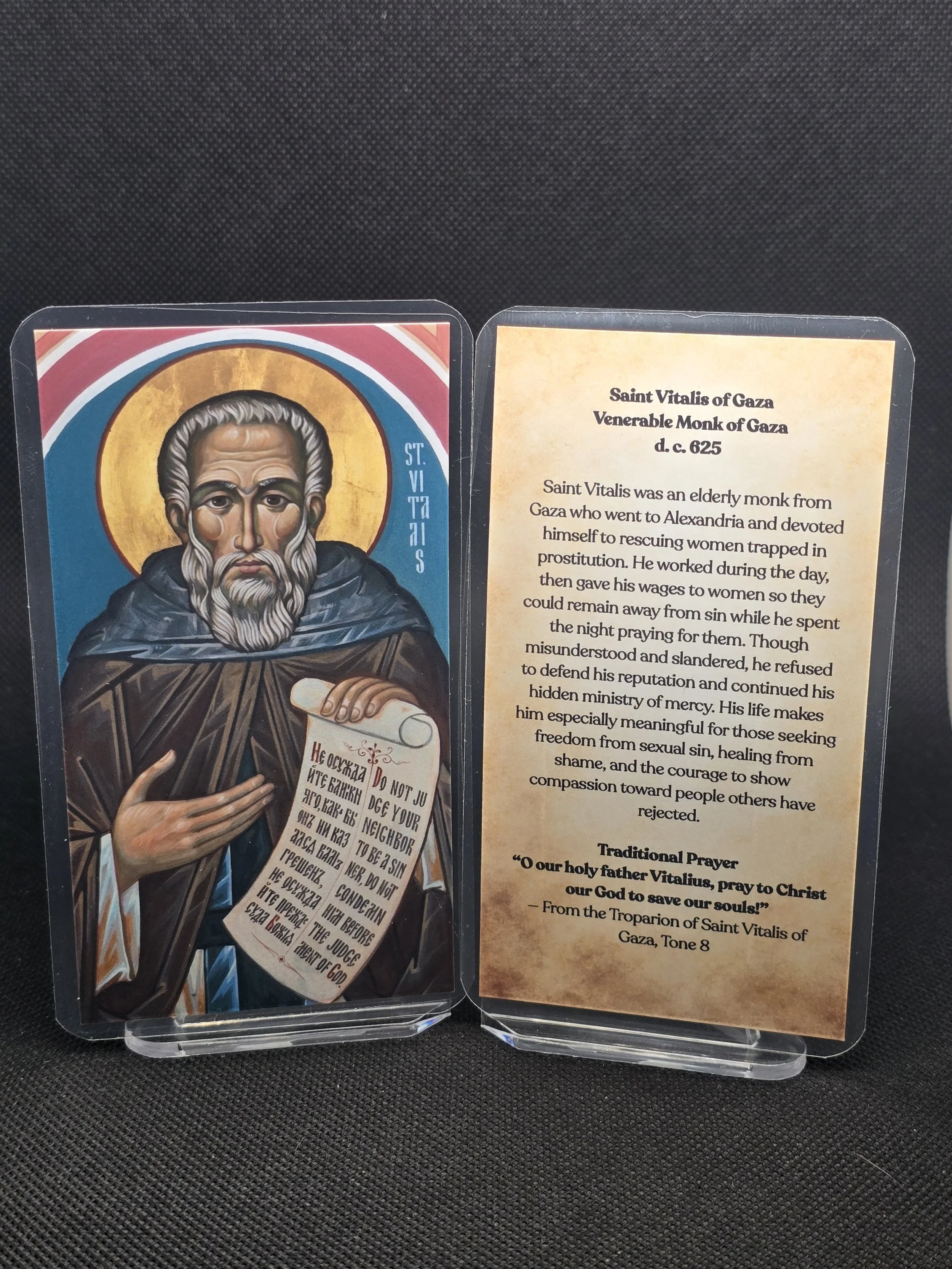
This prayer card is created as a spiritual heirloom, meant to accompany seasons of humility, quiet service, and deeper compassion. It serves as a reminder that God sees what others do not and honors the intentions of the heart. Each card is handmade and created to order, treated as a unique devotional offering rather than a mass-produced item. They are printed on museum-quality photo paper, not cardstock, and are made slowly during prayer with intentional reverence for the saint and for the person who will receive it. Names are lifted before Christ, intentions are held carefully, and each piece is handled multiple times in prayerful silence, asking God for mercy and asking the saint to intercede for the soul it is being made for. This is devotional craftsmanship shaped with patience, care, and spiritual responsibility.
Vitalis spent the majority of his life as a monk in the desert, where he was formed through years of prayer, fasting, and spiritual discipline. His life followed the pattern of many ascetics who sought God through solitude and separation from the distractions of the world. However, near the end of his life, he made a decision that would set him apart and reveal a deeper dimension of his spiritual calling.
He left the desert and entered the city of Alexandria, a place filled with activity, temptation, and social complexity. Instead of continuing in visible ascetic practices, he chose to live among the people in a way that concealed his true purpose. During the day, he worked as a laborer, earning small wages through physical work. Each evening, he took the money he had earned and used it in a way that caused scandal among those who observed him.
He would visit women living in prostitution, entering their homes in a manner that led others to assume he had abandoned his monastic life and fallen into sin. His actions appeared to contradict everything he had once stood for, and he made no effort to defend himself or correct the assumptions being made about him. The truth, however, was entirely different from what people believed.
Vitalis used the money he earned to pay these women on the condition that they rest for the night and not receive clients. During that time, he would pray with them, speak to them about repentance, and remind them of their dignity before God. His work was quiet, intentional, and completely hidden from public understanding. He chose to carry the weight of false judgment rather than reveal his actions, allowing his reputation to be damaged while he continued his ministry in secret.
Over time, some of the women he encountered left their former lives and turned toward repentance, though Vitalis never sought recognition for this transformation. His focus remained entirely on the work itself, not on how it would be perceived. His humility was tested continually as he endured criticism, insult, and rejection from those who believed they understood his behavior.
One day, after being publicly confronted and struck by a man who assumed he was living in sin, Vitalis returned to his place of rest and died shortly afterward. Only after his death did the truth begin to emerge, when a written message was found explaining his actions and warning others against judging too quickly. Those who had condemned him came to understand the depth of his humility and the reality of his hidden charity, realizing that the life they had dismissed was one of extraordinary holiness.
No widely recorded public miracles are associated with Saint Vitalis during his life, as his work was intentionally hidden and carried out without public attention. His life itself stands as the testimony, revealing a form of holiness that is not expressed through visible signs but through the transformation of others and the quiet endurance of misunderstanding.
He is closely associated with hidden acts of charity, refraining from judgment, and ministering to those living in difficult or broken circumstances. His witness is especially meaningful for those who struggle with judging others too quickly, those who feel called to serve without recognition, and those who desire to grow in humility and compassion. His life speaks to individuals who work with people in challenging situations and who must often act without affirmation or understanding from others.
His example teaches that appearances can be misleading and that true charity often takes place in ways that are not seen or understood. It also reminds the soul that God alone sees the full reality of the heart and that faithfulness does not depend on public approval.
Prayer to Saint Vitalis of Gaza
O Lord Jesus Christ, who granted Saint Vitalis the grace to serve others in humility and hidden love, grant us the wisdom to refrain from judgment and the courage to act with compassion. Through his intercession, help us to see others as You see them and to love without seeking recognition, trusting that You alone know the truth of every heart.
Amen.
Who was Saint Vitalis of Gaza?
Saint Vitalis was a monk who left the desert to live in Alexandria, where he secretly ministered to women in prostitution through prayer, compassion, and acts of mercy.
What is Saint Vitalis known for?
He is known for his hidden acts of charity, his willingness to be misunderstood, and his refusal to defend his reputation while serving others.
Is Saint Vitalis the patron saint of anything?
While not formally assigned a universal patronage, he is often associated with humility, compassion, and refraining from judgment.
When is Saint Vitalis’s feast day?
His feast day is celebrated on January 11 in the Eastern Orthodox Church.
Why do people pray to Saint Vitalis?
People seek his intercession when they want to grow in humility, avoid judging others, and serve those in need with compassion and discretion.
Saint Vitalis lived in the sixth century and was formed in the desert monastic tradition before coming to the city of Alexandria later in life. After years of prayer, discipline, and ascetic practice, he chose a path that would define his legacy in a way few could understand at the time. Rather than remaining in the safety of the desert, he entered a city known for its complexity, moral struggles, and constant activity, placing himself directly into an environment where holiness would not be easily recognized.
He did not seek comfort or recognition, and he did not attempt to preserve his reputation. Instead, he chose a form of service that would almost certainly be misunderstood by others, trusting that God alone would see the truth of his intentions. His feast is traditionally observed on January 11 in the Eastern Orthodox Church, where he is remembered as a witness to radical humility, hidden charity, and a refusal to judge others.
People turn to Saint Vitalis when they struggle with judging others too quickly, when they feel called to serve in ways that may not be understood, and when they desire to love others without recognition or approval. His life speaks directly to those who want to live with compassion in a world that often misunderstands intention and judges by appearances alone. His witness reminds the soul that true charity does not seek attention, that holiness is often hidden, and that love sometimes requires the willingness to be misunderstood.
This prayer card is created as a spiritual heirloom, meant to accompany seasons of humility, quiet service, and deeper compassion. It serves as a reminder that God sees what others do not and honors the intentions of the heart. Each card is handmade and created to order, treated as a unique devotional offering rather than a mass-produced item. They are printed on museum-quality photo paper, not cardstock, and are made slowly during prayer with intentional reverence for the saint and for the person who will receive it. Names are lifted before Christ, intentions are held carefully, and each piece is handled multiple times in prayerful silence, asking God for mercy and asking the saint to intercede for the soul it is being made for. This is devotional craftsmanship shaped with patience, care, and spiritual responsibility.
Vitalis spent the majority of his life as a monk in the desert, where he was formed through years of prayer, fasting, and spiritual discipline. His life followed the pattern of many ascetics who sought God through solitude and separation from the distractions of the world. However, near the end of his life, he made a decision that would set him apart and reveal a deeper dimension of his spiritual calling.
He left the desert and entered the city of Alexandria, a place filled with activity, temptation, and social complexity. Instead of continuing in visible ascetic practices, he chose to live among the people in a way that concealed his true purpose. During the day, he worked as a laborer, earning small wages through physical work. Each evening, he took the money he had earned and used it in a way that caused scandal among those who observed him.
He would visit women living in prostitution, entering their homes in a manner that led others to assume he had abandoned his monastic life and fallen into sin. His actions appeared to contradict everything he had once stood for, and he made no effort to defend himself or correct the assumptions being made about him. The truth, however, was entirely different from what people believed.
Vitalis used the money he earned to pay these women on the condition that they rest for the night and not receive clients. During that time, he would pray with them, speak to them about repentance, and remind them of their dignity before God. His work was quiet, intentional, and completely hidden from public understanding. He chose to carry the weight of false judgment rather than reveal his actions, allowing his reputation to be damaged while he continued his ministry in secret.
Over time, some of the women he encountered left their former lives and turned toward repentance, though Vitalis never sought recognition for this transformation. His focus remained entirely on the work itself, not on how it would be perceived. His humility was tested continually as he endured criticism, insult, and rejection from those who believed they understood his behavior.
One day, after being publicly confronted and struck by a man who assumed he was living in sin, Vitalis returned to his place of rest and died shortly afterward. Only after his death did the truth begin to emerge, when a written message was found explaining his actions and warning others against judging too quickly. Those who had condemned him came to understand the depth of his humility and the reality of his hidden charity, realizing that the life they had dismissed was one of extraordinary holiness.
No widely recorded public miracles are associated with Saint Vitalis during his life, as his work was intentionally hidden and carried out without public attention. His life itself stands as the testimony, revealing a form of holiness that is not expressed through visible signs but through the transformation of others and the quiet endurance of misunderstanding.
He is closely associated with hidden acts of charity, refraining from judgment, and ministering to those living in difficult or broken circumstances. His witness is especially meaningful for those who struggle with judging others too quickly, those who feel called to serve without recognition, and those who desire to grow in humility and compassion. His life speaks to individuals who work with people in challenging situations and who must often act without affirmation or understanding from others.
His example teaches that appearances can be misleading and that true charity often takes place in ways that are not seen or understood. It also reminds the soul that God alone sees the full reality of the heart and that faithfulness does not depend on public approval.
Prayer to Saint Vitalis of Gaza
O Lord Jesus Christ, who granted Saint Vitalis the grace to serve others in humility and hidden love, grant us the wisdom to refrain from judgment and the courage to act with compassion. Through his intercession, help us to see others as You see them and to love without seeking recognition, trusting that You alone know the truth of every heart.
Amen.
Who was Saint Vitalis of Gaza?
Saint Vitalis was a monk who left the desert to live in Alexandria, where he secretly ministered to women in prostitution through prayer, compassion, and acts of mercy.
What is Saint Vitalis known for?
He is known for his hidden acts of charity, his willingness to be misunderstood, and his refusal to defend his reputation while serving others.
Is Saint Vitalis the patron saint of anything?
While not formally assigned a universal patronage, he is often associated with humility, compassion, and refraining from judgment.
When is Saint Vitalis’s feast day?
His feast day is celebrated on January 11 in the Eastern Orthodox Church.
Why do people pray to Saint Vitalis?
People seek his intercession when they want to grow in humility, avoid judging others, and serve those in need with compassion and discretion.