 Image 1 of 1
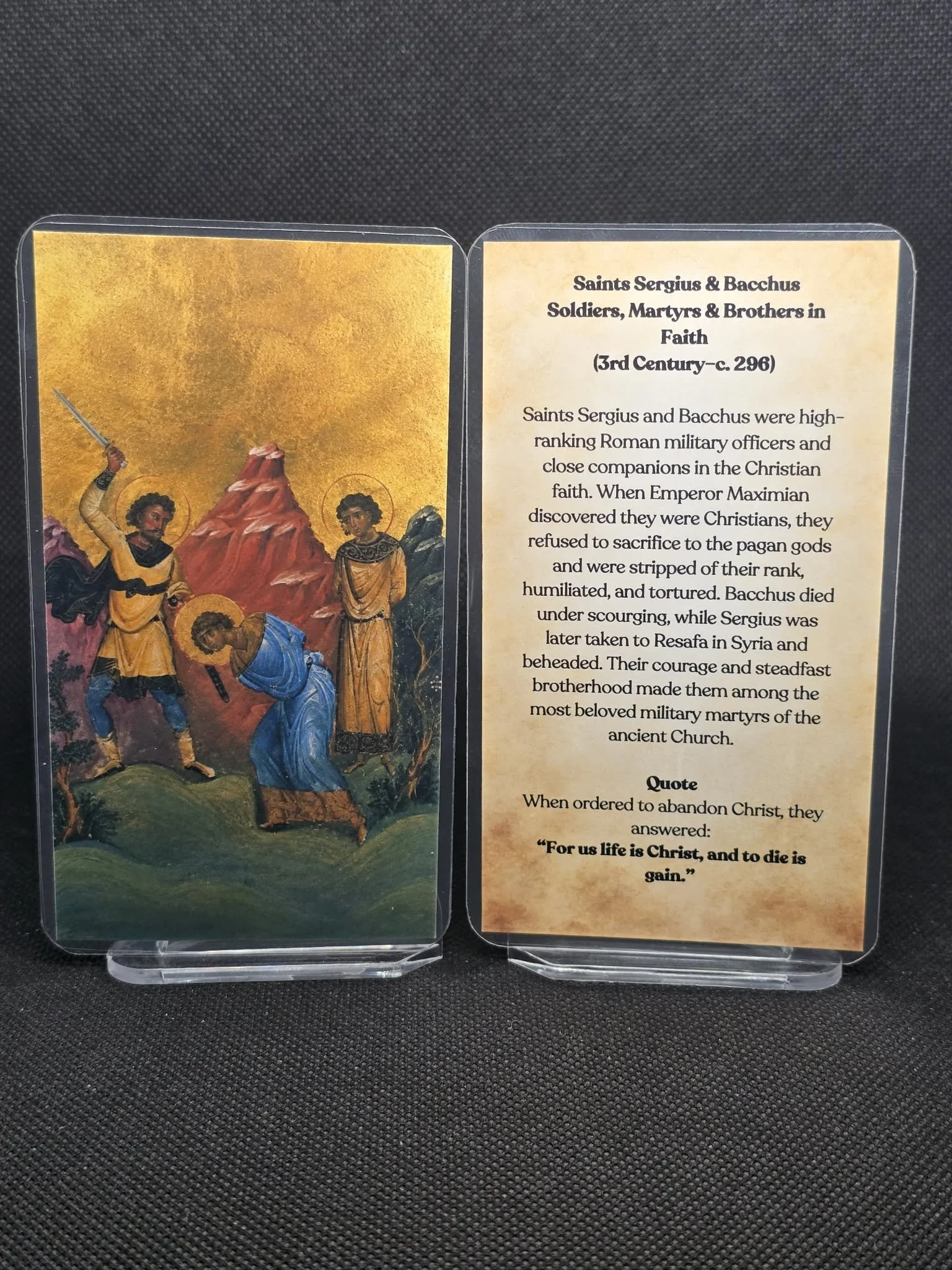
Saints Sergius and Bacchus Prayer Card | For Soldiers, Christian Brotherhood & Courage
Saints Sergius and Bacchus were early Christian military martyrs whose friendship, courage, and refusal to place imperial loyalty above Jesus Christ made them among the most beloved soldier-saints of the ancient Christian East. According to the received tradition, both men held important positions in the Roman military establishment under Emperor Maximian. When their Christian faith was exposed and they refused to sacrifice to the pagan gods, they lost their rank, endured deliberate public humiliation and torture, and ultimately chose martyrdom rather than deny Christ. Their feast is celebrated on October 7 in both Byzantine Orthodox tradition and the Catholic calendar.
Saints Sergius and Bacchus are especially meaningful for soldiers, veterans, military families, close Christian friends, brothers in faith, men serving together in dangerous professions, Christians facing ridicule or persecution, and anyone asking for courage to remain faithful when loyalty to Christ becomes costly. Their connection with military life is ancient, while their joint liturgical commemoration emphasizes that they faced persecution together rather than as isolated individuals. The Greek Orthodox Kontakion calls them “two brethren in the Faith,” while another Orthodox hymn remembers them acting “with one heart.”
Their story is also particularly powerful for men who understand the value of brotherhood formed through shared hardship. Sergius and Bacchus possessed rank, status, and the favor of powerful men, yet when they were stripped of those honors they still had Christ and one another. Bacchus died first under torture, and Sergius then continued toward his own martyrdom without abandoning the faith they had confessed together. Their relationship became such a strong image of spiritual brotherhood that later Byzantine prayers for ritual brotherhood invoked Sergius and Bacchus as examples of men made brothers through faith rather than biological kinship.
For soldiers and veterans, the story contains an especially important Christian distinction. Sergius and Bacchus were not condemned because they lacked discipline or loyalty, but because they recognized that military and political obedience have limits when an earthly ruler commands something contrary to God. The men who had been trusted within the imperial system accepted disgrace rather than allow the emperor to determine whom they would worship.
This prayer card can make a meaningful gift for active-duty military personnel, veterans, military academy graduates, brothers serving together, police officers, first responders, close male friends, godbrothers, men entering dangerous work, Christians experiencing persecution, or anyone trying to remain faithful when social acceptance depends upon compromise. It is also especially appropriate for two friends who want their friendship centered upon Christ rather than merely shared interests, because the Church remembers Sergius and Bacchus not simply as companions but as companions whose bond endured persecution and martyrdom.
Each 2.5" x 4.25" prayer card is handmade in Austin, Texas and prepared prayerfully with each order. It is printed on museum-quality photo paper rather than cardstock, double-laminated for durability, and made while the recipient and their intentions are lifted before Christ in prayer, with Saints Sergius and Bacchus asked to intercede for them.
THE LIFE & STORY
Saints Sergius and Bacchus are traditionally placed in the late third or early fourth century, during the period of Roman persecution associated with Maximian. The exact year varies among liturgical and hagiographic traditions, with Greek Orthodox sources placing their martyrdom around 296 and other traditions closer to the opening years of the fourth century. What remains consistent is their identity as high-ranking military Christians who were punished after refusing pagan sacrifice.
The surviving Passion of Sergius and Bacchus was written after their lifetime, probably in late antiquity rather than as a contemporary court record. Modern scholarship notes that their cult is securely visible by the early fifth century at Resafa, where archaeological evidence confirms an early shrine later replaced by a larger martyrium. The best historical wording is therefore to distinguish between the ancient and firmly established cult of the martyrs and the detailed narrative preserved in their later hagiographic Passion.
HIGH-RANKING MEN IN THE ROMAN MILITARY
The Orthodox tradition remembers Sergius and Bacchus as men occupying important positions in the imperial military establishment. Maximian trusted them without realizing they were Christians, and their prominence appears to have provoked jealousy among others who reported that the two officers refused to participate in pagan religious ceremonies.
Their Christianity therefore existed inside an environment where political loyalty and public religion were closely connected. Refusing sacrifice was not viewed merely as a private religious preference because Roman officials could interpret rejection of the gods as rejection of the imperial order itself.
ORDERED TO SACRIFICE TO THE PAGAN GODS
The emperor decided to test the accusation himself and ordered Sergius and Bacchus to participate in pagan sacrifice. Both refused and openly confessed that they worshiped the one true God.
That refusal transformed successful officers into criminals almost immediately. Rank that had once brought prestige could no longer protect them because the very authority that had rewarded their service now demanded something their consciences would not permit.
STRIPPED OF THEIR MILITARY HONORS
Maximian ordered their military insignia, belts, gold ornaments, and rings removed. These objects were not merely decorative because they publicly represented the rank and identity the two men had earned within the imperial system.
The humiliation therefore struck deliberately at their identity as honored military men. Everything that told the public, “These men possess status and authority,” was taken from them before the crowd.
PUBLICLY HUMILIATED FOR CHRIST
The traditional Passion says Sergius and Bacchus were dressed in feminine clothing, iron chains were placed around their necks, and they were paraded publicly to ridicule them. The purpose was psychological as much as physical: the emperor wanted men accustomed to military honor to experience public shame until they preferred conformity over humiliation.
They refused to allow mockery to control their confession of faith. Their story therefore speaks powerfully to Christians who fear ridicule, professional embarrassment, loss of reputation, or public rejection more than physical danger.
A PRAYER CARD FOR COURAGE UNDER RIDICULE
Modern Christians will rarely face the exact punishment described in their Passion, but the pressure behind it remains recognizable. People can be pushed toward compromise because they fear becoming the person everyone mocks, excludes, or treats as foolish.
Sergius and Bacchus demonstrate a form of courage distinct from battlefield bravery. A soldier can become accustomed to physical danger and still find social humiliation difficult, yet these martyrs endured both because their identity in Christ had become more important than public approval.
THE EMPEROR TRIED TO WIN THEM BACK
According to the Orthodox account, Maximian did not immediately give up on two men who had been valuable to him. He summoned them again and urged them to abandon Christianity and return to the traditional gods of the empire.
The temptation therefore involved restoration, not merely relief from suffering. They could regain status and return to the life they had known if they would make the required religious compromise.
They refused again.
SENT TO ANTIOCHUS
Sergius and Bacchus were eventually placed under the authority of Antiochus, governor of the eastern Syrian region. The cruelty of the situation was intensified by the fact that, according to their Life, Antiochus owed his own advancement to Sergius and Bacchus and therefore personally knew the men he was being required to condemn.
The Orthodox account even remembers Antiochus addressing them as his fathers and benefactors and pleading with them to save themselves. Their answer made clear that preserving earthly life was no longer their highest goal.
BACCHUS IS BEATEN TO DEATH
Bacchus was subjected to a severe beating and died from his injuries. The Greek Orthodox tradition remembers this as the first of the pair's martyrdoms, after which Sergius was forced to continue the ordeal without his companion physically beside him.
This gives their friendship an especially painful dimension. Sergius did not simply face his own approaching death because he first had to endure the loss of the man who had confessed Christ beside him.
SERGIUS CONTINUES ALONE
After Bacchus' death, Sergius was subjected to further torture. The Orthodox Life says iron sandals fitted with nails were placed on his feet and he was forced onward before finally being taken to Resafa in Syria, where he was executed by beheading.
The man whose story had been inseparable from Bacchus now had to complete his martyrdom outwardly alone. Yet the Church continued commemorating them together, joining their names permanently in worship.
BROTHERS IN THE FAITH
The Greek Orthodox liturgical tradition describes Sergius and Bacchus as brethren in the Faith. That language makes Christian brotherhood one of the most natural devotional themes for their prayer card.
Their bond was not based simply upon shared hobbies, military assignments, or social status. When rank disappeared and suffering began, their common allegiance to Christ remained.
For Christian men, that provides a demanding model of friendship. A good friend does more than accompany someone toward comfort because sometimes friendship means helping another person remain faithful when compromise would be easier.
A PRAYER CARD FOR CHRISTIAN FRIENDSHIP
Saints Sergius and Bacchus are especially meaningful for close friends who want their friendship to strengthen rather than weaken their faith. Their liturgical memory emphasizes courage together, shared confession, and spiritual brotherhood.
This can make the card particularly meaningful between longtime friends, godbrothers, military brothers, fraternity brothers who share Christian faith, men in a parish brotherhood, or two people who have helped one another survive a difficult period.
The deeper question behind the card is simple: Does this friendship help both people become more faithful to Christ?
A PRAYER CARD FOR BROTHERS
Biological brothers can also connect strongly with Sergius and Bacchus even though the martyrs themselves were not remembered as blood brothers. Their story demonstrates another kind of brotherhood formed through shared belief, loyalty, sacrifice, and suffering.
For brothers who have served together, endured family difficulties together, returned to the faith together, or simply want Christ to remain at the center of their relationship, Sergius and Bacchus provide a compelling shared devotion.
A PRAYER CARD FOR SOLDIERS SERVING TOGETHER
Military service forms relationships under conditions unlike ordinary friendship. Training, deployment, danger, separation from family, fear, exhaustion, responsibility for another person's safety, and sometimes combat can create bonds that remain for life.
Saints Sergius and Bacchus understood military hierarchy and the mutual dependence of people serving inside it. Their story adds a Christian dimension to military brotherhood by insisting that loyalty to a fellow soldier should ultimately help both men remain loyal to God.
MILITARY OBEDIENCE & CHRISTIAN CONSCIENCE
One of the most significant parts of their story is that Sergius and Bacchus were punished by the very system in which they had successfully served. They did not reject discipline merely because they disliked authority because the conflict emerged only when imperial command required pagan worship.
Their witness therefore establishes a Christian hierarchy of loyalties. Country, commanders, military units, friends, and institutions can deserve genuine loyalty, but God remains above them all.
A SAINTLY PAIR FOR VETERANS
Veterans often understand that leaving military service does not erase the identity and relationships formed there. Sergius and Bacchus can therefore become meaningful saints not only during active duty but long afterward.
Their story speaks to loyalty, memory, fallen companions, courage under pressure, and the question of what remains when rank and uniform are eventually removed. In their case, the answer was faith and the brotherhood formed through it.
RESAFA BECOMES SERGIOPOLIS
Saint Sergius' burial place at Resafa in Syria became one of the great pilgrimage centers of Late Antiquity. Greek Orthodox sources note that pilgrims came from as far away as Western Europe, and the city became known as Sergiopolis in his honor.
Archaeological scholarship confirms a shrine at Resafa by the early fifth century, with evidence of an earlier mud-brick sanctuary beneath a later martyrium. This gives the cult of Sergius particularly strong material evidence from Late Antiquity.
ONE OF THE GREAT MILITARY SAINTS OF SYRIA
Saint Sergius became particularly beloved in Syria, Mesopotamia, and Christian Arabia. His shrine stood in a strategically important frontier landscape, and devotion to him became strongly associated with military protection.
Bacchus remained inseparably joined with him in the liturgical feast, even as Sergius' shrine at Resafa became the more geographically famous center of pilgrimage.
This widespread eastern devotion helps explain why Sergius and Bacchus appear so frequently in military dress within Byzantine iconography.
JUSTINIAN & THE CHURCH OF SAINTS SERGIUS AND BACCHUS
Their cult became important even at the highest level of the Byzantine Empire. Emperor Justinian I built a major church dedicated to Saints Sergius and Bacchus in Constantinople during the sixth century, a building known today as the Little Hagia Sophia. Scholarly work on the church places its construction within Justinian's reign and shows the importance their cult had achieved in the imperial capital.
Art historians have even proposed that Justinian's devotion to Sergius and Bacchus reflected their role as protectors of the empire's eastern frontier. Their identity as military saints had therefore expanded from the story of two individual soldiers into a broader Byzantine idea of heavenly protection.
AN ANCIENT ICONIC PAIR
Sergius and Bacchus were repeatedly portrayed together, usually as youthful military martyrs standing side by side. Their matched appearance emphasizes the unity of their witness, while crosses identify their martyrdom and military clothing recalls their earthly vocation.
The Sinai tradition preserves remarkable images of the pair, including a thirteenth-century double-sided icon of Saints Sergius and Bacchus on one side and the Virgin Hodegetria on the other. The Princeton and University of Michigan Sinai archive documents the icon and its continued preservation at Saint Catherine's Monastery.
CHRIST BETWEEN THE TWO MARTYRS
One famous early icon traditionally associated with Sinai depicts Sergius and Bacchus side by side with Christ above and between them. Art-historical scholarship has discussed this image among the important early icons connected with Saint Catherine's Monastery.
The composition gives an especially appropriate spiritual reading of their friendship. Christ is not merely another person added to the pair because He is the One who stands over, unites, and gives meaning to their relationship.
That is precisely what makes their card meaningful for Christian friendship today.
WERE SAINTS SERGIUS AND BACCHUS A COUPLE?
A modern interpretation popularized in the late twentieth century argued that Sergius and Bacchus should be understood as a romantic or sexual couple and connected them with Byzantine rites of adelphopoiesis. That interpretation became widely repeated online, but it goes beyond what the ancient evidence securely establishes.
The Church's traditional liturgy calls them martyrs, companions, and brethren in the Faith, while scholarship on Byzantine adelphopoiesis generally rejects identifying the ceremony simply as a same-sex marriage rite. A Cambridge scholarly discussion notes that the balance of academic opinion rejected the argument that these brotherhood ceremonies were essentially marriages and instead understands them as rites creating spiritual or ritual brotherhood.
Ancient Christian texts can use extremely affectionate language for spiritual friendship without implying a sexual relationship. The historically responsible product-page wording is therefore to describe Sergius and Bacchus as close companions, fellow soldiers, martyrs, and spiritual brothers in faith, without assigning them a sexual relationship the sources do not establish.
WHY THEY ARE IMPORTANT FOR CHRISTIAN MEN
Modern male friendship can sometimes become emotionally shallow, revolving only around entertainment, sports, work, or shared nostalgia. Sergius and Bacchus represent something deeper because their companionship survived the point at which following Christ became dangerous.
A Christian friend should be someone who can stand beside another person when faith becomes difficult. He should be willing to discourage sin, strengthen courage, tell the truth, pray, remain loyal during suffering, and point his friend back toward Christ.
That kind of friendship is demanding, but it is much closer to the brotherhood reflected in the liturgical memory of Sergius and Bacchus.
A SAINTLY PAIR FOR COURAGE
Courage appears throughout their story, but the most important courage was not physical combat. They endured loss of military status, public mockery, threats from people they knew, torture, separation, and death without changing whom they worshiped.
Their card is therefore fitting for anyone who needs courage to say no when everyone else says yes, especially when compromise would protect reputation, career, relationships, or safety.
A SAINTLY PAIR FOR CHRISTIANS UNDER PERSECUTION
The martyrs' lives naturally connect with Christians facing persecution because the accusation against them was specifically religious. Their professional success did not protect them once their faith was treated as incompatible with imperial demands.
For persecuted Christians today, Sergius and Bacchus offer the memory of two people who discovered that earthly security can disappear quickly while Christ remains.
THEIR FEAST DAY
Saints Sergius and Bacchus are commemorated together on October 7. The date is maintained by the Greek Orthodox Archdiocese, the Orthodox Church in America, and Vatican News.
Their joint feast is itself meaningful because the Church does not separate their memory even though Bacchus died before Sergius. The two men who confessed Christ together continue to be named together in worship centuries later.
PRAYERS
Saints Sergius and Bacchus already possess established Byzantine liturgical hymns, so there is no need to invent a new prayer for them. Their Troparion praises God for strengthening the martyrs against their adversaries and asks for salvation through their intercession, while their Kontakion remembers their shared courage and unity.
A short established line especially suitable for devotional use is:
“Through their intercessions, save our souls!”
Their Kontakion also provides one of the most beautiful descriptions of their unity, remembering Sergius and Bacchus acting “with one heart.” That phrase makes the liturgical text particularly fitting for a prayer card given between brothers, close friends, fellow soldiers, or men trying to help one another remain faithful.
FAQ
Who were Saints Sergius and Bacchus? Sergius and Bacchus were early Christian martyrs traditionally remembered as high-ranking Roman military men who were exposed as Christians and ordered to sacrifice to pagan gods. They refused, lost their military honors, endured torture, and died rather than deny Christ.
When did Saints Sergius and Bacchus live? They are traditionally placed during the reign of Emperor Maximian in the late third or early fourth century. Exact dates differ among later sources, so it is safest to place their martyrdom around the turn of the fourth century rather than insist upon one universally certain year.
When is their feast day? Saints Sergius and Bacchus are celebrated on October 7. The same date appears in Orthodox and Catholic calendars.
Were Sergius and Bacchus soldiers? Yes, their received Christian tradition remembers both men in high-ranking military positions under Maximian. Their later Byzantine cult also developed a strong association with military protection.
Are Saints Sergius and Bacchus good saints for soldiers? Yes, this is one of their strongest historically grounded associations. They were remembered as military martyrs and later became important protectors within Byzantine military devotion.
Why were they arrested? They were accused of refusing to honor the pagan gods expected within Roman public and military life. When Maximian ordered them to sacrifice, they openly confessed the one God and refused.
Why were their military belts removed? Their insignia represented rank and honor within the Roman system. Stripping those objects from them publicly demonstrated that the emperor was removing their status before subjecting them to further humiliation.
Why were they dressed in women's clothing? Their traditional Passion says this was done deliberately to mock and humiliate two honored military men before the public. The important spiritual point is that ridicule failed to make them deny Christ.
How did Saint Bacchus die? Bacchus was brutally beaten and died as a result of the torture. Sergius then continued through additional suffering before receiving his own martyrdom.
How did Saint Sergius die? Sergius was taken to Resafa in Syria and ultimately beheaded. His tomb there later became one of the most important pilgrimage shrines of the Christian East.
What was Sergiopolis? Resafa became so closely associated with Saint Sergius that the city came to be called Sergiopolis. Pilgrims traveled long distances to venerate him there.
Is there archaeological evidence for their ancient cult? Yes, particularly at Resafa. Archaeological research has found an early shrine beneath a later martyrium, with the cult securely visible by the early fifth century.
Were Sergius and Bacchus biological brothers? The traditional sources do not present them as biological brothers. Byzantine liturgy instead calls them brethren in the Faith, emphasizing spiritual brotherhood.
Are they good saints for close friends? Yes, as a devotional association rooted in their shared martyrdom and liturgical identity as brethren in faith. They provide a strong Christian image of friendship that helps another person remain loyal to Christ.
Are they patrons of friendship? It is better not to claim a universal formal patronage that the historic Churches do not clearly assign. Their ancient story and liturgical texts nevertheless make them exceptionally meaningful for Christian friendship, loyalty, brotherhood, and companionship during hardship.
Were Saints Sergius and Bacchus gay? Modern writers have proposed that interpretation, but the surviving evidence does not establish a sexual relationship between them. Traditional Christian sources remember them as companions and brothers in faith, while scholarship has generally rejected treating Byzantine ritual brotherhood as equivalent to same-sex marriage.
Were Sergius and Bacchus married to each other? There is no historical basis for saying that they were married to one another. The modern argument arose partly from interpretations of later Byzantine brotherhood rites, but scholarly discussion generally distinguishes those rites from marriage.
Why are they almost always shown together in icons? Their martyrdom tradition and feast are inseparable, so iconography commonly presents them side by side. This emphasizes their shared confession and continuing identity as a pair within Christian worship.
Why do they wear military clothing in icons? Their clothing refers to their remembered service in the Roman military. Crosses or martyr's symbols identify the greater victory for which the Church honors them, their willingness to die for Christ.
Is Christ sometimes shown between them? Yes, one famous early icon associated with the Sinai tradition places Christ above and between the martyrs. The composition naturally emphasizes that Christ stands at the center of their shared witness.
Is there an icon of them at Saint Catherine's Monastery on Mount Sinai? Yes. The Sinai archive documents a thirteenth-century double-sided icon showing Saints Sergius and Bacchus together, with the Hodegetria on the reverse.
Did Emperor Justinian honor Saints Sergius and Bacchus? Yes, a major sixth-century church dedicated to them was built in Constantinople during Justinian's reign. The building survives today and is commonly known as the Little Hagia Sophia.
Why were they important to Byzantine soldiers? Their own military identity and martyrdom made them natural military saints, and later Byzantine devotion treated them as heavenly protectors. Scholars have even connected Justinian's devotion to them with protection of the empire's eastern frontier.
Can veterans pray to Saints Sergius and Bacchus? Yes. Their story speaks especially strongly to people who understand military duty, brotherhood, sacrifice, loss of rank, and the lasting bonds formed through difficult service.
Can police officers and first responders pray to them? Yes, particularly through the broader themes of courage, loyalty, dangerous service, and Christian conscience. This is best described as a meaningful devotional association rather than an exclusive formal patronage.
Can I give this card to my best friend? Yes. Their identity as brethren in faith makes the card particularly meaningful between close Christian friends who want their friendship to help both men remain faithful to Christ.
Can I give this card to my brother? Yes. Although Sergius and Bacchus were spiritual rather than biological brothers, the devotion communicates loyalty, courage, prayer for one another, and faithfulness during hardship.
Can this card be given before military deployment? Yes. Their military history and later association with protection make it especially fitting for a deployment, enlistment, military graduation, or difficult assignment.
What do Saints Sergius and Bacchus teach about friendship? Their story teaches that the deepest friendship does more than provide companionship because it helps each person remain faithful when obedience to Christ becomes costly. Their liturgical remembrance as brethren in faith gives that lesson a particularly strong foundation.
What do they teach about courage? They demonstrate that courage includes enduring ridicule, loss of status, and social rejection as well as physical suffering. The officers who once possessed imperial prestige remained faithful even after every visible sign of that prestige was removed.
What do they teach about military obedience? Their story teaches that legitimate earthly authority deserves respect but never replaces God. When ordered to perform idolatry, Sergius and Bacchus accepted the consequences of refusal rather than violate Christian conscience.
What is the main message of Saints Sergius and Bacchus? Their lives teach that Christian brotherhood becomes most visible when remaining together in faith costs something. Sergius and Bacchus possessed military rank, imperial favor, public respect, and promising futures, but when those things were offered back only at the price of denying Christ, they chose Christ instead. They were stripped of their honors, mocked publicly, separated by Bacchus' death, and finally united again in the Church's memory as martyrs whose friendship had been tested by something far greater than ordinary hardship. Their story makes them especially powerful saints for soldiers, veterans, brothers, close Christian friends, and anyone who needs the courage to say, “I will not abandon Christ merely because remaining faithful has become expensive.”
Saints Sergius and Bacchus were early Christian military martyrs whose friendship, courage, and refusal to place imperial loyalty above Jesus Christ made them among the most beloved soldier-saints of the ancient Christian East. According to the received tradition, both men held important positions in the Roman military establishment under Emperor Maximian. When their Christian faith was exposed and they refused to sacrifice to the pagan gods, they lost their rank, endured deliberate public humiliation and torture, and ultimately chose martyrdom rather than deny Christ. Their feast is celebrated on October 7 in both Byzantine Orthodox tradition and the Catholic calendar.
Saints Sergius and Bacchus are especially meaningful for soldiers, veterans, military families, close Christian friends, brothers in faith, men serving together in dangerous professions, Christians facing ridicule or persecution, and anyone asking for courage to remain faithful when loyalty to Christ becomes costly. Their connection with military life is ancient, while their joint liturgical commemoration emphasizes that they faced persecution together rather than as isolated individuals. The Greek Orthodox Kontakion calls them “two brethren in the Faith,” while another Orthodox hymn remembers them acting “with one heart.”
Their story is also particularly powerful for men who understand the value of brotherhood formed through shared hardship. Sergius and Bacchus possessed rank, status, and the favor of powerful men, yet when they were stripped of those honors they still had Christ and one another. Bacchus died first under torture, and Sergius then continued toward his own martyrdom without abandoning the faith they had confessed together. Their relationship became such a strong image of spiritual brotherhood that later Byzantine prayers for ritual brotherhood invoked Sergius and Bacchus as examples of men made brothers through faith rather than biological kinship.
For soldiers and veterans, the story contains an especially important Christian distinction. Sergius and Bacchus were not condemned because they lacked discipline or loyalty, but because they recognized that military and political obedience have limits when an earthly ruler commands something contrary to God. The men who had been trusted within the imperial system accepted disgrace rather than allow the emperor to determine whom they would worship.
This prayer card can make a meaningful gift for active-duty military personnel, veterans, military academy graduates, brothers serving together, police officers, first responders, close male friends, godbrothers, men entering dangerous work, Christians experiencing persecution, or anyone trying to remain faithful when social acceptance depends upon compromise. It is also especially appropriate for two friends who want their friendship centered upon Christ rather than merely shared interests, because the Church remembers Sergius and Bacchus not simply as companions but as companions whose bond endured persecution and martyrdom.
Each 2.5" x 4.25" prayer card is handmade in Austin, Texas and prepared prayerfully with each order. It is printed on museum-quality photo paper rather than cardstock, double-laminated for durability, and made while the recipient and their intentions are lifted before Christ in prayer, with Saints Sergius and Bacchus asked to intercede for them.
THE LIFE & STORY
Saints Sergius and Bacchus are traditionally placed in the late third or early fourth century, during the period of Roman persecution associated with Maximian. The exact year varies among liturgical and hagiographic traditions, with Greek Orthodox sources placing their martyrdom around 296 and other traditions closer to the opening years of the fourth century. What remains consistent is their identity as high-ranking military Christians who were punished after refusing pagan sacrifice.
The surviving Passion of Sergius and Bacchus was written after their lifetime, probably in late antiquity rather than as a contemporary court record. Modern scholarship notes that their cult is securely visible by the early fifth century at Resafa, where archaeological evidence confirms an early shrine later replaced by a larger martyrium. The best historical wording is therefore to distinguish between the ancient and firmly established cult of the martyrs and the detailed narrative preserved in their later hagiographic Passion.
HIGH-RANKING MEN IN THE ROMAN MILITARY
The Orthodox tradition remembers Sergius and Bacchus as men occupying important positions in the imperial military establishment. Maximian trusted them without realizing they were Christians, and their prominence appears to have provoked jealousy among others who reported that the two officers refused to participate in pagan religious ceremonies.
Their Christianity therefore existed inside an environment where political loyalty and public religion were closely connected. Refusing sacrifice was not viewed merely as a private religious preference because Roman officials could interpret rejection of the gods as rejection of the imperial order itself.
ORDERED TO SACRIFICE TO THE PAGAN GODS
The emperor decided to test the accusation himself and ordered Sergius and Bacchus to participate in pagan sacrifice. Both refused and openly confessed that they worshiped the one true God.
That refusal transformed successful officers into criminals almost immediately. Rank that had once brought prestige could no longer protect them because the very authority that had rewarded their service now demanded something their consciences would not permit.
STRIPPED OF THEIR MILITARY HONORS
Maximian ordered their military insignia, belts, gold ornaments, and rings removed. These objects were not merely decorative because they publicly represented the rank and identity the two men had earned within the imperial system.
The humiliation therefore struck deliberately at their identity as honored military men. Everything that told the public, “These men possess status and authority,” was taken from them before the crowd.
PUBLICLY HUMILIATED FOR CHRIST
The traditional Passion says Sergius and Bacchus were dressed in feminine clothing, iron chains were placed around their necks, and they were paraded publicly to ridicule them. The purpose was psychological as much as physical: the emperor wanted men accustomed to military honor to experience public shame until they preferred conformity over humiliation.
They refused to allow mockery to control their confession of faith. Their story therefore speaks powerfully to Christians who fear ridicule, professional embarrassment, loss of reputation, or public rejection more than physical danger.
A PRAYER CARD FOR COURAGE UNDER RIDICULE
Modern Christians will rarely face the exact punishment described in their Passion, but the pressure behind it remains recognizable. People can be pushed toward compromise because they fear becoming the person everyone mocks, excludes, or treats as foolish.
Sergius and Bacchus demonstrate a form of courage distinct from battlefield bravery. A soldier can become accustomed to physical danger and still find social humiliation difficult, yet these martyrs endured both because their identity in Christ had become more important than public approval.
THE EMPEROR TRIED TO WIN THEM BACK
According to the Orthodox account, Maximian did not immediately give up on two men who had been valuable to him. He summoned them again and urged them to abandon Christianity and return to the traditional gods of the empire.
The temptation therefore involved restoration, not merely relief from suffering. They could regain status and return to the life they had known if they would make the required religious compromise.
They refused again.
SENT TO ANTIOCHUS
Sergius and Bacchus were eventually placed under the authority of Antiochus, governor of the eastern Syrian region. The cruelty of the situation was intensified by the fact that, according to their Life, Antiochus owed his own advancement to Sergius and Bacchus and therefore personally knew the men he was being required to condemn.
The Orthodox account even remembers Antiochus addressing them as his fathers and benefactors and pleading with them to save themselves. Their answer made clear that preserving earthly life was no longer their highest goal.
BACCHUS IS BEATEN TO DEATH
Bacchus was subjected to a severe beating and died from his injuries. The Greek Orthodox tradition remembers this as the first of the pair's martyrdoms, after which Sergius was forced to continue the ordeal without his companion physically beside him.
This gives their friendship an especially painful dimension. Sergius did not simply face his own approaching death because he first had to endure the loss of the man who had confessed Christ beside him.
SERGIUS CONTINUES ALONE
After Bacchus' death, Sergius was subjected to further torture. The Orthodox Life says iron sandals fitted with nails were placed on his feet and he was forced onward before finally being taken to Resafa in Syria, where he was executed by beheading.
The man whose story had been inseparable from Bacchus now had to complete his martyrdom outwardly alone. Yet the Church continued commemorating them together, joining their names permanently in worship.
BROTHERS IN THE FAITH
The Greek Orthodox liturgical tradition describes Sergius and Bacchus as brethren in the Faith. That language makes Christian brotherhood one of the most natural devotional themes for their prayer card.
Their bond was not based simply upon shared hobbies, military assignments, or social status. When rank disappeared and suffering began, their common allegiance to Christ remained.
For Christian men, that provides a demanding model of friendship. A good friend does more than accompany someone toward comfort because sometimes friendship means helping another person remain faithful when compromise would be easier.
A PRAYER CARD FOR CHRISTIAN FRIENDSHIP
Saints Sergius and Bacchus are especially meaningful for close friends who want their friendship to strengthen rather than weaken their faith. Their liturgical memory emphasizes courage together, shared confession, and spiritual brotherhood.
This can make the card particularly meaningful between longtime friends, godbrothers, military brothers, fraternity brothers who share Christian faith, men in a parish brotherhood, or two people who have helped one another survive a difficult period.
The deeper question behind the card is simple: Does this friendship help both people become more faithful to Christ?
A PRAYER CARD FOR BROTHERS
Biological brothers can also connect strongly with Sergius and Bacchus even though the martyrs themselves were not remembered as blood brothers. Their story demonstrates another kind of brotherhood formed through shared belief, loyalty, sacrifice, and suffering.
For brothers who have served together, endured family difficulties together, returned to the faith together, or simply want Christ to remain at the center of their relationship, Sergius and Bacchus provide a compelling shared devotion.
A PRAYER CARD FOR SOLDIERS SERVING TOGETHER
Military service forms relationships under conditions unlike ordinary friendship. Training, deployment, danger, separation from family, fear, exhaustion, responsibility for another person's safety, and sometimes combat can create bonds that remain for life.
Saints Sergius and Bacchus understood military hierarchy and the mutual dependence of people serving inside it. Their story adds a Christian dimension to military brotherhood by insisting that loyalty to a fellow soldier should ultimately help both men remain loyal to God.
MILITARY OBEDIENCE & CHRISTIAN CONSCIENCE
One of the most significant parts of their story is that Sergius and Bacchus were punished by the very system in which they had successfully served. They did not reject discipline merely because they disliked authority because the conflict emerged only when imperial command required pagan worship.
Their witness therefore establishes a Christian hierarchy of loyalties. Country, commanders, military units, friends, and institutions can deserve genuine loyalty, but God remains above them all.
A SAINTLY PAIR FOR VETERANS
Veterans often understand that leaving military service does not erase the identity and relationships formed there. Sergius and Bacchus can therefore become meaningful saints not only during active duty but long afterward.
Their story speaks to loyalty, memory, fallen companions, courage under pressure, and the question of what remains when rank and uniform are eventually removed. In their case, the answer was faith and the brotherhood formed through it.
RESAFA BECOMES SERGIOPOLIS
Saint Sergius' burial place at Resafa in Syria became one of the great pilgrimage centers of Late Antiquity. Greek Orthodox sources note that pilgrims came from as far away as Western Europe, and the city became known as Sergiopolis in his honor.
Archaeological scholarship confirms a shrine at Resafa by the early fifth century, with evidence of an earlier mud-brick sanctuary beneath a later martyrium. This gives the cult of Sergius particularly strong material evidence from Late Antiquity.
ONE OF THE GREAT MILITARY SAINTS OF SYRIA
Saint Sergius became particularly beloved in Syria, Mesopotamia, and Christian Arabia. His shrine stood in a strategically important frontier landscape, and devotion to him became strongly associated with military protection.
Bacchus remained inseparably joined with him in the liturgical feast, even as Sergius' shrine at Resafa became the more geographically famous center of pilgrimage.
This widespread eastern devotion helps explain why Sergius and Bacchus appear so frequently in military dress within Byzantine iconography.
JUSTINIAN & THE CHURCH OF SAINTS SERGIUS AND BACCHUS
Their cult became important even at the highest level of the Byzantine Empire. Emperor Justinian I built a major church dedicated to Saints Sergius and Bacchus in Constantinople during the sixth century, a building known today as the Little Hagia Sophia. Scholarly work on the church places its construction within Justinian's reign and shows the importance their cult had achieved in the imperial capital.
Art historians have even proposed that Justinian's devotion to Sergius and Bacchus reflected their role as protectors of the empire's eastern frontier. Their identity as military saints had therefore expanded from the story of two individual soldiers into a broader Byzantine idea of heavenly protection.
AN ANCIENT ICONIC PAIR
Sergius and Bacchus were repeatedly portrayed together, usually as youthful military martyrs standing side by side. Their matched appearance emphasizes the unity of their witness, while crosses identify their martyrdom and military clothing recalls their earthly vocation.
The Sinai tradition preserves remarkable images of the pair, including a thirteenth-century double-sided icon of Saints Sergius and Bacchus on one side and the Virgin Hodegetria on the other. The Princeton and University of Michigan Sinai archive documents the icon and its continued preservation at Saint Catherine's Monastery.
CHRIST BETWEEN THE TWO MARTYRS
One famous early icon traditionally associated with Sinai depicts Sergius and Bacchus side by side with Christ above and between them. Art-historical scholarship has discussed this image among the important early icons connected with Saint Catherine's Monastery.
The composition gives an especially appropriate spiritual reading of their friendship. Christ is not merely another person added to the pair because He is the One who stands over, unites, and gives meaning to their relationship.
That is precisely what makes their card meaningful for Christian friendship today.
WERE SAINTS SERGIUS AND BACCHUS A COUPLE?
A modern interpretation popularized in the late twentieth century argued that Sergius and Bacchus should be understood as a romantic or sexual couple and connected them with Byzantine rites of adelphopoiesis. That interpretation became widely repeated online, but it goes beyond what the ancient evidence securely establishes.
The Church's traditional liturgy calls them martyrs, companions, and brethren in the Faith, while scholarship on Byzantine adelphopoiesis generally rejects identifying the ceremony simply as a same-sex marriage rite. A Cambridge scholarly discussion notes that the balance of academic opinion rejected the argument that these brotherhood ceremonies were essentially marriages and instead understands them as rites creating spiritual or ritual brotherhood.
Ancient Christian texts can use extremely affectionate language for spiritual friendship without implying a sexual relationship. The historically responsible product-page wording is therefore to describe Sergius and Bacchus as close companions, fellow soldiers, martyrs, and spiritual brothers in faith, without assigning them a sexual relationship the sources do not establish.
WHY THEY ARE IMPORTANT FOR CHRISTIAN MEN
Modern male friendship can sometimes become emotionally shallow, revolving only around entertainment, sports, work, or shared nostalgia. Sergius and Bacchus represent something deeper because their companionship survived the point at which following Christ became dangerous.
A Christian friend should be someone who can stand beside another person when faith becomes difficult. He should be willing to discourage sin, strengthen courage, tell the truth, pray, remain loyal during suffering, and point his friend back toward Christ.
That kind of friendship is demanding, but it is much closer to the brotherhood reflected in the liturgical memory of Sergius and Bacchus.
A SAINTLY PAIR FOR COURAGE
Courage appears throughout their story, but the most important courage was not physical combat. They endured loss of military status, public mockery, threats from people they knew, torture, separation, and death without changing whom they worshiped.
Their card is therefore fitting for anyone who needs courage to say no when everyone else says yes, especially when compromise would protect reputation, career, relationships, or safety.
A SAINTLY PAIR FOR CHRISTIANS UNDER PERSECUTION
The martyrs' lives naturally connect with Christians facing persecution because the accusation against them was specifically religious. Their professional success did not protect them once their faith was treated as incompatible with imperial demands.
For persecuted Christians today, Sergius and Bacchus offer the memory of two people who discovered that earthly security can disappear quickly while Christ remains.
THEIR FEAST DAY
Saints Sergius and Bacchus are commemorated together on October 7. The date is maintained by the Greek Orthodox Archdiocese, the Orthodox Church in America, and Vatican News.
Their joint feast is itself meaningful because the Church does not separate their memory even though Bacchus died before Sergius. The two men who confessed Christ together continue to be named together in worship centuries later.
PRAYERS
Saints Sergius and Bacchus already possess established Byzantine liturgical hymns, so there is no need to invent a new prayer for them. Their Troparion praises God for strengthening the martyrs against their adversaries and asks for salvation through their intercession, while their Kontakion remembers their shared courage and unity.
A short established line especially suitable for devotional use is:
“Through their intercessions, save our souls!”
Their Kontakion also provides one of the most beautiful descriptions of their unity, remembering Sergius and Bacchus acting “with one heart.” That phrase makes the liturgical text particularly fitting for a prayer card given between brothers, close friends, fellow soldiers, or men trying to help one another remain faithful.
FAQ
Who were Saints Sergius and Bacchus? Sergius and Bacchus were early Christian martyrs traditionally remembered as high-ranking Roman military men who were exposed as Christians and ordered to sacrifice to pagan gods. They refused, lost their military honors, endured torture, and died rather than deny Christ.
When did Saints Sergius and Bacchus live? They are traditionally placed during the reign of Emperor Maximian in the late third or early fourth century. Exact dates differ among later sources, so it is safest to place their martyrdom around the turn of the fourth century rather than insist upon one universally certain year.
When is their feast day? Saints Sergius and Bacchus are celebrated on October 7. The same date appears in Orthodox and Catholic calendars.
Were Sergius and Bacchus soldiers? Yes, their received Christian tradition remembers both men in high-ranking military positions under Maximian. Their later Byzantine cult also developed a strong association with military protection.
Are Saints Sergius and Bacchus good saints for soldiers? Yes, this is one of their strongest historically grounded associations. They were remembered as military martyrs and later became important protectors within Byzantine military devotion.
Why were they arrested? They were accused of refusing to honor the pagan gods expected within Roman public and military life. When Maximian ordered them to sacrifice, they openly confessed the one God and refused.
Why were their military belts removed? Their insignia represented rank and honor within the Roman system. Stripping those objects from them publicly demonstrated that the emperor was removing their status before subjecting them to further humiliation.
Why were they dressed in women's clothing? Their traditional Passion says this was done deliberately to mock and humiliate two honored military men before the public. The important spiritual point is that ridicule failed to make them deny Christ.
How did Saint Bacchus die? Bacchus was brutally beaten and died as a result of the torture. Sergius then continued through additional suffering before receiving his own martyrdom.
How did Saint Sergius die? Sergius was taken to Resafa in Syria and ultimately beheaded. His tomb there later became one of the most important pilgrimage shrines of the Christian East.
What was Sergiopolis? Resafa became so closely associated with Saint Sergius that the city came to be called Sergiopolis. Pilgrims traveled long distances to venerate him there.
Is there archaeological evidence for their ancient cult? Yes, particularly at Resafa. Archaeological research has found an early shrine beneath a later martyrium, with the cult securely visible by the early fifth century.
Were Sergius and Bacchus biological brothers? The traditional sources do not present them as biological brothers. Byzantine liturgy instead calls them brethren in the Faith, emphasizing spiritual brotherhood.
Are they good saints for close friends? Yes, as a devotional association rooted in their shared martyrdom and liturgical identity as brethren in faith. They provide a strong Christian image of friendship that helps another person remain loyal to Christ.
Are they patrons of friendship? It is better not to claim a universal formal patronage that the historic Churches do not clearly assign. Their ancient story and liturgical texts nevertheless make them exceptionally meaningful for Christian friendship, loyalty, brotherhood, and companionship during hardship.
Were Saints Sergius and Bacchus gay? Modern writers have proposed that interpretation, but the surviving evidence does not establish a sexual relationship between them. Traditional Christian sources remember them as companions and brothers in faith, while scholarship has generally rejected treating Byzantine ritual brotherhood as equivalent to same-sex marriage.
Were Sergius and Bacchus married to each other? There is no historical basis for saying that they were married to one another. The modern argument arose partly from interpretations of later Byzantine brotherhood rites, but scholarly discussion generally distinguishes those rites from marriage.
Why are they almost always shown together in icons? Their martyrdom tradition and feast are inseparable, so iconography commonly presents them side by side. This emphasizes their shared confession and continuing identity as a pair within Christian worship.
Why do they wear military clothing in icons? Their clothing refers to their remembered service in the Roman military. Crosses or martyr's symbols identify the greater victory for which the Church honors them, their willingness to die for Christ.
Is Christ sometimes shown between them? Yes, one famous early icon associated with the Sinai tradition places Christ above and between the martyrs. The composition naturally emphasizes that Christ stands at the center of their shared witness.
Is there an icon of them at Saint Catherine's Monastery on Mount Sinai? Yes. The Sinai archive documents a thirteenth-century double-sided icon showing Saints Sergius and Bacchus together, with the Hodegetria on the reverse.
Did Emperor Justinian honor Saints Sergius and Bacchus? Yes, a major sixth-century church dedicated to them was built in Constantinople during Justinian's reign. The building survives today and is commonly known as the Little Hagia Sophia.
Why were they important to Byzantine soldiers? Their own military identity and martyrdom made them natural military saints, and later Byzantine devotion treated them as heavenly protectors. Scholars have even connected Justinian's devotion to them with protection of the empire's eastern frontier.
Can veterans pray to Saints Sergius and Bacchus? Yes. Their story speaks especially strongly to people who understand military duty, brotherhood, sacrifice, loss of rank, and the lasting bonds formed through difficult service.
Can police officers and first responders pray to them? Yes, particularly through the broader themes of courage, loyalty, dangerous service, and Christian conscience. This is best described as a meaningful devotional association rather than an exclusive formal patronage.
Can I give this card to my best friend? Yes. Their identity as brethren in faith makes the card particularly meaningful between close Christian friends who want their friendship to help both men remain faithful to Christ.
Can I give this card to my brother? Yes. Although Sergius and Bacchus were spiritual rather than biological brothers, the devotion communicates loyalty, courage, prayer for one another, and faithfulness during hardship.
Can this card be given before military deployment? Yes. Their military history and later association with protection make it especially fitting for a deployment, enlistment, military graduation, or difficult assignment.
What do Saints Sergius and Bacchus teach about friendship? Their story teaches that the deepest friendship does more than provide companionship because it helps each person remain faithful when obedience to Christ becomes costly. Their liturgical remembrance as brethren in faith gives that lesson a particularly strong foundation.
What do they teach about courage? They demonstrate that courage includes enduring ridicule, loss of status, and social rejection as well as physical suffering. The officers who once possessed imperial prestige remained faithful even after every visible sign of that prestige was removed.
What do they teach about military obedience? Their story teaches that legitimate earthly authority deserves respect but never replaces God. When ordered to perform idolatry, Sergius and Bacchus accepted the consequences of refusal rather than violate Christian conscience.
What is the main message of Saints Sergius and Bacchus? Their lives teach that Christian brotherhood becomes most visible when remaining together in faith costs something. Sergius and Bacchus possessed military rank, imperial favor, public respect, and promising futures, but when those things were offered back only at the price of denying Christ, they chose Christ instead. They were stripped of their honors, mocked publicly, separated by Bacchus' death, and finally united again in the Church's memory as martyrs whose friendship had been tested by something far greater than ordinary hardship. Their story makes them especially powerful saints for soldiers, veterans, brothers, close Christian friends, and anyone who needs the courage to say, “I will not abandon Christ merely because remaining faithful has become expensive.”