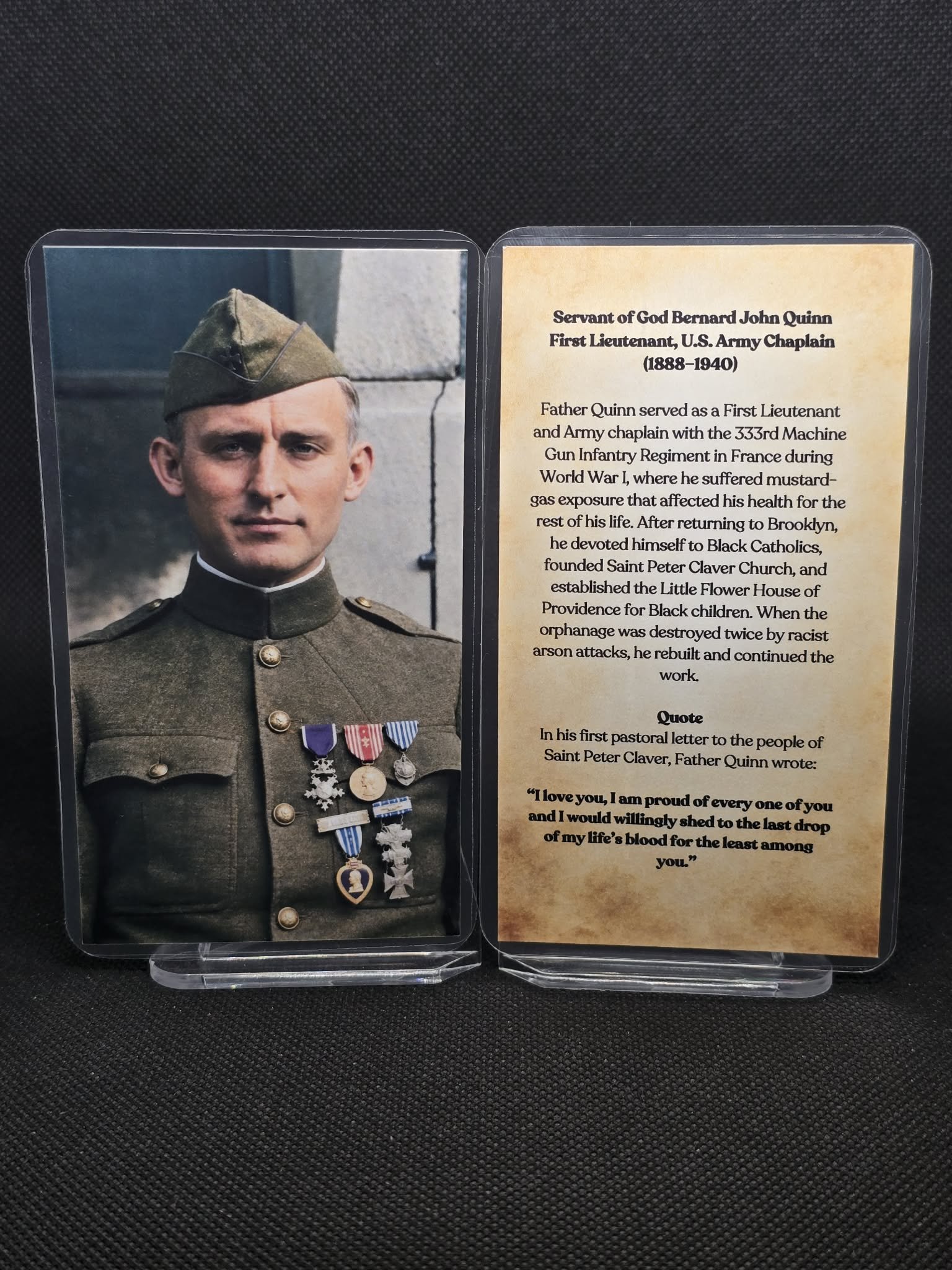
 Image 1 of 1
Servant of God Bernard John Quinn Prayer Card | For Racial Equality, Black Catholics, Veterans, Orphans & Courage
Servant of God Bernard John Quinn was a Catholic priest of the Diocese of Brooklyn, United States Army chaplain, defender of Black Catholics, founder of Brooklyn’s first parish established specifically for African American Catholics, and founder of a home for Black children who had been orphaned, abandoned, or neglected. At a time when racial discrimination was deeply embedded in American society, Father Quinn insisted that the Catholic faith could never be reconciled with excluding people because of race, and he repeatedly placed his reputation, health, finances, and personal safety behind that conviction.
Father Quinn is especially meaningful for Black Catholics, people confronting racism or discrimination, priests, military chaplains, veterans, foster and adopted children, orphans, caregivers, social workers, people defending the dignity of marginalized communities, devotees of Saint Thérèse of Lisieux, and Christians asking for courage to stand against hatred without abandoning charity. These are devotional associations drawn directly from his life rather than formal patronages, because Bernard Quinn remains a Servant of God and has not yet been declared Venerable, Blessed, or Saint.
His story is particularly striking because his work crossed boundaries that were often kept rigidly separate in early twentieth-century America. He served American soldiers overseas, built Catholic institutions for Black families at home, challenged racial discrimination inside and outside the Church, brought Black and white Catholics together in prayer, cared for children rejected by existing institutions, and rebuilt an orphanage after racist attackers burned it down twice.
Each prayer card measures 2.5" x 4.25", is handmade in Austin, Texas, printed on museum-quality photo paper rather than ordinary cardstock, and double laminated for durability. Each card is prepared prayerfully with the recipient and their intentions lifted before Christ while asking Servant of God Bernard John Quinn to intercede for the person who will receive it.
THE LIFE & STORY
Bernard John Quinn was born on January 15, 1888, in Newark, New Jersey, to Bernard and Sarah Quinn, Irish immigrant parents raising a large Catholic family on the modest income his father earned as a longshoreman. The official cause biography describes the family as poor but deeply religious and happy, and Bernard’s childhood religious formation helped foster an early attraction to the priesthood.
There is a remarkable coincidence attached to his birthday. Quinn was born on the very day Pope Leo XIII canonized Saint Peter Claver, the Jesuit missionary whose life became inseparably associated with defending the dignity of enslaved Africans, and decades later Quinn would name the first Black Catholic parish he founded after that same saint.
CALLED TO THE PRIESTHOOD
Bernard entered preparatory seminary studies and eventually came to the Diocese of Brooklyn, where he entered Saint John’s Seminary in 1906. The official cause remembers him as both prayerful and sociable, a young seminarian devoted to daily chapel prayer while also enjoying athletics, friendships, and an energetic family correspondence.
He was ordained a priest of the Diocese of Brooklyn in 1912 and began ordinary parish ministry. While preparing two Black women for baptism, however, he became increasingly conscious that Black Catholics in Brooklyn were receiving inadequate pastoral attention, and the conviction that he should devote himself to this neglected community began taking hold.
A PRIEST WHO WANTED TO SERVE BLACK CATHOLICS
Father Quinn approached his bishop about beginning a dedicated apostolate among Black Catholics. The timing coincided with the United States’ participation in the First World War, however, and the bishop was urgently looking for priests willing to serve as military chaplains.
Quinn volunteered. The decision temporarily delayed the ministry he had hoped to begin in Brooklyn, but military service would deepen both his pastoral experience and his understanding of racial injustice before he returned home.
UNITED STATES ARMY CHAPLAIN
Father Quinn was commissioned as a First Lieutenant and Army chaplain in 1918 and served American troops in France. His official cause records that he suffered exposure to mustard gas during his military service and that its effects damaged his health for the remainder of his life, yet after recovering sufficiently he resumed caring for soldiers.
His military service gives him a strong devotional connection with soldiers, veterans, military chaplains, and Christians whose service leaves them carrying physical consequences long after the immediate danger has ended. Quinn did not return from war untouched, but the lasting damage to his health did not prevent him from pursuing decades of intense pastoral and charitable work.
RACISM DURING THE FIRST WORLD WAR
The experience of military life also exposed Father Quinn to the racial prejudices confronting Black American soldiers. Later accounts of his life describe an incident in which he ministered to a dying Black soldier after another chaplain refused to do so, an encounter remembered as reinforcing Quinn’s determination that Black Catholics should never be treated as lesser members of the Church.
For Quinn, racial equality would never become merely an abstract social principle. It became part of his understanding of priesthood itself, because he believed sacramental ministry and the defense of human dignity could not be separated.
DISCOVERING SAINT THÉRÈSE OF LISIEUX
While stationed in France, Father Quinn discovered The Story of a Soul, the autobiography of Saint Thérèse of Lisieux, in his barracks library. He became captivated by Thérèse’s spirituality and realized that he was stationed near Alençon, where she had been born.
Quinn obtained permission to visit the Martin family home. On January 2, 1919, Thérèse’s birthday, he celebrated Mass in the room where she had been born and later remembered the privilege with great gratitude; the official cause identifies him as the first priest to celebrate Mass there before the home became a major pilgrimage site.
THE LITTLE FLOWER & FATHER QUINN
Saint Thérèse would become one of the central spiritual influences of Quinn’s priesthood. When he later built institutions for Black Catholics and vulnerable children, her nickname, the Little Flower, repeatedly appeared in the names and devotions surrounding his work.
His devotion was not merely sentimental. Quinn believed Thérèse’s intercession supported his work, and the enormous novena that developed at Saint Peter Claver Church became one of the primary ways people of different races encountered one another in common Catholic prayer.
RETURN TO BROOKLYN
After returning from military service, Father Quinn again sought permission to begin his ministry among Black Catholics. He received approval in 1920 and began searching Brooklyn for the Catholic community he hoped to serve.
He soon encountered members of the Colored Catholic Club, a group of Black Catholics who had previously organized in hopes of obtaining a parish where their spiritual needs would be taken seriously. Quinn joined their efforts, helped reorganize the group, and worked with them to raise the money necessary for a church.
SAINT PETER CLAVER CHURCH
A former Protestant church building that had later been used as a warehouse was purchased, restored, and dedicated as Saint Peter Claver Church on February 26, 1922. It became the first parish established for Black Catholics in the Diocese of Brooklyn and the center from which much of Quinn’s later work developed.
Quinn did not envision Saint Peter Claver merely as a place where Black Catholics could attend Mass. He wanted a complete Catholic community with religious education, social services, cultural activities, recreation, vocational encouragement, and practical assistance for families facing discrimination and poverty.
“I LOVE YOU”
In his first pastoral letter to the parishioners of Saint Peter Claver, Father Quinn expressed the depth of his commitment in language his official cause continues to highlight:
“I love you, I am proud of every one of you and I would willingly shed to the last drop of my life’s blood for the least among you.”
The power of the words lies in what followed them. Quinn spent the remaining years of his life repeatedly placing his health, finances, energy, and reputation behind the people to whom that promise had been made.
“NO CHURCH CAN EXCLUDE ANYONE”
Father Quinn’s commitment eventually required challenging racism openly. When a Catholic priest publicly argued against the growing presence of Black Catholics, Quinn responded that “no church can exclude anyone and still keep its Christian ideals.”
The statement makes Quinn particularly meaningful for Catholics struggling with racism inside Christian communities. His position was not that racial equality belonged to some separate political program; he argued that excluding people because of race contradicted what the Church claimed to believe about Christianity itself.
FOR BLACK CATHOLICS
Servant of God Bernard Quinn occupies an important place in the history of Black Catholicism in New York. He worked with Black Catholics rather than simply building institutions around them, and the parish of Saint Peter Claver became a center of religious, educational, cultural, and social life.
His ministry also included active efforts to encourage Black vocations to the priesthood and religious life during a period when Black Catholics faced severe barriers to admission and advancement. Quinn welcomed and celebrated Black candidates for priesthood and wanted the leadership of the Church increasingly to reflect the people being served.
BRINGING BLACK & WHITE CATHOLICS TOGETHER
Following Saint Thérèse’s canonization in 1925, Quinn developed a perpetual novena to the Little Flower at Saint Peter Claver. Reports of answered prayers attracted enormous crowds, including white Catholics who regularly traveled into the Black parish to pray beside Black Catholics at a time when much of American public life remained segregated.
The official cause records that attendance eventually reached extraordinary numbers, with contemporary newspaper reports describing approximately 10,000 participants each week and more than two million visits over several years. The novena became simultaneously a devotional phenomenon and a place where racial barriers were being crossed through shared Catholic worship.
THE LITTLE FLOWER HOUSE OF PROVIDENCE
Father Quinn became increasingly concerned about Black children who were orphaned, abandoned, or unable to obtain care from institutions that discriminated against them. He acquired property at Wading River on Long Island with the goal of creating a home where those children would be welcomed.
The project developed into the Little Flower House of Providence, named in honor of Saint Thérèse. Its purpose extended Quinn’s pastoral principle beyond church doors: children who were unwanted elsewhere would not be abandoned by the Catholic community he was building.
THE KU KLUX KLAN BURNS THE ORPHANAGE
The project encountered violent racist opposition. The orphanage was burned down twice, attacks that Catholic sources connect with the Ku Klux Klan and the intense hostility surrounding Quinn’s determination to establish a home for Black children on Long Island.
Quinn did not abandon the children or relocate the mission simply because racist violence made the project dangerous. He rebuilt again, this time using brick and concrete, and the permanent Little Flower House of Providence was dedicated in 1930.
COURAGE AFTER THE SECOND FIRE
The rebuilding is one of the clearest demonstrations of Quinn’s courage because it required more than surviving a threatening incident. After the first destruction, he rebuilt; after the second, he rebuilt again, making the structure harder to destroy and demonstrating publicly that intimidation would not determine whether Black children deserved a home.
For Christians confronting hatred, discrimination, intimidation, or repeated setbacks, this episode gives Quinn a powerful devotional relevance. His courage was not expressed through hatred toward his attackers but through refusing to stop doing the good they were trying to prevent.
SAINT KATHARINE DREXEL & THE LITTLE FLOWER
Quinn’s work brought him into contact with another future saint, Saint Katharine Drexel, whose own religious community was devoted particularly to Black and Native American Catholics. The official cause records financial assistance connected with Mother Katharine and the involvement of the Sisters of the Blessed Sacrament in staffing the orphanage and parish work.
This places Quinn within a wider network of early twentieth-century Catholic efforts confronting racial injustice. His work was distinctly his own, but it intersected with the missions of Catholics who likewise believed the Church had an obligation to defend communities treated unjustly because of race.
THE LITTLE FLOWER CONTINUES TODAY
Father Quinn’s orphanage did not disappear with his death. The institution developed into Little Flower Children and Family Services of New York, which continues serving children, families, foster youth, and people with developmental disabilities.
The continuity gives Quinn’s work an unusual living legacy. The organization he created to answer the needs of vulnerable Black children in the early twentieth century continued expanding its mission across generations rather than becoming merely a historical memorial bearing his name.
THE SAINT PETER CLAVER INSTITUTE
Father Quinn also developed the Saint Peter Claver Institute, a large parish complex incorporating educational, recreational, religious, and community facilities. The building included a school, parish center, gymnasium, meeting spaces, and services intended to create opportunities for a community routinely denied equal access elsewhere.
The Institute demonstrated that Quinn’s understanding of pastoral ministry included more than sacramental availability. Education, recreation, health, culture, social support, and spiritual formation all belonged to the dignity he believed a parish should help defend.
SAINT BENEDICT THE MOOR
Quinn’s work expanded beyond Saint Peter Claver when he established the Saint Benedict the Moor Mission in Jamaica, Queens, in 1932. The mission eventually developed into another parish serving Black Catholics within the Diocese of Brooklyn.
The expansion showed that the needs Quinn had identified were not limited to one neighborhood. His original apostolate became a wider diocesan mission aimed at ensuring that Black Catholics had pastoral communities, sacramental life, and institutions genuinely committed to them.
MINISTRY TO BLACK SEAMEN
The official cause also records Quinn’s establishment of an Apostleship of the Sea for Black seamen in 1930. His concern therefore extended to men who might otherwise have been isolated from stable parish communities because of both occupation and race.
This part of his ministry broadens the meaning of his work. Quinn consistently searched for people who were being overlooked and then attempted to create practical Catholic structures capable of reaching them.
FOR PRIESTS
Father Quinn offers priests a model of pastoral ministry in which sacramental care cannot be isolated from the conditions affecting people’s actual lives. His postulator summarized Quinn’s approach by explaining that he could not separate sacramental ministry from the social realities denying people opportunity because of race or immigrant status.
His priesthood was deeply Eucharistic and devotional while simultaneously confronting poverty, discrimination, education, employment, housing, children’s welfare, and racial injustice. Quinn’s example therefore resists the idea that serious prayer and serious concern for human dignity somehow compete with one another.
FOR MILITARY CHAPLAINS
Military chaplains may also find a strong connection with Quinn because his priesthood included direct service to soldiers during the First World War. He ministered to wounded men, suffered injury from wartime gas exposure, and carried the consequences of that service for the remainder of his life.
His military experience also affected the direction of his later ministry. Exposure to the treatment of Black servicemen strengthened his awareness that racism could follow soldiers even while they served the same country under the same uniform.
FOR VETERANS
Father Quinn’s life may be especially meaningful to veterans whose military experiences continue shaping them long after service ends. His wartime exposure damaged his health, yet he returned home and converted what he had witnessed into a deeper commitment to people suffering from injustice.
The story does not suggest that suffering automatically becomes useful or easy. It does show that difficult experiences from military life can become part of a later vocation rather than remaining the final definition of a person’s future.
FOR ORPHANS, FOSTER CHILDREN & VULNERABLE YOUTH
Quinn’s determination to establish the Little Flower House of Providence gives him an especially natural devotional association with orphans, foster children, adopted children, children in residential care, and young people who have experienced abandonment or neglect. He did not treat their needs as secondary to his parish work; caring for vulnerable children became one of his central missions.
His story may also be meaningful for foster parents, adoptive parents, child-welfare workers, counselors, teachers, and caregivers. The institution he founded continues serving children and families, demonstrating how one priest’s decision to respond to neglected children developed into a mission extending far beyond his lifetime.
FOR PEOPLE CONFRONTING RACISM
Father Quinn’s response to racism was both direct and deeply Christian. He rejected arguments for racial exclusion, advocated for educational and employment opportunities, built institutions when existing ones failed Black Catholics, and continued his work even when racial hatred became physically violent.
His example is especially important because courage did not require adopting hatred toward those who opposed him. Quinn’s answer was persistent service, public defense of human dignity, prayer, institution-building, and refusal to allow intimidation to decide whom the Church would love.
FOR DEVOTEES OF SAINT THÉRÈSE
Saint Thérèse of Lisieux occupies an unusually large place in Bernard Quinn’s spiritual story. His encounter with Story of a Soul during military service changed his devotional life, and he later placed major parts of his ministry under her patronage.
The weekly Little Flower novena became one of the great devotional engines supporting his mission. For people already devoted to Saint Thérèse, Quinn’s life gives an unusual American example of how her spirituality and intercession inspired concrete work among communities suffering from poverty and discrimination.
HIS INTERIOR LIFE
The official cause describes Quinn as a man who regularly used free moments to pray before the Blessed Sacrament, found spiritual nourishment in daily Mass, prayed the Rosary, and maintained a profound devotion to the Sacred Heart of Jesus. His intense external activity was therefore sustained by a deliberately cultivated interior life rather than by activism alone.
This dimension is essential for understanding him accurately. Quinn did not regard prayer as separate from caring for children or combating discrimination; he believed prayer was what made the sustained work of charity possible.
HIS FINAL ILLNESS
Years of poor health, enormous financial strain, pastoral labor, and the lingering effects attributed to his wartime gas exposure took a serious toll. Father Quinn died on April 7, 1940, at only fifty-two years old after a painful illness associated with cancer.
His death produced an extraordinary public response. Contemporary reports remembered thousands gathering for his funeral, with approximately 8,000 people paying tribute around Saint Peter Claver Church.
HIS GRAVE
Servant of God Bernard Quinn is buried at Holy Rood Cemetery in Westbury, New York. Memorial observances connected with his cause have included Mass followed by processions to his grave, where Catholics continue praying for the advancement of his cause.
His burial place creates a direct physical connection with the Long Island region where the Little Flower orphanage was built despite violent opposition. The sites of his ministry, orphanage, parish, and grave together preserve different parts of the same vocation.
HIS CAUSE FOR CANONIZATION
The Diocese of Brooklyn formally opened Father Quinn’s cause for canonization in 2008, and he bears the title Servant of God. The Father Bernard John Quinn Guild continues promoting his cause, educating Catholics about his life, and encouraging the faithful to seek his intercession.
In 2024, the Diocese of Brooklyn announced completion of its extensive diocesan investigation and the transmission of the collected documentation to Rome for further consideration. As of 2026, the official cause continues to identify him as Servant of God Bernard John Quinn, and he has not yet received the titles Venerable, Blessed, or Saint.
NOT YET VENERABLE, BLESSED OR SAINT
The title Servant of God indicates that Quinn’s formal cause is underway, but it does not itself mean that the Church has issued a decree recognizing heroic virtue. His next major advancement would ordinarily involve such a decree and the title Venerable, followed later by beatification if the requirements of the cause are satisfied.
His proper current title is Servant of God Bernard John Quinn. His strong connections with racial equality, Black Catholics, veterans, orphans, priests, and military chaplains arise from the documented circumstances of his life and are devotional associations rather than formally declared patronages.
APPROVED PRAYER FOR HIS INTERCESSION
There is a specific prayer for Father Quinn’s intercession and canonization carrying ecclesiastical approval from the Diocese of Brooklyn dated December 14, 2007. The prayer remembers his love for the people of Saint Peter Claver and his fatherly care for the children of Little Flower House of Providence while inviting the faithful to present a personal intention through his intercession.
One especially appropriate petition from the approved prayer asks for “the loving care which he gave to others.” The prayer then asks that, if God grants the petition, the favor may assist Father Quinn’s cause for canonization.
A PRAYER CARD FOR RACIAL EQUALITY
A Bernard Quinn prayer card is especially appropriate for someone praying for healing from racism, courage to defend another person’s dignity, reconciliation between communities, or wisdom in confronting prejudice without surrendering Christian charity. His biography gives these intentions unusually concrete historical grounding because racial equality was one of the defining struggles of his priesthood.
Quinn did not simply issue statements against prejudice. He built parishes, schools, recreational facilities, charitable institutions, and an orphanage intended to give Black Catholics access to opportunities and dignity that discriminatory systems routinely denied them.
A PRAYER CARD FOR BLACK CATHOLICS
For Black Catholics, Father Quinn’s life belongs to the history of communities that had to struggle to obtain ordinary pastoral recognition within the American Church. His work with the Colored Catholic Club and the establishment of Saint Peter Claver Church provide a concrete link to Black Catholic perseverance, organization, evangelization, and institution-building in Brooklyn.
The card can also serve as a devotional reminder that many chapters of Black Catholic history developed through cooperation between Black lay Catholics and clergy willing to listen to them. Quinn did not create the community from nothing; he joined people who had already been asking the Church to recognize and support their Catholic life.
A PRAYER CARD FOR VETERANS & MILITARY CHAPLAINS
Father Quinn’s Army chaplaincy makes this card meaningful for Catholic military personnel and veterans as well. His service reminds chaplains that ministry sometimes requires sharing the physical danger and suffering of the people entrusted to them rather than remaining distant from it.
Veterans may also recognize the way wartime experiences continued shaping Quinn after he came home. His physical health remained affected, while what he witnessed concerning racial discrimination contributed to the work that defined the remainder of his priesthood.
A PRAYER CARD FOR FOSTER & ADOPTIVE FAMILIES
The Little Flower House of Providence gives Father Quinn a particularly strong devotional connection with families caring for children who have experienced abandonment, neglect, or instability. Foster parents and adoptive parents may find encouragement in the priest who refused to accept that unwanted or excluded children should simply be left without a safe home.
Social workers, counselors, residential-care employees, and child-welfare professionals may also find his example meaningful. Quinn’s legacy survives through an organization that continues working with vulnerable children and families nearly a century after the original Little Flower mission began.
FAQ
Who was Servant of God Bernard John Quinn? Bernard John Quinn was a Catholic priest of the Diocese of Brooklyn, U.S. Army chaplain, founder of Saint Peter Claver Church, advocate for Black Catholics, and founder of the institution that became Little Flower Children and Family Services of New York. He lived from 1888 to 1940 and devoted much of his priesthood to communities suffering from racial discrimination and poverty.
Is Bernard Quinn a saint? No, his current ecclesiastical title is Servant of God Bernard John Quinn. His canonization cause remains active, but he has not yet been declared Venerable, beatified, or canonized.
Was Bernard Quinn a Monsignor? Yes, he is commonly identified by the Diocese of Brooklyn and his official cause as Monsignor Bernard J. Quinn, although many people who knew or remember him simply call him Father Quinn. His cause itself is maintained under both forms of his name.
Was Bernard Quinn really a military chaplain? Yes, he served as a U.S. Army chaplain in France during the First World War. His official cause records that he suffered mustard-gas exposure and continued experiencing its effects afterward.
Can veterans pray for Bernard Quinn’s intercession? Yes, the Father Bernard John Quinn Guild actively encourages Catholics to seek his intercession for spiritual and temporal needs. His military service gives veterans and military families a natural devotional connection with him, although he has not been formally declared their patron.
Did Father Quinn establish the first Black Catholic parish in Brooklyn? Yes, Saint Peter Claver Church was established as the first church and parish in the Diocese of Brooklyn specifically serving African American Catholics. The church was dedicated in 1922 and became the center of Quinn’s wider apostolate.
Did Black Catholics help establish Saint Peter Claver? Yes, Quinn worked directly with members of the Colored Catholic Club, Black Catholics who had already organized and petitioned for a dedicated parish. The parish therefore grew from cooperation between Quinn and a Black Catholic community that had been seeking stronger diocesan support.
Did Father Quinn oppose racism? Yes, opposition to racial discrimination became one of the central features of his priesthood. He publicly defended Black Catholics, advocated for opportunities in education and employment, and rejected arguments that churches should exclude people because of race.
Did the Ku Klux Klan burn Father Quinn’s orphanage? Catholic historical sources identify the Ku Klux Klan with two arson attacks that destroyed the orphanage he was establishing for Black children. Quinn rebuilt the institution again using more fire-resistant construction rather than abandoning the project.
What was Little Flower House of Providence? It was the home Father Quinn established for Black children who were orphaned, abandoned, or otherwise in need of care. The permanent building was dedicated in 1930 and developed into the organization now known as Little Flower Children and Family Services of New York.
Does Little Flower still exist? Yes, Little Flower Children and Family Services of New York continues operating and has expanded beyond the original residential mission. Its modern work includes services for children, families, foster youth, and people with developmental disabilities.
Was Father Quinn devoted to Saint Thérèse of Lisieux? Yes, his devotion began after reading The Story of a Soul while serving as an Army chaplain in France. He later celebrated Mass at her birthplace, promoted a major weekly novena in Brooklyn, and named the Little Flower House of Providence in her honor.
Was Father Quinn really the first priest to celebrate Mass in Saint Thérèse’s birthplace? His official cause states that he was the first priest to celebrate Mass in the room where Thérèse was born before the house became the major devotional site it later became. Quinn himself regarded the experience as an extraordinary privilege.
Did Saint Katharine Drexel help Father Quinn? Yes, Quinn’s work had connections with Saint Katharine Drexel and the Sisters of the Blessed Sacrament. His official cause records financial help connected with Mother Katharine and the congregation’s service at institutions associated with his apostolate.
Where is Bernard Quinn buried? He is buried at Holy Rood Cemetery in Westbury, New York. Memorial celebrations connected with his cause have included visits and prayer at his grave.
When did Bernard Quinn die? Father Quinn died on April 7, 1940, at fifty-two years old after serious illness. Thousands attended or gathered around his funeral, reflecting the enormous affection his ministry had generated.
When was Bernard Quinn’s sainthood cause opened? The Diocese of Brooklyn opened his cause in 2008, after which he became known as Servant of God Bernard Quinn. The diocesan investigation was later completed, and documentation was forwarded to Rome for the next stages of examination.
Is there an approved prayer for Bernard Quinn? Yes, a prayer seeking his intercession and the advancement of his cause received ecclesiastical approval from the Diocese of Brooklyn in 2007. The prayer asks God to remember Quinn’s fatherly love for his parishioners and vulnerable children while presenting a personal petition through his intercession.
What are some notable Bernard Quinn quotations? His 1922 promise to the people of Saint Peter Claver is especially powerful because he told them he loved them and would willingly give his life for even the least among them. His statement that no church can exclude people while remaining true to Christian ideals is another important expression of his commitment to racial equality and Christian dignity.
Who would this prayer card make a meaningful gift for? It is especially fitting for Black Catholics, priests, veterans, military chaplains, foster and adoptive families, social workers, caregivers, teachers, Saint Thérèse devotees, and Christians confronting racism or discrimination. His story also makes the card appropriate for anyone asking for courage to defend vulnerable people when doing so brings criticism or opposition.
THE MAIN MESSAGE OF SERVANT OF GOD BERNARD JOHN QUINN’S LIFE
Bernard Quinn’s life teaches that Christian love becomes credible when it is willing to build, defend, remain, and rebuild for people whom others would rather overlook. He did not merely preach racial equality from a safe distance; he built a parish when Black Catholics lacked one, defended them when other Catholics objected to their presence, created institutions when Black children were excluded elsewhere, and rebuilt when racist violence tried twice to destroy what he had created.
His devotion to the Eucharist, Sacred Heart, Rosary, and Saint Thérèse did not draw him away from the suffering of the world around him. Those devotions helped form the priest who could tell his parishioners that his heart burned with love for them and then spend the remainder of his short life proving that those words were more than rhetoric.
For Black Catholics, veterans, priests, foster families, caregivers, and Christians standing against racism, Quinn offers a demanding picture of courage rooted in love rather than anger. The fires that destroyed his orphanage did not convince him to stop building, the prejudice surrounding his ministry did not convince him to exclude anyone, and declining health did not convince him to stop serving the people he had promised to love.
Servant of God Bernard John Quinn was a Catholic priest of the Diocese of Brooklyn, United States Army chaplain, defender of Black Catholics, founder of Brooklyn’s first parish established specifically for African American Catholics, and founder of a home for Black children who had been orphaned, abandoned, or neglected. At a time when racial discrimination was deeply embedded in American society, Father Quinn insisted that the Catholic faith could never be reconciled with excluding people because of race, and he repeatedly placed his reputation, health, finances, and personal safety behind that conviction.
Father Quinn is especially meaningful for Black Catholics, people confronting racism or discrimination, priests, military chaplains, veterans, foster and adopted children, orphans, caregivers, social workers, people defending the dignity of marginalized communities, devotees of Saint Thérèse of Lisieux, and Christians asking for courage to stand against hatred without abandoning charity. These are devotional associations drawn directly from his life rather than formal patronages, because Bernard Quinn remains a Servant of God and has not yet been declared Venerable, Blessed, or Saint.
His story is particularly striking because his work crossed boundaries that were often kept rigidly separate in early twentieth-century America. He served American soldiers overseas, built Catholic institutions for Black families at home, challenged racial discrimination inside and outside the Church, brought Black and white Catholics together in prayer, cared for children rejected by existing institutions, and rebuilt an orphanage after racist attackers burned it down twice.
Each prayer card measures 2.5" x 4.25", is handmade in Austin, Texas, printed on museum-quality photo paper rather than ordinary cardstock, and double laminated for durability. Each card is prepared prayerfully with the recipient and their intentions lifted before Christ while asking Servant of God Bernard John Quinn to intercede for the person who will receive it.
THE LIFE & STORY
Bernard John Quinn was born on January 15, 1888, in Newark, New Jersey, to Bernard and Sarah Quinn, Irish immigrant parents raising a large Catholic family on the modest income his father earned as a longshoreman. The official cause biography describes the family as poor but deeply religious and happy, and Bernard’s childhood religious formation helped foster an early attraction to the priesthood.
There is a remarkable coincidence attached to his birthday. Quinn was born on the very day Pope Leo XIII canonized Saint Peter Claver, the Jesuit missionary whose life became inseparably associated with defending the dignity of enslaved Africans, and decades later Quinn would name the first Black Catholic parish he founded after that same saint.
CALLED TO THE PRIESTHOOD
Bernard entered preparatory seminary studies and eventually came to the Diocese of Brooklyn, where he entered Saint John’s Seminary in 1906. The official cause remembers him as both prayerful and sociable, a young seminarian devoted to daily chapel prayer while also enjoying athletics, friendships, and an energetic family correspondence.
He was ordained a priest of the Diocese of Brooklyn in 1912 and began ordinary parish ministry. While preparing two Black women for baptism, however, he became increasingly conscious that Black Catholics in Brooklyn were receiving inadequate pastoral attention, and the conviction that he should devote himself to this neglected community began taking hold.
A PRIEST WHO WANTED TO SERVE BLACK CATHOLICS
Father Quinn approached his bishop about beginning a dedicated apostolate among Black Catholics. The timing coincided with the United States’ participation in the First World War, however, and the bishop was urgently looking for priests willing to serve as military chaplains.
Quinn volunteered. The decision temporarily delayed the ministry he had hoped to begin in Brooklyn, but military service would deepen both his pastoral experience and his understanding of racial injustice before he returned home.
UNITED STATES ARMY CHAPLAIN
Father Quinn was commissioned as a First Lieutenant and Army chaplain in 1918 and served American troops in France. His official cause records that he suffered exposure to mustard gas during his military service and that its effects damaged his health for the remainder of his life, yet after recovering sufficiently he resumed caring for soldiers.
His military service gives him a strong devotional connection with soldiers, veterans, military chaplains, and Christians whose service leaves them carrying physical consequences long after the immediate danger has ended. Quinn did not return from war untouched, but the lasting damage to his health did not prevent him from pursuing decades of intense pastoral and charitable work.
RACISM DURING THE FIRST WORLD WAR
The experience of military life also exposed Father Quinn to the racial prejudices confronting Black American soldiers. Later accounts of his life describe an incident in which he ministered to a dying Black soldier after another chaplain refused to do so, an encounter remembered as reinforcing Quinn’s determination that Black Catholics should never be treated as lesser members of the Church.
For Quinn, racial equality would never become merely an abstract social principle. It became part of his understanding of priesthood itself, because he believed sacramental ministry and the defense of human dignity could not be separated.
DISCOVERING SAINT THÉRÈSE OF LISIEUX
While stationed in France, Father Quinn discovered The Story of a Soul, the autobiography of Saint Thérèse of Lisieux, in his barracks library. He became captivated by Thérèse’s spirituality and realized that he was stationed near Alençon, where she had been born.
Quinn obtained permission to visit the Martin family home. On January 2, 1919, Thérèse’s birthday, he celebrated Mass in the room where she had been born and later remembered the privilege with great gratitude; the official cause identifies him as the first priest to celebrate Mass there before the home became a major pilgrimage site.
THE LITTLE FLOWER & FATHER QUINN
Saint Thérèse would become one of the central spiritual influences of Quinn’s priesthood. When he later built institutions for Black Catholics and vulnerable children, her nickname, the Little Flower, repeatedly appeared in the names and devotions surrounding his work.
His devotion was not merely sentimental. Quinn believed Thérèse’s intercession supported his work, and the enormous novena that developed at Saint Peter Claver Church became one of the primary ways people of different races encountered one another in common Catholic prayer.
RETURN TO BROOKLYN
After returning from military service, Father Quinn again sought permission to begin his ministry among Black Catholics. He received approval in 1920 and began searching Brooklyn for the Catholic community he hoped to serve.
He soon encountered members of the Colored Catholic Club, a group of Black Catholics who had previously organized in hopes of obtaining a parish where their spiritual needs would be taken seriously. Quinn joined their efforts, helped reorganize the group, and worked with them to raise the money necessary for a church.
SAINT PETER CLAVER CHURCH
A former Protestant church building that had later been used as a warehouse was purchased, restored, and dedicated as Saint Peter Claver Church on February 26, 1922. It became the first parish established for Black Catholics in the Diocese of Brooklyn and the center from which much of Quinn’s later work developed.
Quinn did not envision Saint Peter Claver merely as a place where Black Catholics could attend Mass. He wanted a complete Catholic community with religious education, social services, cultural activities, recreation, vocational encouragement, and practical assistance for families facing discrimination and poverty.
“I LOVE YOU”
In his first pastoral letter to the parishioners of Saint Peter Claver, Father Quinn expressed the depth of his commitment in language his official cause continues to highlight:
“I love you, I am proud of every one of you and I would willingly shed to the last drop of my life’s blood for the least among you.”
The power of the words lies in what followed them. Quinn spent the remaining years of his life repeatedly placing his health, finances, energy, and reputation behind the people to whom that promise had been made.
“NO CHURCH CAN EXCLUDE ANYONE”
Father Quinn’s commitment eventually required challenging racism openly. When a Catholic priest publicly argued against the growing presence of Black Catholics, Quinn responded that “no church can exclude anyone and still keep its Christian ideals.”
The statement makes Quinn particularly meaningful for Catholics struggling with racism inside Christian communities. His position was not that racial equality belonged to some separate political program; he argued that excluding people because of race contradicted what the Church claimed to believe about Christianity itself.
FOR BLACK CATHOLICS
Servant of God Bernard Quinn occupies an important place in the history of Black Catholicism in New York. He worked with Black Catholics rather than simply building institutions around them, and the parish of Saint Peter Claver became a center of religious, educational, cultural, and social life.
His ministry also included active efforts to encourage Black vocations to the priesthood and religious life during a period when Black Catholics faced severe barriers to admission and advancement. Quinn welcomed and celebrated Black candidates for priesthood and wanted the leadership of the Church increasingly to reflect the people being served.
BRINGING BLACK & WHITE CATHOLICS TOGETHER
Following Saint Thérèse’s canonization in 1925, Quinn developed a perpetual novena to the Little Flower at Saint Peter Claver. Reports of answered prayers attracted enormous crowds, including white Catholics who regularly traveled into the Black parish to pray beside Black Catholics at a time when much of American public life remained segregated.
The official cause records that attendance eventually reached extraordinary numbers, with contemporary newspaper reports describing approximately 10,000 participants each week and more than two million visits over several years. The novena became simultaneously a devotional phenomenon and a place where racial barriers were being crossed through shared Catholic worship.
THE LITTLE FLOWER HOUSE OF PROVIDENCE
Father Quinn became increasingly concerned about Black children who were orphaned, abandoned, or unable to obtain care from institutions that discriminated against them. He acquired property at Wading River on Long Island with the goal of creating a home where those children would be welcomed.
The project developed into the Little Flower House of Providence, named in honor of Saint Thérèse. Its purpose extended Quinn’s pastoral principle beyond church doors: children who were unwanted elsewhere would not be abandoned by the Catholic community he was building.
THE KU KLUX KLAN BURNS THE ORPHANAGE
The project encountered violent racist opposition. The orphanage was burned down twice, attacks that Catholic sources connect with the Ku Klux Klan and the intense hostility surrounding Quinn’s determination to establish a home for Black children on Long Island.
Quinn did not abandon the children or relocate the mission simply because racist violence made the project dangerous. He rebuilt again, this time using brick and concrete, and the permanent Little Flower House of Providence was dedicated in 1930.
COURAGE AFTER THE SECOND FIRE
The rebuilding is one of the clearest demonstrations of Quinn’s courage because it required more than surviving a threatening incident. After the first destruction, he rebuilt; after the second, he rebuilt again, making the structure harder to destroy and demonstrating publicly that intimidation would not determine whether Black children deserved a home.
For Christians confronting hatred, discrimination, intimidation, or repeated setbacks, this episode gives Quinn a powerful devotional relevance. His courage was not expressed through hatred toward his attackers but through refusing to stop doing the good they were trying to prevent.
SAINT KATHARINE DREXEL & THE LITTLE FLOWER
Quinn’s work brought him into contact with another future saint, Saint Katharine Drexel, whose own religious community was devoted particularly to Black and Native American Catholics. The official cause records financial assistance connected with Mother Katharine and the involvement of the Sisters of the Blessed Sacrament in staffing the orphanage and parish work.
This places Quinn within a wider network of early twentieth-century Catholic efforts confronting racial injustice. His work was distinctly his own, but it intersected with the missions of Catholics who likewise believed the Church had an obligation to defend communities treated unjustly because of race.
THE LITTLE FLOWER CONTINUES TODAY
Father Quinn’s orphanage did not disappear with his death. The institution developed into Little Flower Children and Family Services of New York, which continues serving children, families, foster youth, and people with developmental disabilities.
The continuity gives Quinn’s work an unusual living legacy. The organization he created to answer the needs of vulnerable Black children in the early twentieth century continued expanding its mission across generations rather than becoming merely a historical memorial bearing his name.
THE SAINT PETER CLAVER INSTITUTE
Father Quinn also developed the Saint Peter Claver Institute, a large parish complex incorporating educational, recreational, religious, and community facilities. The building included a school, parish center, gymnasium, meeting spaces, and services intended to create opportunities for a community routinely denied equal access elsewhere.
The Institute demonstrated that Quinn’s understanding of pastoral ministry included more than sacramental availability. Education, recreation, health, culture, social support, and spiritual formation all belonged to the dignity he believed a parish should help defend.
SAINT BENEDICT THE MOOR
Quinn’s work expanded beyond Saint Peter Claver when he established the Saint Benedict the Moor Mission in Jamaica, Queens, in 1932. The mission eventually developed into another parish serving Black Catholics within the Diocese of Brooklyn.
The expansion showed that the needs Quinn had identified were not limited to one neighborhood. His original apostolate became a wider diocesan mission aimed at ensuring that Black Catholics had pastoral communities, sacramental life, and institutions genuinely committed to them.
MINISTRY TO BLACK SEAMEN
The official cause also records Quinn’s establishment of an Apostleship of the Sea for Black seamen in 1930. His concern therefore extended to men who might otherwise have been isolated from stable parish communities because of both occupation and race.
This part of his ministry broadens the meaning of his work. Quinn consistently searched for people who were being overlooked and then attempted to create practical Catholic structures capable of reaching them.
FOR PRIESTS
Father Quinn offers priests a model of pastoral ministry in which sacramental care cannot be isolated from the conditions affecting people’s actual lives. His postulator summarized Quinn’s approach by explaining that he could not separate sacramental ministry from the social realities denying people opportunity because of race or immigrant status.
His priesthood was deeply Eucharistic and devotional while simultaneously confronting poverty, discrimination, education, employment, housing, children’s welfare, and racial injustice. Quinn’s example therefore resists the idea that serious prayer and serious concern for human dignity somehow compete with one another.
FOR MILITARY CHAPLAINS
Military chaplains may also find a strong connection with Quinn because his priesthood included direct service to soldiers during the First World War. He ministered to wounded men, suffered injury from wartime gas exposure, and carried the consequences of that service for the remainder of his life.
His military experience also affected the direction of his later ministry. Exposure to the treatment of Black servicemen strengthened his awareness that racism could follow soldiers even while they served the same country under the same uniform.
FOR VETERANS
Father Quinn’s life may be especially meaningful to veterans whose military experiences continue shaping them long after service ends. His wartime exposure damaged his health, yet he returned home and converted what he had witnessed into a deeper commitment to people suffering from injustice.
The story does not suggest that suffering automatically becomes useful or easy. It does show that difficult experiences from military life can become part of a later vocation rather than remaining the final definition of a person’s future.
FOR ORPHANS, FOSTER CHILDREN & VULNERABLE YOUTH
Quinn’s determination to establish the Little Flower House of Providence gives him an especially natural devotional association with orphans, foster children, adopted children, children in residential care, and young people who have experienced abandonment or neglect. He did not treat their needs as secondary to his parish work; caring for vulnerable children became one of his central missions.
His story may also be meaningful for foster parents, adoptive parents, child-welfare workers, counselors, teachers, and caregivers. The institution he founded continues serving children and families, demonstrating how one priest’s decision to respond to neglected children developed into a mission extending far beyond his lifetime.
FOR PEOPLE CONFRONTING RACISM
Father Quinn’s response to racism was both direct and deeply Christian. He rejected arguments for racial exclusion, advocated for educational and employment opportunities, built institutions when existing ones failed Black Catholics, and continued his work even when racial hatred became physically violent.
His example is especially important because courage did not require adopting hatred toward those who opposed him. Quinn’s answer was persistent service, public defense of human dignity, prayer, institution-building, and refusal to allow intimidation to decide whom the Church would love.
FOR DEVOTEES OF SAINT THÉRÈSE
Saint Thérèse of Lisieux occupies an unusually large place in Bernard Quinn’s spiritual story. His encounter with Story of a Soul during military service changed his devotional life, and he later placed major parts of his ministry under her patronage.
The weekly Little Flower novena became one of the great devotional engines supporting his mission. For people already devoted to Saint Thérèse, Quinn’s life gives an unusual American example of how her spirituality and intercession inspired concrete work among communities suffering from poverty and discrimination.
HIS INTERIOR LIFE
The official cause describes Quinn as a man who regularly used free moments to pray before the Blessed Sacrament, found spiritual nourishment in daily Mass, prayed the Rosary, and maintained a profound devotion to the Sacred Heart of Jesus. His intense external activity was therefore sustained by a deliberately cultivated interior life rather than by activism alone.
This dimension is essential for understanding him accurately. Quinn did not regard prayer as separate from caring for children or combating discrimination; he believed prayer was what made the sustained work of charity possible.
HIS FINAL ILLNESS
Years of poor health, enormous financial strain, pastoral labor, and the lingering effects attributed to his wartime gas exposure took a serious toll. Father Quinn died on April 7, 1940, at only fifty-two years old after a painful illness associated with cancer.
His death produced an extraordinary public response. Contemporary reports remembered thousands gathering for his funeral, with approximately 8,000 people paying tribute around Saint Peter Claver Church.
HIS GRAVE
Servant of God Bernard Quinn is buried at Holy Rood Cemetery in Westbury, New York. Memorial observances connected with his cause have included Mass followed by processions to his grave, where Catholics continue praying for the advancement of his cause.
His burial place creates a direct physical connection with the Long Island region where the Little Flower orphanage was built despite violent opposition. The sites of his ministry, orphanage, parish, and grave together preserve different parts of the same vocation.
HIS CAUSE FOR CANONIZATION
The Diocese of Brooklyn formally opened Father Quinn’s cause for canonization in 2008, and he bears the title Servant of God. The Father Bernard John Quinn Guild continues promoting his cause, educating Catholics about his life, and encouraging the faithful to seek his intercession.
In 2024, the Diocese of Brooklyn announced completion of its extensive diocesan investigation and the transmission of the collected documentation to Rome for further consideration. As of 2026, the official cause continues to identify him as Servant of God Bernard John Quinn, and he has not yet received the titles Venerable, Blessed, or Saint.
NOT YET VENERABLE, BLESSED OR SAINT
The title Servant of God indicates that Quinn’s formal cause is underway, but it does not itself mean that the Church has issued a decree recognizing heroic virtue. His next major advancement would ordinarily involve such a decree and the title Venerable, followed later by beatification if the requirements of the cause are satisfied.
His proper current title is Servant of God Bernard John Quinn. His strong connections with racial equality, Black Catholics, veterans, orphans, priests, and military chaplains arise from the documented circumstances of his life and are devotional associations rather than formally declared patronages.
APPROVED PRAYER FOR HIS INTERCESSION
There is a specific prayer for Father Quinn’s intercession and canonization carrying ecclesiastical approval from the Diocese of Brooklyn dated December 14, 2007. The prayer remembers his love for the people of Saint Peter Claver and his fatherly care for the children of Little Flower House of Providence while inviting the faithful to present a personal intention through his intercession.
One especially appropriate petition from the approved prayer asks for “the loving care which he gave to others.” The prayer then asks that, if God grants the petition, the favor may assist Father Quinn’s cause for canonization.
A PRAYER CARD FOR RACIAL EQUALITY
A Bernard Quinn prayer card is especially appropriate for someone praying for healing from racism, courage to defend another person’s dignity, reconciliation between communities, or wisdom in confronting prejudice without surrendering Christian charity. His biography gives these intentions unusually concrete historical grounding because racial equality was one of the defining struggles of his priesthood.
Quinn did not simply issue statements against prejudice. He built parishes, schools, recreational facilities, charitable institutions, and an orphanage intended to give Black Catholics access to opportunities and dignity that discriminatory systems routinely denied them.
A PRAYER CARD FOR BLACK CATHOLICS
For Black Catholics, Father Quinn’s life belongs to the history of communities that had to struggle to obtain ordinary pastoral recognition within the American Church. His work with the Colored Catholic Club and the establishment of Saint Peter Claver Church provide a concrete link to Black Catholic perseverance, organization, evangelization, and institution-building in Brooklyn.
The card can also serve as a devotional reminder that many chapters of Black Catholic history developed through cooperation between Black lay Catholics and clergy willing to listen to them. Quinn did not create the community from nothing; he joined people who had already been asking the Church to recognize and support their Catholic life.
A PRAYER CARD FOR VETERANS & MILITARY CHAPLAINS
Father Quinn’s Army chaplaincy makes this card meaningful for Catholic military personnel and veterans as well. His service reminds chaplains that ministry sometimes requires sharing the physical danger and suffering of the people entrusted to them rather than remaining distant from it.
Veterans may also recognize the way wartime experiences continued shaping Quinn after he came home. His physical health remained affected, while what he witnessed concerning racial discrimination contributed to the work that defined the remainder of his priesthood.
A PRAYER CARD FOR FOSTER & ADOPTIVE FAMILIES
The Little Flower House of Providence gives Father Quinn a particularly strong devotional connection with families caring for children who have experienced abandonment, neglect, or instability. Foster parents and adoptive parents may find encouragement in the priest who refused to accept that unwanted or excluded children should simply be left without a safe home.
Social workers, counselors, residential-care employees, and child-welfare professionals may also find his example meaningful. Quinn’s legacy survives through an organization that continues working with vulnerable children and families nearly a century after the original Little Flower mission began.
FAQ
Who was Servant of God Bernard John Quinn? Bernard John Quinn was a Catholic priest of the Diocese of Brooklyn, U.S. Army chaplain, founder of Saint Peter Claver Church, advocate for Black Catholics, and founder of the institution that became Little Flower Children and Family Services of New York. He lived from 1888 to 1940 and devoted much of his priesthood to communities suffering from racial discrimination and poverty.
Is Bernard Quinn a saint? No, his current ecclesiastical title is Servant of God Bernard John Quinn. His canonization cause remains active, but he has not yet been declared Venerable, beatified, or canonized.
Was Bernard Quinn a Monsignor? Yes, he is commonly identified by the Diocese of Brooklyn and his official cause as Monsignor Bernard J. Quinn, although many people who knew or remember him simply call him Father Quinn. His cause itself is maintained under both forms of his name.
Was Bernard Quinn really a military chaplain? Yes, he served as a U.S. Army chaplain in France during the First World War. His official cause records that he suffered mustard-gas exposure and continued experiencing its effects afterward.
Can veterans pray for Bernard Quinn’s intercession? Yes, the Father Bernard John Quinn Guild actively encourages Catholics to seek his intercession for spiritual and temporal needs. His military service gives veterans and military families a natural devotional connection with him, although he has not been formally declared their patron.
Did Father Quinn establish the first Black Catholic parish in Brooklyn? Yes, Saint Peter Claver Church was established as the first church and parish in the Diocese of Brooklyn specifically serving African American Catholics. The church was dedicated in 1922 and became the center of Quinn’s wider apostolate.
Did Black Catholics help establish Saint Peter Claver? Yes, Quinn worked directly with members of the Colored Catholic Club, Black Catholics who had already organized and petitioned for a dedicated parish. The parish therefore grew from cooperation between Quinn and a Black Catholic community that had been seeking stronger diocesan support.
Did Father Quinn oppose racism? Yes, opposition to racial discrimination became one of the central features of his priesthood. He publicly defended Black Catholics, advocated for opportunities in education and employment, and rejected arguments that churches should exclude people because of race.
Did the Ku Klux Klan burn Father Quinn’s orphanage? Catholic historical sources identify the Ku Klux Klan with two arson attacks that destroyed the orphanage he was establishing for Black children. Quinn rebuilt the institution again using more fire-resistant construction rather than abandoning the project.
What was Little Flower House of Providence? It was the home Father Quinn established for Black children who were orphaned, abandoned, or otherwise in need of care. The permanent building was dedicated in 1930 and developed into the organization now known as Little Flower Children and Family Services of New York.
Does Little Flower still exist? Yes, Little Flower Children and Family Services of New York continues operating and has expanded beyond the original residential mission. Its modern work includes services for children, families, foster youth, and people with developmental disabilities.
Was Father Quinn devoted to Saint Thérèse of Lisieux? Yes, his devotion began after reading The Story of a Soul while serving as an Army chaplain in France. He later celebrated Mass at her birthplace, promoted a major weekly novena in Brooklyn, and named the Little Flower House of Providence in her honor.
Was Father Quinn really the first priest to celebrate Mass in Saint Thérèse’s birthplace? His official cause states that he was the first priest to celebrate Mass in the room where Thérèse was born before the house became the major devotional site it later became. Quinn himself regarded the experience as an extraordinary privilege.
Did Saint Katharine Drexel help Father Quinn? Yes, Quinn’s work had connections with Saint Katharine Drexel and the Sisters of the Blessed Sacrament. His official cause records financial help connected with Mother Katharine and the congregation’s service at institutions associated with his apostolate.
Where is Bernard Quinn buried? He is buried at Holy Rood Cemetery in Westbury, New York. Memorial celebrations connected with his cause have included visits and prayer at his grave.
When did Bernard Quinn die? Father Quinn died on April 7, 1940, at fifty-two years old after serious illness. Thousands attended or gathered around his funeral, reflecting the enormous affection his ministry had generated.
When was Bernard Quinn’s sainthood cause opened? The Diocese of Brooklyn opened his cause in 2008, after which he became known as Servant of God Bernard Quinn. The diocesan investigation was later completed, and documentation was forwarded to Rome for the next stages of examination.
Is there an approved prayer for Bernard Quinn? Yes, a prayer seeking his intercession and the advancement of his cause received ecclesiastical approval from the Diocese of Brooklyn in 2007. The prayer asks God to remember Quinn’s fatherly love for his parishioners and vulnerable children while presenting a personal petition through his intercession.
What are some notable Bernard Quinn quotations? His 1922 promise to the people of Saint Peter Claver is especially powerful because he told them he loved them and would willingly give his life for even the least among them. His statement that no church can exclude people while remaining true to Christian ideals is another important expression of his commitment to racial equality and Christian dignity.
Who would this prayer card make a meaningful gift for? It is especially fitting for Black Catholics, priests, veterans, military chaplains, foster and adoptive families, social workers, caregivers, teachers, Saint Thérèse devotees, and Christians confronting racism or discrimination. His story also makes the card appropriate for anyone asking for courage to defend vulnerable people when doing so brings criticism or opposition.
THE MAIN MESSAGE OF SERVANT OF GOD BERNARD JOHN QUINN’S LIFE
Bernard Quinn’s life teaches that Christian love becomes credible when it is willing to build, defend, remain, and rebuild for people whom others would rather overlook. He did not merely preach racial equality from a safe distance; he built a parish when Black Catholics lacked one, defended them when other Catholics objected to their presence, created institutions when Black children were excluded elsewhere, and rebuilt when racist violence tried twice to destroy what he had created.
His devotion to the Eucharist, Sacred Heart, Rosary, and Saint Thérèse did not draw him away from the suffering of the world around him. Those devotions helped form the priest who could tell his parishioners that his heart burned with love for them and then spend the remainder of his short life proving that those words were more than rhetoric.
For Black Catholics, veterans, priests, foster families, caregivers, and Christians standing against racism, Quinn offers a demanding picture of courage rooted in love rather than anger. The fires that destroyed his orphanage did not convince him to stop building, the prejudice surrounding his ministry did not convince him to exclude anyone, and declining health did not convince him to stop serving the people he had promised to love.