 Image 1 of 1
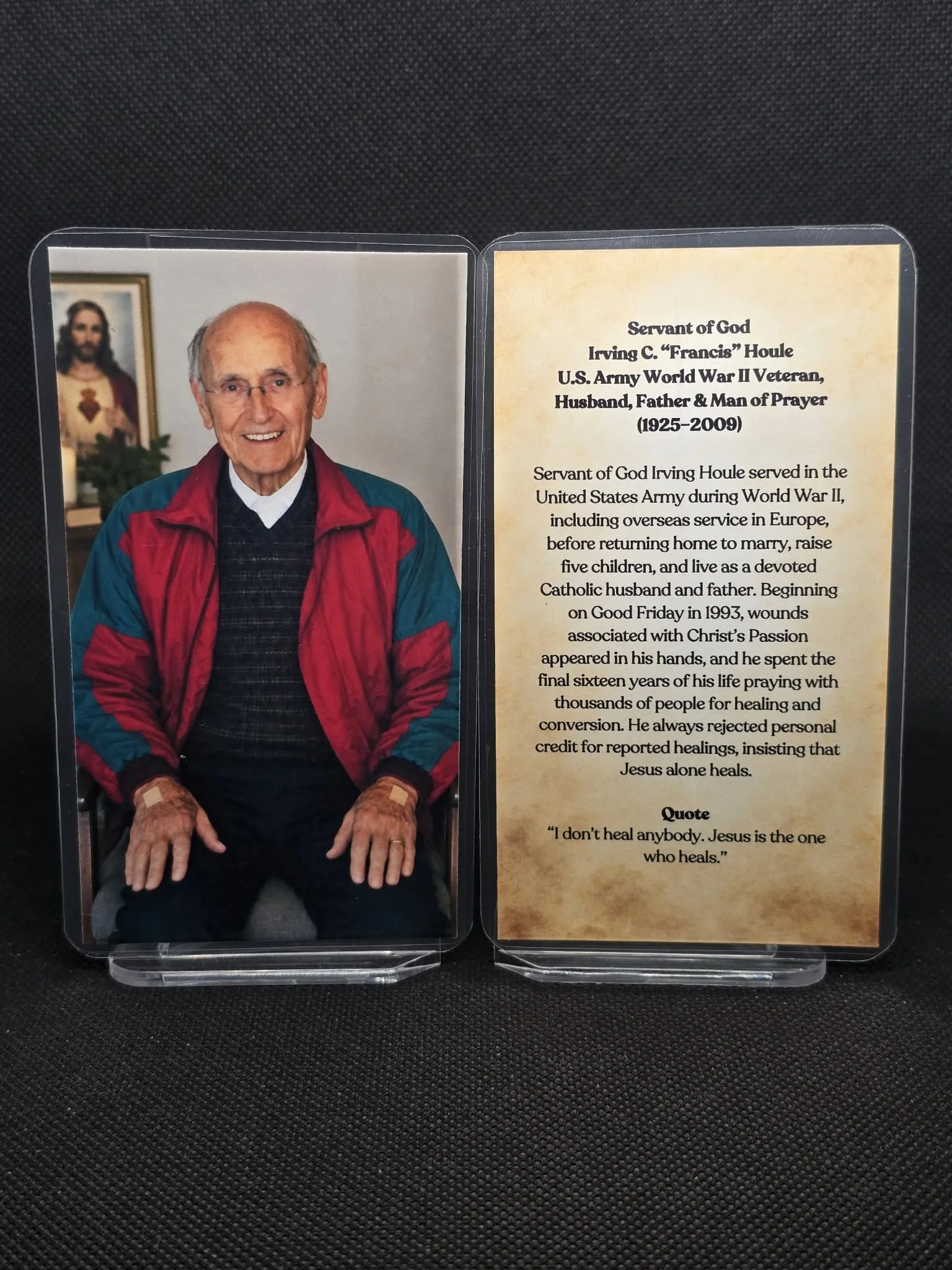
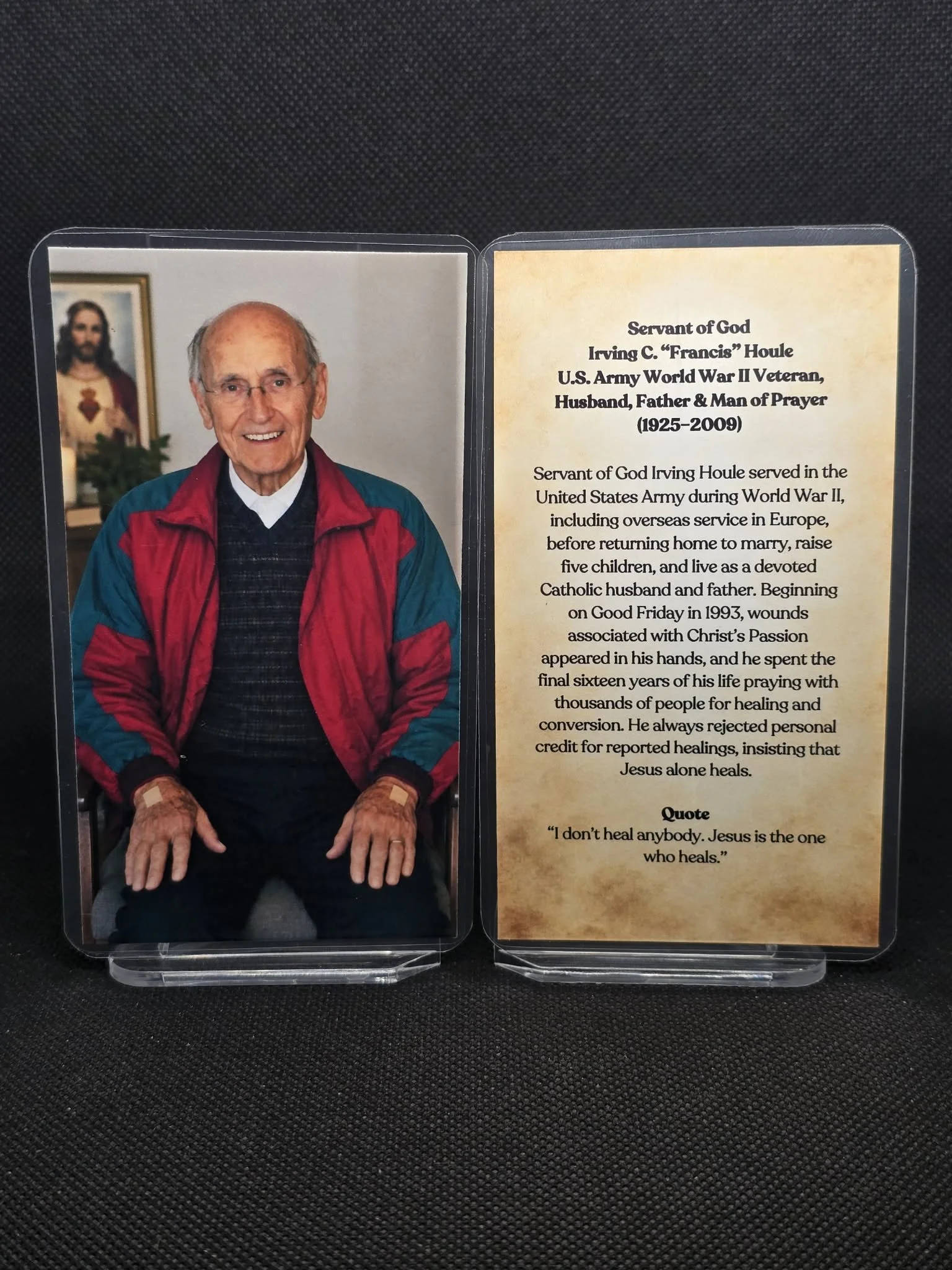
Servant of God Irving C. “Francis” Houle Prayer Card | For Healing, Conversion, Family & Carrying the Cross
Servant of God Irving C. “Francis” Houle was a Catholic husband, father, grandfather, World War II U.S. Army veteran, working man, and extraordinary witness to the power of prayer and redemptive suffering. Born in Michigan in 1925 and married for sixty years, Houle lived most of his life as an ordinary Catholic layman before reportedly receiving the stigmata of Jesus Christ on Good Friday in 1993, beginning the final sixteen years of a remarkable ministry centered upon prayer, healing, repentance, the Eucharist, Confession, and the conversion of souls.
Irving Houle is especially meaningful for people carrying severe physical or emotional suffering, families praying for healing, Catholics who have been away from Confession or the Eucharist, veterans, husbands and fathers, ordinary working people seeking holiness, caregivers, people offering suffering for others, and anyone overwhelmed by a cross that seems too heavy to carry. His life demonstrates that extraordinary holiness does not belong only to priests, monks, nuns, missionaries, or people separated from ordinary family life because Houle's path unfolded through marriage, fatherhood, work, military service, parish life, daily prayer, and concern for the people God placed directly in front of him.
His story is particularly powerful for anyone who believes that their life is too ordinary for God to do something extraordinary with it. Houle worked in retail and manufacturing, became a plant manager, raised five children with his wife Gail, followed his grandchildren's activities, belonged to the Knights of Columbus, and lived for decades without the public knowing anything unusual about him. Only later in his life did the extraordinary events for which he became known begin, making his cause a remarkable modern witness to holiness hidden inside everyday Catholic life.
Houle is also deeply connected with prayer for physical and spiritual healing, but he was emphatic that healing never came from him personally. When people credited him with extraordinary recoveries, he redirected them toward Jesus and repeatedly insisted that God alone was responsible, while his greatest joy was reportedly not dramatic physical cures but hearing that someone had returned to Confession after decades away and had once again received Jesus Christ in the Eucharist.
His life carries a particularly strong message for those suffering under the weight of illness, grief, family problems, sin, addiction, discouragement, or circumstances they cannot change. Houle did not teach that suffering should be loved simply because suffering hurts; rather, his life became an example of bringing suffering deliberately to Jesus, uniting it with the Cross, praying for others through it, and trusting that even pain which appears useless can become an offering of love.
For veterans and military families, Houle offers another remarkable point of connection because he served overseas in the United States Army during World War II before returning home to build a family and civilian life. His surviving biography remembers that his wartime letters frequently spoke about the Eucharist, attending Mass, and sharing his Catholic faith with fellow soldiers, showing that the spiritual life for which he later became known was already present during his military service.
The Catholic Church currently recognizes Irving Houle by the title Servant of God, meaning that his formal cause for canonization has been opened and his life and virtues are being investigated. His cause was officially opened by Bishop John Doerfler of the Diocese of Marquette on November 7, 2018, and the United States bishops subsequently gave unanimous support for the cause to proceed; as of September 2026, he has not yet been declared Venerable, Blessed, or Saint.
This prayer card is especially fitting for people seeking healing, Catholics returning to the sacraments, veterans, military families, husbands, fathers, grandfathers, people enduring chronic illness or pain, families in crisis, caregivers, those devoted to the Passion of Christ, and anyone trying to offer a difficult cross to God rather than allowing suffering to lead them away from Him. It can also make a meaningful gift for someone entering treatment, recovering from surgery, returning to Confession, renewing their Catholic faith, struggling with family burdens, or learning to see ordinary daily life as a real path toward holiness.
Each card is handmade in Austin, TX and created to order. We do not keep stock, because every prayer card is treated as a unique devotional offering. They are printed on museum-quality photo paper, not cardstock, and every card is made slowly during prayer with intentional reverence for the Servant of God and for the person who will receive it. Names are lifted before Christ, intentions are held carefully, and each piece is handled multiple times in prayerful silence, asking God for mercy and asking for the prayers of Servant of God Irving Houle for the soul it is being made for. This is devotional craftsmanship shaped with patience, care, and spiritual responsibility because every soul and every prayer matters.
THE LIFE & STORY
Irving Charles Houle was born on December 27, 1925, at the Houle family home in Michigan's Upper Peninsula. He was the sixth of seven children born to Peter and Lillian Houle, faithful Catholics whose household helped establish the devotional foundation that would remain with Irving throughout his life.
The Houle children grew up with Catholic prayer woven naturally into family life. Irving later remembered praying the Rosary with his family, particularly during Lent, and remaining after Mass while his father led the children through the Stations of the Cross, praying an Our Father and Hail Mary at each station.
These devotions eventually became defining features of Irving's adult spiritual life. The Eucharist, the Rosary, the Stations of the Cross, and later the Divine Mercy Chaplet were not occasional practices for him but became part of the rhythm through which he learned to surrender ordinary life and suffering to Jesus.
THE CHILDHOOD ACCIDENT & AN EXTRAORDINARY RECOVERY
When Irving was approximately six years old, he was thrown from a galloping horse and suffered devastating injuries. According to the official cause biography, his ribs were broken, a lung was punctured, and he was hemorrhaging badly enough that a contemporary newspaper report described his injuries as believed to be fatal.
Irving's aunt, Sister Speciosa, was a Franciscan religious sister, and she and the sisters of her convent reportedly prayed through the night for the injured child. By the following morning, Irving's condition had improved dramatically, surprising the physician who had cared for him.
Irving told his mother and doctor that during the night he had seen a beautiful man dressed in white standing at the foot of his bed who raised a hand over him. Later in his life, Irving told people close to him that he believed the mysterious visitor had been Jesus.
The experience did not immediately turn Irving into a public religious figure because he continued growing up in the ordinary life of his family. Yet the combination of suffering, prayer, healing, and an intense awareness of Jesus would appear again in a much greater way decades later.
A YOUNG MAN DRAWN TO THE EUCHARIST
As Irving grew older, his desire to attend Mass became increasingly important to him. His cause biography records that after his family moved closer to Escanaba during his teenage years, he welcomed the opportunity because it made it easier for him to attend church and pray more frequently.
During high school, Irving attended daily Mass even when he was apparently the only student from his school doing so. He was remembered as deeply moved by the Eucharist, sometimes becoming tearful during the Consecration or when receiving Holy Communion.
This Eucharistic devotion is essential for understanding his later ministry because Houle never attempted to build a spiritual movement around himself. His repeated concern was that people return to Jesus Christ, the Mass, the Eucharist, Confession, prayer, and the life of the Catholic Church.
WORLD WAR II & THE UNITED STATES ARMY
After graduating from high school, Irving entered the United States Army and served overseas during World War II. Sources connected with his cause place his military service from shortly after graduation in 1944 until his honorable discharge in 1946.
His Catholic faith accompanied him into military life rather than being something he rediscovered only after the war. The Houle Association biography says his letters home regularly mentioned the Eucharist, his desire to attend Mass, and efforts to share his faith with other soldiers.
For Catholic veterans, this portion of Houle's life gives his story a particularly personal character. He knew military service, separation from home, overseas duty, and the transition from wartime service back into ordinary civilian responsibilities, yet the vocation that followed was not fame or public ministry but marriage, fatherhood, work, parish life, and decades of quiet Catholic practice.
HUSBAND, FATHER & GRANDFATHER
Irving married Gail LaChapelle on November 17, 1948, beginning a marriage that lasted approximately sixty years until his death. Together they raised five children in Escanaba, Michigan, and Irving later became a grandfather and great-grandfather.
His family did not remember him as a permanently solemn mystic disconnected from normal life. The official biography describes a man who was loving and caring but also humorous, a teaser and prankster, interested in sports and actively involved in the lives and athletic activities of his grandchildren.
The biography also does not artificially portray him as flawless from childhood. His family remembered that his feelings could be hurt easily and that he sometimes had a temper, which makes his cause particularly valuable for ordinary Catholics because Christian holiness is presented as growth in grace and virtue rather than as never possessing weaknesses that must be overcome.
His marriage also matters when considering the extraordinary events of his later life. Gail lived beside the unexpected attention, reported stigmata, prayer ministry, travel, visitors, and suffering that entered their family life, and the cause biography emphasizes that the couple persevered together through the difficulties created by Irving's unusual charism.
HOLINESS AT WORK
Irving spent much of his adult life working ordinary jobs in retail and manufacturing. During the final fifteen years of his working career he served as plant manager at Engineered Machine Products, demonstrating that his spiritual life existed alongside the responsibilities of earning a living, managing employees, and providing for a family.
He kept images of the Sacred Heart of Jesus and Immaculate Heart of Mary on his desk. When someone once commented about the religious pictures, Irving's memorable response was that if the pictures had to leave, he would leave with them.
Even after demanding workdays, Irving was known for stopping at a church to pray the Stations of the Cross. The practice that his father had taught him as a child became a lifelong devotion through which Irving contemplated the Passion he would later report experiencing in an extraordinary physical way.
GOOD FRIDAY 1993 & THE STIGMATA
On Good Friday in 1993, when Irving was sixty-seven years old, wounds reportedly appeared in the palms of his hands that were understood by Irving and those around him as the stigmata, the wounds of the Crucified Christ. From that point until his death almost sixteen years later, the Passion of Jesus became the dominant mystery around which his extraordinary spiritual life revolved.
The reported stigmata did not become an excuse for Irving to claim spiritual importance. People close to him consistently described his discomfort with public attention, while his bishops found his humility, obedience, and refusal to promote himself especially significant.
The Diocese of Marquette's own cause material states that no formal ecclesiastical investigation specifically proving the supernatural origin of the stigmata was conducted during Irving's lifetime. Doctors who examined him reportedly could not provide a medical explanation, while the bishops who knew him emphasized the fruits of his ministry, his humility, his obedience, and the conversions associated with his prayer.
This distinction allows the extraordinary testimony surrounding Houle to be understood alongside the Church's present judgment concerning his cause. Irving is formally a Servant of God whose cause is under investigation, while the reported stigmata, nightly Passion, locutions, fragrances, and extraordinary healings remain part of the testimony surrounding the life the Church is examining.
SUFFERING THE PASSION
According to testimony preserved by those who knew him, Houle experienced intense physical suffering during the night that he understood as participation in the Passion of Jesus. Accounts associated with his cause describe these periods as occurring between approximately midnight and 3:00 a.m., with especially intense periods of suffering connected with the wounds of Christ.
Irving understood this suffering principally as prayer for conversion and the salvation of souls. He spoke of being shown human suffering and sin and responding by praying intensely for people affected by violence, abortion, homelessness, abuse, war, murder, and other forms of human misery.
This is why a prayer card of Servant of God Irving Houle can be especially meaningful for someone living with chronic pain or suffering that does not disappear quickly. His example directs suffering toward Christ without pretending pain is easy, showing instead how a Christian may ask God whether even an unwanted cross can become an offering of love for another person.
“TOUCH MY CHILDREN”
After the reported appearance of the stigmata, Irving believed he was being called to pray personally over other people. Accounts from the cause describe a mission in which he would place his wounded hands upon those seeking prayer and bring their needs directly to Jesus.
Irving did not begin this ministry because he wanted public attention. The evidence surrounding him repeatedly describes his reluctance to draw attention to himself and his dependence upon the approval of Catholic clergy and his bishop before continuing his work.
Over the following years, tens of thousands of people came to him for prayer, while Father Robert Fox, who knew Houle personally and wrote about him, estimated that the number may have exceeded 200,000. People traveled from different parts of the United States, and Houle also visited Catholic institutions and pilgrimage sites including EWTN and Fatima.
PRAYING FOR HEALING
When someone approached Irving, his manner was simple rather than theatrical. The official cause biography says he would ask what the person wanted Jesus to do for them, take their hands or hold their face in his wounded hands, pray, and remind them of the love of Jesus.
Numerous people subsequently testified to physical or spiritual healings connected with these encounters. The cause biography records testimonies involving cancer, infertility, conversion, and other serious needs, while contemporary reporting also documents people who attributed extraordinary recoveries to prayers made during Houle's ministry.
The central point, however, was never that Irving possessed healing power independently from God. He repeatedly denied that interpretation and redirected attention to Christ, making his prayer ministry a witness to dependence upon Jesus rather than a personality-centered healing movement.
That makes Houle particularly appropriate for people praying through serious medical problems. The devotion does not promise a particular result, but it gives the suffering person a concrete Catholic witness who spent years bringing sick and wounded people before Jesus while insisting that the healing itself belonged entirely to God.
“JESUS IS THE ONE WHO HEALS”
One of the clearest themes in Houle's ministry was his refusal to accept credit for healings. When people attempted to treat him as the source of what had happened, he answered plainly that he did not heal anyone and that Jesus was the one who heals.
That distinction shaped the spiritual character of his work. Irving's wounded hands were understood as instruments of prayer, but the person being touched was directed beyond Irving toward Jesus Christ, the sacraments, repentance, Eucharistic faith, and renewed life in the Church.
This makes his example especially important in a culture fascinated by extraordinary religious phenomena. Houle's own response to the extraordinary was repeatedly to make himself smaller and Christ larger.
CONVERSION WAS MORE IMPORTANT THAN PHYSICAL HEALING
Although stories of physical healing attract attention, Irving's greatest concern was reportedly the conversion of souls. The Houle Association biography states that he was particularly happy when he learned that someone who had been away from Confession for twenty, thirty, or even forty years had returned to the sacrament and received Jesus again in Holy Communion.
This gives his prayer card an especially powerful use for families praying for a Catholic loved one who has stopped practicing the faith. Houle understood physical healing as important, but he believed reconciliation with God and reception of the Eucharist touched something even deeper.
A parent praying for an adult child who has left the Church, a spouse praying for a husband or wife who no longer practices, or an individual preparing to return after decades away may therefore find Irving's life particularly meaningful. His ministry continually returned to the hope that no one is too far away, too wounded, or too long absent to come back to Jesus.
THE EUCHARIST
The Eucharist runs through Irving Houle's biography from youth to old age. He attended Mass eagerly as a young man, wrote about the Eucharist while serving overseas, attended daily Mass when possible, and later encouraged people whose lives were touched by his ministry to return to Holy Communion.
For Irving, extraordinary phenomena never replaced sacramental Catholicism. The reported stigmata were meaningful precisely because they pointed to Christ Crucified, while healing and conversion ultimately led people back toward the Eucharistic Lord whom Irving had loved throughout his life.
This gives his story particular relevance for Eucharistic renewal. His life suggests that the most extraordinary encounter with Christ is not necessarily a visible wound or unusual healing, but the presence of Jesus received faithfully in Holy Communion.
CONFESSION & RETURNING TO GOD
Confession was another central fruit of Houle's ministry. During some prayer gatherings, priests would hear Confessions while people waited for Irving to pray over them, linking prayer for healing directly with sacramental reconciliation.
The arrangement captures the heart of Irving's mission remarkably well. He might place wounded hands upon someone's head, but the goal was never fascination with Irving; it was that the person should encounter Jesus, repent, receive mercy, return to the Eucharist, and begin living the Catholic faith again.
For someone ashamed to return to Confession after many years, Irving's life therefore offers a message of hope rather than condemnation. The stories that brought him the greatest happiness were precisely the stories of people who had been gone for decades and finally came home.
DEVOTION TO THE STATIONS OF THE CROSS
The Stations of the Cross connected Irving's childhood, adulthood, and later extraordinary suffering. His father taught the children to remain after Mass and pray the Stations, and Irving continued returning to churches throughout his working years to meditate upon Christ's Passion even after long days on the job.
Long before visible wounds reportedly appeared on his hands, Irving had spent decades voluntarily walking spiritually beside Jesus from condemnation to Calvary. His later identification with the Passion therefore did not suddenly arise in 1993 but emerged from a lifetime of meditating upon the Cross.
This makes Houle especially fitting for Catholics devoted to the Stations of the Cross or learning how to pray through suffering. His life demonstrates what may happen spiritually when the Passion becomes not merely a Good Friday devotion but a lens through which daily life is understood.
THE ROSARY, DIVINE MERCY & DAILY PRAYER
Irving's prayer life remained distinctly Catholic and remarkably consistent. His biography describes daily Mass, the Rosary, Stations of the Cross, the Divine Mercy Chaplet, prayers for other people, and a personal practice of beginning his day with repeated Our Fathers and Hail Marys.
This regularity matters because extraordinary experiences can easily overshadow the hidden foundations beneath them. Houle's story instead suggests that his extraordinary years were built upon decades of ordinary prayer repeated when no crowd was present and no one considered him remarkable.
His life therefore offers encouragement to people who feel that their daily Rosary or repeated prayers are small. Holiness is often constructed from thousands of unnoticed acts of fidelity long before anyone else can see their fruit.
DEVOTION TO JESUS & MARY
Irving's spirituality was intensely centered upon Jesus and strongly Marian. He kept images of the Sacred Heart and Immaculate Heart near him at work, prayed the Rosary, traveled to Fatima, and understood the Blessed Virgin Mary as continually directing souls toward her Son.
Reported locutions attributed to Mary repeatedly emphasized conversion, prayer, bringing the lost back to Jesus, and continued trust in Christ. Whatever judgment the Church ultimately makes regarding individual extraordinary experiences, the content associated with Irving's ministry remained focused upon recognizable Catholic themes of repentance, Eucharistic life, prayer, and love of Jesus.
This makes his devotion particularly compatible with families already praying the Rosary, Divine Mercy Chaplet, Sacred Heart devotions, or the Stations of the Cross. Houle did not present a new spirituality but lived familiar Catholic devotions with unusual intensity.
OBEDIENCE TO THE CHURCH
One of the strongest characteristics emphasized by people who knew Irving was his obedience to legitimate Church authority. Bishop James Garland permitted his prayer ministry, and Houle made clear that if the bishop ever instructed him to stop praying publicly over people, he would obey.
This matters enormously when evaluating a Catholic associated with extraordinary mystical experiences. Irving did not claim that private revelation placed him above the bishop, exempted him from ordinary Catholic discipline, or gave him authority to disregard the Church.
Archbishop Alexander Sample, who encountered Houle while serving in Michigan, later emphasized his humility and willingness to give glory to God rather than himself. That combination of unusual experiences and ordinary obedience became one of the strongest impressions Houle left upon clergy who encountered him.
THE ODOR OF ROSES
Some witnesses reported an unexplained fragrance of roses associated with Irving. His cause biography records testimony that the scent could remain in rooms, upon religious objects, or even upon another person's hands after contact with him.
Archbishop Alexander Sample personally recalled encountering a rose-like fragrance when he met Houle. He also remembered noticing the bandages covering Irving's hands and realizing whom he had encountered.
These accounts form part of the extraordinary testimony surrounding Houle rather than the foundation of Catholic devotion to him. His strongest spiritual legacy remains the ordinary virtues beneath the phenomena: humility, obedience, prayer, sacramental faith, love of family, willingness to suffer, and concern for conversion.
AN ORDINARY MAN WITH AN EXTRAORDINARY MISSION
Perhaps the most compelling aspect of Irving Houle's cause is how ordinary his life remained for so long. He was not a priest, bishop, monk, theologian, missionary founder, or cloistered contemplative but a husband, father, veteran, employee, manager, parishioner, Knight of Columbus, grandfather, and neighbor.
Bishop John Doerfler has specifically presented Houle as an example of holiness for the ordinary person. His family life, workplace, humility, self-sacrifice, suffering, and concern for others demonstrate a form of holiness accessible to people whose vocation unfolds in homes, factories, offices, military service, parishes, and family responsibilities.
This may ultimately be one of his most important messages. A person does not need an extraordinary setting in order to give an extraordinary yes to God.
DEATH
Servant of God Irving Houle died at Marquette General Hospital on January 3, 2009, at eighty-three years old. He had lived approximately sixteen years after the reported appearance of the stigmata and remained associated with prayer for others until near the end of his life.
He was survived by Gail, their children, grandchildren, and great-grandchildren. Gail continued living until 2024, having shared more than six decades of married life with the man whose unexpected spiritual mission eventually became known far beyond their Michigan home.
Irving is buried at Holy Cross Catholic Cemetery in Escanaba, Michigan, where pilgrims can pray at his grave. The location has become part of Catholic pilgrimage itineraries devoted to Americans whose causes of canonization are underway.
THE CAUSE FOR CANONIZATION
Bishop John Doerfler of the Diocese of Marquette formally opened Irving Houle's cause for sainthood on November 7, 2018. From that point, Houle received the ecclesiastical title Servant of God, marking the beginning of the formal process by which his life, virtues, reputation for holiness, writings, testimony, and alleged favors are examined.
In June 2019, the bishops of the United States unanimously supported advancement of the cause. The process is concerned not simply with whether extraordinary things happened around Irving, but with whether he lived the Christian virtues heroically and whether his life provides an authentic model of holiness for the faithful.
As of September 2026, current sources connected with the cause continue to identify him as Servant of God Irving Houle. He has therefore not yet received the titles Venerable, Blessed, or Saint, and his proper current ecclesiastical title remains Servant of God Irving C. “Francis” Houle.
WHAT DOES “SERVANT OF GOD” MEAN?
“Servant of God” is the title used for a deceased Catholic whose formal cause for canonization has been opened. It does not mean that canonization has already occurred, but it signifies that the Church has begun formally examining the person's life and reputation for holiness.
If the Church eventually determines that Houle practiced Christian virtue to a heroic degree, the next major title would ordinarily be Venerable. Beatification would then normally require recognition of a miracle attributed to his intercession after death, while canonization ordinarily requires another approved miracle.
His proper and respectful current title is therefore Servant of God Irving C. “Francis” Houle. Private prayers may be offered asking God for favors and for the advancement of his cause, while any reported favors or healings attributed to his intercession can be submitted to those responsible for the cause.
IS JANUARY 3 HIS FEAST DAY?
Irving Houle does not currently have an official Catholic feast day because he has not yet been beatified or canonized. January 3 is the anniversary of his death and is therefore an especially natural date for private remembrance and prayer, but it is not presently an official liturgical feast.
This distinction keeps devotion aligned with the Church's current judgment. Catholics can confidently pray for his canonization, learn from his life, visit his grave, and privately ask for his prayers while respecting the stage his cause has actually reached.
PRAYERS
A prayer associated directly with Irving Houle asks Jesus to look upon the suffering person with mercy and allow His healing hands to rest upon them. Irving's own prayer concludes by asking, according to God's will, for “health, strength, and peace,” making it particularly appropriate for someone facing illness, exhaustion, chronic pain, surgery, or another overwhelming burden.
The cause also promotes a prayer asking God to advance Irving Houle toward sainthood if it is His will. That prayer thanks God for Irving's life of love and sacrifice, asks for healing within wounded families, seeks greater trust when life's burdens become heavy, and invites the faithful to present their own intentions to God.
Together, these prayers reflect two central themes of Irving Houle's spiritual legacy. His personal prayer turns directly toward the suffering Christ and asks for mercy and healing, while the cause prayer asks God that Irving's example of carrying the Cross may one day be formally recognized by the Church.
Because his cause remains open, those who believe they have received an extraordinary favor after asking for Irving Houle's intercession are encouraged to preserve medical or other relevant documentation and contact the official cause. Such testimony can become important when the Church examines alleged miracles connected with a candidate for beatification or canonization.
FAQ
Who was Servant of God Irving C. “Francis” Houle? Irving Houle was a Catholic husband, father, grandfather, World War II Army veteran, working man, and Michigan layman whose cause for canonization is now underway. During the final sixteen years of his life he was reported to bear the stigmata and became known for praying over tens of thousands of people while continually directing them toward Jesus, Confession, the Eucharist, and conversion.
Is Irving Houle a Catholic saint? No. The Catholic Church currently gives him the title Servant of God, which means his formal cause has been opened, but as of September 2026 he has not been declared Venerable, Blessed, or Saint.
When was Irving Houle born? Irving Houle was born on December 27, 1925, in Michigan's Upper Peninsula. He grew up in a large Catholic family in which the Rosary, Mass, and Stations of the Cross were important parts of family life.
When did Irving Houle die? Irving died on January 3, 2009, at Marquette General Hospital in Michigan. He was eighty-three years old and had been married to his wife Gail for approximately sixty years.
Where is Irving Houle buried? He is buried at Holy Cross Catholic Cemetery in Escanaba, Michigan. His grave can be visited by pilgrims, and Catholic pilgrimage resources include it among important Michigan sites connected with American causes of canonization.
Was Irving Houle married? Yes, he married Gail LaChapelle on November 17, 1948, and their marriage lasted approximately sixty years. They raised five children, and Houle later became a grandfather and great-grandfather.
Was Irving Houle a priest or religious? No, and that is one of the most important things about his story. He was a lay Catholic who lived his vocation through marriage, fatherhood, work, military service, parish life, prayer, and eventually an extraordinary ministry to people seeking healing and conversion.
Was Irving Houle in the military? Yes, Houle served overseas in the United States Army during World War II and received an honorable discharge in 1946. Accounts of his military years say his letters home frequently mentioned Mass, the Eucharist, and his Catholic faith.
Was Irving Houle a Knight of Columbus? Yes, he was a Fourth Degree Knight of Columbus. His father and brothers were also Knights, making the organization part of his family's Catholic life.
Did Irving Houle have the stigmata? Witnesses reported that wounds associated with the stigmata appeared in his hands beginning on Good Friday in 1993 and remained part of his life until his death. The Church has opened his cause for canonization, but the Diocese of Marquette's cause biography notes that no separate formal ecclesiastical process specifically proving the supernatural origin of the wounds was conducted during his lifetime.
What is the stigmata? The word refers to bodily wounds associated with the wounds suffered by Jesus Christ during the Crucifixion. Several figures in Catholic history have been associated with the phenomenon, while the Church evaluates individual cases cautiously and does not make extraordinary phenomena the primary standard for sainthood.
When did Irving Houle first receive the reported stigmata? The wounds reportedly appeared on Good Friday in 1993, when Houle was sixty-seven years old. Accounts surrounding his cause describe this event as the beginning of approximately sixteen years of extraordinary suffering and prayer ministry.
Did Irving Houle suffer the Passion of Jesus? Houle and those close to him reported that he experienced intense nightly suffering associated with the Passion, generally between midnight and 3:00 a.m. He understood these sufferings as an offering for conversion and for people harmed by serious sin and human suffering.
Did Irving Houle heal people? Houle himself rejected the idea that he personally possessed healing power and consistently said that healing belonged to Jesus. Many individuals nevertheless testified to physical and spiritual healings after he prayed over them, and those testimonies form an important part of the history surrounding his ministry and canonization cause.
Can I pray to Servant of God Irving Houle for healing? Catholics may privately ask for the intercession of a Servant of God while praying ultimately to God for the requested grace. Houle's cause specifically promotes prayer for favors and healing while asking that God advance him to sainthood if that is His will.
Is Irving Houle especially associated with cancer patients? Several prominent testimonies connected with his ministry involve people suffering from serious cancers who attributed unexpected recoveries to prayer offered by Houle. It is therefore natural for cancer patients to find his story meaningful, although he has not been officially designated by the Church as a patron saint of cancer.
Can families pray through Irving Houle's intercession? Yes, and family prayer fits his life particularly well because Houle himself was a husband, father, grandfather, and married lay Catholic. The prayer associated with his cause specifically asks God for healing within wounded families and blessings upon the family of the person praying.
Can veterans pray through Irving Houle's intercession? Yes, especially because Houle was himself a U.S. Army veteran who served overseas during World War II. His combination of military service, marriage, employment, family responsibilities, and deep Catholic faith makes him an especially relatable figure for Catholic veterans and military families.
Is Irving Houle a good intercessor for husbands and fathers? His cause presents him precisely as an example of holiness lived within ordinary married and family life. He remained married for approximately sixty years, raised five children, worked to support his family, and continued participating closely in family life even during the extraordinary final years of his ministry.
Can I pray through Irving Houle's intercession for someone who has left the Catholic Church? His life makes that intention particularly appropriate because the conversion of souls was reportedly his greatest concern. He especially rejoiced when people who had been away from Confession for decades returned to the sacrament and received Jesus again in the Eucharist.
Why was Confession so important to Irving Houle? He understood spiritual healing as deeper than physical recovery alone. During some gatherings priests heard Confessions while Houle prayed over people, and he considered a person's reconciliation with God one of the greatest possible fruits of his ministry.
Why was the Eucharist so important to Irving Houle? Eucharistic devotion appears throughout his life, beginning before adulthood and continuing through military service, marriage, work, retirement, and his prayer ministry. His goal was never to attract people merely to extraordinary phenomena but to bring them closer to Jesus, particularly through Confession and Holy Communion.
Was Irving Houle devoted to the Stations of the Cross? Yes, intensely. He learned the Stations from his father as a child and later became known for going to church after work to pray them regardless of how demanding his workday had been.
Did Irving Houle pray the Rosary? Yes, the Rosary was part of his family life from childhood and remained one of his major devotions. He was also devoted to the Divine Mercy Chaplet, the Stations of the Cross, daily Mass, and prayer for the conversion and healing of others.
Did Irving Houle ever visit Fatima? Yes, the official cause biography records that his travels connected with his prayer ministry included a pilgrimage to Fatima. His wider ministry also brought him to Catholic parishes, the Fatima Family Apostolate, and EWTN.
Was Irving Houle ever on EWTN? Yes, Father Robert Fox hosted Houle in connection with EWTN programming, including a 2003 program concerning bringing children back to the Catholic faith. Houle's connection with Father Fox also helped preserve important testimony concerning his spiritual life and ministry.
Did Irving Houle accept money for praying over people? His cause biography emphasizes that he would not accept payment for his ministry. His refusal to profit from reported healings supported the reputation for humility and selflessness repeatedly described by people who knew him.
Was Irving Houle obedient to his bishop? Yes, and his obedience is one of the strongest characteristics emphasized in accounts from clergy who knew him. He prayed over people with episcopal permission and stated that he would stop if his bishop ever told him to stop.
Why is obedience important in Irving Houle's story? Catholic mysticism is not supposed to place private revelations above the Church or the sacraments. Houle's willingness to submit extraordinary experiences and public ministry to his bishop provides an important sign that his spirituality remained rooted in ordinary Catholic obedience rather than personal spiritual authority.
Did people smell roses around Irving Houle? Some witnesses reported an unexplained rose fragrance associated with Houle, his presence, or objects he had touched. Archbishop Alexander Sample later recalled personally noticing a rose-like fragrance during an encounter with him.
What is Irving Houle's official status in the canonization process? His current title is Servant of God, and his cause is being promoted by the Irving C. “Francis” Houle Association under the Diocese of Marquette. Current 2026 material concerning the cause continues to identify him at this stage.
When was Irving Houle declared a Servant of God? His cause was formally opened on November 7, 2018. That date is listed by organizations tracking American causes of canonization and by the official Houle Association.
Do the U.S. Catholic bishops support Irving Houle's cause? Yes, the United States bishops voted unanimously in support of allowing his cause to move forward during their 2019 canonical consultation. Their support permitted the diocesan process to continue but did not itself constitute beatification or canonization.
Does Irving Houle have a feast day? No official liturgical feast day has been assigned because he has not yet been beatified or canonized. January 3 is the anniversary of his death and may naturally be used for private remembrance, but it is not currently his official Catholic feast day.
What prayer is associated with Irving Houle? Houle composed a prayer centered upon carrying the Cross with Jesus and asking for the Lord's merciful healing. His cause also promotes a canonization prayer asking God to honor Irving with sainthood if it is His will and asking for healing, stronger families, greater trust, and particular favors.
What should I do if I believe I received a healing through Irving Houle's intercession? Preserve relevant medical records and details concerning the prayers, dates, diagnosis, treatment, and recovery, then contact the official Irving C. “Francis” Houle Association or those responsible for his cause. Documentation is particularly important because alleged miraculous healings considered in canonization causes undergo extensive medical and theological investigation.
What makes Irving Houle different from many other American sainthood candidates? His vocation was remarkably ordinary before extraordinary mystical experiences became associated with him. He was a married father, grandfather, Army veteran, employee, manager, parishioner, and Knight of Columbus, making his life a compelling example of the universal call to holiness within ordinary lay life.
What does Irving Houle teach about suffering? His life teaches that suffering does not have to become spiritually meaningless simply because it cannot immediately be removed. By uniting suffering with the Passion of Jesus and praying for the conversion and healing of others, Houle understood his own pain as something that could be offered in love rather than endured only in isolation.
What does Irving Houle teach about healing? He teaches that healing belongs to God and that the person praying is an instrument rather than the source. His repeated refusal to claim healing power for himself is one of the most important safeguards for understanding his ministry correctly.
What does Irving Houle teach about ordinary holiness? His life shows that holiness can grow inside marriage, parenthood, military service, employment, parish participation, family responsibilities, and repetitive daily prayer. The extraordinary events of his final years are striking, but the decades of ordinary faithfulness that preceded them may be the part of his life most Catholics can immediately imitate.
What is the main message of Servant of God Irving Houle's life? Irving Houle's life teaches that Jesus can transform an ordinary person's faithfulness, suffering, work, marriage, family life, prayer, and hidden sacrifices into instruments of grace for other people. He was a World War II veteran, husband of sixty years, father and grandfather, working man, Eucharistic Catholic, and lifelong devotee of the Passion who became associated late in life with the stigmata and extraordinary healings, yet he consistently refused to place himself at the center and instead directed people toward Jesus Christ. His story offers hope to the sick, encouragement to veterans and ordinary working Catholics, strength to families carrying heavy crosses, and a powerful reminder that the deepest healing is ultimately the return of a soul to God.
Servant of God Irving C. “Francis” Houle was a Catholic husband, father, grandfather, World War II U.S. Army veteran, working man, and extraordinary witness to the power of prayer and redemptive suffering. Born in Michigan in 1925 and married for sixty years, Houle lived most of his life as an ordinary Catholic layman before reportedly receiving the stigmata of Jesus Christ on Good Friday in 1993, beginning the final sixteen years of a remarkable ministry centered upon prayer, healing, repentance, the Eucharist, Confession, and the conversion of souls.
Irving Houle is especially meaningful for people carrying severe physical or emotional suffering, families praying for healing, Catholics who have been away from Confession or the Eucharist, veterans, husbands and fathers, ordinary working people seeking holiness, caregivers, people offering suffering for others, and anyone overwhelmed by a cross that seems too heavy to carry. His life demonstrates that extraordinary holiness does not belong only to priests, monks, nuns, missionaries, or people separated from ordinary family life because Houle's path unfolded through marriage, fatherhood, work, military service, parish life, daily prayer, and concern for the people God placed directly in front of him.
His story is particularly powerful for anyone who believes that their life is too ordinary for God to do something extraordinary with it. Houle worked in retail and manufacturing, became a plant manager, raised five children with his wife Gail, followed his grandchildren's activities, belonged to the Knights of Columbus, and lived for decades without the public knowing anything unusual about him. Only later in his life did the extraordinary events for which he became known begin, making his cause a remarkable modern witness to holiness hidden inside everyday Catholic life.
Houle is also deeply connected with prayer for physical and spiritual healing, but he was emphatic that healing never came from him personally. When people credited him with extraordinary recoveries, he redirected them toward Jesus and repeatedly insisted that God alone was responsible, while his greatest joy was reportedly not dramatic physical cures but hearing that someone had returned to Confession after decades away and had once again received Jesus Christ in the Eucharist.
His life carries a particularly strong message for those suffering under the weight of illness, grief, family problems, sin, addiction, discouragement, or circumstances they cannot change. Houle did not teach that suffering should be loved simply because suffering hurts; rather, his life became an example of bringing suffering deliberately to Jesus, uniting it with the Cross, praying for others through it, and trusting that even pain which appears useless can become an offering of love.
For veterans and military families, Houle offers another remarkable point of connection because he served overseas in the United States Army during World War II before returning home to build a family and civilian life. His surviving biography remembers that his wartime letters frequently spoke about the Eucharist, attending Mass, and sharing his Catholic faith with fellow soldiers, showing that the spiritual life for which he later became known was already present during his military service.
The Catholic Church currently recognizes Irving Houle by the title Servant of God, meaning that his formal cause for canonization has been opened and his life and virtues are being investigated. His cause was officially opened by Bishop John Doerfler of the Diocese of Marquette on November 7, 2018, and the United States bishops subsequently gave unanimous support for the cause to proceed; as of September 2026, he has not yet been declared Venerable, Blessed, or Saint.
This prayer card is especially fitting for people seeking healing, Catholics returning to the sacraments, veterans, military families, husbands, fathers, grandfathers, people enduring chronic illness or pain, families in crisis, caregivers, those devoted to the Passion of Christ, and anyone trying to offer a difficult cross to God rather than allowing suffering to lead them away from Him. It can also make a meaningful gift for someone entering treatment, recovering from surgery, returning to Confession, renewing their Catholic faith, struggling with family burdens, or learning to see ordinary daily life as a real path toward holiness.
Each card is handmade in Austin, TX and created to order. We do not keep stock, because every prayer card is treated as a unique devotional offering. They are printed on museum-quality photo paper, not cardstock, and every card is made slowly during prayer with intentional reverence for the Servant of God and for the person who will receive it. Names are lifted before Christ, intentions are held carefully, and each piece is handled multiple times in prayerful silence, asking God for mercy and asking for the prayers of Servant of God Irving Houle for the soul it is being made for. This is devotional craftsmanship shaped with patience, care, and spiritual responsibility because every soul and every prayer matters.
THE LIFE & STORY
Irving Charles Houle was born on December 27, 1925, at the Houle family home in Michigan's Upper Peninsula. He was the sixth of seven children born to Peter and Lillian Houle, faithful Catholics whose household helped establish the devotional foundation that would remain with Irving throughout his life.
The Houle children grew up with Catholic prayer woven naturally into family life. Irving later remembered praying the Rosary with his family, particularly during Lent, and remaining after Mass while his father led the children through the Stations of the Cross, praying an Our Father and Hail Mary at each station.
These devotions eventually became defining features of Irving's adult spiritual life. The Eucharist, the Rosary, the Stations of the Cross, and later the Divine Mercy Chaplet were not occasional practices for him but became part of the rhythm through which he learned to surrender ordinary life and suffering to Jesus.
THE CHILDHOOD ACCIDENT & AN EXTRAORDINARY RECOVERY
When Irving was approximately six years old, he was thrown from a galloping horse and suffered devastating injuries. According to the official cause biography, his ribs were broken, a lung was punctured, and he was hemorrhaging badly enough that a contemporary newspaper report described his injuries as believed to be fatal.
Irving's aunt, Sister Speciosa, was a Franciscan religious sister, and she and the sisters of her convent reportedly prayed through the night for the injured child. By the following morning, Irving's condition had improved dramatically, surprising the physician who had cared for him.
Irving told his mother and doctor that during the night he had seen a beautiful man dressed in white standing at the foot of his bed who raised a hand over him. Later in his life, Irving told people close to him that he believed the mysterious visitor had been Jesus.
The experience did not immediately turn Irving into a public religious figure because he continued growing up in the ordinary life of his family. Yet the combination of suffering, prayer, healing, and an intense awareness of Jesus would appear again in a much greater way decades later.
A YOUNG MAN DRAWN TO THE EUCHARIST
As Irving grew older, his desire to attend Mass became increasingly important to him. His cause biography records that after his family moved closer to Escanaba during his teenage years, he welcomed the opportunity because it made it easier for him to attend church and pray more frequently.
During high school, Irving attended daily Mass even when he was apparently the only student from his school doing so. He was remembered as deeply moved by the Eucharist, sometimes becoming tearful during the Consecration or when receiving Holy Communion.
This Eucharistic devotion is essential for understanding his later ministry because Houle never attempted to build a spiritual movement around himself. His repeated concern was that people return to Jesus Christ, the Mass, the Eucharist, Confession, prayer, and the life of the Catholic Church.
WORLD WAR II & THE UNITED STATES ARMY
After graduating from high school, Irving entered the United States Army and served overseas during World War II. Sources connected with his cause place his military service from shortly after graduation in 1944 until his honorable discharge in 1946.
His Catholic faith accompanied him into military life rather than being something he rediscovered only after the war. The Houle Association biography says his letters home regularly mentioned the Eucharist, his desire to attend Mass, and efforts to share his faith with other soldiers.
For Catholic veterans, this portion of Houle's life gives his story a particularly personal character. He knew military service, separation from home, overseas duty, and the transition from wartime service back into ordinary civilian responsibilities, yet the vocation that followed was not fame or public ministry but marriage, fatherhood, work, parish life, and decades of quiet Catholic practice.
HUSBAND, FATHER & GRANDFATHER
Irving married Gail LaChapelle on November 17, 1948, beginning a marriage that lasted approximately sixty years until his death. Together they raised five children in Escanaba, Michigan, and Irving later became a grandfather and great-grandfather.
His family did not remember him as a permanently solemn mystic disconnected from normal life. The official biography describes a man who was loving and caring but also humorous, a teaser and prankster, interested in sports and actively involved in the lives and athletic activities of his grandchildren.
The biography also does not artificially portray him as flawless from childhood. His family remembered that his feelings could be hurt easily and that he sometimes had a temper, which makes his cause particularly valuable for ordinary Catholics because Christian holiness is presented as growth in grace and virtue rather than as never possessing weaknesses that must be overcome.
His marriage also matters when considering the extraordinary events of his later life. Gail lived beside the unexpected attention, reported stigmata, prayer ministry, travel, visitors, and suffering that entered their family life, and the cause biography emphasizes that the couple persevered together through the difficulties created by Irving's unusual charism.
HOLINESS AT WORK
Irving spent much of his adult life working ordinary jobs in retail and manufacturing. During the final fifteen years of his working career he served as plant manager at Engineered Machine Products, demonstrating that his spiritual life existed alongside the responsibilities of earning a living, managing employees, and providing for a family.
He kept images of the Sacred Heart of Jesus and Immaculate Heart of Mary on his desk. When someone once commented about the religious pictures, Irving's memorable response was that if the pictures had to leave, he would leave with them.
Even after demanding workdays, Irving was known for stopping at a church to pray the Stations of the Cross. The practice that his father had taught him as a child became a lifelong devotion through which Irving contemplated the Passion he would later report experiencing in an extraordinary physical way.
GOOD FRIDAY 1993 & THE STIGMATA
On Good Friday in 1993, when Irving was sixty-seven years old, wounds reportedly appeared in the palms of his hands that were understood by Irving and those around him as the stigmata, the wounds of the Crucified Christ. From that point until his death almost sixteen years later, the Passion of Jesus became the dominant mystery around which his extraordinary spiritual life revolved.
The reported stigmata did not become an excuse for Irving to claim spiritual importance. People close to him consistently described his discomfort with public attention, while his bishops found his humility, obedience, and refusal to promote himself especially significant.
The Diocese of Marquette's own cause material states that no formal ecclesiastical investigation specifically proving the supernatural origin of the stigmata was conducted during Irving's lifetime. Doctors who examined him reportedly could not provide a medical explanation, while the bishops who knew him emphasized the fruits of his ministry, his humility, his obedience, and the conversions associated with his prayer.
This distinction allows the extraordinary testimony surrounding Houle to be understood alongside the Church's present judgment concerning his cause. Irving is formally a Servant of God whose cause is under investigation, while the reported stigmata, nightly Passion, locutions, fragrances, and extraordinary healings remain part of the testimony surrounding the life the Church is examining.
SUFFERING THE PASSION
According to testimony preserved by those who knew him, Houle experienced intense physical suffering during the night that he understood as participation in the Passion of Jesus. Accounts associated with his cause describe these periods as occurring between approximately midnight and 3:00 a.m., with especially intense periods of suffering connected with the wounds of Christ.
Irving understood this suffering principally as prayer for conversion and the salvation of souls. He spoke of being shown human suffering and sin and responding by praying intensely for people affected by violence, abortion, homelessness, abuse, war, murder, and other forms of human misery.
This is why a prayer card of Servant of God Irving Houle can be especially meaningful for someone living with chronic pain or suffering that does not disappear quickly. His example directs suffering toward Christ without pretending pain is easy, showing instead how a Christian may ask God whether even an unwanted cross can become an offering of love for another person.
“TOUCH MY CHILDREN”
After the reported appearance of the stigmata, Irving believed he was being called to pray personally over other people. Accounts from the cause describe a mission in which he would place his wounded hands upon those seeking prayer and bring their needs directly to Jesus.
Irving did not begin this ministry because he wanted public attention. The evidence surrounding him repeatedly describes his reluctance to draw attention to himself and his dependence upon the approval of Catholic clergy and his bishop before continuing his work.
Over the following years, tens of thousands of people came to him for prayer, while Father Robert Fox, who knew Houle personally and wrote about him, estimated that the number may have exceeded 200,000. People traveled from different parts of the United States, and Houle also visited Catholic institutions and pilgrimage sites including EWTN and Fatima.
PRAYING FOR HEALING
When someone approached Irving, his manner was simple rather than theatrical. The official cause biography says he would ask what the person wanted Jesus to do for them, take their hands or hold their face in his wounded hands, pray, and remind them of the love of Jesus.
Numerous people subsequently testified to physical or spiritual healings connected with these encounters. The cause biography records testimonies involving cancer, infertility, conversion, and other serious needs, while contemporary reporting also documents people who attributed extraordinary recoveries to prayers made during Houle's ministry.
The central point, however, was never that Irving possessed healing power independently from God. He repeatedly denied that interpretation and redirected attention to Christ, making his prayer ministry a witness to dependence upon Jesus rather than a personality-centered healing movement.
That makes Houle particularly appropriate for people praying through serious medical problems. The devotion does not promise a particular result, but it gives the suffering person a concrete Catholic witness who spent years bringing sick and wounded people before Jesus while insisting that the healing itself belonged entirely to God.
“JESUS IS THE ONE WHO HEALS”
One of the clearest themes in Houle's ministry was his refusal to accept credit for healings. When people attempted to treat him as the source of what had happened, he answered plainly that he did not heal anyone and that Jesus was the one who heals.
That distinction shaped the spiritual character of his work. Irving's wounded hands were understood as instruments of prayer, but the person being touched was directed beyond Irving toward Jesus Christ, the sacraments, repentance, Eucharistic faith, and renewed life in the Church.
This makes his example especially important in a culture fascinated by extraordinary religious phenomena. Houle's own response to the extraordinary was repeatedly to make himself smaller and Christ larger.
CONVERSION WAS MORE IMPORTANT THAN PHYSICAL HEALING
Although stories of physical healing attract attention, Irving's greatest concern was reportedly the conversion of souls. The Houle Association biography states that he was particularly happy when he learned that someone who had been away from Confession for twenty, thirty, or even forty years had returned to the sacrament and received Jesus again in Holy Communion.
This gives his prayer card an especially powerful use for families praying for a Catholic loved one who has stopped practicing the faith. Houle understood physical healing as important, but he believed reconciliation with God and reception of the Eucharist touched something even deeper.
A parent praying for an adult child who has left the Church, a spouse praying for a husband or wife who no longer practices, or an individual preparing to return after decades away may therefore find Irving's life particularly meaningful. His ministry continually returned to the hope that no one is too far away, too wounded, or too long absent to come back to Jesus.
THE EUCHARIST
The Eucharist runs through Irving Houle's biography from youth to old age. He attended Mass eagerly as a young man, wrote about the Eucharist while serving overseas, attended daily Mass when possible, and later encouraged people whose lives were touched by his ministry to return to Holy Communion.
For Irving, extraordinary phenomena never replaced sacramental Catholicism. The reported stigmata were meaningful precisely because they pointed to Christ Crucified, while healing and conversion ultimately led people back toward the Eucharistic Lord whom Irving had loved throughout his life.
This gives his story particular relevance for Eucharistic renewal. His life suggests that the most extraordinary encounter with Christ is not necessarily a visible wound or unusual healing, but the presence of Jesus received faithfully in Holy Communion.
CONFESSION & RETURNING TO GOD
Confession was another central fruit of Houle's ministry. During some prayer gatherings, priests would hear Confessions while people waited for Irving to pray over them, linking prayer for healing directly with sacramental reconciliation.
The arrangement captures the heart of Irving's mission remarkably well. He might place wounded hands upon someone's head, but the goal was never fascination with Irving; it was that the person should encounter Jesus, repent, receive mercy, return to the Eucharist, and begin living the Catholic faith again.
For someone ashamed to return to Confession after many years, Irving's life therefore offers a message of hope rather than condemnation. The stories that brought him the greatest happiness were precisely the stories of people who had been gone for decades and finally came home.
DEVOTION TO THE STATIONS OF THE CROSS
The Stations of the Cross connected Irving's childhood, adulthood, and later extraordinary suffering. His father taught the children to remain after Mass and pray the Stations, and Irving continued returning to churches throughout his working years to meditate upon Christ's Passion even after long days on the job.
Long before visible wounds reportedly appeared on his hands, Irving had spent decades voluntarily walking spiritually beside Jesus from condemnation to Calvary. His later identification with the Passion therefore did not suddenly arise in 1993 but emerged from a lifetime of meditating upon the Cross.
This makes Houle especially fitting for Catholics devoted to the Stations of the Cross or learning how to pray through suffering. His life demonstrates what may happen spiritually when the Passion becomes not merely a Good Friday devotion but a lens through which daily life is understood.
THE ROSARY, DIVINE MERCY & DAILY PRAYER
Irving's prayer life remained distinctly Catholic and remarkably consistent. His biography describes daily Mass, the Rosary, Stations of the Cross, the Divine Mercy Chaplet, prayers for other people, and a personal practice of beginning his day with repeated Our Fathers and Hail Marys.
This regularity matters because extraordinary experiences can easily overshadow the hidden foundations beneath them. Houle's story instead suggests that his extraordinary years were built upon decades of ordinary prayer repeated when no crowd was present and no one considered him remarkable.
His life therefore offers encouragement to people who feel that their daily Rosary or repeated prayers are small. Holiness is often constructed from thousands of unnoticed acts of fidelity long before anyone else can see their fruit.
DEVOTION TO JESUS & MARY
Irving's spirituality was intensely centered upon Jesus and strongly Marian. He kept images of the Sacred Heart and Immaculate Heart near him at work, prayed the Rosary, traveled to Fatima, and understood the Blessed Virgin Mary as continually directing souls toward her Son.
Reported locutions attributed to Mary repeatedly emphasized conversion, prayer, bringing the lost back to Jesus, and continued trust in Christ. Whatever judgment the Church ultimately makes regarding individual extraordinary experiences, the content associated with Irving's ministry remained focused upon recognizable Catholic themes of repentance, Eucharistic life, prayer, and love of Jesus.
This makes his devotion particularly compatible with families already praying the Rosary, Divine Mercy Chaplet, Sacred Heart devotions, or the Stations of the Cross. Houle did not present a new spirituality but lived familiar Catholic devotions with unusual intensity.
OBEDIENCE TO THE CHURCH
One of the strongest characteristics emphasized by people who knew Irving was his obedience to legitimate Church authority. Bishop James Garland permitted his prayer ministry, and Houle made clear that if the bishop ever instructed him to stop praying publicly over people, he would obey.
This matters enormously when evaluating a Catholic associated with extraordinary mystical experiences. Irving did not claim that private revelation placed him above the bishop, exempted him from ordinary Catholic discipline, or gave him authority to disregard the Church.
Archbishop Alexander Sample, who encountered Houle while serving in Michigan, later emphasized his humility and willingness to give glory to God rather than himself. That combination of unusual experiences and ordinary obedience became one of the strongest impressions Houle left upon clergy who encountered him.
THE ODOR OF ROSES
Some witnesses reported an unexplained fragrance of roses associated with Irving. His cause biography records testimony that the scent could remain in rooms, upon religious objects, or even upon another person's hands after contact with him.
Archbishop Alexander Sample personally recalled encountering a rose-like fragrance when he met Houle. He also remembered noticing the bandages covering Irving's hands and realizing whom he had encountered.
These accounts form part of the extraordinary testimony surrounding Houle rather than the foundation of Catholic devotion to him. His strongest spiritual legacy remains the ordinary virtues beneath the phenomena: humility, obedience, prayer, sacramental faith, love of family, willingness to suffer, and concern for conversion.
AN ORDINARY MAN WITH AN EXTRAORDINARY MISSION
Perhaps the most compelling aspect of Irving Houle's cause is how ordinary his life remained for so long. He was not a priest, bishop, monk, theologian, missionary founder, or cloistered contemplative but a husband, father, veteran, employee, manager, parishioner, Knight of Columbus, grandfather, and neighbor.
Bishop John Doerfler has specifically presented Houle as an example of holiness for the ordinary person. His family life, workplace, humility, self-sacrifice, suffering, and concern for others demonstrate a form of holiness accessible to people whose vocation unfolds in homes, factories, offices, military service, parishes, and family responsibilities.
This may ultimately be one of his most important messages. A person does not need an extraordinary setting in order to give an extraordinary yes to God.
DEATH
Servant of God Irving Houle died at Marquette General Hospital on January 3, 2009, at eighty-three years old. He had lived approximately sixteen years after the reported appearance of the stigmata and remained associated with prayer for others until near the end of his life.
He was survived by Gail, their children, grandchildren, and great-grandchildren. Gail continued living until 2024, having shared more than six decades of married life with the man whose unexpected spiritual mission eventually became known far beyond their Michigan home.
Irving is buried at Holy Cross Catholic Cemetery in Escanaba, Michigan, where pilgrims can pray at his grave. The location has become part of Catholic pilgrimage itineraries devoted to Americans whose causes of canonization are underway.
THE CAUSE FOR CANONIZATION
Bishop John Doerfler of the Diocese of Marquette formally opened Irving Houle's cause for sainthood on November 7, 2018. From that point, Houle received the ecclesiastical title Servant of God, marking the beginning of the formal process by which his life, virtues, reputation for holiness, writings, testimony, and alleged favors are examined.
In June 2019, the bishops of the United States unanimously supported advancement of the cause. The process is concerned not simply with whether extraordinary things happened around Irving, but with whether he lived the Christian virtues heroically and whether his life provides an authentic model of holiness for the faithful.
As of September 2026, current sources connected with the cause continue to identify him as Servant of God Irving Houle. He has therefore not yet received the titles Venerable, Blessed, or Saint, and his proper current ecclesiastical title remains Servant of God Irving C. “Francis” Houle.
WHAT DOES “SERVANT OF GOD” MEAN?
“Servant of God” is the title used for a deceased Catholic whose formal cause for canonization has been opened. It does not mean that canonization has already occurred, but it signifies that the Church has begun formally examining the person's life and reputation for holiness.
If the Church eventually determines that Houle practiced Christian virtue to a heroic degree, the next major title would ordinarily be Venerable. Beatification would then normally require recognition of a miracle attributed to his intercession after death, while canonization ordinarily requires another approved miracle.
His proper and respectful current title is therefore Servant of God Irving C. “Francis” Houle. Private prayers may be offered asking God for favors and for the advancement of his cause, while any reported favors or healings attributed to his intercession can be submitted to those responsible for the cause.
IS JANUARY 3 HIS FEAST DAY?
Irving Houle does not currently have an official Catholic feast day because he has not yet been beatified or canonized. January 3 is the anniversary of his death and is therefore an especially natural date for private remembrance and prayer, but it is not presently an official liturgical feast.
This distinction keeps devotion aligned with the Church's current judgment. Catholics can confidently pray for his canonization, learn from his life, visit his grave, and privately ask for his prayers while respecting the stage his cause has actually reached.
PRAYERS
A prayer associated directly with Irving Houle asks Jesus to look upon the suffering person with mercy and allow His healing hands to rest upon them. Irving's own prayer concludes by asking, according to God's will, for “health, strength, and peace,” making it particularly appropriate for someone facing illness, exhaustion, chronic pain, surgery, or another overwhelming burden.
The cause also promotes a prayer asking God to advance Irving Houle toward sainthood if it is His will. That prayer thanks God for Irving's life of love and sacrifice, asks for healing within wounded families, seeks greater trust when life's burdens become heavy, and invites the faithful to present their own intentions to God.
Together, these prayers reflect two central themes of Irving Houle's spiritual legacy. His personal prayer turns directly toward the suffering Christ and asks for mercy and healing, while the cause prayer asks God that Irving's example of carrying the Cross may one day be formally recognized by the Church.
Because his cause remains open, those who believe they have received an extraordinary favor after asking for Irving Houle's intercession are encouraged to preserve medical or other relevant documentation and contact the official cause. Such testimony can become important when the Church examines alleged miracles connected with a candidate for beatification or canonization.
FAQ
Who was Servant of God Irving C. “Francis” Houle? Irving Houle was a Catholic husband, father, grandfather, World War II Army veteran, working man, and Michigan layman whose cause for canonization is now underway. During the final sixteen years of his life he was reported to bear the stigmata and became known for praying over tens of thousands of people while continually directing them toward Jesus, Confession, the Eucharist, and conversion.
Is Irving Houle a Catholic saint? No. The Catholic Church currently gives him the title Servant of God, which means his formal cause has been opened, but as of September 2026 he has not been declared Venerable, Blessed, or Saint.
When was Irving Houle born? Irving Houle was born on December 27, 1925, in Michigan's Upper Peninsula. He grew up in a large Catholic family in which the Rosary, Mass, and Stations of the Cross were important parts of family life.
When did Irving Houle die? Irving died on January 3, 2009, at Marquette General Hospital in Michigan. He was eighty-three years old and had been married to his wife Gail for approximately sixty years.
Where is Irving Houle buried? He is buried at Holy Cross Catholic Cemetery in Escanaba, Michigan. His grave can be visited by pilgrims, and Catholic pilgrimage resources include it among important Michigan sites connected with American causes of canonization.
Was Irving Houle married? Yes, he married Gail LaChapelle on November 17, 1948, and their marriage lasted approximately sixty years. They raised five children, and Houle later became a grandfather and great-grandfather.
Was Irving Houle a priest or religious? No, and that is one of the most important things about his story. He was a lay Catholic who lived his vocation through marriage, fatherhood, work, military service, parish life, prayer, and eventually an extraordinary ministry to people seeking healing and conversion.
Was Irving Houle in the military? Yes, Houle served overseas in the United States Army during World War II and received an honorable discharge in 1946. Accounts of his military years say his letters home frequently mentioned Mass, the Eucharist, and his Catholic faith.
Was Irving Houle a Knight of Columbus? Yes, he was a Fourth Degree Knight of Columbus. His father and brothers were also Knights, making the organization part of his family's Catholic life.
Did Irving Houle have the stigmata? Witnesses reported that wounds associated with the stigmata appeared in his hands beginning on Good Friday in 1993 and remained part of his life until his death. The Church has opened his cause for canonization, but the Diocese of Marquette's cause biography notes that no separate formal ecclesiastical process specifically proving the supernatural origin of the wounds was conducted during his lifetime.
What is the stigmata? The word refers to bodily wounds associated with the wounds suffered by Jesus Christ during the Crucifixion. Several figures in Catholic history have been associated with the phenomenon, while the Church evaluates individual cases cautiously and does not make extraordinary phenomena the primary standard for sainthood.
When did Irving Houle first receive the reported stigmata? The wounds reportedly appeared on Good Friday in 1993, when Houle was sixty-seven years old. Accounts surrounding his cause describe this event as the beginning of approximately sixteen years of extraordinary suffering and prayer ministry.
Did Irving Houle suffer the Passion of Jesus? Houle and those close to him reported that he experienced intense nightly suffering associated with the Passion, generally between midnight and 3:00 a.m. He understood these sufferings as an offering for conversion and for people harmed by serious sin and human suffering.
Did Irving Houle heal people? Houle himself rejected the idea that he personally possessed healing power and consistently said that healing belonged to Jesus. Many individuals nevertheless testified to physical and spiritual healings after he prayed over them, and those testimonies form an important part of the history surrounding his ministry and canonization cause.
Can I pray to Servant of God Irving Houle for healing? Catholics may privately ask for the intercession of a Servant of God while praying ultimately to God for the requested grace. Houle's cause specifically promotes prayer for favors and healing while asking that God advance him to sainthood if that is His will.
Is Irving Houle especially associated with cancer patients? Several prominent testimonies connected with his ministry involve people suffering from serious cancers who attributed unexpected recoveries to prayer offered by Houle. It is therefore natural for cancer patients to find his story meaningful, although he has not been officially designated by the Church as a patron saint of cancer.
Can families pray through Irving Houle's intercession? Yes, and family prayer fits his life particularly well because Houle himself was a husband, father, grandfather, and married lay Catholic. The prayer associated with his cause specifically asks God for healing within wounded families and blessings upon the family of the person praying.
Can veterans pray through Irving Houle's intercession? Yes, especially because Houle was himself a U.S. Army veteran who served overseas during World War II. His combination of military service, marriage, employment, family responsibilities, and deep Catholic faith makes him an especially relatable figure for Catholic veterans and military families.
Is Irving Houle a good intercessor for husbands and fathers? His cause presents him precisely as an example of holiness lived within ordinary married and family life. He remained married for approximately sixty years, raised five children, worked to support his family, and continued participating closely in family life even during the extraordinary final years of his ministry.
Can I pray through Irving Houle's intercession for someone who has left the Catholic Church? His life makes that intention particularly appropriate because the conversion of souls was reportedly his greatest concern. He especially rejoiced when people who had been away from Confession for decades returned to the sacrament and received Jesus again in the Eucharist.
Why was Confession so important to Irving Houle? He understood spiritual healing as deeper than physical recovery alone. During some gatherings priests heard Confessions while Houle prayed over people, and he considered a person's reconciliation with God one of the greatest possible fruits of his ministry.
Why was the Eucharist so important to Irving Houle? Eucharistic devotion appears throughout his life, beginning before adulthood and continuing through military service, marriage, work, retirement, and his prayer ministry. His goal was never to attract people merely to extraordinary phenomena but to bring them closer to Jesus, particularly through Confession and Holy Communion.
Was Irving Houle devoted to the Stations of the Cross? Yes, intensely. He learned the Stations from his father as a child and later became known for going to church after work to pray them regardless of how demanding his workday had been.
Did Irving Houle pray the Rosary? Yes, the Rosary was part of his family life from childhood and remained one of his major devotions. He was also devoted to the Divine Mercy Chaplet, the Stations of the Cross, daily Mass, and prayer for the conversion and healing of others.
Did Irving Houle ever visit Fatima? Yes, the official cause biography records that his travels connected with his prayer ministry included a pilgrimage to Fatima. His wider ministry also brought him to Catholic parishes, the Fatima Family Apostolate, and EWTN.
Was Irving Houle ever on EWTN? Yes, Father Robert Fox hosted Houle in connection with EWTN programming, including a 2003 program concerning bringing children back to the Catholic faith. Houle's connection with Father Fox also helped preserve important testimony concerning his spiritual life and ministry.
Did Irving Houle accept money for praying over people? His cause biography emphasizes that he would not accept payment for his ministry. His refusal to profit from reported healings supported the reputation for humility and selflessness repeatedly described by people who knew him.
Was Irving Houle obedient to his bishop? Yes, and his obedience is one of the strongest characteristics emphasized in accounts from clergy who knew him. He prayed over people with episcopal permission and stated that he would stop if his bishop ever told him to stop.
Why is obedience important in Irving Houle's story? Catholic mysticism is not supposed to place private revelations above the Church or the sacraments. Houle's willingness to submit extraordinary experiences and public ministry to his bishop provides an important sign that his spirituality remained rooted in ordinary Catholic obedience rather than personal spiritual authority.
Did people smell roses around Irving Houle? Some witnesses reported an unexplained rose fragrance associated with Houle, his presence, or objects he had touched. Archbishop Alexander Sample later recalled personally noticing a rose-like fragrance during an encounter with him.
What is Irving Houle's official status in the canonization process? His current title is Servant of God, and his cause is being promoted by the Irving C. “Francis” Houle Association under the Diocese of Marquette. Current 2026 material concerning the cause continues to identify him at this stage.
When was Irving Houle declared a Servant of God? His cause was formally opened on November 7, 2018. That date is listed by organizations tracking American causes of canonization and by the official Houle Association.
Do the U.S. Catholic bishops support Irving Houle's cause? Yes, the United States bishops voted unanimously in support of allowing his cause to move forward during their 2019 canonical consultation. Their support permitted the diocesan process to continue but did not itself constitute beatification or canonization.
Does Irving Houle have a feast day? No official liturgical feast day has been assigned because he has not yet been beatified or canonized. January 3 is the anniversary of his death and may naturally be used for private remembrance, but it is not currently his official Catholic feast day.
What prayer is associated with Irving Houle? Houle composed a prayer centered upon carrying the Cross with Jesus and asking for the Lord's merciful healing. His cause also promotes a canonization prayer asking God to honor Irving with sainthood if it is His will and asking for healing, stronger families, greater trust, and particular favors.
What should I do if I believe I received a healing through Irving Houle's intercession? Preserve relevant medical records and details concerning the prayers, dates, diagnosis, treatment, and recovery, then contact the official Irving C. “Francis” Houle Association or those responsible for his cause. Documentation is particularly important because alleged miraculous healings considered in canonization causes undergo extensive medical and theological investigation.
What makes Irving Houle different from many other American sainthood candidates? His vocation was remarkably ordinary before extraordinary mystical experiences became associated with him. He was a married father, grandfather, Army veteran, employee, manager, parishioner, and Knight of Columbus, making his life a compelling example of the universal call to holiness within ordinary lay life.
What does Irving Houle teach about suffering? His life teaches that suffering does not have to become spiritually meaningless simply because it cannot immediately be removed. By uniting suffering with the Passion of Jesus and praying for the conversion and healing of others, Houle understood his own pain as something that could be offered in love rather than endured only in isolation.
What does Irving Houle teach about healing? He teaches that healing belongs to God and that the person praying is an instrument rather than the source. His repeated refusal to claim healing power for himself is one of the most important safeguards for understanding his ministry correctly.
What does Irving Houle teach about ordinary holiness? His life shows that holiness can grow inside marriage, parenthood, military service, employment, parish participation, family responsibilities, and repetitive daily prayer. The extraordinary events of his final years are striking, but the decades of ordinary faithfulness that preceded them may be the part of his life most Catholics can immediately imitate.
What is the main message of Servant of God Irving Houle's life? Irving Houle's life teaches that Jesus can transform an ordinary person's faithfulness, suffering, work, marriage, family life, prayer, and hidden sacrifices into instruments of grace for other people. He was a World War II veteran, husband of sixty years, father and grandfather, working man, Eucharistic Catholic, and lifelong devotee of the Passion who became associated late in life with the stigmata and extraordinary healings, yet he consistently refused to place himself at the center and instead directed people toward Jesus Christ. His story offers hope to the sick, encouragement to veterans and ordinary working Catholics, strength to families carrying heavy crosses, and a powerful reminder that the deepest healing is ultimately the return of a soul to God.