 Image 1 of 1
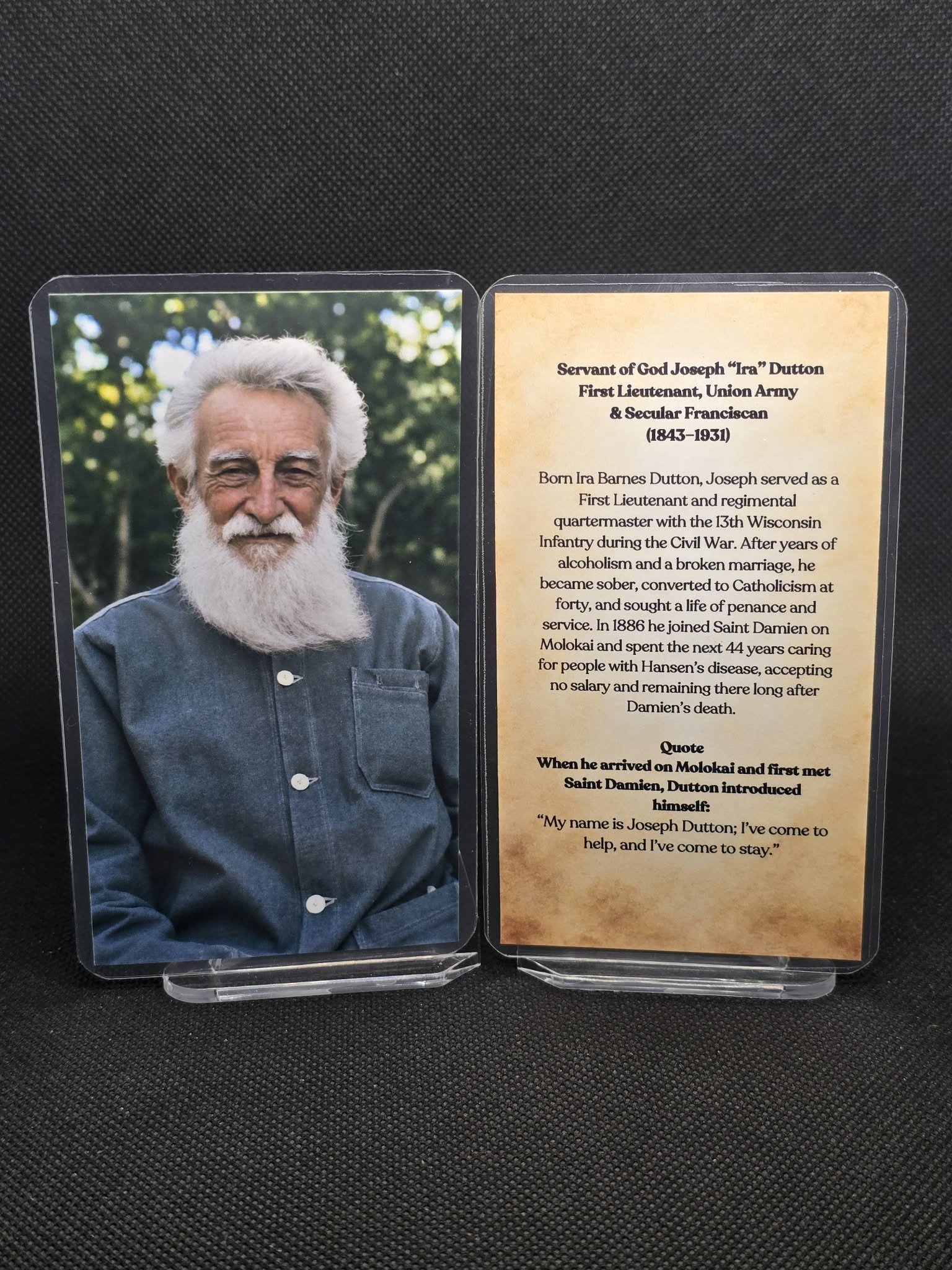
Servant of God Joseph “Ira” Dutton Prayer Card | For Addiction Recovery, Veterans, Conversion, Penance & Caregivers
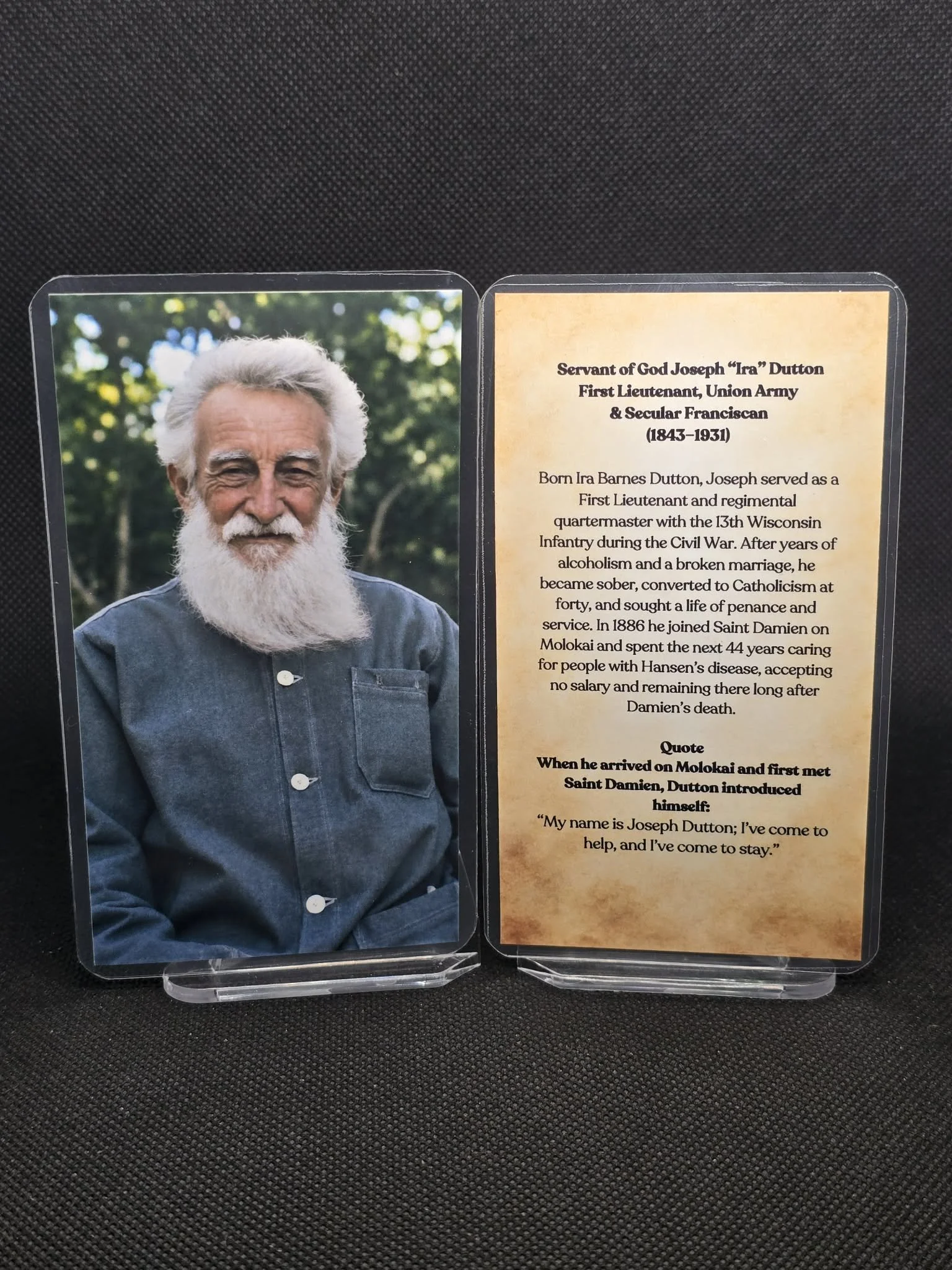
Servant of God Joseph Dutton, born Ira Barnes Dutton, was an American Civil War veteran, recovering alcoholic, Catholic convert, Secular Franciscan, lay missionary, and one of the great servants of the Hansen’s disease community at Kalaupapa, Molokai. After years he later regarded as deeply wasted, Dutton stopped drinking, entered the Catholic Church at forty, searched for a life of penance, and eventually traveled to Hawaii to assist Saint Damien of Molokai. What began as a desire to make amends for his past became nearly forty-five years of direct service to people whom much of society had isolated and feared.
Joseph Dutton is especially meaningful for people recovering from alcoholism or addiction, veterans, converts to Catholicism, people burdened by regret over their past, those seeking radical repentance, caregivers, nurses and medical workers, Secular Franciscans, people living with chronic or stigmatized illness, and anyone afraid that too much of life has already been wasted to begin again. These are devotional associations drawn from his documented life rather than formal patronages, because his canonization cause remains underway and his present ecclesiastical title is Servant of God. As of 2026, his cause is being studied in Rome after completion of the diocesan phase in Honolulu.
His story is particularly powerful because Dutton did not arrive at heroic charity by following a straight path from childhood holiness to missionary service. He knew war, a broken marriage, heavy drinking, spiritual dissatisfaction, and regret before discovering what he believed God was asking him to do with the remainder of his life. Rather than spend the next decades merely looking backward at his failures, he transformed repentance into sustained service and became the man Saint Damien trusted with the boys and young men of his mission.
Each prayer card measures 2.5" x 4.25", is handmade in Austin, Texas, printed on museum-quality photo paper rather than ordinary cardstock, and double laminated for durability. Each card is prepared prayerfully with the recipient and their intentions lifted before Christ while asking Servant of God Joseph Dutton to intercede for the person who will receive it.
THE LIFE & STORY
Ira Barnes Dutton was born on April 27, 1843, in Stowe, Vermont, and was raised primarily in Wisconsin after his family moved west. He grew up in a Protestant environment, worked in a bookstore, taught Sunday school as a young man, and entered adulthood just as the United States was being torn apart by the Civil War.
The name by which Catholics now know him came much later. Ira would not become Joseph Dutton until his conversion to Catholicism at forty, after years in which military service, marriage, alcohol, work, and spiritual searching had taken his life in directions very different from Molokai.
A UNION SOLDIER IN THE CIVIL WAR
Dutton enlisted in the 13th Wisconsin Infantry Regiment in 1861 and served the Union during the American Civil War. Wisconsin Historical Society photographs identify him as a First Lieutenant and note his service as regimental quartermaster, while the Wisconsin Veterans Museum records that he rose from private to quartermaster during his military career.
His military experience matters to his later story because Dutton was not a man unfamiliar with organization, hardship, logistics, responsibility, or suffering. The skills he developed in military service would eventually become useful in an entirely different kind of campaign, where buildings, medicine, food, clothing, supplies, recordkeeping, and disciplined daily work were essential to caring for an isolated community.
A SERVANT OF THE WAR DEAD
After the Civil War, Dutton performed difficult work connected with recovering and relocating the remains of fallen soldiers from battlefield burial sites to the national cemetery that became Arlington National Cemetery. The Diocese of Honolulu’s investigation and contemporary accounts of his cause include this period as one of the unusual chapters between his military service and eventual conversion.
The experience placed him close to the consequences of war even after combat had ended. Dutton’s later life would again bring him into intimate contact with suffering and death, but eventually his response would be shaped consciously by Christian penance, mercy, and service.
A FAILED MARRIAGE & YEARS OF HEAVY DRINKING
After leaving military service, Dutton entered a marriage that quickly collapsed. The official Diocese of Honolulu edict opening his cause states plainly that after the war he experienced a difficult marriage lasting only about a year and “took to drinking heavily.”
His struggle with alcohol continued for years and became one of the defining failures of the period he later looked back upon with regret. The USCCB describes Dutton as determined to make atonement for his “wild years,” while the Diocese of Honolulu presents his later penitential life specifically against the background of the disorder that preceded his conversion.
FOR PEOPLE RECOVERING FROM ALCOHOLISM
Joseph Dutton has an unusually strong devotional connection with alcohol recovery and addiction because his association with alcoholism is not a modern legend created to give him a convenient patronage. Heavy drinking genuinely belonged to his biography, and his recovery preceded a profound reconstruction of his life.
This does not mean he is formally the patron saint of alcoholics or addiction recovery, because he is not yet a canonized saint and no such formal patronage has been assigned. His life nevertheless offers a powerful Catholic example for someone who has stopped drinking but now faces the harder work of rebuilding relationships, identity, conscience, faith, and purpose after addiction.
HE STOPPED DRINKING
Dutton eventually quit alcohol in 1876, several years before entering the Catholic Church. His sobriety therefore was not simply the automatic result of baptism but part of a longer process in which he recognized that his life needed to change and began acting upon that realization.
That detail makes his story valuable for recovery because conversion rarely erases every consequence of addiction in a single moment. Dutton’s later Catholic life gave spiritual meaning and direction to a reform already underway, transforming sobriety from merely stopping destructive behavior into a larger vocation of penance and charity.
FOR PEOPLE ASHAMED OF THEIR PAST
Dutton did not pretend his earlier life had never happened. He considered his past seriously enough that he spent years asking how repentance should shape the remainder of his life, yet he did not allow regret to become an excuse for permanent paralysis.
His example distinguishes repentance from self-destruction. Christian penance, as Dutton ultimately lived it, did not mean spending decades staring at his former sins; it meant allowing God’s mercy to produce a different way of living toward other people.
CONVERSION AT FORTY
On April 27, 1883, his fortieth birthday, Ira Dutton was received into the Catholic Church at Saint Peter’s Church in Memphis, Tennessee. He took Joseph as his Catholic name, and from that point forward became known as Joseph Dutton.
The age is particularly meaningful for anyone afraid that conversion has come too late. Dutton was already forty years old before becoming Catholic, and the work for which he would eventually be remembered had not even begun.
A CONVERT SEARCHING FOR PENANCE
Dutton believed that receiving God’s mercy required a serious response. The USCCB records that he wanted to make atonement for his earlier years and became convinced that Catholicism provided the spiritual life in which he could pursue genuine penance.
His instinct was not initially to become a missionary in Hawaii. Instead, he sought an austere contemplative life and entered one of the most demanding monastic traditions available to him.
THE TRAPPIST MONASTERY AT GETHSEMANI
In 1884, Dutton entered the Abbey of Our Lady of Gethsemani in Kentucky, the Trappist monastery that would decades later become famous as the home of Thomas Merton. Dutton remained there for approximately twenty months, participating in a life of silence, prayer, manual labor, and penitential discipline.
Eventually he discerned that monastic contemplation was not his vocation. With the abbot’s blessing he left Gethsemani, realizing that the penance he sought would be expressed more fully through an active life of service, although he maintained a lasting affection for the monastery.
PENANCE THROUGH ACTION
The distinction became central to Dutton’s spirituality. He had entered Gethsemani looking for a place to do penance, but gradually understood that his own path would involve working for people who needed him rather than withdrawing permanently from the world.
This is one of the most important lessons of his life. Repentance did not remain something directed inward toward his own past; it became outward-facing charity, and eventually the people of Kalaupapa became the human beings through whom Dutton would live the penitential vocation he had been searching for.
DISCOVERING FATHER DAMIEN OF MOLOKAI
Dutton learned about Father Damien de Veuster, now Saint Damien of Molokai, through Charles Warren Stoddard’s writing about the isolated Hansen’s disease settlement in Hawaii. The story immediately appealed to his desire for an active penitential life, and with encouragement from Stoddard he began making arrangements to travel to Hawaii.
He did not seek a comfortable missionary assignment or a position of prestige. Kalaupapa was a place associated with contagious disease, forced isolation, suffering, and social abandonment, precisely the kind of place most people had compelling reasons to avoid.
“I’VE COME TO HELP, AND I’VE COME TO STAY”
When Dutton finally arrived at Molokai in 1886, he introduced himself to Father Damien with words that have become the defining quotation of his life:
“My name is Joseph Dutton; I’ve come to help, and I’ve come to stay.”
The phrase is preserved by organizations following American canonization causes and in Catholic accounts of Dutton’s life. His subsequent forty-four years of service gave those simple words extraordinary credibility because he did almost exactly what he promised.
WORKING BESIDE SAINT DAMIEN
By the time Dutton arrived, Father Damien had already contracted Hansen’s disease himself and knew that the future of his work had become an urgent concern. Dutton quickly became an indispensable assistant, learning the practical medical care required by the community and taking on responsibilities involving wounds, dressings, supplies, construction, administration, and care of the boys entrusted to Damien.
The relationship became close enough that Damien affectionately called him “Brother Joseph.” Dutton was not at that point a vowed religious brother, and later accounts caution against assuming that the title meant membership in a religious order; it functioned as an affectionate and devotional name for the layman who had become Damien’s trusted collaborator.
“BROTHER JOSEPH WILL TAKE CARE OF MY ORPHANS”
As Father Damien approached death from Hansen’s disease, he had reason to worry about what would happen to the boys and young men for whom he had assumed responsibility. The National Park Service preserves his remarkable confidence in Dutton: “I can die now. Brother Joseph will take care of my orphans.”
Damien died in 1889, only about three years after Dutton’s arrival. Dutton could have interpreted the death of the priest who brought him to Molokai as the natural conclusion of his own commitment, but instead he remained and continued the work for more than four additional decades.
AFTER SAINT DAMIEN’S DEATH
Dutton’s longest period of service actually came after Damien was gone. He continued caring for men and boys at Kalaupapa while Saint Marianne Cope and the Franciscan Sisters developed their own extraordinary ministry among women and girls at the settlement.
This placed Joseph Dutton in remarkable company. Molokai eventually became associated with Saint Damien, Saint Marianne, and now the ongoing cause of Servant of God Joseph Dutton, three lives connected through sustained care for people whom government policy and social fear had separated from much of the outside world.
THE BALDWIN HOME FOR BOYS & MEN
With financial assistance from Henry Perrine Baldwin, Dutton became closely associated with the Baldwin Home for Boys and Men, eventually administering a facility capable of caring for approximately 120 residents. He took charge in the 1890s and continued this work for decades, combining administration with intimate daily service.
His responsibilities extended far beyond paperwork. He dealt with wounds, medicine, food, buildings, discipline, education, recreation, clothing, correspondence, and the countless practical problems created by caring for a large community of boys and men living with a chronic infectious disease.
A CAREGIVER WHO LEARNED MEDICINE BY SERVING
The USCCB notes that Dutton became skilled in the medical needs of the Hansen’s disease patients and quickly learned rudimentary medicine and surgery. He was known for methodical, careful work and became particularly associated with the labor-intensive task of cleaning and dressing wounds.
For modern nurses, wound-care specialists, medical assistants, hospice workers, home caregivers, and family members caring for chronically ill relatives, this part of his life gives Dutton an especially strong devotional relevance. His sanctity cause is not built upon escaping unpleasant physical realities but upon entering them day after day with discipline and charity.
FOR CAREGIVERS
Long-term caregiving rarely feels dramatic. It involves repetition, fatigue, unpleasant tasks, administrative burdens, disrupted schedules, and the need to continue caring after the emotional intensity of an initial crisis has passed.
Dutton’s forty-four years on Molokai make him an unusually powerful figure for this kind of hidden endurance. His promise to “stay” mattered precisely because care eventually requires more than compassion in a single moment; it requires fidelity when the work becomes ordinary.
FOR PEOPLE LIVING WITH CHRONIC ILLNESS
Dutton’s work also speaks directly to people whose illnesses are not quickly cured. The residents of Kalaupapa lived with a disease that carried physical suffering together with social stigma, family separation, and fear from outsiders.
His service affirmed that illness did not remove a person’s dignity or make that person unworthy of companionship. Dutton chose to live among people society had physically separated from the wider community and made their daily needs the central work of his remaining life.
HANSEN’S DISEASE & HUMAN DIGNITY
The historical word “leprosy” appears throughout older sources, and Dutton himself lived in an era when patients were commonly called “lepers.” Today the disease is more appropriately called Hansen’s disease, and the people Dutton served should be remembered first as people rather than being defined entirely by a diagnosis.
Dutton’s own conduct helped challenge the dehumanization surrounding the disease. He ate, worked, prayed, organized, cared for, and lived among the residents for decades, demonstrating by ordinary companionship that fear of illness could not justify treating human beings as disposable.
HE NEVER CONTRACTED HANSEN’S DISEASE
Despite approximately forty-four years of close contact with patients, Dutton never developed Hansen’s disease. The National Park Service and the National Shrine of the Immaculate Conception both specifically note this fact in their accounts of his life.
His willingness to remain cannot therefore be explained by claiming that illness eventually trapped him at Kalaupapa. He repeatedly chose the life and work voluntarily even though, physically, he remained free from the disease suffered by the people around him.
HE REFUSED A SALARY
Dutton accepted no salary for his decades of work at Kalaupapa. The National Park Service records that he refused payment and even directed his Civil War pension to the Trappist monks at Gethsemani, maintaining a concrete link with the monastery where he had first tried to live his penitential vocation.
The refusal of compensation gives important context to his motivations. Dutton was not building a professional career in institutional care; he regarded his life on Molokai as voluntary Christian service and penance.
A SECULAR FRANCISCAN
In 1892, at the request of Saint Marianne Cope, Dutton was received into what was then called the Third Order of Saint Francis, today associated with the Secular Franciscan Order. He remained a layman rather than becoming a priest or vowed Franciscan religious brother.
This makes his cause particularly meaningful for Catholic laypeople. Dutton’s life demonstrates that radical service, penance, conversion, and missionary charity do not belong exclusively to ordained clergy or members of religious communities.
FOR SECULAR FRANCISCANS
Secular Franciscans can recognize in Dutton a particularly concrete expression of Franciscan service to people suffering from illness and exclusion. His life among Hansen’s disease patients echoes Saint Francis of Assisi’s own famous encounter with people suffering from leprosy, but Dutton extended that encounter across decades rather than experiencing it as a single transformative episode.
His Franciscan identity also places him alongside Saint Marianne Cope within the larger Franciscan presence at Kalaupapa. Their vocations differed, but both expressed Christian love through direct, disciplined care for the sick.
A VETERAN WHO FOUND A SECOND MISSION
Dutton’s story can be especially meaningful for military veterans searching for purpose after service. His military life ended decades before the work that gave the deepest meaning to his name began, and the discipline he had learned as a soldier eventually became useful in a mission of care rather than war.
There is no need to romanticize every aspect of his postwar years. His life after military service included serious disorder and pain, which makes his later transformation more significant because the veteran did not simply return home already knowing what his future was supposed to become.
FOR VETERANS STRUGGLING AFTER SERVICE
The years after military service can involve questions about identity, purpose, lost structure, relationships, regrets, or habits formed during difficult periods of life. Dutton’s biography gives veterans a Catholic figure who experienced a long and complicated path between military service and the vocation in which he finally found peace.
His example does not suggest that everyone must travel across the world to make amends for the past. It shows instead that a previous chapter of life, even one containing genuine failures, does not have to dictate the meaning of every chapter that follows.
FOR CONVERTS TO CATHOLICISM
Dutton entered the Catholic Church at forty after having been raised in a Protestant environment. His conversion did not make him immediately certain of his vocation, because he still had to discern whether he belonged in a monastery, active service, or some other form of penitential life.
That uncertainty makes his story recognizable to converts whose baptism or reception into the Church begins rather than finishes the process of discovering how Catholic faith should reshape everyday life. Dutton’s conversion eventually altered his relationship with work, money, service, suffering, prayer, and even the way he understood his own past.
FOR RADICAL REPENTANCE
Joseph Dutton is particularly powerful for someone seeking more than vague regret. He believed that repentance should have consequences, and he spent the rest of his life asking what his gratitude for God’s mercy required from him.
Yet his example also protects penance from becoming self-centered. The mature Dutton did not spend forty-four years punishing himself; he spent them helping other people live, which transformed penance into charity.
NATIONAL RECOGNITION
Dutton’s quiet service eventually became known far beyond Molokai. The National Park Service records correspondence and recognition from prominent Americans and notes that President Theodore Roosevelt arranged for the Great White Fleet to salute Molokai in recognition of Dutton’s extraordinary service.
The attention did not draw Dutton away from Kalaupapa. He remained focused upon the daily work of the settlement rather than converting recognition into a more comfortable public career.
“SERVANT OF THE LEPERS OF MOLOKAI”
In a 1911 application related to his Civil War pension, Dutton described his occupation with extraordinary simplicity as “servant of the lepers of Molokai.” The phrase is historically striking because by then he had spent decades administering institutions and had become internationally known, yet he defined himself primarily by service.
HIS FINAL YEARS
Dutton continued at Kalaupapa into extreme old age. Only when declining health finally made continued residence impossible was he transferred to Saint Francis Hospital in Honolulu, where he died on March 26, 1931, shortly before his eighty-eighth birthday.
He had spent approximately forty-four years serving the community associated with Father Damien. The young Union soldier, troubled drinker, Catholic convert, unsuccessful monastic candidate, and Molokai caregiver had become one continuous life whose final decades gave a radically different meaning to everything that came before.
“IT HAS BEEN A HAPPY PLACE, A HAPPY LIFE”
Near the end of his life, Dutton is remembered as saying:
“It has been a happy place, a happy life.”
The National Park Service and the National Shrine of the Immaculate Conception both preserve this final reflection. It is an extraordinary conclusion from a man who had deliberately chosen one of the most difficult forms of service imaginable and remained there for almost half a century.
The quotation also prevents Dutton’s penance from being misunderstood as perpetual misery. Whatever sorrow drove him initially toward atonement, the life he ultimately found on Molokai became a source of joy rather than merely punishment.
HIS GRAVE BESIDE SAINT DAMIEN
Joseph Dutton was returned to Molokai for burial and rests beside Saint Damien at Saint Philomena Church in Kalawao. The National Park Service identifies the grave as the final resting place of the man who had spent decades continuing Damien’s work.
The location creates an extraordinary physical connection between mentor and assistant. Damien entrusted his boys to Dutton before dying, and Dutton eventually came to rest beside the priest whose example had first drawn him across the Pacific.
HIS CAUSE FOR CANONIZATION
The Diocese of Honolulu formally opened Joseph Dutton’s cause for beatification and canonization in 2022, giving him the ecclesiastical title Servant of God. The diocesan tribunal then gathered testimony, historical records, correspondence, and documentation concerning his life, Christian virtues, reputation for holiness, and reported intercessory power.
The diocesan phase formally concluded in January 2024, and the collected material was sent to the Dicastery for the Causes of Saints in Rome. Current Catholic sources in 2026 continue to identify him as Servant of God Joseph Dutton, meaning that no decree declaring him Venerable or Blessed has yet been announced.
HE IS NOT YET VENERABLE, BLESSED OR SAINT
Joseph Dutton’s proper current ecclesiastical title is Servant of God Joseph Dutton. The opening of a canonization cause does not itself mean that the Church has formally declared his virtues heroic, approved a miracle, beatified him, or authorized the public liturgical veneration given to a Blessed or Saint.
Catholics may learn from his life, seek his intercession privately, and pray for the advancement of his cause. His associations with addiction recovery, veterans, converts, caregivers, and people living with chronic illness arise naturally from his documented life rather than from formal patronages assigned by the Church.
AN ALLEGED MIRACLE UNDER STUDY
In 2025, the Hawaii Catholic Herald reported an alleged miracle attributed to Dutton’s intercession and encouraged the faithful to continue reporting possible favors. The existence of such a report does not mean the Church has approved a miracle, because formal recognition requires an extensive medical and theological process.
Dutton’s cause remains active, devotion is growing, and possible favors are being reported, but no miracle attributed to his intercession has yet been formally authenticated by the Catholic Church.
BROTHER JOSEPH DUTTON DAY IN HAWAII
In April 2026, the State of Hawaii formally established April 27 as Brother Joseph Dutton Day, honoring his decades of humanitarian service at Kalaupapa. Governor Josh Green signed the legislation on April 23, 2026, and the Diocese of Honolulu marked the new civil observance while continuing to promote Dutton’s canonization cause.
This is a civil commemorative day rather than a Catholic liturgical feast. Dutton has not yet been beatified, but the statewide recognition demonstrates how deeply his service has become woven into the historical memory of Hawaii.
A DEFINING QUOTE FROM JOSEPH DUTTON
One of the statements most closely associated with Joseph Dutton summarizes the commitment that shaped the remainder of his life:
“My name is Joseph Dutton; I’ve come to help, and I’ve come to stay.”
The force of the quotation lies in what followed. Dutton did not stay for several months or until Father Damien died; he remained committed to the people of Kalaupapa for approximately forty-four years.
APPROVED PRAYER FOR HIS INTERCESSION
There is a specific prayer for Joseph Dutton’s cause that carries ecclesiastical approval from Bishop Larry Silva of Honolulu. It asks God to remember the grace of Dutton’s conversion and to permit him to intercede especially for those who live on the margins of human society.
God our Father, by the grace of conversion you raised your servant, Joseph Dutton, from the darkness of war, betrayal, addiction, and despair to the liberating joy of charity in the service of the abandoned and isolated chronically ill. Therefore we humbly ask you to allow him to intercede today for all who suffer on the periphery of human existence. May he pray especially for us in our urgent need for (state your intention). In so doing may he be listed among your saints in heaven, if it is for your glory and the building up of your kingdom on earth. Amen.
The prayer draws directly upon the major themes of Dutton’s life, including war, addiction, conversion, chronic illness, abandonment, and charitable service, while explicitly praying for his eventual recognition among the saints.
A PRAYER CARD FOR ADDICTION RECOVERY
A Joseph Dutton prayer card can be particularly meaningful for someone newly sober, struggling with relapse, rebuilding a life after alcohol abuse, or carrying regret for things done during addiction. His biography does not offer a shallow story in which every problem disappeared immediately after he stopped drinking.
Instead, Dutton shows that recovery can become the beginning of a new vocation. His sobriety allowed him eventually to confront his past honestly, seek God, enter the Catholic Church, discern his purpose, and give decades of life to people who needed him.
A PRAYER CARD FOR VETERANS
Dutton’s documented Civil War service makes this card especially appropriate for veterans, particularly those trying to understand what should come after military life. He knew military discipline and responsibility but also lived through a difficult postwar period before discovering the work that finally brought together his practical abilities and Catholic faith.
His story does not imply that every veteran follows the same path or carries the same wounds. It does offer a concrete Christian witness that military service can be one chapter of a much longer life and that purpose may emerge years after the uniform has been put away.
A PRAYER CARD FOR CONVERTS
Converts may find Dutton particularly encouraging because he did not become Catholic until age forty. He did not then instantly know what God expected him to do, and his failed attempt at Trappist life became part of the discernment that eventually led him to Molokai.
His life therefore gives converts permission to see reception into the Church as a beginning. Catholic identity can continue unfolding through prayer, work, vocation, repentance, and the gradual discovery of where one’s gifts are actually needed.
A PRAYER CARD FOR CAREGIVERS
Caregivers may recognize themselves in Dutton’s unglamorous fidelity. Much of his life consisted not of spectacular miracles but of repeated work involving wounds, medicine, clothing, buildings, supplies, boys who needed supervision, and sick people who needed someone to keep showing up.
That makes his famous statement about coming to stay especially relevant. Good caregiving often depends less upon one extraordinary act than upon the willingness to remain faithful across hundreds or thousands of ordinary days.
FAQ
Who was Joseph Dutton? Joseph Dutton was an American Civil War veteran, Catholic convert, Secular Franciscan, and lay missionary who spent approximately forty-four years serving people with Hansen’s disease at Kalaupapa on Molokai. Born Ira Barnes Dutton in 1843, he became one of Saint Damien of Molokai’s closest lay collaborators and later administered the Baldwin Home for boys and men.
Is Joseph Dutton a saint? No, his present title is Servant of God Joseph Dutton, which means his formal cause for beatification and canonization has been opened. As of 2026, Catholic sources continue to identify him as Servant of God rather than Venerable, Blessed, or Saint.
Why was Joseph Dutton born with the name Ira? He was born Ira Barnes Dutton and used that name through the first decades of his life. When he entered the Catholic Church on his fortieth birthday in 1883, he took Joseph as his Catholic name and thereafter became known as Joseph Dutton.
Was Joseph Dutton really a Civil War veteran? Yes, he served in the Union Army with the 13th Wisconsin Infantry Regiment. Wisconsin Historical Society records identify him as a First Lieutenant and regimental quartermaster during his service.
Did Joseph Dutton really struggle with alcoholism? Yes, the official Diocese of Honolulu edict for his cause explicitly records that after his difficult marriage he drank heavily. He eventually stopped drinking and later regarded his earlier years as a period requiring serious repentance.
Is Joseph Dutton the official patron of alcoholics or addiction recovery? No, no formal patronage has been assigned to him, and he has not yet been beatified or canonized. His own struggle with heavy drinking and the radical transformation that followed make addiction recovery a strong devotional association rather than an official title.
When did Joseph Dutton become Catholic? He entered the Catholic Church on April 27, 1883, his fortieth birthday, at Saint Peter’s Church in Memphis. His conversion began the period of intense discernment and penance that eventually took him to Molokai.
Was Joseph Dutton a monk? He lived at the Trappist Abbey of Gethsemani for approximately twenty months but ultimately discerned that contemplative monastic life was not his vocation. He left with the abbot’s blessing and pursued an active life of service instead.
Was Brother Joseph Dutton actually a religious brother? The title “Brother Joseph” was used affectionately, especially by Saint Damien, and can create confusion about his canonical status. Dutton remained a layman, although he later became a member of the Secular Third Order of Saint Francis.
Was Joseph Dutton a Franciscan? Yes, he was received into the Secular Third Order of Saint Francis in 1892, reportedly at Saint Marianne Cope’s request. This made him a Secular Franciscan layman rather than a vowed Franciscan friar or brother.
Did Joseph Dutton work directly with Saint Damien? Yes, Dutton arrived at Kalaupapa in 1886 and worked closely with Father Damien during the final years of Damien’s life. Damien trusted him deeply enough to express confidence that Dutton would continue caring for the boys after his death.
Did Joseph Dutton know Saint Marianne Cope? Yes, Saint Marianne and the Franciscan Sisters worked at Kalaupapa during Dutton’s decades there. USCCB material records that Marianne requested Dutton’s reception into the Secular Third Order of Saint Francis.
Did Dutton remain after Saint Damien died? Yes, Damien died in 1889, but Dutton continued serving at Kalaupapa for more than four additional decades. His total period of service on Molokai amounted to approximately forty-four years.
Did Joseph Dutton ever contract Hansen’s disease? No, historical accounts from the National Park Service and the National Shrine note that he never contracted the disease despite decades of close contact with patients. His long residence among them therefore remained a voluntary act of service rather than a consequence of being diagnosed himself.
Did Joseph Dutton receive a salary? No, the National Park Service records that he accepted no pay for his work. He also directed his military pension to the Trappist monks at Gethsemani.
Where is Joseph Dutton buried? He is buried beside Saint Damien at Saint Philomena Church in Kalawao, Molokai. His burial place remains one of the principal physical sites connected with his life and ongoing cause.
When did Joseph Dutton die? He died at Saint Francis Hospital in Honolulu on March 26, 1931, at age eighty-seven. He had devoted nearly forty-five years of his life to the people of Kalaupapa.
What is Brother Joseph Dutton Day? Hawaii established April 27 as Brother Joseph Dutton Day in 2026 to honor his humanitarian service at Kalaupapa. It is a state civil observance, not an official Catholic liturgical feast day.
Is there an official prayer for Joseph Dutton’s cause? Yes, a prayer for his intercession and canonization has received ecclesiastical approval from Bishop Larry Silva of Honolulu. It specifically recalls Dutton’s conversion from war, addiction, and despair into a life of charity among people suffering from chronic illness and isolation.
What are some notable Joseph Dutton quotations? His most recognizable statement is “My name is Joseph Dutton; I’ve come to help, and I’ve come to stay.” Another powerful quotation is his final reflection, “It has been a happy place, a happy life,” which summarizes what his decades of service ultimately became for him.
Who would this prayer card make a meaningful gift for? It is especially fitting for people recovering from alcohol addiction, veterans, Catholic converts, Secular Franciscans, caregivers, medical workers, people burdened by regret, those seeking radical repentance, and families dealing with chronic or stigmatized illness. These connections arise from the documented circumstances of Dutton’s life and are devotional associations rather than formally declared patronages.
THE MAIN MESSAGE OF SERVANT OF GOD JOSEPH DUTTON’S LIFE
Joseph Dutton’s life teaches that repentance does not have to mean spending the rest of life imprisoned by what happened before conversion. He knew war, a failed marriage, years of heavy drinking, and deep dissatisfaction, but after encountering God’s mercy he gradually discovered that the strongest answer to his past was not endless self-condemnation but a different way of living.
He entered a monastery searching for penance and eventually found his vocation among people suffering from Hansen’s disease on an isolated Hawaiian peninsula. The former soldier used discipline to organize care, the recovering alcoholic found a life of sobriety and service, the convert became a Secular Franciscan, and the man who worried about his wasted years gave almost the entire second half of his life to people who needed someone willing to remain.
His arrival words therefore carry far more meaning than a memorable introduction: “I’ve come to help, and I’ve come to stay.” Joseph Dutton stayed long enough for repentance to become charity, for sacrifice to become joy, and for the man who had once been deeply dissatisfied with his life to approach death able to say that Molokai had been “a happy place, a happy life.”
Servant of God Joseph Dutton, born Ira Barnes Dutton, was an American Civil War veteran, recovering alcoholic, Catholic convert, Secular Franciscan, lay missionary, and one of the great servants of the Hansen’s disease community at Kalaupapa, Molokai. After years he later regarded as deeply wasted, Dutton stopped drinking, entered the Catholic Church at forty, searched for a life of penance, and eventually traveled to Hawaii to assist Saint Damien of Molokai. What began as a desire to make amends for his past became nearly forty-five years of direct service to people whom much of society had isolated and feared.
Joseph Dutton is especially meaningful for people recovering from alcoholism or addiction, veterans, converts to Catholicism, people burdened by regret over their past, those seeking radical repentance, caregivers, nurses and medical workers, Secular Franciscans, people living with chronic or stigmatized illness, and anyone afraid that too much of life has already been wasted to begin again. These are devotional associations drawn from his documented life rather than formal patronages, because his canonization cause remains underway and his present ecclesiastical title is Servant of God. As of 2026, his cause is being studied in Rome after completion of the diocesan phase in Honolulu.
His story is particularly powerful because Dutton did not arrive at heroic charity by following a straight path from childhood holiness to missionary service. He knew war, a broken marriage, heavy drinking, spiritual dissatisfaction, and regret before discovering what he believed God was asking him to do with the remainder of his life. Rather than spend the next decades merely looking backward at his failures, he transformed repentance into sustained service and became the man Saint Damien trusted with the boys and young men of his mission.
Each prayer card measures 2.5" x 4.25", is handmade in Austin, Texas, printed on museum-quality photo paper rather than ordinary cardstock, and double laminated for durability. Each card is prepared prayerfully with the recipient and their intentions lifted before Christ while asking Servant of God Joseph Dutton to intercede for the person who will receive it.
THE LIFE & STORY
Ira Barnes Dutton was born on April 27, 1843, in Stowe, Vermont, and was raised primarily in Wisconsin after his family moved west. He grew up in a Protestant environment, worked in a bookstore, taught Sunday school as a young man, and entered adulthood just as the United States was being torn apart by the Civil War.
The name by which Catholics now know him came much later. Ira would not become Joseph Dutton until his conversion to Catholicism at forty, after years in which military service, marriage, alcohol, work, and spiritual searching had taken his life in directions very different from Molokai.
A UNION SOLDIER IN THE CIVIL WAR
Dutton enlisted in the 13th Wisconsin Infantry Regiment in 1861 and served the Union during the American Civil War. Wisconsin Historical Society photographs identify him as a First Lieutenant and note his service as regimental quartermaster, while the Wisconsin Veterans Museum records that he rose from private to quartermaster during his military career.
His military experience matters to his later story because Dutton was not a man unfamiliar with organization, hardship, logistics, responsibility, or suffering. The skills he developed in military service would eventually become useful in an entirely different kind of campaign, where buildings, medicine, food, clothing, supplies, recordkeeping, and disciplined daily work were essential to caring for an isolated community.
A SERVANT OF THE WAR DEAD
After the Civil War, Dutton performed difficult work connected with recovering and relocating the remains of fallen soldiers from battlefield burial sites to the national cemetery that became Arlington National Cemetery. The Diocese of Honolulu’s investigation and contemporary accounts of his cause include this period as one of the unusual chapters between his military service and eventual conversion.
The experience placed him close to the consequences of war even after combat had ended. Dutton’s later life would again bring him into intimate contact with suffering and death, but eventually his response would be shaped consciously by Christian penance, mercy, and service.
A FAILED MARRIAGE & YEARS OF HEAVY DRINKING
After leaving military service, Dutton entered a marriage that quickly collapsed. The official Diocese of Honolulu edict opening his cause states plainly that after the war he experienced a difficult marriage lasting only about a year and “took to drinking heavily.”
His struggle with alcohol continued for years and became one of the defining failures of the period he later looked back upon with regret. The USCCB describes Dutton as determined to make atonement for his “wild years,” while the Diocese of Honolulu presents his later penitential life specifically against the background of the disorder that preceded his conversion.
FOR PEOPLE RECOVERING FROM ALCOHOLISM
Joseph Dutton has an unusually strong devotional connection with alcohol recovery and addiction because his association with alcoholism is not a modern legend created to give him a convenient patronage. Heavy drinking genuinely belonged to his biography, and his recovery preceded a profound reconstruction of his life.
This does not mean he is formally the patron saint of alcoholics or addiction recovery, because he is not yet a canonized saint and no such formal patronage has been assigned. His life nevertheless offers a powerful Catholic example for someone who has stopped drinking but now faces the harder work of rebuilding relationships, identity, conscience, faith, and purpose after addiction.
HE STOPPED DRINKING
Dutton eventually quit alcohol in 1876, several years before entering the Catholic Church. His sobriety therefore was not simply the automatic result of baptism but part of a longer process in which he recognized that his life needed to change and began acting upon that realization.
That detail makes his story valuable for recovery because conversion rarely erases every consequence of addiction in a single moment. Dutton’s later Catholic life gave spiritual meaning and direction to a reform already underway, transforming sobriety from merely stopping destructive behavior into a larger vocation of penance and charity.
FOR PEOPLE ASHAMED OF THEIR PAST
Dutton did not pretend his earlier life had never happened. He considered his past seriously enough that he spent years asking how repentance should shape the remainder of his life, yet he did not allow regret to become an excuse for permanent paralysis.
His example distinguishes repentance from self-destruction. Christian penance, as Dutton ultimately lived it, did not mean spending decades staring at his former sins; it meant allowing God’s mercy to produce a different way of living toward other people.
CONVERSION AT FORTY
On April 27, 1883, his fortieth birthday, Ira Dutton was received into the Catholic Church at Saint Peter’s Church in Memphis, Tennessee. He took Joseph as his Catholic name, and from that point forward became known as Joseph Dutton.
The age is particularly meaningful for anyone afraid that conversion has come too late. Dutton was already forty years old before becoming Catholic, and the work for which he would eventually be remembered had not even begun.
A CONVERT SEARCHING FOR PENANCE
Dutton believed that receiving God’s mercy required a serious response. The USCCB records that he wanted to make atonement for his earlier years and became convinced that Catholicism provided the spiritual life in which he could pursue genuine penance.
His instinct was not initially to become a missionary in Hawaii. Instead, he sought an austere contemplative life and entered one of the most demanding monastic traditions available to him.
THE TRAPPIST MONASTERY AT GETHSEMANI
In 1884, Dutton entered the Abbey of Our Lady of Gethsemani in Kentucky, the Trappist monastery that would decades later become famous as the home of Thomas Merton. Dutton remained there for approximately twenty months, participating in a life of silence, prayer, manual labor, and penitential discipline.
Eventually he discerned that monastic contemplation was not his vocation. With the abbot’s blessing he left Gethsemani, realizing that the penance he sought would be expressed more fully through an active life of service, although he maintained a lasting affection for the monastery.
PENANCE THROUGH ACTION
The distinction became central to Dutton’s spirituality. He had entered Gethsemani looking for a place to do penance, but gradually understood that his own path would involve working for people who needed him rather than withdrawing permanently from the world.
This is one of the most important lessons of his life. Repentance did not remain something directed inward toward his own past; it became outward-facing charity, and eventually the people of Kalaupapa became the human beings through whom Dutton would live the penitential vocation he had been searching for.
DISCOVERING FATHER DAMIEN OF MOLOKAI
Dutton learned about Father Damien de Veuster, now Saint Damien of Molokai, through Charles Warren Stoddard’s writing about the isolated Hansen’s disease settlement in Hawaii. The story immediately appealed to his desire for an active penitential life, and with encouragement from Stoddard he began making arrangements to travel to Hawaii.
He did not seek a comfortable missionary assignment or a position of prestige. Kalaupapa was a place associated with contagious disease, forced isolation, suffering, and social abandonment, precisely the kind of place most people had compelling reasons to avoid.
“I’VE COME TO HELP, AND I’VE COME TO STAY”
When Dutton finally arrived at Molokai in 1886, he introduced himself to Father Damien with words that have become the defining quotation of his life:
“My name is Joseph Dutton; I’ve come to help, and I’ve come to stay.”
The phrase is preserved by organizations following American canonization causes and in Catholic accounts of Dutton’s life. His subsequent forty-four years of service gave those simple words extraordinary credibility because he did almost exactly what he promised.
WORKING BESIDE SAINT DAMIEN
By the time Dutton arrived, Father Damien had already contracted Hansen’s disease himself and knew that the future of his work had become an urgent concern. Dutton quickly became an indispensable assistant, learning the practical medical care required by the community and taking on responsibilities involving wounds, dressings, supplies, construction, administration, and care of the boys entrusted to Damien.
The relationship became close enough that Damien affectionately called him “Brother Joseph.” Dutton was not at that point a vowed religious brother, and later accounts caution against assuming that the title meant membership in a religious order; it functioned as an affectionate and devotional name for the layman who had become Damien’s trusted collaborator.
“BROTHER JOSEPH WILL TAKE CARE OF MY ORPHANS”
As Father Damien approached death from Hansen’s disease, he had reason to worry about what would happen to the boys and young men for whom he had assumed responsibility. The National Park Service preserves his remarkable confidence in Dutton: “I can die now. Brother Joseph will take care of my orphans.”
Damien died in 1889, only about three years after Dutton’s arrival. Dutton could have interpreted the death of the priest who brought him to Molokai as the natural conclusion of his own commitment, but instead he remained and continued the work for more than four additional decades.
AFTER SAINT DAMIEN’S DEATH
Dutton’s longest period of service actually came after Damien was gone. He continued caring for men and boys at Kalaupapa while Saint Marianne Cope and the Franciscan Sisters developed their own extraordinary ministry among women and girls at the settlement.
This placed Joseph Dutton in remarkable company. Molokai eventually became associated with Saint Damien, Saint Marianne, and now the ongoing cause of Servant of God Joseph Dutton, three lives connected through sustained care for people whom government policy and social fear had separated from much of the outside world.
THE BALDWIN HOME FOR BOYS & MEN
With financial assistance from Henry Perrine Baldwin, Dutton became closely associated with the Baldwin Home for Boys and Men, eventually administering a facility capable of caring for approximately 120 residents. He took charge in the 1890s and continued this work for decades, combining administration with intimate daily service.
His responsibilities extended far beyond paperwork. He dealt with wounds, medicine, food, buildings, discipline, education, recreation, clothing, correspondence, and the countless practical problems created by caring for a large community of boys and men living with a chronic infectious disease.
A CAREGIVER WHO LEARNED MEDICINE BY SERVING
The USCCB notes that Dutton became skilled in the medical needs of the Hansen’s disease patients and quickly learned rudimentary medicine and surgery. He was known for methodical, careful work and became particularly associated with the labor-intensive task of cleaning and dressing wounds.
For modern nurses, wound-care specialists, medical assistants, hospice workers, home caregivers, and family members caring for chronically ill relatives, this part of his life gives Dutton an especially strong devotional relevance. His sanctity cause is not built upon escaping unpleasant physical realities but upon entering them day after day with discipline and charity.
FOR CAREGIVERS
Long-term caregiving rarely feels dramatic. It involves repetition, fatigue, unpleasant tasks, administrative burdens, disrupted schedules, and the need to continue caring after the emotional intensity of an initial crisis has passed.
Dutton’s forty-four years on Molokai make him an unusually powerful figure for this kind of hidden endurance. His promise to “stay” mattered precisely because care eventually requires more than compassion in a single moment; it requires fidelity when the work becomes ordinary.
FOR PEOPLE LIVING WITH CHRONIC ILLNESS
Dutton’s work also speaks directly to people whose illnesses are not quickly cured. The residents of Kalaupapa lived with a disease that carried physical suffering together with social stigma, family separation, and fear from outsiders.
His service affirmed that illness did not remove a person’s dignity or make that person unworthy of companionship. Dutton chose to live among people society had physically separated from the wider community and made their daily needs the central work of his remaining life.
HANSEN’S DISEASE & HUMAN DIGNITY
The historical word “leprosy” appears throughout older sources, and Dutton himself lived in an era when patients were commonly called “lepers.” Today the disease is more appropriately called Hansen’s disease, and the people Dutton served should be remembered first as people rather than being defined entirely by a diagnosis.
Dutton’s own conduct helped challenge the dehumanization surrounding the disease. He ate, worked, prayed, organized, cared for, and lived among the residents for decades, demonstrating by ordinary companionship that fear of illness could not justify treating human beings as disposable.
HE NEVER CONTRACTED HANSEN’S DISEASE
Despite approximately forty-four years of close contact with patients, Dutton never developed Hansen’s disease. The National Park Service and the National Shrine of the Immaculate Conception both specifically note this fact in their accounts of his life.
His willingness to remain cannot therefore be explained by claiming that illness eventually trapped him at Kalaupapa. He repeatedly chose the life and work voluntarily even though, physically, he remained free from the disease suffered by the people around him.
HE REFUSED A SALARY
Dutton accepted no salary for his decades of work at Kalaupapa. The National Park Service records that he refused payment and even directed his Civil War pension to the Trappist monks at Gethsemani, maintaining a concrete link with the monastery where he had first tried to live his penitential vocation.
The refusal of compensation gives important context to his motivations. Dutton was not building a professional career in institutional care; he regarded his life on Molokai as voluntary Christian service and penance.
A SECULAR FRANCISCAN
In 1892, at the request of Saint Marianne Cope, Dutton was received into what was then called the Third Order of Saint Francis, today associated with the Secular Franciscan Order. He remained a layman rather than becoming a priest or vowed Franciscan religious brother.
This makes his cause particularly meaningful for Catholic laypeople. Dutton’s life demonstrates that radical service, penance, conversion, and missionary charity do not belong exclusively to ordained clergy or members of religious communities.
FOR SECULAR FRANCISCANS
Secular Franciscans can recognize in Dutton a particularly concrete expression of Franciscan service to people suffering from illness and exclusion. His life among Hansen’s disease patients echoes Saint Francis of Assisi’s own famous encounter with people suffering from leprosy, but Dutton extended that encounter across decades rather than experiencing it as a single transformative episode.
His Franciscan identity also places him alongside Saint Marianne Cope within the larger Franciscan presence at Kalaupapa. Their vocations differed, but both expressed Christian love through direct, disciplined care for the sick.
A VETERAN WHO FOUND A SECOND MISSION
Dutton’s story can be especially meaningful for military veterans searching for purpose after service. His military life ended decades before the work that gave the deepest meaning to his name began, and the discipline he had learned as a soldier eventually became useful in a mission of care rather than war.
There is no need to romanticize every aspect of his postwar years. His life after military service included serious disorder and pain, which makes his later transformation more significant because the veteran did not simply return home already knowing what his future was supposed to become.
FOR VETERANS STRUGGLING AFTER SERVICE
The years after military service can involve questions about identity, purpose, lost structure, relationships, regrets, or habits formed during difficult periods of life. Dutton’s biography gives veterans a Catholic figure who experienced a long and complicated path between military service and the vocation in which he finally found peace.
His example does not suggest that everyone must travel across the world to make amends for the past. It shows instead that a previous chapter of life, even one containing genuine failures, does not have to dictate the meaning of every chapter that follows.
FOR CONVERTS TO CATHOLICISM
Dutton entered the Catholic Church at forty after having been raised in a Protestant environment. His conversion did not make him immediately certain of his vocation, because he still had to discern whether he belonged in a monastery, active service, or some other form of penitential life.
That uncertainty makes his story recognizable to converts whose baptism or reception into the Church begins rather than finishes the process of discovering how Catholic faith should reshape everyday life. Dutton’s conversion eventually altered his relationship with work, money, service, suffering, prayer, and even the way he understood his own past.
FOR RADICAL REPENTANCE
Joseph Dutton is particularly powerful for someone seeking more than vague regret. He believed that repentance should have consequences, and he spent the rest of his life asking what his gratitude for God’s mercy required from him.
Yet his example also protects penance from becoming self-centered. The mature Dutton did not spend forty-four years punishing himself; he spent them helping other people live, which transformed penance into charity.
NATIONAL RECOGNITION
Dutton’s quiet service eventually became known far beyond Molokai. The National Park Service records correspondence and recognition from prominent Americans and notes that President Theodore Roosevelt arranged for the Great White Fleet to salute Molokai in recognition of Dutton’s extraordinary service.
The attention did not draw Dutton away from Kalaupapa. He remained focused upon the daily work of the settlement rather than converting recognition into a more comfortable public career.
“SERVANT OF THE LEPERS OF MOLOKAI”
In a 1911 application related to his Civil War pension, Dutton described his occupation with extraordinary simplicity as “servant of the lepers of Molokai.” The phrase is historically striking because by then he had spent decades administering institutions and had become internationally known, yet he defined himself primarily by service.
HIS FINAL YEARS
Dutton continued at Kalaupapa into extreme old age. Only when declining health finally made continued residence impossible was he transferred to Saint Francis Hospital in Honolulu, where he died on March 26, 1931, shortly before his eighty-eighth birthday.
He had spent approximately forty-four years serving the community associated with Father Damien. The young Union soldier, troubled drinker, Catholic convert, unsuccessful monastic candidate, and Molokai caregiver had become one continuous life whose final decades gave a radically different meaning to everything that came before.
“IT HAS BEEN A HAPPY PLACE, A HAPPY LIFE”
Near the end of his life, Dutton is remembered as saying:
“It has been a happy place, a happy life.”
The National Park Service and the National Shrine of the Immaculate Conception both preserve this final reflection. It is an extraordinary conclusion from a man who had deliberately chosen one of the most difficult forms of service imaginable and remained there for almost half a century.
The quotation also prevents Dutton’s penance from being misunderstood as perpetual misery. Whatever sorrow drove him initially toward atonement, the life he ultimately found on Molokai became a source of joy rather than merely punishment.
HIS GRAVE BESIDE SAINT DAMIEN
Joseph Dutton was returned to Molokai for burial and rests beside Saint Damien at Saint Philomena Church in Kalawao. The National Park Service identifies the grave as the final resting place of the man who had spent decades continuing Damien’s work.
The location creates an extraordinary physical connection between mentor and assistant. Damien entrusted his boys to Dutton before dying, and Dutton eventually came to rest beside the priest whose example had first drawn him across the Pacific.
HIS CAUSE FOR CANONIZATION
The Diocese of Honolulu formally opened Joseph Dutton’s cause for beatification and canonization in 2022, giving him the ecclesiastical title Servant of God. The diocesan tribunal then gathered testimony, historical records, correspondence, and documentation concerning his life, Christian virtues, reputation for holiness, and reported intercessory power.
The diocesan phase formally concluded in January 2024, and the collected material was sent to the Dicastery for the Causes of Saints in Rome. Current Catholic sources in 2026 continue to identify him as Servant of God Joseph Dutton, meaning that no decree declaring him Venerable or Blessed has yet been announced.
HE IS NOT YET VENERABLE, BLESSED OR SAINT
Joseph Dutton’s proper current ecclesiastical title is Servant of God Joseph Dutton. The opening of a canonization cause does not itself mean that the Church has formally declared his virtues heroic, approved a miracle, beatified him, or authorized the public liturgical veneration given to a Blessed or Saint.
Catholics may learn from his life, seek his intercession privately, and pray for the advancement of his cause. His associations with addiction recovery, veterans, converts, caregivers, and people living with chronic illness arise naturally from his documented life rather than from formal patronages assigned by the Church.
AN ALLEGED MIRACLE UNDER STUDY
In 2025, the Hawaii Catholic Herald reported an alleged miracle attributed to Dutton’s intercession and encouraged the faithful to continue reporting possible favors. The existence of such a report does not mean the Church has approved a miracle, because formal recognition requires an extensive medical and theological process.
Dutton’s cause remains active, devotion is growing, and possible favors are being reported, but no miracle attributed to his intercession has yet been formally authenticated by the Catholic Church.
BROTHER JOSEPH DUTTON DAY IN HAWAII
In April 2026, the State of Hawaii formally established April 27 as Brother Joseph Dutton Day, honoring his decades of humanitarian service at Kalaupapa. Governor Josh Green signed the legislation on April 23, 2026, and the Diocese of Honolulu marked the new civil observance while continuing to promote Dutton’s canonization cause.
This is a civil commemorative day rather than a Catholic liturgical feast. Dutton has not yet been beatified, but the statewide recognition demonstrates how deeply his service has become woven into the historical memory of Hawaii.
A DEFINING QUOTE FROM JOSEPH DUTTON
One of the statements most closely associated with Joseph Dutton summarizes the commitment that shaped the remainder of his life:
“My name is Joseph Dutton; I’ve come to help, and I’ve come to stay.”
The force of the quotation lies in what followed. Dutton did not stay for several months or until Father Damien died; he remained committed to the people of Kalaupapa for approximately forty-four years.
APPROVED PRAYER FOR HIS INTERCESSION
There is a specific prayer for Joseph Dutton’s cause that carries ecclesiastical approval from Bishop Larry Silva of Honolulu. It asks God to remember the grace of Dutton’s conversion and to permit him to intercede especially for those who live on the margins of human society.
God our Father, by the grace of conversion you raised your servant, Joseph Dutton, from the darkness of war, betrayal, addiction, and despair to the liberating joy of charity in the service of the abandoned and isolated chronically ill. Therefore we humbly ask you to allow him to intercede today for all who suffer on the periphery of human existence. May he pray especially for us in our urgent need for (state your intention). In so doing may he be listed among your saints in heaven, if it is for your glory and the building up of your kingdom on earth. Amen.
The prayer draws directly upon the major themes of Dutton’s life, including war, addiction, conversion, chronic illness, abandonment, and charitable service, while explicitly praying for his eventual recognition among the saints.
A PRAYER CARD FOR ADDICTION RECOVERY
A Joseph Dutton prayer card can be particularly meaningful for someone newly sober, struggling with relapse, rebuilding a life after alcohol abuse, or carrying regret for things done during addiction. His biography does not offer a shallow story in which every problem disappeared immediately after he stopped drinking.
Instead, Dutton shows that recovery can become the beginning of a new vocation. His sobriety allowed him eventually to confront his past honestly, seek God, enter the Catholic Church, discern his purpose, and give decades of life to people who needed him.
A PRAYER CARD FOR VETERANS
Dutton’s documented Civil War service makes this card especially appropriate for veterans, particularly those trying to understand what should come after military life. He knew military discipline and responsibility but also lived through a difficult postwar period before discovering the work that finally brought together his practical abilities and Catholic faith.
His story does not imply that every veteran follows the same path or carries the same wounds. It does offer a concrete Christian witness that military service can be one chapter of a much longer life and that purpose may emerge years after the uniform has been put away.
A PRAYER CARD FOR CONVERTS
Converts may find Dutton particularly encouraging because he did not become Catholic until age forty. He did not then instantly know what God expected him to do, and his failed attempt at Trappist life became part of the discernment that eventually led him to Molokai.
His life therefore gives converts permission to see reception into the Church as a beginning. Catholic identity can continue unfolding through prayer, work, vocation, repentance, and the gradual discovery of where one’s gifts are actually needed.
A PRAYER CARD FOR CAREGIVERS
Caregivers may recognize themselves in Dutton’s unglamorous fidelity. Much of his life consisted not of spectacular miracles but of repeated work involving wounds, medicine, clothing, buildings, supplies, boys who needed supervision, and sick people who needed someone to keep showing up.
That makes his famous statement about coming to stay especially relevant. Good caregiving often depends less upon one extraordinary act than upon the willingness to remain faithful across hundreds or thousands of ordinary days.
FAQ
Who was Joseph Dutton? Joseph Dutton was an American Civil War veteran, Catholic convert, Secular Franciscan, and lay missionary who spent approximately forty-four years serving people with Hansen’s disease at Kalaupapa on Molokai. Born Ira Barnes Dutton in 1843, he became one of Saint Damien of Molokai’s closest lay collaborators and later administered the Baldwin Home for boys and men.
Is Joseph Dutton a saint? No, his present title is Servant of God Joseph Dutton, which means his formal cause for beatification and canonization has been opened. As of 2026, Catholic sources continue to identify him as Servant of God rather than Venerable, Blessed, or Saint.
Why was Joseph Dutton born with the name Ira? He was born Ira Barnes Dutton and used that name through the first decades of his life. When he entered the Catholic Church on his fortieth birthday in 1883, he took Joseph as his Catholic name and thereafter became known as Joseph Dutton.
Was Joseph Dutton really a Civil War veteran? Yes, he served in the Union Army with the 13th Wisconsin Infantry Regiment. Wisconsin Historical Society records identify him as a First Lieutenant and regimental quartermaster during his service.
Did Joseph Dutton really struggle with alcoholism? Yes, the official Diocese of Honolulu edict for his cause explicitly records that after his difficult marriage he drank heavily. He eventually stopped drinking and later regarded his earlier years as a period requiring serious repentance.
Is Joseph Dutton the official patron of alcoholics or addiction recovery? No, no formal patronage has been assigned to him, and he has not yet been beatified or canonized. His own struggle with heavy drinking and the radical transformation that followed make addiction recovery a strong devotional association rather than an official title.
When did Joseph Dutton become Catholic? He entered the Catholic Church on April 27, 1883, his fortieth birthday, at Saint Peter’s Church in Memphis. His conversion began the period of intense discernment and penance that eventually took him to Molokai.
Was Joseph Dutton a monk? He lived at the Trappist Abbey of Gethsemani for approximately twenty months but ultimately discerned that contemplative monastic life was not his vocation. He left with the abbot’s blessing and pursued an active life of service instead.
Was Brother Joseph Dutton actually a religious brother? The title “Brother Joseph” was used affectionately, especially by Saint Damien, and can create confusion about his canonical status. Dutton remained a layman, although he later became a member of the Secular Third Order of Saint Francis.
Was Joseph Dutton a Franciscan? Yes, he was received into the Secular Third Order of Saint Francis in 1892, reportedly at Saint Marianne Cope’s request. This made him a Secular Franciscan layman rather than a vowed Franciscan friar or brother.
Did Joseph Dutton work directly with Saint Damien? Yes, Dutton arrived at Kalaupapa in 1886 and worked closely with Father Damien during the final years of Damien’s life. Damien trusted him deeply enough to express confidence that Dutton would continue caring for the boys after his death.
Did Joseph Dutton know Saint Marianne Cope? Yes, Saint Marianne and the Franciscan Sisters worked at Kalaupapa during Dutton’s decades there. USCCB material records that Marianne requested Dutton’s reception into the Secular Third Order of Saint Francis.
Did Dutton remain after Saint Damien died? Yes, Damien died in 1889, but Dutton continued serving at Kalaupapa for more than four additional decades. His total period of service on Molokai amounted to approximately forty-four years.
Did Joseph Dutton ever contract Hansen’s disease? No, historical accounts from the National Park Service and the National Shrine note that he never contracted the disease despite decades of close contact with patients. His long residence among them therefore remained a voluntary act of service rather than a consequence of being diagnosed himself.
Did Joseph Dutton receive a salary? No, the National Park Service records that he accepted no pay for his work. He also directed his military pension to the Trappist monks at Gethsemani.
Where is Joseph Dutton buried? He is buried beside Saint Damien at Saint Philomena Church in Kalawao, Molokai. His burial place remains one of the principal physical sites connected with his life and ongoing cause.
When did Joseph Dutton die? He died at Saint Francis Hospital in Honolulu on March 26, 1931, at age eighty-seven. He had devoted nearly forty-five years of his life to the people of Kalaupapa.
What is Brother Joseph Dutton Day? Hawaii established April 27 as Brother Joseph Dutton Day in 2026 to honor his humanitarian service at Kalaupapa. It is a state civil observance, not an official Catholic liturgical feast day.
Is there an official prayer for Joseph Dutton’s cause? Yes, a prayer for his intercession and canonization has received ecclesiastical approval from Bishop Larry Silva of Honolulu. It specifically recalls Dutton’s conversion from war, addiction, and despair into a life of charity among people suffering from chronic illness and isolation.
What are some notable Joseph Dutton quotations? His most recognizable statement is “My name is Joseph Dutton; I’ve come to help, and I’ve come to stay.” Another powerful quotation is his final reflection, “It has been a happy place, a happy life,” which summarizes what his decades of service ultimately became for him.
Who would this prayer card make a meaningful gift for? It is especially fitting for people recovering from alcohol addiction, veterans, Catholic converts, Secular Franciscans, caregivers, medical workers, people burdened by regret, those seeking radical repentance, and families dealing with chronic or stigmatized illness. These connections arise from the documented circumstances of Dutton’s life and are devotional associations rather than formally declared patronages.
THE MAIN MESSAGE OF SERVANT OF GOD JOSEPH DUTTON’S LIFE
Joseph Dutton’s life teaches that repentance does not have to mean spending the rest of life imprisoned by what happened before conversion. He knew war, a failed marriage, years of heavy drinking, and deep dissatisfaction, but after encountering God’s mercy he gradually discovered that the strongest answer to his past was not endless self-condemnation but a different way of living.
He entered a monastery searching for penance and eventually found his vocation among people suffering from Hansen’s disease on an isolated Hawaiian peninsula. The former soldier used discipline to organize care, the recovering alcoholic found a life of sobriety and service, the convert became a Secular Franciscan, and the man who worried about his wasted years gave almost the entire second half of his life to people who needed someone willing to remain.
His arrival words therefore carry far more meaning than a memorable introduction: “I’ve come to help, and I’ve come to stay.” Joseph Dutton stayed long enough for repentance to become charity, for sacrifice to become joy, and for the man who had once been deeply dissatisfied with his life to approach death able to say that Molokai had been “a happy place, a happy life.”