 Image 1 of 1
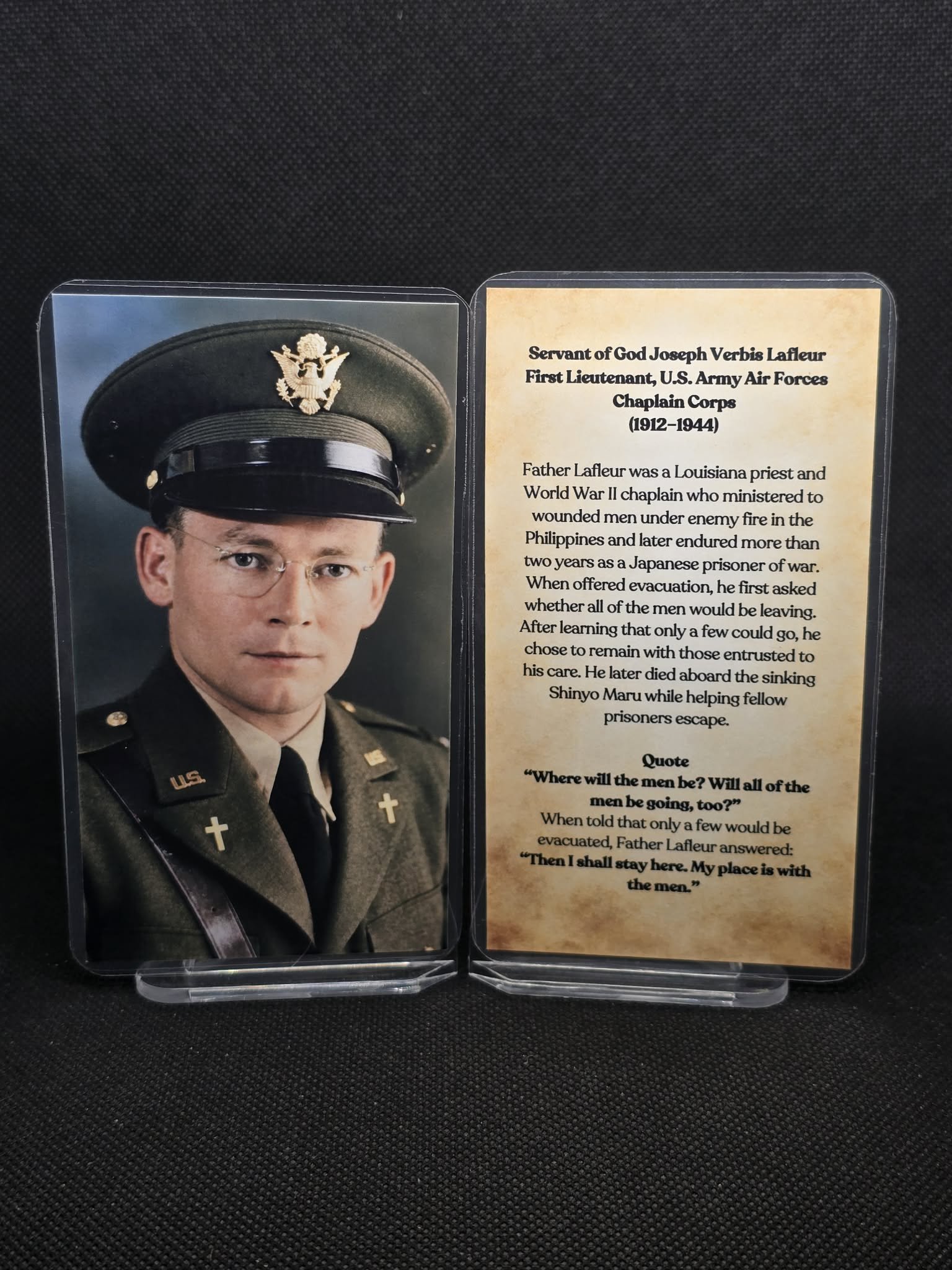
Servant of God Joseph Verbis Lafleur Prayer Card | For Soldiers, POWs, Military Chaplains, Courage & Sacrifice
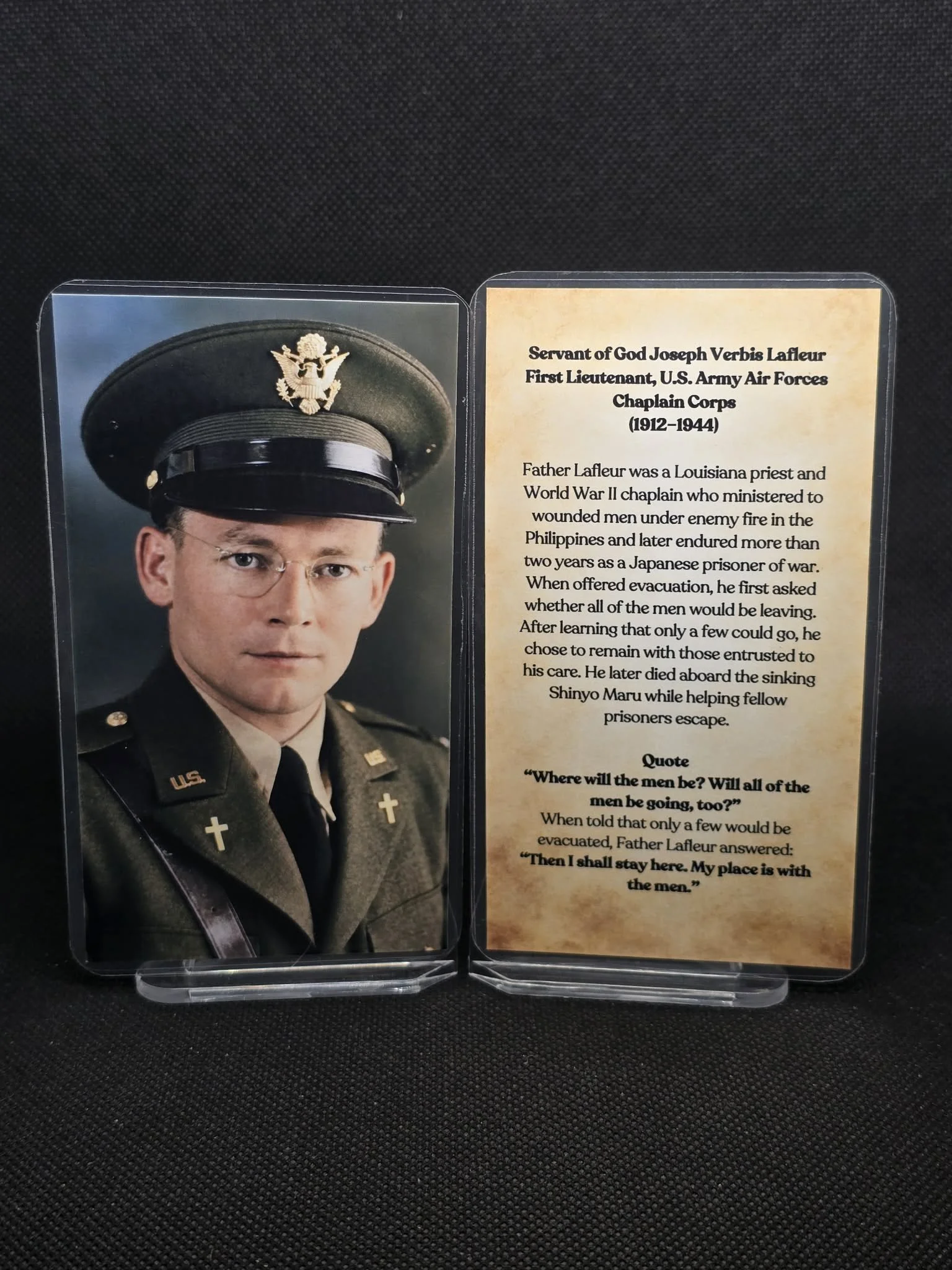
Servant of God Joseph Verbis Lafleur was a Louisiana Catholic priest, United States Army Air Corps chaplain, decorated World War II hero, Japanese prisoner of war, and Knight of Columbus whose priesthood became an extraordinary witness to sacrificial love. From the Japanese bombing of Clark Field in the Philippines through years of brutal captivity and finally the sinking of the Japanese prison ship Shinyo Maru, Father Lafleur repeatedly chose to remain with the servicemen entrusted to him when opportunities for greater safety were available.
Father Lafleur is especially meaningful for soldiers, veterans, military chaplains, prisoners of war, POW and MIA families, priests, seminarians, Knights of Columbus, first responders, and Christians asking for courage, perseverance, sacrificial love, or strength in dangerous circumstances. These are devotional associations arising naturally from his life rather than formal patronages, because Father Lafleur remains a Servant of God and has not yet been declared Venerable, Blessed, or Saint. His official cause continues working toward the examination of his heroic virtue by the Church.
His story is remarkable because the same pattern appears again and again throughout his military service. He ministered to wounded men during enemy bombing, declined opportunities to leave because other soldiers could not go with him, voluntarily accompanied POWs to a harsher labor detail so they would have a priest, surrendered his own belongings to help fellow prisoners, and finally refused to escape a sinking ship before helping other men toward safety.
Each prayer card measures 2.5" x 4.25", is handmade in Austin, Texas, printed on museum-quality photo paper rather than ordinary cardstock, and double laminated for durability. Each card is prepared prayerfully with the recipient and their intentions lifted before Christ while asking Servant of God Joseph Verbis Lafleur to intercede for the person who will receive it.
THE LIFE & STORY
Joseph Verbis Lafleur was born on January 24, 1912, in Ville Platte, Louisiana, the fourth child of Agatha Dupré Lafleur and Valentine Lafleur. His desire for the priesthood appeared early, and by seven years old he was already serving at the altar. After his family moved to Opelousas, he continued pursuing that vocation and eventually entered Saint Joseph Minor Seminary before completing his theological formation at Notre Dame Seminary in New Orleans.
Father Lafleur was ordained to the Catholic priesthood in 1938 and celebrated his first Solemn High Mass at Saint Landry Catholic Church in Opelousas. He then served as assistant pastor at Saint Mary Magdalen Catholic Church in Abbeville, Louisiana, but ordinary parish ministry would occupy only a short period of his priesthood before the approaching world war changed its course.
VOLUNTEERING TO SERVE
Father Lafleur volunteered for military chaplaincy before the United States had formally entered World War II. His official cause preserves his explanation: “I am volunteering for the military service because the other men do not have a choice … I hope they send me to the farthest away places.” The statement reveals a principle that would govern nearly every major decision he made during the remaining three years of his life.
He did not view chaplaincy as a safer position on the edge of military life. If young servicemen were being sent into danger, Lafleur believed a priest should willingly go with them, bringing the sacraments, prayer, spiritual counsel, and the presence of the Church into circumstances the soldiers themselves had not necessarily chosen.
UNITED STATES ARMY AIR CORPS CHAPLAIN
Father Lafleur entered the United States Army Air Corps in 1941 and served as a chaplain with the 19th Bombardment Group. After an assignment in Albuquerque, New Mexico, his unit was transferred to Clark Field in the Philippines only months before Japanese forces attacked American positions throughout the Pacific.
His assignment placed him directly in the opening violence of the war. On December 8, 1941, only hours after the attack on Pearl Harbor because of the International Date Line, Japanese aircraft struck Clark Field and caused devastating casualties among American forces.
HEROISM AT CLARK FIELD
While bombs and gunfire struck Clark Field, Father Lafleur moved among wounded and dying servicemen rather than seeking protection for himself. He helped injured men reach safety, assisted those caring for casualties, prayed with the dying, administered the sacraments, and continued his priestly duties while the attack was still underway.
His actions earned him the Distinguished Service Cross, one of the highest decorations for military valor in the United States. He would ultimately receive two Distinguished Service Crosses, two Purple Hearts, and the Bronze Star, making his military record extraordinary even before the spiritual dimension of his actions is considered.
A PRIEST UNDER FIRE
Father Lafleur’s actions at Clark Field established the pattern of his wartime priesthood. Danger did not persuade him that his ministry should stop until circumstances became safer; instead, the presence of wounded, frightened, and dying men made his priesthood even more urgent.
For military chaplains, his example offers a demanding understanding of pastoral presence. A chaplain may not be able to stop a battle or remove the danger faced by servicemen, but Lafleur demonstrated that a priest can still remain present, bring the sacraments, comfort the dying, and refuse to allow suffering to become abandonment.
“MY PLACE IS WITH THE MEN”
In February 1942, Father Lafleur was given an opportunity to leave a dangerous situation, but he first asked whether all of the men would also be going. When he learned that only a few would be evacuated, he answered, “Then I shall stay here. My place is with the men.”
Those words became a summary of his entire priesthood because he repeatedly acted according to them. Whether he was standing beneath enemy aircraft, facing the possibility of capture, moving into harsher imprisonment, or confronting death aboard a sinking ship, Lafleur understood that his responsibility as a priest required remaining near the people entrusted to his care.
REFUSING PERSONAL SAFETY
Father Lafleur had more than one opportunity to increase his own chances of survival. The choices that eventually placed him in Japanese captivity were therefore not simply a chain of unavoidable accidents but part of a documented pattern in which he repeatedly placed the needs of servicemen ahead of his own security.
This does not mean that he sought suffering for its own sake. Rather, he refused to accept safety when obtaining it would require abandoning men who still needed the spiritual and practical presence of their chaplain.
CAPTURED BY THE JAPANESE
As American and Filipino defenses in the Philippines collapsed, Father Lafleur became a Japanese prisoner of war. For nearly two and a half years he endured the same hunger, disease, forced labor, violence, exhaustion, and uncertainty suffered by the servicemen around him.
Captivity stripped away almost everything associated with ordinary parish ministry. Lafleur no longer had the freedom, security, parish buildings, resources, or regular supplies of a civilian priest, yet survivors remembered that he continued functioning as a chaplain wherever circumstances allowed.
PRIESTHOOD IN THE POW CAMPS
Father Lafleur prayed with prisoners, cared for the sick, encouraged men facing despair, and tried to obtain necessities for fellow captives. His official cause records that he traded away personal possessions, even his eyeglasses, in order to secure things other prisoners desperately needed.
His captivity therefore became an extension rather than an interruption of his priesthood. With almost nothing materially available to him, he continued giving the things that remained within his power: prayer, encouragement, advocacy, companionship, sacrifice, and whatever possessions could still be exchanged for the good of another man.
SAINT PETER IN CHAINS
During his imprisonment, Father Lafleur constructed a primitive chapel known as Saint Peter in Chains, an especially fitting name for a place of Catholic worship built by men living in captivity. The chapel allowed imprisoned servicemen to gather for prayer and gave them a physical reminder that the Church had not disappeared simply because they had been placed behind barbed wire.
The name also expressed something essential about Christian freedom. Saint Peter had worshiped God while imprisoned, and the POWs gathered around Father Lafleur were being reminded that captivity could restrict their bodies without possessing their souls.
FOR PRISONERS OF WAR
Father Lafleur has an especially strong devotional connection with prisoners of war, captives, hostages, and POW families because the final years of his life were lived almost entirely inside Japanese captivity. He understood hunger, forced labor, imprisonment, physical weakness, fear, uncertainty, and the emotional burden of watching fellow prisoners die.
He has not been formally proclaimed a patron of prisoners or POWs, because his cause has not yet reached canonization. The connection is nevertheless deeply grounded in his actual life and makes his prayer card particularly meaningful for families whose loved ones are imprisoned, missing, captured, or serving in places where those dangers exist.
FOR SOLDIERS
Father Lafleur’s relationship with soldiers went far beyond conducting military religious services. He shared danger with them, prayed with them while they were dying, refused evacuation when they could not leave, endured imprisonment with them, surrendered his possessions for them, and ultimately died while helping other prisoners escape.
His example therefore presents a distinctly Christian understanding of military courage. Strength is not only the ability to endure danger personally but the willingness to use whatever strength remains to protect and serve someone else.
FOR VETERANS
Veterans may find in Father Lafleur a priest who knew military life from inside rather than observing it from a distance. He understood deployment, hierarchy, combat, wounded comrades, captivity, exhaustion, responsibility for others, and the possibility that military service might demand far more than anyone anticipated when first putting on the uniform.
His life can be particularly meaningful for veterans praying for peace, perseverance, healing, the souls of fallen comrades, or a renewed sense of purpose after military service. Lafleur’s story also preserves the dignity of acts of service that may remain largely unknown to the wider world but were unforgettable to the men who depended upon them.
FOR MILITARY CHAPLAINS
Father Lafleur offers military chaplains an extraordinary model of pastoral presence under extreme conditions. His phrase “My place is with the men” was not a slogan created after his death but a conviction he expressed when actual evacuation was being discussed.
His ministry demonstrates that military chaplaincy means more than providing scheduled religious services. For Lafleur it meant following men into fear, injury, captivity, hunger, forced labor, and death, while continuing to remind them through both sacrament and example that God had not abandoned them.
VOLUNTEERING FOR A HARSHER LABOR DETAIL
During captivity, approximately 650 prisoners were selected for a grueling forced-labor assignment connected with maintaining a Japanese airfield. Father Lafleur voluntarily exchanged places with another prisoner so that the men being transferred would have a priest with them.
The decision provides one of the clearest examples of his understanding of spiritual fatherhood. No military order forced him to accompany the group, yet he deliberately moved toward greater hardship because hundreds of prisoners were being sent away and he believed they should not face what was coming without a chaplain.
“A FATHER SHOULD GO”
Father Lafleur explained that he believed a father should go with the men, reflecting his understanding of priesthood as spiritual fatherhood rather than simply an office. He knew that something might happen to the prisoners and could not reconcile remaining behind with his responsibility toward them.
That conviction explains much of his wartime behavior. He did not believe a priest’s responsibility disappeared when conditions became dangerous; danger was precisely when men might most desperately need the sacraments, prayer, courage, and reassurance that they had not been forgotten.
THE SHINYO MARU
By 1944, American forces were moving closer to the Philippines, and Japanese authorities began transporting POWs away from advancing Allied troops. Father Lafleur and hundreds of other prisoners were eventually packed into the hold of the Japanese transport vessel Shinyo Maru, one of the infamous ships later remembered by survivors as “hell ships.”
Approximately 750 prisoners were crowded into terrible conditions aboard the vessel. The ship carried no visible indication that Allied POWs were imprisoned below decks, leaving American forces unaware that their own servicemen were aboard.
TORPEDOED BY AN AMERICAN SUBMARINE
On September 7, 1944, an American submarine attacked the Shinyo Maru without knowing Allied prisoners were inside. The ship began burning and sinking, while prisoners trapped below desperately attempted to reach openings and escape into the water.
The disaster became even more horrific when Japanese guards fired upon escaping prisoners. Of the hundreds of POWs aboard, only a small number survived the sinking and the violence that followed.
HIS FINAL ACT OF SACRIFICE
As an escape route opened, fellow prisoners urged Father Lafleur to go first. He refused and instead helped other men climb toward safety, remaining behind while prisoners passed him on their way out of the sinking vessel.
Father Lafleur was last seen blessing and helping another prisoner escape. His exact manner of death is unknown, because he may have drowned or been killed by Japanese gunfire or grenades, but he did not survive the sinking and his body was never recovered.
GREATER LOVE HAS NO MAN
The words of Christ in John 15:13, “Greater love has no one than this, that someone lay down his life for his friends,” have a natural connection with Father Lafleur’s life. His death was not an isolated moment of sacrifice but the conclusion of a pattern in which he had already surrendered opportunities for safety, possessions, comfort, freedom, and physical strength for the people around him.
His final moments aboard the Shinyo Maru therefore completed the principle he had expressed years earlier when he said that his place was with the men. He remained with them beneath enemy bombing, remained with them when evacuation became possible, followed them into forced labor, and remained with them when a sinking ship offered one final opportunity to put himself first.
TWO DISTINGUISHED SERVICE CROSSES
Father Lafleur ultimately received two Distinguished Service Crosses, placing him among a very small number of military chaplains recognized at that level for extraordinary heroism. His decorations also included two Purple Hearts and the Bronze Star, creating an unusually extensive military record for a Catholic chaplain.
These decorations are important because they demonstrate that accounts of his courage are not simply devotional traditions that developed after his canonization cause began. His extraordinary actions were also recognized through the independent military system responsible for documenting and evaluating battlefield heroism.
FOR COURAGE
Father Lafleur’s courage appeared in several different forms. He displayed physical courage under bombing, moral courage when personal safety was available, pastoral courage while remaining with frightened and wounded men, and persevering courage during years of captivity.
His prayer card may therefore be meaningful for people facing dangerous responsibilities even outside military service. First responders, caregivers, priests, medical professionals, parents, and others responsible for vulnerable people may recognize his example of remaining faithful when leaving would be easier.
FOR PEOPLE RESPONSIBLE FOR OTHERS
One of the deepest themes in Lafleur’s life is the relationship between vocation and responsibility. He could not control the war, prevent imprisonment, or guarantee that the men around him would survive, but he could decide whether they would face those circumstances without their priest.
His life therefore offers an important distinction between being able to solve another person’s suffering and being willing to remain present within it. Christian charity sometimes changes circumstances, while at other times its greatest expression is refusing to let another person suffer alone.
FOR PRIESTS & SEMINARIANS
Father Lafleur’s life provides priests and seminarians with an extraordinary example of spiritual fatherhood. His willingness to accompany prisoners into harsher conditions because “a Father should go” demonstrates that he understood priesthood as a personal responsibility toward souls rather than merely the performance of religious duties.
The POW camps stripped his priesthood of almost every external support, yet his vocation remained recognizable. He prayed, encouraged, sacrificed, built a chapel, accompanied suffering men, and continued acting as a father when there was little else available to him.
A KNIGHT OF COLUMBUS
Father Lafleur was a member of the Knights of Columbus, and the Knights continue honoring his life and promoting awareness of his cause. His biography naturally reflects the principles of charity, unity, fraternity, and patriotism associated with the organization.
His patriotism never replaced his Catholic identity but was ordered through it. Lafleur served his country precisely by serving the human beings beside him, and his greatest acts of military heroism were inseparable from his conviction that those servicemen were also souls entrusted to his priesthood.
HIS BODY WAS NEVER RECOVERED
Father Lafleur’s body was never recovered from the sinking of the Shinyo Maru. There is therefore no known tomb containing his mortal remains, a circumstance that connects his story particularly closely with military families who have experienced the grief of a loved one lost without remains being returned.
His absence also gives his memorials unusual significance. Churches, monuments, military records, personal possessions, and surviving testimony preserve the physical memory of a priest whose final resting place remains unknown.
THE FATHER LAFLEUR SHRINE
Saint Landry Catholic Church in Opelousas, Louisiana, maintains a shrine and memorial devoted to Father Lafleur and his cause. The church is closely connected with his family and priestly history and has become one of the principal places where Catholics learn about his life and pray for the advancement of his cause.
A major monument there depicts his final moments aboard the sinking Shinyo Maru, showing the weakened chaplain assisting other prisoners toward escape. The image captures the central theme running through his life: a priest placing another man’s survival ahead of his own.
HIS CAUSE FOR BEATIFICATION & CANONIZATION
The Diocese of Lafayette formally opened Father Lafleur’s cause on September 5, 2020, after which he became known as Servant of God Joseph Verbis Lafleur. In 2021 the bishops of the United States expressed their support for advancement of his cause at the diocesan level.
His official cause continues to identify him as Servant of God and states that the work currently concerns demonstrating his heroic virtue for examination by the Church. He has therefore not yet been declared Venerable, beatified, or canonized, and his proper current ecclesiastical title remains Servant of God Joseph Verbis Lafleur.
PRAYER FOR HIS CANONIZATION
The official Father Lafleur cause provides a Prayer for the Canonization of Servant of God Joseph Verbis Lafleur and encourages Catholics to seek his intercession for their needs. The prayer draws upon Christ’s teaching about laying down one’s life for one’s friends while remembering Lafleur’s priesthood, courage, charity, and complete willingness to serve the men entrusted to him.
The faithful are also encouraged to report significant favors believed to have been received through his intercession so that they may be documented by those promoting the cause. This allows personal devotion to Father Lafleur to remain connected with prayer that the Church may one day formally recognize the holiness reflected in his life.
A PRAYER CARD FOR SOLDIERS
A Servant of God Joseph Verbis Lafleur prayer card is especially meaningful for active-duty servicemen preparing for deployment, soldiers serving in dangerous areas, or military personnel carrying responsibility for the safety of others. His story demonstrates that courage can consist not only in enduring danger but in refusing to abandon someone else when danger arrives.
His example also places faith directly inside military life. Lafleur did not wait for war to become less dangerous before acting as a priest, and his ministry demonstrates that prayer, sacramental life, charity, and spiritual responsibility remain possible even under the most extreme military conditions.
A PRAYER CARD FOR POW & MIA FAMILIES
POW and MIA families may find a particularly deep connection with Father Lafleur because he spent years as a prisoner and ultimately disappeared without his body being recovered. His family therefore knew the peculiar grief of military death without an ordinary grave containing the remains of the person they loved.
His story also provides a Catholic witness from inside captivity itself. Lafleur understood what it meant to lose freedom while continuing to protect the inner freedom of faith, conscience, charity, and hope.
A PRAYER CARD FOR MILITARY CHAPLAINS
Father Lafleur offers military chaplains a concise spiritual principle in the words “My place is with the men.” His life shows what those words meant when tested by bombing, evacuation, surrender, imprisonment, forced labor, starvation, and approaching death.
The chaplain’s vocation is not simply to be present when religious services are convenient. Lafleur’s life presents it as a ministry of spiritual fatherhood that becomes especially important precisely when the people entrusted to the chaplain are frightened, wounded, isolated, imprisoned, or dying.
FAQ
Who was Servant of God Joseph Verbis Lafleur? Joseph Verbis Lafleur was a Louisiana Catholic priest and United States Army Air Corps chaplain who served in the Philippines during World War II. He became a Japanese prisoner of war and died on September 7, 1944, after helping fellow POWs escape the sinking Shinyo Maru.
Is Father Joseph Verbis Lafleur a saint? No, his correct current ecclesiastical title is Servant of God Joseph Verbis Lafleur. His canonization cause is active, but he has not yet been declared Venerable, Blessed, or Saint.
When was Father Lafleur born and ordained? Joseph Verbis Lafleur was born on January 24, 1912, in Ville Platte, Louisiana, and was ordained to the Catholic priesthood in 1938. His military chaplaincy began only a few years after his ordination.
Was Father Lafleur really a military chaplain? Yes, he joined the United States Army Air Corps in 1941 and served as a chaplain with the 19th Bombardment Group. His service eventually placed him at Clark Field in the Philippines when Japanese forces attacked in December 1941.
Did Father Lafleur receive the Distinguished Service Cross? Yes, Father Lafleur ultimately received two Distinguished Service Crosses for extraordinary heroism. He also received two Purple Hearts and the Bronze Star for his wartime service and sacrifice.
Was Father Lafleur really a prisoner of war? Yes, Japanese forces held him as a POW for nearly two and a half years. During captivity he continued ministering to fellow prisoners despite hunger, disease, forced labor, physical weakness, and abuse.
Did Father Lafleur refuse a chance to leave? Yes, his official cause preserves the exchange in which he asked whether all of the men would be evacuated and, after learning they would not, replied that he would remain because his place was with the men. The decision reflects the larger pattern of his military ministry.
Did Father Lafleur voluntarily go with prisoners to forced labor? Yes, the USCCB records that he exchanged places with another prisoner so approximately 650 POWs being sent to a demanding work detail would have a priest with them. His decision was voluntary and placed him in more difficult circumstances.
How did Father Lafleur die? He died during the sinking of the Shinyo Maru on September 7, 1944, after refusing to escape ahead of other prisoners and helping men reach safety. His precise physical cause of death remains unknown because he may have drowned or been killed during the violence surrounding the sinking.
Was Father Lafleur’s body recovered? No, his body was never recovered after the Shinyo Maru sank. Consequently, his memorials and shrine preserve his memory without a known tomb containing his remains.
Can soldiers ask Father Lafleur for intercession? Yes, his official cause actively encourages Catholics to seek the intercession of Servant of God Joseph Verbis Lafleur. His relationship with soldiers is a strong devotional association drawn directly from his military chaplaincy rather than an officially declared patronage.
Can POWs and their families ask Father Lafleur for intercession? Yes, his own years as a Japanese prisoner of war make him especially meaningful for prisoners, POWs, MIA families, hostages, and people suffering captivity. This connection arises from his life and ministry and is a devotional association rather than a formally declared patronage.
Can military chaplains ask Father Lafleur for intercession? Yes, his life provides an extraordinary example of military chaplaincy lived under severe combat and POW conditions. His priesthood centered upon remaining spiritually and physically present with the men even when greater personal safety was available.
Was Father Lafleur a Knight of Columbus? Yes, Father Lafleur was a Knight of Columbus, and the organization continues promoting awareness of his heroic life and canonization cause. His service strongly reflects the organization’s ideals of charity, fraternity, unity, and patriotism.
Is there an official prayer for Father Lafleur’s canonization? Yes, his official cause publishes a specific prayer for his canonization and encourages Catholics to seek his intercession for personal intentions. The cause also asks that significant favors attributed to his intercession be reported so they can be properly documented.
Who would this prayer card make a meaningful gift for? It is especially appropriate for active-duty military personnel, veterans, military chaplains, priests, seminarians, Knights of Columbus, POW and MIA families, first responders, and people preparing for dangerous duties. It is also meaningful for anyone asking for courage, sacrificial love, perseverance, or strength to remain faithfully beside another person during suffering.
THE MAIN MESSAGE OF SERVANT OF GOD JOSEPH VERBIS LAFLEUR’S LIFE
Joseph Verbis Lafleur’s life teaches that Christian courage is not simply surviving danger but remaining faithful when survival could be made easier by abandoning another person. At Clark Field he moved toward wounded men while bombs were falling, later he refused evacuation because the other servicemen could not all leave, and in captivity he voluntarily followed prisoners into harsher conditions because he believed they needed a priest.
His final moments aboard the Shinyo Maru completed rather than suddenly created this pattern. When other prisoners offered him the opportunity to escape first, he remained behind and helped them climb toward safety, making his last known actions consistent with the principle he had already spoken aloud: “My place is with the men.”
For soldiers, veterans, chaplains, POW families, priests, seminarians, first responders, and anyone entrusted with the care of another person, Lafleur offers an unusually demanding understanding of vocation. His life demonstrates that fidelity sometimes means going where others are suffering, remaining when leaving would be easier, and continuing to give until the person entrusted to you is no longer alone.
Servant of God Joseph Verbis Lafleur was a Louisiana Catholic priest, United States Army Air Corps chaplain, decorated World War II hero, Japanese prisoner of war, and Knight of Columbus whose priesthood became an extraordinary witness to sacrificial love. From the Japanese bombing of Clark Field in the Philippines through years of brutal captivity and finally the sinking of the Japanese prison ship Shinyo Maru, Father Lafleur repeatedly chose to remain with the servicemen entrusted to him when opportunities for greater safety were available.
Father Lafleur is especially meaningful for soldiers, veterans, military chaplains, prisoners of war, POW and MIA families, priests, seminarians, Knights of Columbus, first responders, and Christians asking for courage, perseverance, sacrificial love, or strength in dangerous circumstances. These are devotional associations arising naturally from his life rather than formal patronages, because Father Lafleur remains a Servant of God and has not yet been declared Venerable, Blessed, or Saint. His official cause continues working toward the examination of his heroic virtue by the Church.
His story is remarkable because the same pattern appears again and again throughout his military service. He ministered to wounded men during enemy bombing, declined opportunities to leave because other soldiers could not go with him, voluntarily accompanied POWs to a harsher labor detail so they would have a priest, surrendered his own belongings to help fellow prisoners, and finally refused to escape a sinking ship before helping other men toward safety.
Each prayer card measures 2.5" x 4.25", is handmade in Austin, Texas, printed on museum-quality photo paper rather than ordinary cardstock, and double laminated for durability. Each card is prepared prayerfully with the recipient and their intentions lifted before Christ while asking Servant of God Joseph Verbis Lafleur to intercede for the person who will receive it.
THE LIFE & STORY
Joseph Verbis Lafleur was born on January 24, 1912, in Ville Platte, Louisiana, the fourth child of Agatha Dupré Lafleur and Valentine Lafleur. His desire for the priesthood appeared early, and by seven years old he was already serving at the altar. After his family moved to Opelousas, he continued pursuing that vocation and eventually entered Saint Joseph Minor Seminary before completing his theological formation at Notre Dame Seminary in New Orleans.
Father Lafleur was ordained to the Catholic priesthood in 1938 and celebrated his first Solemn High Mass at Saint Landry Catholic Church in Opelousas. He then served as assistant pastor at Saint Mary Magdalen Catholic Church in Abbeville, Louisiana, but ordinary parish ministry would occupy only a short period of his priesthood before the approaching world war changed its course.
VOLUNTEERING TO SERVE
Father Lafleur volunteered for military chaplaincy before the United States had formally entered World War II. His official cause preserves his explanation: “I am volunteering for the military service because the other men do not have a choice … I hope they send me to the farthest away places.” The statement reveals a principle that would govern nearly every major decision he made during the remaining three years of his life.
He did not view chaplaincy as a safer position on the edge of military life. If young servicemen were being sent into danger, Lafleur believed a priest should willingly go with them, bringing the sacraments, prayer, spiritual counsel, and the presence of the Church into circumstances the soldiers themselves had not necessarily chosen.
UNITED STATES ARMY AIR CORPS CHAPLAIN
Father Lafleur entered the United States Army Air Corps in 1941 and served as a chaplain with the 19th Bombardment Group. After an assignment in Albuquerque, New Mexico, his unit was transferred to Clark Field in the Philippines only months before Japanese forces attacked American positions throughout the Pacific.
His assignment placed him directly in the opening violence of the war. On December 8, 1941, only hours after the attack on Pearl Harbor because of the International Date Line, Japanese aircraft struck Clark Field and caused devastating casualties among American forces.
HEROISM AT CLARK FIELD
While bombs and gunfire struck Clark Field, Father Lafleur moved among wounded and dying servicemen rather than seeking protection for himself. He helped injured men reach safety, assisted those caring for casualties, prayed with the dying, administered the sacraments, and continued his priestly duties while the attack was still underway.
His actions earned him the Distinguished Service Cross, one of the highest decorations for military valor in the United States. He would ultimately receive two Distinguished Service Crosses, two Purple Hearts, and the Bronze Star, making his military record extraordinary even before the spiritual dimension of his actions is considered.
A PRIEST UNDER FIRE
Father Lafleur’s actions at Clark Field established the pattern of his wartime priesthood. Danger did not persuade him that his ministry should stop until circumstances became safer; instead, the presence of wounded, frightened, and dying men made his priesthood even more urgent.
For military chaplains, his example offers a demanding understanding of pastoral presence. A chaplain may not be able to stop a battle or remove the danger faced by servicemen, but Lafleur demonstrated that a priest can still remain present, bring the sacraments, comfort the dying, and refuse to allow suffering to become abandonment.
“MY PLACE IS WITH THE MEN”
In February 1942, Father Lafleur was given an opportunity to leave a dangerous situation, but he first asked whether all of the men would also be going. When he learned that only a few would be evacuated, he answered, “Then I shall stay here. My place is with the men.”
Those words became a summary of his entire priesthood because he repeatedly acted according to them. Whether he was standing beneath enemy aircraft, facing the possibility of capture, moving into harsher imprisonment, or confronting death aboard a sinking ship, Lafleur understood that his responsibility as a priest required remaining near the people entrusted to his care.
REFUSING PERSONAL SAFETY
Father Lafleur had more than one opportunity to increase his own chances of survival. The choices that eventually placed him in Japanese captivity were therefore not simply a chain of unavoidable accidents but part of a documented pattern in which he repeatedly placed the needs of servicemen ahead of his own security.
This does not mean that he sought suffering for its own sake. Rather, he refused to accept safety when obtaining it would require abandoning men who still needed the spiritual and practical presence of their chaplain.
CAPTURED BY THE JAPANESE
As American and Filipino defenses in the Philippines collapsed, Father Lafleur became a Japanese prisoner of war. For nearly two and a half years he endured the same hunger, disease, forced labor, violence, exhaustion, and uncertainty suffered by the servicemen around him.
Captivity stripped away almost everything associated with ordinary parish ministry. Lafleur no longer had the freedom, security, parish buildings, resources, or regular supplies of a civilian priest, yet survivors remembered that he continued functioning as a chaplain wherever circumstances allowed.
PRIESTHOOD IN THE POW CAMPS
Father Lafleur prayed with prisoners, cared for the sick, encouraged men facing despair, and tried to obtain necessities for fellow captives. His official cause records that he traded away personal possessions, even his eyeglasses, in order to secure things other prisoners desperately needed.
His captivity therefore became an extension rather than an interruption of his priesthood. With almost nothing materially available to him, he continued giving the things that remained within his power: prayer, encouragement, advocacy, companionship, sacrifice, and whatever possessions could still be exchanged for the good of another man.
SAINT PETER IN CHAINS
During his imprisonment, Father Lafleur constructed a primitive chapel known as Saint Peter in Chains, an especially fitting name for a place of Catholic worship built by men living in captivity. The chapel allowed imprisoned servicemen to gather for prayer and gave them a physical reminder that the Church had not disappeared simply because they had been placed behind barbed wire.
The name also expressed something essential about Christian freedom. Saint Peter had worshiped God while imprisoned, and the POWs gathered around Father Lafleur were being reminded that captivity could restrict their bodies without possessing their souls.
FOR PRISONERS OF WAR
Father Lafleur has an especially strong devotional connection with prisoners of war, captives, hostages, and POW families because the final years of his life were lived almost entirely inside Japanese captivity. He understood hunger, forced labor, imprisonment, physical weakness, fear, uncertainty, and the emotional burden of watching fellow prisoners die.
He has not been formally proclaimed a patron of prisoners or POWs, because his cause has not yet reached canonization. The connection is nevertheless deeply grounded in his actual life and makes his prayer card particularly meaningful for families whose loved ones are imprisoned, missing, captured, or serving in places where those dangers exist.
FOR SOLDIERS
Father Lafleur’s relationship with soldiers went far beyond conducting military religious services. He shared danger with them, prayed with them while they were dying, refused evacuation when they could not leave, endured imprisonment with them, surrendered his possessions for them, and ultimately died while helping other prisoners escape.
His example therefore presents a distinctly Christian understanding of military courage. Strength is not only the ability to endure danger personally but the willingness to use whatever strength remains to protect and serve someone else.
FOR VETERANS
Veterans may find in Father Lafleur a priest who knew military life from inside rather than observing it from a distance. He understood deployment, hierarchy, combat, wounded comrades, captivity, exhaustion, responsibility for others, and the possibility that military service might demand far more than anyone anticipated when first putting on the uniform.
His life can be particularly meaningful for veterans praying for peace, perseverance, healing, the souls of fallen comrades, or a renewed sense of purpose after military service. Lafleur’s story also preserves the dignity of acts of service that may remain largely unknown to the wider world but were unforgettable to the men who depended upon them.
FOR MILITARY CHAPLAINS
Father Lafleur offers military chaplains an extraordinary model of pastoral presence under extreme conditions. His phrase “My place is with the men” was not a slogan created after his death but a conviction he expressed when actual evacuation was being discussed.
His ministry demonstrates that military chaplaincy means more than providing scheduled religious services. For Lafleur it meant following men into fear, injury, captivity, hunger, forced labor, and death, while continuing to remind them through both sacrament and example that God had not abandoned them.
VOLUNTEERING FOR A HARSHER LABOR DETAIL
During captivity, approximately 650 prisoners were selected for a grueling forced-labor assignment connected with maintaining a Japanese airfield. Father Lafleur voluntarily exchanged places with another prisoner so that the men being transferred would have a priest with them.
The decision provides one of the clearest examples of his understanding of spiritual fatherhood. No military order forced him to accompany the group, yet he deliberately moved toward greater hardship because hundreds of prisoners were being sent away and he believed they should not face what was coming without a chaplain.
“A FATHER SHOULD GO”
Father Lafleur explained that he believed a father should go with the men, reflecting his understanding of priesthood as spiritual fatherhood rather than simply an office. He knew that something might happen to the prisoners and could not reconcile remaining behind with his responsibility toward them.
That conviction explains much of his wartime behavior. He did not believe a priest’s responsibility disappeared when conditions became dangerous; danger was precisely when men might most desperately need the sacraments, prayer, courage, and reassurance that they had not been forgotten.
THE SHINYO MARU
By 1944, American forces were moving closer to the Philippines, and Japanese authorities began transporting POWs away from advancing Allied troops. Father Lafleur and hundreds of other prisoners were eventually packed into the hold of the Japanese transport vessel Shinyo Maru, one of the infamous ships later remembered by survivors as “hell ships.”
Approximately 750 prisoners were crowded into terrible conditions aboard the vessel. The ship carried no visible indication that Allied POWs were imprisoned below decks, leaving American forces unaware that their own servicemen were aboard.
TORPEDOED BY AN AMERICAN SUBMARINE
On September 7, 1944, an American submarine attacked the Shinyo Maru without knowing Allied prisoners were inside. The ship began burning and sinking, while prisoners trapped below desperately attempted to reach openings and escape into the water.
The disaster became even more horrific when Japanese guards fired upon escaping prisoners. Of the hundreds of POWs aboard, only a small number survived the sinking and the violence that followed.
HIS FINAL ACT OF SACRIFICE
As an escape route opened, fellow prisoners urged Father Lafleur to go first. He refused and instead helped other men climb toward safety, remaining behind while prisoners passed him on their way out of the sinking vessel.
Father Lafleur was last seen blessing and helping another prisoner escape. His exact manner of death is unknown, because he may have drowned or been killed by Japanese gunfire or grenades, but he did not survive the sinking and his body was never recovered.
GREATER LOVE HAS NO MAN
The words of Christ in John 15:13, “Greater love has no one than this, that someone lay down his life for his friends,” have a natural connection with Father Lafleur’s life. His death was not an isolated moment of sacrifice but the conclusion of a pattern in which he had already surrendered opportunities for safety, possessions, comfort, freedom, and physical strength for the people around him.
His final moments aboard the Shinyo Maru therefore completed the principle he had expressed years earlier when he said that his place was with the men. He remained with them beneath enemy bombing, remained with them when evacuation became possible, followed them into forced labor, and remained with them when a sinking ship offered one final opportunity to put himself first.
TWO DISTINGUISHED SERVICE CROSSES
Father Lafleur ultimately received two Distinguished Service Crosses, placing him among a very small number of military chaplains recognized at that level for extraordinary heroism. His decorations also included two Purple Hearts and the Bronze Star, creating an unusually extensive military record for a Catholic chaplain.
These decorations are important because they demonstrate that accounts of his courage are not simply devotional traditions that developed after his canonization cause began. His extraordinary actions were also recognized through the independent military system responsible for documenting and evaluating battlefield heroism.
FOR COURAGE
Father Lafleur’s courage appeared in several different forms. He displayed physical courage under bombing, moral courage when personal safety was available, pastoral courage while remaining with frightened and wounded men, and persevering courage during years of captivity.
His prayer card may therefore be meaningful for people facing dangerous responsibilities even outside military service. First responders, caregivers, priests, medical professionals, parents, and others responsible for vulnerable people may recognize his example of remaining faithful when leaving would be easier.
FOR PEOPLE RESPONSIBLE FOR OTHERS
One of the deepest themes in Lafleur’s life is the relationship between vocation and responsibility. He could not control the war, prevent imprisonment, or guarantee that the men around him would survive, but he could decide whether they would face those circumstances without their priest.
His life therefore offers an important distinction between being able to solve another person’s suffering and being willing to remain present within it. Christian charity sometimes changes circumstances, while at other times its greatest expression is refusing to let another person suffer alone.
FOR PRIESTS & SEMINARIANS
Father Lafleur’s life provides priests and seminarians with an extraordinary example of spiritual fatherhood. His willingness to accompany prisoners into harsher conditions because “a Father should go” demonstrates that he understood priesthood as a personal responsibility toward souls rather than merely the performance of religious duties.
The POW camps stripped his priesthood of almost every external support, yet his vocation remained recognizable. He prayed, encouraged, sacrificed, built a chapel, accompanied suffering men, and continued acting as a father when there was little else available to him.
A KNIGHT OF COLUMBUS
Father Lafleur was a member of the Knights of Columbus, and the Knights continue honoring his life and promoting awareness of his cause. His biography naturally reflects the principles of charity, unity, fraternity, and patriotism associated with the organization.
His patriotism never replaced his Catholic identity but was ordered through it. Lafleur served his country precisely by serving the human beings beside him, and his greatest acts of military heroism were inseparable from his conviction that those servicemen were also souls entrusted to his priesthood.
HIS BODY WAS NEVER RECOVERED
Father Lafleur’s body was never recovered from the sinking of the Shinyo Maru. There is therefore no known tomb containing his mortal remains, a circumstance that connects his story particularly closely with military families who have experienced the grief of a loved one lost without remains being returned.
His absence also gives his memorials unusual significance. Churches, monuments, military records, personal possessions, and surviving testimony preserve the physical memory of a priest whose final resting place remains unknown.
THE FATHER LAFLEUR SHRINE
Saint Landry Catholic Church in Opelousas, Louisiana, maintains a shrine and memorial devoted to Father Lafleur and his cause. The church is closely connected with his family and priestly history and has become one of the principal places where Catholics learn about his life and pray for the advancement of his cause.
A major monument there depicts his final moments aboard the sinking Shinyo Maru, showing the weakened chaplain assisting other prisoners toward escape. The image captures the central theme running through his life: a priest placing another man’s survival ahead of his own.
HIS CAUSE FOR BEATIFICATION & CANONIZATION
The Diocese of Lafayette formally opened Father Lafleur’s cause on September 5, 2020, after which he became known as Servant of God Joseph Verbis Lafleur. In 2021 the bishops of the United States expressed their support for advancement of his cause at the diocesan level.
His official cause continues to identify him as Servant of God and states that the work currently concerns demonstrating his heroic virtue for examination by the Church. He has therefore not yet been declared Venerable, beatified, or canonized, and his proper current ecclesiastical title remains Servant of God Joseph Verbis Lafleur.
PRAYER FOR HIS CANONIZATION
The official Father Lafleur cause provides a Prayer for the Canonization of Servant of God Joseph Verbis Lafleur and encourages Catholics to seek his intercession for their needs. The prayer draws upon Christ’s teaching about laying down one’s life for one’s friends while remembering Lafleur’s priesthood, courage, charity, and complete willingness to serve the men entrusted to him.
The faithful are also encouraged to report significant favors believed to have been received through his intercession so that they may be documented by those promoting the cause. This allows personal devotion to Father Lafleur to remain connected with prayer that the Church may one day formally recognize the holiness reflected in his life.
A PRAYER CARD FOR SOLDIERS
A Servant of God Joseph Verbis Lafleur prayer card is especially meaningful for active-duty servicemen preparing for deployment, soldiers serving in dangerous areas, or military personnel carrying responsibility for the safety of others. His story demonstrates that courage can consist not only in enduring danger but in refusing to abandon someone else when danger arrives.
His example also places faith directly inside military life. Lafleur did not wait for war to become less dangerous before acting as a priest, and his ministry demonstrates that prayer, sacramental life, charity, and spiritual responsibility remain possible even under the most extreme military conditions.
A PRAYER CARD FOR POW & MIA FAMILIES
POW and MIA families may find a particularly deep connection with Father Lafleur because he spent years as a prisoner and ultimately disappeared without his body being recovered. His family therefore knew the peculiar grief of military death without an ordinary grave containing the remains of the person they loved.
His story also provides a Catholic witness from inside captivity itself. Lafleur understood what it meant to lose freedom while continuing to protect the inner freedom of faith, conscience, charity, and hope.
A PRAYER CARD FOR MILITARY CHAPLAINS
Father Lafleur offers military chaplains a concise spiritual principle in the words “My place is with the men.” His life shows what those words meant when tested by bombing, evacuation, surrender, imprisonment, forced labor, starvation, and approaching death.
The chaplain’s vocation is not simply to be present when religious services are convenient. Lafleur’s life presents it as a ministry of spiritual fatherhood that becomes especially important precisely when the people entrusted to the chaplain are frightened, wounded, isolated, imprisoned, or dying.
FAQ
Who was Servant of God Joseph Verbis Lafleur? Joseph Verbis Lafleur was a Louisiana Catholic priest and United States Army Air Corps chaplain who served in the Philippines during World War II. He became a Japanese prisoner of war and died on September 7, 1944, after helping fellow POWs escape the sinking Shinyo Maru.
Is Father Joseph Verbis Lafleur a saint? No, his correct current ecclesiastical title is Servant of God Joseph Verbis Lafleur. His canonization cause is active, but he has not yet been declared Venerable, Blessed, or Saint.
When was Father Lafleur born and ordained? Joseph Verbis Lafleur was born on January 24, 1912, in Ville Platte, Louisiana, and was ordained to the Catholic priesthood in 1938. His military chaplaincy began only a few years after his ordination.
Was Father Lafleur really a military chaplain? Yes, he joined the United States Army Air Corps in 1941 and served as a chaplain with the 19th Bombardment Group. His service eventually placed him at Clark Field in the Philippines when Japanese forces attacked in December 1941.
Did Father Lafleur receive the Distinguished Service Cross? Yes, Father Lafleur ultimately received two Distinguished Service Crosses for extraordinary heroism. He also received two Purple Hearts and the Bronze Star for his wartime service and sacrifice.
Was Father Lafleur really a prisoner of war? Yes, Japanese forces held him as a POW for nearly two and a half years. During captivity he continued ministering to fellow prisoners despite hunger, disease, forced labor, physical weakness, and abuse.
Did Father Lafleur refuse a chance to leave? Yes, his official cause preserves the exchange in which he asked whether all of the men would be evacuated and, after learning they would not, replied that he would remain because his place was with the men. The decision reflects the larger pattern of his military ministry.
Did Father Lafleur voluntarily go with prisoners to forced labor? Yes, the USCCB records that he exchanged places with another prisoner so approximately 650 POWs being sent to a demanding work detail would have a priest with them. His decision was voluntary and placed him in more difficult circumstances.
How did Father Lafleur die? He died during the sinking of the Shinyo Maru on September 7, 1944, after refusing to escape ahead of other prisoners and helping men reach safety. His precise physical cause of death remains unknown because he may have drowned or been killed during the violence surrounding the sinking.
Was Father Lafleur’s body recovered? No, his body was never recovered after the Shinyo Maru sank. Consequently, his memorials and shrine preserve his memory without a known tomb containing his remains.
Can soldiers ask Father Lafleur for intercession? Yes, his official cause actively encourages Catholics to seek the intercession of Servant of God Joseph Verbis Lafleur. His relationship with soldiers is a strong devotional association drawn directly from his military chaplaincy rather than an officially declared patronage.
Can POWs and their families ask Father Lafleur for intercession? Yes, his own years as a Japanese prisoner of war make him especially meaningful for prisoners, POWs, MIA families, hostages, and people suffering captivity. This connection arises from his life and ministry and is a devotional association rather than a formally declared patronage.
Can military chaplains ask Father Lafleur for intercession? Yes, his life provides an extraordinary example of military chaplaincy lived under severe combat and POW conditions. His priesthood centered upon remaining spiritually and physically present with the men even when greater personal safety was available.
Was Father Lafleur a Knight of Columbus? Yes, Father Lafleur was a Knight of Columbus, and the organization continues promoting awareness of his heroic life and canonization cause. His service strongly reflects the organization’s ideals of charity, fraternity, unity, and patriotism.
Is there an official prayer for Father Lafleur’s canonization? Yes, his official cause publishes a specific prayer for his canonization and encourages Catholics to seek his intercession for personal intentions. The cause also asks that significant favors attributed to his intercession be reported so they can be properly documented.
Who would this prayer card make a meaningful gift for? It is especially appropriate for active-duty military personnel, veterans, military chaplains, priests, seminarians, Knights of Columbus, POW and MIA families, first responders, and people preparing for dangerous duties. It is also meaningful for anyone asking for courage, sacrificial love, perseverance, or strength to remain faithfully beside another person during suffering.
THE MAIN MESSAGE OF SERVANT OF GOD JOSEPH VERBIS LAFLEUR’S LIFE
Joseph Verbis Lafleur’s life teaches that Christian courage is not simply surviving danger but remaining faithful when survival could be made easier by abandoning another person. At Clark Field he moved toward wounded men while bombs were falling, later he refused evacuation because the other servicemen could not all leave, and in captivity he voluntarily followed prisoners into harsher conditions because he believed they needed a priest.
His final moments aboard the Shinyo Maru completed rather than suddenly created this pattern. When other prisoners offered him the opportunity to escape first, he remained behind and helped them climb toward safety, making his last known actions consistent with the principle he had already spoken aloud: “My place is with the men.”
For soldiers, veterans, chaplains, POW families, priests, seminarians, first responders, and anyone entrusted with the care of another person, Lafleur offers an unusually demanding understanding of vocation. His life demonstrates that fidelity sometimes means going where others are suffering, remaining when leaving would be easier, and continuing to give until the person entrusted to you is no longer alone.