 Image 1 of 1
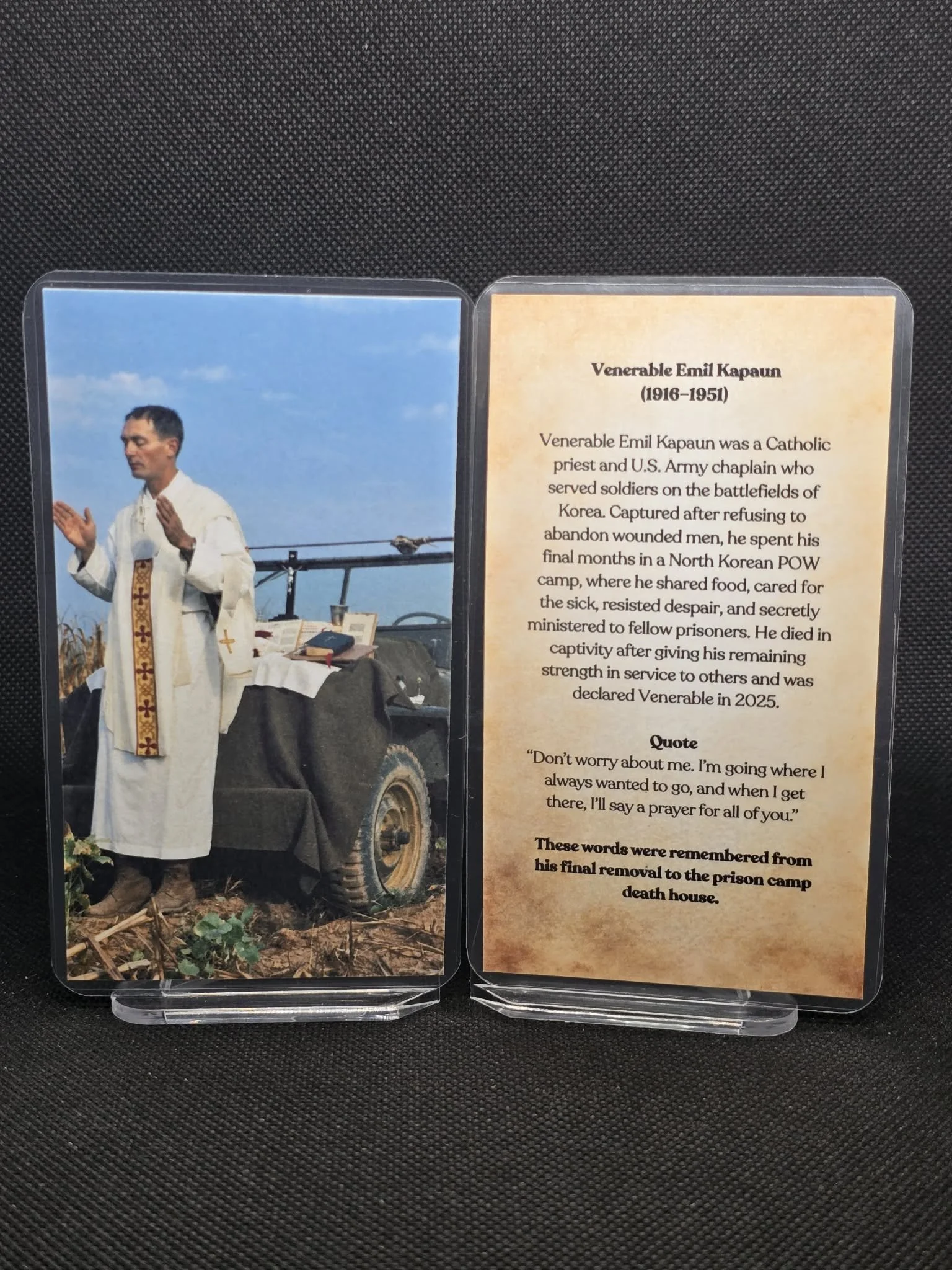
Venerable Emil Kapaun Prayer Card | For Soldiers, Military Chaplains, POWs, Veterans, Courage & Hope
Venerable Emil Joseph Kapaun was a Catholic priest, United States Army chaplain, Korean War prisoner of war, Medal of Honor recipient, and one of the most remarkable American Catholic figures of the twentieth century. Born on a Kansas farm in 1916, Father Kapaun carried his priesthood from rural parish life into military camps, battlefields, foxholes, forced marches, and finally a North Korean prisoner-of-war camp. Wherever soldiers were suffering, he tried to place himself among them, and the men who survived captivity with him remembered his extraordinary courage, charity, humor, resourcefulness, and faith.
Venerable Kapaun is especially meaningful for soldiers, veterans, military chaplains, prisoners of war, military families, those facing captivity or persecution, people struggling to maintain hope during severe hardship, and Christians asking for courage, perseverance, sacrifice, and strength of faith. These are devotional associations arising naturally from his life rather than formal patronages, because Father Kapaun has not yet been beatified or canonized. Since 2025, his proper title has been Venerable Emil Kapaun, following the Church’s recognition of his offering of life.
His heroism was not limited to extraordinary moments under enemy fire. Fellow prisoners remembered him gathering food for starving men, washing clothing for the sick, melting snow for drinking water, caring for wounds, praying secretly with prisoners, resisting Communist indoctrination, encouraging men who had lost hope, and repeatedly sacrificing his own limited strength for others. The Church’s recognition of his offering of life reflects that same pattern of self-giving, in which his entire priestly vocation gradually became an act of sacrificial charity.
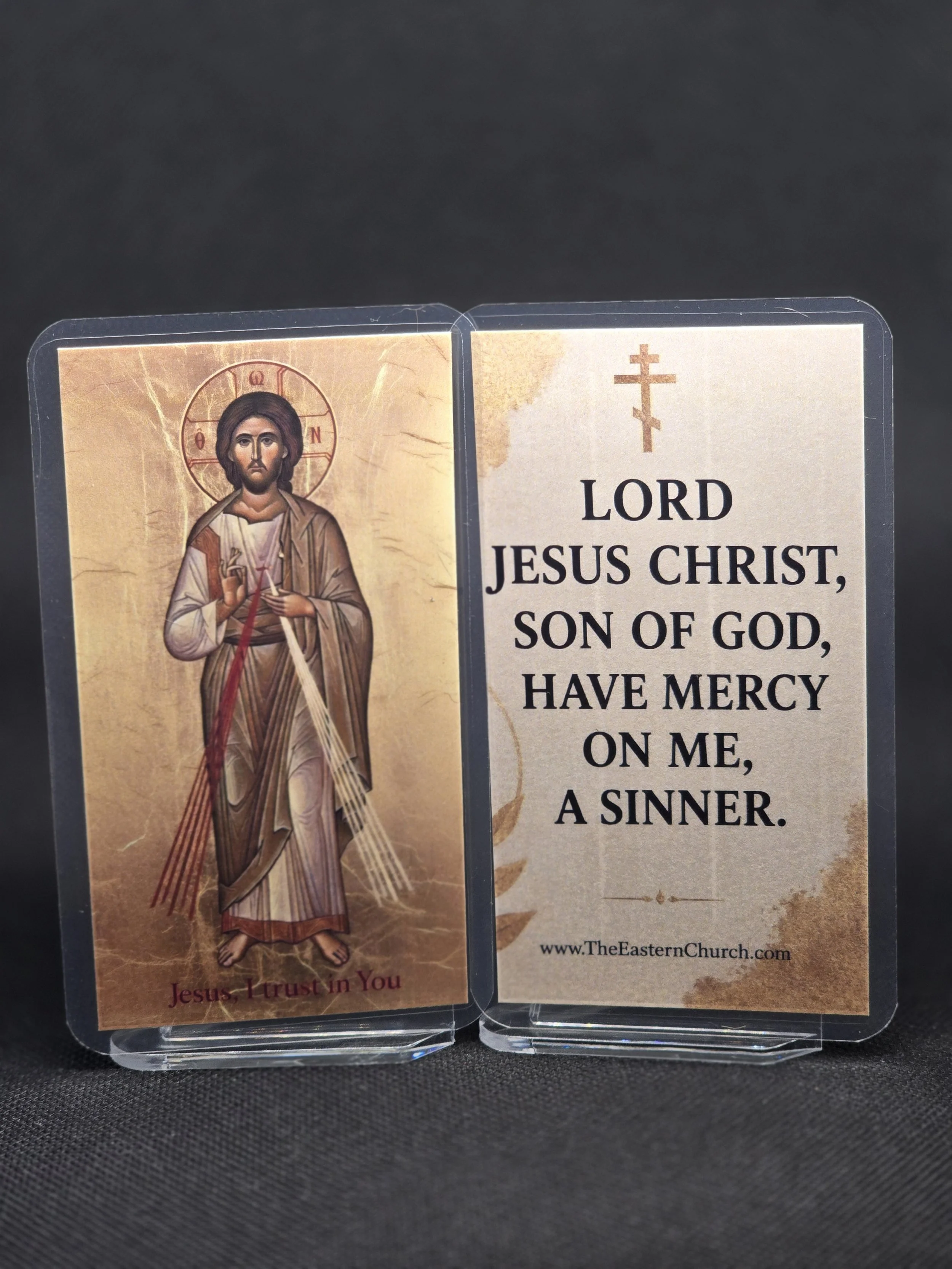
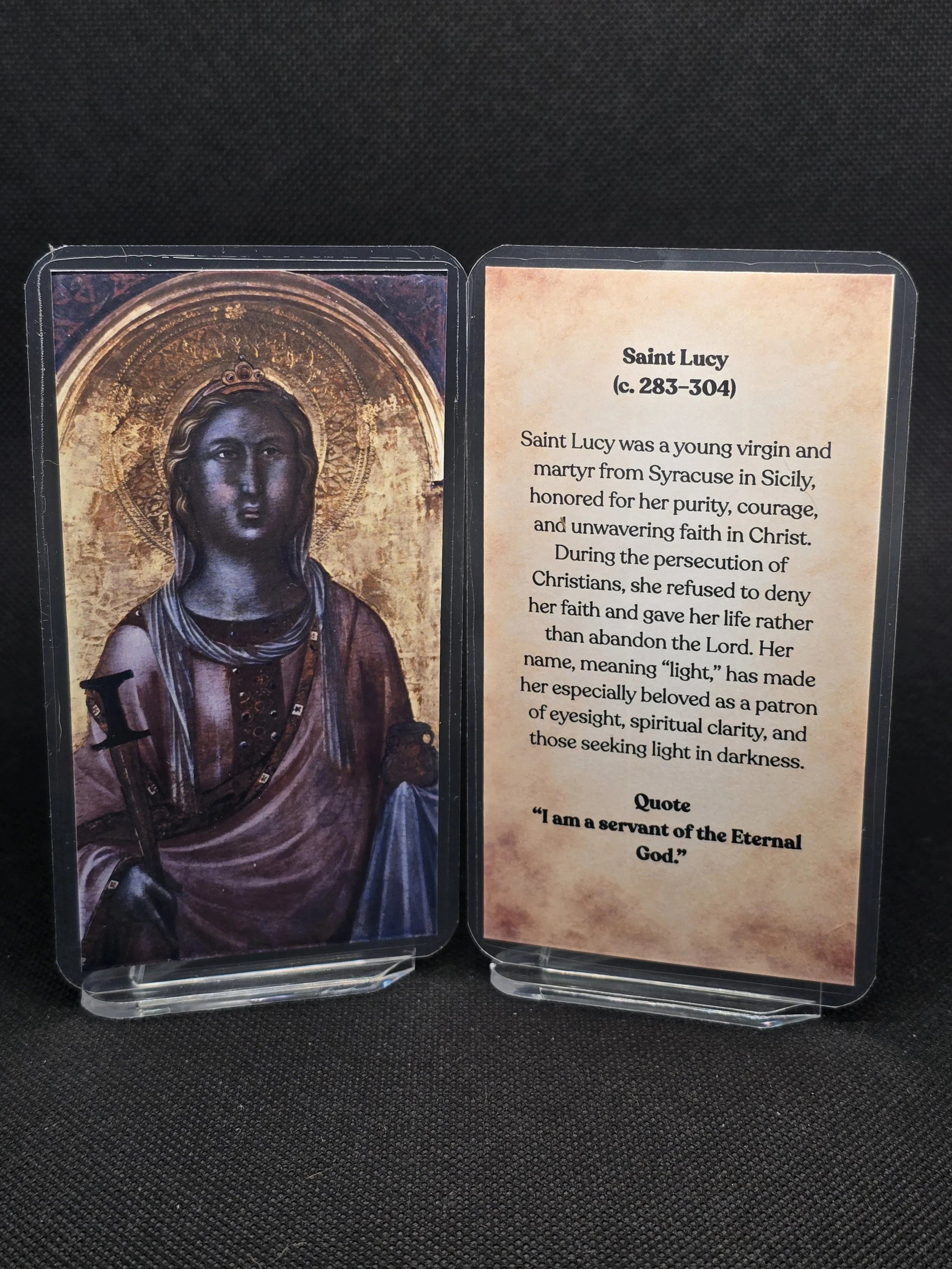
Each prayer card measures 2.5" x 4.25", is handmade in Austin, Texas, printed on museum-quality photo paper rather than ordinary cardstock, and double laminated for durability. Each card is prepared prayerfully with the recipient and their intentions lifted before Christ while asking Venerable Emil Kapaun to intercede for the person who will receive it.
THE LIFE & STORY
Emil Joseph Kapaun was born on April 20, 1916, in Pilsen, Kansas, into a hardworking Catholic farming family of German-Bohemian ancestry. His parents, Enos and Elizabeth Kapaun, raised Emil and his younger brother Eugene on a farm near Saint John Nepomucene Catholic Church. Emil learned practical skills early, including repairing machinery and farm equipment, abilities that decades later would help him improvise tools and necessities for desperate prisoners in Korea.
His childhood was outwardly ordinary, shaped by work, family, parish life, and the rhythms of rural Kansas. Nothing about those surroundings suggested that the quiet farm boy would one day receive the Medal of Honor or that the Catholic Church would formally investigate his life for beatification and canonization. Yet the discipline, resourcefulness, faith, and willingness to work for others that marked his later heroism were already being formed in those ordinary years.
CALLED TO THE PRIESTHOOD
Emil entered seminary as a young man and eventually continued his theological studies at Kenrick Seminary in St. Louis. He was ordained a Catholic priest on June 9, 1940, and celebrated his first Mass at his home parish in Pilsen shortly afterward before a large gathering of family, parishioners, and friends.
His priesthood initially followed the familiar pattern of diocesan parish ministry, but military chaplaincy quickly attracted him. While serving servicemen stationed in Kansas, Father Kapaun encountered young men separated from their homes and families, often facing uncertainty and the possibility of death. He became increasingly convinced that God was calling him to bring the sacraments and the presence of a priest directly into military life.
“SPEND MYSELF FOR GOD”
Father Kapaun once described his vocation with the phrase that he was determined to “spend myself” for God. Those words eventually became an extraordinary summary of his entire life because he understood his priesthood not as a way to preserve his own comfort or security, but as something meant to be used completely in the service of Christ and other people.
With permission from his bishop, he entered the United States Army Chaplain Corps in 1944 and served American military personnel in Asia during the final years of World War II. His approach to chaplaincy was intensely practical and pastoral, and he traveled wherever soldiers needed him rather than expecting them to come to him. The pattern would become even more visible during the Korean War.
RETURNING TO MILITARY SERVICE
After World War II, Father Kapaun temporarily returned to civilian life and pursued graduate studies before resuming parish ministry in Kansas. His conviction that military chaplaincy remained part of his calling never disappeared, and he eventually received permission from his bishop to return to active Army service.
By 1950 he was serving with the 1st Cavalry Division in Asia. When the Korean War began, his unit entered combat, placing Kapaun among soldiers confronting exhaustion, fear, death, bitter weather, long marches, and the constant uncertainty of battlefield life.
MASS ON THE HOOD OF A JEEP
One of the most famous surviving photographs of Father Kapaun shows him celebrating Mass using the hood of his military Jeep as an altar. The photograph has become an enduring image of his priesthood because almost nothing about the setting resembles an ordinary church, yet the Eucharist is still being offered in the middle of war.
For Kapaun, the lack of a sanctuary was never an excuse to remain distant from the men. He carried the essentials of Catholic ministry into the field, heard confessions, celebrated Mass wherever circumstances allowed, prayed with frightened soldiers, administered the sacraments to the wounded and dying, and buried those who had been killed. His priesthood moved with the soldiers because he believed that was where Christ was asking him to be.
COURAGE UNDER FIRE
Father Kapaun repeatedly exposed himself to enemy fire while ministering to wounded soldiers. In August 1950, he entered a dangerous area to help rescue an injured man, an action for which he received the Bronze Star Medal for valor.
That episode happened months before the events for which he would later receive the Medal of Honor. It demonstrates that his courage at the Battle of Unsan was not an isolated burst of heroism but part of an established pattern of repeatedly risking himself for men who needed help.
THE BATTLE OF UNSAN
During the Battle of Unsan in November 1950, Chinese forces overwhelmed and surrounded American positions. Father Kapaun moved through intense fighting to tend wounded soldiers, offer spiritual comfort, administer the sacraments, and help carry men away from exposed positions.
As the American position collapsed, there were opportunities for Kapaun to attempt escape. He chose instead to remain with wounded soldiers who could not withdraw on their own, accepting the likelihood of capture rather than leaving them behind. That decision became one of the defining acts of his life and later became central both to his military recognition and to the Church’s understanding of his sacrificial charity.
HE CHOSE THE WOUNDED OVER ESCAPE
After his capture, Kapaun continued protecting wounded men even though he was now a prisoner himself. In one of the most famous episodes of his captivity, he intervened when an enemy soldier threatened a wounded American and managed to prevent the man from being killed.
His courage in that moment was consistent with the principle that had governed his priesthood from the beginning. He did not measure his responsibility by what was safest for himself but by what the suffering person in front of him needed.
THE MEDAL OF HONOR
The United States posthumously awarded Father Kapaun the Medal of Honor, the nation’s highest military decoration, for his extraordinary actions during the Battle of Unsan. President Barack Obama presented the medal to members of the Kapaun family in 2013.
The nature of the award is especially fitting for a priest because his heroism centered overwhelmingly on rescuing, protecting, comforting, and refusing to abandon wounded men. His greatest military honor was not rooted in destruction of an enemy but in the willingness to put his own life between danger and the men entrusted to his care.
THE FORCED MARCH
After capture, Father Kapaun and other prisoners were forced to march north toward captivity. Many prisoners were wounded, frostbitten, malnourished, or physically incapable of keeping pace, and those who collapsed faced abandonment or death.
Kapaun carried wounded men himself and urged stronger prisoners to help those who were weaker. The march transformed courage from something dramatic on a battlefield into something slower and more exhausting, requiring prisoners who were themselves hungry and freezing to spend what little strength they had helping one another survive.
PRISON CAMP NO. 5
Father Kapaun eventually reached Pyoktong Prison Camp No. 5 in North Korea, where prisoners faced bitter cold, starvation, disease, poor sanitation, ideological indoctrination, and the psychological effects of prolonged captivity. Kapaun suffered the same hunger, cold, disease, and exhaustion as the other men, yet survivors remembered him repeatedly placing their needs before his own.
The battlefield chaplain had lost his Jeep, altar, freedom, equipment, and almost every ordinary means of priestly ministry. What remained was the priest himself, and he turned the prison camp into another place where he could serve the people God had placed around him.
HIS NEW PARISH WAS THE POW CAMP
Father Kapaun gathered wood, built fires, melted snow into drinking water, improvised containers and tools from scrap material, washed clothing, tended sick prisoners, and helped men who had become too weak to care for themselves. He also searched for additional food when prison rations were inadequate, using the practical resourcefulness he had learned years earlier on his family’s Kansas farm.
His service extended far beyond material survival. He prayed with prisoners, encouraged men who were losing hope, challenged anti-Christian indoctrination, and helped remind them that captivity could control where they lived without determining what kind of men they would become.
RESISTING COMMUNIST INDOCTRINATION
Prisoners were subjected to ideological lectures intended to weaken loyalty to their country, undermine religious belief, and reshape their understanding of the world. Father Kapaun challenged these arguments and defended Christian faith even though open resistance placed him at risk of punishment.
His opposition was not merely political. Kapaun understood that the destruction of hope and faith could become as dangerous to prisoners as hunger and disease, and he believed that preserving the inner freedom of the men around him was part of helping them survive.
KEEPING MEN FROM DESPAIR
The POW camp threatened prisoners psychologically as well as physically. Men could begin to withdraw from one another, conserve everything for themselves, or simply stop believing survival was possible.
Kapaun countered that collapse through humor, practical service, prayer, conversation, courage, and constant reminders that the prisoners still had responsibilities toward one another. Survivors later credited his presence with changing the atmosphere of the camp and helping men continue treating one another as brothers rather than competitors for survival.
FOR PRISONERS OF WAR
Venerable Kapaun has a particularly strong devotional connection with prisoners of war, captives, hostages, prisoners, and people whose freedom has been taken from them. Although he has not yet been beatified or canonized and therefore does not hold a formally proclaimed patronage, this devotional association arises directly from his own months of captivity.
He experienced forced marching, starvation, indoctrination, disease, loss of freedom, and the uncertainty of never knowing whether he would return home. His life therefore offers a distinctly Christian understanding of freedom in which captors may control the body without gaining control of conscience, faith, charity, or hope.
FOR SOLDIERS
Father Kapaun is one of the strongest modern Catholic figures for soldiers because he genuinely shared military life with them. He understood deployment, hierarchy, exhaustion, danger, battlefield death, separation from home, responsibility toward comrades, and the fear that accompanies situations where another person’s life may depend upon what you do.
His example does not romanticize war. Instead, it shows what Christian charity can look like inside war, especially when strength is used to protect the wounded, comfort the frightened, accompany the dying, and refuse to abandon those who cannot save themselves.
FOR VETERANS
Veterans may recognize another aspect of Kapaun’s ministry because he understood that soldiers carry more than weapons. He listened to frightened men, buried the dead, prayed with those facing death, and witnessed forms of suffering that do not disappear simply because a battle ends.
A veteran may seek his intercession for peace, healing of memories, perseverance, faith, reconciliation, and freedom from despair. Kapaun’s life offers a model of military service in which courage remains inseparable from compassion and responsibility for the people beside you.
FOR MILITARY CHAPLAINS
Venerable Emil Kapaun offers an extraordinary model for military chaplains because he believed the chaplain should physically go where the service members were. His ministry carried him into remote military positions, exposed battlefields, temporary camps, forced marches, and imprisonment.
His decision at Unsan represents that pastoral principle taken to its extreme. When wounded soldiers could no longer follow him to safety, he chose to remain with them instead, accepting captivity because abandoning them would have contradicted the very priesthood he had spent his life trying to live.
FOR MILITARY FAMILIES
Families of deployed service members often endure a different form of sacrifice, marked by waiting, uncertainty, fear, and the knowledge that they cannot physically protect the person they love. Father Kapaun understood the importance of those families and tried to give soldiers both sacramental care and the reassurance that they were not alone.
A Kapaun prayer card can therefore be meaningful for parents, spouses, children, and relatives of military personnel. His intercession can be sought for protection, courage, perseverance, peace, and the grace to remain faithful when circumstances cannot be controlled.
FOR COURAGE
Kapaun’s life demonstrates that courage has many forms. There was the physical courage of moving through enemy fire, the moral courage of refusing to abandon wounded men, the endurance required by the forced march, and the spiritual courage necessary to resist indoctrination and despair.
There was also a quieter courage that may be more relevant to most people: waking up in terrible circumstances and choosing again to do what is good. Kapaun’s prison-camp life shows that genuine courage often becomes visible through repeated acts of faithfulness rather than through one dramatic moment.
FOR HOPE IN DESPERATE SITUATIONS
Venerable Kapaun is particularly meaningful for people whose circumstances seem to offer little immediate hope. His imprisonment did not suddenly become easy because he prayed, and the camp did not disappear because he believed in God.
Christian hope changed the way he lived within suffering rather than pretending suffering was not real. Kapaun helped men discover that even when they could not control their circumstances, they could still decide whether fear, bitterness, selfishness, or despair would define them.
“NO SINCERE PRAYER IS EVER WASTED”
One of the sayings associated with Father Kapaun is “No sincere prayer is ever wasted.” The words fit his life especially well because he continued to pray in circumstances where outward evidence could easily have convinced someone that prayer had accomplished nothing.
For a person praying for a deployed soldier, a prisoner, healing, conversion, survival, peace, or an intention whose answer seems painfully delayed, the saying offers a concise summary of Kapaun’s confidence in God. Prayer did not always remove the suffering around him, but it prevented suffering from becoming the only reality he could see.
EASTER IN CAPTIVITY
Religious activity in the camp was restricted, yet Father Kapaun continued ministering to the prisoners and led them in prayer whenever possible. During the spring of 1951, he helped lead an Easter observance in captivity, proclaiming Christ’s Resurrection among men surrounded by sickness, graves, hunger, and uncertainty.
The setting gave Easter extraordinary meaning because the Resurrection was being proclaimed where death had become an everyday presence. For Kapaun and the prisoners gathered around him, Christian hope was not an abstract theological idea but a direct answer to the suffering they encountered every day.
HIS FINAL ILLNESS
By the spring of 1951, months of starvation, bitter cold, exhaustion, illness, and self-sacrifice had severely weakened Father Kapaun. His health deteriorated until fellow prisoners tried to care for him themselves, knowing that the camp’s medical facilities offered little real hope.
Eventually his captors ordered him transferred away from the other prisoners. The men resisted because they understood that the transfer probably meant death, but Kapaun refused to allow his friends to risk punishment or injury on his behalf. Even as his own life was ending, he continued trying to protect them.
HIS DEATH IN CAPTIVITY
Father Kapaun died on May 23, 1951, at only thirty-five years old. The prisoners who survived never forgot the priest who had given away food while hungry, strength while exhausted, hope while imprisoned, and comfort while facing death himself.
Their testimony became one of the most important sources for understanding his life. They remembered not only the battlefield chaplain but the man who continued giving until captivity and disease finally left him with nothing more to give.
THE OFFERING OF LIFE
Father Kapaun’s cause for sainthood formally opened in 1993, when he received the title Servant of God. His cause was eventually pursued through the Church’s oblatio vitae, or offering of life, pathway, which recognizes a person whose Christian charity culminated in the free offering of his or her life for others.
In 2025, Pope Francis authorized the decree recognizing Kapaun’s offering of life, and his current title became Venerable Emil Kapaun. The designation reflects the pattern visible throughout his priesthood: he had deliberately chosen to spend himself in service until his life itself became the final gift.
VENERABLE, NOT YET BLESSED OR SAINT
Father Kapaun has not yet been beatified and is not yet a canonized saint. His correct current title is Venerable Emil Kapaun, while the fuller expression Venerable Servant of God Emil Kapaun may also be encountered in formal contexts.
His cause requires an approved miracle for beatification. A further qualifying miracle would ordinarily be required before eventual canonization. Because he has not yet been canonized, formal patron-saint titles have not been assigned to him by the Church.
MIRACLES & HIS CAUSE
The official cause has received reports of favors and possible miraculous healings attributed to Father Kapaun’s intercession. Such reports must undergo careful medical and theological investigation before the Church can recognize any event as a miracle for the purpose of beatification.
This careful process is important because the Church distinguishes personal belief in an answered prayer from the formal recognition of a miracle. Devotion may continue while the evidence is examined, and the faithful are encouraged to pray for both personal intentions and the progress of his cause.
HIS REMAINS RETURNED TO KANSAS
For decades after the Korean War, Father Kapaun’s bodily remains were not positively identified. Modern forensic investigation eventually determined that remains buried among unidentified Korean War dead in Hawaii belonged to him.
His identification allowed his remains to return to Kansas after approximately seventy years. The return became an extraordinary event for the Diocese of Wichita and for the many people who had prayed for his cause and regarded him as one of the great Catholic witnesses of American military history.
HIS TOMB IN WICHITA
Father Kapaun’s remains are now associated with the Cathedral of the Immaculate Conception in Wichita, Kansas, connecting his final resting place with the diocese that sent him into the priesthood. His hometown of Pilsen also remains a major place of devotion and pilgrimage connected with his life.
These sites link the extraordinary story of Korea back to the ordinary Kansas community where his vocation began. The soldier-priest remembered around the world remained, at the deepest level, the same Kansas priest who had first learned to pray, work, repair things, and serve other people in a small rural parish.
THE OFFICIAL PRAYER FOR HIS CAUSE
The official Father Kapaun cause provides a Prayer for the Canonization of Venerable Emil Kapaun as well as a prayer asking for his intercession in personal needs. These prayers recall his battlefield ministry, his captivity, his service to fellow prisoners, and his complete offering of himself to God.
For people seeking his intercession, the prayer for his cause allows personal intentions to be joined with the Church’s hope that his holiness may eventually be confirmed through beatification and canonization. Soldiers, veterans, POW families, military chaplains, and people facing severe hardship may find his example especially meaningful when asking God for courage, perseverance, healing, peace, or hope.
FAQ
Who was Venerable Emil Kapaun? Venerable Emil Joseph Kapaun was a Kansas Catholic priest and United States Army chaplain who served during World War II and the Korean War. He was captured after remaining with wounded soldiers during the Battle of Unsan and died in a North Korean POW camp on May 23, 1951.
Is Emil Kapaun a saint? No, his current title is Venerable Emil Kapaun, and he has not yet been beatified or canonized. The title Venerable reflects the Church’s formal recognition of his offering of life.
Was Emil Kapaun previously called Servant of God? Yes, his cause formally opened in 1993 and he was known as Servant of God Emil Kapaun. After the 2025 decree recognizing his offering of life, the ordinary current title became Venerable Emil Kapaun.
Was Father Kapaun declared a martyr? No, his cause advanced through the Church’s offering of life pathway rather than through a formal decree of martyrdom. His death is understood within the context of the sacrificial charity through which he freely spent himself for fellow soldiers and prisoners.
Did Father Kapaun receive the Medal of Honor? Yes, he was posthumously awarded the Medal of Honor for his actions during the Battle of Unsan. His citation emphasizes his repeated efforts to rescue and protect wounded men and his refusal to abandon them when withdrawal was still possible.
Was Father Kapaun really a prisoner of war? Yes, he was captured in November 1950 and remained in Communist captivity until his death in May 1951. His months in the POW camp became the setting for some of the most extraordinary acts of charity associated with his life.
Did Father Kapaun celebrate Mass on a Jeep? Yes, surviving photographs show him celebrating field Mass using the hood of his military Jeep as an altar. The image has become one of the most recognizable visual representations of his priesthood.
Can soldiers ask Venerable Emil Kapaun for intercession? Yes, the faithful may ask for his intercession, and soldiers have an especially natural devotional connection with him because of his life as an Army chaplain. This is a devotional association rather than a formally proclaimed patronage.
Can veterans ask Venerable Kapaun for intercession? Yes, his experience of military service, combat, loss, captivity, suffering, and responsibility for fellow soldiers gives veterans a strong connection with his life. They may seek his intercession for peace, healing, perseverance, faith, and hope.
Can military chaplains pray to Venerable Kapaun? Yes, his life provides an extraordinary model of Catholic military chaplaincy lived under extreme conditions. He consistently went where soldiers were suffering and ultimately remained with wounded men even when leaving could have preserved his freedom.
Can prisoners or POWs pray to Venerable Kapaun? Yes, his own experience as a prisoner of war makes him especially meaningful for prisoners, POWs, hostages, and their families. He has not been formally proclaimed their patron saint, so this remains a devotional association rather than an official patronage.
Does Father Kapaun need a miracle to become Blessed? Yes, an approved miracle attributed to his intercession is required for beatification under the pathway by which his cause has advanced. A further qualifying miracle would ordinarily be required before eventual canonization.
When was Venerable Emil Kapaun born? Emil Joseph Kapaun was born on April 20, 1916, in Pilsen, Kansas. His rural Catholic upbringing formed many of the practical skills and habits of service that later appeared during his military ministry.
When did Father Kapaun die? He died in captivity on May 23, 1951, at thirty-five years old. His death came after months of starvation, illness, exposure, and continual service to fellow prisoners.
Who would this prayer card make a meaningful gift for? This card is especially appropriate for active-duty military members, veterans, military chaplains, POW and MIA families, military spouses and parents, seminarians, priests, people enduring captivity or persecution, and Christians facing situations requiring courage, sacrifice, perseverance, and hope. His story also makes the card meaningful for someone struggling to believe that prayer still matters when circumstances remain painfully difficult.
THE MAIN MESSAGE OF VENERABLE EMIL KAPAUN’S LIFE
Venerable Emil Kapaun’s life teaches that Christian courage reaches beyond survival and becomes sacrificial love when a person willingly spends himself for someone else. He demonstrated physical courage under enemy fire, but his deepest heroism continued after the shooting stopped, when he used his limited strength to find food, care for sick prisoners, resist despair, pray with frightened men, and preserve the dignity of people trapped in conditions designed to break them.
The Church’s recognition of his offering of life reflects the pattern visible throughout his priesthood. Kapaun had written that he intended to spend himself for God, and years later, in a prison camp thousands of miles from his Kansas home, that promise reached its fullest expression. For soldiers, veterans, chaplains, prisoners, military families, and Christians facing circumstances where hope is difficult to maintain, his life offers a distinctly Christian understanding of strength in which the strongest person may be the one who still has enough love left to serve someone else.
Venerable Emil Joseph Kapaun was a Catholic priest, United States Army chaplain, Korean War prisoner of war, Medal of Honor recipient, and one of the most remarkable American Catholic figures of the twentieth century. Born on a Kansas farm in 1916, Father Kapaun carried his priesthood from rural parish life into military camps, battlefields, foxholes, forced marches, and finally a North Korean prisoner-of-war camp. Wherever soldiers were suffering, he tried to place himself among them, and the men who survived captivity with him remembered his extraordinary courage, charity, humor, resourcefulness, and faith.
Venerable Kapaun is especially meaningful for soldiers, veterans, military chaplains, prisoners of war, military families, those facing captivity or persecution, people struggling to maintain hope during severe hardship, and Christians asking for courage, perseverance, sacrifice, and strength of faith. These are devotional associations arising naturally from his life rather than formal patronages, because Father Kapaun has not yet been beatified or canonized. Since 2025, his proper title has been Venerable Emil Kapaun, following the Church’s recognition of his offering of life.
His heroism was not limited to extraordinary moments under enemy fire. Fellow prisoners remembered him gathering food for starving men, washing clothing for the sick, melting snow for drinking water, caring for wounds, praying secretly with prisoners, resisting Communist indoctrination, encouraging men who had lost hope, and repeatedly sacrificing his own limited strength for others. The Church’s recognition of his offering of life reflects that same pattern of self-giving, in which his entire priestly vocation gradually became an act of sacrificial charity.
Each prayer card measures 2.5" x 4.25", is handmade in Austin, Texas, printed on museum-quality photo paper rather than ordinary cardstock, and double laminated for durability. Each card is prepared prayerfully with the recipient and their intentions lifted before Christ while asking Venerable Emil Kapaun to intercede for the person who will receive it.
THE LIFE & STORY
Emil Joseph Kapaun was born on April 20, 1916, in Pilsen, Kansas, into a hardworking Catholic farming family of German-Bohemian ancestry. His parents, Enos and Elizabeth Kapaun, raised Emil and his younger brother Eugene on a farm near Saint John Nepomucene Catholic Church. Emil learned practical skills early, including repairing machinery and farm equipment, abilities that decades later would help him improvise tools and necessities for desperate prisoners in Korea.
His childhood was outwardly ordinary, shaped by work, family, parish life, and the rhythms of rural Kansas. Nothing about those surroundings suggested that the quiet farm boy would one day receive the Medal of Honor or that the Catholic Church would formally investigate his life for beatification and canonization. Yet the discipline, resourcefulness, faith, and willingness to work for others that marked his later heroism were already being formed in those ordinary years.
CALLED TO THE PRIESTHOOD
Emil entered seminary as a young man and eventually continued his theological studies at Kenrick Seminary in St. Louis. He was ordained a Catholic priest on June 9, 1940, and celebrated his first Mass at his home parish in Pilsen shortly afterward before a large gathering of family, parishioners, and friends.
His priesthood initially followed the familiar pattern of diocesan parish ministry, but military chaplaincy quickly attracted him. While serving servicemen stationed in Kansas, Father Kapaun encountered young men separated from their homes and families, often facing uncertainty and the possibility of death. He became increasingly convinced that God was calling him to bring the sacraments and the presence of a priest directly into military life.
“SPEND MYSELF FOR GOD”
Father Kapaun once described his vocation with the phrase that he was determined to “spend myself” for God. Those words eventually became an extraordinary summary of his entire life because he understood his priesthood not as a way to preserve his own comfort or security, but as something meant to be used completely in the service of Christ and other people.
With permission from his bishop, he entered the United States Army Chaplain Corps in 1944 and served American military personnel in Asia during the final years of World War II. His approach to chaplaincy was intensely practical and pastoral, and he traveled wherever soldiers needed him rather than expecting them to come to him. The pattern would become even more visible during the Korean War.
RETURNING TO MILITARY SERVICE
After World War II, Father Kapaun temporarily returned to civilian life and pursued graduate studies before resuming parish ministry in Kansas. His conviction that military chaplaincy remained part of his calling never disappeared, and he eventually received permission from his bishop to return to active Army service.
By 1950 he was serving with the 1st Cavalry Division in Asia. When the Korean War began, his unit entered combat, placing Kapaun among soldiers confronting exhaustion, fear, death, bitter weather, long marches, and the constant uncertainty of battlefield life.
MASS ON THE HOOD OF A JEEP
One of the most famous surviving photographs of Father Kapaun shows him celebrating Mass using the hood of his military Jeep as an altar. The photograph has become an enduring image of his priesthood because almost nothing about the setting resembles an ordinary church, yet the Eucharist is still being offered in the middle of war.
For Kapaun, the lack of a sanctuary was never an excuse to remain distant from the men. He carried the essentials of Catholic ministry into the field, heard confessions, celebrated Mass wherever circumstances allowed, prayed with frightened soldiers, administered the sacraments to the wounded and dying, and buried those who had been killed. His priesthood moved with the soldiers because he believed that was where Christ was asking him to be.
COURAGE UNDER FIRE
Father Kapaun repeatedly exposed himself to enemy fire while ministering to wounded soldiers. In August 1950, he entered a dangerous area to help rescue an injured man, an action for which he received the Bronze Star Medal for valor.
That episode happened months before the events for which he would later receive the Medal of Honor. It demonstrates that his courage at the Battle of Unsan was not an isolated burst of heroism but part of an established pattern of repeatedly risking himself for men who needed help.
THE BATTLE OF UNSAN
During the Battle of Unsan in November 1950, Chinese forces overwhelmed and surrounded American positions. Father Kapaun moved through intense fighting to tend wounded soldiers, offer spiritual comfort, administer the sacraments, and help carry men away from exposed positions.
As the American position collapsed, there were opportunities for Kapaun to attempt escape. He chose instead to remain with wounded soldiers who could not withdraw on their own, accepting the likelihood of capture rather than leaving them behind. That decision became one of the defining acts of his life and later became central both to his military recognition and to the Church’s understanding of his sacrificial charity.
HE CHOSE THE WOUNDED OVER ESCAPE
After his capture, Kapaun continued protecting wounded men even though he was now a prisoner himself. In one of the most famous episodes of his captivity, he intervened when an enemy soldier threatened a wounded American and managed to prevent the man from being killed.
His courage in that moment was consistent with the principle that had governed his priesthood from the beginning. He did not measure his responsibility by what was safest for himself but by what the suffering person in front of him needed.
THE MEDAL OF HONOR
The United States posthumously awarded Father Kapaun the Medal of Honor, the nation’s highest military decoration, for his extraordinary actions during the Battle of Unsan. President Barack Obama presented the medal to members of the Kapaun family in 2013.
The nature of the award is especially fitting for a priest because his heroism centered overwhelmingly on rescuing, protecting, comforting, and refusing to abandon wounded men. His greatest military honor was not rooted in destruction of an enemy but in the willingness to put his own life between danger and the men entrusted to his care.
THE FORCED MARCH
After capture, Father Kapaun and other prisoners were forced to march north toward captivity. Many prisoners were wounded, frostbitten, malnourished, or physically incapable of keeping pace, and those who collapsed faced abandonment or death.
Kapaun carried wounded men himself and urged stronger prisoners to help those who were weaker. The march transformed courage from something dramatic on a battlefield into something slower and more exhausting, requiring prisoners who were themselves hungry and freezing to spend what little strength they had helping one another survive.
PRISON CAMP NO. 5
Father Kapaun eventually reached Pyoktong Prison Camp No. 5 in North Korea, where prisoners faced bitter cold, starvation, disease, poor sanitation, ideological indoctrination, and the psychological effects of prolonged captivity. Kapaun suffered the same hunger, cold, disease, and exhaustion as the other men, yet survivors remembered him repeatedly placing their needs before his own.
The battlefield chaplain had lost his Jeep, altar, freedom, equipment, and almost every ordinary means of priestly ministry. What remained was the priest himself, and he turned the prison camp into another place where he could serve the people God had placed around him.
HIS NEW PARISH WAS THE POW CAMP
Father Kapaun gathered wood, built fires, melted snow into drinking water, improvised containers and tools from scrap material, washed clothing, tended sick prisoners, and helped men who had become too weak to care for themselves. He also searched for additional food when prison rations were inadequate, using the practical resourcefulness he had learned years earlier on his family’s Kansas farm.
His service extended far beyond material survival. He prayed with prisoners, encouraged men who were losing hope, challenged anti-Christian indoctrination, and helped remind them that captivity could control where they lived without determining what kind of men they would become.
RESISTING COMMUNIST INDOCTRINATION
Prisoners were subjected to ideological lectures intended to weaken loyalty to their country, undermine religious belief, and reshape their understanding of the world. Father Kapaun challenged these arguments and defended Christian faith even though open resistance placed him at risk of punishment.
His opposition was not merely political. Kapaun understood that the destruction of hope and faith could become as dangerous to prisoners as hunger and disease, and he believed that preserving the inner freedom of the men around him was part of helping them survive.
KEEPING MEN FROM DESPAIR
The POW camp threatened prisoners psychologically as well as physically. Men could begin to withdraw from one another, conserve everything for themselves, or simply stop believing survival was possible.
Kapaun countered that collapse through humor, practical service, prayer, conversation, courage, and constant reminders that the prisoners still had responsibilities toward one another. Survivors later credited his presence with changing the atmosphere of the camp and helping men continue treating one another as brothers rather than competitors for survival.
FOR PRISONERS OF WAR
Venerable Kapaun has a particularly strong devotional connection with prisoners of war, captives, hostages, prisoners, and people whose freedom has been taken from them. Although he has not yet been beatified or canonized and therefore does not hold a formally proclaimed patronage, this devotional association arises directly from his own months of captivity.
He experienced forced marching, starvation, indoctrination, disease, loss of freedom, and the uncertainty of never knowing whether he would return home. His life therefore offers a distinctly Christian understanding of freedom in which captors may control the body without gaining control of conscience, faith, charity, or hope.
FOR SOLDIERS
Father Kapaun is one of the strongest modern Catholic figures for soldiers because he genuinely shared military life with them. He understood deployment, hierarchy, exhaustion, danger, battlefield death, separation from home, responsibility toward comrades, and the fear that accompanies situations where another person’s life may depend upon what you do.
His example does not romanticize war. Instead, it shows what Christian charity can look like inside war, especially when strength is used to protect the wounded, comfort the frightened, accompany the dying, and refuse to abandon those who cannot save themselves.
FOR VETERANS
Veterans may recognize another aspect of Kapaun’s ministry because he understood that soldiers carry more than weapons. He listened to frightened men, buried the dead, prayed with those facing death, and witnessed forms of suffering that do not disappear simply because a battle ends.
A veteran may seek his intercession for peace, healing of memories, perseverance, faith, reconciliation, and freedom from despair. Kapaun’s life offers a model of military service in which courage remains inseparable from compassion and responsibility for the people beside you.
FOR MILITARY CHAPLAINS
Venerable Emil Kapaun offers an extraordinary model for military chaplains because he believed the chaplain should physically go where the service members were. His ministry carried him into remote military positions, exposed battlefields, temporary camps, forced marches, and imprisonment.
His decision at Unsan represents that pastoral principle taken to its extreme. When wounded soldiers could no longer follow him to safety, he chose to remain with them instead, accepting captivity because abandoning them would have contradicted the very priesthood he had spent his life trying to live.
FOR MILITARY FAMILIES
Families of deployed service members often endure a different form of sacrifice, marked by waiting, uncertainty, fear, and the knowledge that they cannot physically protect the person they love. Father Kapaun understood the importance of those families and tried to give soldiers both sacramental care and the reassurance that they were not alone.
A Kapaun prayer card can therefore be meaningful for parents, spouses, children, and relatives of military personnel. His intercession can be sought for protection, courage, perseverance, peace, and the grace to remain faithful when circumstances cannot be controlled.
FOR COURAGE
Kapaun’s life demonstrates that courage has many forms. There was the physical courage of moving through enemy fire, the moral courage of refusing to abandon wounded men, the endurance required by the forced march, and the spiritual courage necessary to resist indoctrination and despair.
There was also a quieter courage that may be more relevant to most people: waking up in terrible circumstances and choosing again to do what is good. Kapaun’s prison-camp life shows that genuine courage often becomes visible through repeated acts of faithfulness rather than through one dramatic moment.
FOR HOPE IN DESPERATE SITUATIONS
Venerable Kapaun is particularly meaningful for people whose circumstances seem to offer little immediate hope. His imprisonment did not suddenly become easy because he prayed, and the camp did not disappear because he believed in God.
Christian hope changed the way he lived within suffering rather than pretending suffering was not real. Kapaun helped men discover that even when they could not control their circumstances, they could still decide whether fear, bitterness, selfishness, or despair would define them.
“NO SINCERE PRAYER IS EVER WASTED”
One of the sayings associated with Father Kapaun is “No sincere prayer is ever wasted.” The words fit his life especially well because he continued to pray in circumstances where outward evidence could easily have convinced someone that prayer had accomplished nothing.
For a person praying for a deployed soldier, a prisoner, healing, conversion, survival, peace, or an intention whose answer seems painfully delayed, the saying offers a concise summary of Kapaun’s confidence in God. Prayer did not always remove the suffering around him, but it prevented suffering from becoming the only reality he could see.
EASTER IN CAPTIVITY
Religious activity in the camp was restricted, yet Father Kapaun continued ministering to the prisoners and led them in prayer whenever possible. During the spring of 1951, he helped lead an Easter observance in captivity, proclaiming Christ’s Resurrection among men surrounded by sickness, graves, hunger, and uncertainty.
The setting gave Easter extraordinary meaning because the Resurrection was being proclaimed where death had become an everyday presence. For Kapaun and the prisoners gathered around him, Christian hope was not an abstract theological idea but a direct answer to the suffering they encountered every day.
HIS FINAL ILLNESS
By the spring of 1951, months of starvation, bitter cold, exhaustion, illness, and self-sacrifice had severely weakened Father Kapaun. His health deteriorated until fellow prisoners tried to care for him themselves, knowing that the camp’s medical facilities offered little real hope.
Eventually his captors ordered him transferred away from the other prisoners. The men resisted because they understood that the transfer probably meant death, but Kapaun refused to allow his friends to risk punishment or injury on his behalf. Even as his own life was ending, he continued trying to protect them.
HIS DEATH IN CAPTIVITY
Father Kapaun died on May 23, 1951, at only thirty-five years old. The prisoners who survived never forgot the priest who had given away food while hungry, strength while exhausted, hope while imprisoned, and comfort while facing death himself.
Their testimony became one of the most important sources for understanding his life. They remembered not only the battlefield chaplain but the man who continued giving until captivity and disease finally left him with nothing more to give.
THE OFFERING OF LIFE
Father Kapaun’s cause for sainthood formally opened in 1993, when he received the title Servant of God. His cause was eventually pursued through the Church’s oblatio vitae, or offering of life, pathway, which recognizes a person whose Christian charity culminated in the free offering of his or her life for others.
In 2025, Pope Francis authorized the decree recognizing Kapaun’s offering of life, and his current title became Venerable Emil Kapaun. The designation reflects the pattern visible throughout his priesthood: he had deliberately chosen to spend himself in service until his life itself became the final gift.
VENERABLE, NOT YET BLESSED OR SAINT
Father Kapaun has not yet been beatified and is not yet a canonized saint. His correct current title is Venerable Emil Kapaun, while the fuller expression Venerable Servant of God Emil Kapaun may also be encountered in formal contexts.
His cause requires an approved miracle for beatification. A further qualifying miracle would ordinarily be required before eventual canonization. Because he has not yet been canonized, formal patron-saint titles have not been assigned to him by the Church.
MIRACLES & HIS CAUSE
The official cause has received reports of favors and possible miraculous healings attributed to Father Kapaun’s intercession. Such reports must undergo careful medical and theological investigation before the Church can recognize any event as a miracle for the purpose of beatification.
This careful process is important because the Church distinguishes personal belief in an answered prayer from the formal recognition of a miracle. Devotion may continue while the evidence is examined, and the faithful are encouraged to pray for both personal intentions and the progress of his cause.
HIS REMAINS RETURNED TO KANSAS
For decades after the Korean War, Father Kapaun’s bodily remains were not positively identified. Modern forensic investigation eventually determined that remains buried among unidentified Korean War dead in Hawaii belonged to him.
His identification allowed his remains to return to Kansas after approximately seventy years. The return became an extraordinary event for the Diocese of Wichita and for the many people who had prayed for his cause and regarded him as one of the great Catholic witnesses of American military history.
HIS TOMB IN WICHITA
Father Kapaun’s remains are now associated with the Cathedral of the Immaculate Conception in Wichita, Kansas, connecting his final resting place with the diocese that sent him into the priesthood. His hometown of Pilsen also remains a major place of devotion and pilgrimage connected with his life.
These sites link the extraordinary story of Korea back to the ordinary Kansas community where his vocation began. The soldier-priest remembered around the world remained, at the deepest level, the same Kansas priest who had first learned to pray, work, repair things, and serve other people in a small rural parish.
THE OFFICIAL PRAYER FOR HIS CAUSE
The official Father Kapaun cause provides a Prayer for the Canonization of Venerable Emil Kapaun as well as a prayer asking for his intercession in personal needs. These prayers recall his battlefield ministry, his captivity, his service to fellow prisoners, and his complete offering of himself to God.
For people seeking his intercession, the prayer for his cause allows personal intentions to be joined with the Church’s hope that his holiness may eventually be confirmed through beatification and canonization. Soldiers, veterans, POW families, military chaplains, and people facing severe hardship may find his example especially meaningful when asking God for courage, perseverance, healing, peace, or hope.
FAQ
Who was Venerable Emil Kapaun? Venerable Emil Joseph Kapaun was a Kansas Catholic priest and United States Army chaplain who served during World War II and the Korean War. He was captured after remaining with wounded soldiers during the Battle of Unsan and died in a North Korean POW camp on May 23, 1951.
Is Emil Kapaun a saint? No, his current title is Venerable Emil Kapaun, and he has not yet been beatified or canonized. The title Venerable reflects the Church’s formal recognition of his offering of life.
Was Emil Kapaun previously called Servant of God? Yes, his cause formally opened in 1993 and he was known as Servant of God Emil Kapaun. After the 2025 decree recognizing his offering of life, the ordinary current title became Venerable Emil Kapaun.
Was Father Kapaun declared a martyr? No, his cause advanced through the Church’s offering of life pathway rather than through a formal decree of martyrdom. His death is understood within the context of the sacrificial charity through which he freely spent himself for fellow soldiers and prisoners.
Did Father Kapaun receive the Medal of Honor? Yes, he was posthumously awarded the Medal of Honor for his actions during the Battle of Unsan. His citation emphasizes his repeated efforts to rescue and protect wounded men and his refusal to abandon them when withdrawal was still possible.
Was Father Kapaun really a prisoner of war? Yes, he was captured in November 1950 and remained in Communist captivity until his death in May 1951. His months in the POW camp became the setting for some of the most extraordinary acts of charity associated with his life.
Did Father Kapaun celebrate Mass on a Jeep? Yes, surviving photographs show him celebrating field Mass using the hood of his military Jeep as an altar. The image has become one of the most recognizable visual representations of his priesthood.
Can soldiers ask Venerable Emil Kapaun for intercession? Yes, the faithful may ask for his intercession, and soldiers have an especially natural devotional connection with him because of his life as an Army chaplain. This is a devotional association rather than a formally proclaimed patronage.
Can veterans ask Venerable Kapaun for intercession? Yes, his experience of military service, combat, loss, captivity, suffering, and responsibility for fellow soldiers gives veterans a strong connection with his life. They may seek his intercession for peace, healing, perseverance, faith, and hope.
Can military chaplains pray to Venerable Kapaun? Yes, his life provides an extraordinary model of Catholic military chaplaincy lived under extreme conditions. He consistently went where soldiers were suffering and ultimately remained with wounded men even when leaving could have preserved his freedom.
Can prisoners or POWs pray to Venerable Kapaun? Yes, his own experience as a prisoner of war makes him especially meaningful for prisoners, POWs, hostages, and their families. He has not been formally proclaimed their patron saint, so this remains a devotional association rather than an official patronage.
Does Father Kapaun need a miracle to become Blessed? Yes, an approved miracle attributed to his intercession is required for beatification under the pathway by which his cause has advanced. A further qualifying miracle would ordinarily be required before eventual canonization.
When was Venerable Emil Kapaun born? Emil Joseph Kapaun was born on April 20, 1916, in Pilsen, Kansas. His rural Catholic upbringing formed many of the practical skills and habits of service that later appeared during his military ministry.
When did Father Kapaun die? He died in captivity on May 23, 1951, at thirty-five years old. His death came after months of starvation, illness, exposure, and continual service to fellow prisoners.
Who would this prayer card make a meaningful gift for? This card is especially appropriate for active-duty military members, veterans, military chaplains, POW and MIA families, military spouses and parents, seminarians, priests, people enduring captivity or persecution, and Christians facing situations requiring courage, sacrifice, perseverance, and hope. His story also makes the card meaningful for someone struggling to believe that prayer still matters when circumstances remain painfully difficult.
THE MAIN MESSAGE OF VENERABLE EMIL KAPAUN’S LIFE
Venerable Emil Kapaun’s life teaches that Christian courage reaches beyond survival and becomes sacrificial love when a person willingly spends himself for someone else. He demonstrated physical courage under enemy fire, but his deepest heroism continued after the shooting stopped, when he used his limited strength to find food, care for sick prisoners, resist despair, pray with frightened men, and preserve the dignity of people trapped in conditions designed to break them.
The Church’s recognition of his offering of life reflects the pattern visible throughout his priesthood. Kapaun had written that he intended to spend himself for God, and years later, in a prison camp thousands of miles from his Kansas home, that promise reached its fullest expression. For soldiers, veterans, chaplains, prisoners, military families, and Christians facing circumstances where hope is difficult to maintain, his life offers a distinctly Christian understanding of strength in which the strongest person may be the one who still has enough love left to serve someone else.