 Image 1 of 1
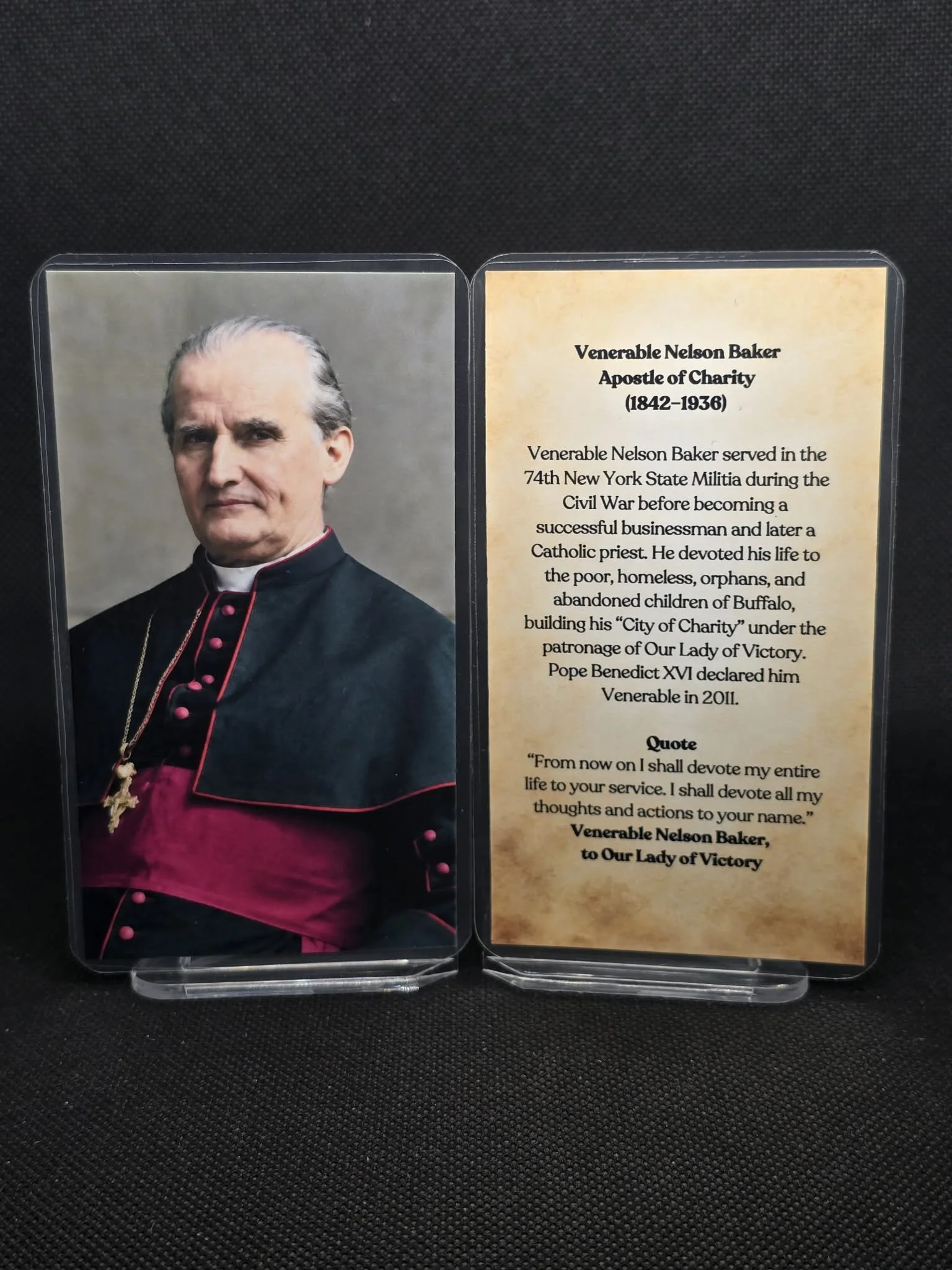
Venerable Nelson Baker Prayer Card | Civil War Veteran, Padre of the Poor & Founder of Our Lady of Victory
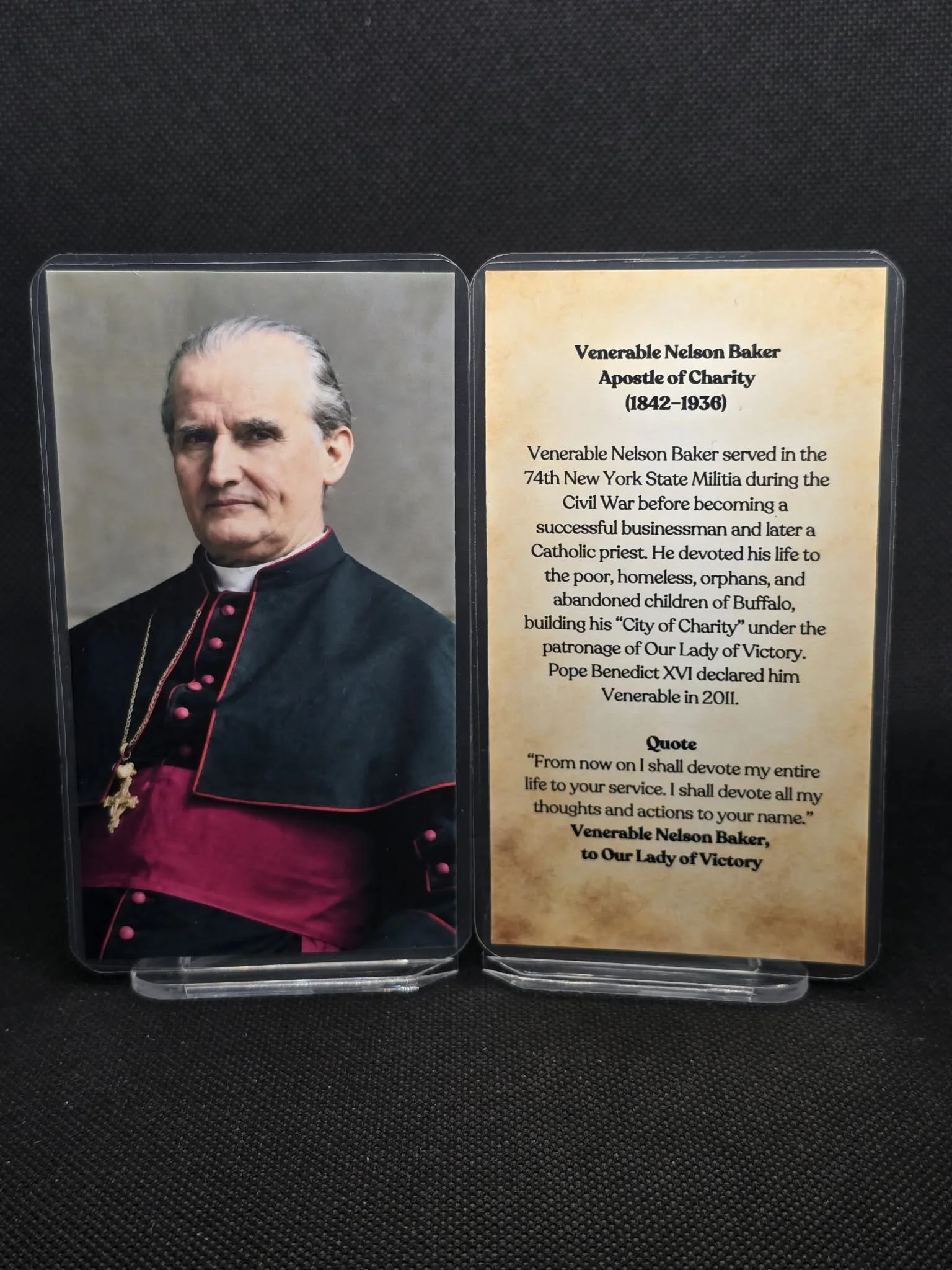
Venerable Nelson Baker was an American Catholic priest, Civil War veteran, businessman, builder, advocate for abandoned children, defender of struggling mothers, and one of the most remarkable charitable figures in the history of the Catholic Church in the United States. Known affectionately as the “Padre of the Poor,” Father Baker transformed a financially struggling orphanage and protectory outside Buffalo, New York, into the extraordinary network of Catholic institutions that became known as his “City of Charity,” while consistently refusing to take the credit himself and directing gratitude toward the Blessed Virgin Mary under her title of Our Lady of Victory.
His life makes this prayer card especially meaningful for American military veterans, active-duty service members, priests, seminarians, Catholic businessmen, social workers, foster and adoptive families, those caring for abandoned or vulnerable children, pro-life ministries, Catholic charities, people discerning a late vocation, and anyone with a devotion to Our Lady of Victory. Father Baker's story is particularly powerful because he did not begin adult life already knowing that he would become a priest, since before entering seminary he had served his country during the Civil War and had become a successful businessman with every reason to expect a comfortable secular future.
Father Baker is also an extraordinary American example of what can happen when practical ability is completely placed at the service of God. His holiness was not separated from budgets, construction projects, fundraising, heating bills, hospitals, schools, food, shelter, employment, and the daily material needs of real people, because he brought Catholic charity directly into those practical problems and spent his long life finding ways to solve them.
For Catholics connected with the United States military, Father Baker has an additional and often overlooked significance. Before becoming one of the best-known priests in western New York, the future Venerable answered his state's call during the American Civil War and served with the 74th New York State Militia during the Gettysburg Campaign before his unit was later sent to New York City during the Draft Riots.
Each prayer card is handmade in Austin, Texas and created to order rather than pulled from mass-produced shelf inventory. It is printed on museum-quality photo paper and double laminated for durability, making it suitable for a wallet, Bible, prayer book, military footlocker, vehicle, office, parish ministry space, hospital room, home prayer corner, or anywhere someone wants a physical reminder of Venerable Nelson Baker's example and a prompt to pray for his canonization.
THE LIFE & STORY
Nelson Henry Baker was born in Buffalo, New York, on February 16, 1842, into a family shaped by both Catholic and Lutheran Christianity. His father was of German Lutheran background while his mother was Irish Catholic, and Nelson was received into the Catholic Church as a boy, beginning a relationship with the faith that would eventually lead him through military service, business, seminary, priesthood, enormous charitable works, and ultimately recognition by the Church for heroic virtue.
His childhood did not outwardly announce the extraordinary life that was coming. Nelson grew up working around his father's grocery and general store, where he developed the practical intelligence, financial ability, familiarity with ordinary working people, and instinct for organization that would later prove invaluable when he found himself responsible for Catholic institutions burdened with debt.
That part of Father Baker's life is especially important because his later charitable achievements did not happen despite his practical abilities. The same mind that could understand commerce, accounts, fundraising, construction, and organization became one of the instruments through which he served thousands of people who otherwise had nowhere to turn.
A CATHOLIC CIVIL WAR VETERAN
In 1863, when Nelson Baker was twenty-one years old, the American Civil War reached a critical moment as Confederate forces moved north into Pennsylvania. Baker answered the call for additional troops and enlisted in the 74th New York State Militia, beginning the short but genuine period of military service that makes him one of the notable U.S. veterans currently on the Catholic path toward canonization.
His term of active service lasted approximately thirty days, but those days came during one of the most consequential military campaigns in American history. Historical material associated with Father Baker describes his regiment serving in Pennsylvania during the Gettysburg Campaign, including protecting strategically important bridges and an aqueduct near Harrisburg as Confederate forces operated in the region.
Our Lady of Victory's present official biography describes Baker as having served at the Battle of Gettysburg itself, while a more detailed Father Baker historical account places the 74th in the broader Gettysburg Campaign protecting infrastructure near Harrisburg. Taken together, the surviving accounts clearly establish that Baker served with the 74th New York State Militia in Pennsylvania during the Gettysburg Campaign, directly connecting the future priest's military service with the crisis surrounding Gettysburg.
His military duty did not end when the Confederate advance receded. Instead of immediately returning home when the thirty-day term was nearing completion, Baker's unit was redirected to New York City during the violent Draft Riots, where militia forces were used to help restore order before the 74th finally returned to Buffalo on July 21, 1863.
A VENERABLE AMERICAN VETERAN
That military chapter gives Venerable Nelson Baker a distinctive place in American Catholic devotion. He knew what it meant to answer a call to duty as a young man, leave home in wartime, serve beside other soldiers, and then return to civilian life without yet knowing the entirely different form of service God would later ask from him.
For veterans, this makes Father Baker particularly relatable because his military service was not the final definition of his life. The uniform was one chapter of a much longer vocation, and his later life demonstrates that service to country, work, family responsibilities, business experience, and the ordinary years of adulthood can all become preparation for a calling that has not yet fully revealed itself.
His story is therefore especially meaningful for veterans asking what God wants from them after military service. Father Baker did not simply look backward upon the period when he had answered his country's call, because he continued asking where he was needed next and eventually discovered that the rest of his life would be spent in a different kind of battle against poverty, abandonment, hopelessness, hunger, and human suffering.
FROM SOLDIER TO BUSINESSMAN
After his military service, Nelson returned to Buffalo and entered business with his friend Joseph Meyer. Together they established a successful feed and grain enterprise, and by the ordinary standards of young adulthood Baker had created a respectable life with financial security and a promising future.
This period matters because entering seminary was not his escape from failure. Nelson Baker was walking away from a path on which he was succeeding, making his eventual decision to pursue priesthood a genuine act of discernment rather than the only remaining option available to him.
His ability in business would later become one of the great practical gifts of his priesthood. When charitable institutions faced overwhelming financial problems, Baker understood both the spiritual obligation to care for people and the earthly reality that buildings had to be heated, debts paid, food purchased, children clothed, workers supported, and benefactors persuaded to help.
A LATE VOCATION TO THE PRIESTHOOD
At twenty-seven years old, an age that Baker himself regarded as unusually advanced for entering formation in that era, he entered Our Lady of the Angels Seminary. He had already been a soldier and businessman before beginning the long process that would lead to the altar, demonstrating that a genuine vocation does not become impossible simply because a person's life has already taken another direction.
This makes Venerable Nelson Baker a particularly meaningful figure for men discerning priesthood later than they originally expected. His story speaks to someone who may look at younger seminarians, previous career choices, military service, financial responsibilities, or years already spent outside formation and wonder whether he has somehow missed the proper moment to answer God's call.
Baker's life gives a powerful answer through example rather than theory. The experiences he accumulated before seminary were not wasted years, because abilities learned in his family's store, military service, and business career later became part of what allowed him to administer one of the most remarkable Catholic charitable works of his generation.
HIS PILGRIMAGE & OUR LADY OF VICTORY
While still a seminarian, Baker traveled to Europe in 1874, and the pilgrimage profoundly strengthened his Marian devotion. From that experience grew the lifelong relationship with the Blessed Virgin Mary under the title of Our Lady of Victory that would become inseparable from virtually everything he later accomplished.
Father Baker did not treat devotion to Mary as something isolated from practical life. He turned to Our Lady of Victory while confronting debt, enormous building projects, desperate social needs, financial uncertainty, and seemingly impossible responsibilities, repeatedly attributing successful outcomes to her intercession rather than to his own intelligence.
His characteristic explanation became beautifully simple: “She did it all!” Those words summarized the humility with which he interpreted the “City of Charity,” the Basilica, the institutions, the benefactors who appeared when money was desperately needed, and the entire work that increasingly surrounded him.
ORDAINED A PRIEST
Nelson Baker was ordained a priest for the Diocese of Buffalo on March 19, 1876. The businessman and Civil War veteran was now Father Nelson Baker, but the administrative abilities formed during his earlier life would immediately become important to the work entrusted to him.
His first major assignment brought him back to the Limestone Hill institutions near Buffalo, an organization that cared for boys through an orphanage and protectory. The work was deeply charitable but financially unstable, and Father Baker eventually inherited responsibility for institutions carrying severe debt and facing circumstances that could easily have convinced a less determined administrator that the entire mission was unsustainable.
THE CITY OF CHARITY
When Father Baker returned as superintendent in 1882, he faced the practical question that would define much of his ministry: how could Catholic charity continue when the institutions providing it could barely survive financially? Instead of reducing his vision to what seemed affordable, Baker combined prayer, devotion to Our Lady of Victory, business intelligence, fundraising, and remarkable persistence to rebuild the institutions and expand their work.
He established the Association of Our Lady of Victory and became an early pioneer in direct-mail fundraising, inviting ordinary Catholics to participate financially in the mission. Small donations multiplied through a national network of supporters, allowing Father Baker not only to confront the existing debt but eventually to enlarge the institutions serving children and families.
His charitable complex eventually became known as the “City of Charity.” The name was appropriate because Baker was not trying to operate one isolated orphanage, but to create a Catholic environment capable of receiving vulnerable people at different stages of life and giving them food, housing, education, medical attention, formation, practical skills, and a genuine possibility of a future.
“THERE ARE NO BAD BOYS”
Father Baker's approach to troubled young people was remarkable for his era. The institutions that came under his care included a protectory for older boys regarded by society as troublesome or delinquent, but Baker resisted reducing those children to the worst things they had done and worked to create surroundings that treated them with greater human dignity.
The institution that continues his legacy records his response to people frightened by the boys under his care: “There are no ‘bad boys.’” He removed bars from protectory windows and worked toward a more home-like environment, expressing in concrete decisions his conviction that damaged or difficult children should not simply be abandoned as hopeless.
This makes Venerable Nelson Baker especially meaningful for foster parents, adoptive parents, teachers, social workers, juvenile counselors, priests, mentors, and anyone caring for children whose behavior has caused other people to give up on them. His example asks the Christian to see a child not merely through a record, diagnosis, mistake, family situation, or reputation, but as a human person who can still be formed, loved, corrected, educated, and given hope.
A DEFENDER OF ABANDONED INFANTS & THEIR MOTHERS
One of the most moving developments in Father Baker's ministry came when he confronted the suffering surrounding abandoned infants and mothers who believed they had nowhere safe to turn. Rather than responding with condemnation from a distance, he decided that if desperation was placing babies in danger, the Church needed to provide an actual place where frightened mothers and children could be received.
The Our Lady of Victory Infant Home was established to provide refuge for mothers and babies, and Father Baker made provision for infants to be left safely rather than abandoned in deadly circumstances. The home expanded his charitable mission so that the “City of Charity” could care for children from infancy through the years when education and training could prepare them for adult life.
This dimension of his life makes Father Baker particularly meaningful for modern pro-life Catholics. His example demonstrates a form of pro-life ministry that does not end with telling a desperate mother that her baby's life matters, because it asks the Church to accompany that truth with shelter, food, medical care, protection, compassion, and a practical answer to the fear that she and her child have nowhere else to go.
A VENERABLE FOR FOSTER & ADOPTIVE FAMILIES
Families caring for children who have endured abandonment, instability, poverty, neglect, or trauma can find a natural connection with Venerable Nelson Baker. His entire priestly life was shaped by the conviction that children society considered burdensome were worth enormous sacrifice, financial investment, patience, education, and personal attention.
He also understood that helping a vulnerable child requires more than sentiment. Buildings had to exist, meals had to be provided, beds had to be available, teachers had to teach, staff had to be paid, and institutions had to survive long enough to continue helping the next child who arrived.
A Father Baker prayer card can therefore make a meaningful gift for foster parents, adoptive parents, grandparents raising grandchildren, social workers, child advocates, teachers, counselors, and families beginning a difficult placement. His life can serve as a reminder that persistent charity toward a child whose future appears uncertain may become one of the most important works a Christian ever performs.
A VENERABLE FOR PRIESTS
Venerable Nelson Baker is also an extraordinary figure for diocesan priests because his holiness was lived in the middle of administration rather than outside it. He handled debt, fundraising campaigns, construction, social institutions, schools, hospitals, personnel, donors, and the constant emergencies associated with caring for large numbers of vulnerable people while remaining fundamentally a priest.
His example is particularly useful for a pastor who sometimes wonders whether budgets, repairs, meetings, fundraising, and administrative decisions are distracting him from “real” priesthood. Father Baker demonstrates that when these responsibilities are carried for the sake of souls and entrusted to God, competent administration itself can become an act of charity.
A VENERABLE FOR BUSINESS OWNERS & ENTREPRENEURS
Catholic business owners may recognize something familiar in Father Baker's unusual combination of faith and organizational intelligence. He understood numbers, fundraising, public communication, infrastructure, operating expenses, and the necessity of making an institution financially sustainable, but he increasingly placed those abilities at the service of people who could never repay him.
That makes him a particularly valuable figure for Catholics who sometimes feel as though business ability and holiness belong to separate worlds. Father Baker's life demonstrates that accounting, management, entrepreneurship, fundraising, organization, construction, and strategic thinking can all become instruments of mercy when the person using them refuses to make profit or personal prestige the highest goal.
THE VICTORIA WELL
One of the most memorable examples of Baker's practical boldness came from the enormous expense required to heat his growing institutions. When natural gas was being discovered in the region, Father Baker conceived the idea of drilling on the property, beginning a project that critics came to regard as an expensive failure when drilling continued without producing the expected result.
He persisted, and at a depth reported as 1,137 feet the drilling finally reached natural gas. The resulting “Victoria Well” provided fuel for the institutions and even supplied nearby homes, transforming what had been mocked as “Father Baker's Folly” into another practical solution that strengthened the charitable mission.
The story is characteristic of Father Baker because faith did not make him passive. He prayed intensely and depended upon Our Lady of Victory, but he was also willing to calculate, plan, raise money, dig, build, organize, take responsibility, and continue working when a project looked as though it might fail.
OUR LADY OF VICTORY BASILICA
The most visually magnificent surviving monument to Father Baker's life is Our Lady of Victory National Shrine & Basilica in Lackawanna, New York. After decades spent crediting the Blessed Virgin Mary for his work, he undertook the creation of an extraordinary church in her honor, and the present Basilica was completed in 1925 before being formally dedicated and designated a Minor Basilica in 1926.
The Basilica was not intended simply as a monument to Baker's success. It was his act of thanksgiving to the Mother of God whom he believed had continually helped him provide for the thousands of people entrusted to his care, making the building itself inseparable from his repeated insistence that Our Lady of Victory deserved the credit.
For pilgrims, the Basilica provides something particularly valuable because Father Baker's story can still be encountered in the physical place where so much of his work occurred. The church, surrounding institutions, museum, charitable legacy, and his tomb allow a visitor to encounter not merely an isolated relic but an entire landscape shaped by the life of an American priest now declared Venerable by the Catholic Church.
HIS FINAL YEARS
Father Baker continued working into extraordinary old age, remaining identified with his charitable institutions and devotion to Our Lady of Victory until his death. He died on July 29, 1936, at ninety-four years old after a life that had stretched from the era of the American Civil War into the Great Depression.
The historical span alone is remarkable. The young man who answered a military call during the crisis of 1863 lived long enough to see automobiles, airplanes, radio, enormous industrial expansion, a world war, and the economic catastrophe of the Depression, while his central response remained remarkably consistent: discover who is in need and find a way to serve them.
THE PADRE OF THE POOR
Father Baker became widely known as the “Padre of the Poor,” a title earned through the enormous charitable network associated with his ministry. During the Great Depression especially, the institutions connected with his work provided food, clothing, shelter, and assistance on an immense scale to people caught in desperate circumstances.
The title beautifully captures something that statistics alone cannot. Father Baker did not build institutions because he loved institutions for their own sake, because the buildings, fundraising systems, wells, hospitals, schools, and charitable organizations existed to make it possible for actual human beings to be fed, sheltered, educated, protected, and treated with dignity.
HALF A MILLION PEOPLE CAME TO HONOR HIM
The scale of public affection following Father Baker's death gives some indication of how deeply his ministry had entered the life of western New York. Our Lady of Victory records that an estimated 500,000 people came to pay their respects in the period surrounding his funeral, an extraordinary response to the death of a diocesan priest who had spent his life among the poor and vulnerable.
That number should not be mistaken for proof of sanctity, because the Catholic Church's judgment is based upon its own canonical investigation rather than popularity. It does, however, reveal the extraordinary human impact of a priest whose work had touched generations of children, families, workers, benefactors, parishioners, and people who knew exactly what the “City of Charity” meant to their community.
HIS CAUSE FOR CANONIZATION
The Catholic Church formally began investigating Father Baker's Cause for Canonization in 1987. After the extensive investigation of his life and virtues, Pope Benedict XVI approved the recognition of his heroic virtue on January 14, 2011, and Nelson Baker thereafter received the title Venerable.
Father Baker's proper current title is Venerable Nelson Baker or Venerable Father Nelson Baker. He has not yet been beatified or canonized and therefore is not properly called Blessed Nelson Baker or Saint Nelson Baker.
His cause currently awaits the recognition of a miracle attributed to his intercession before beatification can proceed. Catholics may therefore privately ask Venerable Nelson Baker to intercede for their needs while also praying that, if it is God's will, an authentic miracle may be recognized and the Church may one day raise him to the altars as Blessed and ultimately Saint.
WHERE VENERABLE NELSON BAKER IS BURIED
Father Baker's earthly remains were transferred from Holy Cross Cemetery to Our Lady of Victory Basilica in 1999 as his cause progressed. He now rests within the Basilica he built in honor of the Blessed Virgin Mary, allowing pilgrims to pray near the earthly remains of the priest whose entire life became so closely identified with that shrine.
For someone making a Catholic pilgrimage through the United States, this makes Lackawanna an especially meaningful destination. A visitor can pray at the Basilica, visit Father Baker's tomb, learn about his life in the museum, encounter the surviving institutions connected with his “City of Charity,” and pray for the advancement of his Cause for Canonization in the place where his ministry actually unfolded.
VENERABLE NELSON BAKER & OUR LADY OF VICTORY
It is almost impossible to understand Father Baker correctly without understanding his devotion to Our Lady of Victory. Again and again, when other people praised his accomplishments, he redirected the attention away from himself and toward the Blessed Mother with his simple explanation, “She did it all!”
This makes his prayer card especially appropriate for Catholics with strong Marian devotion. It also makes a beautiful companion card to an image of Our Lady of Victory, allowing the two together to recall the relationship between Marian intercession and the extraordinary charitable works Father Baker believed had been accomplished under her protection.
A VENERABLE FOR IMPOSSIBLE PROJECTS
Father Baker repeatedly faced responsibilities that appeared larger than the resources available to him. Crushing institutional debt, enormous numbers of people needing care, construction projects, escalating heating expenses, the creation of an infant home, hospitals, schools, and eventually a monumental Basilica all required resources far beyond what one diocesan priest could personally provide.
For someone facing a project that seems impossible, his life provides a compelling Christian model. He did not confuse trust in Providence with sitting still, because he prayed, asked for Mary's intercession, developed plans, appealed to benefactors, used new fundraising methods, negotiated, built, experimented, persisted, and accepted responsibility for the practical work required.
A VENERABLE FOR PEOPLE WORRIED ABOUT MONEY
Father Baker's spirituality may be particularly meaningful to people trying to serve God while confronting real financial limits. His charitable work repeatedly forced him to deal with debt and enormous operating expenses, so his faith was tested not in an imaginary world where money did not matter but in circumstances where insufficient funding could mean that vulnerable people would lose food, shelter, heat, education, or care.
His example does not teach financial recklessness. Instead, it demonstrates the possibility of combining prudent stewardship, hard work, ingenuity, prayer, generosity, and confidence that God can provide through people and opportunities that may not yet be visible.
A VENERABLE FOR THOSE WHO THINK THEY STARTED TOO LATE
Nelson Baker was twenty-seven before entering seminary and thirty-four when he was ordained. By that point he had already lived significant portions of several different lives as a son working in his father's business, a Civil War soldier, and a successful businessman.
Yet the greatest work of his life had barely begun. For someone who believes that age, an earlier career, military service, past decisions, or years spent pursuing another path mean that God's greatest purpose must already have passed them by, Father Baker's life offers a powerful contradiction.
A VENERABLE FOR AMERICAN CATHOLICS
Father Baker's story is deeply American without reducing Catholic faith to nationalism. His life passed through the Civil War, expanding industrial cities, immigration, business, technological change, enormous social problems, and the Great Depression, and he responded to those realities with a distinctly Catholic combination of sacramental priesthood, Marian devotion, charity, ingenuity, and confidence in Providence.
He therefore belongs naturally in an American Catholic home, parish, military chapel, Catholic school, veterans' ministry, hospital, adoption ministry, or charitable organization. His life shows that heroic Catholic sanctity does not belong only to distant centuries and foreign lands, because the Church's call to holiness can unfold on American streets, in American businesses, among American soldiers, and in service to American children and families.
PRAYING WITH VENERABLE NELSON BAKER
Because Father Baker is Venerable rather than canonized, devotion to him should respect the Church's present judgment while his cause continues. Catholics can privately ask for his intercession, pray for his canonization, and bring particular needs before God while asking that any favors granted through Father Baker's intercession may help reveal God's will concerning his cause.
His intercession may be especially sought for priests, seminarians, military veterans, vulnerable children, orphaned or abandoned children, foster and adoptive families, mothers in crisis pregnancies, Catholic charities, social workers, difficult financial needs, large charitable projects, late vocations, business owners trying to use their resources for good, and people seeking deeper trust in the Blessed Virgin Mary's intercession.
The official Father Baker cause particularly encourages prayer for his canonization as the Church awaits the miracle necessary for the next stage. For someone purchasing this card because of a serious intention, praying consistently through Venerable Nelson Baker's intercession and reporting any extraordinary favor to those responsible for his cause can become a meaningful way of participating in the Church's continuing discernment.
A MEANINGFUL MILITARY & VETERAN GIFT
A Venerable Nelson Baker prayer card can make an especially meaningful Catholic gift for a veteran because military service formed part of his own early adulthood. His story is not primarily that of a military chaplain serving from outside the enlisted ranks, because before he ever became Father Baker he had personally answered a wartime call and worn the uniform as a young man.
The card can therefore be appropriate for Veterans Day, Memorial Day remembrance within a Catholic family, retirement from military service, separation from active duty, a veteran entering seminary, a Catholic veterans' group, a military ministry, or someone asking what form his life should take after leaving the service. Baker's own transition from soldier to businessman to seminarian to priest provides an unusually rich example of a life in which one genuine vocation of service prepared the person for another.
A MEANINGFUL GIFT FOR PRIESTS & SEMINARIANS
Father Baker is an excellent gift for a seminarian who entered formation after military service or another career. His life demonstrates that mature experience acquired before seminary can become an asset to priesthood when it is surrendered to Christ and placed at the service of the Church.
He is equally meaningful for pastors responsible for difficult parishes, schools, buildings, budgets, charities, or major fundraising needs. Baker's sanctity developed amid precisely those responsibilities, making him a particularly relatable Venerable for priests whose daily ministry requires them to move constantly between the altar and the practical problems of keeping Catholic institutions alive.
A MEANINGFUL GIFT FOR FOSTER PARENTS, ADOPTIVE PARENTS & CHILD ADVOCATES
Because so much of Father Baker's life was devoted to children who lacked safe and stable homes, his card can make a meaningful gift for people undertaking the difficult work of caring for vulnerable children. Foster placements, adoption, trauma, attachment difficulties, behavioral problems, court processes, and uncertainty can exhaust families who began their work from genuine love.
Father Baker's example does not romanticize caring for children because he knew that such work demanded buildings, money, discipline, education, persistence, staff, and sacrifice. His legacy can therefore provide encouragement precisely when love has become difficult work rather than an easy emotion.
A MEANINGFUL PRO-LIFE GIFT
Venerable Nelson Baker's Infant Home gives his story a powerful connection to Catholics working to protect mothers and unborn or newborn children. He confronted the reality that fear, shame, poverty, and social rejection could place babies in mortal danger and answered by creating a concrete refuge where mothers and children could receive care.
For pregnancy centers, maternity homes, sidewalk counselors, pro-life volunteers, foster ministries, and Catholic families supporting women in crisis, his life presents an important principle. The Christian defense of life becomes especially convincing when the person defending the child is also prepared to help feed, shelter, protect, educate, and accompany the mother and child after the immediate crisis has passed.
PRODUCT DETAILS
This Venerable Nelson Baker prayer card is made to order in Austin, Texas with the same focus on durability and devotional quality used throughout our handmade prayer card collection. The card is printed on museum-quality photo paper, double laminated, and handled prayerfully during production so that it can remain in regular use rather than becoming a fragile item that has to be hidden away for protection.
The card is suitable for a wallet, Bible, missal, prayer book, military bag, desk, office, hospital room, parish office, veterans' ministry, foster-care office, pregnancy center, charitable ministry, home shrine, or Catholic prayer corner. It can also be paired naturally with an Our Lady of Victory card because Father Baker himself insisted that the Blessed Mother's intercession stood behind the work for which others praised him.
FAQ
Who was Venerable Nelson Baker?
Venerable Nelson Baker was an American Catholic priest of the Diocese of Buffalo who became famous for his enormous charitable ministry to children, mothers, families, and the poor in Lackawanna, New York. Before becoming a priest, he served during the American Civil War and worked as a successful businessman, while his later priestly work created the “City of Charity” and Our Lady of Victory Basilica.
Is Nelson Baker a Catholic saint?
No, the Catholic Church has not yet canonized Nelson Baker as a saint. Pope Benedict XVI recognized his heroic virtue in 2011, giving him the title Venerable, and his cause currently awaits the recognition of the miracle required for beatification.
Is Nelson Baker Blessed?
No, he has not yet been beatified and therefore is not called Blessed Nelson Baker. His proper current title is Venerable Nelson Baker, and beatification would require the Church to recognize a qualifying miracle attributed to his intercession.
Did Venerable Nelson Baker serve in the U.S. military?
Yes, Nelson Baker served with the 74th New York State Militia during the American Civil War before he became a priest. His approximately thirty-day period of active service came during the Gettysburg Campaign in 1863 and was followed by duty connected with restoring order during the New York City Draft Riots.
Was Nelson Baker at Gettysburg?
Our Lady of Victory's present biography says that Baker served or fought at Gettysburg, while a more detailed Father Baker historical account describes the 74th New York as protecting bridges and an aqueduct near Harrisburg during the Gettysburg Campaign. The surviving accounts therefore firmly place him in Pennsylvania with the 74th New York during the Gettysburg Campaign, although they differ in the level of detail they provide about his precise location.
How old was Nelson Baker when he joined the military?
Nelson Baker was twenty-one years old when he enlisted in 1863. His military service therefore belonged to his young adulthood, decades before the charitable works for which Father Baker would eventually become famous.
Was Father Baker a military chaplain?
No, Baker's military service occurred before he entered seminary and many years before priestly ordination. He served as a young layman in the New York State Militia, which distinguishes him from American sainthood candidates such as military chaplains whose service occurred after ordination.
When did Nelson Baker become a priest?
Nelson Baker was ordained for the Diocese of Buffalo on March 19, 1876. He was thirty-four years old at ordination, having previously spent portions of his adult life in military service and business.
Is Venerable Nelson Baker good for veterans?
Yes, his own military history gives Catholic veterans a particularly direct connection with him. His life is especially meaningful for veterans trying to discern how their experience of service, discipline, responsibility, or sacrifice might prepare them for a new vocation after leaving the military.
Is Venerable Nelson Baker good for late vocations?
Yes, because he did not enter seminary until he was twenty-seven and had already served in the military and established himself in business. His life is a strong reminder that discovering a priestly or religious vocation later than expected does not mean that the years preceding that discovery were wasted.
Is Venerable Nelson Baker good for priests?
Yes, particularly for diocesan priests responsible for complicated parishes, schools, buildings, budgets, charities, or social ministries. His heroic virtue was lived while carrying enormous administrative responsibilities, showing that pastoral administration can itself become part of a priest's sacrificial service when it remains ordered toward God and people in need.
Is Venerable Nelson Baker good for foster parents?
Yes, because much of his priestly life was devoted to providing safe homes, education, formation, and long-term care for children who lacked stable family situations. His insistence that troubled children should not simply be labeled hopeless makes him especially meaningful for foster and adoptive families facing difficult placements.
Is Venerable Nelson Baker good for adopted children?
Yes, his life's work repeatedly centered upon children who had been abandoned, orphaned, marginalized, or otherwise placed in vulnerable circumstances. A card can therefore be especially meaningful for an adopted child or family as a reminder that Christian love recognizes worth even when someone's beginning in life was marked by loss.
Is Venerable Nelson Baker connected to pro-life ministry?
Yes, particularly through his work establishing the Our Lady of Victory Infant Home for mothers and babies who needed a safe refuge. His response to infant abandonment was not merely to condemn the tragedy but to create a practical institution where vulnerable mothers and children could receive shelter and care.
What was Father Baker's “City of Charity”?
The “City of Charity” was the name associated with the extensive network of Catholic institutions Father Baker developed in Lackawanna, including works for children, mothers, education, medical needs, shelter, and other forms of assistance. It grew from struggling institutions into an enormous charitable mission sustained through Father Baker's leadership, benefactors, and devotion to Our Lady of Victory.
What did Father Baker mean by “She did it all”?
Father Baker used the phrase when people attempted to credit him personally for the extraordinary works associated with his ministry. By “She,” he meant the Blessed Virgin Mary under the title Our Lady of Victory, whose intercession he believed had been responsible for the success of his charitable work.
Was Father Baker devoted to Mary?
Yes, devotion to the Blessed Virgin Mary was one of the defining characteristics of his spiritual life. His particular devotion to Our Lady of Victory intensified during his seminary years and became so central to his priesthood that the institutions, fundraising association, and magnificent Basilica he built all carried her title.
Did Venerable Nelson Baker build Our Lady of Victory Basilica?
Yes, the Basilica in Lackawanna is one of the great surviving monuments to his Marian devotion and charitable vision. It was completed in 1925, dedicated in 1926, and remains both a major Catholic shrine and the final resting place of Father Baker himself.
Where is Venerable Nelson Baker buried?
His remains are now interred inside Our Lady of Victory National Shrine & Basilica in Lackawanna, New York. They were transferred there in 1999 from Holy Cross Cemetery as his Cause for Canonization continued.
Can Catholics visit Venerable Nelson Baker's tomb?
Yes, pilgrims can visit Our Lady of Victory Basilica, where Father Baker's remains rest within the church he built. The pilgrimage can also include the Father Baker Museum and the wider OLV campus connected with the charitable works that developed under his leadership.
When did Venerable Nelson Baker die?
Father Baker died on July 29, 1936, at ninety-four years old. His life had stretched from the American Civil War era through the Great Depression, giving his biography an extraordinary connection with nearly a century of American history.
Does Venerable Nelson Baker have a feast day?
Because Father Baker has not yet been beatified or canonized, he does not have a universal Catholic feast day as a Saint or Blessed. His death anniversary on July 29 is nevertheless an important date for those following his cause and remembering his life.
When was Father Baker declared Venerable?
Pope Benedict XVI approved the recognition of Father Baker's heroic virtues on January 14, 2011. From that point forward his proper canonical title became Venerable Nelson Baker.
What does “Venerable” mean?
The title Venerable means that the Church has formally recognized, after investigation of the person's life and virtues, that the candidate lived a life of heroic virtue. It does not mean that beatification or canonization has already occurred, and Father Baker therefore remains Venerable while his cause continues.
What is needed for Nelson Baker to become Blessed?
His cause needs the recognition of a miracle attributed to his intercession that satisfies the Church's canonical investigation. If such a miracle is formally recognized and the Pope authorizes beatification, Father Baker would then receive the title Blessed.
Can I pray to Venerable Nelson Baker?
Catholics may privately ask Venerable Nelson Baker for his intercession while praying for God's will and for the advancement of his Cause for Canonization. This is especially appropriate because the recognition of favors and a qualifying miracle through his intercession is precisely what is needed before his cause can advance.
What can I ask Venerable Nelson Baker to pray for?
He is especially meaningful when praying for priests, seminarians, veterans, children in difficult circumstances, foster and adoptive families, crisis pregnancies, Catholic charities, social workers, financial problems, large ministry projects, late vocations, and confidence in God's providence. These associations arise naturally from the documented circumstances of his own life rather than from an official declaration that he is patron saint of those causes.
Is Venerable Nelson Baker the patron saint of veterans?
No, he cannot properly be called a patron saint because he has not yet been canonized and the Church has not given him that official patronage. He is nevertheless an especially fitting Venerable for American veterans because he personally served during the Civil War before beginning the business and priestly chapters of his life.
Is Venerable Nelson Baker the patron saint of orphans?
He has not been officially declared the patron saint of orphans, and his present canonical title remains Venerable rather than Saint. His lifelong care for orphaned, abandoned, and vulnerable children nevertheless makes him an exceptionally meaningful intercessor for those intentions.
Is Venerable Nelson Baker good for social workers?
Yes, because his charitable institutions confronted many of the same human realities that modern social services address, including abandonment, poverty, troubled youth, unstable families, homelessness, maternal crisis, education, and medical care. His life also demonstrates the importance of joining compassion with organized, sustainable structures capable of continuing to help people over time.
Is Venerable Nelson Baker good for Catholic business owners?
Yes, particularly because Baker himself was successful in business before entering seminary and later used his financial and organizational abilities throughout his priesthood. His life demonstrates that business knowledge can become a serious instrument of Christian charity when money and management remain subordinate to service.
What was the Victoria Well?
The Victoria Well was Father Baker's effort to obtain natural gas for the enormous heating needs of his institutions. After prolonged drilling that many regarded as foolish, the project reached natural gas at a reported depth of 1,137 feet and helped reduce the institutions' operating expenses.
Why is Father Baker called the Padre of the Poor?
The title reflects the enormous amount of his priestly life devoted to people who were poor, abandoned, hungry, homeless, sick, or otherwise vulnerable. His “City of Charity” eventually became one of the defining Catholic charitable works of western New York.
How many people came to honor Father Baker when he died?
Our Lady of Victory records that approximately 500,000 people came to pay their respects in connection with his death and funeral. That extraordinary response shows how deeply his decades of ministry had affected the community surrounding Buffalo and Lackawanna.
Can I give a Venerable Nelson Baker card to a soldier or veteran?
Yes, especially to someone who would appreciate knowing that Baker himself answered a call to military service before his later vocation became clear. It can be particularly meaningful for a Catholic veteran entering a new stage of life or wondering how military experience might become preparation for future service to God and others.
Can I give this card to someone discerning the priesthood?
Yes, and Father Baker's relatively late entry into seminary makes the card especially meaningful for an older discerner or someone coming from a military or professional career. His life demonstrates that God can make use of everything learned before seminary rather than requiring the candidate's earlier life to be treated as wasted time.
Can I give this card to foster or adoptive parents?
Yes, because caring for vulnerable children stood near the center of Father Baker's ministry for decades. His practical compassion and refusal to regard troubled children as hopeless make him a powerful Catholic model for families who have accepted demanding forms of parenthood.
Can I give this card to someone starting a charity or ministry?
Yes, particularly when the project feels larger than the resources immediately available. Father Baker repeatedly combined prayer, Marian devotion, careful organization, fundraising, financial responsibility, and remarkable perseverance while building works that initially seemed beyond his means.
Can I pair this prayer card with Our Lady of Victory?
Yes, and the pairing is especially appropriate because Father Baker attributed his life's accomplishments to the intercession of the Blessed Virgin Mary under that title. His famous response, “She did it all,” makes it difficult to tell his story fully without placing Our Lady of Victory near the center of it.
What is the main message of Venerable Nelson Baker's life?
Venerable Nelson Baker's life demonstrates that holiness can take everything a person has learned through ordinary life and redirect it toward God: military discipline, business ability, financial knowledge, leadership, persistence, organizational skill, compassion, and devotion. The twenty-one-year-old Civil War soldier became a businessman, the businessman entered seminary at twenty-seven, the seminarian became a diocesan priest, and the priest spent the remainder of a ninety-four-year life building a “City of Charity” for vulnerable children, mothers, families, and the poor while insisting that the credit belonged not to him but to Our Lady of Victory.
His story also teaches that Christian trust does not mean waiting passively for problems to disappear. Father Baker prayed, trusted Providence, asked the Blessed Virgin Mary's intercession, raised money, paid debts, drilled wells, built schools, sheltered babies, cared for troubled children, founded hospitals, fed the poor, constructed a magnificent Basilica, and continued working into old age, showing in extraordinarily concrete form what can happen when practical competence is surrendered completely to charity and faith.
Venerable Nelson Baker was an American Catholic priest, Civil War veteran, businessman, builder, advocate for abandoned children, defender of struggling mothers, and one of the most remarkable charitable figures in the history of the Catholic Church in the United States. Known affectionately as the “Padre of the Poor,” Father Baker transformed a financially struggling orphanage and protectory outside Buffalo, New York, into the extraordinary network of Catholic institutions that became known as his “City of Charity,” while consistently refusing to take the credit himself and directing gratitude toward the Blessed Virgin Mary under her title of Our Lady of Victory.
His life makes this prayer card especially meaningful for American military veterans, active-duty service members, priests, seminarians, Catholic businessmen, social workers, foster and adoptive families, those caring for abandoned or vulnerable children, pro-life ministries, Catholic charities, people discerning a late vocation, and anyone with a devotion to Our Lady of Victory. Father Baker's story is particularly powerful because he did not begin adult life already knowing that he would become a priest, since before entering seminary he had served his country during the Civil War and had become a successful businessman with every reason to expect a comfortable secular future.
Father Baker is also an extraordinary American example of what can happen when practical ability is completely placed at the service of God. His holiness was not separated from budgets, construction projects, fundraising, heating bills, hospitals, schools, food, shelter, employment, and the daily material needs of real people, because he brought Catholic charity directly into those practical problems and spent his long life finding ways to solve them.
For Catholics connected with the United States military, Father Baker has an additional and often overlooked significance. Before becoming one of the best-known priests in western New York, the future Venerable answered his state's call during the American Civil War and served with the 74th New York State Militia during the Gettysburg Campaign before his unit was later sent to New York City during the Draft Riots.
Each prayer card is handmade in Austin, Texas and created to order rather than pulled from mass-produced shelf inventory. It is printed on museum-quality photo paper and double laminated for durability, making it suitable for a wallet, Bible, prayer book, military footlocker, vehicle, office, parish ministry space, hospital room, home prayer corner, or anywhere someone wants a physical reminder of Venerable Nelson Baker's example and a prompt to pray for his canonization.
THE LIFE & STORY
Nelson Henry Baker was born in Buffalo, New York, on February 16, 1842, into a family shaped by both Catholic and Lutheran Christianity. His father was of German Lutheran background while his mother was Irish Catholic, and Nelson was received into the Catholic Church as a boy, beginning a relationship with the faith that would eventually lead him through military service, business, seminary, priesthood, enormous charitable works, and ultimately recognition by the Church for heroic virtue.
His childhood did not outwardly announce the extraordinary life that was coming. Nelson grew up working around his father's grocery and general store, where he developed the practical intelligence, financial ability, familiarity with ordinary working people, and instinct for organization that would later prove invaluable when he found himself responsible for Catholic institutions burdened with debt.
That part of Father Baker's life is especially important because his later charitable achievements did not happen despite his practical abilities. The same mind that could understand commerce, accounts, fundraising, construction, and organization became one of the instruments through which he served thousands of people who otherwise had nowhere to turn.
A CATHOLIC CIVIL WAR VETERAN
In 1863, when Nelson Baker was twenty-one years old, the American Civil War reached a critical moment as Confederate forces moved north into Pennsylvania. Baker answered the call for additional troops and enlisted in the 74th New York State Militia, beginning the short but genuine period of military service that makes him one of the notable U.S. veterans currently on the Catholic path toward canonization.
His term of active service lasted approximately thirty days, but those days came during one of the most consequential military campaigns in American history. Historical material associated with Father Baker describes his regiment serving in Pennsylvania during the Gettysburg Campaign, including protecting strategically important bridges and an aqueduct near Harrisburg as Confederate forces operated in the region.
Our Lady of Victory's present official biography describes Baker as having served at the Battle of Gettysburg itself, while a more detailed Father Baker historical account places the 74th in the broader Gettysburg Campaign protecting infrastructure near Harrisburg. Taken together, the surviving accounts clearly establish that Baker served with the 74th New York State Militia in Pennsylvania during the Gettysburg Campaign, directly connecting the future priest's military service with the crisis surrounding Gettysburg.
His military duty did not end when the Confederate advance receded. Instead of immediately returning home when the thirty-day term was nearing completion, Baker's unit was redirected to New York City during the violent Draft Riots, where militia forces were used to help restore order before the 74th finally returned to Buffalo on July 21, 1863.
A VENERABLE AMERICAN VETERAN
That military chapter gives Venerable Nelson Baker a distinctive place in American Catholic devotion. He knew what it meant to answer a call to duty as a young man, leave home in wartime, serve beside other soldiers, and then return to civilian life without yet knowing the entirely different form of service God would later ask from him.
For veterans, this makes Father Baker particularly relatable because his military service was not the final definition of his life. The uniform was one chapter of a much longer vocation, and his later life demonstrates that service to country, work, family responsibilities, business experience, and the ordinary years of adulthood can all become preparation for a calling that has not yet fully revealed itself.
His story is therefore especially meaningful for veterans asking what God wants from them after military service. Father Baker did not simply look backward upon the period when he had answered his country's call, because he continued asking where he was needed next and eventually discovered that the rest of his life would be spent in a different kind of battle against poverty, abandonment, hopelessness, hunger, and human suffering.
FROM SOLDIER TO BUSINESSMAN
After his military service, Nelson returned to Buffalo and entered business with his friend Joseph Meyer. Together they established a successful feed and grain enterprise, and by the ordinary standards of young adulthood Baker had created a respectable life with financial security and a promising future.
This period matters because entering seminary was not his escape from failure. Nelson Baker was walking away from a path on which he was succeeding, making his eventual decision to pursue priesthood a genuine act of discernment rather than the only remaining option available to him.
His ability in business would later become one of the great practical gifts of his priesthood. When charitable institutions faced overwhelming financial problems, Baker understood both the spiritual obligation to care for people and the earthly reality that buildings had to be heated, debts paid, food purchased, children clothed, workers supported, and benefactors persuaded to help.
A LATE VOCATION TO THE PRIESTHOOD
At twenty-seven years old, an age that Baker himself regarded as unusually advanced for entering formation in that era, he entered Our Lady of the Angels Seminary. He had already been a soldier and businessman before beginning the long process that would lead to the altar, demonstrating that a genuine vocation does not become impossible simply because a person's life has already taken another direction.
This makes Venerable Nelson Baker a particularly meaningful figure for men discerning priesthood later than they originally expected. His story speaks to someone who may look at younger seminarians, previous career choices, military service, financial responsibilities, or years already spent outside formation and wonder whether he has somehow missed the proper moment to answer God's call.
Baker's life gives a powerful answer through example rather than theory. The experiences he accumulated before seminary were not wasted years, because abilities learned in his family's store, military service, and business career later became part of what allowed him to administer one of the most remarkable Catholic charitable works of his generation.
HIS PILGRIMAGE & OUR LADY OF VICTORY
While still a seminarian, Baker traveled to Europe in 1874, and the pilgrimage profoundly strengthened his Marian devotion. From that experience grew the lifelong relationship with the Blessed Virgin Mary under the title of Our Lady of Victory that would become inseparable from virtually everything he later accomplished.
Father Baker did not treat devotion to Mary as something isolated from practical life. He turned to Our Lady of Victory while confronting debt, enormous building projects, desperate social needs, financial uncertainty, and seemingly impossible responsibilities, repeatedly attributing successful outcomes to her intercession rather than to his own intelligence.
His characteristic explanation became beautifully simple: “She did it all!” Those words summarized the humility with which he interpreted the “City of Charity,” the Basilica, the institutions, the benefactors who appeared when money was desperately needed, and the entire work that increasingly surrounded him.
ORDAINED A PRIEST
Nelson Baker was ordained a priest for the Diocese of Buffalo on March 19, 1876. The businessman and Civil War veteran was now Father Nelson Baker, but the administrative abilities formed during his earlier life would immediately become important to the work entrusted to him.
His first major assignment brought him back to the Limestone Hill institutions near Buffalo, an organization that cared for boys through an orphanage and protectory. The work was deeply charitable but financially unstable, and Father Baker eventually inherited responsibility for institutions carrying severe debt and facing circumstances that could easily have convinced a less determined administrator that the entire mission was unsustainable.
THE CITY OF CHARITY
When Father Baker returned as superintendent in 1882, he faced the practical question that would define much of his ministry: how could Catholic charity continue when the institutions providing it could barely survive financially? Instead of reducing his vision to what seemed affordable, Baker combined prayer, devotion to Our Lady of Victory, business intelligence, fundraising, and remarkable persistence to rebuild the institutions and expand their work.
He established the Association of Our Lady of Victory and became an early pioneer in direct-mail fundraising, inviting ordinary Catholics to participate financially in the mission. Small donations multiplied through a national network of supporters, allowing Father Baker not only to confront the existing debt but eventually to enlarge the institutions serving children and families.
His charitable complex eventually became known as the “City of Charity.” The name was appropriate because Baker was not trying to operate one isolated orphanage, but to create a Catholic environment capable of receiving vulnerable people at different stages of life and giving them food, housing, education, medical attention, formation, practical skills, and a genuine possibility of a future.
“THERE ARE NO BAD BOYS”
Father Baker's approach to troubled young people was remarkable for his era. The institutions that came under his care included a protectory for older boys regarded by society as troublesome or delinquent, but Baker resisted reducing those children to the worst things they had done and worked to create surroundings that treated them with greater human dignity.
The institution that continues his legacy records his response to people frightened by the boys under his care: “There are no ‘bad boys.’” He removed bars from protectory windows and worked toward a more home-like environment, expressing in concrete decisions his conviction that damaged or difficult children should not simply be abandoned as hopeless.
This makes Venerable Nelson Baker especially meaningful for foster parents, adoptive parents, teachers, social workers, juvenile counselors, priests, mentors, and anyone caring for children whose behavior has caused other people to give up on them. His example asks the Christian to see a child not merely through a record, diagnosis, mistake, family situation, or reputation, but as a human person who can still be formed, loved, corrected, educated, and given hope.
A DEFENDER OF ABANDONED INFANTS & THEIR MOTHERS
One of the most moving developments in Father Baker's ministry came when he confronted the suffering surrounding abandoned infants and mothers who believed they had nowhere safe to turn. Rather than responding with condemnation from a distance, he decided that if desperation was placing babies in danger, the Church needed to provide an actual place where frightened mothers and children could be received.
The Our Lady of Victory Infant Home was established to provide refuge for mothers and babies, and Father Baker made provision for infants to be left safely rather than abandoned in deadly circumstances. The home expanded his charitable mission so that the “City of Charity” could care for children from infancy through the years when education and training could prepare them for adult life.
This dimension of his life makes Father Baker particularly meaningful for modern pro-life Catholics. His example demonstrates a form of pro-life ministry that does not end with telling a desperate mother that her baby's life matters, because it asks the Church to accompany that truth with shelter, food, medical care, protection, compassion, and a practical answer to the fear that she and her child have nowhere else to go.
A VENERABLE FOR FOSTER & ADOPTIVE FAMILIES
Families caring for children who have endured abandonment, instability, poverty, neglect, or trauma can find a natural connection with Venerable Nelson Baker. His entire priestly life was shaped by the conviction that children society considered burdensome were worth enormous sacrifice, financial investment, patience, education, and personal attention.
He also understood that helping a vulnerable child requires more than sentiment. Buildings had to exist, meals had to be provided, beds had to be available, teachers had to teach, staff had to be paid, and institutions had to survive long enough to continue helping the next child who arrived.
A Father Baker prayer card can therefore make a meaningful gift for foster parents, adoptive parents, grandparents raising grandchildren, social workers, child advocates, teachers, counselors, and families beginning a difficult placement. His life can serve as a reminder that persistent charity toward a child whose future appears uncertain may become one of the most important works a Christian ever performs.
A VENERABLE FOR PRIESTS
Venerable Nelson Baker is also an extraordinary figure for diocesan priests because his holiness was lived in the middle of administration rather than outside it. He handled debt, fundraising campaigns, construction, social institutions, schools, hospitals, personnel, donors, and the constant emergencies associated with caring for large numbers of vulnerable people while remaining fundamentally a priest.
His example is particularly useful for a pastor who sometimes wonders whether budgets, repairs, meetings, fundraising, and administrative decisions are distracting him from “real” priesthood. Father Baker demonstrates that when these responsibilities are carried for the sake of souls and entrusted to God, competent administration itself can become an act of charity.
A VENERABLE FOR BUSINESS OWNERS & ENTREPRENEURS
Catholic business owners may recognize something familiar in Father Baker's unusual combination of faith and organizational intelligence. He understood numbers, fundraising, public communication, infrastructure, operating expenses, and the necessity of making an institution financially sustainable, but he increasingly placed those abilities at the service of people who could never repay him.
That makes him a particularly valuable figure for Catholics who sometimes feel as though business ability and holiness belong to separate worlds. Father Baker's life demonstrates that accounting, management, entrepreneurship, fundraising, organization, construction, and strategic thinking can all become instruments of mercy when the person using them refuses to make profit or personal prestige the highest goal.
THE VICTORIA WELL
One of the most memorable examples of Baker's practical boldness came from the enormous expense required to heat his growing institutions. When natural gas was being discovered in the region, Father Baker conceived the idea of drilling on the property, beginning a project that critics came to regard as an expensive failure when drilling continued without producing the expected result.
He persisted, and at a depth reported as 1,137 feet the drilling finally reached natural gas. The resulting “Victoria Well” provided fuel for the institutions and even supplied nearby homes, transforming what had been mocked as “Father Baker's Folly” into another practical solution that strengthened the charitable mission.
The story is characteristic of Father Baker because faith did not make him passive. He prayed intensely and depended upon Our Lady of Victory, but he was also willing to calculate, plan, raise money, dig, build, organize, take responsibility, and continue working when a project looked as though it might fail.
OUR LADY OF VICTORY BASILICA
The most visually magnificent surviving monument to Father Baker's life is Our Lady of Victory National Shrine & Basilica in Lackawanna, New York. After decades spent crediting the Blessed Virgin Mary for his work, he undertook the creation of an extraordinary church in her honor, and the present Basilica was completed in 1925 before being formally dedicated and designated a Minor Basilica in 1926.
The Basilica was not intended simply as a monument to Baker's success. It was his act of thanksgiving to the Mother of God whom he believed had continually helped him provide for the thousands of people entrusted to his care, making the building itself inseparable from his repeated insistence that Our Lady of Victory deserved the credit.
For pilgrims, the Basilica provides something particularly valuable because Father Baker's story can still be encountered in the physical place where so much of his work occurred. The church, surrounding institutions, museum, charitable legacy, and his tomb allow a visitor to encounter not merely an isolated relic but an entire landscape shaped by the life of an American priest now declared Venerable by the Catholic Church.
HIS FINAL YEARS
Father Baker continued working into extraordinary old age, remaining identified with his charitable institutions and devotion to Our Lady of Victory until his death. He died on July 29, 1936, at ninety-four years old after a life that had stretched from the era of the American Civil War into the Great Depression.
The historical span alone is remarkable. The young man who answered a military call during the crisis of 1863 lived long enough to see automobiles, airplanes, radio, enormous industrial expansion, a world war, and the economic catastrophe of the Depression, while his central response remained remarkably consistent: discover who is in need and find a way to serve them.
THE PADRE OF THE POOR
Father Baker became widely known as the “Padre of the Poor,” a title earned through the enormous charitable network associated with his ministry. During the Great Depression especially, the institutions connected with his work provided food, clothing, shelter, and assistance on an immense scale to people caught in desperate circumstances.
The title beautifully captures something that statistics alone cannot. Father Baker did not build institutions because he loved institutions for their own sake, because the buildings, fundraising systems, wells, hospitals, schools, and charitable organizations existed to make it possible for actual human beings to be fed, sheltered, educated, protected, and treated with dignity.
HALF A MILLION PEOPLE CAME TO HONOR HIM
The scale of public affection following Father Baker's death gives some indication of how deeply his ministry had entered the life of western New York. Our Lady of Victory records that an estimated 500,000 people came to pay their respects in the period surrounding his funeral, an extraordinary response to the death of a diocesan priest who had spent his life among the poor and vulnerable.
That number should not be mistaken for proof of sanctity, because the Catholic Church's judgment is based upon its own canonical investigation rather than popularity. It does, however, reveal the extraordinary human impact of a priest whose work had touched generations of children, families, workers, benefactors, parishioners, and people who knew exactly what the “City of Charity” meant to their community.
HIS CAUSE FOR CANONIZATION
The Catholic Church formally began investigating Father Baker's Cause for Canonization in 1987. After the extensive investigation of his life and virtues, Pope Benedict XVI approved the recognition of his heroic virtue on January 14, 2011, and Nelson Baker thereafter received the title Venerable.
Father Baker's proper current title is Venerable Nelson Baker or Venerable Father Nelson Baker. He has not yet been beatified or canonized and therefore is not properly called Blessed Nelson Baker or Saint Nelson Baker.
His cause currently awaits the recognition of a miracle attributed to his intercession before beatification can proceed. Catholics may therefore privately ask Venerable Nelson Baker to intercede for their needs while also praying that, if it is God's will, an authentic miracle may be recognized and the Church may one day raise him to the altars as Blessed and ultimately Saint.
WHERE VENERABLE NELSON BAKER IS BURIED
Father Baker's earthly remains were transferred from Holy Cross Cemetery to Our Lady of Victory Basilica in 1999 as his cause progressed. He now rests within the Basilica he built in honor of the Blessed Virgin Mary, allowing pilgrims to pray near the earthly remains of the priest whose entire life became so closely identified with that shrine.
For someone making a Catholic pilgrimage through the United States, this makes Lackawanna an especially meaningful destination. A visitor can pray at the Basilica, visit Father Baker's tomb, learn about his life in the museum, encounter the surviving institutions connected with his “City of Charity,” and pray for the advancement of his Cause for Canonization in the place where his ministry actually unfolded.
VENERABLE NELSON BAKER & OUR LADY OF VICTORY
It is almost impossible to understand Father Baker correctly without understanding his devotion to Our Lady of Victory. Again and again, when other people praised his accomplishments, he redirected the attention away from himself and toward the Blessed Mother with his simple explanation, “She did it all!”
This makes his prayer card especially appropriate for Catholics with strong Marian devotion. It also makes a beautiful companion card to an image of Our Lady of Victory, allowing the two together to recall the relationship between Marian intercession and the extraordinary charitable works Father Baker believed had been accomplished under her protection.
A VENERABLE FOR IMPOSSIBLE PROJECTS
Father Baker repeatedly faced responsibilities that appeared larger than the resources available to him. Crushing institutional debt, enormous numbers of people needing care, construction projects, escalating heating expenses, the creation of an infant home, hospitals, schools, and eventually a monumental Basilica all required resources far beyond what one diocesan priest could personally provide.
For someone facing a project that seems impossible, his life provides a compelling Christian model. He did not confuse trust in Providence with sitting still, because he prayed, asked for Mary's intercession, developed plans, appealed to benefactors, used new fundraising methods, negotiated, built, experimented, persisted, and accepted responsibility for the practical work required.
A VENERABLE FOR PEOPLE WORRIED ABOUT MONEY
Father Baker's spirituality may be particularly meaningful to people trying to serve God while confronting real financial limits. His charitable work repeatedly forced him to deal with debt and enormous operating expenses, so his faith was tested not in an imaginary world where money did not matter but in circumstances where insufficient funding could mean that vulnerable people would lose food, shelter, heat, education, or care.
His example does not teach financial recklessness. Instead, it demonstrates the possibility of combining prudent stewardship, hard work, ingenuity, prayer, generosity, and confidence that God can provide through people and opportunities that may not yet be visible.
A VENERABLE FOR THOSE WHO THINK THEY STARTED TOO LATE
Nelson Baker was twenty-seven before entering seminary and thirty-four when he was ordained. By that point he had already lived significant portions of several different lives as a son working in his father's business, a Civil War soldier, and a successful businessman.
Yet the greatest work of his life had barely begun. For someone who believes that age, an earlier career, military service, past decisions, or years spent pursuing another path mean that God's greatest purpose must already have passed them by, Father Baker's life offers a powerful contradiction.
A VENERABLE FOR AMERICAN CATHOLICS
Father Baker's story is deeply American without reducing Catholic faith to nationalism. His life passed through the Civil War, expanding industrial cities, immigration, business, technological change, enormous social problems, and the Great Depression, and he responded to those realities with a distinctly Catholic combination of sacramental priesthood, Marian devotion, charity, ingenuity, and confidence in Providence.
He therefore belongs naturally in an American Catholic home, parish, military chapel, Catholic school, veterans' ministry, hospital, adoption ministry, or charitable organization. His life shows that heroic Catholic sanctity does not belong only to distant centuries and foreign lands, because the Church's call to holiness can unfold on American streets, in American businesses, among American soldiers, and in service to American children and families.
PRAYING WITH VENERABLE NELSON BAKER
Because Father Baker is Venerable rather than canonized, devotion to him should respect the Church's present judgment while his cause continues. Catholics can privately ask for his intercession, pray for his canonization, and bring particular needs before God while asking that any favors granted through Father Baker's intercession may help reveal God's will concerning his cause.
His intercession may be especially sought for priests, seminarians, military veterans, vulnerable children, orphaned or abandoned children, foster and adoptive families, mothers in crisis pregnancies, Catholic charities, social workers, difficult financial needs, large charitable projects, late vocations, business owners trying to use their resources for good, and people seeking deeper trust in the Blessed Virgin Mary's intercession.
The official Father Baker cause particularly encourages prayer for his canonization as the Church awaits the miracle necessary for the next stage. For someone purchasing this card because of a serious intention, praying consistently through Venerable Nelson Baker's intercession and reporting any extraordinary favor to those responsible for his cause can become a meaningful way of participating in the Church's continuing discernment.
A MEANINGFUL MILITARY & VETERAN GIFT
A Venerable Nelson Baker prayer card can make an especially meaningful Catholic gift for a veteran because military service formed part of his own early adulthood. His story is not primarily that of a military chaplain serving from outside the enlisted ranks, because before he ever became Father Baker he had personally answered a wartime call and worn the uniform as a young man.
The card can therefore be appropriate for Veterans Day, Memorial Day remembrance within a Catholic family, retirement from military service, separation from active duty, a veteran entering seminary, a Catholic veterans' group, a military ministry, or someone asking what form his life should take after leaving the service. Baker's own transition from soldier to businessman to seminarian to priest provides an unusually rich example of a life in which one genuine vocation of service prepared the person for another.
A MEANINGFUL GIFT FOR PRIESTS & SEMINARIANS
Father Baker is an excellent gift for a seminarian who entered formation after military service or another career. His life demonstrates that mature experience acquired before seminary can become an asset to priesthood when it is surrendered to Christ and placed at the service of the Church.
He is equally meaningful for pastors responsible for difficult parishes, schools, buildings, budgets, charities, or major fundraising needs. Baker's sanctity developed amid precisely those responsibilities, making him a particularly relatable Venerable for priests whose daily ministry requires them to move constantly between the altar and the practical problems of keeping Catholic institutions alive.
A MEANINGFUL GIFT FOR FOSTER PARENTS, ADOPTIVE PARENTS & CHILD ADVOCATES
Because so much of Father Baker's life was devoted to children who lacked safe and stable homes, his card can make a meaningful gift for people undertaking the difficult work of caring for vulnerable children. Foster placements, adoption, trauma, attachment difficulties, behavioral problems, court processes, and uncertainty can exhaust families who began their work from genuine love.
Father Baker's example does not romanticize caring for children because he knew that such work demanded buildings, money, discipline, education, persistence, staff, and sacrifice. His legacy can therefore provide encouragement precisely when love has become difficult work rather than an easy emotion.
A MEANINGFUL PRO-LIFE GIFT
Venerable Nelson Baker's Infant Home gives his story a powerful connection to Catholics working to protect mothers and unborn or newborn children. He confronted the reality that fear, shame, poverty, and social rejection could place babies in mortal danger and answered by creating a concrete refuge where mothers and children could receive care.
For pregnancy centers, maternity homes, sidewalk counselors, pro-life volunteers, foster ministries, and Catholic families supporting women in crisis, his life presents an important principle. The Christian defense of life becomes especially convincing when the person defending the child is also prepared to help feed, shelter, protect, educate, and accompany the mother and child after the immediate crisis has passed.
PRODUCT DETAILS
This Venerable Nelson Baker prayer card is made to order in Austin, Texas with the same focus on durability and devotional quality used throughout our handmade prayer card collection. The card is printed on museum-quality photo paper, double laminated, and handled prayerfully during production so that it can remain in regular use rather than becoming a fragile item that has to be hidden away for protection.
The card is suitable for a wallet, Bible, missal, prayer book, military bag, desk, office, hospital room, parish office, veterans' ministry, foster-care office, pregnancy center, charitable ministry, home shrine, or Catholic prayer corner. It can also be paired naturally with an Our Lady of Victory card because Father Baker himself insisted that the Blessed Mother's intercession stood behind the work for which others praised him.
FAQ
Who was Venerable Nelson Baker?
Venerable Nelson Baker was an American Catholic priest of the Diocese of Buffalo who became famous for his enormous charitable ministry to children, mothers, families, and the poor in Lackawanna, New York. Before becoming a priest, he served during the American Civil War and worked as a successful businessman, while his later priestly work created the “City of Charity” and Our Lady of Victory Basilica.
Is Nelson Baker a Catholic saint?
No, the Catholic Church has not yet canonized Nelson Baker as a saint. Pope Benedict XVI recognized his heroic virtue in 2011, giving him the title Venerable, and his cause currently awaits the recognition of the miracle required for beatification.
Is Nelson Baker Blessed?
No, he has not yet been beatified and therefore is not called Blessed Nelson Baker. His proper current title is Venerable Nelson Baker, and beatification would require the Church to recognize a qualifying miracle attributed to his intercession.
Did Venerable Nelson Baker serve in the U.S. military?
Yes, Nelson Baker served with the 74th New York State Militia during the American Civil War before he became a priest. His approximately thirty-day period of active service came during the Gettysburg Campaign in 1863 and was followed by duty connected with restoring order during the New York City Draft Riots.
Was Nelson Baker at Gettysburg?
Our Lady of Victory's present biography says that Baker served or fought at Gettysburg, while a more detailed Father Baker historical account describes the 74th New York as protecting bridges and an aqueduct near Harrisburg during the Gettysburg Campaign. The surviving accounts therefore firmly place him in Pennsylvania with the 74th New York during the Gettysburg Campaign, although they differ in the level of detail they provide about his precise location.
How old was Nelson Baker when he joined the military?
Nelson Baker was twenty-one years old when he enlisted in 1863. His military service therefore belonged to his young adulthood, decades before the charitable works for which Father Baker would eventually become famous.
Was Father Baker a military chaplain?
No, Baker's military service occurred before he entered seminary and many years before priestly ordination. He served as a young layman in the New York State Militia, which distinguishes him from American sainthood candidates such as military chaplains whose service occurred after ordination.
When did Nelson Baker become a priest?
Nelson Baker was ordained for the Diocese of Buffalo on March 19, 1876. He was thirty-four years old at ordination, having previously spent portions of his adult life in military service and business.
Is Venerable Nelson Baker good for veterans?
Yes, his own military history gives Catholic veterans a particularly direct connection with him. His life is especially meaningful for veterans trying to discern how their experience of service, discipline, responsibility, or sacrifice might prepare them for a new vocation after leaving the military.
Is Venerable Nelson Baker good for late vocations?
Yes, because he did not enter seminary until he was twenty-seven and had already served in the military and established himself in business. His life is a strong reminder that discovering a priestly or religious vocation later than expected does not mean that the years preceding that discovery were wasted.
Is Venerable Nelson Baker good for priests?
Yes, particularly for diocesan priests responsible for complicated parishes, schools, buildings, budgets, charities, or social ministries. His heroic virtue was lived while carrying enormous administrative responsibilities, showing that pastoral administration can itself become part of a priest's sacrificial service when it remains ordered toward God and people in need.
Is Venerable Nelson Baker good for foster parents?
Yes, because much of his priestly life was devoted to providing safe homes, education, formation, and long-term care for children who lacked stable family situations. His insistence that troubled children should not simply be labeled hopeless makes him especially meaningful for foster and adoptive families facing difficult placements.
Is Venerable Nelson Baker good for adopted children?
Yes, his life's work repeatedly centered upon children who had been abandoned, orphaned, marginalized, or otherwise placed in vulnerable circumstances. A card can therefore be especially meaningful for an adopted child or family as a reminder that Christian love recognizes worth even when someone's beginning in life was marked by loss.
Is Venerable Nelson Baker connected to pro-life ministry?
Yes, particularly through his work establishing the Our Lady of Victory Infant Home for mothers and babies who needed a safe refuge. His response to infant abandonment was not merely to condemn the tragedy but to create a practical institution where vulnerable mothers and children could receive shelter and care.
What was Father Baker's “City of Charity”?
The “City of Charity” was the name associated with the extensive network of Catholic institutions Father Baker developed in Lackawanna, including works for children, mothers, education, medical needs, shelter, and other forms of assistance. It grew from struggling institutions into an enormous charitable mission sustained through Father Baker's leadership, benefactors, and devotion to Our Lady of Victory.
What did Father Baker mean by “She did it all”?
Father Baker used the phrase when people attempted to credit him personally for the extraordinary works associated with his ministry. By “She,” he meant the Blessed Virgin Mary under the title Our Lady of Victory, whose intercession he believed had been responsible for the success of his charitable work.
Was Father Baker devoted to Mary?
Yes, devotion to the Blessed Virgin Mary was one of the defining characteristics of his spiritual life. His particular devotion to Our Lady of Victory intensified during his seminary years and became so central to his priesthood that the institutions, fundraising association, and magnificent Basilica he built all carried her title.
Did Venerable Nelson Baker build Our Lady of Victory Basilica?
Yes, the Basilica in Lackawanna is one of the great surviving monuments to his Marian devotion and charitable vision. It was completed in 1925, dedicated in 1926, and remains both a major Catholic shrine and the final resting place of Father Baker himself.
Where is Venerable Nelson Baker buried?
His remains are now interred inside Our Lady of Victory National Shrine & Basilica in Lackawanna, New York. They were transferred there in 1999 from Holy Cross Cemetery as his Cause for Canonization continued.
Can Catholics visit Venerable Nelson Baker's tomb?
Yes, pilgrims can visit Our Lady of Victory Basilica, where Father Baker's remains rest within the church he built. The pilgrimage can also include the Father Baker Museum and the wider OLV campus connected with the charitable works that developed under his leadership.
When did Venerable Nelson Baker die?
Father Baker died on July 29, 1936, at ninety-four years old. His life had stretched from the American Civil War era through the Great Depression, giving his biography an extraordinary connection with nearly a century of American history.
Does Venerable Nelson Baker have a feast day?
Because Father Baker has not yet been beatified or canonized, he does not have a universal Catholic feast day as a Saint or Blessed. His death anniversary on July 29 is nevertheless an important date for those following his cause and remembering his life.
When was Father Baker declared Venerable?
Pope Benedict XVI approved the recognition of Father Baker's heroic virtues on January 14, 2011. From that point forward his proper canonical title became Venerable Nelson Baker.
What does “Venerable” mean?
The title Venerable means that the Church has formally recognized, after investigation of the person's life and virtues, that the candidate lived a life of heroic virtue. It does not mean that beatification or canonization has already occurred, and Father Baker therefore remains Venerable while his cause continues.
What is needed for Nelson Baker to become Blessed?
His cause needs the recognition of a miracle attributed to his intercession that satisfies the Church's canonical investigation. If such a miracle is formally recognized and the Pope authorizes beatification, Father Baker would then receive the title Blessed.
Can I pray to Venerable Nelson Baker?
Catholics may privately ask Venerable Nelson Baker for his intercession while praying for God's will and for the advancement of his Cause for Canonization. This is especially appropriate because the recognition of favors and a qualifying miracle through his intercession is precisely what is needed before his cause can advance.
What can I ask Venerable Nelson Baker to pray for?
He is especially meaningful when praying for priests, seminarians, veterans, children in difficult circumstances, foster and adoptive families, crisis pregnancies, Catholic charities, social workers, financial problems, large ministry projects, late vocations, and confidence in God's providence. These associations arise naturally from the documented circumstances of his own life rather than from an official declaration that he is patron saint of those causes.
Is Venerable Nelson Baker the patron saint of veterans?
No, he cannot properly be called a patron saint because he has not yet been canonized and the Church has not given him that official patronage. He is nevertheless an especially fitting Venerable for American veterans because he personally served during the Civil War before beginning the business and priestly chapters of his life.
Is Venerable Nelson Baker the patron saint of orphans?
He has not been officially declared the patron saint of orphans, and his present canonical title remains Venerable rather than Saint. His lifelong care for orphaned, abandoned, and vulnerable children nevertheless makes him an exceptionally meaningful intercessor for those intentions.
Is Venerable Nelson Baker good for social workers?
Yes, because his charitable institutions confronted many of the same human realities that modern social services address, including abandonment, poverty, troubled youth, unstable families, homelessness, maternal crisis, education, and medical care. His life also demonstrates the importance of joining compassion with organized, sustainable structures capable of continuing to help people over time.
Is Venerable Nelson Baker good for Catholic business owners?
Yes, particularly because Baker himself was successful in business before entering seminary and later used his financial and organizational abilities throughout his priesthood. His life demonstrates that business knowledge can become a serious instrument of Christian charity when money and management remain subordinate to service.
What was the Victoria Well?
The Victoria Well was Father Baker's effort to obtain natural gas for the enormous heating needs of his institutions. After prolonged drilling that many regarded as foolish, the project reached natural gas at a reported depth of 1,137 feet and helped reduce the institutions' operating expenses.
Why is Father Baker called the Padre of the Poor?
The title reflects the enormous amount of his priestly life devoted to people who were poor, abandoned, hungry, homeless, sick, or otherwise vulnerable. His “City of Charity” eventually became one of the defining Catholic charitable works of western New York.
How many people came to honor Father Baker when he died?
Our Lady of Victory records that approximately 500,000 people came to pay their respects in connection with his death and funeral. That extraordinary response shows how deeply his decades of ministry had affected the community surrounding Buffalo and Lackawanna.
Can I give a Venerable Nelson Baker card to a soldier or veteran?
Yes, especially to someone who would appreciate knowing that Baker himself answered a call to military service before his later vocation became clear. It can be particularly meaningful for a Catholic veteran entering a new stage of life or wondering how military experience might become preparation for future service to God and others.
Can I give this card to someone discerning the priesthood?
Yes, and Father Baker's relatively late entry into seminary makes the card especially meaningful for an older discerner or someone coming from a military or professional career. His life demonstrates that God can make use of everything learned before seminary rather than requiring the candidate's earlier life to be treated as wasted time.
Can I give this card to foster or adoptive parents?
Yes, because caring for vulnerable children stood near the center of Father Baker's ministry for decades. His practical compassion and refusal to regard troubled children as hopeless make him a powerful Catholic model for families who have accepted demanding forms of parenthood.
Can I give this card to someone starting a charity or ministry?
Yes, particularly when the project feels larger than the resources immediately available. Father Baker repeatedly combined prayer, Marian devotion, careful organization, fundraising, financial responsibility, and remarkable perseverance while building works that initially seemed beyond his means.
Can I pair this prayer card with Our Lady of Victory?
Yes, and the pairing is especially appropriate because Father Baker attributed his life's accomplishments to the intercession of the Blessed Virgin Mary under that title. His famous response, “She did it all,” makes it difficult to tell his story fully without placing Our Lady of Victory near the center of it.
What is the main message of Venerable Nelson Baker's life?
Venerable Nelson Baker's life demonstrates that holiness can take everything a person has learned through ordinary life and redirect it toward God: military discipline, business ability, financial knowledge, leadership, persistence, organizational skill, compassion, and devotion. The twenty-one-year-old Civil War soldier became a businessman, the businessman entered seminary at twenty-seven, the seminarian became a diocesan priest, and the priest spent the remainder of a ninety-four-year life building a “City of Charity” for vulnerable children, mothers, families, and the poor while insisting that the credit belonged not to him but to Our Lady of Victory.
His story also teaches that Christian trust does not mean waiting passively for problems to disappear. Father Baker prayed, trusted Providence, asked the Blessed Virgin Mary's intercession, raised money, paid debts, drilled wells, built schools, sheltered babies, cared for troubled children, founded hospitals, fed the poor, constructed a magnificent Basilica, and continued working into old age, showing in extraordinarily concrete form what can happen when practical competence is surrendered completely to charity and faith.