 Image 1 of 2
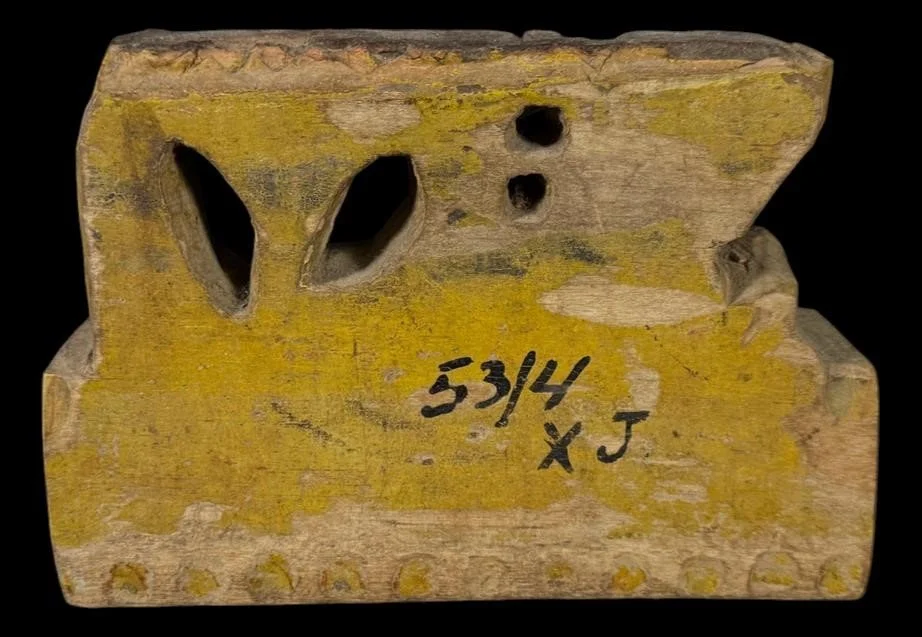 Image 2 of 2
Antique Hand-Carved Saint George and the Dragon Polychrome Wood Icon
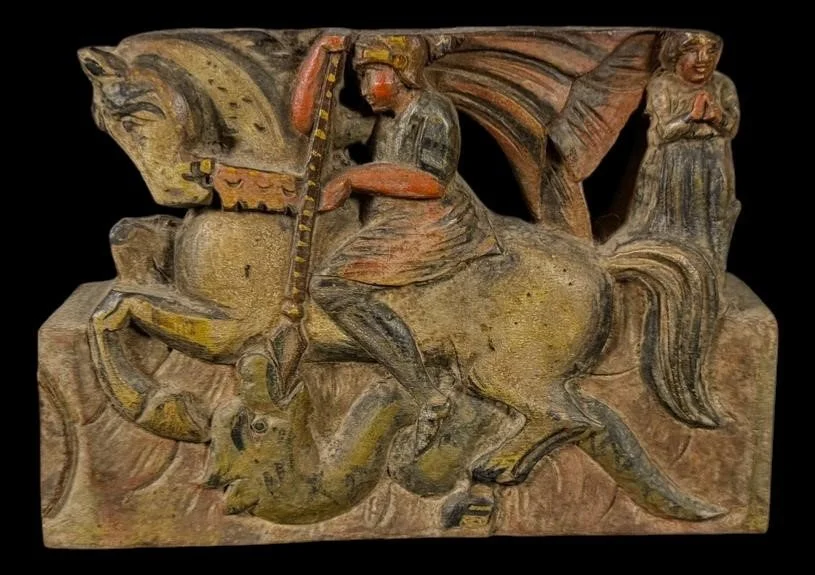
This remarkable antique icon presents one of the most enduring images in Christian art: Saint George mounted on horseback as he defeats the dragon, while the rescued princess stands nearby in prayer. Unlike the familiar painted icons of Saint George, this image was created as a carved wooden relief, with the entire scene shaped by hand from a solid piece of wood and then carefully decorated with color.
The surviving surface immediately gives the piece its character. Areas of red, ochre, yellow, black, and earthy pigment remain visible across the horse, Saint George, the dragon, and the surrounding scene, while many years of handling and age have exposed portions of the underlying wood. Rather than diminishing the icon, that wear gives it the unmistakable appearance of an old devotional object that has lived a life before reaching us.
Someone Sat Down and Carved This by Hand
It is easy to look at an antique religious object today and forget how much human effort was required to create it. There were no computerized routers, molded resin reproductions, or machines producing hundreds of identical copies. Someone had to begin with a piece of wood, determine the composition, establish the outlines of Saint George, the horse, the dragon, and the praying princess, and then slowly remove the surrounding wood until the scene emerged.
Every contour required work. The horse had to be formed from the block, the dragon carved beneath it, Saint George positioned above the action, and the smaller figure of the princess carefully worked into the background. The pierced openings had to be cut completely through the wood, adding depth to the composition while also creating the possibility of damaging the surrounding carving if the craftsman's hand slipped.
After the carving was finished, the piece was painted. The remnants of those colors are still visible today, meaning another stage of careful work followed the carving itself. What now survives as a worn antique would once have appeared much brighter, with the carved forms emphasized by fresh pigment and stronger contrasts.
If our estimated 19th-century dating is approximately correct, someone may have sat with this piece of wood around 140 to 180 years ago, slowly turning it into an image of one of Christianity's most beloved saints. We cannot know the private thoughts of the person who carved it, but in an age when sacred images were often created within deeply Christian communities, it is not difficult to imagine the work being accompanied by prayer, devotion, and familiarity with the saint being depicted.
The person who made this was not merely carving a horse and a warrior. They were creating an image of Saint George the Great-Martyr, intended to communicate courage, faithfulness to Christ, and the defeat of evil. Whether it originally stood in a home, formed part of a cabinet, decorated a church furnishing, or belonged to some other devotional setting, a considerable amount of someone's time and skill went into producing something meant to be beautiful and sacred.
That human connection is one of the most compelling things about the icon. More than a century later, the individual who carved it is almost certainly forgotten, yet the work of their hands remains.
Saint George and the Dragon
Saint George the Great-Martyr is among the most widely venerated military saints in Christianity. His image can be found throughout the Catholic and Orthodox worlds, from ancient churches and monasteries to family prayer corners, processional banners, carved church doors, and painted icons.
The famous image of Saint George slaying the dragon is not simply a medieval story of a knight defeating a monster. Christian tradition came to understand the dragon as an image of evil, chaos, persecution, and ultimately the power of Satan, while Saint George represents the Christian who remains faithful to Christ even when confronted by suffering and death.
That is one reason this image remained so powerful for generations of Christians. Saint George's victory is ultimately understood not merely as the triumph of a warrior, but as the triumph of faith over fear and Christ over evil.
An Unusually Detailed Composition
Saint George dominates the scene on horseback as the dragon lies beneath him, while the horse moves dramatically forward through the composition. The carver managed to create a surprising amount of action within a relatively concentrated field, particularly through the positioning of the horse, Saint George's body, and the creature twisting below.
Behind the mounted saint stands the princess, traditionally shown as the person rescued from the dragon. Her presence is especially important because it identifies the scene immediately as the traditional iconography of Saint George and the Dragon rather than simply an image of a mounted warrior saint.
The artist also used the physical structure of the carving to create genuine depth. Portions of the upper relief are pierced completely through the wood, allowing real shadow to form behind the figures rather than creating the illusion of depth entirely with paint.
Hand-Carved and Hand-Painted
This is not a printed icon, resin reproduction, or modern molded religious decoration. The image was physically carved from wood and subsequently decorated with pigment.
The carving remains visibly irregular throughout the piece, which is precisely what we would expect from hand workmanship. The contours of the horse, dragon, figures, and surrounding elements carry small variations and imperfections that distinguish an individually worked object from a mechanically repeated reproduction.
Remnants of the original polychrome decoration survive across much of the surface. Warm reds and earth tones remain on Saint George and his garments, subdued coloration survives on the horse, and traces of yellow, ochre, and darker outlining can still be seen throughout the carving.
The combination of carving and polychromy makes this an especially interesting form of sacred art. It exists somewhere between an icon, sculpture, and architectural devotional object, while still unmistakably functioning as a sacred image.
Probably Around 140 to 180 Years Old
Based on the style of carving, construction, surviving polychrome surface, wear, and comparison with other European carved devotional reliefs, our best estimate is that this icon dates from the 19th century, possibly somewhere around 1840–1890.
That dating should be regarded as an informed estimate rather than a documented attribution because the icon does not presently have a known workshop, artist, or dated inscription. Even so, the physical characteristics of the piece strongly suggest genuine age rather than a recently manufactured decorative object.
If that estimated range is correct, this icon was already decades old before the First World War and may have been created while many parts of Europe still depended heavily upon local craftsmen for carved religious furnishings and devotional images. The possibility that someone sat carving this very piece in the middle of the 1800s gives the surviving object a very different presence from something manufactured recently.
A person worked this wood long before any of us were born. Their hands shaped the horse's head, carved the folds of Saint George's clothing, opened the spaces behind the figures, created the dragon beneath the horse, and formed the small praying princess who still stands in the corner of the scene today.
Probably a Fragment of a Larger Devotional Object
The reverse of the icon provides one of the most intriguing clues to its original purpose. It is largely flat and unfinished compared with the carved front, with pierced openings corresponding to portions of the relief and visible evidence of age, pigment, and wear.
Its form suggests that it may originally have been incorporated into something larger rather than created solely as a freestanding plaque. Small carved religious reliefs like this were historically used on cabinets, chests, devotional furniture, church furnishings, architectural elements, and other wooden objects.
That possibility makes the piece particularly fascinating because what survives today may once have been only one portion of a much larger devotional object. The surrounding furniture or structure may have disappeared long ago while the sacred image itself was preserved.
The reverse also bears handwritten notation that appears to be later inventory, measurement, or dealer information rather than part of the original devotional design. We have intentionally left the icon exactly as acquired rather than attempting to erase or conceal those traces of its history.
European Christian Folk Art
Based upon its carving style, surviving polychromy, construction, and comparison with other carved Saint George reliefs, this piece appears most consistent with Continental European Christian folk or devotional art. Central European or Alpine influence is possible, although the exact country and workshop remain unknown.
Folk religious carving differs considerably from academically trained sculpture. The craftsman was not necessarily trying to create anatomically perfect figures or classical proportions, but rather to create an immediately recognizable sacred image that communicated its religious subject clearly.
That quality is especially visible here. The horse is powerful but stylized, the dragon has an almost primitive character, and the princess stands behind the scene in a simplified prayerful pose. Those qualities give the carving tremendous personality and connect it with older traditions of popular Christian devotion.
The Princess in Prayer
One of the most charming details is the small female figure standing at the upper right with her hands together in prayer. She represents the princess whom Saint George rescues from the dragon according to the medieval tradition associated with the saint.
Her presence completes the story. Without her, the image could simply represent a military saint overcoming a symbolic beast, but with the princess included, the viewer immediately encounters the traditional narrative of Saint George and the dragon.
The carver could easily have omitted such a small secondary figure, yet took the additional time to include her. That small decision is another reminder that this was not simply a generic decorative horseman carved into wood. The craftsman knew the story being represented and deliberately included the details necessary to tell it.
An Icon That Shows Its Age
This icon has not been refinished to make it appear new, and that is intentional. The surviving pigment is worn, areas of bare wood are visible, edges have softened, and the entire surface carries the irregularities expected from an old hand-carved object.
We strongly prefer preserving that history rather than disguising it beneath modern paint, stain, or varnish. The worn surface allows us to see the object as it has come down through time rather than transforming it into something the original craftsman would no longer recognize.
The contrast between surviving color and exposed wood is especially beautiful in person because it reveals the construction of the piece. One can see both the image the carver intended and the material from which that image was patiently created.
Saint George in Eastern and Western Christianity
Saint George belongs to the shared inheritance of Christianity before the divisions between East and West. He is honored throughout the Eastern Orthodox Churches, Eastern Catholic Churches, Roman Catholic Church, and numerous ancient Oriental Christian traditions.
Churches dedicated to Saint George can be found from the Middle East and the Caucasus to Greece, Italy, Eastern Europe, England, and beyond. His image is particularly beloved throughout the Christian East, where he is frequently depicted mounted on horseback striking the dragon beneath him.
For a collection devoted to the ancient Church, few saints are more fitting. Saint George connects the Christianity of Byzantium, Rome, the Middle East, Eastern Europe, and the wider Christian world through one of the most recognizable sacred images Christianity has produced.
A Singular Antique Devotional Object
This is not an item that we manufacture, nor is it something that can simply be reordered after it sells. It is an individual antique devotional object with its own carving marks, surviving pigments, age, wear, and history.
The photographs show the actual icon being offered. Once this particular piece is purchased, this exact carving will no longer be available.
For someone who loves Saint George, antique Christian art, carved icons, military saints, or old devotional objects, this is the kind of piece that can become the focal point of a prayer corner or religious collection. Its significance is not merely that it depicts Saint George, but that someone more than a century ago took a simple piece of wood and spent hours, perhaps days, patiently transforming it into an image intended to honor a Christian saint.
That craftsman's name may be gone, but the object survived. The tool marks, worn pigment, pierced wood, and small praying princess remain as evidence of someone's attempt long ago to make something worthy of the sacred subject before them.
Details
Subject: Saint George the Great-Martyr and the Dragon
Type: Antique carved Christian icon and devotional relief
Material: Hand-carved wood
Decoration: Surviving hand-painted polychrome pigment
Probable Origin: Continental Europe, possibly Central European or Alpine
Estimated Date: Approximately 1840–1890, with exact date unknown
Estimated Age: Approximately 140–180 years old
Construction: Hand-carved and pierced wooden relief
Condition: Antique condition with extensive authentic surface wear, pigment loss, abrasions, exposed wood, and age-related marks
Provenance: Exact artist, workshop, country of origin, and previous ownership unknown
Because this is an antique object, its irregularities and wear are part of its history and character. Please study the photographs carefully, as they show the actual Saint George icon you will receive.
Product Description
This extraordinary antique wooden icon depicts Saint George the Great-Martyr mounted on horseback defeating the dragon while the rescued princess stands nearby in prayer. Hand-carved in relief and decorated with surviving polychrome pigments, the icon retains the exposed wood, softened edges, old paint, tool-work, and irregular craftsmanship that make historic devotional objects so compelling.
Our best estimate places the carving in the 19th century, possibly around 1840–1890, meaning someone may have sat with this very piece of wood roughly 140 to 180 years ago, carefully carving Saint George, his horse, the dragon, and the tiny praying princess by hand. We cannot know the carver's private thoughts, but this was clearly an object that required considerable time and attention, created within the long Christian tradition of making sacred images meant to inspire devotion and remembrance.
This remarkable antique icon presents one of the most enduring images in Christian art: Saint George mounted on horseback as he defeats the dragon, while the rescued princess stands nearby in prayer. Unlike the familiar painted icons of Saint George, this image was created as a carved wooden relief, with the entire scene shaped by hand from a solid piece of wood and then carefully decorated with color.
The surviving surface immediately gives the piece its character. Areas of red, ochre, yellow, black, and earthy pigment remain visible across the horse, Saint George, the dragon, and the surrounding scene, while many years of handling and age have exposed portions of the underlying wood. Rather than diminishing the icon, that wear gives it the unmistakable appearance of an old devotional object that has lived a life before reaching us.
Someone Sat Down and Carved This by Hand
It is easy to look at an antique religious object today and forget how much human effort was required to create it. There were no computerized routers, molded resin reproductions, or machines producing hundreds of identical copies. Someone had to begin with a piece of wood, determine the composition, establish the outlines of Saint George, the horse, the dragon, and the praying princess, and then slowly remove the surrounding wood until the scene emerged.
Every contour required work. The horse had to be formed from the block, the dragon carved beneath it, Saint George positioned above the action, and the smaller figure of the princess carefully worked into the background. The pierced openings had to be cut completely through the wood, adding depth to the composition while also creating the possibility of damaging the surrounding carving if the craftsman's hand slipped.
After the carving was finished, the piece was painted. The remnants of those colors are still visible today, meaning another stage of careful work followed the carving itself. What now survives as a worn antique would once have appeared much brighter, with the carved forms emphasized by fresh pigment and stronger contrasts.
If our estimated 19th-century dating is approximately correct, someone may have sat with this piece of wood around 140 to 180 years ago, slowly turning it into an image of one of Christianity's most beloved saints. We cannot know the private thoughts of the person who carved it, but in an age when sacred images were often created within deeply Christian communities, it is not difficult to imagine the work being accompanied by prayer, devotion, and familiarity with the saint being depicted.
The person who made this was not merely carving a horse and a warrior. They were creating an image of Saint George the Great-Martyr, intended to communicate courage, faithfulness to Christ, and the defeat of evil. Whether it originally stood in a home, formed part of a cabinet, decorated a church furnishing, or belonged to some other devotional setting, a considerable amount of someone's time and skill went into producing something meant to be beautiful and sacred.
That human connection is one of the most compelling things about the icon. More than a century later, the individual who carved it is almost certainly forgotten, yet the work of their hands remains.
Saint George and the Dragon
Saint George the Great-Martyr is among the most widely venerated military saints in Christianity. His image can be found throughout the Catholic and Orthodox worlds, from ancient churches and monasteries to family prayer corners, processional banners, carved church doors, and painted icons.
The famous image of Saint George slaying the dragon is not simply a medieval story of a knight defeating a monster. Christian tradition came to understand the dragon as an image of evil, chaos, persecution, and ultimately the power of Satan, while Saint George represents the Christian who remains faithful to Christ even when confronted by suffering and death.
That is one reason this image remained so powerful for generations of Christians. Saint George's victory is ultimately understood not merely as the triumph of a warrior, but as the triumph of faith over fear and Christ over evil.
An Unusually Detailed Composition
Saint George dominates the scene on horseback as the dragon lies beneath him, while the horse moves dramatically forward through the composition. The carver managed to create a surprising amount of action within a relatively concentrated field, particularly through the positioning of the horse, Saint George's body, and the creature twisting below.
Behind the mounted saint stands the princess, traditionally shown as the person rescued from the dragon. Her presence is especially important because it identifies the scene immediately as the traditional iconography of Saint George and the Dragon rather than simply an image of a mounted warrior saint.
The artist also used the physical structure of the carving to create genuine depth. Portions of the upper relief are pierced completely through the wood, allowing real shadow to form behind the figures rather than creating the illusion of depth entirely with paint.
Hand-Carved and Hand-Painted
This is not a printed icon, resin reproduction, or modern molded religious decoration. The image was physically carved from wood and subsequently decorated with pigment.
The carving remains visibly irregular throughout the piece, which is precisely what we would expect from hand workmanship. The contours of the horse, dragon, figures, and surrounding elements carry small variations and imperfections that distinguish an individually worked object from a mechanically repeated reproduction.
Remnants of the original polychrome decoration survive across much of the surface. Warm reds and earth tones remain on Saint George and his garments, subdued coloration survives on the horse, and traces of yellow, ochre, and darker outlining can still be seen throughout the carving.
The combination of carving and polychromy makes this an especially interesting form of sacred art. It exists somewhere between an icon, sculpture, and architectural devotional object, while still unmistakably functioning as a sacred image.
Probably Around 140 to 180 Years Old
Based on the style of carving, construction, surviving polychrome surface, wear, and comparison with other European carved devotional reliefs, our best estimate is that this icon dates from the 19th century, possibly somewhere around 1840–1890.
That dating should be regarded as an informed estimate rather than a documented attribution because the icon does not presently have a known workshop, artist, or dated inscription. Even so, the physical characteristics of the piece strongly suggest genuine age rather than a recently manufactured decorative object.
If that estimated range is correct, this icon was already decades old before the First World War and may have been created while many parts of Europe still depended heavily upon local craftsmen for carved religious furnishings and devotional images. The possibility that someone sat carving this very piece in the middle of the 1800s gives the surviving object a very different presence from something manufactured recently.
A person worked this wood long before any of us were born. Their hands shaped the horse's head, carved the folds of Saint George's clothing, opened the spaces behind the figures, created the dragon beneath the horse, and formed the small praying princess who still stands in the corner of the scene today.
Probably a Fragment of a Larger Devotional Object
The reverse of the icon provides one of the most intriguing clues to its original purpose. It is largely flat and unfinished compared with the carved front, with pierced openings corresponding to portions of the relief and visible evidence of age, pigment, and wear.
Its form suggests that it may originally have been incorporated into something larger rather than created solely as a freestanding plaque. Small carved religious reliefs like this were historically used on cabinets, chests, devotional furniture, church furnishings, architectural elements, and other wooden objects.
That possibility makes the piece particularly fascinating because what survives today may once have been only one portion of a much larger devotional object. The surrounding furniture or structure may have disappeared long ago while the sacred image itself was preserved.
The reverse also bears handwritten notation that appears to be later inventory, measurement, or dealer information rather than part of the original devotional design. We have intentionally left the icon exactly as acquired rather than attempting to erase or conceal those traces of its history.
European Christian Folk Art
Based upon its carving style, surviving polychromy, construction, and comparison with other carved Saint George reliefs, this piece appears most consistent with Continental European Christian folk or devotional art. Central European or Alpine influence is possible, although the exact country and workshop remain unknown.
Folk religious carving differs considerably from academically trained sculpture. The craftsman was not necessarily trying to create anatomically perfect figures or classical proportions, but rather to create an immediately recognizable sacred image that communicated its religious subject clearly.
That quality is especially visible here. The horse is powerful but stylized, the dragon has an almost primitive character, and the princess stands behind the scene in a simplified prayerful pose. Those qualities give the carving tremendous personality and connect it with older traditions of popular Christian devotion.
The Princess in Prayer
One of the most charming details is the small female figure standing at the upper right with her hands together in prayer. She represents the princess whom Saint George rescues from the dragon according to the medieval tradition associated with the saint.
Her presence completes the story. Without her, the image could simply represent a military saint overcoming a symbolic beast, but with the princess included, the viewer immediately encounters the traditional narrative of Saint George and the dragon.
The carver could easily have omitted such a small secondary figure, yet took the additional time to include her. That small decision is another reminder that this was not simply a generic decorative horseman carved into wood. The craftsman knew the story being represented and deliberately included the details necessary to tell it.
An Icon That Shows Its Age
This icon has not been refinished to make it appear new, and that is intentional. The surviving pigment is worn, areas of bare wood are visible, edges have softened, and the entire surface carries the irregularities expected from an old hand-carved object.
We strongly prefer preserving that history rather than disguising it beneath modern paint, stain, or varnish. The worn surface allows us to see the object as it has come down through time rather than transforming it into something the original craftsman would no longer recognize.
The contrast between surviving color and exposed wood is especially beautiful in person because it reveals the construction of the piece. One can see both the image the carver intended and the material from which that image was patiently created.
Saint George in Eastern and Western Christianity
Saint George belongs to the shared inheritance of Christianity before the divisions between East and West. He is honored throughout the Eastern Orthodox Churches, Eastern Catholic Churches, Roman Catholic Church, and numerous ancient Oriental Christian traditions.
Churches dedicated to Saint George can be found from the Middle East and the Caucasus to Greece, Italy, Eastern Europe, England, and beyond. His image is particularly beloved throughout the Christian East, where he is frequently depicted mounted on horseback striking the dragon beneath him.
For a collection devoted to the ancient Church, few saints are more fitting. Saint George connects the Christianity of Byzantium, Rome, the Middle East, Eastern Europe, and the wider Christian world through one of the most recognizable sacred images Christianity has produced.
A Singular Antique Devotional Object
This is not an item that we manufacture, nor is it something that can simply be reordered after it sells. It is an individual antique devotional object with its own carving marks, surviving pigments, age, wear, and history.
The photographs show the actual icon being offered. Once this particular piece is purchased, this exact carving will no longer be available.
For someone who loves Saint George, antique Christian art, carved icons, military saints, or old devotional objects, this is the kind of piece that can become the focal point of a prayer corner or religious collection. Its significance is not merely that it depicts Saint George, but that someone more than a century ago took a simple piece of wood and spent hours, perhaps days, patiently transforming it into an image intended to honor a Christian saint.
That craftsman's name may be gone, but the object survived. The tool marks, worn pigment, pierced wood, and small praying princess remain as evidence of someone's attempt long ago to make something worthy of the sacred subject before them.
Details
Subject: Saint George the Great-Martyr and the Dragon
Type: Antique carved Christian icon and devotional relief
Material: Hand-carved wood
Decoration: Surviving hand-painted polychrome pigment
Probable Origin: Continental Europe, possibly Central European or Alpine
Estimated Date: Approximately 1840–1890, with exact date unknown
Estimated Age: Approximately 140–180 years old
Construction: Hand-carved and pierced wooden relief
Condition: Antique condition with extensive authentic surface wear, pigment loss, abrasions, exposed wood, and age-related marks
Provenance: Exact artist, workshop, country of origin, and previous ownership unknown
Because this is an antique object, its irregularities and wear are part of its history and character. Please study the photographs carefully, as they show the actual Saint George icon you will receive.
Product Description
This extraordinary antique wooden icon depicts Saint George the Great-Martyr mounted on horseback defeating the dragon while the rescued princess stands nearby in prayer. Hand-carved in relief and decorated with surviving polychrome pigments, the icon retains the exposed wood, softened edges, old paint, tool-work, and irregular craftsmanship that make historic devotional objects so compelling.
Our best estimate places the carving in the 19th century, possibly around 1840–1890, meaning someone may have sat with this very piece of wood roughly 140 to 180 years ago, carefully carving Saint George, his horse, the dragon, and the tiny praying princess by hand. We cannot know the carver's private thoughts, but this was clearly an object that required considerable time and attention, created within the long Christian tradition of making sacred images meant to inspire devotion and remembrance.