The Albanian Byzantine Catholic Church: The Complete History
The Albanian Byzantine Catholic Church The Rite That Survived 500 Years of Exile, the World's First Atheist State, and Came Home
It is one of the smallest Catholic churches on earth — fewer than 3,500 members in its homeland. Yet its story is one of the most extraordinary in all of Christian history: a Byzantine rite carried into Italian exile by Albanian refugees in the 15th century, preserved in mountain villages for five centuries while it was extinguished in its homeland, brought back to Albania in 1900 by priests trained in Italy — and then entirely destroyed when Albania became the world's first declared atheist state. This is the complete story.
Albanian Catholic vs. Italo-Albanian Catholic: The Confusion Explained
The most-searched question about the Albanian Byzantine Catholic Church is also the most understandable one: Is it the same as the Italo-Albanian Catholic Church? People encounter the Italo-Albanian Church — in Sicily, in Calabria, in descriptions of the Arbëreshë communities — and then read about an Albanian Byzantine Catholic Church in Albania itself and wonder whether they are looking at two descriptions of the same institution. They are not. They are two distinct churches, with two distinct histories, two distinct jurisdictions, and two distinct geographic home bases. But they are so deeply intertwined — sharing a rite, sharing a history, sharing a cultural heritage, and in an important sense sharing a common ancestry — that treating them as entirely separate would be equally wrong.
The Two Albanian Byzantine Catholic Churches: At a Glance
The Albanian Byzantine Catholic Church (officially: Apostolic Administration of Southern Albania) is the small Byzantine Catholic community within the Republic of Albania itself, with approximately 3,200–3,500 members. Its heartland is the Elbasan region and southern Albania. It is the remnant of a 1900 reunion movement and of a tradition that was nearly entirely destroyed by the communist regime of Enver Hoxha.
The Italo-Albanian Catholic Church is the Byzantine Catholic church of the Arbëreshë — the Albanian communities of southern Italy and Sicily who fled the Ottoman conquest of Albania in the 15th century. It has approximately 50,000–80,000 members in Italy and is organized into two eparchies: the Eparchy of Lungro (Calabria, founded 1919) and the Eparchy of Piana degli Albanesi (Sicily, founded 1937), plus the Territorial Abbey of Grottaferrata.
Both use the same Byzantine rite. Both use Albanian and Koine Greek in their liturgy. Both trace their heritage to the same pre-Ottoman Albanian Byzantine Christian tradition. They are, in the most profound sense, two branches of the same tree — separated by the sea, reunited by history.
The relationship between these two churches is not merely historical. It is the key to understanding the Albanian Byzantine Catholic Church's very existence. When the Albanian Byzantine Catholic community was being established in Elbasan in 1900, the priests who came to serve it were Italo-Albanian Basilian monks from the Abbey of Grottaferrata, near Rome — men trained in Italy in the Byzantine rite that had been preserved there while it died in Albania. And when the Albanian Byzantine Catholic community was being reconstructed after the communist period ended in 1991, it was again Italian-trained Arbëreshë clergy who came to help. The Italo-Albanian Church was the vessel in which the rite was preserved during the centuries when Albania itself could not hold it — and it twice poured that rite back into Albanian soil when the conditions finally allowed.
Byzantine Christianity in Ancient Illyria: The Deep Roots
The territory of modern Albania was known to the ancient world as Illyria — a mountainous, strategically important region on the eastern shore of the Adriatic, inhabited by the Illyrian tribes from whom many historians believe the Albanians descend. Christianity arrived in Illyria early: the region was evangelized in the apostolic era, and by the 4th century there were organized Christian communities throughout what is now Albania. The division between northern and southern Albania in religious terms runs very deep and very old: the north was evangelized primarily under Latin influence (associated with Rome and Dyrrachium, modern Durrës), while the south was evangelized under Greek/Byzantine influence (associated with Constantinople and the Patriarchate of Ohrid).
This geographical religious divide — Latin rite in the north, Byzantine rite in the south — is the oldest structural fact of Albanian Christianity. It precedes the Ottoman conquest by a millennium. It precedes the Schism of 1054 between Rome and Constantinople. It is built into the landscape: the northern highlands were always more connected to the Adriatic trade routes and the Latin West; the southern plains and valleys were always more connected to Macedonia, Epirus, and the Greek-speaking Byzantine world. When Christianity became the official religion of the Roman Empire under Constantine in the 4th century, both traditions were already present in Albania, and both would remain present — sometimes in tension, sometimes in coexistence — for the next seventeen centuries.
The Byzantine tradition in southern Albania flourished particularly under the medieval Bulgarian and Byzantine empires. Churches, monasteries, and iconographic programs from the 10th through 15th centuries in what is now southern Albania show a sophisticated Byzantine Christian culture — Greek-language liturgy, Byzantine ecclesiastical architecture, icon painting in the tradition of Constantinople. When the Albanian nation-heroes of the 14th and 15th centuries fought the Ottoman invaders, they were fighting not only for political independence but for the preservation of a civilization that was thoroughly Byzantine Christian in its religious character.
Skanderbeg, the Ottoman Conquest, and the Great Albanian Exodus
The name Gjergj Kastrioti Skanderbeg — Albania's national hero — is inseparable from the story of how the Byzantine rite came to be preserved in Italy rather than Albania. Skanderbeg (1405–1468) was an Albanian nobleman who had been taken as a hostage by the Ottoman Sultan Murad II as a child, raised as a Muslim in the Ottoman court, and trained as a military officer. In 1443, he defected from the Ottoman army, returned to Albania, converted back to Christianity, recaptured his ancestral castle at Krujë, and launched a resistance movement that held the Ottomans at bay for twenty-five years. He won battle after battle against one of the most powerful military forces in the world. Pope Calixtus III called him "the Champion of Christ." He remains the defining national symbol of Albania to this day.
When Skanderbeg died on January 17, 1468, the resistance he had organized began to crumble. The Ottomans pressed their advantage. Krujë fell in 1478. Albanian resistance continued in scattered pockets but without its central organizing force. Over the following decades, the Ottoman consolidation of Albania was completed. A majority of the population — driven by a combination of coercion, economic incentive, and the collapse of the Christian ecclesiastical structures — gradually converted to Islam over the 16th and 17th centuries. By the end of the 17th century, Albania was predominantly Muslim, with Christian minorities in both the Latin north and the Byzantine south.
The Exodus to Italy
Long before the final Ottoman conquest was complete, Albanians had begun leaving. The first significant wave of emigration to Italy began as early as 1448, when King Alfonso I of Naples invited Albanian mercenaries under Demetrio Reres to help suppress a rebellion. Reres and his men were given lands in Calabria and stayed. When Skanderbeg himself came to Italy in 1459 to assist Alfonso's successor, another wave of Albanians followed and settled. After Skanderbeg's death in 1468, the exodus accelerated: his relatives, his followers, and thousands of ordinary Albanians — many of them Orthodox Byzantine Christians from the south — crossed the Adriatic and settled in the mountains and valleys of Calabria, Sicily, and other parts of southern Italy.
These Albanian refugees brought everything with them: their language (a form of Albanian that would be preserved largely unchanged in Italian villages for five centuries), their customs, their social structures — and their Byzantine rite. They were, in the significant majority, Orthodox Christians in the Byzantine tradition. And they were determined to remain so.
"If you ask any resident of Lungro their nationality, the answer is unhesitatingly Albanian. And if you ask any resident what religion he or she practices, the answer is never just Catholic. Invariably, proudly, the response comes: Byzantine rite!"
— ONE Magazine, Catholic Near East Welfare Association, reporting on the Arbëreshë of Lungro
The Arbëreshë: Five Centuries of Rite Preservation in the Mountains of Italy
The Arbëreshë — the Albanian communities of southern Italy and Sicily — accomplished something that has almost no parallel in the history of Christian liturgical preservation: they maintained the Byzantine rite in full living vitality, without interruption, in a foreign country, surrounded by Latin Catholic neighbors, under pressure from Latin bishops who would have preferred their absorption, for more than five hundred years. The rite did not survive in a museum or a library. It survived in living worship, in parishes, in the voices of priests who chanted the Divine Liturgy of Saint John Chrysostom in Albanian and Greek in mountain churches in Calabria and Sicily, generation after generation, from the 15th century to the present day.
This was not achieved easily. The Arbëreshë faced constant pressure from Latin bishops who viewed their Byzantine practices with incomprehension or hostility. The popes of the 16th century had to intervene repeatedly to protect the Albanians' right to maintain their rite. In 1595, Pope Clement VIII issued a bull explicitly permitting Albanian priests to be ordained by a bishop of their own tradition. In 1742, Pope Benedict XIV published the constitution Etsi Pastoralis specifically to protect the position of Eastern Catholics (including the Italo-Albanians) against Latin encroachment. The Arbëreshë needed Rome's protection from Rome's own bishops — a paradox that says much about the complexity of Eastern Catholic life within a predominantly Latin institution.
The Institutions of Rite Preservation
The Arbëreshë preserved their rite through several interlocking institutions. The Basilian monastery of Grottaferrata, near Rome — founded in 1004 by Saint Nilo of Rossano as an Italo-Greek monastery — became a center of Albanian Byzantine scholarship and clergy formation. The Pontifical Greek College of Saint Athanasius in Rome, founded by Pope Gregory XIII in 1577, educated Byzantine-rite clergy including Albanians from both Italy and, later, Albania itself. Seminaries were established in Calabria (at San Demetrio Corone, later in Lungro) and in Sicily (at Piana degli Albanesi) to form local clergy in the Byzantine tradition. These institutions were not merely educational facilities; they were the institutional immune system of a liturgical tradition under perpetual pressure.
The Albanian language itself was preserved alongside the rite. The Arbëreshë dialect spoken in the villages of Calabria and Sicily today is an archaic form of Albanian — essentially the 15th-century Albanian of Skanderbeg's time, preserved in geographic isolation while the Albanian language on the mainland evolved and modernized. When Albanian scholars from the University of Tirana visit Lungro or Piana degli Albanesi to study the Arbëreshë dialect, they are encountering something that has been frozen in linguistic time for five hundred years. The rite and the language preserved each other: liturgical Albanian held the old forms alive, and the old forms gave the liturgy its particular character.
✦ The Arbëreshë Communities of Italy ✦
Sacred Eastern Christian Art & Devotion
The Albanian Byzantine Catholic tradition shares the same Byzantine liturgical and iconographic heritage as the Greek, Melkite, and Ukrainian Catholic churches. Honor the whole Byzantine family with these sacred items.

Lungro and Piana degli Albanesi: The Two Eparchies That Kept the Flame
For most of their five centuries in Italy, the Arbëreshë communities lacked their own bishop. They were subject to Latin ordinaries who often showed little understanding or sympathy for their Byzantine rite. Popes had to intervene repeatedly to protect them from Latinization. The situation began to stabilize only in the 18th century, when Benedict XIV's constitution Etsi Pastoralis (1742) formally protected Eastern Catholics in Italian territory, and two Albanian seminaries — at San Demetrio Corone in Calabria and at Piana degli Albanesi in Sicily — were established to form local clergy.
The formal establishment of proper eparchies came only in the 20th century. The Eparchy of Lungro was created on February 13, 1919, by Pope Benedict XV — the first time the Italo-Albanian Byzantine Catholics on the Italian mainland had their own bishop and their own diocesan structure after nearly five centuries in Italy. The Eparchy of Piana degli Albanesi for Sicily followed on October 26, 1937, under Pius XI. Together with the Territorial Abbey of Santa Maria di Grottaferrata (elevated to that status in 1937), these three jurisdictions form the Italo-Albanian Catholic Church — a single sui iuris Eastern Catholic church with three separate territorial jurisdictions.
Lungro: The Heart of Albanian Catholicism in Mainland Italy
The town of Lungro, perched in the mountains of Calabria, is the most intensely Albanian place in Italy. Its cathedral — the Cathedral of Saint Nicholas of Myra — celebrates the Byzantine liturgy in Greek and Albanian just as it has for centuries. The residents of Lungro, when asked their nationality, say Albanian. When asked their religion, they say Byzantine rite. The fidelity of this community to an identity that is simultaneously Italian by citizenship and Albanian by heritage is one of the most remarkable examples of diaspora cultural preservation in European history. Professors from the University of Tirana visit Lungro to study the 15th-century Albanian dialect that survives there in a purity unattainable anywhere in Albania itself.
Piana degli Albanesi: Easter in Byzantine Color
The Eparchy of Piana degli Albanesi in Sicily is particularly famous for its Byzantine liturgical celebrations — especially Easter, when the faithful wear traditional Albanian costumes that have been preserved for five centuries, and the chanting of the Byzantine Paschal liturgy fills the Cathedral of Saint Demetrius the Martyr. The Easter celebration in Piana degli Albanesi has been photographed and documented by ethnographers, anthropologists, and journalists from around the world — it represents one of the most vivid survivals of Albanian Byzantine culture anywhere on earth. The town's name itself tells the story: it was originally called "Piana dei Greci" (Plain of the Greeks), reflecting the Greek-language Byzantine rite its Albanian founders practiced. In 1941, the name was officially changed to Piana degli Albanesi (Plain of the Albanians) to honor its true ethnic heritage.
The 1900 Elbasan Reunion: The Rite Returns to Its Homeland
Four and a half centuries after the Albanian exodus to Italy, and more than four centuries after the Byzantine rite had effectively died out as an organized tradition in Albania itself, it came home. The vehicle of its return was a reunion movement centered on the central Albanian city of Elbasan — a movement that, while modest in numerical terms, was theologically and historically momentous.
The groundwork was laid in the 1890s. In 1895, a group of villages in the Mali Shpati region, southeast of Elbasan, made a collective decision to become Catholic and specifically requested a bishop of their own Byzantine rite — not the Latin rite that the predominantly Latin Catholic missionaries in Albania had been promoting. The request was ambitious: it was essentially asking Rome to recognize and support a revival of Byzantine Catholicism in a region where it had not been organized for four centuries. The consular representatives of Russia and Montenegro raised political objections with the Ottoman civil authorities, complicating the situation.
The breakthrough came around 1900 through the work of Archimandrite George Germanos — a remarkable figure who was the nephew of the Albanian Orthodox metropolitan. Germanos had come to the conviction that union with Rome was both spiritually right and practically beneficial for the Albanian Byzantine Christian community. He gathered a group of believers in Elbasan who made a formal, definitive act of Catholic unity — the reunion that established the nucleus of the Albanian Byzantine Catholic Church in the form it would take for the 20th century. The specific site at the center of this movement was the Church of Saint Mary in Elbasan — a location that would remain the spiritual heart of Albanian Byzantine Catholicism through the entire communist period and into the present.
The Basilian Priests from Grottaferrata
To serve the newly reunited community, Rome sent Basilian monks from the Abbey of Grottaferrata — the ancient Italo-Greek monastery near Rome that had become associated with Albanian Byzantine scholarship. These Italian-trained priests were, in the most direct sense, carrying the Albanian Byzantine rite home: they were descendants, spiritually and institutionally, of the tradition the Arbëreshë refugees had preserved in Italy for centuries. The 1900 reunion was therefore not merely a theological act of Catholic unity. It was the first moment in the cycle of rite-preservation in which the rite that had been carried into Italian exile by Albanian refugees was carried back to Albania by priests formed in the Italian tradition those refugees had built.
Byzantine Christianity established in southern Illyria/Albania through the influence of Constantinople. The Byzantine liturgy in Greek becomes the rite of southern Albanian Christians.
Ottoman conquest of Albania proceeds. Albanians — most of them Orthodox Byzantine Christians from the south — begin emigrating to Italy. They settle in Calabria, Sicily, and southern Italy, bringing the Byzantine rite with them.
The Arbëreshë face pressure from Latin bishops to Latinize. Popes intervene repeatedly to protect their rite. Seminaries established in Calabria and Sicily. The Pontifical Greek College in Rome trains Albanian Byzantine clergy.
Pope Benedict XIV issues Etsi Pastoralis, formally protecting Eastern Catholics in Italian territory from Latin absorption. A major milestone for Arbëreshë Byzantine Catholic survival.
Archimandrite George Germanos leads the Elbasan reunion movement. Byzantine Catholicism is re-established in Albania for the first time in centuries. Basilian priests from Grottaferrata come from Italy to serve the community.
Eparchy of Lungro established — the first proper diocese for Albanian Byzantine Catholics in mainland Italy. Bishop Giovanni Mele ordained — he will later ordain the future martyr Josif Papamihali.
Josif Papamihali ordained at the Greek College of Saint Athanasius in Rome by Bishop Giovanni Mele of Lungro. He returns to Albania the following year as parish priest of Elbasan.
Southern Albania formally established as a separate apostolic jurisdiction — the Apostolic Administration of Southern Albania.
Communist rule tightens. Josif Papamihali becomes head of the Albanian Greek Catholic Church. He is arrested in 1946, sentenced to forced labor in 1947, and martyred in 1948.
Enver Hoxha declares Albania the world's first atheist state. All religious practice criminalized. Every church, mosque, and monastery is closed, destroyed, or repurposed. The Albanian Byzantine Catholic Church ceases to exist as an institution.
The communist regime collapses. Religious freedom is restored. The Albanian Byzantine Catholic Church begins its second reconstruction, once again with the help of Arbëreshë clergy from Italy.
By this point, there are no parishes or priests for the Byzantine Catholic faithful in Albania. Reconstruction is slower and more difficult than for the Latin Catholic Church.
Pope Francis beatifies 38 Albanian martyrs, including Josif Papamihali, at a ceremony in Shkodër. November 5, 2016.
The Albanian Byzantine Catholic Church ceases to be classified as an autonomous sui iuris particular church in the Pontifical Yearbook, reflecting its extreme smallness and ongoing institutional fragility.
Blessed Josif Papamihali: The Martyr of Elbasan
Blessed Josif Papamihali
The Apostolic Delegate Della Pietra, writing to Rome about the young seminarian Josif Papamihali in 1933, called him "the most beautiful flower of Elbasan." He was twenty-one years old. He would be dead within fifteen years, buried alive in a swamp.
Josif Papamihali was born on September 23, 1912, in the Kala neighborhood of Elbasan — the ancient walled upper city of a town that had been the center of Albanian Byzantine Catholicism since the 1900 reunion. He was born into an Orthodox Albanian family, but one that was notably close to the Catholic Church: his household was, in the words of those who knew it, a home where theological boundaries were felt less as walls than as doorways. At around age ten, the young Josif encountered the Archimandrite Pietro Scarpelli of the Eparchy of Lungro, who was visiting Elbasan. Their spiritual conversations were warm and transformative. When Josif was twelve years old, Albanian patriots and Catholic benefactors arranged for him to travel to Rome to study at the Theological Gymnasium of Grottaferrata — the ancient Basilian monastery near the city where the Albanian Byzantine tradition had been preserved for centuries.
What followed was an education that shaped one of the most remarkable priests of 20th-century Albanian Christianity. At Grottaferrata, the boy from Elbasan encountered for the first time the full richness of the Byzantine tradition — not as something foreign or Italian but as his own inheritance, the tradition of his own Albanian ancestors, preserved in Italy while it had been suppressed in his homeland. From Grottaferrata he moved to the Pontifical Greek College of Saint Athanasius in Rome, where he completed his philosophical and theological studies. He was, as one Albanian commentator observed, "the first and unfortunately the last Albanian religious cadre educated as a priest of the Byzantine rite in the manner of the Arbëreshë priests of Calabria and Sicily." He was ordained a priest on December 1, 1935, by Bishop Giovanni Mele of Lungro — the bishop of the Italian Albanians — and the Arbëreshë community of Lungro loved him so much that when they heard he was preparing to leave for Albania, they wrote to the Prefect of the Congregation for Oriental Churches in Rome begging for his departure to be delayed.
Parish Priest, Head of the Church, and Prisoner
Papamihali returned to Albania in December 1936 and took up his post as parish priest of the Church of Saint Peter in Elbasan. From 1938 he served also in Berat, Lushnjë, and Pogradec. In January 1946, he was transferred to Korçë. By 1944, as the communist Enver Hoxha consolidated power after the end of World War II, Papamihali had become the de facto head of the Albanian Greek Catholic Church — effectively the last functioning priest of the Byzantine rite in Albania. He served his small community in the knowledge that every act of ministry was now a political act under the communist regime, which was rapidly moving toward the elimination of all organized religion.
He was arrested in Korçë on October 31, 1946, charged with being an enemy of the people. On August 5, 1947, he was sentenced to five years of forced labor and sent to the labor camp at Maliq — a swamp in the Korçë region, a place notorious for its brutal conditions: snakes, frogs, leeches, mosquitoes, and the crushing weight of forced labor in disease-ridden wetlands. The communist authorities refused him food until he had completed his daily labor quota — a quota deliberately set beyond his diminished physical capacity. Guards left him outside in the courtyard until midnight.
On October 26, 1948, less than five weeks after his 36th birthday, Josif Papamihali collapsed from exhaustion in the swamp field where he had been laboring. The order was given to cover him with the mud surrounding the swamp and bury him there, alive, where he had fallen. He was martyred in what the Church formally calls odium fidei — hatred of the faith — specifically for refusing to renounce his priesthood and his Church. His brother Kostaq was executed by firing squad in 1952 for the sole crime of being the brother of a priest. Josif Papamihali was beatified by Pope Francis on November 5, 2016, in Shkodër, along with 37 other Albanian martyrs — both Latin and Byzantine Catholics — in the largest beatification of Albanian martyrs in history.
"Pray to Our Lady! She is the mother who leads you on the right path to be closer to God."
— Blessed Josif Papamihali, to the Sisters of his parish in the months before his arrest
Handmade Prayer Cards for Obscure Eastern Saints
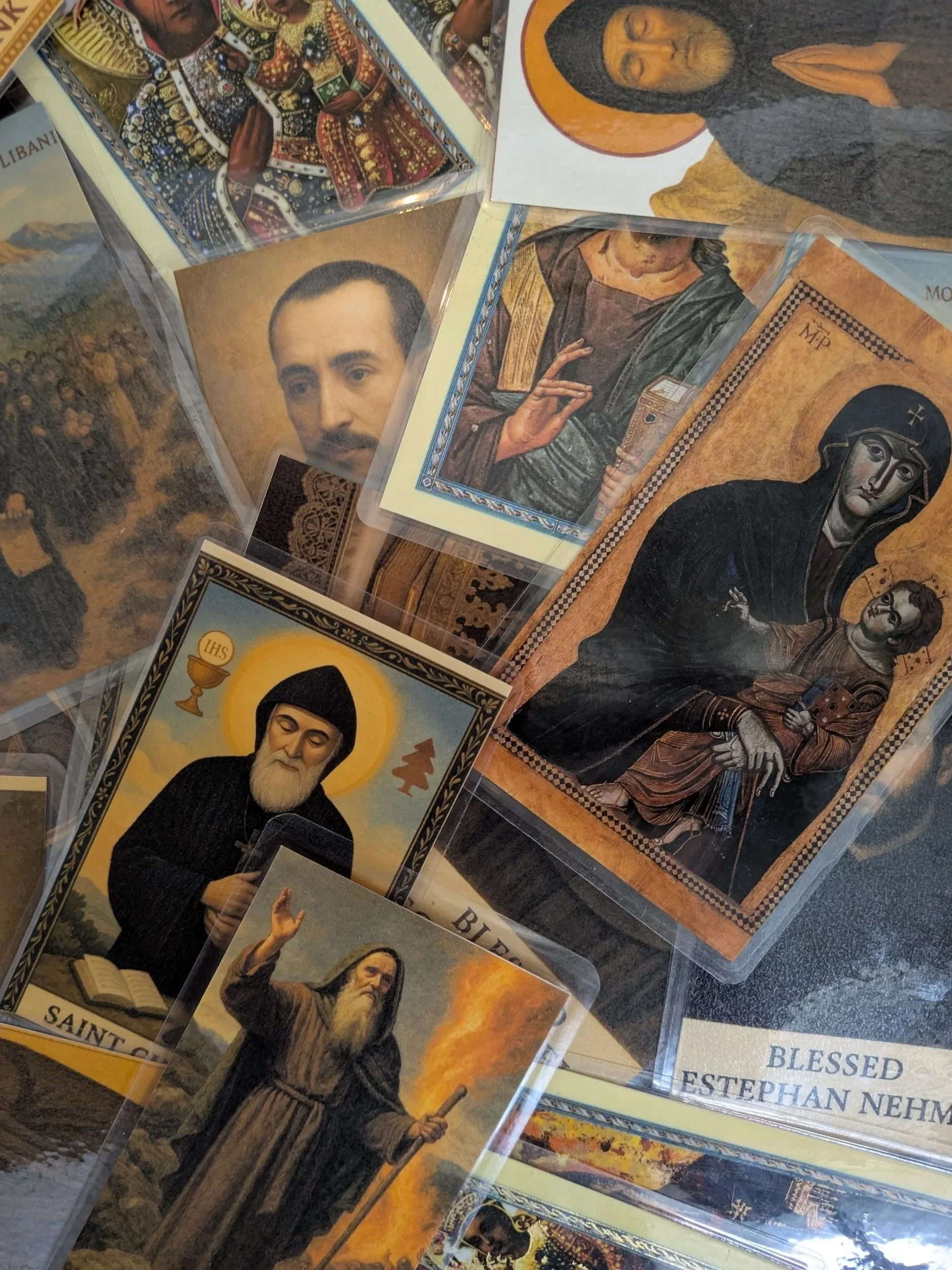
Blessed Josif Papamihali is exactly the kind of saint the world has largely forgotten — a Byzantine Catholic priest from Albania who died buried alive in a swamp in 1948 and whose story almost no one outside his community knows. We exist to make sure these saints are not forgotten. Our handmade prayer cards cover saints from every Eastern and Oriental Catholic tradition, including martyrs of the 20th century. Every card is printed, cut, and finished by hand — and prayed over throughout the entire creation process in Austin, Texas.
Browse the Prayer Card Directory →The World's First Atheist State: Total Suppression (1967–1991)
On February 6, 1967, Enver Hoxha stood before a congress of the Albanian Youth Union and announced that Albania would become the world's first officially atheist state. Within months, every religious institution in the country had been closed, nationalized, or demolished. Every church, every mosque, every monastery — over 2,000 religious buildings in total — was either destroyed, converted into a storehouse, a gymnasium, a cinema, or a cultural center, or repurposed for state use. The possession of religious objects, the performance of religious ceremonies in any form, and the teaching of religion to children were all criminalized. Clergy who refused to renounce their faith or to submit to state authority were imprisoned, tortured, or executed.
Albania under Hoxha did not merely suppress religion. It attempted the complete elimination of religion as a category of human existence. The constitution adopted in 1976 stated explicitly: "The state recognizes no religion, and supports atheist propaganda in order to implant a scientific materialist world outlook in people." In the countryside, ancient churches were dynamited. In the cities, mosques were converted into restaurants. The crucifix was outlawed as a symbol. The names of saints were removed from public squares. Children who were found to own a rosary could be reported to the authorities by their teachers or classmates. Adults who prayed in their own homes risked imprisonment.
What Happened to the Albanian Byzantine Catholic Church
The Albanian Byzantine Catholic community, already tiny — numbering perhaps a few thousand — was eliminated as an institution with a completeness that had no parallel elsewhere in the Eastern Catholic world. Unlike the Ukrainian Greek Catholic Church, which went underground with a remarkable degree of organizational continuity (clandestine bishops, secret ordinations, hidden Masses in apartments), or the Romanian Greek Catholic Church, which maintained some institutional memory through its martyrs and underground priests, the Albanian Byzantine Catholic Church essentially ceased to exist. There were no clandestine bishops. There was no underground network of priests. There were no secret Masses of the Byzantine rite in Albanian homes. There was, after Josif Papamihali's martyrdom in 1948 and the deaths or imprisonment of the handful of other Byzantine Catholic clergy, simply silence.
The memory of the Byzantine rite was preserved only in the consciousness of a small number of elderly faithful — people who remembered attending the Divine Liturgy as children, who carried in their minds the sound of the chanting, the smell of the incense, the prayers they had been taught before the world was unmade. For twenty-four years, from 1967 to 1991, they held this memory against the pressure of a state that insisted that God had never existed, that the liturgy they remembered was a superstition they should be ashamed of, and that the priests who had celebrated it before them were enemies of the people who had received the justice they deserved.
"In Albania, they did not just persecute religion. They tried to make the very idea of God illegal. What the underground church kept alive was not just the faith — it was the possibility of the sacred."
— Reflection on the Albanian Christian experience under Hoxha, Catholic Near East Welfare AssociationThe Underground Church: How the Memory Survived Without Buildings or Priests
The survival of the Albanian Byzantine Catholic community through the Hoxha period is one of the most haunting stories in 20th-century Christian history — precisely because it survived without most of the institutional mechanisms that the Ukrainian, Romanian, or Slovak underground churches used. There were no clandestine priests celebrating secret Masses. There were no underground bishops ordaining new clergy. There was no organized network of catechists smuggling religious materials across borders. What there was, instead, was memory — and the particular tenacity of communities that had already experienced the preservation of a tradition against impossible odds.
The Albanian Byzantine Catholics were the descendants, spiritually if not always biologically, of the Elbasan reunion community of 1900 — people who knew, at some level, that the rite their grandparents had received had itself been preserved in exile in Italy for four centuries before being brought home. The story of the Arbëreshë was not merely historical background for this community; it was a template for survival. If a rite could be kept alive in Italian mountain villages for five hundred years, perhaps it could be kept alive in Albanian minds and hearts for a few decades more.
What the Albanian Byzantine Catholics preserved in the atheist period was what all memory-based preservation preserves: fragments. The prayers said by grandmothers in whispers when no one outside the family could hear. The shape of the cross traced on a child's forehead when the teacher's back was turned. The Marian devotion that went by different names in the atheist state but was still, in its emotional core, the prayer to the Theotokos that Josif Papamihali had taught his parishioners in the months before his arrest: Pray to Our Lady.
Reconstruction After 1991: Coming Home for the Second Time
When the communist regime collapsed in 1991 and religious freedom was restored, the Albanian Byzantine Catholic Church faced a reconstruction challenge that was in some ways more difficult than what the Latin Catholic or Orthodox communities faced. The Latin Catholics had a large global church with institutional resources, trained clergy in diaspora, and a well-organized Vatican diplomatic infrastructure to support reconstruction. The Orthodoxhad numerical strength in Albania and international connections through the Ecumenical Patriarchate and other Orthodox churches. The Albanian Byzantine Catholics had approximately 3,000 faithful, no indigenous priests, no functioning parishes, no church buildings (those that had not been demolished had been converted to other uses), and no institutional infrastructure of any kind.
Once again, it was the Italo-Albanian connection that made reconstruction possible. Arbëreshë priests and Basilian monks from Grottaferrata came to Albania to celebrate the Byzantine liturgy, to catechize the community, and to begin the slow work of training indigenous Albanian Byzantine Catholic clergy. The cycle that had begun in 1900 — when Grottaferrata monks came to Elbasan to establish the Byzantine Catholic community — was repeating itself. The rite that Albanians had carried to Italy in the 15th century was, for the second time in the 20th century, being carried back to Albania by their Italian-Albanian heirs.
By 1998, the situation was assessed as extremely fragile: there were no established parishes and no resident priests for the Byzantine Catholic faithful. A small Byzantine parish was eventually established in Elbasan — the same city where Friar George Germanos had made his definitiveact of Catholic unity in 1900, and where Josif Papamihali had served as parish priest before his arrest. The Church of Saint Peter in Elbasan, where Papamihali had celebrated the Byzantine liturgy in the 1930s, became once again a center of Albanian Byzantine Catholic life.
The Current Status: Small but Alive
Today the Albanian Byzantine Catholic Church exists as the Apostolic Administration of Southern Albania. Its numbers are small — approximately 3,200 members — and the 2020 Pontifical Yearbook removed it from the list of autonomous (sui iuris) particular churches, reflecting its institutional fragility. It has nine parishes and eleven churches, served by four diocesan and ten religious priests, along with ten male and 97 female religious who also administer ten schools and twenty charitable institutions. The disproportion between the number of female religious and the size of the community is notable: the sisters who teach in Albanian Byzantine Catholic schools are, in many cases, the primary carriers of the community's identity and formation in a country where the institutional life of the church remains fragile.
Free Eastern Christian Marriage Resources
The Albanian Byzantine Catholic tradition — like all Eastern Christian traditions — understands marriage as a holy mystery, a covenant before God, and a living icon of Christ's love for his Church. The martyrs and confessors of the Albanian church knew that the survival of the faith depended not only on priests and bishops but on families: households where prayer was kept alive when the churches were closed, where children were given Christian names when the state demanded atheist ones, where the sign of the cross was traced in secret. Our free marriage resources honor this tradition.
Access Free Marriage Resources →The Liturgy: Koine Greek, Albanian, and the Byzantine Rite
The Albanian Byzantine Catholic Church celebrates the Byzantine Divine Liturgy — the same liturgy of Saint John Chrysostom used by the Greek Orthodox, the Melkite, the Ukrainian Greek Catholic, and all other Byzantine-rite churches. The liturgical language question — why this church uses both Koine Greek and Albanian — is one of the most frequently searched aspects of the tradition, and its answer illuminates the entire history we have been tracing.
Why Koine Greek?
The Byzantine rite has always used Koine Greek as its primary liturgical language — not because the communities celebrating it were ethnically Greek, but because Greek was the language of the New Testament, of the early church fathers, of the Ecumenical Councils, and of the theological tradition from which the Byzantine liturgy was drawn. Southern Albania, as we have noted, was evangelized under the influence of Constantinople and the Greek-speaking Byzantine church. The liturgical language of the southern Albanian Christian community was Greek for over a millennium before the Ottoman conquest — it was not an importation but a heritage.
The Italo-Albanian Catholic Church also uses Koine Greek alongside Albanian (Arbëreshë) — a liturgical practice that connects the church directly to the Byzantine heritage it preserved in exile. When the Albanian Byzantine Catholic Church in Elbasan uses Greek in its liturgy, it is using the same Greek that echoed in the churches of southern Albania before the Ottoman conquest, the same Greek that the Arbëreshë preserved in Calabria and Sicily for five centuries, and the same Greek that the Grottaferrata monks brought back to Elbasan in 1900.
Why Albanian?
The use of Albanian in the Byzantine liturgy is not a recent accommodation to modernity. The Arbëreshë communities were using Albanian alongside Greek in their liturgical celebrations from the earliest centuries of their presence in Italy. The process of incorporating Albanian into the Byzantine liturgy was part of the same resistance to Latinization that characterized the entire Arbëreshë cultural project: if the rite was to survive, it had to be the community's rite, in the community's language, not merely a Greek rite performed for Greeks.
What You Hear in an Albanian Byzantine Catholic Liturgy
The Divine Liturgy of Saint John Chrysostom — the standard Byzantine liturgy — is the primary eucharistic prayer. The liturgy alternates between Koine Greek for the ancient liturgical texts (the anaphora, the Scripture readings, the Trisagion) and Albanian (or Arbëreshë in Italy) for the congregational responses, the homily, and the more pastoral elements of the service. The chanting style follows the Byzantine tradition — antiphonal, modal, without Western harmonic accompaniment. Icons of Christ, the Theotokos, and the saints — in the Byzantine flat, frontal style — decorate the iconostasis and the church walls. The overall experience is unmistakably Eastern — unmistakably Byzantine — and equally unmistakably Albanian.
Albanian Byzantine Catholic vs. Albanian Orthodox: Same Rite, Different Communions
One of the most frequent search queries connected to this church is some variation of: "Why is there a Catholic church in Albania that looks Orthodox?" The answer, by now, should be clear — but it is worth stating directly, because it touches something important about the nature of Eastern Catholicism more broadly.
The Albanian Byzantine Catholic Church and the Albanian Orthodox Church (the Autocephalous Orthodox Church of Albania, in communion with the Ecumenical Patriarchate) use the same Byzantine rite. They celebrate the same Divine Liturgy of Saint John Chrysostom. They use the same liturgical structure, the same Greek language, similar chanting traditions, similar iconographic programs, and similar architectural forms. Walking into an Albanian Byzantine Catholic church and an Albanian Orthodox church, the uninformed visitor would have difficulty distinguishing them — which is precisely why the question "why does this Catholic church look Orthodox?" is so common.
The difference is the same as between any Eastern Catholic and Eastern Orthodox church: the Byzantine Catholic church is in full communion with the Pope of Rome and accepts his authority as the universal pastor of the Catholic Church; the Albanian Orthodox Church is in communion with the Ecumenical Patriarch of Constantinople and the broader Eastern Orthodox communion. Both consider themselves the legitimate heirs of the ancient Byzantine Christian tradition in Albania. Both claim historical continuity with the Byzantine Christianity of the pre-Ottoman period. Both celebrate liturgies that look and sound remarkably similar to an outside observer.
Why the Confusion Is Deeper in Albania Than Elsewhere
In most countries where Eastern Catholics and Eastern Orthodox coexist, the distinction is relatively well-understood at the popular level — Ukrainian Greek Catholics and Ukrainian Orthodox, Melkite Catholics and Greek Orthodox, Coptic Catholics and Coptic Orthodox. In Albania, the confusion is deeper for three reasons. First, the Albanian Byzantine Catholic community is so small (3,200 people) that most Albanians — even Christian Albanians — have never encountered it and may not know it exists. Second, the historical connection between the Italo-Albanian Church and the Albanian Byzantine Catholic Church creates a further layer of complexity. Third, Albania's decades as an atheist state wiped out the institutional memory and the common religious literacy that would allow ordinary citizens to navigate the distinctions between different Christian communities.
The Cycle of Preservation: One Rite, Five Centuries, Two Crossings
The history of the Albanian Byzantine rite is one of the most extraordinary examples of liturgical preservation in the history of Christianity. It can be summarized as a cycle — a movement of departure and return, exile and homecoming, suppression and resurrection — that has now completed itself twice, and whose second completion was made possible only by the first.
✦ The Albanian Byzantine Rite: A 600-Year Cycle ✦
The theological significance of this cycle is profound. Every other Eastern Catholic church that survived suppression did so through institutional continuity — underground bishops, secret ordinations, hidden Masses. The Albanian Byzantine Catholic Church survived the second suppression only through memory and through the existence of a sister community in Italy that could serve as its institutional refuge. In this sense, the Arbëreshë were not merely ethnically or culturally connected to the Albanian Byzantine Catholics. They were their institutional survival — the vessel in which the rite was held when Albania itself could not hold it.
This creates a theology of rite-as-shared-heritage that is different from any other Eastern Catholic tradition. The Albanian Byzantine Catholics do not simply inherit a rite from their ancestors; they receive it, twice over, as a gift from a community that preserved it on their behalf. The gratitude of this position — and the humility it requires — shapes the Albanian Byzantine Catholic community's relationship to its liturgical tradition in ways that distinguish it from churches whose rite was never broken.
Marriage and Family Life in the Albanian Byzantine Catholic Tradition
Marriage in the Byzantine tradition — shared by the Albanian Byzantine Catholics and their Italo-Albanian counterparts — is the same holy mystery celebrated throughout the Eastern Christian world: a crowning, a circling of the altar, a covenant blessed by the whole Church. The crowns placed on the heads of bride and groom are not symbols of honor but of martyrdom — the call to lay down one's life in the daily sacrifice of spousal love. The circling of the altar three times represents the couple's walking together in the way of the cross, with Christ as the center of their common life.
In the Albanian context, marriage and family life carry additional weight because the family was the primary unit of religious survival during the atheist period. When churches were closed and priests were imprisoned or executed, it was in family homes that children received their first introduction to the faith — in the whispered prayers of grandmothers, in the sign of the cross traced in secret, in the stories of Blessed Josif Papamihali and the other martyrs told after the children were in bed. The family was the underground church, and this gave Albanian Christian family life a quality of sacred resistance that is not easily forgotten even in a post-communist generation.
The Italo-Albanian communities have a particularly vivid expression of this marriage-and-community theology in their Easter celebrations, where the wearing of traditional Albanian costume — preserved unchanged for five centuries — is inseparable from the celebration of the Byzantine Paschal liturgy. The costume is not merely folk dress; it is a theological statement: this is who we are, this is what we have preserved, this is the beauty that no Ottoman conquest and no Italian assimilation and no political pressure could erase. Marriage, in the Albanian Byzantine tradition, is the sacrament that perpetuates this beauty from generation to generation.
Frequently Asked Questions
The Albanian Byzantine Catholic Church (officially: Apostolic Administration of Southern Albania) is a small Eastern Catholic community of approximately 3,200–3,500 members within the Republic of Albania, using the Byzantine rite in Koine Greek and Albanian. It is in full communion with the Pope of Rome. Its history traces to a 1900 reunion movement in Elbasan led by Archimandrite George Germanos, and it was completely suppressed during Albania's period as the world's first declared atheist state (1967–1991). It is closely related to the Italo-Albanian Catholic Church of southern Italy and Sicily.
They are two distinct churches sharing the same Byzantine rite and Albanian heritage. The Albanian Byzantine Catholic Church is in Albania itself, with ~3,200 members, headquartered in the Apostolic Administration of Southern Albania. The Italo-Albanian Catholic Church is in Italy (Eparchies of Lungro in Calabria and Piana degli Albanesi in Sicily, plus Grottaferrata Abbey), with ~50,000–80,000 members — the descendants of Albanians who fled the Ottoman conquest in the 15th century. Historically, the Italo-Albanian Church has served as the institutional vessel that preserved the Byzantine rite during periods when it was suppressed in Albania itself — most critically during the 1967–1991 atheist period — and has twice sent priests back to help reconstruct the Albanian church.
The Arbëreshë (also called Italo-Albanians) are the Albanian communities of southern Italy and Sicily who descend from Albanian Orthodox Christians who fled the Ottoman conquest of Albania in the 15th century. Beginning around 1448 and accelerating after the death of national hero Skanderbeg in 1468, these Albanian refugees settled in Calabria, Sicily, and other parts of southern Italy, where they preserved their language (an archaic form of 15th-century Albanian), their customs, and their Byzantine rite for over 500 years. Today they number approximately 50,000–80,000 in the Byzantine Catholic tradition and are organized into the Italo-Albanian Catholic Church.
Yes. On February 6, 1967, Albanian communist leader Enver Hoxha declared Albania the world's first officially atheist state. The 1976 constitution stated explicitly: "The state recognizes no religion." All religious practice was criminalized. Over 2,000 churches, mosques, and monasteries were closed, demolished, or repurposed. Clergy who refused to submit were imprisoned, tortured, or executed. The possession of religious objects, the performance of religious ceremonies, and the teaching of religion to children were all illegal offenses. This total suppression lasted until 1991, when the regime collapsed and religious freedom was restored. No other state in history declared itself atheist by constitutional definition in this way.
Blessed Josif Papamihali (September 23, 1912 – October 26, 1948) was an Albanian Byzantine Catholic priest from Elbasan, Albania, who was martyred by the communist regime of Enver Hoxha. Born into an Albanian Orthodox family, he studied at the Grottaferrata Seminary in Rome (from age 11) and the Pontifical Greek College of Saint Athanasius, and was ordained in 1935 by Bishop Giovanni Mele of Lungro (the Italo-Albanian bishop). He served as parish priest in Elbasan and became de facto head of the Albanian Greek Catholic Church during the early communist period. He was arrested in 1946, sentenced to forced labor in 1947, and martyred on October 26, 1948, when he was buried alive in the swamp mud at the Maliq labor camp after collapsing from exhaustion. He was beatified by Pope Francis in Shkodër on November 5, 2016, along with 37 other Albanian martyrs.
The Albanian Byzantine Catholic Church uses Koine Greek in its liturgy because it uses the Byzantine rite — a liturgical tradition that has always used Greek as its primary liturgical language, regardless of the ethnic identity of the communities celebrating it. Southern Albania was historically evangelized under Byzantine/Greek influence, and the Greek liturgy was the rite of southern Albanian Christians for over a millennium before the Ottoman conquest. The Arbëreshë of Italy preserved Greek alongside Albanian in their liturgy for five centuries. When the rite was brought back to Albania in 1900 by Grottaferrata-trained priests, Greek came with it. Today the liturgy alternates between Koine Greek and Albanian (or Arbëreshë in Italy) — a bilingual practice rooted in centuries of Italo-Albanian tradition.
The Eparchy of Lungro (full name: Eparchy of Lungro of the Italo-Albanians of Continental Italy) is one of the two eparchies of the Italo-Albanian Catholic Church, covering mainland Italy (primarily Calabria). It was established on February 13, 1919, by Pope Benedict XV — the first time the Albanian Byzantine Catholics of the Italian mainland had their own bishop after nearly five centuries in Italy. It has approximately 27–29 parishes, mostly in Calabria. Its cathedral is the Cathedral of Saint Nicholas of Myra in Lungro, Calabria. The first bishop of Lungro, Giovanni Mele, was the bishop who ordained the future martyr Blessed Josif Papamihali in 1935. The Eparchy of Lungro has been historically important in forming priests for both Italy and Albania.
Elbasan is the historical heart of the Albanian Byzantine Catholic Church. It was in Elbasan around 1900 that Archimandrite George Germanos led the reunion movement that re-established Byzantine Catholicism in Albania. The Church of Saint Peter in Elbasan was where Blessed Josif Papamihali served as parish priest in the 1930s. After the communist suppression ended in 1991, it was again in Elbasan that the first small Byzantine Catholic parish was re-established. Elbasan represents the entire cycle of the Albanian Byzantine rite's history in miniature: reunion, construction, martyrdom, destruction, and reconstruction — all in the same city.
Yes. The Albanian Byzantine Catholic Church is in full communion with Rome, and its Eucharist is a valid Catholic sacrament. Roman Catholics may attend and receive communion, though it is always respectful to follow local norms. In practice, Albanian Byzantine Catholic parishes are extremely rare outside Albania and Italy, so the opportunity is limited for most Catholics. If you are in Calabria, Sicily, or southern Albania and encounter an Arbëreshë or Albanian Byzantine Catholic community, you are in one of the rarest liturgical spaces in the Catholic world — a living link to the Byzantine Christianity that Albanian ancestors carried across the Adriatic five centuries ago.
The Albanian Orthodox Church — the largest Christian community in Albania — was suppressed along with all other religious institutions in 1967. Its churches were closed or demolished, its clergy imprisoned or executed, and its institutional life eliminated. After 1991, the Ecumenical Patriarchate of Constantinople sent Archbishop Anastasios Yannoulatos to Albania to rebuild the church from essentially nothing. Under his leadership, the Albanian Orthodox Church was substantially reconstructed — new churches built, clergy trained, schools established. The Albanian Orthodox Church today is the largest Christian denomination in Albania, though still a minority in a predominantly Muslim-majority country. Its reconstruction has been more substantial than that of the Albanian Byzantine Catholic Church, partly due to greater international institutional support.
The Territorial Abbey of Santa Maria di Grottaferrata is located near Frascati, in the hills south of Rome. Founded in 1004 by Saint Nilo of Rossano, it is the only surviving Italo-Greek Byzantine monastery in Italy and one of the oldest continuously operating Byzantine monasteries in the world. It became associated with the Albanian Byzantine tradition when Basilian monks from Grottaferrata were sent to serve the newly reunited Albanian Byzantine Catholic community in Elbasan in 1900. The young Josif Papamihali studied at Grottaferrata before moving to the Pontifical Greek College of Saint Athanasius. Grottaferrata's significance for the Albanian Byzantine Catholic Church is that it was the point of contact between the Italian-preserved tradition and the Albanian homeland — twice over, in 1900 and again after 1991.
Explore the Martyrs and Saints of the Whole Eastern Church
The Albanian Byzantine Catholic Church is one of the smallest and least-known communities in all of Catholicism — but its story of exile, preservation, martyrdom, and resurrection is one of the most powerful in the entire history of the Church. We are working to make sure it is never forgotten.
Browse the Prayer Card DirectoryByzantine Icons of Christ — The Same Tradition
The Albanian Byzantine Catholics venerate the same icons, celebrate the same Divine Liturgy, and look upon the same face of Christ as all Byzantine-rite Christians. These handcrafted wooden icons honor that ancient tradition.