Holy Qurbono vs Holy Qurbana: The Complete Guide to the Syro-Malankara and Syro-Malabar Catholic Churches
Holy Qurbono vs. Holy Qurbana The Complete Liturgical & Historical Guide to the Syro-Malankara and Syro-Malabar Catholic Churches
Two churches. One state in India. Both claim Saint Thomas the Apostle. Both celebrate the Eucharist in ancient Syriac. Both are fully Catholic. And yet the liturgy is so different that attending one when you expected the other can feel like arriving on a different planet. This is the complete forensic guide to every difference — from the single vowel that separates "Qurbono" from "Qurbana" to the golden Marvahtho fans, the veiled sanctuary, and the oldest eucharistic prayer still celebrated on earth.
Why Everyone Gets Confused: The Problem This Article Solves
If you have ever attended a wedding or funeral in Kerala, India — or in any of the large Indian Catholic diaspora communities in the United States, the United Kingdom, Australia, or the Gulf states — you may have found yourself standing in a church that was unmistakably ancient, unmistakably Asian, and unmistakably something other than the Roman Catholic church you grew up in. The priest's vestments were strange. The sanctuary was veiled. The chanting was in a language that sounded vaguely like Aramaic. Someone mentioned "Qurbono" and someone else said "Qurbana" and you realized you were not entirely sure which church you were in, what rite was being celebrated, or why it seemed different from the other Indian Catholic Mass you had attended last year.
You are not alone. The confusion between the Syro-Malankara Catholic Church and the Syro-Malabar Catholic Church is one of the most common and most underserved confusion points in all of Catholic ecclesiology. Even practicing Catholics from these communities sometimes struggle to articulate clearly what distinguishes one from the other. The names sound similar. Both are in Kerala. Both trace their origins to Saint Thomas the Apostle. Both celebrate an ancient Syriac liturgy. Both are in full communion with Rome. The difference between them goes far deeper than a single vowel — and understanding it will transform the way you experience both.
This article gives you the complete picture: the linguistic analysis of "Qurbono" vs. "Qurbana," the history of two divergent Syriac traditions that converged in one small state of India, the liturgical forensics of what you see and hear when you walk through each church door, the specific ritual objects — including the famous Marvahtho fans — that signal which rite you are in, and the theological differences that underlie the aesthetic ones. By the end, you will never confuse the two again.
The Word Itself: One Syriac Root, Two Dialects, Two Worlds
Before anything else — before history, before theology, before the names of churches and councils — there is a single Syriac word at the center of everything: Qurbana/Qurbono. Understanding this word, in its two forms, is the key that unlocks the entire difference between these two churches.
Antiochene tradition
Liturgy of Saint James
Used also by Maronites & Syriac Catholics
Chaldean / Edessan tradition
Anaphora of Addai and Mari
Used also by Chaldeans & Assyrians
The Linguistics: Same Word, Different Pronunciation
The word is written identically in classical Syriac script: ܩܘܪܒܳܢܳܐ. It derives from the Syriac root qrb (ܩܪܒ) — meaning "to draw near," "to approach," or "to offer." A qurbana/qurbono is therefore literally an "oblation" or "offering" — something drawn near to God, something offered up. It is the same root as the Hebrew qorban (קָרְבָּן) found throughout the Hebrew Bible, where it refers to the sacrificial offerings of the Temple. When Syriac Christians named their Eucharist the Qurbana or Qurbono, they were making a direct and deliberate theological statement: this is the sacrifice, the ultimate and final offering that fulfills and supersedes every Temple sacrifice of the old covenant.
The two forms of the word differ only in their voweling — the way the final syllables are pronounced — which reflects the phonological difference between the West Syriac and East Syriac dialects. Think of it as the difference between British English "bath" (bɑːθ) and American English "bath" (bæθ): the same word, the same meaning, the same spelling in most contexts, but a different sound that immediately reveals which tradition you are in. West Syriac says Qur-bó-no; East Syriac says Qur-bá-na. That difference in the final vowel is not merely phonetic — it is the auditory signature of two thousand years of divergent theological and liturgical development.
The Mar / Mor Distinction: Another Tell-Tale Sign
The same East/West Syriac voweling difference appears in the honorific title for bishops and saints. East Syriac says Mar — as in "Mar Thomas" or "Mar Addai." West Syriac says Mor (or Mor) — as in "Mor Gregorios" or "Mor Ivanios." If you hear someone call the same apostle "Mar Thomas" vs. "Mor Tuma," you are hearing the East Syriac vs. West Syriac divide in a single syllable. The Syro-Malabar tradition uses "Mar." The Syro-Malankara tradition uses "Mor" (though many Indian members also say "Mar" in everyday speech, due to centuries of East Syriac linguistic influence on Kerala Christian culture).
Why the Same Communities Use Different Dialects
Here is the historical irony at the heart of the confusion: the Thomas Christians of Kerala originally used the East Syriac dialect and tradition — brought to them by missionaries from the Persian church, based in Seleucia-Ctesiphon. This is why East Syriac words like Mar and Qurbana are so deeply embedded in Kerala Christian culture that even communities that switched to the West Syriac rite in the 17th century still use them colloquially. The shift to West Syriac — and thus to Qurbono — was imposed on one part of the community by Antiochene bishops in the 1660s and 1700s. The other part stayed with East Syriac. The result is two communities in the same state, sometimes in the same family, using different liturgical vocabularies for the same sacrament — and frequently confusing everyone who is not deeply embedded in the tradition.
Quick Comparison: Syro-Malankara vs. Syro-Malabar Catholic
| Category | Syro-Malankara Catholic | Syro-Malabar Catholic |
|---|---|---|
| Name of Eucharist | Holy Qurbono | Holy Qurbana |
| Syriac Tradition | West Syriac (Antiochene) | East Syriac (Chaldean / Edessan / Persian) |
| Liturgical Rite | Antiochene Rite (West Syriac) | Chaldean Rite (East Syriac) |
| Primary Anaphora | Anaphora of Saint James (Mor Yacob) | Anaphora of Addai and Mari (oldest in Christendom) |
| Sister Churches (same rite) | Maronite, Syriac Catholic, Syriac Orthodox | Chaldean Catholic, Assyrian Church, Ancient CoE |
| Origin of Rite in Kerala | Brought by Mor Gregorios of Antioch, 1665 | Original Thomas Christian rite; Persian church |
| Reunited with Rome | 1930 (Mar Ivanios reunion) | Synod of Diamper, 1599; restored 1923 |
| Headquarters | Thiruvananthapuram (Trivandrum), Kerala | Ernakulam-Angamaly, Kerala |
| Members | ~500,000 worldwide | ~6 million worldwide (3rd largest Eastern Catholic) |
| Sanctuary Veil | Yes — curtain drawn during mystical hours | Altar more visible; less use of veil |
| Marvahtho Fans | Yes — used during Anaphora | Not a standard feature |
| Three Mystical Hours | Yes — unique structure of the Qurbono | No equivalent structure |
| Bishop Title | Mor (West Syriac) | Mar (East Syriac) |
| Christological Heritage | Originally Miaphysite (Oriental Orthodox); now Chalcedonian as Eastern Catholic | Dyophysite (Chalcedonian) throughout history |
| Shoes in Church | Removed before entering — a distinctive Malankara practice | Not standard practice |
| Men/Women Separation | Traditional — opposite sides of the nave | Less strictly observed today |
| Primary Language | Malayalam + Syriac (West Syriac texts) | Malayalam + Syriac (East Syriac texts) |
| Liturgical Music Style | Antiochene chant tradition; deeply musical, "soaked in music" | East Syriac chant; distinct melodic tradition |
| Married Priests | Yes (same as all Eastern Catholic churches) | Yes (same) |
| Infant Communion | Yes — at Baptism | Yes — at Baptism |
The Thomas Christians: The Ancient Community Both Churches Claim
To understand why there are two Indian Eastern Catholic churches using two different Syriac rites in the same small state, you need to begin where they both begin: with the Thomas Christians, also called the Nasranis or the Syriac Christians of Kerala, one of the most ancient Christian communities on earth.
The Thomas Christians trace their origin to the evangelistic mission of Saint Thomas the Apostle — Doubting Thomas of the Gospels — who, according to a tradition that is ancient, persistent, and taken seriously by historians of early Christianity, sailed from the Middle East to the Malabar Coast of India (modern Kerala) in approximately 52 AD. He is said to have established seven churches in Kerala, baptized thousands, ordained local clergy, and eventually traveled south to the Coromandel Coast (modern Tamil Nadu), where he was martyred near present-day Chennai around 72 AD. His tomb at San Thome Cathedral in Chennai is a major pilgrimage site.
Whether or not the Thomas tradition in its details is historically verifiable, what is certain is that by the time the Portuguese arrived in Kerala in 1498, they encountered a Christian community of considerable antiquity, sophistication, and size — numbering in the tens of thousands, organized under a system of archdeacons, celebrating a liturgy in the East Syriac rite (brought by missionaries from the Syriac-speaking church of Persia), and deeply integrated into the social and economic fabric of the region. These Christians were described by the Portuguese explorer Vasco da Gama as "a people of white and good appearance, and well-dressed," and when they showed him their churches, he reportedly mistook them for Hindu temples decorated with Christian symbols — a misidentification that tells us as much about European assumptions as about the Indians.
"Indian in culture, Christian in faith, Syriac in liturgy."
— The self-description of the Saint Thomas Christian community of KeralaThe East Syriac Original
In the beginning — before the Portuguese arrived, before the Coonan Cross Oath, before West Syriac bishops came from Antioch — all Thomas Christians used the East Syriac rite. Their liturgy was the same tradition as the Chaldean Church of Iraq: the Anaphora of Addai and Mari, the East Syriac calendar, the East Syriac pronunciation of every word. This is why "Qurbana" and "Mar" are so deeply embedded in the linguistic habits of all Kerala Christians, regardless of which church they now belong to. The East Syriac roots are the original soil from which everything else grew.
The Coonan Cross Oath (1653): The Day One Church Became Many
The story of how the Thomas Christians split — and how that split eventually produced the Syro-Malankara and Syro-Malabar Catholic churches — begins with one of the most dramatic scenes in the history of Indian Christianity: the Coonan Cross Oath of 1653.
By the mid-17th century, the Thomas Christians had been under Portuguese colonial authority for over a century. The Portuguese had arrived as protectors but quickly became dominators. They subjected the Thomas Christians to the authority of Latin Catholic bishops, imposed the Roman rite, required conformity with Latin Catholic practice, and — most controversially — treated the ancient independent Thomas Christian church as a mission territory to be reformed rather than a legitimate apostolic community to be respected. The Synod of Diamper (1599), convened by the Latin Archbishop Aleixo de Menezes, effectively outlawed the traditional East Syriac liturgy and theology and imposed Latin Catholic practice across the entire Thomas Christian community.
Resistance had been building for decades. When a delegate from the Patriarch of Antioch — Bishop Ahatallah — was arrested by the Portuguese and reportedly drowned at sea (the Thomas Christians believed he had been executed), the community's patience broke. On January 3, 1653, at the church of Mattancherry in Ernakulam, a vast assembly of Thomas Christians — reportedly 84 churches represented — gathered around a large cross and swore an oath. Those at the front touched the rope tied to the cross with their hands. Those further away, unable to reach through the crowd, touched ropes tied to the central rope. The Coonan Cross Oath — the name means "the bent cross oath" — declared that the Thomas Christians would no longer submit to the authority of the Latin Catholic Portuguese Padroado. It was one of the most significant acts of ecclesiastical independence in the history of Christianity outside Europe.
The Two Parties After the Coonan Cross Oath
Pazhayakuttukar ("Old Allegiance"): Those who eventually reconciled with Rome. They remained in communion with the Catholic Church under Bishop Palliveettil Chandy and preserved the traditional East Syriac liturgy. Their descendants became the Syro-Malabar Catholics.
Puthenkuttukar ("New Allegiance"): Those who refused reconciliation with Rome and aligned with the Syriac Orthodox Church of Antioch. They received West Syriac bishops from Antioch and gradually adopted the West Syriac rite. Their descendants eventually became the Malankara Orthodox Syrian Church — and, in 1930, the Syro-Malankara Catholic Church when Mar Ivanios led a reunion with Rome.
How West and East Syriac Divided One Community
After the Coonan Cross Oath, the Puthenkuttukar — those who had broken from Rome — sent messengers to various Eastern churches seeking canonical episcopal consecration. Only one church responded: the Syriac Orthodox Patriarch of Antioch, who in 1665 sent Mor Gregorios Abdal Jaleel, a bishop of Jerusalem, to India.
Mor Gregorios arrived in Kerala bringing with him something the Puthenkuttukar had not expected: the entire liturgical and theological apparatus of the West Syriac tradition. The Antiochene church used a completely different rite from the East Syriac one the Thomas Christians had always known. Gregorios brought West Syriac vestments, West Syriac chant, the Liturgy of Saint James, and the West Syriac theological vocabulary including — crucially — the Miaphysite Christology of the Syrian Orthodox Church, which rejected the Council of Chalcedon just as the Coptic and Ethiopian churches did.
The adoption of the West Syriac rite was gradual and not without resistance. For nearly a century, the Malankara Church practiced a hybrid of West Syriac and old East Syriac elements. Not until 1772, when visiting bishops from Antioch consecrated Mar Thoma VI as Mar Dionysius I and established a systematic hierarchy, did the West Syriac rite become fully normative in the Malankara community. By then, two generations had grown up hearing "Qurbono" instead of "Qurbana" — but the old East Syriac words had not entirely disappeared from the community's vocabulary or memory.
The Historical Timeline That Explains Everything
Saint Thomas the Apostle arrives on the Malabar Coast of India. The Thomas Christian community is founded.
Persian church missionaries establish formal ecclesiastical structure for the Thomas Christians. East Syriac rite becomes the liturgical standard. Merchant Thomas of Cana (Knai Thoma) arrives with Syrian Christians around 345 AD, reinforcing the East Syriac heritage.
Portuguese arrive in Kerala. Vasco da Gama encounters the Thomas Christians. The Portuguese colonial religious project begins.
Synod of Diamper imposed by Latin Archbishop Aleixo de Menezes. The traditional East Syriac liturgy is effectively suppressed. The Thomas Christians are Latinized against their will.
The Coonan Cross Oath. The Thomas Christians split into Pazhayakuttukar (Catholic) and Puthenkuttukar (independent). The divided community will never fully reunite.
Mor Gregorios Abdal Jaleel arrives from Antioch with the West Syriac rite. The Puthenkuttukar begin their gradual adoption of the Antiochene liturgical tradition. "Qurbono" begins to replace "Qurbana" in one half of the community.
Systematic adoption of the West Syriac rite is formalized under Mar Dionysius I. The Malankara Church is now definitively an Antiochene church.
The Catholic East Syriac hierarchy in India is formally restored as the Syro-Malabar Church, with Augustine Kandathil as the first Metropolitan.
Archbishop Mor Geevarghese Ivanios and Bishop Mor Theophilos of the Malankara Orthodox Syrian Church reunite with Rome on September 20. The Syro-Malankara Catholic Church is born.
The name "Syro-Malabar Catholics" is formally adopted to distinguish the East Syriac Catholic community from the newly united Syro-Malankara Catholics.
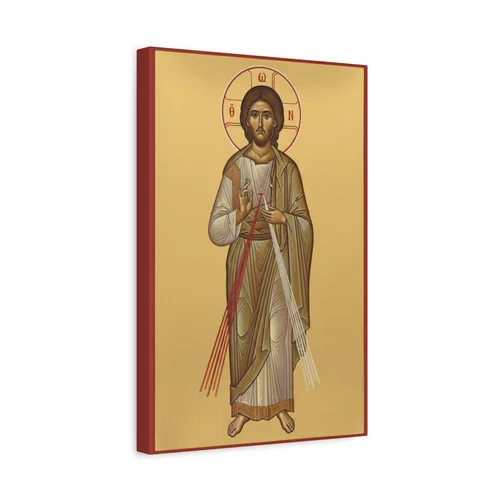
Sacred Eastern Christian Art & Devotion
The Syriac Christian tradition — West and East — shares the same icon tradition, the same Jesus Prayer, the same Eucharistic theology. These items honor the whole Syriac and Eastern Christian heritage.

Mar Ivanios and the 1930 Reunion: The Birth of the Syro-Malankara Catholic Church
The Syro-Malankara Catholic Church was born on September 20, 1930, in one of the most significant acts of ecclesiastical reunion in modern Catholic history. On that day, Archbishop Mor Geevarghese Ivanios and Bishop Mor Theophilos — both bishops of the Malankara Orthodox Syrian Church — formally reunited with the Catholic Church in the presence of the Apostolic Delegate to India, Archbishop Arulappa. With them came a small group of priests and laypeople. The Syro-Malankara Catholic Church had come into existence.
Who Was Mor Geevarghese Ivanios?
Born in 1882 in a small village in Kerala, Geevarghese Panicker was educated at CMS College Kottayam and went on to become one of the most intellectually gifted and spiritually serious bishops in the Malankara Orthodox Syrian Church. He was consecrated as a bishop in 1925 and given the name Ivanios — the West Syriac form of "John." He had long been drawn to the question of Christian unity: not through compromise or indifferentism, but through a genuine conviction that the visible unity of the Church was Christ's will and that the separation of the Malankara tradition from Rome was a wound in the Body of Christ that could and should be healed.
Ivanios was careful and theologically serious in his approach to reunion. He did not want to bring his community into Rome only to lose everything that made it distinctively Malankara — the West Syriac liturgy, the ancient rite, the particular Indian character of the church's life and worship. He negotiated explicitly to ensure that the West Syriac Antiochene rite would be preserved in full, that the Malankara Catholic Church would retain its own hierarchy and identity, and that it would not be Latinized or absorbed into the Roman rite. The Vatican, under Pope Pius XI, agreed to these conditions.
"The Malankara Catholic Church came into being not to destroy anything but to fulfill — to bring the ancient West Syriac heritage of the Thomas Christians into the fullness of Catholic communion without losing a single note of its liturgical or spiritual inheritance."
— Paraphrase of Mar Ivanios's theological vision, from his writings on the reunion
Why Ivanios Matters for the Qurbono/Qurbana Question
The significance of Mar Ivanios for the liturgical confusion we are addressing cannot be overstated. When he brought the Malankara community into Rome in 1930, he brought with it the entire West Syriac liturgical apparatus that had been accumulating since Mor Gregorios arrived from Antioch in 1665. This means that the Holy Qurbono — the West Syriac Eucharist celebrated according to the Antiochene tradition, with its veiled sanctuary, its three mystical hours, its Marvahtho fans, its Liturgy of Saint James — became the liturgy of a Catholic church in India. The Syro-Malabar Church had been Catholic for centuries before this, celebrating the East Syriac Qurbana. Now India had two Catholic Syriac liturgies. And the confusion began in earnest.
Mar Ivanios is a candidate for beatification. The Cause for his beatification was formally opened by the Vatican in 2012. He died in 1953 and is buried at Sardhana Church in Trivandrum, where his tomb is a pilgrimage site for Syro-Malankara Catholics.
The Syro-Malankara Catholic Church: A Deep Dive
The Syro-Malankara Catholic Church is headquartered in Thiruvananthapuram (Trivandrum), the capital of Kerala. It has approximately 500,000 members worldwide — making it one of the smaller Eastern Catholic churches — with the vast majority concentrated in Kerala and a growing diaspora in North America, Europe, and the Gulf states. The Major Archbishop of the Syro-Malankara Catholic Church also carries the title of Cardinal; Cardinal Baselios Cleemis Thottunkal was elevated to the College of Cardinals in 2012, giving the church unprecedented visibility in the global Catholic community.
What Makes the Syro-Malankara Church Distinctively Indian
One of the striking things about the Syro-Malankara Church is how thoroughly it embodies the Malankara self-description as "Indian in culture, Christian in faith, Syriac in liturgy." Unlike many Eastern Catholic churches whose identity is primarily defined by their ethnic or national homeland (Coptic = Egyptian, Maronite = Lebanese), the Syro-Malankara Church has always understood itself as a genuinely Indian church — not a transplant from the Middle East but a tradition that was born in India, shaped in India, and belongs to India.
This Indian identity is expressed in several ways: the removal of shoes before entering the church (a practice shared with Hindu and Islamic worship spaces in India, which Malankara Christians observe as an expression of holiness rather than cultural compromise); the separation of men and women on opposite sides of the nave; the use of Malayalam as the primary liturgical language alongside Syriac; and a quality of liturgical musicality that has absorbed some of the melodic patterns of the Kerala musical tradition even while preserving the ancient Syrian chant forms.
✦ The Syro-Malankara Catholic Church: Key Facts ✦
The Syro-Malabar Catholic Church: A Deep Dive
The Syro-Malabar Catholic Church is the third-largest particular church in the entire Catholic communion — after the Latin Church and the Ukrainian Greek Catholic Church — with approximately 5–6 million members worldwide. It is headquartered at Ernakulam-Angamaly in central Kerala, and its Major Archbishop also bears the title of Cardinal. The Syro-Malabar Church is, by any measure, a major presence in world Catholicism — and it has been in communion with Rome, in one form or another, for four centuries.
The East Syriac Heritage
The Syro-Malabar Church's liturgical roots are in the East Syriac tradition — specifically the tradition of the Church of the East, centered in the Persian capital of Seleucia-Ctesiphon and tracing its apostolic lineage through Saint Addai and his disciple Saint Mari. The primary eucharistic prayer of the East Syriac tradition — the Anaphora of Addai and Mari — is one of the oldest surviving eucharistic prayers in all of Christendom, potentially dating to the 3rd century in its earliest form. It is unique among eucharistic prayers in that it does not contain the Words of Institution ("This is my body... this is my blood...") as a direct quotation — a fact that raised significant ecumenical questions that the Vatican addressed in a special 2001 document permitting Chaldean Catholics to receive communion at an Assyrian celebration of the Anaphora of Addai and Mari without the Words of Institution being recited.
The Synod of Diamper and the Long Road Back
The Syro-Malabar Church's path is one of the most complicated in Catholic history. After the Synod of Diamper (1599) imposed Latin practice on the Thomas Christians, the East Syriac Catholics who remained in communion with Rome were subjected to a century and a half of Latinization. After the Coonan Cross Oath split the community, the Catholic remnant — the Pazhayakuttukar — continued to exist but in a state of significant liturgical and hierarchical ambiguity. It was not until the early 20th century that the East Syriac hierarchy was formally restored, and the Syro-Malabar Church as a formal institution dates from 1923. The church has spent much of the century since then in the work of liturgical restoration — recovering its East Syriac heritage from the Latin accretions of the Portuguese period.
Free Eastern Christian Marriage Resources
When a Syro-Malankara and a Syro-Malabar Catholic marry, they bring two ancient Syriac traditions into one household. Both traditions understand marriage as a holy mystery — a crowning, a martyrdom, a living icon of the love between Christ and his Church. Our free marriage resources draw on the depths of the entire Syriac and Eastern Christian tradition to strengthen your marriage through prayer and the wisdom of the saints.
Access Free Marriage Resources →Anatomy of the Holy Qurbono: What You Will See and Hear (Malankara)
If you walk into a Syro-Malankara Catholic church for a Sunday liturgy — or for a wedding or funeral that uses the Holy Qurbono — here is what you will encounter. This section is the forensic guide you need. Every element described here is either absent from or structurally different in the Syro-Malabar Qurbana, and those differences are noted.
Before You Enter: Remove Your Shoes
The first distinctive thing you will notice about a Malankara Catholic church is that you remove your shoes before entering. Sandals, shoes, and slippers are left at the door. This practice — shared with Hindu and Muslim sacred spaces in India — is a deliberate expression of the Malankara understanding that the church is holy ground, and that entering it in bare feet is an act of humility and reverence. It also marks the Malankara church as genuinely Indian in a way that most Western visitors find immediately striking. You will not be asked to remove your shoes at a Syro-Malabar Qurbana.
The Architecture: Madbaho, Quaestrumo, Nave
A traditional Malankara church is divided into three distinct spaces, each with a theological meaning. The Madbaho (ܡܕܒܚܐ) is the Holy of Holies — the innermost sanctuary where the altar stands, corresponding to the "Holy of Holies" of the Jerusalem Temple. The Quaestrumo is the area between the inner sanctuary and the main nave, often occupied by the choir, representing heaven — the space where the angels sing and from which the divine word proceeds into the world. The main nave is where the congregation stands (or sits). The Madbaho is separated from the rest of the church by a veil — the Holy Door — which is opened and closed at specific mystical moments during the liturgy, making the act of the curtain's drawing a profound theological statement each time it occurs.
The Three Mystical Hours: The Unique Structure of the Qurbono
The most structurally distinctive feature of the Holy Qurbono — one that has no equivalent in the Syro-Malabar Qurbana — is its organization around three "mystical hours," each of which corresponds to a moment in the history of salvation and is marked by the closing and opening of the sanctuary veil.
The Three Mystical Hours of the Holy Qurbono
The First Mystical Hour (during the Tuyobo / Preparatory Rites): The Holy Door is closed. The ceremonies at this stage have a "mysterious dimension" — portions of the Tuyobo are read in silence, and the corresponding gestures are performed within the Holy of Holies. Theologically, this hour commemorates the eternal pre-existence of the Son of God in the immanent Trinity — the eternal generation of the Logos from the Father before all time. It also commemorates the creation of the world and the progressive self-revelation of God in salvation history.
The Second Mystical Hour (during and after the Anaphora): The veil opens for the Liturgy of the Word, then movements between open and closed mark the progression of the Eucharistic Prayer. This hour commemorates the Incarnation, Public Ministry, Passion, Death, and Resurrection of Christ — the full arc of the economy of salvation made present in the Eucharist.
The Third Mystical Hour (Concluding Rites): After the distribution of Communion, the curtain is drawn again. The congregation awaits what the liturgy presents as the Second Coming — the third mystical hour is eschatological, oriented toward the final consummation when Christ will return and all things will be made new. The priest, hidden behind the closed curtain, consumes the remaining Eucharist and then performs one of the most moving ceremonies in any liturgical tradition: he kisses the altar and says the Farewell Prayer.
"Remain in peace, holy altar of the Lord, for I do not know whether I shall return to you or not. May the Lord make me worthy to see you in the assembly of the firstborn in heaven."
— The Farewell Prayer to the Altar, Holy Qurbono of the Syro-Malankara Catholic Church
The Four Parts of the Holy Qurbono
Structurally, the Holy Qurbono consists of four parts: the Tuyobo (preparatory rites, during which the curtain is closed), the Thulmodo (Service of the Word, during which the veil opens), the Anaphora (Service of the Sacrifice — the Eucharistic Prayer), and the Concluding Prayers (during which the veil closes again). Each part has its own character, its own prayers, its own chants, and its own theological orientation.
The Tuyobo: When the Priest Prepares in Secret
The Tuyobo ("purification" or "preparation") is the preparatory rite during which the priest enters the Madbaho with the curtain drawn, vests in the liturgical vestments, washes his hands, prepares the bread and wine on the altar, and prays a series of private prayers including the Husoyo (prayer of forgiveness) and prayers of general and specific commemoration. During this time, the congregation prays and deacons conduct three readings from the Old Testament. The fact that the central preparatory action is hidden from the congregation is not incidental — it is a theological statement about the hiddenness of God's preparatory work in history.
The Thulmodo: When the Word Goes Forth
When the Tuyobo concludes and the curtain is opened for the Thulmodo (Service of the Word), the transition is dramatic. Light floods from the sanctuary. The congregation, which has been in the outer court, now has direct visual access to the altar and the celebrant. Epistles and the Gospel are read (preceded by a Promiun and Sedro — a solemn introductory prayer and a prolonged theological meditation respectively). The Trisagion — "Holy God, Holy Mighty, Holy Immortal" — is sung, addressed to Christ. The whole atmosphere shifts: the hiddenness of preparation gives way to the proclamation of the Word made flesh.
The Anaphora and the Liturgical Music
The Anaphora of Mor Yacob (Saint James) is the heart of the Holy Qurbono. It is considered the most ancient and apostolic of all Christian liturgies by the Malankara tradition — a direct inheritance from the Jerusalem church. The chant that accompanies the Anaphora is one of the most beautiful liturgical experiences in Indian Christianity. As one scholar notes, "Malankara liturgy is soaked in music." The chants used are either original Syrian hymns or their translations, and the tunes are Syrian melodies transmitted orally across the centuries. The musicality of the Malankara Qurbono is its most immediately striking feature for a first-time visitor — it is, quite literally, a liturgy that has been sung rather than merely spoken for over 350 years in India.
Anatomy of the Holy Qurbana: What You Will See and Hear (Malabar)
If you walk into a Syro-Malabar Catholic church for the Holy Qurbana, the experience will be distinct from the Malankara Qurbono in several immediately perceptible ways — and the underlying theological structures are also different. Here is what to expect.
No Shoes Required, No Gender Separation
In the Syro-Malabar church, you keep your shoes on. The strict separation of men and women by side of the nave is not observed in most modern Syro-Malabar parishes, particularly in diaspora communities. The physical entry into the church does not carry the same ritualized quality as the Malankara entry with shoe removal.
The Altar: More Visible, Less Veiled
In the Syro-Malabar Qurbana, the altar and the celebrant are more consistently visible to the congregation. There is no tradition of drawing a curtain across the sanctuary at specific moments in the liturgy the way the Malankara tradition does with its three mystical hours. The Syro-Malabar sanctuary typically has a sanctuary screen or railing, but the liturgical action is not concealed behind a veil as it is in the Malankara Madbaho.
The Ongoing Controversy: Facing the People or Facing East?
The Syro-Malabar Church has been engaged for decades in a significant internal controversy about the direction of celebration at Mass. The Synod of Bishops voted to celebrate the Liturgy of the Word coram populo (facing the people) while celebrating the Anaphora facing East (ad orientem, away from the people and toward God). This split-direction celebration became a major point of controversy, with some eparchies resisting it. The controversy highlights the Syro-Malabar Church's ongoing work of liturgical restoration — recovering its East Syriac heritage from the Latinization of the Portuguese period. No equivalent controversy exists in the Malankara tradition, which has maintained a consistent ad orientem posture throughout the Qurbono.
The Three Anaphoras of the Syro-Malabar Qurbana
The Syro-Malabar Church uses three distinct eucharistic prayers — the same three used by the Chaldean Catholic Church and the Assyrian Church of the East. The Anaphora of Addai and Mari is the primary one. The Anaphora of Theodore of Mopsuestia is used from Advent through Palm Sunday. The Anaphora of Nestorius (despite the name, used for specific feasts) is also occasionally employed. This three-anaphora structure is the East Syriac pattern — distinct from the West Syriac pattern in which the Anaphora of Saint James is the foundation for an entire family of eucharistic prayers.
The Marvahtho Fans: The Ritual Object That Identifies the West Syriac Rite
If you are in a Syriac Christian church and you see large golden fans — shaped like wings, mounted on long handles, and waved or held by deacons flanking the altar during the central prayers of the Eucharist — you are in a West Syriac church. You are at the Holy Qurbono. You are in Malankara territory.
These are the Marvahtho (ܡܪܘܚܬܐ) — from the Syriac root rwaḥ, related to "spirit" or "breath" — liturgical fans used throughout the West Syriac tradition. They are one of the most visually distinctive elements of the Antiochene Syriac liturgy and have no standard equivalent in the East Syriac Syro-Malabar tradition. When you see them, you are looking at a living link to the ancient liturgical practice of the Jerusalem and Antioch church as it was preserved by the Syrian Orthodox tradition and carried to India by Mor Gregorios in 1665.
What the Marvahtho Represents Theologically
The Marvahtho fans represent the wings of the seraphim described in Isaiah chapter 6: the seraphim who stand before the throne of God, whose wings cover their faces and feet in the presence of the divine glory, and who cry out "Holy, Holy, Holy is the Lord of Hosts." When the deacons hold or wave the Marvahtho fans during the Eucharistic Prayer — particularly at the moment of the Sanctus ("Holy, Holy, Holy") and during the Anaphora — they are enacting the heavenly liturgy described in Isaiah. They are the seraphim in the earthly celebration of the heavenly liturgy. They are signifying that what is happening at the altar is not merely a human ritual but the real presence of the heavenly court gathered around the sacrificial offering of Christ.
This same function is served in the Byzantine tradition by the ripidia — the metallic liturgical fans on long handles that appear in Byzantine processions and are sometimes waved near the chalice. The Marvahtho and the Byzantine ripidia share the same theological origin: both derive from the ancient flabellum of the early church, used to keep insects away from the Eucharist but subsequently theologized as seraphim wings. In the West Syriac tradition, the Marvahtho has been preserved with particular elaborateness and solemnity.
West Syriac (Malankara): Marvahtho Present
The Marvahtho fans are held or waved by deacons flanking the altar during the Anaphora and at the Sanctus. Their presence signals that you are in a West Syriac (Antiochene) liturgy — Maronite, Syriac Catholic, or Syro-Malankara Catholic. In the Indian Malankara context, they are one of the most visually striking elements of the liturgy and are frequently photographed by visitors unfamiliar with the tradition.
The Incense Censer: A Universe of Symbolism
In the Holy Qurbono, the thurible (incense censer) used by the deacons carries an elaborate symbolic meaning that is explicitly explained in Malankara liturgical theology. The four chains of the censer have 18 hooks each, totaling 72 hooks — representing the seventy-two disciples sent out by Christ in Luke chapter 10. The 12 bells attached to the censer represent the twelve apostles. The lower plate where the fire is kept represents the praying Church on earth. The smoke rising from the incense represents the prayers of the faithful ascending to God. The upper plate represents heaven. The entire censer is thus a miniature cosmos: the Church on earth, praying, ascending through the mediation of Christ toward heaven. When a Malankara deacon swings the censer, he is enacting this theology with every movement. This level of symbolic elaboration is characteristic of the West Syriac tradition generally, and it is not characteristic of the East Syriac Qurbana in the same way.
The Anaphoras: Two Different Eucharistic Prayers, Two Different Theological Worlds
Of all the liturgical differences between the Holy Qurbono and the Holy Qurbana, the difference in their eucharistic prayers — the Anaphoras — is the most theologically substantial. The Anaphora is the central prayer of the Mass; it is the prayer within which the consecration of the bread and wine occurs, the prayer that encapsulates the theology of sacrifice, intercession, memorial, and presence that defines the Eucharist. The two Indian Eastern Catholic churches celebrate their Eucharists using Anaphoras that belong to completely different liturgical families.
The Anaphora of Saint James (West Syriac / Malankara)
The Anaphora of Mor Yacob — Saint James the brother of the Lord — is the primary eucharistic prayer of the Holy Qurbono and is considered by the Malankara tradition to be the most ancient and apostolic of all Christian liturgies. It belongs to the Antiochene family: its origins are in Jerusalem and Antioch, and it served as the model for the entire West Syriac family of anaphoras. In the West Syriac tradition, the Anaphora of Saint James is the mother text from which approximately 80 anaphoras have been composed — each following its basic structure while elaborating different aspects of the theology of the Eucharist. Of these, about a dozen are used in India.
The Anaphora of Saint James is rich in typological language — it draws extensively on Old Testament imagery, particularly the Temple sacrificial system, the prophets, and the heavenly liturgy of Isaiah and Revelation. It understands the Eucharist as the fulfillment of every sacrifice of the old covenant and as the participation of the earthly church in the eternal heavenly liturgy. The preface of the Anaphora opens with a soaring theological meditation on the nature of God that draws on the apophatic tradition — the unknowability of God — before proceeding to the narrative of salvation history and the Words of Institution.
The Anaphora of Addai and Mari (East Syriac / Malabar)
The Anaphora of Addai and Mari is the primary eucharistic prayer of the Holy Qurbana and is one of the most remarkable documents in the history of Christian worship. It is attributed to Saint Addai — traditionally identified as one of the seventy-two disciples, sent to Edessa by the Apostle Thomas — and his disciple Saint Mari. In its oldest manuscript form, it may date to the 3rd century AD, which would make it the oldest eucharistic prayer in continuous liturgical use anywhere in Christendom. It is older than the Anaphora of Saint James in its textual form, older than the Alexandrian liturgy of Saint Mark, older than any Byzantine anaphora.
What makes the Anaphora of Addai and Mari theologically extraordinary — and theologically controversial — is that in its original form, it does not contain the Words of Institution as a direct quotation ("This is my body... this is my blood..."). This makes it unique among all standard eucharistic prayers of any tradition. The Vatican addressed this directly in a 2001 document, affirming the validity of the Anaphora of Addai and Mari on the grounds that the Words of Institution are present in the prayer in a scattered form as theological references, even if not as a direct narrative quotation. The theological richness of this question — what makes a Eucharist valid, what is the role of the Words of Institution, how does presence relate to narrative — has occupied scholars for decades and is one of the reasons the Syro-Malabar tradition has such importance in global Catholic liturgical theology.
Side by Side: The Two Anaphora Families
Anaphora of Saint James (West Syriac / Malankara): Antiochene origin. Jerusalem / Antioch lineage. Rich typological and apophatic theology. Model for 80+ West Syriac anaphoras. Contains explicit Words of Institution. Characterized by elaborate poetry, theology of the heavenly liturgy, and Syriac hymnody.
Anaphora of Addai and Mari (East Syriac / Malabar): Edessan / Persian origin. Possibly 3rd century in origin — oldest eucharistic prayer still in use. Does not contain Words of Institution as a direct quotation. Characterized by a more spare, direct theology of offering and intercession. One of three anaphoras in the East Syriac rotation.
Attending the Other Church's Wedding or Funeral: A Practical Guide
The most common reason people search "difference between Malankara and Malabar" is precisely because they are about to attend — or have just attended — a wedding, funeral, or baptism in one of these churches and want to understand what they experienced. Here is the practical guide.
If You Are Attending a Syro-Malankara Catholic Liturgy (Holy Qurbono)
Remove your shoes at the door. If you are a man, move to the right side of the nave (as you face the altar); women traditionally sit on the left. Do not expect an obvious cue from the bulletin — much of the liturgy is in Syriac and Malayalam, and following along requires either a bilingual missal or local assistance. Watch for the drawing and opening of the curtain across the sanctuary — this is not a mistake or a malfunction, it is the liturgy's central dramatic structure. When you see golden fans flanking the altar, those are the Marvahtho — the seraphim. The priest's vestments — particularly the phayno (chasuble) and uroro (stole) — follow West Syriac patterns and will look different from both Roman vestments and Malabar vestments. The final farewell prayer to the altar is one of the most moving moments in any liturgy you will ever witness.
If You Are Attending a Syro-Malabar Catholic Liturgy (Holy Qurbana)
Keep your shoes on. Men and women may sit together in most contemporary parishes. The sanctuary is more visible throughout the liturgy — there is no dramatic curtain-drawing. The language is Malayalam and East Syriac. The vestments follow East Syriac patterns. There are no Marvahtho fans. The style of the liturgy is somewhat more understated in its ceremonial than the Malankara Qurbono, though it remains unmistakably ancient and Eastern. You may notice that the direction of the priest's celebration — whether he faces the people or faces the altar — varies between parishes, reflecting the ongoing controversy about liturgical direction within the church.
Communion: The Key Question
If you are Roman Catholic, you are in full communion with both the Syro-Malankara and Syro-Malabar Catholic Churches, which means you may receive Communion at either liturgy — they are Catholic Eucharists celebrated by Catholic priests in valid Catholic rites. However, it is always respectful to follow the local norms. The Malankara tradition expects communicants to be fasting and to have made a recent confession; approach the reception of Communion with the same reverence and preparation you would bring to any Eucharist. If you are not Catholic, the same closed-communion rules apply as in any Catholic church.
Marriage in Both Traditions: The Crowning and the Covenant
Both the Syro-Malankara and Syro-Malabar Catholic traditions understand marriage as a holy mystery — a sacrament of the Church in which two baptized persons become one flesh, one household, one small church. In both traditions, as in all Eastern Christian churches, the marriage ceremony involves the crowning of the bride and groom — crowns that symbolize not worldly honor but the martyrdom of love: the willingness to lay down one's life daily in the service and fidelity of the other.
The Malankara Marriage Ceremony
In the Syro-Malankara Catholic tradition, the marriage ceremony (celebrated within or alongside the Holy Qurbono) includes several distinctive West Syriac elements. The tying of the thali — a sacred thread or gold pendant tied around the bride's neck — is a practice that integrates Syriac Christian theology with Indian cultural tradition. The thali in the Christian context is not a Hindu symbol but has been Christianized: it carries a cross and represents the bond of the marital covenant. The crowning, the circling of the altar, and the extensive chanted prayers in Syriac and Malayalam give the Malankara wedding ceremony a length and elaborateness that many first-time attendees find both overwhelming and deeply beautiful.
Mixed Malankara-Malabar Marriages
Because both churches are in Kerala, in the same communities and sometimes the same families, marriages between Syro-Malankara and Syro-Malabar Catholics are common. These mixed marriages require attention under the CCEO (Code of Canons of the Eastern Churches): the couple must decide which rite will govern their marriage and the religious upbringing of any children. A mixed-rite Catholic wedding is possible — but it requires pastoral preparation and clarity about which tradition the family will primarily inhabit. For Roman Catholics marrying into either Indian Eastern Catholic church, the questions are even more complex but fully navigable under CCEO canon law.
Frequently Asked Questions
Both words refer to the Eucharist — the Mass — in the Syriac Christian tradition. They derive from the same Syriac root meaning "oblation" or "offering." The difference is purely dialectal: "Qurbono" is the West Syriac pronunciation used by the Syro-Malankara Catholic Church (and also by Maronite and Syriac Catholic churches); "Qurbana" is the East Syriac pronunciation used by the Syro-Malabar Catholic Church (and also by the Chaldean Catholic and Assyrian churches). The single vowel difference in the final syllable — "o" vs. "a" — is the auditory signature of 1,500 years of divergent liturgical development between the two Syriac dialects. Same word. Different worlds.
Both are Indian Eastern Catholic churches in full communion with Rome, both rooted in the ancient Thomas Christian community of Kerala. Their primary difference is their liturgical rite: the Syro-Malankara Church uses the West Syriac (Antiochene) rite, with the Holy Qurbono and the Anaphora of Saint James; the Syro-Malabar Church uses the East Syriac (Chaldean) rite, with the Holy Qurbana and the Anaphora of Addai and Mari. Their histories also diverge: the Malankara Catholic Church was reunited with Rome in 1930 by Archbishop Mar Ivanios, while the Malabar Catholic Church has been in communion with Rome (in one form or another) since the 16th century. Key practical differences include the Malankara practice of removing shoes, the three mystical hours and sanctuary veil of the Qurbono, and the Marvahtho fans unique to the West Syriac tradition.
The Marvahtho (ܡܪܘܚܬܐ) are liturgical fans — typically golden, shaped like seraphim wings — used in the West Syriac tradition during the Eucharistic Prayer. They represent the seraphim of Isaiah chapter 6, who stand before the divine throne and cry "Holy, Holy, Holy." When Malankara deacons hold or wave the Marvahtho fans during the Anaphora, they are enacting the heavenly liturgy — signifying that the earthly Eucharist is a participation in the eternal praise of the seraphim before the throne of God. The Marvahtho are used in the Syro-Malankara Catholic Church and its sister churches in the West Syriac tradition (Maronite, Syriac Catholic, Syriac Orthodox). They are NOT used in the Syro-Malabar Church. If you see them, you are in a West Syriac church.
The practice of removing shoes before entering a sacred space — found in Hindu temples, mosques, and the Syro-Malankara Catholic Church — is understood in the Malankara tradition as an act of humility and reverence before the holiness of God's presence. It echoes God's command to Moses at the burning bush: "Remove your sandals, for the place where you are standing is holy ground" (Exodus 3:5). The Malankara church has embraced this practice as an expression of its Indian identity — not as a concession to Hindu culture but as a genuine expression of the theology that the church is holy ground, and that entering it without shoes is entering in the posture of a servant before a king. The Syro-Malabar Church does not observe this practice.
The Coonan Cross Oath (January 3, 1653) was a mass oath taken by representatives of 84 Thomas Christian churches in Kerala, swearing to reject the authority of the Latin Catholic Portuguese Padroado. It was triggered by Portuguese colonial religious domination and the presumed execution of a Syriac Orthodox bishop sent to India from Antioch. The oath split the Thomas Christian community into two groups: the Pazhayakuttukar ("Old Allegiance"), who eventually reconciled with Rome and became the ancestors of the Syro-Malabar Catholics, and the Puthenkuttukar ("New Allegiance"), who received West Syriac bishops from Antioch and eventually became the Malankara Orthodox Syrian Church and, after the 1930 reunion by Mar Ivanios, the Syro-Malankara Catholic Church.
Archbishop Mor Geevarghese Ivanios (1882–1953) was a bishop of the Malankara Orthodox Syrian Church who led the reunion of a portion of that church with Rome on September 20, 1930. This reunion created the Syro-Malankara Catholic Church. Ivanios was motivated by a deep conviction that Christian unity was Christ's will, and he negotiated explicitly with Rome to ensure that the West Syriac Antiochene rite would be fully preserved — that the reunion would not mean Latinization or the loss of the Malankara liturgical heritage. He is buried at Sardhana Church in Trivandrum, a pilgrimage site for Syro-Malankara Catholics. A Cause for his beatification was formally opened by the Vatican in 2012.
The Anaphora of Addai and Mari is the primary eucharistic prayer of the East Syriac tradition (Syro-Malabar, Chaldean Catholic, Assyrian) and is considered by most liturgical scholars to be the oldest eucharistic prayer in continuous liturgical use on earth, potentially dating to the 3rd century AD. It is attributed to Saint Addai, a disciple of Saint Thomas, and his disciple Saint Mari. Its theological significance is extraordinary: in its original form, it does not contain the Words of Institution ("This is my body... this is my blood...") as a direct quotation — making it unique among standard eucharistic prayers of any tradition. The Vatican addressed this in a 2001 document affirming the prayer's validity and permitting certain ecumenical communion arrangements.
Yes. Both the Syro-Malankara and Syro-Malabar Catholic Churches are in full Catholic communion, and their Eucharists are valid Catholic sacraments. A Roman Catholic may receive Communion at either liturgy. However, the Malankara tradition in particular expects communicants to be fasting and to approach in a state of grace (after recent confession). It is always respectful to follow local norms and, if in doubt, to ask a local parishioner or the priest before the liturgy. If you are not Catholic (including non-Catholic Eastern Christians), the standard Catholic closed-communion rules apply.
Yes and no. Both the Syro-Malankara Catholic Church and the Maronite Catholic Church belong to the West Syriac (Antiochene) liturgical family. They share the same liturgical tradition — the Antiochene rite, the same general liturgical vocabulary (including "Qurbono"), and the same roots in the Antiochene church. In that sense they are liturgical sister churches. However, they have completely different histories, different geographic bases, different internal traditions, and they developed independently for many centuries. A Maronite Catholic attending a Malankara Qurbono will recognize the liturgical family immediately — the vestments, the chants, the structure — even though the specific Indian character of the Malankara liturgy gives it a very particular character. They are cousins, not siblings.
The Holy Qurbono of the Syro-Malankara tradition is organized around three "mystical hours," each corresponding to a moment in salvation history and marked by the opening and closing of the sanctuary veil. The First Mystical Hour (during the preparatory Tuyobo, with the curtain closed) commemorates the eternal pre-existence of the Son and the eternal generation of the Logos from the Father. The Second Mystical Hour (during and after the Anaphora) commemorates the Incarnation, Public Ministry, Death, and Resurrection of Christ. The Third Mystical Hour (the concluding rites, with the curtain drawn again) is eschatological — the congregation awaits the Second Coming. This three-hour structure has no equivalent in the Syro-Malabar Qurbana and is one of the most distinctive theological features of the West Syriac Malankara liturgical tradition.
The Syro-Malabar Catholic Church is dramatically larger. With approximately 5–6 million members worldwide, it is the third-largest particular church in the entire Catholic communion, after the Latin Church and the Ukrainian Greek Catholic Church. The Syro-Malankara Catholic Church has approximately 500,000 members worldwide — significant, but about one-tenth the size of the Malabar Church. The size difference reflects their different histories: the Malabar tradition has been Catholic for four centuries and encompasses a much larger share of the original Thomas Christian community; the Malankara Catholic Church was founded in 1930 and represents a relatively small portion of the broader Malankara community (most of which remains in the Malankara Orthodox Syrian Church).
The tradition that Saint Thomas the Apostle traveled to India in approximately 52 AD, evangelized the Malabar Coast, and was martyred near present-day Chennai around 72 AD is ancient, geographically plausible, and taken seriously by historians of early Christianity. The tradition is attested in the Acts of Thomas (a 3rd-century Syriac text), the writings of several early church fathers, and the continuous oral tradition of the Thomas Christian community itself. While it is impossible to verify with documentary certainty, there is nothing historically implausible about an apostolic mission to India in the 1st century AD — India was well connected to the Eastern Mediterranean through maritime trade routes, and a Jewish diaspora existed in Kerala. Both the Syro-Malankara and Syro-Malabar Catholic churches, along with all other Thomas Christian communities, claim the Apostle Thomas as their founder and honor his tomb in Chennai as a major pilgrimage site.
Explore the Saints and Traditions of the Entire Eastern Church
The Syro-Malankara and Syro-Malabar Catholic churches are two of the most extraordinary expressions of apostolic Christianity still alive on earth. We are working to bring the full richness of these and all Eastern traditions to light through prayer cards, biographies, and resources for the whole Eastern Christian world.
Browse the Prayer Card DirectoryIcons of Christ — Byzantine & Syriac Tradition
The West Syriac and East Syriac traditions both honor Christ through sacred imagery. These handcrafted wooden icons connect your prayer corner to the ancient apostolic heritage of the Syriac-speaking church.