Are Armenian Saints Catholic or Orthodox?
The Question Itself Reveals Something Important
When someone asks whether the Armenian saints are Catholic or Orthodox, they are usually expecting one of two answers. They expect to be told that Armenian Christianity is a form of Eastern Orthodoxy, perhaps a slightly unusual variant with some local customs, or they expect to be told that there is a Catholic version of the Armenian church and an Orthodox version and that the question depends on which one you mean. Both of these answers contain partial truth. Neither of them is adequate. And the reason neither is adequate reveals something genuinely important about the nature of the Armenian Christian tradition and about the categories that the question itself is using.
The full answer requires examining what the words Catholic and Orthodox actually mean, how the Armenian Apostolic Church relates to both of those meanings simultaneously, why the Armenian saints appear in the liturgical calendars of both Rome and Constantinople, what the Armenian Catholic Church is and how it relates to the Armenian Apostolic Church, and what the extraordinary twentieth-century theological dialogues have revealed about a division that lasted fifteen centuries and that turns out, on careful examination, to have been driven as much by mutual misunderstanding as by genuine doctrinal disagreement. Along the way, it requires being honest about the real differences that remain, which are not nothing, and about the real convergences that the dialogues have established, which are more than most Christians realize.
None of this is simple. But the question deserves a real answer, and this is it.

What the Armenian Apostolic Church Actually Is
The Armenian Apostolic Church is neither Roman Catholic nor Eastern Orthodox in the institutional senses those terms are most commonly used to mean. It is not in full communion with the Bishop of Rome, which is the defining institutional criterion of membership in the Roman Catholic Church. It is not in full communion with the Ecumenical Patriarch of Constantinople or with the other patriarchs of the Eastern Orthodox communion, which is the defining institutional criterion of membership in Eastern Orthodoxy. It stands in a third position — one that is not simply a midpoint between the other two, not simply a compromise or a hybrid, but a genuinely distinct form of ancient apostolic Christianity with its own theological identity, its own liturgical tradition, its own canonical structure, and its own theological history that runs parallel to and intertwined with both of the other great traditions without being reducible to either.
The technical theological term for the tradition to which the Armenian Apostolic Church belongs is Oriental Orthodox — a designation used to distinguish the six ancient non-Chalcedonian churches from the Eastern Orthodox churches that accepted the Council of Chalcedon in 451 AD. The six Oriental Orthodox churches are the Armenian Apostolic Church, the Coptic Orthodox Church of Alexandria, the Ethiopian Orthodox Tewahedo Church, the Eritrean Orthodox Tewahedo Church, the Syriac Orthodox Church of Antioch, and the Malankara Orthodox Syrian Church of India. These six churches share a common Christological tradition rooted in the theology of Cyril of Alexandria, maintain ancient liturgical rites of great antiquity and beauty, and have preserved their independence from both Rome and Constantinople across fifteen centuries of history during which both of those great communions repeatedly attempted to bring them into alignment with their own positions.
The word Apostolic in the name of the Armenian Apostolic Church is doing real theological work, not simply functioning as a historical title of honor. It signals the church's claim to have been founded directly through the missionary activity of apostles — specifically, the apostles Thaddaeus and Bartholomew, who the Armenian tradition holds preached the Gospel in Armenia in the first century AD — and to have maintained, through unbroken institutional and sacramental continuity, the apostolic tradition established by those original missionary acts. This claim is not unique to the Armenian church — virtually every ancient Christian church makes some version of it — but the Armenian church's version is among the most historically plausible, given the well-documented apostolic missionary activity in the Armenian and surrounding regions in the first century, and the church's continuous institutional existence from at least the third century AD.
The Chalcedonian Question — Why the Separation Happened
To understand why the Armenian Apostolic Church is neither Catholic nor Orthodox in the conventional institutional senses, one must understand the event that produced the separation: the Council of Chalcedon in 451 AD and the Armenian church's subsequent rejection of its theological formula.
The Council of Chalcedon was the fourth ecumenical council of the Christian church, convened by the Emperor Marcian at the Byzantine city of Chalcedon (modern Kadıköy, on the Asian shore of the Bosphorus across from Constantinople) in response to a Christological controversy that had been building in the church for decades. The controversy concerned the correct theological vocabulary for describing the relationship between the divine and human in the person of Jesus Christ. The council's definitive statement — the Chalcedonian Definition — declared that Christ is one person existing in two natures, divine and human, without confusion, change, division, or separation, in one hypostasis and one prosopon.
This formula became the standard of Christological orthodoxy for the majority of the Christian world and remains so to this day for both the Eastern Orthodox churches and the Roman Catholic Church. It is a remarkable piece of theological precision — the four negative qualifications (without confusion, change, division, or separation) are designed to exclude simultaneously the two major Christological errors of the period, Nestorianism (which the formula's first two qualifications address) and Eutychianism (which the last two address) — and its influence on the subsequent development of Christian theology has been immeasurable.
The Armenian church rejected it. The rejection was formalized over a period of decades and was definitively confirmed at a series of Armenian church councils, most importantly the Council of Dvin in 506 AD. The theological basis for the rejection was the Armenian church's deep attachment to the Christological tradition of Cyril of Alexandria, the great fifth-century bishop and theologian who had championed the formula one nature of the Word of God incarnate — mia physis tou theou logou sesarkomene — as the correct way to express the unity of Christ's person. This formula, called miaphysitism (from the Greek mia, meaning one, and physis, meaning nature), insists that after the Incarnation, Christ's divine and human realities are so completely and irreversibly united that they cannot be properly described as two distinct natures. There is one Christ, and in that one Christ, divinity and humanity are not two things operating together but a single, unprecedented, unrepeatable reality.
The Armenian theologians and church leaders who rejected Chalcedon did so, in their own understanding, not to depart from the apostolic faith but to defend it — to resist what they perceived as a retreat from the full implications of the Incarnation, a reintroduction of the division between divinity and humanity in Christ that Cyril had fought to close. Whether they were right or wrong in this theological judgment is the question that fifteen centuries of controversy have been arguing about, and it is the question that the twentieth-century ecumenical dialogues have gone a long way toward answering — in a direction that the Armenian tradition finds vindicating.


The Twentieth-Century Dialogues — The Answer That Changes Everything
The most important single fact about the relationship between the Armenian Apostolic Church and both the Eastern Orthodox churches and the Roman Catholic Church is a fact that very few Christians outside specialist theological circles are aware of, even though it was formally established more than thirty years ago and has been officially reaffirmed multiple times since. That fact is this: the theological dialogues of the twentieth century concluded that the Chalcedonian and non-Chalcedonian traditions share the same fundamental Christological faith.
The joint theological commission between the Eastern Orthodox churches and the Oriental Orthodox churches, meeting at a series of sessions culminating in the agreed statements of 1989 and 1990, produced a document of extraordinary theological significance. After years of careful comparative theological work, the commission declared that both traditions confess the same Lord Jesus Christ — that the terminological differences between the two sides, real and significant as they are at the level of philosophical vocabulary, do not correspond to a genuine difference in the underlying faith either tradition professes about the person of Christ. The Armenian church's miaphysitism and the Orthodox church's Chalcedonianism are, the commission concluded, two different ways of expressing the same conviction: that Jesus Christ is genuinely and completely divine, genuinely and completely human, and that his divinity and his humanity are united in a single personal reality that is neither a confusion of the two nor a separation of them.
The language the commission used was careful and honest: we have inherited from our fathers in Christ the one apostolic faith and tradition, though we have sometimes used Christological terms in different ways. This is not a diplomatic formula designed to paper over genuine disagreement. It is a substantive theological conclusion drawn from serious comparative theological analysis, and it has been endorsed by major theological figures on both sides of the divide.
Parallel dialogues between the Oriental Orthodox churches and the Roman Catholic Church have produced similar results. The series of joint declarations between the Holy See and the Armenian Apostolic Church — including the 1996 declaration signed by Pope John Paul II and Catholicos Karekin I, and the 2016 declaration signed by Pope Francis and Catholicos Karekin II during Francis's historic visit to Armenia — acknowledge a deep communion in the apostolic faith that the institutional separation does not eliminate. The Pope Francis declaration explicitly identified the Armenian Apostolic Church as a church that has preserved the apostolic faith, that celebrates the same sacraments, and whose saints and spiritual tradition belong to the common inheritance of the whole Christian church.
These dialogues have not yet produced the restoration of full communion between the Armenian Apostolic Church and either the Eastern Orthodox churches or the Roman Catholic Church. Significant theological, canonical, and practical obstacles remain on the path to full visible unity, and honest ecumenism requires acknowledging them rather than dissolving them in sentiment. But what the dialogues have established, officially and irrevocably, is that the fifteenth-century mutual condemnations were based on misunderstanding, that the faith professed on both sides of the Chalcedonian divide is the same apostolic faith, and that the Armenian saints — formed in that same apostolic faith, witnesses to that same apostolic Lord — belong to the inheritance of the whole church that professes him.
This means something very specific for the question of whether Armenian saints are Catholic or Orthodox. It means they are neither, in the narrow institutional sense, and they are both, in the deeper theological sense that the dialogues have now officially established. They were formed in the apostolic faith. That faith is the same faith that both the Catholic and Orthodox traditions claim as their inheritance. Therefore, whatever the institutional complications, the saints that faith produced are the saints of the whole church — available to every Christian who shares that faith as teachers, models, and intercessors.


Armenian Saints in the Eastern Orthodox Calendar — Full and Formal
The presence of Armenian saints in the Eastern Orthodox liturgical calendar is not a courtesy gesture or an ecumenical accommodation. It is a reflection of the Eastern Orthodox Church's own theological judgment that these figures are genuine saints — that their witness is genuine, their holiness is real, and their intercession is available to the Orthodox faithful as it is to any Christian who approaches them in faith.
Several Armenian saints appear in the Eastern Orthodox Menaion — the twelve-volume collection of fixed-calendar saints' services that is the heart of the Orthodox liturgical year — with full feast day services, canonical hymns composed specifically for them, and the kind of liturgical elaboration that indicates these figures have been incorporated into the living tradition of Orthodox worship rather than simply listed in a historical appendix.
Gregory the Illuminator is the most prominent of these. He appears in the Orthodox Menaion with the feast day of September 30 (Old Calendar) / October 13 (New Calendar), bearing the title Equal-to-the-Apostles — the designation reserved for those who accomplished apostolic-scale missionary work, placing Gregory in the company of Constantine and Helena, Cyril and Methodius, Nina of Georgia, and Mary Magdalene. The full Vespers and Matins services for his feast include canons, troparia, kontakia, and stichera that celebrate his specific life and mission in considerable detail — the thirteen years in Khor Virap, the healing of Tiridates, the founding vision of Etchmiadzin, the mass baptism of Armenia. This is not a minor commemoration. It is a major feast in the Orthodox calendar, observed with the full liturgical solemnity appropriate to an Equal-to-the-Apostles saint.
The Holy Hripsimian Virgins — Hripsime, Gayane, and their companions — also appear in the Orthodox Menaion, their feast falling on September 29 (Old Calendar) together with Gregory's feast on September 30, the liturgical placement connecting their martyrdom to Gregory's release and mission as cause and effect in a single providential sequence. Their services in the Menaion honor them as the first martyrs of Armenian Christianity, as the women whose blood prepared the ground for the national conversion that Gregory would accomplish.
Mesrop Mashtots appears in the Orthodox calendar on February 17 (Old Calendar) / March 2 (New Calendar), typically commemorated jointly with Sahak the Great — the partnership that produced the Armenian alphabet and the Golden Age of Armenian theological literature honored liturgically in the Orthodox tradition as well as in the Armenian. The Georgian Orthodox Church gives Mesrop particular veneration because of his creation of the Georgian alphabet alongside the Armenian, making him a saint simultaneously of two different national Christian traditions within the broader Orthodox family.
Vartan Mamikonian and the Holy Vardanantz Martyrs are commemorated in the Eastern Orthodox calendar as well, though the specific dating and the degree of liturgical elaboration varies by jurisdiction. The Russian Orthodox Church, the Georgian Orthodox Church, and several other national churches within the Orthodox communion observe the Vartanantz feast, recognizing in Vartan and his companions genuine martyrs for the Christian faith whose witness belongs to the universal church.
The theological rationale for the Orthodox veneration of these Armenian saints is consistent and clearly articulated: Gregory the Illuminator, Mesrop Mashtots, Sahak the Great, and the Hripsimian Virgins all lived and died before the Council of Chalcedon and before the Armenian church's definitive separation from the Chalcedonian communion. They are pre-schism saints by any reasonable calculation, formed in and witnesses to the common apostolic tradition that both Orthodoxy and the Armenian church claim as their origin. For the warrior saints like Vartan Mamikonian who died in 451 AD — the same year as Chalcedon — the Orthodox tradition extends the same recognition, applying the logic that a martyr's witness to the undivided apostolic faith cannot be retroactively invalidated by a theological controversy that was still unfolding at the moment of his death.
For post-Chalcedon Armenian saints like Gregory of Narek, the situation in the Orthodox calendar is more complex, as discussed in dedicated articles in this series. Gregory of Narek does not yet have a formal feast day in the Eastern Orthodox Menaion, though the informal veneration of him among Orthodox monastics and theologians who have encountered his work is real and growing. The parallel case of Isaac the Syrian — himself a bishop of the non-Chalcedonian Church of the East who is universally venerated in Orthodoxy on the basis of the spiritual quality of his writing — suggests both the principle the Orthodox tradition is capable of applying and the specific question of whether Gregory of Narek's formal incorporation into the Orthodox calendar is a matter of time rather than principle.

Armenian Saints in the Catholic Tradition — Multiple Channels
The presence of Armenian saints in the Catholic tradition operates through several distinct channels, each of which illuminates a different dimension of the Armenian-Catholic relationship.
The Roman Martyrology — the official Catholic calendar of saints — includes a number of Armenian saints, among them Gregory the Illuminator (commemorated on September 30, the same date as the Orthodox feast), the Hripsimian Virgins, Mesrop Mashtots, and others. The inclusion of these figures in the Roman Martyrology means that they are formally recognized as saints of the Catholic Church — that any Catholic may venerate them, pray their intercession, celebrate their feast days, and receive the spiritual benefit of their presence in the church's official sanctoral calendar. This recognition is not a recent ecumenical accommodation. Gregory the Illuminator has been in the Roman Martyrology for centuries, his feast observed on September 30 alongside the feast of Jerome, one of the great days of the Catholic autumn liturgical calendar.
The most dramatic and most theologically significant Catholic recognition of an Armenian saint in the modern period is, as discussed elsewhere in this series, the declaration of Gregory of Narek as a Doctor of the Universal Church by Pope Francis on April 12, 2015. The thirty-sixth Doctor of the Church, Gregory joins Augustine, Thomas Aquinas, Thérèse of Lisieux, and thirty-three others in the highest formal category of theological teacher that the Catholic Church recognizes — a category that implies not merely historical importance or regional significance but a universal contribution to the understanding of the faith that the whole church is summoned to receive. Gregory of Narek was not a member of the Roman Catholic Church. He lived and died within the Armenian Apostolic Church. He rejected, implicitly by the tradition he inhabited, the Council of Chalcedon. And the Bishop of Rome declared him a Doctor of the Universal Catholic Church. The theological significance of this act cannot be overstated: it is the official Catholic acknowledgment that the apostolic faith the Armenian tradition has maintained is genuinely the same apostolic faith that the Catholic Church professes, and that the sanctity it has produced is genuinely available to the whole church as teacher and guide.
The second channel through which Armenian saints are present in the Catholic tradition is the Armenian Catholic Church — the Eastern Catholic church of the Armenian rite that is in full communion with Rome. The Armenian Catholic Church maintains the full Armenian liturgical tradition, celebrates the same saints in the same liturgical forms as the Armenian Apostolic Church, and in doing so carries the entire Armenian sanctoral calendar into the communion of the Catholic Church. When an Armenian Catholic celebrates the feast of Vartanantz, prays the sharakans of the Holy Translators, or descends into the crypt of the Church of Saint Hripsime, all of this occurs within the full communion of the Catholic Church — not as a foreign or exotic element imported from outside, but as the Armenian Catholic Church's own inheritance, recognized and valued by Rome as an authentic form of the universal Catholic tradition. The Armenian saints are thus present in the Catholic tradition not only through formal declarations by the Bishop of Rome but through a living community of approximately 600,000 people who celebrate them as their own.
The third channel is the broader tradition of Eastern Catholic theology and spirituality, which has consistently maintained that the Oriental traditions — including the Armenian tradition — carry resources that the Western Catholic tradition has not always fully incorporated and that the universal Catholic Church needs for the fullness of its own self-understanding. The teaching of the Second Vatican Council's decree on the Eastern Churches (Orientalium Ecclesiarum) that the Eastern traditions are not concessions or accommodations to human weakness but genuine expressions of the one Catholic tradition — that they represent forms of the one faith that are irreplaceable and that would impoverish the whole church if they were lost — applies directly to the Armenian tradition and to the saints it has produced.


The Armenian Catholic Church — What It Is and How It Differs
Because the existence of the Armenian Catholic Church is often unknown or misunderstood even by Christians with some knowledge of Eastern Christianity, it deserves specific and careful treatment.
The Armenian Catholic Church is one of the twenty-three Eastern Catholic churches — churches that maintain their own ancient liturgical rites, theological traditions, canonical structures, and spiritual heritages while being in full sacramental and hierarchical communion with the Bishop of Rome. It is not a church that adopted the Latin rite or that became Roman Catholic in the usual sense of that phrase. It is a church that is genuinely Armenian in its liturgy, its theology, its spiritual tradition, and its cultural identity, and that is also genuinely Catholic in the sense of being in full communion with the successor of Peter and accepting the full teaching of the Catholic Church, including papal primacy and infallibility.
The Armenian Catholic Church traces its origins to the period of the Crusades and the Armenian Kingdom of Cilicia (approximately 1080–1375 AD), when significant contact between Armenian Christianity and Latin Christianity produced a movement within the Armenian church toward union with Rome. This movement developed intermittently across several centuries, was given formal institutional shape in the eighteenth century when Pope Benedict XIV established a separate Armenian Catholic patriarchate in 1742, and has continued to develop as a distinct church with its own hierarchical structure, its own educational institutions, and its own diaspora communities throughout the world.
The Patriarch of the Armenian Catholic Church bears the title Patriarch of Cilicia of the Armenians and currently resides in Beirut, Lebanon. The Armenian Catholic Church has approximately 600,000 to 750,000 members worldwide, concentrated in Lebanon, Syria, Iraq, Iran, Turkey, Egypt, and in diaspora communities across Western Europe, the Americas, and Australia. It maintains seminaries, schools, and cultural institutions, and it plays an important role in the preservation of Armenian Christian heritage in communities where both the Armenian Apostolic and the Armenian Catholic traditions are represented.
The liturgy of the Armenian Catholic Church is the same Armenian rite celebrated by the Armenian Apostolic Church — the same Badarak, the same liturgical language of Classical Armenian (Grabar), the same liturgical calendar with the same feasts, the same sharakans, the same vestments and liturgical vessels. An Armenian Catholic Badarak and an Armenian Apostolic Badarak are, to the uninformed observer, virtually indistinguishable. The theological content of the liturgy has been very slightly adjusted in a small number of places to reflect the specific doctrinal commitments of Catholic communion — the filioque, the acknowledgment of papal primacy — but these adjustments are minor in their liturgical impact, and the overwhelming experience of attending either service is one of the same ancient, beautiful, theologically dense Armenian Christian liturgical tradition.
This means that when a Catholic attends an Armenian Catholic Divine Liturgy and venerates the memory of Gregory the Illuminator or Gregory of Narek or Vartan Mamikonian, they are doing so within a fully Catholic liturgical context, using liturgical forms that are entirely Armenian in their origin and their character. The Armenian Catholic Church is the living demonstration that the Armenian tradition and the Catholic tradition are not in fundamental tension — that the specifically Armenian ways of celebrating the faith, venerating the saints, and maintaining the spiritual life are entirely compatible with full Catholic communion, and that the universal Catholic Church is enriched, not compromised, by their presence within it.

Why the Same Saints Appear in Both Calendars
The fact that Armenian saints appear with full formal feast days in both the Eastern Orthodox Menaion and the Roman Catholic Martyrology, celebrated with equal legitimacy in both traditions, is not an anomaly or an accident. It is a theological statement about the nature of sainthood and about the nature of the apostolic tradition from which genuine sanctity flows.
Sainthood, in the theological understanding of both the Catholic and Orthodox traditions, is ultimately not an institutional achievement. It is a divine recognition — God's acknowledgment, through the fruits of a person's life and the miracles worked through their intercession, that this person has fully received and fully lived the grace of Christian life that baptism and the sacraments make available. The church does not create saints by canonizing them; it recognizes saints who have been made holy by God, and it does so through the process of examining the evidence — the life, the death, the subsequent miracles, the enduring witness — that God's recognition has already been given.
When Gregory the Illuminator's witness is examined by Orthodox theologians and by Catholic theologians, both find the same evidence: a man who suffered extreme persecution without denying his faith, who emerged from that suffering to accomplish a missionary work of the first order, who founded an institution that has maintained the apostolic faith for seventeen centuries, and through whose intercession miracles have been worked continuously since his death. This evidence does not have a denomination. It does not require sorting into Catholic or Orthodox categories before being assessed. It is simply the evidence of a holy life, and both traditions, applying their respective processes of discernment with theological honesty, arrive at the same conclusion: this man is a saint.
The same logic applies to every other Armenian saint who appears in both calendars. The Hripsimian Virgins died rather than deny Christ — this is martyrdom in the most unambiguous possible sense, and neither Catholic nor Orthodox theology has any framework within which such deaths are not martyrdom. Mesrop Mashtots created the Armenian alphabet so that a people could pray to God in their own language — this is missionary service of apostolic quality, and neither Catholic nor Orthodox theology has any difficulty recognizing it as such. Vartan Mamikonian chose death rather than apostasy — this is holy resistance in the tradition of every Christian martyr, and neither Catholic nor Orthodox theology has any reason to deny it the name.
The dual presence of these figures in both calendars is therefore not a sign of theological confusion or institutional inconsistency. It is the natural consequence of the fact that genuine holiness, formed by the genuine apostolic tradition and witnessed by the genuine fruits that holiness produces, is recognizable across every institutional boundary by any tradition that takes the evidence seriously. The Armenian saints are present in both calendars because they belong to both traditions in the deepest theological sense: they were formed by the apostolic faith that both traditions claim, they witnessed to the apostolic Lord that both traditions confess, and they are now present in the apostolic communion that both traditions are part of, whatever the institutional complications of that communion's current state.


What Orthodox Christians Should Know About Venerating Armenian Saints
For Eastern Orthodox Christians — whether Greek, Russian, Serbian, Antiochian, or from any other Orthodox jurisdiction — the Armenian saints who appear in the Orthodox Menaion are fully and without qualification their own saints. Gregory the Illuminator is an Orthodox saint. The Holy Hripsimian Virgins are Orthodox saints. Mesrop Mashtots is an Orthodox saint, venerated with particular intensity in the Georgian Orthodox Church because of his creation of the Georgian alphabet. These figures require no special ecumenical justification for Orthodox veneration — they are in the calendar, they have full liturgical services, and any Orthodox Christian who venerates them on their feast days is doing exactly what Orthodox Christians are supposed to do on saints' feast days.
For the post-Chalcedon Armenian saints — Gregory of Narek most prominently — the situation is more nuanced, as the dedicated articles in this series have discussed at length. The Orthodox tradition has not yet formally incorporated Gregory of Narek into its Menaion with a canonical feast day, but the trajectory of the theological dialogues, the Isaac of Nineveh precedent, and the growing informal veneration of Gregory among Orthodox monastics and scholars all point toward a recognition that is growing in substance even if it has not yet been given canonical form. Orthodox Christians who read the Book of Lamentations and venerate Gregory informally are not violating their tradition's commitments; they are extending the same principle that the tradition has already applied in other cases to a figure whose holiness and whose consonance with the Orthodox spiritual tradition is evident to anyone who engages seriously with his work.
The practical implication for Orthodox Christians with Armenian heritage — or simply for Orthodox Christians who have discovered the richness of the Armenian tradition — is one of genuine freedom. The saints in the Menaion are fully yours. The saints not yet formally in the Menaion but recognized by the tradition's own principles as genuine witnesses to the apostolic faith may be approached in private devotion without canonical anxiety. And the entire Armenian liturgical and spiritual tradition, as the twentieth-century dialogues have established, is a tradition whose faith is the same apostolic faith that Orthodox Christianity professes — a tradition that offers resources, perspectives, and witnesses that the Orthodox world is impoverished without.
Offer a Dedication
If this page was meaningful to you, you are welcome to dedicate this or any educational page in memory of a loved one, for a prayer intention, or in gratitude for blessings received.
Each dedication is placed permanently at the bottom of the page and remains there indefinitely as a quiet light of remembrance. Everyone who visits this page will see the dedication and remember the person or intention it honors, much like a candle that continues to burn long after it is first lit.
Your dedication also helps support the continued sharing of Eastern Christian history, prayer, and the lives of the saints.
What Catholics Should Know About Venerating Armenian Saints
For Roman Catholic and Eastern Catholic Christians, the situation with respect to Armenian saints is in several respects even clearer than it is for Orthodox Christians, because the Catholic Church has been particularly explicit in recent years about the status of the Armenian tradition and its saints.
The Armenian saints in the Roman Martyrology — Gregory the Illuminator, the Hripsimian Virgins, Mesrop Mashtots, and others — are fully canonical Catholic saints, available for veneration, prayer, and liturgical commemoration by any Catholic anywhere. There is no canonical qualification needed, no ecumenical footnote required. These are saints of the Catholic Church, celebrated on their feast days in the Martyrology that the Catholic Church officially maintains, and any Catholic who venerates them is doing so in perfect harmony with the church's own formal position.
Gregory of Narek's status as a Doctor of the Universal Church, declared by Pope Francis in 2015, places him in the highest category of saintly recognition that the Catholic Church possesses, and the declaration explicitly addresses him to the whole Catholic Church — not merely to Eastern Catholics, not merely to Armenian Catholics, but to every Catholic everywhere. Reading the Book of Lamentations is not an exotic spiritual practice for a Catholic; it is engaging with a Doctor of the Church, a teacher whom the Bishop of Rome has formally commended to the universal Catholic Church as a source of theological and spiritual instruction.
For Eastern Catholic Christians specifically, and particularly for Armenian Catholics, the Armenian saints are in the most direct and unambiguous sense their own. The Armenian Catholic Church carries the full Armenian sanctoral calendar within its liturgical life, celebrating every feast of the Armenian tradition within the communion of the Catholic Church. Armenian Catholic Christians who celebrate Vartanantz and the feast of Surb Targmanchats and the feast of Gregory of Narek are doing so as fully Catholic Christians, in a liturgical tradition that Rome has officially recognized and valued as an authentic form of the universal Catholic inheritance.
For Latin-rite Catholics who are discovering the Armenian tradition for the first time — through this series, through reading Gregory of Narek, through encountering the extraordinary richness of Armenian Christian history and spirituality — the door is fully and officially open. These are your saints too. The Doctor of the Church declaration is Rome's way of saying that the whole Catholic Church, including every Latin-rite Catholic who has never heard of Gregory of Narek before, has a claim on his teaching and a right to his intercession. He is not an Eastern specialty or an ecumenical courtesy. He is a gift given to the whole church by the God who formed him in an ancient tradition that the whole church needs.
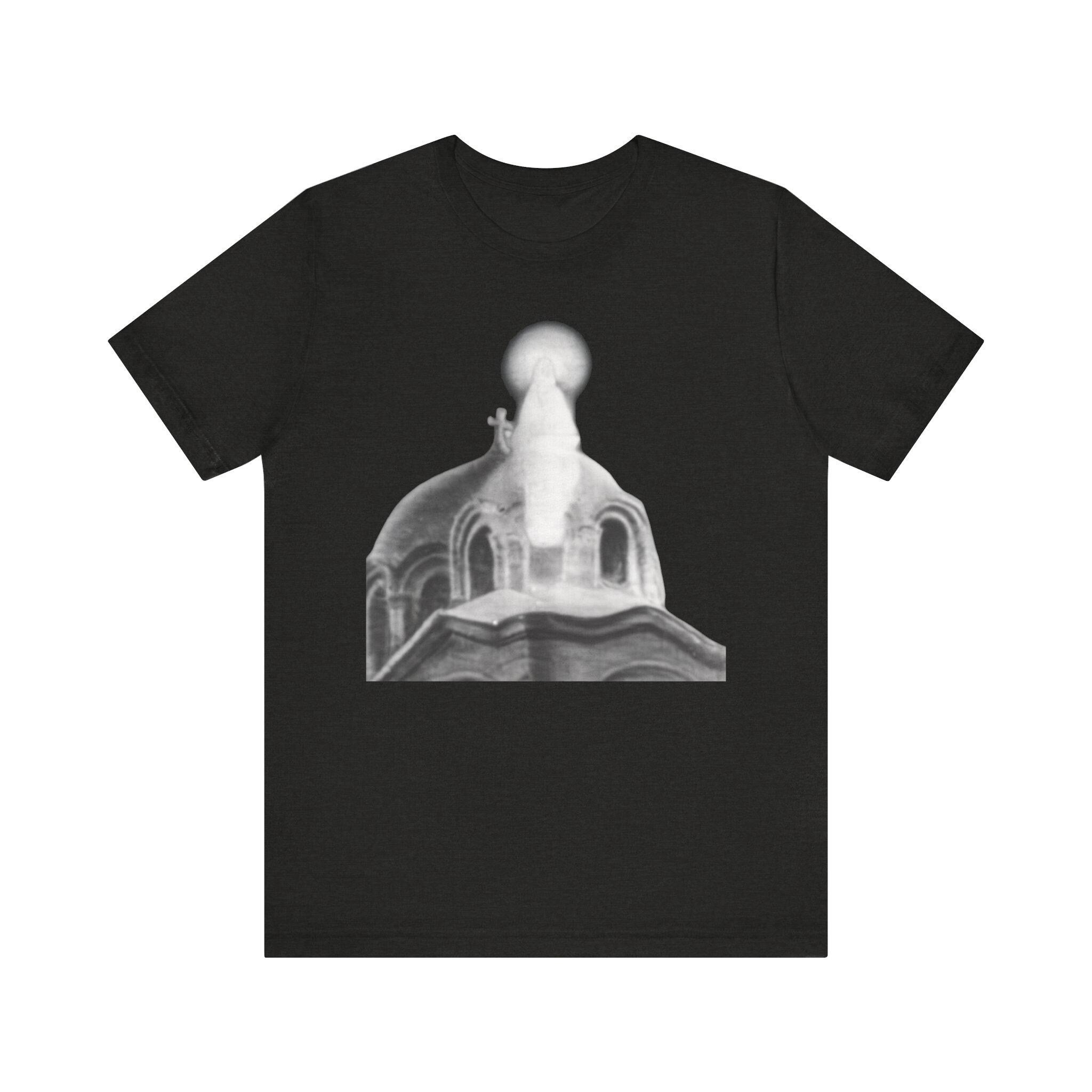
Between 1968 and 1971, the Virgin Mary appeared repeatedly above the church dome in Zeitoun, Cairo. These apparitions were witnessed by hundreds of thousands of people, including Christians and Muslims, police officers, journalists, and government officials. There were no spoken messages. Only her visible presence, light, and peace. This photograph is one of the documented images from those events.
This is not an illustration or artistic interpretation.
This is an actual photograph of the Theotokos as she appeared.
Wearing this shirt is a quiet way to carry a real moment of Christian history with you.
Shirt Quality and Comfort
We print this design on Bella + Canvas shirts because they are known for long-term comfort, softness, and durability. These shirts hold their shape, feel good all day, and age well with repeated wear. They are lightweight but substantial, making them ideal for everyday use.
Premium Bella + Canvas unisex fit
Soft, breathable fabric
Designed for long-lasting comfort
High-quality print that preserves image detail
Why This Shirt Is Different
Features a real Marian apparition photograph, not artwork
Honors the Theotokos with historical accuracy
Suitable for Orthodox, Catholic, and traditional Christian devotion
Subtle, reverent, and meaningful without being flashy
Many people choose this shirt as a personal devotional item, a conversation starter, or a meaningful Christian gift.
Product features
- 100% Airlume combed ring-spun cotton; 4.2 oz/yd² lightweight, breathable fabric
- Ribbed knit collar and shoulder tape for shape retention and stable fit
- Side seams for structural support and longer-lasting form
- Tear-away label to reduce skin irritation; REACH certified materials
- Sleeve and neck label printed with high-detail DTF/DTG techniques for crisp imagery
Care instructions
- Machine wash: cold (max 30C or 90F)
- Non-chlorine: bleach as needed
- Tumble dry: low heat
- Iron, steam or dry: medium heat
- Do not dryclean
EU representative: HONSON VENTURES LIMITED, gpsr@honsonventures.com, 3, Gnaftis House flat 102, Limassol, Mesa Geitonia, 4003, CY
Product information: Bella+Canvas 3001, 2 year warranty in EU and Northern Ireland as per Directive 1999/44/EC
Warnings, Hazard: For adults, Blank product sourced from Honduras
Care instructions: Machine wash: cold (max 30C or 90F), Non-chlorine: bleach as needed, Tumble dry: low heat, Iron, steam or dry: medium heat, Do not dryclean
The Honest Account of What Remains Unresolved
Honesty requires acknowledging, clearly and without minimization, that the ecumenical convergences described in this article have not yet produced the full visible unity between the Armenian Apostolic Church and either the Eastern Orthodox churches or the Roman Catholic Church that the theological dialogues point toward as a possibility. Full communion — the sharing of the same Eucharist, the mutual recognition of orders and sacraments, the full institutional unity of the church as a single body — does not yet exist between these traditions, and the obstacles that remain on the path toward it are real, not merely administrative or historical.
The theological obstacles include questions that the agreed Christological statements have not fully resolved: questions about the ecumenical councils after Chalcedon (the Fifth, Sixth, and Seventh Ecumenical Councils in the Chalcedonian reckoning, which the Armenian church does not recognize as ecumenical); questions about the filioque and its implications; questions about papal primacy and its specific doctrinal content; questions about the exact theological status of the Chalcedonian and non-Chalcedonian formulations relative to each other even after the acknowledgment of their convergent intention. These are not trivial questions, and the theologians engaged in the dialogues have been admirably honest about the work that remains to be done.
The canonical obstacles are equally significant: the restoration of full communion between traditions that have been institutionally separate for fifteen centuries would require a level of canonical and structural reorganization that no single theological agreement, however well-crafted, can accomplish by itself. The question of what full unity would look like in practical terms — what would happen to the Armenian Apostolic Church's institutional identity, to the Armenian Catholic Church's distinct existence, to the specific theological emphases and liturgical particularities that each tradition has developed over centuries of separate life — is one that the dialogues have begun to address and that will require many more decades of careful work to resolve.
What the dialogues have established, however, is the fundamental orientation that makes the resolution of these obstacles a theological possibility rather than a theological absurdity. If the faith professed on both sides of the divide is the same apostolic faith, then the unity that the church prays for in the Lord's Prayer — that they may all be one — is not a unity that would require either side to abandon anything essential. It would be, when it comes, a recognition of a unity that has always been real at the level of the apostolic faith, made visible at the institutional level that human history temporarily obscured.
The Armenian Saints at the Center
The Armenian saints sit, appropriately and in a sense providentially, at the exact center of this complex of relationships — between Catholic and Orthodox, between Eastern and Western, between the Chalcedonian and the non-Chalcedonian traditions. They are claimed by all sides with equal legitimacy and with equal theological seriousness. They are present in the Orthodox Menaion and in the Catholic Martyrology. They are venerated in the Armenian Apostolic Church and in the Armenian Catholic Church. They are celebrated in the liturgical life of Georgian Orthodox Christians who owe their alphabet to Mesrop Mashtots and in the devotional life of Latin-rite Catholics who have discovered Gregory of Narek through a papal declaration that reached across fifteen centuries of institutional separation to name him a teacher of the universal church.
This central position is not an accident and it is not a confusion. It is the natural consequence of the fact that the Armenian saints were formed by, and witness to, the apostolic faith that precedes every subsequent division — a faith that is neither Catholic nor Orthodox in the narrowly institutional sense of those terms because it is both Catholic and Orthodox in the deeper theological sense that both those terms are attempting, however imperfectly, to name. The Armenian church's ancient title of Apostolic is the truest description of what these saints are and where they come from: from the apostolic tradition itself, from the faith delivered once for all to the apostles and maintained, at enormous cost, by a people who refused across seventeen centuries to surrender it for anything the world could offer.
When a Greek Orthodox Christian stands before the icon of Gregory the Illuminator on his feast day in September and asks for his intercession, and when a Roman Catholic reads Gregory of Narek's Book of Lamentations in the middle of the night and finds in it the words for what they cannot say, and when an Armenian Catholic celebrates the feast of Vartanantz with the full liturgical solemnity of the Armenian Badarak, and when an Armenian Apostolic Christian descends into the crypt beneath the altar of the Church of Saint Hripsime and kneels in the dim light before the remains of the woman who would not surrender what she had given to Christ — all of these people are doing the same thing. They are approaching the same holy reality, formed by the same holy tradition, witnessed to by the same holy Lord, and made available by the grace of God to every Christian who comes to it in faith.
The Armenian saints are not Catholic. They are not Orthodox. They are both, in the sense that matters most: they are apostolic, formed by the faith that both Catholicism and Orthodoxy are trying to maintain and transmit, and available to every Christian who belongs to that faith as teachers, intercessors, and witnesses to what the faith requires and what it promises and what, in the end, it costs and what it is worth.
This article draws on the agreed statements of the Joint Commission for Theological Dialogue between the Eastern Orthodox and Oriental Orthodox Churches (1989–1990); the Joint Declarations of Pope John Paul II and Catholicos Karekin I (1996) and Pope Francis and Catholicos Karekin II (2016); the Apostolic Letter of Pope Francis declaring Gregory of Narek a Doctor of the Universal Church (2015); the Second Vatican Council's Decree on the Eastern Churches Orientalium Ecclesiarum (1964); the Eastern Orthodox Menaion; the Roman Martyrology; the scholarship of Robert Thomson, Nina Garsoïan, and Abraham Terian on Armenian Christianity; the theological works of Catholicos Karekin II on ecumenical dialogue; and the canonical records of both the Armenian Apostolic Church and the Armenian Catholic Church.