Saint Alphonsa of the Immaculate Conception: Life, Miracles & Legacy
Saint Alphonsa of the Immaculate Conception
The First Indian Woman Saint, Franciscan Clarist of the Syro-Malabar Church, Patron of the Sick, and India's Flower of Suffering
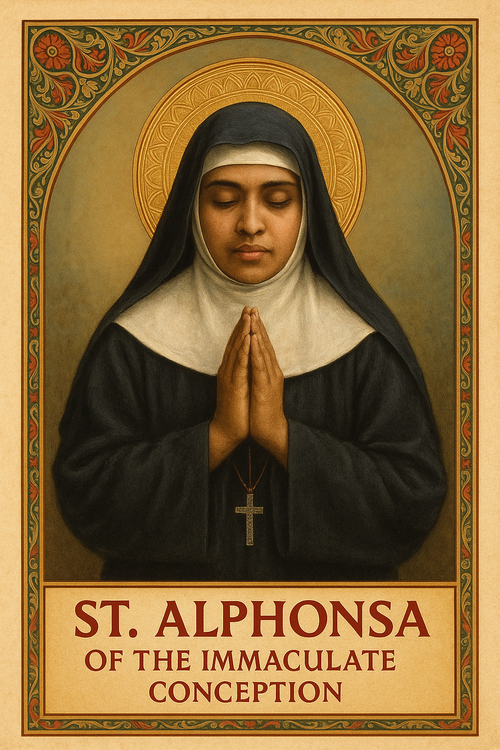
Saint Alphonsa of the Immaculate Conception Prayer Card
Honor India's first canonized woman saint with this beautifully crafted prayer card from The Eastern Church — perfect for personal devotion, novenas, or gifting to the sick who seek her powerful intercession.
View Prayer Card →Quick Reference
| Born | August 19, 1910 — Kudamalur, Kerala, India (as Anna Muttathupadathu) |
| Died | July 28, 1946 — Bharananganam, Kerala (age 35) |
| Religious Name | Alphonsa of the Immaculate Conception (FCC) |
| Order | Franciscan Clarist Congregation (Poor Clares) |
| Church | Syro-Malabar Catholic Church (East Syriac rite) |
| Feast Day | July 28 |
| Beatified | February 8, 1986 by Pope John Paul II (Kottayam, India) |
| Canonized | October 12, 2008 by Pope Benedict XVI (St. Peter's Square, Rome) |
| Primary Shrine | St. Alphonsa Shrine Church & Pilgrim Centre, Bharananganam, Kerala |
| Patron | The sick; against illness; those who suffer |
| Historic Title | First woman of Indian origin canonized by the Catholic Church; first saint of the Syro-Malabar Catholic Church |
In the small convent town of Bharananganam in Kerala's Kottayam district, a young Franciscan nun lived a life almost entirely invisible to the world. Anna Muttathupadathu, known in religion as Sister Alphonsa of the Immaculate Conception, never wrote a great theological treatise, never led a social movement, never founded a congregation. She spent the last years of her life largely bedridden, wracked by illnesses that confounded physicians and stripped her of every comfort. She died at thirty-five, and her funeral was attended by hundreds of people who already suspected they were burying a saint.
They were right. On October 12, 2008, Pope Benedict XVI declared her a saint in St. Peter's Square in Rome — the first woman of Indian origin ever to receive that honor from the Catholic Church, and the first canonized saint of the ancient Syro-Malabar Catholic Church, heir to the apostolic mission of St. Thomas himself. The miracle that sealed her canonization was the healing of a Kerala boy's clubfoot — a condition that mirrored, with poignant symmetry, the permanent disability Alphonsa had carried since her own youth.
This is her complete story.
The Syro-Malabar Church: Alphonsa's Spiritual Inheritance
To understand Saint Alphonsa, one must understand the community that formed her. The Syro-Malabar Catholic Church is one of the oldest Christian communities on earth, tracing its origins to the apostolic mission of St. Thomas the Apostle, who tradition holds arrived on the Malabar Coast of India in 52 AD. These "St. Thomas Christians" — also called Nasrani — have preserved an unbroken chain of Christian faith through the subcontinent for nearly two millennia.
The Syro-Malabar Church celebrates a variant of the East Syriac Rite, a liturgical tradition rooted in the ancient Christian communities of Edessa in Upper Mesopotamia. Its liturgical language draws on Classical Syriac, a dialect of Aramaic — the very tongue spoken in the Near East at the time of Christ. This makes the Syro-Malabar liturgy one of the most ancient in all of Christendom, a living bridge to apostolic Christianity.
The community is also described as "Indian in culture, Christian in faith, and Syriac in liturgy." It is the largest Eastern Catholic church and the second largest sui iuris Catholic church after the Latin Church, with over 4.5 million faithful worldwide. Alphonsa was born into this heritage — a daughter of ancient Syrian Christian families who had kept the faith from the days of the apostles.
Early Life: Born Into Sorrow (1910–1918)
Anna Muttathupadathu was born on August 19, 1910, in Kudamalur, a village in the princely state of Travancore, now part of Kerala's Kottayam district. She was the fourth child of Joseph Muttathupadathu and Mary Puthukari, both of ancient Syrian Christian lineage claiming descent from the original converts of St. Thomas.
Even her birth was marked by suffering. Her mother, eight months pregnant, was sleeping on the veranda when she awoke to find a snake coiled around her waist. The shock of tearing the serpent away triggered a premature birth. The child survived; her mother did not. Mary Puthukari died just a few weeks after Anna's arrival, leaving the infant essentially motherless from her first days of life.
Anna was baptized on August 27, 1910, at St. Mary's Church in Kudamalur, following the Syro-Malabar rite — the ancient East Syriac liturgy of a community that considered itself direct heirs to the Apostle Thomas. She was baptized under the patronage of Saint Anna, the mother of the Virgin Mary, a fitting patron for a child born to loss.
Nicknamed Annakutty ("little Anna") by her family, she was passed from her grandparents' care to that of a maternal aunt, who became her foster mother. Hagiographic accounts describe the aunt as strict and demanding — a childhood shaped not by warmth but by discipline. At school, other children sometimes teased her. From her earliest years, Alphonsa would later say, suffering was simply the texture of her life.
At age three, she contracted a severe infected eczema that plagued her for over a year. In 1916, she began formal schooling in Arpookara. On November 27, 1917, she received her First Communion — an event she would later describe as one of the most sacred moments of her life, the first time she experienced the Eucharistic presence that would become her anchor through decades of agony. The following year, her family moved her to the school in Muttuchira.
The Burning Chaff: A Vocation Defended (1923)
By her early teens, Anna had developed an unmistakable and intense desire for religious life. She wanted to belong entirely to Christ. But her foster aunt had other plans: an arranged marriage, which Anna refused with increasing desperation.
In 1923, at thirteen years of age, Anna was badly burned on her feet when she deliberately stepped into a pit of burning chaff — a pile of rice husks set ablaze near her home. The burns were severe, leaving her permanently partially disabled. She had disfigured her own feet to escape marriage and preserve her vocation. Despite this, her aunt made at least one more attempt to arrange her marriage before relenting.
This act — inflicting suffering on herself to guard a higher calling — would foreshadow the entire spiritual logic of her life. For Alphonsa, suffering was never meaningless. From girlhood, she understood that the cross was not an interruption of the path to God but the path itself.
Entering the Convent: A Vocation Fulfilled (1927–1936)
With the guidance of her confessor, Anna set her sights on the Franciscan Clarist Congregation (FCC), a congregation of the Third Order of St. Francis founded in Kerala in 1888. On Pentecost Sunday in 1927, at the age of sixteen, she arrived at the Clarist convent in Bharananganam, Kottayam district.
From the moment of her Vestition, Alphonsa offered herself to Jesus as a victim of love. She would later write to her spiritual director: "Dear Father, as my good Lord Jesus loves me so very much, I sincerely desire to remain on this sick bed and suffer not only this, but anything else besides, even to the end of the world. I feel now that God has intended my life to be an oblation, a sacrifice of suffering."
The Years of Teaching: Brief Joys, Many Crosses (1929–1939)
Between bouts of illness, Alphonsa taught primary school at St. Alphonsa Girls' High School in Bharananganam. Her students uniformly adored her. Despite her physical frailty, she was described as cheerful, gentle, and radiant — someone who never allowed her own suffering to cast a shadow over those in her care. She was known for a particular quality of joy that could not be explained by her circumstances, as if it came from somewhere the suffering could not reach.
The period between 1930 and 1935 was marked by persistent health crises. Then, in December 1936, something remarkable happened: Alphonsa was reportedly healed from her ailments through the intercession of Blessed Kuriakose Elias Chavara — a Syro-Malabar priest and religious founder who would himself eventually be canonized in 2014. The healing brought a brief restoration of health.
But on June 14, 1939, she was struck by a severe attack of pneumonia that left her permanently weakened. Her health would never fully recover from that point forward.
The Descent: Years of Total Suffering (1940–1946)
The last six years of Alphonsa's life constituted what Pope Benedict XVI would later call "extreme physical and spiritual suffering." The timeline of her deterioration is a chronicle of nearly every dimension of human pain.
On October 18, 1940, a thief broke into her room in the middle of the night. The shock of the intrusion caused Alphonsa to suffer a complete loss of memory — amnesia that lasted for months. Her condition deteriorated severely. On September 29, 1941, she was administered the Last Rites. The following day, her memory returned — though her health did not.
She experienced attacks of severe nausea, convulsions, fever, bleeding, and unrelenting pain from her old foot injuries. Physicians were baffled. Fellow sisters have testified that she endured all of it in near silence, rarely asking for anything, almost never complaining. When visitors expressed sympathy, she would deflect with a quiet smile. She did not want pity; she wanted to participate in the Passion of Christ.
She did not want her sufferings reduced by human attention and sympathy. The shrine's own account of her spirituality describes this as "a strange expression of humility, which seeks that others should never think of you." She bore everything in a deliberate interior silence, offering every pain to Christ — living what she once described as her deepest conviction: "I consider the day I have not suffered a lost day for me."
In the final year of her life, she came to know the young priest Sebastian Valopilly, who would later become Bishop of Kerala and who frequently brought her Holy Communion in her sick room. He became a key witness to the miracles attributed to her intercession after her death.
In July 1945, a stomach ailment caused persistent vomiting. Her health declined sharply through the following year. She received Viaticum for the last time, and on July 28, 1946, Sister Alphonsa of the Immaculate Conception died peacefully at Bharananganam, at the age of thirty-five.
Death and the Odor of Sanctity
The news of her death spread quickly. A large crowd came to her funeral. The eulogies were remarkable. Her spiritual director, Rev. Fr. Romulus CMI, stood before her mourners and delivered what reads now as prophecy:
Those who came to pay respects reported something unusual: a luminous quality in the air around her tomb, and a fragrant aroma — the odor of sanctity that Catholic tradition associates with the bodies of saints. Witnesses described each prayer at her fresh grave as somehow heard and answered.
Her claim on holiness was not long in wait.
Miracles: During Her Life and After Her Death
Miracles During Her Lifetime
- The 1936 Healing: In December 1936, after years of debilitating illness, Alphonsa was reportedly healed through the intercession of Blessed Kuriakose Elias Chavara and St. Thérèse of Lisieux. Fellow sisters and her confessor attested to the sudden and complete disappearance of her ailments — a reprieve that lasted several years before her final decline began.
- Mystical Consolations: Multiple contemporaries reported that during periods of her deepest suffering, Alphonsa radiated a supernatural calm and joy that could not be attributed to her circumstances. Her confessor and spiritual director documented these states carefully during her canonization process.
- The Restoration of Memory (1941): After losing her memory entirely on September 29, 1941 and receiving Last Rites, Alphonsa regained her memory the following morning — a recovery that mystified those around her.
Post-Death Miracles and Intercessions
Claims of miraculous intercession began essentially the moment her funeral ended. The earliest and most persistent reports came from the children of the convent school where she had taught. Over the following decades, these accounts multiplied dramatically.
- The Straightening of Clubbed Feet: The most consistently documented class of miracle associated with St. Alphonsa is the straightening of clubbed feet (talipes equinovarus) — a birth defect that normally requires surgery to correct. Hundreds of such cases have been reported at her tomb. The pattern is understood by devotees as a direct echo of her own lifetime disability: Alphonsa bore deformed, burned feet her entire life; in heaven, she heals others of the same affliction.
- The Beatification Miracle (1985): Pope John Paul II formally approved a miracle attributed to St. Alphonsa's intercession in 1985, clearing the way for her beatification the following year. While the Vatican's formal documentation was released as part of the cause proceedings, the approved miracle enabled her declaration as Venerable on July 9, 1985.
- The Canonization Miracle — Jinil Joseph (1999): The miracle that sealed her canonization is one of the most vividly documented in modern Catholic hagiography. Jinil Joseph, an infant boy from Kerala, was born with clubfoot — a birth defect that, in the judgment of medical experts, cannot correct itself naturally and requires surgical intervention. His parents, Shaji Joseph (a state tax official) and his wife, brought the child to Alphonsa's tomb at Bharananganam on May 11, 1999.
That evening, as the family gathered for rosary prayers, the infant stood up firmly on both feet — something he had never done before. His parents watched as the limbs that had previously drooped almost lifeless bore his full weight. The family brought the child to Dr. Aleyamma Korah of Vimala Hospital, Kottayam. She confirmed that the child's clubfoot was fully corrected, and testified before the Church tribunal that clubfoot does not correct itself naturally. The Vatican's Congregation for the Causes of Saints accepted this case as the canonization miracle. Jinil Joseph, by then a ten-year-old boy, attended St. Alphonsa's canonization ceremony in Rome on October 12, 2008. - The Second Submitted Miracle: A woman was reportedly cured of severe illness after touching a relic of St. Alphonsa. This case, along with the Jinil Joseph healing, was submitted to the Congregation for the Causes of Saints during the canonization process.
- Ongoing Intercessions: The continuing miracles attributed to St. Alphonsa's intercession are chronicled in the devotional magazine PassionFlower, published from Bharananganam. Reports include healings of various ailments, restorations of failing health, and spiritual conversions among people of other faiths. Thousands of devotees from Hindu, Muslim, and other religious backgrounds visit her shrine, and the Bharananganam pilgrim community has always included people from all walks of life.
Canonization: India's First Woman Saint (2008)
The formal path to canonization began on December 2, 1953, when Cardinal Eugène Tisserant inaugurated the diocesan cause for beatification in the Syro-Malabar Catholic Diocese of Palai, where Alphonsa was declared a Servant of God. The proceedings moved through three tribunals over the following decades. Her mortal remains were exhumed and examined by a team of medical experts on April 13, 1957, and placed in a sealed steel casket.
At the canonization ceremony, Pope Benedict XVI delivered a homily that captured the heart of Alphonsa's spirituality. He recalled her life as one of extreme physical and spiritual suffering, and said she was "convinced that her cross was the very means of reaching the heavenly banquet prepared for her by the Father." He described her as having "adorned herself with the garment of God's grace through prayer and penance" and conformed her life entirely to Christ's.
After the ceremony, the Pope delivered a personal message in English to the 5,000 Indians in the crowd: "As the Christian faithful of India give thanks to God for their first native daughter to be presented for public veneration, I wish to assure them of my prayers during this difficult time."
The Spirituality of the Cross: Her Theological Vision
Saint Alphonsa's spirituality is not merely the spirituality of someone who happened to suffer a great deal. It was a consciously developed theology of redemptive suffering — a deliberate mystical participation in the Passion of Christ that drew on both the Franciscan tradition and the ancient East Syriac spiritual heritage of her Syro-Malabar community.
In the East Syriac tradition — the liturgical family of the Syro-Malabar Church — the Eucharist is understood as the qurbana (the sacrifice and offering), and the Christian life is oriented radically toward union with the self-offering of Christ. This is not incidental background to Alphonsa's spirituality; it is its foundation. She lived within a tradition that sang of suffering transfigured, of offering made sacred, of Christ's body as the medicine of life.
Alphonsa also drew deeply on the example of St. Thérèse of Lisieux, whose autobiography she had read and whose "little way" of spiritual childhood she consciously sought to imitate. Like Thérèse, she found holiness not in extraordinary exterior actions but in the interior transformation of every moment of suffering into an act of love. Her spiritual director at the time of her death was Fr. Romulus CMI — a Carmelite of Mary Immaculate — a fitting connection given the Teresian undercurrents in her spirituality.
What distinguishes Alphonsa from a merely passive sufferer is the active dimension of her offering. She did not simply endure pain; she volunteered it. She chose to present her body as a living sacrifice, to be useful to Christ's redemptive work. In this she followed a tradition traceable through Francis of Assisi, through the desert fathers, through the Syrian mystical writers — an understanding that bodily suffering, when united to Christ's, becomes a channel of grace for others.
She is called the Passion Flower of Bharananganam — a title that captures this perfectly. The passionflower's very name refers to the Passion of Christ; its strange, beautiful bloom was seen by early missionaries as a living emblem of the crucifixion. Alphonsa was such a flower: exotic, suffering, strange, and radiant.
Where to Venerate Saint Alphonsa: Relics and Pilgrimage Sites
Saint Alphonsa's primary and most sacred place of veneration is her tomb in Kerala, now an international pilgrimage site. But her presence has extended to Syro-Malabar communities across North America, where her memory is kept alive in parishes and shrines bearing her name. Below is a comprehensive guide for those who wish to encounter this saint more closely.
The Primary Shrine: Bharananganam, Kerala, India
The heart of Alphonsa's veneration is the St. Alphonsa Shrine Church and Pilgrim Centre in Bharananganam, Kottayam district, Kerala — located approximately 5 km east of the town of Pala, on the banks of the Meenachil River. This is where her mortal remains rest, in the very spot where she was buried on July 29, 1946.
The original cemetery chapel of the Bharananganam Forane Church (built in 1945) became the Shrine Church following her canonization in 2008. The chapel and grounds have expanded enormously in the decades since her beatification. Adjacent to the shrine is an Alphonsa Museum housing hundreds of exhibits: her personal belongings, her cot, her books, her umbrella, and records of the canonization process. The room where she spent the last years of her life is preserved nearby.
Each year from July 19–28, the feast of St. Alphonsa is celebrated with a ten-day festival drawing tens of thousands of pilgrims from across India and the world. July 28 — her death anniversary — is the climax: a day of solemn liturgy, procession, and thanksgiving. Devotees of every religious background, including Hindus and Muslims, are among the pilgrims.
| Location | Details | Website |
|---|---|---|
| St. Alphonsa Shrine Church & Pilgrim Centre, Bharananganam, Kerala, India | Primary tomb and shrine; her mortal remains rest here in the Diocese of Palai. Museum, convent, and her former room all on site. International pilgrimage destination. | alphonsa.org |
| St. Alphonsa Syro-Malabar Catholic Cathedral, Mississauga, Ontario, Canada | Cathedral of the Syro-Malabar Eparchy of Mississauga. Named for St. Alphonsa and a major center of her veneration in Canada. Address: 6630 Turner Valley Road, Mississauga, ON L5N 2P1. | syromalabarcanada.com |
| St. Alphonsa Syro-Malabar Catholic Forane Church, Edmonton, Alberta, Canada | First Syro-Malabar mission in Canada. Named for St. Alphonsa. Address: 9120 146 St NW, Edmonton, AB T5R 0W2. | sasmedm.com |
| St. Alphonsa Syro-Malabar Catholic Church, Los Angeles (San Fernando), CA, USA | Parish of the St. Thomas Syro-Malabar Catholic Eparchy of Chicago. Address: 215 N MacNeil St., San Fernando, CA 91340. | syromalabarla.org |
| St. Alphonsa Syro-Malabar Catholic Church (stalphonsachurch.org) | Active Syro-Malabar parish with daily Qurbana (Mass), adoration, and devotions. Celebrates St. Alphonsa's feast day annually with special novena. | stalphonsachurch.org |
| St. Alphonsa Syro-Malabar Catholic Church, Vancouver, BC, Canada | Parish under the Syro-Malabar Eparchy of Mississauga. Formally instituted in 2016. | stalphonsabc.org |
| St. Alphonsa Church Parathi, Mayam, Thiruvananthapuram, Kerala | The first church in Kerala dedicated to St. Alphonsa. Consecrated in 1988. Pilgrims brave the Neyyar River crossing to reach it. | Contact local Diocese of Thiruvananthapuram |
| St. Alphonsa Church Valiyakolly, Diocese of Thamarassery, Kerala | Known as the "Bharananganam of North Kerala." First church named for her in the Thamarassery diocese. Novena to St. Alphonsa held every Friday evening. | thamarasserydiocese.com |
Note on first-class relics in the diaspora: The Syro-Malabar Church's eparchies — including the St. Thomas Syro-Malabar Catholic Eparchy of Chicago (which covers all of the USA) and the Eparchy of Mississauga (Canada) — are the appropriate bodies to contact regarding the location of authenticated first-class relics of St. Alphonsa in North America. Individual parishes named for her are the most likely custodians. Contact the St. Thomas Syro-Malabar Catholic Eparchy of Chicago for guidance on relic veneration in the United States.

Learn More: Saint Alphonsa — Her Life & Spirituality
Deepen your understanding of India's first woman saint with a dedicated biography exploring her spirituality of suffering, her East Syriac heritage, and her path to canonization.
View on Amazon →The Legacy and Cult of Saint Alphonsa
Within two years of her death — before any formal canonization process had even begun — the first institution named after her was already founded: Sister Alphonsa's UP School, Chennamattom, near Ayarkunnam in Kottayam, established in 1948. This was the organic beginning of an enormous legacy.
The institutions bearing her name now number in the dozens across India and the world, including Alphonsa College in Pala (est. 1964), multiple schools, hospitals, and religious houses. Beyond institutions, her image appears throughout Kerala's Christian homes, her feast is celebrated with a solemnity matched by few Indian saints, and her intercession is invoked especially by parents of disabled children and by the chronically ill.
In the 1990s, the Reserve Bank of India recognized her importance by featuring her on a commemorative stamp — the first woman from Kerala to be honored on an Indian postage stamp. In 2009, a commemorative five-rupee coin was issued to mark the centenary of her birth.
The PassionFlower magazine, published from Bharananganam, continues to document ongoing reports of miraculous cures and extraordinary graces attributed to her intercession. The stories cluster especially around children with disabilities, the seriously ill, and families in desperate circumstances.
Bharananganam itself has been called the Lisieux of India — a prophetic title first spoken by her spiritual director at her funeral in 1946, which the subsequent decades have fully vindicated.
Saint Alphonsa and the East Syriac Tradition
Alphonsa's significance for the Syro-Malabar Church extends beyond her personal holiness. She represents the first flowering of canonized sanctity from a tradition stretching back nearly two thousand years. The Syro-Malabar Church had carried its ancient East Syriac liturgy through colonialism, persecution, and ecclesiastical controversy — and its first saint bore witness to the same values the tradition had always proclaimed: that the Eucharistic offering of the qurbana extends into the offering of one's own body and life.
In the East Syriac liturgical world, saints are not figures from another age but living intercessors woven into the fabric of the community's prayer. The Anaphora of Addai and Mari — the ancient East Syriac eucharistic prayer still used in the Syro-Malabar liturgy — calls the saints to mind as fellow participants in the heavenly liturgy. When Syro-Malabar Catholics celebrate the qurbana on July 28, the feast of St. Alphonsa, they are not merely commemorating a historical figure. They are invoking a living member of that heavenly assembly — a woman who offered her suffering as her gift to that same liturgy.
Since her canonization, the Syro-Malabar Church has added three more saints: Kuriakose Elias Chavara (canonized 2014), Euphrasia Eluvathingal (2014), and Mariam Thresia (2019). But Alphonsa remains the first — the one who opened the path, who proved that holiness in this ancient tradition takes root in the same soil it always has: the offering of self, the embrace of the cross, and the absolute surrender of the will to God.
Sacred Art for Your Prayer Corner
Venerate the saints with beautifully crafted Byzantine icons, handmade in Greece with sterling silver. These are heirloom pieces worthy of a prayer corner honoring Eastern Christian tradition.
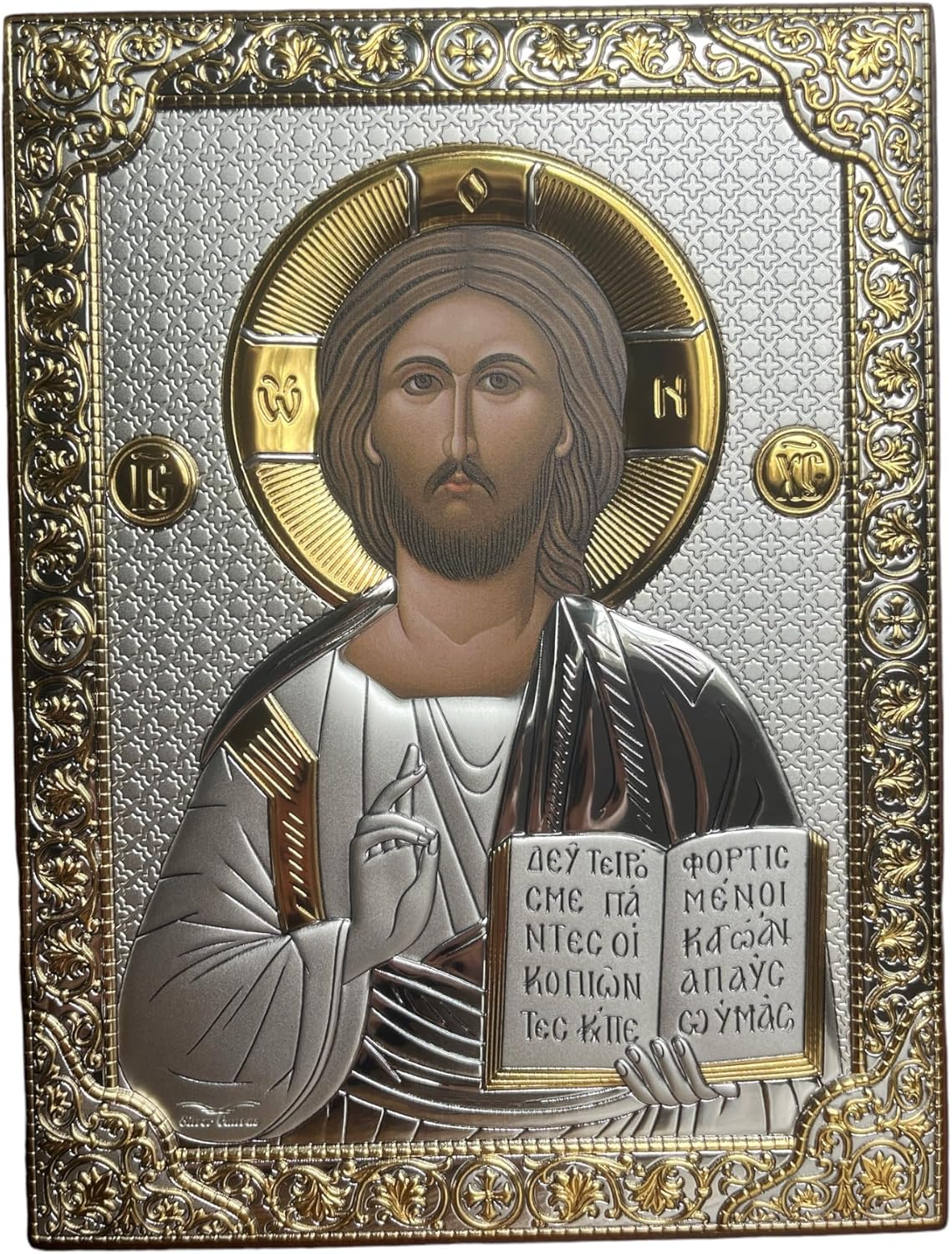
A premium Byzantine icon of Jesus Christ, handmade in Greece with 925° sterling silver. A beautiful heirloom piece for your prayer corner.
View on Amazon
A travel-friendly diptych of Christ the Teacher and the Virgin of Kazan, housed in a luxurious blue velvet protective case.
View on Amazon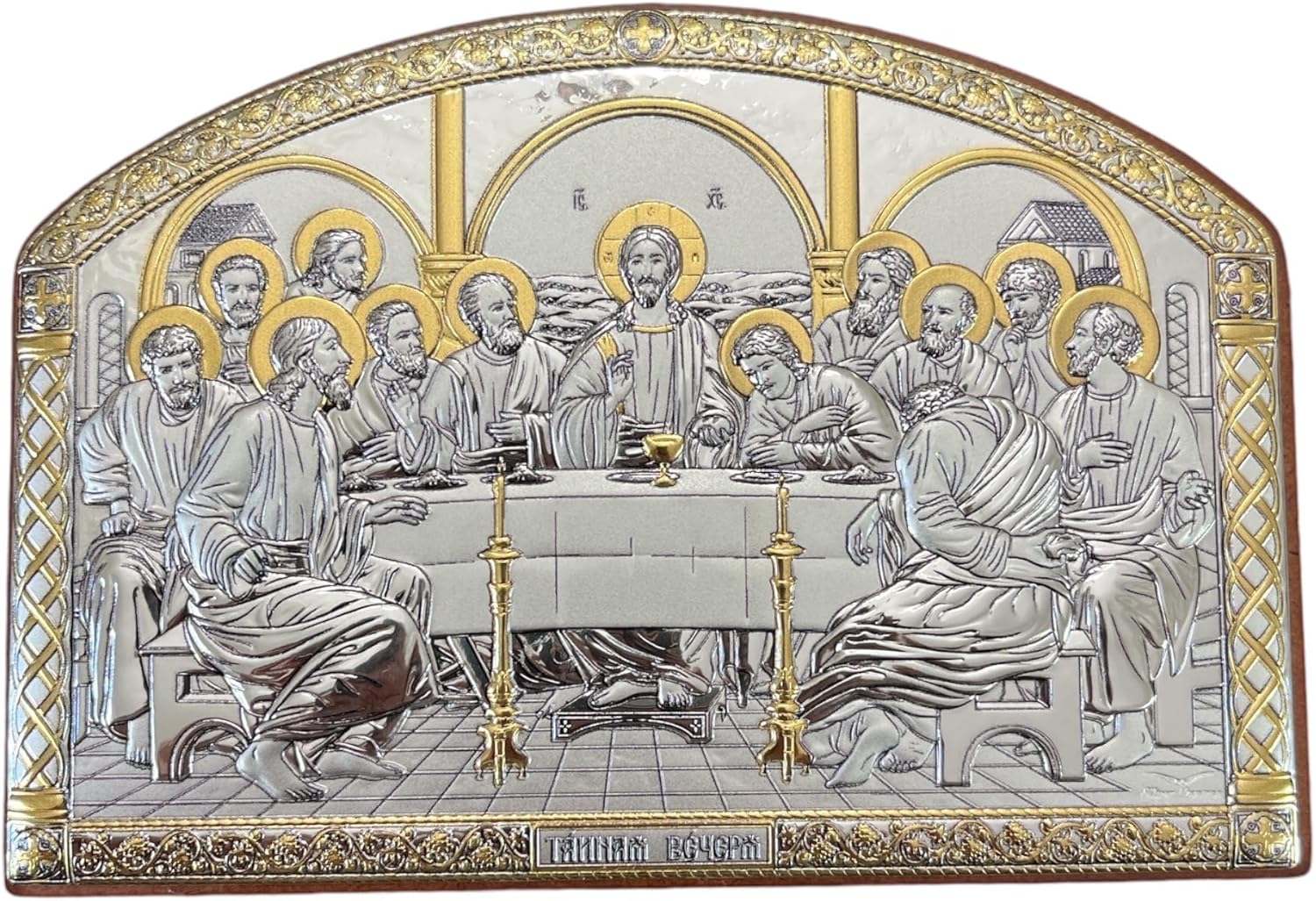
A detailed handmade icon of the Mystical Supper, crafted in Greece with 925° sterling silver and gilded accents. Ideal for dining areas or altars.
View on AmazonExplore the Scriptures of the Eastern Church
The Syro-Malabar tradition shares deep roots with the broader East Syriac and Oriental Christian world. Deepen your understanding of the full breadth of the Eastern biblical canon — including books like Enoch and Jubilees, preserved in some Eastern traditions and absent from the Western canon.
The Complete Ethiopian Bible (81 books) — includes books found only in the Ethiopian Orthodox canon, including Enoch, Jubilees, and more.
View on Amazon →
Bible with Enoch & Jubilees — explore these ancient Jewish-Christian texts that shaped the spirituality of the earliest Eastern churches.
View on Amazon →
Book of Enoch (standalone) — one of the most significant texts in Second Temple Judaism and early Christian mysticism, quoted in the New Testament.
View on Amazon →Free Christian Marriage Resources
Saint Alphonsa's life of total self-offering — of love poured out without reservation — speaks powerfully to the vocation of marriage. If you are looking to deepen your marriage in Christ, explore our collection of free Christian marriage books, written from a deeply Catholic and Eastern Christian perspective.
Explore Free Marriage Books →Frequently Asked Questions
Was Saint Alphonsa the first Indian saint ever canonized?
Saint Alphonsa is the first woman of Indian origin to be canonized by the Catholic Church, and the first canonized saint of the Syro-Malabar Catholic Church. She is also frequently described as the first person of Indian origin to be formally canonized — though technically, some sources note that Gonzalo Garcia, a Japanese-born martyr of partial Indian descent, was canonized earlier (1862). Within the context of Catholic India and the Syro-Malabar Church, however, Alphonsa is universally recognized as the pioneering figure.
What is the Syro-Malabar Catholic Church, and why is it called "East Syriac"?
The Syro-Malabar Catholic Church is one of the 22 Eastern Catholic Churches in full communion with Rome. It traces its origins to the missionary activity of St. Thomas the Apostle in Kerala around 52 AD. The "East Syriac" designation refers to its liturgical tradition, which uses a variant of the East Syriac Rite rooted in the ancient Christian communities of Edessa in Upper Mesopotamia. The liturgical language draws on Classical Syriac, a form of Aramaic. The Church is described as "Indian in culture, Christian in faith, and Syriac in liturgy." It is the largest Eastern Catholic church, with approximately 4.5 million faithful worldwide.
Why does Saint Alphonsa have such a connection to the healing of clubbed feet?
Alphonsa burned her own feet on hot chaff as a teenager to disfigure them and avoid an arranged marriage — permanently disabling herself in service of her vocation. She lived her entire religious life with deformed, scarred feet. Devotees understand the pattern of clubfoot healings at her tomb as a direct spiritual reflection of her own suffering: the saint who bore foot injury in life has been given by God the power to heal foot conditions after death. The canonization miracle itself involved a Kerala boy born with clubfoot whose condition was fully and instantaneously corrected after his parents placed him on her tomb. Medical testimony confirmed the cure was inexplicable by natural means.
What were Saint Alphonsa's actual physical ailments?
The list of physical conditions that afflicted Alphonsa over her life is remarkable. As a child she suffered infected eczema. At thirteen she sustained severe foot burns with permanent disability. As a young nun she experienced recurrent hemorrhages requiring surgery. During her religious life she suffered pneumonia (1939), amnesia caused by traumatic shock (1940), severe nausea and vomiting, convulsions, high fevers, and unspecified ailments that mystified multiple physicians. In her final year, a persistent stomach ailment with vomiting accelerated her decline. She received Last Rites twice and lived in a near-permanent state of physical suffering from approximately age twenty onward.
How do I visit her shrine in Bharananganam?
The St. Alphonsa Shrine Church and Pilgrim Centre is located in Bharananganam, approximately 5 km east of Pala in Kottayam district, Kerala, India. The shrine can be reached by private taxi, cab, or auto-rickshaw from Kottayam, or by state-run buses. The best time to visit is during the annual feast from July 19–28, culminating on July 28 (her death anniversary). The shrine museum is open to visitors and houses her personal belongings. The website for the pilgrim centre is alphonsa.org.
Is there a novena to Saint Alphonsa?
Yes. Novenas in honor of Saint Alphonsa are celebrated at many Syro-Malabar parishes, particularly those dedicated to her. St. Alphonsa Church Valiyakolly in northern Kerala holds a novena every Friday evening. The feast day period (July 19–28) at Bharananganam is itself structured as a ten-day novena of prayer, Mass, and intercession. Individual devotees may also pray a private novena to her, asking her intercession especially in cases of illness, disability, and suffering.
What is the Franciscan Clarist Congregation?
The Franciscan Clarist Congregation (FCC) is a Catholic religious congregation of women founded in Kerala in 1888. It belongs to the Third Order of St. Francis and takes its inspiration from St. Clare of Assisi, the foundress of the Poor Clares and companion of St. Francis. The congregation was founded specifically for the Syro-Malabar Church and has its motherhouse in Kerala. Saint Alphonsa was among its most spiritually significant members, and her canonization has brought the congregation international recognition.
What are first-class relics, and where can I venerate Saint Alphonsa's relics?
A first-class relic is a part of a saint's body — a bone fragment, hair, or similar material. Second-class relics are objects the saint personally used; third-class relics have been touched to a first- or second-class relic. Saint Alphonsa's primary relics (her mortal remains) are enshrined at Bharananganam, Kerala, India. First-class relics have been distributed to Syro-Malabar communities and to Rome. For information about the location of authenticated first-class relics in the United States, contact the St. Thomas Syro-Malabar Catholic Eparchy of Chicago. In Canada, contact the Syro-Malabar Catholic Eparchy of Mississauga. Individual parishes dedicated to her — including St. Alphonsa Syro-Malabar Catholic Church in Los Angeles — may also be custodians of relics.
Strengthen Your Marriage Through Eastern Christian Spirituality
Saint Alphonsa's total offering of herself — every suffering freely given out of love — is a model for every Christian vocation, including marriage. Explore our free collection of Christian marriage books drawing on Eastern and Catholic spiritual tradition, available completely free online.
Access Free Marriage Books →A Final Word: The Passion Flower of India
Saint Alphonsa of the Immaculate Conception lived thirty-five years, mostly in physical pain, almost entirely within the walls of a convent most people had never heard of. She taught children, offered her suffering to God, and died. The world paid little attention at the time.
And yet the Church now considers her among the saints — not in spite of her smallness and obscurity, but precisely because of it. She represents a way of holiness that does not depend on talent, influence, health, or public recognition. It depends only on the willingness to receive every cross as a gift and to transform every moment of suffering into an act of love.
In the East Syriac tradition she called home, there is an ancient saying: the church is built not from stone but from living souls. Saint Alphonsa of the Immaculate Conception is one of those stones — pressed down, ground fine, and made into the bread of the Eucharist. The Passion Flower of Bharananganam blooms still.