Saints Adrian and Natalia of Nicomedia: The Complete Guide to the Patron Saints of Christian Marriage
Holy Martyrs • Court of Nicomedia • Patron Saints of Christian Marriage • 4th Century
Saints Adrian and Natalia of Nicomedia: The Complete Guide to the Patron Saints of Christian Marriage
He converted at the sight of martyred Christians dying in peace. She had been secretly one of them all along. Together, they became the most remarkable married couple in the history of the saints — and a blueprint for every Christian marriage that has ever tried to build something eternal out of ordinary love.
Of all the married saints venerated by the Eastern Orthodox and Catholic churches, no couple quite captures the imagination like Adrian and Natalia of Nicomedia. Their story has everything: a sudden, dramatic conversion in an imperial torture chamber; a wife's hidden faith that her husband had no idea about; the disguises, the vigils outside prison walls, the executions witnessed from the crowd. It is also a story about what Christian marriage is actually for — not merely companionship or family, but the mutual sanctification of two souls, each drawing the other toward God, even unto death. Their story is set in Nicomedia (modern-day İzmit, Turkey) in the early 4th century, during the Diocletianic Persecution, the most systematic and brutal attempt to destroy Christianity the Roman Empire ever undertook. Against that backdrop, Adrian and Natalia shine with a light that has not dimmed in seventeen centuries.
This article is the most comprehensive English-language account of Saints Adrian and Natalia of Nicomedia available online: their hagiography in full detail, the theology of their veneration, their status across Eastern Orthodox and Catholic traditions, their feast days, their patronages, complete prayers addressed to them in both traditions, and the deep spiritual wisdom their marriage holds for Christians today who want more than a good marriage — who want a holy one.
Historical Context: Nicomedia and the Diocletianic Persecution
Nicomedia was not a provincial backwater. In the late 3rd and early 4th centuries it was the eastern capital of the Roman Empire — the city where the Emperor Diocletian held his court, issued his edicts, and organized the machinery of imperial power. It was a city of marble and administrators, of bureaucracy and ambition, of soldiers and scribes. It was also, as it turned out, a city riddled with secret Christians — including some quite close to the Emperor himself.
The Diocletianic Persecution, which began in earnest with the Edict of February 24, 303 AD, was the last and most ferocious Roman attempt to destroy Christianity. Diocletian — and especially his co-emperor Galerius, who was its primary architect — ordered the demolition of churches, the burning of scriptures, the removal of Christians from public office, and ultimately the torture and execution of any who refused to sacrifice to the Roman gods. In Nicomedia itself, the persecution was especially intense. The great basilica church was demolished by imperial order on the very first day. Arrests, torture, and executions followed in waves.
It was into this specific moment — Nicomedia, approximately 306 AD, during the height of the Great Persecution — that the story of Adrian and Natalia begins. And it begins, as so many conversion stories do, with someone whose job it was to destroy Christianity finding himself unexpectedly destroyed by what he encountered instead.
The Conversion of Adrian: At the Torture Chamber Door
Adrian was an officer of high rank at the imperial court in Nicomedia — the sources describe him as a praetor, a position of significant authority in the imperial administration. He was young, successful, pagan, and tasked with one of the most grim duties of the persecution: sitting in the torture chamber with a stylus and a tablet, recording the names and responses of Christians being interrogated under torture. His job was bureaucratic, not sadistic — he was there to document the official proceedings, not to inflict the suffering. But what he witnessed there changed everything.
Twenty-three Christians were brought before the imperial examiners. Each was tortured. Each refused to apostatize. What struck Adrian — what the hagiography emphasizes with remarkable precision — was not simply their endurance of pain. It was the quality of their demeanor: they were not grim or defiant in the way that a soldier might endure pain by brute will. They were peaceful. Joyful, even. The suffering seemed not to reach them in the way it would reach an ordinary man. They spoke of reward and of God with a certainty that had nothing theatrical about it. It was the certainty of people who knew something that Adrian did not.
He leaned forward and asked them the question that had been building in him: What reward do you expect from your God that makes you endure this?
One of the Christians answered with a passage from Saint Paul:
"Eye hath not seen, nor ear heard, neither have entered into the heart of man, the things which God hath prepared for them that love him."
Adrian set down his stylus. He turned to the other imperial scribes sitting at the table and said words that would cost him everything: "Write my name down with theirs, for I also am a Christian."
The declaration was instant and absolute. There was no period of catechesis, no private reflection, no gradual drawing toward the faith. Something in the combination of those suffering, joyful faces and those particular words — the sheer incomprehensibility of a reward that transcended all human imagination — collapsed the distance between Adrian the pagan administrator and Adrian the martyr-in-waiting. He was immediately arrested, still in his official court clothes, and led to prison. The bureaucrat had become the prisoner.
The theological tradition surrounding this conversion is precise about what it was: not an intellectual assent to doctrinal propositions, but a visceral recognition that these people had found something real, and that whatever it was, it was worth more than his career, his status, his freedom, and his life. The Eastern Church's tradition calls such conversions "at the sight of the martyrs" — a specific category of conversion in which the witness of those dying for the faith becomes the direct catalyst of someone else's faith. Adrian's conversion belongs to one of the most ancient and consistently attested patterns of how Christianity actually spread in the Roman Empire: not by argument alone, but by the beauty of those willing to die for what they believed.
Natalia's Secret Faith: The Wife He Didn't Know
Here the story takes its most remarkable turn. When word reached Adrian's household that he had been arrested as a Christian, his wife Natalia received the news — and her response was not grief. It was joy.
Natalia, the hagiography tells us, was already a secret Christian. She had been one for some time, concealing her faith from her husband because the social and legal dangers of open Christian profession were severe, and because Adrian himself had given her no reason to think he would receive such a revelation well. He was a court officer, a man embedded in the imperial apparatus. Natalia had lived for who-knows-how-long in a marriage where the most important thing about her — her faith, the organizing center of her inner life — was something her husband didn't know.
And now, in one declaration in a torture chamber, he had become what she had been all along. The man she had kept her secret from had discovered the secret on his own — through exactly the experience she would have prayed for him.
She rushed to the prison. Not to mourn, not to beg him to recant, not to despair about the future. She went, the sources say, to encourage him — to tell him that what he had done was right, that the glory he was running toward was worth more than anything he was leaving behind. There is a famous line attributed to her in this first prison visit, which the tradition has preserved because it captures something essential about her character: she told him his earthly nobility was nothing compared to the crown he was about to receive.
The fact that Natalia was a secret Christian before Adrian's conversion is not a minor detail of the narrative. It is central to the spiritual theology of their marriage. For years, Natalia had been praying — in secret, at personal risk — for a husband who did not yet share her faith. Her marriage was already a sacrament being lived unilaterally. Her love, her faithfulness, her daily sacrifice of concealment were all oriented toward a God her husband didn't know. And when he found that God, it was in no small part because Natalia had been holding the candle for both of them in the dark.
This pattern — one spouse carrying the faith while the other is not yet there — is one of the most ancient and still most common experiences of Christian marriage. Natalia of Nicomedia is its patron saint. She is the saint of the spouse who prays alone, who goes to church alone, who loves a partner toward faith rather than arguing them into it.
The Imprisonment: Natalia at the Prison Walls
The period between Adrian's arrest and his execution was not brief. He was held for a time, examined, tortured, and given opportunities to recant — as all Christian prisoners of the persecution were. Throughout this period, Natalia maintained a continuous, determined presence as close to him as she could get.
Women were at times barred from visiting the male prisoners. When this happened, Natalia cut her hair and dressed as a boy to gain entry to the prison. The detail is historically plausible — the Roman persecution was not a smoothly administered bureaucratic exercise, and the prison guards' vigilance in excluding visitors varied — and theologically resonant: Natalia's love for her husband transcended not merely social convention but the physical limits placed on it by imperial authority. Nothing that could be done to keep her from him was sufficient.
The hagiography gives a specific and theologically important reason for her determination to stay close: Adrian was a brand-new convert. He had made his declaration in a moment of overwhelming grace, but the long weeks of imprisonment, the sight of ongoing torture, the grinding presence of death — these were the conditions in which a new convert might waver. Natalia knew this. She was there not simply out of marital love, but out of spiritual purpose: to be the experienced believer who strengthened the new one. She had been living in faith for years; he had been living in it for days. She was, functionally, his spiritual director as well as his wife.
The tradition records that she would hold his hands through the prison bars, that she kissed the wounds from his torture, that she spoke to him of the glory of the martyrs and the promises of Scripture. She was, in every way that mattered, holding him in faith while the imperial machinery worked to break it out of him.
Natalia's vigil at the prison is one of the most powerful images in all of Christian hagiography for what it means to support a spouse through suffering. She did not try to rescue him from his martyrdom, which would have been easy — she could have begged him to recant, and he might have survived. She supported him toward it. She strengthened him for what God was calling him to, rather than asking God to call him to something easier. This is the hardest thing any spouse can do: to love someone toward their cross rather than away from it.



The Martyrdom: Anvil, Fire, and the Hand She Saved
When the time for execution arrived, Adrian and the other Christian prisoners were subjected to a particularly brutal form of execution: their limbs were broken on an anvil before they were killed. The anvil — a blacksmith's tool, a thing of labor and craft — was here turned into an instrument of state terror. Adrian's legs and hands were shattered one by one. He did not recant.
Natalia was present. She had stayed through the torture; she would stay through the death. The hagiography records a remarkable moment in the midst of the execution. When the soldiers came to break Adrian's hands, Natalia herself placed his hand upon the anvil. This is not an act of cruelty. It is an act of profound spiritual determination: she would not let her husband flinch back from his martyrdom at the last moment. If his hands were to be broken, she would be the one holding them steady for the blow. She was both his witness and, in some sense, his co-executioner — willing him into the death that would make him a saint.
After the execution, the soldiers prepared to burn the bodies of the martyrs. Natalia intervened. She managed to recover Adrian's right hand before the burning and preserved it as a sacred relic. The preservation of martyrs' relics was already, by the early 4th century, a well-established Christian practice — relics were the physical contact points between the living and the holy dead, the tangible anchors of the saints' presence and intercession. Natalia's recovery of Adrian's hand was an act of love, of faith, and of theology simultaneously.
She carried that hand with her for the rest of her life.
After the Death: The Relic, the Flight, and the Peaceful End
After Adrian's martyrdom, Natalia faced a new threat. She was young, wealthy, and now a widow — and the imperial court took notice. A high-ranking officer sought to marry her, drawn by her beauty and her property. For Natalia, this was intolerable: she had given herself entirely to Adrian in a marriage that was now, she believed, not ended but transformed. She had no intention of remarrying anyone.
She fled to Byzantium — the ancient Greek city that Constantine would, within just a few years of these events, transform into the new imperial capital, Constantinople. She took Adrian's hand with her. She settled there in the company of other Christians, carrying the relic, mourning, praying.
Then Adrian appeared to her in a vision. The accounts vary somewhat in their details, but the essential content is consistent across both Eastern and Western traditions: he came to tell her that she would soon join him. The vision was understood not as a comfort against a distant death but as a promise of an imminent one — and Natalia received it with the same disposition she had brought to every stage of their story: not with dread, but with joy. She had spent years following her husband toward God; now he was coming back to lead her the final step of the way.
She died peacefully in her sleep shortly after the vision — peacefully, despite never having been touched by an executioner's hand. The Eastern Church's understanding of her death is theologically precise: her suffering throughout the entire ordeal — the years of hidden faith, the vigils at the prison, the disguises, the standing at the execution, the watching of her husband's body burned — constituted a martyrdom of the soul even when her body remained physically intact. She is venerated as a martyr not despite dying in peace but because her entire life after Adrian's arrest had been a sustained act of martyrial witness and love.
The Eastern Orthodox theological tradition distinguishes between the red martyrdom of blood and the white martyrdom of complete self-giving love. Natalia's death is one of the clearest examples in the whole calendar of a white martyrdom: she died of love, exhaustion, and the breaking of a heart that had given everything it had. The Orthodox Church does not hesitate to call her a martyr. She suffered fully; she died in the faith; she followed her husband into God. The manner of death is incidental. The disposition is everything.
This theological understanding is directly relevant to how Christian marriage is understood in the Eastern tradition: it is not primarily a social or legal institution, but a path of mutual crucifixion and mutual glorification. Adrian and Natalia did not have a comfortable marriage. They had a holy one. And the tradition insists that holiness is worth far more.
Which Churches Venerate Saints Adrian and Natalia?
Saints Adrian and Natalia of Nicomedia died before the Great Schism of 1054 that divided Eastern and Western Christianity. This makes them what theologians call pre-schism saints — figures who belong not to one branch of Christianity but to the undivided Church from which all Christian traditions draw their heritage. They are venerated across Eastern Orthodox, Eastern Catholic, and Roman Catholic churches, and their cult has never been a matter of controversy between East and West.
In the Eastern Orthodox Church
The Eastern Orthodox Church venerates Adrian and Natalia among the great Holy Martyrs with particular devotion. They appear in the Menaion — the twelve-volume liturgical calendar of the Orthodox Church — on August 26 (Julian Calendar). In the Orthodox Church, Natalia is not treated as a secondary figure who merely accompanied her husband: she is venerated as a full holy martyr in her own right, and many liturgical texts address her directly as one who "ran before the other holy women to the place of suffering." The Orthodox Church also gives Natalia the additional title Natalia the Myrrh-bearer in some regional traditions, drawing a parallel between her care for Adrian's martyred body and the Holy Myrrh-bearers who came to care for the body of Christ.
The couple is particularly beloved in Russian, Serbian, Greek, and Bulgarian Orthodox traditions, where "Natalia" remains a common name given in honor of this saint, and where the feast of August 26 is observed with special prayers for marriages.
In the Catholic Church
The Roman Catholic Church records both saints in the Roman Martyrology, the Church's official register of recognized martyrs and saints. Their joint feast day is September 8 in the Latin calendar. For many centuries — particularly in medieval Belgium, Germany, northern France, and the Low Countries — Saint Adrian was one of the most popular saints in Western Europe. He was patron of the city of Geraardsbergen in Belgium (which the French call Grammont), and his cult spread across the Holy Roman Empire through the multiplication of relics during the medieval period. Pope Adrian VI, the only Dutch pope, took his name from this saint. Paintings, sculptures, altarpieces, and churches throughout Flemish and Germanic Catholic Europe are dedicated to him.
In Eastern Catholic churches — particularly the Maronite, Melkite, and Byzantine Catholic traditions — Adrian and Natalia are celebrated as part of the shared martyrological heritage of the ancient Antiochene and Byzantine rite calendars, venerated alongside the great company of pre-schism martyrs from the era of the Roman persecutions.
The Historical Cult in Northern Europe
Adrian's cult in medieval Western Europe deserves specific attention because it was of extraordinary scope. He was invoked as a protector against the plague — a patronage derived from medieval theological reflection on his role as a soldier-martyr who could intercede against the sudden, violent death that plague inflicted. His name was attached to dozens of churches across Belgium, the Netherlands, Germany, and England. The town of Geraardsbergen (Grammont) in Belgium became a major pilgrimage destination for his relics and drew pilgrims from across Northern Europe. During the Black Death of the 14th century, his intercession was sought across the continent. This dimension of his cult — the powerful protector against death, the warrior-martyr whose courage in the face of execution made him a mediator for those facing sudden death — represents a facet of his patronage that is less familiar today but was for centuries central to popular devotion to him in the West.
Feast Days Across All Traditions
| Tradition | Feast Day | Notes |
|---|---|---|
| Eastern Orthodox Church (Julian Calendar) | August 26 | Holy Martyrs Adrian and Natalia. Full liturgical commemoration in the Menaion with troparion, kontakion, and canon. Natalia venerated as co-martyr in her own right. |
| Eastern Orthodox Church (New Calendar / Gregorian) | September 8 | For Orthodox jurisdictions following the Revised Julian Calendar, August 26 Old Style corresponds to September 8. |
| Roman Catholic Church | September 8 | Listed in the Roman Martyrology. Not currently on the General Roman Calendar as a feast but observed in many local traditions, particularly in Belgium and Germany. |
| Byzantine Catholic Churches (Melkite, Ukrainian, Ruthenian) | August 26 (Julian) / September 8 (Gregorian) | Celebrated according to the Byzantine Menaion tradition, shared with Eastern Orthodoxy. |
| Geraardsbergen, Belgium (Local Catholic) | September 8 with Octave | Historic pilgrimage center for Saint Adrian's relics. Major local observance descending from medieval period; one of the most ancient continuous Western Catholic cults of a pre-schism Eastern martyr. |
| Historic Western Martyrologies | March 4 (Adrian alone) | Older Roman tradition for Adrian's individual martyrdom date. Found in some traditional martyrologies; no longer commonly observed. |
Their Patronages: Who Prays to Them and Why
The patronages of Saints Adrian and Natalia derive directly from specific events in their story. Each one has a precise theological basis in what they actually did, suffered, and embodied.
The Theology of Their Marriage: A Blueprint for Christian Couples
The story of Adrian and Natalia is not merely an inspiring historical narrative. It is a theological statement about what Christian marriage is actually for. And that theological statement is stark: marriage is for holiness, not comfort. It is for the mutual sanctification of two souls — the drawing of each spouse closer to God through the other — even if that process involves suffering, sacrifice, and the willingness to let your beloved run toward something greater than you can protect them from.
The Eastern Christian theological tradition has always understood marriage with unusual depth and seriousness. In Byzantine theology, marriage is not simply a contract or even merely a sacrament in the Western legal sense. It is an eschatological reality — a foretaste of the Kingdom of God, the union of two people in a shared journey toward theosis, toward becoming like God. The wedding liturgy in the Eastern rite crowns the spouses as king and queen of a small kingdom, as martyrs-in-waiting who take upon themselves the crown of thorns as well as the crown of glory. The same word — stephanos, crown — is used for the wedding crowns and for the martyrs' crowns. This is not an accident.
Adrian and Natalia embody this theology completely. Natalia's secret faith for years before Adrian's conversion is a model of what Eastern Christianity calls unilateral holiness in marriage — the sanctifying influence of one faithful spouse on the other, whether or not the other yet knows it is happening. Saint Paul addresses precisely this in 1 Corinthians 7:14, when he writes that the unbelieving spouse is sanctified by the believing one. Natalia was living that sanctification for years before Adrian understood it.
And Adrian's conversion is a model of what can happen when a spouse has been faithfully praying: not a gradual, reasoned movement toward faith, but the sudden, total recognition that comes when God's grace hits a soul that has been, unknown to itself, being prepared for it by the prayers of someone who loved it.
Their marriage, in short, is a story about what it looks like when two people become more together than either of them could have been alone — not more comfortable, not more secure, but more holy, more real, more oriented toward the One who made them both.

The Daily Sacrament: Worshiping God Through Catholic Marriage
Adrian and Natalia didn't just love each other — they lived their marriage as a path of holiness that led them both to God. The Daily Sacrament by Hank Freeman invites you to do the same: to wake up every morning and embrace your marriage not as a memory of vows exchanged, but as a living sacrament, a channel of grace as real as the Eucharist. If you want a marriage that is not just good but holy — the kind of marriage that changes you both — this book will show you the path.
Every Catholic knows the joy of Baptism, Confirmation, and First Communion. The Daily Sacrament challenges you to approach your marriage with the same awe — to wake up every day thrilled for another day of Matrimony, the sacrament that never ends.
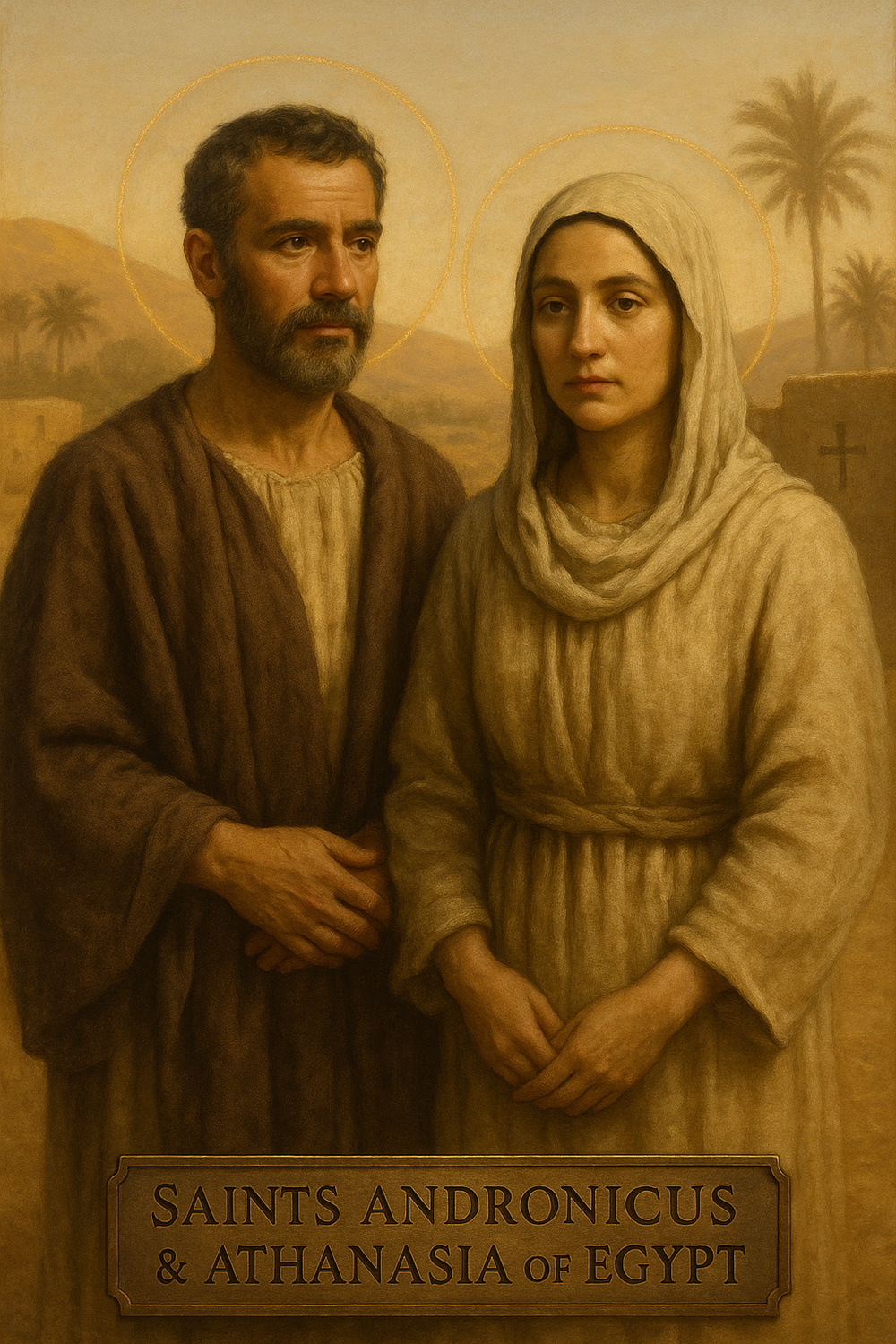
Prayer Card: Saints Adrian & Natalia
Carry the memory of their story with you, or give it to a couple you love. Our handcrafted Eastern Catholic and Orthodox prayer cards are produced with the same liturgical reverence that has always surrounded the veneration of the Holy Martyrs.
Order the Prayer Card →Prayers to Saints Adrian and Natalia of Nicomedia
The prayers addressed to Saints Adrian and Natalia in both Eastern and Western Christian tradition share a common theological structure: they invoke the couple together as the patron saints of Christian marriage, they acknowledge the specific character of their martyrdom and mutual devotion, and they ask for intercession in both the spiritual challenges of married life and the specific situations each saint addressed in their own story.
Eastern Orthodox Troparion of the Holy Martyrs Adrian and Natalia (Tone 4)
Your holy martyrs Adrian and Natalia, O Lord, through their sufferings have received incorruptible crowns from You, our God. For having Your strength, they laid low their adversaries, and shattered the powerless boldness of demons. Through their intercessions, save our souls!
— Eastern Orthodox Church, Troparion for August 26, Tone 4Orthodox Kontakion of the Holy Martyrs Adrian and Natalia (Tone 4)
The two of you were united in the bonds of holy matrimony, yet you became still more closely bound by the bond of faith and martyrdom, O holy Adrian and Natalia. You were not separated in death; together you now stand before the Lord of glory. Intercede for all those joined together in holy marriage, that they too may run as one toward God.
— Eastern Orthodox Kontakion, August 26Catholic Prayer to Saints Adrian and Natalia
Holy Martyrs Adrian and Natalia, you loved each other in Christ and for Christ, and through Christ you came at last to stand together before the throne of God. You are the patrons of every marriage that seeks to be holy rather than merely happy, that is willing to bear the cross as well as the crown.
We ask your intercession for our own marriage: that we may strengthen each other in faith as Natalia strengthened Adrian; that we may be honest with each other as Adrian was honest before the imperial scribes; that we may not ask God to make our love comfortable but to make it holy. Help us to carry one another toward God rather than away from suffering, and grant that we may one day stand before Him together as you do. Amen.
— Traditional Catholic prayer for couples, adaptedPrayer for a Spouse Who Does Not Yet Share Your Faith
This prayer, invoking Saint Natalia's specific experience, is for the spouse who prays alone — who carries the faith for both of them:
Holy Natalia, you were a Christian in secret for years while your husband did not yet know the God you served. You held the faith for both of you, and you lived to see your prayers more than answered — you saw your husband become a saint.
I bring you my own marriage, in which I sometimes feel I carry the faith alone. Do not let me grow bitter in this, or cold, or self-righteous. Teach me to love my spouse toward God rather than to argue them into it. Teach me to pray without ceasing and to trust, as you trusted, that the God who converted an imperial soldier in a torture chamber can reach anyone — including the one I love. Saint Natalia, pray for my marriage. Amen.
Prayer for Protection of Marriage
Saints Adrian and Natalia, holy martyrs and blessed spouses, you faced every assault that the world, the flesh, and the powers of darkness could bring against a marriage — imprisonment, torture, forced separation, and death itself — and your bond was not broken but perfected.
We ask you to stand guard over our marriage. Drive away every force that seeks to divide us: every temptation, every bitterness, every failure of love and attention and fidelity. Help us to see in each other what you saw in each other — not merely a companion, but a fellow pilgrim on the road to God. Grant that our marriage may be a daily sacrament, a sign of God's love in the world, worthy of the crowns you now wear forever. Amen.
Prayer Cards for Your Parish or Wedding
The Eastern Church produces handcrafted Eastern Catholic and Orthodox prayer cards — beautiful, liturgically grounded sacred art for personal devotion, parish distribution, and bulk parish orders. Consider the Saints Adrian and Natalia card for couples' retreats, marriage preparation programs, or anniversary Masses.
Order in Bulk for Your Parish →
Wake Up Every Morning Thrilled to Be Married
Adrian and Natalia had the marriage they had because they understood marriage as a path to God — not a destination in itself, but a sacrament, alive and active, sanctifying them both through every moment of joy and every moment of suffering. The Daily Sacrament will help you live your marriage the same way: as a holy liturgy, a worship offered to God through love, sacrifice, and daily fidelity. Begin reading it free, or pick up a copy on Amazon to hold in your hands.
Questions About Saints Adrian and Natalia of Nicomedia
A Marriage That Outlasted the Empire
The Emperor Maximian is a footnote in history. His edicts are relics of a world that does not exist. The persecution that produced Adrian and Natalia failed in every one of its objectives — Christianity not only survived it but was declared the religion of the Empire within a decade. But the story of a young officer who heard twenty-three people answer a question about reward with a verse from Saint Paul, and who set down his stylus and said "write my name with theirs" — and of the wife who had been secretly praying for that moment for years — that story is as alive today as it was in Nicomedia in 306 AD.
Because marriages are still trying to be holy rather than just comfortable. Spouses are still praying alone for partners who haven't found their way yet. People are still being asked, in one form or another, to write their name with those who believe. And the answer is still worth everything.
Holy Martyrs Adrian and Natalia, pray for our marriages. Pray for us.
As an Amazon Associate, The Eastern Church earns from qualifying purchases.