Saint Raphael the Archangel: The Complete Guide to the Medicine of God
Archangel • Healer • Guide • Exorcist • Medicine of God
Saint Raphael the Archangel: The Complete Guide to the Medicine of God
Every scriptural reference, every patristic commentary, every prayer — Catholic and Orthodox — the most comprehensive account of the Archangel whose name means God has healed, and who stands among the seven before the throne of the Holy One.
Of the countless angels whose names appear in the traditions of Judaism and Christianity, only three have received universal veneration across every major Christian communion: Michael, the warrior; Gabriel, the herald; and Raphael — the physician. His name in Hebrew is רְפָאֵל, Rĕfāʾēl, from the roots rāfāʾ ("to heal") and ʾĒl ("God") — rendered most powerfully in the Latin tradition as Medicina Dei: the Medicine of God. He is the only archangel whom Scripture shows traveling the road of ordinary human life alongside a mortal companion, healing bodies and binding demons, arranging a marriage and restoring sight to the blind — before revealing, with characteristic angelic restraint, that he has been standing in the presence of God the entire time.
This article is the most complete treatment of Saint Raphael the Archangel available in English: every canonical and deuterocanonical scriptural reference, his appearances in patristic literature and scholastic theology, the Eastern Orthodox and Catholic traditions of his veneration, the church-approved accounts of his apparitions, the theology of his role in healing and exorcism, his complete catalogue of patronages, and the full texts of prayers addressed to him across Catholic and Orthodox traditions. It is written for those who seek to know him as the Church has always known him — not merely as a figure in a story, but as a living angelic presence who continues to present human prayers before the throne of God.
His Name: Medicine of God
The name Raphael is a compound of two foundational Hebrew words. The first is רָפָא (rāfāʾ), a verb meaning "to heal," "to restore," or "to make whole." It appears throughout the Hebrew scriptures in the context of both physical and spiritual healing: God heals Abimelech's household in Genesis 20:17; the Psalmist cries "heal my soul" in Psalm 41:5; and in the great messianic passage of Isaiah 53:5 it is the same root that gives us "by his wounds we are healed." The second element is אֵל (ʾĒl), the ancient Semitic word for God, which appears in the names of all three scriptural archangels: Michael ("Who is like God"), Gabriel ("Strength of God"), and Raphael ("God has healed" or, in its most resonant Latin rendering, Medicina Dei — the Medicine of God).
This name is not merely descriptive. In the ancient Near Eastern understanding of names — particularly angelic names — the name is the mission. Raphael's name announces what he does and who sends him to do it. He heals not by his own power but as an instrument and expression of God's own healing will. When he restores Tobit's sight, the gall of the fish is not the cause; it is the vehicle. The cause is the God whose healing he embodies. The Catholic Encyclopedia notes precisely this: "Regarding the functions attributed to Raphael we have little more than his declaration to Tobias (Tobit 12) that he was sent by the Lord to heal him of his blindness and to deliver Sara… from the devil." The name explains the mission; the mission enacts the name.
In the Orthodox Church's liturgical naming tradition, Raphael carries the title "the Curer of Human Infirmities" — expanding his healing mission beyond the physical to encompass the spiritual. The OCA's description of his iconographic role confirms this: he holds a vessel with healing medications in his left hand. He is, in the fullest sense, the archangel of medicine — of divine medicine for the whole person.
The Book of Tobit: The Complete Account of Raphael's Mission
The Book of Tobit — canonical in the Roman Catholic Church by the Council of Trent, and in the Eastern Orthodox Church by the Council of Jerusalem (1672) — is the primary scriptural source for Raphael. Its canonical status rests on solid historical ground: the Dead Sea Scrolls discovered at Qumran in the 1940s and 1950s yielded four manuscripts of Tobit in Aramaic and one in Hebrew, confirming that the book originally existed in Semitic languages contrary to the Protestant reformers' objection that it was composed only in Greek.
The narrative unfolds in two parallel storylines, each describing a person suffering under unjust affliction and crying out to God simultaneously. In Nineveh, the righteous exile Tobit — faithful to the Torah even in captivity, burying the bodies of executed Israelites at personal risk — has gone blind after sparrow dung fell on his eyes while sleeping outside. In Ecbatana (in modern Iran), a young woman named Sarah has been married seven times; on each wedding night, before the marriage could be consummated, the demon Asmodeus has murdered her husband. Both Tobit and Sarah, in the same hour, pray to God for death or deliverance.
"And the prayer of each of them was heard before the glory of God. And Raphael was sent to heal both of them: to scale away the white films from Tobit's eyes, and to give Sarah the daughter of Raguel in marriage to Tobias the son of Tobit, and to bind the demon Asmodeus."
The Journey of Tobias
God dispatches Raphael in human form, presenting himself as "Azarias son of the great Ananias," a kinsman of Israel. The name he adopts is itself theologically charged: Azariah means "Yahweh has helped" — an angelic name that tells the truth in disguise, just as the angel himself is present in human form but doing God's work throughout. Tobias, sent by his father to collect a debt in Media, hires Azarias as a traveling companion without knowing he has contracted an archangel as his guide.
At the Tigris River, a great fish leaps from the water to swallow Tobias's foot. Raphael instructs him to seize it, pull it to land, and remove the heart, liver, and gall — keeping them as medicines. When Tobias asks their purpose, Raphael explains with clinical precision:
"As for the heart and liver, if a demon or evil spirit gives trouble to any man or woman, you must burn them and make a smoke, and the demon will flee and never return. And as for the gall, anoint with it the eyes of a man who has white films, and he will be cured."
This passage has exercised Christian theologians for two millennia. The fish organs do not possess magical properties; they are instruments of divine action — physical signs through which God's healing operates. The medieval preacher whose sermon is preserved through the FSSPX tradition articulates the allegorical theology carefully: the gall represents the bitterness of contrition that heals the soul's blindness, while the heart and liver burned on coals represent the memory of Christ's Passion, whose redemptive power drives away demonic bondage.
The Exorcism of Asmodeus
Arriving in Ecbatana, Raphael instructs Tobias to claim Sarah in marriage. Tobias is afraid — he knows the story of the seven dead husbands — but Raphael gives him precise liturgical instructions: on the wedding night, before approaching his bride, burn the fish's heart and liver, and pray with Sarah for three days before the marriage is consummated. Tobias obeys. The smoke of the burning organs drives Asmodeus out of Egypt, where Raphael pursues him and binds him there. The prayer Tobias offers on his wedding night (Tobit 8:5–8) is so beautiful that it became a standard reading at Catholic wedding Masses.
"Blessed are You, O God of our fathers, and blessed is Your holy and glorious name forever. Let the heavens and all Your creation bless You. You made Adam, and You made his wife Eve as a helper and support. From them has come the race of mankind. You said, 'It is not good that the man should be alone; let us make a helper for him like himself.' And now, Lord, I am not taking this kinswoman of mine because of lust, but with sincerity. Grant that I and she may find mercy and grow old together."
The Healing of Tobit's Blindness
On returning to Nineveh, Tobias anoints his father's eyes with the fish's gall. Tobit's blind eyes are described as having "white films" — likely a form of cataracts or leucoma — and when Tobias rubs them, "the white films scaled off from the corners of his eyes" and Tobit could see again. The moment of Raphael's self-revelation comes immediately after:
"I am Raphael, one of the seven holy angels who present the prayers of the saints and enter into the presence of the glory of the Holy One."
This verse is the most theologically dense in all of Raphael's scriptural appearances. It establishes three things simultaneously: his identity as one of the seven great angelic presences before God's throne; his function as an intercessor who carries human prayers into the divine presence; and his connection to the Apocalypse's "seven angels who stand before God" in Revelation 8:2 — a passage that provides the New Testament's implicit acknowledgment of Raphael's existence and rank. The Catholic Encyclopedia specifically notes this connection, and it is reflected in Orthodox theology's understanding of Raphael as permanently present before the divine glory.
Raphael's parting words to Tobit and Tobias contain some of the most important angelological theology in Scripture:
"I will not conceal anything from you. I have already told you that it is good to keep the secret of a king, but to glorify the works of God with honor. And so: when you and Sarah prayed, I brought your prayer before the Holy One. When you buried the dead, I was with you likewise. And when you did not hesitate to rise and leave your dinner in order to go bury a dead man, I was sent to test you. And at the same time God sent me to heal you and Sarah your daughter-in-law. I am Raphael, one of the seven holy angels who present the prayers of the saints and enter into the presence of the glory of the Holy One."


1 Enoch: Overseer of Spirits and Healer of the Earth
The First Book of Enoch — canonical in the Ethiopian Orthodox Tewahedo Church and deeply influential on Jewish and early Christian angelology despite not being in the Roman Catholic or Eastern Orthodox biblical canon — gives Raphael a cosmic role that goes far beyond his personal mission in Tobit. He appears three times in the Enochic corpus, each time exercising authority over a domain of cosmic scope.
1 Enoch 9: The Four Archangels Intercede for Humanity
In the earliest stratum of 1 Enoch (the Book of the Watchers, dated approximately to the 3rd century BC), Raphael appears among four archangels — Michael, Gabriel, Uriel, and Raphael — who look down and see the suffering of humanity caused by the fallen Watchers and their demonic offspring. Together they bring the cry of human suffering before God:
"And then Michael, Uriel, Raphael, and Gabriel looked down from heaven and saw much blood being shed upon the earth, and all lawlessness being wrought upon the earth... and the souls of men are making their suit to heaven: 'Bring our cause before the Most High.'"
1 Enoch 10: The Binding of Azazel
God's response to the archangels' intercession assigns each a specific mission. To Raphael falls the task of binding Azazel — the chief of the fallen Watchers who taught humanity the arts of war and seduction — and of healing the earth that his corruption has defiled:
"And again the Lord said to Raphael: 'Bind Azazel hand and foot, and cast him into the darkness; and make an opening in the desert, which is in Dudael, and cast him therein. And place upon him rough and jagged rocks, and cover him with darkness, and let him abide there forever, and cover his face that he may not see light. And on the day of the great judgment he shall be cast into the fire. And heal the earth which the angels have corrupted, and proclaim the healing of the earth.'"
This passage establishes Raphael's role as both a binder of demonic powers and a healer of the earth itself — a cosmic physician whose medicine operates at the level of creation. The parallelism with his role in Tobit is striking: in both texts, he binds a demonic being to a desert and heals what the demon's presence has corrupted. The Book of Enoch gives this a cosmic scope; Tobit gives it an intimate, personal one. Together they present a complete portrait of Raphael as the archangel whose mission is the undoing of spiritual and physical corruption at every scale.
1 Enoch 20: Overseer of Spirits and Wounds
In the catalog of the seven holy archangels in chapter 20, Raphael's function is summarized in two parallel clauses that together define the scope of his medical authority:
"Raphael — one of the holy angels, who is set over all disease and every wound of the children of men, and is also over the spirits of men."
Authority over "all disease and every wound" — not merely the specific afflictions of Tobit and Sarah, but the entire domain of human suffering from illness and injury. This is the fullest statement of Raphael's healing commission in any text, and it is the foundation for his veneration as the patron of physicians, the sick, and medical workers across every tradition that knows him.
The Book of Parables (1 Enoch 40): Before the Lord of Spirits
In the Book of Parables (1 Enoch 40), one of the latest sections of the Enochic corpus (dated to approximately the 1st century BC), Raphael appears as one of four angels standing before the "Lord of Spirits" — the vision of the divine throne that scholars believe influenced the Book of Revelation's imagery. Alongside Michael, Gabriel, and Phanuel, Raphael stands in the divine presence, crying "Blessed!" — a perpetual liturgical existence before God that corresponds directly to his self-identification in Tobit 12:15 as one who "enters into the presence of the glory of the Holy One."
John 5:1–4: The Pool of Bethesda and the New Testament Connection
The New Testament does not name Raphael. Only Michael (Jude 1:9, Revelation 12:7) and Gabriel (Luke 1:19, 1:26) are named in the New Testament canon. However, Catholic and Orthodox tradition has consistently identified Raphael with the unnamed angel who appears in the Gospel of John at the Pool of Bethesda in Jerusalem:
"Now there is in Jerusalem by the Sheep Gate a pool, in Aramaic called Bethesda, which has five roofed colonnades. In these lay a multitude of invalids — blind, lame, and paralyzed. An angel of the Lord went down at certain seasons into the pool, and stirred the water; whoever stepped in first after the stirring of the water was healed of whatever disease he had."
The identification of this angel as Raphael is made explicitly in the Catholic Encyclopedia: "Many commentators identify Raphael with the 'angel of the Lord' mentioned in John 5. This conjecture is based both on the significance of the name and on the healing role attributed to Raphael in the Book of Tobias." The identification is not dogmatically defined — it is a pious tradition, a theological inference — but it is ancient, widespread, and liturgically embedded in the Catholic Office for Raphael's feast, whose hymns link him directly to the Bethesda waters.
The connection is theologically coherent: the same angelic power that healed Tobit's eyes with a fish's gall, that "healed the earth" in Enoch, that is described in 1 Enoch 20 as set over "all disease and every wound" — this same power operating at the waters of a Jerusalem pool is entirely consistent with the portrait Scripture gives us of Raphael. Furthermore, the setting — a pool, with the healing concentrated at a moment of angelic stirring of water — echoes the Tigris River scene in Tobit where Raphael's healing mission also begins with water.
This identification was standard in medieval Catholic theology and is reflected in Eastern liturgy. The great medieval sermon on Raphael preserved through the FSSPX explicitly connects the Bethesda waters to Raphael's mission, and the Orthodox Church's commemoration of Raphael on November 8 likewise draws on this tradition.
Part V
Abraham at the Oak of Mamre: The Jewish Tradition
The three angels who appear to Abraham at the Oak of Mamre in Genesis 18 are not named in the biblical text. They eat with Abraham, promise that Sarah will bear a son, and then two proceed toward Sodom while one remains with Abraham. Jewish tradition — preserved in the Babylonian Talmud — identifies all three as archangels and assigns each a specific mission.
Michael walked in the center (as the greatest) and bore the message to Abraham that Sarah would conceive Isaac.
Gabriel walked to Michael's right and was sent to destroy Sodom.
Raphael walked to Michael's left with a twofold mission: to heal Abraham from the pain of his recent circumcision (Genesis 17) and to rescue Lot from the destruction of the cities.
This tradition, while not canonical Christian Scripture, was well known to the Church Fathers and exercised significant influence on Christian angelology. It deepens the portrait of Raphael as a healer — here his healing is not of illness but of the physical pain of the covenant rite, and his protection extends to an innocent man caught in a city under divine judgment. Both functions — healing the righteous and guarding the innocent in moments of divine intervention — are consistent with his character throughout all sources.
It is worth noting that the Talmudic tradition also establishes an implicit hierarchy: Michael at center, Gabriel to the right, Raphael to the left. This positional language corresponds to the Jewish bedtime prayer tradition in which the four archangels are invoked by position around the sleeping believer: Michael to the right, Gabriel to the left, Uriel in front, and Raphael behind — a spatial theology of angelic protection that Eastern Christians will recognize as parallel to the practice of invoking the angelic powers at the four directions during prayer.
The Church Fathers, Scholastic Theology, and the Medieval Sermon
The Church Fathers' treatment of Raphael is embedded primarily in their commentaries on the Book of Tobit and in their broader angelology. While Raphael does not receive the dedicated patristic treatment that Michael attracts (given Michael's more prominent New Testament role), references to him appear consistently across both Eastern and Western traditions.
Origen (c. 184–253 AD)
Origen, the great Alexandrian theologian, draws on the angelology of both Tobit and 1 Enoch in his theological anthropology. In his Homilies on Numbers and De Principiis, Origen develops the idea of personal guardian angels and the angelic hierarchies that oversee both individuals and nations. His engagement with the Enochic tradition's identification of specific archangels with specific cosmic domains — including Raphael's oversight of human spirits and wounds — provides the theological framework within which later patristic writers discuss Raphael. Origen explicitly affirms the ministry of angels as mediators who carry human prayers upward and divine care downward, which maps directly onto Raphael's self-description in Tobit 12:15.
St. Augustine (354–430 AD)
Augustine's City of God engages extensively with angelology and the problem of angelic mediation. While he is cautious about speculative angelic hierarchies, he affirms the canonical status of the Book of Tobit and therefore the reality of Raphael's mission. Augustine's famous dictum — "Angel is the name of their office, not of their nature. If you seek the name of their nature, it is 'spirit'; if you seek the name of their office, it is 'angel': from what they are, 'spirit', from what they do, 'angel'" — provides the framework within which Raphael's healing office is understood: he is spirit by nature, angel (messenger) by office, and healer by his specific mission from God.
Pope St. Gregory the Great (c. 540–604 AD)
Gregory the Great in his Homilies on the Gospels addresses the names and functions of the three scriptural archangels in a passage that became foundational for medieval angelology. His assignment of functions is precise and influenced all subsequent Western theology: "Raphael means, as I said, 'medicine of God'. He is called by this name because he is said to have healed Tobias when he was blind." Gregory locates Raphael's significance not in a general role as healer but specifically in the healing of blindness — and, by extension, in the spiritual healing of souls whose inner eyes are darkened by sin. The connection between physical blindness (Tobit's condition) and spiritual blindness (the soul's inability to perceive God) became one of the richest themes in medieval Raphael theology.
The Medieval Sermon: Three Gifts of the Celestial Physician
A magnificent medieval sermon on Raphael, preserved through the FSSPX's liturgical resources, presents the most developed pre-modern theology of Raphael's healing mission. Drawing entirely on the Book of Tobit, it identifies three gifts by which Raphael delivers human beings from the three deepest spiritual evils:
First Gift — Healing Spiritual Blindness: "Raphael, the celestial physician, rescues us from spiritual infirmity by leading us to the salutary bitterness of contrition." The fish's gall anointed on Tobit's eyes represents the bitterness of true contrition, which heals the soul's inner eyes. "A Psalm tells us: He heals those who are contrite in heart. This contrition is an excellent eye wash."
Second Gift — Liberation from Demonic Bondage: "St. Raphael snatches us from the devil's servitude, when he causes the memory of Christ's passion to penetrate within us, in the figure of which it is said: 'If thou put a little piece of its heart upon coals, the smoke thereof driveth away all kind of devils.'" The burning of the fish's heart represents the Passion of Christ — proceeding from the heart of His love — whose memorial is the ultimate exorcistic power.
Third Gift — Reconciliation with God: "The Archangel Raphael delivers us from the pain of finding ourselves in opposition to God... he delivers us from it when he leads us to pray earnestly; and to this I relate what the Angel Raphael said to Tobias: 'When thou didst pray with tears… I offered thy prayer to the Lord.'" Raphael stands before God as the intercessor who presents the prayers of the penitent, reconciling them with the God they have offended.
St. Thomas Aquinas (1225–1274)
Aquinas, in the Summa Theologiae, addresses angelic hierarchy, mission, and the nature of angelic bodies in extensive detail. He affirms the reality of Raphael's mission in Tobit and situates it within his broader theology of angels as intermediaries between God and creation. Aquinas holds that Raphael's assumption of a human body was a genuine angelic "assumption" for the purposes of divine mission — an act of condescension to human perception — and that his healing actions were genuine divine interventions channeled through angelic mediation. Thomas explicitly addresses the question of whether Raphael genuinely ate food with Tobit's family (Tobit 12:19), affirming that the apparent eating was an accommodation to human perception, not actual digestion.
The Council of Laodicea (4th Century) and Proper Angelic Veneration
The Council of Laodicea (c. 363–364 AD), which preceded the First Council of Nicaea and is counted among the local councils recognized by Orthodox tradition, addressed the veneration of angels with careful theological precision. Canon 35 condemned the worship of angels as gods or rulers of the world — the heretical practice of treating angels as independent deities — while at the same time affirming the legitimacy of their proper veneration as God's servants. The establishment of the November feast of the Synaxis of the Bodiless Powers follows from this theological framework: angels are to be honored as those who stand before God and serve His will, not worshiped in their own right.


Raphael and Exorcism: The Theology of Binding Demons
Among the three scriptural archangels, Raphael is the one most extensively described in explicit exorcistic action. Michael defeats Satan and casts fallen angels into the abyss. But Raphael's encounters with demonic powers — Asmodeus in Tobit and Azazel in 1 Enoch — are narrated in unusually specific detail, and they have shaped the Christian theology of healing as intrinsically connected to spiritual warfare.
Asmodeus: The Demon of Destructive Lust
Asmodeus (from the Avestan Aeshma Daeva, "the demon of wrath") is described in Tobit as a demon who has murdered seven consecutive husbands of Sarah on their wedding night "before the marriage could be consummated." His motivation, according to patristic commentary, is the destruction of holy marriage — preventing the covenant of faithful love from being physically expressed and thereby preventing the transmission of life. He represents, in the theological tradition, the demonic perversion of conjugal love into destruction.
Raphael's method of binding him is specific and liturgical: Tobias burns the heart and liver of the fish, creating smoke that drives Asmodeus out of Egypt, where Raphael pursues him and binds him permanently. The sequential nature of the action — smoke first, then pursuit and binding — suggests a theological structure: the smoke representing the Passion's power (per the medieval sermon), and the binding being the archangel's specific angelic authority over this class of demon.
For Catholic exorcists, the theological significance is direct. Asmodeus is identified in demonological tradition as one of the chief princes of Hell. The fact that Raphael bound him through the invocation of sacred elements (fire, anointed fish) and through the power of a holy marital prayer is directly relevant to the exorcistic tradition that understands demons as most powerfully resisted through the integration of prayer, sacramental life, and the specific angelic authority God has assigned to combat them.
Azazel: The Corrupting Watcher
In 1 Enoch 10, Raphael's binding of Azazel is described in terms that parallel and anticipate the binding of Satan in Revelation 20. Azazel is bound hand and foot, cast into a desert pit, covered with rough rocks and darkness, and sealed there until the Last Judgment. His corruption of humanity — teaching forbidden knowledge, warfare, seduction — is directly addressed by Raphael's mission to "heal the earth which the angels have corrupted." This is the cosmic dimension of Raphael's exorcistic role: not merely driving out individual demons from individuals, but restoring the created order that demonic activity has corrupted.
Raphael in the Catholic Exorcistic Tradition
The Roman Ritual's rite of exorcism invokes primarily St. Michael as the angelic champion against demonic powers — a role firmly established by Jude 1:9 and Revelation 12:7–8. However, the tradition of invoking Raphael in the context of healing and deliverance from demonic oppression (as distinct from possession) has a firm patristic and scriptural basis. The distinction that Tobit draws — between Asmodeus's murderous oppression of Sarah (not possession but demonic assault from without) and the physical and spiritual illness of Tobit — maps directly onto the modern pastoral distinction between demonic possession and demonic affliction. For affliction, illness, and demonic harassment, Raphael's specific scriptural authority is directly relevant.
The medieval sermon's theological framework makes this explicit: Raphael's three gifts (contrition, the memory of the Passion, intercessory prayer) are precisely the three spiritual resources by which demonic power is weakened in a soul. A soul that is deeply contrite, saturated with the memory of Christ's sacrifice, and actively bringing its prayers before God through angelic intercession is a soul in which demonic influence finds no purchase. Raphael is, in this sense, not merely the physician of physical disease but the therapeutic power that restores the spiritual conditions necessary for demonic release.
Church-Approved Apparitions of Saint Raphael
The Catholic Church has recognized several traditions of Raphael's apparitions, distinguished from pious legends by formal papal or episcopal acknowledgment.
Córdoba, Spain — 16th Century
The most formally recognized apparition of Raphael occurred in Córdoba, Spain, during the 16th century. The city suffered from plague and crisis, and Raphael is reported to have appeared and consoled the population. The veneration that developed around these apparitions attracted sufficient attention that it was brought before the Holy See. Pope Innocent X — who served as pope from 1644 to 1655 — formally authorized the local celebration of a feast in the archangel's honor on May 7, the date of the principal apparition. This feast continues to be celebrated in some Spanish dioceses to this day, and a solemn procession is held in Córdoba on that date.
A remarkable physical testimony to Raphael's veneration in this Iberian tradition survives in Venice: a relief on the Doge's Palace depicts Raphael holding a scroll inscribed Efficia fretum quietum — "Keep the Gulf quiet" — reflecting the archangel's role as guardian of maritime routes and travelers by sea, and perhaps the specific appeals made to him during the Adriatic wars of the period.
Saint John of God (1495–1550) — Visitations from Raphael
Saint John of God, the Portuguese-born founder of the Brothers Hospitallers (formally the Brothers of St. John of God), is recorded in his biography as having received visitations from Saint Raphael during the course of his extraordinary ministry to the sick and poor in Granada, Spain. These visitations — in which Raphael appeared to encourage, console, and instruct him — were understood as direct divine confirmation of his hospital ministry. The significance of these apparitions to the order he founded is expressed in an institutional tribute that persists to the present day: many of the facilities operated by the Brothers Hospitallers of St. John of God worldwide are called "Raphael Centers," naming their healing mission after the archangel who guided their founder.
Saint Maria Francesca of the Five Wounds (1715–1791)
Saint Maria Francesca of the Five Wounds, a Third Order Franciscan laywoman of Naples who was canonized by Pope Gregory XVI in 1843, is reported in her hagiography to have experienced apparitions of Raphael alongside her intense mystical life. Her accounts of these apparitions — while not receiving the same formal papal authorization as the Córdoba feast — are part of her approved saintly biography and therefore carry the implicit sanction of her canonization.
Feast Days Across All Traditions
| Tradition | Feast Day | Context |
|---|---|---|
| Roman Catholic (Ordinary Form) | September 29 | Feast of Saints Michael, Gabriel, and Raphael, Archangels. Added to the General Roman Calendar in 1921 (originally October 24); moved to September 29 in the 1969 reform. |
| Roman Catholic (Extraordinary Form / Traditional) | October 24 | Feast of Saint Raphael the Archangel. Preserved under Pope Benedict XVI's Summorum Pontificum (2007). Still observed in some Spanish dioceses and the Antiochian Western Rite Vicariate. |
| Córdoba, Spain (Local) | May 7 | Feast authorized by Pope Innocent X in response to 16th-century apparitions. Celebrated with a solemn procession. |
| Eastern Orthodox Church | November 8 | Synaxis of the Archangel Michael and the Other Bodiless Powers. Established by the Council of Laodicea (4th century). The eighth day of the ninth month, symbolizing the eschatological "Eighth Day." |
| Ethiopian Orthodox Tewahedo Church | 26 August (3 Pagumen) | Feast of Archangel Raphael. Also commemorated on the 26th of each Ethiopian month. The Ethiopian Synaxarium records his miracles at length and attributes to him particular power over fertility and childbirth. |
| Coptic Orthodox Church | Kouji Nabot 3 and Koiak 13 | Two annual commemorations in the Coptic calendar. Koiak 13 falls in the season of the great Coptic liturgical preparation for Christmas. |
| Antiochian Western Rite Vicariate | October 24 | Traditional date preserved in this Eastern Orthodox jurisdiction that uses a Western liturgical rite. |
Patronages: Who Prays to Raphael and Why
Saint Raphael's patronages are not arbitrary devotional assignments but derive directly from specific actions in his scriptural narrative. Each patronage has a precise theological basis in what he did in Tobit, in 1 Enoch, or in the tradition identified with John 5.
Iconography: How Raphael is Depicted East and West
The iconography of Raphael across both Eastern and Western Christianity derives almost entirely from the Book of Tobit and conveys his specific identity through consistent symbolic vocabulary.
Eastern Orthodox Iconography
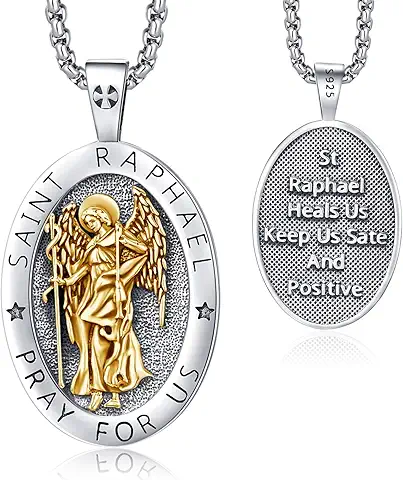
In the Eastern Orthodox tradition, Raphael's standard iconographic form is described precisely by the Orthodox Church in America's theological text: "Raphael holds a vessel with healing medications in his left hand, and with his right hand leads Tobias, carrying a fish for healing." The vessel of healing medications identifies him immediately as the divine physician. Early Byzantine mosaics — including those in the great basilicas of Ravenna — show Raphael and the other archangels dressed in the clothing of Byzantine imperial courtiers, reflecting the theological conviction that angels serve as ministers of the divine court. The fish he carries or stands upon references both the fish of Tobit and, by extension, the ichthus symbol that identifies Christ as the source of all true healing.
In the November Synaxis icon, Raphael appears among the hierarchy of bodiless powers assembled around the central figure of the Archangel Michael — identified by his specific attributes (vessel, Tobias, fish) within the larger assembly of angelic forces.
Western Catholic and Renaissance Iconography
Western art developed an extensive tradition of "Tobias and the Angel" paintings — one of the most popular subjects of the Italian Renaissance — in which Raphael appears as a graceful young man walking alongside the boy Tobias, who carries the fish. The fish is almost universally present, held in Tobias's hand or dangling from a line. Raphael carries a staff (the traveler's attribute) and often a small vessel or flask for the healing medicines. His sandals mark him as a traveler. The dog that accompanies Tobias throughout the journey (one of the few domestic dogs in Scripture) often appears in these paintings as well.
Major Renaissance depictions include works by Titian, Raphael (the painter, named for the archangel), Verrocchio, and — most famously — Rembrandt's intimate and emotionally complex treatments of the departure of the angel. The subject's popularity in the Renaissance reflects the period's intense interest in divine providence, angelic mediation, and the theology of travel and pilgrimage.
The Venice Relief and Vasco da Gama
The stone relief on a corner of the Doge's Palace in Venice — depicting Raphael with a scroll inscribed Efficia fretum quietum ("Keep the Gulf quiet") — represents the archangel's patronage of maritime navigation and the protection of Venice's Adriatic trade routes. This inscription, unique to Raphael's iconography, reflects the practical faith of a maritime civilization that understood itself as dependent on divine protection for its survival.
When Vasco da Gama sailed from Lisbon on July 8, 1497, with the first Portuguese expedition to India by sea, his flagship was named São Rafael at the insistence of King Manuel I. At the Cape of Good Hope — the most dangerous point of the voyage — the expedition made land and erected a column in Raphael's honor. The small statue of Raphael that accompanied the voyage is preserved to this day in the Naval Museum in Lisbon.
Prayers to Saint Raphael: Catholic and Orthodox Traditions
Prayer to Raphael across both Eastern and Western Christianity shares a common theological structure: invocation of his identity ("Medicine of God," "one of the seven"), acknowledgment of his scriptural mission (guiding Tobias, healing Tobit, binding Asmodeus), petition for his intercession in the specific need, and reference to his standing before the throne of God as the one who presents human prayers to the Holy One.
The Indulgenced Prayer — Pope Leo XIII (June 21, 1890)
Pope Leo XIII granted an indulgence of 100 days to the following prayer, which became the standard Catholic invocation of Raphael:
Glorious Archangel Saint Raphael, great Prince of the Heavenly Court, illustrious for thy gifts of wisdom and grace, guide of those who journey by land, sea, or air, consoler of the afflicted, and refuge of sinners —
I entreat thee to assist me in all my needs and in all the trials of this life, as thou didst once assist the young Tobias in his journeys. And since thou art the Medicine of God, I humbly pray thee to heal the many infirmities of my soul and the ills that afflict my body. I ask especially for angelic purity, that I may be made fit to be the temple of the Holy Ghost. Amen.
— Indulgenced by Pope Leo XIII, June 21, 1890. Indulgence: 100 days.The Traditional Novena Prayer
Glorious Archangel Saint Raphael, great prince of the heavenly court, you are illustrious for your gifts of wisdom and grace. You are a guide of those who journey by land or sea or air, consoler of the afflicted, and refuge of sinners. I beg you, assist me in all my needs and in all the sufferings of this life, as once you helped the young Tobias on his travels.
Because you are the Medicine of God, I humbly pray you to heal the many infirmities of my soul and the ills that afflict my body. I especially ask of you this favor: (state your intention), and the great grace of purity to prepare me to be the temple of the Holy Spirit. Amen.
Saint Raphael, of the glorious seven who stand before the throne of Him who lives and reigns, Angel of health, the Lord has filled your hand with balm from heaven to soothe or cure our pains. Heal or cure the child of God who puts his trust in thee. Amen.
Prayer for Finding a Holy Spouse
Derived from Raphael's role in arranging the marriage of Tobias and Sarah, this prayer has been used by Catholic singles for centuries and was promoted by the Catholic Bishops' Conference of England and Wales:
Saint Raphael, you were sent by God to guide young Tobias in choosing a good and virtuous spouse. Please help me in this important choice which will affect my whole future.
You not only directed Tobias in finding a wife, but you also gave him guidelines which should be foremost in every Christian marriage: "Pray together before making important decisions." Grant me wisdom to recognize the person God has prepared for me, courage to act in faith, and patience to wait in hope. Amen.
The Collect from the Traditional Roman Rite (October 24)
O God, Who gave the Blessed Raphael the Archangel to Tobias as his travelling companion: grant to us Thy servants that we also may be guarded by his care and receive the protection of his assistance. Through Our Lord Jesus Christ, Thy Son, Who liveth and reigneth with Thee in the unity of the Holy Spirit, God, world without end. Amen.
— Roman Missal, Feast of Saint Raphael (October 24)Eastern Orthodox: Troparion and Kontakion (November 8 — Synaxis of the Bodiless Powers)
Supreme commanders of the Hosts of Heaven, we who are unworthy pray to you: by your prayers encircle us beneath the wings of your immaterial glory, guarding us who fall down and fervently cry out: Deliver us from all danger, as commanders of the Powers on High!
— Eastern Orthodox Church, Troparion for November 8, Tone 4O Holy Raphael, Angel of God and Healer of men, who didst stand before the Lord of Spirits and didst receive thy name — the Medicine of God — who didst guide young Tobias in his journey and deliver Sarah from the power of the evil one, bind up the wounds of our souls and bodies, lead us safely through the trials of this life, and present our prayers before the throne of the Most High, that healed and strengthened by thy intercession we may give glory to the Father, and to the Son, and to the Holy Spirit, now and ever, and unto the ages of ages. Amen.
The Jewish Bedtime Prayer: The Four Archangels
In Jewish tradition, following the recitation of the Shema before sleep, it is customary to invoke the four archangels in the four directions — a practice that reflects the same theology of angelic protection found throughout Christian tradition and that names Raphael by position:
In the name of the Lord God of Israel: may Michael be at my right hand, Gabriel at my left, Uriel before me, Raphael behind me, and above my head the presence of God.
— Traditional Jewish bedtime prayer recited after the Shema. Raphael guards the back — the most vulnerable position, from behind.Prayer Cards for Saint Raphael the Archangel
The Eastern Church carries handcrafted Eastern Catholic and Orthodox prayer cards for saints and archangels — beautiful, liturgically grounded sacred art for personal devotion, parish distribution, and parish bulk orders.
Order Prayer Cards for Your Parish →Sacred Books on Raphael and the Angelic World
For those who wish to go deeper into the theology of Raphael, the angelic hierarchies, and the rich tradition of angelic devotion in Catholic and Orthodox Christianity, the following resources represent the finest available scholarship and devotional literature:
Questions About Saint Raphael the Archangel
The Medicine of God — Still Present, Still Healing
Raphael traveled every step of Tobias's journey without revealing himself. He ate at Tobit's table. He walked the long road through foreign lands. He stood on the bank of the Tigris and instructed a frightened young man to seize the fish that attacked him. He drove a demon across a continent and bound it in the desert. He restored a blind man's sight with a fish's gall. And then he revealed — with the characteristic restraint of those who truly stand in God's presence — that all of this had been God's doing, presented by Raphael to God, acted through Raphael by God, accomplished by God for those whose tears he had been carrying before the throne of glory since the moment they first prayed.
He is still doing the same thing. He is one of the seven who stand before the Holy One. Your prayers are carried by him. Call on him: Raphael — Medicine of God — heal, guide, and present us before the One who sent you.
As an Amazon Associate, The Eastern Church earns from qualifying purchases.