Saint Alexander Nevsky: The Warrior-Prince Who Saved Orthodox Russia From East and West Alike
Saint Alexander Nevsky: The Warrior-Prince Who Saved Orthodox Russia From East and West Alike
He crushed the Swedes at the Neva before he turned twenty. He broke the Teutonic Knights on the ice of Lake Chudskoe. He bowed four times to the Mongol Horde to spare his people from ruin, and refused Rome even once. He died a monk, and Russia has never stopped praying to him since.
Saint Alexander Nevsky at a Glance
- Also Known As
- Alexander Yaroslavich; in monastic schema, Alexis
- Born
- May 30, 1220 (some sources 1219 or 1221), Pereslavl-Zalessky, Russia
- Died
- November 14, 1263, at Gorodets, on the return journey from the Golden Horde
- Venerated In
- The Russian Orthodox Church
- Canonized
- Locally in 1380 to 1381; by the whole Russian Church at the Moscow Council of 1547, under Metropolitan Macarius
- Feast Days
- November 23 (burial and repose) and August 30 (translation of relics to Saint Petersburg)
- Title
- Holy and Right-Believing Grand Prince
- Reigned As
- Prince of Novgorod (1236 to 1252), Grand Prince of Kiev (1246 to 1252), Grand Prince of Vladimir (1252 to 1263)
- Known For
- The Battle of the Neva (1240), the Battle on the Ice (1242), and diplomatic preservation of Orthodox Russia under the Mongol Golden Horde
- Relics
- Holy Trinity Cathedral, Alexander Nevsky Lavra, Saint Petersburg
- I. A Childhood Between Two Frontiers
- II. The Battle of the Neva, 1240
- III. Liberating Pskov and the Battle on the Ice, 1242
- IV. Answering Rome: Why Alexander Refused the Pope
- V. Four Journeys to the Golden Horde
- VI. Monastic Tonsure and Death at Gorodets, 1263
- VII. The Burial Miracle of Vladimir
- VIII. Incorrupt Relics and the Canonizations of 1380 and 1547
- IX. The Long Journey of the Relics: Vladimir, Saint Petersburg, and a Soviet Museum
- X. Miracles Attributed to Saint Alexander Nevsky
- XI. His Companions: Connections to Other Saints
- XII. On His Words and Writings
- XIII. Churches and Cathedrals Named for Him, With Links
- XIV. Legacy: Patron of Russia, Patron of Soldiers
- Prayer for the Intercession of Saint Alexander Nevsky
- Frequently Asked Questions
A Childhood Between Two Frontiers
Alexander was born on May 30, 1220, in Pereslavl-Zalessky, a small fortified town on the shore of a lake, where his father Yaroslav Vsevolodovich ruled as prince. Yaroslav, baptized Theodore, was remembered by contemporaries as gentle and genial, the younger son of the great Vsevolod III "Large Nest" of Vladimir. Alexander's mother, Theodosia, a princess of Ryazan, was Yaroslav's third wife. Their older son, the future Saint Theodore, died at just fifteen; Alexander was their second son.
Russian princely boys of this era underwent a formal rite of passage, the princely tonsure, marking their initiation as soldiers. Alexander's tonsure took place in the Savior Transfiguration Cathedral of Pereslavl and was performed by Saint Simon, Bishop of Suzdal, one of the compilers of the Kiev Caves Paterikon. From this elder-hierarch Alexander received his first blessing for military service in the name of God, a blessing that would define the rest of his life. In 1227 his father was sent to rule Novgorod at the invitation of its people, taking his sons with him, and by his teenage years Alexander was already accompanying his father on military campaigns, including a 1235 battle at the River Emajogi in present-day Estonia, where Yaroslav's forces routed the invading Germans.
Part II
The Battle of the Neva, 1240
In 1236, at only sixteen, Alexander was installed by his father as independent ruling prince of Novgorod. Four years later, in the summer of 1240, a Swedish force under Yarl Birger sailed up the Neva River with a message of open contempt for the young prince: fight if you dare, for I am already here and taking your land. Alexander, not yet twenty years old, went first to the Cathedral of Saint Sophia, the Wisdom of God, and prayed at length, reciting Psalm 34, asking the Lord to fight against those who fought against him. Archbishop Spyridon blessed the prince and his army, and Alexander left the church with words that have echoed through Russian military tradition ever since: the power of God is not in numbers, but in truth.
He marched with a small force, trusting in the Holy Trinity, without waiting for reinforcement from his father. On the eve of the battle, a warrior named Pelgui, baptized Philip, reported a vision on the river at dawn: a boat bearing the holy martyrs Boris and Gleb in royal purple, with Boris saying to his brother, "let us help our kinsman Alexander." Alexander ordered the vision kept quiet, but it emboldened his army. The battle on July 15, 1240, ended in a rout of the Swedish force, and it was this victory that earned the young prince his enduring name: Alexander Nevsky, of the Neva.
Part III
Liberating Pskov and the Battle on the Ice, 1242
The Teutonic Knights, crusading westward under papal blessing while calling themselves cross-bearers, remained a grave threat. In a swift 1241 campaign, Alexander retook the fortress of Koporye and expelled the Knights, but in 1242 the Germans succeeded in capturing Pskov itself. Alexander launched a winter campaign, liberated Pskov, and in the spring of 1242 met the Teutonic army in a decisive battle on the frozen surface of Lake Chudskoe, Lake Peipus.
On April 5, 1242, with his hands raised toward heaven, Alexander prayed for the same divine help granted to Moses against Amalek and to his own great-grandfather Yaroslav the Wise against the usurper Svyatopolk. The clash that followed became known to history as the Battle on the Ice: chroniclers described a slaughter so violent that the frozen lake itself seemed to move beneath the weight of the fighting, its surface reddened with blood. When the Teutonic line broke, Alexander's forces pursued the fleeing knights across the ice, and a great column of prisoners was later marched behind the victorious prince in disgrace. The western border of Orthodox Russia was, for a generation, secured.
Part IV
Answering Rome: Why Alexander Refused the Pope
In 1248, with the Mongol threat still bearing down from the east, ambassadors of the Roman Pope came to Alexander with an offer many Russian princes found tempting: Western military help against the Horde, in exchange for union with Rome. Alexander refused. His written answer stated plainly that the Russians were faithful to the Church of Christ and to the belief of the Seven Ecumenical Councils, adding, "these we know very well, but we do not accept your teaching."
Alexander's reasoning was rooted in hard personal memory. He knew well the fate of Constantinople, sacked and devastated by Crusaders in 1204, an act that had taught Orthodox Russia not to trust promises of Western rescue. Other Russian princes made a different choice. Saint Michael of Chernigov, Prince Daniel of Galich, and Alexander's own brother Andrew all conducted negotiations with Rome; Daniel of Galich's alliance with the papacy, in particular, delivered nothing in return and was remembered by Orthodox chroniclers as a betrayal, a union that Alexander was determined never to accept for his own Church.
Part V
Four Journeys to the Golden Horde
Having secured Russia's western border by the sword, Alexander turned to the harder task of securing its survival in the east, not through battle but through calculated submission. His father Yaroslav had bequeathed him an alliance with the Golden Horde, and Alexander held to it with what his contemporaries called the meekness of an angel and the wisdom of a serpent. He made the journey to the Horde four times over the course of his reign, forming a close personal bond with Batu Khan's son Sartak, who had accepted Christianity and was, in the chronicler's words, like a brother to him.
The policy was not without cost or controversy, then or since. Some Russian princes, hoping for European rescue instead, resisted the Horde openly, including Alexander's own brother Andrew, who was defeated and fled to Sweden, the very enemy Alexander had crushed at the Neva. Alexander's diplomacy bore lasting institutional fruit: in 1261, through the joint efforts of Alexander and Metropolitan Cyril, a diocese of the Russian Orthodox Church was formally established at Sarai, the Horde's own capital, opening an era of Christian influence deep into the pagan and increasingly Muslim East. In 1262, by Alexander's decree, the hated Tatar tribute collectors and troop conscriptors were expelled from many Russian cities, provoking fears of reprisal that only his fourth and final journey to the Horde, undertaken to smooth relations with the new Khan Berke, was able to avert.
Part VI
Monastic Tonsure and Death at Gorodets, 1263
Alexander's fourth diplomatic journey to Sarai, undertaken to confirm peace with Khan Berke after the expulsion of the tribute collectors, was his last. On the return journey, he fell gravely ill and was unable to reach his capital at Vladimir. At a monastery in Gorodets, sensing the end approaching, the Grand Prince completed his difficult earthly path by receiving the monastic schema, the highest degree of monastic tonsure, taking the name Alexis. He died on November 14, 1263, having spent his entire adult life defending, negotiating for, and ultimately dying in service to the Russian land and its Church.
Metropolitan Cyril, Alexander's spiritual father and lifelong companion in the work of preserving Orthodox Russia, delivered the funeral eulogy with words that captured the scale of the loss: "Know, my child, that already the sun has set for the land of Suzdal. There will be no greater prince in the Russian land." His body was carried the nine days' journey to Vladimir for burial, and chroniclers recorded that it remained undecayed throughout the winter journey.
Part VII
The Burial Miracle of Vladimir
On November 23, 1263, before Alexander's burial at the Nativity Monastery in Vladimir, witnesses recorded what the chronicle calls a wondrous miracle, worthy of memory. As the body was placed in the crypt, the steward Sebastian and Metropolitan Cyril moved to place a written prayer of absolution, the spiritual gramota, between the fingers of the deceased prince, following the customary rite of the Orthodox Church. According to the account, the dead man reached out his hand as though alive and took the scroll directly from the Metropolitan's own hand. Those present were said to have been so struck with terror that they could barely bring themselves to step back from the tomb. The date of November 23 became, and remains, his principal feast day, marking his burial rather than the date of his repose eleven days earlier.
Part VIII
Incorrupt Relics and the Canonizations of 1380 and 1547
Veneration of Alexander as a saint began soon after his death, but the decisive moment came more than a century later. In 1380, on the eve of the Battle of Kulikovo, the first major Russian victory against the Golden Horde, Alexander's relics were uncovered at Vladimir in response to a vision and were found to be incorrupt, one of the traditional Orthodox signs of sanctity. The timing, immediately before a battle that would begin the long turning of the tide against Tatar domination, was received by the Russian people as a providential sign. Local canonization followed by 1381.
The universal, Church-wide glorification of Saint Alexander Nevsky took place under Metropolitan Macarius at the Moscow Council of 1547, the same great council that formally canonized many of Russia's most beloved saints. A liturgical canon in his honor was composed at that time by the monk Michael of Vladimir. His principal feast day of November 23 commemorates his burial and repose; a second feast, August 30, was later established to commemorate the translation of his relics to Saint Petersburg.
Part IX
The Long Journey of the Relics: Vladimir, Saint Petersburg, and a Soviet Museum
For nearly five hundred years, Alexander's relics remained at Vladimir, venerated at the site of his original burial. In 1724, Peter the Great, who had chosen Alexander Nevsky as patron of his new capital, ordered the relics translated to Saint Petersburg, where they were installed in the newly founded Alexander Nevsky Monastery. In 1753 Empress Elizabeth, Peter's daughter, commissioned an enormous Baroque silver sarcophagus and reliquary complex to house them, using nearly a ton and a half of the first silver obtained in Russia by industrial means; the completed monument was installed in the Lavra's new Holy Trinity Cathedral in 1790.
The Soviet period brought a rupture that lasted almost seventy years. In May 1922, Bolshevik authorities publicly opened the reliquary as part of a nationwide campaign against Church valuables, both to seize the silver and to attempt to dispel the aura around the relics. Officials at the Hermitage and Russian Museum intervened to save the elaborate silver sarcophagus itself from being melted down, arguing successfully for its artistic value; the Hermitage preserved it through multiple further threats over the following decades, including the Siege of Leningrad. The saint's actual bodily relics, separated from their sarcophagus, were transferred to the Museum of the History of Religion and Atheism, then housed in the former Kazan Cathedral in Leningrad, where they remained on secular display for the better part of the Soviet era.
In 1989, amid the loosening of the perestroika years, the relics were returned to the Russian Orthodox Church and placed once more in the Holy Trinity Cathedral of the Alexander Nevsky Lavra, where they remain today. The great silver sarcophagus took considerably longer to follow them: it remained on display at the Hermitage Museum for a full century after its removal from the church, and was formally transferred back to the Lavra only in September 2023, under a long-term loan agreement between the museum and the diocese.
Readers planning a pilgrimage should know precisely where things stand: the saint's relics themselves are venerated today in the Holy Trinity Cathedral of the Alexander Nevsky Lavra in Saint Petersburg, where they were returned in 1989. The historic eighteenth-century silver sarcophagus that once held them is now also at the Lavra, in the Annunciation Church, following its 2023 transfer from the Hermitage, though it stands empty of the relics it was built to contain.
Part X
Miracles Attributed to Saint Alexander Nevsky
Several distinct wonders are recorded across Alexander's life and afterlife, each with a different degree of documentation:
The Vision of Boris and Gleb, 1240
Before the Battle of the Neva, the warrior Pelgui reported seeing the holy martyrs Boris and Gleb on the river at dawn, coming to the aid of their kinsman Alexander. This account comes down through the traditional Life of Alexander Nevsky, compiled in the late thirteenth century.
The Burial Miracle, 1263
At his interment in Vladimir, witnesses reported that his hand reached out to take the scroll of absolution from Metropolitan Cyril, as recounted in the previous section.
The Incorrupt Relics, 1380
The best attested and historically most consequential miracle: his relics, uncovered before the Battle of Kulikovo, were found incorrupt, directly triggering his local canonization.
Ongoing Healings at the Shrine
Across the centuries of veneration at Vladimir and later at Saint Petersburg, sources describe the Russian people turning to Saint Alexander Nevsky's intercession especially in times of national danger and crisis. Specific, individually documented healing accounts from this long span of veneration were not located in the sources consulted for this article, though the general tradition of turning to him in national emergency is very well attested and continues into the present day.

Part XI
His Companions: Connections to Other Saints
Alexander Nevsky's life intersects with several other saints of the Russian Church, by blood, by betrothal, and by the shared history of his turbulent century:
Saint Daniel of Moscow
Alexander's fourth and youngest son, born in 1261 to his second wife Vassa, just two years before his father's death. Daniel inherited the least valuable of his father's lands, the small town of Moscow, and through patient, largely peaceful rule became the founder of the House of Moscow and forefather of all its later Grand Princes. His own relics were uncovered incorrupt in 1652, and he was canonized by the Russian Church that same century; he rests today in the Danilov Monastery, which he himself founded.
Saint Euphrosyne of Suzdal
Born Theodosia, daughter of Saint Michael of Chernigov, she was betrothed as a girl to Alexander's older brother, the future Saint Theodore. When Theodore died before the marriage in 1233, the young princess entered a monastery instead and became renowned for her own ascetic life as the nun Euphrosyne, a near-sister-in-law whose path diverged from Alexander's family by tragedy rather than by choice.
Martyr Michael of Chernigov
Father of Euphrosyne and one of the Russian princes who, unlike Alexander, chose to negotiate with Rome for Western aid against the Horde rather than accept submission. Michael was ultimately martyred by the Golden Horde, a fate that stands in the sources as an implicit contrast to Alexander's own more painful, more patient survival strategy.
Saint Simon, Bishop of Suzdal
The hierarch who performed Alexander's princely tonsure in boyhood and gave him his first blessing for military service, one of the compilers of the celebrated Kiev Caves Paterikon.
Holy Martyrs Boris and Gleb
The eleventh-century royal martyr-brothers whose vision, reported by the warrior Pelgui, is recorded as having strengthened Alexander's army on the eve of the Battle of the Neva in 1240.
Part XII
On His Words and Writings
Alexander Nevsky left behind no personal writings, letters, or homilies of his own; he was a ruling prince and soldier, not a cleric or monastic author. What survives instead is the thirteenth-century chronicle Life of Alexander Nevsky, compiled within a generation of his death, which preserves the words attributed to him at the Neva and in his written reply to Rome, both quoted earlier in this article.
One line is so often attributed to Alexander Nevsky that it deserves a direct and honest note: the famous warning, "whoever comes to us with the sword shall perish by the sword," widely repeated as his personal saying and popularized in the West largely through Sergei Eisenstein's 1938 film Alexander Nevsky, does not appear in this precise form in the earliest chronicle sources. It closely echoes Christ's own words in the Gospel of Matthew, chapter 26, and most historians regard it as a later paraphrase or legendary attribution rather than an authenticated statement from the thirteenth-century prince himself. This article presents it as popular tradition, not as a verified historical quotation.
Part XIII
Churches and Cathedrals Named for Him, With Links
Few Orthodox saints have as many churches and cathedrals bearing their name across as many countries as Saint Alexander Nevsky. A representative selection, with links to the churches' own websites where available:
Alexander Nevsky Lavra, Saint Petersburg, Russia
The saint's own monastery, founded by Peter the Great in 1710 specifically in Alexander's honor, elevated to the rank of Lavra in 1797, and home to his relics today. lavra.spb.ru
Saint Alexander Nevsky Cathedral, Sofia, Bulgaria
One of the largest Eastern Orthodox cathedrals in the world, built between 1882 and 1912 to honor the Russian soldiers who died liberating Bulgaria from Ottoman rule in the Russo-Turkish War, and serves today as the cathedral church of the Patriarch of Bulgaria. cathedral.bg
Saint Alexander Nevsky Cathedral, Allison Park, Pittsburgh, Pennsylvania
Cathedral of the Orthodox Church in America's Archdiocese of Western Pennsylvania, tracing its founding to 1891 as Pittsburgh's first Russian Orthodox community. Notably, the parish icon of Saint Alexander Nevsky on its confessional table itself contains relics of the saint. sanocpgh.org
Saint Alexander Nevsky Cathedral, Howell, New Jersey
A cathedral of the Russian Orthodox Church Outside of Russia, founded in 1936, whose current building's cornerstone was laid on the saint's own feast day, September 12, 1989, with relics of Saint Herman of Alaska placed in its foundation. stalexandernevskycathedral.com
Beyond these four, cathedrals and churches dedicated to Saint Alexander Nevsky stand in Tallinn, Paris, Belgrade, Warsaw, Tbilisi, Baku, and numerous Russian cities including Novosibirsk, Nizhny Novgorod, Tver, and Volgograd, a geographic spread matched by very few saints in the entire Orthodox calendar.
Part XIV
Legacy: Patron of Russia, Patron of Soldiers
Alexander Nevsky occupies an unusual place among Orthodox saints: he was neither a hermit, nor a monastic ascetic for most of his life, nor a martyr in the technical sense, and yet he is venerated as one of the most beloved saints the Russian Church has ever produced. His holiness was worked out almost entirely in the public arena, on battlefields, in tense negotiations with a conquering empire, and in a single firm letter to Rome, rather than in a monastery cell. He is, as one source puts it plainly, the saint to whom the Russian people are accustomed to turn at moments when great misfortune threatens the nation's very existence, a pattern of devotion that has repeated itself across seven centuries, from the Battle of Kulikovo in 1380 to the establishment of the imperial Order of Alexander Nevsky in 1725 to his invocation as a national symbol during the Second World War.
For readers of Eastern Christian history, Alexander Nevsky stands as a model of a specific and difficult kind of sanctity: holiness exercised through statecraft, through the patient, humiliating work of preserving a people and a Church under foreign domination rather than through the cleaner narrative of martyrdom or monastic withdrawal. It is, in its own way, no less demanding a path than the desert.
Holy Trinity, Father, Son, and Holy Spirit, to You be glory, honor, and blessing, for having given to Your holy Church the Right-Believing Grand Prince Alexander Nevsky, warrior, statesman, and monk, as a model of courage in battle, wisdom in adversity, and unwavering fidelity to the Orthodox faith.
We ask You humbly: just as You granted him victory against the enemies of his people and the wisdom to preserve his Church through years of hardship, be pleased to grant us, through his intercession, courage in our own trials, protection for those who defend the innocent, and the grace we now ask with confidence.
Through Christ our Lord. Amen.
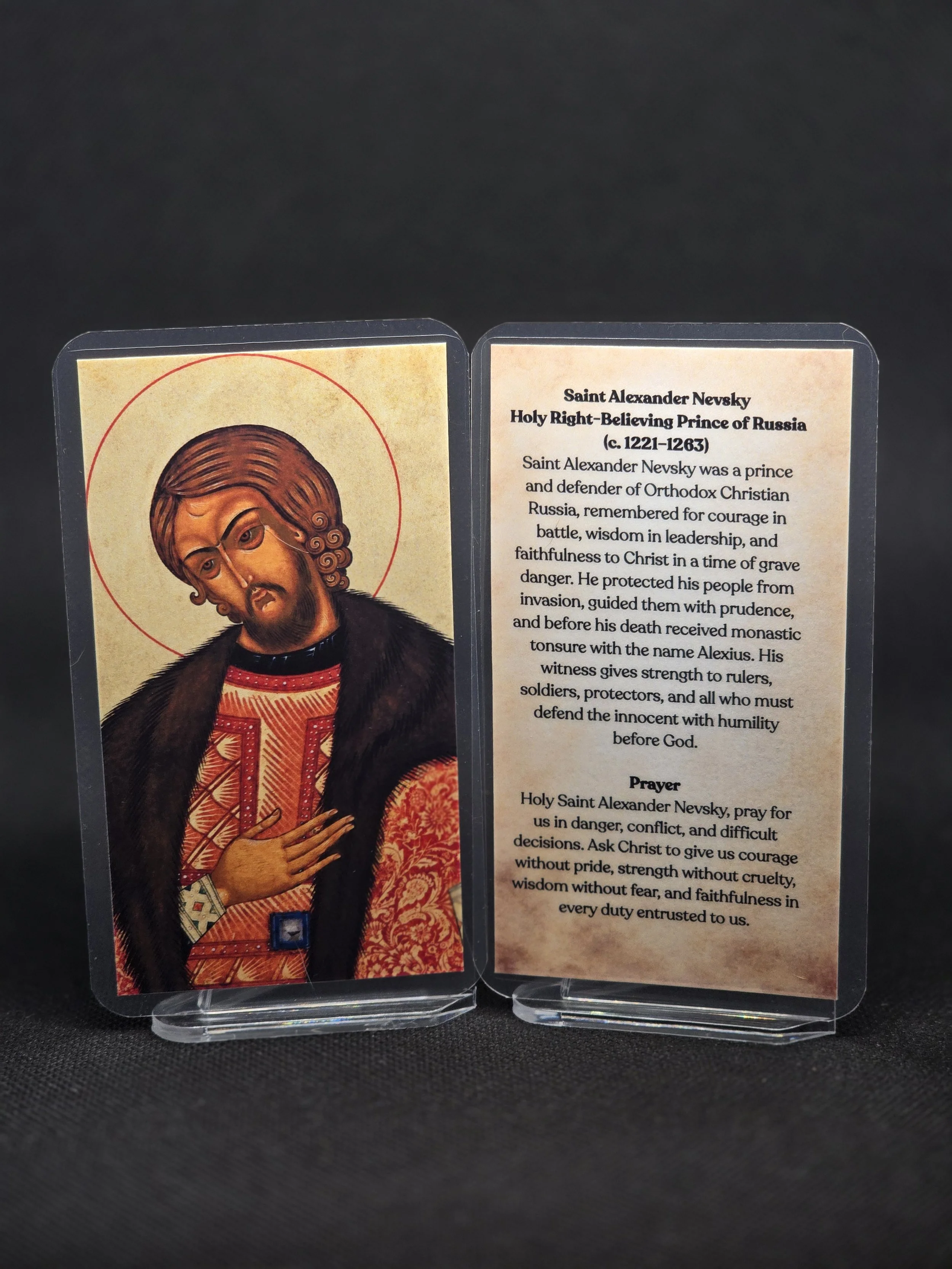
An original English-language devotional prayer composed for use with the Saint Alexander Nevsky prayer card, drawing on the traditional themes of his veneration in the Russian Orthodox Church.
More From Our Store, In Honor of Russia's Warrior Saints

FAQ
Frequently Asked Questions About Saint Alexander Nevsky
He Never Lost a Battle, and He Never Sold His Church.
Saint Alexander Nevsky spent his whole life holding a line most rulers would have broken at, crushing invaders from the west while bowing, again and again, to a conqueror from the east, all so that the Orthodox faith of his people would still exist on the other side of both threats. He died a monk in a small monastery on the road home from his final act of that patient defense, and within a lifetime the Russian people had already begun treating his grave as holy ground.
Ask his intercession. Say his prayer. Remember a prince who understood that sometimes the hardest fight is the one you choose not to have.
Get the Saint Alexander Nevsky Prayer Card →