Saint Benedict of Nursia: The Roman Noble Who Fled the City and Became the Father of Western Monasticism
Saint Benedict of Nursia: The Roman Noble Who Fled the City and Became the Father of Western Monasticism
He left Rome in disgust at nineteen or twenty, survived two attempts on his life by his own monks, and wrote seventy-three short chapters in a cave-country monastery that would go on to organize the prayer, work, and daily bread of a continent for fifteen hundred years.
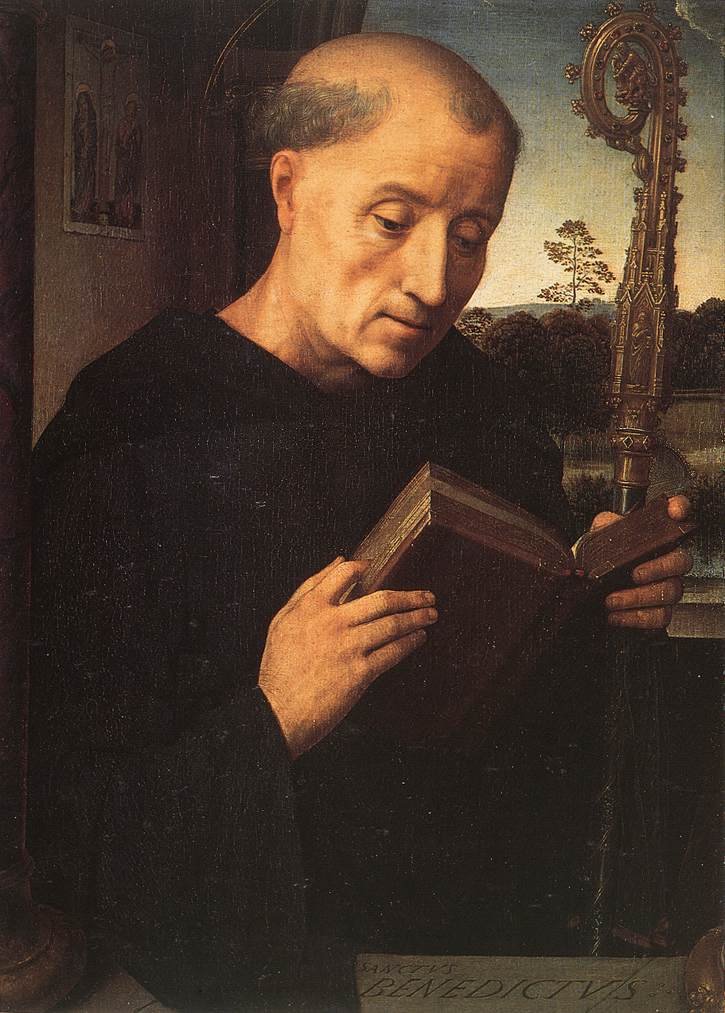
Saint Benedict of Nursia at a Glance
- Born
- c. 480, Nursia (modern Norcia), Italy
- Died
- c. 547, Monte Cassino, Italy, standing in prayer
- Venerated In
- The Catholic Church, the Eastern Orthodox Church, the Anglican Communion, and Lutheranism
- Feast Days
- July 11 (Roman Catholic, translation of relics); March 21 (traditional day of death, kept by Benedictines); March 14 (Eastern Orthodox and Byzantine Catholic)
- Title
- Father of Western Monasticism; Patron of Europe
- Founder Of
- Twelve monasteries at Subiaco; the monastery of Monte Cassino; the Rule of Saint Benedict
- Twin Sister
- Saint Scholastica, foundress of Benedictine women's monasticism
- Patron Declared By
- Pope Paul VI, October 24, 1964, at the rededication of Monte Cassino
- Principal Sources
- Book II of the Dialogues of Pope Saint Gregory the Great, c. 593 to 594
- Disputed Relics
- Monte Cassino, Italy, and Saint-Benoit-sur-Loire (Fleury), France
- I. A Roman Noble's Son, Disgusted by Rome
- II. Enfide and the First Miracle
- III. Three Years Alone in a Cave Above Subiaco
- IV. Called to Be Abbot, and Nearly Poisoned Twice
- V. Twelve Monasteries and the First Benedictine Schools
- VI. Monte Cassino: An Idol Overthrown, a Rule Written
- VII. Miracles at Monte Cassino
- VIII. The Prophecy Given to King Totila, 543
- IX. Scholastica: The Storm That Kept Her Brother Overnight
- X. Death Standing in Prayer, and the Vision of the World in Light
- XI. A Genuinely Disputed Question: Where Are His Relics?
- XII. Canonization and Patron of Europe
- XIII. His Companions: Connections to Other Saints
- XIV. On His Writing: The Rule of Saint Benedict
- XV. Monasteries and Shrines, With Links
- XVI. Legacy: The Man Who Organized a Continent's Prayer
- Prayer for the Intercession of Saint Benedict
- Frequently Asked Questions
A Roman Noble's Son, Disgusted by Rome
Benedict was born around the year 480 in Nursia, a small town near Spoleto in central Italy, the son of a Roman noble family. Tradition, accepted by the Venerable Bede, holds that he was born a twin alongside his sister Scholastica, who would herself become a founder of women's monasticism and remain bound to her brother's life until its final days. His boyhood was spent in Rome, where he lived with his parents and attended the schools through his early studies.
What happened next is recorded only in the account of Pope Saint Gregory the Great, writing roughly half a century after Benedict's death, drawing on the testimony of two of the saint's own disciples. Benedict, by then old enough to be deep in his literary studies and to understand fully the licentious lives of many of his fellow students, and, Gregory tells us, having himself been drawn toward the love of a woman, weighed the dissolute world of late Roman Rome against the life taught in the Gospels and chose the Gospel. He gave over his books, forsook his father's house and inheritance, and left the city, in Gregory's words, "instructed with learned ignorance and furnished with unlearned wisdom." Most careful readings of Gregory's account place his age at this departure closer to nineteen or twenty than to the fourteen years old sometimes claimed in popular tradition.
Part II
Enfide and the First Miracle
Benedict did not initially leave Rome to become a hermit, only to escape the corruption of the great city. He brought his old family nurse with him as a servant, and the two settled at Enfide, in the Simbruini mountains about forty miles from Rome, near a church dedicated to Saint Peter, among a loose community of like-minded men. It was at Enfide that Benedict worked his first recorded miracle: when his elderly nurse accidentally broke an earthenware wheat-sifter she had borrowed, Benedict prayed over the pieces and restored the vessel to perfect condition.
The miracle, rather than pleasing him, alarmed him. The notoriety it brought drove Benedict to withdraw even further from society, and he fled secretly from his own nurse to seek the deeper solitude of Subiaco. His purpose had sharpened as well: he now resolved not merely to avoid the city's corruption but to embrace poverty and labor deliberately, for God's own sake.
Part III
Three Years Alone in a Cave Above Subiaco
On the path from Enfide to Subiaco, Benedict encountered a monk named Romanus, whose own monastery stood on the mountain directly above a cave overlooking the valley and its lake, formed near the ruins of the emperor Nero's old villa. Romanus, learning of Benedict's purpose, gave him the monastic habit and counseled him to become a hermit. For three years, unknown to almost everyone, Benedict lived alone in that cave, sustained only by food that Romanus lowered to him on fixed days.
Gregory tells us little of the specific events of these years, but he marks their significance in a single change of language: he now speaks of Benedict no longer as a boy but as a man of God. In solitude, broken only by Romanus's visits, Benedict matured in mind, in self-knowledge, and in understanding of others, laying the foundation of everything that followed.
Part IV
Called to Be Abbot, and Nearly Poisoned Twice
Word of Benedict's holiness spread until the monks of a nearby monastery, on the death of their abbot, came to beg him to lead them. Benedict knew their way of life differed sharply from his own and warned them plainly that they would never agree, but he eventually consented. The experiment failed disastrously: unwilling to submit to the discipline he demanded, the monks attempted to poison him. According to the tradition recorded in Gregory's account and repeated across centuries of Benedictine devotion, when Benedict made the sign of the cross over the cup of poisoned wine set before him, the cup shattered as though struck by a stone, and Benedict, recognizing what had happened, quietly returned to his cave at Subiaco, telling the monks only that he forgave them and that they should seek a superior suited to their own ways.
Part V
Twelve Monasteries and the First Benedictine Schools
From this point forward, Gregory tells us, Benedict's miracles became frequent, and increasing numbers of people, drawn by his sanctity, came to Subiaco seeking his guidance. To house and form them, Benedict built twelve small monasteries in the valley, each with a superior and twelve monks, keeping a thirteenth for himself and a few he judged would profit most from his direct presence, remaining, in all of them, the father and abbot of the whole. With the founding of these communities came the first schools for children attached to Benedictine life, and among the earliest boys brought to Benedict for education were two who would themselves become central figures in Benedictine tradition: Maurus and Placid.
Life at Subiaco, as the Rule Benedict would later write makes clear in hindsight, was communal rather than solitary: monks carried water up the steep mountainside, cleared ground, built cloisters, made gardens, taught children, preached to the country people, read and studied for hours each day, received strangers, and kept the regular hours of prayer, chanting the full Psalter across the course of each week. It was, in miniature, the entire shape of the life his Rule would soon describe for the whole of the West.
Part VI
Monte Cassino: An Idol Overthrown, a Rule Written
The growing fame and influence of the Subiaco communities brought jealousy and persecution, culminating, according to Gregory, in a neighboring priest's attempt to scandalize the monks by sending dancing women into the monastery courtyard. To spare his monks further harassment, Benedict left Subiaco around the year 529 and traveled south to the summit of Monte Cassino, roughly halfway between Rome and Naples.
The mountain's crest held an ancient chapel where, in Gregory's account, "the foolish and simple country people, according to the custom of the old Gentiles, worshipped the god Apollo," surrounded by woods where the local population still offered pagan sacrifice. Benedict smashed the idol, overturned the altar, and set fire to the sacred grove, building in their place an oratory to Saint Martin where the temple had stood and a second oratory to Saint John the Baptist on the site of Apollo's own altar. Through his continual preaching, the people of the district were converted to the Christian faith, and on this transformed and consecrated ground Benedict built the monastery that would define the rest of his life and, in time, all of Western monastic history.
At Monte Cassino, unlike at Subiaco, Benedict gathered his monks into a single community under one roof, governed by a prior and deans rather than by the scattered abbots of the twelve small Subiaco houses. It was here, most scholars agree, that Benedict composed the seventy-three short chapters of his Rule, addressed, in his own words, to "whoever thou art, that, renouncing thine own will, dost put on the strong and bright armour of obedience in order to fight for the Lord Christ, our true King."
Part VII
Miracles at Monte Cassino
Gregory's Dialogues preserve a rich collection of miracle accounts from Benedict's Monte Cassino years, most of them small, domestic, and deeply human rather than grand or public. When a Gothic monk lost the iron head of his bill-hook in a lake while clearing briars for a garden, Benedict touched the wooden handle to the water and the iron head rose up out of the depths and reattached itself, so that the monk could return to his work. When Benedict's young disciple Placid fell into the lake while drawing water, Benedict, sitting in his cell, perceived the accident instantly and sent Maurus running to save him. Maurus, in perfect obedience, walked out onto the surface of the water itself, pulled Placid to safety by the hair, and only realized upon reaching solid ground what he had actually done.
Repeatedly, Gregory records, Benedict's awareness reached beyond the walls of his own cell: he foresaw and warned against an accident to workmen building a nearby monastery, was present in spirit with monks eating on a journey, with a friend traveling to visit him, with a monk carrying a gift from a community of nuns, and with the new community he had founded at Terracina, on the coast some forty miles from Monte Cassino. Small kindnesses fill the same record: he prayed through entire nights on the mountainside so his monks would be spared the labor of carrying water, and he fed a crow from the neighboring woods with his own hands each day at dinner.
Part VIII
The Prophecy Given to King Totila, 543
The single certain date anchoring Benedict's entire biography comes from an encounter with Totila, King of the Ostrogoths, who visited Monte Cassino in the year 543. Benedict rebuked the king directly for his wicked deeds and, according to Gregory, foretold his future in a few words: "Much wickedness do you daily commit, and many sins have you done: now at length give over your sinful life. Into the city of Rome shall you enter, and over the sea shall you pass: nine years shall you reign, and in the tenth shall you leave this mortal life." Totila, deeply shaken, asked for Benedict's prayers and departed, and Gregory records that from that time forward the king's cruelty measurably softened. Every detail of the prophecy came to pass: Totila entered Rome, crossed the sea into Sicily, and in the tenth year of his reign lost both his kingdom and his life.
Part IX
Scholastica: The Storm That Kept Her Brother Overnight
Only near the very end of Gregory's account does Benedict's sister Scholastica, consecrated to God from her infancy, finally appear by name, though tradition holds she and Benedict were twins. Once a year she came to visit her brother, meeting him not far from the monastery gate. On what would be their last meeting, with the sky perfectly clear, Scholastica begged Benedict to stay through the night so they might continue speaking of the joys of heaven. Benedict, bound by his own rule never to sleep away from his abbey, refused.
Scholastica bowed her head over her folded hands on the table and prayed. The moment she lifted her head, a sudden and violent storm broke, with such thunder, lightning, and rain that Benedict and his companions could not so much as step outside the door. "God forgive you, sister," Benedict is recorded as saying, startled by the tempest her prayer had summoned. "What have you done?" Scholastica answered simply that she had asked him and he had refused her, and she had asked God, who had not. Benedict remained the whole night, and the two siblings continued their holy conversation until morning. Three days later, Benedict, alone in his cell, beheld his sister's soul departing her body in the form of a dove, ascending into heaven. He sent his monks to bring her body back to be buried in the tomb he had already prepared for himself.
Part X
Death Standing in Prayer, and the Vision of the World in Light
Around this same period in his life, Gregory and Saint Bonaventure record, Benedict was granted an extraordinary vision, seeing, in a single beam of light, what appeared to be the whole world gathered together, and within that same vision the soul of Germanus, Bishop of Capua, being carried up to heaven by angels in a globe of fire. Theologians have long debated exactly what this vision entailed. Pope Urban VIII later stated that the saint had merited, while still in this mortal life, to see God himself and in God all that lies beneath him.
Not long afterward, six days before his death, Benedict ordered his own grave opened. A fever seized him, and as his strength failed over the following days he asked his monks, on the sixth day, to carry him into the oratory, where he received the Body and Blood of Christ. Supported upright between the arms of his disciples, his own hands lifted toward heaven in prayer, he gave up his spirit while still standing. He died on March 21, 547, and was buried in the same grave with Scholastica, in the very oratory of Saint John the Baptist that he himself had built over the ruins of Apollo's altar.
Part XI
A Genuinely Disputed Question: Where Are His Relics?
This is one of the few points in Benedict's story where the honest answer is that the two chief claimants disagree, and neither side has definitively persuaded the other. French tradition, well attested from an early date, holds that around the year 672 a group of monks led by Aigulf of Lerins traveled from Gaul to the abandoned ruins of Monte Cassino, by then destroyed and deserted following a Lombard raid in 577, and recovered the relics of both Benedict and Scholastica, translating them to the newly founded abbey of Fleury on the Loire, in what is today Saint-Benoit-sur-Loire, France. A crypt beneath the abbey's Romanesque basilica still holds a reliquary said to contain these relics, and the church has been a major pilgrimage site for well over a millennium.
The monks of Monte Cassino itself dispute this account. When the abbey was bombed to rubble by Allied forces on February 15, 1944, during the Second World War, and later rebuilt exactly as it had stood, workers reportedly discovered the joint tomb of Benedict and Scholastica intact beneath the ruins, apparently confirming Gregory's original account of their shared burial at Monte Cassino rather than a seventh-century removal to France. Rebuilt "where it was and as it was," dov'era e com'era, the reconstructed abbey remains a major site of pilgrimage today, with visitors continuing to pray at the tomb the monastic community there maintains is the saint's authentic and undisturbed resting place.
This article takes no side in a question that has divided serious scholars and devout monastic communities for well over a thousand years. Both Monte Cassino, Italy, and Saint-Benoit-sur-Loire, France, maintain active shrines where pilgrims venerate what each community holds to be the authentic relics of Saint Benedict, and both traditions are presented here as exactly that: sincerely held, long-standing traditions rather than settled historical fact.

Part XII
Canonization and Patron of Europe
Benedict belongs to the large company of early saints venerated by the universal recognition and continuous liturgical practice of the Church long before the modern, centralized canonization process existed. Some records associate a formal papal act with Pope Honorius III in the year 1220, though the earliest and firmest evidence of his sanctity remains simply the unbroken devotion of the Benedictine order and the wider Church stretching back to shortly after his death and Gregory's sixth-century biography.
In the twentieth century, Benedict's honors sharpened into two specific and dateable papal acts. In 1947, Pope Pius XII declared him "Father of Europe." Then, on October 24, 1964, at the ceremony re-consecrating the rebuilt abbey church of Monte Cassino following its wartime destruction, Pope Paul VI formally proclaimed Saint Benedict the Patron and Protector of Europe, in the apostolic letter Pacis Nuntius, recognizing the fundamental role Benedictine monasticism had played in the evangelization and civilization of the continent through the centuries of its formation. Pope John Paul II later expanded the group of European patrons in 1980 and 2000, but Benedict has remained first among them.
Part XIII
His Companions: Connections to Other Saints
Several other saints are woven directly into Benedict's own recorded life:
Saint Scholastica
His twin sister by tradition, consecrated to God from infancy, and the foundress of the Benedictine tradition of women's monasticism. Their final meeting, the storm, and their shared burial are among the most beloved episodes in the whole of Benedict's story.
Saints Maurus and Placid
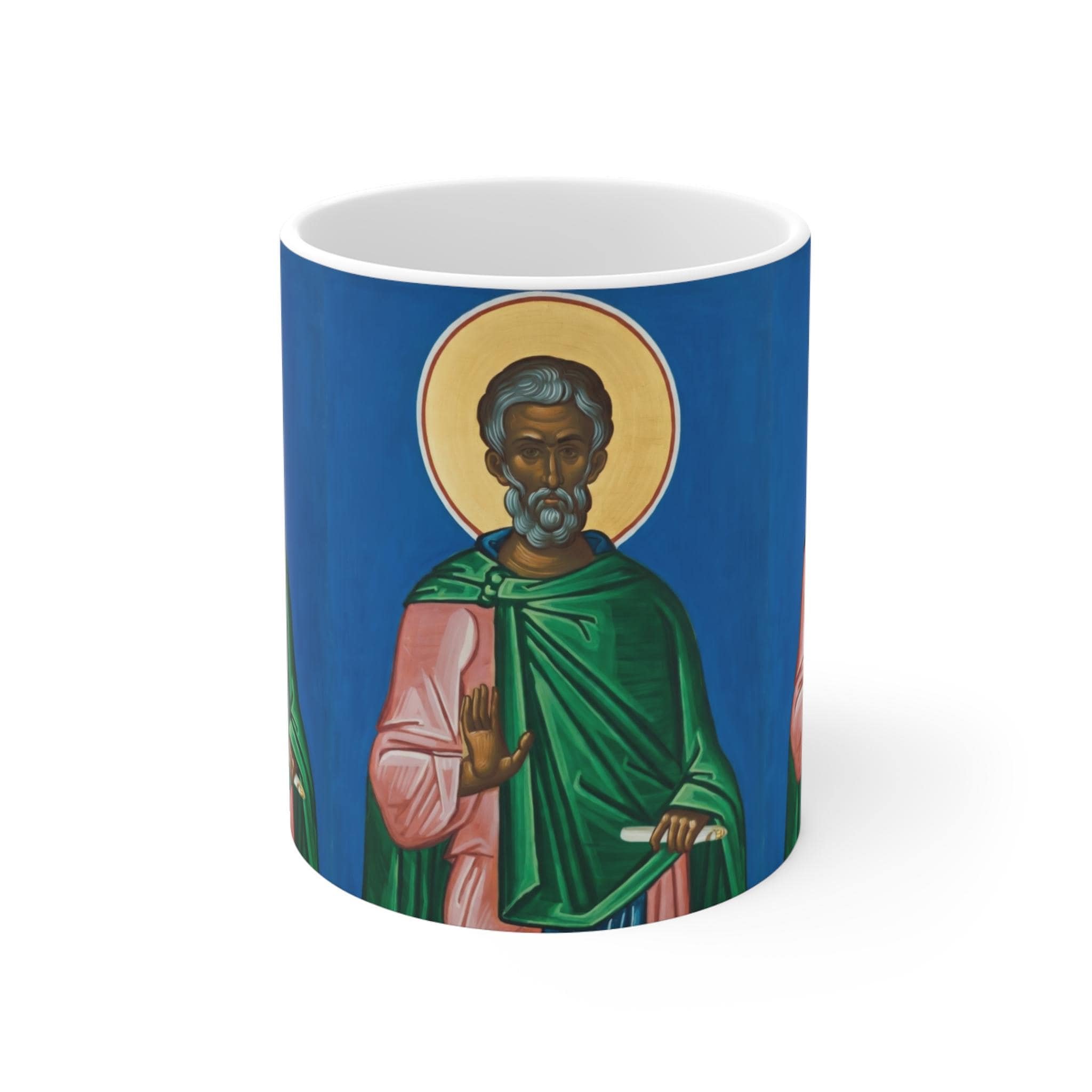
Two boys brought to Subiaco among the first pupils of the earliest Benedictine schools. Placid was the child rescued from drowning; Maurus was the disciple whose perfect obedience carried him walking across the surface of the lake to save him. Both are venerated within the Benedictine tradition as among Benedict's closest and most faithful disciples.
Pope Saint Gregory the Great
Writing some fifty years after Benedict's death, Gregory preserved nearly everything that is known of Benedict's life in Book II of his Dialogues, drawing on the testimony of Benedict's own disciples Constantinus, who succeeded him as Abbot of Monte Cassino, and Honoratus, who was Abbot of Subiaco in Gregory's own day. Without Gregory's Dialogues, almost none of Benedict's biography, as opposed to his Rule, would have survived at all.
The Venerable Bede
The eighth-century English monk and Doctor of the Church who accepted and helped preserve the tradition that Benedict and Scholastica were born twins.
Part XIV
On His Writing: The Rule of Saint Benedict
Benedict left the Church exactly one substantial written work, but it is one of the most influential documents in the history of Western civilization: the Rule of Saint Benedict, seventy-three short chapters governing every practical and spiritual dimension of communal monastic life, from prayer and silence to food, sleep, discipline, and the qualities required of an abbot. Notably, the Rule was written for laymen rather than clergy; the later, familiar association of Benedictine monks with the clerical and priestly state developed only after Benedict's own lifetime, as the Church gradually imposed clerical status upon the order.
One phrase deserves an honest note here, as it is so often presented as Benedict's own words: the famous Latin motto ora et labora, "pray and work," does not appear verbatim anywhere in the text of the Rule itself. It is a later crystallization, coined by subsequent generations of Benedictines, of the Rule's genuine and repeated emphasis on the balance of prayer and labor as the twin disciplines of monastic life. The sentiment is entirely authentic to Benedict's teaching; the exact three-word Latin phrase is not his own.
The Rule's own words on government remain some of the most quoted lines from any monastic legislator in history, describing the ideal abbot as one who should "hate sin and love the brethren," who must "study rather to be loved than feared," and who, in correcting his monks, must take care that "while he seeketh too eagerly to scrape off the rust, the vessel be not broken."
Part XV
Monasteries and Shrines, With Links
Three sites stand above all others in Benedict's own story, each still active and each maintaining its own website for pilgrims and visitors:
Abbey of Monte Cassino, Italy
The monastery Benedict founded around 529 on the site of the ruined temple of Apollo, where he wrote his Rule, died, and where his tomb is venerated today by the community that maintains it as his authentic and undisturbed resting place. Destroyed by Allied bombing in 1944 and rebuilt "where it was and as it was." abbaziamontecassino.it
Sanctuary of the Sacro Speco, Subiaco, Italy
Built into the rock face above the very cave where the young Benedict lived alone as a hermit for three years, part of the wider territorial abbey of Subiaco founded on the site of his original twelve monasteries. monasterosanbenedettosubiaco.it
Abbey of Fleury, Saint-Benoit-sur-Loire, France
The Romanesque basilica on the Loire River holding the reliquary that French tradition identifies as containing the relics of Benedict and Scholastica, translated there around 672, and a major pilgrimage destination for well over a thousand years. abbaye-fleury.com
Part XVI
Legacy: The Man Who Organized a Continent's Prayer
What sets Benedict apart from many of the great early monastic founders, East and West alike, is precisely how unheroic his Rule sounds when read on its own terms. He explicitly did not write for the spiritually advanced; he wrote, in his own words, so that beginners might show "some degree of goodness of life and a beginning of holiness," reserving the loftier teaching of the Fathers for those who wished to press further. It was this deliberate moderation, this refusal to demand more than ordinary men and women could actually sustain over a lifetime lived in common, that let his Rule outlast virtually every more austere monastic experiment that came before it, and let it become, in the centuries after his death, the default constitution of monastic life across the entire Western Church.
Pope Benedict XVI, who took Benedict's name as his own upon his election, called him a luminous star pointing the way out of the dark night of history at the fall of the Roman Empire. Fifteen centuries after a disgusted Roman student walked out of the schools of a decaying city, Benedictine monks and nuns still rise at fixed hours to chant the Psalms he assigned, in monasteries scattered across every inhabited continent on earth.
Holy Trinity, Father, Son, and Holy Spirit, to You be glory, honor, and blessing, for having given to Your holy Church Saint Benedict of Nursia, father of monks, as a model of humility, moderation, and steady fidelity to prayer and labor alike.
We ask You humbly: just as You protected him from poison and evil in his own lifetime and granted him wisdom to guide others toward You, be pleased to grant us, through his intercession, protection from harm, balance between our work and our prayer, and the grace we now ask with confidence.
Through Christ our Lord. Amen.
An original English-language devotional prayer composed for use with the Saint Benedict of Nursia prayer card, drawing on the traditional themes of his veneration across the Catholic and Orthodox Churches.
More From Our Store, In Honor of Western and Eastern Monasticism
FAQ
Frequently Asked Questions About Saint Benedict of Nursia
A Rule Written for Beginners Outlasted Every Rule Written for Heroes.
Saint Benedict never set out to found an order, plant an empire of monasteries, or become the patron of a continent that did not yet know it needed one. He set out, as a disgusted young Roman, to find a place to be poor and to work and pray in peace. He survived poison twice, buried his own twin sister, saw the whole world gathered under a single beam of light, and died on his feet with his arms raised toward heaven. What he left behind was not a legend but a schedule, seventy-three short chapters telling ordinary men exactly when to pray, when to work, and when to rest, and that schedule outlived the empire that had shaped his own Roman boyhood by well over a thousand years.
Ask his intercession. Say his prayer. Remember a Roman noble's son who chose a cave over a career, and built, out of nothing but obedience and moderation, the scaffolding an entire continent's spiritual life would eventually be built on.
Get the Saint Benedict of Nursia Prayer Card →