Saint Hildegard of Bingen: Benedictine Abbess, Visionary, Composer and Doctor of the Church
The twelfth-century abbess of the Rhineland who wrote theology, composed sacred music and defended the singing of the liturgy
At a Glance
- Born
- 1098, traditionally at Bermersheim near Alzey in the Rhineland
- Died
- September 17, 1179, at Rupertsberg near Bingen
- Titles
- Saint, Virgin, Benedictine Abbess, Doctor of the Church
- Feast
- September 17 (Roman Catholic calendar)
- Veneration
- Equivalent canonization May 10, 2012; declared Doctor of the Church October 7, 2012, both by Pope Benedict XVI
- Patronage
- Popularly linked with musicians and writers; no firm official patronage
- Who Was Saint Hildegard of Bingen?
- Birth and Early Years
- Disibodenberg and Leadership of the Community
- The Command to Write and the Approval of Her Visions
- Rupertsberg and Eibingen
- Her Great Books
- Music, Letters and Preaching
- Reform, Rebuke and the Interdict
- Why Hildegard Speaks to Eastern Christian Readers
- Death, Relics and Canonization
- Frequently Asked Questions
Who Was Saint Hildegard of Bingen?
Saint Hildegard of Bingen was a Benedictine nun and abbess who lived in the Rhineland in the twelfth century. She wrote books of visionary theology, composed sacred songs, corresponded with popes and emperors, and led two monastic communities. She is one of the few women to be named a Doctor of the Church.
She belonged to the Latin Church and not to an Eastern Church, and this site presents her as part of the wider Christian heritage that Eastern Catholic and Orthodox readers can read with interest. No universal Orthodox commemoration of her has been verified in the sources consulted, so readers should not assume one.
This article rests on the apostolic letter of Pope Benedict XVI, his two general audiences about her, the chronology kept by the Benedictine abbey that bears her name, and modern scholarship. Where a claim depends only on medieval hagiography, it is marked as tradition.
Birth and Early Years
Hildegard was born in 1098 into a noble landowning family of the Rhineland. Her parents are traditionally named Hildebert and Mechtild of Bermersheim. The year is firmly given in the sources, though the place is traditional. Her social position gave her access to religious instruction and to the church connections that later served her well.
Medieval accounts say she was frail as a child. She later wrote that she had unusual spiritual perceptions from an early age. These are her own reports of experience. Faith may receive them, but history cannot verify them independently.
Around 1106, when she was about eight, her family entrusted her to the care of Jutta of Sponheim. Benedict XVI also mentions a widow named Uda of Gollheim as an early teacher. Her education was monastic and not university-based. She described herself as unlearned, yet her writings show close familiarity with Scripture, the liturgy and the Latin tradition.
Disibodenberg and Leadership of the Community
On November 1, 1112, Hildegard and Jutta entered the women's enclosure attached to the Benedictine monastery of Disibodenberg. Hildegard learned the Psalms, the liturgical hours and the discipline of monastic life there. The Vatican account dates her profession to about 1115, but historians distinguish her childhood dedication, her enclosure and her formal profession, and the evidence for each stage is not equally precise.
Jutta died in 1136, and the sisters chose Hildegard as their magistra, or superior. This put her in charge of the spiritual formation, order and daily life of the community. There is no record of a conversion from another faith, since her vocation grew entirely within the Benedictine world.
She led the community in the framework of the Rule of Saint Benedict, with its balance of common prayer, work, hospitality, obedience and moderation. These years of ordinary responsibility formed the background to everything she later wrote.
The Command to Write and the Approval of Her Visions
In 1141 Hildegard reported a compelling vision in which she was told to write down what she saw and understood. She began Scivias with the help of the monk Volmar, her secretary and adviser, and later of the nun Richardis von Stade. Her own accounts describe a struggle with doubt and with illness before she began, and tradition connects her bouts of illness with her reluctance to obey.
Because her experiences needed discernment, she wrote to Bernard of Clairvaux, one of the most influential churchmen of the age. Bernard encouraged her, although his surviving reply should not be read as a full examination of everything she later produced.
The key public confirmation came at the Synod of Trier in 1147 and 1148, where Pope Eugene III had passages of Scivias read aloud. Medieval accounts and later papal teaching describe his favorable judgment and his encouragement of her writing. It is important to describe this accurately. It was approval of her work and recognition of her authority, and it was not a declaration that every later vision or claim was beyond error.
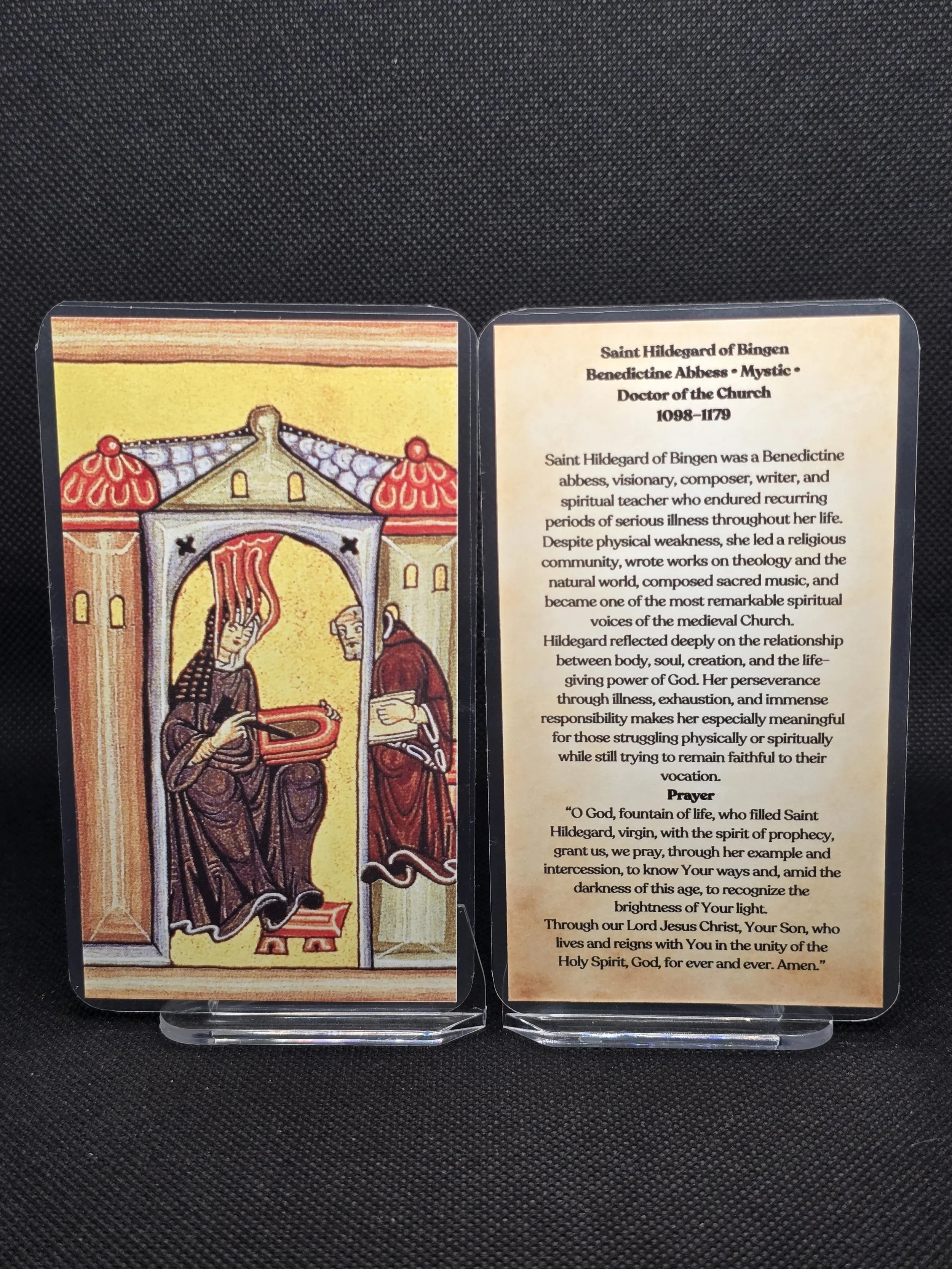
Rupertsberg and Eibingen
Around 1150 Hildegard founded an independent Benedictine house at Rupertsberg, near the meeting of the Nahe and the Rhine. Benedict XVI mentions that about twenty sisters went with her from Disibodenberg. The move gave the community more independence but required careful negotiation over property and church relationships.
In 1165 she founded a second house at Eibingen, across the Rhine, and she remained responsible for both. Hospitality, common prayer, moderation and obedience marked the life she led, in the spirit of the Benedictine Rule.
The buildings did not last forever. The Abbey of Saint Hildegard states that Rupertsberg was destroyed during the Thirty Years' War in 1632 and that her relics were saved and brought to Eibingen. Both houses sit within a landscape that pilgrims still visit.
Her Great Books
Her three principal visionary works are Scivias, the Book of the Merits of Life, and the Book of Divine Works. Scivias, whose name means Know the Ways, was written from about 1141 to 1151 and arranges thirty-five visions into an account of creation, the fall, redemption, the Church and the end of time. The Book of the Merits of Life, from about 1158 to 1163, describes the struggle of virtues and vices. The Book of Divine Works, from about 1163 to 1173 or 1174, is a mature reflection on God, humanity and the cosmos.
These works are not private diaries. They read Scripture through the symbolic language of the medieval Latin Church and draw on biblical and patristic sources, with a strong emphasis on the Incarnation and the Trinity. Chronologies differ a little among scholars, so the date ranges above should be taken as approximate.
Two works on nature and the body are also associated with her, the Physica and Causae et Curae. Their authorship and manuscript history are uncertain, and scholars caution that they should not be treated as word-for-word medical texts by Hildegard alone. Their remedies belong to medieval medicine and are not tested modern treatments, so readers should be wary of modern commercial books that use her name.
Music, Letters and Preaching
Hildegard composed a cycle of sacred songs, the Symphonia of the Harmony of Heavenly Revelations, and a musical morality drama called the Ordo Virtutum, which shows the soul, the virtues and the devil in conflict. Her work is among the most striking music that survives from a named medieval woman. For her, singing in the liturgy expressed the harmony of creation and the human calling to praise God.
She corresponded with popes, bishops, abbots, rulers and religious women. The apostolic letter of 2012 estimates about four hundred surviving letters and mentions fifty-eight Gospel expositions addressed to her sisters. In later years she made preaching journeys, visiting places including Mainz, Cologne, Trier, Metz, Bamberg and Wurzburg, which was unusual for a woman of her time.
She also devised an invented vocabulary, the Lingua Ignota, and an alphabet. Their full purpose is still debated, but they are firmly linked to her devotional and intellectual life.
Reform, Rebuke and the Interdict
Hildegard lived in an age of reform and of conflict between the papacy and the empire. She criticized clerical corruption and the love of wealth among church leaders, and she opposed the Cathars, whose rejection of the material world conflicted with her belief that creation is good. Benedict XVI also notes her rebukes of Emperor Frederick Barbarossa for supporting rival claimants to the papacy.
In 1178 the church authorities of Mainz ordered the removal of a man from the cemetery at Rupertsberg because he had been excommunicated. Hildegard maintained that he had repented and been reconciled and received the sacraments before his death, and she refused to exhume him. An interdict was placed on her community, which limited its normal liturgical life, especially its singing.
She protested in a letter to the prelates of Mainz, arguing that silencing the sisters' song did spiritual harm. The interdict was lifted some months before she died. It should be said clearly that she was never declared a heretic or excommunicated. The dispute was about discipline, burial and the sanctions placed on her community.
Why Hildegard Speaks to Eastern Christian Readers
Hildegard was a Latin Benedictine, and no historical link to Eastern Christian theology has been shown. Even so, several themes in her writing will feel familiar to Eastern Catholic and Orthodox readers. She sees creation as a gift of divine generosity, she joins Scripture, worship and contemplation, and she pictures the heavenly liturgy in images of light and song.
Benedict XVI stressed the biblical and patristic roots of her theology and her focus on the Incarnation, the Trinity and the mystery of God. These are shared concerns across the Christian East and West. Her teaching about the harmony of creation and the praise of God in the liturgy invites comparison with the Eastern emphasis on worship as the heart of theology.
Such comparisons need care. Her visions should not be equated with Byzantine hesychasm or with the later teaching of Saint Gregory Palamas on divine light. Similar themes do not prove influence, and the sources consulted do not show that her work shaped Eastern theology. She is offered here as a respected witness of the Latin tradition whom readers of every Christian tradition may study with profit.
Saint Hildegard, you listened for the voice of God and gave it words and song. Pray for us who live in noisy times. Help us to love the Scriptures, to sing the praises of God with attention, and to see creation as a gift of His love. Teach us to speak the truth with courage and charity, and to stay faithful to the Church in every trial. Amen.
This prayer is an original composition for devotion. It is not an official liturgical text and was not written by the saint.
Death, Relics and Canonization
Hildegard fell seriously ill in the summer of 1179 and died at Rupertsberg on September 17. Her first major biography, the Life of Holy Hildegard, was begun by Gottfried of Disibodenberg while she lived and completed after her death by Theoderic of Echternach. It is indispensable, but it is a work meant to honor a saint, and it has to be read critically. Tradition in the Life reports luminous signs at her passing, which are hagiographical reports and not verified events.
Her community petitioned for canonization in 1226 and 1227, and Pope Gregory IX opened an inquiry. The testimony gathered in the 1230s was judged incomplete, and a later effort under Innocent IV in 1243 did not finish the process. Her veneration nevertheless continued for centuries. On May 10, 2012, Benedict XVI extended her cult to the whole Church by equivalent canonization, and on October 7, 2012 he declared her a Doctor of the Church. These are two distinct acts.
Her relics are kept in a shrine, made in 1929, in the parish and pilgrimage church of Saint Hildegard in Eibingen, near the modern abbey on the hill above the town. Pilgrims gather there around September 17. Her teaching on viriditas, the green and life-giving power of God in creation, has drawn new interest, though it is a theological idea and should not be reduced to herbalism or modern environmental slogans.
Frequently Asked Questions
Ask Her Prayers
Saint Hildegard shows how a cloistered woman can serve the whole Church through prayer, study and song. May she pray for all who write, sing and teach in the service of God.
View Prayer Card