Saint Jacob of Serugh: Syriac Poet, Bishop of Batnan and Flute of the Holy Spirit
The sixth-century bishop whose verse homilies shaped Syriac worship and who is honored by both Syriac Orthodox and Maronite Christians
At a Glance
- Born
- About 451, Kurtam near the Euphrates in the region of Serugh (approximate)
- Died
- Traditionally November 29, 521 (sources differ on the date)
- Titles
- Bishop of Batnan, Flute of the Holy Spirit, Harp of the Church, Teacher
- Feast
- November 29 (Syriac Orthodox); historical Maronite calendars also list January 27 and April 5
- Veneration
- Syriac Orthodox and Maronite Churches; no formal canonization decree is documented
- Patronage
- None formally established
- Who Was Saint Jacob of Serugh?
- Birth, Family and Dates
- Education at Edessa
- Priest, Visitor and Poet
- The Verse Homilies
- Teaching on the Mother of God and the Eucharist
- Letters and a Divided Church
- War, Persecution and the Episcopate
- Death, Relics and Recognition
- Tradition, Devotion and Why He Matters
- Frequently Asked Questions
Who Was Saint Jacob of Serugh?
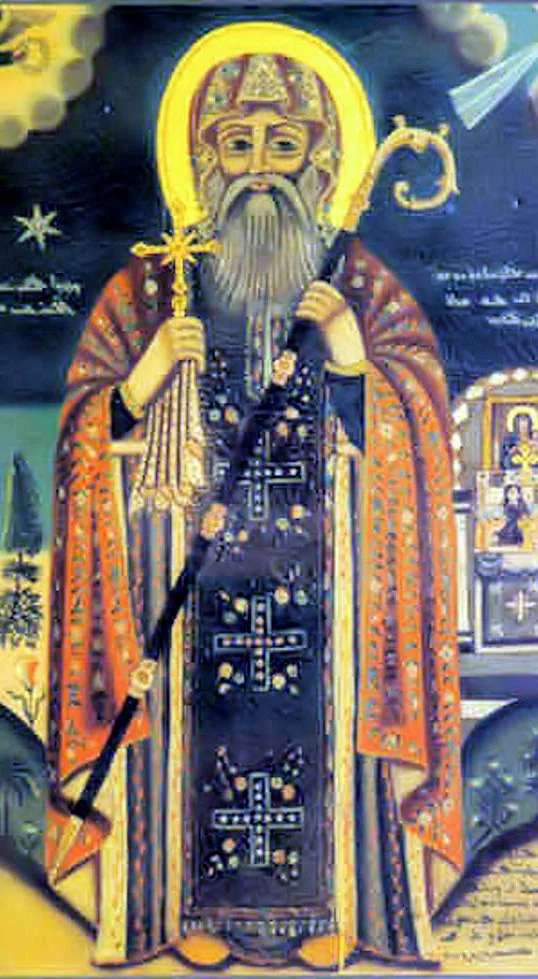
Saint Jacob of Serugh, also called Mar Jacob of Sarug and Jacob of Batnan, was a Syriac Christian priest, teacher and bishop who lived at the turn of the fifth and sixth centuries. He is remembered above all as a poet. His surviving works include hundreds of verse homilies, called memre, as well as a collection of letters.
In the Syriac tradition he is given the affectionate titles Flute of the Holy Spirit and Harp of the Church. The titles express a belief that his poetry was an instrument through which divine teaching sounded. They come from the Syriac hagiographical tradition and are still used in the Syriac Orthodox Church.
Jacob is unusual because two churches that have been divided since the fifth century both honor him. The Syriac Orthodox Church celebrates him as a great teacher, and the Maronite Catholic Church also recognizes him as a saint. This article takes care to describe what the sources say about his theology and to mark the legends as tradition.
Birth, Family and Dates
Jacob was born about 451 in Kurtam, a village near the Euphrates in the district of Serugh, not far from Edessa in Roman Mesopotamia. Both modern scholarship and the Syriac Orthodox Patriarchate name Kurtam as his birthplace. The year is approximate, since the sources do not date his birth directly.
Traditional accounts describe his father as a priest. Tradition adds that his parents had long been childless and that Jacob was born in answer to their prayers. This story appears in the old Syriac biography preserved in the Acta Sanctorum, and it cannot be checked against contemporary records.
His death is traditionally dated to November 29, 521, and the Syriac Orthodox Patriarchate commemorates that date. Modern scholarship cautions that the surviving sources give different dates, so the exact day and year should be treated with care. A life of about seventy years is the usual reconstruction.
Education at Edessa
Jacob studied at Edessa, which was then one of the great centers of Syriac learning. The New Catholic Encyclopedia places his studies roughly between the ages of fifteen and twenty-two, but this is a reconstruction and not a firm date. The schools of the city were known for careful reading of Scripture and for the translation and discussion of Greek theology into Syriac.
Edessa was also a place of dispute. The teaching of Theodore of Mopsuestia and other theologians of the Antiochene school had influence there, and the Christological arguments of the period were sharp. Jacob later opposed positions that he thought divided Christ, and his surviving letters give better evidence for this than later stories about his student years.
How and when he first took a stand against these ideas is uncertain. What the sources do show is that he grew up in a learned environment, where Scripture was read in Syriac, poetry was part of teaching and theology was argued at length.
Priest, Visitor and Poet
There is no reliable evidence that Jacob converted from another faith. He appears to have been raised in a Christian home, and his vocation was pastoral, intellectual and liturgical. Traditional accounts connect him with monastic life, but the date and form of any monastic commitment are not well documented.
By about 502 or 503 he served as a periodeutes, a visitor or traveling overseer, in the region of Haura. A visitor of this kind moved among communities, teaching and encouraging the clergy and the faithful. The New Catholic Encyclopedia and the Syriac Orthodox Patriarchate both place this stage of his ministry at the start of the sixth century.
Tradition says that bishops tested his gifts by asking him to explain the vision of the heavenly chariot in the book of Ezekiel, and that he answered with a remarkable poem. The story is repeated in later biographies, and its details cannot be confirmed. It does fit what the sources show clearly, which is that he treated the explanation of Scripture as a form of pastoral service.
The Verse Homilies
The heart of his legacy is the memra, a verse homily meant to be spoken or sung aloud. His usual form was a long poem in twelve-syllable lines arranged in couplets. This regular pattern made it possible to carry a long theological argument and to make it easy to remember.
Scholars report that nearly four hundred of these homilies survive, out of a traditional total of more than seven hundred and sixty. The numbers are approximate, and the question of which texts truly belong to him is still being studied. Tradition also says that seventy scribes wrote down his words, but the exact number should not be treated as established.
His subjects include biblical history, the person of Christ, the Mother of God, repentance, prayer, the Eucharist, the life of the ascetic and the lives of saints. He frequently used typology, reading the figures and events of the Old Testament as signs pointing to Christ. Philip Michael Forness has studied how he used passages such as Deuteronomy 18 and Matthew 16 to teach his Christology.
Teaching on the Mother of God and the Eucharist
Jacob wrote a good deal about Mary. His homilies treat the Annunciation, the Nativity and other events that touch her life, and they place her within the mystery of the Incarnation and not only within private devotion. Mary Hansbury translated a selection into English in a volume with an introduction by Sebastian Brock.
A homily on the death and burial of the Mother of God also survives. It contains a prayer that asks Christ for peace and protection through her prayers. Readers should keep in mind that this is a prayer in the saint's own homily and is not a hymn in his honor, and this article does not reproduce it.
His homily on the reception of the Holy Mysteries is one of the early Syriac witnesses to Eucharistic spirituality. It addresses people who leave church before the liturgy ends and urges them to stay and take part with reverence, using the image of a wedding feast with Christ as the bridegroom. Hugh Connolly translated extracts into English in 1908.
Letters and a Divided Church
About forty letters of Jacob survive in whole or in part, and they are valuable because they show him acting in real disputes. Forness has documented exchanges with the monastery of Mar Bassus, with the military commander Bessas and with Christians in Najran in South Arabia. These letters show a pastor who wrote to encourage communities under pressure.
The Council of Chalcedon in 451 taught that Christ is one person in two natures, divine and human. Many Christians in Syria and Egypt feared that this wording divided Christ, and they preferred the language of Cyril of Alexandria about the one incarnate nature of God the Word. The result was a lasting separation between those who accepted the council and those who did not.
The strongest modern scholarship, including Forness and the 2022 Cambridge edition, describes Jacob as a miaphysite, meaning that he belonged to the non-Chalcedonian tradition and opposed Nestorius. Some earlier Catholic scholars tried to present him as essentially Chalcedonian, but the best recent research does not support that. It is also important to say that miaphysitism is not the same as the teaching of Eutyches, and Oriental Orthodox churches reject the idea that Christ lacked a complete humanity.
War, Persecution and the Episcopate
Jacob lived through wars between the Roman and Persian empires, and the years around 503 brought displacement and fear to Mesopotamia. The Syriac Orthodox encyclical of 2021 describes letters in which he urged Christians in danger not to give up hope. His writing was shaped by events on the ground.
The political climate for non-Chalcedonians changed when Justin I became emperor in 518 and the empire moved more firmly toward Chalcedonian Christianity. Forness reads Jacob's letter to Bessas as evidence of his concern for non-Chalcedonians who suffered under this policy.
In 519 Jacob was consecrated bishop of Batnan, the main town of the Serugh region. He was already old by the usual reckoning, and his time as bishop was brief, lasting until his death about 521. The details of his episcopate are thin, and the sources do not preserve many acts of his as bishop.
Death, Relics and Recognition
Jacob died about 521, and November 29 is the traditional day. He was buried within the area of his ministry according to the older biographies. The Syriac Orthodox Patriarchate reports that part of his relics was later moved to a shrine beside the Church of Saint Mary in Amid, now Diyarbakir in Turkey. The full history of his relics and where every portion rests today is not established.
No formal canonization decree is documented. In his period saints were recognized by long local and ecclesial veneration, and the Acta Sanctorum shows that his cult existed in more than one Eastern Christian tradition. He should therefore be described as an ancient saint honored by the Syriac Orthodox and Maronite Churches, and not as someone canonized by a named authority on a named date.
Feasts vary. The Syriac Orthodox Church keeps November 29. Historical Maronite calendars list January 27 and April 5, though whether every Maronite jurisdiction observes these dates today has not been verified. Some other calendars list further dates, so readers should check the calendar of their own church.
Holy Father Jacob, you turned the Scriptures into song and taught the faithful to praise the Lord with their whole heart. Pray for us when our words are dry and our hearts are divided. Help us listen to the Word of God, receive the Holy Mysteries with reverence, and love the Mother of God who bore our Savior. May our lives become a hymn to Christ. Amen.
This prayer is an original composition for devotion. It is not an official liturgical text and was not written by the saint.
Tradition, Devotion and Why He Matters
The stories about his childhood belong to tradition. One says that at age three he slipped from his mother during the liturgy, went to the altar and received a gift of the Holy Spirit that explained his later eloquence. Another says he began composing verse homilies at about the age of twelve. These accounts are valued in devotion, but they are not independently confirmed history.
No posthumous healing miracle from a good early source has been verified. His lasting place in devotion rests on the survival of his writings, on his commemoration in church calendars and on his influence on Syriac worship, which the 2021 Syriac Orthodox encyclical highlights.
His importance for Eastern Catholic and Orthodox readers lies in his shared heritage. Sebastian Brock observed that Jacob is recognized as a saint in both the Maronite and Syriac Orthodox Churches. That does not erase the differences between the churches over Chalcedon, but it does show how a single teacher can nourish believers across a long separation, and the Maronite Eparchy of Los Angeles marked the year of Jacob in 2021 with a scholarly conference.
Frequently Asked Questions
Ask His Prayers
Saint Jacob shows that theology can be sung and that a teacher can serve a frightened people with words of hope. May he pray for all who read, preach and sing the Word of God.
View Prayer Card