Saint Maximos the Hut-Burner: The Athonite Hermit Who Burned His Huts
The Byzantine hesychast who gave up even his shelters, sought stillness on Mount Athos and was remembered for his devotion to the Mother of God
At a Glance
- Born
- Lampsacus on the Hellespont, about 1270 to 1285 (UNCERTAIN)
- Died
- January 13, after 1362 or 1363, probably between about 1365 and 1375 (year UNCERTAIN)
- Titles
- Venerable Father, Hesychast, Hut-Burner (Kausokalyvites)
- Feast
- January 13 (Julian calendar), which falls on January 26 on the civil calendar
- Veneration
- Orthodox Church; no formal canonization date is documented, and no Catholic recognition has been verified
- Patronage
- None formally established
- Who Was Saint Maximos the Hut-Burner?
- Dates and Sources: What We Can and Cannot Say
- Childhood in Lampsacus
- Elder Mark and the Years in Thrace
- Constantinople and Holy Foolishness
- The Burning of the Huts
- Meeting Saint Gregory of Sinai
- Hesychasm, the Jesus Prayer and the Controversy
- Visions, Wonders and Devotion to the Mother of God
- Death, Burial and Recognition
- Frequently Asked Questions
Who Was Saint Maximos the Hut-Burner?
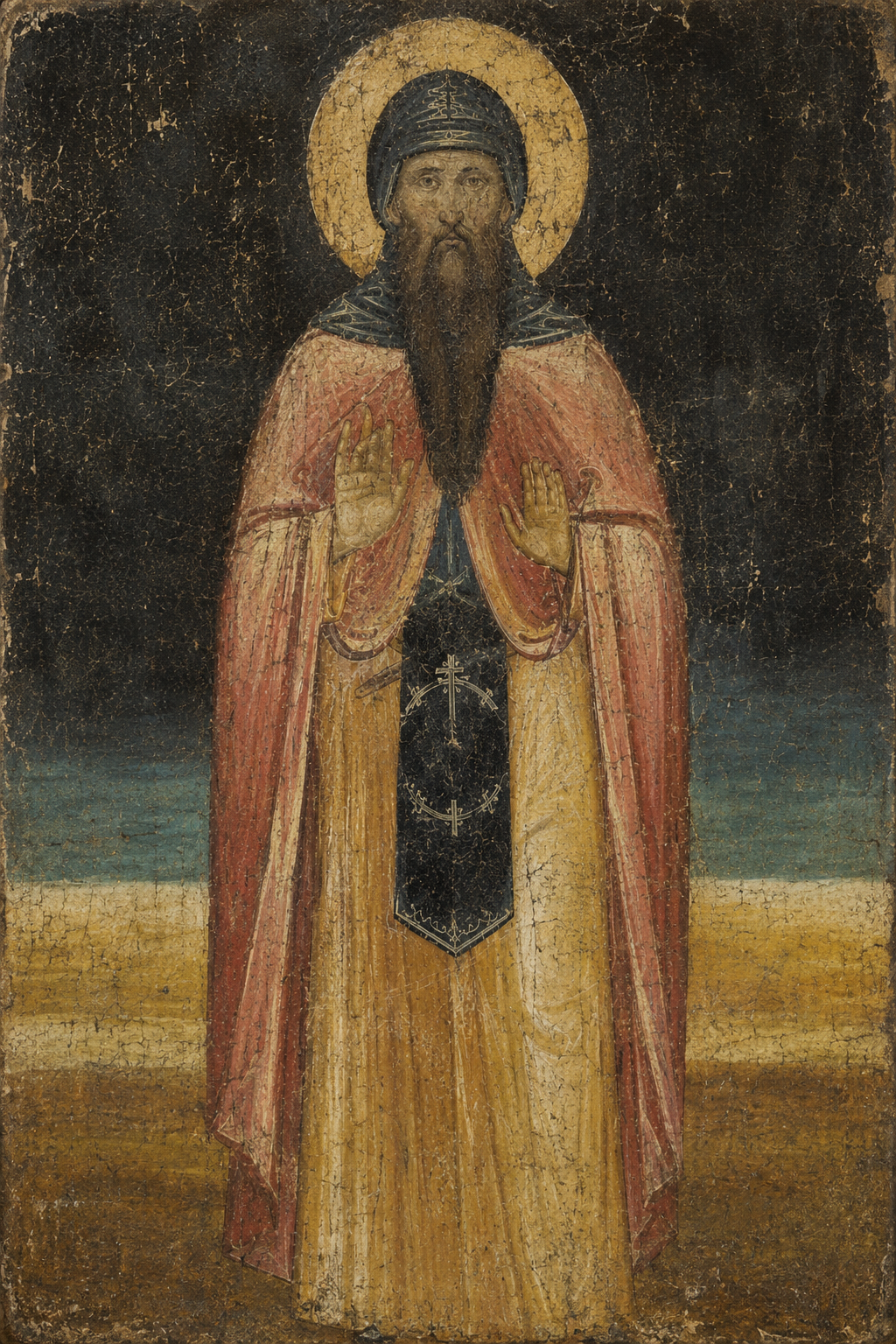
Saint Maximos the Hut-Burner, known in Greek as Maximos Kausokalyvites, was a Byzantine monk who lived in the fourteenth century and spent the greater part of his monastic life on Mount Athos. His name means roughly the burner of huts, and it points to the habit for which he is best remembered. He would build a small shelter of branches, leaves and straw, live in it for a time, and then set it alight before moving on.
He is a historical figure, not a legend. Unusually for a hermit of his age, he is described in two near-contemporary biographies, one by his disciple Niphon and one by Theophanes, who later became metropolitan of Peritheorion. A modern scholar, Metropolitan Kallistos Ware, has studied these Lives closely and used them to place Maximos in the wider story of Athonite spirituality. Most of what we can say about him rests on these sources.
The picture they paint is of a man who wanted to be nobody. He avoided admiration, practiced a kind of holy foolishness, and sought the inner prayer of the heart. Readers should keep one caution in mind from the start. Many episodes in his Lives are reported as wonders, and this article marks those clearly as tradition, meaning that they were reported and believed but cannot be checked by historical methods.
Dates and Sources: What We Can and Cannot Say
The exact years of his life are uncertain. The Life by Theophanes gives January 13 as the day of his death but does not name the year. Many popular summaries state 1365, and this date is repeated widely, but it should not be treated as settled. Some older summaries give other death years, such as 1320 or 1354, and these do not fit the stronger evidence.
The key piece of evidence is that Maximos was still alive in 1362 or 1363, when Patriarch Kallistos I visited him while travelling toward Serbia. That places his death after that visit. Theophanes also says that he reached the age of ninety-five, but that figure is itself uncertain. If it is roughly right, a death in the years between about 1365 and 1375 is plausible, and a birth in the late thirteenth century follows from it.
The Greek Lives were edited by the Belgian scholar François Halkin and published in Analecta Bollandiana in 1936. Two later Lives, by Ioannikios Kochylas and Makarios, also exist. Maximos himself left no known writings, so everything we know of his teaching comes through his biographers, who may have shaped his words with their own theological views.
Childhood in Lampsacus
According to Theophanes, Maximos was born in Lampsacus, an old town on the Asian shore of the Hellespont, and his baptismal name was Manuel. His parents are described as respectable people, though the sources say little about their work or wealth. The precise date of his birth is unknown, and the reconstruction by Ware places it no later than about the early 1280s.
Tradition records that the boy showed unusual piety. He is said to have prayed often in churches of the Mother of God, shared his bread with poor people, and even given away his clothing in the cold. Theophanes adds that Manuel sometimes behaved as if he lacked understanding, which anticipates the foolishness he would later adopt deliberately.
When he was seventeen his parents began to arrange a marriage for him. The Life says he left home instead and set out to become a monk. Readers who know other saints' stories will recognize the pattern, since similar episodes appear in many Byzantine Lives. That familiarity is not a reason to dismiss the account, but the childhood stories cannot be independently confirmed.
Elder Mark and the Years in Thrace
Manuel travelled to Mount Ganos in Thrace and entered monastic life under an elder named Mark, and it was there that he received the monastic name Maximos. Mark taught him obedience, fasting, vigilance and prayer. According to the Lives his early asceticism was so severe that his elder sometimes urged him to be moderate.
This detail matters, because the popular image of Maximos is of a lone wanderer answerable to no one. In fact his first years were spent in obedience to a spiritual father, and he did not abandon that principle later in life. After Mark died, Maximos moved to Mount Papikion, near the border of Thrace and Macedonia, where he met hermits living in caves and exposed places in great poverty.
Ware warns against a common mistake of identifying Mount Papikion with the Rila mountains in Bulgaria, since these are different places. The point is a small one, but it shows how carefully the sources must be read, since later retellings often blur place names and dates without noticing.
Constantinople and Holy Foolishness
Maximos next went to Constantinople, where he visited the great shrines of the Mother of God, especially the church at Blachernae. His biographers connect him with several well-known figures of the capital, including Emperor Andronikos II Palaiologos, Patriarch Athanasios I and the scholar Theodore Metochites. These meetings are reported by the Lives and are not independently confirmed.
One story tells how Metochites mocked his poor Greek, and how Maximos answered him sharply, as though to expose the emptiness of learned pride. This is tradition, preserved only through Theophanes, and it should be read as a lesson the biographer wished to draw rather than as a verified record of a conversation.
In this period he practiced what the Eastern Church calls salos, or foolishness for Christ. He deliberately appeared eccentric or confused so that people would not admire him. The sources do not describe him as scandalous or cruel. His oddness was meant to hide holiness and to protect humility, which is the usual purpose of holy foolishness in Byzantine monastic life.
The Burning of the Huts
After leaving the Lavra, Maximos took up a wandering hermit's life. He built small shelters of branches and straw, stayed in them for a time and then burned them down before moving on. This practice is attested in both early Lives, which is why scholars treat it as part of the historical tradition, though the details are tradition and the sources do not say how often it happened.
The reason is best understood as radical renunciation. A hut, however small, can become a possession, a place of comfort and a mark of reputation. By burning it, Maximos refused to settle, refused to be found and refused to become a recognized teacher. Ware interprets the habit as part of the wider ascetic tradition of dispossession.
Niphon says this wandering lasted about ten years. That length comes from hagiographical testimony and cannot be checked against other records. It is also fair to note that later writers sometimes treat the hut-burning as the whole of his story, when the Lives show it was one phase in a longer life that ended in a settled cell.
Meeting Saint Gregory of Sinai
The most important relationship in his story is with Saint Gregory of Sinai, a teacher of the Jesus Prayer who spent time on Athos. According to Theophanes, Gregory heard of the hermit's gifts and sent his disciples to find him. When they met, the conversation turned to inner prayer, to visions, and to how true experiences can be told from deceptions.
Gregory is said to have advised him to stop wandering and take a settled cell, and Maximos accepted this advice. The timing of the meeting is uncertain. Ware suggests that it most probably took place before about 1325, although a later meeting in the 1330s is possible. Niphon does not record the conversation, and Ware thinks Theophanes probably added his own theological reflection, so the dialogue is not a verbatim record.
It is also worth being clear about what is not supported. Some retellings call Maximos a friend of Saint Gregory Palamas, the great defender of hesychasm. Ware states that there is no evidence that Palamas ever met Maximos or even knew he existed. The link between them is one of shared spiritual world, not of personal acquaintance, and this article does not claim more.
Hesychasm, the Jesus Prayer and the Controversy
Hesychasm is the Eastern Christian tradition of stillness, repentance and attentive prayer, and its best-known practice is the Jesus Prayer. In the fourteenth century it became the centre of a dispute. Gregory Palamas defended the claim that human beings can truly share in the uncreated energies of God without ever possessing the divine essence. Opponents such as Barlaam of Calabria, and later Gregory Akindynos and Nikephoros Gregoras, challenged different parts of this teaching.
The controversy ran through the 1340s and reached important synodal decisions, including the council of 1351. Maximos is not known to have taken part. His place in the story is as an example of the kind of Athonite spirituality that Palamas defended. Theophanes reports that Maximos experienced an inward warmth before an icon of the Mother of God, and that afterward prayer became continuous in his heart. This is tradition, and it is a report of his experience, not a theological treatise.
The Lives also show that holy people in this tradition were expected to test their experiences. Gregory of Sinai is portrayed as examining the claims of Maximos with care. The Eastern ascetic tradition warns against plani, spiritual delusion, and it never treated every vision as automatically genuine. Maximos is remembered not only for his visions but for accepting counsel about them.
Visions, Wonders and Devotion to the Mother of God
All the supernatural episodes in this section are tradition. Theophanes describes visions of the Mother of God during his prayer, including one before an icon in Constantinople and another on the summit of Athos, where she is said to have given him heavenly bread and told him to continue his life of solitude there. These accounts show how strongly Marian his spirituality was remembered to be, and the Marian devotion is the reason he appears so often on devotional cards.
The Lives also report that the monk Arsenios saw Maximos surrounded by light or fire as he prayed. Theophanes claims to have seen him lifted into the air, and other accounts credit him with discernment, foretelling and healings. Ware compares the light stories to similar reports about Abba Arsenios and other desert fathers. The comparison helps us read them as part of a long hagiographical tradition, though it does not prove that they happened.
The sources do not give enough evidence to confirm individual healings by modern standards. What the historian can safely say is that Maximos gained a reputation among his contemporaries for holiness, discernment and the gift of prayer, and that this reputation produced two Lives within a short time of his death.
Holy Father Maximos, you left every shelter and every comfort to seek the Lord in silence. Pray for us who cling to so many things. Teach us to carry little and to love much. Obtain for us humility to accept counsel, a heart turned to the Mother of God, and the patience to call upon the name of Jesus through the day. Amen.
This prayer is an original composition for devotion. It is not an official liturgical text and was not written by the saint.
Death, Burial and Recognition
Toward the end of his life Maximos settled near the Great Lavra, close enough to hear its bells. The Lives say he gave his former dwelling to Niphon. Tradition adds that he foresaw his death and prepared his own grave, and that he was buried beside his last cell. His death is commemorated on January 13.
No reliable record of a shrine or of authenticated relics has been found, and one devotional summary that mentions an instruction against exhuming his body needs confirmation from the Greek text. He should also not be confused with Saint Maximus the Confessor, who is a different saint with different relics and a different feast.
There is no documented act of canonization with a date. In the Orthodox tradition, recognition often grew through long veneration, and his January 13 commemoration is confirmed by the Orthodox Church in America and by the Greek Orthodox Archdiocese of America. For Catholic readers, no formal Catholic canonization or universal Roman calendar feast has been verified, and the article makes no claim of one. He is honored here as a figure of the shared Eastern Christian heritage.
Frequently Asked Questions
Ask His Prayers
Saint Maximos reminds us that holiness can be quiet, poor and hidden. Whatever we think of his burned huts, his life points to obedience, humility and the name of Jesus. May he pray for all who seek stillness in a restless world.
View Prayer Card