Saint Anthony the Great: Father of Monks and His Years Among the Tombs
The Egyptian ascetic who gave away his inheritance, faced his fears in a burial ground and taught the Church to value the desert
At a Glance
- Born
- Traditionally 251, near Coma in Egypt (year uncertain)
- Died
- 356, in the Eastern Desert of Egypt
- Titles
- Anthony the Great, Anthony the Abbot, Father of Monks, Venerable and God-bearing Father
- Feast
- January 17 (Julian calendar January 17, which is January 30 on the civil calendar); Coptic Church, 22 Toubah
- Veneration
- Honored from ancient times in East and West; no formal canonization decree
- Patronage
- Traditionally invoked for domestic animals, livestock and those suffering from ergotism, once called Saint Anthony's fire
Which Anthony of the Tombs?
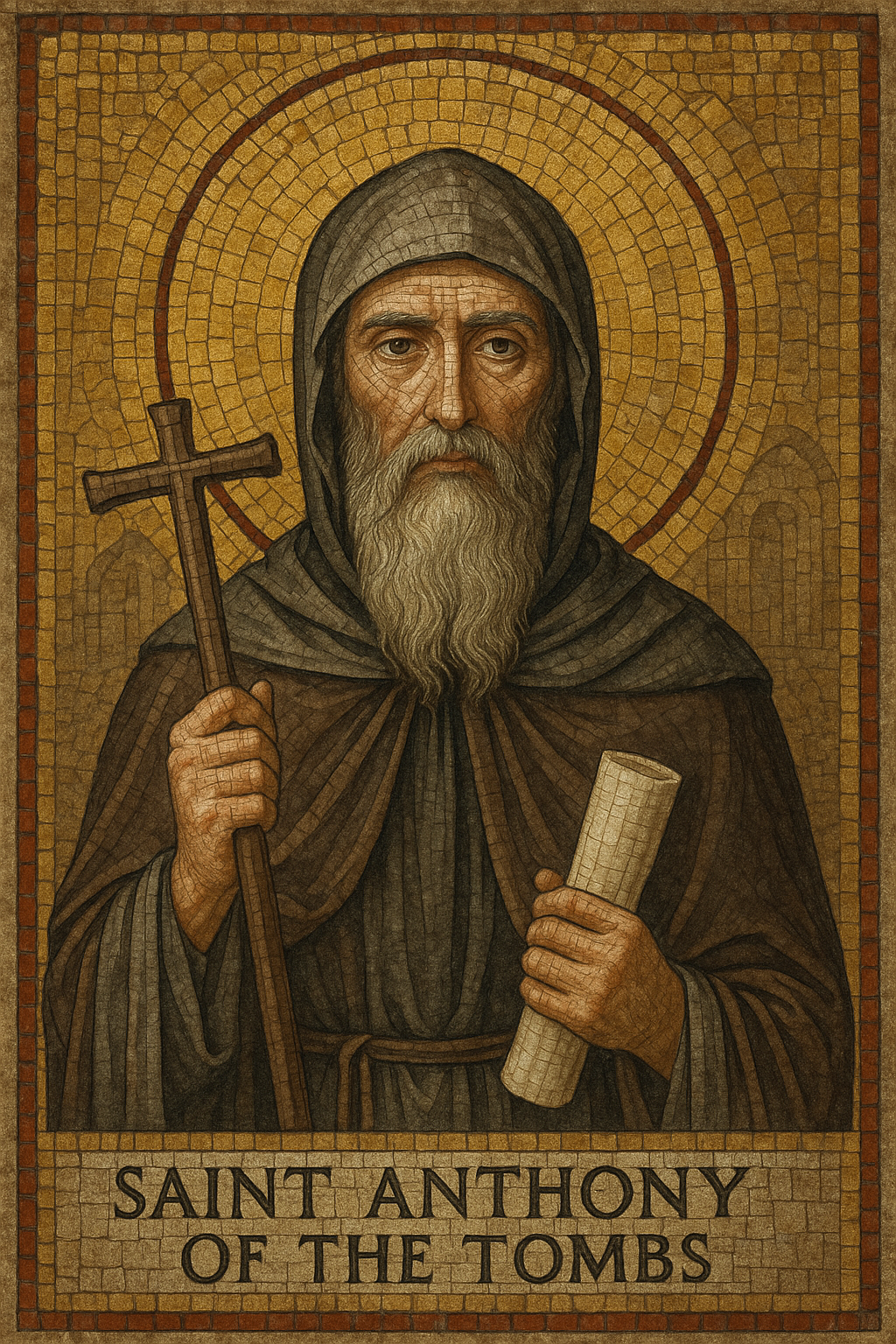
The title Anthony of the Tombs is not the name of a separate saint in any Catholic, Orthodox or Coptic source examined for this article. It points to Saint Anthony the Great, also called Antony of Egypt, Anthony the Abbot and Abba Antony, during one stage of his life, when he lived in a burial place. The source for that stage is the Life of Antony by Saint Athanasius of Alexandria, especially chapters 8 to 10.
This article therefore tells the story of Anthony the Great, and it pays special attention to those years among the tombs. Readers who have a prayer card with the older title can be confident that it refers to the same great father of monks, honored in the Eastern and Western Churches alike on January 17.
A word about method will help. Athanasius wrote a gripping and carefully shaped biography, and it is the main source for Anthony's life. It is a very important work, but it is hagiography, not a modern biography. We will mark as TRADITION the episodes that depend only on Athanasius, and as UNCERTAIN the facts that cannot be confirmed from any other source.
A Christian Boy in Egypt
According to Athanasius, Anthony was born into a Christian family of some wealth in Egypt. Tradition says that he was born in 251 near the village of Coma, but that year is worked out from the report that he lived to be one hundred and five, so it is not secure. Scholars note that independent evidence for his presence in Alexandria in 337, and strong evidence for his death in 356, makes his existence and importance much more certain than the dates of his youth.
Athanasius says that his parents died while he was young, leaving him with a younger sister and the family property. The usual account puts this around his twentieth year, but that age comes from the biography alone. The names of his parents, the name of his sister and the exact location of his birthplace cannot be confirmed from other records.
Athanasius presents Anthony as having little formal education and as a serious, quiet boy. Modern scholars add a qualification. Seven letters attributed to him, discussed below, show a thinker who knew sophisticated Christian ideas. Whether he could write Greek well is debated. It would be a mistake to picture him as unlearned simply because the biography stresses that he avoided the schools.
The Call in Church
Anthony's decisive moment came during a church service, when he heard the Gospel reading in which Christ tells the rich young man to sell what he owns and give to the poor and then to follow Him. Athanasius says that Anthony took the words as meant for himself. He arranged for the care of his sister, gave away his inheritance to the poor and began to live as an ascetic.
His first steps were close to home. He learned from other Christians who were already living lives of solitude, fasting, prayer and manual labor in the neighborhood. Athanasius is careful to say that Anthony did not invent asceticism. He found a pattern that already existed and gave it a new depth and a wider reach.
The stages in the biography are clear. First came asceticism near the village, then the move to the tombs, then retreat into more remote parts of the desert, including an abandoned fortress where he is said to have lived for about twenty years. Finally he emerged as a spiritual father to whom others came for guidance. This order helps us to see the tomb years in context.
Into the Tombs
TRADITION. According to Athanasius, Anthony went to a burial ground at some distance from his village. He asked an acquaintance to bring him bread from time to time and entered an unused tomb, and the entrance was closed behind him. This was not only a search for quiet. A tomb is a place that confronts a person with death, and the biography treats the choice as a deliberate meeting with fear.
TRADITION. Athanasius says that during the night demons attacked Anthony so violently that he was left half dead. When his acquaintance came with the bread, he found him lying as if lifeless and carried him to a church in the village. Many thought he was dying. After he recovered consciousness, Anthony insisted on going back to the tomb.
TRADITION. In a second struggle, the demons appeared in the shape of wild beasts. Anthony stayed steady in prayer, and Athanasius says that he saw the roof open and a light come down, and that the apparitions vanished and his pain ceased. The text puts him at about thirty-five years old, which would suggest about 286 under the traditional dates, but that figure is uncertain. The exact tomb has never been identified, and the length of his stay among the tombs is not given.
The Meaning of the Struggle
Athanasius describes Anthony's trials with vivid scenes of demons, beasts and physical blows. These passages belong to the world of early Christian hagiography. They express a conviction that the Christian life involves a real struggle against evil and that the victory comes from Christ, not from human strength. The physical details cannot be confirmed by historical methods.
The Church has kept these stories in its tradition for seventeen centuries, which tells us how they were understood. It does not follow that every event happened exactly as told. A careful reader can accept the main point, that Anthony endured a long and difficult testing of his faith, while holding the particular episodes with humility.
There is also a useful lesson in the setting. A tomb is a place that no one wants to live in. By choosing it, Anthony acted out the truth that the Christian should not fear death. In the same way, the monks who followed him learned to treat solitude, silence and fasting as places where the heart is purified rather than as punishments.
Father of the Desert
After his years of solitude, Anthony began to receive visitors and disciples. Men who wanted to share his way of life gathered around him, and communities of monks grew up in the desert. He did not found a centralized order like the later Benedictines. He offered an example, and others built on it. This is why he is called the Father of Monks, even though earlier Christians had also been ascetics.
The long discourse in chapters 16 to 43 of the Life gives his teaching on perseverance, humility, discernment and resistance to temptation. Scholars point out that it comes through the pen of Athanasius, so it should not be taken as a word for word record of what Anthony said. It still reflects the spirit of the early desert tradition.
Athanasius also reports that Anthony went to Alexandria during the persecution connected with Maximinus Daia, traditionally dated about 311, to encourage imprisoned Christians. He wished to bear witness but was not martyred. Later he supported the Nicene faith against the Arians, and independent evidence of his presence in Alexandria in 337 and 346 supports the broad picture of a man who left the desert when the Church needed him.
The Letters of Saint Anthony
Saint Jerome reports that Anthony wrote seven letters in the Egyptian language, which were translated into Greek. Modern scholars give them great weight. Samuel Rubenson argued in a major study that they preserve authentic early Egyptian monastic theology, and Peter Toth has studied how they were passed down in Latin, Georgian and other versions.
The letters speak about knowledge of oneself and of God, repentance, human nature, divine grace and the struggle against sin. They offer a more reflective and learned Anthony than the quiet figure of popular summaries. They also serve as a check on Athanasius, because they give us Anthony's own voice, even if only in translation.
Other works attributed to him, such as a collection of sermons or the so-called Rule of Saint Anthony, are much less certain, and the Rule should not be presented as definitely his. The reliable body of his writing remains the seven letters.
Death and the Hidden Grave
Anthony died in 356, according to the chronology accepted by most scholars, supported by Jerome's chronicle and by a letter attributed to Serapion. The traditional age of one hundred and five cannot be verified. Athanasius describes how he prepared for death and gave instructions to his disciples.
He asked to be buried in a hidden place, and Athanasius stresses that he did not want his body kept in a house or put on display, a custom the biography criticizes. Two disciples are said to have buried him secretly in the desert. This is an important detail, because it makes the later history of his relics hard to follow.
Later Eastern and Western accounts speak of relics moved to Alexandria in 544, then to Constantinople and eventually to France. Relics attributed to him were present in the Dauphine by about 1080, at the abbey now called Saint-Antoine-l'Abbaye, and other accounts connect relics with a church of Saint Julian in Arles. The dates and the sequence are not consistent. The cult of relics is real, but it cannot be linked in an unbroken chain to the hidden grave.
Feasts and Devotion
Anthony is honored by Roman Catholics on January 17, and by the Byzantine Churches on the same day. For the Churches that keep the Julian calendar, January 17 falls on January 30 of the civil calendar. The Coptic Orthodox Church commemorates his departure on 22 Toubah, which is usually January 30. He has no formal canonization decree because his veneration comes from the early Church, before modern procedures existed.
In the West a special devotion grew up around him. The Antonine hospitallers cared for those suffering from ergotism, which was called Saint Anthony's fire, and they became associated with pigs and other domestic animals. These customs grew in the medieval West. They are not evidence that Anthony himself kept animals in the Egyptian desert. His patronage of livestock and of those with skin and nerve diseases comes from that later history.
The Eastern liturgical tradition has a troparion for him that praises him for making the desert a city and upholding the world by prayer. A published English rendering exists, but it is not reproduced here. Orthodox, Catholic and Oriental Orthodox Christians all claim him as a common father from the time before their divisions.
Lord Jesus Christ, You are the light that scatters every fear. Through the prayers of Saint Anthony the Great, who sought You in silence and in trial, give us courage when we are afraid. Help us to meet our weakness with patience and our temptations with trust in Your grace. Teach us to pray, to work with our hands and to love the poor. Keep us faithful to the end, and bring us at last to Your peace. Amen.
This prayer is an original composition for devotion. It is not an official liturgical text and was not written by the saint.
Why Anthony Still Speaks
The sources let us say a good deal with confidence. Anthony was a real Egyptian ascetic who became an influential spiritual father. He was important to early monasticism, he supported the Nicene faith and he died in 356. His life was written soon after by Athanasius, whose book carried the idea of the desert to the whole Church.
The tomb episode is clearly attested, but only by that one early biography. The attacks, the light and the recovery should therefore remain labeled tradition. The birth year, the age at death, the identity of the tomb, the length of his stay and the authenticity of later relics remain uncertain. Saying so does not weaken his holiness. It protects it from being confused with legend.
For readers in the Christian East, Anthony stands near the root of the whole tradition of prayer, fasting, vigilance and humility. For readers in the West he is the first great name in the history of monasticism. In either setting he teaches that a person who is willing to meet fear and death in faith may become a source of peace for many.
Frequently Asked Questions
Ask His Prayers
Saint Anthony shows that fear can be met with prayer and that a hidden life can bless the whole world. Ask him to pray for those who struggle with temptation, for monks and nuns, and for anyone who feels alone.
View Prayer Card