Saint Gabriel Urgebadze: Georgian Confessor and Fool for Christ of Samtavro
The monk who burned a portrait of Lenin, survived a psychiatric hospital and became a beloved spiritual father in Mtskheta
At a Glance
- Born
- August 26, 1929, Tbilisi, Georgia
- Died
- November 2, 1995, Samtavro Monastery, Mtskheta
- Titles
- Venerable Father, Confessor, Fool for Christ, Archimandrite
- Feast
- November 2 (October 20 on the Julian calendar)
- Veneration
- Glorified by the Georgian Orthodox Church on December 20, 2012
- Patronage
- No formal patronage verified
A Boy in Soviet Tbilisi
Goderdzi Urgebadze, later known as Gabriel, was born in Tbilisi on August 26, 1929, to Vasili and Barbara Urgebadze. He was baptized as an infant at the Church of Saint Barbara in the Navtlughi district. At home he was called Vasiko, a pet form of his father's name. His birth came at the moment when the Soviet state was closing churches and persecuting believers throughout Georgia.
His father, who was reportedly connected with the Communist Party, died when the boy was very young, probably around 1931. Biographies do not say clearly who killed him or why, so that is uncertain. His party membership should not be taken as an explanation for his death. The child grew up in a household marked by loss, in a country where open faith carried a cost.
The biographies say that as a small boy he heard the name of Christ, became curious about the Crucifixion, found a Gospel and began to read it. He loved icons, church buildings and quiet. TRADITION. His childhood life also includes stories of birds gathering around him, strange visions and an encounter with a demon. These are later devotional recollections, not documented childhood history.
Searching for the Monastery
When his mother opposed his religious wishes, the young man reportedly left home and visited several monasteries, including Samtavro, Shio-Mgvime, Zedazeni and Betania. Many of these were damaged or closed in the Soviet period, but a few monks and nuns still prayed there. He eventually returned to his family. Years later his mother became a nun, Anna, and she was buried near her son at Samtavro.
In 1949 he was drafted into the Soviet army and stationed at Batumi. Orthodox accounts say that he quietly kept the fasts, visited the church of Saint Nicholas and maintained a private life of prayer despite the restrictions of military life. These are the memories of followers, but they match the general pattern of believers in the Soviet forces.
After his service he returned to Tbilisi and worked as a caretaker and psalm reader at Sioni Cathedral, with the blessing of Catholicos-Patriarch Melchizedek III. This was humble work, but it kept him close to the liturgy. His vocation had grown slowly from his baptism rather than from a dramatic conversion, and he now looked toward monastic life.
Monk and Priest
In 1955 he was ordained a deacon, according to the Georgian Orthodox parish biography, and soon afterward was tonsured a monk at the Motsameta Monastery near Kutaisi. He received the name Gabriel in honor of Saint Gabriel of Athos. The sources disagree on the day of the tonsure, giving February 23 in one account and February 27 in others, so the exact day is uncertain.
He was then ordained a hieromonk, a monk-priest, by Bishop Gabriel Chachanidze at the Cathedral of Saints Peter and Paul. The day of this ordination is also given differently in the sources, and the English accounts examined do not settle the matter. The broad outline is clear. In one year he moved from caretaker to deacon, monk and priest.
After his ordination he served at Sioni Cathedral and then at Betania Monastery, where the elderly monks became important influences on him. Betania was later closed under Soviet pressure, after the senior monks died. He returned to Tbilisi, where the events of 1965 would soon change his life.
The Courtyard Church
One of his early projects was a small church in the courtyard of his family's home in Tbilisi. He gathered icons and religious images that had been thrown away in the anti-religious campaigns, repaired them and used them for prayer. The little chapel eventually had several domes. Later accounts say it was damaged and rebuilt with a simpler roof.
This quiet work was itself a kind of protest. At a time when public religious art was being removed or destroyed, a young priest was collecting what others discarded and giving it a home. It shows a pattern in his life, which was to preserve the holy things that the state wished to erase, without making speeches about it.
He was not primarily an organizer of institutions or a writer of theology. His ministry was that of a spiritual father, a man who prayed with people, listened to them and spoke directly. That kind of ministry leaves little paper behind. Most of what is known about his teaching comes from the memories of those who came to him.
May Day, 1965
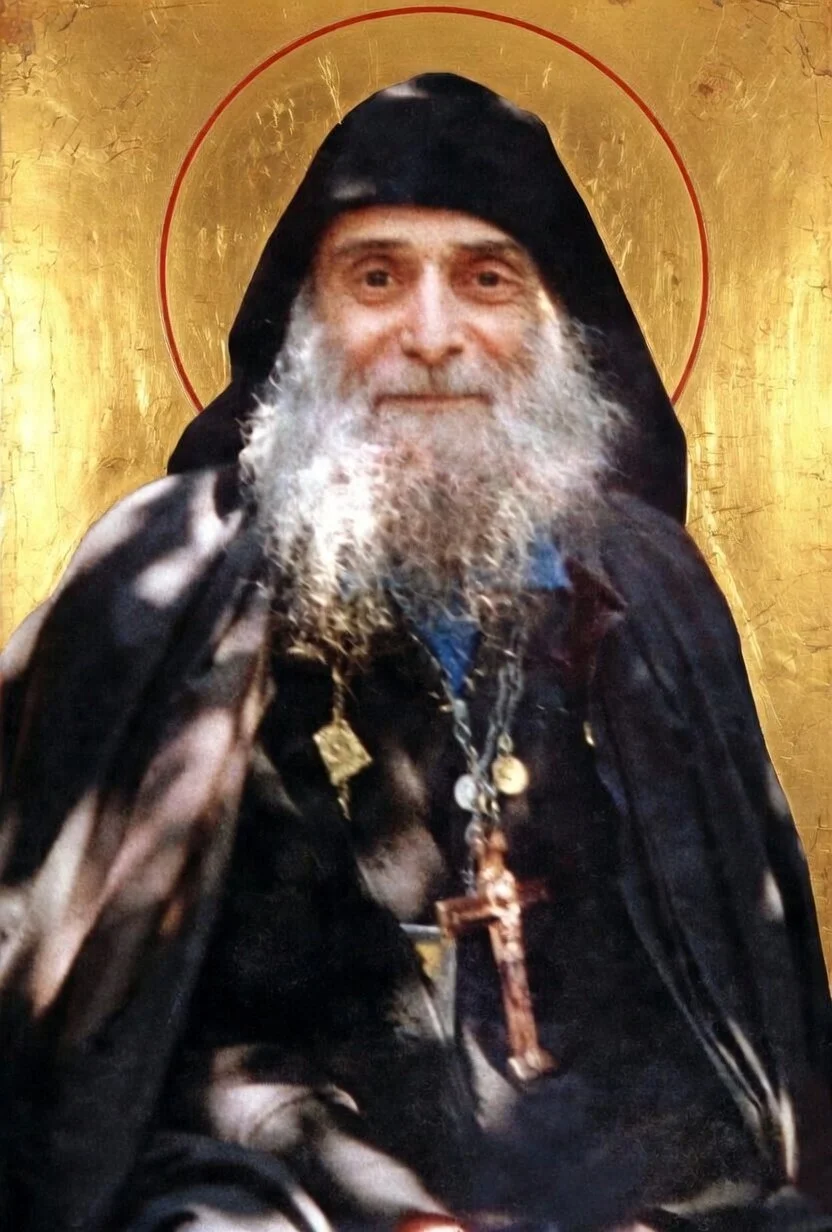
On May 1, 1965, during the May Day celebrations in Tbilisi, Gabriel set fire to a large portrait of Lenin that was displayed on the building of the Council of Ministers. Church biographies agree on the central event, the place and his arrest. For him the great image of the leader, and the public honor given to it, was a form of idolatry. His words at the time are reported in the main biography, but no recording or interrogation record confirms the exact wording, so they are not quoted here.
Accounts say that a hostile crowd beat him before soldiers stepped in. He was taken into custody and questioned. Orthodox sources say that the security officers tried to force him to say that the leaders of the Georgian Church had planned the protest, and that he refused, even under beatings and threats.
This is the most dramatic episode of his life, and it should be told with care. The central facts are well supported by church sources. Details such as a death sentence, or the number of fractures, which some sources give as seventeen and others as eighteen, are not confirmed by any court judgment or medical report that could be examined. The claim that Western press coverage prevented his execution is also unconfirmed.
The Psychiatric Hospital
After his arrest Gabriel was placed in a psychiatric hospital in Tbilisi. A medical report, reproduced in English in his main biography, records an admission on August 18, 1965, after transfer from prison. It lists his religious beliefs, visions, fasting and devotion to icons among the observations used to describe his condition. It is an important document of how Soviet doctors judged religious behavior.
The report is a reproduction, not an authenticated original file, and its discharge dates are inconsistent. One entry gives November 19, 1965, while another line gives an impossible January 1965 date next to a January 1966 signature. The biography speaks of about seven months of combined detention and hospital care, so an exact release date should not be claimed.
It would be wrong to say that the diagnosis proves he was ill, and equally wrong to say that every clinical observation was invented. The political use of psychiatry in the Soviet Union is well known, and the matter needs careful, separate study. What can be said is that Soviet authorities treated an act of religious protest as a mental disorder.
Samtavro and the Fool for Christ
After his release he remained a priest, but he was prevented from performing his normal ministry. He received Communion among the ordinary worshippers and was called in repeatedly by the security services. In 1971, with the blessing of Catholicos-Patriarch Ephraim II and Metropolitan Ilia, he was appointed to serve at Samtavro Monastery in Mtskheta, and he lived in an old tower linked in tradition to King Mirian.
His behavior became more unusual. He sometimes acted as if drunk, behaved unpredictably and invited ridicule. In Orthodox spirituality this is the way of the fool for Christ, who hides holiness behind apparent folly and challenges pride. The apostle Paul speaks of the apostles as fools for Christ's sake in his first letter to the Corinthians. Gabriel's actions are understood within a specific calling, not as a model for ordinary Christians.
Between 1972 and 1990 he visited churches and monasteries that had been abandoned or damaged under Soviet rule, praying at them so that they would not be forgotten. In 1987 he began living in a very small unheated wooden hut that had been a henhouse. People nevertheless came to him in growing numbers for advice. His teaching survives mainly through the recollections of disciples, including a book by Archimandrite Kyrion Oniani published in 2010.
Death and Burial
In his last years his health failed badly. The biography describes severe swelling, a leg injury and a long period in bed. Visitors still came for counsel. He died at Samtavro Monastery on November 2, 1995, at the age of sixty-six, as prayers for the departure of the soul were being said.
In keeping with his wishes, he was buried within the monastery grounds, wrapped in a mat rather than placed in a coffin. His mother, Nun Anna, was later buried near him. His grave soon became a place of pilgrimage for many Georgians who remembered him as a loving and fearless father.
TRADITION. One devotional account says that soil moved by itself over his body at the burial. This is found in his main biography, but no independent documentation exists, and it should be read as a pious tradition. The same is true of reports of healings at his grave, which are numerous but cannot be assessed medically from the published sources.
Glorification and Relics
The Holy Synod of the Georgian Orthodox Church numbered Gabriel among the saints on December 20, 2012, with a commemoration on November 2. He was given the title Venerable Father Gabriel the Confessor and Fool for Christ. Some secondary publications give December 24, but an independent report published on December 22 already spoke of the glorification as having occurred on December 20, so that date is preferred.
On February 22, 2014, his tomb was opened and his remains were solemnly translated. They were taken for public veneration to Svetitskhoveli Cathedral and Holy Trinity Cathedral in Tbilisi. Since April 1, 2014, his relics have rested in the Church of the Transfiguration at Samtavro Monastery. Some accounts call the relics incorrupt, but this is a tradition that has not been checked by published forensic documentation.
TRADITION. Devotional sources tell of a blessed loaf that separated into fire, water and wheat to illustrate the Trinity, of an angel that showed him a hidden relic, and of a warning about bloodshed in Tbilisi before the violence of 1991. These come from the main biography and from recollections, and none has independent confirmation. A troparion and an akathist exist, but no text is quoted here.
Lord Jesus Christ, You chose the weak things of the world to confound the strong. Through the prayers of Saint Gabriel of Georgia, strengthen all who suffer for Your name. Comfort those who are imprisoned, mocked or silenced. Give us a humble heart, a courageous tongue and a love for the poor and the broken. Keep Your Church faithful in every age, and let Your peace rest upon Georgia and all the nations. Amen.
This prayer is an original composition for devotion. It is not an official liturgical text and was not written by the saint.
Why He Matters Beyond Georgia
For Orthodox Christians Gabriel is a sign that monastic life and confession of Christ survived Soviet atheism. His glorification, his feast and his shrine at Samtavro give him a firm place in the life of the Georgian Church. His story links modern Georgia with the old traditions of fasting, humility, icon veneration and spiritual fatherhood.
For Eastern Catholics and other Christians, his life is a moving example of the experience of persecution under communism, and of ascetic traditions that the Eastern Churches share. It must be said clearly, however, that he has not been recognized as a saint by the Catholic Church, and that no Eastern Catholic calendar lists him. His glorification is an Orthodox act and should not be described as canonization by Rome.
The honest portrait is one of a Georgian monk and priest who openly challenged Soviet religious ideology, paid for it with confinement and restriction, and became a trusted spiritual father at Samtavro. His miracles and visions belong to the tradition of his Church and are clearly marked as such. His strongest witness, perhaps, is the simple one of a man who gave glory to Christ rather than to any earthly power.
Frequently Asked Questions
Ask His Prayers
Saint Gabriel reminds us that courage can look like foolishness to the world. Ask him to pray for Georgia, for prisoners and the persecuted, and for all who must choose between comfort and the truth.
View Prayer Card