Saint Romanus of Le Mans: Priest, Confessor and the Mystery of His Early Cult
A holy priest remembered in western France, whose life story is harder to recover than his memory
At a Glance
- Born
- Unknown
- Died
- Unknown; about 380 to 385 is given only if he is identified with Romanus of Blaye
- Titles
- Saint, Priest, Confessor
- Feast
- November 7 at Le Mans (November 24 for Romanus of Blaye)
- Veneration
- Medieval local cult; no formal canonization on record
- Patronage
- No secure patronage
- Which Saint Romanus?
- A Priest, Not a Bishop
- The Family of Tradition
- Vocation and Ministry in the Tradition
- The Journey to Rome in the Story
- A Life Borrowed from Other Saints
- Romanus of Blaye
- Relics and Feast Days
- Miracle Stories of the Life
- What Is Known, and Why It Still Matters
- Frequently Asked Questions
Which Saint Romanus?
There are many saints named Romanus, and the name is a common source of confusion. The saint described here is Romanus of Le Mans, also called Romain du Mans, or Romanus the Confessor. He was venerated in the Diocese of Le Mans, in the old province of Maine in western France. His historical identity is unusually uncertain, and a responsible article has to begin with that fact.
The best study is the critical commentary of the Bollandist scholars in the Acta Sanctorum for November 7. They found that Romanus was truly venerated as a saint at Le Mans, with solid medieval liturgical evidence. They also found that the long medieval Life of Romanus cannot be trusted as biography, and that the saint's date cannot be fixed. This article follows their caution.
Readers should also know that this saint is not the same as the Byzantine hymnographer Saint Romanos the Melodist, nor the other Romanuses of the early Church. If you have a prayer card marked simply Saint Romanus, it is worth checking which saint your family or parish has in mind. Here the subject is the priest of Le Mans.
A Priest, Not a Bishop
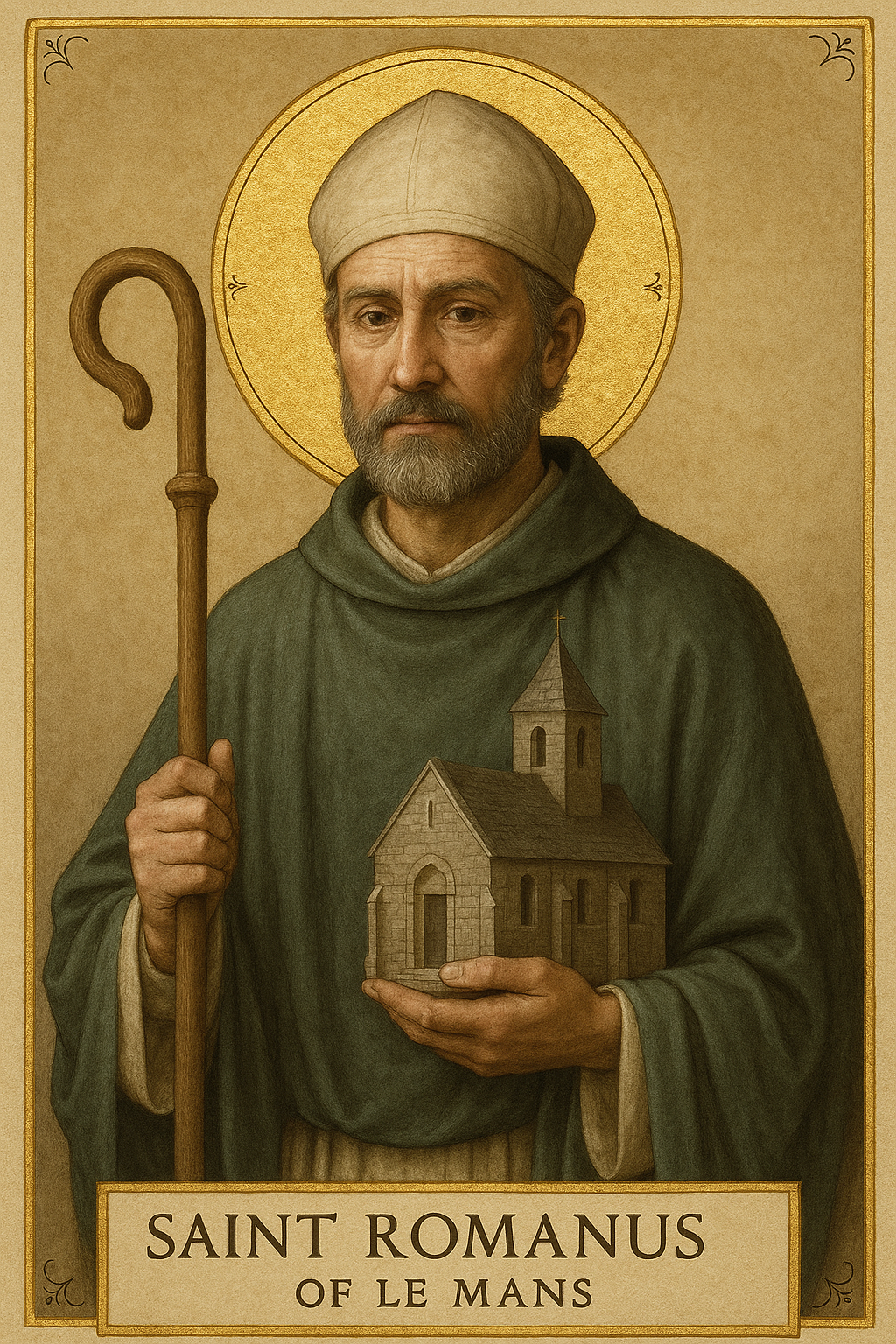
The tradition of Le Mans calls Romanus a priest and a confessor, a title given to holy people who confessed the faith by their lives without dying as martyrs. He is not named as a bishop. The official historical list of the bishops of Le Mans published by the diocese, which relies on the work of the Benedictine historian Dom Oury, does not include a Bishop Romanus. So he should be called a priest.
No reliable birth date or birthplace survives. No contemporary account of his childhood, family or education exists. If a reader finds a precise date of birth in a devotional book, it should be treated with caution. The honest summary is that Romanus was remembered at Le Mans as a holy priest, and that almost all of the details were added later.
This is not unusual for the early Church in Gaul. Many saints of the fourth through the sixth centuries are known from a liturgical memory, a tomb and a medieval Life written long afterward. What they lack in biography they often make up in the strength of local devotion. Romanus belongs to that company of quiet saints.
The Family of Tradition
TRADITION. The medieval Life describes Romanus as born into a distinguished family and as a relative of Saint Julian, the first bishop of Le Mans. Other versions call him Julian's nephew. Some say he came from Rome to the Le Mans region and was ordained by Julian, then helped to preach to the local people.
None of these family ties has independent contemporary documentation. The Bollandists noted that the account of his noble birth borrows its language and structure from the Life of Saint Fursey, which suggests literary borrowing rather than real family history. A relics account names a sister called Julia, but this Julia cannot be identified in any other source.
There is also a chronological difficulty. The dates given for the earliest bishops of Le Mans are not consistent in the medieval sources, and some place Julian much earlier than the chronology now generally used. Because of this, one cannot date Romanus simply by accepting a family link with Julian. The relationship is best treated as a pious tradition.
Vocation and Ministry in the Tradition
TRADITION. The Life says that Romanus loved the Scriptures and left his home to follow a religious vocation. It describes a life of prayer, fasting and preaching, ordination as deacon and priest, and missionary work among the people of the region. It stresses his obedience to church authority and his wish to combine prayer with active service.
TRADITION. The Life also credits him with founding or helping to found monasteries around Le Mans, restoring churches and cultivating land. No monastery has been securely identified from a foundation document as his. The existence of monasteries in the region does not prove that he founded them.
The Bollandists showed that much of this material was copied from the Life and Miracles of Saint Fursey. It therefore tells us about the ideals of the medieval writer, who wanted to present a model priest, more than about the man himself. No writings of Romanus, such as sermons, letters or prayers, are known to exist.
The Journey to Rome in the Story
TRADITION. The medieval Life says that Romanus asked his bishop for permission to go on pilgrimage to Rome, where he prayed at the shrines of Saints Peter and Paul. It describes his return through the region of Vendôme and his arrival back in Le Mans. This is a pleasing story and a very typical one for a medieval saint's Life.
The Bollandists identified this journey as another episode adapted from the tradition of Saint Fursey. It cannot be confirmed that Romanus ever went to Rome. For a writer in the Middle Ages, a pilgrimage to the tombs of the apostles was a mark of a serious Christian, and it may have been added for that reason.
The lesson here is not that Romanus did not pray at Rome but that we cannot say. A careful historian separates what the sources can support from what they only suggest. Here the sources are literary, and so the journey remains a tradition, with real devotional value but no historical proof.
A Life Borrowed from Other Saints
The longest source on Romanus is a Latin Life that has long been falsely attributed to Saint Gregory of Tours. The Bollandists showed that Gregory did not write it. The author drew heavily on the writings of Venantius Fortunatus about Saint Paternus and on the Life of Saint Fursey, adapting whole episodes, miracles and spiritual teachings.
The date of this Life is also uncertain. The Bollandists could not say whether it was written in the ninth century, the tenth or later. This means that the work is good evidence for medieval devotion to Romanus but poor evidence for what he actually did. It is a mirror of the faith of the people who wrote and read it.
This kind of borrowing was common in the Middle Ages and was not meant to deceive. An author who wished to honor a saint with few surviving facts would often use the familiar language and stories of better known holy people. Modern readers should simply know that this was done, and read the stories with that in mind.
Romanus of Blaye
A second Romanus is honored at Blaye, near Bordeaux, in southwestern France. Gregory of Tours mentions this Romanus and his tomb in his book on the glory of the confessors. The French resource Nominis describes the priest of Blaye as Gallo-Roman or, in another tradition, of African origin, and says that he was ordained by Saint Martin of Tours and sent to evangelize the region. Even that tradition is told in cautious language.
The Bollandists considered whether the cult at Le Mans began with Romanus of Blaye. A connection is possible. Bishop Bertichramnus of Le Mans, also called Bertrand, owned land near Blaye, and his testament gave the estate of Plassac to the Church of Le Mans. Devotion and relics could have traveled along such a path. This is a hypothesis, however, and no surviving document proves it.
The feast days also differ. Le Mans keeps November 7, while Blaye keeps November 24. This is why some modern books give a death date of about 380 to 385 and a feast on November 24, and others give November 7. Whether the two commemorations began with one man or two cannot be settled with the evidence we have, and it is wise not to blend the two biographies.
Relics and Feast Days
The medieval Life places the death of Romanus at Le Mans on November 7 and says that he was buried west of the city, beyond the Sarthe River, near the burial place associated with Saint Julian. TRADITION. It adds that an angel foretold the end of his ministry in a vision, and that he died peacefully after the time given. These details are among the material borrowed from other saints' Lives.
The relics are also a puzzle. The Gesta Aldrici tells how Bishop Aldric of Le Mans moved the relics of local saints into the cathedral. The Bollandists noted that Romanus does not appear in the original record of the relics placed in the cathedral altars in 835. His name appears in a passage that was probably added later, possibly not before the tenth century. A thirteenth century martyrology records a translation of his body on March 24.
The present location and authenticity of any relics of Romanus have not been established from current cathedral documentation. What the sources do show is a medieval cult of relics and a continuing liturgical commemoration, including a Le Mans missal of the early twelfth century and a thirteenth century martyrology. A proper liturgical office was later published in the collection of 1854 for the church of Le Mans.
Miracle Stories of the Life
TRADITION. One story says that a boy at Mantula was bitten by a poisonous snake. Romanus made the sign of the cross over him and anointed him with blessed oil, and the boy recovered. Another says that on his way to the church of the Apostles beyond the Sarthe he met a man who could not speak, and by prayer he restored the man's voice and told him to give thanks to God alone.
TRADITION. A third tells of a hostile man who stole the saint's cloak, after which the thief's household suffered terribly. Romanus prayed rather than took revenge, and the family was restored. In a fourth, on his supposed return from Rome, he healed the gravely ill son of a nobleman near Vendôme and refused any reward. The Bollandists showed that these stories were adapted from Paternus and Fursey.
Because of that borrowing, none of these miracles can be treated as an independently recorded event. They are still valuable. They show a priest of the imagination who heals quietly, forgives enemies and refuses wealth, an ideal that the readers of the Life wished to see in their clergy. Their message is moral and spiritual even where the facts are unknown.
Lord Jesus Christ, Eternal High Priest, You are known fully to those whom the world has forgotten. Through the prayers of Saint Romanus, honored by the Church of Le Mans, bless all priests who serve quietly. Give them humility, generosity and love for the poor. Keep them faithful in prayer and patient in service, and teach all of us to seek holiness in small things. Amen.
This prayer is an original composition for devotion. It is not an official liturgical text and was not written by the saint.
What Is Known, and Why It Still Matters
In summary, the safe statements about Romanus are few. He was a saint honored at Le Mans with a feast on November 7. He was called a priest and confessor. His cult is documented from the early twelfth century onward. No formal canonization or beatification is on record, because his recognition belongs to the older system of local veneration. Everything else is tradition or hypothesis.
For readers of the Christian East, it should be said plainly that no Eastern Catholic or Orthodox commemoration of Romanus of Le Mans has been verified, and no troparion or collect for him has been located in the sources. Whatever his date, he belongs to the early Christianity of Gaul, before the later divisions between East and West. No prayer is quoted here because no verified text was found.
There is something worth keeping in this uncertainty. The Church remembers many holy people whose names we know and whose lives we cannot reconstruct. Romanus invites us to pray with humility, to trust that God knows each saint, and to be honest about the limits of our knowledge. That honesty is itself a form of respect for the truth.
Frequently Asked Questions
Ask His Prayers
Saint Romanus asks us to honor holy people even when their stories are only partly known. Ask him to pray for priests who work in obscurity, and for all who seek the truth with humility.
View Prayer Card