Saints Adrian and Natalia of Nicomedia: The Martyr Husband and the Wife Who Strengthened Him
A married couple of the early fourth century, honored in East and West, whose story joins martyrdom, marriage and encouragement
At a Glance
- Born
- Unknown; no reliable birth data for either saint
- Died
- Adrian: martyred at Nicomedia, dated 298 or about 306 depending on the source (UNCERTAIN); Natalia reportedly died soon afterward
- Titles
- Holy Martyrs; Natalia is honored with the martyrs though tradition says she died peacefully
- Feast
- August 26 on the Byzantine calendar (September 8 on the civil calendar for Julian-calendar churches); September 8 in the Western tradition for Adrian
- Veneration
- Ancient cult in East and West; no formal canonization decree is documented
- Patronage
- Married couples; for Adrian also soldiers, prison guards, butchers and protection against plague in medieval Western devotion
- Who Were Saints Adrian and Natalia?
- Nicomedia in the Time of the Persecutions
- Adrian: A Pagan Official
- Adrian Confesses Christ
- Natalia in the Prison
- The Martyrdom of Adrian
- Natalia's Journey and Peaceful Death
- Relics: Constantinople, Rome and Flanders
- Feasts, Patronage and Devotion
- Why They Matter to Eastern Christians
- Frequently Asked Questions
Who Were Saints Adrian and Natalia?
Saints Adrian and Natalia are honored as a husband and wife of Nicomedia, an important city of Bithynia near the Sea of Marmara. In the traditional story Adrian was a pagan officer who watched Christians being tortured, was moved by their courage and confessed Christ himself. Natalia, his wife, was a Christian who encouraged him to hold firm.
Their cult is ancient and well attested. Their detailed biography is not. The Catholic Encyclopedia of 1910 describes the underlying Acts as legendary and unverified, and the Bollandist scholars noted confusion between several martyrs named Adrian. This article keeps that distinction in front of the reader and marks the details of the Acts as tradition.
What can be said confidently is that Christians in both East and West venerated Adrian as a martyr of Nicomedia from early times, that Natalia was honored beside him in Byzantine worship, and that their story became a model of mutual encouragement in marriage.
Nicomedia in the Time of the Persecutions
Nicomedia was an imperial residence under the Tetrarchy, which made it a center of both government and persecution. Lactantius reports that the main Christian church of the city was destroyed on February 23, 303, and that an edict against Christianity followed. Eusebius, in Book 8 of his Ecclesiastical History, also describes the persecution there, with the destruction of property and the imprisonment of clergy.
These witnesses prove that Christians suffered in Nicomedia in these years, but neither names Adrian or Natalia. That is a limit worth stating plainly. The setting is historical, while the individual story is known only from later Acts.
The date of Adrian's martyrdom is uncertain. The Greek Orthodox Archdiocese gives 298, which would be before the general persecution began in 303, and the Catholic Encyclopedia suggests about 306. The safest statement is that he belongs to the late third or early fourth century and, in tradition, to the persecution connected with Diocletian and Galerius.
Adrian: A Pagan Official
Tradition describes Adrian as a young pagan in the service of the empire. The Orthodox Church in America calls him head of the praetorium, while the Catholic Encyclopedia calls him an officer in the bodyguard of Galerius. These descriptions are not necessarily in conflict, but his exact office is uncertain and no service record survives.
Tradition says that Adrian had been married about a year, with one Antiochian synaxarion giving thirteen months. It also says he was twenty-eight when he died. These figures come from the hagiographical narrative and have no independent confirmation.
Nothing reliable is known of the parents, brothers or sisters of the couple. Later retellings sometimes describe them as wealthy or noble, but that belongs to the later synaxaria and should not be given as fact. What is distinctive in the story is that the wife already held the faith that her husband would come to accept.
Adrian Confesses Christ
According to the Acts, a group of Christians was arrested near Nicomedia and brought before the authorities. The numbers differ in the sources. The Orthodox Church in America names twenty-three, the Greek Orthodox Archdiocese commemorates thirty-three and the Catholic Encyclopedia mentions twenty-two. The figure is uncertain, and it would be wrong to treat any one of them as a verified count.
Adrian, who was present at their questioning, saw them tortured and was struck by their calm. Tradition says he asked what reward they hoped to receive from Christ and, after their answer, declared himself a Christian and asked that his name be added to the list. His confession brought him before the emperor, who tried to make him recant. When he refused he was imprisoned with the others.
The scene has an obvious purpose in the Acts. The martyrs convert a man who had been part of the persecution, which shows how Christian witness can reach even those who serve an unjust system. The conversations themselves cannot be checked.
Natalia in the Prison
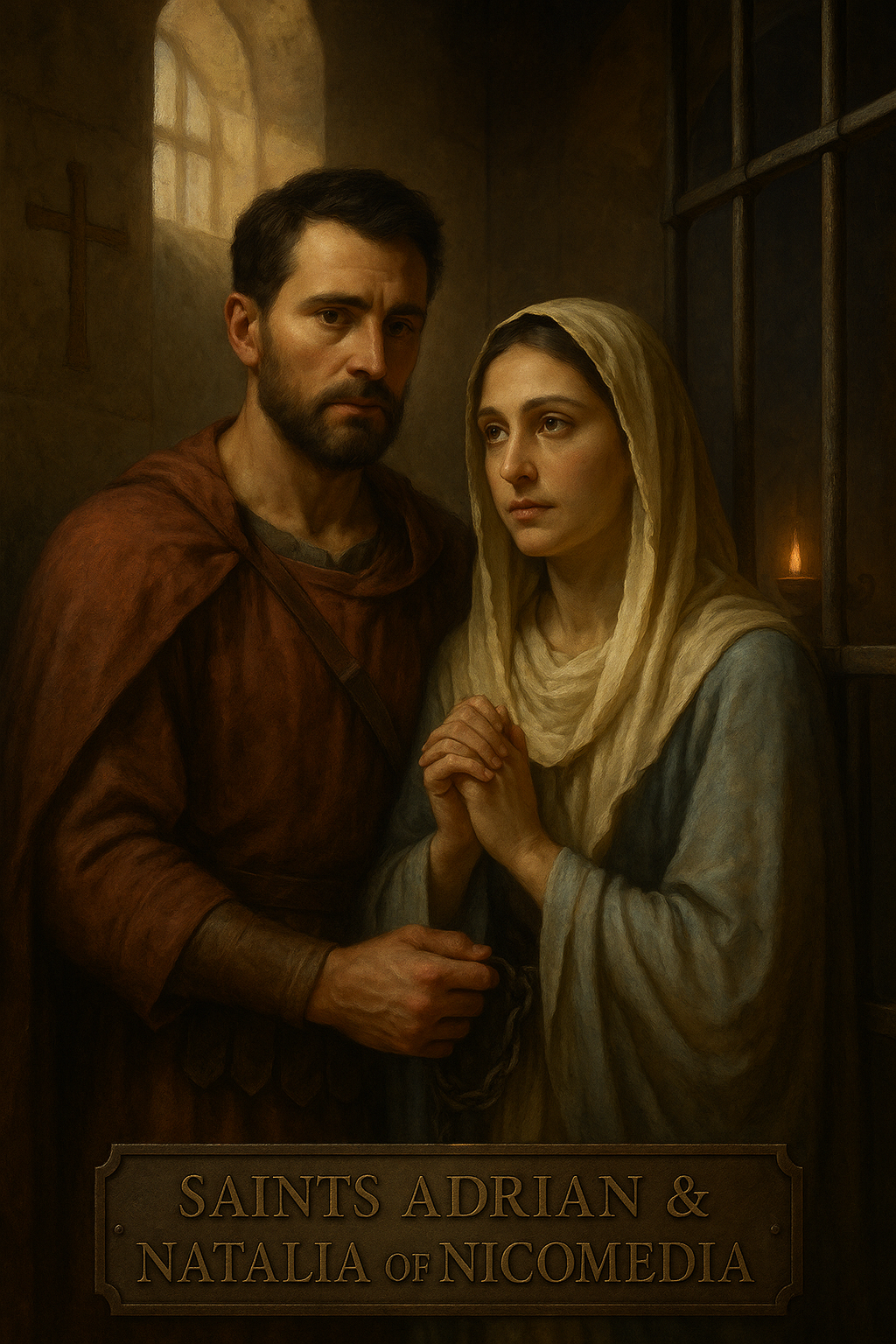
Tradition says that Natalia heard of her husband's arrest and went to see him in prison. She did not ask him to save his life by denying Christ. She encouraged him to remain faithful and spoke of martyrdom as a share in Christ's victory over death. This is the heart of her place in Byzantine worship.
Another tradition says that Adrian was allowed to go home briefly to tell her of his approaching death. Seeing him at the door, Natalia first feared that he had bought his freedom by sacrificing to the idols, and she welcomed him only when she learned the truth. The episode shows how seriously early Christians took the temptation to apostatize.
Natalia held no known church office, founded no community and wrote nothing. Her work, as the tradition tells it, was care for the imprisoned, encouragement of her husband and reverence for the bodies of the martyrs. These actions fit what is known of the early Christian care for prisoners and martyrs, yet the specific acts attributed to her remain tradition.
The Martyrdom of Adrian
The Acts say that Adrian and his companions were tortured after refusing to sacrifice. In the most familiar version their limbs were broken on an anvil, and Natalia stayed to urge Adrian to endure. The anvil became his best-known attribute in Western art. The exact instrument and the order of the tortures cannot be verified.
Tradition adds that the bodies were thrown on a fire, which a sudden storm put out, and that Natalia recovered one of Adrian's severed hands. These wonders express the conviction that God kept the martyrs' remains for the veneration of the faithful. No independent record of them exists.
It is also uncertain which emperor ordered his death. The Acts name Maximian, and the Catholic Encyclopedia reads this as a reference to Galerius, whose full name included Maximianus. The identification is plausible but does not settle every chronological question.
Natalia's Journey and Peaceful Death
According to the long Passion, Natalia left Nicomedia to escape being married to an imperial official. She traveled to Argyropolis, near Byzantium, where the martyrs' remains had reportedly been taken. Tradition adds that Adrian appeared to her at sea and guided her through danger.
She is said to have had a dream in which Adrian told her she would soon share his rest, and she died shortly after her arrival. The Greek Orthodox Archdiocese describes her death as peaceful. This is why her title needs care. She is honored with the martyrs, but the received story does not describe her execution.
The Catholic Encyclopedia treats the existence of a venerated grave of Adrian at Constantinople as a historical feature of the cult and the story of Natalia's journey as legend. Both observations are useful, since they separate the cult, which is attested, from the narrative, which is not.
Relics: Constantinople, Rome and Flanders
The cult of Adrian spread early. In the Byzantine world his grave or reputed relics drew veneration. In Rome, Pope Honorius I converted the old Senate house in the Forum into a church of Saint Adrian in 630, which became Sant'Adriano al Foro. The Catholic Encyclopedia connects the Western September 8 commemoration with the translation of his relics to this church, though the date of the translation and the later history of the remains are uncertain.
In Flanders, the Metropolitan Museum of Art records that relics of Adrian were brought to Geraardsbergen in 1175. The abbey there became known as Saint Adrian's Abbey and a pilgrimage center, where people prayed to him in times of plague. The Orthodox Church in America also reports that Kykkos Monastery in Cyprus holds a portion of Natalia's relics, a church-reported tradition that has not been independently verified.
These records show how strongly the cult developed. They do not authenticate every relic. Museum pieces such as the South Netherlandish pilgrim badges of the later fifteenth century give material evidence of devotion, with Adrian shown as an armored soldier beside an anvil.
Feasts, Patronage and Devotion
The Byzantine tradition keeps their feast on August 26, which falls on September 8 on the civil calendar for churches that follow the Julian calendar for fixed feasts. The Western tradition independently keeps September 8 for Adrian in connection with the Roman relics. The two September 8 dates should not be confused, and older Roman martyrologies list further commemorations for an Adrian on other days.
Both are invoked for married couples. Adrian is also linked, mostly in medieval Western Europe, with soldiers, prison guards, butchers and blacksmiths and with protection against plague. Some of these associations arose later than the earliest accounts.
No canonization decree is documented for either. They were recognized in the ancient way, through the veneration of the Church, which has honored them for well over a thousand years.
Holy Martyrs Adrian and Natalia, you stood together in faith when it cost everything. Pray for husbands and wives, that they may encourage one another toward Christ. Keep them faithful in trials, patient in weakness and gentle in correction. Help us to prefer the Lord to every comfort, and bring our families at last to the peace of heaven. Amen.
This prayer is an original composition for devotion. It is not an official liturgical text and was not written by the saints.
Why They Matter to Eastern Christians
Their significance is supported by Byzantine liturgical material. The Antiochian House of Studies publishes an Orthros service for August 26 that honors Adrian and Natalia as a married couple, and the kontakion recalls the counsel Natalia gave her husband. Eastern Catholics who use the Byzantine rite share this heritage with the Orthodox.
Their story presents marriage as a way of helping each other toward holiness. Natalia does not make the decision for Adrian. She strengthens him in the choice he has made. This theme echoes the New Testament call to endure together and to encourage one another in suffering.
The precise age of every hymn should not be assumed without manuscript evidence. The sources support the liturgical reception of their story, not the claim that every event of the Passion occurred as written, and that honesty serves the faith better than inflated certainty.
Frequently Asked Questions
Ask Their Prayers
Saints Adrian and Natalia remind us that faith is often kept alive by someone beside us. May they pray for every married couple and for all who must stand firm for Christ.
View Prayer Card