Saints Andronicus and Athanasia of Egypt: A Married Couple Who Became Desert Monastics
The couple from Antioch who gave away their wealth after the death of their children and found each other again in the Egyptian desert
At a Glance
- Born
- Unknown; Antioch is the traditional home
- Died
- Uncertain; traditionally in the fifth century or about 500, though the link with Abba Daniel suggests a later date
- Titles
- Venerable Andronicus and Venerable Athanasia
- Feast
- October 9 (Byzantine and older Roman calendars); the Ethiopian Synaxarium lists Hamle 28
- Veneration
- Byzantine Orthodox and Byzantine Catholic calendars; no formal canonization date is documented
- Patronage
- Devotionally linked with married couples and bereaved parents; no official patronage
- Who Were Saints Andronicus and Athanasia?
- Antioch and a Charitable Household
- The Death of Their Children
- To Egypt and Into Separate Monasteries
- The Meeting on the Road
- Hidden Holiness and the Disguised Monk
- The Problem of Dates
- The Death of Athanasia and Andronicus
- Feasts and Recognition
- Why They Matter to Eastern Christians
- Frequently Asked Questions
Who Were Saints Andronicus and Athanasia?
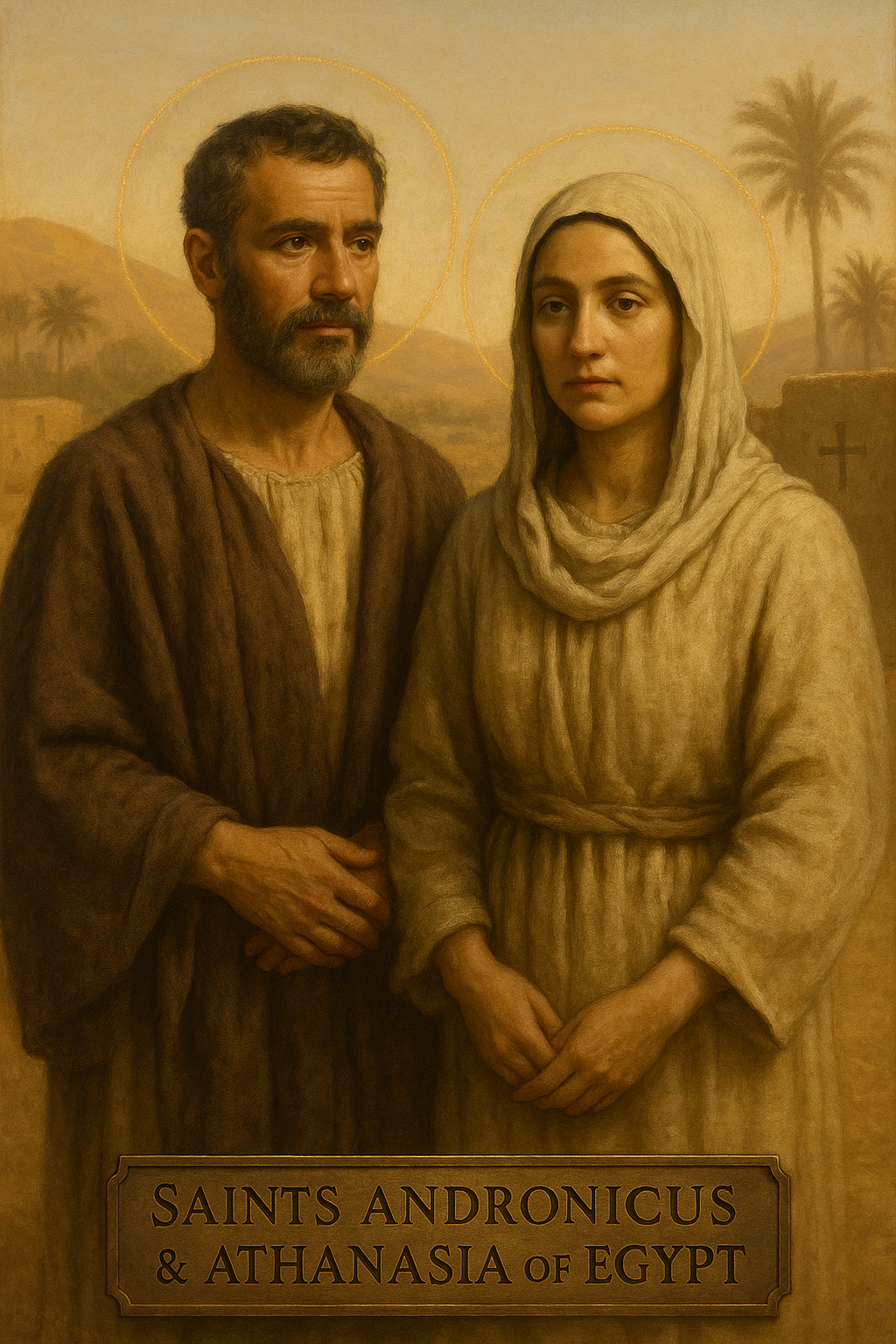
Saints Andronicus and Athanasia are honored together as a married couple who, after the death of their children, gave away their wealth and became monastics in Egypt. Their story is told in a Life that circulated in Greek, Syriac, Arabic, Armenian, Ethiopic and other languages. It is a moving narrative of grief, renunciation and a hidden reunion.
The Life is hagiography. It was written to edify, and it cannot be treated as an eyewitness record. Britt Dahlman edited and translated the Greek version in 2007 within a group of stories about Abba Daniel of Scetis, and Anna Maria Taragna published a critical edition of the Sinai version in 2019. Anne Alwis has studied the Life as one of several narratives about celibate marriages in late antiquity.
This article therefore marks the details of the story as tradition and the chronology as uncertain, while taking the story seriously as a witness to Eastern Christian ideals of charity, marriage and humility.
Antioch and a Charitable Household
According to tradition the couple lived in Antioch, one of the great Christian cities of the East, and were prosperous. A Syriac version calls Andronicus an argyroprates, a dealer in silver or money, and names Athanasia as the daughter of John, who followed the same trade. Greek traditions describe him as a wealthy banker, and later retellings sometimes say silversmith, so the exact trade varies with the version.
They are described as generous. The Orthodox Church in America reports that they divided their income into three parts, one for the Church, one for the poor and one for their household. The Ethiopian Synaxarium gives a different account, in which half their profit went to charity. These figures are not financial records, and both versions simply stress that they held wealth lightly.
The Life also says that after the birth of their children the couple agreed to live in continence while continuing their works of charity. This feature belongs to a recognized type of late antique writing about married couples who move toward asceticism, and it is a particular ideal and not a rule for every Christian marriage.
The Death of Their Children
The Life names their children John and Mary. In Alwis's account John was twelve and Mary ten when both became seriously ill and died, and another version names plague as the cause. These details come from the hagiographical narrative and are not attested elsewhere.
Tradition says that the children were buried at a church of the martyr Julian, and that Athanasia stayed by the tomb in deep grief. She is said to have received a dream in which a monk, understood to be Saint Julian, comforted her and turned her thoughts toward repentance and eternal life. It is a traditional vision, and its purpose in the story is to turn bereavement toward hope in the resurrection.
The grief of the parents is the center of this part of the narrative. The story does not hide their sorrow, and that honesty is part of why it has been loved for so many centuries. The couple did not respond with bitterness but with a decision to give themselves wholly to God.
To Egypt and Into Separate Monasteries
The couple distributed their possessions and left for Egypt. The versions of the journey differ, and the fuller account passes through Jerusalem, Alexandria and the shrine of Saint Menas before they parted. They were already Christians, so there is no conversion from paganism here. The change is from householders and benefactors to desert ascetics.
Tradition says that Andronicus entered the monastic world of Scetis under the guidance of Abba Daniel. Athanasia entered a women's monastery connected with Tabennisi, a place tied to the Pachomian tradition of Egyptian monasticism. The Orthodox Church in America confirms the association with Scetis and with the women's monastery.
Neither saint is known to have founded a monastery, held a documented church office or written a treatise. In the monastic phase their life, as the Life presents it, was prayer, fasting, silence, obedience and pilgrimage under the discernment of an elder.
The Meeting on the Road
According to the narrative, after twelve years of monastic life Andronicus set out on another pilgrimage to Jerusalem. On the road he met a monk he did not recognize. The companion was Athanasia, who now wore male monastic dress and had been changed by years of discipline. This is tradition.
It is important to state exactly what happens. Athanasia recognized her husband but hid her identity, and Andronicus did not recognize her. They did not embrace as husband and wife. The story turns on her deliberate silence and on his not seeing who she was, which gives the account its character of hidden holiness.
After visiting Jerusalem they returned to Egypt and lived near each other as ascetic companions. In the fuller account studied by Alwis, their final dwelling was associated with a place called Oktokaidekaton, where they remained together for another twelve years.
Hidden Holiness and the Disguised Monk
Athanasia belongs to a recognized group of women in Eastern Christian hagiography who live in disguise as monks. These stories usually stress humility, the renunciation of social standing and the discovery of holiness after death. Her disguise is not an isolated detail of this Life but part of a literary and spiritual tradition.
Dahlman's edition places the Life within the Daniel of Scetis collection, which explores hidden sanctity. Modern scholarship treats the collection as a body of edifying stories and not as a set of independently verified biographies. That women adopted male monastic identity at times is a separate historical question from whether this exact episode happened as told.
There is no sign of a doctrinal controversy involving the couple. Their importance lies in ascetic practice and the way their story was transmitted, and in how it shows spouses who practiced charity in marriage before taking up a different form of life.
The Problem of Dates
The traditional accounts place the couple in the fifth century, and the Greek Orthodox Archdiocese suggests that they died about 500. Some narratives connect their early lives with the reign of Theodosius I, which lasted from 379 to 395. Those dates do not sit easily with the Abba Daniel of the story.
The Daniel of Scetis whose name is linked with their Life belongs to the monastic world of the sixth century, and Taragna places the narrative among the Daniel stories. If the Theodosian dating were taken literally it would be hard to square with Daniel's chronology. For that reason the lifetime of the couple, and the date at which their Life was written, remain uncertain.
A careful account will avoid giving either 500 or any earlier year as a settled date of death. What can be said is that the Life is an important witness to Eastern Christian ideals, whatever the exact period of its heroes.
The Death of Athanasia and Andronicus
Tradition says that Athanasia fell gravely ill while living with Andronicus. Abba Daniel visited her before her death and gave her the Holy Mysteries. After she died, her identity was revealed by a written statement she had left and, in some versions, when her body was prepared for burial.
Andronicus then learned that his companion in the desert had been his wife. Overcome by grief, he died soon afterward. Some later synaxaria say he died eight days after her, while the shorter Orthodox account says only that it was soon, so the interval is uncertain. The Ethiopian Synaxarium adds that a sweet fragrance filled the place at her death, a sign of holiness that appears often in this literature.
The Life describes a dispute among monks over the burial of Andronicus and says Abba Daniel decided that he should be buried beside Athanasia at Oktokaidekaton. This is a burial tradition and not archaeological evidence. No authenticated shrine or relics have been identified in the sources consulted.
Feasts and Recognition
The couple are commemorated on October 9 in Byzantine Orthodox and Byzantine Catholic calendars, and older editions of the Roman Martyrology list them on the same day. The Greek Orthodox Archdiocese publishes an apolytikion and kontakion for them, and the Orthodox Church in America publishes an English troparion.
Their story also appears in Oriental Christian literature, with Syriac, Coptic and Ethiopic versions. The Ethiopian Synaxarium keeps their commemoration on Hamle 28, which corresponds to August 4 on the calendar presentation of the source consulted. A current Coptic feast for this couple has not been verified, and the Coptic calendar lists similarly named saints who are different people.
No formal canonization decree is documented. Their veneration arose through liturgical tradition. The presence of the couple in the Byzantine and older Roman calendars shows church recognition without pointing to one act of declaration.
Holy Andronicus and Athanasia, you knew the sorrow of burying your children and you turned that sorrow toward God. Pray for parents who grieve and for husbands and wives who are tempted to despair. Teach us to give generously, to keep silence when words would wound, and to trust that nothing offered to Christ is lost. Bring us and those we love to the joy of the resurrection. Amen.
This prayer is an original composition for devotion. It is not an official liturgical text and was not written by the saints.
Why They Matter to Eastern Christians
They are remembered together, and the Greek kontakion connects their marriage with their later monastic calling, so their partnership is central to their remembrance. Their story ties married life to the spirituality of the Egyptian desert. It does not begin with two people who despise marriage, but with spouses who practiced charity at home before taking another path.
The narrative also preserves marks of Scetis spirituality, among them silence, humility, obedience and the habit of hiding one's own achievements. For Eastern Catholics, their presence in Byzantine Catholic calendars confirms that their memory belongs to the shared Byzantine heritage.
The story should be read carefully. The choice of continence and later separation in monastic life is a particular ascetic ideal and not a requirement for married Christians. What the story offers every reader is a picture of faith after loss, of charity that outlasts wealth, and of a love that is purified and not destroyed.
Frequently Asked Questions
Ask Their Prayers
Saints Andronicus and Athanasia show that grief can be given to God and that love can survive loss. May they pray for the bereaved and for every married couple.
View Prayer Card