Saints Peter and Fevronia of Murom: The Princely Couple Honored as Models of Marriage
The Russian Orthodox saints whose story of humility, fidelity and a shared death has made them patrons of married life
At a Glance
- Born
- Unknown; no secure birth data for either saint
- Died
- Traditionally June 25, 1228, as the monks David and Euphrosyne (year and day UNCERTAIN)
- Titles
- Right-Believing Prince and Princess, Wonderworkers of Murom
- Feast
- June 25 on the Julian calendar, which falls on July 8 on the civil calendar
- Veneration
- Russian Orthodox Church; cult recognized at the Moscow Council of 1547; no Catholic canonization verified
- Patronage
- Marriage, married couples and family life
- Who Were Saints Peter and Fevronia?
- Peter, a Prince of Murom
- Fevronia, the Wise Beekeeper's Daughter
- The Serpent, the Illness and the Healing
- Exile and the Test of Fidelity
- The Miracles of the Tale
- The Sixteenth-Century Tale and the Council of 1547
- Monastic Life and the Shared Tomb
- Relics, Feasts and Modern Observance
- Why They Matter and the Question of Catholic Recognition
- Frequently Asked Questions
Who Were Saints Peter and Fevronia?
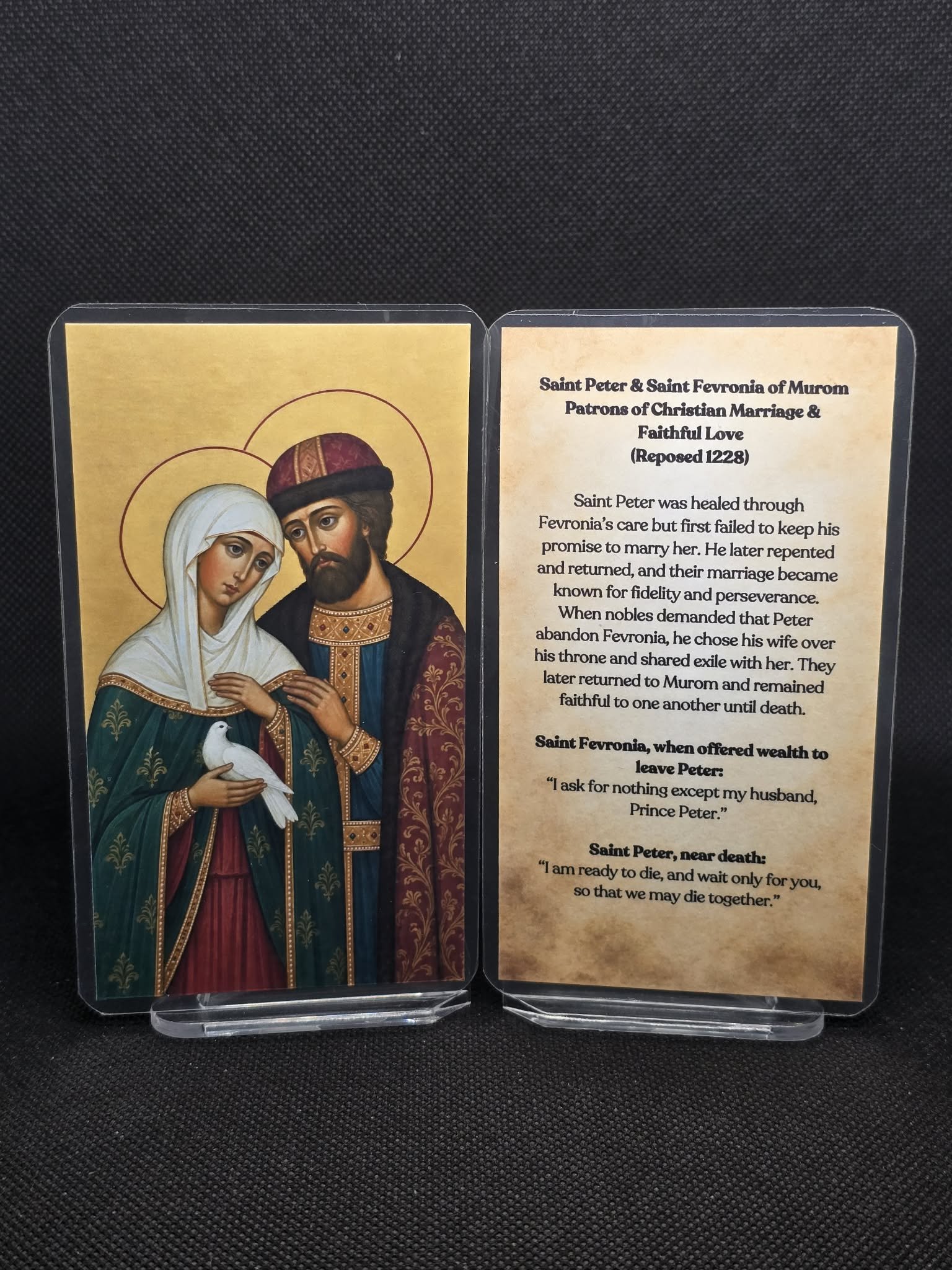
Saints Peter and Fevronia of Murom are a princely couple honored in the Russian Orthodox Church as a model of Christian marriage. In the traditional account Peter was a prince of Murom, an old city on the Oka River, and Fevronia was a wise young woman of humble birth who became his wife. Late in life they are said to have become monastics under the names David and Euphrosyne and to have died on the same day.
Their cult is real and documented. Their famous biography is another matter. The Tale of Peter and Fevronia, the main source for their story, was written in the middle of the sixteenth century, and it blends hagiography, moral teaching and older folktale. Scholars cannot show that every episode of the Tale happened, nor can they securely match the couple with people named in thirteenth-century chronicles.
This article therefore sets out three levels of certainty. It records what is historically documented, what is plausible but uncertain, and what belongs to tradition, so that the reader can enjoy the story and still know where the evidence stops.
Peter, a Prince of Murom
The Orthodox Church in America presents Peter as a son of Prince Yuri Vladimirovich of Murom who came to the throne in 1203. These details belong to the received church biography and should not be treated as independently established chronology.
A real difficulty is that the thirteenth-century Russian chronicles do not clearly name a Prince Peter of Murom married to a woman called Fevronia. Some historians have suggested that Peter stands for Prince David Yuryevich of Murom, who died in 1228, and that Fevronia is his wife, though she is little known. Other scholars warn that the names and circumstances may belong mainly to local devotional tradition and folklore. The identification is possible but not proved.
The older literary evidence is also puzzling. According to the Sinaxarion, one early Prologue version of their story describes the two figures as mother and son and not as husband and wife, and another version leaves Fevronia out. These variations do not erase their cult, but they show that the earliest development of the story was more complex than the familiar marriage tale.
Fevronia, the Wise Beekeeper's Daughter
Tradition describes Fevronia as the daughter of a beekeeper, a gatherer of wild honey, from the village of Laskovo in the Ryazan region. She has no princely rank or political standing. What she has is intelligence, practical wisdom, faith and knowledge of healing.
In the Tale, when Peter's messengers first find her, she is weaving, and she answers their questions with riddles that they cannot at first understand. The Murom museum's study of the Tale sees this scene as part of the work's use of folk wisdom stories. It is tradition, and it serves to show her character.
It would be wrong to picture her simply as an uneducated peasant who happened to marry a prince. In the literary tradition she is the equal of Peter in mind and spirit and often wiser than he. The Tale gives a woman of humble birth real moral authority over the nobility around her, which is one of its most striking features.
The Serpent, the Illness and the Healing
The Tale begins with a tradition about a serpent. A demonic serpent takes the form of Peter's brother Paul and visits Paul's wife. Peter learns how to destroy it and kills it with a sword, but the creature's blood falls on him and he is covered with a severe skin disease. This is part of the dragon-slayer motif found throughout medieval European literature and has no independent historical support.
Fevronia agrees to heal Peter if he will marry her. Peter at first hesitates to marry a woman of common birth, and his pride shows. In the fuller story his cure is incomplete because he does not follow her instructions fully, and when the sickness returns he comes to her again. The marriage that follows is presented as the overcoming of pride by humility and faithfulness.
None of this can be verified, and the article offers it as tradition. Its value is as a Christian parable. The man who rules must learn to receive healing from a person he thought beneath him, and the marriage begins with an act of repentance.
Exile and the Test of Fidelity
In the Tale, the nobles of Murom refuse to accept a princess of peasant birth and demand that Peter either give her up or give up the throne. Peter refuses to leave his wife. The couple sail away along the Oka, and in their absence the story says ambition produced bloodshed in Murom until the leading men begged them to return.
The episode presents Christian marriage as a bond that political ambition cannot rightly override. It is tradition and not recorded history, but it explains why the pair came to be honored as patrons of married couples.
A scene often confused in retellings deserves a correction. The famous story of the honey and wine is not part of the Tale, and no miracle of wine and honey is told of Fevronia. In the Tale a man who desires her is told to drink from the water on either side of their boat. When he finds it the same, she uses the comparison to rebuke his wish for another man's wife. It is a moral lesson and not a wonder.
The Miracles of the Tale
Several other wonders appear in the Tale and are all tradition. Fevronia is accused of keeping food scraps after a meal, and when she opens her hand the crumbs have become fragrant incense. During the exile she blesses small wooden stakes used for cooking, and by morning they have turned into leafy trees.
Orthodox devotional texts also credit healings to the intercession of the couple at their relics, and the kontakion associates healing with their shared tomb. Such claims are ecclesiastical testimony. Independent medical evidence was not found in the sources consulted.
These stories express the conviction that humility and fidelity bear fruit, which is the symbolic force of the blossoming trees. They should be read as the religious literature that they are, without being treated as established history.
The Sixteenth-Century Tale and the Council of 1547
The best-known version of the story was written by the priest Yermolai-Erasmus in connection with the church movement led by Metropolitan Macarius. Scholars describe it as a rare combination of folktale, moral teaching and hagiography. Priscilla Hunt has studied its theological introduction and closing invocation, and its relation to the icon of the couple.
Researchers also note that its unusually legendary character may be why it was left out of the intended collection of the Menaion, although the saints themselves were recognized. The Moscow Council of 1547 formally recognized the cult. Victoria Legkikh points to earlier liturgical evidence, which shows that devotion existed before the council.
The right conclusion is that a sixteenth-century writer did not invent the cult. Peter and Fevronia were already venerated, and Yermolai-Erasmus gave their tradition its most influential literary form. The Tale must not be attributed to the saints, and no writings of their own have been found.
Monastic Life and the Shared Tomb
According to tradition, in later life Peter and Fevronia took monastic vows as David and Euphrosyne. The Tale says they prayed to die together, and that when Peter sent word that his death was near, Fevronia was embroidering a cloth for the church. She finished her stitch and joined him in prayer, and both died. The dates of their tonsure are uncertain.
Orthodox summaries give June 25 and the year 1228. The Laurentian Chronicle records the death of Prince David Yuryevich in Bright Week of 1228, and if he is identified with Peter this does not match June 25. Some have suggested that June 25 may originally have marked a translation of relics, but this has not been proved.
The Tale says that the couple asked to be buried in one tomb and that church authorities, because they were monastics, placed them in separate places. The next morning the bodies were found together in the shared tomb, and when separated again the same thing happened. It is a miracle story within the Tale and not a verified account of a burial.
Relics, Feasts and Modern Observance
The couple were venerated at the Cathedral of the Nativity of the Mother of God in Murom, and sources describe a visit by Ivan IV to their relics before the Kazan campaign in 1552. In the Soviet period the relics were removed from church veneration, with the reliquary opened in 1919 and the remains moved to a museum in 1921. Since 1992 they have been available for veneration at Holy Trinity Convent in Murom. The convent holds their relics, but this does not show that they founded it.
Their feast is June 25 on the Julian calendar, which is July 8 on the civil calendar. Since 2008 Russia has marked July 8 as the Day of Family, Love and Fidelity, and a presidential decree gave it formal state status in 2022. Victoria Legkikh has noted how the medieval cult has been adapted to modern culture, and it should be said that the civil holiday is distinct from the church feast.
The Orthodox Church in America publishes a troparion and kontakion for them. This article does not quote the hymns. Readers can find the texts through the OCA, along with the account of their life.
Holy Peter and Fevronia, you sought humility in marriage and faithfulness in trial. Pray for husbands and wives, that they may honor one another and keep their vows. Teach us to prefer love to pride, to forgive quickly and to serve the poor with open hands. Watch over our homes, protect our children, and lead our families to the peace of Christ. Amen.
This prayer is an original composition for devotion. It is not an official liturgical text and was not written by the saints.
Why They Matter and the Question of Catholic Recognition
For Orthodox readers the importance of Peter and Fevronia rests on liturgical commemoration, iconography and long devotion. Their story shows marriage as a path of sanctification, with faithfulness in adversity, mercy to the poor, resistance to pride and, at the end, a monastic vocation that places the marriage within the wider ascetic outlook of the Christian East.
For Catholics and Eastern Catholics the position is different. No inclusion in the Roman Martyrology, no Vatican canonization and no prescribed feast in an Eastern Catholic church has been verified. An honest article presents them as saints canonized and venerated in the Russian Orthodox Church. Eastern Catholics may still read their story with interest, since they share much of the Byzantine spiritual and liturgical inheritance.
Their witness crosses boundaries nonetheless. A couple who chose each other over rank, and who tried to stay together in life and death, speak to all Christians. The story's own claims should be held with humility, but the ideals it teaches are plain and old.
Frequently Asked Questions
Ask Their Prayers
Saints Peter and Fevronia teach that a home can be a school of humility and love. May they pray for every marriage and for all families who seek to stay faithful.
View Prayer Card