Saints Louis and Zélie Martin: The Married Saints Who Raised Saint Thérèse of Lisieux
The French watchmaker and lace maker whose family life, grief and perseverance led the Church to canonize them together
At a Glance
- Born
- Louis: August 22, 1823, Bordeaux. Zélie: December 23, 1831, Gandelain, Normandy
- Died
- Zélie: August 28, 1877, Alençon. Louis: July 29, 1894, near Évreux
- Titles
- Saints, spouses and parents of Saint Thérèse of the Child Jesus
- Feast
- July 12 in the Roman Catholic calendar; no Byzantine or Orthodox feast verified
- Veneration
- Roman Catholic Church; declared Venerable 1994, beatified 2008, canonized 2015
- Patronage
- Married couples, parents and families
- Who Were Saints Louis and Zélie Martin?
- Louis Martin of Bordeaux and Alençon
- Zélie Guérin and the Lace of Alençon
- Marriage in 1858
- Nine Children and Five Daughters
- Work, Money and Daily Life
- Zélie's Illness and Death
- Louis's Last Years
- Beatification, Miracles and Canonization
- Why They Matter to Eastern Christian Readers
- Frequently Asked Questions
Who Were Saints Louis and Zélie Martin?
Louis and Zélie Martin were a married couple from Normandy in nineteenth century France. Louis was a watchmaker and jeweler, and Zélie was a maker of Alençon needle lace. They are best known as the parents of Saint Thérèse of Lisieux, but the Church did not canonize them for that reason alone. It examined their own lives and recognized their holiness as spouses and parents.
They were declared Venerable by Pope John Paul II on March 26, 1994, beatified at Lisieux on October 19, 2008, and canonized by Pope Francis in Rome on October 18, 2015. They are often described as the first married couple canonized together in the modern process of the Catholic Church. That wording matters, because married saints are far older than the Martins, and other couples were beatified before them.
Their feast is celebrated on July 12. The Martins belong to the Latin Catholic Church, and no Eastern Orthodox glorification has been verified. For Eastern Christian readers they are best approached as a modern witness to a theme the East has long honored, the holiness of marriage lived in ordinary work, grief and charity.
Louis Martin of Bordeaux and Alençon
Louis Joseph Stanislas Martin was born in Bordeaux on August 22, 1823, into a family with a military background. His father was a career soldier, and the family later settled in Alençon, in Normandy. Louis trained as a watchmaker, a craft that demands patience and a steady hand, and later opened his own shop selling watches and jewelry.
As a young man he was drawn to monastic life. The usual account says he hoped to enter the monastery and hospice of the Great Saint Bernard in the Alps, but he was not admitted because he had not learned enough Latin. He returned to Alençon and to his trade, and he kept a quiet life of prayer, Sunday rest and regular Mass.
His surviving writings are few, so much of what we know about his inner life comes from his wife's letters, his daughters' memories and testimony gathered for the causes of beatification. This is a real limit for any biography. We can describe his habits and his reputation with confidence, but we should be careful about claiming to know his private thoughts.
Zélie Guérin and the Lace of Alençon
Marie-Azélie Guérin, called Zélie, was born on December 23, 1831, at Gandelain, near Saint-Denis-sur-Sarthon in Normandy. Like Louis, she once hoped for religious life. The usual account says she asked to enter the Daughters of Charity and was gently turned away, with concerns raised about her health and suitability.
She then learned the craft of Alençon needle lace, a famous and demanding French textile art. Zélie became skilled enough to run her own enterprise, organizing the work of other lace makers and dealing with merchants. One historical account says she employed about eighteen workers at one stage. She was therefore not only a mother but also a working businesswoman, which makes her unusual among the saints of her century.
Her many surviving letters, especially to her brother, her sister-in-law and her daughters, give us a rare and honest view of her days. They show a woman of strong faith who also worried about money, deadlines, illness and the future of her children. That honesty is one of the main reasons her life still speaks to families today.
Marriage in 1858
Louis and Zélie met in Alençon in 1858. One family tradition says Zélie passed Louis on the Saint-Léonard bridge and felt an inner conviction that he was the man God had prepared for her. This account appears in the Vatican biography as part of the received story, but it cannot be independently verified and is best treated as tradition.
They married in the church of Notre-Dame in Alençon. The Vatican canonization booklet gives the date as July 13, 1858, while many other sources give July 12. The difference may reflect a civil and a religious ceremony around the same time, but this is UNCERTAIN without the original registers, so the date is best stated with care.
Carmelite accounts say the couple first lived as brother and sister for about ten months, until a priest advised them to accept the ordinary openness to children that marriage involves. This too rests on family testimony, and it should be read in its nineteenth century setting. It does not mean that married love is less holy. Their later family life shows that they embraced parenthood fully.
Nine Children and Five Daughters
Louis and Zélie had nine children between 1860 and 1873. The daughters who lived to adulthood were Marie, Pauline, Léonie, Céline and Thérèse. Four children died young: Hélène in childhood, Joseph-Louis and Joseph-Jean-Baptiste in infancy, and a baby girl, Mélanie-Thérèse, who died soon after birth in 1870.
These deaths marked the household deeply. Zélie's letters show real grief, along with a faith that did not remove the pain. The family kept up prayer, daily Mass when possible, charity to the poor and a close attention to the religious education of the girls.
All five surviving daughters became nuns. Marie, Pauline, Céline and Thérèse entered the Carmel of Lisieux, and Léonie joined the Visitation Order, in her case after several difficult attempts. Their vocations were not forced by the parents, but they clearly grew in a home where God was treated as a daily presence rather than a distant subject.
Work, Money and Daily Life
The Martins lived by their work. Louis ran his watch and jewelry business, and Zélie directed her lace enterprise. Around 1870 Louis gave up his own shop to help manage her business, which had grown more successful than his. A husband in that period who adjusted his career to support his wife's work was not typical, and it says something about their partnership.
Their routine was shaped by prayer and the Church year. They attended Mass, observed Sundays and feast days, supported the parish and the poor, and made pilgrimages. Louis is remembered as gentle and patient with his daughters, and Zélie as energetic and practical. Both are described by relatives as generous with strangers in need.
The family letters collected in English as A Call to a Deeper Love, translated by Ann Connors Hess and published by ICS Publications, remain the best way to meet them. They contain business matters, children's illnesses, small jokes and quiet confidence in providence. They show holiness as something worked out inside an ordinary budget and an ordinary calendar.
Zélie's Illness and Death
A health problem in Zélie's breast appeared by about 1865, and it worsened over the following years. By late 1876 doctors could offer little hope. In 1877 she went on pilgrimage to Lourdes with some of her daughters, hoping for a cure, but she was not healed.
She died in Alençon on August 28, 1877, at the age of forty five. Thérèse, her youngest child, was four. Her letters in her last months show that she wanted to live for her husband and children while also trying to accept God's will. A fair account does not make her calm acceptance look effortless.
After her death Louis moved with his daughters to Lisieux, so that they could live near Zélie's brother Isidore Guérin and his family. This move placed the girls in the town where Thérèse would grow up and later enter Carmel. It was a practical decision made by a grieving widower, and it shaped the future of the whole family.
Louis's Last Years
In the late 1880s Louis began to suffer serious health problems, including confusion, memory loss and later paralysis. In February 1889 he was admitted to the Bon Sauveur hospital in Caen, where he stayed until May 1892. For his daughters, who had by then entered Carmel or remained at home, this was a time of deep distress.
Some sources mention cerebral arteriosclerosis. A precise modern diagnosis cannot be made from the surviving evidence, so it is UNCERTAIN, and it is better not to label his illness with a confident modern term. What can be said is that he suffered a long decline, that his family cared for him as they were able and that his illness was not a sign of spiritual failure.
Louis died on July 29, 1894, at La Musse, near Évreux, at the age of seventy. His trial is part of why the Church holds him up as a saint. His holiness is not shown by success or comfort, but by fidelity through grief, illness and dependence on others.
Beatification, Miracles and Canonization
The investigation of their causes began in the twentieth century, and the two causes were joined in 1971. Pope John Paul II declared them Venerable on March 26, 1994. The miracle for beatification concerned Pietro Schilirò, a child born in Monza, Italy, in 2002 with grave breathing problems, who recovered after his family prayed through their intercession. Pope Benedict XVI approved it in 2008.
The beatification took place at Lisieux on October 19, 2008. The miracle for canonization concerned Carmen Pérez Pons, born prematurely in Valencia, Spain, in October 2008 with a severe brain hemorrhage. After her parents prayed to the Martins, she recovered without the damage doctors had feared. Pope Francis approved the miracle on March 18, 2015. Note that the Valencia case is from 2008, not 2002, which is a common confusion.
Pope Francis canonized the couple on October 18, 2015, in Saint Peter's Square. The Church's judgment of a miracle is a theological conclusion based on a medical and canonical investigation, not simply a medical report. Their relics are kept in the Basilica of Saint Thérèse at Lisieux, and in July 2025 a reliquary with bones of both saints was brought to the basilica of Notre-Dame in Alençon.
Holy Louis and Zélie, you worked, prayed and grieved together, and you trusted God in every season of family life. Pray for husbands and wives who are tired or discouraged. Pray for parents who have lost a child, for families in illness and for homes where money is short. Teach us to see the ordinary day as a place where God is present, and to love one another with patience. Intercede for our children that they may know the Lord and follow his call. Amen.
This prayer is an original composition for devotion. It is not an official liturgical text and was not written by the saints.
Why They Matter to Eastern Christian Readers
The Martins were Latin Catholics, so their feast is not part of the general Byzantine or Orthodox calendars, and we found no official Orthodox glorification. Eastern Catholics, who are in full communion with Rome, can honor them as canonized saints. Orthodox readers may see in them a sign of how widely the holiness of marriage is recognized across Christianity, without treating them as part of the Orthodox calendar.
The East has its own married saints, among them Joachim and Anna, Peter and Fevronia of Murom, and Adrian and Natalia. In Eastern theology marriage is a sacrament crowned with a shared life of prayer, and the home is a small church. The Martins' story of grief, work, charity and the training of children in prayer fits easily within that way of thinking, though it arose in a different culture.
Readers should keep the distinction clear. The Martins did not belong to an Eastern Church, and this article does not claim that they did. What it offers is a modern example from the West that many Eastern Catholic and Orthodox families find recognizable, and that can be read alongside their own tradition.
Frequently Asked Questions
Ask Their Prayers
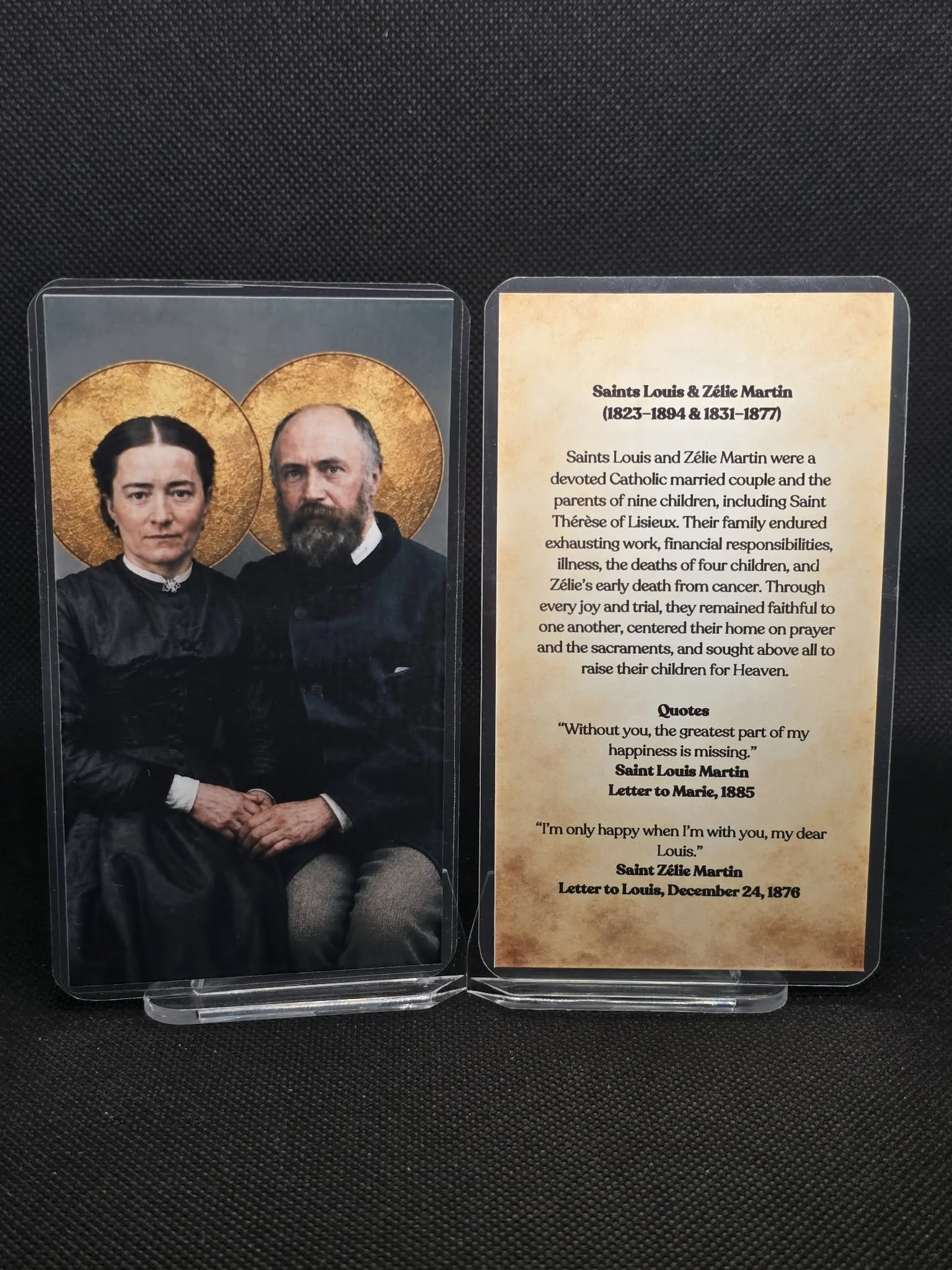
Saints Louis and Zélie Martin show that a home can become a place of holiness through work, patience and trust in God. Ask their prayers for your marriage, your children and every family that is carrying a heavy burden. Their prayer card below can help you keep them in mind each day.
View Prayer Card