Saints Basil the Elder and Emmelia of Caesarea: The Parents of Basil the Great and the Cappadocian Saints
The Christian rhetorician and the widow who raised saints and joined an ascetic community in fourth century Pontus
At a Glance
- Born
- Unknown for both, probably late third or early fourth century (UNCERTAIN)
- Died
- Basil the Elder about 340 to 345; Emmelia about 370 to 375 (both UNCERTAIN)
- Titles
- Righteous parents and parents of the Cappadocian saints
- Feast
- May 30 in Greek Orthodox usage; Emmelia also January 1 in the Orthodox Church in America calendar
- Veneration
- Eastern Orthodox commemoration; no formal canonization date; Eastern Catholic calendars not verified
- Patronage
- Christian parents and family life by devotion; no formal patronage defined
- Who Were Basil the Elder and Emmelia?
- Basil the Elder, Rhetorician of Pontus
- Emmelia, Daughter of a Martyr
- A Large Family
- Roots in Persecution
- Widowhood and Household
- Annesi and the Ascetic Community
- Death and Burial of Emmelia
- Commemoration and Tradition
- Why They Matter to Eastern Christian Readers
- Frequently Asked Questions
Who Were Basil the Elder and Emmelia?
Basil the Elder and Emmelia were a married Christian couple of fourth century Asia Minor. They are remembered as the parents of Saint Basil the Great, Saint Gregory of Nyssa, Saint Macrina the Younger, Saint Peter of Sebaste and Naucratius. Few families in Christian history produced so many figures who shaped theology and monastic life.
The main source for the family is the Life of Macrina by Gregory of Nyssa, written by a son who knew the household from inside. Other evidence comes from letters of Basil the Great and from the funeral oration for Basil by Gregory of Nazianzus. These are not neutral records, since they are works of praise, but they are early and close to the events.
Neither parent has a documented canonization ceremony. Their veneration comes from the older pattern in which the Church remembered righteous Christians through liturgical commemoration. This article separates what the sources support from what later tradition has added.
Basil the Elder, Rhetorician of Pontus
Basil the Elder belonged to an educated Christian family of Pontus and Cappadocia. He is remembered as a rhetorician, a teacher of public speaking, a skill that prepared students for law, administration and public life. Later accounts also call him a lawyer, but that detail is less securely documented than his work as a rhetorician.
His mother was Macrina the Elder. In Letter 204, Basil the Great says that his grandmother Macrina taught him the teaching handed down from Saint Gregory Thaumaturgus, the third century bishop of Neocaesarea. This is valuable evidence that the family carried Christian teaching across generations. Whether Macrina personally studied under Gregory, as later accounts suggest, is UNCERTAIN.
We do not know his birth year. He died while his children were still young, around the time his youngest son Peter was born, but the exact date is also UNCERTAIN. Some writers give about 345, while modern reconstructions sometimes suggest about 340 or 341. No reliable account describes his last illness.
Emmelia, Daughter of a Martyr
Emmelia came from a Christian family of some standing. Orthodox biographical tradition calls her the daughter of a martyr who died in the last great persecutions of the Roman Empire. His name, his place of death and the circumstances of his martyrdom are not securely known, so they are UNCERTAIN, and it is safer not to supply a detailed story.
Gregory of Nyssa describes his mother as devout and practical. She managed a large household with property in more than one region, which meant real administrative work. She is not shown as a distant pious figure. She is shown as a woman who carried heavy responsibilities and still gave her children a Christian formation.
The date of her birth is unknown. Her marriage to Basil the Elder joined two families that both carried memories of persecution and a serious commitment to education. From that marriage came a household that would shape the Church of the fourth century.
A Large Family
Gregory of Nyssa says the couple had ten children, five sons and five daughters. Not all of them are well documented. The best known are Macrina the Younger, Basil the Great, Naucratius, Gregory of Nyssa and Peter of Sebaste. Some of the others are known only by passing remarks, and a few appear not to have reached adulthood.
Theosebia is sometimes named as another daughter and counted among the family's saints. Her exact relationship to Gregory of Nyssa is disputed, so she should not be presented without qualification as a daughter of this couple. Statements that all ten children were formally glorified as saints also go beyond the evidence.
What is well documented is the influence of the family. Basil became bishop of Caesarea and a defender of the Nicene faith. Gregory became bishop of Nyssa and a major theologian. Macrina led a community of women. Peter became bishop of Sebaste. Naucratius chose a life of solitude and died young. Together they form one of the most remarkable families in Christian history.
Roots in Persecution
Gregory of Nazianzus says that Basil the Great's paternal ancestors suffered under the emperor Maximinus. This refers to Maximinus Daia, who shared in the last great persecution of the early fourth century, not to the earlier emperor Maximinus Thrax. According to Gregory, those ancestors fled into the wooded mountains of Pontus and lived there for about seven years.
This point is often misunderstood. The forest exile belongs to Basil the Great's grandparents' generation, not to Basil the Elder and Emmelia as a married couple. Later summaries sometimes move the story to the wrong generation, and the better reading is that the persecution shaped the family before the marriage.
The length of the exile is Gregory's own report in a funeral oration, and it has not been verified from another source, so it should be treated as UNCERTAIN. Gregory also says the refugees were fed in a remarkable way by game, which is a TRADITION with an early literary witness but no independent confirmation.
Widowhood and Household
When Basil the Elder died, Emmelia was left with many children and property spread across several places. Gregory of Nyssa says that Peter, the youngest, was born around that time. Emmelia had to raise a large family and manage an estate, all as a widow.
Her eldest daughter Macrina became her closest helper. According to Gregory, Emmelia taught Macrina from the Scriptures, especially the Psalms, rather than from the literary and theatrical texts common in elite schooling. Macrina also refused a second betrothal after the young man chosen for her died, and she stayed with her mother in a life of prayer.
The family also faced bereavement. Gregory describes the sudden death of Naucratius, which deeply affected Emmelia. Macrina helped her mother bear that loss in Christian hope and to hold her worldly attachments more lightly. Their religious vocation grew through grief and duty, not through an easy life.
Annesi and the Ascetic Community
After her children had grown, Emmelia accepted Macrina's invitation to a more ascetic way of life. The family estate at Annesi, near the Iris River in Pontus, became a center of prayer. Gregory describes it as a community where women of different social ranks, including former servants, lived as equals.
Gregory says that shared prayer, shared meals and simple living replaced earlier distinctions between the mistress and those who had served the household. This account is important evidence for early women's monastic life in Pontus. It also shows that Emmelia did not merely produce saints. She changed her own life to follow the same path.
Care must be taken not to overstate her role. The monastic rules later linked to Basil the Great were not written by Emmelia, and no theological work survives under her name. The community also helped the hungry during a famine, according to Gregory, though the date of the famine is UNCERTAIN.
Death and Burial of Emmelia
Gregory of Nyssa gives a personal account of his mother's death. She died with Macrina, her eldest child, and Peter, her youngest, at her side. She blessed them and remembered her absent children in prayer, in language drawn from the Bible's idea of firstfruits and the tithe.
Her death is often placed around 370 to 375, but the year cannot be fixed from Gregory's account, so it is UNCERTAIN. Gregory also says she asked to be buried in her husband's grave. This supports the idea of a shared burial, though the place and later history of the tomb are not securely known.
No authenticated shrine of relics of Basil the Elder and Emmelia has been established. Their burial should not be confused with the better documented relics and commemorations of their children, and claims that their remains were moved to a particular church need independent proof.
Commemoration and Tradition
Their commemoration in Eastern Orthodox calendars is firmly attested. May 30 is associated with them in Greek Orthodox usage, along with Macrina the Elder. The Orthodox Church in America lists Emmelia on January 1, and some Russian derived calendars list her on January 3. These dates should not be merged into one universal Byzantine date.
One TRADITION concerns Macrina's name. Gregory of Nyssa says that a vision told Emmelia to call her daughter Thecla, after the early Christian ascetic Saint Thecla. Because Gregory was a family member, the account is early, but its supernatural element cannot be independently confirmed.
The sources do not present the couple as wonderworkers. Their reputation rests on Christian perseverance, family life, charity and the formation of saints. That is a quieter kind of sanctity, but it is well supported by evidence and it is the main reason they are remembered.
Holy Basil and Emmelia, you passed on the faith through teaching, patience and hard work. Pray for mothers and fathers who are raising children in difficult times. Pray for widows and widowers who carry a family alone. Pray for those who have lost a child. Help us to teach the Scriptures at home, to give to the poor and to treat every person in our household with dignity. May our families become places where Christ is known. Amen.
This prayer is an original composition for devotion. It is not an official liturgical text and was not written by the saints.
Why They Matter to Eastern Christian Readers
Basil the Elder and Emmelia belong to the shared Christian inheritance from before the later divisions between East and West. Their sons Basil and Gregory helped shape the language of the Trinity used in the Nicene Creed, and the household at Annesi belongs to the early story of Eastern monasticism.
For Eastern Orthodox readers their commemoration is found in the calendar. For Eastern Catholics the family is historically important through the shared Cappadocian Fathers, but a separate feast for both parents has not been verified in each Eastern Catholic calendar, so that point is UNCERTAIN.
Their story also shows that marriage and monastic life were not rivals in this family. Marriage and parenthood came first, and the ascetic vocations of several children grew out of that home. The parents' example gives families a reminder that faith is handed down in daily life, over many years.
Frequently Asked Questions
Ask Their Prayers
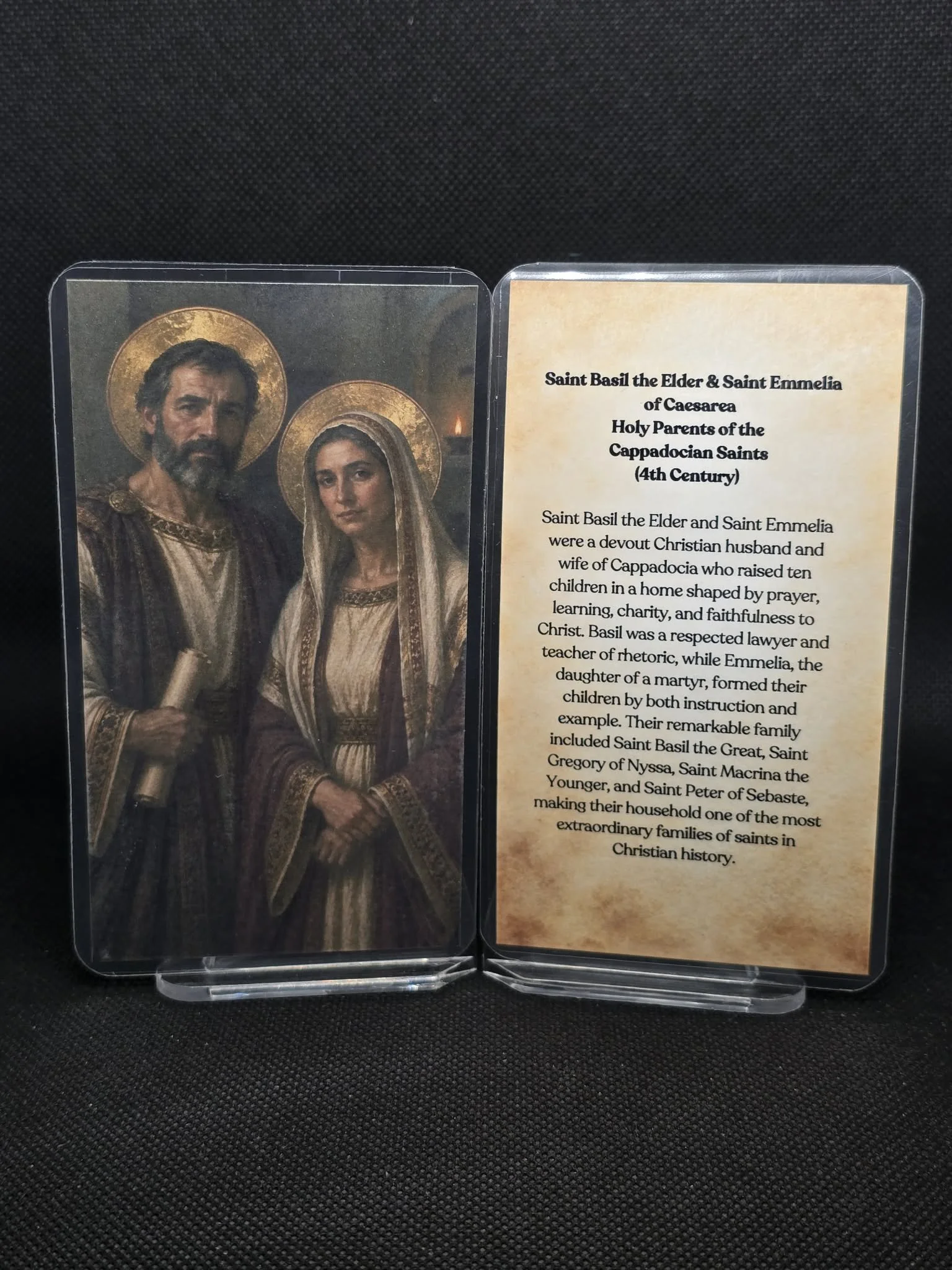
Saints Basil the Elder and Emmelia teach that faith is passed on in a household through years of teaching, work and sacrifice. Ask their prayers for parents, for widows and for every family trying to raise children in the faith. Their prayer card below can help you remember them each day.
View Prayer Card