Saints Gregory the Elder and Nonna of Nazianzus: The Bishop and the Wife Who Prayed for His Conversion
The Cappadocian couple who raised Saint Gregory the Theologian, Saint Gorgonia and Saint Caesarius
At a Glance
- Born
- Gregory the Elder about 275 (UNCERTAIN); Nonna in the late third or early fourth century (UNCERTAIN)
- Died
- Both in 374 according to tradition; exact dates UNCERTAIN
- Titles
- Gregory the Elder, Bishop of Nazianzus and Confessor; Nonna, Righteous Mother of Saint Gregory the Theologian
- Feast
- Gregory the Elder January 1; Nonna August 5 (Byzantine calendars)
- Veneration
- Eastern Orthodox commemoration and older Catholic hagiography; no formal canonization date
- Patronage
- Christian mothers and families by devotion; no formal patronage defined
- Who Were Gregory the Elder and Nonna?
- Gregory the Elder, Landowner of Cappadocia
- Nonna and Her Family
- The Conversion of Gregory the Elder
- Bishop of Nazianzus
- The Church He Built
- The Homoian Formula and the Division
- Their Children
- Death and Commemoration
- Why They Matter to Eastern Christian Readers
- Frequently Asked Questions
Who Were Gregory the Elder and Nonna?
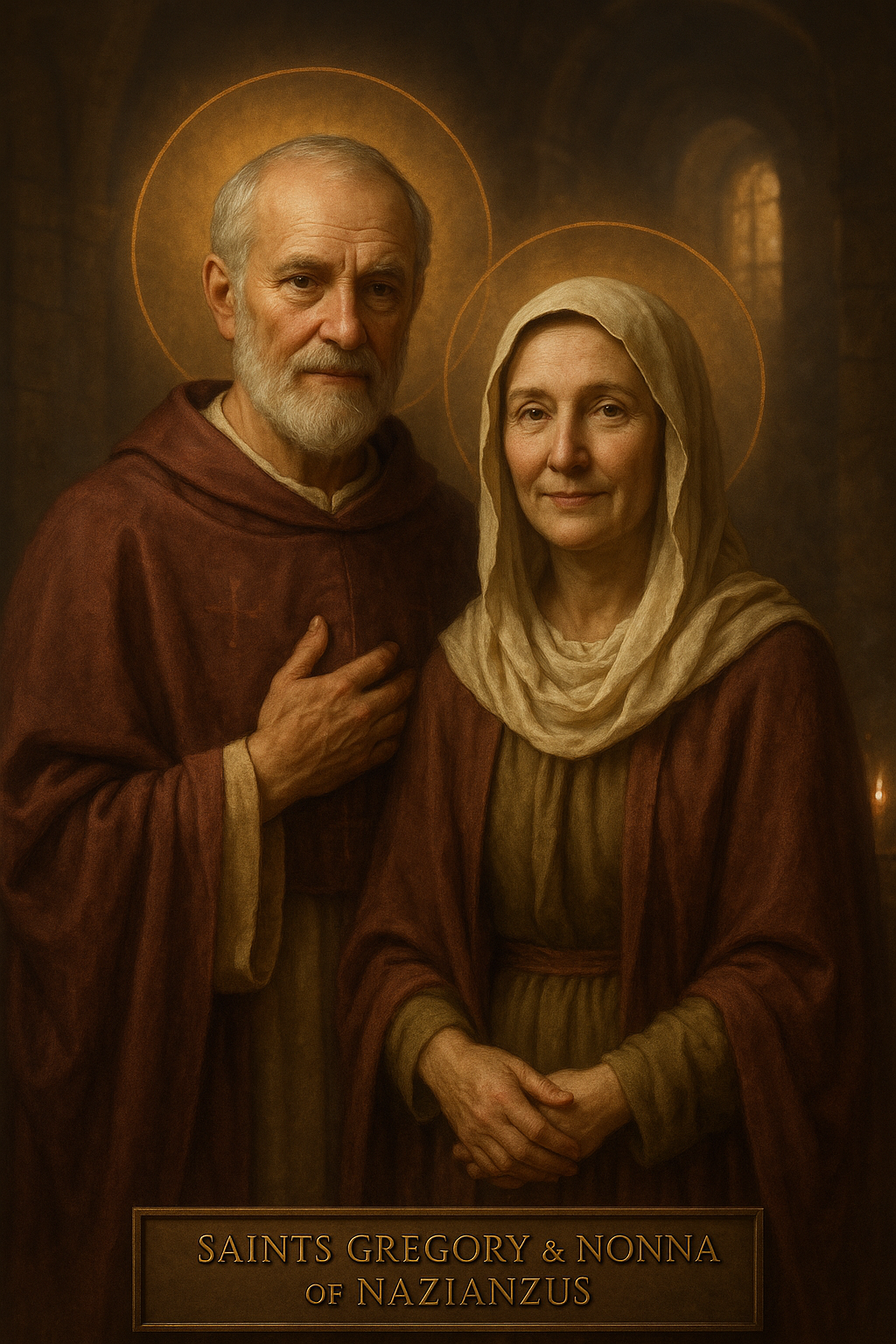
Gregory the Elder and Nonna were a married couple of fourth century Cappadocia, in what is now Turkey. Their family lived at Arianzus, near the town of Nazianzus. They are remembered as the parents of Saint Gregory the Theologian, Saint Gorgonia and Saint Caesarius. Gregory the Elder became bishop of Nazianzus, and Nonna is remembered for her prayer and charity.
Almost everything we know about them comes from their son, Gregory the Theologian. He gave a funeral oration for his father in 374, known as Oration 18, and he spoke about his sister Gorgonia and his mother elsewhere. These are early and personal sources, but they are also works of praise, so careful readers separate the plain facts from the devotional coloring.
Neither saint has a documented canonization ceremony. Their veneration is part of the older practice in which the Church remembered holy Christians through its calendars. In Byzantine usage, Gregory the Elder is commemorated on January 1 and Nonna on August 5.
Gregory the Elder, Landowner of Cappadocia
Gregory the Elder belonged to the landowning class of Cappadocia. His son describes a man of property and local standing, with real administrative duties and a reputation for generosity. He was not born into the Christian Church. Before his conversion he belonged to a religious group called the Hypsistarians.
The Hypsistarians, whose name means worshippers of the Most High, are described in Oration 18 as rejecting idols and animal sacrifice while honoring fire and light and keeping some practices like the Jewish Sabbath and dietary rules. How organized the group was and what exactly it taught is UNCERTAIN, so calling Gregory simply a pagan would be inaccurate.
His birth year is also uncertain. Because his son says he lived for nearly a century, historians place his birth around 275, but this is an estimate. We can say with confidence that he was an older man by the time he led the church at Nazianzus and that his age made him a striking figure in the region.
Nonna and Her Family
Nonna came from a Christian family. Later tradition, preserved by the Orthodox Church in America, names her parents as Philotatos and Gorgonia and says she was related to Saint Amphilochius of Iconium. These details come from later biographical tradition and are not as firmly established as the descriptions of her character by her son.
Gregory the Theologian portrays his mother as a woman of prayer, disciplined worship and generosity to the poor. She was also a careful manager of the household. In his view, her marriage to a man outside the Church made the conversion of her husband a matter of deep concern, and he says she worked for it through prayer and example rather than force.
The date of their marriage is UNCERTAIN. We know that they had three children who are remembered as saints: Gorgonia, Caesarius and Gregory the Theologian. The order of their births cannot be reconstructed with full certainty, though Gregory is generally thought to have been born around 329 or 330.
The Conversion of Gregory the Elder
In Oration 18, Gregory the Theologian says that his father's conversion came through his mother's prayers and also through his father's own response. The funeral oration places the conversion around the time of the Council of Nicaea in 325. The bishops traveling to the council are said to have met Gregory while he was preparing for baptism.
It is important not to push this further than the source does. Gregory the Elder is sometimes described as a participant in Nicaea or even a signer of its creed. His son does not say that. The oration places him among those being instructed in the faith while bishops traveled to the council. A claim that he signed the Nicene Creed in 325 is not supported and should be treated as UNCERTAIN.
The conversion story contains elements that belong to TRADITION, because they are reports of private experiences. One is a dream in which Gregory sang the opening words of Psalm 122, about going to the house of the Lord, which Nonna understood as a sign. Another is a report of a light seen at his baptism. These accounts come from his son and cannot be independently confirmed.
Bishop of Nazianzus
Gregory the Elder later became bishop of Nazianzus. His episcopate is usually dated from about 328 or 329 until his death in 374, a total of roughly forty five years, according to his son. The starting year is UNCERTAIN, and the long length of the ministry should be understood as an approximate figure from a funeral speech.
His son tells a story from the period of his catechumen rites, in which words usually used for ordination were said over him. Those present took it as a sign of his later priesthood. This is part of the family's tradition, and it is best read as how his son remembered and explained his father's calling.
As bishop he led a church through a time of political and doctrinal conflict. He cared for the poor, helped settle disputes and remained active in church affairs even in old age. His son also says that he took part in the consecration of Saint Basil the Great as bishop of Caesarea, traditionally dated to 370.
The Church He Built
One concrete achievement of Gregory the Elder was the construction of a new church in Nazianzus. His son describes an eight sided building with columns, porches, stonework and elaborate decoration. According to the oration, Gregory paid for most of it himself, while the congregation contributed relatively little.
This account is useful to historians because it shows how a wealthy convert could shape the buildings of a Christian community in fourth century Cappadocia. It also shows that his generosity was not limited to words. He used his own property for the benefit of the church.
Scholars have not firmly identified the building with surviving ruins, so the site should not be presented as located. Nonna also gave to the poor and to the church, and her son describes her devotion as part of the same household life. Their holiness was displayed through work and giving as much as through teaching.
The Homoian Formula and the Division
The best known controversy of his episcopate came around 360 to 361. Under Emperor Constantius II, a theological formula was promoted that avoided the key Nicene terminology and described the Son in looser terms. Modern scholars usually call this position Homoian. Gregory the Elder agreed to the formula, apparently without seeing all of its doctrinal consequences.
Many of the more ascetic Christians in his city protested and separated from his communion. His son Gregory played a role in restoring unity. In Oration 18 he presents his father as having been misled by ambiguous language rather than deliberately abandoning the Nicene faith. Whether the old bishop understood the issue clearly is UNCERTAIN, and later explanations may also have been meant to protect his reputation.
The fair account avoids two errors. He should not be called simply an Arian bishop, and the subscription should not be hidden. The evidence points to an elderly bishop who accepted a disputed formula, provoked resistance and then took part in a reconciliation. His story is a reminder that even saints lived through real confusion and correction.
Their Children
Gorgonia is remembered as a devout wife and mother, known for charity and for her care of her family. She died before her father, probably in the early 370s, but the exact year is UNCERTAIN. Her brother wrote an oration in her honor, which is one of the main sources for the household's religious life.
Caesarius became an educated physician and served in the imperial environment. He survived an earthquake at Nicaea in 368 and died around 368 or 369. The family lost him at a time when its older members were already in old age, and his death was a real grief for Nonna.
Gregory the Theologian was ordained a priest by his father around 361 or 362, even though he preferred a contemplative life. He withdrew for a time, then returned to help his father. He later became bishop of Constantinople and one of the central defenders of the Nicene faith, and the family is commemorated together in Orthodox calendars.
Death and Commemoration
Gregory the Elder died in 374. His son says he had lived almost a century, and that he remained active in worship until the end. The exact date is UNCERTAIN. January 1 is his traditional commemoration, but that is a liturgical date and should not automatically be treated as the day of his death.
Nonna outlived him, and the funeral oration shows that she was present when it was delivered. Orthodox tradition records that she died on August 5, 374, while praying in church. The funeral oration proves only that she survived her husband, so the exact date and circumstances are UNCERTAIN. A funerary epigram by her son, preserved in the Greek Anthology, remembers her as the wife of Gregory and the mother of devout children.
No reliable evidence of their burial sites or of identifiable relics has been established, and claims about relics should not be repeated without documentation. Some later accounts call Nonna a deaconess, but her formal appointment to that ministry is not secure. It is safer to describe her as a devout laywoman.
Holy Gregory and Nonna, you served God as husband and wife, as parents and as members of the Church. Pray for spouses who are divided in faith, that love and patience may lead them to peace. Pray for parents who are praying for the conversion of a loved one. Pray for pastors who guide God's people through confusion, and for families who grieve their children. Teach us to give generously, to listen humbly and to correct our mistakes. Amen.
This prayer is an original composition for devotion. It is not an official liturgical text and was not written by the saints.
Why They Matter to Eastern Christian Readers
Gregory the Elder and Nonna belong to the household that formed one of the great theologians of the East. Their son's later defense of Nicene Trinitarian faith grew in a home shaped by prayer, charity and the struggles of the Church. Their story shows how a Christian family can pass on faith over many years.
Nonna is an early example of holiness within marriage, and her story shows the role a wife and mother can have in the conversion of a husband. Gregory the Elder shows the life of a mature convert who became a bishop and also lived through real mistakes and reconciliation. Both saints are preserved in Orthodox calendars on January 1 and August 5.
Eastern Catholics share the same Cappadocian heritage, but a separate feast for Gregory the Elder and Nonna has not been verified across the Eastern Catholic Churches, so that point is UNCERTAIN. Calendars differ by Church. What can be said is that the couple belong to the shared patristic inheritance of East and West.
Frequently Asked Questions
Ask Their Prayers
Saints Gregory the Elder and Nonna remind us that holiness can begin in a home and can be handed on through patient prayer. Ask their prayers for spouses, for parents, for pastors and for anyone praying for a loved one to come to faith. Their prayer card below can help you keep them in mind each day.
View Prayer Card