Saint Pachomius the Great: Egyptian Monk and Father of Communal Monasticism
A former Roman conscript of Upper Egypt who became a disciple of the hermit Palamon and then organized the Koinonia, a federation of monasteries living in common.
At a Glance
- Also known as
- Pachomios, Pakhom; Father of cenobitic (communal) monasticism
- Lived
- Born about 292 in Upper Egypt (UNCERTAIN); died probably May 9, 346, though 348 is the traditional date
- Region
- The Thebaid in Upper Egypt: Sheneset, Tabennisi and Pbow
- Feast day
- May 15 in Byzantine Orthodox and Byzantine Catholic calendars; May 9 in the Roman Martyrology; the fourteenth of Bashans in the Coptic calendar
- Recognition
- Venerated since antiquity; no formal canonization date
- Known for
- Organizing the Koinonia, a federation of monasteries with shared work, prayer and property
Who Was Saint Pachomius the Great?
Saint Pachomius was an Egyptian Christian who lived in the fourth century and gave monks a way to live together. Before him, many ascetics lived as hermits, with Saint Anthony the Great as the best known example. Pachomius is called the father of cenobitic monasticism, from the Greek word for a common life.
It is better to call him a principal pioneer than the absolute inventor of communal monasticism. Groups of ascetics already existed, and Pachomius inherited a tradition from his own teacher. What he added was organization, a federation of monasteries that shared work, prayer, property and leadership.
Our knowledge comes mostly from early Lives written by his own monastic family, and these must be read with the usual care. Where the sources are uncertain, this article says so.
Early Life in Upper Egypt
Pachomius was born about 292 in Upper Egypt, probably in the region called the Thebaid, into a family that was not Christian. His exact birthplace, his parents' names and the family's means are UNCERTAIN.
TRADITION: the Coptic Synaxarium says that his parents tried to bring him to the worship of pagan gods and that he refused, and the Orthodox Church in America describes a good secular education. Neither claim is independently confirmed.
The early Lives name an elder brother, John, who later joined him, and a sister, traditionally called Maria, linked with the first community of women. Pachomius came from a Coptic speaking village world, and many scholars think that this background helped to shape the practical, communal character of his monasteries.
Conscription and Conversion
Pachomius was conscripted into the Roman army, traditionally about 312, though the exact year and campaign are UNCERTAIN. The early Lives say that he and other recruits were held under guard during a movement of troops through Egypt, and that local Christians came with food and help without asking for payment.
He asked who these people were and learned that they acted out of Christian charity. According to the Lives he resolved then to serve others, and after his release he took up the Christian life. The broad story is consistent across the sources, but military records cannot confirm the details.
He settled at Sheneset, also called Chenoboskion, where he was baptized and spent about three years in prayer, fasting and service to the people of the villages. The length of that period is a reconstruction from the monastic biographies.
Disciple of Palamon
Pachomius then became a disciple of the hermit Palamon, who taught him the older Egyptian habits of fasting, vigil, prayer, work with the hands and renunciation of possessions. The relationship matters because it shows that Pachomius did not invent monastic life from nothing.
TRADITION: the Lives say that while praying near the abandoned village of Tabennisi on the Nile, Pachomius heard a divine command to stay and found a monastery there. Palamon is said to have approved and to have helped him build a dwelling. The vision belongs to hagiography, but the founding of a community at Tabennisi is historically supported.
The foundation is usually placed about 318 to 320. This chronology is uncertain, and the earliest Lives may point to a somewhat later development of organized communal life.
The Koinonia
His first attempt at common life was not a success. According to early Sahidic traditions, some of the men who gathered around him resisted the discipline he tried to introduce, and the first effort failed. The story is a useful reminder that he did not receive a finished system and apply it at once.
The community gradually took shape around mutual responsibility. Monks prayed together, worked at assigned tasks, shared goods and obeyed their superiors. The federation became known as the Koinonia, meaning fellowship, and its inspiration was the common life of the first Christians described in Acts.
Tabennisi became too small, and Pbow grew into the administrative center. Before his death the federation is reported to have included about nine monasteries for men and two for women, and estimates of its size range from about 5,000 monks to 7,000. These numbers are estimates and not counts.
Work, Prayer and Women's Communities
Each monastery had its own leaders, and the federation had a central superior and officers. Monks lived in small groups with assigned duties, including farming, cooking, nursing the sick, hospitality and crafts. They met for common prayer and instruction, and learning Scripture by heart was central, so that monks could recite it as they worked.
Communities for women also belonged to the Koinonia. TRADITION: the story says that Pachomius's sister Maria came to join him and that he spoke to her through a messenger rather than in person, and that a separate community grew under her leadership. The details are hagiographical, but the early existence of women's houses is supported by the early Lives and by Palladius.
The shape of the day, with labor, prayer and shared responsibility, became a pattern for later monastic life in both East and West.
The Rule and His Writings
Pachomius set down practical regulations about obedience, work, possessions, meals, worship and the correction of faults. The Rule that survives is not a single document written by him at one time. In 404 Jerome translated into Latin a collection that had grown within the federation, containing material from Pachomius and from his successors.
UNCERTAIN: scholars cannot reliably say which regulations are his own and which were added or changed after his death. A collection of eleven letters under his name survives in the Latin tradition, with Greek and Coptic discoveries helping to study its history. Some letters use unusual symbolic readings of the letters of the alphabet.
A long instruction that contains material from Athanasius may be a later composition within the community. The texts are valuable witnesses to early Egyptian monasticism even where authorship is uncertain.
Trials and Succession
The sources show a demanding spiritual father who was also attentive to human weakness. They describe tension with his brother John over expanding their dwelling, since John preferred a quieter life while Pachomius expected more disciples. The dialogue cannot be taken as a transcript, but it shows a real conflict of monastic ideals.
Later difficulties included disagreements among the leaders, and the Lives describe a temporary loss of favor for Theodore and problems over the succession. These show how hard it was to turn one man's spiritual authority into an institution that could last.
Tradition also connects Pachomius with Saint Athanasius of Alexandria, and the Lives show respect for the bishops and reluctance to accept clerical office. There is no reliable evidence that he founded a separate church or taught heresy. His work was monastic and not a rival hierarchy.
Death, Relics and Traditions
Pachomius died during an epidemic that struck the federation, after caring for sick monks and falling ill himself. The date is a real scholarly question. Many Church sources, including Coptic and Roman Catholic ones, give 348, but a careful modern argument, using the First Greek Life, the Letter of Ammon and the movements of Athanasius, supports May 9, 346. Both dates are cited in this article.
He named Petronius as successor, but Petronius died soon afterward, and Horsiesius then led the community, with Theodore playing a large part in restoring it. TRADITION: the Great Coptic Life says that Pachomius told Theodore to hide or move his body so that it would not become the object of an excessive cult of relics.
The location of his tomb and remains is UNCERTAIN. Archaeologists have found parts of the Pachomian complex at Pbow, including early church structures, but no authenticated tomb or relics of Pachomius himself.
TRADITION: Palladius, in the Lausiac History, tells how an angel gave Pachomius a bronze tablet containing the rule of monastic life. The story does not match the actual Pachomian regulations that came down through Jerome, so it cannot show the historical origin of the Rule.
TRADITION: other stories tell of grain that arrived after prayer in time of shortage, of healings, of spiritual insight and of visions of the trials of future monks. The crocodile that carries him across the Nile belongs to a later Greek tradition, and no reliable evidence shows that it happened.
Devotion to him is centered on humility, charity, obedience and shared responsibility, and his feast is kept on May 15 in the Byzantine tradition, May 9 in the Roman Martyrology and on the fourteenth of Bashans in the Coptic calendar. These are different calendars for one saint.
Holy Father Pachomius, you were helped by strangers in your need and then built a house where no one lived for himself alone. Pray for monks and nuns, for those who serve the poor, and for families and parishes that try to live in common. Ask the Lord to give us humility, patience with one another and a love that shares what it has.
This prayer was written for this page and is not an official liturgical text. The Byzantine troparion ends with the invocation to our venerable father Pachomius to pray to Christ our God to save our souls.
Pachomius in the Eastern Churches
Pachomius belongs to the Christian heritage that existed before the later divisions between East and West. Byzantine Orthodox and Byzantine Catholic Christians keep his memory on May 15, and the Coptic Orthodox Church honors him as a father of organized communal monastic life in Egypt.
The Greek Orthodox Archdiocese of America places him with the cenobitic tradition, in contrast to the hermit life of Saint Anthony. His ideas also reached Basil and later monastic writers, partly through Jerome's Latin translation, and so they shaped monasteries far from Egypt.
For modern readers, the most secure inheritance is not a single miracle. It is the idea that prayer, labor, obedience and charity shared in common can form a complete Christian life.
Frequently Asked Questions
Saint Pachomius in Brief
Saint Pachomius was a soldier who was helped by strangers and spent his life making a home for others. The shape of the Koinonia is well supported, the exact dates and numbers are uncertain, and the angel, the crocodile and the visions belong to tradition. His real legacy is the common life that still shapes monasteries.
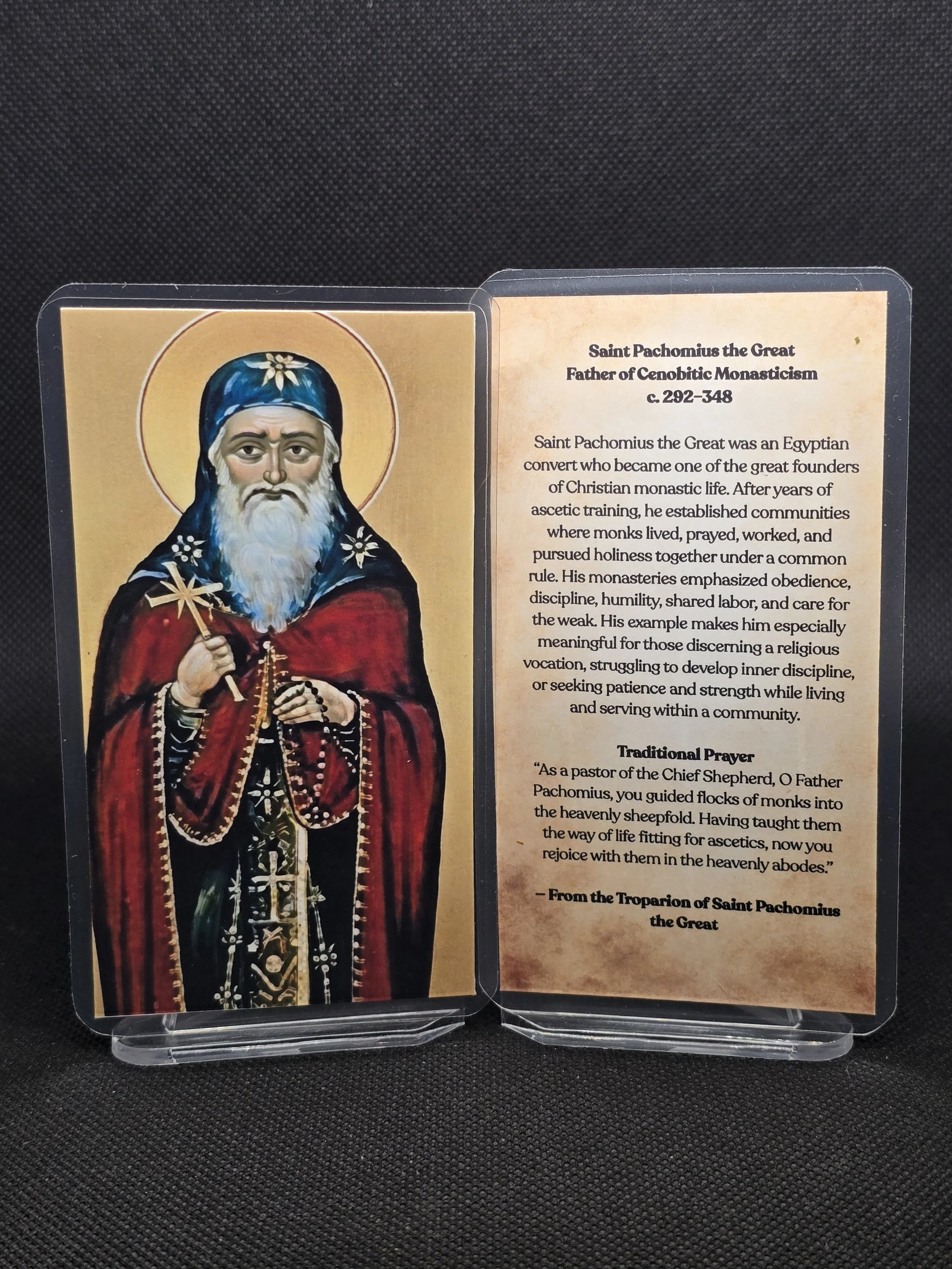
View Prayer Card