Saints Cyril and Methodius: Apostles to the Slavs and Co-Patrons of Europe
Two brothers from Thessalonica who carried the Gospel to Great Moravia, gave the Slavs their first alphabet and liturgical books, and are honored by both East and West.
At a Glance
- Also known as
- Cyril (Constantine the Philosopher) and Methodius; Equals to the Apostles; Apostles to the Slavs
- Lived
- Cyril about 826 to 828 until February 14, 869 in Rome; Methodius about 815 to 820 until April 6, 885 in Great Moravia
- Region
- Thessalonica, Constantinople, the Khazar lands, Great Moravia, Venice and Rome
- Feast day
- February 14 in the Roman calendar; May 11 in Orthodox and Byzantine calendars; July 5 in Czechia and Slovakia
- Recognition
- Venerated since antiquity; Leo XIII extended the feast to the whole Roman Church in 1880; named co-patrons of Europe on December 31, 1980
- Known for
- Creating the Glagolitic alphabet, translating Scripture and the liturgy into Slavonic, and defending Slavonic worship
- Who Were Saints Cyril and Methodius?
- Brothers from Thessalonica
- Scholar and Administrator
- The Khazar Mission
- The Mission to Great Moravia
- The Glagolitic Alphabet and the Slavonic Scriptures
- Opposition and the Journey to Rome
- Methodius After Cyril
- After the Brothers
- Cyril and Methodius in the Eastern Churches
- Frequently Asked Questions
Who Were Saints Cyril and Methodius?
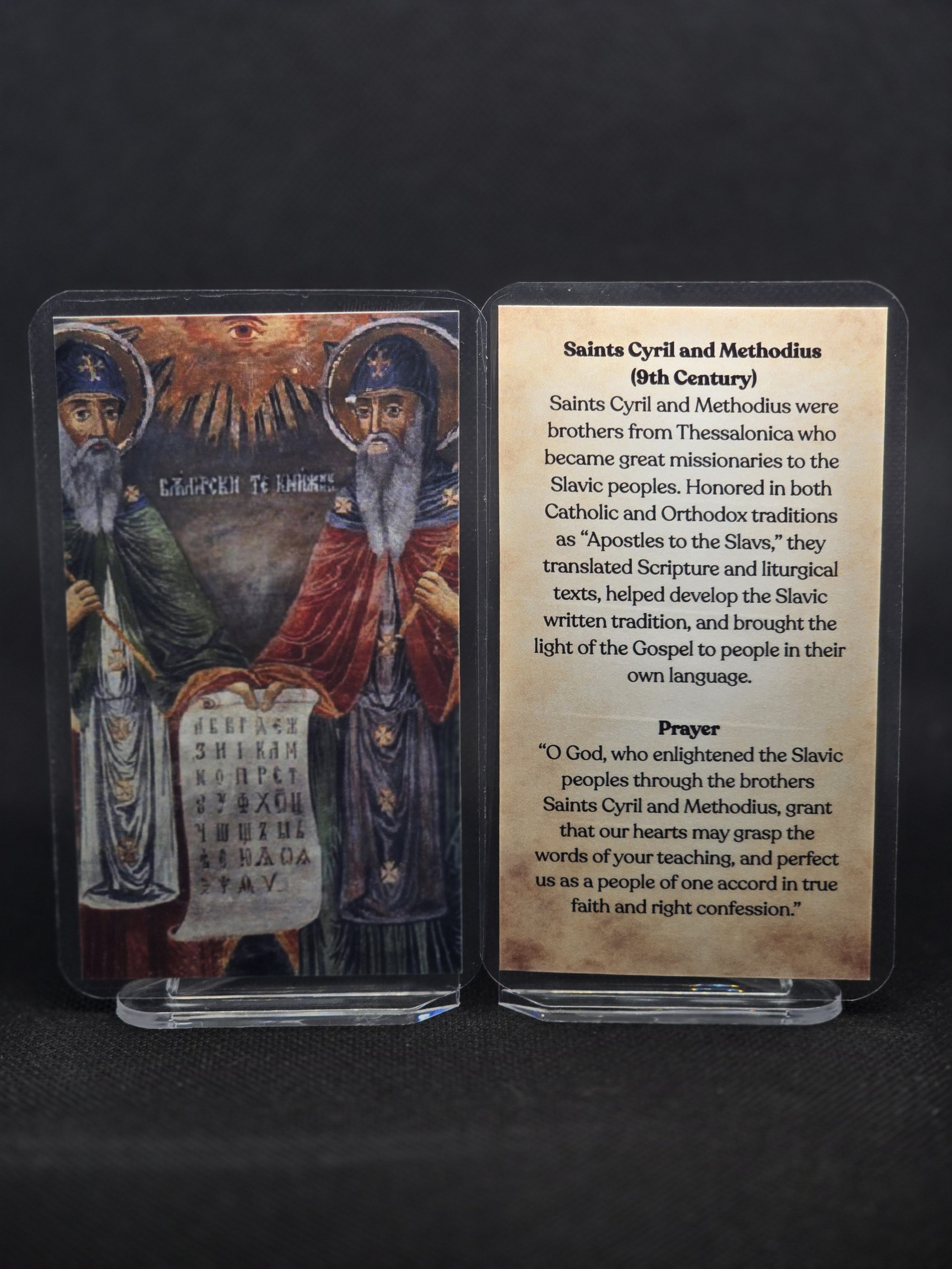
Saints Cyril and Methodius were brothers from the Byzantine city of Thessalonica who lived in the ninth century. They are called the Apostles to the Slavs, and Eastern Christians honor them as Equals to the Apostles. Their most lasting work was giving Slavic peoples a written language of their own for Scripture and worship.
Their lives are known mainly from two early biographies, the Life of Constantine and the Life of Methodius, together with papal letters and other documents. Constantine was the name Cyril used until he became a monk shortly before his death. The Lives are valuable, but they are also devotional writings, and a 2020 study has even questioned how early they were written. Details that rest only on them should be received with care.
Both Catholics and Orthodox keep their feasts, and both claim them with good reason, since the brothers lived before the final break between East and West.
Brothers from Thessalonica
Both were born in Thessalonica, a major city of the Byzantine Empire, into a Christian family. Their father Leo held a senior post in the imperial administration. Cyril was born about 826 to 828 and was the youngest of seven children according to Benedict XVI's summary, while Methodius was born around 815 to 820. These dates are approximate and UNCERTAIN.
Thessalonica was surrounded by Slavic speaking settlements, which probably helped the brothers learn the language that would shape their lives. Their ancestry is sometimes claimed for one nation or another, but the evidence supports only that they were Greek speaking Byzantines from a cultured family.
Cyril showed unusual ability and was sent to Constantinople, where he studied philosophy, theology, rhetoric and languages. Traditional accounts name the future patriarch Photius among his teachers, and he earned the title of Philosopher.
The family background explains much of what came later. A son of an official in a great imperial port learned the habits of administration, diplomacy and language, and both brothers would later use those habits in negotiations with princes, patriarchs and popes.
Scholar and Administrator
Neither brother had a dramatic conversion from paganism, since both grew up in a Christian society. Their development was a slow turn from successful secular careers toward monastic life and mission.
Cyril entered church service after his studies, and he is said to have served as a librarian at Hagia Sophia and taught philosophy. Methodius first had an administrative career, governing a Slavic region under Byzantine rule, though its exact location is UNCERTAIN. He later entered a monastery on the Bithynian Mount Olympus in present day Turkey, not the mountain in Greece.
Their gifts were different. Cyril was the scholar and debater, and Methodius had the experience of organizing and ruling, which later helped him to govern communities and a church province.
The Khazar Mission
About 861 Cyril took part in a mission to the Khazars, whose ruling class had adopted Judaism, and Methodius went with him. The Life of Constantine preserves accounts of debates with Jewish and Muslim representatives, but the exact words and circumstances are UNCERTAIN.
On the way, during a stay in the Crimea, Cyril is said to have found the remains of Pope Clement I near Cherson. TRADITION adds that later Orthodox accounts describe the relics being brought up from the sea after prayer, but the identity of the relics and the miraculous details cannot be verified.
The relics of Clement would later matter a great deal when the brothers reached Rome.
The Mission to Great Moravia
The decisive turn came when Prince Rastislav of Great Moravia asked the Byzantine emperor for teachers who could explain the faith in the language of his people. Emperor Michael III and Patriarch Photius chose the two brothers, who arrived about 863.
Christianity had already reached Moravia through missionaries from Frankish lands. The brothers did not bring a first knowledge of the faith, but a deeper and native language form of it. For Rastislav there was also a political aim, since clergy who used Slavonic would be less dependent on the Frankish bishops.
The mission therefore stood at the meeting point of two empires and two ways of Christian life, and its story cannot be separated from that politics.
The brothers did more than translate words. They had to invent ways to express abstract Christian ideas in a language that had never been written, and the vocabulary they shaped was used by Slavic Christians for many centuries after them.
The Glagolitic Alphabet and the Slavonic Scriptures
Cyril devised the Glagolitic alphabet to write the sounds of Slavic speech, and it was in use in connection with the Moravian mission from about 863. Scholars debate when it was invented. Cyril did not demonstrably invent the Cyrillic alphabet, which developed later, probably in the Bulgarian literary world, and was named in his honor. Its exact inventor is UNCERTAIN.
With their helpers the brothers translated Gospel readings, the Psalter, apostolic readings and liturgical services into the language now called Old Church Slavonic. The Life of Methodius says that Methodius translated almost the whole Bible except the books of Maccabees, along with legal texts and writings of the Fathers, though the extent of his personal work cannot be checked.
Works connected with them include the poem called the Proglas, an introduction to the Slavonic Gospel, whose authorship is UNCERTAIN, and the Nomocanon, a collection of church and civil law adapted under Methodius. The Lives themselves were not written by the brothers.
This was a daring choice for its time. Many Christians believed that only a few sacred languages could carry the liturgy, and the brothers argued by deed that the Gospel belongs in every language.
Opposition and the Journey to Rome
Some Latin clergy objected to worship in Slavonic. The Life of Constantine describes a dispute in Venice with opponents who held that only Hebrew, Greek and Latin were fit for liturgy, and Cyril is said to have answered from Scripture and from the example of other peoples worshiping in their own languages. The conversation cannot be reconstructed word for word, but the conflict is credible.
About 867 to 868 the brothers went to Rome bringing the relics believed to be those of Clement. Pope Hadrian II received them and approved their Slavonic books, and tradition says the books were laid on the altar of Saint Mary Major and some of their disciples were ordained. The exact order of events varies in the accounts.
Cyril became seriously ill in Rome, took the monastic habit with the name Cyril and died on February 14, 869. He was buried in the Basilica of Saint Clement.
Methodius After Cyril
Methodius returned to Central Europe as archbishop. Frankish bishops challenged his authority, and around 870 he was arrested and imprisoned. Pope John VIII intervened and he was freed in 873. Later he faced opposition from Wiching, bishop of Nitra, and from the political resistance of Prince Svatopluk.
In 880 Pope John VIII issued the letter Industriae tuae, which confirmed Methodius and authorized worship in Slavonic under certain conditions. John Paul II records that Methodius also visited Constantinople about 881 or 882 and was received by the emperor and the patriarch.
He died on April 6, 885. The Life of Methodius says that he named his disciple Gorazd as successor and that his funeral was celebrated in Greek, Latin and Slavonic. His burial place is UNCERTAIN, and Velehrad is traditionally linked to him though the identification is historically problematic.
The cost to Methodius was real. He spent years in prison, in disputes over jurisdiction and under suspicion from rulers who wanted to control the Church, and he kept working through all of it until close to his death.
After the Brothers
After Methodius died, opposition to his followers grew. Many were expelled, imprisoned or sold into slavery, and others found refuge in Bulgaria, where Saints Clement and Naum of Ohrid carried on the Slavonic literary tradition. This is why the brothers' influence spread more through disciples and books than through their own travels.
Pope Leo XIII extended the feast to the whole Catholic Church in 1880 through the letter Grande Munus, and on December 31, 1980 Pope John Paul II named Cyril and Methodius co-patrons of Europe with Saint Benedict. Neither act was a first canonization, because their veneration was ancient.
Relics said to be of Saint Cyril are venerated in the Basilica of Saint Clement in Rome, and a fragment rediscovered in 1963 was placed there by Pope Paul VI. TRADITION also records that Cyril urged Methodius not to retreat to monastic solitude, an episode whose exact words cannot be verified.
Holy brothers Cyril and Methodius, you gave the Slavs letters so that they could hear the Gospel in their own tongue. Pray for translators and teachers, for those who suffer for the sake of their language and faith, and for the unity of the Churches of East and West. Ask the Lord to give us wisdom, patience in opposition and love for every people.
This prayer was written for this page and is not an official liturgical text. The Orthodox Church in America publishes the common troparion and kontakion for May 11, in which the brothers are called equals to the apostles and teachers of the Slavs.
Cyril and Methodius in the Eastern Churches
The brothers were formed in Byzantine Christianity, sent by Constantinople and received by Rome. That makes them a rare example of cooperation between the two centers before the long separation, and both Catholics and Orthodox can honor them without anachronism.
The Orthodox Church in America keeps their joint commemoration on May 11, with separate days of February 14 for Cyril and April 6 for Methodius. Some Julian calendar churches observe May 11 on May 24 of the civil calendar. In Bulgaria May 24 is also a national celebration of Slavic letters and culture.
For Byzantine Catholics and Orthodox who use Church Slavonic, their legacy is still sung in the Divine Liturgy. John Paul II's encyclical Slavorum Apostoli discusses this connection, and it is a good example of how a Church can honor legitimate differences of language and rite.
Frequently Asked Questions
Saints Cyril and Methodius in Brief
Cyril and Methodius were brothers who gave a people its alphabet and its liturgy, and who were honored by both Constantinople and Rome. The Lives that tell their story should be read with care, and the miracles are tradition. Their lasting gift is a Church that prays in the language of the people.
View Prayer Card