Saint Athanasius of Alexandria: Patriarch, Doctor of the Church and Defender of Nicaea
The fourth century bishop of Alexandria who defended the full divinity of Christ through five exiles and about forty five years as bishop.
At a Glance
- Also known as
- Athanasius the Great; Athanasius the Apostolic; Father of Orthodoxy
- Lived
- About 296 to 300 (UNCERTAIN) until May 2, 373, Alexandria, Egypt
- Office
- Bishop of Alexandria from 328 until 373, with five periods of exile
- Feast days
- May 2 (Roman Catholic and Byzantine Orthodox); January 18 with Saint Cyril (Byzantine); 7 Pashons, about May 15 (Coptic)
- Status
- Venerated in the ancient Church; no formal canonization date; Doctor of the Church
- Known for
- Defending the divinity of Christ at and after Nicaea; Life of Anthony; the earliest surviving list of the 27 New Testament books
- Who Was Saint Athanasius?
- Early Life and Family
- Deacon at Nicaea and Election as Bishop
- Bishop of Alexandria
- The Incarnation and the Heart of His Theology
- The Life of Anthony and the Festal Letters
- Five Exiles and the Controversies
- Death, Relics and Veneration
- Traditions and Legends
- Athanasius and the Eastern Churches
- Frequently Asked Questions
Who Was Saint Athanasius?
Saint Athanasius of Alexandria was bishop of Alexandria in Egypt from 328 until his death on May 2, 373. He is one of the most important figures of the fourth century and is honored as a Church Father by Catholic, Eastern Orthodox and Oriental Orthodox Christians. The Coptic Church calls him Athanasius the Apostolic, and the Orthodox tradition has long called him the Father of Orthodoxy.
His fame rests on one conviction that he defended for decades: that the Son of God is truly and eternally God, of the same divine being as the Father, and that the Word truly became man to save humanity. The council of Nicaea in 325 had stated this faith, and Athanasius became its most persistent defender, in writing, in synods and in his own person.
He paid for that defense. Over his long episcopate he was driven from Alexandria five times by emperors and by rival church parties, spending roughly seventeen years away from his see according to the usual count. Pope Benedict XVI described him in a general audience in 2007 as a man who suffered for the faith and who shaped both Eastern and Western Christianity. This article separates what the sources document from what later tradition added.
Early Life and Family
Athanasius was almost certainly born in Alexandria, one of the great intellectual and commercial cities of the Roman world, around the years 296 to 300. The exact year is UNCERTAIN, and scholars have proposed dates from about 293 to 300. His childhood fell in the years of the great persecution under Diocletian and his successors, although no reliable source tells us what he personally saw.
His parents are unknown to us. UNCERTAIN: later Greek biographies describe Christian parents, while the medieval Coptic History of the Patriarchs describes his mother as a wealthy pagan widow. These accounts disagree, so no firm statement about his family's religion or social rank is possible.
His own writings show a thorough education in Greek rhetoric, in the Scriptures and in philosophical argument. It is often said that he studied at the catechetical school of Alexandria, but that claim is not securely documented. What we can say is that he became a trusted young cleric in the household of Bishop Alexander and that his later works are those of a trained and careful writer.
TRADITION: the historian Rufinus, followed by Socrates Scholasticus, tells that Bishop Alexander once saw children on the seashore imitating baptism, and that the boy Athanasius, playing the bishop, performed the rite so seriously that Alexander took him in for his education. The story is old and beloved, but it was written down after his lifetime and cannot be verified.
Deacon at Nicaea and Election as Bishop
Athanasius first appears in the record as a deacon of Alexandria, serving Bishop Alexander during the controversy with the priest Arius. Arius taught that the Son, though the highest of God's creatures, was not eternally God in the same sense as the Father. The dispute divided the Egyptian church and soon the whole Roman Empire.
In 325 the emperor Constantine called the first ecumenical council at Nicaea. Athanasius went there as a deacon in the company of Bishop Alexander. He was young and not a bishop, and he did not preside or single handedly defeat Arius, as later retellings sometimes suggest. The council taught that the Son is begotten, not made, and of one substance with the Father.
Alexander died on April 27, 328, and Athanasius was chosen to succeed him, being consecrated in June of that year according to the usual chronology. His opponents later claimed that he was too young and that the election was irregular. These charges survive only from hostile voices, so they cannot be taken as proven, but they show that his authority was contested from the first day.
Bishop of Alexandria
As bishop of Alexandria, Athanasius led the churches of Egypt and the neighboring provinces. His letters show a pastor who cared for bishops, monks, consecrated virgins and ordinary families. He kept close ties with the Egyptian monks, including the communities that followed Saint Pachomius, and he made use of the monastic movement as a source of support for the Nicene cause.
He also consecrated Frumentius as the first bishop of Aksum, in the region of modern Ethiopia and Eritrea. This began a long link between the Alexandrian church and the Ethiopian church. Athanasius did not himself found Christianity there, and some details of the story remain uncertain, but the connection is one reason he is honored so strongly in the Oriental Orthodox world.
Each year he wrote a Festal Letter to announce the date of Easter and to teach his people. These letters are some of our best evidence for how a fourth century bishop used his office to teach, correct and encourage a whole region.
The Incarnation and the Heart of His Theology
The most influential teaching of Athanasius is found in his treatise On the Incarnation of the Word, joined to a companion work called Against the Heathen. Scholars disagree about when they were written, and some date them before Nicaea while many now prefer a date afterward. UNCERTAIN: the date does not change the argument, which is that only God himself could heal humanity from sin and death.
He teaches that the divine Word did not merely send a message or send a created helper. The Word himself took a human body, died and rose, so that human nature could be renewed. In the often quoted line from the Robertson translation, he writes that the Word was made man that we might be made God. In context this means a sharing in the life of God by grace, not human beings becoming independent gods. The idea is at the center of Eastern Christian thought on salvation.
His longer work, the Discourses Against the Arians, argues from Scripture that the Son is eternal and not a creature. In On the Decrees of Nicaea he defends the Nicene wording that the Son is of one substance with the Father, answering the charge that the term does not appear in the Bible. In his Letters to Serapion he defends the divinity of the Holy Spirit, which helped prepare the way for the creed of the council of Constantinople in 381.
The Life of Anthony and the Festal Letters
Around the years 356 to 362, Athanasius wrote the Life of Anthony, a biography of the Egyptian hermit Saint Anthony the Great. The book became one of the most widely read works in the early Church and helped carry the ideals of desert monasticism across the Greek, Latin and Syriac worlds. Like all ancient saints' lives, it is hagiography, and its stories of visions and demons should be read as the author's spiritual portrait of Anthony, not as independently confirmed history.
His Thirty Ninth Festal Letter, written for Easter of 367, contains the earliest surviving list of exactly the twenty seven books of the New Testament that Christians use today. This is important, but it needs care. He was not the one man who fixed the Bible, and his Old Testament list differs from the later arrangements of the Catholic and Orthodox churches. He also named certain other books as useful for instruction without placing them in the canon.
Together these writings show a bishop who joined strict doctrine with a pastoral concern for prayer, Scripture and the monastic life. They also show that for Athanasius, theology was never only a debate. It was the defense of the faith that his people prayed and lived.
Five Exiles and the Controversies
The traditional count lists five exiles. The first was in 335 to 337, when the council of Tyre condemned him and Constantine sent him to Trier. The second was from 339 to 346, much of it in Rome, after a rival bishop was placed in Alexandria. The third was from 356 to 362, when soldiers tried to arrest him during a night service and he lived hidden among Egyptian monks and communities. A fourth short exile came under Julian in 362 and 363, and a fifth brief one under Valens in 365 and 366.
His enemies accused him of misuse of funds, of violence against opponents and of damaging a chalice in a church. The best known charge was that he had murdered a bishop named Arsenius, and the accounts say that Arsenius was later produced alive. Athanasius' own defenses are important sources, but they were written to defend him, and the hostile sources were written to accuse him. A careful reader should hold both in view.
Modern scholars also warn against a simple picture of Athanasius alone against the world. The Latin phrase Athanasius contra mundum came later and is not a quotation from him. He had strong support at many times, and not every opponent was an Arian. The fourth century debate involved several positions on the Father and the Son, along with real disputes over church politics and imperial power. In 362 he led a council at Alexandria that showed flexibility, accepting different terms for the divine persons where the faith itself was shared.
Death, Relics and Veneration
After his last return in 366, Athanasius governed the church of Alexandria in relative peace until he died on May 2, 373. He was not a martyr, and he died in his own city. Peter II succeeded him, as Theodoret and others record. His memory spread quickly, and Gregory of Nazianzus gave a famous eulogy of him within a few years, which is early evidence of how he was honored.
There is no formal canonization date, because he was venerated in the ancient Church before the later papal procedures existed. In the Roman tradition he is counted among the great Doctors, a title linked to the 1568 liturgical books of Pope Pius V. His feast in the Roman calendar is May 2. The Byzantine churches keep January 18 together with Saint Cyril of Alexandria and also remember him on May 2, and the Coptic Church keeps 7 Pashons.
His relics have a complicated history. UNCERTAIN: sources disagree about where they were taken, and relics honored in Venice have been disputed. A well documented event is the gift of relics by Pope Paul VI to Pope Shenouda III of the Coptic Orthodox Church in May 1973, on the sixteen hundredth anniversary of his death. It was a notable moment in the dialogue between Rome and Alexandria.
Traditions and Legends
TRADITION: besides the childhood baptism story, later accounts say that when Julian threatened him, Athanasius comforted his friends by calling the danger a small cloud that would soon pass. His exile under Julian is well documented, but the exact words are UNCERTAIN and should not be treated as a verified quotation.
The miracles in the Life of Anthony belong to Anthony, not Athanasius. They tell us how Athanasius understood holiness and spiritual struggle, but they do not make him a wonderworker in his own right. In general, Athanasius is honored for his teaching, his courage and his pastoral work, which are well attested, and the Church has never needed legends to value him.
Holy Athanasius, faithful shepherd and teacher of the true faith, you stood firm when many gave way. Pray for us that we may know Christ as true God and true man, that we may be steady in trial, and that we may love the Scriptures and the Church. Amen.
This short prayer was written for this page and is not an official liturgical text. The traditional Byzantine kontakion for January 18 may be found in Orthodox liturgical books.
Athanasius and the Eastern Churches
Athanasius lived before the separations between the Catholic, Eastern Orthodox and Oriental Orthodox churches, so he belongs to all of them. For the Byzantine tradition he is a pillar of Trinitarian and Christological teaching. For the Coptic Orthodox and Coptic Catholic churches he is one of their greatest patriarchs, and his Alexandrian see is their spiritual home. For Ethiopian and Eritrean Christians he is the bishop who sent them their first bishop.
His teaching on the Incarnation and on deification is close to the center of Eastern Christian spirituality, and his Life of Anthony shaped Eastern monasticism. For Eastern Catholics, who live in communion with Rome while keeping Eastern rites, he is a shared father of the whole Church. We do not claim a special documented link between Athanasius and any one Eastern Catholic church beyond this common inheritance.
Frequently Asked Questions
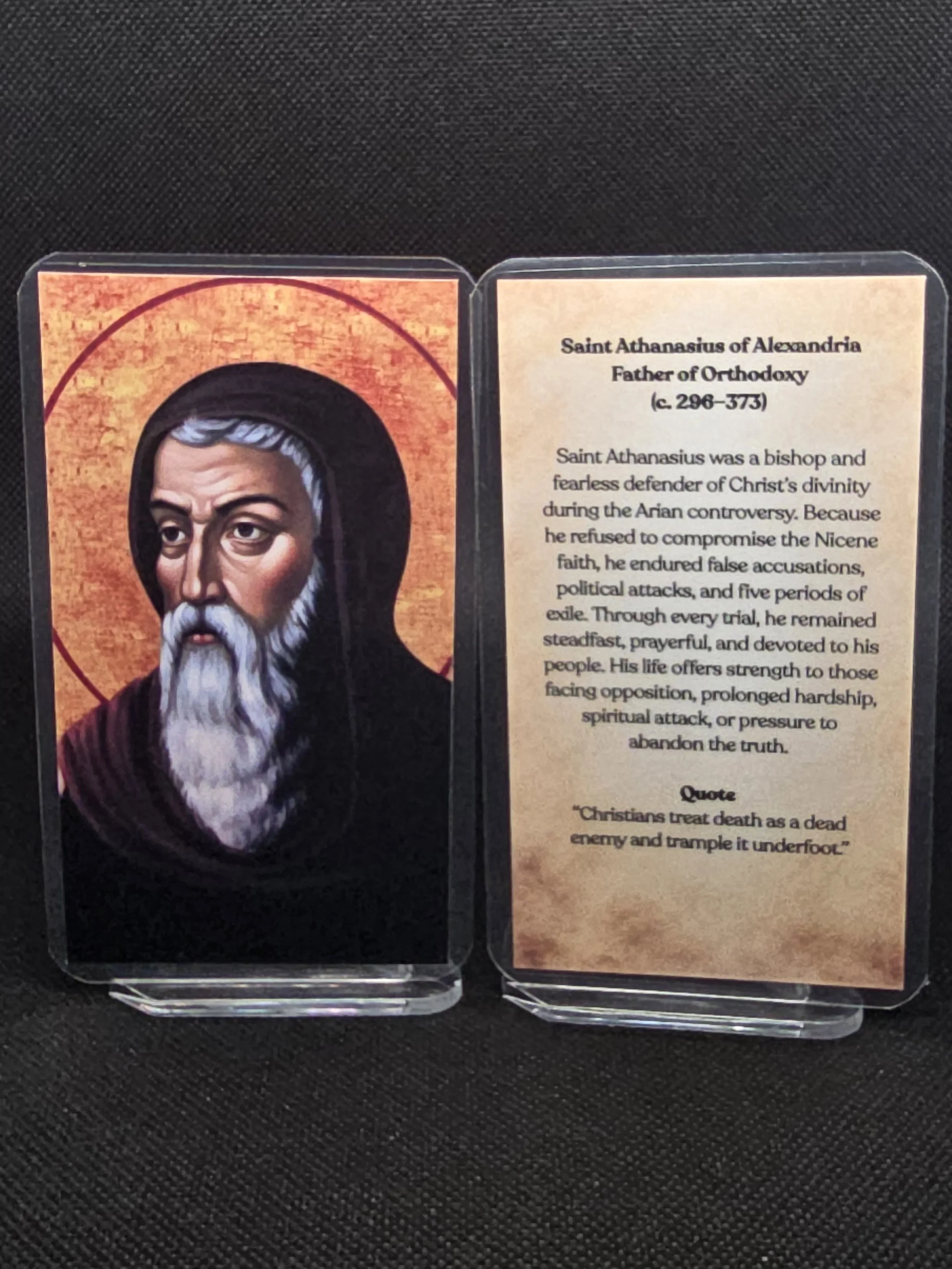
Saint Athanasius, Teacher of the True Faith
Athanasius reminds us that the faith we recite was defended at real cost. Keep his prayer card near you as a sign of steady faith in Christ, true God and true man.
View Prayer Card