Saint Maurice and the Theban Legion: Soldier Martyrs of Agaunum
The soldier saint of Agaunum and his companions, honored for centuries, with the historical questions about their story stated plainly.
At a Glance
- Also known as
- Mauritius; Maurice of Agaunum; Maurice of the Theban Legion
- Lived
- Traditionally a Roman officer from Egypt, killed about 286 to 303 (UNCERTAIN, with 286, 297, 302 and 303 all proposed)
- Place
- Agaunum, now Saint-Maurice in Valais, Switzerland
- Feast days
- September 22 (Roman Catholic and Orthodox calendars); 25 Thout, about October 5 (Coptic)
- Status
- Ancient martyr, venerated before formal canonization procedures
- Patron of
- Soldiers, among many others in Switzerland, France, Germany and northern Italy
Who Was Saint Maurice?
Saint Maurice, also called Mauritius, is honored as the leader of the Theban Legion, a group of Roman soldiers said to have been put to death at Agaunum, in the Swiss Alps, because they refused to take part in the persecution of Christians. Churches, towns and knightly orders across Europe carry his name, and he is a patron of soldiers.
This is a case where the honest approach is to speak in two layers. The first layer is the cult: from late antiquity there was a shrine of martyrs at Agaunum, an abbey grew there, and devotion to Maurice spread widely. All of this is well documented. The second layer is the story: that an entire legion of about six thousand six hundred men was massacred under the emperor Maximian. That story was written down well after the events, and historians disagree about how much of it is true.
We will therefore mark what is documented, what is TRADITION and what is UNCERTAIN. The faith of the martyrs, whoever they were, has been honored by Western and Eastern Christians alike, and that is where the lasting value of this saint lies.
Early Life and Family
Almost nothing about Maurice's personal life can be established. We have no surviving record of his parents, wife, children, education or birthplace. UNCERTAIN: even his existence as a single historical person is debated.
TRADITION: Maurice came from Thebes, in Upper Egypt, because the legion that bears his name is said to have been raised in the Egyptian Thebaid. This follows from the name of the unit and not from an independent biography of him. Some later accounts give his birth as about 250 and say he came from a pagan family, but no early evidence supports these details, and they should not be treated as fact.
His Latin name, Mauritius, and his Egyptian origin have shaped how he has been shown in art. Medieval sculptors often portrayed him as a Black African knight, and these images are an important record of how he was received, though they cannot tell us how the historical man looked.
It is also worth separating him from a different martyr named Maurice, who is remembered in Eastern hagiography as suffering at Apamea in Syria with his son Photinus and other soldiers. The Orthodox Church in America remembers that group on February 22. These are different traditions, and they should not be merged without evidence.
The Account of Eucherius
No personal testimony from Maurice survives, and there is no reliable account of his conversion, baptism or military career. The main source for the story is the Passion of the Martyrs of Agaunum, written by Eucherius, bishop of Lyon, probably between 434 and 450.
Eucherius was not an eyewitness. He says he received the account through Bishop Isaac of Geneva, who had it from Bishop Theodore of Octodurum, now Martigny, in the later fourth century. Theodore is attested elsewhere, since he attended the council of Aquileia in 381, which shows that the chain of transmission is not invented, but it still leaves a gap of more than a century between the events and the writing.
According to Eucherius, a legion of Thebans, drawn from the East to help the emperor Maximian, was known for its courage and its Christian faith. When ordered to join in persecuting Christians, the soldiers refused. The moral point of the story is that the soldiers were willing to give Caesar what belonged to Caesar, but they would not obey a command that set them against God. This is how Eucherius frames the story, in the spirit of the gospel teaching on what is owed to Caesar and to God.
The Martyrdom as Told
TRADITION: Eucherius says the emperor ordered decimation, the killing of every tenth man, and that when the rest stood firm the punishment was repeated and finally the whole unit was ordered to be killed. Maurice, Exuperius and Candidus are named as officers who urged the men to keep their confession. Eucherius gives the officers titles that cannot be matched to precise modern ranks. He calls Maurice the primicerius, meaning a senior officer.
The soldiers are shown as not resisting. They lay down their arms and accepted death. A speech is attributed to them in the text, but it is a literary composition of the fifth century and not a record of what was said. Another soldier named Victor, a veteran who was not part of the legion, is said to have come upon the executioners resting and, on hearing what had happened, to have declared his faith and been killed. UNCERTAIN: nothing outside the tradition confirms him.
The number given by Eucherius is six thousand six hundred. Later versions give 6,660 and even 6,666. These are traditional or symbolic figures and not casualty counts from any military record. No Roman military register or contemporary witness confirms the destruction of a legion at Agaunum.
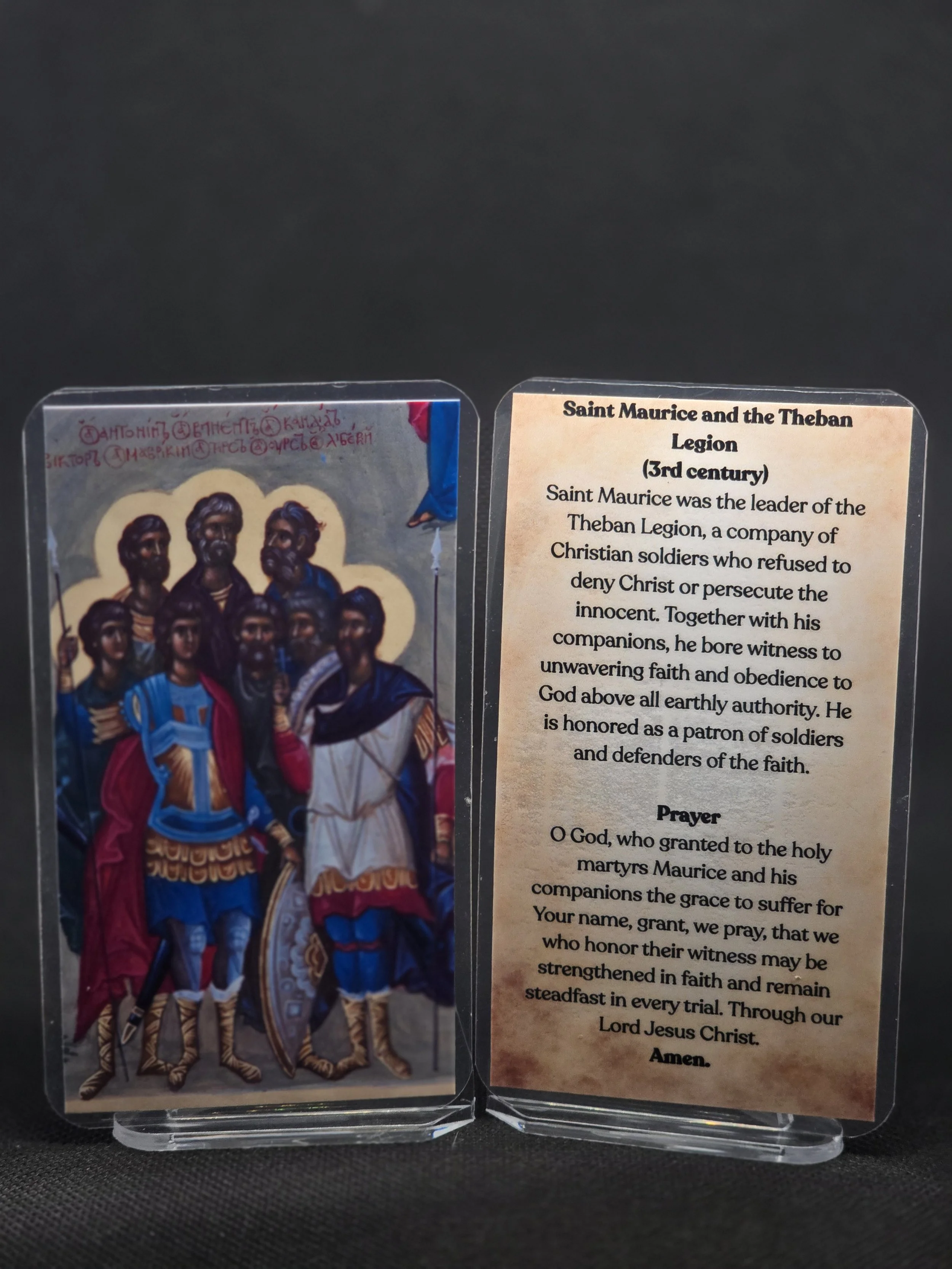
The Abbey of Saint-Maurice
Maurice did not found the great abbey that bears his name. It was established in 515 by Sigismund, king of the Burgundians, after a Christian sanctuary had already been built on the site. Eucherius tells us that Theodore found the burial place of the martyrs and built a church there, and that pilgrims came from far away.
The abbey became a center of continuous prayer, in which groups of monks took turns so that the praise of God never stopped. This practice, called laus perennis, made Agaunum a model for other monasteries. Gregory of Tours also refers to the cult in the sixth century, which shows that by then it was famous in Gaul.
The abbey still stands in Saint-Maurice, and its treasury holds reliquaries that reflect fifteen centuries of devotion. The monastery grew around the martyrs, and that is the reason the story of Maurice is so closely tied to the abbey. The existence of this devotion is far better documented than the details of the massacre.
Historical Questions
The story has a dating problem. Maximian's campaign against the Bagaudae in Gaul is placed about 285 and 286, while the great persecution of Christians under Diocletian and his colleagues began in 303. A massacre for refusing to persecute fits poorly with the earlier date, and this is one reason scholars doubt the details.
The Swiss historian Denis Van Berchem argued in the twentieth century that the account is a legend that grew over time. David Woods, in a study published in 1994, found his criticisms persuasive but offered another idea. He pointed to a unit called the Thebaei in the late Roman army lists and suggested that the legend may have taken shape around real Egyptian troops in the west, perhaps in the conflicts of 392 to 394, and that an officer with a name like Mauricius may have contributed to the name. This is a hypothesis and not an established fact.
Other scholars defend the idea that the tradition keeps the memory of a real, smaller event in which some Christian soldiers were killed. The honest conclusion is that the existence of a very early cult is supported, but the identity of the martyrs, their number and the circumstances of their deaths cannot be confirmed.
Death, Relics and Veneration
Because the martyrdom is known only through the disputed tradition, even the date of death is uncertain. Dates of about 286, 297, 302 and 303 all appear in the literature. The place, Agaunum, is much better established as the center of the cult.
There is no formal canonization date. Like other ancient martyrs, Maurice was recognized through the practice of keeping the memory of martyrs at their tombs and in the liturgical calendar. His feast is September 22 in the Roman Martyrology and in Orthodox calendars that include Western saints. The Coptic Church keeps the Theban martyrs on 25 Thout, which usually falls about October 5.
The abbey holds relics honored as those of Maurice and his companions. UNCERTAIN: nothing in the ancient evidence allows us to identify whose bones they are. Their veneration is a fact of history, and the devotion of the faithful does not depend on settling the question.
Miracles and Medieval Devotion
TRADITION: Eucherius tells of a pagan craftsman who kept working on the martyrs' church on a Sunday while the others rested. The martyrs are said to have appeared to him in light and rebuked him, and he became a Christian. He also tells of the healing of the wife of a man named Quincius, who could not walk, and who recovered her strength after being brought to the church. These stories show the kind of devotion that grew at the shrine, but they cannot be verified.
In the Middle Ages Maurice became a major saint of the Holy Roman Empire. His lance was among the imperial regalia, and the cathedral of Magdeburg holds a statue of him from about 1240 to 1250 that shows him as a Black knight in armor. It is one of the best known medieval images of a Black saint. Military and knightly orders took his name, and he became the patron of soldiers.
A Witness to Conscience
Whether or not the story happened exactly as told, its lesson has moved Christians for sixteen centuries. The soldiers are portrayed as faithful servants of the state in every lawful duty, and as unwilling to attack innocent believers. They do not rebel and they do not take revenge. They accept suffering instead of doing wrong.
This teaching matches the words of the apostles in the Acts, that we must obey God rather than men. For people who work in the army, the police or public service today, the story of Maurice remains a reminder that conscience has limits that no command can override. Because the tradition is disputed, it is best to read it as a witness to this principle, honored by the Church, and not as a precise military report.
Holy Maurice and companions, soldiers of Christ, you chose faithfulness to God over obedience to an unjust command. Pray for all who serve, that they may do their duty with honor, protect the innocent and never lose their conscience. Strengthen us to stand for what is right with courage and without hatred. Amen.
This short prayer was written for this page and is not an official liturgical text. The traditional Roman collect for September 22 may be found in the Roman Missal.
Maurice and the Eastern Churches
Maurice is linked to Egypt by tradition, and so he is especially dear to Coptic Christians. In September 2024 Coptic bishops took part in the celebrations at Saint-Maurice in Switzerland, including the procession of the relics, which shows that the connection is alive. This does not mean he was a Coptic monk or priest, which no evidence suggests.
Orthodox sources also list the martyrs on September 22. For Eastern Catholics, Maurice belongs to the shared heritage of the early Church before the divisions. We could not establish that he is commemorated in the calendars of all Eastern Catholic churches, so it would be wrong to say that he is. His place for them is mainly that of a martyr honored by the whole Church, and an example of faithful witness.
Frequently Asked Questions
Saint Maurice, Soldier Martyr
Maurice and his companions stand for conscience under pressure. Keep his prayer card near you as a sign of courage and faithful service.
View Prayer Card