Saint Teresa of Calcutta: Mother Teresa, Foundress of the Missionaries of Charity
The Albanian born sister who served the poorest of Calcutta, and who carried a long interior darkness that her own letters later revealed.
At a Glance
- Also known as
- Mother Teresa; Agnes Gonxha Bojaxhiu (birth name); Saint Teresa of Calcutta
- Lived
- August 26, 1910 in Skopje (then Ottoman Empire) until September 5, 1997 in Calcutta, India
- Founded
- The Missionaries of Charity, established in the Archdiocese of Calcutta on October 7, 1950
- Feast day
- September 5 (Roman Catholic); no Eastern Orthodox feast verified
- Beatified and canonized
- Beatified October 19, 2003 by John Paul II; canonized September 4, 2016 by Pope Francis
- Known for
- Service to the abandoned and dying; the Nobel Peace Prize of 1979; her private letters on spiritual darkness
Who Was Saint Teresa of Calcutta?
Saint Teresa of Calcutta, known to the world as Mother Teresa, was born Agnes Gonxha Bojaxhiu to an Albanian Catholic family in Skopje, then part of the Ottoman Empire. She joined the Sisters of Loreto, went to India, and in 1950 founded the Missionaries of Charity, a congregation devoted to the poorest and most abandoned people of Calcutta and then of the world.
She was a Latin Catholic and not a member of an Eastern Church, but her life of service reached many Eastern Christian communities, and the Church honors her as a saint for all. She was beatified by Pope John Paul II on October 19, 2003, and canonized by Pope Francis on September 4, 2016.
This article tells her story as the documents record it. That includes her service, her prayer, the long interior darkness that her private letters reveal, and the criticisms that have been made of her institutions. A saint is not honored for being beyond questions, and a fair biography is the best honor we can give.
Early Life and Family
Gonxha was born on August 26, 1910, and baptized the next day. Her parents were Nikola and Drane Bojaxhiu. She was the youngest of three children, with an older sister, Aga, and an older brother, Lazar. Her father was involved in business and public life, and her mother was known for devotion and for practical charity to neighbors in need.
Her father died when she was about eight, and the family faced hardship. UNCERTAIN: it has sometimes been said that he was poisoned for political reasons, but this has not been established. Her mother Drane kept the family together and left a lasting mark on her youngest daughter's faith.
She received her First Communion at about five and a half and was confirmed in 1916. In her parish, run by Jesuits, she heard about missionaries working abroad. According to the Nobel Prize biography, she felt drawn to missionary life at about the age of twelve. This was not a conversion, since she was Catholic from infancy. Biographers should not treat every childhood story as a sign of her future sainthood. What the record supports is a steady early vocation.
The Call Within a Call
In September 1928 she left home to join the Sisters of Loreto in Ireland, where she took the name Sister Mary Teresa after Saint Therese of Lisieux. She reached Calcutta on January 6, 1929, made her first vows in 1931 and her final vows on May 24, 1937. She taught at Saint Mary's School in Calcutta and later became its principal.
On September 10, 1946, on a train to Darjeeling for a retreat, she believed that Christ asked her to leave the convent and serve the poorest of the poor, a moment she later called a call within a call. These were personal mystical experiences, known from her own testimony and letters, not events that history can confirm independently.
Her superiors did not accept the idea at once. After a long period of discernment she received permission, and on August 17, 1948 she left Loreto in a plain white sari with a blue border. She took basic medical training with the Medical Mission Sisters in Patna and, in December 1948, began visiting poor families and the sick in the slums of Calcutta. She had not rejected her vows or the Church. She was entering a new form of consecrated service.
The Missionaries of Charity
On October 7, 1950, the Archdiocese of Calcutta recognized the Missionaries of Charity as a new religious congregation. It began with a small group of sisters, and its first work was serving people who had been refused help elsewhere. In 1952 she opened Nirmal Hriday, a home for the dying. In 1955 came Shishu Bhavan, a home for abandoned children, and in 1957 the first mobile clinic for people with leprosy.
Her work rested on the gospel passage in which Christ says that what is done for the least of his brothers and sisters is done for him. Prayer was never separate from the work. The sisters' day centers on the Eucharist, adoration and the Rosary, and the congregation was never meant to be only a relief agency.
The congregation spread across India and then overseas. It received a decree of praise from Pope Paul VI in 1965 and opened its first house abroad in Venezuela. Branches for brothers, contemplatives and priests followed. At her death the Vatican reported nearly four thousand sisters in more than six hundred foundations in over a hundred countries. UNCERTAIN: the congregation and the Vatican give slightly different totals, so the exact figures should be treated as approximate.
Writings, Awards and Public Life
Mother Teresa wrote no systematic theology. Her written legacy is mostly letters, retreat notes, instructions and talks. The most important collection is Come Be My Light, edited by Father Brian Kolodiejchuk and published in 2007, which brings together her private letters to spiritual directors. Malcolm Muggeridge's book Something Beautiful for God, from 1971, introduced her to many readers, though he wrote as a sympathetic admirer.
She received the Padma Shri from India in 1962 and the Nobel Peace Prize in 1979. In her Nobel address and elsewhere she spoke firmly about the dignity of the unborn and of the dying, which reflected Catholic teaching and drew both praise and criticism.
Her public image was of a joyful woman of action. The letters published after her death showed another side of her inner life, which is the subject of the next section.
The Long Darkness
Her private letters to confessors and spiritual directors show that, from about the time she began her new work, she lived through long periods of spiritual desolation. She felt that God was absent and that she was unwanted by him. In a letter of 1959 she wrote of a terrible pain of loss. Some letters even express doubt about God's reality, though not a public rejection of the faith.
It matters what this shows and what it does not. It shows deep suffering that she kept hidden from most people. It does not show that she gave up Christianity. She kept praying, receiving the sacraments and serving the poor, and Father Joseph Neuner helped her see her darkness as a share in Christ's sense of abandonment. Come Be My Light and other writers place her experience in the tradition of the dark night known from Saint John of the Cross.
UNCERTAIN: no historian can fully separate spiritual, psychological and medical factors in her distress. Readers who recognize something of this darkness in their own lives may find comfort in knowing that a saint knew it too, and should also feel free to seek a spiritual director, a doctor or a counselor.
Criticisms and Controversies
Her institutions have been criticized seriously. The physician Robin Fox wrote an assessment of the care for the dying in The Lancet in 1994, and a 2013 article by Serge Larivee, Carole Senechal and Genevieve Chenard questioned her medical standards, finances and relationships with some wealthy donors. These critics raised real questions about pain relief, diagnosis and how donations were used.
The Missionaries of Charity respond that they accepted people whom hospitals had turned away, and that their aim was dignity for the dying along with care for those who could recover. UNCERTAIN: the evidence does not prove every accusation for every house, and the charitable purpose does not prove that every clinical practice was adequate. Both things need to be said.
In India some critics accused her of using charity to convert people. She denied any forced conversion, while saying plainly that her work came from her Christian faith. A fair account notes that the accusations exist and that systematic forced conversion by her has not been established. A balanced biography neither hides these matters nor lets polemic replace evidence.
Death and Canonization
Her last years were marked by heart trouble, but she stayed involved in the congregation. In March 1997 Sister Nirmala Joshi succeeded her as superior general. Mother Teresa died in Calcutta on September 5, 1997, at the age of eighty seven. India gave her a state funeral, and she was buried at the Mother House of the Missionaries of Charity, where her tomb draws pilgrims.
Pope John Paul II waived the usual waiting period for opening her cause. She was beatified on October 19, 2003, after the Church accepted the healing of Monica Besra, an Indian woman, as a miracle through her intercession. Some doctors who treated Besra attributed her recovery to medical treatment, so the case has been disputed outside the Church. She was canonized by Pope Francis on September 4, 2016, after the healing of a Brazilian man named Marcilio Haddad Andrino, who recovered from a severe brain infection in 2008, was accepted as the second miracle.
The recognition of a miracle is a judgment of the Church that a healing has no natural explanation and is a sign of God's action. It is not a statement of universal medical agreement. Her feast is September 5, the day of her death.
Devotion and Tradition
The documented parts of her spirituality include devotion to Christ's thirst on the cross, the Eucharist and Mary, and the view that one serves Christ in the distressing disguise of the poor. These are not legends but well attested features of her religious life.
TRADITION: many people report answered prayers and unexpected help through her intercession. Such accounts are valued as personal testimony, but they should not be mistaken for medically or ecclesiastically verified miracles. During a hospital stay in 1996, Archbishop Henry D'Souza arranged special prayers because she was very restless, and he later said that he did not think she was possessed. This episode should not be used as proof of anything dramatic.
Holy Teresa, servant of the poor, you saw the face of Christ in the suffering and the forgotten. Pray for us that we may see him too and serve with humility and joy. Be near to all who walk in darkness and feel that God is far away, and help them to keep praying until the light returns. Amen.
This short prayer was written for this page and is not an official text. The Missionaries of Charity publish their own prayers to her through the Mother Teresa Center.
Teresa and the Eastern Churches
Mother Teresa belonged to the Latin Church, and she was never glorified by an Eastern Orthodox Church. We could not verify an Orthodox feast day or any common liturgical commemoration for her, and we cannot say that every Eastern Catholic church keeps September 5 in its own calendar.
There are documented contacts, however. In 1987 she visited the Soviet Union, including areas near Chernobyl, and Russian Orthodox clergy and laity were reported to have welcomed her work. After the earthquake of 1988 she went to Armenia and helped begin charitable work there. In India, a spokesman of the Syro-Malabar Church spoke warmly of her coming canonization. Her stress on mercy, simplicity and finding Christ in the suffering also resonates with Eastern Christian spirituality, though there is no evidence that she followed the Philokalia or an Eastern monastic rule.
Frequently Asked Questions
Saint Teresa, Servant of the Forgotten
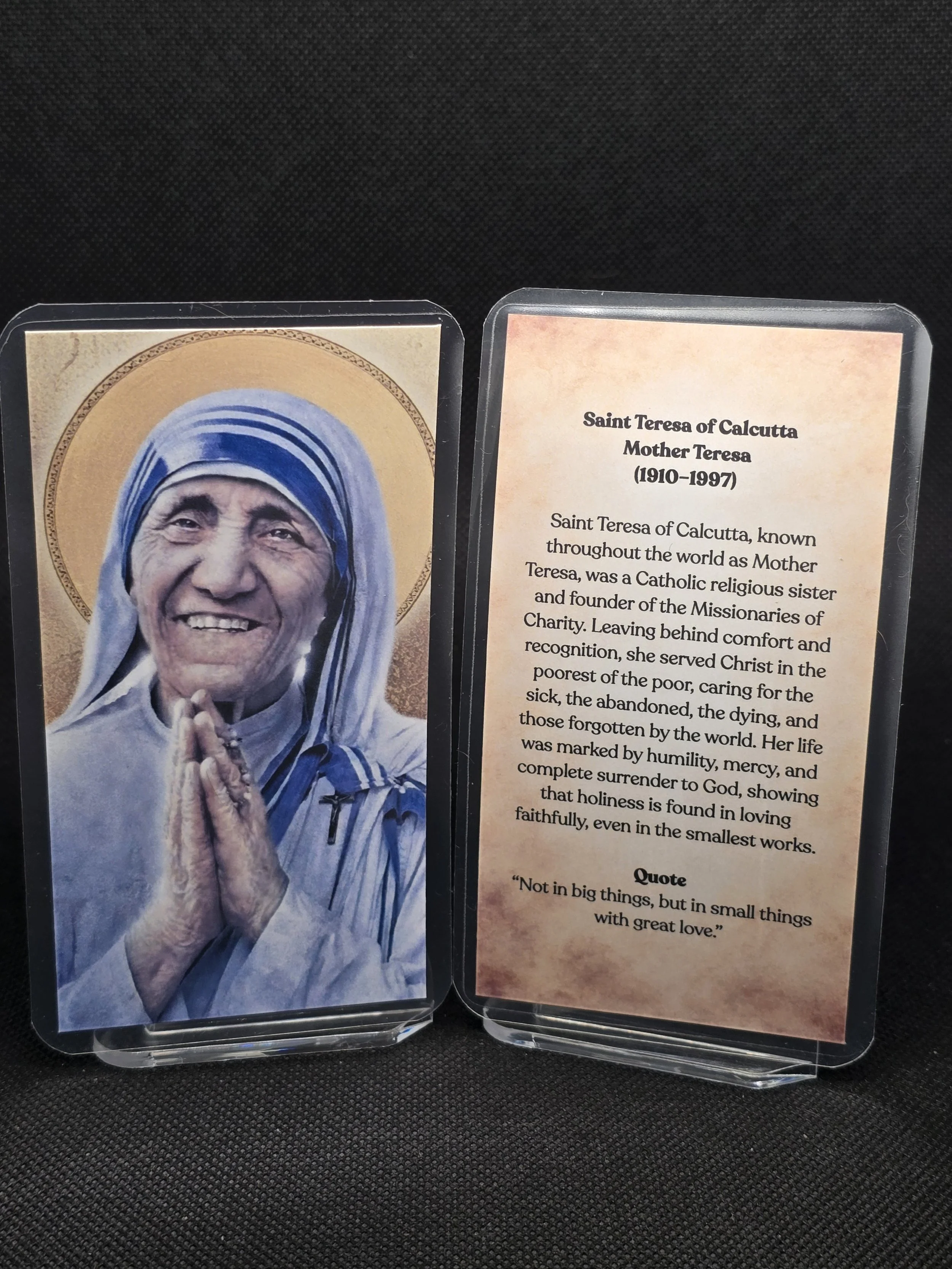
Teresa shows that a heart can keep serving through darkness. Keep her prayer card near you as a sign of mercy for the poor and hope for those who struggle to pray.
View Prayer Card