Father Anton Niemancewicz: Belarusian Greek Catholic Exarch and Jesuit Martyr
A Jesuit priest and wartime head of the Belarusian Greek Catholic Church who died in Nazi custody in Minsk in 1943.
At a Glance
- Also known as
- Antoni Niemancewicz; Anton Nemantsevich; Anton Niemancevic
- Lived
- February 8, 1893 in Saint Petersburg until January 6, 1943 in Minsk
- Office
- Jesuit priest and Apostolic Exarch of Belarusian Greek Catholics, appointed September 17, 1940
- Death
- In the hospital of the German security prison in Minsk; the immediate cause is disputed
- Status
- Remembered as a martyr by Belarusian Greek Catholics; a formal beatification could not be verified
- Remembrance
- January 6, the anniversary of his death, is observed locally; no official feast was found
- Who Was Father Anton Niemancewicz?
- Early Life and Family
- From Petrograd to Rome
- Teacher, Editor and Pastor
- Exarch of the Belarusian Greek Catholics
- Pressures from Several Powers
- Arrest and Death in Minsk
- Remembrance and Devotion
- What His Life Teaches
- Niemancewicz and the Eastern Churches
- Frequently Asked Questions
Who Was Father Anton Niemancewicz?
Father Anton Niemancewicz was a Jesuit priest, a scholar and the leader of the Belarusian Greek Catholic Church during the Second World War. He served as Apostolic Exarch from 1940 until his arrest by the German occupiers in 1942, and he died in custody in Minsk on January 6, 1943, at the age of forty nine.
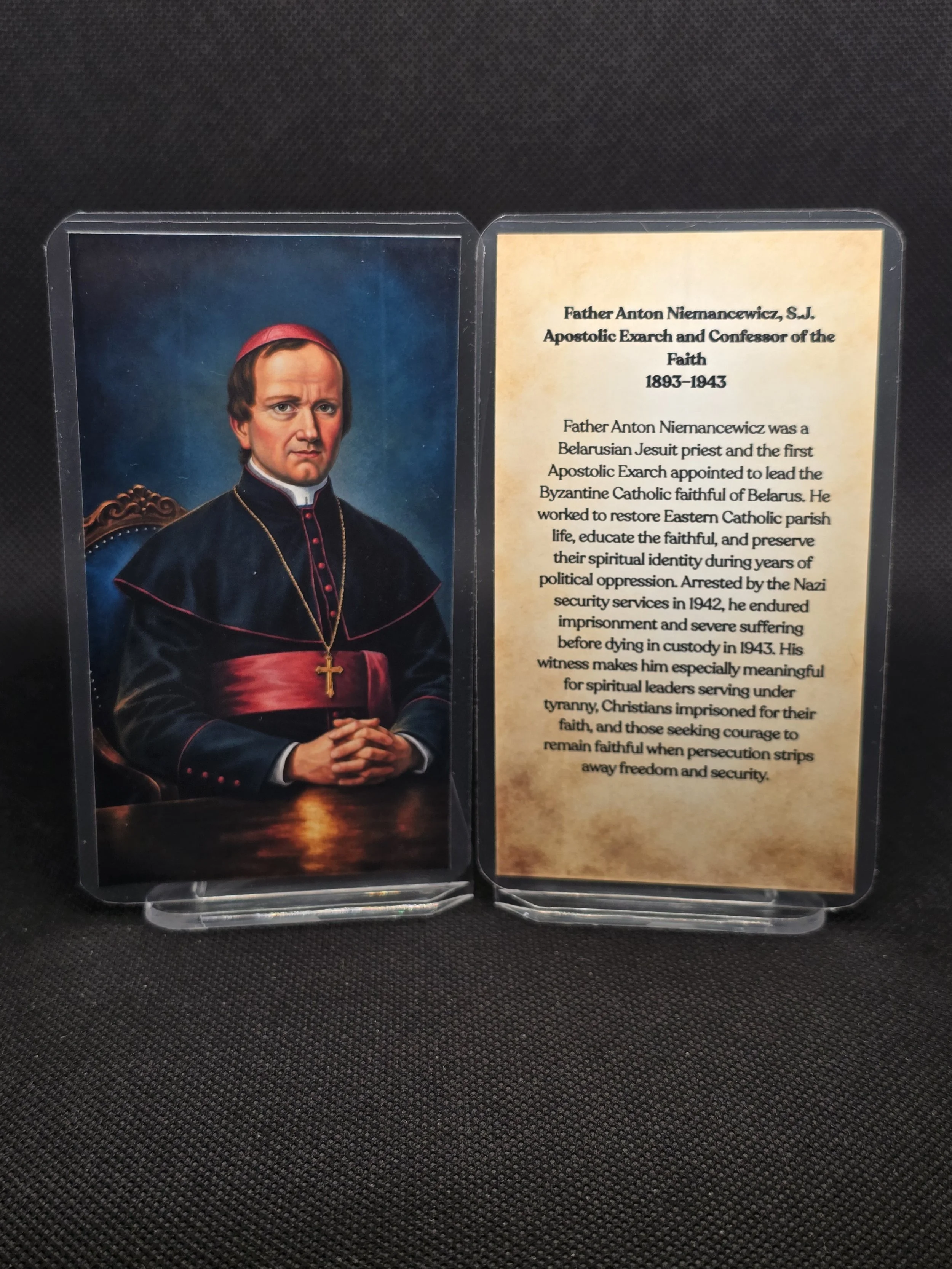
Belarusian Greek Catholics remember him as a martyr. A note on titles is needed here. His prayer card is titled with the word Blessed, but we could not verify an official beatification or any other decree of beatification. A scholarly study published in 2023 states that a beatification process had not yet been opened, and Church sources from 2023 and 2024 speak of keeping his memory and of candidates for beatification. This article therefore calls him Father Anton, and treats his martyrdom as a matter of historical record and Church remembrance and not of a formal declaration.
His life crossed the Russian Revolution, Soviet prisons, the Polish Republic and German occupation, and it tells much about how small Eastern Catholic communities survived under pressure from several powers.
Early Life and Family
Anton was born in Saint Petersburg on February 8, 1893, into a Belarusian Roman Catholic family. His parents were Jan Niemancewicz and Victoria, born Rudzevich, who had come from the region of Sokolka, near the present border between Poland and Belarus. It was a land where Latin Catholics, Orthodox Christians and the memory of the old Uniate Church lived side by side.
UNCERTAIN: we do not know whether family memories of Greek Catholic tradition shaped his childhood. A Belarusian historian who studied his life calls this a possibility only. The sources also disagree on his early schooling, with the local Church biography naming Saint Catherine's Catholic gymnasium and other accounts mentioning pharmacy studies.
He studied theology in Saint Petersburg and was ordained a priest on September 27, 1915, by Archbishop Jan Cieplak. As a student he took part in a Belarusian circle interested in national culture and history, and he gave a presentation on the Union of Brest, which anticipated his later interest in relations between Catholics and Orthodox. He finished a licentiate in theology in May 1918. There is no reliable account of how he first sensed his vocation, and nothing supports stories of early visions or prophecies.
From Petrograd to Rome
Niemancewicz was born Catholic and did not convert from Orthodoxy. His main change was a move from serving as a Latin priest to serving Byzantine Catholic communities as a Jesuit. After the Russian Revolution he served Catholic communities in Petrograd and nearby places such as Gatchina and Kolpino, taught religion and worked to protect parish life against Soviet restrictions.
The Soviet authorities arrested him more than once. Researchers point to arrests in 1919 and 1921, and a further imprisonment from 1923 or 1924. UNCERTAIN: the date of the last arrest is given differently by different historians. He was sent to Poland in a prisoner exchange on February 1, 1925.
Metropolitan Edward von der Ropp then sent him to Rome, where he studied at the Pontifical Oriental Institute and, on July 2, 1927, defended a doctoral dissertation on Bolshevik laws and the religious and moral education of young people. He taught church history and comparative theology in Lublin in 1928 and 1929. Then he went to Albertin, near Slonim, and entered the Jesuit novitiate on September 13, 1929. It was the decisive step toward a life of service to Byzantine Catholics.
Teacher, Editor and Pastor
Albertin was already an Eastern rite Jesuit mission, so Niemancewicz did not found it. After his novitiate he worked in its parish ministry and later at the Transfiguration parish in Synkovichi. He also taught theology and canon law at the Pontifical Eastern Seminary in Dubno. He preached in Belarusian, gave religious instruction and met Orthodox Christians in friendly dialogue, and he took part in the Pinsk conferences of the 1930s, where Byzantine Slavonic Catholics discussed their future.
His best known project was Da Zluchennia, which means Toward Union, a Belarusian language periodical first issued in January 1932. He edited it and wrote for it under his own name and under the pseudonym Zluchanets. It dealt with Christian unity, church history and doctrine, and carried Gospel readings and answers to objections. Pressure from the Polish authorities later in the decade limited its life.
One article under his name survives, called In the Faith in Which I Was Born, I Shall Die, published in the first issue, on pages 9 to 11. It asks whether the religion we inherit must always decide our beliefs, and it separates sincere conscience from indifference to truth while defending the visible unity of the Church. The doctoral dissertation of 1927 is also known to be his, though a full list of his sermons, letters and articles has not been compiled.
Exarch of the Belarusian Greek Catholics
Metropolitan Andrey Sheptytsky appointed him to lead the Belarusian Greek Catholic exarchate on September 17, 1940, and Pope Pius XII confirmed the appointment on November 22, 1941. He was a Jesuit priest, and we found no evidence that he was consecrated a bishop. It should also be said that Blessed Mykola Charnetsky had led the exarchate earlier on a temporary basis, so Niemancewicz is better described as the first Belarusian exarch than as the first officeholder.
In 1942 he sought recognition for the exarchate from the German authorities. He issued a pastoral message on April 5, and on May 2 an exarchate council was formed. He promoted the use of Belarusian in church business and preaching. He also founded an Apostleship of Prayer for Belarus, which asked priests and later laypeople to pray regularly for the Belarusian people.
Accounts of his ministry also describe visits to Soviet prisoner of war camps near Slonim in spite of the danger of epidemic disease. These are his main institutional and pastoral achievements. We know of no religious order or monastic rule that he founded.
Pressures from Several Powers
Under the Soviet regime he was jailed for his pastoral work. His doctoral subject and his journalism show that he criticized Bolshevik religious policy well before his later troubles. Vatican Radio also records that he published criticism of Nazism and its racial ideas as early as 1932.
In the Polish period, Eastern Catholics faced difficulties from different sides. Some Orthodox Christians saw the movement as an effort to bring believers under Rome, and some Latin Catholics were uneasy about Byzantine rites and the use of Belarusian. His vision of unity meant communion with Rome while keeping Byzantine worship and friendly relations with Orthodox neighbors.
UNCERTAIN: some later writers say that particular Orthodox figures opposed him or that denunciations led to his arrest, but these claims are not well documented. Another possibility is that he and members of the Albertin mission helped Jews who were persecuted by the Nazis. The 2023 study says this needs further research, so it cannot be treated as proven.
The German occupation brought the greatest danger. A statement of the Minsk security chief, Eduard Strauch, dated April 10, 1943, calls the Catholic Church an enemy and shows hostility toward the Uniate Church. It documents the climate in which Niemancewicz died, though it does not by itself state the charges against him.
Arrest and Death in Minsk
He was arrested by the German authorities in 1942. UNCERTAIN: sources give July 4, early August or September for the arrest. He was held and then taken to Minsk, and Metropolitan Sheptytsky tried to learn what had happened to him but received only delayed and partial answers.
A German document found in the National Archives of Belarus in 2004 says that he caught epidemic typhus on November 30, 1942, and died of heart failure on January 6, 1943. It was signed by the SS officer Eduard Strauch and addressed to the German administrator Wilhelm Kube. Father Leo Haroshka, who knew him, doubted this account and believed that he had been tortured or killed in custody. UNCERTAIN: this doubt shows that the official explanation was disputed, but it does not prove murder, and the facts of his treatment are unresolved. His death in German custody is firmly established.
According to archival research he was buried on January 9, 1943, in a German cemetery in Minsk, and an Orthodox priest conducted the service. His exact grave is unknown, so no authenticated bodily relics exist. In April 2009 a capsule of soil from the former cemetery was placed at the Greek Catholic center of Saint Joseph in Minsk, as a memorial and not as relics.
Remembrance and Devotion
We found no documented miracles, apparitions or recognized healings connected with him. His devotion rests on fidelity under persecution, on pastoral service in terrible conditions and on loyalty to the Belarusian Greek Catholic Church.
TRADITION: Father Leo Haroshka recalled that when lice were found on Niemancewicz's clothing after he visited prisoners, he answered with a joke. The story shows a calm attitude toward danger, but it is a later recollection and not a miracle.
On January 6, 2018, Belarusian Greek Catholic communities marked the anniversary of his death with Divine Liturgies, and he was remembered in a gathering in Polotsk to honor martyrs and witnesses of faith. These events show a living memory. They do not show a formal beatification, and January 6 should not be called an official feast day.
What His Life Teaches
Niemancewicz belonged to a generation of priests who had to keep faith alive in prisons and under occupation, while also thinking about the unity of divided Christians. He did not treat unity as a political tool, and he wrote that sincere conscience matters, and that truth matters too.
His life also shows that a Church's identity does not have to belong to one nation. He refused to assume that Catholicism meant only Polish culture or that Orthodoxy meant only Russian culture, and he encouraged Belarusians to be Christian in their own language.
Lord Jesus Christ, shepherd of your people, we remember your servant Anton, who taught and served in times of fear, and who died in captivity. Grant rest to his soul and strengthen all who are held in prison for their faith. Give us courage to be faithful, peace to those who are divided, and hope to the people of Belarus. Amen.
This short prayer was written for this page and is not an official liturgical text. No approved prayer or hymn specifically for him was found.
Niemancewicz and the Eastern Churches
For Eastern Catholics he is a witness to the struggle to keep Byzantine worship in communion with Rome in lands where governments tried to control religion. He was not a Latin priest who happened to serve Eastern parishes. He studied Eastern Christianity, used the Byzantine liturgy and helped build an organized Church for Belarusian Greek Catholics, whose present Apostolic Administration continues that history.
For Orthodox readers his significance is more complicated. His idea of unity involved communion with the Pope, which some Orthodox saw as an effort to extend Catholic authority. Still, his respectful relations with Orthodox clergy and his burial by an Orthodox priest are real points of contact. No Orthodox glorification of him is known.
Frequently Asked Questions
Father Anton Niemancewicz, Faithful in Captivity
Anton Niemancewicz reminds us how faith can be kept in prison and war. Keep his prayer card near you as a sign of remembrance for persecuted Christians.
View Prayer Card